

ASTM E2279-20
(Practice)Standard Practice for Establishing the Guiding Principles of Property Asset Management
General Information
- Abstract
SIGNIFICANCE AND USE
4.1 The intent of these principles and desired outcomes is to provide requirements and guidance for an effective and efficient system for (1) the acquisition of property, (2) the utilization of available property, and (3) the disposal of property. (40 U.S. Code § 101)
4.2 Asset management practices shall seek, when viewed in totality, to be effective and efficient, to the point at which benefits exceed the costs of operation.
4.3 The requirements and guidance in this practice shall be used to establish property management plans that strategically address organizational objectives including: scope, management system, management structure, process flows, alignment, internal controls, enforcement, risks, accountability, and resources to collectively realize optimal value from assets.
4.4 The intent of this practice is to promote the right sizing and scope of the asset management activity to appropriately manage organizational assets.
4.5 To establish a learning and innovative culture with continuous self-assessments and process improvements.
4.6 To establish policies, systems, and processes to timely prevent, detect, and correct operational weaknesses and deficiencies in internal controls that may result in waste, fraud abuse, mismanagement, and corruption.
SCOPE
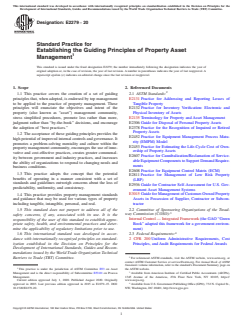
1.1 This practice covers the creation of a set of guiding principles that, when adopted, is endorsed by top management to be applied to the practice of property management. These principles will enunciate the objectives and intent of the property (also known as “asset”) management community, stress simplified procedures, promote less rather than more, judgment rather than “by-the-book” decisions, and encourage the adoption of “best practices.”
1.2 The acceptance of these guiding principles provides the high potential of improved internal controls and governance. It promotes a problem-solving mentality and culture within the property management community, encourages the use of innovative and cost-effective practices, creates greater commonality between government and industry practices, and increases the ability of organizations to respond to changing needs and business conditions.
1.3 This practice adopts the concept that the potential benefits of operating in a manner consistent with a set of standards and guidelines outweigh concerns about the loss of predictability, uniformity, and consistency.
1.4 This practice provides property management standards and guidance that may be used for various types of property including tangible, intangible, personal, and real.
1.5 This standard does not purport to address all of the safety concerns, if any, associated with its use. It is the responsibility of the user of this standard to establish appropriate safety, health, and environmental practices and determine the applicability of regulatory limitations prior to use.
1.6 This international standard was developed in accordance with internationally recognized principles on standardization established in the Decision on Principles for the Development of International Standards, Guides and Recommendations issued by the World Trade Organization Technical Barriers to Trade (TBT) Committee.
- Status
- Published
- Publication Date
- 30-Jun-2020
- Technical Committee
- E53 - Asset Management
- Drafting Committee
- E53.01 - Process Management
Buy Documents
ASTM E2279-20 - Standard Practice for Establishing the Guiding Principles of Property Asset Management
REDLINE ASTM E2279-20 - Standard Practice for Establishing the Guiding Principles of Property Asset Management
Overview
ASTM E2279-20: Standard Practice for Establishing the Guiding Principles of Property Asset Management provides a comprehensive framework for developing and implementing effective property asset management systems. Established by ASTM International, this standard outlines essential principles for organizations to achieve efficient acquisition, use, and disposal of both tangible and intangible assets. The guidance is designed to ensure that asset management practices align with organizational objectives, foster judicious use of resources, improve internal controls, and enable continual process improvements.
Adopting the principles in ASTM E2279-20 helps organizations-whether in government, industry, or non-profit sectors-standardize their property management approaches, enhance accountability, and optimize asset value throughout their lifecycle.
Key Topics
ASTM E2279-20 addresses critical elements of property asset management, including:
- Strategic Planning: Establishing property management plans that support organizational goals, including defining scope, aligning management systems, and structuring internal controls.
- Acquisition, Utilization, and Disposal: Providing requirements for effective procedures across the entire asset lifecycle-from acquisition and daily use to eventual disposal.
- Right-sizing Asset Activities: Ensuring asset management activities are scaled appropriately to organizational needs and risks to maximize value and efficiency.
- Internal Controls: Instituting systems and policies to prevent, detect, and correct weaknesses, thus safeguarding against waste, fraud, misuse, and operational inefficiency.
- Continuous Improvement: Promoting a learning culture through regular self-assessments and continual process improvement initiatives.
- Best Value and Professional Judgment: Encouraging streamlined procedures, application of professional judgment, and adoption of industry best practices over rigid, unnecessarily costly approaches.
- Comprehensive Coverage: Applicability to various asset types, including real property, personal property, tangible and intangible assets.
Applications
ASTM E2279-20 is designed for diverse settings and serves as a foundational document for organizations seeking to:
- Develop or Enhance Property Asset Management Systems: Establishing organizational policies and procedures in compliance with recognized standards for asset management.
- Improve Governance and Accountability: Strengthening internal controls and reporting mechanisms, ensuring compliance with laws and regulations.
- Conduct Internal Reports and Audits: Setting clear standards for maintaining records, assessing asset condition, and documenting transactions, which are crucial for both internal management and external audits.
- Optimize Asset Utilization and Reutilization: Facilitating the efficient use of property, minimizing idle or underutilized assets, and encouraging the reassignment and reutilization of excess property.
- Implement Sustainable and Cost-effective Disposition: Guiding the environmentally responsible and economically beneficial disposal of surplus property when no longer needed.
- Foster an Innovative Organizational Culture: Encouraging ongoing learning, innovation, and adaptation to changing business conditions within property management functions.
Organizations that adopt ASTM E2279-20 benefit from increased transparency, improved decision-making, cost savings, and enhanced ability to respond to evolving operational needs.
Related Standards
ASTM E2279-20 references and complements several important property and asset management standards and guidelines, including:
ASTM Standards:
- ASTM E2131: Practice for Addressing and Reporting Losses of Tangible Property
- ASTM E2132: Practice for Inventory Verification
- ASTM E2306: Guide for Disposal of Personal Property Assets
- ASTM E2453: Practice for Estimating the Life-Cycle Cost of Ownership of Property Assets
- ASTM E3015: Guide for Management of Customer-Owned Property Assets
International Standards:
- ISO 55000 Series: Asset management principles and requirements
Governing Documents and Regulations:
- Federal Management Regulation (41 CFR)
- Government Accountability Office (GAO) Green Book
- Federal Acquisition Regulation (FAR)
- U.S. Code Title 40 (Public Buildings, Property, and Works), Title 15 (Securities Exchange Act)
Financial and Accounting Guidance:
- Financial Accounting Standards Board (FASB) Concepts and Guidelines
Implementing ASTM E2279-20 alongside these standards ensures a globally recognized, compliant, and effective approach to property asset management.
Relations
- Effective Date
- 01-Jul-2020
- Effective Date
- 01-Jul-2020
- Refers
ASTM E2453-19 - Standard Practice for Estimating the Life-Cycle Cost of Ownership of Property Assets - Effective Date
- 01-May-2019
- Refers
ASTM E2452-12(2019) - Standard Practice for Equipment Management Process Maturity (EMPM) Model - Effective Date
- 01-May-2019
- Effective Date
- 01-May-2019
- Effective Date
- 01-Jul-2018
- Effective Date
- 01-Nov-2017
- Effective Date
- 01-May-2017
- Effective Date
- 01-Jan-2017
- Effective Date
- 15-May-2015
- Effective Date
- 01-Jun-2014
- Effective Date
- 01-Nov-2013
- Effective Date
- 15-Jul-2013
- Refers
ASTM E2378-13 - Standard Practice for the Recognition of Impaired or Retired Personal Property - Effective Date
- 15-Jul-2013
- Effective Date
- 01-Mar-2013
Buy Documents
ASTM E2279-20 - Standard Practice for Establishing the Guiding Principles of Property Asset Management
REDLINE ASTM E2279-20 - Standard Practice for Establishing the Guiding Principles of Property Asset Management
Get Certified
Connect with accredited certification bodies for this standard

BSI Group
BSI (British Standards Institution) is the business standards company that helps organizations make excellence a habit.

Bureau Veritas
Bureau Veritas is a world leader in laboratory testing, inspection and certification services.

DNV
DNV is an independent assurance and risk management provider.
Sponsored listings
Frequently Asked Questions
ASTM E2279-20 is a standard published by ASTM International. Its full title is "Standard Practice for Establishing the Guiding Principles of Property Asset Management". This standard covers: SIGNIFICANCE AND USE 4.1 The intent of these principles and desired outcomes is to provide requirements and guidance for an effective and efficient system for (1) the acquisition of property, (2) the utilization of available property, and (3) the disposal of property. (40 U.S. Code § 101) 4.2 Asset management practices shall seek, when viewed in totality, to be effective and efficient, to the point at which benefits exceed the costs of operation. 4.3 The requirements and guidance in this practice shall be used to establish property management plans that strategically address organizational objectives including: scope, management system, management structure, process flows, alignment, internal controls, enforcement, risks, accountability, and resources to collectively realize optimal value from assets. 4.4 The intent of this practice is to promote the right sizing and scope of the asset management activity to appropriately manage organizational assets. 4.5 To establish a learning and innovative culture with continuous self-assessments and process improvements. 4.6 To establish policies, systems, and processes to timely prevent, detect, and correct operational weaknesses and deficiencies in internal controls that may result in waste, fraud abuse, mismanagement, and corruption. SCOPE 1.1 This practice covers the creation of a set of guiding principles that, when adopted, is endorsed by top management to be applied to the practice of property management. These principles will enunciate the objectives and intent of the property (also known as “asset”) management community, stress simplified procedures, promote less rather than more, judgment rather than “by-the-book” decisions, and encourage the adoption of “best practices.” 1.2 The acceptance of these guiding principles provides the high potential of improved internal controls and governance. It promotes a problem-solving mentality and culture within the property management community, encourages the use of innovative and cost-effective practices, creates greater commonality between government and industry practices, and increases the ability of organizations to respond to changing needs and business conditions. 1.3 This practice adopts the concept that the potential benefits of operating in a manner consistent with a set of standards and guidelines outweigh concerns about the loss of predictability, uniformity, and consistency. 1.4 This practice provides property management standards and guidance that may be used for various types of property including tangible, intangible, personal, and real. 1.5 This standard does not purport to address all of the safety concerns, if any, associated with its use. It is the responsibility of the user of this standard to establish appropriate safety, health, and environmental practices and determine the applicability of regulatory limitations prior to use. 1.6 This international standard was developed in accordance with internationally recognized principles on standardization established in the Decision on Principles for the Development of International Standards, Guides and Recommendations issued by the World Trade Organization Technical Barriers to Trade (TBT) Committee.
SIGNIFICANCE AND USE 4.1 The intent of these principles and desired outcomes is to provide requirements and guidance for an effective and efficient system for (1) the acquisition of property, (2) the utilization of available property, and (3) the disposal of property. (40 U.S. Code § 101) 4.2 Asset management practices shall seek, when viewed in totality, to be effective and efficient, to the point at which benefits exceed the costs of operation. 4.3 The requirements and guidance in this practice shall be used to establish property management plans that strategically address organizational objectives including: scope, management system, management structure, process flows, alignment, internal controls, enforcement, risks, accountability, and resources to collectively realize optimal value from assets. 4.4 The intent of this practice is to promote the right sizing and scope of the asset management activity to appropriately manage organizational assets. 4.5 To establish a learning and innovative culture with continuous self-assessments and process improvements. 4.6 To establish policies, systems, and processes to timely prevent, detect, and correct operational weaknesses and deficiencies in internal controls that may result in waste, fraud abuse, mismanagement, and corruption. SCOPE 1.1 This practice covers the creation of a set of guiding principles that, when adopted, is endorsed by top management to be applied to the practice of property management. These principles will enunciate the objectives and intent of the property (also known as “asset”) management community, stress simplified procedures, promote less rather than more, judgment rather than “by-the-book” decisions, and encourage the adoption of “best practices.” 1.2 The acceptance of these guiding principles provides the high potential of improved internal controls and governance. It promotes a problem-solving mentality and culture within the property management community, encourages the use of innovative and cost-effective practices, creates greater commonality between government and industry practices, and increases the ability of organizations to respond to changing needs and business conditions. 1.3 This practice adopts the concept that the potential benefits of operating in a manner consistent with a set of standards and guidelines outweigh concerns about the loss of predictability, uniformity, and consistency. 1.4 This practice provides property management standards and guidance that may be used for various types of property including tangible, intangible, personal, and real. 1.5 This standard does not purport to address all of the safety concerns, if any, associated with its use. It is the responsibility of the user of this standard to establish appropriate safety, health, and environmental practices and determine the applicability of regulatory limitations prior to use. 1.6 This international standard was developed in accordance with internationally recognized principles on standardization established in the Decision on Principles for the Development of International Standards, Guides and Recommendations issued by the World Trade Organization Technical Barriers to Trade (TBT) Committee.
ASTM E2279-20 is classified under the following ICS (International Classification for Standards) categories: 03.100.01 - Company organization and management in general. The ICS classification helps identify the subject area and facilitates finding related standards.
ASTM E2279-20 has the following relationships with other standards: It is inter standard links to ASTM E2279-15, ASTM E3015-15(2020), ASTM E2453-19, ASTM E2452-12(2019), ASTM E2378-19, ASTM E2306-18, ASTM E2811-17, ASTM E2135-10a(2017), ASTM E2132-17, ASTM E3015-15, ASTM E2608-08(2014), ASTM E2936-13, ASTM E2453-13, ASTM E2378-13, ASTM E2306-13. Understanding these relationships helps ensure you are using the most current and applicable version of the standard.
ASTM E2279-20 is available in PDF format for immediate download after purchase. The document can be added to your cart and obtained through the secure checkout process. Digital delivery ensures instant access to the complete standard document.
Standards Content (Sample)
This international standard was developed in accordance with internationally recognized principles on standardization established in the Decision on Principles for the
Development of International Standards, Guides and Recommendations issued by the World Trade Organization Technical Barriers to Trade (TBT) Committee.
Designation: E2279 − 20
Standard Practice for
Establishing the Guiding Principles of Property Asset
Management
This standard is issued under the fixed designation E2279; the number immediately following the designation indicates the year of
original adoption or, in the case of revision, the year of last revision. A number in parentheses indicates the year of last reapproval. A
superscript epsilon (´) indicates an editorial change since the last revision or reapproval.
1. Scope 2. Referenced Documents
1.1 This practice covers the creation of a set of guiding 2.1 ASTM Standards:
principles that, when adopted, is endorsed by top management E2131 Practice for Addressing and Reporting Losses of
to be applied to the practice of property management. These Tangible Property
principles will enunciate the objectives and intent of the E2132 Practice for Inventory Verification: Electronic and
property (also known as “asset”) management community, Physical Inventory of Assets
stress simplified procedures, promote less rather than more, E2135 Terminology for Property and Asset Management
judgment rather than “by-the-book” decisions, and encourage E2306 Guide for Disposal of Personal Property Assets
the adoption of “best practices.” E2378 Practice for the Recognition of Impaired or Retired
Property Assets
1.2 The acceptance of these guiding principles provides the
E2452 Practice for Equipment Management Process Matu-
high potential of improved internal controls and governance. It
rity (EMPM) Model
promotes a problem-solving mentality and culture within the
E2453 Practice for Estimating the Life-Cycle Cost of Own-
property management community, encourages the use of inno-
ership of Property Assets
vative and cost-effective practices, creates greater commonal-
E2607 Practice for Cannibalization/Reclamation of Service-
ity between government and industry practices, and increases
ableEquipmentComponentstoSupportDemandRequire-
the ability of organizations to respond to changing needs and
ments
business conditions.
E2608 Practice for Equipment Control Matrix (ECM)
1.3 This practice adopts the concept that the potential
E2811 Practice for Management of Low Risk Property
benefits of operating in a manner consistent with a set of
(LRP)
standards and guidelines outweigh concerns about the loss of
E2936 Guide for Contractor Self-Assessment for U.S. Gov-
predictability, uniformity, and consistency.
ernment Asset Management Systems
E3015 Guide for Management of Customer-Owned Property
1.4 This practice provides property management standards
and guidance that may be used for various types of property Assets in Possession of Supplier, Contractor or Subcon-
tractor
including tangible, intangible, personal, and real.
2.2 Committee of Sponsoring Organizations of the Tread-
1.5 This standard does not purport to address all of the
way Commission (COSO):
safety concerns, if any, associated with its use. It is the
Internal Control — Integrated Framework(the GAO “Green
responsibility of the user of this standard to establish appro-
Book” adapted this framework for a government environ-
priate safety, health, and environmental practices and deter-
ment)
mine the applicability of regulatory limitations prior to use.
1.6 This international standard was developed in accor-
2.3 Federal Requirements:
dance with internationally recognized principles on standard-
2 CFR 200 Uniform Administrative Requirements, Cost
ization established in the Decision on Principles for the
Principles, and Audit Requirements for Federal Awards
Development of International Standards, Guides and Recom-
mendations issued by the World Trade Organization Technical
Barriers to Trade (TBT) Committee. For referenced ASTM standards, visit the ASTM website, www.astm.org, or
contact ASTM Customer Service at service@astm.org. For Annual Book of ASTM
Standards volume information, refer to the standard’s Document Summary page on
This practice is under the jurisdiction of ASTM Committee E53 on Asset the ASTM website.
Management and is the direct responsibility of Subcommittee E53.01 on Process Available from American Institute of Certified Public Accountants (AICPA),
Management. 1345 Avenue of the Americas, 27th Floor New York, NY 10105, https://
Current edition approved July 1, 2020. Published August 2020. Originally www.aicpa.org.
approved in 2003. Last previous edition approved in 2015 as E2279–15. DOI: Available from U.S. Government Publishing Office (GPO), 732 N. Capitol St.,
10.1520/E2279-20. NW, Washington, DC 20401, http://www.gpo.gov.
Copyright © ASTM International, 100 Barr Harbor Drive, PO Box C700, West Conshohocken, PA 19428-2959. United States
E2279 − 20
41 CFR Federal Management Regulation property, and asset and property may be used in practice and in
Federal Accounting Standards Advisory Board (FASAB) documents interchangeably. (For Asset Management pur-
Statement of Federal Financial Accounting Concepts poses.)
1: Objectives of Federal Financial Reporting 3.1.4.1 Discussion—Value can be tangible or intangible,
Title 48 Federal Acquisition Regulations System financial or non-financial (ISO 55000), and includes consider-
2.4 GAO Documents: ation of risks and liabilities. It can be positive or negative at
different stages of the asset life.
GAO-14-704G Standards for Internal Control in the Federal
Government (GAO Green Book is based upon COSO’s 3.1.4.2 Discussion—Physical assets usually refer to
equipment, inventory, and properties owned by the organiza-
Internal Control – Integrated Framework)
GAO-18-568G GovernmentAuditing Standards: 2018 Revi- tion.Physicalassetsaretheoppositeofintangibleassets,which
are non-physical assets such as leases, brands, digital assets,
sion (The GAO Yellow Book)
Title 15, Section 78m (b)(2)(A) (Part of Securities Ex- use rights, licenses, intellectual property rights, reputation, or
agreements.
change Act of 1934)
Title 40 of the U.S. Code Public Buildings, Property, and 3.1.4.3 Discussion—A grouping of assets referred to as an
asset system could also be considered as an asset.
Works
Securities and Exchange Commission Staff Account-
3.1.5 asset, n—assets are probable future economic benefits
ing Bulletin No. 99, Materiality (1999)
obtained or controlled by a particular entity as a result of past
2.5 Financial Accounting Standards Board (FASB) Docu-
transactions or events. (For Financial Accounting reporting
ments:
purposes. FASB Statement of Financial Accounting Concepts
ASC 360 Property, Plant, and Equipment—Prior to recodi-
No. 6.)
fication guidance included FASB 144 Accounting for the
3.1.6 best value, n—expected outcome of an action, in the
Impairment or Disposal of Long-Lived Assets
entity’s estimation, which provides the greatest overall benefit.
FASB Statement Concepts No. 8 Conceptual Framework for
Federal Acquisition Regulations
Financial Reporting
8 3.1.7 care and handling, n—includes the costs of
2.6 ISO Standards:
completing, repairing, converting, rehabilitating, operating,
ISO 55000 Asset management — Overview, principles and
preparing, preserving, protecting, insuring, packing, storing,
terminology
conserving, and transporting of property, and—in the case of
ISO 55001 Asset management — Management systems —
property that is dangerous to public health, safety, and
Requirements
security—destroying or rendering the property useless for its
ISO 55002 Asset management — Management systems —
original purpose.
Guidelines on the application of ISO 55001
3.1.8 company, n—a for-profit organization.
ISO 55010 Asset management — Guidance on the align-
ment of financial and non-financial functions in asset
3.1.9 condoned, v—a responsible individual “condoned” an
management
act non-compliant with internal controls established by an
entity if the individual knew of the non-compliant act or
3. Terminology
wrongdoing and did not take required or reasonable steps to
3.1 Definitions—For definitions relating to property and prevent or terminate the action. Adapted from United States
asset management, refer to Terminology E2135. Sentencing Commission Eight - Sentencing of
3.1.1 acquisition cost, n—purchase price paid for property
Organizations (2018)
and any appropriate subsequent improvements to it; includes
3.1.10 due, n—what is owed others or a right including due
cash paid or fair value received and material amounts of
care, due diligence, due process, due processes of governance
preparation cost such as inspection, testing, and installation.
and operations, undue risk, and what is due in contracts such as
3.1.2 agency, n—government organization, regardless of
acting in good faith and fair dealing.
level (federal, state, or local).
3.1.11 entity, n—an agency, institution, or organization, or
3.1.3 alignment, n—deliberate arrangement, relationship,
any component thereof.
and mutual understanding of common concerns within a
3.1.12 excess property—property no longer required by the
particular activity or among activities.
owning agency or entity.
3.1.4 asset, n—item, thing, or entity that has potential or
3.1.13 exchange or sale of similar items, n—an arrangement
actual value to an organization; also may be referred to as
whereby in acquiring personal property, an entity may ex-
change or sell similar items and may apply the exchange
5 allowance or proceeds of sale in whole or in part payment for
AvailablefromU.S.GovernmentAccountabilityOffice(GAO),441GSt.,NW,
Washington, DC 20548, http://www.gao.gov. the property acquired. Adapted from 40 U.S. Code § 503
Previously known as the Federal Property and Administrative Services Act of
3.1.14 expendable property, n—items that may be
1949.
expended, used up in service, also items that may be more
Available from Financial Accounting Standards Board (FASB), 401 Merritt 7,
P.O. Box 5116, Norwalk, CT 06856-5116, http://www.fasb.org.
Available from International Organization for Standardization (ISO), ISO
Central Secretariat, BIBC II, Chemin de Blandonnet 8, CP 401, 1214 Vernier, The definition of the term best value is adapted from Federal Acquisi-
Geneva, Switzerland, http://www.iso.org. tion Regulations, Part 2.1: Definitions of Words and Terms.
E2279 − 20
easily, safely, and economically replaced than applying signifi- regulations, and contractual requirements. The property man-
cant efforts and resources to rescue, salvage, maintain, control, agement system may be referred to as a property management
or protect. business system.
3.1.14.1 Discussion—The timing and level of control is
3.1.21 reasonable detail and reasonable assurance, n—that
circumstantial. Examples in a production environment expend-
level of detail and assurance as would satisfy a prudent and
able property may include drill bits and grinding wheels.As an
knowledgeable asset manager.
adjective, able to be sacrificed to achieve an objective, espe-
Adapted from Title 15, Section 78m (b)(2)(A)
cially a military one.
3.1.22 sensitive items, n—items for which under the
3.1.15 institution, n—a not-for-profit, non-governmental conditions, circumstances and regardless of value, there is a
organization. Federal Acquisition Regulations
reasonable and worthwhile need for an enhanced level of
security, accountability, and control.
3.1.16 impairment or impairments, n—is a condition that
3.1.23 surplus personal property, n—any excess personal
exists when the carrying amount of a long-lived asset (asset
property not required for the needs and discharge of responsi-
group) exceeds its fair value. FASB ASC 360
bilities of any entity.
3.1.16.1 Discussion—An impairment loss shall be recog-
nized only if the carrying amount of a long-lived asset (asset 3.1.24 willfully ignorant of non-compliance with internal
group) is not recoverable and exceeds its fair value. An controls, v—a responsible individual was “willfully ignorant of
impairment loss shall be measured as the amount by which the non-compliancewithinternalcontrols”iftheindividualdidnot
carrying amount of a long-lived asset (asset group) exceeds its investigate the possible occurrence of non-compliance of such
fair value. conduct despite knowledge of circumstances that would lead a
reasonable person to report or investigate whether non-
3.1.17 materiality, n—magnitude of an omission or mis-
compliance had occurred.
statement of accounting data that misleads financial statement
readers or decision makers; materiality is judged both by
4. Significance and Use
relative amount and by the nature of the item.
4.1 The intent of these principles and desired outcomes is to
3.1.17.1 Discussion—Materiality is circumstantiality. Facts
provide requirements and guidance for an effective and effi-
omitted or misleading may harm the decision-making process.
cient system for (1) the acquisition of property, (2) the
The U.S. Supreme Court and Accounting Standards Organiza-
utilization of available property, and (3) the disposal of
tion have provided guidance. Small things can make a
property. (40 U.S. Code § 101)
difference, for example, even a small theft by the president of
a company is material. If an item is material, it should be
4.2 Asset management practices shall seek, when viewed in
disclosed in the body of the financial statements or footnotes
totality, to be effective and efficient, to the point at which
(Securities and Exchange Commission Staff Accounting Bul-
benefits exceed the costs of operation.
letin).
4.3 The requirements and guidance in this practice shall be
In determining whether items or amounts of cost are
used
...
This document is not an ASTM standard and is intended only to provide the user of an ASTM standard an indication of what changes have been made to the previous version. Because
it may not be technically possible to adequately depict all changes accurately, ASTM recommends that users consult prior editions as appropriate. In all cases only the current version
of the standard as published by ASTM is to be considered the official document.
Designation: E2279 − 15 E2279 − 20
Standard Practice for
Establishing the Guiding Principles of Property Asset
Management
This standard is issued under the fixed designation E2279; the number immediately following the designation indicates the year of
original adoption or, in the case of revision, the year of last revision. A number in parentheses indicates the year of last reapproval. A
superscript epsilon (´) indicates an editorial change since the last revision or reapproval.
1. Scope
1.1 This practice covers the creation of a set of guiding principles that, when adopted, is endorsed by top management to be
applied to the practice of property management. These principles will enunciate the objectives and intent of the property (also
known as “asset”) management community, stress simplified procedures, promote less rather than more, judgment rather than
“by-the-book” decisions, and encourage the adoption of “best practices.”
1.2 The acceptance of these guiding principles hasprovides the potential to foster high potential of improved internal controls
and governance. It promotes a problem-solving mentality and culture within the property management community, encourageen-
courages the use of innovative and cost-effective practices, createcreates greater commonality between government and industry
practices, and increaseincreases the ability of organizations to respond to changing needs and business conditions.
1.3 The potential economic and practical This practice adopts the concept that the potential benefits of operating in a manner
consistent with a set of standards and guidelines outweigh concerns about the loss of predictability, uniformity, and consistency.
1.4 The intent of this practice is to provide property management guidance for tangible personal property; however, many of
the principles appropriately apply to other types of property.This practice provides property management standards and guidance
that may be used for various types of property including tangible, intangible, personal, and real.
1.5 This standard does not purport to address all of the safety concerns, if any, associated with its use. It is the responsibility
of the user of this standard to establish appropriate safety, health, and environmental practices and determine the applicability of
regulatory limitations prior to use.
1.6 This international standard was developed in accordance with internationally recognized principles on standardization
established in the Decision on Principles for the Development of International Standards, Guides and Recommendations issued
by the World Trade Organization Technical Barriers to Trade (TBT) Committee.
2. Referenced Documents
2.1 ASTM Standards:
E2131 Practice for Addressing and Reporting Losses of Tangible Property
E2132 Practice for Inventory Verification: Electronic and Physical Inventory of Assets
E2135 Terminology for Property and Asset Management
E2306 Guide for Disposal of Personal Property Assets
E2378 Practice for the Recognition of Impaired or Retired Property Assets
E2452 Practice for Equipment Management Process Maturity (EMPM) Model
E2453 Practice for Estimating the Life-Cycle Cost of Ownership of Property Assets
E2607 Practice for Cannibalization/Reclamation of Serviceable Equipment Components to Support Demand Requirements
E2608 Practice for Equipment Control Matrix (ECM)
E2811 Practice for Management of Low Risk Property (LRP)
E2936 Guide for Contractor Self-Assessment for U.S. Government Asset Management Systems
E3015 Guide for Management of Customer-Owned Property Assets in Possession of Supplier, Contractor or Subcontractor
This practice is under the jurisdiction of ASTM Committee E53 on Asset Management and is the direct responsibility of Subcommittee E53.01 on Process Management.
Current edition approved Jan. 1, 2015July 1, 2020. Published January 2015August 2020. Originally approved in 2003. Last previous edition approved in 20092015 as
E2279 – 09.E2279–15. DOI: 10.1520/E2279-15.10.1520/E2279-20.
For referenced ASTM standards, visit the ASTM website, www.astm.org, or contact ASTM Customer Service at service@astm.org. For Annual Book of ASTM Standards
volume information, refer to the standard’sstandard’s Document Summary page on the ASTM website.
Copyright © ASTM International, 100 Barr Harbor Drive, PO Box C700, West Conshohocken, PA 19428-2959. United States
E2279 − 20
2.2 Committee of Sponsoring Organizations of the Treadway Commission (COSO):
Internal Control — Integrated Framework(the GAO “Green Book” adapted this framework for a government environment)
2.3 Federal Standards:Requirements:
2 CFR 200 Uniform Administrative Requirements, Cost Principles, and Audit Requirements for Federal Awards
41 CFR Federal Management Regulation
Federal Accounting Standards Advisory Board (FASAB) Statement of Federal Financial Accounting Concepts 1: (FASAB)
Statement of Federal Financial Accounting Concepts 1: Objectives of Federal Financial Reporting
Federal Acquisition RegulationsTitle 48 Federal Acquisition Regulations System
Federal Management Regulations
Public Law 107-217 Codified as “Title 40 of the U.S. Code”
Securities Exchange Act of 1934 Title 15, Section 78m (b)(2)(A)
Securities and Exchange Commission Staff Accounting Bulletin No. 99, Materiality (1999)
2.4 GAO Documents:
GAO-14-704G Standards for Internal Control in the Federal Government (GAO Green Book is based upon COSO’s Internal
Control – Integrated Framework)
GAO-18-568G Government Auditing Standards: 2018 Revision (The GAO Yellow Book)
Title 15, Section 78m (b)(2)(A) (Part of Securities Exchange Act of 1934)
Title 40 of the U.S. Code Public Buildings, Property, and Works
Securities and Exchange Commission Staff Accounting Bulletin No. 99, Materiality (1999)
2.5 Financial Accounting Standards Board (FASB) Documents:
ASC 360 Property, Plant, and Equipment—Prior to recodification guidance contained in FASB 144included FASB 144
Accounting for the Impairment or Disposal of Long-Lived Assets
FASB 144 Accounting for the Impairment or Disposal of Long-Lived Assets
FASB Statement Concepts No. 2FASB Statement Concepts No. 8 Qualitative Characteristics of Accounting Information Con-
ceptual Framework for Financial Reporting
2.6 ISO Standards:
ISO 55000 Asset management — Overview, principles and terminology
ISO 55001 Asset management — Management systems — Requirements
ISO 55002 Asset management — Management systems — Guidelines on the application of ISO 55001
ISO 55010 Asset management — Guidance on the alignment of financial and non-financial functions in asset management
3. Terminology
3.1 Definitions—For definitions relating to property and asset management, refer to Terminology E2135.
3.1.1 acquisition cost, n—purchase price paid for property and any appropriate subsequent improvements to it. Includesit;
includes cash paid or fair value received and material amounts of preparation cost such as inspection, testing, and installation.
3.1.2 agency, n—government organization, regardless of level (federal, state, or local).
3.1.3 alignment, n—deliberate arrangement, relationship, and mutual understanding of common concerns within a particular
activity or among activities.
3.1.4 asset, n—item, thing, or entity that has potential or actual value to an organization; also may be referred to as property,
and asset and property may be used in practice and in documents interchangeably. (For Asset Management purposes.)
3.1.4.1 Discussion—
Value can be tangible or intangible, financial or non-financial (ISO 55000), and includes consideration of risks and liabilities. It
can be positive or negative at different stages of the asset life.
3.1.4.2 Discussion—
Available from American Institute of Certified Public Accountants (AICPA), 1345 Avenue of the Americas, 27th Floor New York, NY 10105, https://www.aicpa.org.
Available from U.S. Government Printing Office Superintendent of Documents, Publishing Office (GPO), 732 N. Capitol St., NW, Mail Stop: SDE, Washington, DC
20401, http://www.access.gpo.gov.http://www.gpo.gov.
Previously known as the Federal Property and Administrative Services Act of 1949.
Available from U. S. Government Accountability Office (GAO), 441 G St., NW, Washington, DC 20548, http://www.gao.gov.
Available from Financial Accounting Standards Board (FASB), 401 Merritt 7, P.O. Box 5116, Norwalk, CT 06856-5116, http://www.fasb.org.
Available from International Organization for Standardization (ISO), ISO Central Secretariat, BIBC II, Chemin de Blandonnet 8, CP 401, 1214 Vernier, Geneva,
Switzerland, http://www.iso.org.
E2279 − 20
Physical assets usually refer to equipment, inventory, and properties owned by the organization. Physical assets are the opposite
of intangible assets, which are non-physical assets such as leases, brands, digital assets, use rights, licenses, intellectual property
rights, reputation, or agreements.
3.1.4.3 Discussion—
A grouping of assets referred to as an asset system could also be considered as an asset.
3.1.5 asset, n—assets are probable future economic benefits obtained or controlled by a particular entity as a result of past
transactions or events. (For Financial Accounting reporting purposes. FASB Statement of Financial Accounting Concepts No. 6.)
3.1.6 best value, n—expected outcome of an action, in the entity’sentity’s estimation, which provides the greatest overall benefit.
Federal Acquisition Regulations
3.1.7 care and handling, n—includes the costs of completing, repairing, converting, rehabilitating, operating, preparing,
preserving, protecting, insuring, packing, storing, conserving, and transporting of property, and—in the case of property that is
dangerous to public health, safety, and security—destroying or rendering the property useless for its original purpose.
3.1.8 company, n—a for-profit organization.
3.1.9 condoned, v—a responsible individual “condoned” an act non-compliant with internal controls established by an entity if
the individual knew of the non-compliant act or wrongdoing and did not take required or reasonable steps to prevent or terminate
the action. Adapted from United States Sentencing Commission Eight - Sentencing of
Organizations (2018)
3.1.10 due, n—what is owed others or a right including due care, due diligence, due process, due processes of governance and
operations, undue risk, and what is due in contracts such as acting in good faith and fair dealing.
3.1.11 entity, n—an agency, institution, or organization, or any component thereof.
3.1.12 excess property—property no longer required by the owning agency or entity.
3.1.13 exchange or sale of similar items, n—an arrangement whereby in acquiring personal property, an entity may exchange
or sell similar items and may apply the exchange allowance or proceeds of sale in whole or in part payment for the property
acquired. Adapted from 40 U.S. Code § 503
3.1.14 expendable property, n—items that may be expended, used up in service, also items that may be more easily, safely, and
economically replaced than applying significant efforts and resources to rescue, salvage, maintain, control, or protect.
3.1.14.1 Discussion—
The timing and level of control is circumstantial. Examples in a production environment expendable property may include drill
bits and grinding wheels. As an adjective, able to be sacrificed to achieve an objective, especially a military one.
3.1.15 institution, n—a not-for-profit, nongovernmentalnon-governmental organization. Federal Acquisition Regulations
3.1.16 impairment or impairments, n—is a condition that exists when the carrying amount of a long-lived asset (asset group)
exceeds its fair value. FASB 144FASB ASC 360
3.1.16.1 Discussion—
An impairment loss shall be recognized only if the carrying amount of a long-lived asset (asset group) is not recoverable and
exceeds its fair value. An impairment loss shall be measured as the amount by which the carrying amount of a long-lived asset
(asset group) exceeds itits fair value.
3.1.17 materiality, n—magnitude of an omission or misstatement of accounting data that misleads financial statement readers
or decision makers; materiality is judged both by relative amount and by the nature of the item.
3.1.17.1 Discussion—
Materiality is circumstantiality. Facts omitted or misleading may harm the decision-making process. The U.S. Supreme Court and
Accounting Standards Organization have provided guidance. Small things can make a difference, for example, even a small theft
by the president of a company is material. If an item is material, it should be disclosed in the body of the financial statements or
footnotes (Securities and Exchange Commission Staff Accounting Bulletin).
The definition of the term best value is adapted from Federal Acquisition Regulations, Part 2.1: Definitions of Words and Terms, available online from
http://farsite.hill.af.mil, 13 November 2014.Terms.
E2279 − 20
For example, even a small theft by the president of a company is material. If an item is material, it should be disclosed in the
body of the financial statements or footnotes (Securities and Exchange Commission Staff Accounting Bulletin). In determining
whether items or amounts of cost are material or immaterial, the following quantitative and qualitative criteria should be
considered where appropriate but no one criterion is necessarily determinative: (1) the absolute dollar amount involved, (2) the
relationship between a cost item/occurrence and a cost objective, (3) the criticality of an item in terms of importance or use, (4)
the cumulative impact of individually immaterial items, and (5) the cost of administrative processing (Fed-
eral Acquisition Regulations).processing. (Federal Acquisition Regulations)
3.1.18 personal property—property owned or subject to ownership other than real estate, includes items determined to be
non-real estate moveable property.
3.1.19 property management—monitoring and control function charged with assuring that organizational processes related to
the lifecycle management of property support organization objectives represent sound business practice and are compliant with
applicable regulations, contract requirements, standards, and policies.
3.1.20 property management system, n—subset of existing organizational processes related to the lifecycle management of
property.
3.1.20.1 Discussion—
These processes represent sound practice and are compliant with applicable standards, policies, regulations, and contractual
requirements. The property management system may be referred to as a property management business system.
3.1.21 reasonable detail and reasonable assurance, n—that level of detail and assurance as would satisfy a prudent and
knowledgeable asset manager.
Securities Exchange Act of 1934Adapted from Title 15, Section 78m (b)(2)(A)
3.1.22 sensitive items, n—items for which under the conditions, circumstances and regardless of value, there is a reasonable and
worthwhile need for an enhanced level of security, accountability, and control.
3.1.23 surplus personal property, n—any excess personal property not required for the needs an
...