

ASTM E2811-17
(Practice)Standard Practice for Management of Low Risk Property (LRP)
General Information
- Abstract
SIGNIFICANCE AND USE
4.1 LRP should be administratively controlled and managed using less resource-intensive methods than higher risk property.
4.2 The type and scope of control and management should be commensurate with the level of risk. The entity shall determine the level of risk considering the following criteria:
4.2.1 Scarcity,
4.2.2 Technological obsolescence,
4.2.3 Lead time,
4.2.4 Standardization,
4.2.5 Criticality,
4.2.6 Sensitivity,
4.2.7 Threshold/monetary values,
4.2.8 Environmentally regulated,
4.2.9 National security/threat,
4.2.10 Schedule constraints,
4.2.11 Vulnerability,
4.2.12 Societal or personal safety,
4.2.13 Documented business agreements (for example, contract, grant, memorandum of agreement), and
4.2.14 Initial accounting treatment.
Note 1: The listing in 4.2.1 – 4.2.14 is not all inclusive and may be supplemented by the entity and country. The management threshold/monetary value for item 4.2.7 in the United States and internationally may fluctuate up to $5000.00 or higher depending on agency and industry type.
4.3 The information received from conducting standard asset Life Cycle Processes (LCP) within each Life Cycle Stage (LCS) for LRP may not provide sufficient value to the entity that is equal to or greater than the cost associated with performing the processes.
4.4 Entities should establish policies and procedures, based on certain criteria in determining whether all or selected asset LCP should be conducted for LRP.
4.5 The success of any entity is dependent in part on its operational effectiveness. To be effective entities should shift their focus from “risk avoidance” to one of “risk management.” The required processes and associated cost to eliminate all risk is prohibitive and contrary to producing timely, high-quality, and competitive products and services.
4.6 While a variety of different strategies can mitigate or eliminate risk, the process for identifying risk includes:
4.6.1 Vulnera...
SCOPE
1.1 This practice covers the assessment of risk and management of low risk property (LRP).
1.2 This practice is directed at tangible LRP.
1.3 This practice does not promote mismanagement or dereliction of duty to protect property, nor protecting property unreasonably – to the extent that usefulness is impaired. This practice recognizes the constraints of materiality and costs versus benefits in the control and management of property.
1.4 This international standard was developed in accordance with internationally recognized principles on standardization established in the Decision on Principles for the Development of International Standards, Guides and Recommendations issued by the World Trade Organization Technical Barriers to Trade (TBT) Committee.
- Status
- Published
- Publication Date
- 31-Oct-2017
- Technical Committee
- E53 - Asset Management
- Drafting Committee
- E53.01 - Process Management




Overview
ASTM E2811-17: Standard Practice for Management of Low Risk Property (LRP) provides guidance for assessing risk and managing tangible low risk property within organizations. Established by ASTM International, this standard ensures entities manage low risk assets using efficient and cost-effective processes that are appropriately scaled to the actual level of risk. The scope of this practice extends to administrative controls and policy development, emphasizing balanced risk management over risk avoidance. The standard recognizes the importance of operational effectiveness and supports organizations in maintaining compliance with international asset management principles.
Key Topics
Risk Assessment of Property
- Focuses on assets considered to be low risk based on specific, disclosed criteria.
- Lays out factors to determine risk level, including:
- Scarcity and technological obsolescence
- Lead time and standardization
- Criticality and sensitivity
- Threshold/monetary value (typically up to $5,000 or more, variable by sector)
- Environmental regulation, national security, and schedule constraints
- Societal or personal safety
- Documented business agreements or initial accounting treatment
Efficient Management Methods
- Encourages use of less resource-intensive management approaches for low risk property.
- Supports the establishment of policies aligned with cost-benefit principles to avoid unnecessary controls that impair asset usefulness.
Lifecycle Process Considerations
- Suggests that not all standard asset lifecycle processes-such as acquisition, movement, maintenance, or inventory-may be necessary or beneficial for managing LRP.
- Recommends organizations evaluate the practical value versus costs when determining the scope of property management.
Applications
Practical Uses of ASTM E2811-17
- Asset Managers: Establish and maintain appropriate controls so that low-value or expendable assets are managed efficiently, preventing over-allocation of resources.
- Policy Development: Guides the creation of internal procedures for risk-based property oversight, documentation, and review.
- Compliance and Audit: Serves as a reference for regulatory compliance concerning the management, documentation, and control of tangible property.
- Operational Effectiveness: Enables organizations to shift from rigid risk avoidance to practical risk management, supporting timely and competitive business operations.
- Sector Flexibility: The standard can be adapted by different agencies and industries to reflect varying risk tolerances and resource constraints.
Related Standards
ASTM E2811-17 references and aligns with several other important standards and practices in property and asset management, including:
- ASTM E2131 - Practice for Addressing and Reporting Losses of Tangible Property
- ASTM E2132 - Practice for Inventory Verification: Electronic and Physical Inventory of Assets
- ASTM E2135 - Terminology for Property and Asset Management
- ASTM E2453 - Practice for Determining the Life-Cycle Cost of Ownership of Personal Property
- ASTM E2604 - Practice for Data Characteristics of Equipment Asset Record
- ASTM E2608 - Practice for Equipment Control Matrix (ECM)
- ASTM E2279 - Practice for Establishing the Guiding Principles of Property Asset Management
Entities implementing ASTM E2811-17 benefit from leveraging these related standards to build a comprehensive, risk-based property management framework that aligns with global best practices.
Keywords: ASTM E2811-17, low risk property, LRP, asset management, risk management, property control, administrative controls, tangible assets, property lifecycle, compliance, cost-effective asset management.
Relations
- Effective Date
- 01-Nov-2017
- Effective Date
- 01-Jul-2020
- Refers
ASTM E2453-19 - Standard Practice for Estimating the Life-Cycle Cost of Ownership of Property Assets - Effective Date
- 01-May-2019
- Effective Date
- 01-May-2017
- Effective Date
- 01-Jan-2017
- Effective Date
- 01-Jan-2015
- Effective Date
- 01-Jun-2014
- Effective Date
- 15-Jul-2013
- Effective Date
- 01-Dec-2011
- Effective Date
- 15-Oct-2010
- Effective Date
- 15-Oct-2010
- Effective Date
- 15-Oct-2010
- Effective Date
- 01-Jul-2010
- Effective Date
- 01-Sep-2009
- Refers
ASTM E2279-09 - Standard Practice for Establishing the Guiding Principles of Property Management - Effective Date
- 01-Aug-2009
Get Certified
Connect with accredited certification bodies for this standard

BSI Group
BSI (British Standards Institution) is the business standards company that helps organizations make excellence a habit.

Bureau Veritas
Bureau Veritas is a world leader in laboratory testing, inspection and certification services.

DNV
DNV is an independent assurance and risk management provider.
Sponsored listings
Frequently Asked Questions
ASTM E2811-17 is a standard published by ASTM International. Its full title is "Standard Practice for Management of Low Risk Property (LRP)". This standard covers: SIGNIFICANCE AND USE 4.1 LRP should be administratively controlled and managed using less resource-intensive methods than higher risk property. 4.2 The type and scope of control and management should be commensurate with the level of risk. The entity shall determine the level of risk considering the following criteria: 4.2.1 Scarcity, 4.2.2 Technological obsolescence, 4.2.3 Lead time, 4.2.4 Standardization, 4.2.5 Criticality, 4.2.6 Sensitivity, 4.2.7 Threshold/monetary values, 4.2.8 Environmentally regulated, 4.2.9 National security/threat, 4.2.10 Schedule constraints, 4.2.11 Vulnerability, 4.2.12 Societal or personal safety, 4.2.13 Documented business agreements (for example, contract, grant, memorandum of agreement), and 4.2.14 Initial accounting treatment. Note 1: The listing in 4.2.1 – 4.2.14 is not all inclusive and may be supplemented by the entity and country. The management threshold/monetary value for item 4.2.7 in the United States and internationally may fluctuate up to $5000.00 or higher depending on agency and industry type. 4.3 The information received from conducting standard asset Life Cycle Processes (LCP) within each Life Cycle Stage (LCS) for LRP may not provide sufficient value to the entity that is equal to or greater than the cost associated with performing the processes. 4.4 Entities should establish policies and procedures, based on certain criteria in determining whether all or selected asset LCP should be conducted for LRP. 4.5 The success of any entity is dependent in part on its operational effectiveness. To be effective entities should shift their focus from “risk avoidance” to one of “risk management.” The required processes and associated cost to eliminate all risk is prohibitive and contrary to producing timely, high-quality, and competitive products and services. 4.6 While a variety of different strategies can mitigate or eliminate risk, the process for identifying risk includes: 4.6.1 Vulnera... SCOPE 1.1 This practice covers the assessment of risk and management of low risk property (LRP). 1.2 This practice is directed at tangible LRP. 1.3 This practice does not promote mismanagement or dereliction of duty to protect property, nor protecting property unreasonably – to the extent that usefulness is impaired. This practice recognizes the constraints of materiality and costs versus benefits in the control and management of property. 1.4 This international standard was developed in accordance with internationally recognized principles on standardization established in the Decision on Principles for the Development of International Standards, Guides and Recommendations issued by the World Trade Organization Technical Barriers to Trade (TBT) Committee.
SIGNIFICANCE AND USE 4.1 LRP should be administratively controlled and managed using less resource-intensive methods than higher risk property. 4.2 The type and scope of control and management should be commensurate with the level of risk. The entity shall determine the level of risk considering the following criteria: 4.2.1 Scarcity, 4.2.2 Technological obsolescence, 4.2.3 Lead time, 4.2.4 Standardization, 4.2.5 Criticality, 4.2.6 Sensitivity, 4.2.7 Threshold/monetary values, 4.2.8 Environmentally regulated, 4.2.9 National security/threat, 4.2.10 Schedule constraints, 4.2.11 Vulnerability, 4.2.12 Societal or personal safety, 4.2.13 Documented business agreements (for example, contract, grant, memorandum of agreement), and 4.2.14 Initial accounting treatment. Note 1: The listing in 4.2.1 – 4.2.14 is not all inclusive and may be supplemented by the entity and country. The management threshold/monetary value for item 4.2.7 in the United States and internationally may fluctuate up to $5000.00 or higher depending on agency and industry type. 4.3 The information received from conducting standard asset Life Cycle Processes (LCP) within each Life Cycle Stage (LCS) for LRP may not provide sufficient value to the entity that is equal to or greater than the cost associated with performing the processes. 4.4 Entities should establish policies and procedures, based on certain criteria in determining whether all or selected asset LCP should be conducted for LRP. 4.5 The success of any entity is dependent in part on its operational effectiveness. To be effective entities should shift their focus from “risk avoidance” to one of “risk management.” The required processes and associated cost to eliminate all risk is prohibitive and contrary to producing timely, high-quality, and competitive products and services. 4.6 While a variety of different strategies can mitigate or eliminate risk, the process for identifying risk includes: 4.6.1 Vulnera... SCOPE 1.1 This practice covers the assessment of risk and management of low risk property (LRP). 1.2 This practice is directed at tangible LRP. 1.3 This practice does not promote mismanagement or dereliction of duty to protect property, nor protecting property unreasonably – to the extent that usefulness is impaired. This practice recognizes the constraints of materiality and costs versus benefits in the control and management of property. 1.4 This international standard was developed in accordance with internationally recognized principles on standardization established in the Decision on Principles for the Development of International Standards, Guides and Recommendations issued by the World Trade Organization Technical Barriers to Trade (TBT) Committee.
ASTM E2811-17 is classified under the following ICS (International Classification for Standards) categories: 03.100.01 - Company organization and management in general. The ICS classification helps identify the subject area and facilitates finding related standards.
ASTM E2811-17 has the following relationships with other standards: It is inter standard links to ASTM E2811-11, ASTM E2608-20, ASTM E2453-19, ASTM E2135-10a(2017), ASTM E2132-17, ASTM E2279-15, ASTM E2608-08(2014), ASTM E2453-13, ASTM E2132-11, ASTM E2135-10ae2, ASTM E2135-10a, ASTM E2135-10ae1, ASTM E2135-10, ASTM E2131-09, ASTM E2279-09. Understanding these relationships helps ensure you are using the most current and applicable version of the standard.
ASTM E2811-17 is available in PDF format for immediate download after purchase. The document can be added to your cart and obtained through the secure checkout process. Digital delivery ensures instant access to the complete standard document.
Standards Content (Sample)
This international standard was developed in accordance with internationally recognized principles on standardization established in the Decision on Principles for the
Development of International Standards, Guides and Recommendations issued by the World Trade Organization Technical Barriers to Trade (TBT) Committee.
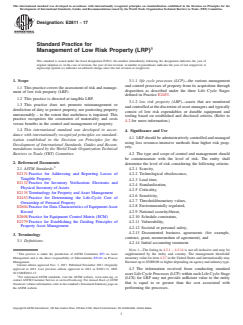
Designation: E2811 − 17
Standard Practice for
Management of Low Risk Property (LRP)
This standard is issued under the fixed designation E2811; the number immediately following the designation indicates the year of
original adoption or, in the case of revision, the year of last revision. A number in parentheses indicates the year of last reapproval. A
superscript epsilon (´) indicates an editorial change since the last revision or reapproval.
1. Scope 3.1.1 life cycle processes (LCP)—the various management
and control processes of property from its acquisition through
1.1 This practice covers the assessment of risk and manage-
disposition as described under the three Life Cycle Stages
ment of low risk property (LRP).
defined in Practice E2453.
1.2 This practice is directed at tangible LRP.
3.1.2 low risk property (LRP)—assets that are monitored
1.3 This practice does not promote mismanagement or
and controlled at the discretion of asset managers and typically
dereliction of duty to protect property, nor protecting property
consist of low risk expendables or durable equipment and
unreasonably – to the extent that usefulness is impaired. This
tooling based on established and disclosed criteria. (Refer to
practice recognizes the constraints of materiality and costs
4.2 for more information.)
versus benefits in the control and management of property.
1.4 This international standard was developed in accor-
4. Significance and Use
dance with internationally recognized principles on standard-
4.1 LRPshould be administratively controlled and managed
ization established in the Decision on Principles for the
using less resource-intensive methods than higher risk prop-
Development of International Standards, Guides and Recom-
erty.
mendations issued by the World Trade Organization Technical
Barriers to Trade (TBT) Committee. 4.2 The type and scope of control and management should
be commensurate with the level of risk. The entity shall
2. Referenced Documents
determine the level of risk considering the following criteria:
2.1 ASTM Standards: 4.2.1 Scarcity,
E2131 Practice for Addressing and Reporting Losses of
4.2.2 Technological obsolescence,
Tangible Property
4.2.3 Lead time,
E2132 Practice for Inventory Verification: Electronic and
4.2.4 Standardization,
Physical Inventory of Assets
4.2.5 Criticality,
E2135 Terminology for Property and Asset Management
4.2.6 Sensitivity,
E2453 Practice for Determining the Life-Cycle Cost of
4.2.7 Threshold/monetary values,
Ownership of Personal Property
4.2.8 Environmentally regulated,
E2604 Practice for Data Characteristics of Equipment Asset
4.2.9 National security/threat,
Record
E2608 Practice for Equipment Control Matrix (ECM) 4.2.10 Schedule constraints,
E2279 Practice for Establishing the Guiding Principles of
4.2.11 Vulnerability,
Property Asset Management
4.2.12 Societal or personal safety,
4.2.13 Documented business agreements (for example,
3. Terminology
contract, grant, memorandum of agreement), and
3.1 Definitions:
4.2.14 Initial accounting treatment.
NOTE 1—The listing in 4.2.1 – 4.2.14 is not all inclusive and may be
This practice is under the jurisdiction of ASTM Committee E53 on Asset supplemented by the entity and country. The management threshold/
Management and is the direct responsibility of Subcommittee E53.01 on Process
monetary value for item 4.2.7 in the United States and internationally may
Management.
fluctuate up to $5000.00 or higher depending
...
This document is not an ASTM standard and is intended only to provide the user of an ASTM standard an indication of what changes have been made to the previous version. Because
it may not be technically possible to adequately depict all changes accurately, ASTM recommends that users consult prior editions as appropriate. In all cases only the current version
of the standard as published by ASTM is to be considered the official document.
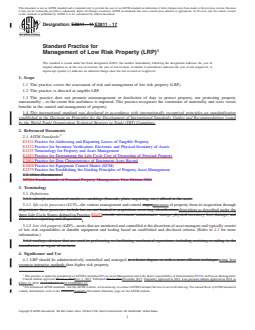
Designation: E2811 − 11 E2811 − 17
Standard Practice for
Management of Low Risk Property (LRP)
This standard is issued under the fixed designation E2811; the number immediately following the designation indicates the year of
original adoption or, in the case of revision, the year of last revision. A number in parentheses indicates the year of last reapproval. A
superscript epsilon (´) indicates an editorial change since the last revision or reapproval.
1. Scope
1.1 This practice covers the assessment of risk and management of low risk property (LRP).
1.2 This practice is directed at tangible LRP.
1.3 This practice does not promote mismanagement or dereliction of duty to protect property, nor protecting property
unreasonably – to the extent that usefulness is impaired. This practice recognizes the constraints of materiality and costs versus
benefits in the control and management of property.
1.4 This international standard was developed in accordance with internationally recognized principles on standardization
established in the Decision on Principles for the Development of International Standards, Guides and Recommendations issued
by the World Trade Organization Technical Barriers to Trade (TBT) Committee.
2. Referenced Documents
2.1 ASTM Standards:
E2131 Practice for Addressing and Reporting Losses of Tangible Property
E2132 Practice for Inventory Verification: Electronic and Physical Inventory of Assets
E2135 Terminology for Property and Asset Management
E2453 Practice for Determining the Life-Cycle Cost of Ownership of Personal Property
E2604 Practice for Data Characteristics of Equipment Asset Record
E2608 Practice for Equipment Control Matrix (ECM)
E2279 Practice for Establishing the Guiding Principles of Property Asset Management
2.2 Other Documents:
NPMA Fundamentals of Personal Property Management, First Edition 2006
3. Terminology
3.1 Definitions:
3.1.1 identification/control numbers—markings (barcode, plate, engraving, etc.) affixed to the asset.
3.1.1 life cycle processes (LCP)—the various management and control stagesprocesses of property from its acquisition through
disposition; these processes include but are not limited to acquisition, receiving, identification,disposition as described under the
three Life Cycle Stages defined in Practice E2453records, movement, maintenance, storage, physical inventory, loss, damage, and
destruction reporting and disposition.
3.1.2 low risk property (LRP)—assets that are monitored and controlled at the discretion of asset managers and typically consist
of low risk expendables or durable equipment and tooling based on established and disclosed criteria. (Refer to 4.2 for more
information.)
3.1.4 tooling—devices that are used in performing or facilitating mechanical operations, including assisting or aiding in the
manufacture or repair of an item.
4. Significance and Use
4.1 LRP should be administratively controlled and managed to a lesser degree or with a more efficient technique using less
resource-intensive methods than higher risk property.
This practice is under the jurisdiction of ASTM Committee E53 on Asset Management and is the direct responsibility of Subcommittee E53.01 on Process Management.
Current edition approved March 1, 2011Nov. 1, 2017. Published March 2011November 2017. Originally approved in 2011. Last previous edition approved in 2011 as
E2811-11. DOI: 10.1520/E2811-11.10.1520/E2811-17.
For referenced ASTM standards, visit the ASTM website, www.astm.org, or contact ASTM Customer Service at service@astm.org. For Annual Book of ASTM Standards
volume information, refer to the standard’sstandard’s Document Summary page on the ASTM website.
Copyright © ASTM International, 100 Barr Harbor Drive, PO Box C700, West Conshohocken, PA 19428-2959. United States
E2811 − 17
4.2 The type and scope of control and managemen
...