

ASTM E3012-22
(Guide)Standard Guide for Characterizing Environmental Aspects of Manufacturing Processes
General Information
- Abstract
SIGNIFICANCE AND USE
4.1 This guide provides a systematic approach for characterizing the environmental aspects of manufacturing processes based on well-established formal languages.
Note 1: In computer science, a formal language is a language designed for use in situations in which natural language is unsuitable as, for example, in mathematics, logic, or computer programming. The symbols and formulas of such languages stand in precisely specified syntactic and semantic relations to one another. Formal representations are derived from formal languages.
Note 2: A UMP model is defined using formal languages, such as eXtensible Markup Language (XML) (1),6 Unified Modeling Language (UML) (2), or Systems Modeling Language (SysML) to facilitate data exchange, computability, and communication with other manufacturing and analysis applications. These capabilities support manufacturers in evaluating, documenting, and improving performance. This guide specifically incorporates UML and XML but does not limit implementations to these languages.
4.2 This guide provides the structure and formalism to ensure consistency in characterizing manufacturing processes in a computer-interpretable way, thus enabling effective communication, computational analytics, and exchange of performance information.
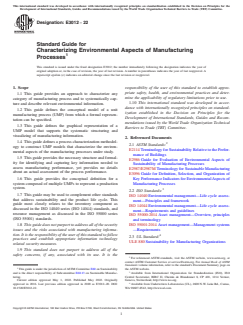
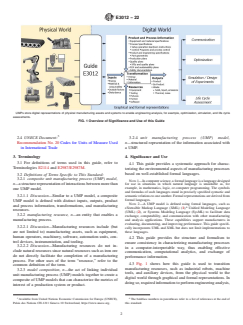
4.3 Fig. 1 shows how this guide is used to transition manufacturing resources, such as industrial robots, machine tools, and auxiliary devices, from the phycical world to the digital world through graphical and formal representations. In doing so, required information to perform engineering analysis, such as optimization, simulation, and life cycle assessment, is characterized in a manner that is complete, standardized, and efficient.
FIG. 1 Overview of Significance and Use of this Guide
UMPs store digital representations of physical manufacturing assets and systems to enable engineering analysis, for example, optimization, simulation, and life cycle assessments.
Note 3: This guide will promot...
SCOPE
1.1 This guide provides an approach to characterize any category of manufacturing process and to systematically capture and describe relevant environmental information.
1.2 This guide defines the conceptual model of a unit manufacturing process (UMP) from which a formal representation can be specified.
1.3 This guide defines the graphical representation of a UMP model that supports the systematic structuring and visualizing of manufacturing information.
1.4 This guide defines a process characterization methodology to construct UMP models that characterize the environmental aspects of the manufacturing processes under study.
1.5 This guide provides the necessary structure and formality for identifying and capturing key information needed to assess manufacturing performance, yet provides no details about an actual assessment of the process performance.
1.6 This guide provides the conceptual definition for a system composed of multiple UMPs to represent a production system.
1.7 This guide may be used to complement other standards that address sustainability and the product life cycle. This guide most closely relates to the inventory component as discussed in the ISO 14040 series (ISO 14044) standards, and resource management as discussed in the ISO 55000 series (ISO 55001) standards.
1.8 This guide does not purport to address all of the security issues and the risks associated with manufacturing information. It is the responsibility of the user of this standard to follow practices and establish appropriate information technology related security measures.
1.9 This standard does not purport to address all of the safety concerns, if any, associated with its use. It is the responsibility of the user of this standard to establish appropriate safety, health, and environmental practices and determine the applicability of regulatory limitations prior to use.
1.10 This international standard was developed...
- Status
- Published
- Publication Date
- 30-Apr-2022
- Technical Committee
- E60 - Sustainability
- Drafting Committee
- E60.13 - Sustainable Manufacturing
Buy Documents
ASTM E3012-22 - Standard Guide for Characterizing Environmental Aspects of Manufacturing Processes
REDLINE ASTM E3012-22 - Standard Guide for Characterizing Environmental Aspects of Manufacturing Processes
Overview
ASTM E3012-22 is the Standard Guide for Characterizing Environmental Aspects of Manufacturing Processes, published by ASTM International. This guide provides a systematic, formalized approach to model, document, and analyze the environmental factors involved in manufacturing processes. It is applicable to any manufacturing process type and supports organizations in capturing, structuring, and exchanging environmental information in a consistent, computer-interpretable manner.
The standard leverages established formal languages like XML (eXtensible Markup Language) and UML (Unified Modeling Language) for digital representation. These methods improve the exchange of process information, facilitate engineering analyses such as optimization and life cycle assessment, and enable integration with digital manufacturing and analysis tools.
Key Topics
- Formal Process Representation
- Uses standardized formal languages, such as XML and UML, to develop models of manufacturing processes called Unit Manufacturing Processes (UMPs).
- Enables machine-reading, data interchange, and integration into broader software environments.
- Systematic Characterization of Environmental Aspects
- Guides users in identifying process inputs, outputs, transformation functions, and associated environmental metrics.
- Supports documenting energy flows, material consumption, emissions, waste, and other relevant factors.
- Graphical and Conceptual Modeling
- Provides visual methods to structure and communicate complex process information.
- Facilitates understanding across multidisciplinary teams and stakeholders.
- Process Characterization Methodology
- Outlines a step-by-step approach to specify UMPs, define key performance indicators (KPIs), and assemble models for both individual operations and complete production systems.
- Model Composition and System Representation
- Allows integration of multiple UMP models into larger, composite system models representing entire production lines or facilities.
- Supports comparative analysis of alternative manufacturing routes and sustainability performance.
Applications
The ASTM E3012-22 standard delivers practical value in several key application areas:
- Sustainable Manufacturing Initiatives
- Assists organizations in systematically modeling and analyzing environmental impacts for cleaner production and eco-efficiency improvement.
- Engineering Analysis and Optimization
- Provides structured data necessary for simulation, optimization, and digital twin applications in manufacturing.
- Life Cycle Assessment (LCA) and Reporting
- Supplies consistent, detailed process data to support life cycle inventory (LCI) and life cycle assessment in compliance with ISO 14040 and ISO 14044.
- Data Integration and Digital Transformation
- Enables interoperability between manufacturing information systems, environmental databases, and decision support tools.
- Regulatory and Stakeholder Communication
- Enhances transparency and traceability of environmental information for compliance and reporting purposes.
Industries ranging from automotive, aerospace, and electronics to precision engineering can leverage the standard to improve environmental performance, streamline digital integration, and drive continuous improvement.
Related Standards
ASTM E3012-22 is designed to complement and interoperate with the following key standards:
- ISO 14040 / ISO 14044 – Environmental management, life cycle assessment principles and requirements.
- ISO 55000 / ISO 55001 – Asset management standards supporting the systematic management of manufacturing resources.
- ASTM E2986 – Guide for the evaluation of environmental aspects of manufacturing process sustainability.
- ASTM E3096 – Guide for key performance indicators relating to environmental aspects in manufacturing.
- ULE 880 – UL standard related to sustainability for manufacturing organizations.
- UNECE Recommendation No. 20 – Codes for units of measure used in international trade, ensuring consistency in process data representation.
By aligning with these standards, ASTM E3012-22 enhances interoperability and promotes a consistent approach to sustainable manufacturing information management.
Keywords: Characterizing environmental aspects, manufacturing process modeling, sustainable manufacturing, unit manufacturing process, formal languages, environmental data, process optimization, life cycle assessment, ASTM E3012-22.
Relations
- Effective Date
- 01-Oct-2018
- Effective Date
- 01-Sep-2018
- Effective Date
- 15-Oct-2017
- Effective Date
- 01-Jul-2017
- Refers
ASTM E2114-17 - Standard Terminology for Sustainability Relative to the Performance of Buildings - Effective Date
- 01-Feb-2017
- Effective Date
- 01-Feb-2016
- Effective Date
- 01-Aug-2015
- Refers
ASTM E2114-08 - Standard Terminology for Sustainability Relative to the Performance of Buildings - Effective Date
- 01-Nov-2008
- Refers
ASTM E2114-06a - Standard Terminology for Sustainability Relative to the Performance of Buildings - Effective Date
- 01-Dec-2006
- Refers
ASTM E2114-06 - Standard Terminology for Sustainability Relative to the Performance of Buildings - Effective Date
- 15-Feb-2006
- Refers
ASTM E2114-05a - Standard Terminology for Sustainability Relative to the Performance of Buildings - Effective Date
- 01-Jun-2005
- Refers
ASTM E2114-05 - Standard Terminology for Sustainability Relative to the Performance of Buildings - Effective Date
- 01-Feb-2005
- Refers
ASTM E2114-04 - Standard Terminology for Sustainability Relative to the Performance of Buildings - Effective Date
- 01-Dec-2004
- Refers
ASTM E2114-01 - Standard Terminology for Sustainability Relative to the Performance of Buildings - Effective Date
- 10-Feb-2001
- Refers
ASTM E2114-00a - Standard Terminology for Sustainability Relative to the Performance of Buildings - Effective Date
- 10-Feb-2001
Buy Documents
ASTM E3012-22 - Standard Guide for Characterizing Environmental Aspects of Manufacturing Processes
REDLINE ASTM E3012-22 - Standard Guide for Characterizing Environmental Aspects of Manufacturing Processes
Get Certified
Connect with accredited certification bodies for this standard

BSI Group
BSI (British Standards Institution) is the business standards company that helps organizations make excellence a habit.

Bureau Veritas
Bureau Veritas is a world leader in laboratory testing, inspection and certification services.

DNV
DNV is an independent assurance and risk management provider.
Sponsored listings
Frequently Asked Questions
ASTM E3012-22 is a guide published by ASTM International. Its full title is "Standard Guide for Characterizing Environmental Aspects of Manufacturing Processes". This standard covers: SIGNIFICANCE AND USE 4.1 This guide provides a systematic approach for characterizing the environmental aspects of manufacturing processes based on well-established formal languages. Note 1: In computer science, a formal language is a language designed for use in situations in which natural language is unsuitable as, for example, in mathematics, logic, or computer programming. The symbols and formulas of such languages stand in precisely specified syntactic and semantic relations to one another. Formal representations are derived from formal languages. Note 2: A UMP model is defined using formal languages, such as eXtensible Markup Language (XML) (1),6 Unified Modeling Language (UML) (2), or Systems Modeling Language (SysML) to facilitate data exchange, computability, and communication with other manufacturing and analysis applications. These capabilities support manufacturers in evaluating, documenting, and improving performance. This guide specifically incorporates UML and XML but does not limit implementations to these languages. 4.2 This guide provides the structure and formalism to ensure consistency in characterizing manufacturing processes in a computer-interpretable way, thus enabling effective communication, computational analytics, and exchange of performance information. 4.3 Fig. 1 shows how this guide is used to transition manufacturing resources, such as industrial robots, machine tools, and auxiliary devices, from the phycical world to the digital world through graphical and formal representations. In doing so, required information to perform engineering analysis, such as optimization, simulation, and life cycle assessment, is characterized in a manner that is complete, standardized, and efficient. FIG. 1 Overview of Significance and Use of this Guide UMPs store digital representations of physical manufacturing assets and systems to enable engineering analysis, for example, optimization, simulation, and life cycle assessments. Note 3: This guide will promot... SCOPE 1.1 This guide provides an approach to characterize any category of manufacturing process and to systematically capture and describe relevant environmental information. 1.2 This guide defines the conceptual model of a unit manufacturing process (UMP) from which a formal representation can be specified. 1.3 This guide defines the graphical representation of a UMP model that supports the systematic structuring and visualizing of manufacturing information. 1.4 This guide defines a process characterization methodology to construct UMP models that characterize the environmental aspects of the manufacturing processes under study. 1.5 This guide provides the necessary structure and formality for identifying and capturing key information needed to assess manufacturing performance, yet provides no details about an actual assessment of the process performance. 1.6 This guide provides the conceptual definition for a system composed of multiple UMPs to represent a production system. 1.7 This guide may be used to complement other standards that address sustainability and the product life cycle. This guide most closely relates to the inventory component as discussed in the ISO 14040 series (ISO 14044) standards, and resource management as discussed in the ISO 55000 series (ISO 55001) standards. 1.8 This guide does not purport to address all of the security issues and the risks associated with manufacturing information. It is the responsibility of the user of this standard to follow practices and establish appropriate information technology related security measures. 1.9 This standard does not purport to address all of the safety concerns, if any, associated with its use. It is the responsibility of the user of this standard to establish appropriate safety, health, and environmental practices and determine the applicability of regulatory limitations prior to use. 1.10 This international standard was developed...
SIGNIFICANCE AND USE 4.1 This guide provides a systematic approach for characterizing the environmental aspects of manufacturing processes based on well-established formal languages. Note 1: In computer science, a formal language is a language designed for use in situations in which natural language is unsuitable as, for example, in mathematics, logic, or computer programming. The symbols and formulas of such languages stand in precisely specified syntactic and semantic relations to one another. Formal representations are derived from formal languages. Note 2: A UMP model is defined using formal languages, such as eXtensible Markup Language (XML) (1),6 Unified Modeling Language (UML) (2), or Systems Modeling Language (SysML) to facilitate data exchange, computability, and communication with other manufacturing and analysis applications. These capabilities support manufacturers in evaluating, documenting, and improving performance. This guide specifically incorporates UML and XML but does not limit implementations to these languages. 4.2 This guide provides the structure and formalism to ensure consistency in characterizing manufacturing processes in a computer-interpretable way, thus enabling effective communication, computational analytics, and exchange of performance information. 4.3 Fig. 1 shows how this guide is used to transition manufacturing resources, such as industrial robots, machine tools, and auxiliary devices, from the phycical world to the digital world through graphical and formal representations. In doing so, required information to perform engineering analysis, such as optimization, simulation, and life cycle assessment, is characterized in a manner that is complete, standardized, and efficient. FIG. 1 Overview of Significance and Use of this Guide UMPs store digital representations of physical manufacturing assets and systems to enable engineering analysis, for example, optimization, simulation, and life cycle assessments. Note 3: This guide will promot... SCOPE 1.1 This guide provides an approach to characterize any category of manufacturing process and to systematically capture and describe relevant environmental information. 1.2 This guide defines the conceptual model of a unit manufacturing process (UMP) from which a formal representation can be specified. 1.3 This guide defines the graphical representation of a UMP model that supports the systematic structuring and visualizing of manufacturing information. 1.4 This guide defines a process characterization methodology to construct UMP models that characterize the environmental aspects of the manufacturing processes under study. 1.5 This guide provides the necessary structure and formality for identifying and capturing key information needed to assess manufacturing performance, yet provides no details about an actual assessment of the process performance. 1.6 This guide provides the conceptual definition for a system composed of multiple UMPs to represent a production system. 1.7 This guide may be used to complement other standards that address sustainability and the product life cycle. This guide most closely relates to the inventory component as discussed in the ISO 14040 series (ISO 14044) standards, and resource management as discussed in the ISO 55000 series (ISO 55001) standards. 1.8 This guide does not purport to address all of the security issues and the risks associated with manufacturing information. It is the responsibility of the user of this standard to follow practices and establish appropriate information technology related security measures. 1.9 This standard does not purport to address all of the safety concerns, if any, associated with its use. It is the responsibility of the user of this standard to establish appropriate safety, health, and environmental practices and determine the applicability of regulatory limitations prior to use. 1.10 This international standard was developed...
ASTM E3012-22 is classified under the following ICS (International Classification for Standards) categories: 03.100.01 - Company organization and management in general. The ICS classification helps identify the subject area and facilitates finding related standards.
ASTM E3012-22 has the following relationships with other standards: It is inter standard links to ASTM E2987/E2987M-18, ASTM E3096-18, ASTM E2987/E2987M-17, ASTM E3096-17, ASTM E2114-17, ASTM E2987/E2987M-16, ASTM E2986-15, ASTM E2114-08, ASTM E2114-06a, ASTM E2114-06, ASTM E2114-05a, ASTM E2114-05, ASTM E2114-04, ASTM E2114-01, ASTM E2114-00a. Understanding these relationships helps ensure you are using the most current and applicable version of the standard.
ASTM E3012-22 is available in PDF format for immediate download after purchase. The document can be added to your cart and obtained through the secure checkout process. Digital delivery ensures instant access to the complete standard document.
Standards Content (Sample)
This international standard was developed in accordance with internationally recognized principles on standardization established in the Decision on Principles for the
Development of International Standards, Guides and Recommendations issued by the World Trade Organization Technical Barriers to Trade (TBT) Committee.
Designation:E3012 −22
Standard Guide for
Characterizing Environmental Aspects of Manufacturing
Processes
This standard is issued under the fixed designation E3012; the number immediately following the designation indicates the year of
original adoption or, in the case of revision, the year of last revision. A number in parentheses indicates the year of last reapproval. A
superscript epsilon (´) indicates an editorial change since the last revision or reapproval.
1. Scope responsibility of the user of this standard to establish appro-
priate safety, health, and environmental practices and deter-
1.1 This guide provides an approach to characterize any
mine the applicability of regulatory limitations prior to use.
category of manufacturing process and to systematically cap-
ture and describe relevant environmental information. 1.10 This international standard was developed in accor-
dance with internationally recognized principles on standard-
1.2 This guide defines the conceptual model of a unit
ization established in the Decision on Principles for the
manufacturing process (UMP) from which a formal represen-
Development of International Standards, Guides and Recom-
tation can be specified.
mendations issued by the World Trade Organization Technical
1.3 This guide defines the graphical representation of a
Barriers to Trade (TBT) Committee.
UMP model that supports the systematic structuring and
visualizing of manufacturing information.
2. Referenced Documents
1.4 This guide defines a process characterization methodol-
2.1 ASTM Standards:
ogy to construct UMP models that characterize the environ-
E2114 Terminology for Sustainability Relative to the Perfor-
mental aspects of the manufacturing processes under study.
mance of Buildings
1.5 This guide provides the necessary structure and formal-
E2986 Guide for Evaluation of Environmental Aspects of
ity for identifying and capturing key information needed to
Sustainability of Manufacturing Processes
assess manufacturing performance, yet provides no details
E2987/E2987M Terminology for Sustainable Manufacturing
about an actual assessment of the process performance.
E3096 Guide for Definition, Selection, and Organization of
1.6 This guide provides the conceptual definition for a
Key Performance Indicators for EnvironmentalAspects of
system composed of multiple UMPs to represent a production
Manufacturing Processes
system.
2.2 ISO Standards:
1.7 This guide may be used to complement other standards
ISO 14040 Environmental management—Life cycle assess-
that address sustainability and the product life cycle. This
ment—Principles and framework
guide most closely relates to the inventory component as
ISO 14044 Environmental management—Life cycle assess-
discussed in the ISO 14040 series (ISO 14044) standards, and
ment—Requirements and guidelines
resource management as discussed in the ISO 55000 series
ISO 55000:2014 Asset management—Overview, principles
(ISO 55001) standards.
and terminology
1.8 This guide does not purport to address all of the security
ISO 55001:2014 Asset management—Management systems
issues and the risks associated with manufacturing informa-
—Requirements
tion. It is the responsibility of the user of this standard to follow
2.3 UL Standard:
practices and establish appropriate information technology
ULE 880 Sustainability for Manufacturing Organizations
related security measures.
1.9 This standard does not purport to address all of the
safety concerns, if any, associated with its use. It is the
For referenced ASTM standards, visit the ASTM website, www.astm.org, or
contact ASTM Customer Service at service@astm.org. For Annual Book of ASTM
Standards volume information, refer to the standard’s Document Summary page on
This guide is under the jurisdiction ofASTM Committee E60 on Sustainability the ASTM website.
and is the direct responsibility of Subcommittee E60.13 on Sustainable Manufac- Available from International Organization for Standardization (ISO), ISO
turing. Central Secretariat, BIBC II, Chemin de Blandonnet 8, CP 401, 1214 Vernier,
Current edition approved May 1, 2022. Published May 2022. Originally Geneva, Switzerland, http://www.iso.org.
approved in 2016. Last previous edition approved in 2020 as E3012–20. DOI: Available from Underwriters Laboratories (UL), 2600 N.W. Lake Rd., Camas,
10.1520/E3012-22. WA 98607-8542, http://www.ul.com.
Copyright © ASTM International, 100 Barr Harbor Drive, PO Box C700, West Conshohocken, PA 19428-2959. United States
E3012−22
UMPs store digital representations of physical manufacturing assets and systems to enable engineering analysis, for example, optimization, simulation, and life cycle
assessments.
FIG. 1Overview of Significance and Use of this Guide
2.4 UNECE Document: 3.2.4 unit manufacturing process (UMP) model,
Recommendation No. 20 Codes for Units of Measure Used n—structured reprsentation of the information associated with
in International Trade a UMP.
3. Terminology
4. Significance and Use
3.1 For definitions of terms used in this guide, refer to
4.1 This guide provides a systematic approach for charac-
Terminologies E2114 and E2987/E2987M.
terizing the environmental aspects of manufacturing processes
based on well-established formal languages.
3.2 Definitions of Terms Specific to This Standard:
3.2.1 composite unit manufacturing process (UMP) model,
NOTE1—Incomputerscience,aformallanguageisalanguagedesigned
n—astructurerepresentationofinteractionsbetweenmorethan
for use in situations in which natural language is unsuitable as, for
example, in mathematics, logic, or computer programming. The symbols
one UMP model.
and formulas of such languages stand in precisely specified syntactic and
3.2.1.1 Discussion—Similar to a UMP model, a composite semanticrelationstooneanother.Formalrepresentationsarederivedfrom
formal languages.
UMP model is defined with distinct inputs, outputs, product
NOTE 2—A UMP model is defined using formal languages, such as
and process information, transformations, and manufacturing
eXtensible Markup Language (XML) (1), Unified Modeling Language
resources.
(UML) (2), or Systems Modeling Language (SysML) to facilitate data
3.2.2 manufacturing resource, n—an entity that enables a
exchange, computability, and communication with other manufacturing
manufacturing process. and analysis applications. These capabilities support manufacturers in
evaluating, documenting, and improving performance. This guide specifi-
3.2.2.1 Discussion—Manufacturing resources include (but
cally incorporates UML and XML but does not limit implementations to
are not limited to) manufacturing assets, such as equipment, these languages.
human operators, machinery, software, automation units, con-
4.2 This guide provides the structure and formalism to
trol devices, instrumentation, and tooling.
ensure consistency in characterizing manufacturing processes
3.2.2.2 Discussion—Manufacturing resources do not in-
in a computer-interpretable way, thus enabling effective
clude natural resources since natural resources such as iron ore
communication, computational analytics, and exchange of
do not directly facilitate the completion of a manufacturing
performance information.
process. For other uses of the term “resource,” refer to the
4.3 Fig. 1 shows how this guide is used to transition
common definition of the term.
manufacturing resources, such as industrial robots, machine
3.2.3 model composition, n—the act of linking individual
tools, and auxiliary devices, from the phycical world to the
unit manufacturing process (UMP) models together to create a
digital world through graphical and formal representations. In
composite of UMP models that can characterize the metrics of
doingso,requiredinformationtoperformengineeringanalysis,
interest of a production system or product.
5 6
Available from United Nations Economic Commission for Europe (UNECE), The boldface numbers in parentheses refer to a list of references at the end of
Palais des Nations CH-1211 Geneva 10 Switzerland, https://www.unece.org. this standard.
E3012−22
NOTE 4—Data collected within manufacturing enterprises can be used
such as optimization, simulation, and life cycle assessment, is
to build enterprise-or-sector-specific databases that complement or extend
characterized in a manner that is complete, standardized, and
Life Cycle Inventory (LCI) databases (ULE 880). This approach will
efficient.
improve the relevancy and completeness of the data while retaining key
links to Life Cycle Assessment (LCA) methods.
NOTE 3—This guide will promote new tool development that can link
manufacturing information and analytics for calculating the desired
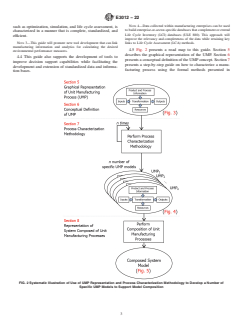
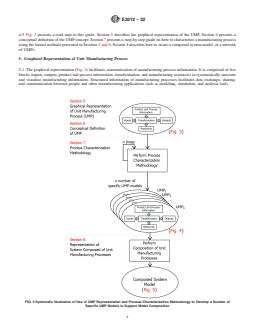
4.5 Fig. 2 presents a road map to this guide. Section 5
environmental performance measures.
describes the graphical representation of the UMP. Section 6
4.4 This guide also supports the development of tools to
presents a conceptual definition of the UMPconcept. Section 7
improve decision support capabilities while facilitating the
presents a step-by-step guide on how to characterize a manu-
development and extension of standardized data and informa-
facturing process using the formal methods presented in
tion bases.
FIG. 2Systematic Illustration of Use of UMP Representation and Process Characterization Methodology to Develop a Number of
Specific UMP Models to Support Model Composition
E3012−22
Sections5and6.Section8describeshowtocreateacomposed Italics are used to indicate the names of UML classes and
system model, or a network of UMPs. attributes that represent that concept. Examples are given for
the attributes of each concept.
5. Graphical Representation of Unit Manufacturing
NOTE 5—Information described in the conceptual definition of a UMP
Process
is purposefully written to provide flexibility in implementation. For
5.1 The graphical representation (Fig. 3) facilitates commu- guidance towards implementation strategies, see Appendix X1 and
Appendix X2 for examples of implementation based on XML Schema.
nication of manufacturing process information. It is comprised
Other implementation forms may be defined.
of five blocks (inputs, outputs, product and process
NOTE 6—Subsections 6.2 and 6.2.1 – 6.2.5 provide examples and
information, transformation, and manufacturing resources) to
semantic explanation of concepts and attributes presented in the concep-
systematically structure and visualize manufacturing informa-
tual definition.
tion. Structured information of manufacturing processes facili-
6.2 Unit Manufacturing Process (UMP)—A model of a
tates data exchange, sharing, and communication between
physical process in a manufacturing setting that adds value
people and other manufacturing applications such as modeling,
through the modification or transformation of shape, structure,
simulation, and analysis tools.
or property of input material or workpiece.Aunit manufactur-
5.2 The contents of each of the five blocks is defined in
ing process (defined as UnitManufacturingProcess) accepts
Section 6 using UML (the Unified Modeling Language) to
inputs (defined as InputOutput), generates outputs (defined as
define a conceptual representation. From the conceptual
InputOutput), uses product and process information (defined as
representation, a formal representation may be defined. An ProductProcessInformation), uses manufacturing resources
example of a formal representation of the UMP implemented
(defined as Resource), has a transformation (defined as
as an XSD schema (eXtensible Modeling Language Schema Transformation),includesreviews(definedas Review),andhas
Definition) (3) is presented in Appendix X1. An instantiated
authors (defined as Person). Some examples of a type of a unit
UMP model conforming to the example XSD schema is
manufacturing process include milling, turning, die casting,
presented in Appendix X2 as an XML document.
injection molding, and laser powder bed fusion.An example of
the description in a UseBound is “This model is only valid
6. Conceptual Definition of Unit Manufacturing Process
when assessing the process in the state of Ohio.” An example
ofamathematicalExpressionofaUseBoundEquationis“15 °C
6.1 Fig. 4 presents the conceptual definition of a UMP as a
UML class diagram. Starting with the UnitManufacturingPro- < temperature_ambient < 40 °C” and an example of the
associated description is “The model has only been validated
cess definition in the center, UMP concepts are described as
UML classes in boxes in the figure. Concept attributes are under this range of temperature conditions.”
described as UML attributes, and are shown inside the boxes. 6.2.1 Input—All physical inputs that enter the UMP, such as
Relationships between concepts are described as UML aggre- material (for example, raw materials or work-in-progress),
gations and associations, and are depicted as connecting lines consumables(forexample,lubricationorforcedair),energy,as
in the figure. In 6.2, each of the UMP concepts is defined. well as external factors (such as temperature, humidity,
FIG. 3Graphical Representation of UMP Information
E3012−22
FIG. 4Conceptual Definition of UMP
particulates, vibration, and shocks) that occur during the ate variables (defined as Parameter), metrics of interest (de-
manufactureofaproduct.Anexampleofacategoryofaninput fined as Parameter), fixed parameters (defined as
can be material, energy, or part-in-process. An example of the FixedParameter), and supporting information (defined as Sup-
symbol is “electricity_used.” An example of the code in a portingInformation). FixedParameter extends the concept of
UOMCode is “KWH” with the source “UNECE Recommen- Parameter. The process parameters are distinguished into the
dation No. 20 - Units of Measure used in International Trade.” following four types. For each type of parameter, unit of
An example of the mathematicalExpression of a UseBound- measure codes, use bound equations, and descriptions are
Equation is “electricity_used > 0” and an example of the similartotheonesprovidedforinput(6.2.1)andoutput(6.2.2).
associated description is “For this process to run, electricity is For specific examples, refer to the UMP example in Appendix
required.” X2.
6.2.2 Output—All physical outputs that exit the UMP 6.2.3.1 Control Parameter—Tunable parameters that can be
model, such as products, by-products, waste, and emissions. adjusted to evaluate different process settings. Examples of
Output of one UMP can be an input to another UMP. An control parameters in machining processes include depth of
example of the symbol is “waste_aluminum.”An example of a cut, spindle speed, and feed rate.
category of an output can be waste, by-product, or product.An 6.2.3.2 Fixed Parameter—Parameters that are fixed through
example of the code in a UOMCode is “KGM” with the source the evaluation of the transformation equations. Examples of
“UNECE Recommendation No. 20 - Units of Measure used in fixed parameters in machining processes include specific
International Trade.” An example of the mathematicalExpres- cutting energy and density of the workpiece material.
sion of a UseBound Equation is “waste_aluminum≥ 0” and an 6.2.3.3 Intermediate Variable—Calculated variables re-
example of the associated description is “It is possible that the quired to complete the evaluation of the metrics of interest
process does not produce any waste.” (6.2.3.4). An example of an intermediate variable in a milling
6.2.3 Product and Process Information—Relevant informa- processisthemillingtimeofagivensurfacearea.Millingtime
tion to facilitate the evaluation of the transformation (6.2.5) must be calculated before assessing the machining power.
calculationsofmaterial,energy,andinformation.Thisincludes 6.2.3.4 Metric of Interest—Performance metrics related to
items such as part geometry, material properties, control the process that the UMP model is used to evaluate. Examples
programs, and process plans. Product and process information of metrics of interest include cost per part and mass of CO
includes control parameters (defined as Parameter, intermedi- emissions per part.
E3012−22
6.2.3.5 Supporting Information—All other relevant links to 6.2.6 Review—An expert review of a UMPmodel.Areview
information regarding the manufacturing process, including hasareviewer(definedas Person).Examplesofwaysinwhich
production plans, product and engineering specifications, and a model can be reviewed include a peer-review procedure, a
setup-operation-teardown instructions. validation study using empirical data, and a cross-validation
6.2.4 Manufacturing Resource—Information about process study using a subset of training data in the case of data-driven
resources such as equipment, fixtures, tooling, and inspection models.
gauges.
6.3 Tables 1-14 describe the attributes and relationships of
6.2.5 Transformation—Theformalrelationsbetweeninputs,
each concept in the conceptual definition. For each attribute, a
outputs, and metrics of interest through the use of product and
data type and description are provided. For each relationship to
process information and information about the manufacturing
the concept, the name of the related concept, the cardinality of
resources. A transformation is represented as some form of
the relationship, and a reference providing additional informa-
mathematical representation (defined as MathematicalRepre-
tion are provided.
sentation).
NOTE 8—These tables provide additional information to facilitate
6.2.5.1 MathematicalRepresentation—A description or a
implementation of the conceptual definition.
formal definition, or both, of components of a transformation.
Examples for content of a mathematical representation include
7. Process Characterization Methodology
an equation described as a MathML expression, a data-driven
7.1 The process characterization methodology supports the
model described as a PMML model, and an inequality con-
derivation of specific UMP models for characterizing the
straint described as a MathML expression representing a
environmental and other aspects of manufacturing processes.
feasibility space in a manufacturing model.
The process characterization methodology is comprised of the
steps described in 7.2 through 7.4.
NOTE 7—MathML is a markup language (4) developed by the World
Wide Web Consortium (W3C) to describe mathematical notations, cap-
7.2 Identify UMPs and KPIs:
turingbothitsstructureandcontent.PMML(5)isastandarddev
...
This document is not an ASTM standard and is intended only to provide the user of an ASTM standard an indication of what changes have been made to the previous version. Because
it may not be technically possible to adequately depict all changes accurately, ASTM recommends that users consult prior editions as appropriate. In all cases only the current version
of the standard as published by ASTM is to be considered the official document.
Designation: E3012 − 20 E3012 − 22
Standard Guide for
Characterizing Environmental Aspects of Manufacturing
Processes
This standard is issued under the fixed designation E3012; the number immediately following the designation indicates the year of
original adoption or, in the case of revision, the year of last revision. A number in parentheses indicates the year of last reapproval. A
superscript epsilon (´) indicates an editorial change since the last revision or reapproval.
1. Scope
1.1 This guide provides an approach to characterize any category of manufacturing process and to systematically capture and
describe relevant environmental information.
1.2 This guide defines the conceptual model of a unit manufacturing process (UMP) from which a formal representation can be
specified.
1.3 This guide defines the graphical representation of a UMP model that supports the systematic structuring and visualizing of
manufacturing information.
1.4 This guide defines a process characterization methodology to construct UMP models that characterize the environmental
aspects of the manufacturing processes under study.
1.5 This guide provides the necessary structure and formality for identifying and capturing key information needed to assess
manufacturing performance, yet provides no details about an actual assessment of the process performance.
1.6 This guide provides the conceptual definition for a system composed of multiple UMPs to represent a production system.
1.7 This guide may be used to complement other standards that address sustainability and the product life cycle. This guide most
closely relates to the inventory component as discussed in the ISO 14040 series (ISO 14044) standards, and resource management
as discussed in the ISO 55000 series (ISO 55001) standards.
1.8 This guide does not purport to address all of the security issues and the risks associated with manufacturing information. It
is the responsibility of the user of this standard to follow practices and establish appropriate information technology related
security measures.
1.9 This standard does not purport to address all of the safety concerns, if any, associated with its use. It is the responsibility
of the user of this standard to establish appropriate safety, health, and environmental practices and determine the applicability of
regulatory limitations prior to use.
1.10 This international standard was developed in accordance with internationally recognized principles on standardization
established in the Decision on Principles for the Development of International Standards, Guides and Recommendations issued
by the World Trade Organization Technical Barriers to Trade (TBT) Committee.
This guide is under the jurisdiction of ASTM Committee E60 on Sustainability and is the direct responsibility of Subcommittee E60.13 on Sustainable Manufacturing.
Current edition approved Jan. 1, 2020May 1, 2022. Published March 2020May 2022. Originally approved in 2016. Last previous edition approved in 20162020 as
E3012–16.–20. DOI: 10.1520/E3012–20.10.1520/E3012-22.
Copyright © ASTM International, 100 Barr Harbor Drive, PO Box C700, West Conshohocken, PA 19428-2959. United States
E3012 − 22
2. Referenced Documents
2.1 ASTM Standards:
E2114 Terminology for Sustainability Relative to the Performance of Buildings
E2986 Guide for Evaluation of Environmental Aspects of Sustainability of Manufacturing Processes
E2987/E2987M Terminology for Sustainable Manufacturing
E3096 Guide for Definition, Selection, and Organization of Key Performance Indicators for Environmental Aspects of
Manufacturing Processes
2.2 ISO Standards:
ISO 14040 Environmental management—Life cycle assess-
ment—Principles and framework
ISO 14044 Environmental management—Life cycle assess-
ment—Requirements and guidelines
ISO 55000:2014 Asset management—Overview, principles and terminology
ISO 55001:2014 Asset management—Management systems
—Requirements
2.3 UL Standard:
ULE 880 Sustainability for Manufacturing Organizations
2.4 UNECE Document:
Recommendation No. 20 Codes for Units of Measure Used in International Trade
3. Terminology
3.1 Definitions For definitions of terms shall be in accordance with Terminology used in this guide, refer to Terminologies E2114
and E2987/E2987M.
3.2 Definitions of Terms Specific to This Standard:
3.2.1 composite unit manufacturing process (UMP) model, n—a structure representation of interactions between more than one
UMP model.
UMPs store digital representations of physical manufacturing assets and systems to enable engineering analysis, for example, optimization, simulation, and life cycle
assessments.
FIG. 1 Overview of Significance and Use of this Guide
For referenced ASTM standards, visit the ASTM website, www.astm.org, or contact ASTM Customer Service at service@astm.org. For Annual Book of ASTM Standards
volume information, refer to the standard’sstandard’s Document Summary page on the ASTM website.
Available from International Organization for Standardization (ISO), ISO Central Secretariat, BIBC II, Chemin de Blandonnet 8, CP 401, 1214 Vernier, Geneva,
Switzerland, http://www.iso.org.
Available from Underwriters Laboratories (UL), 2600 N.W. Lake Rd., Camas, WA 98607-8542, http://www.ul.com.
Available from United Nations Economic Commission for Europe (UNECE), Palais des Nations CH-1211 Geneva 10 Switzerland, https://www.unece.org.
E3012 − 22
3.2.1.1 Discussion—
Similar to a UMP model, a composite UMP model is defined with distinct inputs, outputs, product and process information,
transformations, and manufacturing resources.
3.2.2 manufacturing resource, n—an entity that enables a manufacturing process.
3.2.2.1 Discussion—
Manufacturing resources include (but are not limited to) manufacturing assets, such as equipment, human operators, machinery,
software, automation units, control devices, instrumentation, and tooling.
3.2.2.2 Discussion—
Manufacturing resources do not include natural resources since natural resources such as iron ore do not directly facilitate the
completion of a manufacturing process. For other uses of the term “resource,” refer to the common definition of the term.
3.2.3 model composition, n—the act of linking individual unit manufacturing process (UMP) models together to create a composite
of UMP models that can characterize the metrics of interest of a production system or product.
3.2.4 unit manufacturing process (UMP), n—the smallest element or subprocess in manufacturing that adds value through the
modification or transformation of shape, structure, or property of input material or workpiece.
3.2.4.1 Discussion—
A UMP is a clearly-scoped and well-defined manufacturing process that products a component, assembly, or product.
3.2.4 unit manufacturing process (UMP) model, n—structured reprsentation of the information associated with a UMP.
4. Significance and Use
4.1 This guide provides a systematic approach for characterizing the environmental aspects of manufacturing processes based on
well-established formal languages.
NOTE 1—In computer science, a formal language is a language designed for use in situations in which natural language is unsuitable as, for example, in
mathematics, logic, or computer programming. The symbols and formulas of such languages stand in precisely specified syntactic and semantic relations
to one another. Formal representations are derived from formal languages.
NOTE 2—A UMP model is defined using formal languages, such as eXtensible Markup Language (XML) (1), Unified Modeling Language (UML) (2),
or Systems Modeling Language (SysML) to facilitate data exchange, computability, and communication with other manufacturing and analysis
applications. These capabilities support manufacturers in evaluating, documenting, and improving performance. This guide specifically incorporates UML
and XML but does not limit implementations to these languages.
4.2 This guide provides the structure and formalism to ensure consistency in characterizing manufacturing processes in a
computer-interpretable way, thus enabling effective communication, computational analytics, and exchange of performance
information.
4.3 Fig. 1 shows how this guide is used to transition manufacturing resources, such as industrial robots, machine tools, and
auxiliary devices, from the phycical world to the digital world through graphical and formal representations. In doing so, required
information to perform engineering analysis, such as optimization, simulation, and life cycle assessment, is characterized in a
manner that is complete, standardized, and efficient.
NOTE 3—This guide will promote new tool development that can link manufacturing information and analytics for calculating the desired environmental
performance measures.
4.4 This guide also supports the development of tools to improve decision support capabilities while facilitating the development
and extension of standardized data and information bases.
NOTE 4—Data collected within manufacturing enterprises can be used to build enterprise-or-sector-specific databases that complement or extend Life
Cycle Inventory (LCI) databases (ULE 880). This approach will improve the relevancy and completeness of the data while retaining key links to Life
Cycle Assessment (LCA) methods.
The boldface numbers in parentheses refer to a list of references at the end of this standard.
E3012 − 22
4.5 Fig. 2 presents a road map to this guide. Section 5 describes the graphical representation of the UMP. Section 6 presents a
conceptual definition of the UMP concept. Section 7 presents a step-by-step guide on how to characterize a manufacturing process
using the formal methods presented in Sections 5 and 6. Section 8 describes how to create a composed system model, or a network
of UMPs.
5. Graphical Representation of Unit Manufacturing Process
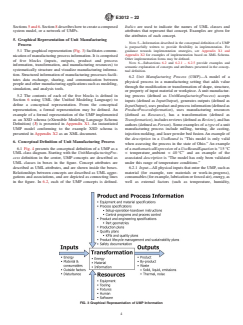
5.1 The graphical representation (Fig. 3) facilitates communication of manufacturing process information. It is comprised of five
blocks (inputs, outputs, product and process information, transformation, and manufacturing resources) to systematically structure
and visualize manufacturing information. Structured information of manufacturing processes facilitates data exchange, sharing,
and communication between people and other manufacturing applications such as modeling, simulation, and analysis tools.
FIG. 2 Systematic Illustration of Use of UMP Representation and Process Characterization Methodology to Develop a Number of
Specific UMP Models to Support Model Composition
E3012 − 22
FIG. 3 Graphical Representation of UMP Information
5.2 The contents of each of the five blocks is defined in Section 6 using UML (the Unified Modeling Language) to define a
conceptual representation. From the conceptual representation, a formal representation may be defined. An example of a formal
representation of the UMP implemented as an XSD schema (eXtensible Modeling Language Schema Definition) (3) is presented
in Appendix X1. An instantiated UMP model conforming to the example XSD schema is presented in Appendix X2 as an XML
document.
6. Conceptual Definition of Unit Manufacturing Process
6.1 Fig. 4 presents the conceptual definition of a UMP as a UML class diagram. Starting with the UnitManufacturingProcess
definition in the center, UMP concepts are described as UML classes in boxes in the figure. Concept attributes are described as
UML attributes, and are shown inside the boxes. Relationships between concepts are described as UML aggregations and
associations, and are depicted as connecting lines in the figure. In 6.2, each of the UMP concepts is defined. Italics are used to
indicate the names of UML classes and attributes that represent that concept. Examples are given for the attributes of each concept.
NOTE 5—Information described in the conceptual definition of a UMP is purposefully written to provide flexibility in implementation. For guidance
towards implementation strategies, see Appendix X1 and Appendix X2 for examples of implementation based on XML Schema. Other implementation
forms may be defined.
NOTE 6—Subsections 6.2 and 6.2.1 – 6.2.5 provide examples and semantic explanation of concepts and attributes presented in the conceptual definition.
6.2 Unit Manufacturing Process (UMP)—A model of a physical process in a manufacturing setting that adds value through the
modification or transformation of shape, structure, or property of input material or workpiece. A unit manufacturing process
(defined as UnitManufacturingProcess) accepts inputs (defined as InputOutput), generates outputs (defined as InputOutput), uses
product and process information (defined as ProductProcessInformation), uses manufacturing resources (defined as Resource), has
a transformation (defined as Transformation), includes reviews (defined as Review), and has authors (defined as Person). Some
examples of a type of a unit manufacturing process include milling, turning, die casting, injection molding, and laser powder bed
fusion. An example of the description in a UseBound is “This model is only valid when assessing the process in the state of Ohio.”
An example of a mathematicalExpression of a UseBoundEquation is “15 °C < temperature_ambient < 40 °C” and an example of
the associated description is “The model has only been validated under this range of temperature conditions.”
6.2.1 Input—All physical inputs that enter the UMP, such as material (for example, raw materials or work-in-progress),
consumables (for example, lubrication or forced air), energy, as well as external factors (such as temperature, humidity,
E3012 − 22
FIG. 4 Conceptual Definition of UMP
particulates, vibration, and shocks) that occur during the manufacture of a product. An example of a category of an input can be
material, energy, or part-in-process. An example of the symbol is “electricity_used.” An example of the code in a UOMCode is
“KWH” with the source “UNECE Recommendation No. 20 - Units of Measure used in International Trade.” An example of the
mathematicalExpression of a UseBoundEquation is “electricity_used > 0” and an example of the associated description is “For this
process to run, electricity is required.”
6.2.2 Output—All physical outputs that exit the UMP model, such as products, by-products, waste, and emissions. Output of one
UMP can be an input to another UMP. An example of the symbol is “waste_aluminum.” An example of a category of an output
can be waste, by-product, or product. An example of the code in a UOMCode is “KGM” with the source “UNECE
Recommendation No. 20 - Units of Measure used in International Trade.” An example of the mathematicalExpression of a
UseBound Equation is “waste_aluminum ≥ 0” and an example of the associated description is “It is possible that the process does
not produce any waste.”
6.2.3 Product and Process Information—Relevant information to facilitate the evaluation of the transformation (6.2.5) calculations
of material, energy, and information. This includes items such as part geometry, material properties, control programs, and process
plans. Product and process information includes control parameters (defined as Parameter, intermediate variables (defined as
Parameter), metrics of interest (defined as Parameter), fixed parameters (defined as FixedParameter), and supporting information
(defined as SupportingInformation). FixedParameter extends the concept of Parameter. The process parameters are distinguished
into the following four types. For each type of parameter, unit of measure codes, use bound equations, and descriptions are similar
to the ones provided for input (6.2.1) and output (6.2.2). For specific examples, refer to the UMP example in Appendix X2.
6.2.3.1 Control Parameter—Tunable parameters that can be adjusted to evaluate different process settings. Examples of control
parameters in machining processes include depth of cut, spindle speed, and feed rate.
6.2.3.2 Fixed Parameter—Parameters that are fixed through the evaluation of the transformation equations. Examples of fixed
parameters in machining processes include specific cutting energy and density of the workpiece material.
E3012 − 22
6.2.3.3 Intermediate Variable—Calculated variables required to complete the evaluation of the metrics of interest (6.2.3.4). An
example of an intermediate variable in a milling process is the milling time of a given surface area. Milling time must be calculated
before assessing the machining power.
6.2.3.4 Metric of Interest—Performance metrics related to the process that the UMP model is used to evaluate. Examples of
metrics of interest include cost per part and mass of CO emissions per part.
6.2.3.5 Supporting Information—All other relevant links to information regarding the manufacturing process, including
production plans, product and engineering specifications, and setup-operation-teardown instructions.
6.2.4 Manufacturing Resource—Information about process resources such as equipment, fixtures, tooling, and inspection gauges.
6.2.5 Transformation—The formal relations between inputs, outputs, and metrics of interest through the use of product and process
information and information about the manufacturing resources. A transformation is represented as some form of mathematical
representation (defined as MathematicalRepresentation).
6.2.5.1 MathematicalRepresentation—A description or a formal definition, or both, of components of a transformation. Examples
for content of a mathematical representation include an equation described as a MathML expression, a data-driven model described
as a PMML model, and an inequality constraint described as a MathML expression representing a feasibility space in a
manufacturing model.
NOTE 7—MathML is a markup language (4) developed by the World Wide Web Consortium (W3C) to describe mathematical notations, capturing both
its structure and content. PMML (5) is a standard developed by the Data Mining Group (DMG) to represent predictive models in an XML format,
promoting the deployment of such models.
FIG. 5 Graphical Representation of Specific UMP for Compacting Process
E3012 − 22
6.2.6 Review—An expert review of a UMP model. A review has a reviewer (defined as Person). Examples of ways in which a
model can be reviewed include a peer-review procedure, a validation study using empirical data, and a cross-validation study using
a subset of training data in the case of data-driven models.
6.3 Tables 1-14 describe the attributes and relationships of each concept in the conceptual definition. For each attribute, a data type
and description are provided. For each relationship to the concept, the name of the related concept, the cardinality of the
relationship, and a reference providing additional inf
...