

ASTM E3200-21
(Guide)Standard Guide for Investment Analysis in Environmentally Sustainable Manufacturing
General Information
- Abstract
SIGNIFICANCE AND USE
5.1 This guide provides a method for evaluating investments in terms of their financial merits and environmental merits. This guide can be used to answer whether an investment is both economical and environmentally sustainable or if there is a tradeoff between the environmental aspects of manufacturing and profitability. In the event that there are tradeoffs, this guide provides methods for evaluating those tradeoffs.
5.2 The financial merits for this guide are typically from the individual stakeholder perspective (for example, owners or investors, or both) or from the perspective of a selection of stakeholders. It is up to the users to decide what financial changes are relevant to them. For instance, if there is a financial cost borne by a third party, the users may opt to exclude it from their analysis, as it is not relevant for them. The environmental merits are from a multi-stakeholder perspective (for example, societal level) and should follow established standards for evaluating environmental aspects of manufacturing. That is, environmental aspects of manufacturing should not be excluded simply because they do not affect the user.
SCOPE
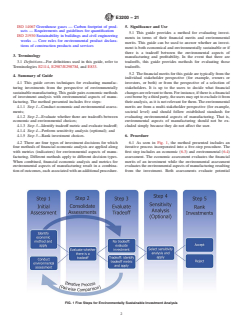
1.1 This guide covers techniques for evaluating manufacturing investments from the perspective of environmentally sustainable manufacturing by pairing economic methods of investment analysis with environmental aspect of manufacturing, including manufacturing processes.
1.2 The economic techniques discussed include net present value, internal rate of return, payback period, and hurdle rate. These four techniques are deterministic, meaning that they deal with known values that are certain. Probabilistic considerations play no role in determining how these four techniques are deployed. The guide will also move beyond standard deterministic techniques to look at probabilistic methods like the concept of sensitivity analyses with a focus on Monte Carlo analyses.
1.3 The techniques can be used by manufacturers, regardless of size or complexity, to make environmentally sustainable decisions, including but not limited to whether to embark on an investment, discontinue a manufacturing line, invest or re-invest in a new project or factory. To outline all possible decision types would constitute a guide in itself.
1.4 This guide does not assume specific knowledge of financial techniques on the part of the user, besides some knowledge of discounting. The interested reader is encouraged to follow up and consult outside readings to cover financial techniques beyond the scope of this guide.
1.5 This guide uses U.S. dollars, percent change in environmental aspects of manufacturing, and unit change in environmental aspects of manufacturing as its primary units.
1.6 This standard does not purport to address all of the safety concerns, if any, associated with its use. It is the responsibility of the user of this standard to establish appropriate safety, health, and environmental practices and determine the applicability of regulatory limitations prior to use.
1.7 This international standard was developed in accordance with internationally recognized principles on standardization established in the Decision on Principles for the Development of International Standards, Guides and Recommendations issued by the World Trade Organization Technical Barriers to Trade (TBT) Committee.
- Status
- Published
- Publication Date
- 31-Jan-2021
- Technical Committee
- E60 - Sustainability
- Drafting Committee
- E60.13 - Sustainable Manufacturing
Overview
ASTM E3200-21: Standard Guide for Investment Analysis in Environmentally Sustainable Manufacturing provides a comprehensive framework for evaluating manufacturing investments by integrating financial analysis with environmental assessments. Developed by ASTM International, this guide assists organizations in determining whether investments are both financially viable and environmentally sustainable. Recognizing that sustainable manufacturing involves balancing profitability with environmental responsibility, ASTM E3200-21 introduces methods to evaluate tradeoffs and ensure informed decision-making.
Key Topics
Dual Assessment Approach
The guide outlines processes to assess both the financial and environmental merits of an investment. Financial aspects are typically evaluated from a stakeholder perspective, while environmental impacts are considered from a broader, multi-stakeholder or societal standpoint.Economic Techniques
Deterministic economic methods discussed include:- Net Present Value (NPV)
- Internal Rate of Return (IRR)
- Payback Period
- Hurdle Rate
The guide also introduces probabilistic approaches, notably sensitivity analysis and Monte Carlo analysis, to handle uncertainties in investment variables.
Tradeoff Evaluation
ASTM E3200-21 details how to identify and assess tradeoffs where financial gains may result in increased environmental impacts, or vice versa. The guide recommends using established metrics and decision trees to rank investments when tradeoffs are present.Applicability Without Advanced Financial Expertise
The guide is accessible to users with only basic financial knowledge (e.g., understanding discounting), making it suitable for a wide range of manufacturers regardless of size or complexity.
Applications
Investment Decision Support
Manufacturers can use ASTM E3200-21 to evaluate whether to proceed with potential investments, discontinue manufacturing lines, or prioritize among several investment options. The guide’s five-step process leads users from initial assessment to final ranking of choices, integrating both economic and environmental performance.Strategic Planning for Sustainability
Aligns investment analysis with sustainability goals. By quantifying financial returns and environmental impacts (such as emissions reductions or resource savings), organizations can prioritize projects with the highest sustainable value.Risk and Sensitivity Analysis
With probabilistic techniques such as sensitivity analysis and Monte Carlo simulations, users can assess the potential impact of uncertain variables (e.g., future costs, regulatory changes, or environmental outcomes) on investment performance.Multi-Stakeholder Engagement
By incorporating both stakeholder-specific financial considerations and broader environmental impacts, the guide supports decision-making that addresses diverse interests and regulatory requirements.
Related Standards
ASTM E3200-21 integrates concepts and terminology from various national and international standards, including:
- ASTM E833: Terminology of Building Economics
- ASTM E2114: Terminology for Sustainability Relative to Building Performance
- ASTM E2986: Guide for Evaluation of Environmental Aspects of Manufacturing Processes Sustainability
- ASTM E2987/E2987M: Terminology for Sustainable Manufacturing
- ASTM E3096: Guide for Definition and Organization of Key Performance Indicators for Environmental Aspects of Manufacturing
- ASTM E1057: Practice for IRR in Buildings and Systems
Relevant ISO standards include:
- ISO 14025 – Environmental labels and declarations
- ISO 14040, 14044, 14049 – Life cycle assessment
- ISO 14067 – Carbon footprint of products
- ISO 21930 – Sustainability in construction
Practical Value
ASTM E3200-21 offers a structured, standardized approach for manufacturers seeking to align financial investments with sustainability initiatives. The guide improves transparency in investment analysis, supports compliance with international sustainability standards, and promotes informed choices that benefit owners, investors, and society. By leveraging this standard, manufacturers can drive progress toward economically and environmentally sustainable manufacturing practices.
Keywords: sustainable manufacturing, investment analysis, financial evaluation, environmental impact, sensitivity analysis, Monte Carlo simulation, ASTM standards, ISO standards, profitability, sustainability, stakeholder decision-making.
Relations
- Effective Date
- 01-Apr-2020
- Effective Date
- 01-Oct-2018
- Effective Date
- 01-Sep-2018
- Effective Date
- 15-Oct-2017
- Effective Date
- 01-Jul-2017
- Refers
ASTM E2114-17 - Standard Terminology for Sustainability Relative to the Performance of Buildings - Effective Date
- 01-Feb-2017
- Effective Date
- 01-May-2016
- Effective Date
- 01-Feb-2016
- Effective Date
- 01-Aug-2015
- Effective Date
- 01-May-2015
- Effective Date
- 01-Dec-2013
- Effective Date
- 01-Nov-2013
- Effective Date
- 15-Oct-2013
- Effective Date
- 01-Oct-2013
- Effective Date
- 01-May-2012
Get Certified
Connect with accredited certification bodies for this standard

BSI Group
BSI (British Standards Institution) is the business standards company that helps organizations make excellence a habit.

Bureau Veritas
Bureau Veritas is a world leader in laboratory testing, inspection and certification services.

DNV
DNV is an independent assurance and risk management provider.
Sponsored listings
Frequently Asked Questions
ASTM E3200-21 is a guide published by ASTM International. Its full title is "Standard Guide for Investment Analysis in Environmentally Sustainable Manufacturing". This standard covers: SIGNIFICANCE AND USE 5.1 This guide provides a method for evaluating investments in terms of their financial merits and environmental merits. This guide can be used to answer whether an investment is both economical and environmentally sustainable or if there is a tradeoff between the environmental aspects of manufacturing and profitability. In the event that there are tradeoffs, this guide provides methods for evaluating those tradeoffs. 5.2 The financial merits for this guide are typically from the individual stakeholder perspective (for example, owners or investors, or both) or from the perspective of a selection of stakeholders. It is up to the users to decide what financial changes are relevant to them. For instance, if there is a financial cost borne by a third party, the users may opt to exclude it from their analysis, as it is not relevant for them. The environmental merits are from a multi-stakeholder perspective (for example, societal level) and should follow established standards for evaluating environmental aspects of manufacturing. That is, environmental aspects of manufacturing should not be excluded simply because they do not affect the user. SCOPE 1.1 This guide covers techniques for evaluating manufacturing investments from the perspective of environmentally sustainable manufacturing by pairing economic methods of investment analysis with environmental aspect of manufacturing, including manufacturing processes. 1.2 The economic techniques discussed include net present value, internal rate of return, payback period, and hurdle rate. These four techniques are deterministic, meaning that they deal with known values that are certain. Probabilistic considerations play no role in determining how these four techniques are deployed. The guide will also move beyond standard deterministic techniques to look at probabilistic methods like the concept of sensitivity analyses with a focus on Monte Carlo analyses. 1.3 The techniques can be used by manufacturers, regardless of size or complexity, to make environmentally sustainable decisions, including but not limited to whether to embark on an investment, discontinue a manufacturing line, invest or re-invest in a new project or factory. To outline all possible decision types would constitute a guide in itself. 1.4 This guide does not assume specific knowledge of financial techniques on the part of the user, besides some knowledge of discounting. The interested reader is encouraged to follow up and consult outside readings to cover financial techniques beyond the scope of this guide. 1.5 This guide uses U.S. dollars, percent change in environmental aspects of manufacturing, and unit change in environmental aspects of manufacturing as its primary units. 1.6 This standard does not purport to address all of the safety concerns, if any, associated with its use. It is the responsibility of the user of this standard to establish appropriate safety, health, and environmental practices and determine the applicability of regulatory limitations prior to use. 1.7 This international standard was developed in accordance with internationally recognized principles on standardization established in the Decision on Principles for the Development of International Standards, Guides and Recommendations issued by the World Trade Organization Technical Barriers to Trade (TBT) Committee.
SIGNIFICANCE AND USE 5.1 This guide provides a method for evaluating investments in terms of their financial merits and environmental merits. This guide can be used to answer whether an investment is both economical and environmentally sustainable or if there is a tradeoff between the environmental aspects of manufacturing and profitability. In the event that there are tradeoffs, this guide provides methods for evaluating those tradeoffs. 5.2 The financial merits for this guide are typically from the individual stakeholder perspective (for example, owners or investors, or both) or from the perspective of a selection of stakeholders. It is up to the users to decide what financial changes are relevant to them. For instance, if there is a financial cost borne by a third party, the users may opt to exclude it from their analysis, as it is not relevant for them. The environmental merits are from a multi-stakeholder perspective (for example, societal level) and should follow established standards for evaluating environmental aspects of manufacturing. That is, environmental aspects of manufacturing should not be excluded simply because they do not affect the user. SCOPE 1.1 This guide covers techniques for evaluating manufacturing investments from the perspective of environmentally sustainable manufacturing by pairing economic methods of investment analysis with environmental aspect of manufacturing, including manufacturing processes. 1.2 The economic techniques discussed include net present value, internal rate of return, payback period, and hurdle rate. These four techniques are deterministic, meaning that they deal with known values that are certain. Probabilistic considerations play no role in determining how these four techniques are deployed. The guide will also move beyond standard deterministic techniques to look at probabilistic methods like the concept of sensitivity analyses with a focus on Monte Carlo analyses. 1.3 The techniques can be used by manufacturers, regardless of size or complexity, to make environmentally sustainable decisions, including but not limited to whether to embark on an investment, discontinue a manufacturing line, invest or re-invest in a new project or factory. To outline all possible decision types would constitute a guide in itself. 1.4 This guide does not assume specific knowledge of financial techniques on the part of the user, besides some knowledge of discounting. The interested reader is encouraged to follow up and consult outside readings to cover financial techniques beyond the scope of this guide. 1.5 This guide uses U.S. dollars, percent change in environmental aspects of manufacturing, and unit change in environmental aspects of manufacturing as its primary units. 1.6 This standard does not purport to address all of the safety concerns, if any, associated with its use. It is the responsibility of the user of this standard to establish appropriate safety, health, and environmental practices and determine the applicability of regulatory limitations prior to use. 1.7 This international standard was developed in accordance with internationally recognized principles on standardization established in the Decision on Principles for the Development of International Standards, Guides and Recommendations issued by the World Trade Organization Technical Barriers to Trade (TBT) Committee.
ASTM E3200-21 is classified under the following ICS (International Classification for Standards) categories: 03.100.01 - Company organization and management in general. The ICS classification helps identify the subject area and facilitates finding related standards.
ASTM E3200-21 has the following relationships with other standards: It is inter standard links to ASTM E1057-15(2020)e1, ASTM E2987/E2987M-18, ASTM E3096-18, ASTM E2987/E2987M-17, ASTM E3096-17, ASTM E2114-17, ASTM E2921-16, ASTM E2987/E2987M-16, ASTM E2986-15, ASTM E1057-15, ASTM E2921-13, ASTM E833-13b, ASTM E833-13a, ASTM E833-13, ASTM E833-12. Understanding these relationships helps ensure you are using the most current and applicable version of the standard.
ASTM E3200-21 is available in PDF format for immediate download after purchase. The document can be added to your cart and obtained through the secure checkout process. Digital delivery ensures instant access to the complete standard document.
Standards Content (Sample)
This international standard was developed in accordance with internationally recognized principles on standardization established in the Decision on Principles for the
Development of International Standards, Guides and Recommendations issued by the World Trade Organization Technical Barriers to Trade (TBT) Committee.
Designation: E3200 − 21
Standard Guide for
Investment Analysis in Environmentally Sustainable
Manufacturing
This standard is issued under the fixed designation E3200; the number immediately following the designation indicates the year of
original adoption or, in the case of revision, the year of last revision. A number in parentheses indicates the year of last reapproval. A
superscript epsilon (´) indicates an editorial change since the last revision or reapproval.
1. Scope 1.7 This international standard was developed in accor-
dance with internationally recognized principles on standard-
1.1 This guide covers techniques for evaluating manufac-
ization established in the Decision on Principles for the
turing investments from the perspective of environmentally
Development of International Standards, Guides and Recom-
sustainable manufacturing by pairing economic methods of
mendations issued by the World Trade Organization Technical
investment analysis with environmental aspect of
Barriers to Trade (TBT) Committee.
manufacturing, including manufacturing processes.
1.2 The economic techniques discussed include net present
2. Referenced Documents
value, internal rate of return, payback period, and hurdle rate. 2
2.1 ASTM Standards:
Thesefourtechniquesaredeterministic,meaningthattheydeal
E833 Terminology of Building Economics
withknownvaluesthatarecertain.Probabilisticconsiderations
E1057 Practice for Measuring Internal Rate of Return and
play no role in determining how these four techniques are
Adjusted Internal Rate of Return for Investments in
deployed.The guide will also move beyond standard determin-
Buildings and Building Systems
istic techniques to look at probabilistic methods like the
E2114 Terminology for Sustainability Relative to the Perfor-
concept of sensitivity analyses with a focus on Monte Carlo
mance of Buildings
analyses.
E2921 Practice for Minimum Criteria for Comparing Whole
1.3 The techniques can be used by manufacturers, regard- Building Life Cycle Assessments for Use with Building
Codes, Standards, and Rating Systems
lessofsizeorcomplexity,tomakeenvironmentallysustainable
decisions,includingbutnotlimitedtowhethertoembarkonan E2986 Guide for Evaluation of Environmental Aspects of
Sustainability of Manufacturing Processes
investment, discontinue a manufacturing line, invest or re-
invest in a new project or factory. To outline all possible E2987/E2987M Terminology for Sustainable Manufacturing
E3096 Guide for Definition, Selection, and Organization of
decision types would constitute a guide in itself.
Key Performance Indicators for EnvironmentalAspects of
1.4 This guide does not assume specific knowledge of
Manufacturing Processes
financial techniques on the part of the user, besides some
2.2 ISO Standards:
knowledge of discounting. The interested reader is encouraged
ISO 14025 Environmental labels and declarations — Type
to follow up and consult outside readings to cover financial
III environmental declarations — Principles and proce-
techniques beyond the scope of this guide.
dures
1.5 This guide uses U.S. dollars, percent change in environ-
ISO 14040 Environmental management — Life cycle as-
mental aspects of manufacturing, and unit change in environ-
sessment — Principles and framework
mental aspects of manufacturing as its primary units.
ISO 14044 Environmental management — Life cycle as-
1.6 This standard does not purport to address all of the sessment — Requirements and guidelines
ISO 14049 Environmental management — Life cycle as-
safety concerns, if any, associated with its use. It is the
responsibility of the user of this standard to establish appro- sessment — Illustrative examples on how to apply ISO
14044 to goal and scope definition and inventory analysis
priate safety, health, and environmental practices and deter-
mine the applicability of regulatory limitations prior to use.
For referenced ASTM standards, visit the ASTM website, www.astm.org, or
contact ASTM Customer Service at service@astm.org. For Annual Book of ASTM
This guide is under the jurisdiction ofASTM Committee E60 on Sustainability Standards volume information, refer to the standard’s Document Summary page on
and is the direct responsibility of Subcommittee E60.13 on Sustainable Manufac- the ASTM website.
turing. Available from International Organization for Standardization (ISO), ISO
Current edition approved Feb. 1, 2021. Published March 2021. DOI: 10.1520/ Central Secretariat, BIBC II, Chemin de Blandonnet 8, CP 401, 1214 Vernier,
E3200-21. Geneva, Switzerland, http://www.iso.org.
Copyright © ASTM International, 100 Barr Harbor Drive, PO Box C700, West Conshohocken, PA 19428-2959. United States
E3200 − 21
ISO 14067 Greenhouse gases — Carbon footprint of prod- 5. Significance and Use
ucts — Requirements and guidelines for quantification
5.1 This guide provides a method for evaluating invest-
ISO 21930 Sustainability in buildings and civil engineering
ments in terms of their financial merits and environmental
works — Core rules for environmental product declara-
merits. This guide can be used to answer whether an invest-
tions of construction products and services
ment is both economical and environmentally sustainable or if
there is a tradeoff between the environmental aspects of
3. Terminology
manufacturing and profitability. In the event that there are
3.1 Definitions—For definitions used in this guide, refer to tradeoffs, this guide provides methods for evaluating those
Terminologies E2114, E2987/E2987M, and E833. tradeoffs.
5.2 The financial merits for this guide are typically from the
4. Summary of Guide
individual stakeholder perspective (for example, owners or
4.1 This guide covers techniques for evaluating manufac- investors, or both) or from the perspective of a selection of
turing investments from the perspective of environmentally stakeholders. It is up to the users to decide what financial
sustainable manufacturing.This guide pairs economic methods changesarerelevanttothem.Forinstance,ifthereisafinancial
of investment analysis with environmental aspects of manu- costbornebyathirdparty,theusersmayopttoexcludeitfrom
facturing. The method presented includes five steps: their analysis, as it is not relevant for them. The environmental
4.1.1 Step 1—Conduct economic and environmental assess- merits are from a multi-stakeholder perspective (for example,
ments; societal level) and should follow established standards for
4.1.2 Step 2—Evaluate whether there are tradeoffs between evaluating environmental aspects of manufacturing. That is,
economic and environmental choices; environmental aspects of manufacturing should not be ex-
cluded simply because they do not affect the user.
4.1.3 Step 3—Identify tradeoff metric and evaluate tradeoff;
4.1.4 Step 4—Perform sensitivity analysis (optional); and
4.1.5 Step 5—Rank investment choices. 6. Procedure
4.2 There are four types of investment decisions for which 6.1 As seen in Fig. 1, the method presented includes an
four methods of financial economic analysis are applied along iterative process incorporated into a five-step procedure. The
with metrics (indicators) for environmental aspects of manu- first step includes an economic (6.3) and environmental (6.4)
facturing. Different methods apply to different decision types. assessment. The economic assessment evaluates the financial
When combined, financial economic analysis and metrics for merits of an investment while the environmental assessment
environmental aspects of manufacturing result in a combina- evaluates the environmental aspects of manufacturing resulting
tionofoutcomes,eachassociatedwithanadditionalprocedure. from the investment. Both assessments evaluate potential
FIG. 1 Five Steps for Environmentally Sustainable Investment Analysis
E3200 − 21
investments relative to the status quo (that is, base case). Steps 6.4 Step 1.2 - Initial Assessment—Conduct Environmental
2(6.5)and3(6.6) bring these assessments together for Assessment:
comparison and consider any tradeoffs. The outcome of the
6.4.1 Step 1.2 is to examine the environmental aspects of
economic and environmental assessment results in any one of
manufacturing of the proposed investments. This guide is not
a number of outcome combinations, each having its own
intended to contradict or circumvent the provisions of ISO
implications. Depending on the outcomes, the first three steps
14025, ISO 14040, ISO 14044, ISO 14067, ISO 14049, or
may need to be repeated. Step 4 (6.7) evaluates the impact of
ISO 21930andencouragestheiruseand,iftheassessmentisof
uncertainty in the data. There are often variables that are not
a building, Practice E2921. For the purpose of the method
known with certainty and there is a need to consider the
presented here, the user can either use a percent change in
possibility of having different values, resulting in different
environmental aspects of manufacturing or a unit change (for
outcomes. The final step, Step 5 (6.8), is to rank the invest-
example,tonsofcarbondioxideemitted).Theseenvironmental
ments.
impacts could be measured using methods presented in Guide
E3096.
6.2 Multiple economic and environmental assessments are
6.4.2 Guide E3096 provides a procedure for identifying key
being completed and compared. The scope of each economic/
performance indicators for the environmental aspects of manu-
environmental assessment is the change that results from a
particular investment. For an economic assessment, it is the facturing processes. It also provides a procedure for normaliz-
ing key indicators, assigning weights, and aligning them with
change in finances that result in the investment. For an
environmental assessment, it is the change in the environmen- environmental objectives.
tal aspects of manufacturing that results from the investment.
6.4.3 One additional standard that can be utilized for evalu-
ating the environmental aspects of manufacturing is Guide
6.3 Step 1.1 - Initial Assessment—Identify Economic
E2986.Thisguideprovidesguidancetodevelopproceduresfor
Method and Apply:
evaluating environmental sustainability performance of pro-
6.3.1 The first part of Step 1 (that is, Step 1.1) is an
cesses in manufacturing. This guide addresses a number of
economicanalysis.Therearefourtypesofeconomicdecisions:
issues, including setting boundaries and identifying process-
accept/reject, design, size, and priority/ranking. An accept/
and equipment-related parameters.
reject decision does not compare investments, but rather
6.4.4 The methods presented here in this guide are designed
determines whether an investment meets a threshold level of
to make comparisons across a single metric (indicator) of
performance. A design decision pertains to choices between
environmental aspects of manufacturing measured as either its
variations of an investment where only one can be selected. A
percent change or the unit change resulting from the invest-
sizing decision is one that involves different magnitudes within
ment. For simplicity, the guide relies on percent change.To use
an investment, where only one magnitude can be selected. A
unitchange,theusercansimplyreplacethemeasureofpercent
ranking decision includes prioritizing and then selecting one or
change with the preferred units. Guide E3096 provides meth-
more investments from a group when a budget is not sufficient
ods of defining and selecting key performance indicators,
to fund all cost-effective investments. Examples for each of the
including a process for aggregating multiple indicators into a
decision types are presented in Table 1.
single metric.
6.3.2 Four basic approaches for financial economic analysis
are discussed in this guide. Different approaches are appropri- 6.4.5 For this guide, an investment is considered environ-
ate for each of the four decision types, as defined in Table 2. mentally favorable if the percent change or unit change is less
Net present value is appropriate for three of the decision types: than or equal to zero (that is, does not increase the environ-
accept/reject, design, and size. Internal rate of return is mental impact). It is considered to be environmentally unfa-
appropriate for all four decision types, while hurdle rate and vorableifthepercentchangeorunitchangeisgreaterthanzero
paybackperiodareonlyappropriateforaccept/rejectdecisions. (that is, an increase in environmental impact). In the case
Annex A1 details each of the methods for financial economic where Step 1 and Step 2 are being repeated (discussed in
analysis. 6.5.4.3 and 6.5.4.4), the denominator, EI ',in Eq 1 does not
a
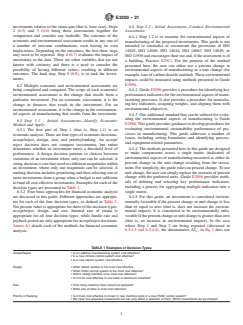
TABLE 1 Examples of Decision Types
Accept/Reject Is an additive manufacturing system cost effective?
Is a new climate control system cost effective?
Is a new robotic system cost effective
Design What robotic system is the most cost effective
What HVAC control system is the most cost effective?
Which milling machine is he most cost effective?
Is it more cost effective to use steel or aluminum materials?
Size How many machine tools should be replaced?
What size of lathe is most cost effective?
Priority or Ranking Is it more cost effective to invest in new machine tools or a new HVAC control system?
We have five proposed investments but can only afford a selection of them. Which investments do we choose?
E3200 − 21
TABLE 2 Appropriate Application of Financial Economic Methods
Payback Period and
Net Present Value Internal Rate of Return Hurdle Rate Discounted Payback
Period
A
Accept/Reject X X X X
B
Design X X . .
B
Size X X . .
Priority or Ranking X X . .
A
Note significant limitations
B
Appropriate when incremental discounted costs and benefits are considered (that is, the difference in costs/benefits between two investments). To decide between more
than two options, pairwise comparisons are necessary.
change. Moreover, in the first iteration, EI ' equals EI ; ments from multiple scenarios (or the same scenario) within a
a a
however, in subsequent iterations, they will not be equivalent. decision type. In the following sections, each decision type is
This is done so that one percentage point of environmental discussedwithreferencesmadetothescenariosinFig.2,along
impact always equals the same nominal amount throughout the withadecisiontreeforeachdecisiontype.Thescenariosinthe
evaluation. The percent change between two investment op- decision trees correspond with those in Fig. 2.
tions a and b can then be estimated: 6.5.2 Accept/Reject Decisions—If a decision is an accept/
reject decision for both the environmental and financial assess-
EI 2 EI
~ !
b a
PC 5 3100 (1)
ment (that is, scenarios 1.1 through 1.4), then the investment is
e
EI '
a
only acceptable if both assessments are accepted (see scenario
where:
1.1) and, therefore, no scenarios are compared. This process
PC = percent change in environmental impact between
can be traced in the decision tree in Fig. 3.
e
option a (that is, base case) and potential investment
6.5.3 Accept/Reject with Priority/Ranking Decision—If a
option b;
decision is a combination of accept/reject and ranking/priority
EI ' = environmental impact of the status quo (that is, initial
a (that is, scenarios 2.1 through 3.4), then all but two of the
base case), which does not change throughout the
scenarios are rejected, as seen in the decision trees in Figs. 4
evaluation;
and 5. There could be multiple investments categorized as
EI = environmental impact of investment option a; and
a scenario 2.1 or 3.1. If this is the case, then there is a
EI = environmental impact of investment option b.
b
comparison based on either the financial assessment (appli-
cable to scenario 2.1) or the environmental assessment (appli-
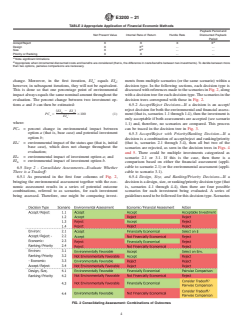
6.5 Step 2 - Consolidate Assessments—Evaluate Whether
There is a Tradeoff: cable to scenario 3.1).
6.5.1 As presented in the first four columns of Fig. 2, 6.5.4 Design, Size, and Ranking/Priority Decisions—If a
bringing the environmental assessment together with the eco- decisionisadesign,size,orranking/prioritydecisiontype(that
nomic assessment results in a series of potential outcome is, scenarios 4.1 through 4.4), then there are four possible
combinations, referred to as scenarios, for each investment scenarios for each investment being evaluated. A series of
being assessed. Therefore, one might be comparing invest- guidelinesneedtobefollowedforthisdecisiontype.Scenarios
FIG. 2 Consolidating Assessment: Combinations of Outcomes
E3200 − 21
FIG. 3 Decision Tree for Accept/Reject Decisions
FIG. 4 Decision Tree where Environmental Analysis is Accept/Reject Decision and Economic Analysis is Priority/Ranking Decision
where only one alternative to the status quo is considered (see environmental terms and economic terms (see scenario 4.1). In
Fig. 6) are considered separately from those that have two or this case, the alternative is preferred to the status quo. The
more alternatives (see Fig. 7). secondpotentialoutcomeisthatthealternativeisrankedworse
6.5.4.1 One Alternative—As seen in Fig. 6, there are three in both economic and environmental terms (see scenario 4.2).
potential outcomes for those instances where there is only one In this case, the status quo is preferred to the alternative being
alternative to the status quo. The first potential outcome is considered. The last potential outcome has a tradeoff when
when the alternative is ranked better than the status quo in both compared to the status quo (see scenarios 4.3 and 4.4). The
E3200 − 21
FIG. 5 Decision Tree where Economic Analysis is Accept/Reject Decision and Environmental Analysis is Priority/Ranking Decision
tradeoff involves one of two situations: (1) an economical investments then can be compared to determine where they
investment that increases environmental impact, or (2) an rank relative to the others.
investmentthatisnoteconomicalthatdecreasesenvironmental
6.5.4.4 Fig. 8 illustrates how investments are compared in a
impact. In this case, the user must decide whether the invest-
pairwise comparison. In this example, it was determined that
ment with the tradeoff is better or worse than the status quo.A
Investments A, B, and C were each preferred over the status
selection of tradeoff metrics is discussed in Step 3 shown in
quo. A second iteration compared Investment A with Invest-
6.6.
ment B, which resulted in determining thatAis preferred to B.
6.5.4.2 Two or More Alternatives—For instances where
A second iteration is needed to determine if Investment C is
there is more than one alternative to the status quo, the user
preferred toAor B, or both. Investment C can be compared to
st
follows the decision tree in Fig. 7. Similar to Fig. 6,ifan
InvestmentAto determine if it is ranked 1 . If Investment C is
investment is not economical, and it is not environmentally
not preferred to A, then it must be compared to Investment B
nd rd
favorable (scenario 4.2), then that investment is not preferred
to determine whether it is ranked 2 or 3 . Note that in the
to the status quo. Investments that are both economically and
case where Step 1 and Step 2 are being repeated, the
environmentally favorable must be compared in a pairwise
denominator, EI ',in Eq 1 from Step 1.2 (6.4) does not change
a
comparison, as discussed in 6.5.4.3. If there is a tradeoff
when using a percent change, as previously discussed.
(scenarios 4.3 and 4.4), then the user must determine if the
Moreover, in the first iteration EI ' equals EI ; however, in
a a
tradeoff is preferred to the status quo. A selection of tradeoff
subsequent iterations they will not be equivalent. This is done
metrics is discussed in Step 3 shown in 6.6. If the tradeoff is
so that one percentage point of environmental impact always
preferred, then a pairwise comparison must be made between
equals the same nominal amount of environmental impact
the other alternatives.
throughout the evaluation.
6.5.4.3 Pairwise Comparison—In the case where there are
6.6 Step 3 - Evaluate Tradeoff:
multiple alternative investments, it may be necessary to con-
6.6.1 A tradeoff exists when (1) a scenario includes an
duct a pairwise comparison where each investment is com-
investment that is not environmentally favorable but is finan-
pared relative to each of the other investments. The result will
cially economical, or(2) a scenario includes an investment that
rank all of the investments. This requires repeating Step 1 and
isnotfinanciallyeconomical,butisenvironmentallyfavorable.
Step 2, but only considering two investments at a time. In each
Each of these has a set of metrics for evaluation.
comparison, one investment is selected as the new status quo
(that is, a new base case) while the other investment is treated 6.6.2 Not Environmentally Favorable and Financially
as a potential alternative investment to the new status quo. Economical—There are four metrics for considering a tradeoff
EachofthecomparisonswillresultinusingFig.6todetermine where the investment is not environmentally favorable: maxi-
if the alternative is preferred to the new status quo.Additional mum impact, the net present value per percent change in
E3200 − 21
*These two boxes represent the same environmental analysis and not two separate or different analyses.
FIG. 6 Decision Tree for Design, Size, and Ranking/Priority Decisions, One Alternative
environmental impact (NPVP), environmental hurdle rate, and impact is positive (that is, an increase in the impact). If the
the net present value elasticity (NPVE). Each of these are
impact of the investment is greater than the maximum impact,
discussed in 6.6.4.1 through 6.6.4.6.
thentheinvestmentisrejectedorrankedlowerwhencompared
6.6.3 Not Financially Economical but Environmentally
to the status quo. For instance, if an investment increases the
Favorable—There are four metrics for considering a tradeoff
environmental impact by 10 %, and the maximum impact for
where the investment is not financially economical but is
the investor is 5 %, then the investment would be ranked lower
environmentally favorable: maximum environmental
than the status quo.
expenditure, maximum environmental expenditure rate
6.6.4.2 NPVP—This value is the average increase or de-
(MEER), NPVP, and the NPVE. Each of these metrics are
crease in income brought about by each percentage point
discussed in 6.6.4.1 through 6.6.4.6.
change (or unit change) in environmental impact. It is calcu-
6.6.4 The following sections discuss the tradeoff metrics,
lated as:
which are applicable to investments that are either (1) not
NPV
environmentally favorable and financially economical, or (2)
NPVP 5 (2)
not financially economic but environmentally favorable. PC
e
6.6.4.1 Maximum Impact—The maximum impact is the
where:
largest acceptable increase in environmental impact. It can
NPVP = net present value per percent increase in environ-
either be in percent or in units (for example, tons of CO ). It is
mental impact.
compared to the change in impact for the investment being
evaluated and is applicable when the change in environmental
E3200 − 21
*These two boxes represent the same environmental analysis and not two separate or different analyses.
FIG. 7 Decision Tree for Design, Size, and Ranking/Priority Decisions, Multiple Alternatives
FIG. 8 Illustration for Pairwise Comparison
This calculation is only used when there is a tradeoff tive (not financially economical but environmentally favor-
between cost effectiveness and environmental impact, which able). In the former situation, higher values are better, as this
occurs when both NPV and PC are both positive (financially represents income or cost savings. In the latter situation, lower
e
economical but not environmentally favorable) or both nega- values are better, as this represents expenditures.Values should
E3200 − 21
not be compared between these two categories, as one repre- that are financially economical but not environmentally favor-
sents an expenditure while the other represents income or cost able should not be compared with the NPVE for investments
savings. thatareenvironmentallyfavorablebutnotfinanciallyeconomi-
cal.
6.6.4.3 Environmental Hurdle Rate—The environmental
hurdle rate is a value selected by the decision-maker and
6.7 Step 4 - Sensitivity Analysis:
represents the net present value of income or cost savings
6.7.1 The techniques discussed in 6.1 through 6.6 are what
needed to compel a 1 % percent increase (or one-unit increase)
are known as deterministic techniques, meaning that there are
in environmental impact. It is applicable in the case where an
single values assumed for calculations incorporated into the
investment is financially economical but not environmentally
analysis. Deterministic techniques assume the manufacturer
favorable. If the investment’s NPVP exceeds the decision
knows with complete certainty all of the variables in the
maker’s environmental hurdle rate, then the investment is
relevant equation, whether they are future payment streams or
considered acceptable or ranked higher when compared to the
interest/discountrates.Everypartofeveryequationisassumed
status quo. For example, consider an investment with an NPVP
to be known with absolute confidence.
of $4500 per percent (or unit) increase in environmental
6.7.2 In most situations that a manufacturer faces, at least
impact. If the decision-maker has a $10 000 environmental
some of the values needed to make a decision are not be
hurdle rate, that is, they are willing to increase their environ-
completely transparent or may be known with only partial
mentalimpactby1 %inreturnfora$10 000increase,thenthis
certainty.
investment is not preferred.
6.7.3 To account for this uncertainty, the manufacturer can
6.6.4.4 Maximum Environmental Expenditure—The maxi-
turn to probabilistic techniques such as a sensitivity analysis.
mum environmental expenditure is the total amount the user is
Sensitivity analysis quantifies the change in results due to
willing to pay to reduce environmental impact after all other
variation in one or
...