

ASTM E2986-22
(Guide)Standard Guide for Evaluation of Environmental Aspects of Sustainability of Manufacturing Processes
General Information
- Abstract
SIGNIFICANCE AND USE
4.1 This guide provides a reference to the manufacturing community for the evaluation of environmental sustainability aspects of manufacturing processes. This guide is intended to improve efficiencies and consistencies of informal methods by providing procedures for consistent evaluations of manufacturing processes.
4.2 This guide describes a procedure to identify parameters and models for evaluating sustainability metrics for a particular process. Users of this guide will benefit from insight into the sustainability implications of selected processes as well as the contributing factors.
SCOPE
1.1 This guide provides guidance to develop manufacturer-specific procedures for evaluating the environmental sustainability performance of manufacturing processes. This guide introduces decision support methods that can be used to improve sustainability performance.
1.2 The scope of this guide is constrained by the manufacturing phase of the life cycle. The guide addresses specifics related to the processes and procedures within this phase.
1.3 This guide will allow manufacturers to make effective evaluations during plant and enterprise-wide decision-making within the manufacturing phase.
1.4 This guide focuses on environmental sustainability impacts, though social and economic impacts are not explicitly excluded.
1.5 This guide addresses:
1.5.1 Setting boundaries for the evaluation of environmental sustainability of a process or processes,
1.5.2 Identifying the process and equipment-related parameters necessary for environmental sustainability-driven process evaluation,
1.5.3 Creating process models using these parameters,
1.5.4 Utilizing process models to support consistent evaluations and sustainability-driven decision-making in a manufacturing enterprise.
Note 1: See ULE 880 for additional guidance at enterprise-level decision-making.
1.6 This guide may be used to complement other standards that address sustainability and the product life cycle. This guide most closely relates to the inventory component as discussed in the ISO 14040 series (ISO 14040, ISO 14044) standards, efficiency as discussed in the ISO 50000 series (ISO 50001) standards, and resource management as discussed in the ISO 55000 series (ISO 55001) standards.
1.7 The values stated in SI units are to be regarded as standard. No other units of measurement are included in this standard.
1.8 This standard does not purport to address all of the safety concerns, if any, associated with its use. It is the responsibility of the user of this standard to establish appropriate safety, health, and environmental practices and determine the applicability of regulatory limitations prior to use.
1.9 This international standard was developed in accordance with internationally recognized principles on standardization established in the Decision on Principles for the Development of International Standards, Guides and Recommendations issued by the World Trade Organization Technical Barriers to Trade (TBT) Committee.
- Status
- Published
- Publication Date
- 30-Apr-2022
- Technical Committee
- E60 - Sustainability
- Drafting Committee
- E60.13 - Sustainable Manufacturing
Buy Documents
ASTM E2986-22 - Standard Guide for Evaluation of Environmental Aspects of Sustainability of Manufacturing Processes
REDLINE ASTM E2986-22 - Standard Guide for Evaluation of Environmental Aspects of Sustainability of Manufacturing Processes
Overview
ASTM E2986-22 – Standard Guide for Evaluation of Environmental Aspects of Sustainability of Manufacturing Processes provides comprehensive guidance for manufacturers to evaluate and improve the environmental sustainability of their manufacturing processes. Developed by ASTM Committee E60 on Sustainability, this standard establishes procedures for consistent, manufacturer-specific evaluations, focusing on environmentally sustainable performance within the manufacturing phase of the product life cycle.
By introducing decision support methods and process evaluation models, ASTM E2986-22 helps organizations streamline their sustainability assessments, making them more efficient and comparable. While its primary focus is environmental impacts, the standard does not exclude related social and economic aspects, thereby supporting holistic sustainable manufacturing initiatives.
Key Topics
- Establishing Evaluation Boundaries: Define the physical or temporal limits of sustainability assessments at various scales, such as plant, process, or supply chain level.
- Identifying Processes and Parameters: Document manufacturing processes and equipment, gather engineering drawings, routing sheets, and operational data to support process identification.
- Selecting Sustainability Indicators and Metrics: Choose relevant environmental indicators (e.g., energy consumption, material efficiency) and corresponding metrics to evaluate performance.
- Developing Process Models: Create structured, repeatable models using process input/output data, supporting consistent and repeatable sustainability evaluations.
- Data Collection and Evaluation: Use standardized templates and measurement methods to collect and document data on inputs (materials, energy) and outputs (products, emissions, waste).
- Setting Targets and Baselines: Establish objective targets based on reference or baseline data to support progressive sustainability improvement.
- Decision-Making Approaches: Apply techniques like simulation, optimization, what-if analysis, and normalization to analyze results and guide sustainability-driven decisions.
- Reporting and Documentation: Effectively communicate results, establish baselines for future assessments, and facilitate knowledge sharing and training.
Applications
ASTM E2986-22 can be practically applied across a broad range of manufacturing organizations seeking to enhance environmental sustainability within their operations. Key applications include:
- Plant-Level Sustainability Assessments: Evaluate energy usage, material efficiency, and emissions to identify and prioritize improvement opportunities at the plant or enterprise level.
- Process Optimization: Use process models and collected data to simulate or optimize manufacturing processes for reduced environmental impact and resource consumption.
- Regulatory Compliance and Reporting: Provide robust documentation for environmental audits, regulatory submissions, or reporting against sustainability benchmarks.
- Continuous Improvement Initiatives: Establish baselines and targets for specific indicators (e.g., kWh per unit produced, percentage of material recycled) to drive ongoing improvement programs.
- Supply Chain Integration: Assess upstream and downstream environmental impacts by collecting data across the supply chain, fostering collaboration and transparency.
- Staff Training and Stakeholder Engagement: Utilize evaluation results and documentation for internal training or external communication to build awareness and commitment to sustainability goals.
Related Standards
To achieve comprehensive sustainability and integrate best practices, organizations should consider using ASTM E2986-22 alongside other recognized standards:
- ISO 14001 – Environmental management systems - Requirements with guidance
- ISO 14040 / ISO 14044 – Life cycle assessment - Principles, framework, and requirements
- ISO 50001 – Energy management systems - Requirements
- ISO 55001 – Asset management - Management systems
- ULE 880 – Sustainability for Manufacturing Organizations (for enterprise-level guidance)
- ASTM E2114 / E2987 – Terminology for sustainable manufacturing and buildings
Keywords: environmental sustainability, process evaluation, sustainable manufacturing, ASTM E2986-22, manufacturing process assessment, sustainability metrics, environmental indicators, process modeling, decision support, resource management
By aligning manufacturing operations with ASTM E2986-22, organizations can consistently evaluate, improve, and report on the environmental sustainability of their processes, supporting regulatory compliance, operational efficiency, and enhanced market reputation.
Relations
- Effective Date
- 15-Jun-2019
- Effective Date
- 01-Oct-2018
- Effective Date
- 15-Oct-2017
- Refers
ASTM E2114-17 - Standard Terminology for Sustainability Relative to the Performance of Buildings - Effective Date
- 01-Feb-2017
- Effective Date
- 01-Feb-2016
- Effective Date
- 15-Apr-2011
- Effective Date
- 01-Dec-2009
- Refers
ASTM E2114-08 - Standard Terminology for Sustainability Relative to the Performance of Buildings - Effective Date
- 01-Nov-2008
- Refers
ASTM E2114-06a - Standard Terminology for Sustainability Relative to the Performance of Buildings - Effective Date
- 01-Dec-2006
- Refers
ASTM E2114-06 - Standard Terminology for Sustainability Relative to the Performance of Buildings - Effective Date
- 15-Feb-2006
- Refers
ASTM E2114-05a - Standard Terminology for Sustainability Relative to the Performance of Buildings - Effective Date
- 01-Jun-2005
- Refers
ASTM E2114-05 - Standard Terminology for Sustainability Relative to the Performance of Buildings - Effective Date
- 01-Feb-2005
- Refers
ASTM E2114-04 - Standard Terminology for Sustainability Relative to the Performance of Buildings - Effective Date
- 01-Dec-2004
- Effective Date
- 01-Dec-2003
- Refers
ASTM E2114-00a - Standard Terminology for Sustainability Relative to the Performance of Buildings - Effective Date
- 10-Feb-2001
Buy Documents
ASTM E2986-22 - Standard Guide for Evaluation of Environmental Aspects of Sustainability of Manufacturing Processes
REDLINE ASTM E2986-22 - Standard Guide for Evaluation of Environmental Aspects of Sustainability of Manufacturing Processes
Get Certified
Connect with accredited certification bodies for this standard

BSI Group
BSI (British Standards Institution) is the business standards company that helps organizations make excellence a habit.

Bureau Veritas
Bureau Veritas is a world leader in laboratory testing, inspection and certification services.

DNV
DNV is an independent assurance and risk management provider.
Sponsored listings
Frequently Asked Questions
ASTM E2986-22 is a guide published by ASTM International. Its full title is "Standard Guide for Evaluation of Environmental Aspects of Sustainability of Manufacturing Processes". This standard covers: SIGNIFICANCE AND USE 4.1 This guide provides a reference to the manufacturing community for the evaluation of environmental sustainability aspects of manufacturing processes. This guide is intended to improve efficiencies and consistencies of informal methods by providing procedures for consistent evaluations of manufacturing processes. 4.2 This guide describes a procedure to identify parameters and models for evaluating sustainability metrics for a particular process. Users of this guide will benefit from insight into the sustainability implications of selected processes as well as the contributing factors. SCOPE 1.1 This guide provides guidance to develop manufacturer-specific procedures for evaluating the environmental sustainability performance of manufacturing processes. This guide introduces decision support methods that can be used to improve sustainability performance. 1.2 The scope of this guide is constrained by the manufacturing phase of the life cycle. The guide addresses specifics related to the processes and procedures within this phase. 1.3 This guide will allow manufacturers to make effective evaluations during plant and enterprise-wide decision-making within the manufacturing phase. 1.4 This guide focuses on environmental sustainability impacts, though social and economic impacts are not explicitly excluded. 1.5 This guide addresses: 1.5.1 Setting boundaries for the evaluation of environmental sustainability of a process or processes, 1.5.2 Identifying the process and equipment-related parameters necessary for environmental sustainability-driven process evaluation, 1.5.3 Creating process models using these parameters, 1.5.4 Utilizing process models to support consistent evaluations and sustainability-driven decision-making in a manufacturing enterprise. Note 1: See ULE 880 for additional guidance at enterprise-level decision-making. 1.6 This guide may be used to complement other standards that address sustainability and the product life cycle. This guide most closely relates to the inventory component as discussed in the ISO 14040 series (ISO 14040, ISO 14044) standards, efficiency as discussed in the ISO 50000 series (ISO 50001) standards, and resource management as discussed in the ISO 55000 series (ISO 55001) standards. 1.7 The values stated in SI units are to be regarded as standard. No other units of measurement are included in this standard. 1.8 This standard does not purport to address all of the safety concerns, if any, associated with its use. It is the responsibility of the user of this standard to establish appropriate safety, health, and environmental practices and determine the applicability of regulatory limitations prior to use. 1.9 This international standard was developed in accordance with internationally recognized principles on standardization established in the Decision on Principles for the Development of International Standards, Guides and Recommendations issued by the World Trade Organization Technical Barriers to Trade (TBT) Committee.
SIGNIFICANCE AND USE 4.1 This guide provides a reference to the manufacturing community for the evaluation of environmental sustainability aspects of manufacturing processes. This guide is intended to improve efficiencies and consistencies of informal methods by providing procedures for consistent evaluations of manufacturing processes. 4.2 This guide describes a procedure to identify parameters and models for evaluating sustainability metrics for a particular process. Users of this guide will benefit from insight into the sustainability implications of selected processes as well as the contributing factors. SCOPE 1.1 This guide provides guidance to develop manufacturer-specific procedures for evaluating the environmental sustainability performance of manufacturing processes. This guide introduces decision support methods that can be used to improve sustainability performance. 1.2 The scope of this guide is constrained by the manufacturing phase of the life cycle. The guide addresses specifics related to the processes and procedures within this phase. 1.3 This guide will allow manufacturers to make effective evaluations during plant and enterprise-wide decision-making within the manufacturing phase. 1.4 This guide focuses on environmental sustainability impacts, though social and economic impacts are not explicitly excluded. 1.5 This guide addresses: 1.5.1 Setting boundaries for the evaluation of environmental sustainability of a process or processes, 1.5.2 Identifying the process and equipment-related parameters necessary for environmental sustainability-driven process evaluation, 1.5.3 Creating process models using these parameters, 1.5.4 Utilizing process models to support consistent evaluations and sustainability-driven decision-making in a manufacturing enterprise. Note 1: See ULE 880 for additional guidance at enterprise-level decision-making. 1.6 This guide may be used to complement other standards that address sustainability and the product life cycle. This guide most closely relates to the inventory component as discussed in the ISO 14040 series (ISO 14040, ISO 14044) standards, efficiency as discussed in the ISO 50000 series (ISO 50001) standards, and resource management as discussed in the ISO 55000 series (ISO 55001) standards. 1.7 The values stated in SI units are to be regarded as standard. No other units of measurement are included in this standard. 1.8 This standard does not purport to address all of the safety concerns, if any, associated with its use. It is the responsibility of the user of this standard to establish appropriate safety, health, and environmental practices and determine the applicability of regulatory limitations prior to use. 1.9 This international standard was developed in accordance with internationally recognized principles on standardization established in the Decision on Principles for the Development of International Standards, Guides and Recommendations issued by the World Trade Organization Technical Barriers to Trade (TBT) Committee.
ASTM E2986-22 is classified under the following ICS (International Classification for Standards) categories: 03.100.01 - Company organization and management in general. The ICS classification helps identify the subject area and facilitates finding related standards.
ASTM E2986-22 has the following relationships with other standards: It is inter standard links to ASTM E2629-19, ASTM E2987/E2987M-18, ASTM E2987/E2987M-17, ASTM E2114-17, ASTM E2987/E2987M-16, ASTM E2629-11, ASTM E1808-96(2009), ASTM E2114-08, ASTM E2114-06a, ASTM E2114-06, ASTM E2114-05a, ASTM E2114-05, ASTM E2114-04, ASTM E1808-96(2003), ASTM E2114-00a. Understanding these relationships helps ensure you are using the most current and applicable version of the standard.
ASTM E2986-22 is available in PDF format for immediate download after purchase. The document can be added to your cart and obtained through the secure checkout process. Digital delivery ensures instant access to the complete standard document.
Standards Content (Sample)
This international standard was developed in accordance with internationally recognized principles on standardization established in the Decision on Principles for the
Development of International Standards, Guides and Recommendations issued by the World Trade Organization Technical Barriers to Trade (TBT) Committee.
Designation: E2986 − 22
Standard Guide for
Evaluation of Environmental Aspects of Sustainability of
Manufacturing Processes
This standard is issued under the fixed designation E2986; the number immediately following the designation indicates the year of
original adoption or, in the case of revision, the year of last revision. A number in parentheses indicates the year of last reapproval. A
superscript epsilon (´) indicates an editorial change since the last revision or reapproval.
1. Scope 1.7 The values stated in SI units are to be regarded as
standard. No other units of measurement are included in this
1.1 This guide provides guidance to develop manufacturer-
standard.
specific procedures for evaluating the environmental sustain-
1.8 This standard does not purport to address all of the
ability performance of manufacturing processes. This guide
safety concerns, if any, associated with its use. It is the
introduces decision support methods that can be used to
responsibility of the user of this standard to establish appro-
improve sustainability performance.
priate safety, health, and environmental practices and deter-
1.2 The scope of this guide is constrained by the manufac-
mine the applicability of regulatory limitations prior to use.
turing phase of the life cycle. The guide addresses specifics
1.9 This international standard was developed in accor-
related to the processes and procedures within this phase.
dance with internationally recognized principles on standard-
1.3 This guide will allow manufacturers to make effective
ization established in the Decision on Principles for the
evaluations during plant and enterprise-wide decision-making
Development of International Standards, Guides and Recom-
within the manufacturing phase.
mendations issued by the World Trade Organization Technical
Barriers to Trade (TBT) Committee.
1.4 This guide focuses on environmental sustainability
impacts, though social and economic impacts are not explicitly
2. Referenced Documents
excluded.
2.1 ASTM Standards:
1.5 This guide addresses:
E1808 Guide for Designing and Conducting Visual Experi-
1.5.1 Settingboundariesfortheevaluationofenvironmental
ments
sustainability of a process or processes,
E2114 Terminology for Sustainability Relative to the Perfor-
1.5.2 Identifying the process and equipment-related param-
mance of Buildings
eters necessary for environmental sustainability-driven process
E2629 Guide for Verification of ProcessAnalytical Technol-
evaluation,
ogy (PAT) Enabled Control Systems
1.5.3 Creating process models using these parameters,
E2987/E2987M Terminology for Sustainable Manufacturing
1.5.4 Utilizing process models to support consistent evalu-
2.2 ISO Standards:
ations and sustainability-driven decision-making in a manufac-
ISO 14001 Environmental management systems -- Require-
turing enterprise.
ments with guidance for use
NOTE 1—See ULE 880 for additional guidance at enterprise-level
ISO 14040 Environmental management -- Life cycle assess-
decision-making.
ment -- Principles and framework
1.6 This guide may be used to complement other standards
ISO 14044 Environmental management -- Life cycle assess-
that address sustainability and the product life cycle. This
ment -- Requirements and guidelines
guide most closely relates to the inventory component as
ISO 50001 Energy management
discussed in the ISO 14040 series (ISO 14040, ISO 14044)
ISO 55001 Asset management -- Management systems --
standards, efficiency as discussed in the ISO 50000 series (ISO
Requirements
50001) standards, and resource management as discussed in
the ISO 55000 series (ISO 55001) standards.
1 2
This guide is under the jurisdiction ofASTM Committee E60 on Sustainability For referenced ASTM standards, visit the ASTM website, www.astm.org, or
and is the direct responsibility of Subcommittee E60.13 on Sustainable Manufac- contact ASTM Customer Service at service@astm.org. For Annual Book of ASTM
turing. Standards volume information, refer to the standard’s Document Summary page on
Current edition approved May 1, 2022. Published May 2022. Originally the ASTM website.
approved in 2015. Last previous edition approved in 2018 as E2986–18. DOI: Available fromAmerican National Standards Institute (ANSI), 25 W. 43rd St.,
10.1520/E2986-22. 4th Floor, New York, NY 10036, http://www.ansi.org.
Copyright © ASTM International, 100 Barr Harbor Drive, PO Box C700, West Conshohocken, PA 19428-2959. United States
E2986 − 22
2.3 UL Standard: Indicators can be defined internally, or can be selected from
ULE 880 Sustainability for Manufacturing Organizations various indicator repositories.
5.3.2 Indicators are selected based on the sustainability
3. Terminology
objective, such as energy consumption for efficiency or CO
3.1 For definitions of terms used in this guide, refer to equivalent emissions for climate considerations. Factors that
Terminologies E2114 and E2987/E2987M. may influence indicator selection include the type of product,
type of process, type of resource, quantity of resource, final
3.2 Definitions of Terms Specific to This Standard:
reporting format, budget, approvals required, market, time
3.2.1 manufacturing resource, n—any equipment,
availability, or other external guidelines.
personnel, fixtures, gages, tooling, external accessories, soft-
5.3.3 An indicator is characterized by the following attri-
ware and control programs, and required operational settings
butes:
used in manufacturing a product.
5.3.3.1 Name—The word(s) for the distinctive designation
3.2.2 metric, n—measurable quantity on which processes
of an indicator.
are evaluated and/or compared.
5.3.3.2 Definition—The statement expressing the essential
3.2.2.1 Discussion—Forinstance,CO equivalentemissions
characteristics and function of an indicator.
in metric tons or total energy consumption in kWh. Metrics
5.3.3.3 Measurement Type—The type of an indicator (quan-
provide a measure for which indicators can be evaluated.
titative or qualitative).
3.2.3 process model, n—structured representation of the
5.3.3.4 Unit of Measure—The unit value of the indicator.
information associated with a manufacturing process.
5.3.3.5 References—Citable documents of existing indicator
3.2.3.1 Discussion—See Guide E2629 for process models
set(s) or specific indicator(s), based on which an indicator is
specific to material use.
adopted from existing set(s) or newly developed.
5.3.3.6 Application Level—The level in a hierarchical orga-
4. Significance and Use
nization at which the indicator is applied.
4.1 This guide provides a reference to the manufacturing
5.3.4 Using this information, an organization may also set
community for the evaluation of environmental sustainability
up their own sustainability indicators based on their business
aspects of manufacturing processes. This guide is intended to
strategies.
improve efficiencies and consistencies of informal methods by
providing procedures for consistent evaluations of manufactur- 5.4 Identifying Process(es):
ing processes.
5.4.1 Process identification establishes the specific process
or set of processes that contribute to the identified indicator.
4.2 This guide describes a procedure to identify parameters
5.4.2 Processidentificationshouldbeguidedthroughtheset
andmodelsforevaluatingsustainabilitymetricsforaparticular
objectives and the associated indicators selected.
process. Users of this guide will benefit from insight into the
5.4.3 The process or set of processes under evaluation
sustainability implications of selected processes as well as the
should fall within the governing process or production plan.
contributing factors.
The order in which a process is selected or an objective is
5. Method for Manufacturing Process Evaluation
determined will vary depending on the production plan and
organizational goals.
5.1 To evaluate the sustainability of manufacturing pro-
5.4.4 Relevant documentation should be collected and may
cesses for improvement, organizations need to develop and
include:
implement a consistent, organization-wide sustainability mea-
5.4.4.1 Engineering drawings.
surement process. The following sections provide guidelines
for such a process. 5.4.4.2 Routing sheets with several processes.
5.4.4.3 Safety data sheets.
5.2 Setting Sustainability Objective:
5.4.4.4 Quality control plans that provide product and pro-
5.2.1 Sustainabilityassessmentstartswithastatementofthe
cess specifications.
sustainability goals, including the area of opportunity to be
5.4.4.5 Setup sheets for individual machines. Setup sheets
addressed. In this step, an organization identifies the opportu-
include the operating parameters of the machine.
nities from several perspectives: organizational,
environmental, external and internal stakeholders.
5.5 Identifying Evaluation Metrics:
5.5.1 Evaluation metrics associate the process or processes
NOTE 2—To define the objective(s), various methods for data collection
and analysis can be used, such as interviewing managers, sustainability
to be evaluated with the identified indicator. Metrics provide a
auditors, the study of past sustainability reports of the organization, or
measure for which indicators can be evaluated.
various external guidelines.
5.5.2 Evaluation metrics are dependent on the selected
5.3 Identifying Indicator:
indicator (example: waste for material efficiency and energy
5.3.1 Indicators provide a context to measure, analyze, and
usage for energy efficiency), the equipment and processes
score the sustainability aspects of manufacturing processes.
being evaluated, and the availability of data.
5.5.3 Evaluation metric identification should take into con-
4 siderationthecapabilitiesandlimitationsofavailablemeasure-
Available from UL, 333 Pfingsten Road, Northbrook, IL 60062-2096, http://
www.ul.com. ment equipment.
E2986 − 22
NOTE 3—Identifying the appropriate metric is important, as the metric
5.6.3.1 The identification of unit manufacturing processes
may influence the boundary conditions of the evaluation process and the
will (1) determine where measurements should be taken in
uncertainty of the results.
order to calculate process-specific metrics, and (2) provide
5.6 Setting Boundary Conditions:
boundaries for analytical models that can be developed using
5.6.1 Boundary conditions limit the scope and constrain the well-defined unit manufacturing processes.
extent of the evaluation. Boundary conditions may include the
5.6.3.2 Production processes can consist of multiple unit
physical boundaries associated with identified equipment or
manufacturing processes. In these scenarios, the sustainability
time-related boundaries. Physical boundaries may be refined
performanceofamanufacturingprocesscanbeevaluatedasan
depending on the definitions of the unit manufacturing pro-
aggregation of the performance of unit manufacturing pro-
cesses. Time-related boundary conditions establish the period
cesses. The unit manufacturing processes identified within the
of time for which measurements are taken or evaluation results
established boundary conditions should either directly or
are valid.
indirectly relate to the chosen indicator.
5.6.1.1 The production plan associated with the process or
5.6.3.3 Examples of boundary conditions that should be
processes of interest will outline and establish the boundaries.
considered at the unit manufacturing process level include:
Boundaries of the evaluation may be set at the supply chain,
(a) Identifying useful energy, that is, the energy consumed
the company, the plant level, or within the plant at the
in making the part or product.
manufacturing process level.
(b) Incorporating waste heat generated during processing.
5.6.1.2 A manufacturing process can be described as a
(c) Distinguishing material removed from a part or product
system that consists of multiple subprocesses within the
as waste or recycled.
boundaries. A simple boundary example consists of a single
(d) Evaluating sub-processes within the process at efficien-
unit manufacturing process and the designated manufacturing
cies other than 100 % efficient.
equipment.
5.6.4 Supply Chain Considerations:
5.6.1.3 An example boundary application on a system is the
5.6.4.1 Production planning may consider manufacturing
assembly of a hand-held power tool. The boundary will
resources outside of the plant through an established supply
determine how the unit is characterized, for instance, a
chain. The boundary conditions of the supply chain must be
boundarymaybeplacedaroundtheentireassemblyprocessfor
carefully considered. Resource data can be collected from
the power tool, or the boundary may be placed around a
outside plants along the supply chain.
subassembly of the power tool.
5.6.4.2 It is possible to include external data from down-
5.6.2 Establishing Process Boundaries:
stream and upstream processes, that is, consideration of the
5.6.2.1 The production plan may include handling and
emissions associated with the electricity used by the processes.
storage activities associated with the production process, thus
5.6.4.3 It is important that wherever boundaries are created
including the peripheral equipment and storage facility. Ex-
that they remain consistent throughout the evaluation process.
amples include the material handling systems used to transport
5.7 Identifying Input and Output Parameters:
work-in-process (WIP) between manufacturing processes, the
5.7.1 Each unit manufacturing process has one or more
racks and storage for WIP and inventory, and a portion of the
heating and cooling of the facility. The organization may input and output parameters associated with it. Input param-
eters are those parameters that feed into the process. Output
choose not to include the peripheral equipment and storage
facility in the study. parameters are those parameters that can be used to calculate
the indicators used to evaluate manufacturing sustainability.
5.6.2.2 Examples of boundary conditions that should be
considered:
5.7.2 Input and output parameters may be associated with
(a) Upstream and downstream information from the supply materials, energy, or intermediate products used to manufac-
chain. ture a product and produce other non-product outputs, by-
(b) Materials handling between processes. products, and other non-product substances and emissions that
(c) Allocation of energy consumption in the facility (for result from a manufacturing process.
example, heating, ventilation, and air conditioning-HVAC).
5.7.3 Input and output parameters for processes are pro-
(d) Impact of peak versus off peak energy consumption.
vided in documentation such as engineering drawings, routing
(e) Process monitoring at the machine level.
plans or schematics, setup sheets, and quality control plans.
5.6.2.3 Indicators and corresponding metrics will influence
5.7.4 Parameter values can be measured, estimated, or
how boundary conditions are defined. For example, when
calculated. Data collection techniques are important when
evaluating for material efficiency, boundary conditions may be
measuring the inputs and outputs (See 6.2).
affected by considerations such as use of co-products, by-
5.8 Creating a Process Model:
products, reworked, recycled or scrap material. When evaluat-
5.8.1 Process models are used to represent a process or set
ing for energy efficiency, considerations may include
ofprocesses.Processmodelscanincludetherequiredanalytics
cogeneration, alternate sources of energy, energy audits, or
to support repeatable evaluations of a manufacturing process.
reclamation of waste energy from processes (that is, using
exhaust heat from one process as energy input for a different
NOTE 4—Process models may be empirical or theoretical. A process
process).
model may include, or be aggregated of, both empirical and theoretical
5.6.3 Establishing Unit Manufacturing Processes: models.
E2986 − 22
5.8.2 When creating a process model, the information and 6.2 Data Collection Methods:
analytics that describe the manufacturing processes often differ 6.2.1 Data collection can be performed at different levels of
depending on operational modes and conditions (for example,
granularity for a given range of metrics. Different scales used
high and low speeds). Empirical models developed to simulate include: nominal scale, ordinal scale, interval scale and ratio
any process could consider such differences or be described
scale.
otherwise.
NOTE 6—See Section 8 Scaling Methods in Guide E1808 for further
5.8.3 An input-process-output model (Fig. 1) relates input
clarification. The scale will depend on the level at which the evaluation is
and output metrics, and their unit of measure (UOM), for each
needed: factory, production plan, workstation, machine, or machine
process in the production plan. component level. The methods chosen for data collection may vary
depending on factors such as desired scale, equipment, resources, and
5.8.4 The input and output parameters of the process model
desired degree of certainty. The data collection method chosen will
will correspond with those identified as input and output
influence the overall uncertainty of process model results.
parameters when establishing the boundaries of the system.
6.2.2 Different types of measurement methods include:
The input and output parameters of a process model will be a
6.2.2.1 Direct measurement method: In this method, the
combinationoftheinputandoutputparametersassociatedwith
parameter measurement is taken directly from a source ma-
the boundaries of the system, the input and output parameters
chine or component.
of other unit manufacturing processes within the system, and
6.2.2.2 Theoreticalcomputationmethod:Inthismethod,the
the indicator for which the system is being evaluated.
parameter is calculated based on physical equations, such as
5.8.5 Once necessary system parameters have been
those used in characterizing process models.
determined, and the analytical models for the manufacturing
process identified, an input/output process model can be 6.2.2.3 Estimation method: In this method, measurements
are taken at a scale more abstract than the target. With
developed. The resulting process model will allow for a
repeatable evaluation of the manufacturing process for the estimates, care must be taken to account for outside influences.
identified sustainability metric.
6.3 Data Collection Templates:
5.8.6 A composite process model may be formulated
...
This document is not an ASTM standard and is intended only to provide the user of an ASTM standard an indication of what changes have been made to the previous version. Because
it may not be technically possible to adequately depict all changes accurately, ASTM recommends that users consult prior editions as appropriate. In all cases only the current version
of the standard as published by ASTM is to be considered the official document.
Designation: E2986 − 18 E2986 − 22
Standard Guide for
Evaluation of Environmental Aspects of Sustainability of
Manufacturing Processes
This standard is issued under the fixed designation E2986; the number immediately following the designation indicates the year of
original adoption or, in the case of revision, the year of last revision. A number in parentheses indicates the year of last reapproval. A
superscript epsilon (´) indicates an editorial change since the last revision or reapproval.
1. Scope
1.1 This guide provides guidance to develop manufacturer-specific procedures for evaluating the environmental sustainability
performance of manufacturing processes. This guide introduces decision support methods that can be used to improve
sustainability performance.
1.2 The scope of this guide is constrained by the manufacturing phase of the life cycle. The guide addresses specifics related to
the processes and procedures within this phase.
1.3 This guide will allow manufacturers to make effective evaluations during plant and enterprise-wide decision-making within
the manufacturing phase.
1.4 This guide focuses on environmental sustainability impacts, though social and economic impacts are not explicitly excluded.
1.5 This guide addresses:
1.5.1 Setting boundaries for the evaluation of environmental sustainability of a process or processes,
1.5.2 Identifying the process and equipment-related parameters necessary for environmental sustainability-driven process
evaluation,
1.5.3 Creating process models using these parameters,
1.5.4 Utilizing process models to support consistent evaluations and sustainability-driven decision-making in a manufacturing
enterprise.
NOTE 1—See ULE 880 for additional guidance at enterprise-level decision-making.
1.6 This guide may be used to complement other standards that address sustainability and the product life cycle. This guide most
closely relates to the inventory component as discussed in the ISO 14040 series (ISO 14040, ISO 14044) standards, efficiency as
discussed in the ISO 50000 series (ISO 50001) standards, and resource management as discussed in the ISO 55000 series (ISO
55001) standards.
This guide is under the jurisdiction of ASTM Committee E60 on Sustainability and is the direct responsibility of Subcommittee E60.13 on Sustainable Manufacturing.
Current edition approved Nov. 1, 2018May 1, 2022. Published November 2018May 2022. Originally approved in 2015. Last previous edition approved in 20152018 as
E2986–15.–18. DOI: 10.1520/E2986–18.10.1520/E2986-22.
Copyright © ASTM International, 100 Barr Harbor Drive, PO Box C700, West Conshohocken, PA 19428-2959. United States
E2986 − 22
1.7 The values stated in SI units are to be regarded as standard. No other units of measurement are included in this standard.
1.8 This standard does not purport to address all of the safety concerns, if any, associated with its use. It is the responsibility
of the user of this standard to establish appropriate safety, health, and environmental practices and determine the applicability of
regulatory limitations prior to use.
1.9 This international standard was developed in accordance with internationally recognized principles on standardization
established in the Decision on Principles for the Development of International Standards, Guides and Recommendations issued
by the World Trade Organization Technical Barriers to Trade (TBT) Committee.
2. Referenced Documents
2.1 ASTM Standards:
E1808 Guide for Designing and Conducting Visual Experiments
E2114 Terminology for Sustainability Relative to the Performance of Buildings
E2629 Guide for Verification of Process Analytical Technology (PAT) Enabled Control Systems
E2987/E2987M Terminology for Sustainable Manufacturing
2.2 ISO Standards:
ISO 14001 Environmental management systems -- Requirements with guidance for use
ISO 14040 Environmental management -- Life cycle assess-
ment -- Principles and framework
ISO 14044 Environmental management -- Life cycle assess-
ment -- Requirements and guidelines
ISO 50001 Energy management
ISO 55001 Asset management -- Management systems -- Requirements
2.3 UL Standard:
ULE 880 Sustainability for Manufacturing Organizations
3. Terminology
3.1 Definitions For definitions of terms shall be in accordance with Terminology used in this guide, refer to Terminologies E2114
and E2987/E2987M.
3.2 Definitions of Terms Specific to This Standard:
3.2.1 indicator, n—quantitative value or qualitative information derived from a set of parameters that provides information about
the state of a phenomenon.
3.2.1.1 Discussion—
An example of a common indicator is CO equivalent emissions.
3.2.1.2 Discussion—
An indicator can be used as a reference for decision-making.
3.2.1.3 Discussion—
This definition is consistent with the definition in Terminology E2114.
3.2.1 manufacturing resource, n—any equipment, personnel, fixtures, gages, tooling, external accessories, software and control
programs, and required operational settings used in manufacturing a product.
3.2.2 metric, n—measurable quantity on which processes are evaluated and/or compared.
3.2.2.1 Discussion—
For instance, CO equivalent emissions in metric tons or total energy consumption in kWh. Metrics provide a measure for which
indicators can be evaluated.
3.2.3 process model, n—structured representation of the information associated with a manufacturing process.
For referenced ASTM standards, visit the ASTM website, www.astm.org, or contact ASTM Customer Service at service@astm.org. For Annual Book of ASTM Standards
volume information, refer to the standard’s Document Summary page on the ASTM website.
Available from American National Standards Institute (ANSI), 25 W. 43rd St., 4th Floor, New York, NY 10036, http://www.ansi.org.
Available from UL, 333 Pfingsten Road, Northbrook, IL 60062-2096, http://www.ul.com.
E2986 − 22
3.2.3.1 Discussion—
See Guide E2629 for process models specific to material use.
3.2.5 unit manufacturing process, n—equipment and associated operations that provide fundamental manufacturing functionality
for making or modifying a part, assembly, or product.
3.2.5.1 Discussion—
The unit manufacturing process may consist of one or more tightly integrated operations yet further decomposition of process
functionality would compromise the accuracy and application of the model.
4. Significance and Use
4.1 This guide provides a reference to the manufacturing community for the evaluation of environmental sustainability aspects of
manufacturing processes. This guide is intended to improve efficiencies and consistencies of informal methods by providing
procedures for consistent evaluations of manufacturing processes.
4.2 This guide describes a procedure to identify parameters and models for evaluating sustainability metrics for a particular
process. Users of this guide will benefit from insight into the sustainability implications of selected processes as well as the
contributing factors.
5. Method for Manufacturing Process Evaluation
5.1 To evaluate the sustainability of manufacturing processes for improvement, organizations need to develop and implement a
consistent, organization-wide sustainability measurement process. The following sections provide guidelines for such a process.
5.2 Setting Sustainability Objective:
5.2.1 Sustainability assessment starts with a statement of the sustainability goals, including the area of opportunity to be addressed.
In this step, an organization identifies the opportunities from several perspectives: organizational, environmental, external and
internal stakeholders.
NOTE 2—To define the objective(s), various methods for data collection and analysis can be used, such as interviewing managers, sustainability auditors,
the study of past sustainability reports of the organization, or various external guidelines.
5.3 Identifying Indicator:
5.3.1 Indicators provide a context to measure, analyze, and score the sustainability aspects of manufacturing processes. Indicators
can be defined internally, or can be selected from various indicator repositories.
5.3.2 Indicators are selected based on the sustainability objective, such as energy consumption for efficiency or CO equivalent
emissions for climate considerations. Factors that may influence indicator selection include the type of product, type of process,
type of resource, quantity of resource, final reporting format, budget, approvals required, market, time availability, or other external
guidelines.
5.3.3 An indicator is characterized by the following attributes:
5.3.3.1 Name—The word(s) for the distinctive designation of an indicator.
5.3.3.2 Definition—The statement expressing the essential characteristics and function of an indicator.
5.3.3.3 Measurement Type—The type of an indicator (quantitative or qualitative).
5.3.3.4 Unit of Measure—The unit value of the indicator.
5.3.3.5 References—Citable documents of existing indicator set(s) or specific indicator(s), based on which an indicator is adopted
from existing set(s) or newly developed.
5.3.3.6 Application Level—The level in a hierarchical organization at which the indicator is applied.
E2986 − 22
5.3.4 Using this information, an organization may also set up their own sustainability indicators based on their business strategies.
5.4 Identifying Process(es):
5.4.1 Process identification establishes the specific process or set of processes that contribute to the identified indicator.
5.4.2 Process identification should be guided through the set objectives and the associated indicators selected.
5.4.3 The process or set of processes under evaluation should fall within the governing process or production plan. The order in
which a process is selected or an objective is determined will vary depending on the production plan and organizational goals.
5.4.4 Relevant documentation should be collected and may include:
5.4.4.1 Engineering drawings.
5.4.4.2 Routing sheets with several processes.
5.4.4.3 Safety data sheets.
5.4.4.4 Quality control plans that provide product and process specifications.
5.4.4.5 Setup sheets for individual machines. Setup sheets include the operating parameters of the machine.
5.5 Identifying Evaluation Metrics:
5.5.1 Evaluation metrics associate the process or processes to be evaluated with the identified indicator. Metrics provide a measure
for which indicators can be evaluated.
5.5.2 Evaluation metrics are dependent on the selected indicator (example: waste for material efficiency and energy usage for
energy efficiency), the equipment and processes being evaluated, and the availability of data.
5.5.3 Evaluation metric identification should take into consideration the capabilities and limitations of available measurement
equipment.
E2986 − 22
NOTE 3—Identifying the appropriate metric is important, as the metric may influence the boundary conditions of the evaluation process and the uncertainty
of the results.
5.6 Setting Boundary Conditions:
5.6.1 Boundary conditions limit the scope and constrain the extent of the evaluation. Boundary conditions may include the
physical boundaries associated with identified equipment or time-related boundaries. Physical boundaries may be refined
depending on the definitions of the unit manufacturing processes. Time-related boundary conditions establish the period of time
for which measurements are taken or evaluation results are valid.
5.6.1.1 The production plan associated with the process or processes of interest will outline and establish the boundaries.
Boundaries of the evaluation may be set at the supply chain, the company, the plant level, or within the plant at the manufacturing
process level.
5.6.1.2 A manufacturing process can be described as a system that consists of multiple subprocesses within the boundaries. A
simple boundary example consists of a single unit manufacturing process and the designated manufacturing equipment.
5.6.1.3 An example boundary application on a system is the assembly of a hand-held power tool. The boundary will determine
how the unit is characterized, for instance, a boundary may be placed around the entire assembly process for the power tool, or
the boundary may be placed around a subassembly of the power tool.
5.6.2 Establishing Process Boundaries:
5.6.2.1 The production plan may include handling and storage activities associated with the production process, thus including the
peripheral equipment and storage facility. Examples include the material handling systems used to transport work-in-process (WIP)
between manufacturing processes, the racks and storage for WIP and inventory, and a portion of the heating and cooling of the
facility. The organization may choose not to include the peripheral equipment and storage facility in the study.
5.6.2.2 Examples of boundary conditions that should be considered:
(a) Upstream and downstream information from the supply chain.
(b) Materials handling between processes.
(c) Allocation of energy consumption in the facility (for example, heating, ventilation, and air conditioning-HVAC).
(d) Impact of peak versus off peak energy consumption.
(e) Process monitoring at the machine level.
5.6.2.3 Indicators and corresponding metrics will influence how boundary conditions are defined. For example, when evaluating
for material efficiency, boundary conditions may be affected by considerations such as use of co-products, by-products, reworked,
recycled or scrap material. When evaluating for energy efficiency, considerations may include cogeneration, alternate sources of
energy, energy audits, or reclamation of waste energy from processes (that is, using exhaust heat from one process as energy input
for a different process).
5.6.3 Establishing Unit Manufacturing Processes:
5.6.3.1 The identification of unit manufacturing processes will (1) determine where measurements should be taken in order to
calculate process-specific metrics, and (2) provide boundaries for analytical models that can be developed using well-defined unit
manufacturing processes.
5.6.3.2 Production processes can consist of multiple unit manufacturing processes. In these scenarios, the sustainability
performance of a manufacturing process can be evaluated as an aggregation of the performance of unit manufacturing processes.
The unit manufacturing processes identified within the established boundary conditions should either directly or indirectly relate
to the chosen indicator.
5.6.3.3 Examples of boundary conditions that should be considered at the unit manufacturing process level include:
(a) Identifying useful energy, that is, the energy consumed in making the part or product.
(b) Incorporating waste heat generated during processing.
(c) Distinguishing material removed from a part or product as waste or recycled.
(d) Evaluating sub-processes within the process at efficiencies other than 100 % efficient.
E2986 − 22
5.6.4 Supply Chain Considerations:
5.6.4.1 Production planning may consider manufacturing resources outside of the plant through an established supply chain. The
boundary conditions of the supply chain must be carefully considered. Resource data can be collected from outside plants along
the supply chain.
5.6.4.2 It is possible to include external data from downstream and upstream processes, that is, consideration of the emissions
associated with the electricity used by the processes.
5.6.4.3 It is important that wherever boundaries are created that they remain consistent throughout the evaluation process.
5.7 Identifying Input and Output Parameters:
5.7.1 Each unit manufacturing process has one or more input and output parameters associated with it. Input parameters are those
parameters that feed into the process. Output parameters are those parameters that can be used to calculate the indicators used to
evaluate manufacturing sustainability.
5.7.2 Input and output parameters may be associated with materials, energy, or intermediate products used to manufacture a
product and produce other non-product outputs, by-products, and other non-product substances and emissions that result from a
manufacturing process.
5.7.3 Input and output parameters for processes are provided in documentation such as engineering drawings, routing plans or
schematics, setup sheets, and quality control plans.
5.7.4 Parameter values can be measured, estimated, or calculated. Data collection techniques are important when measuring the
inputs and outputs (See 6.2).
5.8 Creating a Process Model:
5.8.1 Process models are used to represent a process or set of processes. Process models can include the required analytics to
support repeatable evaluations of a manufacturing process.
NOTE 4—Process models may be empirical or theoretical. A process model may include, or be aggregated of, both empirical and theoretical models.
5.8.2 When creating a process model, the information and analytics that describe the manufacturing processes often differ
depending on operational modes and conditions (for example, high and low speeds). Empirical models developed to simulate any
process could consider such differences or be described otherwise.
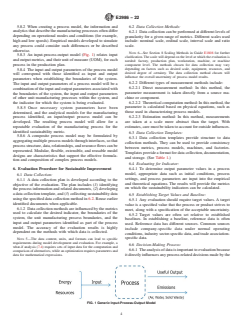
5.8.3 An input-process-output model (Fig. 1) relates input and output metrics, and their unit of measure (UOM), for each process
in the production plan.
5.8.4 The input and output parameters of the process model will correspond with those identified as input and output parameters
when establishing the boundaries of the system. The input and output parameters of a process model will be a combination of the
input and output parameters associated with the boundaries of the system, the input and output parameters of other unit
manufacturing processes within the system, and the indicator for which the system is being evaluated.
FIG. 1 Generic Input-Process-Output Model
E2986 − 22
5.8.5 Once necessary system parameters have been determined, and the analytical models for the manufacturing process identified,
an input/output process model can be developed. The resulting process model will allow for a repeatable evaluation of the
manufacturing process for the identified sustainability metric.
5.8.6 A composite process model may be formulated by aggregating multiple process models through interfaces, so that process
structure, data, relationships, and resource flows can be represented. Modular, flexible, extensible, and reusable model designs are
characteristics that support the effective formulation and composition of complex process models.
6. Evaluation Procedure for Sustainable Improvement
6.1 Data Collection:
6.1.1 A data collection plan is developed according to the objective of the evaluation. The plan includes (1) identifying the process
information and related documents, (2) developing a data collection template, and (3) collecting sustainability data using the
specified data collection method in 6.2. Reuse earlier identified documents when applicable.
6.1.2 Data collection methods are influenced by the metrics used to calculate the desired indicator, the boundaries of the system,
the unit manufacturing process boundaries, and the input and output parameters identified as part of the process
...