

kSIST FprEN 748:2026
(Main)Playing field equipment - Football goals - Functional and safety requirements, test methods
- Abstract
This document specifies the functional and safety requirements and test methods for all types of portable/freestanding and permanent/socketed football goals having a total weight greater than 10 kg.
This document is applicable to goals used for all forms of football for all age groups, including:
— 11 a-side football;
— small-sided and junior football (all forms);
— futsal;
— recreational play;
— training;
— competition.
This document is applicable to goals intended for use outdoors and indoors.
This document is not applicable to the following football goals:
— lightweight goals of 10 kg or less.
NOTE 1 Requirements for lightweight goals are given in EN 16664.
NOTE 2 The rules of futsal also allow the use of handball goals. Requirements for handball goals are given in EN 749.
- Status
- Not Published
- Public Enquiry End Date
- 21-Dec-2025
- Technical Committee
- SPO - Sports
- Current Stage
- 5020 - Formal vote (FV) (Adopted Project)
- Start Date
- 01-Sep-2026
- Due Date
- 20-Oct-2026



kSIST FprEN 748:2026 is a CEN standard for football goals. It specifies functional and safety requirements, plus test methods, for portable/freestanding and permanent/socketed goals weighing more than 10 kg. The document is written for manufacturers, test laboratories, installers, operators, and buyers who need to verify that a goal is suitable for use in football settings indoors or outdoors.
What does kSIST FprEN 748:2026 specify?
kSIST FprEN 748:2026 applies to football goals for all age groups and all forms of football covered by the scope, including 11 a-side football, small-sided and junior football, futsal, recreational play, training, and competition. It sets requirements for goals used indoors and outdoors, while excluding lightweight goals of 10 kg or less.
The document is organized into clauses on scope, references, terms, general design, classification and dimensions, materials, design, requirements, test methods, test reports, assembly/storage/transport/inspection/maintenance, and marking. Annex A is normative and contains entrapment test methods; Annexes B to F are informative and give supporting guidance.
| Annex | What it covers |
|---|---|
| Annex A | Test methods for head, neck, and finger entrapment |
| Annex B | Foundation guidance for socketed and portable goals |
| Annex C | Selection and examples of typical goals by category |
| Annex D | Recommendations on material selection |
| Annex E | Inspection and maintenance |
| Annex F | Moving and storage of goals |
What are the key requirements of kSIST FprEN 748:2026?
Classification, size, and construction
kSIST FprEN 748:2026 classifies goals by method of installation, size, and total weight in Clause 5. This matters because the later strength and stability tests depend on the category, so a manufacturer or purchaser has to match the goal type to the intended use.
The document requires the goal width and height to match the manufacturer’s declared size, within stated manufacturing tolerances. Clause 7 also requires a secure construction that can withstand use and movement, and it states that the uprights and crossbar of one goal shall have the same cross section. For Type 4 goals, the ground frame should incorporate a fixed counterweight.
Strength and stability
Clause 8.1 sets strength requirements for socketed goals and portable goals in different weight ranges. In practice, the goal must not crack, fracture, collapse, or lose parts under test loading, and the permitted crossbar deflection depends on the goal type and weight. A separate requirement applies to goals at least 2,0 m high and weighing between 22 kg and 42 kg: they must also pass an additional structural and entrapment check under a higher load.
Clause 8.2 requires all goal classes and types to remain upright in the stability test and not show a permanent out-of-vertical deflection of 100 mm or more. Clause 9 explains how this is checked, including the pre-load, the applied horizontal force, and the repeat testing of portable goals with each anchoring system. For users, this means the goal has to stay standing when it is pushed or loaded during play, movement, or misuse.
Entrapment and net safety
Clause 8.3 requires the goal to be designed so that fingers, head, and neck cannot be trapped in hazardous ways during use and storage. Annex A provides the probe-based methods used to check openings, with different probes for head and neck and finger entrapment. This matters because a goal can pass strength tests and still be unsafe if its openings create a trapping risk.
Clause 8.4 covers net fixings. Net fixings must not fracture, deform permanently, or dislodge in the test, and they must not create an entrapment hazard. Metal cup hooks and metal spring cup hooks are not allowed as net fixing methods. Clause 8.5 adds net requirements: the yarn, woven or knitted net material must have a minimum diameter of 2 mm, the mesh must not let the intended ball pass through, and the mesh size must not exceed 120 mm.
Test methods and reporting
Clause 9 gives the test methods for strength, stability, net fixings, and net diameter. It also describes the conditioning of the goal before testing, the setup in the ready-for-use condition, and the measurement approach for deflection and movement. Table 3 sets the load levels used for the different goal categories, so testing is not one-size-fits-all.
Clause 10 defines the minimum contents of the test report. A test report needs the tester, date, test conditions, goal identification, pre-test and post-test condition, and results. That helps purchasers and inspectors compare products and keep evidence of conformity.
Instructions, marking, and use in service
Clause 11 requires written instructions for safe assembly, installation, transport, storage, and maintenance in the relevant local language. For portable goals, the instructions must explain anchoring, transport, storage, and the need to keep the goal secured when in use and when stored.
Clause 12 requires a durable warning label, product identification, and clear markings for anchoring-system mounting positions on portable goals. The warning label includes safety instructions and the goal weight. In practice, this helps users assemble the goal correctly, anchor it properly, and avoid misuse such as climbing or hanging on the frame.
What terms does kSIST FprEN 748:2026 define?
- Goal - the opening or area that forms the target for ball games, usually made up of two uprights and a crossbar, together with fixed parts such as net support, sockets, anchors, wheels, or handles.
- Portable goal - a goal that is stabilized by a specific anchorage or weight system when assembled, so it can resist the required loads while remaining movable.
- Socketed goal - a goal set in a permanent fixed foundation so the combined structure can withstand the required loads.
- Goal frame - the crossbar and uprights that form the goal opening.
- Anchoring system - the system that prevents a portable goal from tipping, sliding, or moving out of position.
- Ready for use - the state reached when assembly is complete and the equipment is placed in position.
- Not in use - the period after dismantling, movement, and storage, when the goal is no longer available for its intended use.
- Total weight - the weight of the goal including back bar, net, net fixing, and any permanently attached anchoring or stabilizing system.
Who uses kSIST FprEN 748:2026?
kSIST FprEN 748:2026 is used by goal manufacturers and suppliers to design products that meet the required strength, stability, and safety checks. It is also used by test laboratories for verification, by installers and grounds staff for correct assembly and anchoring, and by operators responsible for inspection, maintenance, storage, and safe use.
Buyers, retailers, and facility managers use it to choose between socketed and portable goals, assess whether a goal suits the intended users and playing surface, and check that instructions, markings, and test evidence are available. Sports governing bodies and competition organizers use it as a technical basis when specifying goal types for particular competitions or venues.
What changed in kSIST FprEN 748:2026 from the previous edition?
The foreword states that this document supersedes EN 748:2013+A1:2018 and partly replaces EN 16579:2018+AC:2019. It also lists these significant changes in the revised version: a completely changed structure, a new scope for all football goals, coverage of goals above 10 kg, and new Annexes A to F covering entrapment, foundation, category selection, material selection, inspection and maintenance, and moving and storage. The document is also stated to have been editorially revised.
Which standards are used with kSIST FprEN 748:2026?
- EN 913 - provides general safety requirements and test methods for gymnastic equipment; kSIST FprEN 748:2026 uses it for surface finish and for relevant integrated transport-system components.
- EN ISO 1806:2002 - provides the method for determining mesh breaking force of netting; kSIST FprEN 748:2026 uses it for the net strength requirement.
- EN 16664 - covers lightweight goals of 10 kg or less; kSIST FprEN 748:2026 excludes that product range and points readers to this standard.
- EN 749 - gives requirements for handball goals; the scope notes that futsal rules also allow handball goals.
- EN 16579:2018+AC:2019 - is partly replaced by kSIST FprEN 748:2026 according to the foreword, so users of the earlier goal standard need to check the revised structure and scope.
What does the kSIST FprEN 748:2026 document contain?
kSIST FprEN 748:2026 contains tables, figures, procedures, and a formula-driven measurement method for deflection. Table 1 classifies goals by installation method, size, and weight; Table 2 gives the net mesh breaking-strength requirement; and Table 3 sets the test loads used for strength and stability checks.
The figures show goal types, the strength-test setup, the stability-test setup, the net-fixing test, and the warning sign for goal weight. Annex A gives probe-based entrapment tests, while Annex B describes sockets, caps, and stabilization for portable goals. Annex E provides inspection record content and checklist-style control points, and Annex F explains how to move and store goals safely after use.
Relations
- Effective Date
- 16-Jul-2025
Frequently Asked Questions
kSIST FprEN 748:2026 is a draft published by the Slovenian Institute for Standardization (SIST). Its full title is "Playing field equipment - Football goals - Functional and safety requirements, test methods". This standard covers: This document specifies the functional and safety requirements and test methods for all types of portable/freestanding and permanent/socketed football goals having a total weight greater than 10 kg. This document is applicable to goals used for all forms of football for all age groups, including: — 11 a-side football; — small-sided and junior football (all forms); — futsal; — recreational play; — training; — competition. This document is applicable to goals intended for use outdoors and indoors. This document is not applicable to the following football goals: — lightweight goals of 10 kg or less. NOTE 1 Requirements for lightweight goals are given in EN 16664. NOTE 2 The rules of futsal also allow the use of handball goals. Requirements for handball goals are given in EN 749.
This document specifies the functional and safety requirements and test methods for all types of portable/freestanding and permanent/socketed football goals having a total weight greater than 10 kg. This document is applicable to goals used for all forms of football for all age groups, including: — 11 a-side football; — small-sided and junior football (all forms); — futsal; — recreational play; — training; — competition. This document is applicable to goals intended for use outdoors and indoors. This document is not applicable to the following football goals: — lightweight goals of 10 kg or less. NOTE 1 Requirements for lightweight goals are given in EN 16664. NOTE 2 The rules of futsal also allow the use of handball goals. Requirements for handball goals are given in EN 749.
kSIST FprEN 748:2026 is classified under the following ICS (International Classification for Standards) categories: 97.220.30 - Indoor sports equipment; 97.220.40 - Outdoor and water sports equipment. The ICS classification helps identify the subject area and facilitates finding related standards.
kSIST FprEN 748:2026 has the following relationships with other standards: It is inter standard links to SIST EN 748:2013+A1:2018. Understanding these relationships helps ensure you are using the most current and applicable version of the standard.
kSIST FprEN 748:2026 is available in PDF format for immediate download after purchase. The document can be added to your cart and obtained through the secure checkout process. Digital delivery ensures instant access to the complete standard document.
Standards Content (Sample)
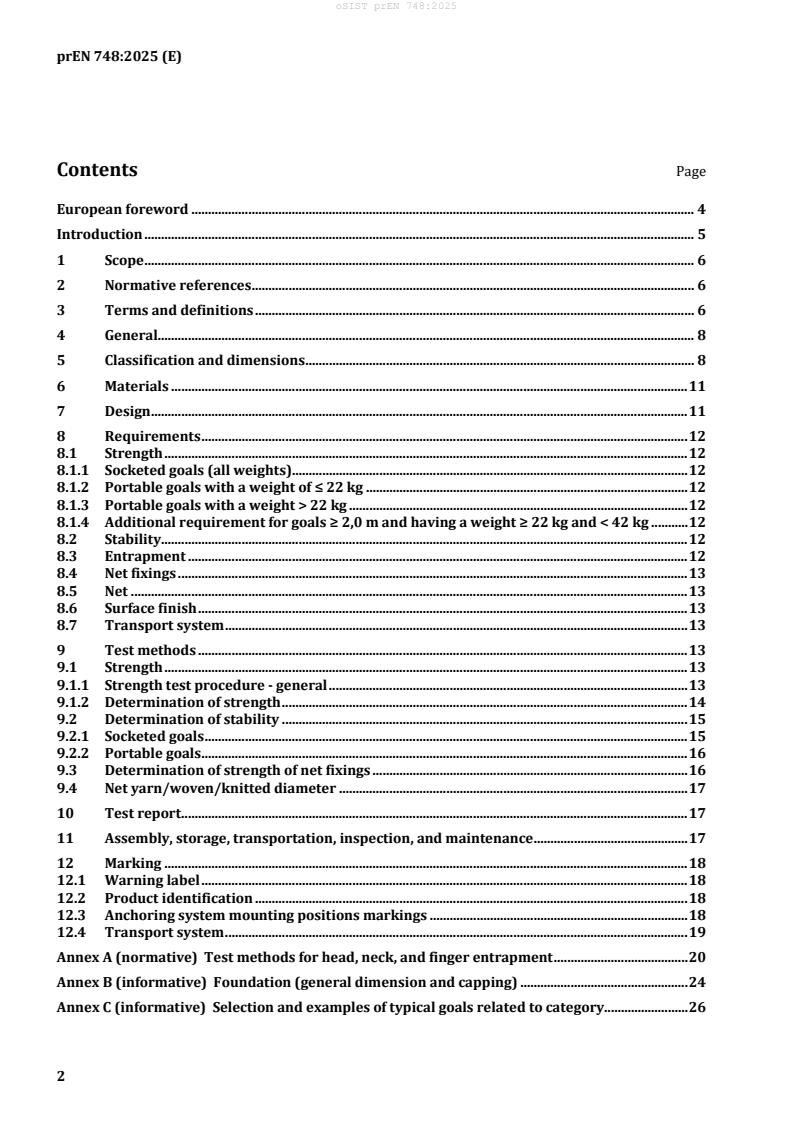
Contents
- Introduction
- 1 Scope
- 2 Normative references
- 3 Terms and definitions
- 3.1 goal
- 3.2 portable goal
- 3.3 socketed goal
- 3.4 goal frame
- 3.5 net support
- 3.6 frame support
- 3.7 anchoring system
- 3.8 ready for use
- 3.9 intended use
- 3.10 not in use
- 3.11 entrapment
- 3.12 transport system
- 3.13 total weight
- 4 General
- 5 Classification and dimensions
- 6 Materials
- 7 Design
- 8 Requirements
- 8.1 Strength
- 8.2 Stability
- 8.3 Entrapment
- 8.4 Net fixings
- 8.5 Net
- 8.6 Surface finish
- 8.7 Transport system
- 9 Test methods
- 9.1 Strength
- 9.2 Determination of stability
- 9.3 Determination of strength of net fixings
- 9.4 Net yarn/woven/knitted diameter
- 10 Test report
- 11 Assembly, storage, transportation, inspection, and maintenance
- 12 Marking
- 12.1 Warning label
- 12.2 Product identification
- 12.3 Anchoring system mounting positions markings
- 12.4 Transport system
- Annex A
- Annex B
- Annex C
- Annex D
- Annex E
- Annex F
- Bibliography
- 18 December 2006 concerning the Registration, Evaluation, Authorisation and Restriction of
Introduction
This document specifies requirements for all types of goal used for football, including adult, youth and small sided versions of the game, both for competitive play and competitions. It specified requirements for all types of football goal that have a weight greater than 10 kg and includes socketed goals and freestanding goals.
oSIST prEN 748:2025 prEN 748:2025 (E)
1 Scope
This document specifies the functional and safety requirements and test methods for all types of portable/freestanding and permanent/socketed football goals having a total weight greater than 10 kg. It is applicable to goals used for all forms of football for all age groups, including:
- 11 a-side football;
- Small-sided and junior football (all forms);
- Futsal;
- Recreational play;
- Training;
- Competition.
It is applicable to goals intended for use outdoors and indoors. The following football goals are excluded:
a) EN 16664, Playing field equipment — Lightweight goals — Functional, safety requirements and test methods (lightweight goals of 10 kg or less).
NOTE The rules of futsal also allow the use of handball goals. Requirements for handball goals are given in EN 749.
2 Normative references
The following documents are referred to in the text in such a way that some or all of their content constitutes requirements of this document. For dated references, only the edition cited applies. For undated references, the latest edition of the referenced document (including any amendments) applies. EN 913, Gymnastic equipment — General safety requirements and test methods EN ISO 1806:2002, Fishing nets - Determination of mesh breaking force of netting (ISO 1806:2002)
3 Terms and definitions
For the purposes of this document, the following terms and definitions apply. ISO and IEC maintain terminology databases for use in standardization at the following addresses:
- ISO Online browsing platform: available at https://www.iso.org/obp
- IEC Electropedia: available at https://www.electropedia.org/
3.1 goal
opening or area which forms the target for ball games, usually comprising two uprights and one crossbar Note 1 to entry: Includes any other parts such as net, net support, net fixing, socket(s), anchoring system(s), wheels and handles, which are permanently fitted to the goal.
oSIST prEN 748:2025 prEN 748:2025 (E)
3.2 portable goal
goal structure which, when erected or assembled is stabilised by means of a specific anchorage or weight system which enables the structure to withstand the required design and test loads Note 1 to entry: Portable goals can be referred to as movable goals or free standing goals. Note 2 to entry: See Annex B for more information on portable goals. Note 3 to entry: To minimize the weight that is necessary to stabilize the portable goal it helps to have a runback that measures at least 75 % of the height.
3.3 socketed goal
goal structure which is set in a suitably-sized permanent fixed foundation in such a way as to enable the combined structure to withstand the required design and test loads Note 1 to entry: See Annex B for Foundation information.
3.4 goal frame
crossbar and uprights which form the goal opening
3.5 net support
attachment which may be fixed to the goal frame for supporting the net
3.6 frame support
framework comprising the side frame and back frame that may support the goal frame
3.7 anchoring system
system for ensuring that a portable goal cannot tip over, slide or displace
3.8 ready for use
when the assembly is completed, and the equipment is placed in position
3.9 intended use
purpose for which the goal has been designed and manufactured
3.10 not in use
period commencing with the dismantling of the goal, the subsequent movement and storage after use and any subsequent period when they are not available for their intended use
3.11 entrapment
hazard presented by the situation in which a body, or part of a body, or clothing can become trapped Note 1 to entry: EN 748 only considers certain types of entrapment where the user is not able to free him/herself and injury is caused by the entrapment.
oSIST prEN 748:2025 prEN 748:2025 (E)
3.12 transport system
means of moving the goal
3.13 total weight
weight of goal including back bar, net, net fixing, and any permanently attached anchoring or stabilizing system
4 General
A goal should be used as a complete unit (e.g. goal, net, back bar, anchors, stabilizers, etc.), as shown in Figure 1 and Figure 2, together with any other accessories that may be required. NOTE Sport governing bodies specify additional requirements of a goal within their rules.
5 Classification and dimensions
Football goals shall be classified by their method of installation, weight, and size, as shown in Table 1.
oSIST prEN 748:2025 prEN 748:2025 (E) Table 1 — Classification of goals Type Method of Width Height to a Total weight installation crossbar
w h m
(internal) (internal) Kg
m m min max 1 a Socketed 0,70 ≤ w ≤ 1,80 0,50 ≤ h ≤ 1,20 > 10,0 ≤ 42,0
b Socketed > 42,0 — c Portable > 10,0 ≤ 22,0 d Portable > 22,0 ≤ 42,0 e Portable > 42,0 — 2 a Socketed 1,80 < w < 3,00 1,20 < h < 2,00 > 10,0 ≤ 42,0
b Socketed > 42,0 — c Portable > 10,0 ≤ 22,0 d Portable > 22,0 ≤ 42,0 e Portable > 42,0 — 3 a Socketed 3,00 ≤ w ≤ 6,40 2,00 ≤ h ≤ 2,44 > 10,0 ≤ 42,0
b Socketed > 42,0 — c Portable > 10,0 ≤ 22,0 d Portable > 22,0 ≤ 42,0 e Portable > 42,0 — 4 a Socketed 6,40 < w ≤ 7,32 2,00 ≤ h ≤ 2,44 > 10,0 ≤ 42,0
b Socketed > 42,0 — c Portable > 10,0 ≤ 42,0 d Portable > 42,0 — a including back bar, net, net fixing, and any permanently attached anchoring or stabilizing system
oSIST prEN 748:2025 prEN 748:2025 (E)
Key 1 crossbar 2 upright 3 net 4 net supporting pole for net head line (example) 5 net head line 6 net support NOTE Referring to key 4 “pole for net head line” requirements to the poles and its position depend on national regulation of free space for safety and to football federation. Figure 1 — Football goal — Socketed
oSIST prEN 748:2025 prEN 748:2025 (E)
Figure 2 — Football goal — Portable The width and height of the goal shall comply with the manufacturer’s designated size, subject to a manufacturing tolerance of ± 8 mm in the length and width and ± 2 mm in the profile of the goal posts and crossbar.
6 Materials
The selection of materials and their use shall be in accordance with the appropriate European Standards.
Further information for the selection of material is given in Annex D. The materials should be selected so that potential hazards through direct contact with the skin can be avoided.
7 Design
The goal’s construction shall be sufficiently secure to withstand the stresses during a game and when moved.
The uprights and the crossbar may be made of one or more pieces. The uprights and the crossbar of one football goal shall have the same cross section. NOTE Additional requirements on the colour of the frame and net are set in national and international competition rules.
The ground frame of Type 4 should incorporate a fixed counterweight, which is part of the ground frame.
oSIST prEN 748:2025 prEN 748:2025 (E)
8 Requirements
8.1 Strength
8.1.1 Socketed goals (all weights)
When tested in accordance with 9.1.2 the goal frame shall not show:
a) visible signs of cracks/fractures or collapse and no frame component shall become detached; b) a measured deflection (or permanent deformation) d (see Formula (1)) of the crossbar a > 10 mm.
8.1.2 Portable goals with a weight of ≤ 22 kg
When tested in accordance with 9.1.2 the goal frame shall not show:
a) visible signs of cracks/fractures or collapse and no frame component shall become detached; b) a measured deflection (or permanent deformation) d (see Formula (1)) of the crossbar of > 50 mm after disassembly and re-assembly.
8.1.3 Portable goals with a weight > 22 kg
When tested in accordance with 9.1.2 the goal frame shall not show:
a) visible signs of cracks/fractures or collapse and no frame component shall become detached; b) a measured deflection (or permanent deformation) d (see Formula (1)) of the crossbar a > 10 mm.
8.1.4 Additional requirement for goals ≥ 2,0 m and having a weight ≥ 22 kg and < 42 kg
When tested in accordance with 9.1.2 under a load of (1 800 ± 50) N, the goal shall:
a) not show visible signs of cracks/fractures or collapse and no frame component shall become detached; b) pass entrapment requirements according to Clause A.3.
NOTE This requirement also applies to goals that are tested for strength under loads other than (1 800 ± 50) N.
8.2 Stability
When tested in accordance with 9.2, the goal frame of all classes and types of goals shall not fall over, and shall have no permanent deflection from the vertical of 100 mm or greater.
8.3 Entrapment
Goals shall be designed and constructed so that during use and storage (if applicable) there shall be no crushing or shearing hazards between moving parts and/or fixed parts or risk of entrapment of finger, head and neck when assessed in accordance with the procedure given in Annex A of this document. Openings with a lower edge more than 600 mm above ground shall be tested in accordance with A.2 (goal frame).
For goal frame probe C shall not pass through any opening unless it also allows the passage of large probe D.
oSIST prEN 748:2025 prEN 748:2025 (E) Non-rigid parts (e.g. ropes) shall not overlap if this creates apertures that are not in accordance with the above.
8.4 Net fixings
When tested according to 9.3 no visible fracture and/or permanent deformation shall occur at the net fixings and the net fixing shall not dislodge.
Any opening in the net fixing outside the profile of the goal frame shall not result in entrapment when tested in accordance with 9.3.
Metal cup hooks and metal spring cup hooks shall not be used as a means of fixing the net to the goal frame.
The spacing between net fixings shall not allow a ball for which the goal is intended to be used to pass and shall not create any entrapment in accordance with 9.3.
8.5 Net
Net yarn/woven/knitted shall have a minimum diameter of 2 mm to reduce the risk of cutting, when tested according to 9.4.
Net dimensions shall comply with the requirements of goal frame dimensions and the associated goal frame net supports, for which it is intended to be used.
The mesh size shall not allow a ball for which the goal is intended to be used to pass through. The mesh size shall be less than or equal to 120 mm and shall not create any finger entrapment when tested in accordance with A.3.
The net shall meet at least the requirement for mesh breaking strength according to Table 2. Table 2 — Mesh breaking strength Minimum Force Test method N a EN ISO 1806:2002 792 (660) a This corresponds to the breaking strength of the net yarn, tested in accordance with EN ISO 2062:2010.
8.6 Surface finish
The requirements of EN 913 shall be met, when assessed by visual inspection and measurement.
8.7 Transport system
When a transport system is fitted no part of the goal shall disengage or drop unintentionally. Where the goal has an integrated transportation system or permanently fixed components thereof, these shall comply with the requirements in EN 913.
9 Test methods
9.1 Strength
9.1.1 Strength test procedure - general
Condition the goal frame for a minimum of 1 h at a temperature of (20 ± 15) °C. This shall be recorded. Assemble and install the goal ready for use in accordance with the manufacturer’s instructions.
oSIST prEN 748:2025 prEN 748:2025 (E)
9.1.2 Determination of strength
It shall be considered that the loadings during the strength test may cause localized settlement of the uprights. The following procedure shall apply to take this into account:
a) Measure dimensions a, b, c (defined in Figure 3). These dimensions are called a , b and c , 1 1 1 respectively; b) Apply the force to the appropriate value as defined in Table 3 at the centre of the crossbar using a +10 s strap of 50 mm nominal width for 1 min . Then remove the force. Note any fracture or other 0s damage to the goal; +1 min c) After 30 min measure dimensions a, b, c. again. These dimensions are called a , b and c , 2 2 2 0 min respectively; d) Determine the deflection (or deformation) of the centre of the crossbar (d) as follows:
a − a +−bb
1 2 12 dc= −−c (1)
1 2
where a is the internal height of the crossbar at the junction of the left upright before loading;
a is the internal height of the crossbar at the junction of the left upright after loading;
b is the internal height of the crossbar at the junction of the right upright before loading;
b is the internal height of the crossbar at the junction of the right upright after loading;
c is the internal height of the middle crossbar before loading;
c is the internal height of the middle crossbar after loading;
d is the deflection measured at the middle of the crossbar, after the release of the loading.
Key 1 centre of crossbar 2 ground a internal height of the crossbar at the junction of the left upright
oSIST prEN 748:2025 prEN 748:2025 (E) b internal height of the crossbar at the junction of the right upright c internal height of the middle crossbar F applied load Figure 3 — Strength Test Table 3 — Vertical and horizontal test loadings Goal category Goal type and total weight Strength Testing Stability Testing Vertical Loading Horizontal Loading Kg N N a Socketed > 10,0 ≤ 42,0 800 ± 50 700 ± 50 b Socketed > 42,0 — 1 800 ± 50 1 100 ± 50 1 c Portable > 10,0 ≤ 22,0 300 ± 15 300 ± 15 d Portable > 22,0 ≤ 42,0 800 ± 30 700 ± 50 e Portable > 42,0 1 800 ± 50 1 100 ± 50 a Socketed > 10,0 ≤ 42,0 800 ± 50 700 ± 50 b Socketed > 42,0 — 1 800 ± 50 1 100 ± 50 2 c Portable > 10,0 ≤ 22,0 300 ± 15 300 ± 15 d Portable > 22,0 ≤ 42,0 800 ± 30 700 ± 50 e Portable > 42,0 1 800 ± 50 1 100 ± 50 a Socketed > 10,0 ≤ 42,0 1 000 ± 50 700 ± 50 b Socketed > 42,0 — 1 800 ± 50 1 100 ± 50 a c Portable > 10,0 ≤ 22,0 300 ± 15 300 ± 15
d Portable > 22,0 ≤ 42,0 1 000 ± 50 700 ± 50 e Portable > 42,0 1 800 ± 50 1 100 ± 50 a Socketed > 10,0 ≤ 42,0 1 000 ± 50 700 ± 50 b Socketed > 42,0 — 1 800 ± 50 1 100 ± 50 a
c Portable > 10,0 ≤ 42,0 1 000 ± 50 700 ± 50 d Portable > 42,0 1 800 ± 50 1 100 ± 50 a Type 3 and 4 goals with a weight of ≥ 22,0 kg shall also be tested for structural integrity using a vertical load of (1 800 ± 50) N.
9.2 Determination of stability
9.2.1 Socketed goals
1) Check if the goal is vertical 2) Apply a pre-load 3) Apply the test load
oSIST prEN 748:2025 prEN 748:2025 (E) Assemble and install the goal and its socket ready for use in accordance with the manufacturer's instructions.
+20 Apply a pre-load of ( 100 ) N at the top of the centre of the crossbar and measure the horizontal
position of the cross bar whilst the load is still applied.
...