

kSIST FprEN 16579:2026
(Main)Playing field equipment - Portable and permanent socketed goals - Functional, safety requirements and test methods
- Abstract
This document is applicable to rugby, Gaelic football, hurling, camogie goals used for competition, training or recreational play, indoor and outdoor areas including educational establishments and public recreational areas.
It specifies the functional and safety requirements and test methods for all types of portable and permanent socketed goals having a total weight greater than 10 kg.
- Status
- Not Published
- Public Enquiry End Date
- 21-Dec-2025
- Technical Committee
- SPO - Sports
- Current Stage
- 5020 - Formal vote (FV) (Adopted Project)
- Start Date
- 01-Sep-2026
- Due Date
- 20-Oct-2026


kSIST FprEN 16579:2026 is a CEN standard for portable and permanent socketed goals used in rugby, Gaelic football, hurling and camogie. It sets the functional and safety requirements, plus the test methods, for goals used in competition, training or recreational play indoors and outdoors.
The document is meant for anyone who designs, buys, installs, tests, inspects or maintains these goals. It matters because it covers the goal as a complete unit - frame, net, fixings, sockets, anchoring system and related accessories - so safety is assessed in the way the goal is actually used.
What does kSIST FprEN 16579:2026 specify?
kSIST FprEN 16579:2026 specifies the scope, the way goals are categorized, the safety requirements, the test methods, and the information that manufacturers must provide for assembly, storage, transport, inspection, maintenance and marking.
It applies to portable and permanent socketed goals with a total weight greater than 10 kg, for indoor and outdoor use, including educational establishments and public recreational areas. The document is organized into clauses on scope, references, terms, general principles, classification, requirements, test methods, test reporting, instructions and marking, with informative and normative annexes that support the main text.
| Annex | What it covers |
|---|---|
| Annex A | Normative test methods for head, neck and finger entrapment |
| Annex B | Foundation guidance for permanent socketed goals and portable goal anchoring points |
| Annex C | Selection guidance and examples of typical goals by category |
| Annex D | Recommendations for material selection |
| Annex E | Inspection and maintenance guidance, including checklists and record sheet examples |
| Annex F | Moving and storage guidance for goals |
What are the key requirements of kSIST FprEN 16579:2026?
kSIST FprEN 16579:2026 requires goals to be treated and tested as complete systems, not as isolated frames. That matters in practice because the safety of the goal depends on the frame, net, fixings, anchors, sockets and any stabilizing parts working together.
Classification and intended use
The document classifies goals by category, type and size, with socketed goals and portable goals handled differently. Table 1 and the related figures define the category structure, and Annex C gives examples of typical goals for different sports and user groups. For a buyer or designer, this is the first step in choosing the right goal for the intended sport and location.
Strength and stability
Clause 6 requires the goal frame to withstand strength testing without cracks, fractures, collapse or detachment of frame components. It also sets deflection limits for the crossbar, and Type 2 goals have an additional post-reassembly check. In practice, this means the goal must keep its shape under load and after handling, so the structure does not become unsafe through normal use or movement.
Clause 6 also requires the goal to remain stable under the specified stability test. Socketed goals and portable goals are tested differently, but both must avoid tipping and excessive permanent movement from the vertical. For portable goals, the test is repeated for each supplied anchoring system, so the manufacturer has to show that every permitted setup is safe.
Entrapment protection
Clause 6.3 requires the goal to avoid crushing, shearing and entrapment hazards during use, transport and storage, assessed with EN 913 and the additional checks in Annex A of this document. Annex A gives probe-based methods for head, neck and finger entrapment in openings. In practice, this is about preventing a child or adult from getting trapped in an opening that looks harmless but could not be escaped from safely.
Net fixings and net requirements
Clause 6.4 requires net fixings to resist fracture, deformation and dislodgement, and it bans metal cup hooks and metal spring cup hooks as net fixings. It also requires the spacing of fixings to avoid passage of the intended ball and to avoid entrapment hazards. Clause 6.5 then requires the net material to meet minimum yarn or woven or knitted diameter, mesh-size limits for the sports covered, and the required mesh breaking strength. For users, this means the net is not just a target backstop - it is part of the safety system.
Surface finish, transport system and markings
Clause 6.6 requires the surface finish to meet the safety requirements taken from EN 913. Clause 6.7 requires any transport system to prevent unintended disengagement or dropping of parts and to avoid entrapment. Clause 10 requires a durable warning label, product identification and, for portable goals, permanent marking of anchoring system mounting positions and required counterweights. In practice, these markings help operators set up, move and store the goal correctly and reduce misuse.
Instructions, inspection and maintenance
Clause 9 requires written instructions for safe assembly, installation, transport, storage and maintenance in the appropriate language of the country of use. It also requires instructions for portable goals to explain anchoring and storage, and it points to the need for inspection and maintenance guidance. Annex E then gives routine, operational and main inspection guidance, plus record-sheet and checklist examples. This is important because many hazards appear only after use, wear, damage or poor storage.
What terms does kSIST FprEN 16579:2026 define?
- Goal - the target opening or area for ball games, usually made up of uprights and a crossbar, together with permanently fitted parts such as nets, fixings, sockets, wheels or handles.
- Portable goal - a goal that is stabilized by an anchoring or weight system when erected, so it can withstand the required loads while remaining movable.
- Socketed goal - a goal set into a permanent fixed foundation so the combined structure can withstand the required loads.
- Goal frame - the uprights and crossbar that form the goal opening.
- Anchoring system - the system that prevents a portable goal from tipping, sliding or moving.
- Entrapment - a hazard where a body part or clothing can become trapped and the user cannot free themselves safely.
- Transport system - the means used to move the goal.
Who uses kSIST FprEN 16579:2026?
kSIST FprEN 16579:2026 is used by goal manufacturers, importers and retailers, as well as test laboratories and conformity assessors. It is also relevant to schools, clubs, sports facility operators, grounds staff and purchasers who need to choose, install, inspect and maintain goals safely.
Annex C is especially useful for procurement and sport-specific selection, while Annex E and Annex F support inspection, maintenance, moving and storage. Sports governing bodies may also use it as a technical reference when setting local rules or choosing equipment for a specific level of play.
What changed in kSIST FprEN 16579:2026 from the previous edition?
kSIST FprEN 16579:2026 supersedes EN 16579:2018+AC:2019. The changes stated in the foreword are:
- the scope is extended to Rugby, Gaelic Football, Hurling and Camogie goals
- the exception for certain large goals covered by EN 748 is removed from this document
- Clause 6 no longer has a separate chapter for Type 2 goals
- the former goal category A is deleted and former category B is renamed category A
- Annex A is updated
- former Annex B.1.3 on net support is deleted
- Annex C content on Youth football, Small-sided football, Futsal and Mini-football is deleted
- the document has been editorially revised
Which standards are used with kSIST FprEN 16579:2026?
kSIST FprEN 16579:2026 names EN 913:2018+A1:2021 as a normative reference and states that it is intended to be used with it. EN 913 supplies the general safety requirements and entrapment test approach that EN 16579 builds on.
EN ISO 1806 is also a normative reference. It contributes the mesh breaking force method used for the net performance requirement.
The document also points to EN ISO 2062 in the note on net yarn breaking strength, so readers may encounter it when checking how the net requirement relates to yarn performance.
What does the kSIST FprEN 16579:2026 document contain?
kSIST FprEN 16579:2026 contains classification figures and Table 1 for goal categories, Table 2 for mesh breaking strength, and Table 3 for test loadings by category and type. It also includes Figure 3 for the strength test setup and figures in Annex A for the entrapment probes and opening checks.
For testing and certification work, the most useful procedural content is the step-by-step strength test, the stability test for socketed and portable goals, the net-fixing test and the net diameter check. For installation and maintenance work, Annex B gives foundation guidance, Annex E gives inspection checklists and records, and Annex F explains how to move and store goals safely.
Relations
- Effective Date
- 16-Jul-2025
Frequently Asked Questions
kSIST FprEN 16579:2026 is a draft published by the Slovenian Institute for Standardization (SIST). Its full title is "Playing field equipment - Portable and permanent socketed goals - Functional, safety requirements and test methods". This standard covers: This document is applicable to rugby, Gaelic football, hurling, camogie goals used for competition, training or recreational play, indoor and outdoor areas including educational establishments and public recreational areas. It specifies the functional and safety requirements and test methods for all types of portable and permanent socketed goals having a total weight greater than 10 kg.
This document is applicable to rugby, Gaelic football, hurling, camogie goals used for competition, training or recreational play, indoor and outdoor areas including educational establishments and public recreational areas. It specifies the functional and safety requirements and test methods for all types of portable and permanent socketed goals having a total weight greater than 10 kg.
kSIST FprEN 16579:2026 is classified under the following ICS (International Classification for Standards) categories: 97.220.30 - Indoor sports equipment; 97.220.40 - Outdoor and water sports equipment. The ICS classification helps identify the subject area and facilitates finding related standards.
kSIST FprEN 16579:2026 has the following relationships with other standards: It is inter standard links to SIST EN 16579:2018+AC:2019. Understanding these relationships helps ensure you are using the most current and applicable version of the standard.
kSIST FprEN 16579:2026 is available in PDF format for immediate download after purchase. The document can be added to your cart and obtained through the secure checkout process. Digital delivery ensures instant access to the complete standard document.
Standards Content (Sample)
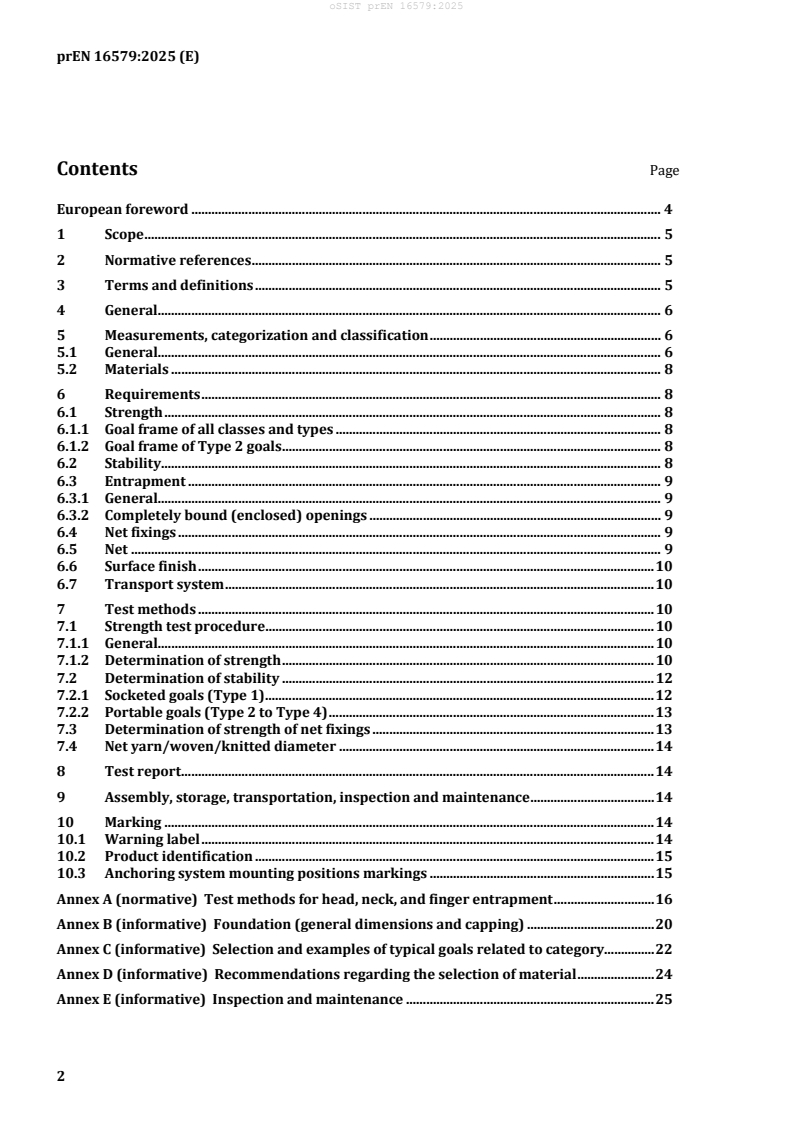
Contents
- 1 Scope
- 2 Normative references
- 3 Terms and definitions
- 3.1 goal
- 3.2 portable goal
- 3.3 socketed goal
- 3.4 goal frame
- 3.5 net support
- 3.6 frame support
- 3.7 anchoring system
- 3.8 in use
- 3.9 intended use
- 3.10 not in use
- 3.13 entrapment
- 3.14 transport system
- 4 General
- 5 Measurements, categorization and classification
- 5.1 General
- 5.2 Materials
- 6 Requirements
- 6.1 Strength
- 6.2 Stability
- 6.3 Entrapment
- 6.4 Net fixings
- 6.5 Net
- 6.6 Surface finish
- 6.7 Transport system
- 7 Test methods
- 7.1 Strength test procedure
- 7.2 Determination of stability
- 7.3 Determination of strength of net fixings
- 7.4 Net yarn/woven/knitted diameter
- 8 Test report
- 9 Assembly, storage, transportation, inspection and maintenance
- 10 Marking
- 10.1 Warning label
- 10.2 Product identification
- 10.3 Anchoring system mounting positions markings
- Annex A
- Annex B
- Annex C
- Annex D
- Annex E
- Annex F
- Bibliography
- 18 December 2006 concerning the Registration, Evaluation, Authorisation and Restriction of
1 Scope
This document is applicable to Rugby, Gaelic Football, Hurling, Camogie goals used for competition, training or recreational play, indoor and outdoor areas including educational establishments and public recreational areas.
It specifies the functional and safety requirements and test methods for all types of portable and permanent socketed goals having a total weight greater than 10 kg.
2 Normative references
The following documents are referred to in the text in such a way that some or all of their content constitutes requirements of this document. For dated references, only the edition cited applies. For undated references, the latest edition of the referenced document (including any amendments) applies. EN 913:2018+A1:2021, Gymnastic equipment - General safety requirements and test methods EN ISO 1806, Fishing nets - Determination of mesh breaking force of netting (ISO 1806)
3 Terms and definitions
For the purposes of this document, the following terms and definitions apply. ISO and IEC maintain terminology databases for use in standardization at the following addresses:
- IEC Electropedia: available at https://www.electropedia.org/
- ISO Online browsing platform: available at https://www.iso.org/obp
3.1 goal
opening or area which forms the target for ball games, usually comprising two uprights and one crossbar Note 1 to entry: Includes any other parts such as net, net support, net fixing, socket(s), anchoring system(s), wheels and handles, which are permanently fitted to the goal.
3.2 portable goal
goal structure which, when erected or assembled is stabilised by means of a specific anchorage or weight system which enables the structure to withstand the required design and test loads Note 1 to entry: Portable goals can be referred to as movable goals or free standing goals. Note 2 to entry: See Annex B for more information on portable goals.
3.3 socketed goal
goal structure which is set in a suitably-sized permanent fixed foundation in such a way as to enable the combined structure to withstand the required design and test loads Note 1 to entry: See Annex B for foundation information.
3.4 goal frame
crossbar and uprights which form the goal opening
oSIST prEN 16579:2025 prEN 16579:2025 (E)
3.5 net support
attachment which may be fixed to the goal frame for supporting the net
3.6 frame support
framework comprising the side frame and back frame that may support the goal frame
3.7 anchoring system
system for ensuring that a portable goal cannot tip over, slide or displace
3.8 in use
period commencing with the erection of the goals on the field of play and their subsequent use for training or play
3.9 intended use
purpose for which the goal has been designed and manufactured
3.10 not in use
period commencing with the dismantling of the goal, the subsequent movement and storage after use and any subsequent period when they are not available for their intended use
3.13 entrapment
hazard presented by the situation in which a body, or part of a body, or clothing can become trapped Note 1 to entry: EN 16579 only considers certain types of entrapment where the user is not able to free him/herself and injury is caused by the entrapment.
[SOURCE: EN 913:2018+A1:2021, Annex A modified — The note to entry has been adapted to this document.]
3.14 transport system
means of moving the goal
4 General
A goal should be used as a complete unit (e.g. goal, net, back bar, anchors, stabilizers, etc.) together with any other accessories that may be required.
NOTE 1 Sport governing bodies specify additional requirements of a goal within their rules. NOTE 2 The net is optional.
5 Measurements, categorization and classification
5.1 General
The categories are shown in Figures 1 and 2 and Table 1.
oSIST prEN 16579:2025 prEN 16579:2025 (E) NOTE See Annex C for examples.
Figure 1 — Goal frame category A Table 1 — Goal sizes — Category A (height to crossbar/height to top of the crossbar) Categor Type Class Total weight Size ranges y Height to Overall height of m Width crossbar uprights (including net, w H (Gaelic) H 1 2 net fixing and any (internal) (to top of the permanently crossbar attached (Rugby) anchoring or stabilizing system) kg m m m A1 1 Socketed — 2,50 ≤ w < 3,0 1,50 ≤ h 1,85 4,50 ± 0,05
a
2 Portable 10,0 < m ≤ 20,0 3 Portable 20,0 < m ≤ 42,0 4 Portable m > 42,0 A2 1 Socketed — 3,00 ≤ w < 4,6 1,85 ≤ h < 2,20 4,50 ± 0,05
a
2 Portable 10,0 < m ≤ 20,0 3 Portable 20,0 < m ≤ 42,0 4 Portable m > 42,0 A3 1 Socketed — 4,60 ≤ w < 6,5 2,20 ≤ h ≤ 2,50 8,50 ± 0,05
a 0
2 Portable 10,0 < m ≤ 20,0 3 Portable 20,0 < m ≤ 42,0 4 Portable m > 42,0 A4 1 Socketed — 4,55 ≤ w < 4,6 2,20 ≤ h ≤ 2,50 6,00 ≤ h ≤ 10,00 1 2 a 5
2 Portable 10,0 < m ≤ 20,0 3 Portable 20,0 < m ≤ 42,0 4 Portable m > 42,0
oSIST prEN 16579:2025 prEN 16579:2025 (E) A5 1 Socketed — 6,45 ≤ w < 6,5 2,39 ≤ h ≤ 2,49 11,00 ± 0,05
a 5
A6 1 Socketed — 5,50 ≤ w < 6,5 2,44 ≤ h ≤ 3,10 3,40 ≤ h ≤ 16,0 1 2 b 0 b
a As socketed goals can be left on a playing field they need to satisfy the highest stability and strength requirements for their Class irrespective of their weight, to minimize the risk of injury in case of misuse. b The laws of the game of Rugby Union do not specify any maximum value (see [1]). The maximum value is given as guidance.
Figure 2 — Dimensions of goal frame category A
5.2 Materials
The selection of materials and their use shall be in accordance with the appropriate European Standards. Further information for the selection of material is given in Annex D. The materials should be selected so that potential hazards through direct contact with the skin can be avoided.
6 Requirements
6.1 Strength
6.1.1 Goal frame of all classes and types
When tested in accordance with 7.1.2 the goal frame of all classes shall not show:
a) visible signs of cracks/fractures or collapse and no frame component shall become detached; b) a measured deflection (or permanent deformation) d (see Formula (1)) of the crossbar of > 10 mm.
6.1.2 Goal frame of Type 2 goals
When tested in accordance with 7.1.2 the goal frame of Type 2 goals shall not show:
c) a measured deflection (or permanent deformation) d (see Formula (1)) of the crossbar of > 50 mm after disassembly and re-assembly.
6.2 Stability
When tested in accordance with 7.2, the goal frame of all classes and types of goals shall not fall over, shall have no permanent deflection from the vertical of 100 mm or greater.
oSIST prEN 16579:2025 prEN 16579:2025 (E)
6.3 Entrapment
6.3.1 General
Goals shall be designed and constructed so that during use, transportation, and storage (if applicable) there shall be no crushing or shearing hazards between moving parts and/or fixed parts or risk of entrapment of finger, head and neck when assessed in accordance with the procedure given in EN 913:2018+A1:2021, Annex A and with the additional requirements according to Annex A of this document.
6.3.2 Completely bound (enclosed) openings
Openings with a lower edge more than 600 mm above ground shall be tested in accordance with A.2 (goal frame).
For goal frame probe C shall not pass through any opening unless it also allows the passage of large probe D.
Non-rigid parts (e.g. ropes) shall not overlap if this creates apertures that are not in accordance with the above.
6.4 Net fixings
When tested according to 7.3 no visible fracture and/or permanent deformation shall occur at the net fixings and the net fixing shall not dislodge.
Any opening in the net fixing outside the profile of the goal frame shall not result in entrapment when tested in accordance with 6.3.
Metal cup hooks and metal spring cup hooks shall not be used as a means of fixing the net to the goal frame.
The spacing between net fixings shall not allow a ball for which the goal is intended to be used to pass and shall not create any entrapment in accordance with 6.3.
6.5 Net
Net yarn/woven/knitted shall have a minimum diameter of 2 mm to reduce the risk of cutting, when tested according to 7.4.
Net dimensions shall comply with the requirements of goal frame dimensions and the associated goal frame net supports, for which it is intended to be used.
Mesh sizes shall be:
- ≤ 50 mm for Gaelic Football, Camogie and Hurling; The mesh size shall not allow a ball for which the goal is intended to be used to pass through nor create any finger, head and neck entrapment when tested in accordance with 6.3.2. The net shall meet at least the requirement for mesh breaking strength according to Table 2.
oSIST prEN 16579:2025 prEN 16579:2025 (E) Table 2 — Mesh breaking strength Minimum Force Test method N a EN ISO 1806 792 (660) a This corresponds to the breaking strength of the net yarn, tested in accordance with EN ISO 2062.
6.6 Surface finish
The requirements of EN 913:2018+A1:2021, 5.2, shall be met, when assessed by visual inspection and measurement.
6.7 Transport system
When a transport system is fitted no part of the goal shall disengage or drop unintentionally. The transport system shall not result in entrapment in accordance with EN 913.
7 Test methods
7.1 Strength test procedure
7.1.1 General
Condition the goal frame for a minimum of 1 h at a temperature of (20 ± 15) °C. This shall be recorded. Assemble and install the goal ready for use in accordance with the manufacturer's instructions.
7.1.2 Determination of strength
It shall be taken into account that the loadings during the strength test may cause localized settlement of the uprights. The following procedure shall apply to take this into account:
a) Apply a vertical force at centre of the crossbar using strap of 50 mm nominal width. Apply the vertical force equal to 80 % of value as defined in Table 3 to allow for bedding in joints, sockets and uprights +10 s etc. Hold the force for 1 min . Then remove the force. Ensure the uprights are vertical. If the 0 s uprights are not vertical adjust them.
b) Measure dimensions a, b, c (defined in Figure 3). These dimensions are called a , b and c , 1 1 1 respectively.
c) Apply the force to the appropriate value as defined in Table 4 at the centre of the crossbar using a +10 s strap of 50 mm nominal width for 1 min . Then remove the force. Note any fracture or other 0 s damage to the goal.
+1 min d) After 30 min measure dimensions a, b, c. again. These dimensions are called a , b and c , 2 2 2 0 min respectively.
e) Determine the deflection (or deformation) of the centre of the crossbar (d) as follows:
a − a +−bb
1 2 12 dc= −−c (1)
1 2
oSIST prEN 16579:2025 prEN 16579:2025 (E) where a is the internal height of the crossbar at the junction of the left upright before loading;
a is the internal height of the crossbar at the junction of the left upright after loading;
b is the internal height of the crossbar at the junction of the right upright before loading;
b is the internal height of the crossbar at the junction of the right upright after loading;
c is the internal height of the middle crossbar before loading;
c is the internal height of the middle crossbar after loading;
d is the deflection measured at the middle of the crossbar after the release of the loading.
Key 1 centre of crossbar 2 ground a internal height of the crossbar at the junction of the left upright b internal height of the crossbar at the junction of the right upright c internal height of the middle crossbar F applied load Figure 3 — Strength Test
oSIST prEN 16579:2025 prEN 16579:2025 (E) Table 3 — Vertical and horizontal test loadings Category Type Strength Testing Vertical Stability Testing Loading Horizontal Loading N N A1 1 700 ± 50 700 ± 50 2 300 ± 15 300 ± 15 3 600 ± 30 700 ± 50 4 1 500 ± 50 1 100 ± 50 a2 1 700 ± 50 700 ± 50 2 300 ± 15 300 ± 15 3 600 ± 30 700 ± 50 4 1 500 ± 50 1 100 ± 50 A3 1 2 000 ± 50 1 250 ± 50 2 300 ± 15 300 ± 15 3 600 ± 30 700 ± 50 4 2 000 ± 50 1 250 ± 50 A4 1 1 500 ± 50 1 100 ± 50 2 300 ± 15 300 ± 15 3 600 ± 30 700 ± 50 4 1 500 ± 50 1 100 ± 50 A5 1 2 000 ± 50 1 100 ± 50 A6 1 a a 2 000 ± 50 1 100 ± 50 a The maximum value of 16,0 m as given in Table 1 is the basis for this loading.
7.2 Determination of stability
7.2.1 Socketed goals (Type 1)
Install the goal and its socket in accordance with the manufacturer's instructions. Measure the total movement of the upright at the height of the crossbar or 2 m above the ground (whichever is greater) in forward and backward directions (in the axis of the test direction) when no external force is being applied.
Record this movement, if any.
Apply a forward horizontal force for the goal size being tested as defined in Table 3 at the top of the centre +10 s of the crossbar for 1 min , by means of a strap of 50 mm nominal width and of not less than 5,0 m in 0 s length.
Measure and record the movement of the upright again as specified above. Record any falling of the goal and any permanent deformation further as the recorded movement between socket and upright before the test. If the goal is not vertical after the test measure the deflection from the vertical at the crossbar height or 2 m above the ground (whichever is greater).
oSIST prEN 16579:2025 prEN 16579:2025 (E)
7.2.2 Portable goals (Type 2 to Type 4)
Install the goal in its normal position of use in accordance with the manufacturer's instructions. Apply a forward horizontal force for the goal size being tested as defined in Table 3 at the top of the centre +10 s of the crossbar for 1 min , by means of a strap of 50 mm nominal width and of not less than 5,0 m in 0 s length.
For goals fitted with counterweights — stop the goal from sliding with max. 20 mm high blocks before applying force.
Record any falling of the goal and any permanent deformation.
If the goal is not vertical after the test measure the deflection from the vertical at the crossbar height or 2 m above the ground (whichever is greater).
Repeat the test using, in turn, each of the anchoring systems with which the goal can be supplied and in each case with the goal anchored on the corresponding playing surface. The test methodology should be designed in a way that takes into account the possibility of failure and the resultant danger to persons carrying out the test.
7.3 Determination of strength of net fixings
Secure the goal to prevent movement.
Take a rigid circular disc (400 ± 10) mm in diameter, with rounded edges, with a mass of ≤ 50 N and with a metal ring at its centre.
Place the disc against the inside face of the net at the point of loading with the ring through the net (see Figure 4). The disc shall be located at the centre of the net.
...