

SIST EN 12819:2019
(Main)LPG equipment and accessories - Inspection and requalification of LPG pressure vessels greater than 13 m³
General Information
- Abstract
This document specifies requirements for:
a) routine inspection, periodic inspection and requalification of fixed LPG pressure vessels of sizes greater than 13 m3, and associated fittings;
b) marking pressure vessels and/or keeping records, as appropriate, as a result of routine inspection, periodic inspection and requalification.
This document excludes refrigerated storage.
- Status
- Published
- Public Enquiry End Date
- 03-Jan-2018
- Publication Date
- 14-May-2019
- Technical Committee
- TLP - Pressure vessels
- Current Stage
- 6060 - National Implementation/Publication (Adopted Project)
- Start Date
- 07-May-2019
- Due Date
- 12-Jul-2019
- Completion Date
- 15-May-2019


Overview
EN 12819:2019 - published by CEN - specifies requirements for the inspection, periodic inspection and requalification of fixed LPG pressure vessels greater than 13 m³ and their associated fittings. The standard covers routine and periodic inspections, requalification methods (for aboveground and underground vessels), marking and record-keeping as a result of inspections, and excludes refrigerated storage. EN 12819:2019 supersedes earlier editions and is intended to harmonize safe maintenance and testing practices for large LPG pressure vessels across CEN member states.
Key topics and technical requirements
- Scope and exclusions: Applies to fixed LPG pressure vessels >13 m³ and associated fittings; refrigerated storage vessels are excluded.
- Inspection types: Defines routine inspection, periodic inspection, and requalification (including recommissioning procedures).
- Safety and written scheme: Requires documented safety precautions and a written inspection/requalification scheme.
- Component inspections: Addresses inspection of pressure vessel shells, fittings and immediate pipework, pressure relief valves, gauges, contents gauges, shut-off and emergency valves, bonding, studs/bolts/nuts, gaskets, pressure/temperature switches, remotely operated valves, corrosion protection systems, piers and foundations.
- Testing methods (Annexes):
- Hydraulic pressure test (Annex B - normative)
- Acoustic emission testing (Annex C - normative) with sensor placement, pressurization and evaluation guidance
- Ultrasonic thickness testing (Annex D - informative) for shell/end thickness measurement and interpretation
- Cathodic protection monitoring and coating evaluation for underground vessels (Annexes E & F - informative)
- Guidance on visual inspection, monitoring, data storage and reporting (Annexes A, G, bibliography)
- Competence & records: Specifies competence levels for routine, periodic and requalification inspections and the required vessel data and reporting format.
Practical applications
- Establishing or auditing inspection programs and maintenance plans for LPG storage terminals, distribution depots, industrial sites and refineries.
- Guiding selection and execution of non‑destructive testing (NDT) methods such as acoustic emission and ultrasonic thickness measurement.
- Defining requalification and recommissioning procedures for vessels returned to service after repairs or prolonged outage.
- Ensuring regulatory compliance, operator safety and asset integrity through standardized marking and record-keeping.
Who should use this standard
- LPG terminal and storage operators
- Inspection bodies and third‑party testing organizations
- Maintenance and integrity engineers
- Safety and compliance managers
- Regulators and certification authorities
Related standards
EN 12819:2019 is part of the CEN portfolio on LPG equipment and accessories and should be used alongside other relevant pressure-vessel, NDT and safety standards referenced within its normative references.
Keywords: EN 12819:2019, LPG pressure vessels, inspection and requalification, periodic inspection, routine inspection, acoustic emission testing, ultrasonic thickness test, hydraulic pressure test, cathodic protection.
Relations
- Effective Date
- 01-Jun-2019
- Effective Date
- 27-May-2026
- Effective Date
- 28-Jan-2026
- Effective Date
- 28-Jan-2026
- Effective Date
- 28-Jan-2026
- Effective Date
- 28-Jan-2026
- Effective Date
- 28-Jan-2026
- Refers
SIST EN 14129:2025 - LPG Equipment and accessories - Pressure relief valves for LPG pressure vessels - Effective Date
- 28-Jan-2026
- Effective Date
- 28-Jan-2026
- Effective Date
- 28-Jan-2026
Get Certified
Connect with accredited certification bodies for this standard

Institut za varilstvo d.o.o. (Welding Institute)
Slovenia's leading welding institute since 1952. ISO 3834, EN 1090, pressure equipment certification, NDT personnel, welder qualification. Only IIW Au
Sponsored listings
Frequently Asked Questions
SIST EN 12819:2019 is a standard published by the Slovenian Institute for Standardization (SIST). Its full title is "LPG equipment and accessories - Inspection and requalification of LPG pressure vessels greater than 13 m³". This standard covers: This document specifies requirements for: a) routine inspection, periodic inspection and requalification of fixed LPG pressure vessels of sizes greater than 13 m3, and associated fittings; b) marking pressure vessels and/or keeping records, as appropriate, as a result of routine inspection, periodic inspection and requalification. This document excludes refrigerated storage.
This document specifies requirements for: a) routine inspection, periodic inspection and requalification of fixed LPG pressure vessels of sizes greater than 13 m3, and associated fittings; b) marking pressure vessels and/or keeping records, as appropriate, as a result of routine inspection, periodic inspection and requalification. This document excludes refrigerated storage.
SIST EN 12819:2019 is classified under the following ICS (International Classification for Standards) categories: 23.020.32 - Pressure vessels. The ICS classification helps identify the subject area and facilitates finding related standards.
SIST EN 12819:2019 has the following relationships with other standards: It is inter standard links to SIST EN 12819:2010, SIST EN ISO 12716:2026, SIST EN 16631:2025, SIST EN 13477-2:2021, SIST EN 14584:2013, SIST EN 1330-9:2017, SIST EN 13477-1:2001, SIST EN 14129:2025, SIST EN 13554:2011, SIST EN 17228:2019. Understanding these relationships helps ensure you are using the most current and applicable version of the standard.
SIST EN 12819:2019 is associated with the following European legislation: EU Directives/Regulations: 2008/68/EC, 2014/68/EU; Standardization Mandates: M/071, M/086. When a standard is cited in the Official Journal of the European Union, products manufactured in conformity with it benefit from a presumption of conformity with the essential requirements of the corresponding EU directive or regulation.
SIST EN 12819:2019 is available in PDF format for immediate download after purchase. The document can be added to your cart and obtained through the secure checkout process. Digital delivery ensures instant access to the complete standard document.
Standards Content (Sample)
SLOVENSKI STANDARD
01-junij-2019
Nadomešča:
SIST EN 12819:2010
Oprema in pribor za utekočinjeni naftni plin (UNP) - Pregledi in periodični preskusi
tlačnih posod za UNP s prostornino nad 13 m³
LPG equipment and accessories - Inspection and requalification of LPG pressure
vessels greater than 13 m³
Flüssiggas-Geräte und Ausrüstungsteile - Inspektion und wiederkehrende Prüfung von
Druckbehältern für Flüssiggas (LPG) mit einem Fassungsraum größer als 13 m³
Équipements et accessoires GPL - Inspection et requalification des réservoirs GPL d’un
volume supérieur à 13 m3 pour gaz de pétrole liquéfiés (GPL)
Ta slovenski standard je istoveten z: EN 12819:2019
ICS:
23.020.32 Tlačne posode Pressure vessels
2003-01.Slovenski inštitut za standardizacijo. Razmnoževanje celote ali delov tega standarda ni dovoljeno.
EN 12819
EUROPEAN STANDARD
NORME EUROPÉENNE
March 2019
EUROPÄISCHE NORM
ICS 23.020.35 Supersedes EN 12819:2009
English Version
LPG equipment and accessories - Inspection and
requalification of LPG pressure vessels greater than 13 m³
Équipements et accessoires GPL - Inspection et Flüssiggas-Geräte und Ausrüstungsteile - Inspektion
requalification des réservoirs de capacité supérieure à und wiederkehrende Prüfung von Druckbehältern für
13 m³ pour gaz de pétrole liquéfiés (GPL) Flüssiggas (LPG) mit einem Fassungsraum größer als
13 m³
This European Standard was approved by CEN on 9 December 2018.
CEN members are bound to comply with the CEN/CENELEC Internal Regulations which stipulate the conditions for giving this
European Standard the status of a national standard without any alteration. Up-to-date lists and bibliographical references
concerning such national standards may be obtained on application to the CEN-CENELEC Management Centre or to any CEN
member.
This European Standard exists in three official versions (English, French, German). A version in any other language made by
translation under the responsibility of a CEN member into its own language and notified to the CEN-CENELEC Management
Centre has the same status as the official versions.
CEN members are the national standards bodies of Austria, Belgium, Bulgaria, Croatia, Cyprus, Czech Republic, Denmark, Estonia,
Finland, Former Yugoslav Republic of Macedonia, France, Germany, Greece, Hungary, Iceland, Ireland, Italy, Latvia, Lithuania,
Luxembourg, Malta, Netherlands, Norway, Poland, Portugal, Romania, Serbia, Slovakia, Slovenia, Spain, Sweden, Switzerland,
Turkey and United Kingdom.
EUROPEAN COMMITTEE FOR STANDARDIZATION
COMITÉ EUROPÉEN DE NORMALISATION
EUROPÄISCHES KOMITEE FÜR NORMUNG
CEN-CENELEC Management Centre: Rue de la Science 23, B-1040 Brussels
© 2019 CEN All rights of exploitation in any form and by any means reserved Ref. No. EN 12819:2019 E
worldwide for CEN national Members.
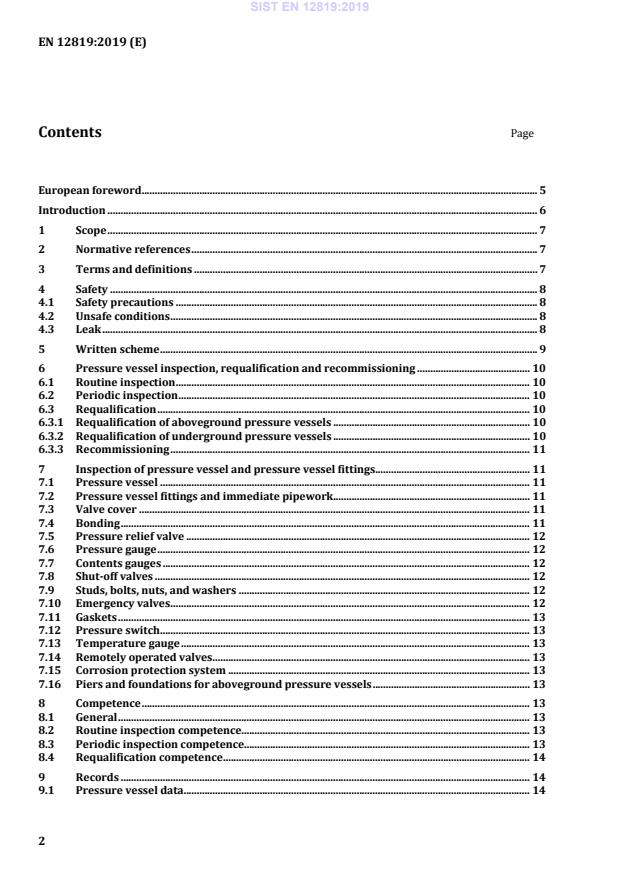
Contents Page
European foreword . 5
Introduction . 6
1 Scope . 7
2 Normative references . 7
3 Terms and definitions . 7
4 Safety . 8
4.1 Safety precautions . 8
4.2 Unsafe conditions . 8
4.3 Leak . 8
5 Written scheme . 9
6 Pressure vessel inspection, requalification and recommissioning . 10
6.1 Routine inspection . 10
6.2 Periodic inspection . 10
6.3 Requalification . 10
6.3.1 Requalification of aboveground pressure vessels . 10
6.3.2 Requalification of underground pressure vessels . 10
6.3.3 Recommissioning . 11
7 Inspection of pressure vessel and pressure vessel fittings. 11
7.1 Pressure vessel . 11
7.2 Pressure vessel fittings and immediate pipework. 11
7.3 Valve cover . 11
7.4 Bonding . 11
7.5 Pressure relief valve . 12
7.6 Pressure gauge . 12
7.7 Contents gauges . 12
7.8 Shut-off valves . 12
7.9 Studs, bolts, nuts, and washers . 12
7.10 Emergency valves . 12
7.11 Gaskets . 13
7.12 Pressure switch . 13
7.13 Temperature gauge . 13
7.14 Remotely operated valves . 13
7.15 Corrosion protection system . 13
7.16 Piers and foundations for aboveground pressure vessels . 13
8 Competence . 13
8.1 General . 13
8.2 Routine inspection competence. 13
8.3 Periodic inspection competence. 13
8.4 Requalification competence . 14
9 Records . 14
9.1 Pressure vessel data . 14
9.2 Reports . 14
Annex A (informative) Visual inspection . 15
A.1 Internal and external visual inspections . 15
A.2 Inspection techniques . 15
A.2.1 External visual inspection . 15
A.2.2 Internal visual inspection . 15
A.2.3 Records . 15
A.3 Additional inspection . 15
Annex B (normative) Hydraulic pressure test . 17
Annex C (normative) Acoustic emission testing . 18
C.1 Scope . 18
C.2 Testing procedure . 18
C.3 Instrumentation . 18
C.3.1 Sensors . 18
C.3.2 Acquisition and evaluation system . 18
C.4 Testing . 18
C.4.1 Test instruction . 18
C.4.2 Safety precautions . 18
C.5 Sensor location . 19
C.5.1 Overground pressure vessels . 19
C.5.2 Underground or mounded pressure vessels . 19
C.5.3 Pressurization . 21
C.6 Data evaluation and analysis . 22
C.6.1 Evaluation criteria . 22
C.6.1.1 General . 22
C.6.1.2 Overground pressure vessels . 22
C.6.1.3 Underground and mounded pressure vessels . 22
C.6.2 Real time control and stop criteria . 22
C.6.2.1 Overground pressure vessels . 22
C.6.2.2 Underground and mounded pressure vessels . 23
C.6.3 Post test analysis . 23
C.6.4 Pressure vessel grading . 23
C.7 Data storage and reporting . 24
Annex D (informative) Ultrasonic thickness test . 25
D.1 General . 25
D.2 Apparatus setting . 25
D.3 Control measurement . 25
D.4 Shell thickness measurements . 25
D.5 End thickness measurements . 25
D.6 Interpretation . 25
D.7 Rejection criteria . 25
Annex E (informative) Monitoring cathodic protection with sacrificial anodes for
underground pressure vessels . 26
E.1 General . 26
E.2 Records . 26
E.3 Procedure. 26
E.4 Measurement of the galvanic current . 26
E.5 Measurement of the potential difference of the pressure vessel to the reference
electrode . 26
E.6 Results . 27
Annex F (informative) Evaluation of coating condition of underground pressure vessels
(cathodic protection by impressed current) . 28
F.1 General . 28
F.2 Apparatus . 28
F.3 Conditions . 28
F.4 Isolation resistance of the coating . 28
F.4.1 Procedure. 28
F.4.2 Calculation . 29
F.5 Results . 29
F.6 Checking intervals . 29
Annex G (informative) A-deviations . 30
Bibliography . 31
European foreword
This document (EN 12819:2019) has been prepared by Technical Committee CEN/TC 286 “Liquefied
petroleum gas equipment and accessories”, the secretariat of which is held by NSAI.
This European Standard shall be given the status of a national standard, either by publication of an
identical text or by endorsement, at the latest by September 2019, and conflicting national standards shall
be withdrawn at the latest by September 2019.
Attention is drawn to the possibility that some of the elements of this document may be the subject of
patent rights. CEN shall not be held responsible for identifying any or all such patent rights.
This document supersedes EN 12819:2009.
This document was thereby technically revised.
In using this document, prepared in the field of application of Article 153 of the treaty on the functioning
of the European Union, users are aware that standards have no formal legal relationship with Directives
that may have been made under Article 153 of the treaty on the functioning of the European Union. In
addition, national legislation in the Member states may contain more stringent requirements than the
minimum requirements of a Directive based on Article 153. Information on the relationship between the
national legislation implementing Directives based on Article 153 and this EN may be given in a national
foreword of the national standard implementing this EN.
According to the CEN-CENELEC Internal Regulations, the national standards organisations of the
following countries are bound to implement this European Standard: Austria, Belgium, Bulgaria, Croatia,
Cyprus, Czech Republic, Denmark, Estonia, Finland, Former Yugoslav Republic of Macedonia, France,
Germany, Greece, Hungary, Iceland, Ireland, Italy, Latvia, Lithuania, Luxembourg, Malta, Netherlands,
Norway, Poland, Portugal, Romania, Serbia, Slovakia, Slovenia, Spain, Sweden, Switzerland, Turkey and
the United Kingdom.
Introduction
Inspection and requalification regimes for pressure vessels greater than 13 m have developed in various
countries in different ways that range from defined to variable inspection periods with requalification
regimes achieved by various methods. This European Standard for inspection and requalification is based
on European countries’ legislation and codes of practice and industries’ codes of practice. In addition, use
of LPG in different applications has encouraged the industry to approach the requirements for inspection
and requalification in different ways for each application.
This document calls for the use of substances and procedures that can be injurious to health if adequate
precautions are not taken. It refers only to technical suitability and does not absolve the user from legal
obligations relating to health and safety at any stage.
Protection of the environment is a key political issue in Europe and elsewhere, for CEN/TC 286 this is
covered in CEN/TS 16765 [1], and this document should be read in conjunction with this standard.
It has been assumed in the drafting of this document that execution of its provisions is entrusted to
appropriately qualified and experienced people.
1 Scope
This document specifies requirements for:
a) routine inspection, periodic inspection and requalification of fixed LPG pressure vessels of sizes
greater than 13 m , and associated fittings;
b) marking pressure vessels and/or keeping records, as appropriate, as a result of routine inspection,
periodic inspection and requalification.
This document excludes refrigerated storage.
2 Normative references
The following documents are referred to in the text in such a way that some or all of their content
constitutes requirements of this document. For dated references, only the edition cited applies. For
undated references, the latest edition of the referenced document (including any amendments) applies.
EN 1330-9, Non-destructive testing - Terminology - Part 9: Terms used in acoustic emission testing
EN 13477-1, Non-destructive testing - Acoustic emission - Equipment characterisation - Part 1: Equipment
description
EN 13477-2, Non-destructive testing - Acoustic emission - Equipment characterisation - Part 2: Verification
of operating characteristic
EN 13554, Non-destructive testing - Acoustic emission testing - General principles
EN 14129, LPG Equipment and accessories - Pressure relief valves for LPG pressure vessels
EN 14584, Non-destructive testing - Acoustic emission testing - Examination of metallic pressure equipment
during proof testing - Planar location of AE sources
EN 16631, LPG equipment and accessories - Pressure relief valves for LPG pressure vessels - Reconditioning
requirements
3 Terms and definitions
For the purposes of this document, the following terms and definitions apply.
ISO and IEC maintain terminological databases for use in standardization at the following addresses:
• IEC Electropedia: available at http://www.electropedia.org/
• ISO Online browsing platform: available at http://www.iso.org/obp
3.1
periodic inspection
external inspection of the visible parts of a pressure vessel and its fittings at defined intervals
3.2
routine inspection
external inspection of the visible parts of a pressure vessel and its fittings, carried out more frequently
than periodic inspections
3.3
requalification
test carried out at defined intervals, as part of the scheme, to confirm that a pressure vessel is fit for a
further period of service
3.4
inspection body
independent inspection and testing body approved by the competent authority
3.5
competent person
person which by combination of appropriate qualification, training, experience, and resources, is able to
make objective judgments on the subject
3.6
competent authority
authority or authorities or any other body or bodies designated as such in each State and in each specific
case in accordance with domestic law
3.7
commissioning
preparation for safe service
3.8
decommissioning
removing from service and preparing safely for inspection/test
3.9
Liquefied Petroleum Gas
LPG
low pressure liquefied gas composed of one or more light hydrocarbons which are assigned to UN 1011,
UN 1075, UN 1965, UN 1969 or UN 1978 only and which consists mainly of propane, propene, butane,
butane isomers, butene with traces of other hydrocarbon gases
4 Safety
4.1 Safety precautions
Appropriate safety precautions shall be taken during decommissioning, commissioning and
inspection/requalification of a pressure vessel and its fittings.
4.2 Unsafe conditions
Any unsafe condition observed by a competent person on the site of an LPG storage pressure vessel shall
be reported to the person responsible for safe operation of the pressure vessel /site, as appropriate, and
action taken.
4.3 Leak
Any leak discovered from the pressure vessel or its fittings shall be reported immediately to the person
responsible for safe operation of the pressure vessel.
Action to make the pressure vessel or its fittings safe shall be taken by a competent person.
NOTE Methods for detecting leaks include:
— visual inspection;
— smell;
— listening;
— use of gas detectors;
— leak detection fluid.
5 Written scheme
5.1 Each pressure vessel and its fittings shall be included in a written scheme, prepared by a competent
person, containing inspection and testing information, taking into account the requirements of Clauses 6
to 8.
5.2 If duties are shared between different parties then the written scheme shall clearly identify the
respective areas of responsibility.
5.3 Intervals between inspections shall be parts of the written scheme and shall be determined by
consideration of the following:
— the design specification of the pressure vessel and its equipment;
— the corrosion protection system on the pressure vessel;
— the system used to ensure that the LPG quality conforms to its specifications/standards, and that it
does not contain components damaging to the material of the pressure vessel or its fittings;
— the maintenance program of the pressure vessel.
NOTE The requirements for the written scheme can also be determined by national regulations.
5.4 The written scheme shall contain the following information:
— the maximum interval between inspections;
— the parts to be inspected;
— the nature of the inspection;
— the critical parts that, if modified or repaired, shall be inspected by a competent person/body before
they can be put back into service;
— the requirements for pressure relief valves (see 7.5.1);
— the name of the competent person preparing the written scheme;
— the date of issue of the written scheme.
6 Pressure vessel inspection, requalification and recommissioning
6.1 Routine inspection
6.1.1 Each pressure vessel and its fittings shall be routinely inspected at intervals defined in the written
scheme.
6.1.2 Routine inspections shall include 7.1, 7.2, 7.3, 7.4, 7.5.2, 7.5.3, 7.5.4, 7.7, 7.14 and 7.16.
6.2 Periodic inspection
6.2.1 Each pressure vessel and its fittings shall be periodically inspected at intervals defined in the
written scheme.
6.2.2 Periodic inspections shall include 6.1.2, 7.6, 7.8, 7.12, 7.13 and 7.15.
6.2.3 For aboveground pressure vessels, a visual inspection of external surfaces shall be carried out
(see Annex A). If pressure vessels are provided with fixed passive fire protection, which prevents the full
external visual inspection according to Annex A, the written scheme shall specify alternative techniques
to identify the presence of defects (e.g. the presence of corrosion).
NOTE Periodic inspection can also be referred to as intermediate inspection.
6.3 Requalification
6.3.1 Requalification of aboveground pressure vessels
Requalification intervals shall be specified in the written scheme. Requalification shall include 7.5.1, 7.9,
7.10, 7.11, an external visual inspection, and at least one of the following:
— an internal visual inspection (see Annex A);
— a hydraulic pressure test (see Annex B);
— an acoustic emission test (see Annex C);
— an ultrasonic thickness test (see Annex D);
— any other method agreed by the competent authority.
6.3.2 Requalification of underground pressure vessels
Requalification intervals shall be specified in the written scheme. Requalification shall include 7.5.1, 7.9,
7.10, 7.11 with at least one test from group 1 and one test from group 2 of Table 1.
Table 1 — Requalification tests
Group 1 Group 2
Internal visual inspection (see Annex A) External visual inspection (i.e. excavation)
Hydraulic pressure test (see Annex B) Cathodic protection monitoring (see Annex E or
Annex F)
Acoustic emission test (Annex C)
Other equivalent method
Ultrasonic thickness test (see Annex D)
Other equivalent method
For pressure vessels provided with means of protection other than cathodic, when an acoustic emission
test is performed, an external visual inspection of directly accessible parts of the shell and the pressure
vessel fittings can be done instead of the tests described in group 2.
6.3.3 Recommissioning
At recommissioning, after periodic inspection and requalification, leak checks shall be carried out at
connections. Gaskets that have been removed when breaking connections shall not be reused.
When underground pressure vessels are excavated for inspection, the anchoring system shall be checked
prior to commissioning.
7 Inspection of pressure vessel and pressure vessel fittings
7.1 Pressure vessel
Aboveground pressure vessels shall be checked for external corrosion or visible damage. If pressure
vessels are provided with fixed passive fire protection, which prevents the full external visual inspection
according to Annex A, the written scheme shall specify alternative techniques to identify the presence of
defects (e.g. the presence of corrosion).
For underground pressure vessels, only the visible part of the pressure vessel shall be checked for
external corrosion or visible damage.
7.2 Pressure vessel fittings and immediate pipework
The fittings and immediate pipework shall be inspected for the following and rectified as necessary:
— corrosion;
— damage;
— inoperative or leaking filler valves;
— worn or damaged filler valve thread or connection;
7.3 Valve cover
There shall be checks that the valve covers, if fitted, are in place, undamaged and able to be locked.
7.4 Bonding
7.4.1 The electrical bonding between the pressure vessel and earth point shall be visually checked,
where fitted.
7.4.2 There shall be a check that the road tanker bonding tag is undamaged (if applicable).
7.5 Pressure relief valve
7.5.1 There shall be either:
a) a test of the set pressure of the pressure relief valve and, for an external pressure relief valve, a check
of the condition of the spring; or
b) the pressure relief valve shall be replaced with a new valve according to EN 14129 or a reconditioned
valve according to EN 16631.
WARNING — Do not remove a pressure relief valve from a pressure relief valve manifold or check-device
while a pressure vessel is under pressure, unless a serviceable replacement is available for immediate
fitting. Do not remove a pressure relief valve mounted in a pressure vessel under pressure unless the type
and construction of the check device can be identified and the manufacturer’s instructions for safe
removal are complied with. Some check devices or pressure relief valves include positive means of
confirming that the check device has closed before the pressure relief valve is unscrewed to an otherwise
dangerous stage.
7.5.2 The pressure relief valve drain hole, if provided, shall be checked to ensure it is clear.
7.5.3 Stack pipes shall be inspected for corrosion. Pressure relief valves shall also be externally
inspected if corrosion is found in the stack pipes. There shall be a check that rain caps are present and in
good condition.
7.5.4 Multiport mechanisms shall be checked to ensure that they move freely into position when
operated.
WARNING — After testing, the mechanism shall be positioned so that pressure relief valve inlets are not
obstructed.
7.6 Pressure gauge
The pressure gauge, if fitted, shall be calibrated or metrological verified or replaced.
7.7 Contents gauges
Gauging devices or contents gauges that bleed to the atmosphere (e.g. rotary tubes, fixed liquid level
gauges or slip tubes) shall be tested for correct functions when filling the pressure vessel. Other types of
contents gauges shall be checked as required (e.g. during product transfer to or from the pressure vessel).
7.8 Shut-off valves
Shut-off valves shall be tested for correct function.
WARNING — When checking the function of a shut–off valve do not shut off the gas supply unless the
user has been informed. Do not restore a gas supply before checking that the gas appliance shut-off valves
are closed.
Blanked or plugged valves shall be checked for external leakage.
7.9 Studs, bolts, nuts, and washers
Studs, bolts, nuts, and washers shall be checked for damage or corrosion and replaced if required.
7.10 Emergency valves
Excess flow valves and non-return valves shall be checked for correct operation.
7.11 Gaskets
Gaskets between any separated connections shall be renewed before reconnecting.
7.12 Pressure switch
Pressure switches (if fitted) shall be checked for correct operation using a calibrated or a metrological
verified test pressure gauge.
7.13 Temperature gauge
The accuracy of temperature gauges shall be checked, using a calibrated or a metrological verified
instrument.
7.14 Remotely operated valves
Remotely operated valves (if fitted) shall be checked for correct operation when activated.
7.15 Corrosion protection system
Any check required for the selected corrosion protection system, as detailed in the written scheme, shall
be carried out.
7.16 Piers and foundations for aboveground pressure vessels
The condition of piers and foundations shall be checked to ensure that they are sound with no visible
damage or uneven settlement. Anchoring bolts shall be visually inspected for deterioration, where fitted
and accessible.
8 Competence
8.1 General
Guidance on the competences required to perform routine inspection, periodic inspection and
requalification are detailed in 8.2 to 8.4.
NOTE It is advised to consider definitions of the competence to do inspections/requalification per national
legislations.
8.2 Routine inspection competence
Persons shall be deemed competent to carry out routine inspections if they have received the appropriate
training to carry out the routine inspection of 6.1 and to prepare a report.
8.3 Periodic inspection competence
Persons shall be deemed competent to carry out periodic inspections if:
— they are competent to carry out routine inspections (see 8.1); and
— they are part of an inspection team with the appropriate background, training and qualification, or
have worked with or within the LPG industry, performing the relevant task, and have a good general
knowledge of LPG and its operating environment; or
— they are part of an accredited inspection body.
The relevant attributes shall be documented.
8.4 Requalification competence
Persons shall be deemed competent to requalify a pressure vessel if they are competent to carry out
periodic inspection and if they possess detailed knowledge of the technique(s) used in requalification
with relevant training and certification.
9 Records
9.1 Pressure vessel data
If the pressure vessel identification plate or tag is illegible, it shall be cleaned, repaired or replaced as
appropriate.
All information on the pressure vessel data plate or tag or documentation shall be updated, as
appropriate, after periodic inspection or requalification.
9.2 Reports
A routine inspection report shall be issued if required by the written scheme.
A report shall be produced following a periodic inspection or requalification.
If a pressure vessel fails a routine inspection, periodic inspection or requalification, a test report shall be
prepared as part of a formal follow-up system.
Annex A
(informative)
Visual inspection
A.1 Internal and external visual inspections
The aim of internal and external visual inspections is to detect surface defects on the pressure vessel
shell, including:
— deterioration of coating (where visible for underground pressure vessels);
— corrosion;
— cracks, dents, gouges, lamination and bulges.
A.2 Inspection techniques
A.2.1 External visual inspection
External surfaces should be clean and dry. The condition of the coating should be checked and a note
made of any corrosion, imperfections, or mechanical damage.
The inspection should be carried out visually, using, if required, the following:
— a beam of light directed along the surface of the pressure vessel to indicate imperfections by shadow;
— a straight edge placed along the surface to show the extent of a defect;
— a depth gauge to determine the depth of corrosion, dents or gouges;
— a magnifying glass for detailed inspections;
— a mirror.
A.2.2 Internal visual inspection
The pressure vessel should be clean, dry and free from foreign matter.
Checks for corrosion and mechanical damage should be undertaken using an endoscope, camera or other
means.
If it is possible for a person to enter the pressure vessel, then the inspection techniques in A.2.1 can be
used for the internal visual inspection.
A.2.3 Records
Defects shall be noted in the pressure vessel record and in the inspection report. Deterioration in
recorded defects should be assessed at the next inspection.
A.3 Additional inspection
A.3.1 Additional inspections can be required to confirm the suitability of a pressure vessel for further
service.
A.3.2 Written instructions for additional inspections of a pressure vessel should be prepared by a
competent person.
A.3.3 Written instructions and results of additional inspections should be kept in the pressure vessel
record.
Annex B
(normative)
Hydraulic pressure test
B.1 The hydraulic pressure test should be performed in accordance with this annex. All fittings should
be removed before testing.
Water should normally be used as the test fluid. During the test, the water temperature should not fall
below 7 °C.
The pressure vessel should be properly vented before the test pressure is applied to prevent formation
of air pockets.
B.2 The test pressure for the pressure vessels should be as specified on the data plate or
documentation. The test pressure can be lower if required by the competent person.
B.3 The pressure in the pressure vessel should be gradually increased up to the test pressure, and the
pressure vessel isolated from the pressurizing system. The pressure in the pressure vessel should be
maintained for sufficient time to assess the pressure vessel, but not less than 10 min.
B.4 The pressure vessel should be deemed to pass the test if:
— no noticeable reduction in pressure or leaks are observed in the pressure vessel during the test; and
— there are no visible signs of plastic yielding after depressurization.
NOTE The last indent is only applicable to excavated underground pressure vessel and aboveground pressure
vessel.
B.5 The pressure vessel should be carefully drained and dried out if required.
B.6 Gaskets, bolts, etc. should be changed as appropriate after the test.
Annex C
(normative)
Acoustic emission testing
C.1 Scope
This annex specifies the minimum requirements for the test equipment, the type and sequence of loading,
data acquisition and data evaluation, for the performance of an AT (acoustic testing) on pressure vessels
greater than 13 m .
NOTE It is advised to consider further requirements per national regulations.
These minimum requirements cover all types of pressure vessels, including those produced with joggle
joints, both above and underground.
The purpose of the AT is to detect and evaluate indications of growing flaws within the pressure vessel.
The tests can be performed on-site and the pressurization shall be performed with LPG and/or inert gas
(e.g. N ) or any other compatible gas or liquid.
C.2 Testing procedure
A testing procedure according to EN 13554 for AT shall be developed.
C.3 Instrumentation
C.3.1 Sensors
The resonant frequency of the sensors shall be in the range of 70 kHz to 180 kHz, except for bitumen
coated pressure vessels where the range shall be 30 kHz to 80 kHz.
C.3.2 Acquisition and evaluation system
The AE (acoustic emission) acquisition and evaluation system shall be checked and maintained in
accordance with EN 13477-1 and EN 13477-2.
The AE acquisition and evaluation system shall be able to acquire, record and evaluate all data to meet
the requirements of C.6.1.
C.4 Testing
C.4.1 Test instruction
The written AT test instruction shall conform to EN 14584. The values for stop, acceptance and rejection
criteria of the pressure vessel shall be included in the test instruction. Any intermediate position (e.g.
active source, see Table 1) shall also be included in the test instruction. This test instruction shall be
delivered to the pressure vessel owner/user and the supervision body, where required, before the test is
performed.
C.4.2 Safety precautions
The pressure vessel shall not be overfilled.
If the acoustic signals indicate a leak, the leak shall be fixed before proceeding.
The test pressure equipment shall have an emergency shut-down system to stop the pressurization and
to initiate rapid depressurization of the pressure vessel.
When pressurizing a pressure vessel containing LPG, if the test pressure is to exceed PS then:
a) the written agreement of the p
...