

SIST EN 13445-2:2021+A1:2023
(Main + Amendment)Unfired pressure vessels - Part 2: Materials
General Information
- Abstract
This document specifies the requirements for steel products used for unfired pressure vessels.
For some metallic materials other than steel, such as spheroidal graphite cast iron, aluminium, nickel, copper, titanium, requirements are or will be formulated in separate parts of this document.
For metallic materials which are not covered by a harmonized material standard and are not likely to be in near future, specific rules are given in this part or the above cited parts of this document.
- Status
- Published
- Publication Date
- 17-Oct-2023
- Technical Committee
- TLP - Pressure vessels
- Current Stage
- 6060 - National Implementation/Publication (Adopted Project)
- Start Date
- 25-Aug-2023
- Due Date
- 30-Oct-2023
- Completion Date
- 18-Oct-2023
- Directive
- 2014/68/EU - Directive 2014/68/EU of the European Parliament and of the Council of 15 May 2014 on the harmonisation of the laws of the Member States relating to the making available on the market of pressure equipmentOJ Ref: 2025/165, 31.1.2025, L, OJ L OJ Date: 31-Jan-2025

Overview
SIST EN 13445-2:2021+A1:2023 - Unfired pressure vessels: Part 2 - Materials specifies the requirements for steel products used in the manufacture of unfired pressure vessels. Adopted from EN 13445-2 with Amendment A1 (2023), this standard sets material selection, testing and documentation rules to ensure mechanical integrity, safety and regulatory compliance of pressure equipment across Europe. For non-steel metallic materials (e.g., aluminium, nickel, copper, titanium, spheroidal graphite cast iron), separate parts of the EN 13445 series or specific rules apply.
Key topics and technical requirements
- Material scope: Requirements primarily for steels intended for pressure-bearing parts; rules for non-harmonized materials are included where necessary.
- Prevention of brittle fracture: Procedures and selection criteria to avoid brittle failure at low temperatures (grouping systems, impact energy requirements, fracture mechanics options).
- Design temperature & creep: Rules for materials used above 20 °C and guidance for creep-range properties and design considerations.
- Technical delivery conditions: Acceptance criteria, documentation (e.g., EN 10204 inspection documents), and applicable European technical delivery standards for plates, tubes and forgings.
- Welds and cladding: Requirements for welding consumables, welding procedure qualification, production test plates, and special provisions for clad products used to provide corrosion or wear resistance.
- Fasteners and components: Specific requirements for steels used for fasteners (mechanical properties, delivery conditions).
- Marking and inspection: Traceability, marking and inspection documentation to meet pressure equipment conformity.
- Annexes and informative guidance: Includes grouping systems, testing methods, weld creep-strength factors, and a list of European steels for pressure purposes.
Practical applications
- Use this standard when selecting steel grades and verifying material certificates for:
- Pressure vessel designers and engineers
- Fabricators and welders manufacturing unfired pressure vessels
- Material suppliers and procurement teams
- Inspection bodies and conformity assessment organizations
- Asset owners seeking compliance with European pressure equipment rules
- Helps ensure safe operation, regulatory conformity (see Annex ZA on relationship to EU legislation), and consistent material quality across manufacturing, testing and inspection stages.
Who should use this standard
- Mechanical and pressure equipment designers
- Materials engineers and metallurgists
- Welding coordinators and QA/QC personnel
- Certification bodies and notified bodies working under Pressure Equipment Directive frameworks
- Manufacturers of boilers, heat exchangers, tanks and other unfired pressure vessels
Related standards (selection)
- EN 13445 series (other parts)
- EN 764-1 / EN 764-4 (pressure equipment terminology and delivery conditions)
- EN 10204 (inspection documents)
- EN 10028 series, EN 10216 / EN 10217, EN 10222 (steel product specifications)
Keywords: SIST EN 13445-2:2021+A1:2023, unfired pressure vessels, materials, steel products, pressure equipment standard, brittle fracture, technical delivery conditions, cladding, welding consumables.
Relations
- Effective Date
- 01-Nov-2023
- Effective Date
- 01-Nov-2023
- Effective Date
- 01-Dec-2026
- Effective Date
- 28-Jan-2026
- Effective Date
- 28-Jan-2026
- Effective Date
- 28-Jan-2026
- Effective Date
- 28-Jan-2026
- Effective Date
- 28-Jan-2026
- Effective Date
- 28-Jan-2026
- Effective Date
- 28-Jan-2026
- Effective Date
- 28-Jan-2026
- Effective Date
- 28-Jan-2026
- Effective Date
- 28-Jan-2026
- Effective Date
- 28-Jan-2026
- Effective Date
- 28-Jan-2026
Get Certified
Connect with accredited certification bodies for this standard

Institut za varilstvo d.o.o. (Welding Institute)
Slovenia's leading welding institute since 1952. ISO 3834, EN 1090, pressure equipment certification, NDT personnel, welder qualification. Only IIW Au
Sponsored listings
Frequently Asked Questions
SIST EN 13445-2:2021+A1:2023 is a standard published by the Slovenian Institute for Standardization (SIST). Its full title is "Unfired pressure vessels - Part 2: Materials". This standard covers: This document specifies the requirements for steel products used for unfired pressure vessels. For some metallic materials other than steel, such as spheroidal graphite cast iron, aluminium, nickel, copper, titanium, requirements are or will be formulated in separate parts of this document. For metallic materials which are not covered by a harmonized material standard and are not likely to be in near future, specific rules are given in this part or the above cited parts of this document.
This document specifies the requirements for steel products used for unfired pressure vessels. For some metallic materials other than steel, such as spheroidal graphite cast iron, aluminium, nickel, copper, titanium, requirements are or will be formulated in separate parts of this document. For metallic materials which are not covered by a harmonized material standard and are not likely to be in near future, specific rules are given in this part or the above cited parts of this document.
SIST EN 13445-2:2021+A1:2023 is classified under the following ICS (International Classification for Standards) categories: 23.020.30 - Pressure vessels, gas cylinders; 23.020.32 - Pressure vessels. The ICS classification helps identify the subject area and facilitates finding related standards.
SIST EN 13445-2:2021+A1:2023 has the following relationships with other standards: It is inter standard links to SIST EN 13445-2:2021/A1:2023, SIST EN 13445-2:2021, SIST EN 13445-2:2026, SIST EN 10217-4:2019, SIST EN 10217-3:2019, SIST EN 764-1:2015+A1:2016, SIST EN 10028-2:2017, SIST EN 764-5:2015, SIST EN 10273:2016, SIST EN 764-2:2012, SIST EN 10028-5:2017, SIST EN 10028-4:2017, SIST EN ISO 2566-2:2022, SIST EN 10269:2014, SIST EN 13445-5:2021. Understanding these relationships helps ensure you are using the most current and applicable version of the standard.
SIST EN 13445-2:2021+A1:2023 is associated with the following European legislation: EU Directives/Regulations: 2014/68/EU, EUR-PUB; Standardization Mandates: M/071, M/601. When a standard is cited in the Official Journal of the European Union, products manufactured in conformity with it benefit from a presumption of conformity with the essential requirements of the corresponding EU directive or regulation.
SIST EN 13445-2:2021+A1:2023 is available in PDF format for immediate download after purchase. The document can be added to your cart and obtained through the secure checkout process. Digital delivery ensures instant access to the complete standard document.
Standards Content (Sample)
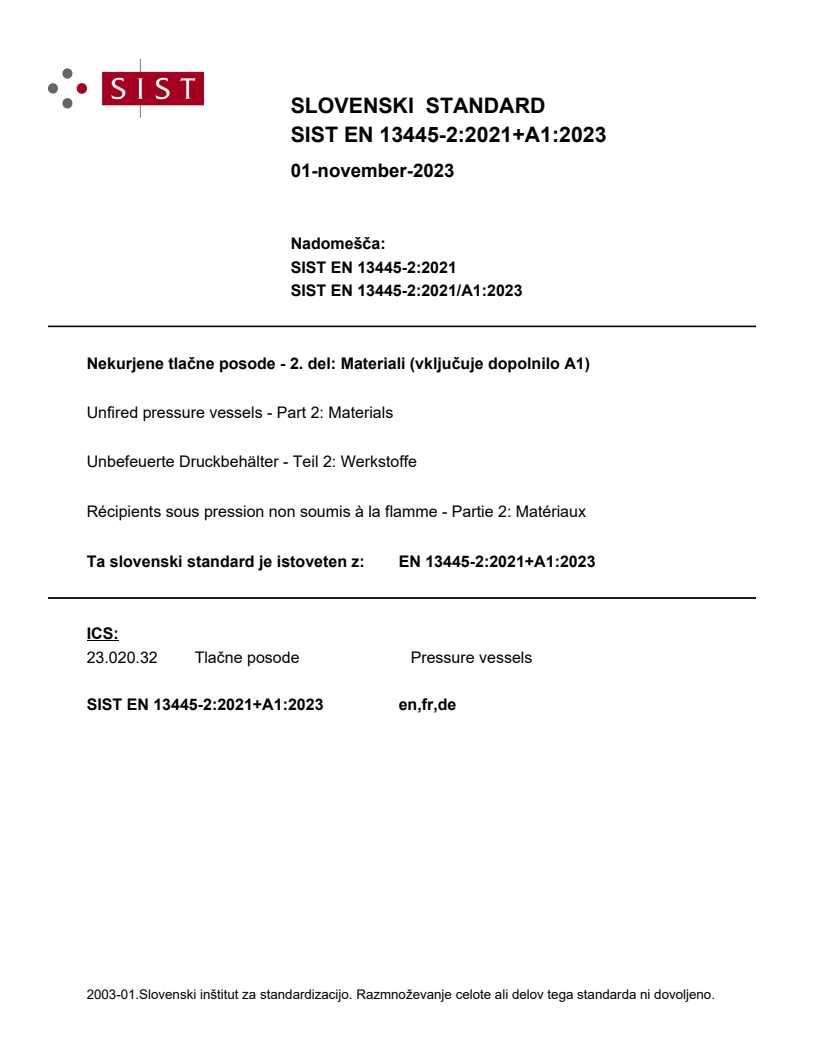
SLOVENSKI STANDARD
01-november-2023
Nadomešča:
SIST EN 13445-2:2021
SIST EN 13445-2:2021/A1:2023
Nekurjene tlačne posode - 2. del: Materiali (vključuje dopolnilo A1)
Unfired pressure vessels - Part 2: Materials
Unbefeuerte Druckbehälter - Teil 2: Werkstoffe
Récipients sous pression non soumis à la flamme - Partie 2: Matériaux
Ta slovenski standard je istoveten z: EN 13445-2:2021+A1:2023
ICS:
23.020.32 Tlačne posode Pressure vessels
2003-01.Slovenski inštitut za standardizacijo. Razmnoževanje celote ali delov tega standarda ni dovoljeno.
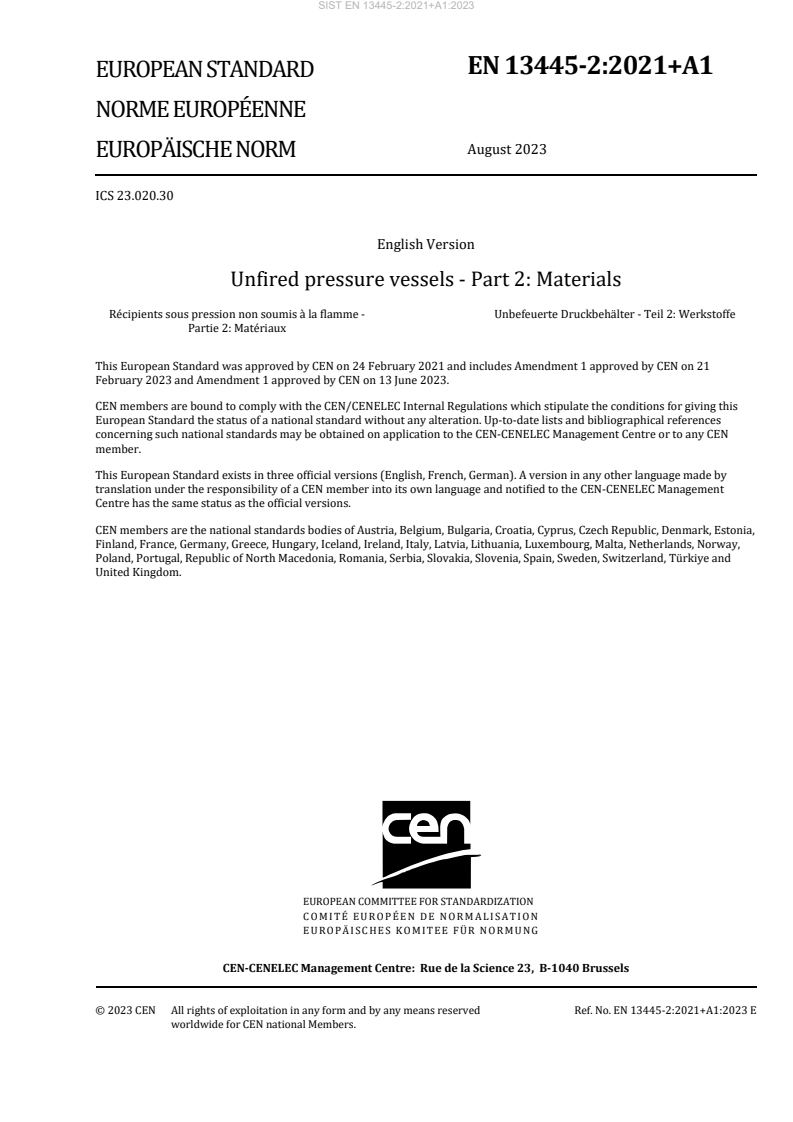
EN 13445-2:2021+A1
EUROPEAN STANDARD
NORME EUROPÉENNE
August 2023
EUROPÄISCHE NORM
ICS 23.020.30
English Version
Unfired pressure vessels - Part 2: Materials
Récipients sous pression non soumis à la flamme - Unbefeuerte Druckbehälter - Teil 2: Werkstoffe
Partie 2: Matériaux
This European Standard was approved by CEN on 24 February 2021 and includes Amendment 1 approved by CEN on 21
February 2023 and Amendment 1 approved by CEN on 13 June 2023.
CEN members are bound to comply with the CEN/CENELEC Internal Regulations which stipulate the conditions for giving this
European Standard the status of a national standard without any alteration. Up-to-date lists and bibliographical references
concerning such national standards may be obtained on application to the CEN-CENELEC Management Centre or to any CEN
member.
This European Standard exists in three official versions (English, French, German). A version in any other language made by
translation under the responsibility of a CEN member into its own language and notified to the CEN-CENELEC Management
Centre has the same status as the official versions.
CEN members are the national standards bodies of Austria, Belgium, Bulgaria, Croatia, Cyprus, Czech Republic, Denmark, Estonia,
Finland, France, Germany, Greece, Hungary, Iceland, Ireland, Italy, Latvia, Lithuania, Luxembourg, Malta, Netherlands, Norway,
Poland, Portugal, Republic of North Macedonia, Romania, Serbia, Slovakia, Slovenia, Spain, Sweden, Switzerland, Türkiye and
United Kingdom.
EUROPEAN COMMITTEE FOR STANDARDIZATION
COMITÉ EUROPÉEN DE NORMALISATION
EUROPÄISCHES KOMITEE FÜR NORMUNG
CEN-CENELEC Management Centre: Rue de la Science 23, B-1040 Brussels
© 2023 CEN All rights of exploitation in any form and by any means reserved Ref. No. EN 13445-2:2021+A1:2023 E
worldwide for CEN national Members.
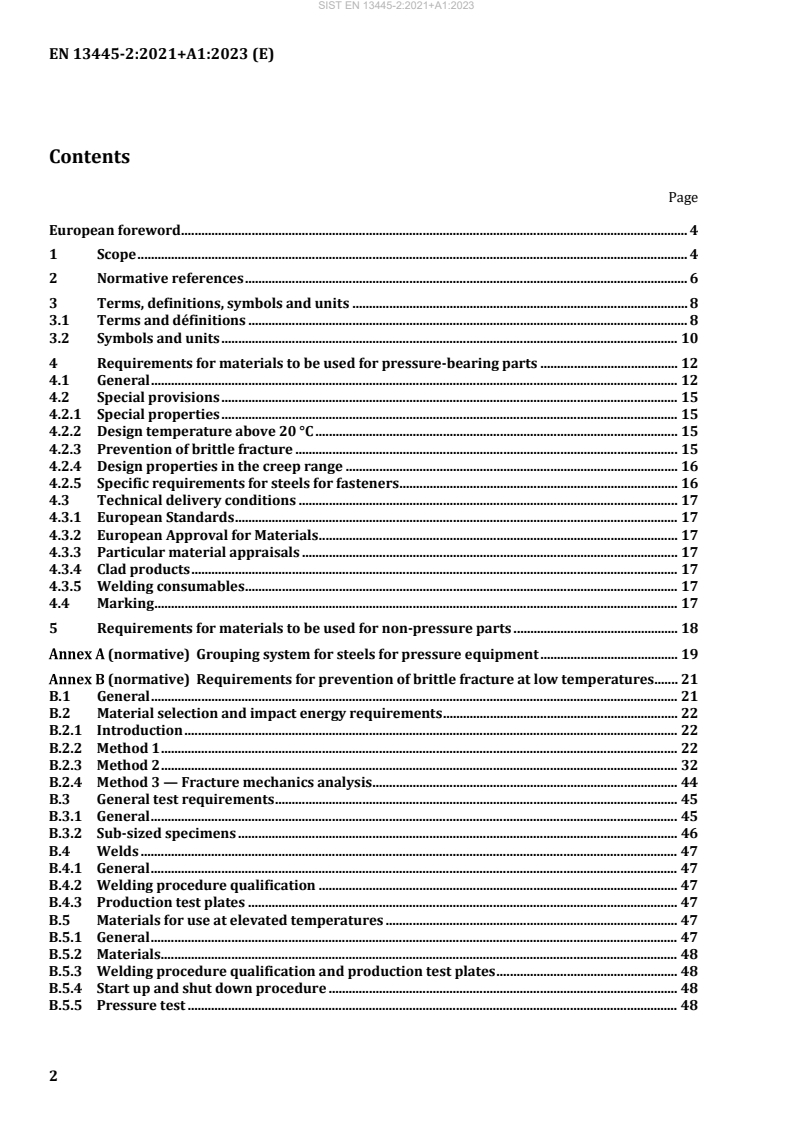
Contents
Page
European foreword . 4
1 Scope . 4
2 Normative references . 6
3 Terms, definitions, symbols and units . 8
3.1 Terms and définitions . 8
3.2 Symbols and units . 10
4 Requirements for materials to be used for pressure-bearing parts . 12
4.1 General . 12
4.2 Special provisions . 15
4.2.1 Special properties . 15
4.2.2 Design temperature above 20 °C . 15
4.2.3 Prevention of brittle fracture . 15
4.2.4 Design properties in the creep range . 16
4.2.5 Specific requirements for steels for fasteners . 16
4.3 Technical delivery conditions . 17
4.3.1 European Standards . 17
4.3.2 European Approval for Materials . 17
4.3.3 Particular material appraisals . 17
4.3.4 Clad products . 17
4.3.5 Welding consumables . 17
4.4 Marking . 17
5 Requirements for materials to be used for non-pressure parts . 18
(normative) Grouping system for steels for pressure equipment . 19
(normative) Requirements for prevention of brittle fracture at low temperatures . 21
B.1 General . 21
B.2 Material selection and impact energy requirements . 22
B.2.1 Introduction . 22
B.2.2 Method 1 . 22
B.2.3 Method 2 . 32
B.2.4 Method 3 — Fracture mechanics analysis . 44
B.3 General test requirements . 45
B.3.1 General . 45
B.3.2 Sub-sized specimens . 46
B.4 Welds . 47
B.4.1 General . 47
B.4.2 Welding procedure qualification . 47
B.4.3 Production test plates . 47
B.5 Materials for use at elevated temperatures . 47
B.5.1 General . 47
B.5.2 Materials . 48
B.5.3 Welding procedure qualification and production test plates . 48
B.5.4 Start up and shut down procedure . 48
B.5.5 Pressure test . 48
(informative) Procedure for determination of the weld creep strength reduction
factor (WCSRF) . 56
(informative) Technical delivery conditions for clad products for pressure
purposes . 57
D.1 Introductory note . 57
D.2 Requirements for the material . 57
D.3 Requirements for the deposited material . 57
D.4 Qualification of the cladding procedure . 58
D.5 Production tests . 59
(informative) European steels for pressure purposes . 61
E.1 European Standards for steels and steel components for pressure purposes . 61
E.2 European standardised steels grouped according to product forms . 62
(normative) Special provisions for materials and components . 85
F.1 General . 85
F.2 Mechanical properties and technical delivery conditions for fasteners in accordance
with EN ISO 3506 . 85
F.2.1 Mechanical properties for austenitic bolts in accordance with EN ISO 3506-1 . 85
F.2.2 Delivery conditions for austenitic fasteners. 86
(informative) History of EN 13445-2 . 87
Y.1 Differences between EN 13445-2:2014 and EN 13445-2:2021. 87
Annex ZA (informative) Relationship between this European Standard and the essential
requirements of Directive 2014/68/EU aimed to be covered . 88
Bibliography . 89
European foreword
This document (EN 13445-2:2021+A1:2023) has been prepared by Technical Committee CEN/TC 54
“Unfired pressure vessels”, the secretariat of which is held by BSI.
This European Standard shall be given the status of a national standard, either by publication of an
identical text or by endorsement, at the latest by February 2024, and conflicting national standards shall
be withdrawn at the latest by February 2024.
Attention is drawn to the possibility that some of the elements of this document may be the subject of
patent rights. CEN shall not be held responsible for identifying any or all such patent rights.
This document supersedes !EN 13445-2:2021".
This document includes Amendment 1 approved by CEN on 21 February 2023.
The start and finish of text introduced or altered by amendment is indicated in the text by tags !".
This document has been prepared under a standardisation request addressed to [the relevant ESO] by
the European Commission. The Standing Committee of the EFTA States subsequently approves these
requests for its Member States.
For the relationship with EU Legislation, see informative Annex ZA, which is an integral part of this
document.
The list of all parts in the EN 13445 series can be found on the CEN website.
Although these Parts may be obtained separately, it should be recognised that the Parts are inter-
dependant. As such the manufacture of unfired pressure vessels requires the application of all the
relevant Parts in order for the requirements of the Standard to be satisfactorily fulfilled.
Corrections to the standard interpretations where several options seem possible are conducted through
the Migration Help Desk (MHD). Information related to the Help Desk can be found at http://www.unm.fr
(en13445@unm.fr). A form for submitting questions can be downloaded from the link to the MHD
website. After subject experts have agreed an answer, the answer will be communicated to the
questioner. Corrected pages will be given specific issue number and issued by CEN according to CEN
Rules. Interpretation sheets will be posted on the website of the MHD.
This document supersedes EN 13445-2:2014. This new edition incorporates the Amendments which
have been approved previously by CEN members, and the corrected pages up to Issue 5 without any
further technical change. Annex Y provides details of significant technical changes between this European
Standard and the previous edition.
Amendments to this new edition may be issued from time to time and then used immediately as
alternatives to rules contained herein. It is intended to deliver a new Issue of EN 13445:2021 each year,
starting with the precedent as Issue 1, consolidating these Amendments and including other identified
corrections.
Any feedback and questions on this document should be directed to the users’ national standards body.
A complete listing of these bodies can be found on the CEN website.
According to the CEN-CENELEC Internal Regulations, the national standards organisations of the
following countries are bound to implement this European Standard: Austria, Belgium, Bulgaria, Croatia,
Cyprus, Czech Republic, Denmark, Estonia, Finland, France, Germany, Greece, Hungary, Iceland, Ireland,
Italy, Latvia, Lithuania, Luxembourg, Malta, Netherlands, Norway, Poland, Portugal, Republic of North
Macedonia, Romania, Serbia, Slovakia, Slovenia, Spain, Sweden, Switzerland, Turkey and the United
Kingdom.
1 Scope
This document specifies the requirements for steel products used for unfired pressure vessels.
For some metallic materials other than steel, such as spheroidal graphite cast iron, aluminium, nickel,
copper, titanium, requirements are or will be formulated in separate parts of this document.
For metallic materials which are not covered by a harmonized material standard and are not likely to be
in near future, specific rules are given in this part or the above cited parts of this document.
2 Normative references
The following documents are referred to in the text in such a way that some or all of their content
constitutes requirements of this document. For dated references, only the edition cited applies. For
undated references, the latest edition of the referenced document (including any amendments) applies.
EN 764-1:2015+A1:2016, Pressure equipment — Terminology — Part 1: Pressure, temperature, volume,
nominal size
EN 764-2:2012, Pressure equipment — Part 2: Quantities, symbols and units
!Deleted reference"
EN 764-4:2014, Pressure equipment — Part 4: Establishment of technical delivery conditions for metallic
materials
EN 764-5:2014, Pressure equipment — Part 5: Inspection documentation of metallic materials and
compliance with the material specification
EN 1092-1:2018, Flanges and their joints — Circular flanges for pipes, valves, fittings and accessories, PN
designated — Part 1: Steel flanges
!EN 10028-2:2017", Flat products made of steels for pressure purposes — Part 2: Non-alloy and alloy
steels with specified elevated temperature properties
!EN 10028-3:2017", Flat products made of steels for pressure purposes — Part 3: Weldable fine grain
steels, normalized
!EN 10028-4:2017", Flat products made of steels for pressure purposes — Part 4: Nickel alloy steels
with specified low temperature properties
!EN 10028-5:2017", Flat products made of steels for pressure purposes — Part 5: Weldable fine grain
steels, thermomechanically rolled
!EN 10028-6:2017", Flat products made of steels for pressure purposes — Part 6: Weldable fine grain
steels, quenched and tempered
!EN 10028-7:2016", Flat products made of steels for pressure purposes — Part 7: Stainless steels
EN 10204:2004, Metallic products — Types of inspection documents
EN 10216-3:2013, Seamless steel tubes for pressure purposes — Technical delivery conditions — Part 3:
Alloy fine grain steel tubes
EN 10216-4:2013, Seamless steel tubes for pressure purposes — Technical delivery conditions — Part 4:
Non-alloy and alloy steel tubes with specified low temperature properties
!EN 10217-3:2019, Welded steel tubes for pressure purposes — Technical delivery conditions — Part 3:
Electric welded and submerged arc welded alloy fine grain steel tubes with specified room, elevated and low
temperature properties"
!EN 10217-4:2019", Welded steel tubes for pressure purposes — Technical delivery conditions —
Part 4: Electric welded non-alloy steel tubes with specified low temperature properties
!EN 10217-6:2019", Welded steel tubes for pressure purposes — Technical delivery conditions —
Part 6: Submerged arc welded non-alloy steel tubes with specified low temperature properties
!EN 10222-3:2017", Steel forgings for pressure purposes — Part 3: Nickel steels with specified low
temperature properties
!EN 10222-4:2017+A1:2021", Steel forgings for pressures purposes — Part 4: Weldable fine grain
steels with high proof strength
EN 10269:2013, Steels and nickel alloys for fasteners with specified elevated and/or low temperature
properties
!EN 10273:2016", Hot rolled weldable steel bars for pressure purposes with specified elevated
temperature properties
EN 12074:2000, Welding consumables — Quality requirements for manufacture, supply and distribution of
consumables for welding and allied processes
EN 13445-1:2021, Unfired pressure vessels — Part 1: General
EN 13445-3:2021, Unfired pressure vessels — Part 3: Design
EN 13445-4:2021, Unfired pressure vessels — Part 4: Fabrication
EN 13445-5:2021, Unfired pressure vessels — Part 5: Inspection and testing
!EN 13479:2017", Welding consumables — General product standard for filler metals and fluxes for
fusion welding of metallic materials
!EN ISO 148-1:2016, Metallic materials — Charpy pendulum impact test — Part 1: Test method
(ISO 148-1:2016)"
!EN ISO 204:2018", Metallic materials — Uniaxial creep testing in tension — Method of test
(ISO 204:2009)
EN ISO 898-1:2013, Mechanical properties of fasteners made of carbon steel and alloy steel — Part 1: Bolts,
screws and studs with specified property classes — Coarse thread and fine pitch thread (ISO 898-1:2013)
EN ISO 898-2:2012, Mechanical properties of fasteners made of carbon steel and alloy steel — Part 2: Nuts
with specified property classes — Coarse thread and fine pitch thread (ISO 898-2:2012)
!EN ISO 2566-1:2021, Steel — Conversion of elongation values — Part 1: Carbon and low alloy steels
(ISO 2566-1:2021)"
!EN ISO 2566-2:2021, Steel — Conversion of elongation values — Part 2: Austenitic steels (ISO 2566-
2:2021)"
!EN ISO 3506-1:2020, Mechanical properties of corrosion-resistant stainless-steel fasteners — Part 1:
Bolts, screws and studs with specified grades and property classes (ISO 3506-1:2020)"
!EN ISO 3506-2:2020, Mechanical properties of corrosion-resistant stainless-steel fasteners — Part 2:
Nuts with specified grades and property classes (ISO 3506-2:2020)"
!EN ISO 6892-1:2019, Metallic materials — Tensile testing — Part 1: Method of test at room temperature
(ISO 6892-1:2019)"
!CEN ISO/TR 15608:2017, Welding — Guidelines for a metallic materials grouping system
(ISO/TR 15608:2017)"
3 Terms, definitions, symbols and units
3.1 Terms and définitions
For the purposes of this document, the terms and definitions given in EN 13445-1:2021, EN 764-
1:2015+A1:2016, !deleted reference" and the following apply.
ISO and IEC maintain terminological databases for use in standardization at the following addresses:
— IEC Electropedia: available at http://www.electropedia.org/
— ISO Online browsing platform: available at http://www.iso.org/obp
3.1.1
minimum metal temperature T
M
the lowest temperature determined for any of the following conditions (also see 3.1.2, 3.1.3):
— normal operations;
— start up and shut down procedures;
— possible process upsets, such as flashings of fluid, which have an atmospheric boiling point below
0 °C;
— during pressure or leak testing.
3.1.2
temperature adjustment term !T"
A
relevant to the calculation of the design reference temperature T and is dependent on the calculated
R
tensile membrane stress at the appropriate minimum metal temperature
Note 1 to entry: Values for !TA" are given in Table B.2-12.
Note 2 to entry: For tensile membrane stress reference is made to EN 13445-3:2021, Annex C.
3.1.3
design reference temperature T
R
the temperature used for determining the impact energy requirements and is determined by adding the
temperature adjustment !T" to the minimum metal temperature T :
A M
T = T + !T"
R M A
3.1.4
impact test temperature T
KV
the temperature at which the required impact energy has to be achieved (see B.2).
3.1.5
impact energy KV
the energy absorbed by a sample of material when subjected to a Charpy-V-notch test in accordance with
!EN ISO 148-1:2016"
3.1.6
reference thickness eB
thickness of a component to be used to relate the design reference temperature T of the component with
R
its required impact test temperature T , (see Tables B.2-2 to B.2-7 and Figures B.2-1 to B.2-11). For
KV
unwelded parts the reference thickness e is equal to the nominal wall thickness (including corrosion
B
allowance). For welded parts the reference thickness is defined in Table B.4-1.
3.1.7
weld creep strength reduction factor (WCSRF)
factor to account for creep strength reduction at the weldment
3.2 Symbols and units
For the purpose of this part, the symbols and units of EN 764-2:2012 apply together with those given in
Table 3.2-1 and Table 3.2-2.
Table 3.2-1 — Quantities for space and time
Quantity Symbol Unit
time t s, min, h, d, a
frequency f Hz
any Latin letter a
dimension mm
length l mm
thickness e mm
corrosion allowance c mm
diameter d, D mm
radius r, R mm
area A, S mm
b, c
volume, capacity V mm
weight W N, kN
d
density kg/mm
ρ
second moment of area mm
Ι
section modulus Z mm
acceleration m/s
γ
a
any Greek letter
plane angle rad, °
a
Symbols may use any lower-case letter, except for those defined elsewhere in this table.
b
Volume may also be given in m or L.
c
Litre "L" is a non-SI unit which may be used with SI units and their multiples.
d
Density may also be given in kg/m .
Table 3.2-2 — Mechanical quantities
a
b
Quantity Symbol Unit
force F N
moment M .
N mm
c
pressure p, P bar , MPa
Temperature T °C
linear expansion coefficient
α µm/m°C
normal stress σ MPa
shear stress τ MPa
nominal design stress f MPa
tensile strength R MPa
m
ultimate tensile strength at temperature T R MPa
m/T
yield strength R MPa
e
yield strength at temperature T R MPa
e/T
upper yield strength R MPa
eH
1 % proof strength R MPa
p1,0
0,2 % proof strength R MPa
p0,2
0,2 % proof strength at temperature T R MPa
p0,2/T
modulus of elasticity E MPa
shear modulus G MPa
Poisson's ratio –
υ
strain %
ε
elongation after fracture A %
impact energy KV J
hardness HB, HV –
Joint coefficient z –
safety factor S –
R
Mean 1 % creep strain limit at calculation MPa
p1,0/T/t
temperature T and lifetime t
Mean creep rupture strength at calculation R MPa
m/T/t
temperature T and lifetime t
Weld creep strength reduction factor z -
c
a
Quantities without a temperature index normally refer to room temperature.
b
Some of these symbols, such as R, f, are not part of ISO 31.
c
"bar" is a non-SI unit which may be used with SI units and their multiples. The unit bar shall be used on nameplates,
certificates, drawings, pressure gauges and instrumentation and is always used as a gauge pressure. This is in line with
the requirements of the Pressure Equipment Directive 97/23/EC.
4 Requirements for materials to be used for pressure-bearing parts
4.1 General
4.1.1 Materials to be used for pressure-bearing parts shall meet the general requirements of 4.1 and the
special provisions of 4.2, if applicable. Materials for pressure bearing parts shall be ordered complying
with the technical delivery conditions in 4.3.
Marking of materials for pressure-bearing parts shall be performed in accordance with 4.4.
Materials shall be selected to be compatible with anticipated fabrication steps and to be suitable for the
internal fluid and external environment. Both normal operating conditions and transient conditions
occurring during fabrication transport, testing and operation shall be taken into account when specifying
the materials.
NOTE 1 The requirements of 4.1 and 4.2 should also be fulfilled when technical delivery conditions are
developed for European material standards, European approval of materials or particular material appraisals.
NOTE 2 When technical delivery conditions for pressure-bearing parts are developed, the structure and
requirements of EN 764-4:2014 should be met. Exceptions should be technically justified.
The materials shall be grouped in accordance with !CEN ISO/TR 15608:2017" to relate
manufacturing and inspection requirements to generic material types.
NOTE 3 Materials have been allocated into these groups in accordance with their chemical composition and
properties in view of manufacture and heat treatment after welding.
4.1.2 Materials for pressure-bearing parts compliant with the requirements of this document shall be
accompanied by inspection documents in accordance with EN 10204:2004. Certificate of specific control
(3.1 or 3.2 certificate) shall be required for all steels if Design by Analysis – Direct Route according to
Annex B of EN 13445-3:2021 is used.
The type of inspection document shall be in accordance with EN 764-5:2014 and include a declaration of
compliance to the material specification.
4.1.3 The materials shall be free from surface and internal defects which can impair their intended
usability.
4.1.4 Steels shall have a specified minimum elongation after fracture measured on a gauge length
L = 5,65 S (4.1-1)
o o
where
S is the original cross sectional area within the gauge length.
o
The minimum elongation after fracture in any direction shall be ≥ 14 %.
When measured on a gauge length other than that stated here, the minimum elongation after fracture
shall be determined by converting the elongation in accordance with
— !EN ISO 2566-1:2021" for carbon and low alloy steels;
— !EN ISO 2566-2:2021" for austenitic steels.
4.1.5 However, lower elongation values may also be applied (e.g. for fasteners or castings), provided
that appropriate measures are taken to compensate for these lower values and the specific requirements
are verifiable.
NOTE Examples for compensation:
— application of higher safety factors in design;
— performance of burst tests to demonstrate ductile material behaviour.
4.1.6 Steels shall have a specified minimum impact energy measured on a Charpy-V-notch impact test
specimen (!EN ISO 148-1:2016") as follows:
— ≥ 27 J for ferritic and 1,5 % to 5 % Ni alloy steels;
— ≥ 40 J for steels of material group 8, 9.3 and 10
at a test temperature in accordance with Annex B, but not higher than 20 °C. The other requirements of
Annex B shall also apply.
4.1.7 The chemical composition of steels intended for welding or forming shall not exceed the values in
Table 4.1-1. Line 2 of the table refers to vessels or parts designed using Design by Analysis – Direct Route
according to Annex B of EN 13445-3:2021. Exceptions shall be technically justified.
Table 4.1-1 — Maximum carbon-, phosphorus- and sulphur contents for steels intended
for welding or forming
!
Maximum content of cast analysis
Steel group
(according to Table A.1)
% C % P % S
Steels
a
0,23 0,035 0,025
(1 to 6 and 9)
Steels
(1 to 6 and 9) 0,20 0,025 0,015
c
when DBA – Direct Route is used
Ferritic stainless steels
0,08 0,040 0,015
(7.1)
Martensitic stainless steels
0,06 0,040 0,015
(7.2)
Austenitic stainless steels
b
0,08 0,045 0,015
(8.1) (8.3)
Austenitic stainless steels
0,10 0,035 0,015
(8.2)
Austenitic-ferritic stainless steels
0,030 0,035 0,015
(10)
a
Maximum content of product analysis may be 0,25 %.
b
For products to be machined a controlled sulphur content of 0,015 % to 0,030 % is permitted by agreement
provided the resistance to corrosion is satisfied for the intended purpose.
c
In addition the ratio on thickness reduction (ratio of initial thickness of slab/ingot to the thickness of the final
plate) shall be equal or greater than:
— 4 for NL2 steels and steels of material group 9;
— 3 for other materials.
"
4.2 Special provisions
4.2.1 Special properties
Where the behaviour of a material can be affected by manufacturing processes or operating conditions,
to an extent that would adversely affect the safety or service life of the pressure vessel, this shall be taken
into consideration when specifying material.
Adverse effects may arise from:
— manufacturing processes: e.g. degree of cold forming and heat treatment;
— operating conditions: e.g. hydrogen embrittlement, corrosion, scaling and ageing behaviour of the
material after cold forming.
4.2.2 Design temperature above 20 °C
4.2.2.1 A material shall only be used for pressure parts within the range of temperatures for which the
material properties required by EN 13445-3:2021 are defined in the technical specification for the
material. If the technical delivery condition does not contain the specific material values required for the
allowable temperature TS the values required in EN 13445-3:2021 for the design shall be determined by
linear interpolation between the two adjacent values. Values shall not be rounded up.
For other than austenitic and austenitic-ferritic stainless steels, the specified value of R (R ) at room
eH p0,2
temperature (RT) may be used for temperatures less than or equal to 50 °C. Interpolation between 50 °C
and 100 °C shall be performed with the values of RT and 100 °C and using 20 °C as the starting point for
interpolation. Above 100 °C linear interpolation shall be performed between the tabulated values given
in the table.
4.2.2.2 As the impact properties may be affected by long or frequent holding of the material at elevated
temperatures, it is presupposed that the temperatures and periods of exposure to elevated temperatures
be recorded for review during in-service inspection. The influence of such exposure upon the lifetime
expectancy shall be estimated and recorded.
For operations such as drying and cleaning of pressure vessels, steels with specified low temperature
properties but without elevated temperature 0,2 % proof strength values may however be used at
elevated temperatures for drying and cleaning processes provided that the values of 0,2 % proof strength
used in design calculations for elevated temperatures shall be obtained by multiplying the specified
minimum yield strength values at 20 °C by the factor given in Table 4.2-1.
Table 4.2-1 — Yield strength reduction factors for low temperature steels
Temperature T
Steel
100 °C 200 °C 250 °C 300 °C
Quenched and tempered 0,75 0,68 0,64 0,60
Normalised or thermomechanically treated 0,70 0,58 0,53 0,48
Interpolation shall be carried out as in 4.2.2.1.
4.2.3 Prevention of brittle fracture
The requirements in Annex B shall apply.
4.2.4 Design properties in the creep range
4.2.4.1 Creep properties of base material
For interpolation and extrapolation of creep properties given in the materials standard, see EN 13445-
3:2021, Clause 19.
When creep properties are not available from a materials standard, they shall be determined using
!EN ISO 204:2018".
4.2.4.2 Creep properties of weldments
Creep properties of weld joints subjected to stresses normal to the weld can differ significantly from those
of the base material.
For the design of vessels in the creep range, this is taken into account in EN 13445-3:2021 by making use
of a weld creep strength reduction factor z obtained from tests on weldments. If no data are available,
c
a default value of is used.
z
c
An acceptable method to determine z by cross-weld tests is given in Annex C (see also [17]).
c
4.2.5 Specific requirements for steels for fasteners
Fasteners include bolts, studs and nuts.
Free cutting steel shall not be used. Bolting made of carbon steel or Ni alloy ferritic steel with > 3,5 %
nickel shall not be used above 300 °C.
The specified minimum tensile strength of bar material of ferritic and martensitic steel for bolts shall not
exceed 1 000 MPa. The minimum elongation of bar material after fracture shall be at least A = 14 %.
Impact requirements for ferritic and martensitic steels are specified in B.2.2.4.
Bolt material with a design temperature below −160 °C shall be impact tested at −196 °C.
Hydrogen embrittlement, fatigue or relaxation properties shall be taken into account where appropriate.
NOTE 1 Detailed requirements on the surface condition and internal soundness of the bar can be necessary for
some applications.
NOTE 2 Materials for fasteners compliant with the requirements of this standard should be certified on the basis
of EN 10204:2004.
4.3 Technical delivery conditions
4.3.1 European Standards
The European Standards for plates, strips, bars, tubes, forgings and castings for pressure purposes shall
be used.
NOTE 1 Table E.2-1 provides an overview on materials for pressure purposes specified in harmonised standards.
NOTE 2 Table E.1-1 contains an informative summary of European Materials Standards referred to and of
European Standards covering components of pressure-bearing parts.
Special provisions due to fabrication and operation shall be taken into account, if appropriate.
4.3.2 European Approval for Materials
A material specified in an EMDS for pressure vessels shall only be used within its range of application and
if 4.1 and 4.2 have been taken into consideration.
4.3.3 Particular material appraisals
Materials other than those specified in 4.3.1 and 4.3.2 may also be used provided that they have been
undergone a particular material appraisal and if 4.1 and 4.2 have been taken into consideration.
4.3.4 Clad products
Technical delivery conditions for clad products for pressure parts shall be in accordance with the
requirements of Annex D.
NOTE 1 European Standards specifying technical delivery conditions for clad products for pressure purposes are
not currently available.
NOTE 2 Examples of national documents covering technical delivery condition for clad steels are given in [2] to
[4].
4.3.5 Welding consumables
Technical delivery conditions for welding consumables used of pressure parts and attachments to
pressure parts shall be in accordance with !EN 13479:2017" and EN 12074:2000.
NOTE Equivalent national/international specifications are accepted which fulfil the same criteria with respect
to the requirements for the Quality Assurance System and the requirements for manufacture, supply, distribution,
test methods and evaluation of consumables.
4.4 Marking
The marking of the products or delivery units shall ensure traceability between the product or delivery
unit and the inspection documents.
For European standardised materials the marking shall fulfil the requirements of the relevant product
standard.
For materials not contained in a European Standard the marking shall at least contain:
— the material specification (reference, material designation);
— the manufacturers name or mark;
— the stamp of the inspection representative, if applicable.
For material supplied with specific inspection the marking shall include an identification which permits
the correlation between the product or delivery unit and the relevant inspection document.
5 Requirements for materials to be used for non-pressure parts
For non-pressure parts, e.g. for supporting lugs, skirts, baffles and similar parts welded to pressure
vessels, material shall be used which are supplied to material specifications covering at least
requirements for the chemical composition and the tensile properties. These materials shall not limit the
operating conditions of the material to which they are attached.
(normative)
Grouping system for steels for pressure equipment
Steels shall be grouped as shown in Table A-1. The figures given in group 1 are referring to the ladle
analysis of the materials. The figures given in group 4 to 10 are based on the element content used in the
designation of the alloys.
Table A.1 — Grouping system for steels (extract from !CEN ISO/TR 15608:2017")
!
Sub-
Group Type of steel
group
a
1 Steels with a specified minimum yield strength R ≤ 460 MPa and with analysis in %:
eH
C ≤ 0,25
Si ≤ 0,60
Mn ≤ 1,70
b
Mo ≤ 0,70
S ≤ 0,045
P ≤ 0,045
b
Cu ≤ 0,40
b
Ni ≤ 0,5
b
Cr ≤ 0,3 (0,4 for castings)
Nb ≤ 0,05
b
V ≤ 0,12
Ti ≤ 0,05
1.1 Steels with a specified minimum yield strength R ≤ 275 MPa
eH
1.2 Steels with a specified minimum yield strength 275 MPa < ReH ≤ 360 MPa
1.3 Normalised fine grain steels with a specified minimum yield strength ReH > 360 MPa
1.4 Steels with improved atmospheric corrosion resistance whose analysis may exceed the
requirements for the single elements as indicated under 1
2 Thermomechanically treated fine grain steels and cast steels with a specified minimum
yield strength ReH > 360 MPa
2.1 Thermomechanically treated fine grain steels and cast steels with a specified minimum
yield strength 360 MPa < ReH ≤ 460 MPa
2.2 Thermomechanically treated fine grain steels and cast steels with a specified minimum
> 460 MPa
yield strength ReH
3 Quenched and tempered steels and precipitation hardened steels except stainless steels
with a specified minimum yield strength R > 360 MPa
eH
3.1 Quenched and tempered steels with a specified minimum yield strength
360 MPa < R ≤ 690 MPa
eH
3.2 Quenched and tempered steels with a specified minimum yield strength ReH > 690 MPa
3.3 Precipitation hardened steels except stainless steels
4 Low vanadium alloyed Cr-Mo-(Ni) steels with Mo ≤ 0,7 % and V ≤ 0,1 %
4.1 Steels with Cr ≤ 0,3 % and Ni ≤ 0,7 %
4.2 Steels with Cr ≤ 0,7 % and Ni ≤ 1,5 %
c
5 Cr-Mo steels free of vanadium with C ≤ 0,35 %
5.1 Steels with 0,75 % ≤ Cr ≤ 1,5 % and Mo ≤ 0,7 %
5.2 Steels with 1,5 % < Cr ≤ 3,5 % and 0,7 < Mo ≤ 1,2 %
5.3 Steels with 3,5 % < Cr ≤ 7,0 % and 0,4 < Mo ≤ 0,7 %
5.4 Steels with 7,0 % < Cr ≤ 10 % and 0,7 < Mo ≤ 1,2 %
6 High vanadium alloyed Cr-Mo-(Ni) steels
6.1 Steels with 0,3 % ≤ Cr ≤ 0,75 %, Mo ≤ 0,7 % and V ≤ 0,35 %
6.2 Steels with 0,75 % < Cr ≤ 3,5 %, 0,7 % < Mo ≤ 1,2 % and V ≤ 0,35 %
6.3 Steels with 3,5 % < Cr ≤ 7,0 %, Mo ≤ 0,7 % and 0,45 % ≤ V ≤ 0,55 %
6.4 Steels with 7,0 % < Cr ≤ 12,5 %, 0,7 % < Mo ≤ 1,2 % and V ≤ 0,35 %
7 Ferritic, martensitic or precipitation hardened stainless steels with C ≤ 0,35 % and
10,5 % ≤ Cr ≤ 30 %
7.1 Ferritic stainless steels
7.2 Martensitic stainless steels
7.3 Precipitation hardened stainless steels
8 Austenitic steels
8.1 Austenitic stainless steels with Cr ≤ 19 %
8.2 Austenitic stainless steels with Cr > 19 %
8.3 Manganese austenitic stainless steels with 4 % < Mn ≤ 12 %
9 Nickel alloyed steels with Ni ≤ 10 %
9.1 Nickel alloyed steels with Ni ≤ 3 %
9.2 Nickel alloyed steels with 3 % < Ni ≤ 8 %
9.3 Nickel alloyed steels with 8 % < Ni ≤ 10 %
10 Austenitic ferritic stainless steels (duplex)
10.1 Austenitic ferritic stainless steels with Cr ≤ 24 % and Ni ≤ 4 %
10.2 Austenitic ferritic stainless steels with Cr > 24 % and Ni ≥ 4 %
10.3 Austenitic ferritic stainless steels with Cr > 24 % and Ni ≤ 4 %
a
In accordance with the specification of the steel product standards, ReH may be replaced by Rp0,2 or Rt0.5.
b
A higher value is accepted provided that Cr + Mo + Ni + Cu + V ≤ 0,75 %.
c
“Free of vanadium” means not deliberately added to the material.
"
(normative)
Requirements for prevention of brittle fracture at low temperatures
B.1 General
This annex distinguishes between pressure equipment that has design temperature for normal operation
higher or lower than 50 °C.
For pressure equipment with normal operation temperatures higher than 50 °C B.5 applies. I
...