

SIST EN 62628:2012
(Main)Guidance on software aspects of dependability
General Information
- Abstract
IEC 62628:2012 addresses the issues concerning software aspects of dependability and gives guidance on achievement of dependability in software performance influenced by management disciplines, design processes and application environments. It establishes a generic framework on software dependability requirements, provides a software dependability process for system life cycle applications, presents assurance criteria and methodology for software dependability design and implementation and provides practical approaches for performance evaluation and measurement of dependability characteristics in software systems. Keywords: software, performance, dependability
- Status
- Published
- Publication Date
- 29-Oct-2012
- Technical Committee
- I11 - Imaginarni 11
- Current Stage
- 6060 - National Implementation/Publication (Adopted Project)
- Start Date
- 15-Oct-2012
- Due Date
- 20-Dec-2012
- Completion Date
- 30-Oct-2012



Overview - What SIST EN 62628:2012 covers
SIST EN 62628:2012 (identical to IEC 62628:2012) provides guidance on software aspects of dependability, establishing a generic framework for defining, engineering and assuring dependability in software-intensive systems. The standard addresses how management disciplines, design processes and application environments influence software dependability and offers methodologies for achieving and measuring trustworthy software performance.
Key technical topics and requirements
- Software dependability framework: generic model for dependability requirements and allocation across the system life cycle.
- Software life-cycle processes: guidance for integrating dependability into system and software life-cycle activities (requirements, design, implementation, verification, validation, maintenance).
- Assurance criteria and methodology: approaches for demonstrating that software meets dependability objectives, including tailoring and best practices.
- Fault classification and control: taxonomy of software faults and strategies for fault avoidance, control and tolerance.
- Verification, validation and testing: recommendations on software verification, system validation, testing strategies and measurement.
- Dependability metrics and data collection: guidance on selecting metrics, collecting operational and test data, reliability growth and forecasting techniques.
- Performance evaluation: practical approaches to measure and evaluate dependability characteristics (reliability, availability, maintainability, safety aspects where applicable).
- Improvement techniques: guidance on complexity reduction, fault tolerance, reuse, maintenance, documentation, automated tools and user training.
- Assurance and tailoring: how to adapt dependability assurance to project context and technology influences.
Practical applications and who uses this standard
SIST EN 62628 is intended for organizations and professionals responsible for the dependability of software systems, including:
- Software engineers, architects and developers
- System and dependability engineers
- Project managers and QA/test leads
- Safety and certification specialists in regulated industries
Typical application domains:
- Industrial control and programmable logic systems
- Communication networks and IT infrastructure
- Transportation, aerospace and automotive systems
- Medical devices and energy systems
Use cases include defining dependability requirements, planning verification/validation activities, selecting metrics for reliability growth, and establishing assurance evidence for audits and certification.
Related standards
SIST EN 62628 references and complements other IEC/CENELEC standards useful for dependability engineering, for example:
- IEC 60300 series (dependability management and application guides)
- IEC 60300-3-15 (engineering of system dependability)
- IEC 61508-3 (functional safety guidance)
- IEC 62508 and other software/quality related standards
By combining SIST EN 62628 with relevant domain-specific standards, organizations can build robust processes to achieve measurable software performance and dependability outcomes.
Relations
- Effective Date
- 09-Feb-2026
- Effective Date
- 03-Feb-2026
Get Certified
Connect with accredited certification bodies for this standard

BSI Group
BSI (British Standards Institution) is the business standards company that helps organizations make excellence a habit.

Bureau Veritas
Bureau Veritas is a world leader in laboratory testing, inspection and certification services.

DNV
DNV is an independent assurance and risk management provider.
Sponsored listings
Frequently Asked Questions
SIST EN 62628:2012 is a standard published by the Slovenian Institute for Standardization (SIST). Its full title is "Guidance on software aspects of dependability". This standard covers: IEC 62628:2012 addresses the issues concerning software aspects of dependability and gives guidance on achievement of dependability in software performance influenced by management disciplines, design processes and application environments. It establishes a generic framework on software dependability requirements, provides a software dependability process for system life cycle applications, presents assurance criteria and methodology for software dependability design and implementation and provides practical approaches for performance evaluation and measurement of dependability characteristics in software systems. Keywords: software, performance, dependability
IEC 62628:2012 addresses the issues concerning software aspects of dependability and gives guidance on achievement of dependability in software performance influenced by management disciplines, design processes and application environments. It establishes a generic framework on software dependability requirements, provides a software dependability process for system life cycle applications, presents assurance criteria and methodology for software dependability design and implementation and provides practical approaches for performance evaluation and measurement of dependability characteristics in software systems. Keywords: software, performance, dependability
SIST EN 62628:2012 is classified under the following ICS (International Classification for Standards) categories: 03.120.01 - Quality in general; 35.020 - Information technology (IT) in general. The ICS classification helps identify the subject area and facilitates finding related standards.
SIST EN 62628:2012 has the following relationships with other standards: It is inter standard links to SIST EN ISO 14935:1999, SIST EN 60300-3-15:2010. Understanding these relationships helps ensure you are using the most current and applicable version of the standard.
SIST EN 62628:2012 is available in PDF format for immediate download after purchase. The document can be added to your cart and obtained through the secure checkout process. Digital delivery ensures instant access to the complete standard document.
Standards Content (Sample)
SLOVENSKI STANDARD
01-december-2012
Navodilo o programskih vidikih zagotovljivosti
Guidance on software aspects of dependability
Leitlinien zu Softwareaspekten der Zuverlässigkeit
Lignes directrices concernant la sûreté de fonctionnement du logiciel
Ta slovenski standard je istoveten z: EN 62628:2012
ICS:
03.120.01 Kakovost na splošno Quality in general
35.020 Informacijska tehnika in Information technology (IT) in
tehnologija na splošno general
2003-01.Slovenski inštitut za standardizacijo. Razmnoževanje celote ali delov tega standarda ni dovoljeno.
EUROPEAN STANDARD
EN 62628
NORME EUROPÉENNE
September 2012
EUROPÄISCHE NORM
ICS 03.120.01
English version
Guidance on software aspects of dependability
(IEC 62628:2012)
Lignes directrices concernant la sûreté de Leitlinien zu Softwareaspekten der
fonctionnement du logiciel Zuverlässigkeit
(CEI 62628:2012) (IEC 62628:2012)
This European Standard was approved by CENELEC on 2012-09-12. CENELEC members are bound to comply
with the CEN/CENELEC Internal Regulations which stipulate the conditions for giving this European Standard
the status of a national standard without any alteration.
Up-to-date lists and bibliographical references concerning such national standards may be obtained on
application to the CEN-CENELEC Management Centre or to any CENELEC member.
This European Standard exists in three official versions (English, French, German). A version in any other
language made by translation under the responsibility of a CENELEC member into its own language and notified
to the CEN-CENELEC Management Centre has the same status as the official versions.
CENELEC members are the national electrotechnical committees of Austria, Belgium, Bulgaria, Croatia, Cyprus,
the Czech Republic, Denmark, Estonia, Finland, Former Yugoslav Republic of Macedonia, France, Germany,
Greece, Hungary, Iceland, Ireland, Italy, Latvia, Lithuania, Luxembourg, Malta, the Netherlands, Norway, Poland,
Portugal, Romania, Slovakia, Slovenia, Spain, Sweden, Switzerland, Turkey and the United Kingdom.
CENELEC
European Committee for Electrotechnical Standardization
Comité Européen de Normalisation Electrotechnique
Europäisches Komitee für Elektrotechnische Normung
Management Centre: Avenue Marnix 17, B - 1000 Brussels
© 2012 CENELEC - All rights of exploitation in any form and by any means reserved worldwide for CENELEC members.
Ref. No. EN 62628:2012 E
Foreword
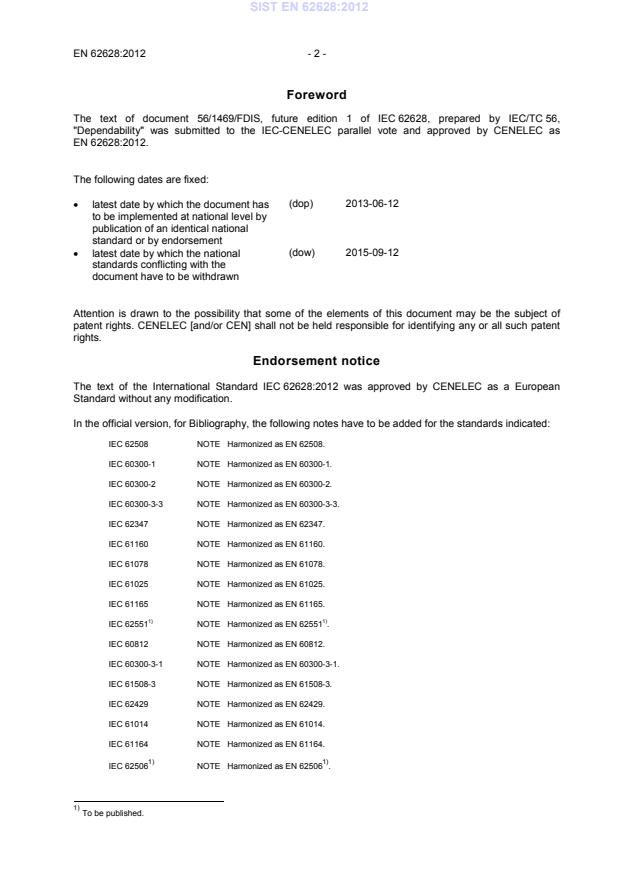
The text of document 56/1469/FDIS, future edition 1 of IEC 62628, prepared by IEC/TC 56,
"Dependability" was submitted to the IEC-CENELEC parallel vote and approved by CENELEC as
The following dates are fixed:
(dop) 2013-06-12
• latest date by which the document has
to be implemented at national level by
publication of an identical national
standard or by endorsement
(dow) 2015-09-12
• latest date by which the national
standards conflicting with the
document have to be withdrawn
Attention is drawn to the possibility that some of the elements of this document may be the subject of
patent rights. CENELEC [and/or CEN] shall not be held responsible for identifying any or all such patent
rights.
Endorsement notice
The text of the International Standard IEC 62628:2012 was approved by CENELEC as a European
Standard without any modification.
In the official version, for Bibliography, the following notes have to be added for the standards indicated:
IEC 62508 NOTE Harmonized as EN 62508.
IEC 60300-1 NOTE Harmonized as EN 60300-1.
IEC 60300-2 NOTE Harmonized as EN 60300-2.
IEC 60300-3-3 NOTE Harmonized as EN 60300-3-3.
IEC 62347 NOTE Harmonized as EN 62347.
IEC 61160 NOTE Harmonized as EN 61160.
IEC 61078 NOTE Harmonized as EN 61078.
IEC 61025 NOTE Harmonized as EN 61025.
IEC 61165 NOTE Harmonized as EN 61165.
1) 1)
IEC 62551 NOTE Harmonized as EN 62551 .
IEC 60812 NOTE Harmonized as EN 60812.
IEC 60300-3-1 NOTE Harmonized as EN 60300-3-1.
IEC 61508-3 NOTE Harmonized as EN 61508-3.
IEC 62429 NOTE Harmonized as EN 62429.
IEC 61014 NOTE Harmonized as EN 61014.
IEC 61164 NOTE Harmonized as EN 61164.
1) 1)
IEC 62506 NOTE Harmonized as EN 62506 .
1)
To be published.
- 3 - EN 62628:2012
Annex ZA
(normative)
Normative references to international publications
with their corresponding European publications
The following documents, in whole or in part, are normatively referenced in this document and are
indispensable for its application. For dated references, only the edition cited applies. For undated
references, the latest edition of the referenced document (including any amendments) applies.
NOTE When an international publication has been modified by common modifications, indicated by (mod), the relevant EN/HD
applies.
Publication Year Title EN/HD Year
IEC 60050-191 - International Electrotechnical Vocabulary - -
(IEV) -
Chapter 191: Dependability and quality of
service
IEC 60300-3-15 - Dependability management - EN 60300-3-15 -
Part 3-15: Application guide - Engineering of
system dependability
IEC 62628 ®
Edition 1.0 2012-08
INTERNATIONAL
STANDARD
NORME
INTERNATIONALE
Guidance on software aspects of dependability
Lignes directrices concernant la sûreté de fonctionnement du logiciel
INTERNATIONAL
ELECTROTECHNICAL
COMMISSION
COMMISSION
ELECTROTECHNIQUE
PRICE CODE
INTERNATIONALE
CODE PRIX XB
ICS 03.120.01 ISBN 978-2-83220-303-3
– 2 – 62628 © IEC:2012
CONTENTS
FOREWORD . 4
INTRODUCTION . 6
1 Scope . 7
2 Normative references . 7
3 Terms, definitions and abbreviations . 7
3.1 Terms and definitions . 7
3.2 Abbreviations . 9
4 Overview of software aspects of dependability . 9
4.1 Software and software systems . 9
4.2 Software dependability and software organizations . 10
4.3 Relationship between software and hardware dependability . 10
4.4 Software and hardware interaction . 11
5 Software dependability engineering and application. 12
5.1 System life cycle framework . 12
5.2 Software dependability project implementation . 12
5.3 Software life cycle activities . 13
5.4 Software dependability attributes . 14
5.5 Software design environment . 15
5.6 Establishing software requirements and dependability objectives . 15
5.7 Classification of software faults . 16
5.8 Strategy for software dependability implementation . 17
5.8.1 Software fault avoidance . 17
5.8.2 Software fault control . 17
6 Methodology for software dependability applications . 18
6.1 Software development practices for dependability achievement . 18
6.2 Software dependability metrics and data collection . 18
6.3 Software dependability assessment . 19
6.3.1 Software dependability assessment process . 19
6.3.2 System performance and dependability specification . 20
6.3.3 Establishing software operational profile . 21
6.3.4 Allocation of dependability attributes . 21
6.3.5 Dependability analysis and evaluation . 22
6.3.6 Software verification and software system validation . 24
6.3.7 Software testing and measurement . 25
6.3.8 Software reliability growth and forecasting . 28
6.3.9 Software dependability information feedback . 29
6.4 Software dependability improvement . 29
6.4.1 Overview of software dependability improvement . 29
6.4.2 Software complexity simplification . 29
6.4.3 Software fault tolerance . 30
6.4.4 Software interoperability . 30
6.4.5 Software reuse . 31
6.4.6 Software maintenance and enhancement . 31
6.4.7 Software documentation . 32
6.4.8 Automated tools . 33
6.4.9 Technical support and user training . 33
62628 © IEC:2012 – 3 –
7 Software assurance . 34
7.1 Overview of software assurance . 34
7.2 Tailoring process . 34
7.3 Technology influence on software assurance. 34
7.4 Software assurance best practices . 35
Annex A (informative) Categorization of software and software applications . 37
Annex B (informative) Software system requirements and related dependability
activities . 39
Annex C (informative) Capability maturity model integration process . 43
Annex D (informative) Classification of software defect attributes . 46
Annex E (informative) Examples of software data metrics obtained from data collection . 50
Annex F (informative) Example of combined hardware/software reliability functions . 53
Annex G (informative) Summary of software reliability model metrics . 55
Annex H (informative) Software reliability models selection and application . 56
Bibliography . 59
Figure 1 – Software life cycle activities . 14
Figure F.1 – Block diagram for a monitoring control system . 53
Table C.1 – Comparison of capability and maturity levels . 43
Table D.1 – Classification of software defect attributes when a fault is found . 46
Table D.2 – Classification of software defect attributes when a fault is fixed . 47
Table D.3 – Design review/code inspection activity to triggers mapping . 47
Table D.4 – Unit test activity to triggers mapping . 48
Table D.5 – Function test activity to triggers mapping . 48
Table D.6 – System test activity to triggers mapping . 49
Table H.1 – Examples of software reliability models . 57
– 4 – 62628 © IEC:2012
INTERNATIONAL ELECTROTECHNICAL COMMISSION
____________
GUIDANCE ON SOFTWARE ASPECTS OF DEPENDABILITY
FOREWORD
1) The International Electrotechnical Commission (IEC) is a worldwide organization for standardization comprising
all national electrotechnical committees (IEC National Committees). The object of IEC is to promote
international co-operation on all questions concerning standardization in the electrical and electronic fields. To
this end and in addition to other activities, IEC publishes International Standards, Technical Specifications,
Technical Reports, Publicly Available Specifications (PAS) and Guides (hereafter referred to as “IEC
Publication(s)”). Their preparation is entrusted to technical committees; any IEC National Committee interested
in the subject dealt with may participate in this preparatory work. International, governmental and non-
governmental organizations liaising with the IEC also participate in this preparation. IEC collaborates closely
with the International Organization for Standardization (ISO) in accordance with conditions determined by
agreement between the two organizations.
2) The formal decisions or agreements of IEC on technical matters express, as nearly as possible, an international
consensus of opinion on the relevant subjects since each technical committee has representation from all
interested IEC National Committees.
3) IEC Publications have the form of recommendations for international use and are accepted by IEC National
Committees in that sense. While all reasonable efforts are made to ensure that the technical content of IEC
Publications is accurate, IEC cannot be held responsible for the way in which they are used or for any
misinterpretation by any end user.
4) In order to promote international uniformity, IEC National Committees undertake to apply IEC Publications
transparently to the maximum extent possible in their national and regional publications. Any divergence
between any IEC Publication and the corresponding national or regional publication shall be clearly indicated in
the latter.
5) IEC itself does not provide any attestation of conformity. Independent certification bodies provide conformity
assessment services and, in some areas, access to IEC marks of conformity. IEC is not responsible for any
services carried out by independent certification bodies.
6) All users should ensure that they have the latest edition of this publication.
7) No liability shall attach to IEC or its directors, employees, servants or agents including individual experts and
members of its technical committees and IEC National Committees for any personal injury, property damage or
other damage of any nature whatsoever, whether direct or indirect, or for costs (including legal fees) and
expenses arising out of the publication, use of, or reliance upon, this IEC Publication or any other IEC
Publications.
8) Attention is drawn to the Normative references cited in this publication. Use of the referenced publications is
indispensable for the correct application of this publication.
9) Attention is drawn to the possibility that some of the elements of this IEC Publication may be the subject of
patent rights. IEC shall not be held responsible for identifying any or all such patent rights.
International Standard IEC 62628 has been prepared by IEC technical committee 56:
Dependability.
The text of this standard is based on the following documents:
FDIS Report on voting
56/1469/FDIS 56/1480/RVD
Full information on the voting for the approval of this standard can be found in the report on
voting indicated in the above table.
This publication has been drafted in accordance with the ISO/IEC Directives, Part 2.
62628 © IEC:2012 – 5 –
The committee has decided that the contents of this publication will remain unchanged until
the stability date indicated on the IEC web site under "http://webstore.iec.ch" in the data
related to the specific publication. At this date, the publication will be
• reconfirmed,
• withdrawn,
• replaced by a revised edition, or
• amended.
– 6 – 62628 © IEC:2012
INTRODUCTION
Software has widespread applications in today’s products and systems. Examples include
software applications in programmable control equipment, computer systems and
communication networks. Over the years, many standards have been developed for software
engineering, software process management, software quality and reliability assurance, but
only a few standards have addressed the software issues from a dependability perspective.
Dependability is the ability of a system to perform as and when required to meet specific
objectives under given conditions of use. The dependability of a system infers that the system
is trustworthy and capable of performing the desired service upon demand to satisfy user
needs. The increasing trends in software applications in the service industry have permeated
in the rapid growth of Internet services and Web development. Standardized interfaces and
protocols have enabled the use of third-party software functionality over the Internet to permit
cross-platform, cross-provider, and cross-domain applications. Software has become a driving
mechanism to realize complex system operations and enable the achievement of viable e-
businesses for seamless integration and enterprise process management. Software design
has assumed the primary function in data processing, safety monitoring, security protection
and communication links in network services. This paradigm shift has put the global business
communities in trust of a situation relying heavily on the software systems to sustain business
operations. Software dependability plays a dominant role to influence the success in system
performance and data integrity.
This International Standard provides current industry best practices and presents relevant
methodology to facilitate the achievement of software dependability. It identifies the influence
of management on software aspects of dependability and provides relevant technical
processes to engineer software dependability into systems. The evolution of software
technology and rapid adaptation of software applications in industry practices have created
the need for practical software dependability standard for the global business environment. A
structured approach is provided for guidance on the use of this standard.
The generic software dependability requirements and processes are presented in this
standard. They form the basis for dependability applications for most software product
development and software system implementation. Additional requirements are needed for
mission critical, safety and security applications. Industry specific software qualification
issues for reliability and quality conformance are not addressed in this standard.
This standard can also serve as guidance for dependability design of firmware. It does not
however, address the implementation aspects of firmware with software contained or
embedded in the hardware chips to realize their dedicated functions. Examples include
application specific integrated circuit (ASIC) chips and microprocessor driven controller
devices. These products are often designed and integrated as part of the physical hardware
features to minimize their size and weight and facilitate real time applications such as those
used in cell phones. Although the general dependability principles and practices described in
this standard can be used to guide design and application of firmware, specific requirements
are needed for their physical construction, device fabrication and embedded software product
implementation. The physics of failure of application specific devices behaves differently as
compared to software system failures.
This International Standard is not intended for conformity assessment or certification
purposes.
62628 © IEC:2012 – 7 –
GUIDANCE ON SOFTWARE ASPECTS OF DEPENDABILITY
1 Scope
This International Standard addresses the issues concerning software aspects of
dependability and gives guidance on achievement of dependability in software performance
influenced by management disciplines, design processes and application environments. It
establishes a generic framework on software dependability requirements, provides a software
dependability process for system life cycle applications, presents assurance criteria and
methodology for software dependability design and implementation and provides practical
approaches for performance evaluation and measurement of dependability characteristics in
software systems.
This standard is applicable for guidance to software system developers and suppliers, system
integrators, operators and maintainers and users of software systems who are concerned with
practical approaches and application engineering to achieve dependability of software
products and systems.
2 Normative references
The following documents, in whole or in part, are normatively referenced in this document and
are indispensable for its application. For dated references, only the edition cited applies. For
undated references, the latest edition of the referenced document (including any
amendments) applies.
IEC 60050-191, International Electrotechnical Vocabulary – Chapter 191: Dependability and
quality of service
IEC 60300-3-15, Dependability management – Part 3-15: Application guide – Engineering of
system dependability
3 Terms, definitions and abbreviations
For the purposes of this document, the terms and definitions given in IEC 60050-191, as well
as the following apply.
3.1 Terms and definitions
3.1.1
software
programs, procedures, rules, documentation and data of an information processing system
Note 1 to entry: Software is an intellectual creation that is independent of the medium upon which it is recorded.
Note 2 to entry: Software requires hardware devices to execute programs and to store and transmit data.
Note 3 to entry: Types of software include firmware, system software and application software.
Note 4 to entry: Documentation includes: requirements specifications, design specifications, source code listings,
comments in source code, “help” text and messages for display at the computer/human interface, installation
instructions, operating instructions, user manuals and support guides used in software maintenance.
3.1.2
firmware
software contained in a read-only memory device, and not intended for modification
– 8 – 62628 © IEC:2012
EXAMPLE Basic input/output system (BIOS) of a personal computer.
Note 1 to entry: Software modification requires the hardware device containing it to be replaced or re-
programmed.
3.1.3
embedded software
software within a system whose primary purpose is not computational
EXAMPLES Software used in the engine management system or brake control systems of motor vehicles.
3.1.4
software unit
software module
software element that can be separately compiled in programming codes to perform a task or
activity to achieve a desired outcome of a software function or functions
Note 1 to entry: The terms "module" and "unit" are often used interchangeably or defined to be sub-elements of
one another in different ways depending upon the context. The relationship of these terms is not yet standardized.
Note 2 to entry: In an ideal situation, a software unit can be designed and programmed to perform exactly a
specific function. In some applications, it may require two or more software units combined to achieve the specified
software function. In such cases, these software units are tested as a single software function.
3.1.5
software configuration item
software item that has been configured and treated as a single item in the configuration
management process
Note 1 to entry: A software configuration item can consist of one or more software units to perform a software
function.
3.1.6
software function
elementary operation performed by the software module or unit as specified or defined as per
stated requirements
3.1.7
software system
defined set of software items that, when integrated, behave collectively to satisfy a
requirement
EXAMPLES Application software (software for accounting and information management); programming software
(software for performance analysis and CASE tools) and system software (software for control and management of
computer hardware system such as operating systems).
3.1.8
software dependability
ability of the software item to perform as and when required when integrated in system
operation
3.1.9
software fault
bug
state of a software item that may prevent it from performing as required
Note 1 to entry: Software faults are either specification faults, design faults, programming faults, compiler-
inserted faults or faults introduced during software maintenance.
Note 2 to entry: A software fault is dormant until activated by a specific trigger, and usually reverts to being
dormant when the trigger is removed.
Note 3 to entry: In the context of this standard, a bug is a special case of software fault also known as latent
software fault.
62628 © IEC:2012 – 9 –
3.1.10
software failure
failure that is a manifestation of a software fault
Note 1 to entry: A single software fault will continue to manifest itself as a failure until it is removed.
3.1.11
code
character or bit pattern that is assigned a particular meaning to express a computer program
in a programming language
Note 1 to entry: Source codes are coded instructions and data definitions expressed in a form suitable for input to
an assembler, compiler, or other translator.
Note 2 to entry: Coding is the process of transforming of logic and data from design specifications or descriptions
into a programming language.
Note 3 to entry: A programming language is a language used to express computer programs.
3.1.12
(computer) program
set of coded instructions executed to perform specified logical and mathematical operations
on data
Note 1 to entry: Programming is the general activity of software development in which the programmer or computer
user states a specific set of instructions that the computer must perform.
Note 2 to entry: A program consists of a combination of coded instructions and data definitions that enable
computer hardware to perform computational or control functions.
3.2 Abbreviations
ASIC Application specific integrated circuit
CASE Computer-aided software engineering
CMM Capability maturity model
CMMI Capability maturity model integration
COTS Commercial-off-the-shelf
FMEA Failure mode and effects analysis
FTA Fault tree analysis
IP Internet protocol
IT Information technology
KSLOC Kilo-(thousand) source lines of code
ODC Orthogonal defect classification
RBD Reliability block diagram
USB Universal serial bus
4 Overview of software aspects of dependability
4.1 Software and software systems
Software is a virtual entity. In the context of this standard, software refers to procedures,
programs, codes, data and instructions for system control and information processing. A
software system consists of an integrated collection of software items such as computer
programs, procedures, and executable codes, and incorporated into physical host of the
processing and control hardware to realize system operation and deliver performance
functions. The hierarchy of the software system can be viewed as a structure representing the
system architecture and consisting of subsystem software programs and lower-level software
units. A software unit can be tested as specified in the design of a program. In some cases,
– 10 – 62628 © IEC:2012
two or more software units are required to construct a software function. The system
encompasses both hardware and software elements interacting to provide useful functions in
rendering the required performance services.
In a combined hardware/software system, the software elements of the system contribute in
two major roles: a) operating software to run continuously to sustain hardware elements in
system operation; and b) application software to run as and when required upon user
demands for provision of specific customer services. Dependability analysis of the software
sub-systems has to consider the software application time factors in the system operational
profile and those software elements required for full-time system operation. Software
modelling is needed for reliability allocation and dependability assessment of software-based
systems.
play a pivotal role in guiding effective software design
Human aspects of dependability [1]
and implementation. The human-machine interface and operating environment influence the
outcome of software and hardware interaction and affect the dependability of system
performance. This leads to a strategic need for software dependability design and perfective
maintenance efforts in the software life cycle process [2].
4.2 Software dependability and software organizations
Software dependability is achieved by proper design and appropriate incorporation into
system operation. This standard presents an approach where existing dependability
techniques and established industry best practices can be identified and used for software
dependability design and implementation. The dependability management systems [3, 4]
describe where relevant dependability activities can be effectively implemented in the life
cycle process. The achievement of software dependability is influenced by
• management policy and technical direction;
• design and implementation processes;
• project specific needs and application environments.
Software organizations are organized and managed groups that have people and facilities
with responsibilities, authorities and relationships involving software as part of their routine
activities. They exist in governments, public and private corporations, companies,
associations and institutions. Software organizations are structured according to specific
business needs and application environments for various combinations of development,
operation and service provision.
Typical software organizations include those that
a) develop software as their primary product,
b) develop hardware products with embedded software,
c) provide software service support to clients,
d) operate and maintain software networks and systems.
Annex A describes the categorization of software and software applications provided by
typical software organizations.
4.3 Relationship between software and hardware dependability
Software behaviour and performance characteristics are different than those experienced in
hardware from a dependability perspective. Software codes are created by humans. They are
susceptible to human errors, which are influenced by the design environment and
organizational culture. Whereas most hardware component failure data are well documented
and experienced in use environment, the nature of software faults and their traceability of
—————————
Reference in square brackets refers to the bibliography.
62628 © IEC:2012 – 11 –
cause and effects are not easy to determine in system operation. In most cases the software
faults leading to system failures cannot be consistently duplicated. Corrective actions on
system failures due to software faults do not guarantee total elimination of the root causes of
the software problem.
A bug, after being triggered, results in a software failure (event) and exhibits as a software
fault (state). All software faults that cause the inability of the software to accomplish its
intended functions are noticed by the software user. Faults and bugs cause problems in the
software to perform as designed. Software containing bugs could still accomplish its intended
function that is not noticeable to the user. Bugs could cause failures, but could also create
nuisance issues that are not affecting a certain function. A software fault can cause system
failure, which may exhibit systematic failure symptom.
Software systems and hardware products also have many similarities. They both are managed
throughout their design and development stages, and followed by integration and test and
production. The discovery of failures and latent faults occur through rigorous analysis, test
and verification process with high-levels of test or fault coverage. The high-levels of coverage
of the verification process are determined by the assessment of its percentage of fault
detection, or fault detection probability. While the management techniques are similar, there
are also differences [5, 6]. The following are some examples:
• Software has no physical properties, while hardware does. Software does not wear-out.
Failures attributable to software faults appear without advance warning and often provide
no indication that they have occurred. Hardware often provides a period of gradual wear-
out and possibly graceful degradation until reaching a failed condition.
• Changes to software are flexible and much less time consuming or costly as compared to
hardware design changes. Changes to hardware designs require a series of time-
consuming adjustments to capital equipment, material procurement, fabrication, assembly,
and documentation. However, regression testing of large and complex software programs
could be constrained by time and cost limitations.
• Hardware verification and testing is simplified since it is possible to conduct limited testing
through knowledge of the physics of the device to analyse and predict behaviour. Software
testing can also become simplified through regression testing and analysis to verify minor
changes to software due to an identified failure cause. However, minor changes to correct
probabilistic failure causes of software, such as race conditions, could lead to very
elaborate test and verification cycles to demonstrate adequate correction of the problem.
• Repair and maintenance actions would restore hardware to its operational state generally
without design changes. Software repair and maintenance would involve design changes
with new service packs or software releases to correct or rectify software faults.
4.4 Software and hardware interaction
Software and hardware interaction occurs in system operation. Dependability issues exist in
the interface between the hardware and the operating system. The issues are generally
resolved by incorporation of error detection and correction techniques, and exception handling
of the hardware and the operating system to mitigate physical faults, and information and
timing errors that exist in the interaction. The advent of multi-core processors has enabled
redundant multi-threading to enhance dependability in system performance. This enables the
user, programmer, or system architect to influence and exploit the redundancy inherent in the
multi-core processors to enhance detection and recovery from errors. This also provides
opportunity for recovery from soft errors or transient errors that affect either hardware or
software or both. The exploitation of increased complexity in multi-core redundancy should be
taken into consideration in such applications.
In any control system, the system is controlling some physical processes of actual hardware
devices such as sensors and actuators that can fail in system operation. Many of these
devices contain embedded software not accessible to the system designer or architect.
Examples include smart sensors that contain error detection, redundancy and some error
correction features, which are driven by the embedded software. It is important to review the
software control algorithms. This is to ensure that the control algorithms are resilient to bad
– 12 – 62628 © IEC:2012
sensor data and missing sensor values, and that they can detect failed actuation and are
capable to compensate or revert to fail-safe condition. Sensor feedback is essential to confirm
successful actuation. The feedback mechanism should contain some independent checking of
the effects of the commanded actuation. The control system behaviour, assumptions and
failure modes should be considered in the design of the software control system.
Intentional and malicious injection of hardware faults to thwart or foil the software algorithms
could happen when the system is exposed to deliberate cyber attack. For example, one can
inject hardware faults into a cryptographic system to extract the key, or inject a virus into the
USB device that is used to initialize a voting machine. The software and hardware interaction
could create serious problems to the system operation and affect the dependability in system
performance.
Interoperability problems associated with software and hardware interaction could also exist
when the software is inappropriately reused in a different environment or for a different
application.
The solution to dependability problems related to software and hardware interaction is to
increase better understanding of how the new technological system works, and to exercise
caution in conducting dependability assessment and testing to fully consider the effects of
hardware failures on the software system.
5 Software dependability engineering and application
5.1 System life cycle framework
A system life cycle framework should be established to guide product development and
system implementation. The framework is used for defining the system life cycle and
governing the performance of the system life cycle processes. IEC 60300-3-15 describes the
engineering of system dependability and life cycle implementation, which is based on the
technical processes of ISO/IEC 15288 [7]. This applies to any system, whether composed of
hardware, software or both.
5.2 Software dependability project implementation
Software engineering activities during the design cycle and useful life period of the system life
cycle should be planned, coordinated and managed accordingly along with their hardware
counterparts. Engineering activities during the useful life period would involve design changes
that could be caused by high failure rates in the customer application, or hardware
obsolescence while supplying spares for sustainment of operations. As the hardware changes
over the product life cycle, the software would need to change as well. Changes to the
software are necessary, as the system design requires forward and backward compatibility
between different versions and configurations of the system design.
Dependability activities should be integrated in the respective project plans and incorporated
in the system engineering tasks for effective system design, realization, implementation,
operation and maintenance. The guidance to engineering dependability into systems per
IEC 60300-3-15 applies to this standard. The guidance on software aspects of dependability
consists of the following recommended procedures for software dependability achievement in
software project implementation:
a) identify the software application objectives and requirements relevant to the software life
cycle (see 5.3) and application environment (see Clause A.2);
b) identify the applicable software dependability attributes (see 5.4) relevant to the software
project;
c) review the adequacy of dependability management processes and available resources to
support software project development and implementation (see 5.5);
d) establish software requirements and dependability objectives (see 5.6, Annex B);
62628 © IEC:2012 – 13 –
e) classify software faults (see 5.7) and identify relevant software metrics (see 6.2,
Annex E) for software dependability strategy implementation (see 5.8);
f) apply relevant dependability methodology for software design and realization (see 6.1,
6.3);
g) initiate dependability improvement where needed taking into consideration of various
constraints and limitations for project tailoring (see 6.4, 7.2);
h) monitor development and implementation process for control and feedback to sustain
software operability and assure dependability in system operation (see Clause 7).
5.3 Software life cycle activities
The software life cycle encompasses the following activities:
• requirements definition identifies the system requirements for combined hardware and
software elements in response to the users’ needs and constraints of system applications;
• requirements analysis determines the feasible design options and transforms the system
requirements for service applications into a technical view for hardware and software
subsystem design and system development;
• architectural design provides a solution to meet system requirements by allocation of
system elements into subsystem building blocks to establish a baseline structure for
software subsystem decomposition and identify relevant software functions to meet the
specified requirements;
• detailed design provides a design for each identified function in the system architecture
and creates the needed software units and interfaces for the function which can be
apportioned to software, hardware, or bot
...