

SIST EN 14503:2004
(Main)Inland navigation vessels - Harbours for inland navigation
General Information
- Abstract
This standard applies to harbours for inland navigation.
It does not apply to
- harbours for recreational craft
- ferry terminals or
- landing stages for passenger ships.
- Status
- Published
- Publication Date
- 31-Aug-2004
- Technical Committee
- SS SPL - Technical Board for the general field
- Current Stage
- 6060 - National Implementation/Publication (Adopted Project)
- Start Date
- 01-Sep-2004
- Due Date
- 01-Sep-2004
- Completion Date
- 01-Sep-2004

Overview
EN 14503:2003 - published by CEN - is the European standard that applies to harbours for inland navigation. It defines the scope and technical framework for designing, constructing and operating harbour facilities specifically serving inland navigation vessels on rivers, canals and other inland waterways. The standard explicitly does not apply to harbours for recreational craft, ferry terminals or landing stages for passenger ships. A Slovenian adoption is published as SIST EN 14503:2004.
Key topics and requirements
EN 14503:2003 sets out requirements and guidance relevant to inland harbour infrastructure. While the standard text itself provides the definitive requirements, typical technical topics and areas it addresses include:
- Harbour layout and planning - arrangement of berths, turning areas and approach channels to support inland navigation operations.
- Berthing and mooring - recommendations for berth types, fendering, mooring points and safe mooring practices for inland navigation vessels.
- Navigation safety and traffic organization - guidance on traffic lanes, signage, lighting and marking to reduce collision and grounding risks.
- Cargo handling and terminal facilities - considerations for loading/unloading areas, quay strength, storage and equipment suitable for inland ports.
- Utilities and services - supply of power, water, waste reception and bunkering services tailored to inland vessels.
- Environmental and hydraulic considerations - erosion control, bank protection, dredging needs and pollution prevention measures specific to inland waterways.
- Access, emergency and operational safety - emergency access routes, firefighting, rescue procedures and maintenance routines.
- Compatibility with inland navigation vessels - geometric and operational criteria to ensure harbour facilities match the dimensions and characteristics of inland craft.
Note: Do not rely on this summary for prescriptive values (dimensions, loads or clearances). Consult the official EN 14503:2003 text for exact technical specifications.
Applications
EN 14503:2003 is used to:
- Design and engineer inland harbour projects and upgrades
- Prepare technical specifications and procurement documents
- Inform operational procedures and safety management for inland ports
- Support regulatory compliance, permitting and project approval processes
- Guide port authorities, consultants and contractors during construction and maintenance
Who uses it
- Port and harbour authorities for inland navigation
- Civil and marine engineers, architects and planners
- Inland shipping companies and terminal operators
- Regulatory bodies and safety auditors
- Environmental and hydraulic consultants
Related standards
EN 14503 is part of the broader body of CEN and national standards covering inland waterways, port infrastructure and vessel safety. For implementation, combine EN 14503 with national regulations and other applicable CEN standards for inland navigation and port operations.
Relations
- Effective Date
- 28-Jan-2026
- Effective Date
- 28-Jan-2026
- Effective Date
- 28-Jan-2026
- Effective Date
- 28-Jan-2026
- Effective Date
- 28-Jan-2026
- Effective Date
- 28-Jan-2026
- Effective Date
- 28-Jan-2026
Get Certified
Connect with accredited certification bodies for this standard

DNV
DNV is an independent assurance and risk management provider.

Lloyd's Register
Lloyd's Register is a global professional services organisation specialising in engineering and technology.

FSC International
Forest Stewardship Council certification.
Sponsored listings
Frequently Asked Questions
SIST EN 14503:2004 is a standard published by the Slovenian Institute for Standardization (SIST). Its full title is "Inland navigation vessels - Harbours for inland navigation". This standard covers: This standard applies to harbours for inland navigation. It does not apply to - harbours for recreational craft - ferry terminals or - landing stages for passenger ships.
This standard applies to harbours for inland navigation. It does not apply to - harbours for recreational craft - ferry terminals or - landing stages for passenger ships.
SIST EN 14503:2004 is classified under the following ICS (International Classification for Standards) categories: 47.060 - Inland navigation vessels; 93.140 - Construction of waterways, ports and dykes. The ICS classification helps identify the subject area and facilitates finding related standards.
SIST EN 14503:2004 has the following relationships with other standards: It is inter standard links to SIST EN 12827:2000, SIST EN 14145:2004, SIST EN 13573:2009, SIST EN 1306:2018, SIST EN 14329:2004, SIST EN 14144:2026, SIST EN 1305:2018. Understanding these relationships helps ensure you are using the most current and applicable version of the standard.
SIST EN 14503:2004 is available in PDF format for immediate download after purchase. The document can be added to your cart and obtained through the secure checkout process. Digital delivery ensures instant access to the complete standard document.
Standards Content (Sample)
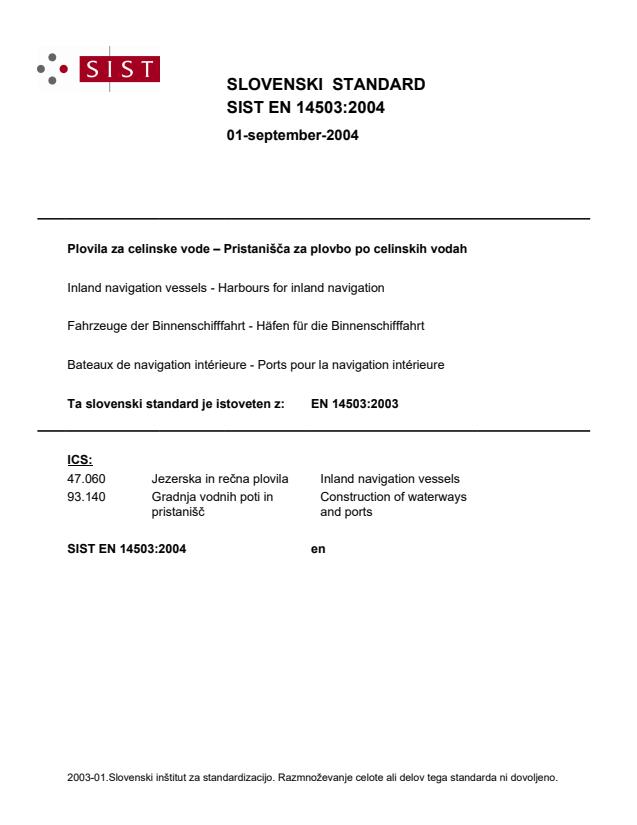
2003-01.Slovenski inštitut za standardizacijo. Razmnoževanje celote ali delov tega standarda ni dovoljeno.DKFahrzeuge der Binnenschifffahrt - Häfen für die BinnenschifffahrtBateaux de navigation intérieure - Ports pour la navigation intérieureInland navigation vessels - Harbours for inland navigation93.140SULVWDQLãþConstruction of waterways and ports4
...