

SIST EN 13113:2003+A1:2010
(Main)Tannery machines - Roller coating machines - Safety requirements
General Information
- Abstract
This European Standard deals with the following roller coating machines (see Figures 2 to 4 and normative annex A for description):
a) single and multi-roller contra-rotating machines (see Figure 2);
b) single and multi-roller synchronised machines (see Figure 3);
c) single and multi roller- contra-rotating /synchronised machines, so-called combined machines (see Figure 4).
The machines are not intended to be used during transportation.
This standard specifies safety requirements for design, construction and operation.
It takes account of intended use, foreseeable misuse, component and systems failure.
This standard takes account of material feeding and handling devices which, when attached to the machine, become an integral part.
This document is not applicable to the roller coating machines which are manufactured before the date of its publication as EN.
This standard does not establish any requirements for electromagnetic disturbances.
NOTE Directive 94/9/EC concerning equipment and protective systems intended for use in potentially explosive atmospheres can be applicable to the type of machine or equipment covered by this European Standard. The present standard does not necessarily comply with Directive 94/9/EC. Additional safety requirements in a future revision of this standard can be necessary to satisfy Directive 94/9/EC.
- Status
- Published
- Publication Date
- 05-Oct-2010
- Technical Committee
- I13 - Imaginarni 13
- Current Stage
- 6060 - National Implementation/Publication (Adopted Project)
- Start Date
- 24-Sep-2010
- Due Date
- 29-Nov-2010
- Completion Date
- 06-Oct-2010
- Directive
- 2006/42/EC - Directive 2006/42/EC of the European Parliament and of the Council of 17 May 2006 on machinery, and amending Directive 95/16/EC (recast)OJ Ref: C 110,TIP C,7.9.2026 UMIK 20.1.2027 OJ Date: 08-Apr-2011 Conflicting Date: 20-Jan-2027

Overview
EN 13113:2002+A1:2010 - titled Tannery machines – Roller coating machines – Safety requirements - is a CEN European Standard that defines safety requirements for the design, construction and operation of roller coating machines used in leather and fur production. It covers single- and multi-roller machines in contra-rotating, synchronised, and combined configurations and includes material feeding and handling devices that become integral to the machine. The standard takes account of intended use, foreseeable misuse and component/system failures. It does not cover electromagnetic disturbances and is not applicable to machines manufactured before its publication as an EN standard. Amendment A1 (2010) updates the original 2002 edition.
Key topics and technical requirements
EN 13113 focuses on practical machine safety and risk reduction. Major topics include:
- List of significant hazards: mechanical entanglement, high-pressure fluid ejection, electrical hazards, slips/trips/falls, noise, thermal hazards, roller changing, disassembly, belt washing and side access.
- Safety requirements and measures:
- General design and construction principles for safe operation
- Mechanical safeguards and guarding principles for working zones
- Requirements for high-pressure fluid systems and ejection protection
- Electrical safety for all machine types (control and protection circuits)
- Measures to reduce slip, trip and fall risks and to manage noise exposure
- Control system design and emergency stop requirements
- Provisions for maintenance, cleaning, roller changing and safe disassembly
- Requirements for belt washing systems and safe side access
- Verification and testing: procedures for verifying that safety requirements and protective measures meet the standard.
- Information for use: operator instructions, installation, transport/storage, maintenance guidance, signal/warning devices and machine marking.
- Normative annexes provide machine descriptions and an informative Annex ZA explains the relationship with the EU Machinery Directive 2006/42/EC.
Practical applications and who uses it
EN 13113 is used by:
- Machine manufacturers and OEMs - to design and certify roller coating machines to EU safety expectations.
- Safety and design engineers - for risk assessments and specification of guards, controls and emergency systems.
- Tannery operators and maintenance teams - to implement safe operating, cleaning and maintenance procedures.
- Compliance officers and notified bodies - for conformity assessment and CE-marking support (see Annex ZA).
- Purchasing/specification teams - to define safety requirements in procurement of new roller coating equipment.
This standard helps reduce workplace injuries, ensures safer machine integration, and supports regulatory compliance for tannery roller coating machines.
Related standards
Relevant referenced standards include (not exhaustive): EN 349, EN 953, EN 1037, EN/ISO acoustic standards (e.g., EN ISO 11201) and safety standards for fluid power, interlocks and pressure-sensitive devices. Consult Annexes and the normative references section of EN 13113 for full cross-references.
Relations
- Effective Date
- 18-Mar-2026
- Effective Date
- 09-Feb-2026
- Effective Date
- 09-Feb-2026
- Effective Date
- 09-Feb-2026
- Effective Date
- 09-Feb-2026
- Effective Date
- 28-Jan-2026
- Effective Date
- 28-Jan-2026
- Effective Date
- 28-Jan-2026
- Effective Date
- 28-Jan-2026
- Effective Date
- 28-Jan-2026
- Effective Date
- 28-Jan-2026
- Effective Date
- 28-Jan-2026
- Effective Date
- 28-Jan-2026
- Effective Date
- 28-Jan-2026
- Refers
SIST EN ISO 14118:2018 - Safety of machinery - Prevention of unexpected start-up (ISO 14118:2017) - Effective Date
- 28-Jan-2026
Get Certified
Connect with accredited certification bodies for this standard

Control Union Certifications
Global certification for agriculture and sustainability.

Hohenstein Institut
Textile testing and certification.

Bureau Veritas Bangladesh
Bureau Veritas certification services in Bangladesh.
Sponsored listings
Frequently Asked Questions
SIST EN 13113:2003+A1:2010 is a standard published by the Slovenian Institute for Standardization (SIST). Its full title is "Tannery machines - Roller coating machines - Safety requirements". This standard covers: This European Standard deals with the following roller coating machines (see Figures 2 to 4 and normative annex A for description): a) single and multi-roller contra-rotating machines (see Figure 2); b) single and multi-roller synchronised machines (see Figure 3); c) single and multi roller- contra-rotating /synchronised machines, so-called combined machines (see Figure 4). The machines are not intended to be used during transportation. This standard specifies safety requirements for design, construction and operation. It takes account of intended use, foreseeable misuse, component and systems failure. This standard takes account of material feeding and handling devices which, when attached to the machine, become an integral part. This document is not applicable to the roller coating machines which are manufactured before the date of its publication as EN. This standard does not establish any requirements for electromagnetic disturbances. NOTE Directive 94/9/EC concerning equipment and protective systems intended for use in potentially explosive atmospheres can be applicable to the type of machine or equipment covered by this European Standard. The present standard does not necessarily comply with Directive 94/9/EC. Additional safety requirements in a future revision of this standard can be necessary to satisfy Directive 94/9/EC.
This European Standard deals with the following roller coating machines (see Figures 2 to 4 and normative annex A for description): a) single and multi-roller contra-rotating machines (see Figure 2); b) single and multi-roller synchronised machines (see Figure 3); c) single and multi roller- contra-rotating /synchronised machines, so-called combined machines (see Figure 4). The machines are not intended to be used during transportation. This standard specifies safety requirements for design, construction and operation. It takes account of intended use, foreseeable misuse, component and systems failure. This standard takes account of material feeding and handling devices which, when attached to the machine, become an integral part. This document is not applicable to the roller coating machines which are manufactured before the date of its publication as EN. This standard does not establish any requirements for electromagnetic disturbances. NOTE Directive 94/9/EC concerning equipment and protective systems intended for use in potentially explosive atmospheres can be applicable to the type of machine or equipment covered by this European Standard. The present standard does not necessarily comply with Directive 94/9/EC. Additional safety requirements in a future revision of this standard can be necessary to satisfy Directive 94/9/EC.
SIST EN 13113:2003+A1:2010 is classified under the following ICS (International Classification for Standards) categories: 59.140.40 - Machines and equipment for leather and fur production. The ICS classification helps identify the subject area and facilitates finding related standards.
SIST EN 13113:2003+A1:2010 has the following relationships with other standards: It is inter standard links to SIST EN ISO 3744:2026, SIST EN 60529:1997, SIST-TS CLC/TS 61496-2:2006, SIST EN 61310-1:2008, SIST EN IEC 61496-1:2020, SIST EN ISO 3744:2010, SIST EN ISO 3743-2:2019, SIST EN 953:2000+A1:2009, SIST EN ISO 4871:2009, SIST EN ISO 13732-1:2008, SIST EN ISO 11202:2010, SIST EN ISO 9614-2:1997, SIST EN 1760-2:2002+A1:2009, SIST EN ISO 13855:2025, SIST EN ISO 14118:2018. Understanding these relationships helps ensure you are using the most current and applicable version of the standard.
SIST EN 13113:2003+A1:2010 is associated with the following European legislation: EU Directives/Regulations: 2006/42/EC, 98/37/EC; Standardization Mandates: M/396. When a standard is cited in the Official Journal of the European Union, products manufactured in conformity with it benefit from a presumption of conformity with the essential requirements of the corresponding EU directive or regulation.
SIST EN 13113:2003+A1:2010 is available in PDF format for immediate download after purchase. The document can be added to your cart and obtained through the secure checkout process. Digital delivery ensures instant access to the complete standard document.
Standards Content (Sample)
2003-01.Slovenski inštitut za standardizacijo. Razmnoževanje celote ali delov tega standarda ni dovoljeno.Strojarski stroji - Stroji za nanos z valjem - Varnostne zahteveGerberei-Maschinen - Walzenauftragmaschinen - SicherheitsanforderungenMachines de tannerie - Machines d'enduction à rouleaux - Prescriptions de sécuritéTannery machines - Roller coating machines - Safety requirements59.140.40Stroji in oprema za proizvodnjo usnja in krznaMachines and equipment for leather and fur productionICS:Ta slovenski standard je istoveten z:EN 13113:2002+A1:2010SIST EN 13113:2003+A1:2010en,fr01-november-2010SIST EN 13113:2003+A1:2010SLOVENSKI
STANDARD
EUROPEAN STANDARD NORME EUROPÉENNE EUROPÄISCHE NORM
EN 13113:2002+A1
August 2010 ICS 59.140.40 Supersedes EN 13113:2002English Version
Tannery machines - Roller coating machines - Safety requirements
Machines de tannerie - Machines d'enduction à rouleaux - Prescriptions de sécurité
Gerberei-Maschinen - Walzenauftragmaschinen - Sicherheitsanforderungen This European Standard was approved by CEN on 27 December 2001 and includes Amendment 1 approved by CEN on 22 July 2010.
CEN members are bound to comply with the CEN/CENELEC Internal Regulations which stipulate the conditions for giving this European Standard the status of a national standard without any alteration. Up-to-date lists and bibliographical references concerning such national standards may be obtained on application to the CEN Management Centre or to any CEN member.
This European Standard exists in three official versions (English, French, German). A version in any other language made by translation under the responsibility of a CEN member into its own language and notified to the CEN Management Centre has the same status as the official versions.
CEN members are the national standards bodies of Austria, Belgium, Bulgaria, Croatia, Cyprus, Czech Republic, Denmark, Estonia, Finland, France, Germany, Greece, Hungary, Iceland, Ireland, Italy, Latvia, Lithuania, Luxembourg, Malta, Netherlands, Norway, Poland, Portugal, Romania, Slovakia, Slovenia, Spain, Sweden, Switzerland and United Kingdom.
EUROPEAN COMMITTEE FOR STANDARDIZATION
COMITÉ EUROPÉEN DE NORMALISATION EUROPÄISCHES KOMITEE FÜR NORMUNG
Management Centre:
Avenue Marnix 17,
B-1000 Brussels © 2010 CEN All rights of exploitation in any form and by any means reserved worldwide for CEN national Members. Ref. No. EN 13113:2002+A1:2010: ESIST EN 13113:2003+A1:2010
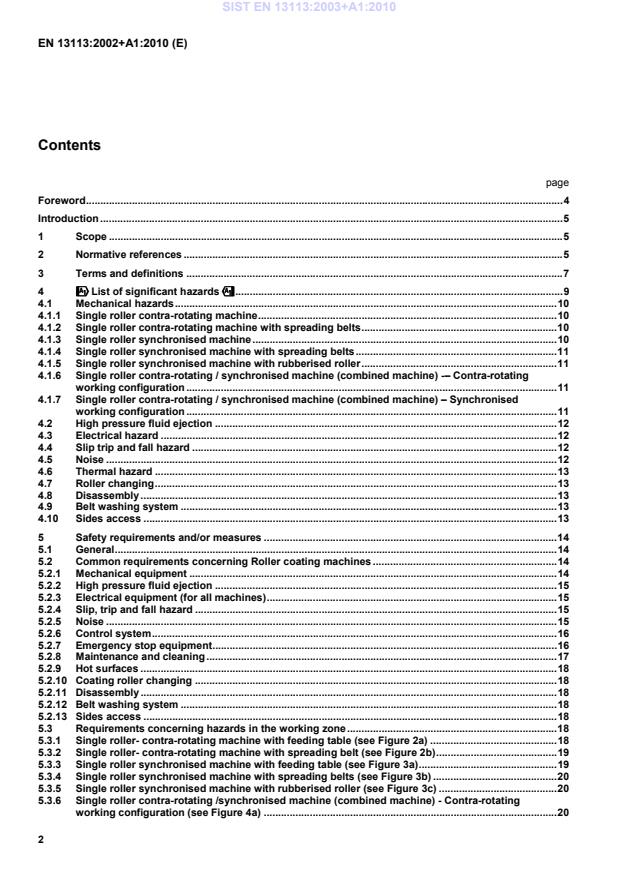
!!!!List of significant hazards"""" . 94.1 Mechanical hazards . 104.1.1 Single roller contra-rotating machine . 104.1.2 Single roller contra-rotating machine with spreading belts . 104.1.3 Single roller synchronised machine . 104.1.4 Single roller synchronised machine with spreading belts . 114.1.5 Single roller synchronised machine with rubberised roller . 114.1.6 Single roller contra-rotating / synchronised machine (combined machine) -– Contra-rotating working configuration . 114.1.7 Single roller contra-rotating / synchronised machine (combined machine) – Synchronised working configuration . 114.2 High pressure fluid ejection . 124.3 Electrical hazard . 124.4 Slip trip and fall hazard . 124.5 Noise . 124.6 Thermal hazard . 134.7 Roller changing . 134.8 Disassembly . 134.9 Belt washing system . 134.10 Sides access . 135 Safety requirements and/or measures . 145.1 General . 145.2 Common requirements concerning Roller coating machines . 145.2.1 Mechanical equipment . 145.2.2 High pressure fluid ejection . 155.2.3 Electrical equipment (for all machines) . 155.2.4 Slip, trip and fall hazard . 155.2.5 Noise . 155.2.6 Control system . 165.2.7 Emergency stop equipment . 165.2.8 Maintenance and cleaning . 175.2.9 Hot surfaces . 185.2.10 Coating roller changing . 185.2.11 Disassembly . 185.2.12 Belt washing system . 185.2.13 Sides access . 185.3 Requirements concerning hazards in the working zone . 185.3.1 Single roller- contra-rotating machine with feeding table (see Figure 2a) . 185.3.2 Single roller- contra-rotating machine with spreading belt (see Figure 2b) . 195.3.3 Single roller synchronised machine with feeding table (see Figure 3a) . 195.3.4 Single roller synchronised machine with spreading belts (see Figure 3b) . 205.3.5 Single roller synchronised machine with rubberised roller (see Figure 3c) . 205.3.6 Single roller contra-rotating /synchronised machine (combined machine) - Contra-rotating working configuration (see Figure 4a) . 20SIST EN 13113:2003+A1:2010
Machinery description . 37Annex ZA (informative)
!!!!Relationship between this European Standard and the Essential Requirements of EU Directive 2006/42/EC"""" . 38Bibliography . 39 SIST EN 13113:2003+A1:2010
The machinery concerned and the extent to which hazards, hazardous situations and hazardous events are covered are indicated in the scope of this document.
When provisions of this type C standard are different from those which are stated in type A or B standards, the provisions of this type C standard take precedence over the provisions of the other standards, for machines that have been designed and built according to the provisions of this type C standard." 1 Scope This European Standard deals with the following roller coating machines (see Figures 2 to 4 and normative annex A for description): a) single and multi-roller contra-rotating machines (see Figure 2); b) single and multi-roller synchronised machines (see Figure 3); c) single and multi roller- contra-rotating /synchronised machines, so-called combined machines (see Figure 4). The machines are not intended to be used during transportation. This standard specifies safety requirements for design, construction and operation. It takes account of intended use, foreseeable misuse, component and systems failure. This standard takes account of material feeding and handling devices which, when attached to the machine, become an integral part. !This document is not applicable to the roller coating machines which are manufactured before the date of its publication as EN." This standard does not establish any requirements for electromagnetic disturbances. NOTE Directive 94/9/EC concerning equipment and protective systems intended for use in potentially explosive atmospheres can be applicable to the type of machine or equipment covered by this European Standard. The present standard does not necessarily comply with Directive 94/9/EC. Additional safety requirements in a future revision of this standard can be necessary to satisfy Directive 94/9/EC. 2 Normative references !The following referenced documents are indispensable for the application of this document. For dated references, only the edition cited applies. For undated references, the latest edition of the referenced document (including any amendments) applies." !deleted text" !EN 349", Safety of machinery — Minimum gaps to avoid crushing of parts of the human body !EN 388, Protective gloves against mechanical risks" !deleted text" SIST EN 13113:2003+A1:2010
(ISO 11204:2010)" EN ISO 11688-1, Acoustics — Recommended practice for the design of low-noise machinery and equipment — Part 1: Planning (ISO/TR 11688-1:1995) EN ISO 11688-2, Acoustics – Recommended practice for the design of low-noise machinery and equipment – Part 2: Introduction to the physics of low-noise design (ISO/TR 11688-2:1998) !EN ISO 12100-1:2003, Safety of machinery — Basic concepts, general principles for design — Part 1: Basic terminology, methodology (ISO 12100-1:2003)" !EN ISO 12100-2:2003, Safety of machinery — Basic concepts, general principles for design — Part 2: Technical principles (ISO 12100-2:2003)" !EN ISO 13732-1:2008, Ergonomics of the thermal environment — Methods for the assessment of human responses to contact with surfaces — Part 1: Hot surfaces (ISO 13732-1:2006)" !EN ISO 13849-1, Safety of machinery —
Safety-related parts of control systems — Part 1: General principles for design (ISO 13849-1:2006)" !EN ISO 13850:2008, Safety of machinery — Emergency stop — Principles for design (ISO 13850:2006)" !EN ISO 13857:2008, Safety of machinery — Safety distances to prevent hazard zones being reached by upper and lower limbs (ISO 13857:2008)" !EN 60204-1:2006, Safety of machinery — Electrical equipment of machines — Part 1: General requirements (IEC 60204-1:2005, modified)" EN 60529:1991, Degrees of protection provided by enclosures (IP code) (IEC 60529:1989) !EN 61310-1, Safety of machinery — Indication, marking and actuation — Part 1: Requirements for visual, acoustic and
tactile signals (IEC 61310-1:2007)" !EN 61496-1, Safety of machinery — Electro-sensitive protective equipment — Part 1: General requirements and tests (IEC 61496-1:2004, modified)" !CLC/TS 61496-2:2006, Safety of machinery — Electro-sensitive protective equipment — Part 2: Particular requirements for equipment using active opto-electronic protective devices (AOPDs) (IEC 61496-2:2006)"
3 Terms and definitions !For the purposes of this document, the terms and definitions given in EN ISO 12100-1:2003 and the following apply." 3.1 roller coating machines (see Figure 1) machines which are used to apply liquid coated substances on hides or skins. The substances are applied from a reservoir formed by the coating roller and a doctor blade. The hides or skins are fed to the coating roller either directly or by means of a transport belt 3.2 accessible zone any danger zone except the working zone SIST EN 13113:2003+A1:2010
3.8 feeding-in table table that allows hides or skins to be introduced into the working area 3.9 rubberised counter pressure roller roller used to adjust the pressure hand gap in which the skin is processed 3.10 spreading belt belt used to spread the skin before it is passed between the working rollers 3.11 transport belt belt that feeds-in the hides or skins into the working area 3.12 transmission parts parts in motion acting singly or in combination which transmit motion to the working parts 3.13 turning device with coating roller device that carries non working rollers and whose rotation executes roller change 3.14 working parts parts carrying out the process for which this machine was designed 3.15 working zone zone around a power driven working part in which the work process takes place for the treatment and processing or manufacturing of products 3.16 feed-in zone part of the working zone, which has particular hazards and needs appropriate safety devices, in which the operators place the material to be split SIST EN 13113:2003+A1:2010
4.1
Mechanical hazards 4.1.1
Single roller contra-rotating machine The feed-in zone
Coating roller and rubberised counter pressure roller rotation Crushing Entanglement Trapping A 2a 5.2.1.2 and 5.3.1.1 Colour space Doctor blade Cutting
Trapping F 2a 5.2.1.2 and 5.3.1.2 Drive roller Drive roller rotation Crushing Entanglement Trapping
D
2a
5.2.1.2 4.1.2
Single roller contra-rotating machine with spreading belts The feed-in zone
Spreading belts movements Crushing Entanglement Trapping Friction/Abrasion B 2b 5.2.1.2 and 5.3.2.1 For zones D, F see 4.1.1 of this standard 4.1.3
Single roller synchronised machine The feed-in zone
Coating roller and rubberised counter pressure roller rotation Crushing Entanglement Trapping A 3a 5.2.1.2 and 5.3.3.1 Colour space Doctor blade Cutting
Trapping F 3a 5.2.1.2 and 5.3.3.2 Drive roller Drive roller rotation Crushing Entanglement Trapping
D
3a
5.2.1.2 SIST EN 13113:2003+A1:2010
Danger Zone Source of hazard Hazard Zone Figure Safety requirements
4.1.4
Single roller synchronised machine with spreading belts The feed-in zone
coating roller and rubberised counter pressure roller rotation Crushing Entanglement Trapping Friction/Abrasion B 3b 5.2.1.2 and 5.3.4.1 For zones D, F see 4.1.3 of this standard
4.1.5
Single roller synchronised machine with rubberised roller The feed-in zone
coating roller and rubberised counter pressure roller rotation Crushing Entanglement Trapping Friction/Abrasion A 3c 5.2.1.2 and 5.3.4.1 For zones A, F see 4.1.3 of this standard 4.1.6 Single roller contra-rotating / synchronised machine (combined machine) -– Contra-rotating working configuration The feed-in zone
Coating roller and rubberised counter pressure roller rotation Crushing Entanglement Trapping A 4a 5.2.1.2 and 5.3.6.1 Colour space Doctor blade Cutting
Trapping F 4a 5.2.1.2 and 5.3.6.2 Drive roller Drive roller rotation Crushing Entanglement Trapping
D
4a
5.2.1.2 4.1.7
Single roller contra-rotating / synchronised machine (combined machine) – Synchronised working configuration The feed-in zone
Coating roller and rubberised counter pressure roller rotation Crushing Entanglement Trapping A 4b 5.2.1.2 and 5.3.7.1 Colour space Doctor blade Cutting
Trapping F 4b 5.2.1.2 and 5.3.7.2 Drive roller drive roller rotation Crushing Entanglement Trapping
D
4b
5.2.1.2 SIST EN 13113:2003+A1:2010
Danger Zone and source of hazard Hazard Zone Figure Safety requirements
4.2
High pressure fluid ejection
High pressure fluid ejection or ejection of a burst component part by failure of hydraulic unit (broken hoses, fittings and tubes) Burn and impact from hot oil or
machinery parts under pressure
5.2.2
4.3
Electrical hazard
Electrical contact, direct or indirect caused by: - component failure - insulation failure incorrect design, installation or component specification of the electrical equipment
Electric shock, burns
5.2.3
4.4
Slip trip and fall hazard
Spilling and overflowing of substances during processing.
Slip
5.2.4
4.5
Noise
Noise generated by: - action of the roller on the material - hydraulic unit Hearing loss
Interference with communication and acoustic signals
5.2.5 SIST EN 13113:2003+A1:2010
Danger Zone and source of hazard Hazard Zone Figure Safety requirements
4.6
Thermal hazard
Accidental contact with heated roller surface Burns and scalds E 2 3 4 5.2.9
4.7
Roller changing
The contact with moving turning device with coating roller Impact G 2 3 4
5.2. 10
4.8
Disassembly
Instability from disassembly for maintenance -
-
-
5.2. 11
4.9
Belt washing system
Arm introduction in the zone between the rubberised counter pressure roller and belt washing system Entanglement Trapping Friction/abrasion H 2 3 4 5.2. 12
4.10
Sides access
The contact with all the previous systems from machine sides Crushing
Cutting Entanglement Trapping Friction/Abrasion A,B,C,D,E.F,G 2 3 4 5.2.13
General !Machinery shall comply with the safety requirements and/or protective measures of this clause. In addition, the machine shall be designed according to the principles of EN ISO 12100-2 for relevant but not significant hazards which are not dealt with by this document. For hazards which are to be reduced by the application of a type B-standard such as EN ISO 13857, EN 953,
EN ISO 13850, EN 60204-1 etc., the manufacturer shall carry out a risk assessment to establish the requirements of the B-standards which are to be applied." 5.2 Common requirements concerning Roller coating machines 5.2.1 Mechanical equipment 5.2.1.1 Safeguarding against the hazards generated by moving transmission parts (such as pulleys, belts, gears, rack, etc.) shall be ensured by: fixed enclosing guards in accordance with !EN 953 and 5.3.2.2 of EN ISO 12100-2:2003" or movable interlocking guards in accordance with !EN 953, EN 1088 and 5.3.2.3 of EN ISO 12100-2:2003." 5.2.1.2 Hazardous motions of moving machinery parts, feed systems, tools and workpieces shall be safeguarded by: fixed enclosing guards or covers which satisfy !EN 953 and 5.3.2.2 of EN ISO 12100-2:2003" or !fixed distance guards which satisfy EN 953, 5.3.2.3 of EN ISO 12100-2:2003 and the distances given in appropriate Tables (1, 3 or 4) of EN ISO 13857:2008." !Fixing systems of fixed guards and fixed covers shall remain attached to these parts or to the machine when the parts are removed." 5.2.1.3
All the guards mentioned in 5.2 and 5.3 shall be in accordance with clause 5 of
!EN 953:1997+A1:2009" (design and construction) and shall be designed and manufactured in such a way as to keep all their functions during a force application of 800 N to the central zone of the guard between two supports, distributed over an area of approximately 0,01 m2. On release of the force no detectable distortion of the guard shall remain. 5.2.1.4 !!!!Where the above measures cannot be applied, devices shall be provided which will shutdown the hazardous motion before the danger point is reached." !Suitable protective devices are: - movable interlocking guards which satisfy EN 953, EN 1088, 5.3.2.3 of EN ISO 12100-2:2003 and the distances given in the appropriate Table (1 or 3) of EN ISO 13857:2008, - trip devices, such as: - electrosensitive protective devices satisfying EN 61496-1, CLC/TS 61496-2 and EN 999,
Electrical equipment (for all machines) 5.2.3.1 Electrical systems and equipment shall be in accordance with !EN 60204-1". Control and safety devices shall be protected to IP54 level. Specific levels of protection are defined in
!EN 60529". 5.2.3.2 All operating controls requiring adjustment for changing the working process shall be located on the outside of the electrical cabinet. NOTE Controls for routine electrical adjustment are for example temperature, speed and thickness variation 5.2.4 Slip, trip and fall hazard
Hazards, slipping especially, may arise by substances spilling and overflowing during processing material. The manufacturer shall include in the “instructions for use” information on water and grease, if discharged from the machine, and advice on the need to provide, at machine installation, safeguards such as footboards, non-slip floors etc., shall be noted in the instruction handbook (!see 7.3.2 j of this standard"). 5.2.5 Noise 5.2.5.1 Noise reduction at source and by protective measures at the design stage: noise reduction shall be achieved as an integral part of the design by: taking account of the measures to control noise at source given in EN ISO 11688-1, incorporating one or more of the measures indicated below as examples. a) reduction of vibration through the static and dynamic balancing of the rotating parts; b) reduction of vibration within the machine by reducing both the mass of the moving parts and their acceleration; c) reduction of impactive over clearance of rotational bearings by application of positive reloading; d) proper choice and design of the energy transfer-components to eliminate bouncing; e) proper choice and design of the transmission components (gears, pulleys, belts, bearings and so on); f) proper design of the machine structures by taking care of vibrations damping and by avoiding structural resonance. Antivibration feet shall be mounted to reduce vibration transmission by the floor; g) sound deadening of pneumatic discharges, vibrations damping of hydraulic circuits. h) when practical, screens fitted to the machine, partial or total enclosure of noisy elements. This list of technical measures for noise reduction at the source gives only examples and is not meant to be complete. SIST EN 13113:2003+A1:2010
Noise reduction by information: if it is known that, after taking possible measures to control noise at the design stage, further protection of the operators is necessary, the instruction handbook shall give additional information (!see 7.3.1"). 5.2.6 Control system 5.2.6.1 Electrical control system shall be in compliance with !EN 60204-1". Pneumatic control system shall be in compliance with EN 983. Hydraulic control system shall be in compliance with EN 982. 5.2.6.2 Devices shall be fitted, in accordance with EN 1037, to prevent uncontrolled dangerous movements caused by irregularities, failure or unexpected reconnection of the power supply. The stipulation for preventing uncontrolled dangerous movements caused by unexpected reconnection of the power supply is met by means of a further device to start the machine, for example a reset device. 5.2.6.3 Unless demanded by 5.2.6.4 or 5.3, safety related parts of the machine control system shall have at least the same level as the safeguarding used or, where not otherwise specified !shall as a minimum comply with performance level “c” as defined in EN ISO 13849-1." 5.2.6.4 The use of programmable electronic systems (PES) shall not reduce any level of safety laid down in this standard. When a machine is fitted with programmable electronic systems, safety related function shall not rely solely on it. This requirement is met, if using additional hardwired control system or duplicated solid state channel. 5.2.7 Emergency stop equipment 5.2.7.1 The emergency stop equipment function shall be independent from the normal control systems of the machines and shall comply with !EN ISO 13850". The stop achieved with the emergency stop equipment shall be a category 1 stop (see 4.1.5 of !EN ISO 13850:2008"). For specific requirements for electrical equipment see 9.2.2, 9.2.5.4 and 10.7 of !EN 60204-1:12006". 5.2.7.2 At least one emergency stop actuator shall be provided and it shall be positioned so as to be easily accessible to the operator at the operator position and actuable by the head or knees of a person whose hands are trapped at the operating position. The emergency stop actuation shall: stop the rollers; stop the conveying and spreading belts; stop the oscillating motion of the doctor blade; not drive away the doctor blade from the coating roller; SIST EN 13113:2003+A1:2010
fixed guards are removed; belt changing; doctor blade changing (appropriate gloves and other personal protective equipment shall be recommended in the instruction handbook, !see 7.3.4.i"). In this position of mode selection device, no machine start shall be possible. 5.2.8.1.2 Maintenance for machine in movement During maintenance of machine in movement some interventions are executed. For example the following: scraping blade adjustment; covering material of Roller and counter pressure belt grinding; doctor blade grinding; belt centring, in case fixed guards are not removed. In this position of mode selection device: the conveying belt shall stop; the rubberised counter pressure roller may continue to rotate at a reduced speed which shall not be greater that 5 m/min; all the safety devices shall operate. 5.2.8.2 Cleaning 5.2.8.2.1 Cleaning for machine at rest During cleaning of machine at rest some interventions are executed. For example the following: cleaning of belt washing system. This position of mode selection device is the same of the one in 5.2.8.1.1. 5.2.8.2.2 Cleaning machine in movement During cleaning of machine in movement some interventions are executed. For example the following: SIST EN 13113:2003+A1:2010
!EN ISO 13732-1". Where the normal operation of the machine or for its setting makes this not possible to achieve warning signs shall be fixed to the machine and suitable personal protective equipment shall be recommended in the “Information for use”. Any insulating materials used shall not include asbestos or other dangerous materials. 5.2.10 Coating roller changing In case when the machine is equipped with a roller changing device, the impact hazard referring to danger zone G (see Figures 2, 3, 4) shall be safeguarded by: a balancing device which shall assure that the turning device with coating roller is balanced; a geared motor and a brake system that shall drive turning device with coating roller rotation. In cases when the machine is not equipped with such a device, the manufacturer shall provide information about centre of gravity, sling points etc. in the “Instruction for use” (!see 7.3.3"). 5.2.11 Disassembly Hazards arising from instability may result from disassembly of a machine for transportation or maintenance. The manufacturer shall identify in the “instruction for use” the circumstances leading to the instability and include advice on how the risks can be reduced. Where the manufacturer recommends the use of special supports, details shall be given in the “Instruction for use”, or offered for supply with the machine. 5.2.12 Belt washing system The gap between the belt washing system with brush roller and rubber scraping blade and rubberised counter pressure roller, in all machines, shall be protected by fixed cover in compliance with EN 349. Solvent shall not be used for cleaning unless suitable arrestment plant is fitted. 5.2.13 Sides access !Access from the sides of the machine shall be controlled by a) and b): a) fixed enclosing guards in accordance with EN 953 and 5.3.2.2 of EN ISO 12100-2:2003 or movable interlocking guards in accordance with EN 953, EN 1088 and 5.3.2.3 of EN ISO 12100-2:2003 b) fixed distance guard according to EN ISO 13857:2008 (Table 1,3 or 4), EN 349 and EN 953." 5.3 Requirements concerning hazards in the working zone 5.3.1 Single roller- contra-rotating machine with feeding table (see Figure 2a) 5.3.1.1 Crushing, entanglement and trapping hazards referring to danger zone A, feed-in area, (see Figure 2a) shall be protected by: SIST EN 13113:2003+A1:2010
EN ISO 13849-1", along the full machine width, shall be installed in the feed-in zone to prevent the contact between the operator hands and coating roller. The trip device actuation shall: stop the rollers; stop the conveying and spreading belts; stop doctor blade oscillating movement; not drive away the doctor blade from coating roller; open automatically the coating roller and rubber-covered back pressure roller to 30 mm minimum. 5.3.1.1.2 The feed-in table height from the floor or working platform shall be equal to 1 000 mm + 30 mm. 5.3.1.2 During cleaning, maintenance and adjustment, the doctor blade shall be moved out from the coating roller. Cutting and trapping hazards referring to danger zone F (see Figure 2a) shall be reduced using warning labels, appropriate personal protective equipment and information in the instruction handbook. A closing movement of a distance in excess of !EN ISO 13857:2008" Table 4 shall not be permitted without constant operator control, for example push button which, when released, stops movement, or a manual wheel. 5.3.2 Single roller- contra-rotating machine with spreading belt (see Figure 2b) 5.3.2.1 Crushing, entanglement, trapping and friction/abrasion hazards referring to danger zone B (see
Figure 2b) shall be protected by a pressure sensitive protective device of type 3.1 or 3.2 according to
!EN 1760-2 and with the related parts of the control system as a minimum complying with performance level “c” as defined in EN ISO 13849-1", along the full spreading belt width, shall be installed in the feed-in zone to prevent the contact between the operator hands and spreading belts. The trip device actuation shall: stop the rollers; stop the conveying and spreading belts; stop the oscillating motion of the doctor blade; not drive away the doctor blade from the coating roller; lead to an automatic divergence of the coating roller and the rubberised counter pressure roller to 30 mm minimum. 5.3.2.2 Cutting and trapping hazards referring to all other danger zones shall be protected by the requirements indicated in 5.3.1.2. 5.3.3 Single roller synchronised machine with feeding table (see Figure 3a) 5.3.3.1 Crushing, entanglement and trapping hazards referring to danger zone A, feed-in area, (see Figure 3a) shall be protected by: 5.3.3.1.1 A pressure sensitive protective device of type 3.1 or 3.2 according to !EN 1760-2 and with the related parts of the control system as a minimum complying with performance level “d” as defined in
EN ISO 13849-1", along the full machine width, shall be installed in the feed-in zone to prevent the contact between the operator hands and coating roller. The trip device actuation shall: SIST EN 13113:2003+A1:2010
...