

SIST EN 12952-3:2023
(Main)Water-tube boilers and auxiliary installations - Part 3: Design and calculation for pressure parts of the boiler
General Information
- Abstract
This document specifies the requirements for the design and calculation of water-tube boilers as defined in EN 12952-1.
The purpose of this document is to ensure that the hazards associated with water-tube boilers are reduced to a minimum by the proper application of the design according to this part of EN 12952.
- Status
- Published
- Public Enquiry End Date
- 03-Aug-2021
- Publication Date
- 09-Oct-2023
- Technical Committee
- TLP - Pressure vessels
- Current Stage
- 6060 - National Implementation/Publication (Adopted Project)
- Start Date
- 27-Oct-2022
- Due Date
- 01-Jan-2023
- Completion Date
- 10-Oct-2023
- Directive
- 2014/68/EU - Directive 2014/68/EU of the European Parliament and of the Council of 15 May 2014 on the harmonisation of the laws of the Member States relating to the making available on the market of pressure equipmentOJ Ref: 2025/165, 31.1.2025, L, OJ L OJ Date: 31-Jan-2025

Overview
EN 12952-3:2022 is a CEN European standard covering the design and calculation of pressure parts for water-tube boilers and auxiliary installations (as defined in EN 12952-1). Its purpose is to minimise hazards associated with water-tube boilers through consistent, safe design practices. This 2022 edition updates earlier versions and sets requirements for structural integrity, pressure containment and durable operation of drums, headers, tubes and associated pressure-retaining components.
Key topics and technical requirements
The standard addresses technical subjects necessary for safe boiler pressure-part design, including:
- Design and calculation pressures: definitions and requirements for design pressure, calculation pressure and hydrostatic test pressure.
- Calculation temperature and design stress: procedures to select calculation temperatures and allowable design stresses for steels, austenitic materials, cast components and welds.
- Cylindrical shells (drums and headers): wall thickness requirements, basic thickness calculations, fabrication tolerances and combined stress assessment (longitudinal, bending and ligament stresses).
- Openings, branches and reinforcement: rules for openings and branch connections, efficiency factors, reinforcement pad design, isolated and adjacent openings.
- Connections and fastenings: bolted, screwed and socket-welded connections - calculation of bolt loads, diameters and design strength values.
- Metal wastage and corrosion allowances: internal and external wastage considerations, stress corrosion and mechanical requirements for retained strength.
- Cyclic loading and fatigue: guidance on design under cyclic loads and requirements for components subject to repeated stress.
- Attachments and non-pressure components: load-carrying vs non-load-carrying attachments, drainage, venting, access and auxiliary features.
- Special shapes and components: rectangular-section headers and tubes, ends, dished heads and spherical shells.
(These topics align with the standard’s table of contents and main clauses.)
Practical applications
EN 12952-3:2022 is applied where safe, regulatory-compliant design of pressure parts for water-tube boilers is required. Typical uses include:
- Engineering design and verification of boiler drums, headers, superheaters and reheaters
- Preparation of calculation reports for conformity assessment and CE marking
- Specifying fabrication tolerances, weld procedures and testing (hydrostatic tests)
- Assessing modifications, repairs or life-extension work for existing pressure parts
Who should use this standard
- Boiler designers and structural/mechanical engineers
- Boiler manufacturers and fabricators
- Inspection bodies, notified bodies and conformity assessors
- Plant owners, operators and maintenance engineers working with industrial water-tube boilers
Related standards
- EN 12952-1 (definitions and general requirements for water-tube boilers)
- Other parts of the EN 12952 series covering materials, manufacture, testing and operation
EN 12952-3:2022 is essential for ensuring compliant, safe pressure-part design in water-tube boiler projects and for aligning engineering work with European boiler safety practice.
Relations
- Effective Date
- 01-Nov-2023
- Effective Date
- 28-Jan-2026
- Effective Date
- 28-Jan-2026
- Effective Date
- 28-Jan-2026
- Effective Date
- 28-Jan-2026
- Effective Date
- 28-Jan-2026
- Effective Date
- 28-Jan-2026
- Effective Date
- 28-Jan-2026
- Effective Date
- 28-Jan-2026
- Effective Date
- 28-Jan-2026
- Effective Date
- 28-Jan-2026
- Effective Date
- 28-Jan-2026
- Effective Date
- 28-Jan-2026
- Effective Date
- 28-Jan-2026
- Effective Date
- 28-Jan-2026
Get Certified
Connect with accredited certification bodies for this standard

DNV
DNV is an independent assurance and risk management provider.

Lloyd's Register
Lloyd's Register is a global professional services organisation specialising in engineering and technology.
DNV Energy Systems
Energy and renewable energy certification.
Sponsored listings
Frequently Asked Questions
SIST EN 12952-3:2023 is a standard published by the Slovenian Institute for Standardization (SIST). Its full title is "Water-tube boilers and auxiliary installations - Part 3: Design and calculation for pressure parts of the boiler". This standard covers: This document specifies the requirements for the design and calculation of water-tube boilers as defined in EN 12952-1. The purpose of this document is to ensure that the hazards associated with water-tube boilers are reduced to a minimum by the proper application of the design according to this part of EN 12952.
This document specifies the requirements for the design and calculation of water-tube boilers as defined in EN 12952-1. The purpose of this document is to ensure that the hazards associated with water-tube boilers are reduced to a minimum by the proper application of the design according to this part of EN 12952.
SIST EN 12952-3:2023 is classified under the following ICS (International Classification for Standards) categories: 27.040 - Gas and steam turbines. Steam engines; 27.060.30 - Boilers and heat exchangers. The ICS classification helps identify the subject area and facilitates finding related standards.
SIST EN 12952-3:2023 has the following relationships with other standards: It is inter standard links to SIST EN 12952-3:2012, SIST EN 12952-6:2022, SIST EN 13480-3:2018/A4:2021, SIST EN 12952-2:2022, SIST EN 12952-7:2012, SIST EN 13480-3:2018/A3:2020, SIST EN 13480-3:2018/A2:2020, SIST EN 12952-5:2022, SIST EN 1759-1:2005, SIST EN 13445-3:2021, SIST EN 12953-3:2016, SIST EN 12952-12:2004, SIST EN 12952-1:2016, SIST EN 1092-1:2018, SIST EN 10164:2018. Understanding these relationships helps ensure you are using the most current and applicable version of the standard.
SIST EN 12952-3:2023 is associated with the following European legislation: EU Directives/Regulations: 2014/68/EU; Standardization Mandates: M/071, M/601. When a standard is cited in the Official Journal of the European Union, products manufactured in conformity with it benefit from a presumption of conformity with the essential requirements of the corresponding EU directive or regulation.
SIST EN 12952-3:2023 is available in PDF format for immediate download after purchase. The document can be added to your cart and obtained through the secure checkout process. Digital delivery ensures instant access to the complete standard document.
Standards Content (Sample)
SLOVENSKI STANDARD
01-november-2023
Nadomešča:
SIST EN 12952-3:2012
Vodocevni kotli in pomožne napeljave - 3. del: Konstruiranje in izračun tlačno
obremenjenih delov kotla
Water-tube boilers and auxiliary installations - Part 3: Design and calculation for pressure
parts of the boiler
Wasserrohrkessel und Anlagenkomponenten - Teil 3: Konstruktion und Berechnung für
drucktragende Kesselteile
Chaudière à tubes d'eau et installations auxiliaires - Partie 3 : Conception et calcul des
parties sous pression de la chaudière
Ta slovenski standard je istoveten z: EN 12952-3:2022
ICS:
27.060.30 Grelniki vode in prenosniki Boilers and heat exchangers
toplote
2003-01.Slovenski inštitut za standardizacijo. Razmnoževanje celote ali delov tega standarda ni dovoljeno.
EN 12952-3
EUROPEAN STANDARD
NORME EUROPÉENNE
November 2022
EUROPÄISCHE NORM
ICS 27.040 Supersedes EN 12952-3:2011
English Version
Water-tube boilers and auxiliary installations - Part 3:
Design and calculation for pressure parts of the boiler
Chaudière à tubes d'eau et installations auxiliaires - Wasserrohrkessel und Anlagenkomponenten - Teil 3:
Partie 3 : Conception et calcul des parties sous pression Konstruktion und Berechnung für drucktragende
de la chaudière Kesselteile
This European Standard was approved by CEN on 26 September 2022.
CEN members are bound to comply with the CEN/CENELEC Internal Regulations which stipulate the conditions for giving this
European Standard the status of a national standard without any alteration. Up-to-date lists and bibliographical references
concerning such national standards may be obtained on application to the CEN-CENELEC Management Centre or to any CEN
member.
This European Standard exists in three official versions (English, French, German). A version in any other language made by
translation under the responsibility of a CEN member into its own language and notified to the CEN-CENELEC Management
Centre has the same status as the official versions.
CEN members are the national standards bodies of Austria, Belgium, Bulgaria, Croatia, Cyprus, Czech Republic, Denmark, Estonia,
Finland, France, Germany, Greece, Hungary, Iceland, Ireland, Italy, Latvia, Lithuania, Luxembourg, Malta, Netherlands, Norway,
Poland, Portugal, Republic of North Macedonia, Romania, Serbia, Slovakia, Slovenia, Spain, Sweden, Switzerland, Türkiye and
United Kingdom.
EUROPEAN COMMITTEE FOR STANDARDIZATION
COMITÉ EUROPÉEN DE NORMALISATION
EUROPÄISCHES KOMITEE FÜR NORMUNG
CEN-CENELEC Management Centre: Rue de la Science 23, B-1040 Brussels
© 2022 CEN All rights of exploitation in any form and by any means reserved Ref. No. EN 12952-3:2022 E
worldwide for CEN national Members.
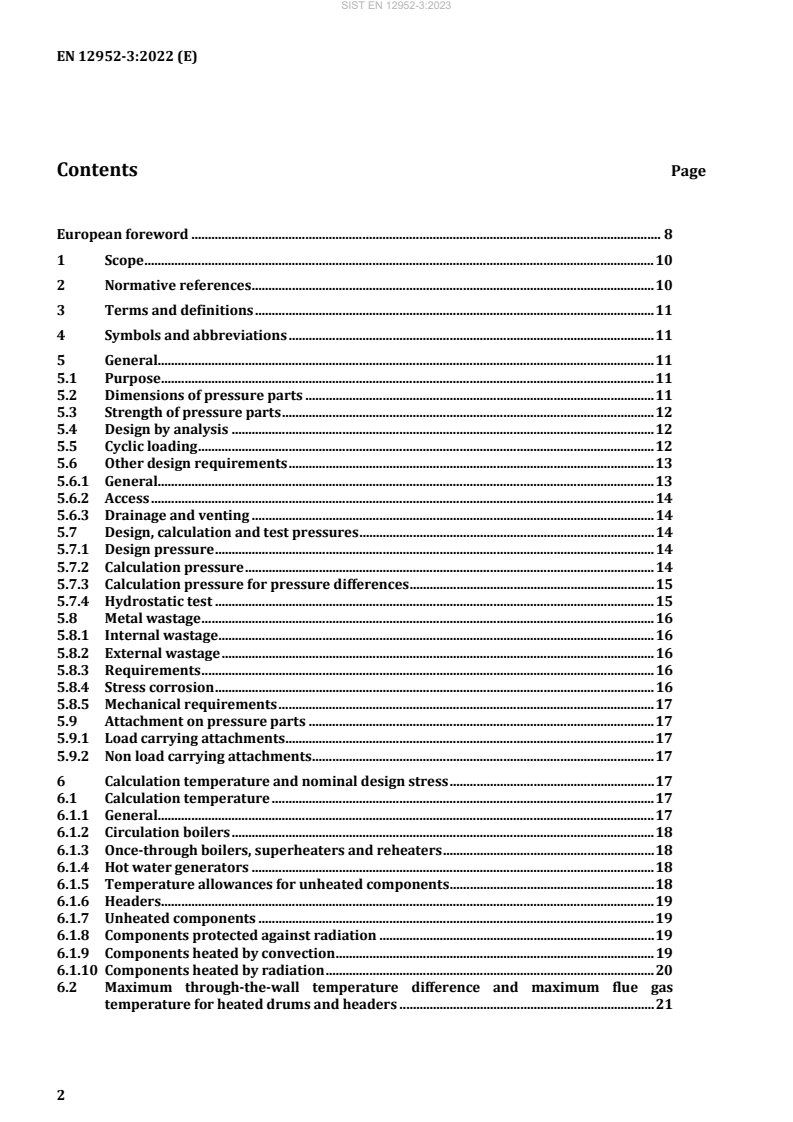
Contents Page
European foreword . 8
1 Scope . 10
2 Normative references . 10
3 Terms and definitions . 11
4 Symbols and abbreviations . 11
5 General. 11
5.1 Purpose . 11
5.2 Dimensions of pressure parts . 11
5.3 Strength of pressure parts . 12
5.4 Design by analysis . 12
5.5 Cyclic loading . 12
5.6 Other design requirements . 13
5.6.1 General. 13
5.6.2 Access . 14
5.6.3 Drainage and venting . 14
5.7 Design, calculation and test pressures . 14
5.7.1 Design pressure . 14
5.7.2 Calculation pressure . 14
5.7.3 Calculation pressure for pressure differences . 15
5.7.4 Hydrostatic test . 15
5.8 Metal wastage . 16
5.8.1 Internal wastage . 16
5.8.2 External wastage . 16
5.8.3 Requirements . 16
5.8.4 Stress corrosion . 16
5.8.5 Mechanical requirements . 17
5.9 Attachment on pressure parts . 17
5.9.1 Load carrying attachments . 17
5.9.2 Non load carrying attachments . 17
6 Calculation temperature and nominal design stress . 17
6.1 Calculation temperature . 17
6.1.1 General. 17
6.1.2 Circulation boilers . 18
6.1.3 Once-through boilers, superheaters and reheaters . 18
6.1.4 Hot water generators . 18
6.1.5 Temperature allowances for unheated components . 18
6.1.6 Headers . 19
6.1.7 Unheated components . 19
6.1.8 Components protected against radiation . 19
6.1.9 Components heated by convection . 19
6.1.10 Components heated by radiation . 20
6.2 Maximum through-the-wall temperature difference and maximum flue gas
temperature for heated drums and headers . 21
6.2.1 Maximum through-the-wall temperature difference . 21
6.2.2 Headers exposed to flue gas . 21
6.2.3 Allowable deviations . 22
6.3 Design stress. 22
6.3.1 General . 22
6.3.2 Rolled and forged steels . 23
6.3.3 Austenitic steels . 23
6.3.4 Non-alloy and low-alloy cast steel . 24
6.3.5 Nodular graphite cast iron . 24
6.3.6 Design stress for welded connections operating under creep condition . 25
6.3.7 Design stress for test pressure . 25
7 Cylindrical shells of drums and headers under internal pressure . 25
7.1 Shell thickness . 25
7.1.1 Requirements . 25
7.1.2 Required wall thickness including allowances . 26
7.2 Basic calculation . 26
7.2.1 Required wall thickness without allowances . 26
7.2.2 Different thickness . 26
7.2.3 Fabrication tolerances . 26
7.3 Combined stress in drum or header shells . 27
7.3.1 General . 27
7.3.2 Stress from longitudinal loads . 27
7.3.3 Longitudinal bending stress . 28
7.3.4 Evaluation of ligament stress for inclined ligaments in drums . 29
7.4 Boiler drum supports . 30
7.5 Other stresses in cylindrical shells . 31
8 Openings and branches in cylindrical shells of drums and headers and integral tubes
................................................................................................................................................................... 31
8.1 General . 31
8.1.1 Requirements for the ligament efficiency of the main body with openings and
branches . 31
8.1.2 Effective lengths for calculation of efficiencies of components . 36
8.1.3 Conditions for isolated openings . 37
8.1.4 Requirements for design of branches . 37
8.1.5 Requirements for the design of reinforcing pads . 38
8.2 Efficiency factor, calculation by way of approximation, and maximum diameter of
unreinforced openings . 38
8.2.1 General . 38
8.2.2 Allowable efficiency and maximum diameter of unreinforced opening . 38
8.2.3 Isolated openings . 39
8.2.4 Adjacent openings . 41
8.3 Design of openings and branches in cylindrical shells (efficiency and reinforcement)
................................................................................................................................................................... 42
8.3.1 Symbols and abbreviations . 42
8.3.2 Requirements for application . 42
8.3.3 Design of isolated openings and branch connections . 47
8.3.4 Design of adjacent openings and branch connections . 50
8.4 Bolted connections . 51
8.4.1 General . 51
8.4.2 Symbols and abbreviations . 52
8.4.3 Calculation of bolt diameter . 53
8.4.4 Calculation of bolt load . 54
8.4.5 Calculation temperature t . 56
c
8.4.6 Design strength value K . 57
8.4.7 Safety factor S . 57
8.4.8 Quality factor q . 57
8.5 Screwed and socket welded connections . 58
8.5.1 Screwed connections into the belt . 58
8.5.2 Screwed socket connections . 58
8.5.3 Socket welded connections . 59
9 Headers and plain tubes of rectangular section . 60
9.1 General. 60
9.2 Symbols and abbreviations . 62
9.3 Required wall thickness . 63
9.3.1 General. 63
9.3.2 Minimum wall thickness at the centre of one side . 64
9.3.3 Minimum wall thickness at the corners . 64
9.3.4 Minimum thickness at a line of openings . 64
9.3.5 Minimum wall thickness at staggered opening arrangement (diagonal pitch) . 65
9.3.6 Minimum wall thickness at isolated openings . 65
10 Ends and spherical shells . 66
10.1 Symbols and abbreviations . 66
10.2 Spherical shells and dished heads . 66
10.2.1 General. 66
10.2.2 Calculation formula . 68
10.2.3 Openings in dished ends and spherical ends . 71
10.3 Unstayed flat ends . 75
10.3.1 General. 75
10.3.2 Thickness of circular unstayed flat ends . 78
10.3.3 Thickness of non-circular and rectangular unstayed flat ends. 78
10.4 Flat unstayed closures . 81
11 Tubes . 83
11.1 Symbols and abbreviations . 83
11.2 Thickness of straight boiler tubes . 83
11.2.1 Required wall thickness with allowances . 83
11.2.2 Required wall thickness without allowances . 84
11.2.3 Minimum thickness . 84
11.2.4 Circumferentially butt welded tubes . 85
11.3 Thickness of tube bends and elbows . 85
11.3.1 General. 85
11.3.2 Required wall thickness with allowances . 85
11.3.3 Required wall thickness without allowances . 86
11.3.4 Departure from circularity of tube bends . 86
11.4 Flexibility of integral tubing systems . 87
11.4.1 General. 87
11.4.2 Analysis . 87
11.5 Structural attachments to tubes . 87
11.5.1 General. 87
11.5.2 Attachments welded on tube bends . 89
11.5.3 Length of attachments . 89
11.5.4 Limit of intensity in the case of radial loading . 89
11.5.5 Calculation of intensity in the case of radial loading . 89
11.5.6 Strength of welds . 91
11.6 Fitting and joining of heated tubes . 92
11.6.1 Fitting of tubes . 92
11.6.2 Joining of heated tubes . 92
11.7 Joining of unheated tubes . 92
11.7.1 General . 92
11.7.2 Flanges and bolting . 92
11.7.3 Butt welded joints . 92
11.7.4 Screwed or screwed and seal welded joints . 92
11.8 Standardized fittings . 92
12 Pressure parts of irregular shape . 93
12.1 Hydrostatic test for determining the allowable internal pressure . 93
12.1.1 General . 93
12.1.2 Proof test to produce yielding . 93
12.1.3 Proof test to destruction . 94
12.2 Numerical methods . 94
12.2.1 General . 94
12.2.2 Methods . 94
12.2.3 Evaluation of stress . 95
13 Fatigue . 95
13.1 General . 95
13.1.1 Procedure . 95
13.1.2 Fatigue loading . 95
13.1.3 Calculation of fluctuating stress . 96
13.1.4 Fatigue assessment . 96
13.2 Symbols and abbreviations . 96
13.3 Exemption rule for fatigue analysis . 98
13.3.1 General . 98
13.3.2 Materials . 98
13.3.3 Loadings . 99
13.3.4 Temperature differences during transient operating conditions . 100
13.4 Stress analysis for fatigue calculation . 106
13.4.1 Principal and equivalent stresses . 106
13.4.2 Temperature of a load cycle . 106
13.4.3 Protection of the magnetite layer . 107
13.4.4 Allowable circumferential stress range at the inside corner of a bore . 107
13.4.5 Circumferential stress caused by pressure at the inside corner of a bore . 107
13.4.6 Stresses on the branch caused by external forces and moments . 108
13.4.7 Thermal stresses . 108
13.4.8 Upper and lower limit of the circumferential stress at the inside corner of a bore 108
13.4.9 Admissible through-the-wall temperature differences . 112
13.4.10 Allowable temperature transients . 113
13.4.11 Components with oblique and/or non-radial branches . 113
13.5 Example calculations . 113
Annex A (normative) Calculation of tube bends and elbows . 117
A.1 General . 117
A.2 Symbols and abbreviations . 117
A.3 Calculation . 118
A.3.1 Required wall thickness . 118
A.3.2 Calculation of the wall thickness. 118
A.3.3 Calculation of stress . 120
A.3.3.1 The strength conditions for the intrados of the bend shall be: . 120
A.3.3.2 The strength conditions for the extrados of the bend shall be: . 120
Annex B (normative) Fatigue cracking – Design to allow for fluctuating stress . 127
B.1 General. 127
B.2 Conditions . 127
B.3 Symbols and abbreviations . 129
B.4 Cyclic stress range and mean cyclic stress in the case of uniaxial and multiaxial
fluctuating stress . 130
B.4.1 General. 130
B.4.2 Uniaxial stress state . 130
B.4.3 Multiaxial stress state with principal stress directions constant . 130
B.5 Correction factors for taking into account the influences of surface finish and
weldments . 132
B.6 Controlling stress range . 140
B.6.1 General. 140
B.6.1.1 Controlling stress range . 140
B.6.1.2 Elastic range . 140
B.6.1.3 Partly elastic range. 140
B.6.1.4 Fully plastic range. 140
B.6.2 Correction factor . 141
B.7 Permissible stress range with a known number of load cycles . 142
Annex C (informative) Examples of calculating the effects of fatigue . 143
C.1 General. 143
C.2 Calculation of the admissible number of load cycles . 143
C.3 Calculation of the admissible temperature gradient . 146
Annex D (informative) Physical properties of steels . 150
D.1 General. 150
D.2 Symbols and abbreviations . 150
D.3 Physical properties . 150
D.3.1 Density . 150
D.3.2 Differential coefficient of linear thermal expansion. 150
D.3.3 Heat capacity . 151
D.3.4 Thermal diffusivity . 151
D.3.5 Poisson’s ratio . 151
D.4 Physical properties of steels . 151
D.4.1 Data sheet (tables) . 151
D.4.2 Graphs . 153
D.4.3 Polynomials . 157
Annex E (informative) Consideration of external wastage due to flue gas exposure . 160
E.1 General . 160
E.2 Symbols and abbreviations . 160
E.3 Wall thickness of straight tubes in accordance to Clause 11 . 160
E.3.1 Required wall thickness with allowance . 160
E.3.2 Required wall thickness without allowances . 160
E.3.3 Circumferentially butt welded tubes . 160
E.4 Wall thickness of tube bends and elbows in accordance with Clause 11 . 161
E.4.1 Required wall thickness with allowance . 161
E.4.2 Required wall thickness without allowances . 161
E.5 Wall thickness of tube bends and elbows in accordance with Annex A . 161
Annex F (informative) Significant technical changes between this European Standard and
the previous edition . 162
Annex ZA (informative) Clauses of this European Standard addressing essential safety
requirements of the Pressure Equipment Directive 2014/68/EU . 163
Bibliography . 165
European foreword
This document (EN 12952-3:2022) has been prepared by Technical Committee CEN/TC 269 “Shell and
water-tube boilers”, the secretariat of which is held by DIN.
This European Standard shall be given the status of a national standard, either by publication of an
identical text or by endorsement, at the latest by May 2023, and conflicting national standards shall be
withdrawn at the latest by May 2023.
Attention is drawn to the possibility that some of the elements of this document may be the subject of
patent rights. CEN shall not be held responsible for identifying any or all such patent rights.
This document supersedes EN 12952-3:2011.
Annex F provides details of significant technical changes between this document and the previous
edition.
The EN 12952 series, concerning water-tube boilers and auxiliary installations, consists of the following
parts:
— Part 1: General
— Part 2: Materials for pressure parts of boilers and accessories
— Part 3: Design and calculation for pressure parts of the boiler
— Part 4: In-service boiler life expectancy calculations
— Part 5: Workmanship and construction of pressure parts of the boiler
— Part 6: Inspection during construction, documentation and marking of pressure parts of the boiler
— Part 7: Requirements for equipment for the boiler
— Part 8: Requirements for firing systems for liquid and gaseous fuels for the boiler
— Part 9: Requirements for firing systems for pulverized solid fuels for the boiler
— Part 10: Requirements for safety devices against excessive pressure
— Part 11: Requirements for limiting devices of the boiler and accessories
— Part 12: Requirements for boiler feedwater and boiler water quality
— Part 13: Requirements for flue gas cleaning systems
— Part 14: Requirements for flue gas DENOX-systems using liquified pressurized ammonia and ammonia
water solution
— Part 15: Acceptance tests
— Part 16: Requirements for grate and fluidized-bed firing systems for solid fuels for the boiler
— CR 12952 Part 17: Guideline for the involvement of an inspection body independent of the manufacturer
— Part 18: Operating Instructions
Although these parts can be obtained separately, it should be recognized that the parts are inter-
dependent. As such, the design and manufacture of water-tube boilers requires the application of more
than one part in order for the requirements of this document to be satisfactorily fulfilled.
NOTE A “Boiler Helpdesk” has been established in CEN/TC 269 which may be contacted for any questions
regarding the application of European Standards series EN 12952 and EN 12953, see the following website:
http://www.boiler-helpdesk.din.de.
This document has been prepared under a Standardization Request given to CEN by the European
Commission and the European Free Trade Association, and supports essential requirements of EU
Directive(s) / Regulation(s).
For relationship with EU Directive(s) / Regulation(s), see informative Annex ZA, which is an integral part
of this document.
Any feedback and questions on this document should be directed to the users’ national standards body.
A complete listing of these bodies can be found on the CEN website.
According to the CEN-CENELEC Internal Regulations, the national standards organisations of the
following countries are bound to implement this European Standard: Austria, Belgium, Bulgaria, Croatia,
Cyprus, Czech Republic, Denmark, Estonia, Finland, France, Germany, Greece, Hungary, Iceland, Ireland,
Italy, Latvia, Lithuania, Luxembourg, Malta, Netherlands, Norway, Poland, Portugal, Republic of North
Macedonia, Romania, Serbia, Slovakia, Slovenia, Spain, Sweden, Switzerland, Türkiye and the United
Kingdom.
1 Scope
This document specifies the requirements for the design and calculation of water-tube boilers as defined
in EN 12952-1.
The purpose of this document is to ensure that the hazards associated with water-tube boilers are
reduced to a minimum by the proper application of the design according to this part of EN 12952.
2 Normative references
The following documents are referred to in the text in such a way that some or all of their content
constitutes requirements of this document. For dated references, only the edition cited applies. For
undated references, the latest edition of the referenced document (including any amendments) applies.
EN 1092-1:2018, Flanges and their joints - Circular flanges for pipes, valves, fittings and accessories, PN
designated - Part 1: Steel flanges
EN 1759-1:2004, Flanges and their joint - Circular flanges for pipes, valves, fittings and accessories, Class
designated - Part 1: Steel flanges, NPS 1/2 to 24
EN 10028-1:2017, Flat products made of steels for pressure purposes - Part 1: General requirements
EN 10164:2018, Steel products with improved deformation properties perpendicular to the surface of the
product - Technical delivery conditions
EN 10253-2:2021, Butt-welding pipe fittings — Part 2: Non alloy and ferritic alloy steels with specific
inspection requirements
EN 10266:2003, Steel tubes, fittings and structural hollow sections - Symbols and definitions of terms for
use in product standards
EN 12952-1:2015, Water-tube boilers and auxiliary installations - Part 1: General
EN 12952-2:2021, Water-tube boilers and auxiliary installations - Part 2: Materials for pressure parts of
boilers and accessories
EN 12952-5:2021, Water-tube boilers and auxiliary installations - Part 5: Workmanship and construction
of pressure parts of t
...