


SIST-TS CEN/TS 18264:2026
(Main)Policy and security requirements on trust services on electronic ledgers
Policy and security requirements on trust services on electronic ledgers
This document defines the policy, functional and security requirements on (qualified) trust services for electronic ledger. This includes requirements to ensure:
- their provision by one or more trust service providers;
- the establishment of the origin of data records in the ledger;
- the unique sequential chronological ordering of data records in the ledger;
- the recording of data in such a way that any subsequent change to the data is immediately detectable, ensuring their integrity over time.
Policy- und Sicherheitsanforderungen an Trust Services bei elektronischen Journalen
Dieses Dokument legt die Richtlinie, die Funktions- und Sicherheitsanforderungen für (qualifizierte) Vertrauensdienste für elektronische Journale fest. Dies umfasst Anforderungen, um Folgendes sicherzustellen:
- deren Bereitstellung durch einen oder mehrere Vertrauensdiensteanbieter;
- die Feststellung der Herkunft der Datensätze im elektronischen Journal;
- die spezifische chronologisch aufeinanderfolgende Ordnung der Datensätze im elektronischen Journal;
- die Aufzeichnung der Daten in einer Weise, dass jede nachträgliche Änderung der Daten sofort erkennbar ist, womit ihre Integrität im Laufe der Zeit sichergestellt wird.
Exigences en matière de politique et de sécurité relatives aux services de confiance dans le domaine des registres électroniques
Zahteve politike in varnosti za storitve zaupanja na elektronskih porazdeljenih knjigah podatkov
Ta dokument določa politiko, funkcionalne in varnostne zahteve za (kvalificirane) storitve zaupanja za elektronsko knjigo. To vključuje zahteve za zagotavljanje:
- njihovega izvajanja s strani enega ali več ponudnikov storitev zaupanja;
- ugotavljanje izvora podatkovnih zapisov v knjigi;
- edinstveno zaporedno kronološko razvrščanje podatkovnih zapisov v knjigi;
- zapisovanje podatkov na način, ki omogoča takojšnje zaznavanje kakršnih koli naknadnih sprememb podatkov, s čimer se zagotavlja njihova celovitost skozi čas.
General Information
- Status
- Published
- Publication Date
- 06-Apr-2026
- Technical Committee
- BLC - Blockchain
- Current Stage
- 6060 - National Implementation/Publication (Adopted Project)
- Start Date
- 01-Apr-2026
- Due Date
- 06-Jun-2026
- Completion Date
- 07-Apr-2026
Relations
- Effective Date
- 08-Apr-2026
- Effective Date
- 08-Apr-2026
Overview
SIST-TS CEN/TS 18264:2026 specifies the policy, functional, and security requirements for trust services on electronic ledgers. This European Technical Specification supports the implementation of the amended eIDAS Regulation (EU) 2024/1183, enabling secure and trustworthy electronic ledger services for digital transactions across Europe. By defining a framework for trust service providers (TSPs), the standard ensures the integrity, authenticity, and chronological order of data recorded on electronic ledgers, whether centralized or distributed, and clarifies the roles, responsibilities, and technical measures needed to deliver compliant trust services.
Key Topics
Policy Requirements
- Establishes the need for comprehensive policy documentation, including practice statements, service policies, and profiles.
- Ensures alignment with the eIDAS Regulation and applicable ETSI standards (e.g., ETSI EN 319 401).
- Stipulates contract terms, information security policies, and subscriber agreements.
Security and Functional Requirements
- Ensures that only authorized individuals have access to ledger operations, including read and write permissions.
- Requires cryptographic controls (digital signatures, encryption) to secure the data and guarantee its integrity.
- Mandates immediate detectability of any changes to ledger records, supporting non-repudiation and long-term data integrity.
- Requires robust management of vulnerabilities, incident response, business continuity, and compliance procedures.
Ledger Models and Architectures
- Defines support for centralized and distributed ledger architectures, distinguishing between permissioned-public and permissioned-private models.
- Excludes permissionless ledgers from its scope due to regulatory and operational constraints.
- Emphasizes consensus mechanisms in distributed environments for validation and data consistency.
Interoperability and Data Management
- Guidance on migration, data integration, and standardized interfaces.
- Requirements for off-ledger storage and the interrelation with on-ledger records.
Additional Considerations
- Calls for accessibility measures in line with ETSI EN 301 549.
- Environmental management in accordance with standards such as ISO 14001.
- Clear roles and accountability for governance, administration, user participation, and development as described in ISO/TS 23635.
Applications
SIST-TS CEN/TS 18264:2026 is relevant for a broad range of sectors and entities engaging with blockchain and distributed ledger technology (DLT), particularly where trust, security, and regulatory compliance are paramount:
- Qualified Trust Service Providers:
- Organizations delivering trust services for digital signatures, timestamping, or archival, ensuring legal admissibility and auditability.
- Financial Services & Digital Asset Management:
- Banks, fintechs, and custodians leveraging electronic ledgers for transactions, identity verification, and asset tracking.
- Government and Public Sector:
- Digital public services, registries, and compliance authorities requiring secure electronic records with clear provenance and immutability.
- Legal, Health, and Supply Chain Sectors:
- Document management, tracking consent or proof of existence, and verifying chronological events in regulated environments.
Compliance with this standard helps organizations demonstrate conformity with EU digital identity and trust services regulations, facilitating smooth cross-border transactions and fostering trust in digital ecosystems.
Related Standards
SIST-TS CEN/TS 18264:2026 is closely connected with the following standards and technical specifications:
- ISO 22739:2024 – Blockchain and distributed ledger technologies - Vocabulary
- ISO 23257:2022 – Blockchain and distributed ledger technologies - Reference architecture
- ISO/TS 23635:2022 – Blockchain and distributed ledger technologies - Guidelines for governance
- CEN/TS 18170 – Functional requirements for electronic archiving services
- ETSI EN 319 401 – General policy requirements for Trust Service Providers
- ETSI EN 319 421 – Policy and security requirements for time-stamp service providers
- ETSI EN 301 549 – Accessibility requirements for ICT products and services
- ISO 14001 – Environmental management systems (referenced for environmental considerations)
Implementing SIST-TS CEN/TS 18264:2026 alongside these related standards ensures robust electronic ledger trust services and supports secure, legally-compliant, and interoperable DLT solutions.

Get Certified
Connect with accredited certification bodies for this standard

BSI Group
BSI (British Standards Institution) is the business standards company that helps organizations make excellence a habit.

Bureau Veritas
Bureau Veritas is a world leader in laboratory testing, inspection and certification services.

DNV
DNV is an independent assurance and risk management provider.
Sponsored listings
Frequently Asked Questions
SIST-TS CEN/TS 18264:2026 is a technical specification published by the Slovenian Institute for Standardization (SIST). Its full title is "Policy and security requirements on trust services on electronic ledgers". This standard covers: This document defines the policy, functional and security requirements on (qualified) trust services for electronic ledger. This includes requirements to ensure: - their provision by one or more trust service providers; - the establishment of the origin of data records in the ledger; - the unique sequential chronological ordering of data records in the ledger; - the recording of data in such a way that any subsequent change to the data is immediately detectable, ensuring their integrity over time.
This document defines the policy, functional and security requirements on (qualified) trust services for electronic ledger. This includes requirements to ensure: - their provision by one or more trust service providers; - the establishment of the origin of data records in the ledger; - the unique sequential chronological ordering of data records in the ledger; - the recording of data in such a way that any subsequent change to the data is immediately detectable, ensuring their integrity over time.
SIST-TS CEN/TS 18264:2026 is classified under the following ICS (International Classification for Standards) categories: 35.030 - IT Security; 35.240.01 - Application of information technology in general. The ICS classification helps identify the subject area and facilitates finding related standards.
SIST-TS CEN/TS 18264:2026 has the following relationships with other standards: It is inter standard links to SIST-TS CEN/TS 18170:2025, kSIST FprISO 23257:2021. Understanding these relationships helps ensure you are using the most current and applicable version of the standard.
SIST-TS CEN/TS 18264:2026 is available in PDF format for immediate download after purchase. The document can be added to your cart and obtained through the secure checkout process. Digital delivery ensures instant access to the complete standard document.
Standards Content (Sample)
SLOVENSKI STANDARD
01-maj-2026
Zahteve politike in varnosti za storitve zaupanja na elektronskih porazdeljenih
knjigah podatkov
Policy and security requirements on trust services on electronic ledgers
Policy- und Sicherheitsanforderungen an Trust Services bei elektronischen Journalen
Exigences en matière de politique et de sécurité relatives aux services de confiance
dans le domaine des registres électroniques
Ta slovenski standard je istoveten z: CEN/TS 18264:2026
ICS:
35.030 Informacijska varnost IT Security
35.240.01 Uporabniške rešitve Application of information
informacijske tehnike in technology in general
tehnologije na splošno
2003-01.Slovenski inštitut za standardizacijo. Razmnoževanje celote ali delov tega standarda ni dovoljeno.
TECHNICAL SPECIFICATION CEN/TS 18264
SPÉCIFICATION TECHNIQUE
TECHNISCHE SPEZIFIKATION
March 2026
ICS 35.030
English version
Policy and security requirements on trust services on
electronic ledgers
Exigences en matière de politique et de sécurité Policy- und Sicherheitsanforderungen an Trust
relatives aux services de confiance dans le domaine des Services bei elektronischen Journalen
registres électroniques
This Technical Specification (CEN/TS) was approved by CEN on 16 February 2026 for provisional application.
The period of validity of this CEN/TS is limited initially to three years. After two years the members of CEN and CENELEC will be
requested to submit their comments, particularly on the question whether the CEN/TS can be converted into a European
Standard.
CEN and CENELEC members are required to announce the existence of this CEN/TS in the same way as for an EN and to make the
CEN/TS available promptly at national level in an appropriate form. It is permissible to keep conflicting national standards in
force (in parallel to the CEN/TS) until the final decision about the possible conversion of the CEN/TS into an EN is reached.
CEN and CENELEC members are the national standards bodies and national electrotechnical committees of Austria, Belgium,
Bulgaria, Croatia, Cyprus, Czech Republic, Denmark, Estonia, Finland, France, Germany, Greece, Hungary, Iceland, Ireland, Italy,
Latvia, Lithuania, Luxembourg, Malta, Netherlands, Norway, Poland, Portugal, Republic of North Macedonia, Romania, Serbia,
Slovakia, Slovenia, Spain, Sweden, Switzerland, Türkiye and United Kingdom.
CEN-CENELEC Management Centre:
Rue de la Science 23, B-1040 Brussels
© 2026 CEN/CENELEC All rights of exploitation in any form and by any means
Ref. No. CEN/TS 18264:2026 E
reserved worldwide for CEN national Members and for
CENELEC Members.
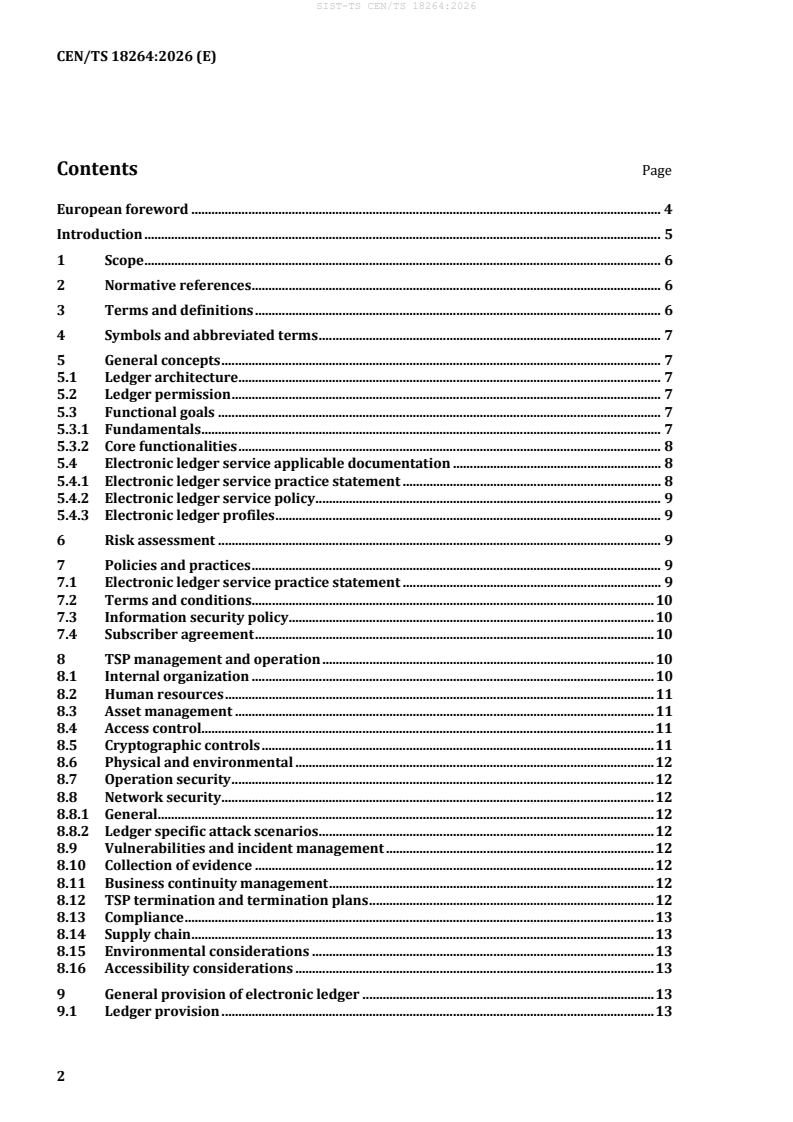
Contents Page
European foreword . 4
Introduction . 5
1 Scope . 6
2 Normative references . 6
3 Terms and definitions . 6
4 Symbols and abbreviated terms . 7
5 General concepts . 7
5.1 Ledger architecture . 7
5.2 Ledger permission . 7
5.3 Functional goals . 7
5.3.1 Fundamentals . 7
5.3.2 Core functionalities . 8
5.4 Electronic ledger service applicable documentation . 8
5.4.1 Electronic ledger service practice statement . 8
5.4.2 Electronic ledger service policy . 9
5.4.3 Electronic ledger profiles . 9
6 Risk assessment . 9
7 Policies and practices . 9
7.1 Electronic ledger service practice statement . 9
7.2 Terms and conditions . 10
7.3 Information security policy . 10
7.4 Subscriber agreement . 10
8 TSP management and operation . 10
8.1 Internal organization . 10
8.2 Human resources . 11
8.3 Asset management . 11
8.4 Access control. 11
8.5 Cryptographic controls . 11
8.6 Physical and environmental . 12
8.7 Operation security . 12
8.8 Network security . 12
8.8.1 General. 12
8.8.2 Ledger specific attack scenarios . 12
8.9 Vulnerabilities and incident management . 12
8.10 Collection of evidence . 12
8.11 Business continuity management . 12
8.12 TSP termination and termination plans . 12
8.13 Compliance . 13
8.14 Supply chain . 13
8.15 Environmental considerations . 13
8.16 Accessibility considerations . 13
9 General provision of electronic ledger . 13
9.1 Ledger provision . 13
9.1.1 Ledger oracles . 13
9.1.2 Non-ledger applications . 13
9.1.3 Off ledger data. 13
9.1.4 Smart contracts . 13
9.1.5 Ledger management . 14
9.1.6 Node management [DLPub], [DLPriv] . 15
9.1.7 Consensus mechanism [DLPub], [DLPriv] . 15
9.2 Data and storage . 16
9.2.1 Data integration . 16
9.2.2 Data storage . 16
9.2.3 Migration . 16
9.2.4 Interoperability considerations . 17
Bibliography . 18
European foreword
This document (CEN/TS 18264:2026) has been prepared by Technical Committee CEN/CLC JTC 19
“Blockchain and Distributed Ledger Technologies”, the secretariat of which is held by UNI.
Attention is drawn to the possibility that some of the elements of this document may be the subject of
patent rights. CEN shall not be held responsible for identifying any or all such patent rights.
Any feedback and questions on this document should be directed to the users’ national standards body.
A complete listing of these bodies can be found on the CEN website.
According to the CEN/CENELEC Internal Regulations, the national standards organisations of the
following countries are bound to announce this Technical Specification: Austria, Belgium, Bulgaria,
Croatia, Cyprus, Czech Republic, Denmark, Estonia, Finland, France, Germany, Greece, Hungary, Iceland,
Ireland, Italy, Latvia, Lithuania, Luxembourg, Malta, Netherlands, Norway, Poland, Portugal, Republic of
North Macedonia, Romania, Serbia, Slovakia, Slovenia, Spain, Sweden, Switzerland, Türkiye and the
United Kingdom.
Introduction
This document defines the policy, functional and security requirements on trust services for electronic
ledgers.
The implementation of Regulation (EU) 2024/1183 of the European Parliament and of the Council of 11
April 2024 amending Regulation (EU) No 910/2014 on electronic identification and trust services for
electronic transactions in the internal market (referred in this document as the amended eIDAS
Regulation) requires standards for services, processes, systems and products related to trust services as
well as guidance for conformity assessment of such services, processes, systems and products.
This document, being part of the set of European Standards, is aimed to meet the requirements of the
amended eIDAS Regulation for the electronic ledger service, which can be delivered by one or more a
trust service provider in order to record electronic data in an electronic ledger.
European Regulation (EU) 2024/1183 of the European Parliament and of the Council of 11 April 2024
(eIDAS 2) amending Regulation (EU) No 910/2014 (eIDAS) as regards establishing the European Digital
Identity Framework establishes a legal framework of requirements for electronic signatures and trust
services. This Regulation introduces the (qualified) electronic ledger service. It requires standards for
services, processes, systems and products related to trust services as well as guidance for conformity
assessment of such services, processes, systems and products.
It is assumed that the electronic ledger trust service provider (ELTSP), which provides electronic ledger
services, operate the trustworthy system within an environment with a security policy which
incorporates general physical, procedural and documentation security requirements applicable to trust
service providers (TSP) providing electronic ledger services.
As explained further, this document follows ETSI EN 319 401 for general policy requirements for trust
service providers to ensure that the common requirements are met.
1 Scope
This document defines the policy, functional and security requirements on (qualified) trust services for
electronic ledger. This includes requirements to ensure:
— their provision by one or more trust service providers;
— the establishment of the origin of data records in the ledger;
— the unique sequential chronological ordering of data records in the ledger;
— the recording of data in such a way that any subsequent change to the data is immediately detectable,
ensuring their integrity over time.
2 Normative references
The following documents are referred to in the text in such a way that some or all of their content
constitutes requirements of this document. For dated references, only the edition cited applies. For
undated references, the latest edition of the referenced document (including any amendments) applies.
CEN/TS 18170, Functional requirements for the electronic archiving services
ISO 22739:2024, Blockchain and distributed ledger technologies — Vocabulary
ISO 23257:2022, Blockchain and distributed ledger technologies — Reference architecture
ISO/TS 23635:2022, Blockchain and distributed ledger technologies — Guidelines for governance
ETSI EN 319 401:2024-06, Electronic Signatures and Trust Infrastructures (ESI); General Policy
Requirements for Trust Service Providers
ETSI EN 319 421, Electronic Signatures and Infrastructures (ESI); Policy and Security Requirements for
Trust Service Providers issuing Time-Stamps
ETSI EN 301 549, Accessibility requirements for ICT products and services
3 Terms and definitions
For the purposes of this document, the terms and definitions given in ISO 22739:2024 and
ETSI EN 319 401 and the following apply.
ISO and IEC maintain terminology databases for use in standardization at the following addresses:
— ISO Online browsing platform: available at https://www.iso.org/obp/
— IEC Electropedia: available at https://www.electropedia.org/
3.1
proof of existence
evidence that proves that an object existed at a specific date/time
[SOURCE: ISO 14533-4:2019]
4 Symbols and abbreviated terms
CL centralized ledger
DL distributed ledger
ELSP electronic ledger service practice
OID object identifier
OVR general requirement (requirement applicable to more than 1 component)
Priv private permissioned (ledger)
Pu public permissioned (ledger)
REQ requirement
TSP trust service providers
5 General concepts
5.1 Ledger architecture
The following ledger architecture models are distinguished. These include storage and control
architecture:
— centralized ledger, where a central server or authority (trust service provider) stores a single
complete instance of the ledger and controls the decision-making related to the ledger [CL];
— distributed ledger, where each node stores a complete or partial replica of the ledger, and all
architectural elements (especially the nodes) control the decision-making related to the ledger based
on a consensus mechanism running on a distributed system. The system can be provided by one or
more trust service providers [DL].
5.2 Ledger permission
The following ledger permission models are distinguished:
— permissioned-public: in this model, read access to transaction records is open to anyone, but other
operations on the system, such as writing transactions to the ledger or operating a node, require
permission based on appropriate access management [Pu];
— permissioned-private: in this model, all operations on the ledger are limited to authorized groups
and permissions are required to perform any operation on the system, such as writing transactions
to the ledger, operating a node or even reading ledger records [Priv].
Both models are applicable for any kind of ledger architectural models.
As eIDAS Regulation and ETSI EN 319 401 contain fundamental requirements for dedicated trust service
providers, e.g. access management and defined termination, which are not possible in permissionless
ledger plans (see ISO/TS 23635:2022, 6.3), permissionless ledger models are outside the scope of this
document.
5.3 Functional goals
5.3.1 Fundamentals
Different scenarios for electronic ledger services can be distinguished, each having specific security and
policy requirements. An electronic ledger service provides at least the following core functions:
— establishment of the origin of data records in the ledger;
— ensuring the unique sequential chronological ordering of data records in the ledger;
— recording of data in such a manner that any subsequent change to the data is immediately detectable;
— ensuring the integrity of data records over time.
Furthermore, the electronic ledger service can provide additional functions, as long as the core
functionalities are not interfered with.
5.3.2 Core functionalities
The electronic ledger service is built according to the architecture defined in ISO 23257.
The establishment of the origin of data records in the ledger is achieved by writing records in a tamper-
resistant ledger through clearly identified and authorized users. A consensus algorithm, executed by
clearly identified and authorized nodes, ensures valid proof of origin while the immanent mechanisms of
the ledger make the origin evident.
The electronic ledger service achieves the chronological ordering of data records by storing ledger
records within the ledger. The chain can be ordered in blocks. Any ledger record shall be sequentially
written in an immutable, tamper resistant row. The ledger’s immanent immutability ensures that no
ledger record can be changed once recorded. Once a transaction is included in the ledger, it cannot be
reversed or altered. This protection against tampering is due to the cryptographic hash functions used to
link between consolidated transactions (e.g. in blocks) in the ledger. Any change to a ledger record would
change the compilation hash, which in turn would affect the hashes of all subsequent compilations.
In case of a distributed ledger, the writing to the ledger is confirmed through a consensus mechanism
which also proves the integrity and order of all data records on the ledger. Each node holds a partial or
full copy of all transactions and ledger records, ensuring that any alteration can be avoided.
Cryptographic techniques such as digital signatures and encryption enable the secure exchange of
information and authentication of participants.
In case strict accuracy for proof of existence of on-ledger records is required, the electronic ledger service
shall be combined with a (qualified) time stamp service conformant to ETSI EN 319 421.
As the cryptographic algorithm is used for integrity protection in the ELSP, it is necessary to implement
appropriate measures to ensure the longevity/long-term use of the cryptographic algorithm (in use). In
order to achieve this, the ELSP may integrate a preservation service or preservation component
conformant to ETSI TS 119 511.
5.4 Electronic ledger service applicable documentation
5.4.1 Electronic ledger service practice statement
The ELSP develops, implements, enforces, and updates an electronic ledger practice statement, which is
a trust service practice statement as defined in ETSI EN 319 401, instantiated for an electronic ledger
service (see 7.1).
The electronic ledger service practice statements are owned by the ELSP and describe how the ELSP
operates its service. Recipients of the practice statements may include the auditors, the subscribers and
the relying parties, among others.
5.4.2 Electronic ledger service policy
An electronic ledger service policy describes what is offered and may include additional information
beyond the scope of this document to indicate the applicability of the service to a particular community
or class of application with common requirements.
According to ETSI EN 319 401 it is mandatory for a TSP to identify the service policies it supports. For
electronic ledger services, such identifier is communicated through the documentation provided to the
subscribers and relying parties.
Recipients of the service policy may include the auditors, the subscribers and the relying parties. The
service policy contains the rules to be followed in the provision of the service. However, it is not limited
to the technical description as provided in the electronic ledger profile but also covers more general
requirements on the service management and operation.
An electronic ledger service policy is not necessarily part of the TSP's documentation (as per
ETSI EN 319 401 a practice state
...
Questions, Comments and Discussion
Ask us and Technical Secretary will try to provide an answer. You can facilitate discussion about the standard in here.
Loading comments...