

SIST EN 16581:2015
(Main)Conservation of Cultural Heritage - Surface protection for porous inorganic materials - Laboratory test methods for the evaluation of the performance of water repellent products
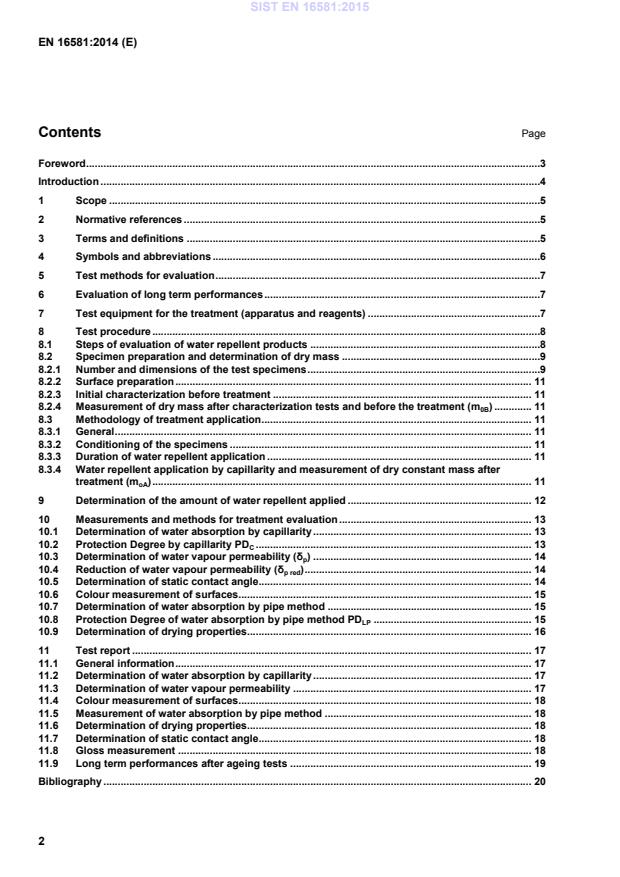
General Information
- Abstract
This European Standard specifies the methodology for laboratory evaluation of the performance of water repellent products on porous inorganic materials.
It is based on the measurement of several parameters which assess the performance of the product using standard test methods before and after ageing.
Acceptable performance within the laboratory does not constitute a blanket endorsement of application in every situation. The particular context of the heritage object, including such factors as material designation, condition, exposure, salt content and problems related to water ingress requires further investigation.
- Status
- Published
- Public Enquiry End Date
- 14-Sep-2014
- Publication Date
- 18-Jan-2015
- Technical Committee
- I13 - Imaginarni 13
- Current Stage
- 6060 - National Implementation/Publication (Adopted Project)
- Start Date
- 05-Jan-2015
- Due Date
- 12-Mar-2015
- Completion Date
- 19-Jan-2015

Overview
EN 16581:2014 - published by CEN - defines a laboratory methodology for evaluating water repellent products applied to porous inorganic materials in the context of the conservation of cultural heritage. The standard specifies test sequences, measurement parameters and reporting requirements to assess product performance before and after ageing. It emphasizes that acceptable laboratory performance is not a blanket endorsement for in‑situ use: material type, condition, exposure, salt content and water ingress issues must be considered and field trials on representative samples are recommended.
Key Topics
- Scope and approach
- Laboratory evaluation based on measurable parameters and standardized test methods.
- Capillarity application method is the reference for reproducible treatment in the lab.
- Primary performance indicators
- Water absorption by capillarity and Protection Degree by Capillarity (PDC) - quantifies reduction of liquid water uptake.
- Water vapour permeability and percentage reduction - ensures breathability is not unduly impaired.
- Static contact angle - surface wetting behaviour after treatment.
- Colour and gloss measurements - detect aesthetic changes important for heritage conservation.
- Water absorption by pipe method (PDLP) and drying properties - complementary assessments of liquid transport and drying.
- Amount of water repellent applied - mass uptake and application reproducibility.
- Durability and ageing
- Requires evaluation after ageing tests (natural or laboratory: light, freeze–thaw, wet/dry cycles, salt crystallization, pollutants, biological growth, etc.) to assess long‑term stability.
- Reporting
- Detailed test reports must include treatment application method, technical/chemical data sheets, and comparison of before/after and ageing results.
Applications / Who uses this standard
EN 16581:2014 is intended for:
- Historic building conservators and conservation scientists assessing protective treatments.
- Materials testing laboratories performing standardized evaluations of hydrophobic products.
- Manufacturers and suppliers of water repellent formulations seeking documented performance data.
- Restoration architects and site managers planning interventions on stone, brick, mortar and similar porous inorganic substrates.
- Regulatory bodies and procurement teams specifying conservation-compatible surface protection.
Practical uses include pre‑application testing on representative samples, product selection, quality control and documentation of expected in‑service behaviour.
Related Standards
EN 16581 references and integrates results from these conservation test methods:
- EN 15801 - Water absorption by capillarity
- EN 15802 - Static contact angle
- EN 15803 - Water vapour permeability
- EN 15886 - Colour measurement of surfaces
- EN 16302 - Water absorption by pipe method
- EN 16322 - Determination of drying properties
- EN ISO 2813 - Gloss measurement
Keywords: EN 16581:2014, water repellent, conservation of cultural heritage, porous inorganic materials, laboratory test methods, protection degree, water vapour permeability, contact angle, ageing tests.
Relations
- Effective Date
- 28-Jan-2026
- Effective Date
- 28-Jan-2026
- Effective Date
- 28-Jan-2026
- Effective Date
- 28-Jan-2026
- Effective Date
- 28-Jan-2026
- Effective Date
- 28-Jan-2026
- Effective Date
- 28-Jan-2026
- Effective Date
- 28-Jan-2026
- Effective Date
- 28-Jan-2026
- Effective Date
- 28-Jan-2026
Get Certified
Connect with accredited certification bodies for this standard

DVS-ZERT GmbH
German welding certification society.
CARES (UK Certification Authority for Reinforcing Steels)
UK certification for reinforcing steels and construction.
EWF/IIW (European/International Welding Federation)
International welding personnel certification.
Sponsored listings
Frequently Asked Questions
SIST EN 16581:2015 is a standard published by the Slovenian Institute for Standardization (SIST). Its full title is "Conservation of Cultural Heritage - Surface protection for porous inorganic materials - Laboratory test methods for the evaluation of the performance of water repellent products". This standard covers: This European Standard specifies the methodology for laboratory evaluation of the performance of water repellent products on porous inorganic materials. It is based on the measurement of several parameters which assess the performance of the product using standard test methods before and after ageing. Acceptable performance within the laboratory does not constitute a blanket endorsement of application in every situation. The particular context of the heritage object, including such factors as material designation, condition, exposure, salt content and problems related to water ingress requires further investigation.
This European Standard specifies the methodology for laboratory evaluation of the performance of water repellent products on porous inorganic materials. It is based on the measurement of several parameters which assess the performance of the product using standard test methods before and after ageing. Acceptable performance within the laboratory does not constitute a blanket endorsement of application in every situation. The particular context of the heritage object, including such factors as material designation, condition, exposure, salt content and problems related to water ingress requires further investigation.
SIST EN 16581:2015 is classified under the following ICS (International Classification for Standards) categories: 25.220.01 - Surface treatment and coating in general; 97.195 - Items of art and handicrafts. Cultural property and heritage. The ICS classification helps identify the subject area and facilitates finding related standards.
SIST EN 16581:2015 has the following relationships with other standards: It is inter standard links to SIST EN 16302:2014, SIST EN 16085:2012, SIST EN ISO 2813:2015, SIST EN 15886:2010, SIST EN 15802:2010, SIST EN 15803:2010, SIST EN 15801:2010, SIST EN 16322:2014, SIST EN 15898:2020, SIST EN 17114:2019. Understanding these relationships helps ensure you are using the most current and applicable version of the standard.
SIST EN 16581:2015 is available in PDF format for immediate download after purchase. The document can be added to your cart and obtained through the secure checkout process. Digital delivery ensures instant access to the complete standard document.
Standards Content (Sample)
2003-01.Slovenski inštitut za standardizacijo. Razmnoževanje celote ali delov tega standarda ni dovoljeno.GRRGERMQLKVUHGVWHYErhaltung des kulturellen Erbes - Oberflächenschutz für poröse anorganische Materialien - Laborprüfverfahren für die Ermittlung der Wirksamkeit von wasserabweisenden ProduktenConservation du patrimoine culturel - Protection de surface des matériaux inorganiques poreux - Méthodes d'essai en laboratoire pour l'évaluation des performances des produits hydrofugesConservation of Cultural Heritage - Surface protection for porous inorganic materials - Laboratory test methods for the evaluation of the performance of water repellent products97.195Umetniški in obrtniški izdelkiItems of art and handicrafts25.220.01Površinska obdelava in prevleke na splošnoSurface treatment and coating in generalICS:Ta slovenski standard je istoveten z:EN 16581:2014SIST EN 16581:2015en,fr,de01-februar-2015SIST EN 16581:2015SLOVENSKI
STANDARD
EUROPEAN STANDARD NORME EUROPÉENNE EUROPÄISCHE NORM
EN 16581
December 2014 ICS 97.195 English Version
Conservation of Cultural Heritage - Surface protection for porous inorganic materials - Laboratory test methods for the evaluation of the performance of water repellent products
Conservation du patrimoine culturel - Protection de surface des matériaux inorganiques poreux - Méthodes d'essai en laboratoire pour l'évaluation des performances des produits hydrofuges
Erhaltung des kulturellen Erbes - Oberflächenschutz für poröse anorganische Materialien - Laborprüfverfahren für die Ermittlung der Wirksamkeit von wasserabweisenden Produkten This European Standard was approved by CEN on 18 October 2014.
CEN members are bound to comply with the CEN/CENELEC Internal Regulations which stipulate the conditions for giving this European Standard the status of a national standard without any alteration. Up-to-date lists and bibliographical references concerning such national standards may be obtained on application to the CEN-CENELEC Management Centre or to any CEN member.
This European Standard exists in three official versions (English, French, German). A version in any other language made by translation under the responsibility of a CEN member into its own language and notified to the CEN-CENELEC Management Centre has the same status as the official versions.
CEN members are the national standards bodies of Austria, Belgium, Bulgaria, Croatia, Cyprus, Czech Republic, Denmark, Estonia, Finland, Former Yugoslav Republic of Macedonia, France, Germany, Greece, Hungary, Iceland, Ireland, Italy, Latvia, Lithuania, Luxembourg, Malta, Netherlands, Norway, Poland, Portugal, Romania, Slovakia, Slovenia, Spain, Sweden, Switzerland, Turkey and United Kingdom.
EUROPEAN COMMITTEE FOR STANDARDIZATION
COMITÉ EUROPÉEN DE NORMALISATION EUROPÄISCHES KOMITEE FÜR NORMUNG
CEN-CENELEC Management Centre:
Avenue Marnix 17,
B-1000 Brussels © 2014 CEN All rights of exploitation in any form and by any means reserved worldwide for CEN national Members. Ref. No. EN 16581:2014 ESIST EN 16581:2015
contact angle, in °. 5 Test methods for evaluation The methods listed here below are used for the evaluation of a water repellent product in relation to the possible changes of the characteristics of porous inorganic materials. 1) Determination of water absorption by capillarity (EN 15801) 2) Determination of static contact angle (EN 15802) 3) Determination of water vapour permeability (EN 15803) 4) Colour measurement of surfaces (EN 15886) 5) Determination of water absorption by pipe method (EN 16302) 6) Determination of drying properties (EN 16322) 7) Gloss measurement (EN ISO 2813) 6 Evaluation of long term performances Water repellents are expected to demonstrate suitable durability on exposure to natural weathering or laboratory tests (such as light irradiation, freeze and thaw, wetting and drying, thermal cycles, salt crystallization, pollutant simulation, biological growth, etc.) representing the environment in which the object is located. In the event that a specific methodology for the assessment of environmental degradation is standardised in the field of conservation of cultural heritage, it shall be used. Where these do not exist, a suitable assessment method for Cultural Heritage should be used and described in the test report. It is important to monitor the performances of water repellent products after ageing repeating the tests listed in Clause 5, taking into account that different comparisons of the results are possible (i.e. after ageing-before treatment or after ageing-before ageing, etc…). The comparison of the results allow to evaluate the durability of products. 7 Test equipment for the treatment (apparatus and reagents) 7.1
Crystallization vessel 7.2
Bedding layer such as filter paper, foam or cotton. 7.3 Chronometer with an accuracy of 1 s. 7.4
Ventilated oven which can maintain a temperature of (40 ± 2) °C. 7.5
Analytical balance with an accuracy of at least 0,01 g. SIST EN 16581:2015
Linear measuring device (calliper) with an accuracy of 0,1 mm. 7.7
Chamber capable of maintaining a constant temperature of (23 ± 2) °C. 7.8
Sand paper with grain size of 82 µm (corresponding to grit number P180 according to the FEPA 1) classification). 7.9
Desiccator filled with desiccant such as self-indicating silica gel or other drying agents. 7.10
Deionised water (with max. conductivity of 6
7.11
Soft bristle brush 7.12
Ammonium chloride saturated solution, or a climatic chamber capable of maintaining a relative humidity of (80 ± 5) %. 7.13
Magnesium nitrate saturated solution, or a climatic chamber capable of maintaining a relative humidity of (53 ± 5)%. 7.14
Glass spheres or bars (e.g. 3 mm to 4 mm diameter). 8 Test procedure 8.1 Steps of evaluation of water repellent products The evaluation of water repellent products applied on porous inorganic materials should be carried out according to the following steps (Figure 1).
1) Federation of European Producers of Abrasives SIST EN 16581:2015
Figure 1 — Flow diagram for recommended test procedure 8.2 Specimen preparation and determination of dry mass 8.2.1 Number and dimensions of the test specimens Specimens shall have a regular shape such as cubes, parallelepipeds or cylinders (see Table 1). SIST EN 16581:2015
OR
50 × 50 × 20 OR 40 × 40 × 80 OR 40 × 80 Determination of static contact angle 3 (5 measurements on each test specimen) flat surface - Determination of water vapour permeability 3
50 × 50 × 10
45 × 5 Colour measurement of surfaces 3 (5 measurements on each test specimen) flat surface - Determination of water absorption by pipe method NOTE Supplied dimensions relate to the use of vertical pipe. 3
OR
50 × 50 × 20 OR 40 × 40 × 80 OR 40 × 80 Determination of drying properties 3
OR
50 × 50 × 20 OR 40 × 40 × 80 OR 40 × 80 Gloss measurement 3 (5 measurements on each test specimen) flat surface - In the case of non-homogeneous materials, such as mortars, containing coarse aggregates, the dimensions shall be at least three times (and preferably five times) the largest grain size. The number of specimens is also dependent on the heterogeneity of the material. In case of anisotropy, the specimens shall always be tested according to the same orientation. All dimensions shall have a ± 0,5 mm tolerance. The constraints of sampling material from the cultural heritage may limit sizes and numbers of samples. However, they should be as close to the requirements above as possible. When evaluating inorganic porous materials from cultural heritage, the sampling shall follow EN 16085. SIST EN 16581:2015
...