


kSIST FprEN IEC 63409-3:2025
(Main)Photovoltaic power generating systems connection with grid - Testing of power conversion equipment - Part 3: Basic operations
Photovoltaic power generating systems connection with grid - Testing of power conversion equipment - Part 3: Basic operations
IEC 63409-3:2025 specifies test procedures for confirming the basic operational characteristics of power conversion equipment (PCE) for use in photovoltaic (PV) power systems with or without energy storage. The basic operational characteristics are the capability of the PCE before any limitations due to internal settings are applied to the PCE to meet specific grid support functions or specific behaviours against abnormal changes.
This document covers the testing of the following items:
a) Steady state characteristics
Test procedures to confirm operable range of PCE at steady state condition are described. The operable ranges in apparent power, active power, reactive power, power factor, grid voltage and grid frequency are confirmed according to the test procedures.
b) Transient-response characteristics
Test procedures to confirm PCE’s response against a change of operational condition are described.
This document only considers the changes within normal (continuous) operable ranges. Therefore, the behaviours against abnormal changes and grid support functions are out of the scope and are covered in other parts of this series.
Photovoltaische Stromerzeugungssysteme mit Netzanschluss – Prüfung von Energieumwandlungsanlagen Teil 3: Grundlegende Funktionen
Systèmes de production d’énergie photovoltaïque connectés au réseau électrique - Essais des équipements de conversion de puissance - Partie 3: Opérations de base
L’IEC 63409-3:2025 spécifie les procédures d’essai permettant de confirmer les caractéristiques opérationnelles de base des équipements de conversion de puissance (PCE) destinés à être utilisés dans les systèmes de production d’énergie photovoltaïque (PV) avec ou sans stockage d’énergie. Les caractéristiques opérationnelles de base correspondent aux capacités du PCE avant que des limitations dues à des réglages internes ne lui soient appliquées, pour satisfaire à des fonctions spécifiques de support du réseau électrique ou adopter des comportements spécifiques face à des changements anormaux.
Le présent document couvre les essais des éléments suivants:
a) Caractéristiques en régime permanent
Les procédures d’essai permettant de confirmer la plage de service du PCE en régime permanent font l’objet d’une description. Les plages de service de la puissance apparente, de la puissance active, de la puissance réactive, du facteur de puissance, de la tension et de la fréquence du réseau doivent être confirmées conformément aux procédures d’essai.
b) Caractéristiques en réponse transitoire
Les procédures d’essai permettant de confirmer la réponse du PCE à un changement des conditions de fonctionnement font l’objet d’une description.
Le présent document ne prend en considération que les changements survenant dans les plages de service normales (continues). Par conséquent, les comportements face à des changements anormaux et les fonctions de support du réseau ne relèvent pas du domaine d’application de la présente norme et sont traités dans d’autres parties de cette série de Normes internationales.
Povezava fotonapetostnih sistemov za proizvodnjo električne energije z omrežjem - Preskušanje opreme za pretvorbo električne energije - 3. del: Osnovni postopki
General Information
- Status
- Not Published
- Public Enquiry End Date
- 13-Jun-2024
- Technical Committee
- PVS - Solar photovoltaic energy systems
- Current Stage
- 5020 - Formal vote (FV) (Adopted Project)
- Start Date
- 14-Jul-2025
- Due Date
- 01-Sep-2025
- Completion Date
- 21-Aug-2025
Overview
FprEN IEC 63409-3:2025 - "Photovoltaic power generating systems connection with the grid - Testing of power conversion equipment - Part 3: Basic operations" specifies standardized test procedures to confirm the basic operational characteristics of power conversion equipment (PCE) used in photovoltaic (PV) systems, with or without energy storage. The document defines how to verify the PCE capability before any manufacturer or grid‑support settings are applied. It is part of the IEC 63409 series addressing PV grid connection testing.
Key topics and technical requirements
- Scope of testing
- Verification of PCE basic operations within normal (continuous) operable ranges.
- Applies to systems both with and without energy storage.
- Excludes behaviours against abnormal events and dedicated grid‑support functions (covered in other parts of the series).
- Steady‑state characteristics
- Test procedures to confirm operable ranges in apparent power, active power, reactive power, power factor, grid voltage, and grid frequency.
- Recording formats and P‑Q capability curves to document results.
- Transient‑response characteristics
- Procedures to evaluate PCE response to changes in operational conditions that remain within the normal operating envelope (e.g., setpoint steps, voltage or frequency variations, phase angle changes, unbalance).
- Includes guidance on measuring settling time and response waveforms.
- Measurement and test environment
- Normative annexes define recommended test setups, measuring instrumentation, power supplies, sign conventions for voltage/current/power, and test recording formats.
- Supplementary guidance
- Annexes provide details on unbalanced voltage testing, phase‑angle variation setups, and the impact of low DC voltage on reactive capability.
Applications
- Provides a consistent, reproducible method to validate the fundamental performance of inverters and grid converters for PV plants and hybrid systems.
- Useful for:
- Factory acceptance testing and type‑testing of PCEs.
- Independent test laboratories performing compliance verification.
- R&D teams characterizing converter dynamic and steady‑state behaviour.
- System integrators and PV plant owners evaluating converter suitability for a given grid environment.
Who should use this standard
- Manufacturers of inverters, converters and PCEs
- Test laboratories and certification bodies
- Grid operators and distribution network planners assessing DER behaviour
- Consultants and system integrators performing commissioning and acceptance testing
Related standards
- Part of the IEC 63409 series - other parts cover abnormal behaviour and grid support functions.
- Cross‑references to regional DER/grid connection standards and measurement guidance are included in annexes and bibliography.
Keywords: IEC 63409-3:2025, photovoltaic testing, power conversion equipment (PCE), inverter testing, grid connection, steady state, transient response, reactive power, operable frequency, PV systems.


Frequently Asked Questions
kSIST FprEN IEC 63409-3:2025 is a draft published by the Slovenian Institute for Standardization (SIST). Its full title is "Photovoltaic power generating systems connection with grid - Testing of power conversion equipment - Part 3: Basic operations". This standard covers: IEC 63409-3:2025 specifies test procedures for confirming the basic operational characteristics of power conversion equipment (PCE) for use in photovoltaic (PV) power systems with or without energy storage. The basic operational characteristics are the capability of the PCE before any limitations due to internal settings are applied to the PCE to meet specific grid support functions or specific behaviours against abnormal changes. This document covers the testing of the following items: a) Steady state characteristics Test procedures to confirm operable range of PCE at steady state condition are described. The operable ranges in apparent power, active power, reactive power, power factor, grid voltage and grid frequency are confirmed according to the test procedures. b) Transient-response characteristics Test procedures to confirm PCE’s response against a change of operational condition are described. This document only considers the changes within normal (continuous) operable ranges. Therefore, the behaviours against abnormal changes and grid support functions are out of the scope and are covered in other parts of this series.
IEC 63409-3:2025 specifies test procedures for confirming the basic operational characteristics of power conversion equipment (PCE) for use in photovoltaic (PV) power systems with or without energy storage. The basic operational characteristics are the capability of the PCE before any limitations due to internal settings are applied to the PCE to meet specific grid support functions or specific behaviours against abnormal changes. This document covers the testing of the following items: a) Steady state characteristics Test procedures to confirm operable range of PCE at steady state condition are described. The operable ranges in apparent power, active power, reactive power, power factor, grid voltage and grid frequency are confirmed according to the test procedures. b) Transient-response characteristics Test procedures to confirm PCE’s response against a change of operational condition are described. This document only considers the changes within normal (continuous) operable ranges. Therefore, the behaviours against abnormal changes and grid support functions are out of the scope and are covered in other parts of this series.
kSIST FprEN IEC 63409-3:2025 is classified under the following ICS (International Classification for Standards) categories: 27.160 - Solar energy engineering; 29.240.01 - Power transmission and distribution networks in general. The ICS classification helps identify the subject area and facilitates finding related standards.
kSIST FprEN IEC 63409-3:2025 is available in PDF format for immediate download after purchase. The document can be added to your cart and obtained through the secure checkout process. Digital delivery ensures instant access to the complete standard document.
Standards Content (Sample)
SLOVENSKI STANDARD
oSIST prEN IEC 63409-3:2024
01-junij-2024
Povezava fotonapetostnih sistemov za proizvodnjo električne energije z omrežjem
- Preskušanje opreme za pretvorbo električne energije - 3. del: Osnovne operacije
Photovoltaic power generating systems connection with grid - Testing of power
conversion equipment - Part 3: Basic operations
Ta slovenski standard je istoveten z: prEN IEC 63409-3:2024
ICS:
27.160 Sončna energija Solar energy engineering
29.240.01 Omrežja za prenos in Power transmission and
distribucijo električne energije distribution networks in
na splošno general
oSIST prEN IEC 63409-3:2024 en,fr,de
2003-01.Slovenski inštitut za standardizacijo. Razmnoževanje celote ali delov tega standarda ni dovoljeno.
oSIST prEN IEC 63409-3:2024
oSIST prEN IEC 63409-3:2024
82/2226/CDV
COMMITTEE DRAFT FOR VOTE (CDV)
PROJECT NUMBER:
IEC 63409-3 ED1
DATE OF CIRCULATION: CLOSING DATE FOR VOTING:
2024-03-29 2024-06-21
SUPERSEDES DOCUMENTS:
82/2114/CD, 82/2153A/CC
IEC TC 82 : SOLAR PHOTOVOLTAIC ENERGY SYSTEMS
SECRETARIAT: SECRETARY:
United States of America Mr George Kelly
OF INTEREST TO THE FOLLOWING COMMITTEES: PROPOSED HORIZONTAL STANDARD:
TC 8, TC 22, TC 57, TC 69, TC 77, TC 88, ACTAD
Other TC/SCs are requested to indicate their interest, if any, in this
CDV to the secretary.
FUNCTIONS CONCERNED:
EMC ENVIRONMENT QUALITY ASSURANCE SAFETY
SUBMITTED FOR CENELEC PARALLEL VOTING NOT SUBMITTED FOR CENELEC PARALLEL VOTING
Attention IEC-CENELEC parallel voting
The attention of IEC National Committees, members of CENELEC, is
drawn to the fact that this Committee Draft for Vote (CDV) is submitted
for parallel voting.
The CENELEC members are invited to vote through the CENELEC
online voting system.
This document is still under study and subject to change. It should not be used for reference purposes.
Recipients of this document are invited to submit, with their comments, notification of any relevant patent rights of which they are aware and
to provide supporting documentation.
Recipients of this document are invited to submit, with their comments, notification of any relevant “In Some Countries” clauses to be included
should this proposal proceed. Recipients are reminded that the CDV stage is the final stage for submitting ISC clauses. (SEE AC/22/2007
OR NEW GUIDANCE DOC).
TITLE:
Photovoltaic power generating systems connection with grid – Testing of power conversion equipment –
Part 3: Basic operations
PROPOSED STABILITY DATE: 2030
NOTE FROM TC/SC OFFICERS:
This project was discussed and supported by WG6 during their meeting in 2023-10.
electronic file, to make a copy and to print out the content for the sole purpose of preparing National Committee positions.
You may not copy or "mirror" the file or printed version of the document, or any part of it, for any other purpose without
permission in writing from IEC.
oSIST prEN IEC 63409-3:2024
IEC CDV 63409-3 © IEC 2024 2 82/2226/CDV
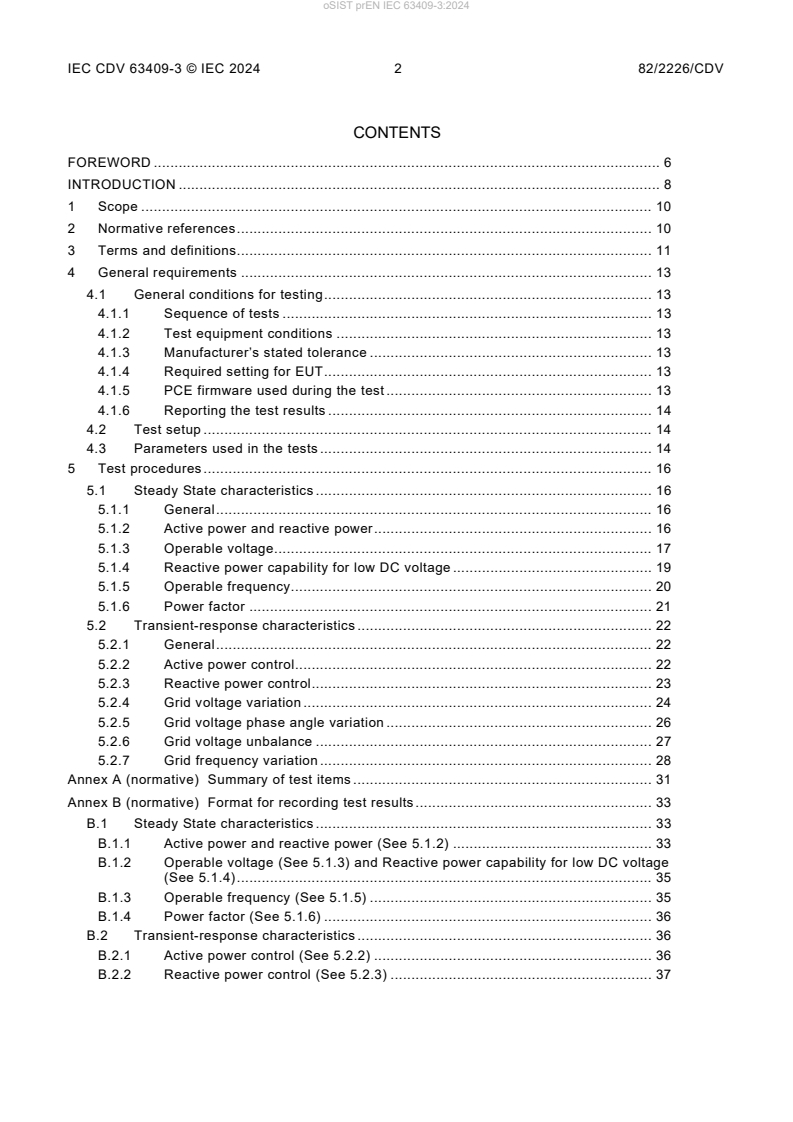
CONTENTS
FOREWORD . 6
INTRODUCTION . 8
1 Scope . 10
2 Normative references . 10
3 Terms and definitions . 11
4 General requirements . 13
4.1 General conditions for testing . 13
4.1.1 Sequence of tests . 13
4.1.2 Test equipment conditions . 13
4.1.3 Manufacturer’s stated tolerance . 13
4.1.4 Required setting for EUT . 13
4.1.5 PCE firmware used during the test . 13
4.1.6 Reporting the test results . 14
4.2 Test setup . 14
4.3 Parameters used in the tests . 14
5 Test procedures . 16
5.1 Steady State characteristics . 16
5.1.1 General . 16
5.1.2 Active power and reactive power . 16
5.1.3 Operable voltage. 17
5.1.4 Reactive power capability for low DC voltage . 19
5.1.5 Operable frequency. 20
5.1.6 Power factor . 21
5.2 Transient-response characteristics . 22
5.2.1 General . 22
5.2.2 Active power control . 22
5.2.3 Reactive power control . 23
5.2.4 Grid voltage variation . 24
5.2.5 Grid voltage phase angle variation . 26
5.2.6 Grid voltage unbalance . 27
5.2.7 Grid frequency variation . 28
Annex A (normative) Summary of test items . 31
Annex B (normative) Format for recording test results . 33
B.1 Steady State characteristics . 33
B.1.1 Active power and reactive power (See 5.1.2) . 33
B.1.2 Operable voltage (See 5.1.3) and Reactive power capability for low DC voltage
(See 5.1.4) . 35
B.1.3 Operable frequency (See 5.1.5) . 35
B.1.4 Power factor (See 5.1.6) . 36
B.2 Transient-response characteristics . 36
B.2.1 Active power control (See 5.2.2) . 36
B.2.2 Reactive power control (See 5.2.3) . 37
oSIST prEN IEC 63409-3:2024
82/2226/CDV 3 IEC CDV 63409-3 © IEC 2024
B.2.3 Grid voltage variation (See 5.2.4) . 38
B.2.4 Grid voltage phase angle variation (See 5.2.5) . 39
B.2.5 Grid voltage unbalance (See 5.2.6) . 40
B.2.6 Grid frequency variation (See 5.2.7) . 41
Annex C (normative) Requirements for testing environments . 43
C.1 Outline . 43
C.2 Recommended specification of power supplies . 44
C.3 Recommended specification of measuring instruments . 45
Annex D (normative) Supplemental information for settling time measurement . 48
Annex E (normative) Sign conventions for measurements of voltage, current and power . 49
E.1 General . 49
E.2 Reference polarity and direction . 49
E.2.1 Reference polarity of voltage . 49
E.2.2 Reference direction of current . 49
E.2.3 Sign conventions for measurements of voltage, current and power . 50
E.3 Reference frame of active and reactive power . 50
E.4 Physical meanings of the power flows of generators in regional standards . 54
Annex F (normative) Grid voltage unbalance – test condition . 57
F.1 Outline . 57
F.2 Causes and definitions of Unbalanced grid voltage. 57
F.3 Test conditions . 57
Annex G (informative) Phase angle variation of grid voltage – alternative test setup . 58
G.1 Outline . 58
G.2 Alternative test setup and test procedure . 58
Annex H (informative) Fundamental principle of reactive power reduction with lower DC voltage
..................................................................................................................................... 59
H.1 Outline . 59
H.2 Controllability limit . 59
Annex I (informative) Grid support functions covered in IEC 63409 series . 63
Bibliography . 65
Figure 1- Scopes of IEC 63409 Series . 9
Figure 2 – Example of step response . 13
Figure 3 – Example of a test setup . 14
Figure 4– Example operational parameters in P-Q capability curve of PCE in Producer
Reference Frame (PRF) . 16
Figure 5 – Example of settling time measurement for grid voltage variation test . 26
Figure 6 – Example of settling time measurement for grid frequency variation . 30
Figure B.1 – P-Q capability curve showing Active power and reactive power test results and
Power factor test results (example) . 34
Figure B.2 – Active power control test waveform example when active power setpoint was
changed from 100 % . 37
Figure B.3 – Reactive power control test waveform example when reactive power setpoint was
changed from 52,7 % to 0 % . 38
oSIST prEN IEC 63409-3:2024
IEC CDV 63409-3 © IEC 2024 4 82/2226/CDV
Figure B.4 – Grid voltage variation test waveform example when AC voltage was changed from
100 % to 110 % . 39
Figure B.5 – Phase angle of grid voltage change test waveform example (10 degree step
change was applied to AC voltages for illustrative purpose) . 40
Figure B.6 – Grid voltage unbalance test waveform example when negative sequence voltage
was applied to AC voltages . 41
Figure B.7 – Grid frequency variation test waveform example when AC frequency was changed
from 50 Hz to 50,5 Hz . 42
Figure C.1 – Example of a testing environment . 43
Figure D.1 – Example of settling time measurement for grid voltage variation in case the settled
power is different from the original steady state . 48
Figure E.1 – Reference polarity of voltage . 49
Figure E.2 – Reference polarity of current . 49
Figure E.3 – Reference polarity and direction for the measurements for DER . 50
Figure E.4 – Reference polarity and direction for the measurements for Load . 50
Figure E.5 – Rotating vector voltage and current for load . 51
Figure E.6 – Rotating vector voltage and current for DER . 51
Figure E.7 – Complex power for load. 52
Figure E.8 – Complex power for DER . 53
Figure E.9 – Power quadrants for load . 53
Figure E.10 – Power quadrants for DER . 54
Figure G.1 – Configuration of an alternative test setup . 58
Figure H.1 – Basic configuration of a power conversion equipment . 59
Figure H.2 – EUT voltage and current vector diagram and operating point depicted in the PQ
curve with sufficient U (over-excited) . 61
ac
Figure H.3 – EUT voltage and current vector diagram and operating point depicted in the PQ
curve with small U (over-excited) . 61
ac
Figure H.4 – EUT voltage and current vector diagram and operating point depicted in the PQ
curve with small U (under-excited) . 61
ac
Figure H.5 – EUT voltage and current vector diagram and operating point depicted in the PQ
curve during inflexion operating point (over-excited) . 62
Table 1 – Parameters defined for the tests . 15
Table 2: Test conditions for operable voltage test . 19
Table 3: Test conditions for operable frequency test . 21
Table 4 – Test cases for grid voltage unbalance . 28
Table A.1 – Test items for Steady state characteristics (example) . 31
Table A.2 – Test items for Transient-response characteristics (example) . 32
Table B.1 – Record of Active power and reactive power test (example) . 33
Table B.2 – Record of Operable voltage test (example) . 35
Table B.3 – Record of Operable frequency test (example) . 35
Table B.4 – Record of Power factor test (example) . 36
oSIST prEN IEC 63409-3:2024
82/2226/CDV 5 IEC CDV 63409-3 © IEC 2024
Table B.5 – Record of Active power control test (example) . 36
Table B.6 – Record of Reactive power control test (example) . 37
Table B.7 – Record of Grid voltage variation test (example) . 38
Table B.8 – Record of Grid voltage phase angle variation test (example) . 39
Table B.9 – Record of Grid voltage unbalance test (example) . 40
Table B.10 – Record of Grid frequency variation test (example) . 41
Table C.1 – Required functions for power supplies . 43
Table C.2 –Electrical quantity measured with measuring instruments/devices . 44
Table C.3 – Recommended specifications for power supplies . 45
Table C.4 – Recommended specifications of power quality measurement . 46
Table C.5 – Recommended specifications of waveform monitoring and recording device. 46
Table E.1 – Physical meanings of the power flows of loads . 54
Table E.2 – Physical meanings of the power flows of generators . 54
Table E.3 – Physical meanings of the power flows of generators in Japan . 55
Table E.4 – Physical meanings of the power flows of generators in IEEE 1547.1. 55
Table E.5 – Physical meanings of the power flows of generators in EN 50549-10 . 55
Table E.6 – Physical meanings of the power flows of generators in AS/NZS 4777.2 . 55
Table I.1 – Grid support functions covered in IEC 63409 series . 63
oSIST prEN IEC 63409-3:2024
IEC CDV 63409-3 © IEC 2024 6 82/2226/CDV
INTERNATIONAL ELECTROTECHNICAL COMMISSION
____________
PHOTOVOLTAIC POWER GENERATING SYSTEMS CONNECTION
WITH THE GRID –
TESTING OF POWER CONVERSION EQUIPMENT –
Part 3: Basic operations
FOREWORD
1) The International Electrotechnical Commission (IEC) is a worldwide organization for standardization comprising all national
electrotechnical committees (IEC National Committees). The object of IEC is to promote international co-operation on all
questions concerning standardization in the electrical and electronic fields. To this end and in addition to other activities,
IEC publishes International Standards, Technical Specifications, Technical Reports, Publicly Available Specifications (PAS)
and Guides (hereafter referred to as “IEC Publication(s)”). Their preparation is entrusted to technical committees; any IEC
National Committee interested in the subject dealt with may participate in this preparatory work. International, governmental
and non-governmental organizations liaising with the IEC also participate in this preparation. IEC collaborates closely with
the International Organization for Standardization (ISO) in accordance with conditions determined by agreement between
the two organizations.
2) The formal decisions or agreements of IEC on technical matters express, as nearly as possible, an international consensus
of opinion on the relevant subjects since each technical committee has representation from all interested IEC National
Committees.
3) IEC Publications have the form of recommendations for international use and are accepted by IEC National Committees in
that sense. While all reasonable efforts are made to ensure that the technical content of IEC Publications is accurate, IEC
cannot be held responsible for the way in which they are used or for any misinterpretation by any end user.
4) In order to promote international uniformity, IEC National Committees undertake to apply IEC Publications transparently to
the maximum extent possible in their national and regional publications. Any divergence between any IEC Publication and
the corresponding national or regional publication shall be clearly indicated in the latter.
5) IEC itself does not provide any attestation of conformity. Independent certification bodies provide conformity assessment
services and, in some areas, access to IEC marks of conformity. IEC is not responsible for any services carried out by
independent certification bodies.
6) All users should ensure that they have the latest edition of this publication.
7) No liability shall attach to IEC or its directors, employees, servants or agents including individual experts and members of
its technical committees and IEC National Committees for any personal injury, property damage or other damage of any
nature whatsoever, whether direct or indirect, or for costs (including legal fees) and expenses arising out of the publication,
use of, or reliance upon, this IEC Publication or any other IEC Publications.
8) Attention is drawn to the Normative references cited in this publication. Use of the referenced publications is indispensable
for the correct application of this publication.
9) IEC draws attention to the possibility that the implementation of this document may involve the use of (a) patent(s). IEC
takes no position concerning the evidence, validity or applicability of any claimed patent rights in respect thereof. As of the
date of publication of this document, IEC [had/had not] received notice of (a) patent(s), which may be required to implement
this document. However, implementers are cautioned that this may not represent the latest information, which may be
obtained from the patent database available at https://patents.iec.ch. IEC shall not be held responsible for identifying any
or all such patent rights.
International Standard IEC PHOTOVOLTAIC POWER GENERATING SYSTEMS CONNECTION WITH
THE GRID – TESTING FOR POWER CONVERSION EQUIPMENT – Part 3: Basic operations has been
prepared by IEC technical committee 82.
oSIST prEN IEC 63409-3:2024
82/2226/CDV 7 IEC CDV 63409-3 © IEC 2024
The text of this International Standard is based on the following documents:
Draft Report on voting
82/XX/FDIS 82/XX/RVD
Full information on the voting for its approval can be found in the report on voting indicated in the above
table.
The language used for the development of this International Standard is English.
This document was drafted in accordance with ISO/IEC Directives, Part 2, and developed in accordance
with ISO/IEC Directives, Part 1 and ISO/IEC Directives, IEC Supplement, available at
www.iec.ch/members_experts/refdocs. The main document types developed by IEC are described in
greater detail at www.iec.ch/publications.
The committee has decided that the contents of this document will remain unchanged until the stability
date indicated on the IEC website under webstore.iec.ch in the data related to the specific document.
At this date, the document will be
• reconfirmed,
• withdrawn, or
• revised.
The National Committees are requested to note that for this document the stability date is 20XX.
THIS TEXT IS INCLUDED FOR THE INFORMATION OF THE NATIONAL COMMITTEES AND WILL BE DELETED AT THE
PUBLICATION STAGE.
oSIST prEN IEC 63409-3:2024
IEC CDV 63409-3 © IEC 2024 8 82/2226/CDV
1 INTRODUCTION
2 Background
3 TC82 has been making efforts to contribute the standardization of DER connection with the grid. In 2016,
4 TC82 joined TC8/JWG10 to harmonize with utility power system operation requirements. In parallel with
5 such a liaison work, TC82 has also been preparing the standardization of testing requirements to
6 evaluate grid connection requirements for power conversion equipment (PCE) for use in PV systems
7 since 2016.
8 Purpose
9 This document proposes the Part 3 of this series which gives test procedures for confirming the basic
10 operation characteristics of PCE.
11 The main purpose of Part 3 is to confirm basic power conversion control of PCE at steady state condition
12 and at transient response. Figure 1 shows the relationships of the seven parts in IEC 63409. Part 3 is
13 focused on the control functions in PCE in respect of power conversion. Power flow control and grid
14 support functions will generate active and reactive power commands according to the grid conditions.
15 The commands are sent to power conversion control, and power conversion control will make current or
16 voltage references, which manipulate signals for the switching devices.
17 It is important to confirm the basic control performance of the PCE as power conversion equipment
18 without power flow control and grid support functions so that additional functions such as power flow
19 control and grid support functions can perform appropriately.
20 The responses of PCE against abnormal grid conditions will be covered in Part 4 (IEC 63409-4).
21 Power quality of the PCE output will be covered in Part 5 (IEC 63409-5).
22 Power flow control and grid support functions will be covered in Part 6 (IEC 63409-6).
23 Responses against commands through communication will be covered Part 7 (IEC 63409-7).
oSIST prEN IEC 63409-3:2024
82/2226/CDV 9 IEC CDV 63409-3 © IEC 2024
26 Figure 1- Scopes of IEC 63409 Series
oSIST prEN IEC 63409-3:2024
IEC CDV 63409-3 © IEC 2024 10 82/2226/CDV
28 PHOTOVOLTAIC POWER GENERATING SYSTEMS CONNECTION WITH THE GRID
29 – TESTING OF POWER CONVERSION EQUIPMENT
30 Part 3: Basic operations
32 1 Scope
33 This document specifies test procedures for confirming the basic operational characteristics of power
34 conversion equipment (PCE) for use in photovoltaic (PV) power systems with or without energy storage.
35 The basic operational characteristics are the capability of the PCE before any limitations due to internal
36 settings are applied to the PCE to meet specific grid support functions or specific behaviours against
37 abnormal changes.
38 This document covers the testing of following items:
39 a) Steady state characteristics
40 Test procedures to confirm operable range of PCE at steady state condition are described. The operable
41 ranges in apparent power, active power, reactive power, power factor, grid voltage and grid frequency
42 shall be confirmed according to the test procedures.
43 b) Transient-response characteristics
44 Test procedures to confirm PCE’s response against a change of operational condition are described.
45 Transient-response characteristics to be confirmed are response behaviours against;
46 • Active power set point change and reactive power set point change
47 • Grid voltage change, phase angle change, voltage unbalance and frequency change
48 This document only considers the changes within normal (continuous) operable ranges. Therefore, the
49 behaviours against abnormal changes and grid support functions are out of the scope and are covered
50 in other parts of this series of International Standards.
52 2 Normative references
53 The following documents are referred to in the text in such a way that some or all of their content
54 constitutes requirements of this document. For dated references, only the edition cited applies. For
55 undated references, the latest edition of the referenced document (including any amendments) applies.
56 IEC TS 61836:2016, Solar photovoltaic energy systems – Terms, definitions and symbols
57 IEC TS 62786-1:2023, Distributed energy resources connection with the grid - Part 1: General
58 requirements
59 IEC 61850-7-420:2021, Communication networks and systems for power utility automation - Part 7-420: Basic
60 communication structure - Distributed energy resources and distribution automation logical nodes
61 IEC 60375:2018, Conventions concerning electric circuits
62 IEC 61557-12:2018+AMD1:2021, Amendment 1 - Electrical safety in low voltage distribution systems up
63 to 1 000 V AC and 1 500 V DC - Equipment for testing, measuring or monitoring of protective measures
64 - Part 12: Power metering and monitoring devices (PMD)
oSIST prEN IEC 63409-3:2024
82/2226/CDV 11 IEC CDV 63409-3 © IEC 2024
65 IEC 62053-23:2020, Electricity metering equipment - Particular requirements - Part 23: Static meters for
66 reactive energy (classes 2 and 3)
67 IEC TS 62910:2020, Utility-interconnected photovoltaic inverters - Test procedure for under voltage ride-
68 through measurements
69 IEC 61000-2-2:2002+A1:2017+A2:2018, Electromagnetic compatibility (EMC) - Environment -
70 Compatibility levels for low-frequency conducted disturbances and signalling in public low-voltage power
71 supply systems
72 IEC 61000-4-27:2000+AMD1:2009, Amendment 1 - Electromagnetic compatibility (EMC) - Part 4-27:
73 Testing and measurement techniques - Unbalance, immunity test for equipment with input current not
74 exceeding 16 A per phase
75 IEC 61000-4-30:2015+AMD1:2021, Electromagnetic compatibility (EMC) - Part 4-30: Testing and
76 measurement techniques - Power quality measurement methods
77 3 Terms and definitions
78 ISO and IEC maintain terminological databases for use in standardization at the following addresses:
79 IEC Electropedia: available at http://www.electropedia.org/
80 ISO Online browsing platform: available at http://www.iso.org/obp
82 3.1
83 EUT
84 Equipment under test
85 3.2
86 power conversion equipment
87 PCE
88 electrical device converting one kind of electrical power from a voltage or current source into another
89 kind of electrical power with respect to voltage, current and frequency
90 [SOURCE: IEC 62109-1:2010, 3.66]
91 3.3
92 grid support functions
93 PCE’s functions which controls active power and / or reactive power according to pre-defined
94 characteristics or set point command to support stabilizing the power quality of the grid the PCE is
95 connected to
96 3.4
97 maximum power point tracking
98 MPPT
99 PCE’s control function which tracks the maximum DC power point in the PV module’s power generation
100 characteristics
101 3.5
102 steady state
103 equilibrium state in which the relevant characteristics remain constant with time
104 [SOURCE: IEV 103-05-01, modified – the original definition has been changed to adopt usage in PCE
105 testing]
oSIST prEN IEC 63409-3:2024
IEC CDV 63409-3 © IEC 2024 12 82/2226/CDV
106 3.6
107 response time
108 elapsed time from the start of a step change or start of event until the observed value first time enters
109 the predefined tolerance band of the target value
110 Note: See Figure 2.
111 [SOURCE: IEC 61400-21-1: 2019]
112 3.7
113 settling time
114 elapsed time from the start of a step change event until the observed value continuously stays within
115 the predefined tolerance band of the target value
116 Note: See Figure 2.
117 [SOURCE: IEC 61400-21-1: 2019]
118 3.8
119 rise time
120 time from when the observed value reaches 10 % of the step change until the observed value reaches
121 90 % of the step change
122 Note: See Figure 2.
123 [SOURCE: IEC 61400-21-1: 2019]
124 3.9
125 overshoot
126 difference between the maximum value of the response and the steady-state final value
127 Note: See Figure 2.
128 [SOURCE: IEC 61400-21-1: 2019]
129 3.10
130 reaction time
131 elapsed time from test command issued until the change in amplitude reaches 10 % of the measured
132 output variable of the step height
133 Note: See Figure 2.
134 [SOURCE: IEC 61400-21-1: 2019]
135 3.11
136 tolerance
137 permitted deviation between the declared value of a quantity and the measured value
139 [SOURCE: IEV 411-36-19]
140 3.12
141 tolerance band
142 acceptable deviation range of measured signal from the defined target value
144 [SOURCE: IEC 61400-21-1: 2019]
145 3.13
146 accuracy
147 quality which characterizes the ability of a measuring instrument to provide an indicated value close to
148 a true value of the measurand
149 [SOURCE: IEV 311-06-08]
oSIST prEN IEC 63409-3:2024
82/2226/CDV 13 IEC CDV 63409-3 © IEC 2024
Reference
Overshoot
Measurement
Tolerance
band
90 %
10 %
Reaction Rise
time
time
Response time
Settling time
152 Figure 2 – Example of step response
153 4 General requirements
154 4.1 General conditions for testing
155 4.1.1 Sequence of tests
156 The test may be performed in any order unless otherwise specified in this document. The same sample
157 need not be used for all tests unless otherwise specified in this document.
158 4.1.2 Test equipment conditions
159 Requirements on the test equipment such as external power supplies and test instruments are described
160 in Annex C.
161 4.1.3 Manufacturer’s stated tolerance
162 Standards or local regulations may specify the tolerance bands for ac voltage, frequency, active power,
163 reactive power and the time measurements. If not, the manufacturer of the PCE under evaluation shall
164 state the tolerance.
165 4.1.4 Required setting for EUT
166 All the grid support functions, some of which are listed as examples in Annex I, shall be disabled
167 throughout the test. If any one of the grid support functions is essential to perform the test, it is
168 permissible to enable it. In that case, it shall be written in the test report as remark that the specific
169 function was enabled during the test because it was essential to complete the test.
170 MPPT control shall be disabled as written in 4.2.
171 4.1.5 PCE firmware used during the test
172 The versions of the PCE firmware used during the test shall be recorded in the test report.
oSIST prEN IEC 63409-3:2024
IEC CDV 63409-3 © IEC 2024 14 82/2226/CDV
173 4.1.6 Reporting the test results
174 Test results shall be presented in the way shown in Annex B
175 4.2 Test setup
176 During testing, the EUT’s DC and AC ports shall be connected to external DC and AC power supplies
177 according to EUT manufacturer’s instructions. The test circuit diagram with positions of measurement
178 sensors shall be recorded in the test report. Figure 3 shows the typical test setup required for test items
179 described in this document.
180 Apparent power, active power and reactive power shall be measured at AC ports of EUT. The current
181 measuring instruments at AC port of the EUT shall be installed so that the current flowing from EUT to
182 AC power supply is measured as positive. See Annex E for more detailed definitions of sign conventions
183 for measurements of voltage, current and power in this document.
184 The testing of the EUT shall not be influenced by the performance of DC power supply used for the test
185 or the EUT MPPT control. Where the EUT has the capability to disable MPPT control, it shall be disabled
186 and a DC power supply that is able to provide constant voltage at any required power levels shall be
187 used. Where the EUT does not have capability to disable MPPT control, a PV simulator may be used
188 provided that the test results are not influenced by any DC instability by the PV simulator or the EUT
189 MPPT control. In each case, remarks shall be written in the test report to note the type of the DC power
190 supply used in the test.
192 Figure 3 – Example of a test setup
193 4.3 Parameters used in the tests
194 The parameters in Table 1 are defined for the tests. Manufacturer shall declare the parameters before
195 starting the tests.
oSIST prEN IEC 63409-3:2024
82/2226/CDV 15 IEC CDV 63409-3 © IEC 2024
197 Table 1 – Parameters defined for the tests
Items Symbols Units Explanation
Minimum DC operating voltage U V the minimum DC voltage for PCE to import or export
dc_min
active power continuously to or from the grid
DC
Nominal DC operation voltage U V The nominal DC voltage for PCE to import or export
dc_nom
power
active power continuously to or from the grid defined
port
by the manufacturer
Maximum DC operating voltage U V the maximum DC voltage for PCE to import or export
dc_max
active power continuously to or from the grid
Maximum apparent power S VA the maximum apparent power which flows
max
continuously and can be controlled by the PCE
Nominal active power P W the maximum active power which flows continuously
nom
and can be controlled by the PCE
Maximum over-excited reactive Qmax,oe var the maximum over-excited (capacitive) reactive
power power which flows continuously and can be
controlled by the PCE
Maximum under-excited reactive Q var the maximum under-excited (inductive) reactive
max,ue
power power which flows continuously and can be
controlled by the PCE
Nominal AC voltage U V the rated AC voltage of the PCE
N
Continuous operable maximum U V the maximum grid voltage at which the PCE can
H
AC voltage operate and deliver power continuously without
tripping
AC
Continuous operable minimum U V the minimum grid voltage at which the PCE can
L
power
AC voltage operate and deliver power continuously without
port
tripping
Minimum over-excited power PF - minimum over-excited power factor of the PCE
min.oe
factor at maximum apparent where PV system can deliver maximum apparent
power power continuously at nominal AC voltage
Minimum under-excited power PF - minimum under-excited power factor of the PCE
min.ue
factor at maximum apparent where PV system can deliver maximum apparent
power power continuously at nominal AC voltage
Nominal frequency f Hz the rated AC frequency of the PCE
N
Continuous operable maximum the maximum grid frequency at which the PCE can
f Hz
H
grid frequency operate and deliver power continuously without
tripping
Continuous operable minimum f Hz the minimum grid frequency at which the PCE can
L
grid frequency operate and deliver power continuously without
tripping
199 P-Q capability curve is used to visualize the operating area of the PCE in terms of active power (P) and
200 reactive power (Q). The horizontal axis is active power in watt, and the value is positive when the PCE
201 is producing power. The vertical axis is reactive power in var, and the value is positive when the PCE’s
202 reactive power is over-excited or injecting direction from Producer Reference Frame (PRF). See
203 Figure E.3 in Annex E for the directions of the measurements referred in this document.
204 The P-Q curve shape defines the operating area as well as nominal active power P , maximum reactive
nom
205 power Q and Q , and minimum power factor PF and PF
max,oe max,ue min.oe min.ue.
206 An example P-Q capability curve for PCE is shown in Figure 4. In this case, all four quadrants are used
207 to show the PCE’s capability in both positive and negative active power direction. If a PCE can only
208 produce power, the curve will be drawn only using two quadrants. The parameters shown in the curve
209 correspond to the parameters in Table 1.
oSIST prEN IEC 63409-3:2024
IEC CDV 63409-3 © IEC 2024 16 82/2226/CDV
212 Figure 4– Example operational parameters in P-Q capability curve of PCE in Producer Reference
213 Frame (PRF)
215 5 Test procedures
216 5.1 Steady State characteristics
217 5.1.1 General
218 This section describes how to confirm the PCE’s rating parameters declared by the manufacturer in
219 terms of steady state operations.
220 5.1.2 Active power and reactive power
221 5.1.2.1 General
222 This section describes how to confirm the operational area of EUT in terms of apparent power, active
223 power and reactive power.
224 5.1.2.2 Test conditions
225 AC voltage and frequency shall be set at nominal for the EUT.
226 5.1.2.3 Test setup
227 Follow the instructions in 4.2.
228 5.1.2.4 Procedure
229 a) Connect EUT to external DC and AC power supplies according to manufacturer’s instructions and
230 specifications.
oSIST prEN IEC 63409-3:2024
82/2226/CDV 17 IEC CDV 63409-3 © IEC 2024
231 b) Set AC power supply’s parameters to the nominal operating voltage and frequency of the EUT. DC
232 power supply’s voltage can be set within EUT’s operating range.
233 c) Start EUT’s operation and set EUT’s active power to 100 % of rating (P ). Set reactive power
nom
234 command to 0 %. Hereafter at every step adjust AC power supply’s voltage if EUT’s AC terminal
235 voltage is not within nominal operating voltage with specified tolerance band.
236 d) Wait at least for 60 s to allow EUT to reach steady state and measure apparent power, active power
237 and reactive power.
238 e) Set EUT’s active power to 90 % of rating. Wait at least for 60 s to allow EUT to reach steady state
239 and measure apparent power, active power and reactive power.
240 f) Repeat step e) at 80 %, 70 %, 60 %, 50 %, 40 %, 30 %, 20 % and 10 % active power set point.
241 g) Set EUT’s reactive power to the maximum over-excited (capacitive) power Q . Set EUT’s active
max,oe
242 power to the maximum available point while keeping the reactive power at Q . Wait at least for
max,oe
243 60 s to allow EUT to reach steady state and measure apparent power, active power and reactive
244 power.
245 h) The active power measured at step g) is reduced in 10 % steps until the measured active power is
246 no more than 10 % of the nominal rated value. At each step in power, wait at least for 60 s to allow
247 EUT to reach steady state and measure apparent power, active power and reactive power. It is not
248 required to test at active power levels greater than the maximum available active power while
249 keeping the reactive power at Q .
max,oe
250 i) Repeat step g) to h) with reactive power set at maximum under-excited (inductive) power Q .
max.ue
251 5.1.2.5 Criteria
252 The measured apparent power, active power, and reactive power shall be equivalent to PCE’s rating
253 parameters within the specified tolerance band.
254 Apparent power, active power and reactive power measured at each test step shall be within the
255 specified tolerance band from the specified set points for each test step.
257 5.1.3 Operable voltage
258 5.1.3.1 General
259 This section describes how to verify the operable range of AC voltage. The EUT’s maxi
...
Questions, Comments and Discussion
Ask us and Technical Secretary will try to provide an answer. You can facilitate discussion about the standard in here.
Loading comments...