

SIST ISO 11669:2024
(Main)Translation projects - General guidance
General Information
- Abstract
This document gives general guidance on all stages of a translation project. Its main purpose is to ensure efficiency and quality by enhancing communication among the parties involved in the translation project.
This document provides a framework for developing translation project specifications that are the basis for requesting, setting up, managing and evaluating translation projects. It also includes guidance on needs analysis, risk assessment and workflows, but it does not provide procedures for evaluating the quality of translation output.
This document is primarily intended for those who request translation services. However, it can also be relevant for the translation service providers and the end users of the translation output.
It is applicable to all sectors, including the commercial and government sectors, and non-profit organizations.
It does not apply to interpreting services.
- Status
- Published
- Publication Date
- 06-Oct-2024
- Technical Committee
- IDT - Information, documentation, language and terminology
- Current Stage
- 6060 - National Implementation/Publication (Adopted Project)
- Start Date
- 18-Sep-2024
- Due Date
- 23-Nov-2024
- Completion Date
- 07-Oct-2024




Overview
SIST ISO 11669:2024 - "Translation projects - General guidance" provides a practical framework for planning, setting up and managing translation projects. Its main purpose is to improve efficiency and quality by enhancing communication among parties (requesters, translation service providers and end users). The standard covers all stages of a translation project (initiation, planning/pre-production, execution/production and closing/post-production) and supplies guidance on translation project specifications, needs analysis, risk assessment, workflows and transversal activities. It does not provide procedures for formally evaluating translation output and does not apply to interpreting services.
Key topics and technical requirements
- Translation project specifications: Framework for defining clear, agreed-upon requirements that form the basis for requesting and managing translation work.
- Project lifecycle stages: Guidance for initiation, planning (pre-production), execution (production) and closure (post-production), including handoffs and documentation.
- Needs analysis and risk assessment: Emphasizes early identification of project objectives, stakeholders, constraints and risks to inform scope, timelines and contingency planning.
- Workflows and processes: Advice on preparing source content, pre-processing, terminology work, translation, post-editing, in-process quality checks, verification and delivery.
- Translation technology: Considerations for CAT tools, machine translation (MT) and related technologies; includes informative annex on using unedited machine translation (UEMT) output.
- Roles and communication: Definitions of requester/TSP responsibilities, query management and communication channels to avoid misunderstandings.
- Checklists and annexes: Practical aids such as a checklist for developing project specifications, selecting a translation service provider, and assessing terminology needs.
Practical applications - who should use SIST ISO 11669:2024
- Requesters of translation services (primary audience): public sector bodies, corporate localization managers, product teams, legal/compliance departments, marketing and communications - to develop precise project briefs and vendor instructions.
- Translation service providers (TSPs): to align proposals, workflows and communication with requester expectations and to implement risk mitigation and quality-focused processes.
- End users and localization stakeholders: to understand project parameters, acceptance criteria and content readiness.
- Procurement and vendor selection teams: use annexed checklists when selecting or auditing suppliers and defining service-level expectations.
Related standards
- ISO 20539:2023 (translation, interpreting and related technology - vocabulary) - referenced for terminology.
- ISO 17100:2015 and ISO 5060:2024 - related normative references for translation service processes and evaluation terms cited in the standard.
SIST ISO 11669:2024 is sector-agnostic (commercial, government, non-profit) and is especially useful where clear, consistent translation project specifications and risk-aware workflows are needed to achieve reliable multilingual output.
Relations
- Effective Date
- 01-Nov-2024
Get Certified
Connect with accredited certification bodies for this standard

Great Wall Tianjin Quality Assurance Center
Established 1993, first batch to receive national accreditation with IAF recognition.
Hong Kong Quality Assurance Agency (HKQAA)
Hong Kong's leading certification body.

Innovative Quality Certifications Pvt. Ltd. (IQCPL)
Known for integrity, providing ethical & impartial Assessment & Certification. CMMI Institute Partner.
Sponsored listings
Frequently Asked Questions
SIST ISO 11669:2024 is a standard published by the Slovenian Institute for Standardization (SIST). Its full title is "Translation projects - General guidance". This standard covers: This document gives general guidance on all stages of a translation project. Its main purpose is to ensure efficiency and quality by enhancing communication among the parties involved in the translation project. This document provides a framework for developing translation project specifications that are the basis for requesting, setting up, managing and evaluating translation projects. It also includes guidance on needs analysis, risk assessment and workflows, but it does not provide procedures for evaluating the quality of translation output. This document is primarily intended for those who request translation services. However, it can also be relevant for the translation service providers and the end users of the translation output. It is applicable to all sectors, including the commercial and government sectors, and non-profit organizations. It does not apply to interpreting services.
This document gives general guidance on all stages of a translation project. Its main purpose is to ensure efficiency and quality by enhancing communication among the parties involved in the translation project. This document provides a framework for developing translation project specifications that are the basis for requesting, setting up, managing and evaluating translation projects. It also includes guidance on needs analysis, risk assessment and workflows, but it does not provide procedures for evaluating the quality of translation output. This document is primarily intended for those who request translation services. However, it can also be relevant for the translation service providers and the end users of the translation output. It is applicable to all sectors, including the commercial and government sectors, and non-profit organizations. It does not apply to interpreting services.
SIST ISO 11669:2024 is classified under the following ICS (International Classification for Standards) categories: 01.020 - Terminology (principles and coordination); 03.080.99 - Other services. The ICS classification helps identify the subject area and facilitates finding related standards.
SIST ISO 11669:2024 has the following relationships with other standards: It is inter standard links to SIST-TS ISO/TS 11669:2013. Understanding these relationships helps ensure you are using the most current and applicable version of the standard.
SIST ISO 11669:2024 is available in PDF format for immediate download after purchase. The document can be added to your cart and obtained through the secure checkout process. Digital delivery ensures instant access to the complete standard document.
Standards Content (Sample)
SLOVENSKI STANDARD
01-november-2024
Nadomešča:
SIST-TS ISO/TS 11669:2013
Prevajalski projekti - Splošna navodila
Translation projects — General guidance
Projets de traduction — Recommandations générales
Ta slovenski standard je istoveten z: ISO 11669:2024
ICS:
01.020 Terminologija (načela in Terminology (principles and
koordinacija) coordination)
03.080.99 Druge storitve Other services
2003-01.Slovenski inštitut za standardizacijo. Razmnoževanje celote ali delov tega standarda ni dovoljeno.
International
Standard
ISO 11669
First edition
Translation projects — General
2024-03
guidance
Projets de traduction — Recommandations générales
Reference number
© ISO 2024
All rights reserved. Unless otherwise specified, or required in the context of its implementation, no part of this publication may
be reproduced or utilized otherwise in any form or by any means, electronic or mechanical, including photocopying, or posting on
the internet or an intranet, without prior written permission. Permission can be requested from either ISO at the address below
or ISO’s member body in the country of the requester.
ISO copyright office
CP 401 • Ch. de Blandonnet 8
CH-1214 Vernier, Geneva
Phone: +41 22 749 01 11
Email: copyright@iso.org
Website: www.iso.org
Published in Switzerland
ii
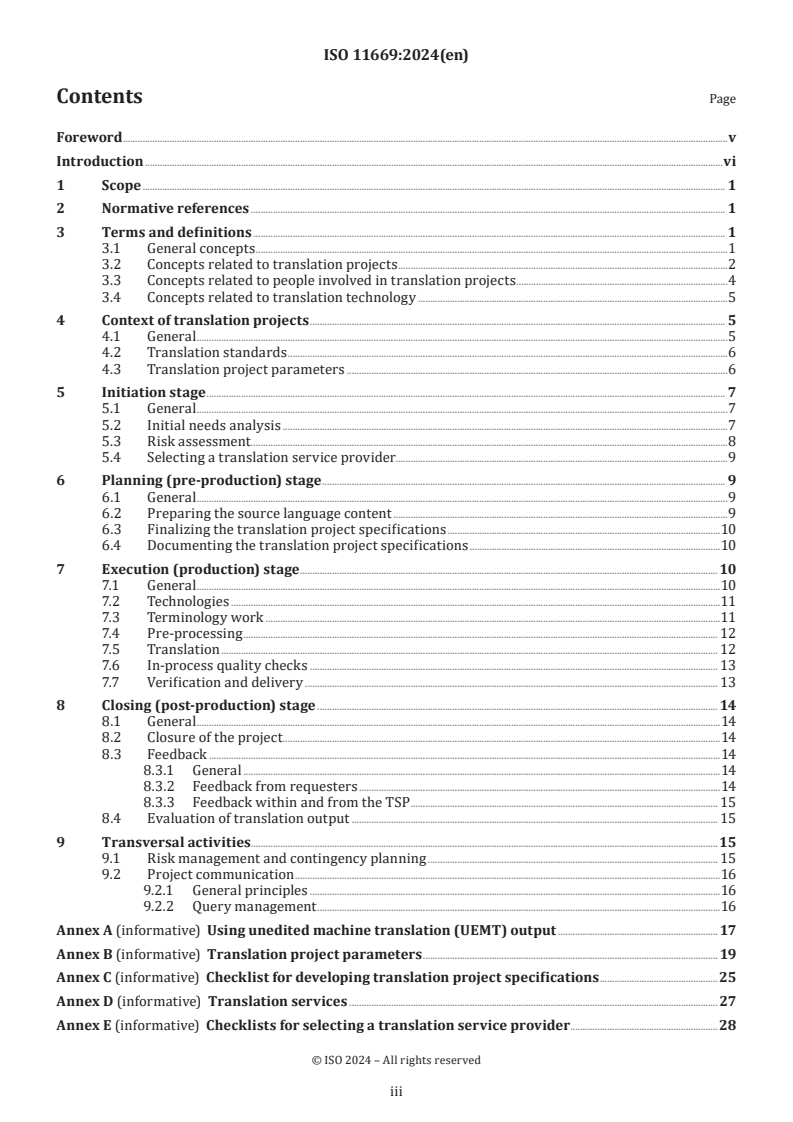
Contents Page
Foreword .v
Introduction .vi
1 Scope . 1
2 Normative references . 1
3 Terms and definitions . 1
3.1 General concepts .1
3.2 Concepts related to translation projects .2
3.3 Concepts related to people involved in translation projects .4
3.4 Concepts related to translation technology .5
4 Context of translation projects . 5
4.1 General .5
4.2 Translation standards .6
4.3 Translation project parameters .6
5 Initiation stage . 7
5.1 General .7
5.2 Initial needs analysis .7
5.3 Risk assessment .8
5.4 Selecting a translation service provider .9
6 Planning (pre-production) stage . 9
6.1 General .9
6.2 Preparing the source language content .9
6.3 Finalizing the translation project specifications .10
6.4 Documenting the translation project specifications .10
7 Execution (production) stage . 10
7.1 General .10
7.2 Technologies .11
7.3 Terminology work .11
7.4 Pre-processing . 12
7.5 Translation . 12
7.6 In-process quality checks . 13
7.7 Verification and delivery . 13
8 Closing (post-production) stage . 14
8.1 General .14
8.2 Closure of the project .14
8.3 Feedback .14
8.3.1 General .14
8.3.2 Feedback from requesters .14
8.3.3 Feedback within and from the TSP . 15
8.4 Evaluation of translation output . 15
9 Transversal activities.15
9.1 Risk management and contingency planning . 15
9.2 Project communication .16
9.2.1 General principles .16
9.2.2 Query management .16
Annex A (informative) Using unedited machine translation (UEMT) output . 17
Annex B (informative) Translation project parameters . 19
Annex C (informative) Checklist for developing translation project specifications .25
Annex D (informative) Translation services .27
Annex E (informative) Checklists for selecting a translation service provider .28
iii
Annex F (informative) Checklist for terminology needs .30
Bibliography .32
iv
Foreword
ISO (the International Organization for Standardization) is a worldwide federation of national standards
bodies (ISO member bodies). The work of preparing International Standards is normally carried out through
ISO technical committees. Each member body interested in a subject for which a technical committee
has been established has the right to be represented on that committee. International organizations,
governmental and non-governmental, in liaison with ISO, also take part in the work. ISO collaborates closely
with the International Electrotechnical Commission (IEC) on all matters of electrotechnical standardization.
The procedures used to develop this document and those intended for its further maintenance are described
in the ISO/IEC Directives, Part 1. In particular, the different approval criteria needed for the different types
of ISO document should be noted. This document was drafted in accordance with the editorial rules of the
ISO/IEC Directives, Part 2 (see www.iso.org/directives).
ISO draws attention to the possibility that the implementation of this document may involve the use of (a)
patent(s). ISO takes no position concerning the evidence, validity or applicability of any claimed patent
rights in respect thereof. As of the date of publication of this document, ISO had not received notice of (a)
patent(s) which may be required to implement this document. However, implementers are cautioned that
this may not represent the latest information, which may be obtained from the patent database available at
www.iso.org/patents. ISO shall not be held responsible for identifying any or all such patent rights.
Any trade name used in this document is information given for the convenience of users and does not
constitute an endorsement.
For an explanation of the voluntary nature of standards, the meaning of ISO specific terms and expressions
related to conformity assessment, as well as information about ISO's adherence to the World Trade
Organization (WTO) principles in the Technical Barriers to Trade (TBT), see www.iso.org/iso/foreword.html.
This document was prepared by Technical Committee ISO/TC 37, Language and terminology, Subcommittee
SC 5, Translation, interpreting and related technology.
This first edition cancels and replaces ISO/TS 11669:2012, which has been technically revised.
The main changes are as follows:
— there is an increased focus on the requester’s and translation service provider’s shared responsibility in
developing translation project specifications;
— a description has been added of the key role that risk assessment plays, together with the initial needs
analysis, in setting up the translation project;
— the informative annexes have been updated.
Any feedback or questions on this document should be directed to the user’s national standards body. A
complete listing of these bodies can be found at www.iso.org/members.html.
v
Introduction
The translation industry is changing rapidly and globalization is driving increased demand for translation.
Technological innovation has stepped up to provide solutions designed to meet these needs, including
making use of artificial intelligence and machine translation. Anyone who needs translation services
has many options to choose from. To obtain translation output that meets requirements, those who need
translation services should have a basic understanding of what a translation project involves. They should
also know how efficient communication with a translation service provider (TSP) can help to ensure a
successful translation project.
Efficient communication entails that requirements are explicitly defined and agreed-upon as translation
project specifications. Successful translation projects are a result of:
— developing and following these translation project specifications,
— involving people with the appropriate competences and qualifications, and
— assuring smooth communication flows throughout the projects.
This document is primarily intended for persons who request translation services, but it can be useful for all
stakeholders in a translation project, such as TSPs and end users.
vi
International Standard ISO 11669:2024(en)
Translation projects — General guidance
1 Scope
This document gives general guidance on all stages of a translation project. Its main purpose is to ensure
efficiency and quality by enhancing communication among the parties involved in the translation project.
This document provides a framework for developing translation project specifications that are the basis
for requesting, setting up, managing and evaluating translation projects. It also includes guidance on needs
analysis, risk assessment and workflows, but it does not provide procedures for evaluating the quality of
translation output.
This document is primarily intended for those who request translation services. However, it can also be
relevant for the translation service providers and the end users of the translation output.
It is applicable to all sectors, including the commercial and government sectors, and non-profit organizations.
It does not apply to interpreting services.
2 Normative references
The following documents are referred to in the text in such a way that some or all of their content constitutes
requirements of this document. For dated references, only the edition cited applies. For undated references,
the latest edition of the referenced document (including any amendments) applies.
ISO 20539:2023, Translation, interpreting and related technology — Vocabulary
3 Terms and definitions
For the purposes of this document, the terms and definitions given in ISO 20539 and the following apply.
ISO and IEC maintain terminology databases for use in standardization at the following addresses:
— ISO Online browsing platform: available at https:// www .iso .org/ obp
— IEC Electropedia: available at https:// www .electropedia .org/
3.1 General concepts
3.1.1
source language content
content to be translated
[SOURCE: ISO 20539:2023, 3.1.5, modified — “or interpreted” has been removed in the definition.]
3.1.2
target language content
content translated from a source language
[SOURCE: ISO 20539:2023, 3.1.6, modified — “or interpreted” has been removed in the definition.]
3.1.3
translation service
production and delivery of target language content (3.1.2) according to translation project specifications (3.2.5)
[SOURCE: ISO 20539:2023, 3.3.4, modified — “specifications issued by a client” has been replaced by
“translation project specifications” in the definition.]
3.1.4
revision
bilingual editing
bilingual examination of target language content (3.1.2) against source language content (3.1.1) for its
suitability for the agreed purpose
[SOURCE: ISO 17100:2015, 2.2.6, modified — “bilingual editing” has been added as an admitted term. Note 1
to entry has been removed.]
3.1.5
review
monolingual editing
monolingual examination of target language content (3.1.2) for its suitability for the agreed purpose
[SOURCE: ISO 17100:2015, 2.2.7, modified — “monolingual editing” has been added as an admitted term.
Note 1 to entry has been removed.]
3.1.6
proofreading
examination of the final target language content (3.1.2) and application of corrections before submission to
the client
[SOURCE: ISO 20539:2023, 3.3.12, modified — “proofread” has been replaced by “proofreading” as the term.
“examine” has been replaced by “examination of” and “apply” has been replaced by “application of” in the
definition.]
3.1.7
evaluation of translation output
evaluation
bilingual examination of target language content (3.1.2) against source language content (3.1.1) while
classifying any errors with respect to translation evaluation specifications and for the purpose of reaching
a quality (3.2.2) rating
[SOURCE: ISO 5060:2024, 3.1.4, modified — Note 1 to entry has been removed.]
3.1.8
post-editing
checking and correcting of machine translation (3.4.2) output
[SOURCE: ISO 20539:2023, 3.5.1.13, modified — “editing and correcting” has been replaced by “checking and
correcting of” in the definition.]
3.2 Concepts related to translation projects
3.2.1
requirement
need or expectation that is stated, generally implied or obligatory
Note 1 to entry: “Generally implied” means that it is custom or common practice for the organization and interested
parties that the need or expectation under consideration is implied.
[SOURCE: ISO 9000:2015, 3.6.4, modified — Notes 2 to 6 to entry have been removed.]
3.2.2
quality
degree to which a set of inherent characteristics of an object fulfils requirements (3.2.1)
Note 1 to entry: The term “quality” can be used with adjectives such as poor, good or excellent.
Note 2 to entry: “Inherent”, as opposed to “assigned”, means existing in the object.
[SOURCE: ISO 9000:2015, 3.6.2]
3.2.3
translation project
coordinated and controlled activities, with start and finish dates, set up to deliver a translation service (3.1.3)
3.2.4
translation project parameter
translation parameter
attribute of a translation project (3.2.3)
3.2.5
translation project specification
defined and agreed upon requirement (3.2.1) that is related to a translation project parameter (3.2.4) and
that is used for producing translation output
3.2.6
quality check
examination of target language content (3.1.2) to determine its conformance to translation project
specifications (3.2.5)
Note 1 to entry: In-process quality checks, such as revision (3.1.4), review (3.1.5) or proofreading (3.1.6), take place
during the execution (production) stage of a translation project (3.2.3).
Note 2 to entry: Quality checks for specific aspects of the target language content, such as spelling, terminological
consistency and completeness, can be performed with the help of tools.
Note 3 to entry: Evaluation of translation output (3.1.7) is a form of quality check that includes measurement and that
often takes place after the execution (production) stage of a translation project.
3.2.7
use case
description of a specific situation in which an output or service can potentially be used
3.2.8
service level
performance targets for a service
[SOURCE: ISO/IEC 17826:2022, 3.49]
3.2.9
risk
effect of uncertainty on objectives
Note 1 to entry: An effect is a deviation from the expected — positive and/or negative.
Note 2 to entry: Objectives can have different aspects (such as financial, health and safety, reputational and
environmental goals) and can apply at different levels (such as strategic, organization-wide, project, product and
process).
[SOURCE: ISO 31000:2018, 3.1, modified — Notes 1 – 3 to entry have been removed and replaced with new
Notes 1 and 2 to entry.]
3.2.10
risk assessment
overall process of risk (3.2.9) identification, risk analysis and risk evaluation
[SOURCE: ISO Guide 73:2009, 3.4.1]
3.2.11
risk management
coordinated activities to direct and control an organization with regard to risk (3.2.9)
[SOURCE: ISO 31000:2018, 3.2]
3.2.12
risk tolerance
organization’s or stakeholder’s readiness to bear the risk (3.2.9) in order to achieve its objectives
Note 1 to entry: Risk tolerance can be influenced by legal or regulatory requirements (3.2.1).
[SOURCE: ISO Guide 73:2009, 3.7.1.3, modified — “after risk treatment” has been deleted from the definition.]
3.3 Concepts related to people involved in translation projects
3.3.1
requester
person or entity making enquiries with the view of commissioning a translation service (3.1.3)
Note 1 to entry: The requester usually receives the translation output for their own use or on behalf of the end users.
Note 2 to entry: In situations where the requester proceeds to commission a translation service, they can also be
considered as a client from the perspective of the translation service provider that will provide the translation service.
3.3.2
translator
person who renders source language content (3.1.1) into target language content (3.1.2) in written or other
recorded form
[SOURCE: ISO 20539:2023, 3.1.12, modified — "translates" has been replaced by “renders source language
content into target language content in written or other recorded form” in the definition.]
3.3.3
language professional
person who has the competences and qualifications to perform tasks in translation and translation-related
services
EXAMPLE Translator (3.3.2), reviser, post-editor, evaluator.
Note 1 to entry: A language professional can be a translation service provider (TSP).
3.3.4
target audience
person or group of persons for whom source language content (3.1.1) or target language content (3.1.2) is
intended
[SOURCE: ISO 10209:2022, 3.14.42, modified — “person or” has been added at the beginning of the definition.
"information for use" has been replaced by “source language content or target language content” and “by the
supplier” has been removed.]
3.4 Concepts related to translation technology
3.4.1
translation memory
TM
digital repository of aligned source language content (3.1.1) and target language content (3.1.2)
[SOURCE: ISO 20539:2023, 3.5.1.6, modified — “used to store and retrieve previously translated content
matched with source language content” has been replaced by “of aligned source language content and target
language content”.]
3.4.2
machine translation
MT
automated translation of content from one natural language to another using software
[SOURCE: ISO 20539:2023, 3.5.1.8]
3.4.3
unedited machine translation output
UEMT output
raw machine translation output
output of machine translation (3.4.2) that has not been post-edited (3.1.8)
3.4.4
termbase
terminology database
database comprising a terminological data collection
[SOURCE: ISO 30042:2019, 3.28]
4 Context of translation projects
4.1 General
Translation projects are set up when someone needs to transform content in written form from one
language into one or several other languages. For a translation project to produce a result that meets the
requester’s and the end users’ needs and expectations, the stakeholders should agree on translation project
specifications based on the relevant requirements. The translation project specifications should be created
with reference to translation project parameters and should play a central role at all stages of the translation
project.
This document structures the guidance on translation projects according to the following stages of a
translation project.
— The initiation stage is a preparation stage where the requester carries out an initial needs analysis and
a risk assessment and selects a TSP.
— The planning (or pre-production) stage builds on the result of the analysis conducted during the initiation
stage. It includes the preparation of the source language content and the development, finalization and
documentation of the translation project specifications.
— The execution (or production) stage involves creating the translation output in conformance with the
agreed-upon translation project specifications.
— The closing (or post-production) stage covers the exchange of feedback and, where appropriate, the
evaluation of translation output based on the translation project specifications.
In addition, this document gives guidance on two transversal activities that are essential throughout
translation projects: risk management and project communication.
Figure 1 gives an overview of the main elements of each stage.
Figure 1 — Translation project stages
4.2 Translation standards
This document aims to complement other standards in the field of translation. ISO 17100, ISO 20771 and
ISO 18587 define requirements for translation services.
The processes set out in these International Standards can be used to provide translation services for
different use cases. The TSPs can advise the requesters on the appropriate standard to apply based on the
requirements.
ISO 5060 gives guidance on the evaluation of translation output.
There is currently no International Standard that sets requirements for the use of unedited machine
translation (UEMT) output. For more information on using UEMT output, see Annex A.
4.3 Translation project parameters
Translation project parameters are used to transform requirements into translation project specifications.
This document recommends that translation project specifications always be created using translation
project parameters. This approach ensures that all requirements relevant for a specific translation project
are defined and agreed upon in a structured way. The full set of translation project parameters is organized
into the following three categories:
a) Content parameters, which include languages and locales, type of content, target audience, purpose,
domain, terminology, content correspondence, style, language register, target language conventions,
format, complexity, origin and volume.
b) Process parameters, which include technology, pre-processing, translation, in-process quality checks
and additional tasks.
c) Other project parameters, which include risks, reference material, workplace requirements, permissions,
qualifications, security, confidentiality, delivery, compensation and communication.
Table 1 illustrates how to use a translation project parameter to define relevant translation project
specifications with the help of guiding questions.
Table 1 — Example of how to use a translation project parameter
Translation Guiding questions Translation project specifications
project
parameter
Purpose Why is the translation output need- EXAMPLE 1 For use in court.
ed?
EXAMPLE 2 Marketing of a product.
How will it be used?
EXAMPLE 3 Information for personal use.
Annex B provides a detailed description of all translation project parameters and examples of guiding
questions and resulting translation project specifications for each translation project parameter. The
requester can use the examples of guiding questions to carry out their initial needs analysis (see 5.2). Once
the requester has selected a TSP, the TSP can guide the requester to ensure that all relevant translation
project parameters for a given translation project have been adequately addressed.
Clause 5 and Clause 6 describe how translation project parameters can be used during the initiation and
planning stages to develop translation project specifications. Annex C contains a checklist that covers the
steps for developing the translation project specifications and lists the parameters relevant for each step.
5 Initiation stage
5.1 General
Before a translation project is set up and a translation service is commissioned, the requester should carefully
analyse their needs and the risks involved. At this stage, the requester should also select a TSP or TSPs who
will carry out the translation project. Once the requester is ready to commission a translation service, the
requirements identified during the initial needs analysis and risk assessment should be communicated to
the TSPs, so that they can advise on the appropriate course of action to meet the needs and address the risks.
5.2 Initial needs analysis
The initial needs analysis should cover at least the type of content that needs to be translated and the
use case. Table 2 contains the translation project parameters relevant to the initial needs analysis. It also
includes guiding questions.
Table 2 — Translation project parameters for the initial needs analysis
Translation Guiding questions Translation project specifications
project
parameter
Language and Which source and target EXAMPLE 1 British English into Canadian French.
locale languages or language
EXAMPLE 2 British English into Brazilian Portuguese.
variants are concerned?
EXAMPLE 3 Estonian into Swedish and Finnish.
Type of What type of content needs to be EXAMPLE 1 A contract.
content translated?
EXAMPLE 2 A brochure.
EXAMPLE 3 A website.
EXAMPLE 4 A user interface.
EXAMPLE 5 A tweet.
Purpose Why is the translation output EXAMPLE 1 For use in court.
needed?
EXAMPLE 2 Marketing of a product.
How will it be used?
EXAMPLE 3 Information for personal use.
Target Whom is it for? EXAMPLE 1 General public who will visit the organization’s
audience website.
Who will read or use it?
EXAMPLE 2 A customer.
Volume How large is the translation EXAMPLE 1 A one-off request of 2 500 words.
volume?
EXAMPLE 2 1 000 words per week.
Delivery How urgent is the request? EXAMPLE 1 Needed in 10 working days.
deadline
By when is the translation EXAMPLE 2 Needed by tomorrow 2 p.m.
output needed?
The replies to the questions can guide the requester in choosing a TSP (see 5.4 for more information on
selecting a TSP or TSPs).
These replies are also necessary for the TSP to be able to develop a quotation and to advise on the selection
of the translation service (e.g. translation, localization, audiovisual translation, summary translation). See
Annex D for more information on different types of translation services.
5.3 Risk assessment
The requester should reflect on the risks related to the translation output and its use. Table 3 lists some
guiding questions and resulting translation project specifications for determining the risks. See Table B.4
for further guiding questions related to risks.
Table 3 — Translation project parameter for risk assessment
Translation Guiding questions Translation project specifications
project
parameter
Risks What are the risks related to EXAMPLE 1 Risks: Risk of miscommunication, reputational risk,
the translation output and its financial risk, risk of data loss or data breach, legal risk, risk of prop-
use? erty damage, risk of injury or death.
What potential consequences EXAMPLE 2 Consequences: Impaired communication, reputational
would translation errors have damage, loss of clients, missed business opportunities, property
for the stakeholders? damages, data breach, litigation, financial penalties, injuries, death.
The replies to the risk-related questions are necessary for the TSP to:
— engage with the requester in a discussion concerning tolerance for various kinds of errors, for example
with regard to the fluency of the target language content or the correspondence between source and
target language content; and
— provide the requester with advice on the appropriate production method (e.g. human translation,
machine translation), workflow and risk mitigation measures (e.g. revision, review, user testing).
If unedited machine translation is being considered for the method of production, Annex A should be
consulted.
When carrying out the risk assessment, the requester and the TSP can refer to ISO 31000 on risk management
guidelines, ISO/IEC 27005 on information security risk management or use a risk matrix to visualize the
requester’s risk tolerance level. For an example of a risk matrix for translation output, see Reference [15].
5.4 Selecting a translation service provider
TSPs specialize in different language services (e.g. localization, audiovisual translation), specialized domains
(e.g. law, medicine), specialized language combinations and preferred translation technology. The requester
should select a TSP or TSPs that have the necessary competences, capacities and resources to meet the
identified needs of the translation project.
Translation projects can involve different actors or stakeholders, such as requester, project manager,
translator, reviser or end user. The distribution of tasks among these actors can vary. For example, a
requester can also carry out the tasks of a project manager.
It is important to work with competent language professionals. Language professionals involved in a
translation project should have as a minimum the competences of a translator (see ISO 17100:2015, 3.1.3, for
translator competences and ISO 17100:2015/Amd 1:2017, 3.1.4, for qualifications). Additional requirements
apply to post-editors, revisers and evaluators (see ISO 18587:2017, 5.1, ISO 17100:2015, 3.1.5, and
ISO 5060:2024, 4.2). For legal translation services conforming to ISO 20771 there are also specific additional
requirements for translators, revisers and reviewers (see ISO 20771:2020, Clause 5).
For larger translation needs or projects with a long duration, the requesters can define their requirements,
for example, by way of calls for tenders or requests for proposals. This way of requesting information can
make it easier to compare TSPs or to identify those that best meet the needs and expectations.
For small projects or occasional translation needs, when working with a new TSP or when there is no written
agreement already in place, the requester can provide the TSP with the results of the initial needs analysis
and the risk assessment and ask for a quotation. The requester can ask the TSP to include certain information
in the quotation or to use certain units (e.g. lines, words, characters), to make it easier to compare quotations
from different TSPs. If the requester has asked for quotations from several TSPs, they should consider what
is included in the basic price. Annex E includes a checklist with questions to consider when selecting a TSP.
6 Planning (pre-production) stage
6.1 General
The planning stage comprises the requester’s preparation of the source language content and further
development, finalization and documentation of the translation project specifications together with the
chosen TSP. These specifications should be defined in relation to the translation project parameters. This
approach ensures a structured resource that makes requirements explicit and guides all stakeholders
throughout the translation project. Properly structured translation project specifications also enable
accurate and fair evaluation of the translation output, either during the translation process or as part of the
post-production stage.
6.2 Preparing the source language content
The requester should identify and prepare the source language content. Relevant translation project
parameters to consider include the origin and complexity of the source language content, reference material
and, where appropriate, content pre-processing, which is one of the process parameters. See Table B.2 and
Table B.3 for examples of guiding questions and resulting translation project specifications.
When the source language content is to be translated into multiple languages or in different file formats, the
translation project specifications should, when appropriate, be tailored for each language combination or
file format.
6.3 Finalizing the translation project specifications
The requester and the TSP should continue developing the translation project specifications to cover all
relevant translation project parameters that were not defined during the initial needs analysis (see 5.2), risk
assessment (see 5.3) and the identification of the source language content (see 6.2). Whether they use all or
a subset of the translation project parameters in Annex B depends on the nature of the translation project,
the relationship between the parties, and their preferences.
The selected translation project parameters should make it possible to describe the desired characteristics
of the translation output with a sufficient level of detail. The translation project parameters relevant for
describing translation output requirements include content parameters such as terminology, content
correspondence, style, language register, target language conventions and format. See Table B.2 for examples
of guiding questions and resulting translation project specifications.
The TSP and client should agree on the service level based on the translation project specifications identified
during the preceding steps, including the requirements regarding correspondence between the source
and target language content and the fluency of the target language content. The requirements related to
service level should cover process parameters such as technologies, pre-processing, translation, in-process
quality checks, additional tasks and other remaining project parameters (see Table B.3 for a list of process
parameters and Table B.4 for a list of other project parameters). The agreed service level should provide
assurance that the risks identified during the risk assessment (see 5.3) will be mitigated to the agreed risk
tolerance level.
In conclusion, the requester is responsible for providing the TSP with all necessary information so that the
TSP can create the translation project specifications and provide guidance on the most suitable service level
for the specific content type, use case and the translation output requirements.
Translation project specifications can be general (valid for more than one translation project) or project-
specific (valid for one specific translation project). They are relevant during all stages of a translation
project. They can be developed and used both within and outside commercial relationships. Once developed,
the translation project specifications can be reused, partly or entirely, for repetitive or similar projects.
Annex C gives an overview of the steps for developing translation project specifications and the translation
project parameters that are relevant for each step.
6.4 Documenting the translation project specifications
Once the translation project specifications have been agreed upon, the requester and the TSP should
document the agreed form of cooperation and its scope to ensure cost transparency and clarify mutual
expectations. This agreement should also set an objective basis for monitoring the workflow and
measuring the degree to which the translation service adheres to the translation project specifications. The
documentation can be in the form of a framework agreement, a service level agreement or a price list. It can
also be in the form of quotations in writing ahead of every project, containing information determining all
relevant aspects of the expected service.
NOTE In some cases, no legal contract is required at any point (e.g. an in-house translation department fulfilling a
request from another department in the same organization).
7 Execution (production) stage
7.1 General
Translation projects vary in size, complexity and purpose, depending on the requirements. The translation
project specifications agreed upon at the planning stage should determine not only the type of translation
service, but also the selection of the resources, the technology, and the workflow necessary to execute the
translation project.
This clause describes technologies, terminology work and the main activities during the execution stage of
translation projects. It aims to provide requesters with a basic understanding so that they can form an opinion
on possible choices for the translation project and discuss these matters with the TSP in an informed way.
7.2 Technologies
The translation project should make use of the most suitable technologies according to the translation
project specifications. For example, the following categories of technologies can be relev
...
International
Standard
ISO 11669
First edition
Translation projects — General
2024-03
guidance
Projets de traduction — Recommandations générales
Reference number
© ISO 2024
All rights reserved. Unless otherwise specified, or required in the context of its implementation, no part of this publication may
be reproduced or utilized otherwise in any form or by any means, electronic or mechanical, including photocopying, or posting on
the internet or an intranet, without prior written permission. Permission can be requested from either ISO at the address below
or ISO’s member body in the country of the requester.
ISO copyright office
CP 401 • Ch. de Blandonnet 8
CH-1214 Vernier, Geneva
Phone: +41 22 749 01 11
Email: copyright@iso.org
Website: www.iso.org
Published in Switzerland
ii
Contents Page
Foreword .v
Introduction .vi
1 Scope . 1
2 Normative references . 1
3 Terms and definitions . 1
3.1 General concepts .1
3.2 Concepts related to translation projects .2
3.3 Concepts related to people involved in translation projects .4
3.4 Concepts related to translation technology .5
4 Context of translation projects . 5
4.1 General .5
4.2 Translation standards .6
4.3 Translation project parameters .6
5 Initiation stage . 7
5.1 General .7
5.2 Initial needs analysis .7
5.3 Risk assessment .8
5.4 Selecting a translation service provider .9
6 Planning (pre-production) stage . 9
6.1 General .9
6.2 Preparing the source language content .9
6.3 Finalizing the translation project specifications .10
6.4 Documenting the translation project specifications .10
7 Execution (production) stage . 10
7.1 General .10
7.2 Technologies .11
7.3 Terminology work .11
7.4 Pre-processing . 12
7.5 Translation . 12
7.6 In-process quality checks . 13
7.7 Verification and delivery . 13
8 Closing (post-production) stage . 14
8.1 General .14
8.2 Closure of the project .14
8.3 Feedback .14
8.3.1 General .14
8.3.2 Feedback from requesters .14
8.3.3 Feedback within and from the TSP . 15
8.4 Evaluation of translation output . 15
9 Transversal activities.15
9.1 Risk management and contingency planning . 15
9.2 Project communication .16
9.2.1 General principles .16
9.2.2 Query management .16
Annex A (informative) Using unedited machine translation (UEMT) output . 17
Annex B (informative) Translation project parameters . 19
Annex C (informative) Checklist for developing translation project specifications .25
Annex D (informative) Translation services .27
Annex E (informative) Checklists for selecting a translation service provider .28
iii
Annex F (informative) Checklist for terminology needs .30
Bibliography .32
iv
Foreword
ISO (the International Organization for Standardization) is a worldwide federation of national standards
bodies (ISO member bodies). The work of preparing International Standards is normally carried out through
ISO technical committees. Each member body interested in a subject for which a technical committee
has been established has the right to be represented on that committee. International organizations,
governmental and non-governmental, in liaison with ISO, also take part in the work. ISO collaborates closely
with the International Electrotechnical Commission (IEC) on all matters of electrotechnical standardization.
The procedures used to develop this document and those intended for its further maintenance are described
in the ISO/IEC Directives, Part 1. In particular, the different approval criteria needed for the different types
of ISO document should be noted. This document was drafted in accordance with the editorial rules of the
ISO/IEC Directives, Part 2 (see www.iso.org/directives).
ISO draws attention to the possibility that the implementation of this document may involve the use of (a)
patent(s). ISO takes no position concerning the evidence, validity or applicability of any claimed patent
rights in respect thereof. As of the date of publication of this document, ISO had not received notice of (a)
patent(s) which may be required to implement this document. However, implementers are cautioned that
this may not represent the latest information, which may be obtained from the patent database available at
www.iso.org/patents. ISO shall not be held responsible for identifying any or all such patent rights.
Any trade name used in this document is information given for the convenience of users and does not
constitute an endorsement.
For an explanation of the voluntary nature of standards, the meaning of ISO specific terms and expressions
related to conformity assessment, as well as information about ISO's adherence to the World Trade
Organization (WTO) principles in the Technical Barriers to Trade (TBT), see www.iso.org/iso/foreword.html.
This document was prepared by Technical Committee ISO/TC 37, Language and terminology, Subcommittee
SC 5, Translation, interpreting and related technology.
This first edition cancels and replaces ISO/TS 11669:2012, which has been technically revised.
The main changes are as follows:
— there is an increased focus on the requester’s and translation service provider’s shared responsibility in
developing translation project specifications;
— a description has been added of the key role that risk assessment plays, together with the initial needs
analysis, in setting up the translation project;
— the informative annexes have been updated.
Any feedback or questions on this document should be directed to the user’s national standards body. A
complete listing of these bodies can be found at www.iso.org/members.html.
v
Introduction
The translation industry is changing rapidly and globalization is driving increased demand for translation.
Technological innovation has stepped up to provide solutions designed to meet these needs, including
making use of artificial intelligence and machine translation. Anyone who needs translation services
has many options to choose from. To obtain translation output that meets requirements, those who need
translation services should have a basic understanding of what a translation project involves. They should
also know how efficient communication with a translation service provider (TSP) can help to ensure a
successful translation project.
Efficient communication entails that requirements are explicitly defined and agreed-upon as translation
project specifications. Successful translation projects are a result of:
— developing and following these translation project specifications,
— involving people with the appropriate competences and qualifications, and
— assuring smooth communication flows throughout the projects.
This document is primarily intended for persons who request translation services, but it can be useful for all
stakeholders in a translation project, such as TSPs and end users.
vi
International Standard ISO 11669:2024(en)
Translation projects — General guidance
1 Scope
This document gives general guidance on all stages of a translation project. Its main purpose is to ensure
efficiency and quality by enhancing communication among the parties involved in the translation project.
This document provides a framework for developing translation project specifications that are the basis
for requesting, setting up, managing and evaluating translation projects. It also includes guidance on needs
analysis, risk assessment and workflows, but it does not provide procedures for evaluating the quality of
translation output.
This document is primarily intended for those who request translation services. However, it can also be
relevant for the translation service providers and the end users of the translation output.
It is applicable to all sectors, including the commercial and government sectors, and non-profit organizations.
It does not apply to interpreting services.
2 Normative references
The following documents are referred to in the text in such a way that some or all of their content constitutes
requirements of this document. For dated references, only the edition cited applies. For undated references,
the latest edition of the referenced document (including any amendments) applies.
ISO 20539:2023, Translation, interpreting and related technology — Vocabulary
3 Terms and definitions
For the purposes of this document, the terms and definitions given in ISO 20539 and the following apply.
ISO and IEC maintain terminology databases for use in standardization at the following addresses:
— ISO Online browsing platform: available at https:// www .iso .org/ obp
— IEC Electropedia: available at https:// www .electropedia .org/
3.1 General concepts
3.1.1
source language content
content to be translated
[SOURCE: ISO 20539:2023, 3.1.5, modified — “or interpreted” has been removed in the definition.]
3.1.2
target language content
content translated from a source language
[SOURCE: ISO 20539:2023, 3.1.6, modified — “or interpreted” has been removed in the definition.]
3.1.3
translation service
production and delivery of target language content (3.1.2) according to translation project specifications (3.2.5)
[SOURCE: ISO 20539:2023, 3.3.4, modified — “specifications issued by a client” has been replaced by
“translation project specifications” in the definition.]
3.1.4
revision
bilingual editing
bilingual examination of target language content (3.1.2) against source language content (3.1.1) for its
suitability for the agreed purpose
[SOURCE: ISO 17100:2015, 2.2.6, modified — “bilingual editing” has been added as an admitted term. Note 1
to entry has been removed.]
3.1.5
review
monolingual editing
monolingual examination of target language content (3.1.2) for its suitability for the agreed purpose
[SOURCE: ISO 17100:2015, 2.2.7, modified — “monolingual editing” has been added as an admitted term.
Note 1 to entry has been removed.]
3.1.6
proofreading
examination of the final target language content (3.1.2) and application of corrections before submission to
the client
[SOURCE: ISO 20539:2023, 3.3.12, modified — “proofread” has been replaced by “proofreading” as the term.
“examine” has been replaced by “examination of” and “apply” has been replaced by “application of” in the
definition.]
3.1.7
evaluation of translation output
evaluation
bilingual examination of target language content (3.1.2) against source language content (3.1.1) while
classifying any errors with respect to translation evaluation specifications and for the purpose of reaching
a quality (3.2.2) rating
[SOURCE: ISO 5060:2024, 3.1.4, modified — Note 1 to entry has been removed.]
3.1.8
post-editing
checking and correcting of machine translation (3.4.2) output
[SOURCE: ISO 20539:2023, 3.5.1.13, modified — “editing and correcting” has been replaced by “checking and
correcting of” in the definition.]
3.2 Concepts related to translation projects
3.2.1
requirement
need or expectation that is stated, generally implied or obligatory
Note 1 to entry: “Generally implied” means that it is custom or common practice for the organization and interested
parties that the need or expectation under consideration is implied.
[SOURCE: ISO 9000:2015, 3.6.4, modified — Notes 2 to 6 to entry have been removed.]
3.2.2
quality
degree to which a set of inherent characteristics of an object fulfils requirements (3.2.1)
Note 1 to entry: The term “quality” can be used with adjectives such as poor, good or excellent.
Note 2 to entry: “Inherent”, as opposed to “assigned”, means existing in the object.
[SOURCE: ISO 9000:2015, 3.6.2]
3.2.3
translation project
coordinated and controlled activities, with start and finish dates, set up to deliver a translation service (3.1.3)
3.2.4
translation project parameter
translation parameter
attribute of a translation project (3.2.3)
3.2.5
translation project specification
defined and agreed upon requirement (3.2.1) that is related to a translation project parameter (3.2.4) and
that is used for producing translation output
3.2.6
quality check
examination of target language content (3.1.2) to determine its conformance to translation project
specifications (3.2.5)
Note 1 to entry: In-process quality checks, such as revision (3.1.4), review (3.1.5) or proofreading (3.1.6), take place
during the execution (production) stage of a translation project (3.2.3).
Note 2 to entry: Quality checks for specific aspects of the target language content, such as spelling, terminological
consistency and completeness, can be performed with the help of tools.
Note 3 to entry: Evaluation of translation output (3.1.7) is a form of quality check that includes measurement and that
often takes place after the execution (production) stage of a translation project.
3.2.7
use case
description of a specific situation in which an output or service can potentially be used
3.2.8
service level
performance targets for a service
[SOURCE: ISO/IEC 17826:2022, 3.49]
3.2.9
risk
effect of uncertainty on objectives
Note 1 to entry: An effect is a deviation from the expected — positive and/or negative.
Note 2 to entry: Objectives can have different aspects (such as financial, health and safety, reputational and
environmental goals) and can apply at different levels (such as strategic, organization-wide, project, product and
process).
[SOURCE: ISO 31000:2018, 3.1, modified — Notes 1 – 3 to entry have been removed and replaced with new
Notes 1 and 2 to entry.]
3.2.10
risk assessment
overall process of risk (3.2.9) identification, risk analysis and risk evaluation
[SOURCE: ISO Guide 73:2009, 3.4.1]
3.2.11
risk management
coordinated activities to direct and control an organization with regard to risk (3.2.9)
[SOURCE: ISO 31000:2018, 3.2]
3.2.12
risk tolerance
organization’s or stakeholder’s readiness to bear the risk (3.2.9) in order to achieve its objectives
Note 1 to entry: Risk tolerance can be influenced by legal or regulatory requirements (3.2.1).
[SOURCE: ISO Guide 73:2009, 3.7.1.3, modified — “after risk treatment” has been deleted from the definition.]
3.3 Concepts related to people involved in translation projects
3.3.1
requester
person or entity making enquiries with the view of commissioning a translation service (3.1.3)
Note 1 to entry: The requester usually receives the translation output for their own use or on behalf of the end users.
Note 2 to entry: In situations where the requester proceeds to commission a translation service, they can also be
considered as a client from the perspective of the translation service provider that will provide the translation service.
3.3.2
translator
person who renders source language content (3.1.1) into target language content (3.1.2) in written or other
recorded form
[SOURCE: ISO 20539:2023, 3.1.12, modified — "translates" has been replaced by “renders source language
content into target language content in written or other recorded form” in the definition.]
3.3.3
language professional
person who has the competences and qualifications to perform tasks in translation and translation-related
services
EXAMPLE Translator (3.3.2), reviser, post-editor, evaluator.
Note 1 to entry: A language professional can be a translation service provider (TSP).
3.3.4
target audience
person or group of persons for whom source language content (3.1.1) or target language content (3.1.2) is
intended
[SOURCE: ISO 10209:2022, 3.14.42, modified — “person or” has been added at the beginning of the definition.
"information for use" has been replaced by “source language content or target language content” and “by the
supplier” has been removed.]
3.4 Concepts related to translation technology
3.4.1
translation memory
TM
digital repository of aligned source language content (3.1.1) and target language content (3.1.2)
[SOURCE: ISO 20539:2023, 3.5.1.6, modified — “used to store and retrieve previously translated content
matched with source language content” has been replaced by “of aligned source language content and target
language content”.]
3.4.2
machine translation
MT
automated translation of content from one natural language to another using software
[SOURCE: ISO 20539:2023, 3.5.1.8]
3.4.3
unedited machine translation output
UEMT output
raw machine translation output
output of machine translation (3.4.2) that has not been post-edited (3.1.8)
3.4.4
termbase
terminology database
database comprising a terminological data collection
[SOURCE: ISO 30042:2019, 3.28]
4 Context of translation projects
4.1 General
Translation projects are set up when someone needs to transform content in written form from one
language into one or several other languages. For a translation project to produce a result that meets the
requester’s and the end users’ needs and expectations, the stakeholders should agree on translation project
specifications based on the relevant requirements. The translation project specifications should be created
with reference to translation project parameters and should play a central role at all stages of the translation
project.
This document structures the guidance on translation projects according to the following stages of a
translation project.
— The initiation stage is a preparation stage where the requester carries out an initial needs analysis and
a risk assessment and selects a TSP.
— The planning (or pre-production) stage builds on the result of the analysis conducted during the initiation
stage. It includes the preparation of the source language content and the development, finalization and
documentation of the translation project specifications.
— The execution (or production) stage involves creating the translation output in conformance with the
agreed-upon translation project specifications.
— The closing (or post-production) stage covers the exchange of feedback and, where appropriate, the
evaluation of translation output based on the translation project specifications.
In addition, this document gives guidance on two transversal activities that are essential throughout
translation projects: risk management and project communication.
Figure 1 gives an overview of the main elements of each stage.
Figure 1 — Translation project stages
4.2 Translation standards
This document aims to complement other standards in the field of translation. ISO 17100, ISO 20771 and
ISO 18587 define requirements for translation services.
The processes set out in these International Standards can be used to provide translation services for
different use cases. The TSPs can advise the requesters on the appropriate standard to apply based on the
requirements.
ISO 5060 gives guidance on the evaluation of translation output.
There is currently no International Standard that sets requirements for the use of unedited machine
translation (UEMT) output. For more information on using UEMT output, see Annex A.
4.3 Translation project parameters
Translation project parameters are used to transform requirements into translation project specifications.
This document recommends that translation project specifications always be created using translation
project parameters. This approach ensures that all requirements relevant for a specific translation project
are defined and agreed upon in a structured way. The full set of translation project parameters is organized
into the following three categories:
a) Content parameters, which include languages and locales, type of content, target audience, purpose,
domain, terminology, content correspondence, style, language register, target language conventions,
format, complexity, origin and volume.
b) Process parameters, which include technology, pre-processing, translation, in-process quality checks
and additional tasks.
c) Other project parameters, which include risks, reference material, workplace requirements, permissions,
qualifications, security, confidentiality, delivery, compensation and communication.
Table 1 illustrates how to use a translation project parameter to define relevant translation project
specifications with the help of guiding questions.
Table 1 — Example of how to use a translation project parameter
Translation Guiding questions Translation project specifications
project
parameter
Purpose Why is the translation output need- EXAMPLE 1 For use in court.
ed?
EXAMPLE 2 Marketing of a product.
How will it be used?
EXAMPLE 3 Information for personal use.
Annex B provides a detailed description of all translation project parameters and examples of guiding
questions and resulting translation project specifications for each translation project parameter. The
requester can use the examples of guiding questions to carry out their initial needs analysis (see 5.2). Once
the requester has selected a TSP, the TSP can guide the requester to ensure that all relevant translation
project parameters for a given translation project have been adequately addressed.
Clause 5 and Clause 6 describe how translation project parameters can be used during the initiation and
planning stages to develop translation project specifications. Annex C contains a checklist that covers the
steps for developing the translation project specifications and lists the parameters relevant for each step.
5 Initiation stage
5.1 General
Before a translation project is set up and a translation service is commissioned, the requester should carefully
analyse their needs and the risks involved. At this stage, the requester should also select a TSP or TSPs who
will carry out the translation project. Once the requester is ready to commission a translation service, the
requirements identified during the initial needs analysis and risk assessment should be communicated to
the TSPs, so that they can advise on the appropriate course of action to meet the needs and address the risks.
5.2 Initial needs analysis
The initial needs analysis should cover at least the type of content that needs to be translated and the
use case. Table 2 contains the translation project parameters relevant to the initial needs analysis. It also
includes guiding questions.
Table 2 — Translation project parameters for the initial needs analysis
Translation Guiding questions Translation project specifications
project
parameter
Language and Which source and target EXAMPLE 1 British English into Canadian French.
locale languages or language
EXAMPLE 2 British English into Brazilian Portuguese.
variants are concerned?
EXAMPLE 3 Estonian into Swedish and Finnish.
Type of What type of content needs to be EXAMPLE 1 A contract.
content translated?
EXAMPLE 2 A brochure.
EXAMPLE 3 A website.
EXAMPLE 4 A user interface.
EXAMPLE 5 A tweet.
Purpose Why is the translation output EXAMPLE 1 For use in court.
needed?
EXAMPLE 2 Marketing of a product.
How will it be used?
EXAMPLE 3 Information for personal use.
Target Whom is it for? EXAMPLE 1 General public who will visit the organization’s
audience website.
Who will read or use it?
EXAMPLE 2 A customer.
Volume How large is the translation EXAMPLE 1 A one-off request of 2 500 words.
volume?
EXAMPLE 2 1 000 words per week.
Delivery How urgent is the request? EXAMPLE 1 Needed in 10 working days.
deadline
By when is the translation EXAMPLE 2 Needed by tomorrow 2 p.m.
output needed?
The replies to the questions can guide the requester in choosing a TSP (see 5.4 for more information on
selecting a TSP or TSPs).
These replies are also necessary for the TSP to be able to develop a quotation and to advise on the selection
of the translation service (e.g. translation, localization, audiovisual translation, summary translation). See
Annex D for more information on different types of translation services.
5.3 Risk assessment
The requester should reflect on the risks related to the translation output and its use. Table 3 lists some
guiding questions and resulting translation project specifications for determining the risks. See Table B.4
for further guiding questions related to risks.
Table 3 — Translation project parameter for risk assessment
Translation Guiding questions Translation project specifications
project
parameter
Risks What are the risks related to EXAMPLE 1 Risks: Risk of miscommunication, reputational risk,
the translation output and its financial risk, risk of data loss or data breach, legal risk, risk of prop-
use? erty damage, risk of injury or death.
What potential consequences EXAMPLE 2 Consequences: Impaired communication, reputational
would translation errors have damage, loss of clients, missed business opportunities, property
for the stakeholders? damages, data breach, litigation, financial penalties, injuries, death.
The replies to the risk-related questions are necessary for the TSP to:
— engage with the requester in a discussion concerning tolerance for various kinds of errors, for example
with regard to the fluency of the target language content or the correspondence between source and
target language content; and
— provide the requester with advice on the appropriate production method (e.g. human translation,
machine translation), workflow and risk mitigation measures (e.g. revision, review, user testing).
If unedited machine translation is being considered for the method of production, Annex A should be
consulted.
When carrying out the risk assessment, the requester and the TSP can refer to ISO 31000 on risk management
guidelines, ISO/IEC 27005 on information security risk management or use a risk matrix to visualize the
requester’s risk tolerance level. For an example of a risk matrix for translation output, see Reference [15].
5.4 Selecting a translation service provider
TSPs specialize in different language services (e.g. localization, audiovisual translation), specialized domains
(e.g. law, medicine), specialized language combinations and preferred translation technology. The requester
should select a TSP or TSPs that have the necessary competences, capacities and resources to meet the
identified needs of the translation project.
Translation projects can involve different actors or stakeholders, such as requester, project manager,
translator, reviser or end user. The distribution of tasks among these actors can vary. For example, a
requester can also carry out the tasks of a project manager.
It is important to work with competent language professionals. Language professionals involved in a
translation project should have as a minimum the competences of a translator (see ISO 17100:2015, 3.1.3, for
translator competences and ISO 17100:2015/Amd 1:2017, 3.1.4, for qualifications). Additional requirements
apply to post-editors, revisers and evaluators (see ISO 18587:2017, 5.1, ISO 17100:2015, 3.1.5, and
ISO 5060:2024, 4.2). For legal translation services conforming to ISO 20771 there are also specific additional
requirements for translators, revisers and reviewers (see ISO 20771:2020, Clause 5).
For larger translation needs or projects with a long duration, the requesters can define their requirements,
for example, by way of calls for tenders or requests for proposals. This way of requesting information can
make it easier to compare TSPs or to identify those that best meet the needs and expectations.
For small projects or occasional translation needs, when working with a new TSP or when there is no written
agreement already in place, the requester can provide the TSP with the results of the initial needs analysis
and the risk assessment and ask for a quotation. The requester can ask the TSP to include certain information
in the quotation or to use certain units (e.g. lines, words, characters), to make it easier to compare quotations
from different TSPs. If the requester has asked for quotations from several TSPs, they should consider what
is included in the basic price. Annex E includes a checklist with questions to consider when selecting a TSP.
6 Planning (pre-production) stage
6.1 General
The planning stage comprises the requester’s preparation of the source language content and further
development, finalization and documentation of the translation project specifications together with the
chosen TSP. These specifications should be defined in relation to the translation project parameters. This
approach ensures a structured resource that makes requirements explicit and guides all stakeholders
throughout the translation project. Properly structured translation project specifications also enable
accurate and fair evaluation of the translation output, either during the translation process or as part of the
post-production stage.
6.2 Preparing the source language content
The requester should identify and prepare the source language content. Relevant translation project
parameters to consider include the origin and complexity of the source language content, reference material
and, where appropriate, content pre-processing, which is one of the process parameters. See Table B.2 and
Table B.3 for examples of guiding questions and resulting translation project specifications.
When the source language content is to be translated into multiple languages or in different file formats, the
translation project specifications should, when appropriate, be tailored for each language combination or
file format.
6.3 Finalizing the translation project specifications
The requester and the TSP should continue developing the translation project specifications to cover all
relevant translation project parameters that were not defined during the initial needs analysis (see 5.2), risk
assessment (see 5.3) and the identification of the source language content (see 6.2). Whether they use all or
a subset of the translation project parameters in Annex B depends on the nature of the translation project,
the relationship between the parties, and their preferences.
The selected translation project parameters should make it possible to describe the desired characteristics
of the translation output with a sufficient level of detail. The translation project parameters relevant for
describing translation output requirements include content parameters such as terminology, content
correspondence, style, language register, target language conventions and format. See Table B.2 for examples
of guiding questions and resulting translation project specifications.
The TSP and client should agree on the service level based on the translation project specifications identified
during the preceding steps, including the requirements regarding correspondence between the source
and target language content and the fluency of the target language content. The requirements related to
service level should cover process parameters such as technologies, pre-processing, translation, in-process
quality checks, additional tasks and other remaining project parameters (see Table B.3 for a list of process
parameters and Table B.4 for a list of other project parameters). The agreed service level should provide
assurance that the risks identified during the risk assessment (see 5.3) will be mitigated to the agreed risk
tolerance level.
In conclusion, the requester is responsible for providing the TSP with all necessary information so that the
TSP can create the translation project specifications and provide guidance on the most suitable service level
for the specific content type, use case and the translation output requirements.
Translation project specifications can be general (valid for more than one translation project) or project-
specific (valid for one specific translation project). They are relevant during all stages of a translation
project. They can be developed and used both within and outside commercial relationships. Once developed,
the translation project specifications can be reused, partly or entirely, for repetitive or similar projects.
Annex C gives an overview of the steps for developing translation project specifications and the translation
project parameters that are relevant for each step.
6.4 Documenting the translation project specifications
Once the translation project specifications have been agreed upon, the requester and the TSP should
document the agreed form of cooperation and its scope to ensure cost transparency and clarify mutual
expectations. This agreement should also set an objective basis for monitoring the workflow and
measuring the degree to which the translation service adheres to the translation project specifications. The
documentation can be in the form of a framework agreement, a service level agreement or a price list. It can
also be in the form of quotations in writing ahead of every project, containing information determining all
relevant aspects of the expected service.
NOTE In some cases, no legal contract is required at any point (e.g. an in-house translation department fulfilling a
request from another department in the same organization).
7 Execution (production) stage
7.1 General
Translation projects vary in size, complexity and purpose, depending on the requirements. The translation
project specifications agreed upon at the planning stage should determine not only the type of translation
service, but also the selection of the resources, the technology, and the workflow necessary to execute the
translation project.
This clause describes technologies, terminology work and the main activities during the execution stage of
translation projects. It aims to provide requesters with a basic understanding so that they can form an opinion
on possible choices for the translation project and discuss these matters with the TSP in an informed way.
7.2 Technologies
The translation project should make use of the most suitable technologies according to the translation
project specifications. For example, the following categories of technologies can be relevant for a translation
project:
— content creation and content management technologies;
— project management technologies, such as translation management systems;
— terminology management software;
— collaboration and communication tools;
— translation technologies.
The two most widely used translation technologies, often combined for maximum efficiency, are:
— translation memory systems, which retrieve previously translated content that matches the source
language content and enable its re-use;
— machine translation systems, which use software to automatically translate content from one language
to another.
Language professionals involved in translation projects work with increasingly sophisticated software
applications designed to support human translation. Computer-aided translation (CAT) tools combine
different resources and functions, such as translation memories, machine translation output, termbases and
glossaries, automatic checks, advanced search and navigation options and progress reports.
...