

SIST ISO 23155:2023
(Main)Interpreting services -- Conference interpreting -- Requirements and recommendations
General Information
- Abstract
This document specifies requirements and recommendations for the provision of conference interpreting services. It is primarily addressed to conference interpreters and conference interpreting service providers. It also serves as reference for users of conference interpreting services.
- Status
- Published
- Public Enquiry End Date
- 14-Mar-2021
- Publication Date
- 29-Nov-2022
- Technical Committee
- IDT - Information, documentation, language and terminology
- Current Stage
- 6060 - National Implementation/Publication (Adopted Project)
- Start Date
- 03-Nov-2022
- Due Date
- 08-Jan-2023
- Completion Date
- 30-Nov-2022
Buy Documents







ISO 23155:2022 - Interpreting services — Conference interpreting — Requirements and recommendations Released:1/3/2022




ISO 23155:2022 - Interpreting services — Conference interpreting — Requirements and recommendations Released:1/3/2022
Overview
SIST ISO 23155:2023 - "Interpreting services - Conference interpreting - Requirements and recommendations" is an international standard from ISO (first edition, 2022) that defines general requirements, recommendations and terminology for the provision of conference interpreting services. Primarily addressed to conference interpreters and conference interpreting service providers (CISPs), it also serves as a reference for users of interpreting services such as conference organizers, international organizations, governments, equipment vendors and educational institutions.
The document sets out a structured framework covering scope, terms and definitions, general provisions, competence and qualification requirements, and practical requirements before, during and after assignments. It also includes informative annexes (workflow, code of conduct, contract content, team roles and customary recruitment practice).
Key Topics and Technical Requirements
The standard covers both conceptual and practical aspects, including:
- Terminology and definitions: clear definitions for concepts such as source/target language, ‘A’/‘B’/‘C’ languages, working languages, content, competence and qualification.
- Modes of interpreting: guidance on modes used in conferences (e.g., simultaneous, consecutive) and related considerations.
- Team strength and working hours: requirements and recommendations for team composition and shift planning for simultaneous interpreting to ensure quality and interpreter wellbeing.
- Competences and qualifications: a comprehensive breakdown of required competences - intellectual, linguistic, interpreting, communicative, intercultural, technical, interpersonal, research/knowledge management, business, information security and stress management.
- Professional conduct: confidentiality, code of ethics and recommended behaviours for interpreters.
- Operational requirements: pre-conference preparation, travel arrangements, on-site workflows, terminology management, conference information management and post-assignment quality assurance.
- Requirements for CISPs: planning, client and interpreter liaison, assignment agreements and responsibilities before, during and after conferences.
- Informative annexes: model code of conduct, example assignment agreement contents, head-of-team role and recruitment practices.
Note: SIST ISO 23155:2023 contains no normative references and was prepared by ISO/TC 37/SC 5.
Practical Applications - Who Uses It
ISO 23155 is directly useful to:
- Freelance and staff conference interpreters seeking guidance on professional competences and best practice.
- Conference interpreting service providers (CISPs) for designing contracts, staffing, workflows and quality assurance.
- Event organizers and conference centres procuring interpreting services and equipment.
- International organizations, governments and agencies setting procurement or operational policies.
- Language service providers, equipment manufacturers and training institutions aligning services, products and curricula with recognized international practice.
Adopting ISO 23155 helps improve service quality, clarify roles and expectations, mitigate risks (confidentiality, security, fatigue) and support consistent procurement and staffing decisions.
Related Standards
- ISO 20539 (terminology and concepts for translation/interpreting) - referenced for definitions.
- ISO/IEC 17024 (personnel certification) - referenced for the definition of qualification. For implementation or purchase, consult your national ISO member body or ISO’s online catalogue.
Buy Documents
ISO 23155:2022 - Interpreting services — Conference interpreting — Requirements and recommendations Released:1/3/2022
ISO 23155:2022 - Interpreting services — Conference interpreting — Requirements and recommendations Released:1/3/2022
Get Certified
Connect with accredited certification bodies for this standard

Great Wall Tianjin Quality Assurance Center
Established 1993, first batch to receive national accreditation with IAF recognition.
Hong Kong Quality Assurance Agency (HKQAA)
Hong Kong's leading certification body.

Innovative Quality Certifications Pvt. Ltd. (IQCPL)
Known for integrity, providing ethical & impartial Assessment & Certification. CMMI Institute Partner.
Sponsored listings
Frequently Asked Questions
SIST ISO 23155:2023 is a standard published by the Slovenian Institute for Standardization (SIST). Its full title is "Interpreting services -- Conference interpreting -- Requirements and recommendations". This standard covers: This document specifies requirements and recommendations for the provision of conference interpreting services. It is primarily addressed to conference interpreters and conference interpreting service providers. It also serves as reference for users of conference interpreting services.
This document specifies requirements and recommendations for the provision of conference interpreting services. It is primarily addressed to conference interpreters and conference interpreting service providers. It also serves as reference for users of conference interpreting services.
SIST ISO 23155:2023 is classified under the following ICS (International Classification for Standards) categories: 01.020 - Terminology (principles and coordination); 03.080.99 - Other services. The ICS classification helps identify the subject area and facilitates finding related standards.
SIST ISO 23155:2023 is available in PDF format for immediate download after purchase. The document can be added to your cart and obtained through the secure checkout process. Digital delivery ensures instant access to the complete standard document.
Standards Content (Sample)
SLOVENSKI STANDARD
01-januar-2023
Storitve tolmačenja - Konferenčno tolmačenje - Zahteve in priporočila
Interpreting services -- Conference interpreting -- Requirements and recommendations
Services d’Interprétation -- Interprétation de conférence -- Exigences et
recommandations
Ta slovenski standard je istoveten z: ISO 23155:2022
ICS:
01.020 Terminologija (načela in Terminology (principles and
koordinacija) coordination)
03.080.99 Druge storitve Other services
2003-01.Slovenski inštitut za standardizacijo. Razmnoževanje celote ali delov tega standarda ni dovoljeno.
INTERNATIONAL ISO
STANDARD 23155
First edition
2022-01
Interpreting services — Conference
interpreting — Requirements and
recommendations
Services d’interprétation — Interprétation de conférence —
Exigences et recommandations
Reference number
© ISO 2022
All rights reserved. Unless otherwise specified, or required in the context of its implementation, no part of this publication may
be reproduced or utilized otherwise in any form or by any means, electronic or mechanical, including photocopying, or posting on
the internet or an intranet, without prior written permission. Permission can be requested from either ISO at the address below
or ISO’s member body in the country of the requester.
ISO copyright office
CP 401 • Ch. de Blandonnet 8
CH-1214 Vernier, Geneva
Phone: +41 22 749 01 11
Email: copyright@iso.org
Website: www.iso.org
Published in Switzerland
ii
Contents Page
Foreword .v
Introduction . vi
1 Scope . 1
2 Normative references . 1
3 Terms and definitions . 1
3.1 Concepts related to language . 1
3.2 Concepts related to parties involved in conference interpreting and to modes
of interpreting . 3
3.3 Concepts related to conference interpreting equipment and settings . 6
4 General provisions about conference interpreting . 9
4.1 General . 9
4.2 Modes of interpreting . 9
4.3 Team strength and working hours in simultaneous interpreting . 9
4.4 Teamwork between conference interpreters . 10
4.5 Code of ethics . 10
5 Competences and qualifications of conference interpreters .10
5.1 General . 10
5.2 Competences . . . 10
5.2.1 Intellectual competences . 10
5.2.2 Linguistic competences . 10
5.2.3 Interpreting competences . 11
5.2.4 Communicative competences . 11
5.2.5 Intercultural competences . 11
5.2.6 Technical competences . 11
5.2.7 Interpersonal competences . 11
5.2.8 Competences in research, information acquisition and knowledge
management . 11
5.2.9 Business competences . 11
5.2.10 Competences in the field of information security .12
5.2.11 Stress management competences .12
5.3 Qualifications .12
6 Requirements and recommendations applicable to conference interpreters
in connection with conference interpreting assignments .12
6.1 Confidentiality .12
6.2 Requirements and recommendations before the conference interpreting
assignment .12
6.2.1 General .12
6.2.2 Travel arrangements . 13
6.2.3 Preparation . 13
6.3 Requirements and recommendations during the conference interpreting
assignment . 13
6.4 Requirements and recommendations after the conference interpreting assignment .13
6.4.1 Conference information management . 13
6.4.2 Terminology management . 13
6.4.3 Ongoing quality assurance measures . 13
7 Requirements concerning the conference interpreting service provider (CISP) .14
7.1 General . 14
7.2 General requirements . 14
7.3 Requirements during the planning phase of a conference . 15
7.3.1 Requirements relating to the client . 15
7.3.2 Requirements relating to conference interpreters. 15
7.3.3 Agreement with conference interpreters . 16
iii
7.4 Requirements before the start of the conference. 16
7.5 Requirements after the conference . 16
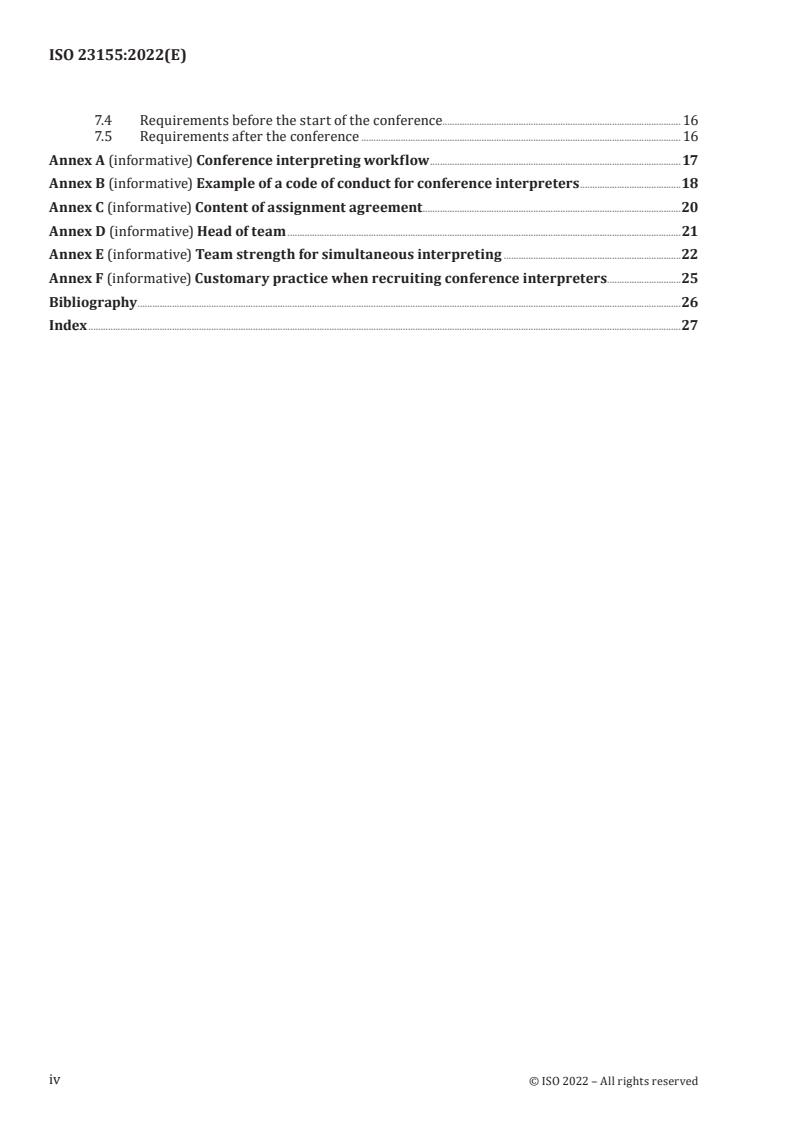
Annex A (informative) Conference interpreting workflow .17
Annex B (informative) Example of a code of conduct for conference interpreters .18
Annex C (informative) Content of assignment agreement .20
Annex D (informative) Head of team .21
Annex E (informative) Team strength for simultaneous interpreting .22
Annex F (informative) Customary practice when recruiting conference interpreters.25
Bibliography .26
Index .27
iv
Foreword
ISO (the International Organization for Standardization) is a worldwide federation of national standards
bodies (ISO member bodies). The work of preparing International Standards is normally carried out
through ISO technical committees. Each member body interested in a subject for which a technical
committee has been established has the right to be represented on that committee. International
organizations, governmental and non-governmental, in liaison with ISO, also take part in the work.
ISO collaborates closely with the International Electrotechnical Commission (IEC) on all matters of
electrotechnical standardization.
The procedures used to develop this document and those intended for its further maintenance are
described in the ISO/IEC Directives, Part 1. In particular, the different approval criteria needed for the
different types of ISO documents should be noted. This document was drafted in accordance with the
editorial rules of the ISO/IEC Directives, Part 2 (see www.iso.org/directives).
Attention is drawn to the possibility that some of the elements of this document may be the subject of
patent rights. ISO shall not be held responsible for identifying any or all such patent rights. Details of
any patent rights identified during the development of the document will be in the Introduction and/or
on the ISO list of patent declarations received (see www.iso.org/patents).
Any trade name used in this document is information given for the convenience of users and does not
constitute an endorsement.
For an explanation of the voluntary nature of standards, the meaning of ISO specific terms and
expressions related to conformity assessment, as well as information about ISO’s adherence to
the World Trade Organization (WTO) principles in the Technical Barriers to Trade (TBT), see
www.iso.org/iso/foreword.html.
This document was prepared by Technical Committee ISO/TC 37, Language and terminology,
Subcommittee SC 5, Translation, interpreting and related technology.
Any feedback or questions on this document should be directed to the user’s national standards body. A
complete listing of these bodies can be found at www.iso.org/members.html.
v
Introduction
This document responds to the need for general requirements for the provision of quality conference
interpreting services. It also offers information and guidance to users of conference interpreting
services and to parties involved in conference interpreting. These include:
— conference interpreters;
— conference interpreting service providers;
— consultant interpreters;
— language service providers;
— international organizations;
— governments and their departments and agencies;
— conference organizers;
— conference centres;
— providers of conference interpreting equipment;
— educational institutions and research centres.
vi
INTERNATIONAL STANDARD ISO 23155:2022(E)
Interpreting services — Conference interpreting —
Requirements and recommendations
1 Scope
This document specifies requirements and recommendations for the provision of conference
interpreting services. It is primarily addressed to conference interpreters and conference interpreting
service providers. It also serves as reference for users of conference interpreting services.
2 Normative references
There are no normative references in this document.
3 Terms and definitions
For the purposes of this document, the following terms and definitions apply.
ISO and IEC maintain terminology databases for use in standardization at the following addresses:
— ISO Online browsing platform: available at https:// www .iso .org/ obp
— IEC Electropedia: available at https:// www .electropedia .org/
3.1 Concepts related to language
3.1.1
language
systematic use of sounds, characters, symbols or signs by which to communicate
[SOURCE: ISO 20539:2019, 3.1.1]
3.1.2
spoken language
language (3.1.1) expressed orally
[SOURCE: ISO 20539:2019, 3.4.4]
3.1.3
signed language
language (3.1.1) which uses a combination of hand shapes, orientation and movement of the hands,
arms or body, and facial expressions
[SOURCE: ISO 20539:2019, 3.2.3]
3.1.4
source language
language (3.1.1) from which content (3.1.11) is translated (3.2.5) or interpreted (3.2.4)
[SOURCE: ISO 20539:2019, 3.1.3]
3.1.5
target language
language (3.1.1) into which content (3.1.11) is translated (3.2.5) or interpreted (3.2.4)
[SOURCE: ISO 20539:2019, 3.1.4]
3.1.6
‘A’ language
primary language (3.1.1) or its strict equivalent of which the interpreter (3.2.3) has complete command
and into which the interpreter interprets (3.2.4) from all their other ‘A’ languages, ‘B’ languages (3.1.7)
or ‘C’ languages (3.1.8)
[SOURCE: ISO 20539:2019, 3.4.1]
3.1.7
‘B’ language
language (3.1.1) in which the interpreter (3.2.3) is proficient, but which is not their primary language or
its strict equivalent
Note 1 to entry: An interpreter interprets (3.2.4) into this language from one or more other languages.
[SOURCE: ISO 20539:2019, 3.4.2, modified — In Note 1 to entry, “works” has been changed to
“interprets”.]
3.1.8
‘C’ language
language (3.1.1) from which the interpreter (3.2.3) interprets (3.2.4) into their ‘A’ languages (3.1.6) or
‘B’ languages (3.1.7)
Note 1 to entry: An interpreter can have more than one ‘A’ language, ‘B’ language or ‘C’ language.
[SOURCE: ISO 20539:2019, 3.4.3, modified — In Note 1 to entry, “language” has been added after ‘A’ and
after ‘B’.]
3.1.9
working language
language (3.1.1) from or into which an interpreter (3.2.3) is qualified to interpret (3.2.4)
Note 1 to entry: An interpreter’s working languages are classified as ‘A’ languages (3.1.6), ‘B’ languages (3.1.7) or
‘C’ languages (3.1.8).
3.1.10
language register
language (3.1.1) variety used for a particular purpose or in an event of language use, depending on the
type of situation, especially its degree of formality
Note 1 to entry: Individuals usually have more than one language register in their linguistic repertoire and can
vary their use of language register according to their perception of what is appropriate for different purposes or
domains (3.1.14).
[SOURCE: ISO 20539:2019, 3.2.1]
3.1.11
content
information in any form
EXAMPLE Text, audio, video, etc.
[SOURCE: ISO 20539:2019, 3.1.2]
3.1.12
competence
ability to apply knowledge, experience and skills to achieve intended results
[SOURCE: ISO 20539:2019, 3.3.24]
3.1.13
qualification
demonstrated education, training, and work experience, where applicable
[SOURCE: ISO/IEC 17024:2012, 3.7]
3.1.14
domain
sphere of knowledge or activity
Note 1 to entry: A domain can have its own culture, social context and linguistic characteristics.
[SOURCE: ISO 20539:2019, 3.2.4]
3.1.15
source language content
content (3.1.11) to be translated (3.2.5) or interpreted (3.2.4)
[SOURCE: ISO 20539:2019, 3.1.5]
3.1.16
target language content
content (3.1.11) that has been translated (3.2.5) or interpreted (3.2.4) from a source language (3.1.4)
[SOURCE: ISO 20539:2019, 3.1.6]
3.2 Concepts related to parties involved in conference interpreting and to modes
of interpreting
3.2.1
speaker
person addressing others using spoken language (3.1.2)
[SOURCE: ISO 20539:2019, 3.4.9]
3.2.2
signer
person addressing others using signed language (3.1.3)
[SOURCE: ISO 20539:2019, 3.4.10]
3.2.3
interpreter
person who interprets (3.2.4)
[SOURCE: ISO 20539:2019, 3.1.12]
3.2.4
interpret
render spoken or signed information from a source language (3.1.4) to a target language (3.1.5) in oral or
signed form, conveying both the meaning and language register (3.1.10) of the source language content
(3.1.15)
[SOURCE: ISO 20539:2019, 3.1.9, modified — The order of the wording “both the language register and
meaning” has been changed to “both the meaning and language register”.]
3.2.5
translate
render source language content (3.1.15) into target language content (3.1.16) in written form or signed
language (3.1.3)
[SOURCE: ISO 20539:2019, 3.1.7]
3.2.6
interpreting
interpretation
rendering spoken or signed information from a source language (3.1.4) to a target language (3.1.5) in
oral or signed form, conveying both the meaning and language register (3.1.10) of the source language
content (3.1.15)
[SOURCE: ISO 20539:2019, 3.1.10, modified — The order of the wording “both the language register and
meaning” has been changed to “both the meaning and language register”.]
3.2.7
spoken language interpreting
interpreting (3.2.6) between two spoken languages (3.1.2)
[SOURCE: ISO 20539:2019, 3.4.5]
3.2.8
signed language interpreting
interpreting (3.2.6) between two signed languages (3.1.3) or between a signed language and a spoken
language (3.1.2)
[SOURCE: ISO 20539:2019, 3.4.6]
3.2.9
conference interpreter
interpreter (3.2.3) who is qualified to perform conference interpreting (3.2.10)
3.2.10
conference interpreting
interpreting (3.2.6) used for multilingual communication at technical, political, scientific and other
formal meetings
[SOURCE: ISO 20539:2019, 3.4.18]
3.2.11
conference interpreting service
series of processes required to deliver the services of conference interpreters (3.2.9) to a client (3.2.15)
3.2.12
conference interpreting service provider
CISP
person or organization making available conference interpreting services (3.2.11)
EXAMPLE Individual conference interpreter (3.2.9), consultant interpreter (3.2.13), government department,
international organization.
3.2.13
consultant interpreter
conference interpreter (3.2.9) who provides consultancy services in addition to working as a conference
interpreter
3.2.14
head of team
conference interpreter (3.2.9) acting as liaison between the team of conference interpreters and the
client (3.2.15), technicians, the conference interpreting service provider (3.2.12) and other parties
involved in the conference (3.3.1)
3.2.15
client
customer
person, or organization, who enters into a formal agreement for the provision of a service
Note 1 to entry: The formal agreement can, for example, take the form of a contract or an interdepartmental
service agreement between units of an organization.
Note 2 to entry: The client can be the end user, but this does not have to be the case.
[SOURCE: ISO 20539:2019, 3.2.5]
3.2.16
mode
established method for the delivery of spoken language interpreting (3.2.7) and signed language
interpreting (3.2.8)
[SOURCE: ISO 20539:2019, 3.4.11]
3.2.17
consecutive interpreting
mode (3.2.16) of interpreting (3.2.6) performed after the speaker (3.2.1) or signer (3.2.2) pauses
Note 1 to entry: Interpreters (3.2.3) can use note-taking (3.2.21) to help in rendering lengthy passages.
[SOURCE: ISO 20539:2019, 3.4.13]
3.2.18
simultaneous interpreting
mode (3.2.16) of interpreting (3.2.6) performed while a speaker (3.2.1) or signer (3.2.2) is still speaking
or signing
[SOURCE: ISO 20539:2019, 3.4.12]
3.2.19
whispered interpreting
chuchotage
simultaneous interpreting (3.2.18) where the interpreter (3.2.3) interprets (3.2.4) very quietly, in close
proximity to the listeners without using a microphone
Note 1 to entry: Whispered interpreting is used for interpreting (3.2.6) to a very small number of listeners, ideally
one or two.
[SOURCE: ISO 20539:2019, 3.4.17, modified — “whispered interpreting” has replaced “chuchotage” as
the preferred term, and the definition has been amended.]
3.2.20
sight translation
sight interpreting
rendering written source language content (3.1.15) to the target language (3.1.5) in the form of spoken
language (3.1.2) or signed language (3.1.3)
[SOURCE: ISO 20539:2019, 3.4.16, modified — The admitted term “sight interpreting” has been added.]
3.2.21
note-taking
technique in consecutive interpreting (3.2.17) used by interpreters (3.2.3) for remembering,
conceptualizing and summarizing information
Note 1 to entry: Note-taking is highly individual and can involve a mixture of symbols, abbreviations, words and
diagrams.
[SOURCE: ISO 20539:2019, 3.4.29]
3.2.22
availability enquiry
request for information about whether an interpreter (3.2.3) is free to accept an assignment from a
client (3.2.15) on a specific date or dates
3.2.23
option
offer of an assignment to an interpreter (3.2.3) subject to confirmation
3.2.24
firm offer
proposal of an assignment which, when accepted, creates a binding commitment between the interpreter
(3.2.3) and the client (3.2.15)
3.2.25
cognitive load
amount of mental effort exerted by an interpreter (3.2.3) when interpreting (3.2.6) in a given
environment
3.3 Concepts related to conference interpreting equipment and settings
3.3.1
conference
structured formal meeting, or set of meetings, following an established agenda, in which issues, ideas
and policies are discussed
3.3.2
system
combination of interacting elements organized to achieve a given objective
[SOURCE: ISO 20539:2019, 3.5.2.6]
3.3.3
conference system
system (3.3.2) that controls technical equipment used to conduct a communicative event (3.3.20)
[SOURCE: ISO 20539:2019, 3.5.2.7, modified — “communicative” has been added.]
3.3.4
interpreting system
combination of interpreting (3.2.6) equipment and system (3.3.2) for language distribution
Note 1 to entry: An interpreting system can require the use of booths (3.3.5) compliant with ISO 2603 or ISO 4043,
equipped with hard consoles (3.3.6) compliant with ISO 20109, or a portable interpreting system (3.3.9), compliant
with ISO 20109.
[SOURCE: ISO 20539:2019, 3.5.2.12, modified — In Note 1 to entry, “hard consoles” has replaced
“interpreter consoles”.]
3.3.5
booth
simultaneous interpreting booth
self-contained unit enclosing the interpreter’s (3.2.3) workspace
Note 1 to entry: One of the purposes of booths is to provide sound insulation.
[SOURCE: ISO 20539:2019, 3.5.2.1, modified — In Note 1 to entry, the text after “insulation” has been
deleted.]
3.3.6
hard console
interpreter console
interpreter interface (3.3.8) containing physical controls for listening and speaking
[SOURCE: ISO 20539:2019, 3.5.2.21, modified — “hard console” has been added as the preferred term;
the definition has been amended.]
3.3.7
soft console
interpreter interface (3.3.8) which runs on a computer or portable IT device and has onscreen controls
1)
[SOURCE: ISO 24019:— , 3.3.5, modified — “type of” has been deleted.]
3.3.8
interpreter interface
equipment containing controls used by the interpreter (3.2.3) to facilitate simultaneous interpreting
(3.2.18)
EXAMPLE Controls for listening, viewing, speaking, signing.
[SOURCE: ISO 24019:—, 3.3.3, modified — “for listening, speaking or signing” has been deleted from
the definition and moved to an added example; “and viewing” has been added in the example.]
3.3.9
portable interpreting system
simultaneous interpreting (3.2.18) equipment, with battery-operated components, which is lightweight
and enables the interpreter (3.2.3) and the participants to move around
[SOURCE: ISO 20539:2019, 3.5.2.14]
3.3.10
webcasting
web streaming
transmitting video and audio data across a network to an audience
[SOURCE: ISO 20539:2019, 3.5.2.30]
3.3.11
incoming channel
electric circuit serving as a path for an audio or video signal to an interpreter interface (3.3.8)
[SOURCE: ISO 24019:—, 3.3.9]
3.3.12
outgoing channel
electric circuit serving as a path for an audio or video signal from an interpreter’s (3.2.3) microphone or
camera which, when activated by the interpreter, transmits the interpreter’s interpreting (3.2.6)
Note 1 to entry: Each language (3.1.1) in which interpreting is provided at a conference (3.3.1) is allocated an
outgoing channel.
[SOURCE: ISO 24019:—, 3.3.8]
3.3.13
relay interpreting
interpreting (3.2.6) of another interpreter’s (3.2.3) rendition
1) Under preparation. Stage at the time of publication: ISO/DIS 24019:2021. (Revision of ISO/PAS 24019:2020.)
3.3.14
double relay interpreting
interpreting (3.2.6) in which the source language content (3.1.15) is relay interpreting (3.3.13)
3.3.15
relay status
indication of the source of an interpreter interface’s (3.3.8) incoming channel (3.3.11)
Note 1 to entry: This source can be the floor (3.3.18), interpreting (3.2.6) of the floor, or relay interpreting (3.3.13).
[SOURCE: ISO 20539:2019, 3.5.2.33, modified — “console” has been replaced by “interface”; Note 1 to
entry has been amended.]
3.3.16
retour
retour interpreting
interpreting (3.2.6) from an ‘A’ language (3.1.6) into another ‘A’ language or ‘B’ language (3.1.7)
3.3.17
pivot
conference interpreter (3.2.9) whose rendition other conference interpreters interpret (3.2.4)
Note 1 to entry: Conference interpreters who do not have a language (3.1.1) spoken at a meeting among their
working languages (3.1.9) can use a pivot to provide relay interpreting (3.3.13).
3.3.18
floor
floor channel
electric circuit serving as a path for information spoken, signed or otherwise presented in the course of
the proceedings of a conference (3.3.1) by participants other than conference interpreters (3.2.9)
3.3.19
communicative setting
environment where an interaction between interlocutors takes place
[SOURCE: ISO 20539:2019, 3.4.7]
3.3.20
communicative event
encounter between two or more parties during which information is transmitted
[SOURCE: ISO 20539:2019, 3.4.8]
3.3.21
distance interpreting
remote interpreting
interpreting (3.2.6) of a speaker (3.2.1) or signer (3.2.2) in a different location from that of the interpreter
(3.2.3), enabled by information and communications technology
[SOURCE: ISO 20539:2019, 3.4.15]
3.3.22
bidirectional booth
team of interpreters (3.2.3) sitting in the same booth (3.3.5) who interpret (3.2.4) alternately into two
target languages (3.1.5), transmitting into the corresponding outgoing channels (3.3.12)
4 General provisions about conference interpreting
4.1 General
Conference interpreting is provided at bilingual and multilingual conferences to facilitate
communication between participants using different spoken or signed languages.
Conference interpreters shall have two or more working languages, classified as ‘A’ languages,
‘B’ languages, or ‘C’ languages, according to their level of proficiency.
Conference interpreters interpret from all their working languages into their ‘A’ languages and from
their ‘A’ languages into their ‘B’ languages.
Conference interpreters can either be staff interpreters, who are employed on an open-ended or fixed-
term contract, or self–employed interpreters who carry out conference interpreting assignments on
the basis of individual contracts.
Conference interpreting is an intellectually demanding activity and assignments can be particularly
strenuous owing to specific characteristics, such as the level of technical detail. Coping with stress is
inherent to conference interpreting.
Distance interpreting can entail increased cognitive load, which requires additional intellectual effort
and increases stress.
4.2 Modes of interpreting
Conference interpreters interpret in simultaneous or consecutive interpreting mode, depending on the
needs of the conference and the infrastructure and technical options available.
In consecutive interpreting no equipment is generally required, while simultaneous interpreting is
provided from booths, using equipment including interpreter interfaces, screens, headphones and
microphones. Exceptionally, simultaneous interpreting can also be provided using portable interpreting
systems, for example during itinerant events or site inspections.
In simultaneous interpreting, conference interpreters select an incoming channel to listen to a
source language and their rendition is transmitted on an outgoing channel. Conference interpreters
interpreting into the same language, using the same outgoing channel, should sit in the same booth;
however, such outgoing channel can be temporarily used by interpreters working at the same conference
sitting in other booths for the purposes of retour. See 4.4 for additional provisions.
In whispered interpreting, conference interpreters interpret in the simultaneous mode without using
interpreting equipment but can use headphones to listen to the speaker or an outgoing channel.
Signed language interpreters interpret in the meeting room, facing the audience, or in a booth or other
dedicated space.
4.3 Team strength and working hours in simultaneous interpreting
The composition and organization of interpreting teams, as well as the working hours of conference
interpreters, including breaks, have an impact on the quality of conference interpreting.
Conference interpreters shall work in teams of at least two interpreters per booth. In exceptional cases,
a conference interpreter may work alone for a maximum of 45 min. This can be reduced if warranted by
the language combination or the degree of difficulty of the assignment.
The number of conference interpreters in a team of conference interpreters primarily depends on the
number of languages used at the conference, as well as on its duration and difficulty. Good results have
been achieved with the team strengths recommended in Annex E.
Given health and quality considerations, an interpreter’s working day should not exceed two sessions of
3,5 h each, separated by a break of 90 min.
Working hours and breaks are among the basic elements of agreements that govern conference
interpreting assignments (see Annex C). Staff and self-employed conference interpreters working
for government departments or international organizations can be subject to a legal act or collective
agreement governing contractual relations, including working hours and work organization.
Distance interpreting can entail additional cognitive load and stress for conference interpreters,
accelerating the onset of fatigue. In planning assignments involving distance interpreting, the client
and the CISP should take mitigating measures, including shorter sessions, more frequent or longer
breaks or increasing team strength.
4.4 Teamwork between conference interpreters
Continuous communication and coordination are necessary between conference interpreters
interpreting at a conference.
In simultaneous interpreting, conference interpreters interpreting into the same outgoing channel
shall be able to communicate with each other visually and orally to:
— support each other when numbers, acronyms, technical terms or proper names are read out at
speed;
— monitor each other’s outgoing channel, especially in the case of a bidirectional booth;
— monitor each other’s incoming channel (to avoid unnecessary relay);
— coordinate with each other in case of technical problems;
— take over from one another as necessary.
In distance interpreting, increased cognitive load and stress are compounding factors which heighten
the need for effective communication between interpreters.
4.5 Code of ethics
Conference interpreters shall adhere to a code of professional ethics governing the practice of
conference interpreting.
NOTE See Annex B for an example of code of ethics.
5 Competences and qualifications of conference interpreters
5.1 General
Conference interpreters shall be able to provide evidence of their competences with the qualifications
described in 5.3.
5.2 Competences
5.2.1 Intellectual competences
Conference interpreters shall be able to analyse complex spoken-language content or signed-language
content and interpret it by applying situation-specific techniques.
5.2.2 Linguistic competences
Conference interpreters shall have comprehensive knowledge of their working languages.
Conference interpreters shall be able to comprehend regional accents and dialectical differences,
recognize different language registers, and understand subject-specific vocabulary, colloquialisms,
idioms and slang.
Conference interpreters shall be able to make quick decisions regarding lexical or terminological
choices and the appropriate level of formality.
5.2.3 Interpreting competences
Conference interpreters shall master the various modes of interpreting as well as support techniques,
including memory skills and note-taking.
Conference interpreters shall know how to maintain paralinguistic features of the source message
when necessary, such as hesitations, false starts and repetitions.
5.2.4 Communicative competences
Conference interpreters shall be able to render the full content of general and specialized messages
from a source language into a target language, in a manner that is factually correct and appropriate for
the situation and target audience. Their communicative competences shall include the ability to convey
tone and emotions using intonation and other means of expression.
5.2.5 Intercultural competences
Conference interpreters shall be aware of, and familiar with, cultural differences. They shall be able to
assess the meaning of the demeanour, tone and gestures of the participants at a communicative event,
as well as linguistic differences and similarities. Conference interpreters should be self-aware to reduce
the possible impact of cultural bias.
NOTE Where necessary and appropriate, intercultural competences can be used to resolve cultural
misunderstandings which might impede communication.
5.2.6 Technical competences
Conference interpreters shall be able to use conference interpreting equipment effectively.
NOTE This includes interpreter interfaces, microphones, portable interpreting systems, and audio and video
conferencing equipment.
5.2.7 Interpersonal competences
Conference interpreters shall be able to show respect, courtesy, tact and good judgement when
interacting with different people, such as other conference interpreters, conference technicians and
conference participants.
5.2.8 Competences in research, information acquisition and knowledge management
Conference interpreters should be able to carry out appropriate research prior to an interpreting
assignment. They should be able to retrieve information from a range of sources and media at short
notice, as well as assess the quality of the information retrieved.
5.2.9 Business competences
Self-employed conference interpreters should be familiar with the practical, financial, legal and tax
issues related to planning, setting up and running their own business.
5.2.10 Competences in the field of information security
Conference interpreters should be able to assess risks and take appropriate security measures
in relation to information to which they have access prior to or during a conference interpreting
assignment.
NOTE Such measures can include keeping documents under supervision or storing them at a secure place,
returning them as soon as possible to their rightful owner, arranging for their final disposal, using antivirus and
internet security software and creating appropriate backups when handling documents electronically.
5.2.11 Stress management competences
Conference interpreters should be able to use strategies to prevent and control stress related to
conference interpreting.
NOTE Stress in conference interpreters is compounded by public speaking, the work environment
(booth size, ventilation, lighting) and the difficulty in achieving a good work-life balance due to travelling and
unpredictable schedules.
5.3 Qualifications
Conference interpreters shall be able to present documented evidence of meeting at least one of the
following criteria:
a) a degree from a recognized postgraduate study programme in conference interpreting;
b) a degree from a recognized higher-education undergraduate study programme of at least three
years in conference interpreting, that is equivalent to a postgraduate programme in terms of scope,
content, and core competences taught;
c) a degree from a recognized higher-education study programme (Bachelor level or higher) in a
subject other than conference interpreting, and proof of 150 days of experience working as a
conference interpreter in accordance with Clause 4, 5.2 and Clause 6;
d) a positive result in an accreditation test for conference interpreters held by an international
organization or a national government agency or department.
6 Requirements and recommendations applicable to conference interpreters
in connection with conference interpreting assignments
6.1 Confidentiality
Conference interpreters shall not disclose confidential information to which they have access in the
context of performing their duties.
NOTE This can involve not disclosing the fact that a particular meeting ever took place or not disclosing the
location and time of a meeting, or the identity of its participants.
6.2 Requirements and recommendations before the conference interpreting
assignment
6.2.1 General
Conference interpreters should only accept assignments for which they are qualified, upon consideration
of the nature, duration and intensity of the assignment, as well as its language requirements.
For additional information, see Annex A.
6.2.2 Travel arrangements
Conference interpreters should not accept travel arrangements that could jeopardize their ability to
perform in accordance with this document.
6.2.3 Preparation
Conference interpreters shall prepare for each assignment, study conference-related material and
carry out their own research, as necessary.
6.3 Requirements and recommendations during the conference interpreting
assignment
During the assignment, conference interpreters shall:
— maintain uninterrupted situational awareness;
— follow the proceedings attentively at all times;
— study last-minute presentations or other material while they are not interpreting;
— assist other interpreters with vocabulary, acronyms, proper names and documents.
During the assignment, conference interpreters should:
— monitor channel settings on their own interpreter interface and, if feasible, other interpreter
interfaces in the same booth, and alert booth partners or technicians to problems, if necessary;
— observe appropriate microphone etiquette;
— not allow unauthorized persons to be present in the booth.
6.4 Requirements and recommendations after the conference interpreting assignment
6.4.1 Conference information management
Conference interpreters shall manage conference-related material as agreed with the owners of the
material.
6.4.2 Terminology management
Conference interpreters should compile and maintain glossaries and terminology lists.
6.4.3 Ongoing quality assurance measures
Conference interpreters should:
— provide feedback about the conference to the client or the CISP;
— seek feedback on their interpreting performance to the extent possible;
— continue their professional development in light of technological advances and other
...
INTERNATIONAL ISO
STANDARD 23155
First edition
2022-01
Interpreting services — Conference
interpreting — Requirements and
recommendations
Services d’interprétation — Interprétation de conférence —
Exigences et recommandations
Reference number
© ISO 2022
All rights reserved. Unless otherwise specified, or required in the context of its implementation, no part of this publication may
be reproduced or utilized otherwise in any form or by any means, electronic or mechanical, including photocopying, or posting on
the internet or an intranet, without prior written permission. Permission can be requested from either ISO at the address below
or ISO’s member body in the country of the requester.
ISO copyright office
CP 401 • Ch. de Blandonnet 8
CH-1214 Vernier, Geneva
Phone: +41 22 749 01 11
Email: copyright@iso.org
Website: www.iso.org
Published in Switzerland
ii
Contents Page
Foreword .v
Introduction . vi
1 Scope . 1
2 Normative references . 1
3 Terms and definitions . 1
3.1 Concepts related to language . 1
3.2 Concepts related to parties involved in conference interpreting and to modes
of interpreting . 3
3.3 Concepts related to conference interpreting equipment and settings . 6
4 General provisions about conference interpreting . 9
4.1 General . 9
4.2 Modes of interpreting . 9
4.3 Team strength and working hours in simultaneous interpreting . 9
4.4 Teamwork between conference interpreters . 10
4.5 Code of ethics . 10
5 Competences and qualifications of conference interpreters .10
5.1 General . 10
5.2 Competences . . . 10
5.2.1 Intellectual competences . 10
5.2.2 Linguistic competences . 10
5.2.3 Interpreting competences . 11
5.2.4 Communicative competences . 11
5.2.5 Intercultural competences . 11
5.2.6 Technical competences . 11
5.2.7 Interpersonal competences . 11
5.2.8 Competences in research, information acquisition and knowledge
management . 11
5.2.9 Business competences . 11
5.2.10 Competences in the field of information security .12
5.2.11 Stress management competences .12
5.3 Qualifications .12
6 Requirements and recommendations applicable to conference interpreters
in connection with conference interpreting assignments .12
6.1 Confidentiality .12
6.2 Requirements and recommendations before the conference interpreting
assignment .12
6.2.1 General .12
6.2.2 Travel arrangements . 13
6.2.3 Preparation . 13
6.3 Requirements and recommendations during the conference interpreting
assignment . 13
6.4 Requirements and recommendations after the conference interpreting assignment .13
6.4.1 Conference information management . 13
6.4.2 Terminology management . 13
6.4.3 Ongoing quality assurance measures . 13
7 Requirements concerning the conference interpreting service provider (CISP) .14
7.1 General . 14
7.2 General requirements . 14
7.3 Requirements during the planning phase of a conference . 15
7.3.1 Requirements relating to the client . 15
7.3.2 Requirements relating to conference interpreters. 15
7.3.3 Agreement with conference interpreters . 16
iii
7.4 Requirements before the start of the conference. 16
7.5 Requirements after the conference . 16
Annex A (informative) Conference interpreting workflow .17
Annex B (informative) Example of a code of conduct for conference interpreters .18
Annex C (informative) Content of assignment agreement .20
Annex D (informative) Head of team .21
Annex E (informative) Team strength for simultaneous interpreting .22
Annex F (informative) Customary practice when recruiting conference interpreters.25
Bibliography .26
Index .27
iv
Foreword
ISO (the International Organization for Standardization) is a worldwide federation of national standards
bodies (ISO member bodies). The work of preparing International Standards is normally carried out
through ISO technical committees. Each member body interested in a subject for which a technical
committee has been established has the right to be represented on that committee. International
organizations, governmental and non-governmental, in liaison with ISO, also take part in the work.
ISO collaborates closely with the International Electrotechnical Commission (IEC) on all matters of
electrotechnical standardization.
The procedures used to develop this document and those intended for its further maintenance are
described in the ISO/IEC Directives, Part 1. In particular, the different approval criteria needed for the
different types of ISO documents should be noted. This document was drafted in accordance with the
editorial rules of the ISO/IEC Directives, Part 2 (see www.iso.org/directives).
Attention is drawn to the possibility that some of the elements of this document may be the subject of
patent rights. ISO shall not be held responsible for identifying any or all such patent rights. Details of
any patent rights identified during the development of the document will be in the Introduction and/or
on the ISO list of patent declarations received (see www.iso.org/patents).
Any trade name used in this document is information given for the convenience of users and does not
constitute an endorsement.
For an explanation of the voluntary nature of standards, the meaning of ISO specific terms and
expressions related to conformity assessment, as well as information about ISO’s adherence to
the World Trade Organization (WTO) principles in the Technical Barriers to Trade (TBT), see
www.iso.org/iso/foreword.html.
This document was prepared by Technical Committee ISO/TC 37, Language and terminology,
Subcommittee SC 5, Translation, interpreting and related technology.
Any feedback or questions on this document should be directed to the user’s national standards body. A
complete listing of these bodies can be found at www.iso.org/members.html.
v
Introduction
This document responds to the need for general requirements for the provision of quality conference
interpreting services. It also offers information and guidance to users of conference interpreting
services and to parties involved in conference interpreting. These include:
— conference interpreters;
— conference interpreting service providers;
— consultant interpreters;
— language service providers;
— international organizations;
— governments and their departments and agencies;
— conference organizers;
— conference centres;
— providers of conference interpreting equipment;
— educational institutions and research centres.
vi
INTERNATIONAL STANDARD ISO 23155:2022(E)
Interpreting services — Conference interpreting —
Requirements and recommendations
1 Scope
This document specifies requirements and recommendations for the provision of conference
interpreting services. It is primarily addressed to conference interpreters and conference interpreting
service providers. It also serves as reference for users of conference interpreting services.
2 Normative references
There are no normative references in this document.
3 Terms and definitions
For the purposes of this document, the following terms and definitions apply.
ISO and IEC maintain terminology databases for use in standardization at the following addresses:
— ISO Online browsing platform: available at https:// www .iso .org/ obp
— IEC Electropedia: available at https:// www .electropedia .org/
3.1 Concepts related to language
3.1.1
language
systematic use of sounds, characters, symbols or signs by which to communicate
[SOURCE: ISO 20539:2019, 3.1.1]
3.1.2
spoken language
language (3.1.1) expressed orally
[SOURCE: ISO 20539:2019, 3.4.4]
3.1.3
signed language
language (3.1.1) which uses a combination of hand shapes, orientation and movement of the hands,
arms or body, and facial expressions
[SOURCE: ISO 20539:2019, 3.2.3]
3.1.4
source language
language (3.1.1) from which content (3.1.11) is translated (3.2.5) or interpreted (3.2.4)
[SOURCE: ISO 20539:2019, 3.1.3]
3.1.5
target language
language (3.1.1) into which content (3.1.11) is translated (3.2.5) or interpreted (3.2.4)
[SOURCE: ISO 20539:2019, 3.1.4]
3.1.6
‘A’ language
primary language (3.1.1) or its strict equivalent of which the interpreter (3.2.3) has complete command
and into which the interpreter interprets (3.2.4) from all their other ‘A’ languages, ‘B’ languages (3.1.7)
or ‘C’ languages (3.1.8)
[SOURCE: ISO 20539:2019, 3.4.1]
3.1.7
‘B’ language
language (3.1.1) in which the interpreter (3.2.3) is proficient, but which is not their primary language or
its strict equivalent
Note 1 to entry: An interpreter interprets (3.2.4) into this language from one or more other languages.
[SOURCE: ISO 20539:2019, 3.4.2, modified — In Note 1 to entry, “works” has been changed to
“interprets”.]
3.1.8
‘C’ language
language (3.1.1) from which the interpreter (3.2.3) interprets (3.2.4) into their ‘A’ languages (3.1.6) or
‘B’ languages (3.1.7)
Note 1 to entry: An interpreter can have more than one ‘A’ language, ‘B’ language or ‘C’ language.
[SOURCE: ISO 20539:2019, 3.4.3, modified — In Note 1 to entry, “language” has been added after ‘A’ and
after ‘B’.]
3.1.9
working language
language (3.1.1) from or into which an interpreter (3.2.3) is qualified to interpret (3.2.4)
Note 1 to entry: An interpreter’s working languages are classified as ‘A’ languages (3.1.6), ‘B’ languages (3.1.7) or
‘C’ languages (3.1.8).
3.1.10
language register
language (3.1.1) variety used for a particular purpose or in an event of language use, depending on the
type of situation, especially its degree of formality
Note 1 to entry: Individuals usually have more than one language register in their linguistic repertoire and can
vary their use of language register according to their perception of what is appropriate for different purposes or
domains (3.1.14).
[SOURCE: ISO 20539:2019, 3.2.1]
3.1.11
content
information in any form
EXAMPLE Text, audio, video, etc.
[SOURCE: ISO 20539:2019, 3.1.2]
3.1.12
competence
ability to apply knowledge, experience and skills to achieve intended results
[SOURCE: ISO 20539:2019, 3.3.24]
3.1.13
qualification
demonstrated education, training, and work experience, where applicable
[SOURCE: ISO/IEC 17024:2012, 3.7]
3.1.14
domain
sphere of knowledge or activity
Note 1 to entry: A domain can have its own culture, social context and linguistic characteristics.
[SOURCE: ISO 20539:2019, 3.2.4]
3.1.15
source language content
content (3.1.11) to be translated (3.2.5) or interpreted (3.2.4)
[SOURCE: ISO 20539:2019, 3.1.5]
3.1.16
target language content
content (3.1.11) that has been translated (3.2.5) or interpreted (3.2.4) from a source language (3.1.4)
[SOURCE: ISO 20539:2019, 3.1.6]
3.2 Concepts related to parties involved in conference interpreting and to modes
of interpreting
3.2.1
speaker
person addressing others using spoken language (3.1.2)
[SOURCE: ISO 20539:2019, 3.4.9]
3.2.2
signer
person addressing others using signed language (3.1.3)
[SOURCE: ISO 20539:2019, 3.4.10]
3.2.3
interpreter
person who interprets (3.2.4)
[SOURCE: ISO 20539:2019, 3.1.12]
3.2.4
interpret
render spoken or signed information from a source language (3.1.4) to a target language (3.1.5) in oral or
signed form, conveying both the meaning and language register (3.1.10) of the source language content
(3.1.15)
[SOURCE: ISO 20539:2019, 3.1.9, modified — The order of the wording “both the language register and
meaning” has been changed to “both the meaning and language register”.]
3.2.5
translate
render source language content (3.1.15) into target language content (3.1.16) in written form or signed
language (3.1.3)
[SOURCE: ISO 20539:2019, 3.1.7]
3.2.6
interpreting
interpretation
rendering spoken or signed information from a source language (3.1.4) to a target language (3.1.5) in
oral or signed form, conveying both the meaning and language register (3.1.10) of the source language
content (3.1.15)
[SOURCE: ISO 20539:2019, 3.1.10, modified — The order of the wording “both the language register and
meaning” has been changed to “both the meaning and language register”.]
3.2.7
spoken language interpreting
interpreting (3.2.6) between two spoken languages (3.1.2)
[SOURCE: ISO 20539:2019, 3.4.5]
3.2.8
signed language interpreting
interpreting (3.2.6) between two signed languages (3.1.3) or between a signed language and a spoken
language (3.1.2)
[SOURCE: ISO 20539:2019, 3.4.6]
3.2.9
conference interpreter
interpreter (3.2.3) who is qualified to perform conference interpreting (3.2.10)
3.2.10
conference interpreting
interpreting (3.2.6) used for multilingual communication at technical, political, scientific and other
formal meetings
[SOURCE: ISO 20539:2019, 3.4.18]
3.2.11
conference interpreting service
series of processes required to deliver the services of conference interpreters (3.2.9) to a client (3.2.15)
3.2.12
conference interpreting service provider
CISP
person or organization making available conference interpreting services (3.2.11)
EXAMPLE Individual conference interpreter (3.2.9), consultant interpreter (3.2.13), government department,
international organization.
3.2.13
consultant interpreter
conference interpreter (3.2.9) who provides consultancy services in addition to working as a conference
interpreter
3.2.14
head of team
conference interpreter (3.2.9) acting as liaison between the team of conference interpreters and the
client (3.2.15), technicians, the conference interpreting service provider (3.2.12) and other parties
involved in the conference (3.3.1)
3.2.15
client
customer
person, or organization, who enters into a formal agreement for the provision of a service
Note 1 to entry: The formal agreement can, for example, take the form of a contract or an interdepartmental
service agreement between units of an organization.
Note 2 to entry: The client can be the end user, but this does not have to be the case.
[SOURCE: ISO 20539:2019, 3.2.5]
3.2.16
mode
established method for the delivery of spoken language interpreting (3.2.7) and signed language
interpreting (3.2.8)
[SOURCE: ISO 20539:2019, 3.4.11]
3.2.17
consecutive interpreting
mode (3.2.16) of interpreting (3.2.6) performed after the speaker (3.2.1) or signer (3.2.2) pauses
Note 1 to entry: Interpreters (3.2.3) can use note-taking (3.2.21) to help in rendering lengthy passages.
[SOURCE: ISO 20539:2019, 3.4.13]
3.2.18
simultaneous interpreting
mode (3.2.16) of interpreting (3.2.6) performed while a speaker (3.2.1) or signer (3.2.2) is still speaking
or signing
[SOURCE: ISO 20539:2019, 3.4.12]
3.2.19
whispered interpreting
chuchotage
simultaneous interpreting (3.2.18) where the interpreter (3.2.3) interprets (3.2.4) very quietly, in close
proximity to the listeners without using a microphone
Note 1 to entry: Whispered interpreting is used for interpreting (3.2.6) to a very small number of listeners, ideally
one or two.
[SOURCE: ISO 20539:2019, 3.4.17, modified — “whispered interpreting” has replaced “chuchotage” as
the preferred term, and the definition has been amended.]
3.2.20
sight translation
sight interpreting
rendering written source language content (3.1.15) to the target language (3.1.5) in the form of spoken
language (3.1.2) or signed language (3.1.3)
[SOURCE: ISO 20539:2019, 3.4.16, modified — The admitted term “sight interpreting” has been added.]
3.2.21
note-taking
technique in consecutive interpreting (3.2.17) used by interpreters (3.2.3) for remembering,
conceptualizing and summarizing information
Note 1 to entry: Note-taking is highly individual and can involve a mixture of symbols, abbreviations, words and
diagrams.
[SOURCE: ISO 20539:2019, 3.4.29]
3.2.22
availability enquiry
request for information about whether an interpreter (3.2.3) is free to accept an assignment from a
client (3.2.15) on a specific date or dates
3.2.23
option
offer of an assignment to an interpreter (3.2.3) subject to confirmation
3.2.24
firm offer
proposal of an assignment which, when accepted, creates a binding commitment between the interpreter
(3.2.3) and the client (3.2.15)
3.2.25
cognitive load
amount of mental effort exerted by an interpreter (3.2.3) when interpreting (3.2.6) in a given
environment
3.3 Concepts related to conference interpreting equipment and settings
3.3.1
conference
structured formal meeting, or set of meetings, following an established agenda, in which issues, ideas
and policies are discussed
3.3.2
system
combination of interacting elements organized to achieve a given objective
[SOURCE: ISO 20539:2019, 3.5.2.6]
3.3.3
conference system
system (3.3.2) that controls technical equipment used to conduct a communicative event (3.3.20)
[SOURCE: ISO 20539:2019, 3.5.2.7, modified — “communicative” has been added.]
3.3.4
interpreting system
combination of interpreting (3.2.6) equipment and system (3.3.2) for language distribution
Note 1 to entry: An interpreting system can require the use of booths (3.3.5) compliant with ISO 2603 or ISO 4043,
equipped with hard consoles (3.3.6) compliant with ISO 20109, or a portable interpreting system (3.3.9), compliant
with ISO 20109.
[SOURCE: ISO 20539:2019, 3.5.2.12, modified — In Note 1 to entry, “hard consoles” has replaced
“interpreter consoles”.]
3.3.5
booth
simultaneous interpreting booth
self-contained unit enclosing the interpreter’s (3.2.3) workspace
Note 1 to entry: One of the purposes of booths is to provide sound insulation.
[SOURCE: ISO 20539:2019, 3.5.2.1, modified — In Note 1 to entry, the text after “insulation” has been
deleted.]
3.3.6
hard console
interpreter console
interpreter interface (3.3.8) containing physical controls for listening and speaking
[SOURCE: ISO 20539:2019, 3.5.2.21, modified — “hard console” has been added as the preferred term;
the definition has been amended.]
3.3.7
soft console
interpreter interface (3.3.8) which runs on a computer or portable IT device and has onscreen controls
1)
[SOURCE: ISO 24019:— , 3.3.5, modified — “type of” has been deleted.]
3.3.8
interpreter interface
equipment containing controls used by the interpreter (3.2.3) to facilitate simultaneous interpreting
(3.2.18)
EXAMPLE Controls for listening, viewing, speaking, signing.
[SOURCE: ISO 24019:—, 3.3.3, modified — “for listening, speaking or signing” has been deleted from
the definition and moved to an added example; “and viewing” has been added in the example.]
3.3.9
portable interpreting system
simultaneous interpreting (3.2.18) equipment, with battery-operated components, which is lightweight
and enables the interpreter (3.2.3) and the participants to move around
[SOURCE: ISO 20539:2019, 3.5.2.14]
3.3.10
webcasting
web streaming
transmitting video and audio data across a network to an audience
[SOURCE: ISO 20539:2019, 3.5.2.30]
3.3.11
incoming channel
electric circuit serving as a path for an audio or video signal to an interpreter interface (3.3.8)
[SOURCE: ISO 24019:—, 3.3.9]
3.3.12
outgoing channel
electric circuit serving as a path for an audio or video signal from an interpreter’s (3.2.3) microphone or
camera which, when activated by the interpreter, transmits the interpreter’s interpreting (3.2.6)
Note 1 to entry: Each language (3.1.1) in which interpreting is provided at a conference (3.3.1) is allocated an
outgoing channel.
[SOURCE: ISO 24019:—, 3.3.8]
3.3.13
relay interpreting
interpreting (3.2.6) of another interpreter’s (3.2.3) rendition
1) Under preparation. Stage at the time of publication: ISO/DIS 24019:2021. (Revision of ISO/PAS 24019:2020.)
3.3.14
double relay interpreting
interpreting (3.2.6) in which the source language content (3.1.15) is relay interpreting (3.3.13)
3.3.15
relay status
indication of the source of an interpreter interface’s (3.3.8) incoming channel (3.3.11)
Note 1 to entry: This source can be the floor (3.3.18), interpreting (3.2.6) of the floor, or relay interpreting (3.3.13).
[SOURCE: ISO 20539:2019, 3.5.2.33, modified — “console” has been replaced by “interface”; Note 1 to
entry has been amended.]
3.3.16
retour
retour interpreting
interpreting (3.2.6) from an ‘A’ language (3.1.6) into another ‘A’ language or ‘B’ language (3.1.7)
3.3.17
pivot
conference interpreter (3.2.9) whose rendition other conference interpreters interpret (3.2.4)
Note 1 to entry: Conference interpreters who do not have a language (3.1.1) spoken at a meeting among their
working languages (3.1.9) can use a pivot to provide relay interpreting (3.3.13).
3.3.18
floor
floor channel
electric circuit serving as a path for information spoken, signed or otherwise presented in the course of
the proceedings of a conference (3.3.1) by participants other than conference interpreters (3.2.9)
3.3.19
communicative setting
environment where an interaction between interlocutors takes place
[SOURCE: ISO 20539:2019, 3.4.7]
3.3.20
communicative event
encounter between two or more parties during which information is transmitted
[SOURCE: ISO 20539:2019, 3.4.8]
3.3.21
distance interpreting
remote interpreting
interpreting (3.2.6) of a speaker (3.2.1) or signer (3.2.2) in a different location from that of the interpreter
(3.2.3), enabled by information and communications technology
[SOURCE: ISO 20539:2019, 3.4.15]
3.3.22
bidirectional booth
team of interpreters (3.2.3) sitting in the same booth (3.3.5) who interpret (3.2.4) alternately into two
target languages (3.1.5), transmitting into the corresponding outgoing channels (3.3.12)
4 General provisions about conference interpreting
4.1 General
Conference interpreting is provided at bilingual and multilingual conferences to facilitate
communication between participants using different spoken or signed languages.
Conference interpreters shall have two or more working languages, classified as ‘A’ languages,
‘B’ languages, or ‘C’ languages, according to their level of proficiency.
Conference interpreters interpret from all their working languages into their ‘A’ languages and from
their ‘A’ languages into their ‘B’ languages.
Conference interpreters can either be staff interpreters, who are employed on an open-ended or fixed-
term contract, or self–employed interpreters who carry out conference interpreting assignments on
the basis of individual contracts.
Conference interpreting is an intellectually demanding activity and assignments can be particularly
strenuous owing to specific characteristics, such as the level of technical detail. Coping with stress is
inherent to conference interpreting.
Distance interpreting can entail increased cognitive load, which requires additional intellectual effort
and increases stress.
4.2 Modes of interpreting
Conference interpreters interpret in simultaneous or consecutive interpreting mode, depending on the
needs of the conference and the infrastructure and technical options available.
In consecutive interpreting no equipment is generally required, while simultaneous interpreting is
provided from booths, using equipment including interpreter interfaces, screens, headphones and
microphones. Exceptionally, simultaneous interpreting can also be provided using portable interpreting
systems, for example during itinerant events or site inspections.
In simultaneous interpreting, conference interpreters select an incoming channel to listen to a
source language and their rendition is transmitted on an outgoing channel. Conference interpreters
interpreting into the same language, using the same outgoing channel, should sit in the same booth;
however, such outgoing channel can be temporarily used by interpreters working at the same conference
sitting in other booths for the purposes of retour. See 4.4 for additional provisions.
In whispered interpreting, conference interpreters interpret in the simultaneous mode without using
interpreting equipment but can use headphones to listen to the speaker or an outgoing channel.
Signed language interpreters interpret in the meeting room, facing the audience, or in a booth or other
dedicated space.
4.3 Team strength and working hours in simultaneous interpreting
The composition and organization of interpreting teams, as well as the working hours of conference
interpreters, including breaks, have an impact on the quality of conference inte
...
NORME ISO
INTERNATIONALE 23155
Première édition
2022-01
Services d’interprétation —
Interprétation de conférence —
Exigences et recommandations
Interpreting services — Conference interpreting — Requirements and
recommendations
Numéro de référence
DOCUMENT PROTÉGÉ PAR COPYRIGHT
© ISO 2022
Tous droits réservés. Sauf prescription différente ou nécessité dans le contexte de sa mise en œuvre, aucune partie de cette
publication ne peut être reproduite ni utilisée sous quelque forme que ce soit et par aucun procédé, électronique ou mécanique,
y compris la photocopie, ou la diffusion sur l’internet ou sur un intranet, sans autorisation écrite préalable. Une autorisation peut
être demandée à l’ISO à l’adresse ci-après ou au comité membre de l’ISO dans le pays du demandeur.
ISO copyright office
Case postale 401 • Ch. de Blandonnet 8
CH-1214 Vernier, Genève
Tél.: +41 22 749 01 11
E-mail: copyright@iso.org
Web: www.iso.org
Publié en Suisse
ii
Sommaire Page
Avant-propos .v
Introduction . vi
1 Domaine d’application . 1
2 Références normatives .1
3 Termes et définitions . 1
3.1 Concepts relatifs à la langue . 1
3.2 Concepts relatifs aux parties impliquées dans l’interprétation de conférence et
aux modes d’interprétation . 3
3.3 Concepts relatifs à l’équipement et aux contextes de l’interprétation de conférence . 6
4 Dispositions générales relatives à l’interprétation de conférence .9
4.1 Généralités . 9
4.2 Modes d’interprétation . 9
4.3 Effectifs et temps de travail en interprétation simultanée . 10
4.4 Travail d’équipe entre les interprètes de conférence . 10
4.5 Code de déontologie . 11
5 Compétences et qualifications des interprètes de conférence .11
5.1 Généralités . 11
5.2 Compétences . . . 11
5.2.1 Compétences intellectuelles . . 11
5.2.2 Compétences linguistiques . 11
5.2.3 Compétences en interprétation . 11
5.2.4 Compétences en communication . 11
5.2.5 Compétences interculturelles . 11
5.2.6 Compétences techniques .12
5.2.7 Compétences interpersonnelles .12
5.2.8 Compétences en recherche documentaire, acquisition d’informations et
gestion des connaissances .12
5.2.9 Compétences administratives .12
5.2.10 Compétences dans le domaine de la sécurité de l’information .12
5.2.11 Compétences en gestion du stress .12
5.3 Qualifications .12
6 Exigences et recommandations applicables aux interprètes de conférence dans le
cadre des missions d’interprétation de conférence .13
6.1 Confidentialité .13
6.2 Exigences et recommandations avant la mission d’interprétation de conférence .13
6.2.1 Généralités .13
6.2.2 Conditions de déplacement . 13
6.2.3 Préparation . 13
6.3 Exigences et recommandations pendant la mission d’interprétation de conférence .13
6.4 Exigences et recommandations après la mission d’interprétation de conférence . 14
6.4.1 Gestion des informations relatives à la conférence . 14
6.4.2 Gestion de la terminologie . 14
6.4.3 Mesures d’assurance de la qualité en routine . 14
7 Exigences concernant le prestataire de services d’interprétation de conférence
(PSIC) .14
7.1 Généralités . 14
7.2 Exigences générales .15
7.3 Exigences pendant la phase de planification d’une conférence . 16
7.3.1 Exigences relatives au client . 16
7.3.2 Exigences relatives aux interprètes de conférence . 16
7.3.3 Accord avec les interprètes de conférence . 17
7.4 Exigences avant le début de la conférence . 17
iii
7.5 Exigences après la conférence . 17
Annexe A (informative) Flux des tâches d’interprétation de conférence.18
Annexe B (informative) Exemple de code de conduite pour les interprètes de conférence .19
Annexe C (informative) Contenu de l’accord de mission .21
Annexe D (informative) Chef d’équipe .22
Annexe E (informative) Effectifs en interprétation simultanée .23
Annexe F (informative) Pratiques habituelles de recrutement des interprètes de conférence .26
Bibliographie .27
Index .28
iv
Avant-propos
L'ISO (Organisation internationale de normalisation) est une fédération mondiale d'organismes
nationaux de normalisation (comités membres de l'ISO). L'élaboration des Normes internationales est
en général confiée aux comités techniques de l'ISO. Chaque comité membre intéressé par une étude
a le droit de faire partie du comité technique créé à cet effet. Les organisations internationales,
gouvernementales et non gouvernementales, en liaison avec l'ISO participent également aux travaux.
L'ISO collabore étroitement avec la Commission électrotechnique internationale (IEC) en ce qui
concerne la normalisation électrotechnique.
Les procédures utilisées pour élaborer le présent document et celles destinées à sa mise à jour sont
décrites dans les Directives ISO/IEC, Partie 1. Il convient, en particulier, de prendre note des différents
critères d'approbation requis pour les différents types de documents ISO. Le présent document a
été rédigé conformément aux règles de rédaction données dans les Directives ISO/IEC, Partie 2 (voir
www.iso.org/directives).
L'attention est attirée sur le fait que certains des éléments du présent document peuvent faire l'objet de
droits de propriété intellectuelle ou de droits analogues. L'ISO ne saurait être tenue pour responsable
de ne pas avoir identifié de tels droits de propriété et averti de leur existence. Les détails concernant
les références aux droits de propriété intellectuelle ou autres droits analogues identifiés lors de
l'élaboration du document sont indiqués dans l'Introduction et/ou dans la liste des déclarations de
brevets reçues par l'ISO (voir www.iso.org/brevets).
Les appellations commerciales éventuellement mentionnées dans le présent document sont données
pour information, par souci de commodité, à l’intention des utilisateurs et ne sauraient constituer un
engagement.
Pour une explication de la nature volontaire des normes, la signification des termes et expressions
spécifiques de l'ISO liés à l'évaluation de la conformité, ou pour toute information au sujet de l'adhésion
de l'ISO aux principes de l’Organisation mondiale du commerce (OMC) concernant les obstacles
techniques au commerce (OTC), voir www.iso.org/avant-propos.
Le présent document a été élaboré par le comité technique ISO/TC 37, Langage et terminologie, sous-
comité SC 5, Traduction, interprétation et technologies apparentées.
Il convient que l’utilisateur adresse tout retour d’information ou toute question concernant le présent
document à l’organisme national de normalisation de son pays. Une liste exhaustive desdits organismes
se trouve à l’adresse www.iso.org/fr/members.html.
v
Introduction
Le présent document répond à la nécessité de disposer d’exigences générales pour la prestation
de services d’interprétation de conférence de qualité. Il offre également des informations et des
recommandations aux utilisateurs de services d’interprétation de conférence et aux parties impliquées
dans l’interprétation de conférence. Ceux-ci comprennent:
— les interprètes de conférence;
— les prestataires de services d’interprétation de conférence;
— les interprètes-consultants;
— les prestataires de services linguistiques;
— les organisations internationales;
— les gouvernements et leurs ministères et agences;
— les organisateurs de conférences;
— les centres de conférence;
— les fournisseurs d’équipement d’interprétation de conférence;
— les établissements d’enseignement et les centres de recherche.
vi
NORME INTERNATIONALE ISO 23155:2022(F)
Services d’interprétation — Interprétation de conférence
— Exigences et recommandations
1 Domaine d’application
Le présent document spécifie les exigences et les recommandations relatives à la prestation de services
d’interprétation de conférence. Il s’adresse principalement aux interprètes de conférence et aux
prestataires de services d’interprétation de conférence. Il sert également de référence aux utilisateurs
de services d’interprétation de conférence.
2 Références normatives
Le présent document ne contient aucune référence normative.
3 Termes et définitions
Pour les besoins du présent document, les termes et définitions suivants s’appliquent.
L’ISO et l’IEC tiennent à jour des bases de données terminologiques destinées à être utilisées en
normalisation, consultables aux adresses suivantes:
— ISO Online browsing platform: disponible à l’adresse https:// www .iso .org/ obp
— IEC Electropedia: disponible à l’adresse https:// www .electropedia .org/
3.1 Concepts relatifs à la langue
3.1.1
langue
utilisation systématique de sons, caractères, symboles ou signes pour communiquer
[SOURCE: ISO 20539:2019, 3.1.1]
3.1.2
langue orale
langue (3.1.1) exprimée oralement
[SOURCE: ISO 20539:2019, 3.4.4]
3.1.3
langue des signes
langue (3.1.1) qui utilise une combinaison de formes des mains, d’orientation et de mouvement des
mains, des bras ou du corps, et d’expressions faciales
[SOURCE: ISO 20539:2019, 3.2.3]
3.1.4
langue source
langue (3.1.1) à partir de laquelle du contenu (3.1.11) est traduit (3.2.5) ou interprété (3.2.4)
[SOURCE: ISO 20539:2019, 3.1.3]
3.1.5
langue cible
langue (3.1.1) dans laquelle du contenu (3.1.11) est traduit (3.2.5) ou interprété (3.2.4)
[SOURCE: ISO 20539:2019, 3.1.4]
3.1.6
langue «A»
langue (3.1.1) maternelle ou son strict équivalent, entièrement maîtrisée par l’interprète (3.2.3) ou dans
laquelle l’interprète interprète (3.2.4) à partir de toutes ses autres langues «A», langues «B» (3.1.7) ou
langues «C» (3.1.8)
[SOURCE: ISO 20539:2019, 3.4.1]
3.1.7
langue «B»
langue (3.1.1) maîtrisée par l’interprète (3.2.3) mais qui n’est pas sa langue maternelle ou son strict
équivalent
Note 1 à l'article: Un interprète interprète (3.2.4) dans cette langue à partir d’une ou plusieurs autres langues.
[SOURCE: ISO 20539:2019, 3.4.2, modifié — Dans la Note 1 à l’article, «travaille» a été remplacé par
«interprète».]
3.1.8
langue «C»
langue (3.1.1) à partir de laquelle l’interprète (3.2.3) interprète (3.2.4) dans ses langues «A» (3.1.6) ou
langues «B» (3.1.7)
Note 1 à l'article: Un interprète peut avoir plusieurs langues «A», langues «B» ou langues «C».
[SOURCE: ISO 20539:2019, 3.4.3, modifié — Dans la Note 1 à l’article, «langues» a été ajouté devant «B»
et «C».]
3.1.9
langue de travail
langue (3.1.1) à partir de laquelle ou vers laquelle un interprète (3.2.3) est qualifié pour interpréter
(3.2.4)
Note 1 à l'article: Les langues de travail d’un interprète sont classées comme langues «A» (3.1.6), langues «B»
(3.1.7) ou langues «C» (3.1.8).
3.1.10
registre de langue
variété d'une langue (3.1.1) utilisée dans un but particulier ou dans le cadre d’une utilisation particulière
de la langue en fonction du type de situation, notamment du degré de formalité
Note 1 à l'article: Les individus ont en général plusieurs registres de langue dans leur répertoire linguistique et
peuvent adapter le registre de langue qu’ils utilisent en fonction de leur perception de ce qui est approprié pour
différents objectifs ou dans différents domaines (3.1.14).
[SOURCE: ISO 20539:2019, 3.2.1]
3.1.11
contenu
information sous quelque forme que ce soit
EXEMPLE Texte, audio, vidéo, etc.
[SOURCE: ISO 20539:2019, 3.1.2]
3.1.12
compétence
aptitude à utiliser ses connaissances, son expérience et ses compétences pour atteindre des résultats
prévus
[SOURCE: ISO 20539:2019, 3.3.24]
3.1.13
qualification
enseignement, formation et expérience professionnelle, démontrés, lorsque applicable
[SOURCE: ISO/IEC 17024:2012, 3.7]
3.1.14
domaine
sphère de connaissance ou d’activité
Note 1 à l'article: Un domaine peut avoir sa propre culture, son propre contexte social et ses propres
caractéristiques linguistiques.
[SOURCE: ISO 20539:2019, 3.2.4]
3.1.15
contenu dans la langue source
contenu (3.1.11) à traduire (3.2.5) ou à interpréter (3.2.4)
[SOURCE: ISO 20539:2019, 3.1.5]
3.1.16
contenu dans la langue cible
contenu (3.1.11) qui a été traduit (3.2.5) ou interprété (3.2.4) à partir d’une langue source (3.1.4)
[SOURCE: ISO 20539:2019, 3.1.6]
3.2 Concepts relatifs aux parties impliquées dans l’interprétation de conférence et aux
modes d’interprétation
3.2.1
orateur
personne s’adressant à d’autres en langue orale (3.1.2)
[SOURCE: ISO 20539:2019, 3.4.9]
3.2.2
signeur
personne s’adressant à d’autres en langue des signes (3.1.3)
[SOURCE: ISO 20539:2019, 3.4.10]
3.2.3
interprète
personne qui interprète (3.2.4)
[SOURCE: ISO 20539:2019, 3.1.12]
3.2.4
interpréter
restituer des informations parlées ou signées d’une langue source (3.1.4) dans une langue cible (3.1.5)
sous forme orale ou signée, en transmettant à la fois la signification et le registre de langue (3.1.10) du
contenu dans la langue source (3.1.15)
[SOURCE: ISO 20539:2019, 3.1.9, modifié — L’ordre des mots «à la fois le registre de langue et la
signification» a été modifié par «à la fois la signification et le registre de langue».]
3.2.5
traduire
restituer un contenu dans la langue source (3.1.15) en un contenu dans la langue cible (3.1.16) sous forme
écrite ou en langue des signes (3.1.3)
[SOURCE: ISO 20539:2019, 3.1.7]
3.2.6
interprétation
restitution d’informations parlées ou signées d’une langue source (3.1.4) dans une langue cible (3.1.5)
sous forme orale ou signée, en transmettant à la fois la signification et le registre de langue (3.1.10) du
contenu dans la langue source (3.1.15)
[SOURCE: ISO 20539:2019, 3.1.10, modifié — L’ordre des mots «à la fois le registre de langue et la
signification» a été modifié par «à la fois la signification et le registre de langue».]
3.2.7
interprétation en langue orale
interprétation (3.2.6) entre deux langues orales (3.1.2)
[SOURCE: ISO 20539:2019, 3.4.5]
3.2.8
interprétation en langue des signes
interprétation (3.2.6) entre deux langues des signes (3.1.3) ou entre une langue des signes et une langue
orale (3.1.2)
[SOURCE: ISO 20539:2019, 3.4.6]
3.2.9
interprète de conférence
interprète (3.2.3) qui est qualifié pour pratiquer l’interprétation de conférence (3.2.10)
3.2.10
interprétation de conférence
interprétation (3.2.6) utilisée pour la communication multilingue lors de réunions formelles techniques,
politiques, scientifiques et autres
[SOURCE: ISO 20539:2019, 3.4.18]
3.2.11
service d’interprétation de conférence
série de processus nécessaires pour fournir les services d’interprètes de conférence (3.2.9) à un client
(3.2.15)
3.2.12
prestataire de services d’interprétation de conférence
PSIC
personne physique ou morale mettant à disposition des services d’interprétation de conférence (3.2.11)
EXEMPLE Interprète de conférence (3.2.9) individuel, interprète-consultant (3.2.13), ministère, organisation
internationale.
3.2.13
interprète-consultant
interprète de conférence (3.2.9) qui fournit des services de conseil en plus de son activité d’interprète de
conférence
3.2.14
chef d’équipe
interprète de conférence (3.2.9) assurant la liaison entre l’équipe d’interprètes de conférence et le client
(3.2.15), les techniciens, le prestataire de services d’interprétation de conférence (3.2.12) et les autres
parties impliquées dans la conférence (3.3.1)
3.2.15
client
client
personne ou organisation qui conclut un accord formel pour la prestation d’un service
Note 1 à l'article: L’accord formel peut, par exemple, prendre la forme d’un contrat ou d’un accord de service
interdépartemental entre les entités d’une organisation.
Note 2 à l'article: Le client peut être l’utilisateur final, mais cela n’est pas obligatoirement le cas.
[SOURCE: ISO 20539:2019, 3.2.5]
3.2.16
mode
méthode établie pour la fourniture d’une interprétation en langue orale (3.2.7) et d’une interprétation en
langue des signes (3.2.8)
[SOURCE: ISO 20539:2019, 3.4.11]
3.2.17
interprétation consécutive
mode (3.2.16) d’interprétation (3.2.6) réalisé une fois que l’orateur (3.2.1) ou le signeur (3.2.2) s’est
arrêté
Note 1 à l'article: Les interprètes (3.2.3) peuvent utiliser la prise de notes (3.2.21) pour faciliter la restitution de
longs passages.
[SOURCE: ISO 20539:2019, 3.4.13]
3.2.18
interprétation simultanée
mode (3.2.16) d’interprétation (3.2.6) réalisé pendant qu’un orateur (3.2.1) ou un signeur (3.2.2) continue
de parler ou de signer
[SOURCE: ISO 20539:2019, 3.4.12]
3.2.19
interprétation chuchotée
chuchotage
interprétation simultanée (3.2.18) au cours de laquelle l’interprète (3.2.3) interprète (3.2.4) à voix basse,
à proximité physique directe des auditeurs, sans utiliser de microphone
Note 1 à l'article: L’interprétation chuchotée est employée pour une interprétation (3.2.6) destinée à un très petit
nombre d’auditeurs, idéalement un ou deux.
[SOURCE: ISO 20539:2019, 3.4.17, modifié — «interprétation chuchotée» a remplacé «chuchotage»
comme terme préféré, et la définition a été modifiée.]
3.2.20
traduction à vue
interprétation à vue
restitution d’un contenu écrit dans la langue source (3.1.15) dans la langue cible (3.1.5) en langue orale
(3.1.2) ou en langue des signes (3.1.3)
[SOURCE: ISO 20539:2019, 3.4.16, modifié — Le terme admis «interprétation à vue» a été ajouté.]
3.2.21
prise de notes
technique d’interprétation consécutive (3.2.17) employée par des interprètes (3.2.3) pour mémoriser,
conceptualiser et résumer des informations
Note 1 à l'article: La prise de notes est très personnelle et peut impliquer un mélange de symboles, d’abréviations,
de mots et de diagrammes.
[SOURCE: ISO 20539:2019, 3.4.29]
3.2.22
demande de disponibilité
demande d’informations sur la possibilité pour un interprète (3.2.3) d’accepter une mission d’un client
(3.2.15) à une ou des dates spécifiées
3.2.23
option
offre d’une mission à un interprète (3.2.3) sous réserve de confirmation
3.2.24
offre ferme
proposition d’une mission qui, une fois acceptée, crée un engagement contraignant entre l’interprète
(3.2.3) et le client (3.2.15)
3.2.25
charge cognitive
quantité d’effort mental déployé par un interprète (3.2.3) lors de l’interprétation (3.2.6) dans un
environnement donné
3.3 Concepts relatifs à l’équipement et aux contextes de l’interprétation de conférence
3.3.1
conférence
assemblée ou série d’assemblées formelles structurées, suivant un ordre du jour établi pour discuter de
problèmes, d’idées et d’orientations
3.3.2
système
combinaison d’éléments interactifs organisés pour atteindre un objectif donné
[SOURCE: ISO 20539:2019, 3.5.2.6]
3.3.3
système de conférence
système (3.3.2) qui contrôle l’équipement technique utilisé pour la conduite d’un événement de
communication (3.3.20)
[SOURCE: ISO 20539:2019, 3.5.2.7, modifié — «de communication» a été ajouté.]
3.3.4
système d’interprétation
combinaison de l’équipement d’interprétation (3.2.6) et du système (3.3.2) pour la distribution
linguistique
Note 1 à l'article: Un système d’interprétation peut nécessiter l’utilisation de cabines (3.3.5) conformes à l’ISO 2603
ou l’ISO 4043, équipées de consoles matérielle (3.3.6) conformes à l’ISO 20109 ou d’un système d’interprétation
portable (3.3.9) conforme à l’ISO 20109.
[SOURCE: ISO 20539:2019, 3.5.2.12, modifié — Dans la Note 1 à l’article, «consoles matérielle» a
remplacé «console d’interprétation».]
3.3.5
cabine
cabine d’interprétation simultanée
unité autonome contenant l’espace de travail de l’interprète (3.2.3)
Note 1 à l'article: L’un des objectifs des cabines est de fournir une isolation acoustique.
[SOURCE: ISO 20539:2019, 3.5.2.1, modifié — Dans la Note 1 à l’article, le texte après «isolation
acoustique» a été supprimé.]
3.3.6
console matérielle
console d’interprétation
interface d’interprétation (3.3.8) contenant les éléments de contrôle physiques de l’écoute et de la parole
[SOURCE: ISO 20539:2019, 3.5.2.21, modifié — «console matérielle» a été ajouté comme terme privilégié;
la définition a été modifiée.]
3.3.7
console logicielle
interface d’interprétation (3.3.8) fonctionnant sur un ordinateur ou sur un équipement informatique
portable et disposant de commandes sur écran
1)
[SOURCE: ISO 24019:— , 3.3.5, modifié — «type d’» a été supprimé.]
3.3.8
interface d’interprétation
équipement comprenant des commandes, utilisé par l’interprète (3.2.3) pour faciliter l’interprétation
simultanée (3.2.18)
EXEMPLE Commandes de l’écoute, de la vision, de la parole et des signes.
[SOURCE: ISO 24019:—, 3.3.3, modifié — «de l’écoute, de la parole ou des signes» a été supprimé de la
définition et déplacé dans un exemple qui a été ajouté; «de la vision» a été ajouté dans l’exemple.]
3.3.9
système d’interprétation portable
équipement d’interprétation simultanée (3.2.18), avec des composants fonctionnant sur accumulateurs,
qui est léger et permet à l’interprète (3.2.3) et aux participants de se déplacer
[SOURCE: ISO 20539:2019, 3.5.2.14]
3.3.10
webdiffusion
diffusion web
transmission de données vidéo et audio à une audience via un réseau
[SOURCE: ISO 20539:2019, 3.5.2.30]
1) En préparation. Stade au moment de la publication: ISO/DIS 24019:2021. (Révision de l’ISO/PAS 24019:2020.)
3.3.11
canal d’entrée
circuit électrique servant de chemin à un signal audio ou vidéo vers une interface d’interprétation (3.3.8)
[SOURCE: ISO 24019:—, 3.3.9]
3.3.12
canal de sortie
circuit électrique servant de chemin à un signal audio ou vidéo provenant du microphone ou de la
caméra d’un interprète (3.2.3) qui, lorsqu’il est activé par l’interprète, transmet l’interprétation (3.2.6)
réalisée par celui-ci
Note 1 à l'article: Chaque langue (3.1.1) dans laquelle l’interprétation est assurée lors d’une conférence (3.3.1) se
voit attribuer un canal de sortie.
[SOURCE: ISO 24019:—, 3.3.8]
3.3.13
interprétation en relais
interprétation (3.2.6) de la restitution effectuée par un autre interprète (3.2.3)
3.3.14
interprétation en double relais
interprétation (3.2.6) dont le contenu dans la langue source (3.1.15) est une interprétation en relais
(3.3.13)
3.3.15
état du relais
indication de la source du canal d’entrée (3.3.11) d’une interface d’interprétation (3.3.8)
Note 1 à l'article: Cette source peut être l’original (3.3.18), une interprétation (3.2.6) de l’original ou une
interprétation en relais (3.3.13).
[SOURCE: ISO 20539:2019, 3.5.2.33, modifié — «console» a été remplacé par «interface»; la Note 1 à
l’article a été modifiée.]
3.3.16
retour
interprétation en retour
interprétation (3.2.6) d’une langue «A» (3.1.6) vers une autre langue «A» ou une langue «B» (3.1.7)
3.3.17
pivot
interprète de conférence (3.2.9) dont la restitution est interprétée (3.2.4) par d’autres interprètes de
conférence
Note 1 à l'article: Les interprètes de conférence qui n’ont pas une langue (3.1.1) orale lors d’une réunion parmi
leurs langues de travail (3.1.9) peuvent utiliser un pivot pour assurer une interprétation en relais (3.3.13).
3.3.18
original
canal original
circuit électrique servant de chemin aux informations parlées, signées ou présentées de quelque autre
manière au cours des travaux d’une conférence (3.3.1) par d’autres participants que les interprètes de
conférence (3.2.9)
3.3.19
contexte de communication
environnement dans lequel une interaction entre des interlocuteurs a lieu
[SOURCE: ISO 20539:2019, 3.4.7]
3.3.20
événement de communication
rencontre entre au moins deux parties au cours de laquelle des informations sont transmises
[SOURCE: ISO 20539:2019, 3.4.8]
3.3.21
interprétation à distance
télé-interprétation
interprétation (3.2.6) d’un orateur (3.2.1) ou d’un signeur (3.2.2) situé à un endroit différent de celui de
l’interprète (3.2.3), rendue possible par les technologies de l’information et de la communication
[SOURCE: ISO 20539:2019, 3.4.15]
3.3.22
cabine bidirectionnelle
équipe d’interprètes (3.2.3) assis dans la même cabine (3.3.5) qui interprètent (3.2.4) alternativement
vers deux langues cibles (3.1.5), en transmettant vers les canaux de sortie (3.3.12) correspondants
4 Dispositions générales relatives à l’interprétation de conférence
4.1 Généralités
L’interprétation de conférence est pratiquée lors de conférences bilingues et multilingues afin de
faciliter la communication entre des participants utilisant différentes langues orales ou signées.
Les interprètes de conférence doivent avoir deux langues de travail ou plus, classées comme langues
«A», langues «B» ou langues «C», selon leur niveau de maîtrise.
Les interprètes de conférence interprètent à partir de toutes leurs langues de travail vers leurs langues
«A» et à partir de leurs langues «A» vers leurs langues «B».
Les interprètes de conférence peuvent être soit des interprètes salariés, employés dans le cadre d’un
contrat à durée déterminée ou indéterminée, soit des interprètes indépendants qui effectuent des
missions d’interprétation de conférence sur la base de contrats individuels.
L’interprétation de conférence est une activité exigeante sur le plan intellectuel et les missions peuvent
être particulièrement ardues en raison de caractéristiques spécifiques, telles que le niveau de détail
technique. La gestion du stress est inhérente à l’interprétation de conférence.
L’interprétation à distance peut entraîner une augmentation de la charge cognitive, ce qui demande un
effort intellectuel supplémentaire et augmente le stress.
4.2 Modes d’interprétation
Les interprètes de conférence interprètent en mode d’interprétation simultanée ou consécutive, selon
les besoins de la conférence et selon l’infrastructure et les options techniques disponibles.
En interprétation consécutive, généralement aucun équipement n’est nécessaire, tandis que
l’interprétation simultanée est assurée depuis des cabines, à l’aide d’équipements comprenant
des interfaces d’interprétation, des écrans, des casques et des microphones. Exceptionnellement,
l’interprétation simultanée peut également être assurée au moyen de systèmes d’interprétation
portables, par exemple lors d’événements itinérants ou d’inspections de sites.
En interprétation simultanée, les interprètes de conférence sélectionnent un canal d’entrée pour
écouter une langue source et leur restitution est transmise sur un canal de sortie. Il convient que les
interprètes de conférence qui interprètent dans la même langue, en utilisant le même canal de sortie,
soient assis dans la même cabine; toutefois, ce canal de sortie peut être temporairement utilisé par des
interprètes travaillant à la même conférence et assis dans d’autres cabines pour les besoins du retour.
Voir 4.4 pour d’autres dispositions.
En interprétation chuchotée, les interprètes de conférence interprètent en mode simultané sans utiliser
d’équipement d’interprétation, mais peuvent utiliser un casque pour écouter l’orateur ou un canal
de sortie.
Les interprètes en langue des signes interprètent dans la salle de réunion, face à l’auditoire, ou dans une
cabine ou un autre espace dédié.
4.3 Effectifs et temps de travail en interprétation simultanée
La composition et l’organisation des équipes d’interprètes, ainsi que le temps de travail des interprètes
de conférence, y compris les pauses, ont un impact sur la qualité de l’interprétation de conférence.
Les interprètes de conférence doivent travailler en équipes d’au moins deux interprètes par cabine.
Dans des cas exceptionnels, un interprète de conférence peut travailler seul pendant un maximum
de 45 min. Cette durée peut être réduite si la combinaison linguistique ou le degré de difficulté de la
mission le justifient.
Le nombre d’interprètes dans une équipe d’interprètes de conférence dépend principalement du
nombre de langues utilisées lors de la conférence, ainsi que de sa durée et de la difficulté qu’elle pose.
De bons résultats ont été obtenus avec les effectifs recommandés à l’Annexe E.
Pour des raisons de santé et de qualité, il convient que la journée de travail d’un interprète ne dépasse
pas deux séances de 3,5 h chacune, séparées par une pause de 90 min.
Le temps de travail et les pauses font partie des éléments de base des accords qui régissent les missions
d’interprétation de conférence (voir l’Annexe C). Les interprètes de conférence salariés et indépendants
travaillant pour des ministères ou des organisations internationales peuvent être soumis à un statut
juridique ou à une convention collective régissant les relations contractuelles, notamment le temps de
travail et l’organisation du travail.
L’interprétation à distance peut entrainer une charge cognitive et un stress supplémentaires pour les
interprètes de conférence, ce qui accélère l’apparition de la fatigue. Lors de la planification de missions
d’interprétation à distance, il convient que le client et le PSIC prennent des mesures préventives, incluant
des séances plus courtes, des pauses plus fréquentes ou plus longues, ou l’augmentation des effectifs.
4.4 Travail d’équipe entre les interprètes de conférence
Une communication et une coordination continues sont nécessaires entre les interprètes de conférence
assurant l’interprétation au cours d’une conférence.
En interprétation simultanée, les interprètes de conférence qui interprètent dans le même canal de
sortie doivent pouvoir communiquer entre eux visuellement et oralement afin de:
— s’aider mutuellement lorsque des chiffres, des acronymes, des termes techniques ou des noms
propres sont lus rapidement;
— surveiller le canal de sortie des autres, notamment dans le cas d’une cabine bidirectionnelle;
— surveiller le canal d’entrée des autres (pour éviter les relais inutiles);
— se coordonner entre eux en cas de problèmes techniques;
— se relayer en cas de besoin.
Dans l’interprétation à distance, l’augmentation de la charge cognitive et du stress sont des facteurs
concomitants qui accentuent la nécessité d’une communication efficace entre les interprètes.
4.5 Code de déontologie
Les interprètes de conférence doivent adhérer à un code d’éthique professionnelle régissant la pratique
de l’interprétation de conférence.
NOTE Voir l’Annexe B pour un exemple de code de déontologie.
5 Compétences et qualifications des interprètes de conférence
5.1 Généralités
Les interprètes de conférence doivent être en mesure de fournir la preuve de leurs compétences avec
les qualifications décrites en 5.3.
5.2 Compétences
5.2.1 Compétences intellectuelles
Les interprètes de conférence doivent être capables d’analyser des contenus complexes en langue orale
ou en langue des signes et de les interpréter en appliquant des techniques spécifiques à la situation.
5.2.2 Compétences linguistiques
Les interprètes de conférence doivent avoir une connaissance approfondie de leurs langues de travail.
Les interprètes de conférence doivent être capables de comprendre les accents régionaux et les
différences de dialectes, de reconnaître les différents registres de langue et de comprendre le
vocabulaire, les expressions familières, les idiomes et l’argot spécifiques à une discipline.
Les interprètes de conférence doivent être capables de prendre des décisions rapides concernant les
choix lexicaux ou terminologiques et le niveau de formalisme approprié.
5.2.3 Compétences en interprétation
Les interprètes de conférence doivent maîtriser les différents modes d’interprétation ainsi que les
techniques d’accompagnement, notamment la mémorisation et la prise de notes.
Les interprètes de conférence doivent savoir conserver les caractéristiques paralinguistiques du
message source lorsque cela est nécessaire, comme les hésitations, les faux départs et les répétitions.
5.2.4 Compétences en communication
Les interprètes de conférence doivent être capables de restituer l’intégralité du contenu des messages
généraux et spécialisés d’une langue source vers une langue cible, d’une manière qui soit factuellement
correcte et adaptée à la situation ainsi qu’à l’auditoire visé. Leurs compétences en communication
doivent inclure l’aptitude à transmettre le ton et les émotions en utilisant l’intonation et d’autres
moyens d’expression.
5.2.5 Compétences interculturelles
Les interprètes de conférence doivent être conscients et avoir une bonne connaissance des différences
culturelles. Ils doivent être capables d’évaluer le sens du comportement, du ton et des gestes des
participants à un événement de communication, ainsi que les différences et les similitudes linguistiques.
Il convient que les interprètes de conférence réfléchissent à la manière de limiter la portée éventuelle
de préjugés culturels.
NOTE Lorsque cela est nécessaire et approprié, les compétences interculturelles peuvent permettre de
résoudre les malentendus culturels qui pourraient entraver la communication.
5.2.6 Compétences techniques
Les interprètes de conférence doivent être en mesure d’utiliser efficacement l’équipement
d’interprétation de conférence.
NOTE Cela comprend les interfaces d’interprétation, les microphones, les systèmes d’interprétation
portables ainsi que l’équipement d’audioconférence et de vidéoconférence.
5.2.7 Compétences interpersonnelles
Les interprètes de conférence doivent savoir faire preuve de respect, de courtoisie, de tact et de
discernement lorsqu’ils interagissent avec différentes personnes, telles que les autres interprètes de
conférence, les techniciens de conférence et les participants à la conférence.
5.2.8 Compétences en recherche documentaire, acquisition d’informations et gestion des
connaissances
Il convient que les interprètes de conférence puissent effectuer les recherches appropriées avant
une mission d’interprétation. Il convient qu’ils soient en mesure d’obtenir des informations auprès
de diverses sources et de divers médias à bref délai, ainsi que d’évaluer la qualité des informations
obtenues.
5.2.9 Compétences administratives
Il convient que les interprètes de conférence indépendants soient familiarisés avec les questions
pratiques, financières, juridiques et fiscales liées à la planification, à la création et à la gestion de leur
propre entreprise.
5.2.10 Compétences dans le domaine de la sécurité de l’information
Il convient que les interprètes de conférence soient capables d’évaluer les risques et de prendre les
mesures de sécurité appropriées en ce qui concerne les informations auxquelles ils ont accès avant ou
pendant une mission d’interprétation de conférence.
NOTE Ces mesures peuvent comprendre la surveillance des documents ou leur stockage dans un lieu sûr,
leur restitution dès que possible à leur propriétaire légitime, des dispositions pour leur élimination finale,
l’utilisation de logiciels antivirus et de sécurité Internet et la création de sauvegardes appropriées lors de la
manipulation de documents électroniques.
5.2.11 Compétences en gestion du stress
Il convient que les interprètes de conférence puissent utiliser des stratégies pour prévenir et gérer le
stress lié à l’interprétation de conférence.
NOTE Le stress chez les interprètes de conférence est amplifié par la prise de parole en public,
l’environnement de travail (taille de la cabine, ventilation, éclairage) et la difficulté à trouver un bon équilibre
entre vie professionnelle et vie privée en raison des déplacements et des horaires imprévisibles.
5.3 Qualifications
Les interprètes de conférence doivent être en mesure de présenter des documents attestant qu’ils
remplissent au moins un des critères suivants:
a) un diplôme d’un programme d’études de troisième cycle reconnu en interprétation de conférence;
b) un diplôme d’un programme d’études supérieures de premier cycle reconnu, d’une durée d’au moins
trois ans en interprétation de conférence, équivalant à un programme de troisième cycle en termes
de portée, de contenu et de compétences de base enseignées;
c) un diplôme d’un programme d’études supérieures reconnu (niveau licence ou supérieur) dans une
discipline autre que l’interprétation de conférence, et la preuve d’une expérience de 150 jours en
tant qu’interprète de conférence conformément à l’Article 4, 5.2 et l’Article 6;
d) un résultat positif à un test d’accréditation pour les interprètes de conférence organisé par une
organisation internationale ou une agence ou un service de l’État.
6 Exigences et recommandations applicables aux interprètes de conférence
dans le cadre des missions d’in
...