


oSIST prEN 13445-14:2025
(Main)Unfired pressure vessels - Part 14: Additional requirements for pressure equipment and pressure components fabricated with additive manufacturing methods
Unfired pressure vessels - Part 14: Additional requirements for pressure equipment and pressure components fabricated with additive manufacturing methods
This document specifies general requirements for the application of additive manufacturing processes for pressure vessels and parts.
Separate Annexes of this document provide detailed requirements for specific additive manufacturing processes and materials.
This document is currently limited to metallic material applications. If a pressure part manufactured to this document is integrated into a pressure vessel, all parts of EN 13445 apply for this integration.
Unbefeuerte Druckbehälter - Teil 14: Zusätzliche Anforderungen an additiv gefertigte Druckgeräte und deren Bauteile
Dieses Dokument legt allgemeine Anforderungen für die Anwendung additiver Fertigungsprozesse für Druckbehälter und deren Bauteile fest.
Separate Anhänge dieser Norm legen detaillierte Anforderungen für bestimmte additive Fertigungsprozesse und Werkstoffe fest.
Dieses Dokument beschränkt sich derzeit auf Anwendungen metallischer Werkstoffe. Wenn ein druckbeaufschlagtes Teil, das nach diesem Dokument gefertigt wird, in einen Druckbehälter eingebaut wird, gelten für diesen Einbau alle Teile der EN 13445.
Récipients sous pression non soumis à la flamme - Partie 14 : exigences complémentaires pour équipement et composants sous pression obtenus par fabrication additive
Le présent document spécifie les exigences générales pour l’application de procédés de fabrication additive pour les récipients et pièces sous pression.
Les Annexes séparées du présent document fournissent des exigences détaillées pour des procédés et des matériaux de fabrication additive spécifiques.
Le présent document se limite actuellement aux applications de matériaux métalliques. Si une pièce sous pression fabriquée selon le présent document est intégrée dans un récipient sous pression, toutes les parties de l'EN 13445 s’appliquent à cette intégration.
Nekurjene tlačne posode - 14. del: Dodatne zahteve za tlačno opremo in dele pod tlakom, narejene z dodajalno izdelavo
General Information
Overview
FprEN 13445-14 - Unfired pressure vessels: Part 14 sets out additional requirements for pressure equipment and pressure components fabricated with additive manufacturing (AM) methods. Published by CEN as part of the EN 13445 series, this draft standard defines general requirements for using AM for metallic materials in unfired pressure vessels. The document is structured with a main part common to all AM processes and normative annexes that provide process- and material-specific requirements. Currently Annex A (Powder Bed Fusion - PBF) and Annex B (Directed Energy Deposition - DED) are available.
Key topics
- Scope and applicability: Focused on metallic AM parts for unfired pressure vessels; when an AM pressure part is integrated into a vessel, all applicable parts of EN 13445 apply.
- Materials and material certification: Requirements for material documentation, methods to establish mechanical properties, and procedures for particular material appraisal (PMA).
- Design requirements: General design rules, nominal design stress, and provisions for design by experimental method.
- Fabrication controls: Quality management system routes, direct inspection routes, heat treatment, identification and traceability, and rules for permanent joining of AM components.
- Inspection and testing: Requirements for non-destructive testing (NDT), destructive testing, marking and documentation of AM components.
- Process-specific annexes: Normative Annex A (PBF) and Annex B (DED) include detailed demands for steels, aluminium alloys, nickel alloys, titanium, copper, zirconium and related AM feedstock/methods.
Applications and users
Who uses FprEN 13445-14:
- Manufacturers and fabricators producing AM pressure components (PBF, DED) for industrial pressure vessels.
- Design and engineering teams integrating AM parts into unfired pressure vessels who must ensure compliance with EN 13445.
- Quality, inspection and certification bodies assessing material documentation, testing regimes and NDT for AM components.
- Material suppliers and AM process developers establishing traceability, qualification and particular material appraisals.
Practical applications:
- Production of complex, load-bearing pressure components not feasible with conventional fabrication.
- Rapid prototyping and low-volume bespoke pressure parts where validated AM procedures and documented testing ensure safety and compliance.
- Repair or remanufacture of pressure components using DED or PBF under controlled qualification routes.
Related standards
FprEN 13445-14 references and complements core standards including:
- EN 13445 series (Parts 1–10) for unfired pressure vessels
- EN ISO/ASTM 52900, 52904, 52907 (AM vocabulary, PBF process characteristics, powder characterization)
- EN and ISO test standards for tensile, impact, weld tests, and NDT (e.g., EN ISO 6892, EN ISO 148-1, EN ISO 17635)
This standard bridges pressure-vessel safety requirements with modern additive manufacturing practices to enable compliant, quality-assured metallic AM components in pressure equipment.
Frequently Asked Questions
oSIST prEN 13445-14:2025 is a draft published by the Slovenian Institute for Standardization (SIST). Its full title is "Unfired pressure vessels - Part 14: Additional requirements for pressure equipment and pressure components fabricated with additive manufacturing methods". This standard covers: This document specifies general requirements for the application of additive manufacturing processes for pressure vessels and parts. Separate Annexes of this document provide detailed requirements for specific additive manufacturing processes and materials. This document is currently limited to metallic material applications. If a pressure part manufactured to this document is integrated into a pressure vessel, all parts of EN 13445 apply for this integration.
This document specifies general requirements for the application of additive manufacturing processes for pressure vessels and parts. Separate Annexes of this document provide detailed requirements for specific additive manufacturing processes and materials. This document is currently limited to metallic material applications. If a pressure part manufactured to this document is integrated into a pressure vessel, all parts of EN 13445 apply for this integration.
oSIST prEN 13445-14:2025 is classified under the following ICS (International Classification for Standards) categories: 23.020.30 - Pressure vessels, gas cylinders; 23.020.32 - Pressure vessels. The ICS classification helps identify the subject area and facilitates finding related standards.
oSIST prEN 13445-14:2025 is associated with the following European legislation: EU Directives/Regulations: 2014/68/EU; Standardization Mandates: M/071, M/601. When a standard is cited in the Official Journal of the European Union, products manufactured in conformity with it benefit from a presumption of conformity with the essential requirements of the corresponding EU directive or regulation.
You can purchase oSIST prEN 13445-14:2025 directly from iTeh Standards. The document is available in PDF format and is delivered instantly after payment. Add the standard to your cart and complete the secure checkout process. iTeh Standards is an authorized distributor of SIST standards.
Standards Content (Sample)
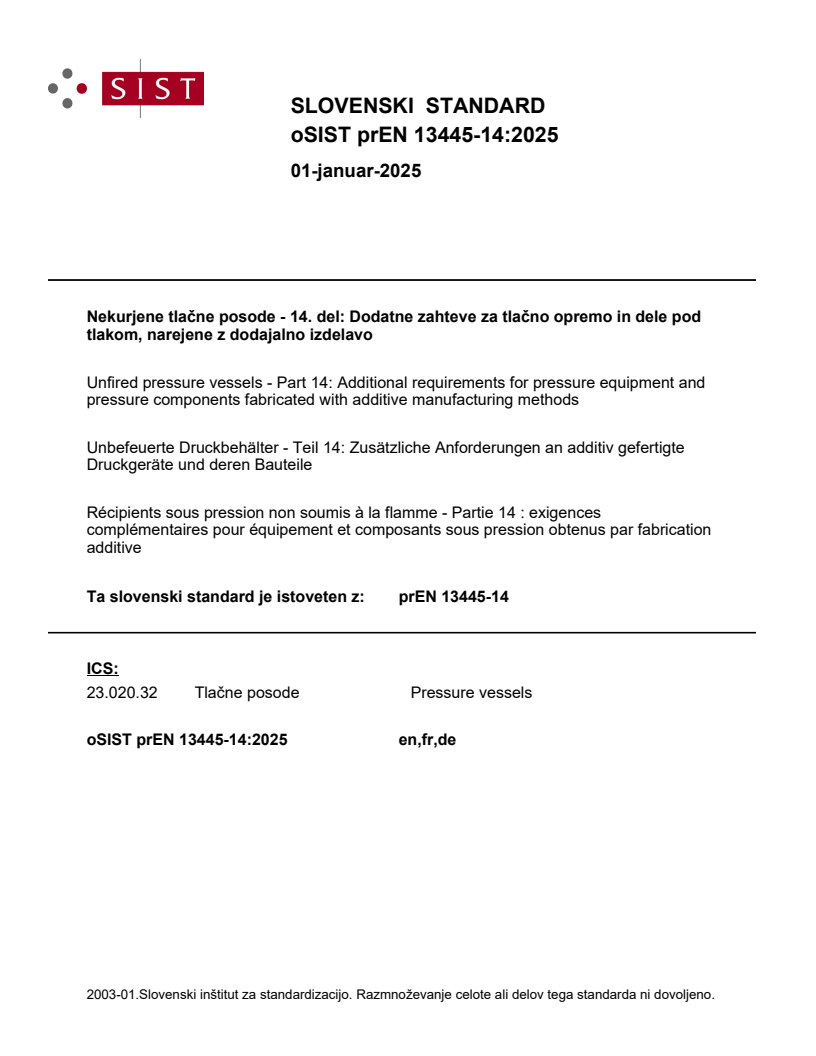
SLOVENSKI STANDARD
01-januar-2025
Nekurjene tlačne posode - 14. del: Dodatne zahteve za tlačno opremo in dele pod
tlakom, narejene z dodajalno izdelavo
Unfired pressure vessels - Part 14: Additional requirements for pressure equipment and
pressure components fabricated with additive manufacturing methods
Unbefeuerte Druckbehälter - Teil 14: Zusätzliche Anforderungen an additiv gefertigte
Druckgeräte und deren Bauteile
Récipients sous pression non soumis à la flamme - Partie 14 : exigences
complémentaires pour équipement et composants sous pression obtenus par fabrication
additive
Ta slovenski standard je istoveten z: prEN 13445-14
ICS:
23.020.32 Tlačne posode Pressure vessels
2003-01.Slovenski inštitut za standardizacijo. Razmnoževanje celote ali delov tega standarda ni dovoljeno.
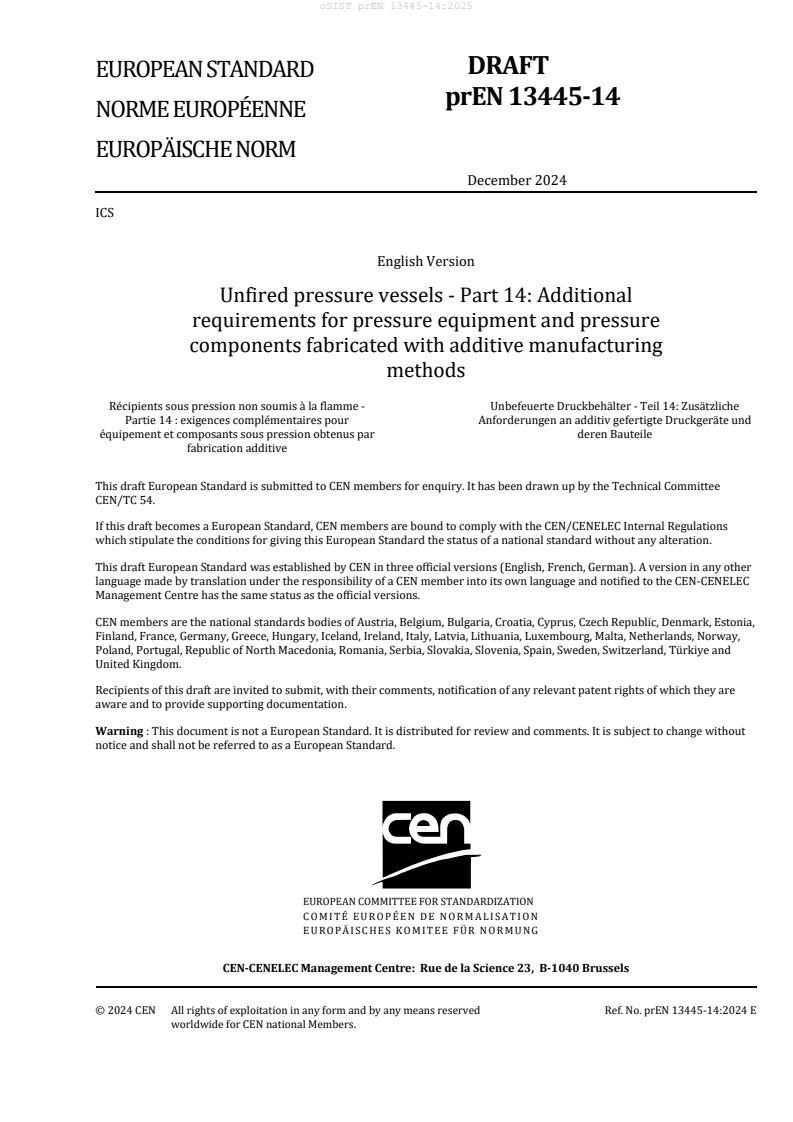
DRAFT
EUROPEAN STANDARD
prEN 13445-14
NORME EUROPÉENNE
EUROPÄISCHE NORM
December 2024
ICS
English Version
Unfired pressure vessels - Part 14: Additional
requirements for pressure equipment and pressure
components fabricated with additive manufacturing
methods
Récipients sous pression non soumis à la flamme - Unbefeuerte Druckbehälter - Teil 14: Zusätzliche
Partie 14 : exigences complémentaires pour Anforderungen an additiv gefertigte Druckgeräte und
équipement et composants sous pression obtenus par deren Bauteile
fabrication additive
This draft European Standard is submitted to CEN members for enquiry. It has been drawn up by the Technical Committee
CEN/TC 54.
If this draft becomes a European Standard, CEN members are bound to comply with the CEN/CENELEC Internal Regulations
which stipulate the conditions for giving this European Standard the status of a national standard without any alteration.
This draft European Standard was established by CEN in three official versions (English, French, German). A version in any other
language made by translation under the responsibility of a CEN member into its own language and notified to the CEN-CENELEC
Management Centre has the same status as the official versions.
CEN members are the national standards bodies of Austria, Belgium, Bulgaria, Croatia, Cyprus, Czech Republic, Denmark, Estonia,
Finland, France, Germany, Greece, Hungary, Iceland, Ireland, Italy, Latvia, Lithuania, Luxembourg, Malta, Netherlands, Norway,
Poland, Portugal, Republic of North Macedonia, Romania, Serbia, Slovakia, Slovenia, Spain, Sweden, Switzerland, Türkiye and
United Kingdom.
Recipients of this draft are invited to submit, with their comments, notification of any relevant patent rights of which they are
aware and to provide supporting documentation.
Warning : This document is not a European Standard. It is distributed for review and comments. It is subject to change without
notice and shall not be referred to as a European Standard.
EUROPEAN COMMITTEE FOR STANDARDIZATION
COMITÉ EUROPÉEN DE NORMALISATION
EUROPÄISCHES KOMITEE FÜR NORMUNG
CEN-CENELEC Management Centre: Rue de la Science 23, B-1040 Brussels
© 2024 CEN All rights of exploitation in any form and by any means reserved Ref. No. prEN 13445-14:2024 E
worldwide for CEN national Members.
prEN 13445-14:2024 (E)
Contents Page
European foreword . 4
Introduction . 5
1 Scope . 6
2 Normative references . 6
3 Terms and definitions . 8
4 General requirements . 12
5 Materials . 13
5.1 General requirements . 13
5.1.1 General requirements for establishing mechanical properties . 13
5.1.2 Materials with specified mechanical data . 13
5.1.3 Materials where mechanical properties of the processed parts are specified by the
part manufacturer . 13
5.1.4 Material data for establishing the design reference value R . 13
r
5.2 Material documentation . 14
5.3 Methodology for the certification of material . 14
5.4 Contents of the particular material appraisal (PMA) . 14
5.5 Avoidance of low brittle fracture . 14
6 Design . 14
6.1 General. 14
6.2 Nominal design stress . 15
6.3 Design by experimental method . 15
7 Fabrication . 16
7.1 General. 16
7.2 Quality management system route for verification of the process . 16
7.3 Direct inspection route for the verification process . 16
7.4 Heat treatment . 16
7.5 Identification system . 17
7.6 Permanent joining of AM components . 17
8 Inspection and testing . 17
8.1 General. 17
8.2 Non-destructive and destructive testing . 17
8.3 Marking and documentation . 18
8.3.1 General. 18
8.3.2 Marking and documentation of components . 18
Annex A (normative) Powder bed fusion (PBF) . 19
A.1 Requirements for PBF (all materials) . 19
A.2 PBF for steels . 32
A.3 PBF for aluminium alloys . 35
A.4 PBF for nickel alloys . 35
Annex B (normative) Directed energy deposition (DED) . 40
B.1 Requirements for DED wire (all materials) . 40
B.2 DED for steel . 56
B.3 DED for aluminium . 77
prEN 13445-14:2024 (E)
B.4 DED for nickel alloy . 93
B.5 DED for titanium alloy . 93
B.6 DED copper alloy . 93
B.7 DED for zirconium alloy . 93
Annex ZA (informative) Relationship between this European Standard and the essential
requirements of Directive 2014/68/EU aimed to be covered . 94
Bibliography . 95
prEN 13445-14:2024 (E)
European foreword
This document (prEN 13445-14:2024) has been prepared by Technical Committee CEN/TC 54 “Unfired
pressure vessels”, the secretariat of which is held by BSI.
This document is currently submitted to the CEN Enquiry.
This document has been prepared under a standardization request addressed to CEN by the European
Commission. The Standing Committee of the EFTA States subsequently approves these requests for its
Member States.
For the relationship with EU Legislation, see informative Annex ZA, which is an integral part of this
document.
prEN 13445-14:2024 (E)
Introduction
This document is applicable to unfired pressure vessels or parts of pressure vessels made with additive
manufacturing (AM) processes.
This document is organized in a main part common to all additive manufacturing processes and
normative Annexes A to D.
Those Annexes are dedicated to specific AM processes and contain requirements relevant to specific
materials.
In this first edition of this document, only Annex A and Annex B are available. The other Annexes will be
added to this document during amendment or revision as they are completed.
The structure of the specific Annexes is described in Table 1.
Table 1 — Structure of Annexes of this document
Annex Annex A Annex B Annex C Annex D
DED using DED using
Powder Binder
AM Process wire powder
bed fusion jetting
feedstock feedstock
General A1 B1 C1 D1
Steel A2 B2 C2 D2
Aluminum
A3 B3 C3 D3
alloys
Nickel base
A4 B4 C4 D4
alloys
Materials
Titanium
A5 B5 C5 D5
alloys
Copper
A6 B6 C6 D6
alloys
Zirconium
A7 B7 C7 D7
alloys
prEN 13445-14:2024 (E)
1 Scope
This document specifies general requirements for the application of additive manufacturing processes
for pressure vessels and parts.
Separate Annexes of this document provide detailed requirements for specific additive manufacturing
processes and materials.
This document is currently limited to metallic material applications. If a pressure part manufactured to
this document is integrated into a pressure vessel, all parts of EN 13445 apply for this integration.
2 Normative references
The following documents are referred to in the text in such a way that some or all of their content
constitutes requirements of this document. For dated references, only the edition cited applies. For
undated references, the latest edition of the referenced document (including any amendments) applies.
EN 764-4:2014, Pressure equipment — Part 4: Establishment of technical delivery conditions for metallic
materials
EN 764-5:2014, Pressure equipment — Part 5: Inspection documentation of metallic materials and
compliance with the material specification
EN 10204:2004, Metallic products — Types of inspection documents
EN 13445-1:2021, Unfired pressure vessels — Part 1: General
EN 13445-2:2021+A1:2023, Unfired pressure vessels — Part 2: Materials
EN 13445-3:2021, Unfired pressure vessels — Part 3: Design
EN 13445-4:2021+A1:2023, Unfired pressure vessels — Part 4: Fabrication
EN 13445-5:2021+A1:2024, Unfired pressure vessels — Part 5: Inspection and testing
EN 13445-8:2021, Unfired pressure vessels — Part 8: Additional requirements for pressure vessels of
aluminium and aluminium alloys
EN 13445-10:2021, Unfired pressure vessels — Part 10: Additional requirements for pressure vessels of
nickel and nickel alloys
EN 14532-1:2004, Welding consumables — Test methods and quality requirements — Part 1: Primary
methods and conformity assessment of consumables for steel, nickel and nickel alloys
EN 14532-2:2004, Welding consumables — Test methods and quality requirements — Part 2:
Supplementary methods and conformity assessment of consumables for steel, nickel and nickel alloys
EN 14532-3:2004, Welding consumables — Test methods and quality requirements — Part 3: Conformity
assessment of wire electrodes, wires and rods for welding of aluminium alloys
EN ISO 148-1:2016, Metallic materials — Charpy pendulum impact test — Part 1: Test method (ISO 148-
1:2016)
EN ISO 636:2017, Welding consumables — Rods, wires and deposits for tungsten inert gas welding of non-
alloy and fine-grain steels — Classification (ISO 636:2017)
prEN 13445-14:2024 (E)
EN ISO 3452-1:2021, Non-destructive testing — Penetrant testing — Part 1: General principles (ISO 3452-
1:2021)
EN ISO 4136:2022, Destructive tests on welds in metallic materials — Transverse tensile test (ISO
4136:2022)
EN ISO 5173:2023, Destructive tests on welds in metallic materials — Bend tests (ISO 5173:2023)
EN ISO 5178:2019, Destructive tests on welds in metallic materials — Longitudinal tensile test on weld
metal in fusion welded joints (ISO 5178:2019)
EN ISO 6892-1:2019, Metallic materials — Tensile testing — Part 1: Method of test at room temperature
(ISO 6892-1:2019)
EN ISO 6892-2:2018, Metallic materials — Tensile testing — Part 2: Method of test at elevated
temperature (ISO 6892-2:2018)
EN ISO 9015-1:2011, Destructive tests on welds in metallic materials — Hardness testing — Part 1:
Hardness test on arc welded joints (ISO 9015-1:2001)
EN ISO 10042:2018, Welding — Arc-welded joints in aluminium and its alloys — Quality levels for
imperfections (ISO 10042:2018)
EN ISO 14175:2008, Welding consumables — Gases and gas mixtures for fusion welding and allied
processes (ISO 14175:2008)
EN ISO 14341:2020, Welding consumables — Wire electrodes and weld deposits for gas shielded metal
arc welding of non alloy and fine grain steels — Classification (ISO 14341:2020)
EN ISO 14343:2017, Welding consumables — Wire electrodes, strip electrodes, wires and rods for arc
welding of stainless and heat resisting steels — Classification (ISO 14343:2017)
EN ISO 14732:2013, Welding personnel — Qualification testing of welding operators and weld setters for
mechanized and automatic welding of metallic materials (ISO 14732:2013)
EN ISO 15708-2:2019, Non-destructive testing — Radiation methods for Computed tomography — Part 2:
Principles, equipment and samples (ISO 15708-2:2017)
EN ISO 15614-1:2017, Specification and qualification of welding procedures for metallic materials —
Welding procedure test — Part 1 : arc and gas welding of steels and arc welding of nickel and nickel alloys
EN ISO 15614-2:2005, Specification and qualification of welding procedures for metallic materials —
Welding procedure test — Part 2: Arc welding of aluminium and its alloys (ISO 15614-2:2005)
EN ISO 15614-11:2002, Specification and qualification of welding procedures for metallic materials —
Welding procedure test — Part 11: Electron and laser beam welding (ISO 15614-11:2002)
EN ISO 17635:2016, Non-destructive testing of welds — General rules for metallic materials (ISO
17635:2016)
As impacted by EN ISO 15614-1:2017/A1:2019.
prEN 13445-14:2024 (E)
EN ISO 17636-1:2022, Non-destructive testing of welds — Radiographic testing — Part 1: X- and gamma-
ray techniques with film (ISO 17636-1:2022)
EN ISO 17637:2016, Non-destructive testing of welds — Visual testing of fusion-welded joints (ISO
17637:2016)
EN ISO 17639:2022, Destructive tests on welds in metallic materials — Macroscopic and microscopic
examination of welds (ISO 17639:2022)
EN ISO 17640:2018, Non-destructive testing of welds — Ultrasonic testing — Techniques, testing levels,
and assessment (ISO 17640:2018)
EN ISO 18273:2015, Welding consumables — Wire electrodes, wires and rods for welding of aluminium
and aluminium alloys — Classification (ISO 18273:2015)
EN ISO 21952:2012, Welding consumables — Wire electrodes, wires, rods and deposits for gas shielded
arc welding of creep-resisting steels — Classification (ISO 21952:2012)
EN ISO/ASTM 52900:2021, Additive manufacturing — General principles — Fundamentals and
vocabulary (ISO/ASTM 52900:2021)
EN ISO/ASTM 52904:2024, Additive manufacturing of metals — Process characteristics and performance
— Metal powder bed fusion process to meet critical applications (ISO/ASTM 52904:2024)
EN ISO/ASTM 52907:2019, Additive manufacturing — Feedstock materials — Methods to characterize
metal powders (ISO/ASTM 52907:2019)
EN ISO/ASTM 52911-1:2019, Additive manufacturing — Design — Part 1 : Laser-based powder bed
fusion of metals (ISO/ASTM 52911-1:2019)
EN ISO/ASTM 52926-1:2023, Additive Manufacturing of metals — Qualification principles — Part 1:
General qualification of operators (ISO/ASTM 52926-1:2023)
EN ISO/ASTM 52926-5:2023, Additive manufacturing of metals — Qualification principles — Part 5:
Qualification of operators for DED-Arc (ISO/ASTM 52926-5:2023)
EN ISO/ASTM 52928:2024, Additive manufacturing of metals— Feedstock materials — Powder life cycle
management (ISO/ASTM 52928:2024)
CEN ISO/ASTM/TS 52930:2021, Additive Manufacturing — Qualification principles — Installation,
operation and performance (IQ/OQ/PQ) of PBF-LB equipment (ISO/ASTM/TS 52930:2021)
EN ISO/ASTM 52941:2020, System performance and reliability — Acceptance tests for laser metal
powder-bed fusion machines for metallic materials for aerospace application (ISO/ASTM 52941:2020)
3 Terms and definitions
For the purposes of this document, the terms and definitions given in EN 13445-1:2021 and
EN ISO/ASTM 52900:2021 and the following apply.
ISO and IEC maintain terminology databases for use in standardization at the following addresses:
— ISO Online browsing platform: available at https://www.iso.org/obp/
— IEC Electropedia: available at https://www.electropedia.org/
prEN 13445-14:2024 (E)
3.1
additive manufacturing
AM
process of joining materials to make parts from 3D model data, usually layer upon layer, as opposed to
subtractive manufacturing and formative manufacturing methodologies
Note 1 to entry: Historical terms: additive fabrication, additive processes, additive techniques, additive layer
manufacturing, layer manufacturing, solid freeform fabrication and freeform fabrication.
[SOURCE: EN ISO/ASTM 52900:2021, 3.1.2]
3.2
annealed
heat treatment to increase the ductility of the material and reduce its hardness, making it more
workable
Note 1 to entry: Annealed involves heating a material above its recrystallization temperature, maintaining a
specified temperature for a defined time, and then cooling according to the selected method.
3.3
batch
defined quantity of feedstock with uniform properties and composition
Note 1 to entry: One batch of any feedstock can be used in one or more production runs using different process
parameters.
Note 2 to entry: For some types of feedstock, for example powders and resins, one batch can consist of virgin
material, used material or a blend of virgin and used materials.
[SOURCE: EN ISO/ASTM 52900:2021, 3.6.1]
3.4
bead
single deposition run made on the build surface
3.5
build cycle
single process cycle in which one or more parts are built up in layers
[SOURCE: EN ISO/ASTM 52900:2021, 3.3.8, modified]
3.6
build platform
base which provides a surface upon which the building of the part(s) is started and
supported throughout the build process
[SOURCE: EN ISO/ASTM 52900:2021, 3.3.5]
prEN 13445-14:2024 (E)
3.7
build surface
area where material is added, normally on the last deposited layer which becomes the foundation upon
which the next layer is formed
Note 1 to entry: For the first layer, the build surface is often the build platform (A.2.3.5).
Note 2 to entry: In the case of directed energy deposition processes, the build surface can be an existing part onto
which material is added.
Note 3 to entry: If the orientation of the material deposition or consolidation means, or both, is variable, it may be
defined relative to the build surface.
[SOURCE: EN ISO/ASTM 52900:2021, 3.3.6]
3.8
component
part of pressure equipment which can be considered as an individual item for the calculation
[SOURCE: EN 13445-3:2021, 3.7]
3.9
design class
DC
class for design which determines the design class factor to use for the design according to the level of
non-destructive testing (NDT)
3.10
design class factor
F
dc
reducing factor taking into account the NDT range, applied to the design stress to account for any
manufacturing imperfections
3.11
directed energy deposition
DED
additive manufacturing process in which focused thermal energy is used to fuse materials by melting as
they are being deposited
Note 1 to entry: “Focused thermal energy” means that an energy source (e.g. laser, electron beam, or plasma arc)
is focused to melt the materials being deposited.
[SOURCE: EN ISO/ASTM 52900:2021, 3.2.2]
3.12
feedstock
bulk raw material supplied to the additive manufacturing building process
Note 1 to entry: For additive manufacturing building processes, the bulk raw material is typically supplied in
various forms such as liquid, powder, suspensions, filaments, sheets, etc.
[SOURCE: EN ISO/ASTM 52900:2021, 3.6.5]
prEN 13445-14:2024 (E)
3.13
feedstock supplier
feedstock vendor
provider of feedstock
Note 1 to entry: In additive manufacturing, the feedstock supplier can often be a different entity than the
feedstock manufacturer.
[SOURCE ISO/ASTM 52900:2021, 3.6.7]
3.14
layer
material laid out, or spread, to create a surface
Note 1 to entry: A layer may include single or multiple deposition runs.
[SOURCE: ISO/ASTM 52900:2021, 3.3.7 modified]
3.15
longitudinal bend test specimen
test specimen for a test that is longitudinally bisected by the portion of the weld included in it; tests in
welding direction or within the layers, respectively
[SOURCE: ISO/TR 25901-1:2016, 2.2.3.8 modified]
3.16
multi-bead performance
wall thickness made from two or more beads
Note 1 to entry: Multi-bead performance can include weaving.
3.17
near net shape
condition where the components require little post-processing to meet dimensional tolerance
[SOURCE: EN ISO/ASTM 52900:2021, 3.11.7]
3.18
part
joined material forming a functional element that could constitute all or a section of a pressure
equipment
Note 1 to entry: The functional requirements for a part are typically determined by the intended application.
[SOURCE: EN ISO/ASTM 52900:2021, 3.9.1, modified]
3.19
post-processing
process step, or series of process steps, taken after the completion of an additive manufacturing build
cycle in order to achieve the desired properties in the final product
[SOURCE: EN ISO/ASTM 52900:2021, 3.6.10]
prEN 13445-14:2024 (E)
3.20
powder bed fusion
PBF
additive manufacturing process in which thermal energy selectively fuses regions of a powder bed
[SOURCE: EN ISO/ASTM 52900:2021, 3.2.5]
3.21
process parameters
operating parameters and system settings used during a build cycle
[SOURCE: EN ISO/ASTM 52900:2021, 3.3.10]
3.22
reference value
R
r
value used for design calculations or burst test procedure for pressure vessels and parts with varying
mechanical properties depending on the position and orientation within the part
Note 1 to entry: This is the value taking into consideration all stress directions or for a simplified approach the
lowest value of mechanical properties considering all positions/orientations.
3.23
single-bead performance
wall thickness made from one bead
Note 1 to entry: Single-bead performance can include weaving.
3.24
solution annealing
heat treatment in order to place the constituents into solid solution
Note 1 to entry: The material is held at the temperatures for a period necessary to bring the alloying elements
into a solid solution.
4 General requirements
The material manufacturer is the party responsible for providing certification of the consolidated
material. This is typically the party that performs the additive manufacturing process, although in
exceptional cases where the feedstock supplier confirms that consolidated material properties comply
with a European Standard or other published specification (see 5.1.2) then the feedstock supplier can
be the material manufacturer (see Figure 1). The material manufacturer can also be the part
manufacturer.
The material manufacturer shall produce a material certificate 3.1 or 3.2 as defined in EN 10204:2004
in accordance with EN 764-5:2014, based on a material specification issued in compliance with
EN 764-4:2014 and the applicable Annex of this document. The material manufacturer shall affirm the
mechanical properties used for the design.
prEN 13445-14:2024 (E)
5 Materials
5.1 General requirements
5.1.1 General requirements for establishing mechanical properties
EN 13445-2:2021+A1:2023 is applicable only where it is referred to in this document.
Materials selected in accordance with this document shall be suitable for the additive manufacturing
process.
The part manufacturer shall document the mechanical properties used for design and the source of
these data.
5.1.2 Materials with specified mechanical data
Material mechanical data used for design shall be as specified in the specific Annex of this document or
according to harmonized additive manufacturing material standards or according to standards within
other pressure equipment codes and standards. For mechanical data coming from non-harmonized
codes and standards, a PMA is required.
The procedure to verify these values shall comply with the requirements in the specific Annex of this
document.
5.1.3 Materials where mechanical properties of the processed parts are specified by the part
manufacturer
The mechanical data used for design shall be either those given in the specific Annex of this document
or the way of obtaining the values shall be described fully. The procedure to verify the values used shall
comply with the requirements in the specific Annex of this document.
5.1.4 Material data for establishing the design reference value R
r
R is the reference value used to determine the nominal design stress, f (see 6.2), used in the design
r Rr
calculations or burst test procedure.
NOTE See 3.22 for full definition.
Figure 1 describes how to obtain the appropriate data for material.
prEN 13445-14:2024 (E)
Figure 1 — Flowchart to obtain material data for design
5.2 Material documentation
The material manufacturer shall provide the inspection documents required by Clause 4. The
documentation shall comply with the requirements in the specific Annex of this document.
The part manufacturer shall ensure that the material conforms with the material specification.
5.3 Methodology for the certification of material
Requirements of EN 764-5:2015 apply. Where applicable, further requirements are detailed in the
relevant Annexes of this document.
5.4 Contents of the particular material appraisal (PMA)
The PMA, where required, shall consider the material specification as referred to in Clause 4. Where
applicable, further requirements are detailed in the relevant Annexes of this document.
5.5 Avoidance of low brittle fracture
The method for avoidance of low temperature brittle fracture shall be either one of the methods
described in EN 13445-2:2021+A1:2023, EN 13445-8:2021 or EN 13445-10:2021 or a method specified
in the specific Annex of this document.
If a method is specified in a specific Annex dealing with carbon steels, low-alloy steels or austenitic
steels, the toughness requirements of EN 13445-2:2021+A1:2023, 4.1.6, shall be fulfilled.
6 Design
6.1 General
EN 13445-3:2021 applies with the following:
Unless specifically addressed in one of the specific Annexes of this standard, fatigue design for more
than 500 full equivalent pressure cycles is not covered by this document for pressure vessels and parts
made by additive manufacturing. For the determination of 500 full equivalent pressure cycles, see
EN 13445-3:2021, 5.4.2.
prEN 13445-14:2024 (E)
NOTE 1 This will be subject to a future revision of or an amendment to this document.
For establishing of nominal design stresses, refer to 6.2.
Where creep design is applied, the approach described in EN 13445-3:2021, Clause 19 shall be used.
NOTE 2 A pre-supposition of the requirements in EN 13445-3:2021, Clause 19 is usage of sufficiently creep
ductile materials. Since the material grades listed in EN 13445-2:2021+A1:2023, Table E.2-1 do not include
additively manufactured materials, other evidence that the AM material is sufficiently creep ductile is necessary
for the application of 13445-3, Clause 19.
The safety factor S used in EN 13445-3:2021, EN 13445-8:2021, and EN 13445-10:2021 for establishing
nominal design stresses applies, provided that the specified minimum elongation after fracture fulfils
the criteria as laid down in EN 13445-2:2021+A1:2023, EN 13445-8:2021, and EN 13445-10:2021.
Material(s) with lower elongation values may also be applied, provided that the requirements of
EN 13445-2:2021+A1:2023, Clause 4.1.5 are fulfilled. The corresponding measures shall comply with
the specific Annexes of this document.
NOTE 3 Examples for compensation:
— application of higher safety factors in design;
— performance of burst tests to demonstrate ductile material behaviour.
If applicable, more detailed requirements are specified in the specific Annex of this document.
6.2 Nominal design stress
Nominal design stresses f shall be determined using Formula (1) as follows:
Rr
f = F . RS/ (1)
R dc r
r
where
shall be used instead of the nominal stresses in EN 13445-3:2021 for establishing the
f
R
r
calculated wall thickness e or for establishing the design pressure for burst testing as
described in EN 13445-3:2021, Annex T;
is the design class factor as defined in 3.10;
F
dc
is the appropriate mechanical property (see 5.1.4) and used in EN 13445-3:2021, EN 13445-
Rr
8:2021, and EN 13445-10:2021 for establishing nominal design stresses;
S is the safety factor used in EN 13445-3:2021, EN 13445-8:2021, and EN 13445-10:2021 for
establishing nominal design stresses;
Nominal design stress f shall be established at design temperature.
Rr
6.3 Design by experimental method
Where a product is designed by experimental methods, EN 13445-3:2021, Annex T may be used. This
requires several values to be determined, in particular the actual wall thickness, e . In cases where
act
direct measurement can be made of the wall thickness (where bursting is likely to start), this shall be
used for eact. However, it is recognized that the AM process is expected to produce a single, enclosed
pressure component, in which case it is unlikely that the wall thickness would be directly measurable.
Therefore, the following alternative methods may be used, in conjunction with the approach described
within EN 13445-3:2021, Annex T, subject to satisfying the stated conditions:
prEN 13445-14:2024 (E)
(i) Produce a representative test piece of the pressure boundary and interior of the non-measurable
pressure equipment and perform a burst test on this test piece. To be representative, the nominal
wall thickness and predicted stresses with increasing pressure in the area where bursting is likely
to start shall be consistent with those in the actual part. The predicted stresses in the actual part
and the test piece shall be determined using the same method and the same material properties
(as stated in the material specification); where a finite element analysis approach is used, the
requirements stated in EN 13445-3:2021, Annex B apply. Following the burst test, actual material
property values (that conform to the requirements of the material specification) shall be used for
determining the design pressure, as described within EN 13445-3:2021, Annex T.
(ii) Test an actual pre-production part using measurements taken during the build process of the
actual part to determine e (e.g. utilizing images of the fused layers), provided that the method
act
used is validated beforehand using actual measurements on test pieces that have been subjected
to the same build process and thermal post-processing.
(iii) Test an actual pre-production part using measurements determined from a test piece that is
representative of a section of the actual part containing the wall thickness to be measured, and
directly measure that wall to determine e . The test piece shall be produced using the same build
act
process and thermal post-processing as the actual part, prior to taking the measurement.
For each approach described above, where a representative test piece is specified, three test pieces
shall be produced, before manufacturing of the final part, and used to demonstrate consistency and the
minimum value for e shall be used in calculations.
act
7 Fabrication
7.1 General
EN 13445-4:2021+A1:2023 is applicable only where it is referred to in this document.
7.2 Quality management system route for verification of the process
The material manufacturer shall comply with the requirements of EN 764-5:2014, Clause 4, and
requirements within the specific Annex of this document.
Parameter control is essential for the consistency of Rr throughout the build, and the reproducibility of
R between builds. The requirements for parameter control for the selected AM method are defined
r
within the specific Annex of this document.
7.3 Direct inspection route for the verification process
The material manufacturer shall comply with the requirements of EN 764-5:2014, Clause 5, and
requirements within the specific Annex of this document.
Parameter control is essential for the consistency of R throughout the build. The requirements for
r
parameter control for the selected AM method are defined within the specific Annex of this document.
7.4 Heat treatment
Heat treatment applied during or after additive manufacturing shall fulfill the requirements of the
material specification and the establishment of the value R . It shall be part of the qualification of the
r.
manufacturing process. This qualification shall include as a minimum the type of heat treatment, heat
treatment parameters and parameter tolerances. Any deviation from these parameters shall require a
new qualification.
prEN 13445-14:2024 (E)
7.5 Identification system
The part manufacturer shall have and maintain an identification system for materials and feedstock
used in fabrication. All material subject to stress due to pressure in the completed work shall be
traceable to its origin by recording the batch number.
7.6 Permanent joining of AM components
This document is not applicable to the joining by welding or brazing of additively manufactured parts to
other additively manufactured parts or to conventionally manufactured parts. For permanent joining,
the requirements of EN 13445-4:2021+A1:2023, EN 13445-8:2021 and EN 13445-10:2021 shall apply,
including consideration of dissimilar materials, or physical properties.
Where the build platform remains in the finished part, the requirements for proving the joint between
the build platform and AM material is addressed in B.1.7.2.2.4 (ii) (Parts with integrated build platform)
and B.1.7.2.4 (iii).
8 Inspection and testing
8.1 General
EN 13445-5:2021+A1:2024 applies with the following modifications:
in 4.2 the reference to testing group shall be replaced by a reference to design class;
4.3 does not apply;
in addition to the requirements listed in 5.2.2 c), the value R and the design class DC shall be given;
r
Clause 6 does not apply;
7.1 and 7.2 do not apply.
8.2 Non-destructive and destructive testing
All pressure vessels and parts shall be subject to 100 % visual examination of all areas that can be
exposed to view.
The required extent of non-destructive and destructive testing depends on the design class. Relation
between design classes and testing is given in Table 2.
Non-destructive testing (NDT) typically includes volumetric testing and surface testing. The type of
NDT as well as the acceptance criteria are specified in the specific Annex of this document.
If NDT is specified as “Full” in Table 2, all areas governing the design shall be fully tested.
If NDT is specified as “Spot” in Table 2, areas governing the design shall be spot-tested. The extent of
NDT shall be specified for each individual pressure vessel or part in the applicable Annex of this
document.
NOTE A full test of the areas governing the design means either to test the area in question by 100 % or to apply
a suitable grid covering this area. Similarly, in the case of spot-testing the chosen areas are either to be fully tested
or by application of a suitable grate.
If NDT is specified as “Random spot” in Table 2, areas governing the design shall be spot-tested for a
randomly chosen lot of pressure vessels and parts. The designation of the lot and the extent of NDT are
specified in the applicable Annex of this document.
If destructive testing is specified in Table 2, this destructive testing shall be carried out to verify R .
r
prEN 13445-14:2024 (E)
Table 2 — Design classes
Design class DC 1 DC 2 DC 3 DC 4
F 1 0,85 0,7 0,5
dc
Burst test
A, B, C A, B A A
a, c
method
Destructive See specific See specific
See specific Annexes See specific Annexes
testing Annexes Annexes
Full unless specified Spot unless specified
Non-destructive Random
Full otherwise in the specific otherwise in the specific
b
testing spot
Annex Annex
a
For explanation of the different burst test methods, see EN 13445-3:2021, Annex T.
b
In the case of a pneumatic pressure test with a test pressure of 1,1 PS (see e.g. EN 13445-5:2021+A1:2024, 10.2.3.4.2 or
EN 13445-8:2021, 8.7), NDT shall be carried out and the extent of this NDT shall be not less than for DC 2.
c
When selected as design base.
8.3 Marking and documentation
8.3.1 General
The requirements in EN 13445-5:2021+A1:2024, 11.5 and Clause 12, shall be followed.
8.3.2 Marking and documentation of components
This subclause is applicable if a manufacturer supplies a component manufactured under the provisions
of this document to other parties.
Components shall be marked in such a way that they can be attributed to the documents as described
below.
Where a component is to be incorporated into a larger pressure assembly, the component shall be
accompanied by a certificate that references this document and confirms the value R and the design
r
class DC.
If further information/documentation (such as information about NDT, destructive testing, heat
treatment) is required, the purchaser of the component shall specify this in the order.
prEN 13445-14:2024 (E)
Annex A
(normative)
Powder bed fusion (PBF)
A.1 Requirements for PBF (all materials)
A.1.1 Application boundary of this Annex
This Annex contains specific requirements for laser and electron beam powder bed fusion processes.
A.1.2 Background information
For the purpose of this Annex, the normative references cited in Clause 2 are applicable.
A.1.3 Terminology
For the purpose of this Annex, the terms and definitions cited in Clause 3 are applicable.
A.1.4 General requirements
This Annex has the structure according to Table A.1.
Table A.1 — Structure of Annex A
Process
Powder Bed Fusion (PBF) -
Annex A
General A.1
Steels A.2 (Later version)
Aluminium alloys A.3 (Later version)
Nickel Base alloys A.4
Copper alloys A.5 (Later version)
Materials
Titanium alloys A.6 (Later version)
Zirconium alloys A.7 (Later version)
Etc.
prEN 13445-14:2024 (E)
A.1.5 Materials
A.1.5.1 General requirements
The sections of this Annex shall be applied for the maximum values of the nominal design stress for
normal load cases and for test load cases.
Subclause 5.1 applies as modified by the material specific clauses.
A.1.5.2 Material documentation
A.1.5.2.1 General
Material documentation, as outlined in the following subclauses, is required.
A.1.5.2.2 Requirements for the feedstock manufacturer
The feedstock shall be manufactured with reproducible quality and shall meet the requirements of the
applicable standards, regulations and specifications as well as this technical delivery condition. The
feedstock manufacturer shall ensure that the manufacturing process repeatedly
...
Le document oSIST prEN 13445-14:2025 établit des exigences générales pour l'application des procédés de fabrication additive dans le domaine des réservoirs sous pression et des composants de pression. Ce standard revêt une grande importance dans le contexte actuel où l’additive manufacturing, ou fabrication additive, devient de plus en plus intégré dans l’industrie des équipements sous pression. L'un des principaux atouts de ce standard est qu'il fournit des exigences spécifiques et détaillées qui s'appliquent aux matériaux et procédés de fabrication additive, offrant ainsi un cadre clair et précis pour les fabricants. Les annexes séparées de ce document renforcent cette approche en décrivant les exigences supplémentaires pour des procédés de fabrication additive spécifiques. Cela garantit que les utilisateurs disposent des informations nécessaires pour appliquer correctement ces technologies innovantes, tout en respectant la sécurité et la fiabilité des équipements fabriqués. Un autre point fort de cette norme est son approche méticuleuse concernant l'intégration des parties fabriquées selon ce standard dans un réservoir sous pression. La stipulation que toutes les parties de la norme EN 13445 s'appliquent en cas d'intégration démontre une prise en compte rigoureuse de la sécurité et de la conformité au sein de l'ensemble du système. Le fait que le standard se concentre actuellement uniquement sur les applications en matériaux métalliques souligne son importance pour les secteurs industriels qui utilisent principalement des matériaux métalliques dans leurs créations. Cela le rend particulièrement pertinent pour les entreprises qui cherchent à adopter la fabrication additive tout en maintenant des normes élevées de sécurité et de qualité dans leurs processus de fabrication. Dans l'ensemble, le oSIST prEN 13445-14:2025 constitue une avancée significative dans la standardisation de la fabrication additive dans les équipements sous pression, en établissant des critères clairs et en abordant les préoccupations spécifiques liées à ces technologies émergentes.
The standard oSIST prEN 13445-14:2025 outlines comprehensive general requirements for the incorporation of additive manufacturing processes in the fabrication of unfired pressure vessels and associated parts. Its primary scope focuses on the critical aspects of utilizing additive manufacturing methods specifically for pressure equipment and pressure components, making it a pivotal resource for the industry transitioning to advanced manufacturing techniques. One of the significant strengths of this standard is its structured approach, which includes dedicated annexes that specify detailed requirements tailored to particular additive manufacturing processes and materials. This inclusion aids manufacturers in understanding best practices and adheres to safety and regulatory expectations. Moreover, the focus on metallic materials ensures that the standard addresses the most common materials used in pressure vessel fabrication, thus enhancing its practical applicability within the field. Another noteworthy aspect of this document is its integration mandate with EN 13445, which ensures that all pertinent regulations governing pressure vessels remain applicable when components produced under this standard are incorporated into a larger system. This alignment highlights the standard's relevance, ensuring that manufacturers can confidently deliver products that meet both innovative design practices and regulatory compliance. In summary, oSIST prEN 13445-14:2025 serves as an essential guideline for industry stakeholders, emphasizing the emerging prominence of additive manufacturing in the production of pressure vessels and parts while ensuring adherence to stringent safety standards. Its emphasis on specific processes, materials, and integration with existing regulations enhances its utility and relevance in contemporary manufacturing ecosystems.
oSIST prEN 13445-14:2025 표준은 비가열 압력 용기와 관련된 추가 요구 사항을 규정하고 있으며, 특히 적층 제조 방법으로 제작된 압력 장비 및 압력 구성 요소에 중점을 둡니다. 이 표준은 압력 용기 및 부품의 적층 제조 공정 적용에 대한 일반 요구 사항을 명시하고 있으며, 특정 적층 제조 공정 및 재료에 대한 자세한 요구 사항은 별도의 부록으로 제공됩니다. 이 표준의 힘은 현대 제조 기술인 적층 제조를 효과적으로 수용하고 적용할 수 있다는 점입니다. 특히, 금속 재료에 한정하여 현재의 적층 제조 방식에 대한 엄격한 지침을 제공함으로써, 품질 관리 및 안전성을 높이고 있습니다. 이는 압력 용기의 설계를 혁신하고, 새로운 제조 기술을 활용하여 효율성을 극대화할 수 있는 중요한 기회를 제공하는 요소입니다. 또한, 이 문서는 EN 13445와의 통합을 명확히 하여, 적층 제조 공법으로 제작된 압력 부품이 압력 용기에 통합될 경우 모든 EN 13445 조항이 적용됨을 강조하고 있습니다. 이는 사용자와 제조업체가 표준의 일관성을 유지하면서도 새로운 기술을 활용할 수 있도록 하는 중요한 연결고리 역할을 합니다. 결론적으로, oSIST prEN 13445-14:2025는 적층 제조 기술의 발전에 발맞춰 압력 용기 제조 과정에서의 안전성과 품질을 보장하는 데 필수적인 표준입니다. 이 표준은 업계에서의 실질적인 요구를 반영하고, 금속 재료를 중심으로한 적층 제조의 적용에 따른 명확한 요구 사항을 제시함으로써, 관련된 모든 분야에 걸쳐 중요한 영향을 미칠 것으로 보입니다.
Die Norm oSIST prEN 13445-14:2025 stellt einen wesentlichen Fortschritt in der Regulierung von unbefeuerten Druckbehältern dar, indem sie spezifische Anforderungen für die Anwendung von additiven Fertigungsverfahren für Druckgeräte und -komponenten definiert. Ihr Anwendungsbereich ist klar umrissen und konzentriert sich auf die Verwendung von metallischen Materialien, was für die Branche von großer Bedeutung ist. In einer Zeit, in der additive Fertigung zunehmend an Bedeutung gewinnt, zeigt diese Norm, wie wichtig es ist, klare Richtlinien und Standards zu haben, um Sicherheit und Qualität zu gewährleisten. Ein herausragendes Merkmal dieser Norm ist die Bereitstellung separater Anhänge, die detaillierte Anforderungen für spezifische additive Fertigungsverfahren und Materialien enthalten. Dies ermöglicht es Herstellern und Ingenieuren, präzise und konforme Lösungen zu entwickeln, die den einzigartigen Herausforderungen der additiven Fertigung gerecht werden. Die Norm schafft nicht nur Richtlinien, sondern fördert auch Best Practices in der Branche und trägt dazu bei, das Vertrauen in Produkte, die durch additive Fertigung hergestellt werden, zu stärken. Die Relevanz von oSIST prEN 13445-14:2025 ist unbestritten, da sie einen strukturierten Ansatz zur Integration moderner Fertigungstechnologien in etablierte Vorgaben des Druckbehälterbaus bietet. Der Hinweis, dass alle Teile von EN 13445 bei der Integration eines nach dieser Norm hergestellten Druckteils in einen Druckbehälter Anwendung finden, unterstreicht die umfassende Betrachtung der Norm und ihre Fähigkeit, bestehende Standards zu integrieren und damit ein hohes Maß an Sicherheit zu gewährleisten. Insgesamt bietet die Norm oSIST prEN 13445-14:2025 einen wichtigen Rahmen, der nicht nur den aktuellen Stand der Technik in der additiven Fertigung widerspiegelt, sondern auch die Zukunft der Druckgeräteherstellung mitgestaltet. Ihre Stärken liegen in der klaren Struktur, den umfassenden Anforderungen und der direkten Anwendbarkeit auf reale Fertigungsprozesse, was sie zu einem unverzichtbaren Leitfaden für die Industrie macht.
oSIST prEN 13445-14:2025は、圧力機器および圧力部品の製造における追加要件を定めた重要な標準です。この標準の主な範囲は、圧力容器および部品における添加製造プロセスの適用に関する一般要件を示しています。特に、金属材料の適用に限定されている点が特徴的です。 この標準の強みは、添加製造プロセスの多様な要求に対して、詳細な要件を提供する別の附属書が存在することです。これにより、特定の製造方法や材料に適した指針が確立され、製造業者やエンジニアは、より安全で信頼性の高い圧力機器を設計・製造するための基準を持つことができます。また、圧力部品がこの文書に基づいて製造された場合、その統合にはEN 13445の全ての部分が適用されるという明確なガイダンスが提供されているため、標準化プロセスの一環としての安心感もあります。 この標準は、圧力容器とその部品の安全性と性能の向上に寄与し、添加製造技術の進展に対応したものであるため、製造業界における関連性も非常に高いと言えます。特に、近年の工業界における additive manufacturing の普及に伴い、oSIST prEN 13445-14:2025は、将来の製品開発やリスクマネジメントの基盤となる可能性があります。
Questions, Comments and Discussion
Ask us and Technical Secretary will try to provide an answer. You can facilitate discussion about the standard in here.
Loading comments...