

SIST EN 13807:2026
(Main)Transportable gas cylinders - Battery vehicles and multiple-element gas containers (MEGCs) - Design, manufacture, identification and testing
General Information
- Abstract
This document specifies the requirements for the design, manufacture, identification and testing of battery vehicles and multiple-element gas containers (MEGCs) containing cylinders, tubes, or bundles of cylinders. This document applies also to battery vehicles and MEGCs containing bundles of cylinders connected by a manifold which are dis-assembled from the battery vehicle and filled individually.
It is applicable to battery vehicles and MEGCs containing compressed gas, liquefied gas, and mixtures thereof. It is also applicable to battery vehicles for dissolved acetylene.
This document is not applicable to battery vehicles and MEGC for toxic gases with an LC50 value less than or equal to 200 ml/m3.
This document does not apply to battery vehicles and MEGCs containing pressure drums or tanks.
This document does not specify requirements for the vehicle chassis or motive unit.
This document is primarily intended for industrial gases other than liquefied petroleum gases (LPG).
- Status
- Published
- Public Enquiry End Date
- 02-Feb-2025
- Publication Date
- 17-Mar-2026
- Technical Committee
- TLP - Pressure vessels
- Current Stage
- 6060 - National Implementation/Publication (Adopted Project)
- Start Date
- 11-Mar-2026
- Due Date
- 16-May-2026
- Completion Date
- 18-Mar-2026

Overview
SIST EN 13807:2026, published by CEN, specifies detailed requirements for the design, manufacture, identification, and testing of battery vehicles and multiple-element gas containers (MEGCs) that transport gas cylinders, tubes, or bundles of cylinders. This standard covers battery vehicles and MEGCs used with compressed gases, liquefied gases, dissolved acetylene, and their mixtures. The document is applicable to units where bundles of cylinders may be removed and filled individually, enhancing operational flexibility.
The standard does not apply to:
- Battery vehicles or MEGCs carrying toxic gases with an LC50 ≤ 200 ml/m³
- Units containing pressure drums or tanks
- Battery vehicle chassis or motive units
- Transportation of liquefied petroleum gases (LPG)
SIST EN 13807:2026 primarily targets the industrial gases sector, providing essential guidelines for safe, compliant, and efficient gas transport using battery vehicles and MEGCs.
Key Topics
The standard comprehensively addresses core aspects of battery vehicle and MEGC usage, including:
Design Requirements
- Temperature ranges for pressurized and non-pressurized components
- Impact and rollover protection measures
- Proper selection of materials for gas compatibility
- Stability, fastening, and support for secure attachment
Manufacturing
- Use of quality materials meeting European and ISO standards
- Specific guidelines for composite and metallic components
Identification
- Clear marking and unique identification for traceability
- Hazard and product identification systems to enhance safety
Testing and Inspection
- Type approval and initial inspection protocols
- Testing manifolds, valves, and assemblies for integrity and leakage
- Special requirements for vibration and impact resistance
- Documentation and retention protocols for inspection and conformity
Special Considerations
- Additional requirements for dissolved acetylene battery vehicles
- Exclusion of specific gas types and container formats for safety
Applications
SIST EN 13807:2026 is highly relevant to organizations and industries involved in:
- Industrial Gas Supply
- Distribution of oxygen, nitrogen, hydrogen, argon, and air
- Manufacture and Assembly
- Manufacturers of battery vehicles and MEGCs requiring adherence to consistent European standards for product quality and safety
- Gas Cylinder Filling Stations
- Facilities filling bundles individually or as part of assembled units
- Transport and Logistics
- Operators transporting large volumes of industrial gases safely and compliantly across national and international borders
The standard enhances operational safety, reduces risk of accidental leakage, and streamlines regulatory compliance, benefiting stakeholders across the gas transport and industrial supply chain.
Related Standards
For comprehensive compliance and best practices, SIST EN 13807:2026 should be used alongside the following standards and references:
- EN ISO 10961: Gas cylinders - Cylinder bundles - Design, manufacture, testing and inspection
- EN ISO 10297: Gas cylinders - Cylinder valves - Specification and type testing
- EN ISO 11114-1 / EN ISO 11114-2: Gas cylinders - Compatibility of cylinder and valve materials with gas contents
- EN ISO 23826: Gas cylinders - Ball valves - Specification and testing
- EN 10204: Metallic products - Types of inspection documents
- ISO 1496-3: Tank containers for liquids, gases and pressurized dry bulk
Aligning with these standards supports a robust safety management system for transportable gas cylinders and related assemblies.
By adopting SIST EN 13807:2026, manufacturers, operators, and users ensure safer, standardized operations in the transport of industrial gases via battery vehicles and MEGCs, meeting essential European regulatory and quality requirements.
Relations
- Effective Date
- 01-Apr-2026
- Effective Date
- 29-Jul-2026
- Effective Date
- 29-Jul-2026
- Refers
SIST EN ISO 23826:2022 - Gas cylinders - Ball valves - Specification and testing (ISO 23826:2021) - Effective Date
- 29-Jul-2026
- Effective Date
- 29-Jul-2026
- Effective Date
- 29-Jul-2026
- Effective Date
- 29-Jul-2026
- Effective Date
- 29-Jul-2026
- Effective Date
- 29-Jul-2026
- Effective Date
- 29-Jul-2026
- Effective Date
- 29-Jul-2026
- Effective Date
- 29-Jul-2026
- Effective Date
- 17-Jun-2026
- Effective Date
- 03-Jun-2026
- Effective Date
- 20-May-2026
Get Certified
Connect with accredited certification bodies for this standard

TÜV Rheinland
TÜV Rheinland is a leading international provider of technical services.

TÜV SÜD
TÜV SÜD is a trusted partner of choice for safety, security and sustainability solutions.

DEKRA Certification Inc.
DEKRA US certification services.
Sponsored listings
Frequently Asked Questions
SIST EN 13807:2026 is a standard published by the Slovenian Institute for Standardization (SIST). Its full title is "Transportable gas cylinders - Battery vehicles and multiple-element gas containers (MEGCs) - Design, manufacture, identification and testing". This standard covers: This document specifies the requirements for the design, manufacture, identification and testing of battery vehicles and multiple-element gas containers (MEGCs) containing cylinders, tubes, or bundles of cylinders. This document applies also to battery vehicles and MEGCs containing bundles of cylinders connected by a manifold which are dis-assembled from the battery vehicle and filled individually. It is applicable to battery vehicles and MEGCs containing compressed gas, liquefied gas, and mixtures thereof. It is also applicable to battery vehicles for dissolved acetylene. This document is not applicable to battery vehicles and MEGC for toxic gases with an LC50 value less than or equal to 200 ml/m3. This document does not apply to battery vehicles and MEGCs containing pressure drums or tanks. This document does not specify requirements for the vehicle chassis or motive unit. This document is primarily intended for industrial gases other than liquefied petroleum gases (LPG).
This document specifies the requirements for the design, manufacture, identification and testing of battery vehicles and multiple-element gas containers (MEGCs) containing cylinders, tubes, or bundles of cylinders. This document applies also to battery vehicles and MEGCs containing bundles of cylinders connected by a manifold which are dis-assembled from the battery vehicle and filled individually. It is applicable to battery vehicles and MEGCs containing compressed gas, liquefied gas, and mixtures thereof. It is also applicable to battery vehicles for dissolved acetylene. This document is not applicable to battery vehicles and MEGC for toxic gases with an LC50 value less than or equal to 200 ml/m3. This document does not apply to battery vehicles and MEGCs containing pressure drums or tanks. This document does not specify requirements for the vehicle chassis or motive unit. This document is primarily intended for industrial gases other than liquefied petroleum gases (LPG).
SIST EN 13807:2026 is classified under the following ICS (International Classification for Standards) categories: 23.020.35 - Gas cylinders; 43.160 - Special purpose vehicles. The ICS classification helps identify the subject area and facilitates finding related standards.
SIST EN 13807:2026 has the following relationships with other standards: It is inter standard links to SIST EN 13807:2017, SIST EN ISO 11114-2:2022, SIST EN ISO 3834-3:2021, SIST EN ISO 23826:2022, SIST EN ISO 15607:2020, SIST EN ISO 10297:2024, SIST EN ISO 16964:2020, SIST EN ISO 3834-2:2021, SIST EN ISO 10961:2020, SIST EN ISO 11114-1:2020, SIST EN ISO 15615:2023, SIST EN ISO 9606-1:2018, SIST EN ISO 10286:2025, SIST EN 10204:2004, SIST EN ISO 13585:2024. Understanding these relationships helps ensure you are using the most current and applicable version of the standard.
SIST EN 13807:2026 is associated with the following European legislation: EU Directives/Regulations: 2008/68/EC; Standardization Mandates: M/TDG. When a standard is cited in the Official Journal of the European Union, products manufactured in conformity with it benefit from a presumption of conformity with the essential requirements of the corresponding EU directive or regulation.
SIST EN 13807:2026 is available in PDF format for immediate download after purchase. The document can be added to your cart and obtained through the secure checkout process. Digital delivery ensures instant access to the complete standard document.
Standards Content (Sample)
SLOVENSKI STANDARD
01-april-2026
Nadomešča:
SIST EN 13807:2017
Premične plinske jeklenke - Baterijska vozila in večprekatni zabojniki za pline
(MEGC) - Konstruiranje, izdelava, označevanje in preskušanje
Transportable gas cylinders - Battery vehicles and multiple-element gas containers
(MEGCs) - Design, manufacture, identification and testing
Ortsbewegliche Gasflaschen - Batteriefahrzeuge und Gascontainer mit mehreren
Elementen (MEGCs) - Auslegung, Herstellung, Kennzeichnung und Prüfung
Bouteilles à gaz transportables - Véhicules-batteries et conteneurs à gaz à éléments
multiples (CGEM) - Conception, fabrication, identification et essai
Ta slovenski standard je istoveten z: EN 13807:2026
ICS:
23.020.35 Plinske jeklenke Gas cylinders
43.160 Vozila za posebne namene Special purpose vehicles
2003-01.Slovenski inštitut za standardizacijo. Razmnoževanje celote ali delov tega standarda ni dovoljeno.
EN 13807
EUROPEAN STANDARD
NORME EUROPÉENNE
February 2026
EUROPÄISCHE NORM
ICS 43.160; 23.020.35 Supersedes EN 13807:2017
English Version
Transportable gas cylinders - Battery vehicles and
multiple-element gas containers (MEGCs) - Design,
manufacture, identification and testing
Bouteilles à gaz transportables - Véhicules-batteries et Ortsbewegliche Gasflaschen - Batteriefahrzeuge und
conteneurs à gaz à éléments multiples (CGEM) - Gascontainer mit mehreren Elementen (MEGCs) -
Conception, fabrication, identification et essai Auslegung, Herstellung, Kennzeichnung und Prüfung
This European Standard was approved by CEN on 5 January 2026.
CEN members are bound to comply with the CEN/CENELEC Internal Regulations which stipulate the conditions for giving this
European Standard the status of a national standard without any alteration. Up-to-date lists and bibliographical references
concerning such national standards may be obtained on application to the CEN-CENELEC Management Centre or to any CEN
member.
This European Standard exists in three official versions (English, French, German). A version in any other language made by
translation under the responsibility of a CEN member into its own language and notified to the CEN-CENELEC Management
Centre has the same status as the official versions.
CEN members are the national standards bodies of Austria, Belgium, Bulgaria, Croatia, Cyprus, Czech Republic, Denmark, Estonia,
Finland, France, Germany, Greece, Hungary, Iceland, Ireland, Italy, Latvia, Lithuania, Luxembourg, Malta, Netherlands, Norway,
Poland, Portugal, Republic of North Macedonia, Romania, Serbia, Slovakia, Slovenia, Spain, Sweden, Switzerland, Türkiye and
United Kingdom.
EUROPEAN COMMITTEE FOR STANDARDIZATION
COMITÉ EUROPÉEN DE NORMALISATION
EUROPÄISCHES KOMITEE FÜR NORMUNG
CEN-CENELEC Management Centre: Rue de la Science 23, B-1040 Brussels
© 2026 CEN All rights of exploitation in any form and by any means reserved Ref. No. EN 13807:2026 E
worldwide for CEN national Members.
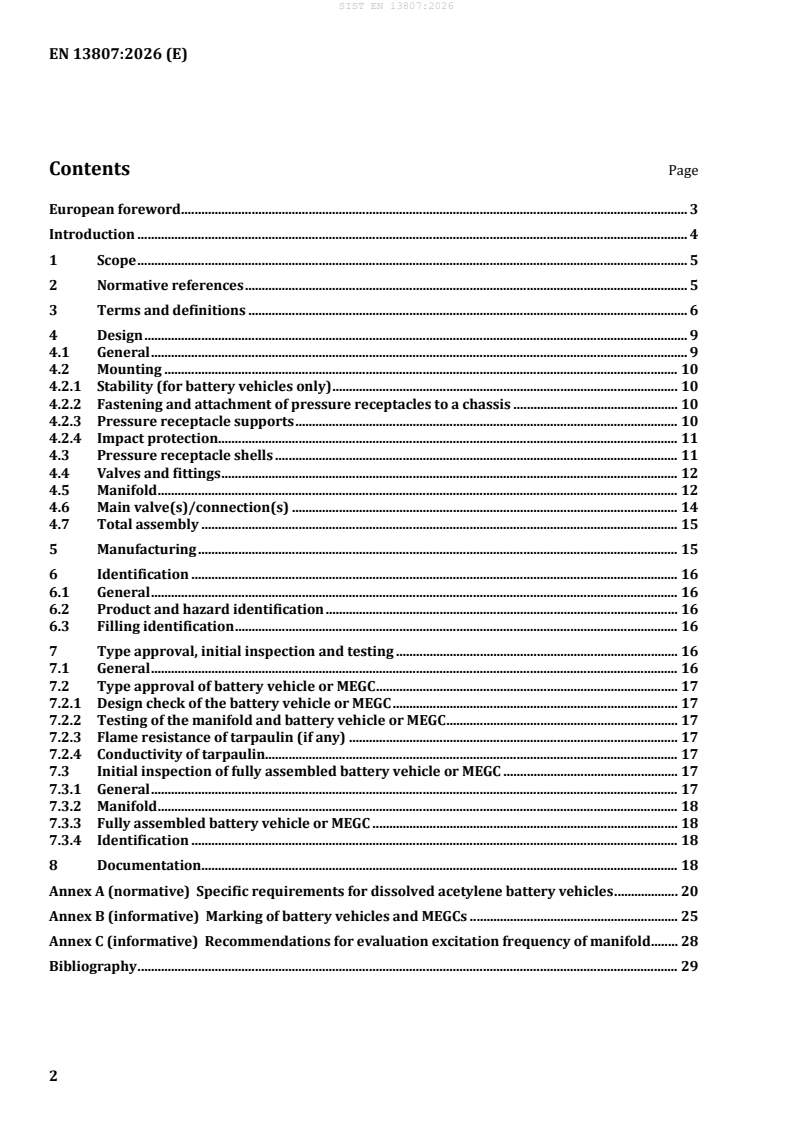
Contents Page
European foreword . 3
Introduction . 4
1 Scope . 5
2 Normative references . 5
3 Terms and definitions . 6
4 Design . 9
4.1 General . 9
4.2 Mounting . 10
4.2.1 Stability (for battery vehicles only) . 10
4.2.2 Fastening and attachment of pressure receptacles to a chassis . 10
4.2.3 Pressure receptacle supports . 10
4.2.4 Impact protection. 11
4.3 Pressure receptacle shells . 11
4.4 Valves and fittings . 12
4.5 Manifold . 12
4.6 Main valve(s)/connection(s) . 14
4.7 Total assembly . 15
5 Manufacturing . 15
6 Identification . 16
6.1 General . 16
6.2 Product and hazard identification . 16
6.3 Filling identification . 16
7 Type approval, initial inspection and testing . 16
7.1 General . 16
7.2 Type approval of battery vehicle or MEGC . 17
7.2.1 Design check of the battery vehicle or MEGC . 17
7.2.2 Testing of the manifold and battery vehicle or MEGC . 17
7.2.3 Flame resistance of tarpaulin (if any) . 17
7.2.4 Conductivity of tarpaulin. 17
7.3 Initial inspection of fully assembled battery vehicle or MEGC . 17
7.3.1 General . 17
7.3.2 Manifold . 18
7.3.3 Fully assembled battery vehicle or MEGC . 18
7.3.4 Identification . 18
8 Documentation . 18
Annex A (normative) Specific requirements for dissolved acetylene battery vehicles . 20
Annex B (informative) Marking of battery vehicles and MEGCs . 25
Annex C (informative) Recommendations for evaluation excitation frequency of manifold . 28
Bibliography . 29
European foreword
This document (EN 13807:2026) has been prepared by Technical Committee CEN/TC 23 “Transportable
gas cylinders”, the secretariat of which is held by BSI.
This European Standard shall be given the status of a national standard, either by publication of an
identical text or by endorsement, at the latest by August 2026, and conflicting national standards shall be
withdrawn at the latest by August 2026.
Attention is drawn to the possibility that some of the elements of this document may be the subject of
patent rights. CEN shall not be held responsible for identifying any or all such patent rights.
This document supersedes EN 13807:2017.
a) clarification of scope;
b) revision of definitions;
c) add ball valves (EN ISO 23826) as another type of closures;
d) clarification of operation temperature for the pressurized and non-pressurized components
e) more details in chapter mounting to clarify the request;
f) special requirement of forming the manifold in hydrogen service;
g) clarification of leakage check after assembling and initial filling with gas in use;
h) add an Annex C for vibration test.
This document has been prepared under a standardization request addressed to CEN by the European
Commission. The Standing Committee of the EFTA States subsequently approves these requests for its
Member States.
Any feedback and questions on this document should be directed to the users’ national standards body.
A complete listing of these bodies can be found on the CEN website.
According to the CEN-CENELEC Internal Regulations, the national standards organisations of the
following countries are bound to implement this European Standard: Austria, Belgium, Bulgaria, Croatia,
Cyprus, Czech Republic, Denmark, Estonia, Finland, France, Germany, Greece, Hungary, Iceland, Ireland,
Italy, Latvia, Lithuania, Luxembourg, Malta, Netherlands, Norway, Poland, Portugal, Republic of North
Macedonia, Romania, Serbia, Slovakia, Slovenia, Spain, Sweden, Switzerland, Türkiye and the United
Kingdom.
Introduction
For certain applications, transport units known as battery vehicles and MEGCs of non-UN pressure
receptacles are used to supply greater volumes of gas in a single unit.
A battery vehicle is a vehicle containing pressure receptacles which are linked to each other by a manifold
and permanently fixed to a transport unit.
NOTE 1 General requirements for the design, construction, equipment, type approval, inspections and tests and
marking of battery vehicles or MEGCs are provided in Chapter 6.8 and 9 of the RID/ADR [11]. Some specific or
additional requirements are given in this document.
In standards, weight is equivalent to a force, expressed in Newton. However, in common parlance (as
used in terms defined in this document), the word “weight” continues to be used to mean “mass”, but this
practice is deprecated (ISO 80000-4).
In this document, the unit bar is used, due to its universal use in the field of technical gases. It should,
however, be noted that bar is not an SI unit, and that the according SI unit for pressure is Pa
5 5 2
(1 bar = 10 Pa = 10 N/m ).
Pressure values given in this document are given as gauge pressure (pressure exceeding atmospheric
pressure) unless noted otherwise.
Where there is any conflict between this document and any applicable regulation, the regulation always
takes precedence.
NOTE 2 Where there is no risk of ambiguity, gas cylinders, tubes and bundles of cylinders are addressed with the
collective term ‘cylinder’ within this document.
1 Scope
This document specifies the requirements for the design, manufacture, identification and testing of
battery vehicles and multiple-element gas containers (MEGCs) containing cylinders, tubes, or bundles of
cylinders. This document applies also to battery vehicles and MEGCs containing bundles of cylinders
connected by a manifold which are dis-assembled from the battery vehicle and filled individually.
It is applicable to battery vehicles and MEGCs containing compressed gas, liquefied gas, and mixtures
thereof. It is also applicable to battery vehicles for dissolved acetylene.
This document is not applicable to battery vehicles and MEGC for toxic gases with an LC value less than
or equal to 200 ml/m .
This document does not apply to battery vehicles and MEGCs containing pressure drums or tanks.
This document does not specify requirements for the vehicle chassis or motive unit.
This document is primarily intended for industrial gases other than liquefied petroleum gases (LPG).
2 Normative references
The following documents are referred to in the text in such a way that some or all of their content
constitutes requirements of this document. For dated references, only the edition cited applies. For
undated references, the latest edition of the referenced document (including any amendments) applies.
EN 10204, Metallic products - Types of inspection documents
EN 13134 , Brazing - Procedure approval
EN 13501-1, Fire classification of construction products and building elements - Part 1: Classification using
data from reaction to fire tests
EN ISO 3834-2, Quality requirements for fusion welding of metallic materials — Part 2: Comprehensive
quality requirements (ISO 3834-2)
EN ISO 3834-3, Quality requirements for fusion welding of metallic materials — Part 3: Standard quality
requirements (ISO 3834-3)
EN ISO 9606-1, Qualification testing of welders - Fusion welding - Part 1: Steels (ISO 9606-1)
EN ISO 10286:2025, Gas cylinders - Vocabulary (ISO 10286:2025)
EN ISO 10297, Gas cylinders - Cylinder valves - Specification and type testing (ISO 10297)
EN ISO 10961, Gas cylinders - Cylinder bundles - Design, manufacture, testing and inspection (ISO 10961)
EN ISO 11114-1, Gas cylinders - Compatibility of cylinder and valve materials with gas contents - Part 1:
Metallic materials (ISO 11114-1)
EN ISO 11114-2, Gas cylinders - Compatibility of cylinder and valve materials with gas contents - Part 2:
Non-metallic materials (ISO 11114-2)
Standard is withdrawn and replaced by EN ISO 17779
EN ISO 13585, Brazing - Qualification testing of brazers and brazing operators (ISO 13585)
EN ISO 15607, Specification and qualification of welding procedures for metallic materials - General rules
(ISO 15607)
EN ISO 15615:2022, Gas welding equipment - Acetylene manifold systems for welding, cutting and allied
processes - Safety requirements in high-pressure devices (ISO 15615:2022)
EN ISO 16964, Gas cylinders - Flexible hoses assemblies - Specification and testing (ISO 16964)
EN ISO 23826, Gas cylinders - Ball valves - Specification and testing (ISO 23826)
ISO 1496-3, Series 1 freight containers — Specification and testing — Part 3: Tank containers for liquids,
gases and pressurized dry bulk
ISO 5171, Gas welding equipment - Pressure gauges used in welding, cutting and allied processes
ISO 11872, Gas welding equipment - Decomposition blockers for high-pressure acetylene
3 Terms and definitions
For the purposes of this document, the terms and definitions given in EN ISO 10286:2025 and the
following apply.
ISO and IEC maintain terminology databases for use in standardization at the following addresses:
— ISO Online browsing platform: available at https://www.iso.org/obp/
— IEC Electropedia: available at https://www.electropedia.org/
3.1
pressure receptacle
transportable receptacle intended for holding substances under pressure including its closure(s) and
other service equipment
Note 1 to entry: It is a collective term that includes cylinders, tubes, pressure drums, closed cryogenic
receptacles, metal-hydride storage system, bundle of cylinders and salvage pressure receptacles.
[SOURCE: EN ISO 10286:2025, 3.1.1.1, modified — Deprecated term and example removed.]
3.2
battery vehicle
vehicle containing pressure receptacles which are linked to each other by a manifold and permanently
fixed to a vehicle such that the assembly is filled, transported and emptied as a transport unit
[SOURCE: EN ISO 10286:2025, 3.1.1.13, modified — Hyphenation of the term removed, “elements”
replaced by “pressure receptacles” and “transport unit” replaced by “vehicle such that the assembly is
filled, transported and emptied as a transport unit” in the definition, removed both Notes to entry.]
3.3
multiple-element gas container
MEGC
unit containing cylinders, tubes or bundles of cylinders which are linked to each other by a manifold and
mounted on a frame
Note 1 to entry: This definition is different but not in contradiction with the one given in RID/ADR [11] because
it aims to reflect the scope of this document which excludes pressure drums and tanks.
3.4
manifold
piping system for connecting pressure receptacle(s) valves or fittings to the main valve(s) or the main
connection(s)
[SOURCE: EN ISO 10286:2025, 3.1.5.2, modified — Example removed.]
3.5
pressure receptacle valve
valve that is fitted into a pressure receptacle and to which a manifold is connected
3.6
pressure receptacle fitting
component with no gas shut-off capability that serves as a method for connecting a manifold to individual
pressure receptacle, when valves are not fitted to the pressure receptacles
[SOURCE: EN ISO 10286:2025, 3.1.5.5, modified — Replaced “cylinder” by “pressure receptacle” in the
term, domain in angle brackets removed, “cylinders or tubes” replaced by “pressure receptacles” and
Note to entry deleted.]
3.7
main connection
means of making a gas connection to a battery vehicle/MEGC
[SOURCE: EN ISO 10286:2025, 3.1.5.3, modified — “bundle” deleted from the definition.]
3.8
main valve
valve which is fitted to the manifold of a battery vehicle or MEGC isolating it from the main connection(s)
[SOURCE: EN ISO 10286:2025, 3.1.5.4., modified — “bundle of cylinders” and “battery wagon” deleted
from the definition, alternative and deprecated terms deleted.]
3.9
tare
/ weight of the battery vehicle or MEGC when empty, including accessories
fitted as presented for filling
[SOURCE: EN ISO 10286:2025, 3.5.43, modified — removed deprecated term, replaced “” with
“/” and “pressure receptacle” with “battery vehicle or MEGC” in the definition.]
3.10
maximum gross weight
< battery vehicle > / sum of the tare of battery vehicle or MEGC and the maximum weight of the
gas product
Note 1 to entry: In RID/ADR the term “total mass” is used.
[SOURCE: EN ISO 10286:2025, 3.5.41, modified — replaced “” with “
vehicle>/”, “bundle” with “battery vehicle or MEGC”, and replaced “maximum permissible filling
weight” with “maximum weight of the gas product” in the definition and added Note 1 to entry.]
3.11
maximum filling weight
for liquefied gases (e.g. SF ), sum of the minimum guaranteed water capacity of all pressure receptacles
of the battery vehicle or MEGC multiplied with the filling ratio of the gas contained
[SOURCE: EN ISO 10286:2025, 3.5.38, modified — included Note 1 to entry to definition by replacing
“product” by “for liquefied gases (e. g. SF ) sum” and replaced “the pressure receptacle” with “all pressure
receptacle of the battery vehicle or MEGC” and replaced “and” with “multiplied with”.]
3.12
working pressure
settled pressure of a compressed gas at a uniform reference temperature of 15 °C in a
full battery vehicle or MEGC
[SOURCE: EN ISO 10286:2025, 3.5.30, modified — “gas cylinder” replaced by “battery vehicle or MEGC”]
3.13
maximum developed pressure
pressure developed by the gas contents in a battery vehicle or MEGC at a uniform temperature of T
max
Note 1 to entry: Tmax is the expected maximum uniform temperature in normal service as specified in
international or national cylinder filling regulations.
[SOURCE: EN ISO 10286:2025, 3.5.27, modified — Added “maximum” to the term, replaced “cylinder” by
“battery vehicle or MEGC”, added “of T ” to definition and added corresponding Note 1 to entry.]
max
3.14
leak test gas
gas or gas mixture used for leak testing
3.15
acetylene battery vehicle
assembly of acetylene cylinders or acetylene bundles of cylinders connected to a manifold and securely
mounted onto a vehicle chassis such that the assembly is transported and emptied as a single unit
3.16
acetylene battery vehicle type A
assembly of acetylene cylinders or acetylene bundles of cylinders that are removed each time from the
vehicle and filled individually
3.17
acetylene battery vehicle type B
assembly of acetylene cylinders or acetylene bundles of cylinders that are filled and emptied for a
prescribed number of re-fillings without removal from the vehicle
3.18
home station of the acetylene battery vehicle
location (name of the company, address and telephone number) where the documentation is kept
3.19
tare
sum of the tare weights of the individual cylinders (see EN ISO 3807 [2]) or
bundles of cylinders (see EN ISO 13088 [7]) plus the weight of the associated manifold, fittings, supports
and the chassis
3.20
maximum gross weight
sum of the total weight of the individual filled cylinders or the maximum
gross weight of the individual acetylene bundles of cylinders plus the weight of the associated manifold,
fittings, supports and the vehicle chassis
Note 1 to entry: In RID/ADR the term “total mass” is used.
3.21
maximum acetylene content
sum of the specified maximum weight of acetylene including saturation
acetylene in the pressure receptacles
3.22
dimensioning pressure
pressure taking into account the pressure increase caused by the
decomposition of acetylene
Note 1 to entry: It is used for the dimensioning of the manifold, hoses, valves and fittings.
3.23
working pressure
pressure equal to the working pressure stamped on the individual pressure
receptacles of the battery vehicle
3.24
maximum filling pressure
highest pressure which is allowed in an acetylene battery vehicle manifold
during filling
Note 1 to entry: It is 25 bar gauge, see A.2.5.3.
3.25
acetylene decomposition blocker
safety device that stops acetylene decomposition at a pressure of ≤ 25 bar
Note 1 to entry: The decomposition blocker for high-pressure acetylene can optionally comprise other safety
elements such as non-return valve or automatic quick-acting shut-off device (see ISO 15615).
[SOURCE: EN ISO 10286:2025, 3.1.4.13]
4 Design
4.1 General
All pressurized components shall be designed to operate in the temperature range of at least –20 °C to
+65 °C. All other parts such as frame, fastenings, etc. shall be designed to operate in the temperature
range of at least −20°C to +50°C.
NOTE 1 Local temperature conditions can necessitate higher or lower service temperatures.
NOTE 2 Pressure components and the frame, fastenings etc. can have different operating temperatures (see also
marking Clause B.2)
Materials for parts which are in contact with the gas shall be selected in accordance with EN ISO 11114-1
and EN ISO 11114-2.
For battery vehicles and MEGCs which are filled by weight, the tare used as a reference for filling shall be
clearly identified taking into account removable components, where applicable.
For all gases consideration shall be given regarding the risk of accumulation of gases (e.g. explosive
atmosphere, anoxia) by permeation (as applicable) and leak rates by taking into account all possible
confined volumes (if any).
For acetylene battery vehicles, additional requirements apply on certain subjects. These shall be
according to Annex A.
4.2 Mounting
4.2.1 Stability (for battery vehicles only)
The overall width of the ground-level bearing surface (distance between the outer points of contact with
the ground of the right-hand tyre and the left-hand tyre of the same axle) of the axle with greatest width
shall be at least equal to 90 % of the height of the centre of gravity of the laden battery vehicle. In an
articulated vehicle the mass on the axles of the load-carrying unit of the laden semi-trailer shall not
exceed 60 % of the nominal total laden mass of the complete articulated vehicle.
NOTE There could be more prescriptive vehicle regulations.
4.2.2 Fastening and attachment of pressure receptacles to a chassis
Fastenings and attachments of pressure receptacles to a chassis of a battery vehicle or a MEGC shall, at
the maximum gross weight, be capable of absorbing the forces equal to those exerted by:
— in the direction of travel: twice the maximum gross weight;
— horizontally at right angles to the direction of travel: the maximum gross weight, or, where the
direction of travel is not clearly determined, twice the maximum gross weight in each direction;
— vertically upward: the maximum gross weight;
— vertically downward: twice maximum gross weight.
Values for resulting forces shall be calculated independently of each other.
For the fastenings and attachments of pressure receptacles, for each force, the following requirements
apply:
— for a battery vehicle, the stress at the most severely stressed point of fastenings and attachments
shall be lower than the values 75 % of the yield strength (R = guaranteed yield strength) or 50 %
e
of the tensile strength (R = minimum guaranteed tensile strength) of the metal material used.
m
— for a MEGC, the stress at the most severely stressed point of fastenings and attachments shall be
lower than the values 67 % of the yield strength (R = guaranteed yield strength or for metals with
e
no clearly defined yield point R and for austenitic steel R ) of the metal material used.
p0,2 p1,0
For non-metallic material equivalent safety margin under consideration of the failure mechanism and
time dependent properties changes can be applied.
4.2.3 Pressure receptacle supports
Pressure receptacles shall be secured in a manner that they are able to resists the force according to 4.2.2
under consideration of the working pressure.
For metal pressure receptacle supports, at the most severely stressed point, the max allowed stress shall
not exceed the value of 77 % R (of the guaranteed yield strength) or if more stringent 2/3 R (R ;
e m m
minimum guaranteed tensile strength).
For composite pressure receptacles the maximum allowed acceleration, for the x-, y- and z-direction shall
be provided from the pressure receptacle manufacturer for that load condition according to 4.2.2 taking
into account the working pressure (which are at least equal to the values resulting from loads in 4.2.2).
For composite cylinders or tubes the supports shall leave sufficient space between the pressure
receptacles to avoid damaging of the overwrap. If a dome cap is used it may be in contact with one or
more dome caps and / or the frame.
4.2.4 Impact protection
4.2.4.1 For battery vehicles
There are two types of impact protection:
a) Rear end protection
An arrangement shall be fitted at the rear of the battery vehicle to provide adequate protection to the
rear manifold and fittings to prevent accidental leakage of product in the event of a rear impact. The
width of this arrangement shall be not less than that of the rear under-run protective device and not
less than that of the manifold and fittings. There shall be a clearance of at least 100 mm between the
arrangement and the rearmost point of the manifold, fittings, and valves under gas pressure during
transport.
NOTE European directive 70/221/EEC [9] contains additional requirements regarding the resistance to
impact for a rear under-run protective device.
b) Rollover protection
Manifolds shall be designed such that they are protected from impact in the event of a battery vehicle
rolling onto its side or upside down.
4.2.4.2 For MEGCs
An arrangement shall be fitted on the MEGC to provide adequate protection for manifold and fittings to
prevent accidental leakage of product in the event of a rear end impact.
The arrangement shall meet at least the impact requirements of an ISO frame in accordance with the
relevant provisions of ISO 1496-3. The manifolds shall be designed and/or placed such that they are
protected from impact in the event of a MEGC in case of rollover onto its side or upside down.
NOTE Compliance with the tests of ISO 1496-3 also fulfil the requirements of CSC 1972 [12].
4.3 Pressure receptacle shells
Pressure receptacle shells shall be suitable for their intended gas service and shall have the same test
pressure. They shall be in accordance with a relevant European Standard (e.g. EN ISO 11120 [19],
EN 12245 [20], EN 17339 [21]) for the individual type of pressure receptacle shell.
Composite pressure receptacle shells shall be protected from ultraviolet radiation according to the
manufacturer’s instructions. This may be achieved by individual or overall protection. Such protection
shall be taken into consideration for design of the ventilation.
4.4 Valves and fittings
4.4.1 Either a pressure receptacle valve or fitting shall be fitted into each pressure receptacle’s inlet
connection.
If a valve is used, it shall conform to either EN ISO 10297 or EN ISO 23826.
For acetylene battery vehicles, A.2.4 and A.2.6 apply.
Valves and fittings shall be suitable for the gas service and pressure for which the battery vehicle or MEGC
is intended.
Valves and fittings inlet threads shall be compatible with the neck thread of the pressure receptacle shell.
Valves, pressure receptacles or manifolds as part of battery vehicles or MEGCs can also include pressure
relief devices.
NOTE The relevant transport regulation can require or forbid pressure relief devices for some gases, gas
mixtures or gas groups. Additional requirements for pressure relief devices can exist in international/regional
regulations/standards.
WARNING — Fast opening valve can lead to a pressure surge and related hazard e.g. adiabatic
compression shall take into consideration when designing the manifold.
4.4.2 Pressure receptacles of a battery-vehicle and MEGCs intended for the carriage of flammable gases
shall be combined in groups of not more than 5 000 l which are capable of being isolated by a shut-off
valve, which shall fulfil the requirements of 4.4.1 except for the threads.
For acetylene battery vehicles, A.2.6 applies.
4.4.3 Access shall be provided to all valves.
4.5 Manifold
4.5.1 The manifold shall be designed and manufactured so as to avoid the risk of damage due to thermal
expansion and contraction, mechanical shock and vibration and be compatible with the gas.
The manifold shall be designed for service in a temperature range of −20 °C to +65 °C.
The manifold shall be designed, constructed, and installed so as to avoid the risk of damage due to thermal
expansion and contraction, mechanical shock and vibration. All material of manifold shall be suitable
metallic material.
4.5.2 In order to avoid damage to the manifold due to vibration, the excitation frequency generated by
the various types of transport should be considered and associated mitigation defined (see as an example
Annex C). Different solutions to mitigate the risk may be used (e.g. proper fastening of the manifold).
For acetylene battery vehicles' manifolds A.2.5 applies in addition.
4.5.3 For manifolds in use with embrittling gases, such as hydrogen, the following items need to be
covered:
— Many metallic materials can suffer embrittlement in hydrogen gas environments. These include
steels (especially high strength steels), stainless steel, and nickel alloys. The manifold shall be of
suitable metallic material (see EN ISO 11114-1).
— The pipe material tensile strength (R ) for steels is limited to 950 MPa.
m
— General: Austenitic stainless steel shall be either:
i. low carbon stainless steel grades (e.g. 1.4307, 1.4404) or
ii. stabilized stainless steel grades (e.g. 1.4541, 1.4550, 1.4571) or
iii. stainless steel grades with satisfactorily passed intergranular corrosion test according to an
applicable product standard.
NOTE 1 ASTM A 262 [22] Practice E and EN ISO 3651-2 [23] Method A are examples of applicable
product standards.
— In case of hydrogen service processes and materials should be adapted to take hydrogen
embrittlement issues under consideration.
— Cold forming:
The process of cold forming (e.g. bending pipe radius smaller than three times the outer diameter)
can influence mechanical and environmental properties such as ductility, impact energy and
corrosion resistance. In these cases, the mechanical properties after cold forming should be
considered.
— Welding:
For the welds and heat affected zones, hardness and therefore capability to prevent hydrogen
embrittlement shall be considered.
NOTE 2 Limiting the risk of cracking in the welding seams.
NOTE 3 See also e.g. EIGA Doc 121 [14].
— Screwing parts:
When screwing connections are used then the material limits of the pressure component should be
the same as specified in EN ISO 11114-1.
The connection type should be chosen in accordance with the intended use.
In case of use of non-metallic material as sealing, EN ISO 11114-2 gives the relevant data for gas /
material compatibility (see 4.1).
— Cold formed connections:
In case of cold formed connections, the yield strength ratio (R /R ) shall be below 0,85. This shall be
e m
verified before forming, in the material inspection certificate. The certificate type 3.1 shall be in
accordance with EN 10204. After cold forming of the connection the squeezed area should be free
from cracks. In case cracks are detected, consequences and likelihood of a possible rupture shall be
assessed.
NOTE 4 Working in compressive stress is known to significantly reduce the probability of a propagation of
a crack.
NOTE 5 Rm is the tensile strength.
NOTE 6 The yield strength R is the stress value corresponding to the upper yield strength. The
e
corresponding value for metallic materials, which do not exhibit a defined yield, is:
— for steels: the 0,2 % proof strength (Rp0,2) or
— for austenitic steels: the 1 % proof strength (R ).
p1,0
The values of R (R ; R ) and R to be used for calculation of the whole manifold shall be specified
e p0,2 p1,0 m
minimum values according to material standards.
— The engineering alloys used in critical locations should have high toughness levels in the fabricated
condition and be relatively insensitive to welding problems, e.g. hard/brittle areas, microcracks,
fissures etc.
— There are a number of variables, which can affect the severity of the embrittlement mechanisms
encountered such as purity, temperature and pressure. It is generally recognized that the tendency
for embrittlement in hydrogen atmospheres increases with increasing pressure.
4.5.4 For compressed gases the design pressure shall be not less than 1,5 × working pressure. For
liquefied gases, the design pressure shall be not less than the test pressure of the pressure receptacles.
4.5.5 The test pressure shall be not less than the design pressure except for acetylene for which the
test pressure shall be 617 bar.
The maximum stress of the manifold arrangement at the test pressure shall not exceed 75 % of the
guaranteed yield strength of the material.
4.5.6 No part of the manifold shall bear against other components except at pressure receptacle
valve/fitting interfaces or at defined attachment points to the frame.
4.5.7 The manifold shall be of suitable metallic material. Welded pipe joints shall be used wherever
possible and has shown to be practical. If welding cannot be carried out (e.g. joint of cylinder), screw
connections, cold formed connection, etc. when approved as the alternative solution and done by
qualified operator may be used.
NOTE Orbital welding provides high level of repeatability.
Joints in copper tubing shall be brazed or have an equally strong metal union. The melting point of brazing
materials shall not be less than 525 °C. Joints shall not decrease the strength of tubing as can happen
when cutting threads.
Flexible hoses or non-metallic manifold should only be used as part of the fixed manifold on the battery
vehicle and MEGCs. For use of flexible hoses for acetylene battery vehicles A.2.5.6 applies. The length of
such hoses and manifold should be appropriate to the operational parameters of the hoses.
EXAMPLE Examples of operational parameters are bend radius and vibrations.
4.5.8 The concept of the manifold shall be documented in a P&ID (Piping and Instrumentation
Diagram).
4.6 Main valve(s)/connection(s)
4.6.1 The main valve shall be in accordance with EN ISO 10297 or EN ISO 23826.
4.6.2 The main valve shall be able to be operated from ground level (either directly for manual actuated
valve or via an actuator for an automatic valve).
4.6.3 For toxic gases, the main valve/connection shall be protected from tampering.
4.6.4 All openings, other than those used for safety devices and closed bleed holes of pressure
receptacles intended for the carriage of liquefied flammable and/or toxic gases shall, if the diameter is
more than 1,5 mm, be equipped with a shut off device within the manifold arrangement.
4.6.5 Pressure relief devices may be used on battery-vehicles and MEGCs for non-toxic gases (see
EN ISO 10298 [24]), except for acetylene. If pressure relief devices are used, they shall be designed to
avoid any rupture of the receptacles and the relief device shall be setup to minimize damages.
Battery-vehicles or MEGCs intended for the carriage of toxic gases shall not have safety valves, unless the
safety valves are preceded by a bursting disc.
4.6.6 In all cases an emergency shut-down system shall be installed, to stop the flow of gas, when
needed.
This could be realized e.g. by a pneumatic or electrical activation. The activation shall be fail-close, i.e.
closed when no pressure or electric power is available.
The emergency shut-down system shall be documented (e.g. P&ID).
4.7 Total assembly
4.7.1 In the case of flammable gases, electrical continuity shall be maintained throughout the manifold
system and between the manifold, the pressure receptacles and their supports. An earthing connection
shall be provided for use during loading and discharging and its position shall be clearly indicated and be
readily accessible.
4.7.2 A means to protect the battery vehicle and MEGC against unacceptable consequences (e.g. gas
release) resulting from uncontrolled movement during filling or emptying (e.g. tow away prevention
system) shall be provided.
5 Manufacturing
A battery vehicle and MEGC shall be manufactured in accordance with the design criteria listed in
Clause 4.
The welding method shall be appropriate and shall be carried out by qualified welders and/or operators,
the materials shall be compatible, and there shall be verification by a welding procedure test.
In addition, the following qualification requirements shall be fulfilled for the manufacture:
— Quality requirements for fusion welding of metallic materials shall be in accordance with
EN ISO 3834-2 or EN ISO 3834-3;
— welding procedures shall be in accordance with EN ISO 15607;
— welders shall be approved in accordance with EN ISO 9606-1;
— brazing procedures shall be in accordance with EN 13134;
— brazers shall be approved in accordance with EN ISO 13585.
The mechanical assembly procedure with related Bill of Materials shall be documented.
6 Identification
6.1 General
A battery vehicle and MEGC can include components which are intended to protect the manifold, and
which cause an obstruction to the view of the shoulders of the pressure receptacles. Therefore, the
requirements for labelling and colour coding of battery vehicles and MEGCs differ from those for
individual cylinders given in EN ISO 7225 [3] and EN 1089-3 [1].
Additionally, markings on the individual pressure receptacles can be obscured, therefore information
which shall be checked at the time of filling shall be duplicated on the outside of the battery vehicle and
MEGCs (e.g. tank plate).
For acetylene battery vehicles, A.3 applies.
6.2 Product and hazard identification
It is not necessary to attach precautionary labels to individual pressure receptacles within a battery
vehicle or MEGC.
NOTE 1 Regarding placarding, marking, and labelling of battery vehicles or MEGC, transport regulations can
apply.
The use of colour coding, specified in EN 1089-3 [1] is not mandatory for pressure receptacles assembled
into a battery vehicle or MEGC.
NOTE 2 The colour of a battery vehicle chassis does not carry significance with respect to the gas contained in
the battery vehicle.
6.3 Filling identification
For identification of a battery vehicle and MEGCs a name plate shall be used.
NOTE 1 Please be aware of applicable regulations regarding battery vehicle filling identification. For guidance
on marking for battery vehicles and MEGCs see informative Annex B.
NOTE 2 Marking requirements for battery vehicles and MEGCs are provided in RID/ADR:2025, 6.8.3.5.10,
6.8.3.5.11 and 6.8.3.5.12 [11].
7 Type approval, initial inspection and testing
7.1 General
Battery vehicle or MEGC testing is separated into two distinct sections:
— type approval of battery vehicle or MEGC (see 7.2);
— initial inspection/production testing of the manifold and fully assembled battery vehicle or MEGC
(see 7.3).
Leak testing shall be performed using gases or gas mixtures representative of the intended gas service or
compressed air or nitrogen.
For battery vehicles or MEGCs for helium, hydrogen or their mixtures, the test gas for the leak testing
shall be nitrogen or a non-flammable gas mixture containing helium or hydrogen (e.g. min 2 % helium or
max 5 % hydrogen in nitrogen).
...