

SIST ISO 31700-1:2024
(Main)Consumer protection - Privacy by design for consumer goods and services - Part 1: High-level requirements
General Information
- Abstract
This document establishes high-level requirements for privacy by design to protect privacy throughout the lifecycle of a consumer product, including data processed by the consumer.
This document does not contain specific requirements for the privacy assurances and commitments that organizations can offer consumers nor does it specify particular methodologies that an organization can adopt to design and-implement privacy controls, nor the technology that can be used to operate such controls.
- Status
- Published
- Publication Date
- 19-Mar-2024
- Current Stage
- 6060 - National Implementation/Publication (Adopted Project)
- Start Date
- 13-Mar-2024
- Due Date
- 18-May-2024
- Completion Date
- 20-Mar-2024




Overview
SIST ISO 31700-1:2024 provides high-level requirements for “privacy by design” in consumer goods and services. Issued by the International Organization for Standardization (ISO), this part of the standard focuses on protecting privacy throughout the entire lifecycle of a consumer product, including data processed by the consumer. The standard emphasizes a proactive, systematic approach to embedding privacy protections into products and services, ensuring that privacy considerations are addressed from the initial design stage to retirement and disposal.
ISO 31700-1 does not mandate specific privacy assurances, methodologies, or technologies. Instead, it guides organizations in establishing frameworks and processes that enable consumer privacy protection by default and by design.
Key Topics
The standard covers the following essential areas:
- Empowerment and Transparency: Ensuring consumers can exercise their privacy rights and understand privacy controls.
- Institutionalization and Responsibility: Assigning roles, responsibilities, and accountability for privacy within organizations and throughout product ecosystems.
- Lifecycle and Ecosystem Approach: Addressing privacy risks and controls across all stages-from product conception, use, maintenance, to decommission and data deletion.
- Risk Management: Identifying and mitigating privacy risks through assessments, third-party evaluations, and ongoing monitoring.
- Consumer Communication: Providing clear, accessible privacy information; responding to inquiries and complaints; communicating breaches.
- Design and Operation of Privacy Controls: Integrating privacy into product development, testing, deployment, operation, and end-of-life processes.
- Documentation and Information Management: Maintaining records related to privacy controls, risk assessments, and communications.
Key terminology defined includes:
- Consumer
- Personally Identifiable Information (PII)
- Privacy breach
- Service
- Privacy by design
- Consumer-configurable privacy settings
Applications
SIST ISO 31700-1:2024 is valuable for various organizations, particularly those that:
- Design, manufacture, or offer consumer products or services that process personal data.
- Develop software, digital goods, or connected devices intended for widespread consumer use, such as smart home products or mobile applications.
- Operate globally and must demonstrate due diligence and accountability in privacy protection, aligning with consumer protection laws and expectations.
Key practical applications include:
- Product Designers & Engineers: Applying privacy by design principles from the beginning of the product lifecycle.
- Compliance Managers & Data Protection Officers: Using the standard to support privacy compliance, transparency, and accountability measures.
- Marketers & Customer Service Teams: Ensuring clear privacy communication, supporting rights for data access, rectification, and erasure.
- Cross-functional Privacy Teams: Establishing multidisciplinary oversight and responsiveness for privacy incidents or changes in regulatory requirements.
Adherence to ISO 31700-1 helps organizations build consumer trust, meet evolving legal and societal expectations for data protection, and minimize the risk of privacy breaches.
Related Standards
Organizations utilizing SIST ISO 31700-1:2024 may also benefit from consulting the following related standards:
- ISO/IEC 29100: Privacy framework
- ISO/IEC 27701: Extension to ISO/IEC 27001 for privacy information management
- ISO/IEC 27018: Protection of personal data in the cloud
- ISO/IEC 19944: Cloud services and PII processing
- ISO/IEC 9000: Quality management systems-Fundamentals and vocabulary (for definitions relevant to services)
- ISO/IEC Guide 14: Product information for consumers
Integrating ISO 31700-1 with these standards enables a comprehensive privacy management system, strengthening consumer protection and supporting compliance with global data protection regulations.
Get Certified
Connect with accredited certification bodies for this standard

BSI Group
BSI (British Standards Institution) is the business standards company that helps organizations make excellence a habit.

Bureau Veritas
Bureau Veritas is a world leader in laboratory testing, inspection and certification services.

DNV
DNV is an independent assurance and risk management provider.
Sponsored listings
Frequently Asked Questions
SIST ISO 31700-1:2024 is a standard published by the Slovenian Institute for Standardization (SIST). Its full title is "Consumer protection - Privacy by design for consumer goods and services - Part 1: High-level requirements". This standard covers: This document establishes high-level requirements for privacy by design to protect privacy throughout the lifecycle of a consumer product, including data processed by the consumer. This document does not contain specific requirements for the privacy assurances and commitments that organizations can offer consumers nor does it specify particular methodologies that an organization can adopt to design and-implement privacy controls, nor the technology that can be used to operate such controls.
This document establishes high-level requirements for privacy by design to protect privacy throughout the lifecycle of a consumer product, including data processed by the consumer. This document does not contain specific requirements for the privacy assurances and commitments that organizations can offer consumers nor does it specify particular methodologies that an organization can adopt to design and-implement privacy controls, nor the technology that can be used to operate such controls.
SIST ISO 31700-1:2024 is classified under the following ICS (International Classification for Standards) categories: 03.080.30 - Services for consumers; 03.100.01 - Company organization and management in general. The ICS classification helps identify the subject area and facilitates finding related standards.
SIST ISO 31700-1:2024 is available in PDF format for immediate download after purchase. The document can be added to your cart and obtained through the secure checkout process. Digital delivery ensures instant access to the complete standard document.
Standards Content (Sample)
SLOVENSKI STANDARD
01-maj-2024
Varstvo potrošnikov - Vgrajena zasebnost za potrošniško blago in storitve - 1. del:
Zahteve na visoki ravni
Consumer protection — Privacy by design for consumer goods and services — Part 1:
High-level requirements
Protection des consommateurs — Respect de la vie privée assuré dès la conception des
biens de consommation et services aux consommateurs — Partie 1: Exigences de haut
niveau
Ta slovenski standard je istoveten z: ISO 31700-1:2023
ICS:
03.080.30 Storitve za potrošnike Services for consumers
03.100.01 Organizacija in vodenje Company organization and
podjetja na splošno management in general
2003-01.Slovenski inštitut za standardizacijo. Razmnoževanje celote ali delov tega standarda ni dovoljeno.
INTERNATIONAL ISO
STANDARD 31700-1
First edition
2023-01
Consumer protection — Privacy
by design for consumer goods and
services —
Part 1:
High-level requirements
Protection des consommateurs — Respect de la vie privée assuré
dès la conception des biens de consommation et services aux
consommateurs —
Partie 1: Exigences de haut niveau
Reference number
© ISO 2023
All rights reserved. Unless otherwise specified, or required in the context of its implementation, no part of this publication may
be reproduced or utilized otherwise in any form or by any means, electronic or mechanical, including photocopying, or posting on
the internet or an intranet, without prior written permission. Permission can be requested from either ISO at the address below
or ISO’s member body in the country of the requester.
ISO copyright office
CP 401 • Ch. de Blandonnet 8
CH-1214 Vernier, Geneva
Phone: +41 22 749 01 11
Email: copyright@iso.org
Website: www.iso.org
Published in Switzerland
ii
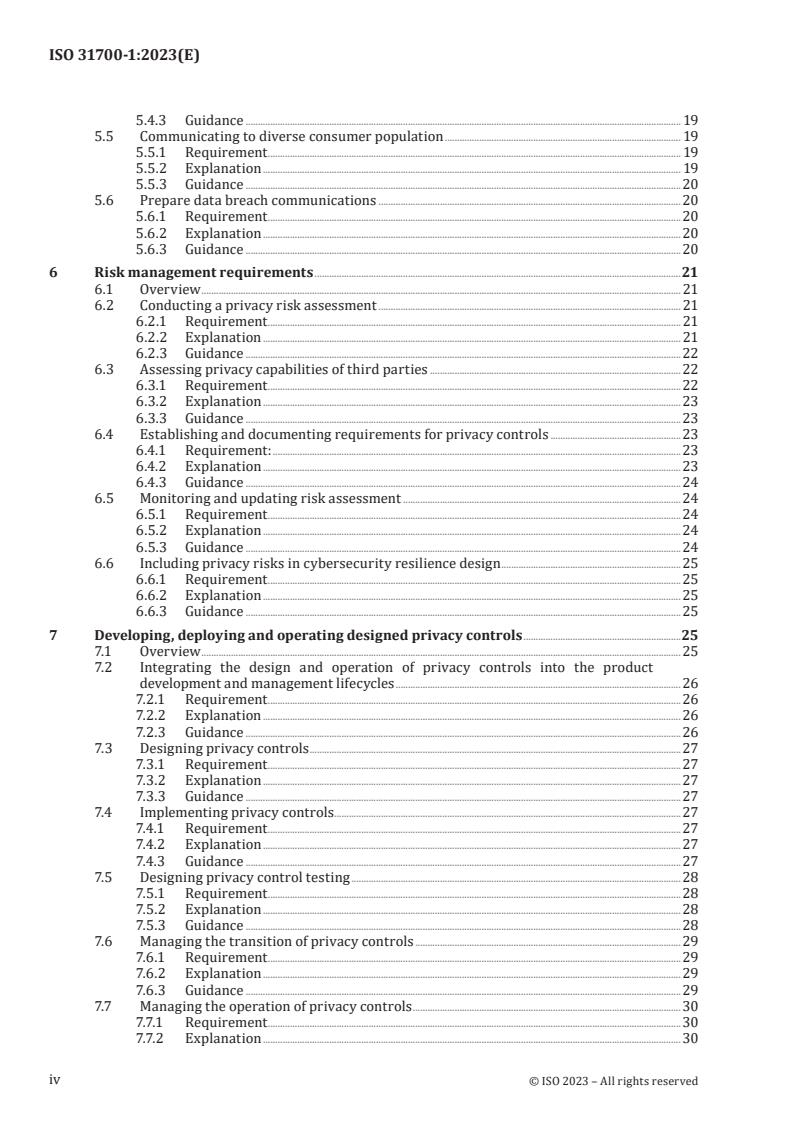
Contents Page
Foreword . vi
Introduction .vii
1 Scope . 1
2 Normative references . 1
3 Terms and definitions . 1
4 General . 8
4.1 Overview . 8
4.2 Designing capabilities to enable consumers to enforce their privacy rights . 9
4.2.1 Requirement . 9
4.2.2 Explanation . 9
4.2.3 Guidance . 10
4.3 Developing capability to determine consumer privacy preferences . 10
4.3.1 Requirement . 10
4.3.2 Explanation . 11
4.3.3 Guidance . 11
4.4 Designing human computer interface (HCI) for privacy . 11
4.4.1 Requirement . 11
4.4.2 Explanation .12
4.4.3 Guidance .12
4.5 Assigning relevant roles and authorities .12
4.5.1 Requirement .12
4.5.2 Explanation . 12
4.5.3 Guidance .12
4.6 Establishing multi-functional responsibilities . 13
4.6.1 Requirement .13
4.6.2 Explanation . 13
4.6.3 Guidance .13
4.7 Developing privacy knowledge, skill and ability . 13
4.7.1 Requirement .13
4.7.2 Explanation . 14
4.7.3 Guidance . 14
4.8 Ensuring knowledge of privacy controls . 14
4.8.1 Requirement . 14
4.8.2 Explanation . 14
4.8.3 Guidance .15
4.9 Documentation and information management . 15
4.9.1 Requirement .15
4.9.2 Explanation . 15
4.9.3 Guidance . 16
5 Consumer communication requirements .16
5.1 Overview . 16
5.2 Provision of privacy information . 17
5.2.1 Requirement . 17
5.2.2 Explanation . 17
5.2.3 Guidance . 17
5.3 Accountability for providing privacy information . 18
5.3.1 Requirement . 18
5.3.2 Explanation . 19
5.3.3 Guidance . 19
5.4 Responding to consumer inquiries and complaints . 19
5.4.1 Requirement . 19
5.4.2 Explanation . 19
iii
5.4.3 Guidance . 19
5.5 Communicating to diverse consumer population . 19
5.5.1 Requirement . 19
5.5.2 Explanation . 19
5.5.3 Guidance . 20
5.6 Prepare data breach communications . 20
5.6.1 Requirement .20
5.6.2 Explanation . 20
5.6.3 Guidance . 20
6 Risk management requirements .21
6.1 Overview . 21
6.2 Conducting a privacy risk assessment . 21
6.2.1 Requirement . 21
6.2.2 Explanation . 21
6.2.3 Guidance .22
6.3 Assessing privacy capabilities of third parties . 22
6.3.1 Requirement .22
6.3.2 Explanation . 23
6.3.3 Guidance .23
6.4 Establishing and documenting requirements for privacy controls .23
6.4.1 Requirement: .23
6.4.2 Explanation . 23
6.4.3 Guidance . 24
6.5 Monitoring and updating risk assessment . 24
6.5.1 Requirement . 24
6.5.2 Explanation . 24
6.5.3 Guidance . 24
6.6 Including privacy risks in cybersecurity resilience design . 25
6.6.1 Requirement . 25
6.6.2 Explanation . 25
6.6.3 Guidance . 25
7 Developing, deploying and operating designed privacy controls .25
7.1 Overview . 25
7.2 Integrating the design and operation of privacy controls into the product
development and management lifecycles . 26
7.2.1 Requirement .26
7.2.2 Explanation . 26
7.2.3 Guidance . 26
7.3 Designing privacy controls . 27
7.3.1 Requirement . 27
7.3.2 Explanation . 27
7.3.3 Guidance . 27
7.4 Implementing privacy controls . . 27
7.4.1 Requirement . 27
7.4.2 Explanation . 27
7.4.3 Guidance . 27
7.5 Designing privacy control testing .28
7.5.1 Requirement .28
7.5.2 Explanation .28
7.5.3 Guidance .28
7.6 Managing the transition of privacy controls .29
7.6.1 Requirement .29
7.6.2 Explanation .29
7.6.3 Guidance .29
7.7 Managing the operation of privacy controls .30
7.7.1 Requirement .30
7.7.2 Explanation . 30
iv
7.7.3 Guidance . 30
7.8 Preparing for and managing a privacy breach.30
7.8.1 Requirement .30
7.8.2 Explanation . 31
7.8.3 Guidance . 31
7.9 Operating privacy controls for the processes and products upon which the
product in scope depends throughout the PII lifecycle . 31
7.9.1 Requirement . 31
7.9.2 Explanation . 31
7.9.3 Guidance . 31
8 End of PII lifecycle requirements .32
8.1 Overview . 32
8.2 Designing privacy controls for retirement and end of use . 32
8.2.1 Requirement . 32
8.2.2 Explanation . 32
8.2.3 Guidance . 32
Bibliography .34
v
Foreword
ISO (the International Organization for Standardization) is a worldwide federation of national standards
bodies (ISO member bodies). The work of preparing International Standards is normally carried out
through ISO technical committees. Each member body interested in a subject for which a technical
committee has been established has the right to be represented on that committee. International
organizations, governmental and non-governmental, in liaison with ISO, also take part in the work.
ISO collaborates closely with the International Electrotechnical Commission (IEC) on all matters of
electrotechnical standardization.
The procedures used to develop this document and those intended for its further maintenance are
described in the ISO/IEC Directives, Part 1. In particular, the different approval criteria needed for the
different types of ISO documents should be noted. This document was drafted in accordance with the
editorial rules of the ISO/IEC Directives, Part 2 (see www.iso.org/directives).
Attention is drawn to the possibility that some of the elements of this document may be the subject of
patent rights. ISO shall not be held responsible for identifying any or all such patent rights. Details of
any patent rights identified during the development of the document will be in the Introduction and/or
on the ISO list of patent declarations received (see www.iso.org/patents).
Any trade name used in this document is information given for the convenience of users and does not
constitute an endorsement.
For an explanation of the voluntary nature of standards, the meaning of ISO specific terms and
expressions related to conformity assessment, as well as information about ISO's adherence to
the World Trade Organization (WTO) principles in the Technical Barriers to Trade (TBT), see
www.iso.org/iso/foreword.html.
This document was prepared by Project Committee ISO/PC 317, Consumer protection: privacy by design
for consumer goods and services.
Any feedback or questions on this document should be directed to the user’s national standards body. A
complete listing of these bodies can be found at www.iso.org/members.html.
vi
Introduction
Consumers’ trust and how well individual privacy needs are met are defining concerns for the digital
economy. This includes how consumers' personally identifiable information (PII) and other data are
processed (collected, used, accessed, stored, and deleted) — or intentionally not collected or processed
— by the organization and by the digital goods and services within that digital economy. If PII has
been compromised because of lax, outdated, or non-existent privacy practices, the consequences for
the individual can be severe. In addition, consumers' trust of the digital product can be damaged with
potentially legal or reputational impacts to the organization providing that consumer product.
“Privacy by Design” was originally used by the Information and Privacy Commissioner of Ontario,
Canada. with the goal that the individual need not bear the burden of striving for protection when using
a consumer product.
Privacy by design refers to several methodologies for product, process, system, software and service
development, e.g. References [1], [2], [3], [4], [5] and [6]. These methodologies take into account the
privacy of a consumer throughout the design and development of a product, considering the entire
product lifecycle - from before it is placed on the market, through purchase and use by consumers, to
the expected time when all instances of that product finally stop being used. It means that a product
has default consumer-oriented privacy controls and settings that provide appropriate levels of privacy,
without placing undue burden on the consumer.
NOTE This document provides references in the bibliography to other existing standards and resources,
that provide more detailed requirements and guidance on privacy (e.g. identification of PII, PII access and
privacy controls, consumer consent, notification of privacy breach, secure disposal of PII, interactions with third
party processors) for common functions within the organization (e.g. Corporate Governance; Data and Privacy
Governance; IT Operations and IT Services Management; Security and Security Management; Data Management
and Database Administration; Marketing, Product Management; Web and mobile application development,
systems development; Systems administration, network administration).
In this document, the benefits of privacy by design can be viewed through three guiding principles as
outlined below.
Empowerment and transparency
There is growing demand for accurate privacy assertions, systematic methods of privacy due diligence,
and greater transparency and accountability in the design and operation of consumer products that
process PII. The goal is to promote wider adoption of privacy-aware design, earn consumer trust and
satisfy consumer needs for robust privacy and data protection. In addition, the intent is to create
and promote innovative solutions that protect and manage consumers' privacy: a) by analysing and
implementing privacy controls based on the consumer’s perspective, context, and needs, and b) by
succinctly documenting and communicating directly to consumers how privacy considerations were
approached.
Institutionalization and responsibility
In today’s digital world of shared platforms, interconnected devices, cloud applications and
personalization, it is increasingly important to delineate and distinguish the responsibilities and
perspectives of the consumer of the products that process PII from those of product design, business
and other stakeholders in the ecosystems in which the product operates.
Privacy by design focuses on the consumer perspective when institutionalizing robust privacy norms
throughout the ecosystem including privacy protection and data handling practices. With privacy
by design, the consumer’s behavioural engagement with the product(s) and their privacy needs
are considered early and throughout the product lifecycle process. This way, decisions concerning
consumer privacy needs will be more consistent and systematic and become a functional requirement
alongside the interests of product design, business and other stakeholders.
Privacy by design also focuses on accountability, responsibility, and leadership. These aspects are
essential to successfully operationalizing and institutionalizing the privacy by design process.
vii
A demonstrated leadership commitment to privacy by design is essential to operationalize and
institutionalize privacy in the product design process of an organization.
Ecosystem and lifecycle
A privacy by design approach can be applied to the broader information ecosystems in which both
technologies and organizations operate and function. Privacy and consumer protection benefit from
taking a holistic, integrative approach that considers as many contextual factors as possible (e.g. the
type of consumer, their goal and intent in using a product, and the data the product will process for
that consumer) – even (or especially) when these factors lie outside the direct control of any particular
actor, organization, or component in the system. [see 5.5.3 a)].
Privacy by design applies to all products that use PII, whether physical goods, or intangible services
such as software as a service, or a mixture of both. It is intended to be scalable to the needs of all types
of organizations in different countries and different sectors, regardless of organization size or maturity.
It is possible that additional privacy issues and a need for related controls are identified at any point
in the product lifecycle, including during development or after use by consumers. Privacy by design
methodologies support iterative approaches to product development, with supplementary privacy
enhancements designed and deployed long after the initial design phase.
Audience for this document
The primary audiences for this document are those staff of organizations and third parties, who
are responsible for the concept, design, manufacturing, management, testing, operation, service,
maintenance and disposal of consumer goods and services.
viii
INTERNATIONAL STANDARD ISO 31700-1:2023(E)
Consumer protection — Privacy by design for consumer
goods and services —
Part 1:
High-level requirements
1 Scope
This document establishes high-level requirements for privacy by design to protect privacy throughout
the lifecycle of a consumer product, including data processed by the consumer.
This document does not contain specific requirements for the privacy assurances and commitments that
organizations can offer consumers nor does it specify particular methodologies that an organization
can adopt to design and-implement privacy controls, nor the technology that can be used to operate
such controls.
2 Normative references
There are no normative references in this document.
3 Terms and definitions
For the purposes of this document, the following terms and definitions apply.
ISO and IEC maintain terminology databases for use in standardization at the following addresses:
— ISO Online browsing platform: available at https:// www .iso .org/ obp
— IEC Electropedia: available at https:// www .electropedia .org/
3.1
consumer
individual member of the general public purchasing or using property, products for private purposes
Note 1 to entry: “Consumer” (including elderly, children, and persons with disabilities) covers both consumers
and potential consumers. Consumer products can be one-time purchases or long-term contracts or obligations.
Note 2 to entry: This term only applies to natural persons, not legal entities.
Note 3 to entry: Property, products or services (3.3) purchased or used by consumers can be used for professional
purposes and not only private ones (e.g. Bring Your Own Device).
[SOURCE: ISO/IEC Guide 14:2018, 3.2, modified — "or serviced" has been removed from the definition,
Note 1 to entry has been modified, Notes 2 and 3 to entry have been added.]
3.2
personally identifiable information
PII
personal information
information that a) can be used to establish a link between the information and the natural person to
whom such information relates or b) is or can be directly or indirectly linked to a natural person
Note 1 to entry: To determine whether a PII principal is identifiable, account should be taken of all the means
which can reasonably be used by the privacy stakeholder holding the data, or by any other party, to establish the
link between the set of PII and the natural person.
Note 2 to entry: A public cloud PII processor (3.18) is typically not in a position to know explicitly whether
information it processes falls into any specified category unless this is made transparent by the cloud service
customer.
[SOURCE: ISO/IEC 19944-1:2020, 3.3.1, modified — The admitted term has been deleted, Note 1 to
entry and Note 2 to entry have been shortened.]
3.3
privacy breach
situation where personally identifiable information (3.2) is processed in violation of one or more relevant
privacy safeguarding requirements (3.9)
[SOURCE: ISO/IEC 29100:2011, 2.13]
3.4
service
output of an organization with at least one activity necessarily performed between the organization
and the consumer (3.1)
Note 1 to entry: The dominant elements of a service are generally intangible.
Note 2 to entry: A service often involves activities at the interface with the consumer to establish consumer
requirements (3.9) as well as upon delivery of the service and can involve a continuing relationship such as banks,
accountancies or public organizations, e.g. schools or hospitals.
Note 3 to entry: Provision of a service can involve, for example, the following:
— an activity performed on a consumer-supplied tangible product (e.g. a car to be repaired);
— an activity performed on a consumer-supplied intangible product (e.g. the income statement needed to
prepare a tax return);
— the delivery of an intangible product (e.g. the delivery of information in the context of knowledge transmission);
— the creation of ambience for the customer (e.g. in hotels and restaurants).
Note 4 to entry: A service is generally experienced by the consumer.
[SOURCE: ISO 9000:2015, 3.7.7, modified — “customer” has been replaced with “consumer”.]
3.5
privacy by design
design methodologies in which privacy is considered and integrated into the initial design stage and
throughout the complete lifecycle of products, processes or services (3.3) that involve processing of
personally identifiable information (3.2), including product retirement (3.15) and the eventual deletion
(3.26) of any associated personally identifiable information (3.2)
Note 1 to entry: The lifecycle also includes changes or updates.
3.6
interested party
stakeholder
person, group of people or organization (3.2.1) that has an interest in, can affect, be affected by, or
perceive itself to be affected by a decision or activity
3.7
consumer-configurable privacy setting
consumer privacy setting
consumer privacy control
specific choices made by a personally identifiable information (3.2) principal about how their personally
identifiable information is processed for a particular purpose
[SOURCE: ISO/IEC 29100:2011, 2.17, modified — Preferred term deleted, new preferred and admitted
terms added.]
3.8
processing of personally identifiable information
processing of PII
operation or set of operations performed upon personally identifiable information (3.2)
Note 1 to entry: Examples of processing operations of personally identifiable information include, but are not limited
to, the collection, storage, alteration, retrieval, consultation, disclosure, anonymization, pseudonymization,
dissemination or otherwise making available, deletion or destruction of personally identifiable information.
[SOURCE: ISO/IEC 29100:2011, 2.23]
3.9
requirement
statement that translates or expresses a need and its associated constraints (3.7) and conditions (3.10)
in an unambiguous manner
Note 1 to entry: Requirements exist at different levels in the system structure.
Note 2 to entry: A requirement always relates to a system, software or service (3.4), or other item of interest.
[SOURCE: ISO/IEC/IEEE 29148:2018, 3.1.19, modified – "in an unambiguous manner” has been added to
the definition, Note 2 to entry has been deleted and Note 3 to entry is now Note 2 to entry.]
3.10
condition
measurable qualitative or quantitative attribute (3.11) that is stipulated for a requirement (3.9) and that
indicates a circumstance or event under which a requirement applies
[SOURCE: ISO/IEC/IEEE 29148:2018, 3.1.6]
3.11
attribute
inherent property or characteristic of an entity that can be distinguished quantitatively or qualitatively
by human or automated means
Note 1 to entry: ISO 9000 distinguishes two types of attributes: a permanent characteristic existing inherently in
something; and an assigned characteristic of a product, process, or system (e.g. the price of a product, the owner
of a product). The assigned characteristic is not an inherent quality characteristic of that product, process or
system.
[SOURCE: ISO/IEC 25000:2014, 4.1, modified — Note 1 to entry has been removed; Note 2 to entry has
become Note 1 to entry.]
3.12
third party
person or body that is independent of the organization (3.1)
Note 1 to entry: All business associates are third parties, but not all third parties are business associates.
Note 2 to entry: A third party can be a personally identifiable information controller (3.19) or a personally
identifiable information processor (3.20) or both, depending on context.
3.13
consumer product
good or service designed and produced primarily for, but not limited to, personal or household use,
including its components, parts accessories, instructions and packaging
[SOURCE: ISO 10377:2013, 2.2, modified]
3.14
personally identifiable information lifecycle
PII lifecycle
sequence of events from creation or origination, collection, through storage, use and transfer to
eventual disposal (e.g. secure destruction) of personally identifiable information (3.2).
3.15
retirement
withdrawal of active support by the operation and maintenance organization, partial or total
replacement by a new system, or installation of an upgraded system
Note 1 to entry: This can include decommissioning, cessation of marketing, selling, or provision of parts, services
or software updates for the product.
[SOURCE: ISO/IEC/IEEE 15288:2015, 4.1.39, modified — Note 1 to entry added.]
3.16
privacy control
measure that treats privacy risks (3.18) by reducing their likelihood or their consequences
Note 1 to entry: Privacy controls include organizational, physical and technical measures, e.g. policies,
procedures, guidelines, legal contracts, management practices, data-minimizing protocols and techniques or
organizational structures.
Note 2 to entry: Control is also used as a synonym for safeguard or countermeasure.
[SOURCE: ISO/IEC 29100:2011, modified — Note 1 to entry modified.]
3.17
information security
preservation of confidentiality, integrity and availability of information
Note 1 to entry: In addition, other properties, such as authenticity, accountability, non-repudiation, and reliability
can also be involved.
[SOURCE: ISO/IEC 27000:2018, 3.28]
3.18
privacy risk
effect of uncertainty on privacy
Note 1 to entry: Uncertainty is the state, even partial, of deficiency of information related to, understanding or
knowledge of, an event, its consequence, or likelihood.
Note 2 to entry: a privacy risk can be personally identifiable information (3.2) misuse or the risk that consumers
(3.1) will experience adverse consequences resulting from personally identifiable information processing.
[SOURCE: ISO/IEC 29100:2011, 2.19, modified — Note 1 to entry has been deleted, Note 2 to entry has
been added.]
3.19
personally identifiable information controller
PII controller
privacy stakeholder (or privacy stakeholders) that determines the purposes and means for pro
...
INTERNATIONAL ISO
STANDARD 31700-1
First edition
2023-01
Consumer protection — Privacy
by design for consumer goods and
services —
Part 1:
High-level requirements
Protection des consommateurs — Respect de la vie privée assuré
dès la conception des biens de consommation et services aux
consommateurs —
Partie 1: Exigences de haut niveau
Reference number
© ISO 2023
All rights reserved. Unless otherwise specified, or required in the context of its implementation, no part of this publication may
be reproduced or utilized otherwise in any form or by any means, electronic or mechanical, including photocopying, or posting on
the internet or an intranet, without prior written permission. Permission can be requested from either ISO at the address below
or ISO’s member body in the country of the requester.
ISO copyright office
CP 401 • Ch. de Blandonnet 8
CH-1214 Vernier, Geneva
Phone: +41 22 749 01 11
Email: copyright@iso.org
Website: www.iso.org
Published in Switzerland
ii
Contents Page
Foreword . vi
Introduction .vii
1 Scope . 1
2 Normative references . 1
3 Terms and definitions . 1
4 General . 8
4.1 Overview . 8
4.2 Designing capabilities to enable consumers to enforce their privacy rights . 9
4.2.1 Requirement . 9
4.2.2 Explanation . 9
4.2.3 Guidance . 10
4.3 Developing capability to determine consumer privacy preferences . 10
4.3.1 Requirement . 10
4.3.2 Explanation . 11
4.3.3 Guidance . 11
4.4 Designing human computer interface (HCI) for privacy . 11
4.4.1 Requirement . 11
4.4.2 Explanation .12
4.4.3 Guidance .12
4.5 Assigning relevant roles and authorities .12
4.5.1 Requirement .12
4.5.2 Explanation . 12
4.5.3 Guidance .12
4.6 Establishing multi-functional responsibilities . 13
4.6.1 Requirement .13
4.6.2 Explanation . 13
4.6.3 Guidance .13
4.7 Developing privacy knowledge, skill and ability . 13
4.7.1 Requirement .13
4.7.2 Explanation . 14
4.7.3 Guidance . 14
4.8 Ensuring knowledge of privacy controls . 14
4.8.1 Requirement . 14
4.8.2 Explanation . 14
4.8.3 Guidance .15
4.9 Documentation and information management . 15
4.9.1 Requirement .15
4.9.2 Explanation . 15
4.9.3 Guidance . 16
5 Consumer communication requirements .16
5.1 Overview . 16
5.2 Provision of privacy information . 17
5.2.1 Requirement . 17
5.2.2 Explanation . 17
5.2.3 Guidance . 17
5.3 Accountability for providing privacy information . 18
5.3.1 Requirement . 18
5.3.2 Explanation . 19
5.3.3 Guidance . 19
5.4 Responding to consumer inquiries and complaints . 19
5.4.1 Requirement . 19
5.4.2 Explanation . 19
iii
5.4.3 Guidance . 19
5.5 Communicating to diverse consumer population . 19
5.5.1 Requirement . 19
5.5.2 Explanation . 19
5.5.3 Guidance . 20
5.6 Prepare data breach communications . 20
5.6.1 Requirement .20
5.6.2 Explanation . 20
5.6.3 Guidance . 20
6 Risk management requirements .21
6.1 Overview . 21
6.2 Conducting a privacy risk assessment . 21
6.2.1 Requirement . 21
6.2.2 Explanation . 21
6.2.3 Guidance .22
6.3 Assessing privacy capabilities of third parties . 22
6.3.1 Requirement .22
6.3.2 Explanation . 23
6.3.3 Guidance .23
6.4 Establishing and documenting requirements for privacy controls .23
6.4.1 Requirement: .23
6.4.2 Explanation . 23
6.4.3 Guidance . 24
6.5 Monitoring and updating risk assessment . 24
6.5.1 Requirement . 24
6.5.2 Explanation . 24
6.5.3 Guidance . 24
6.6 Including privacy risks in cybersecurity resilience design . 25
6.6.1 Requirement . 25
6.6.2 Explanation . 25
6.6.3 Guidance . 25
7 Developing, deploying and operating designed privacy controls .25
7.1 Overview . 25
7.2 Integrating the design and operation of privacy controls into the product
development and management lifecycles . 26
7.2.1 Requirement .26
7.2.2 Explanation . 26
7.2.3 Guidance . 26
7.3 Designing privacy controls . 27
7.3.1 Requirement . 27
7.3.2 Explanation . 27
7.3.3 Guidance . 27
7.4 Implementing privacy controls . . 27
7.4.1 Requirement . 27
7.4.2 Explanation . 27
7.4.3 Guidance . 27
7.5 Designing privacy control testing .28
7.5.1 Requirement .28
7.5.2 Explanation .28
7.5.3 Guidance .28
7.6 Managing the transition of privacy controls .29
7.6.1 Requirement .29
7.6.2 Explanation .29
7.6.3 Guidance .29
7.7 Managing the operation of privacy controls .30
7.7.1 Requirement .30
7.7.2 Explanation . 30
iv
7.7.3 Guidance . 30
7.8 Preparing for and managing a privacy breach.30
7.8.1 Requirement .30
7.8.2 Explanation . 31
7.8.3 Guidance . 31
7.9 Operating privacy controls for the processes and products upon which the
product in scope depends throughout the PII lifecycle . 31
7.9.1 Requirement . 31
7.9.2 Explanation . 31
7.9.3 Guidance . 31
8 End of PII lifecycle requirements .32
8.1 Overview . 32
8.2 Designing privacy controls for retirement and end of use . 32
8.2.1 Requirement . 32
8.2.2 Explanation . 32
8.2.3 Guidance . 32
Bibliography .34
v
Foreword
ISO (the International Organization for Standardization) is a worldwide federation of national standards
bodies (ISO member bodies). The work of preparing International Standards is normally carried out
through ISO technical committees. Each member body interested in a subject for which a technical
committee has been established has the right to be represented on that committee. International
organizations, governmental and non-governmental, in liaison with ISO, also take part in the work.
ISO collaborates closely with the International Electrotechnical Commission (IEC) on all matters of
electrotechnical standardization.
The procedures used to develop this document and those intended for its further maintenance are
described in the ISO/IEC Directives, Part 1. In particular, the different approval criteria needed for the
different types of ISO documents should be noted. This document was drafted in accordance with the
editorial rules of the ISO/IEC Directives, Part 2 (see www.iso.org/directives).
Attention is drawn to the possibility that some of the elements of this document may be the subject of
patent rights. ISO shall not be held responsible for identifying any or all such patent rights. Details of
any patent rights identified during the development of the document will be in the Introduction and/or
on the ISO list of patent declarations received (see www.iso.org/patents).
Any trade name used in this document is information given for the convenience of users and does not
constitute an endorsement.
For an explanation of the voluntary nature of standards, the meaning of ISO specific terms and
expressions related to conformity assessment, as well as information about ISO's adherence to
the World Trade Organization (WTO) principles in the Technical Barriers to Trade (TBT), see
www.iso.org/iso/foreword.html.
This document was prepared by Project Committee ISO/PC 317, Consumer protection: privacy by design
for consumer goods and services.
Any feedback or questions on this document should be directed to the user’s national standards body. A
complete listing of these bodies can be found at www.iso.org/members.html.
vi
Introduction
Consumers’ trust and how well individual privacy needs are met are defining concerns for the digital
economy. This includes how consumers' personally identifiable information (PII) and other data are
processed (collected, used, accessed, stored, and deleted) — or intentionally not collected or processed
— by the organization and by the digital goods and services within that digital economy. If PII has
been compromised because of lax, outdated, or non-existent privacy practices, the consequences for
the individual can be severe. In addition, consumers' trust of the digital product can be damaged with
potentially legal or reputational impacts to the organization providing that consumer product.
“Privacy by Design” was originally used by the Information and Privacy Commissioner of Ontario,
Canada. with the goal that the individual need not bear the burden of striving for protection when using
a consumer product.
Privacy by design refers to several methodologies for product, process, system, software and service
development, e.g. References [1], [2], [3], [4], [5] and [6]. These methodologies take into account the
privacy of a consumer throughout the design and development of a product, considering the entire
product lifecycle - from before it is placed on the market, through purchase and use by consumers, to
the expected time when all instances of that product finally stop being used. It means that a product
has default consumer-oriented privacy controls and settings that provide appropriate levels of privacy,
without placing undue burden on the consumer.
NOTE This document provides references in the bibliography to other existing standards and resources,
that provide more detailed requirements and guidance on privacy (e.g. identification of PII, PII access and
privacy controls, consumer consent, notification of privacy breach, secure disposal of PII, interactions with third
party processors) for common functions within the organization (e.g. Corporate Governance; Data and Privacy
Governance; IT Operations and IT Services Management; Security and Security Management; Data Management
and Database Administration; Marketing, Product Management; Web and mobile application development,
systems development; Systems administration, network administration).
In this document, the benefits of privacy by design can be viewed through three guiding principles as
outlined below.
Empowerment and transparency
There is growing demand for accurate privacy assertions, systematic methods of privacy due diligence,
and greater transparency and accountability in the design and operation of consumer products that
process PII. The goal is to promote wider adoption of privacy-aware design, earn consumer trust and
satisfy consumer needs for robust privacy and data protection. In addition, the intent is to create
and promote innovative solutions that protect and manage consumers' privacy: a) by analysing and
implementing privacy controls based on the consumer’s perspective, context, and needs, and b) by
succinctly documenting and communicating directly to consumers how privacy considerations were
approached.
Institutionalization and responsibility
In today’s digital world of shared platforms, interconnected devices, cloud applications and
personalization, it is increasingly important to delineate and distinguish the responsibilities and
perspectives of the consumer of the products that process PII from those of product design, business
and other stakeholders in the ecosystems in which the product operates.
Privacy by design focuses on the consumer perspective when institutionalizing robust privacy norms
throughout the ecosystem including privacy protection and data handling practices. With privacy
by design, the consumer’s behavioural engagement with the product(s) and their privacy needs
are considered early and throughout the product lifecycle process. This way, decisions concerning
consumer privacy needs will be more consistent and systematic and become a functional requirement
alongside the interests of product design, business and other stakeholders.
Privacy by design also focuses on accountability, responsibility, and leadership. These aspects are
essential to successfully operationalizing and institutionalizing the privacy by design process.
vii
A demonstrated leadership commitment to privacy by design is essential to operationalize and
institutionalize privacy in the product design process of an organization.
Ecosystem and lifecycle
A privacy by design approach can be applied to the broader information ecosystems in which both
technologies and organizations operate and function. Privacy and consumer protection benefit from
taking a holistic, integrative approach that considers as many contextual factors as possible (e.g. the
type of consumer, their goal and intent in using a product, and the data the product will process for
that consumer) – even (or especially) when these factors lie outside the direct control of any particular
actor, organization, or component in the system. [see 5.5.3 a)].
Privacy by design applies to all products that use PII, whether physical goods, or intangible services
such as software as a service, or a mixture of both. It is intended to be scalable to the needs of all types
of organizations in different countries and different sectors, regardless of organization size or maturity.
It is possible that additional privacy issues and a need for related controls are identified at any point
in the product lifecycle, including during development or after use by consumers. Privacy by design
methodologies support iterative approaches to product development, with supplementary privacy
enhancements designed and deployed long after the initial design phase.
Audience for this document
The primary audiences for this document are those staff of organizations and third parties, who
are responsible for the concept, design, manufacturing, management, testing, operation, service,
maintenance and disposal of consumer goods and services.
viii
INTERNATIONAL STANDARD ISO 31700-1:2023(E)
Consumer protection — Privacy by design for consumer
goods and services —
Part 1:
High-level requirements
1 Scope
This document establishes high-level requirements for privacy by design to protect privacy throughout
the lifecycle of a consumer product, including data processed by the consumer.
This document does not contain specific requirements for the privacy assurances and commitments that
organizations can offer consumers nor does it specify particular methodologies that an organization
can adopt to design and-implement privacy controls, nor the technology that can be used to operate
such controls.
2 Normative references
There are no normative references in this document.
3 Terms and definitions
For the purposes of this document, the following terms and definitions apply.
ISO and IEC maintain terminology databases for use in standardization at the following addresses:
— ISO Online browsing platform: available at https:// www .iso .org/ obp
— IEC Electropedia: available at https:// www .electropedia .org/
3.1
consumer
individual member of the general public purchasing or using property, products for private purposes
Note 1 to entry: “Consumer” (including elderly, children, and persons with disabilities) covers both consumers
and potential consumers. Consumer products can be one-time purchases or long-term contracts or obligations.
Note 2 to entry: This term only applies to natural persons, not legal entities.
Note 3 to entry: Property, products or services (3.3) purchased or used by consumers can be used for professional
purposes and not only private ones (e.g. Bring Your Own Device).
[SOURCE: ISO/IEC Guide 14:2018, 3.2, modified — "or serviced" has been removed from the definition,
Note 1 to entry has been modified, Notes 2 and 3 to entry have been added.]
3.2
personally identifiable information
PII
personal information
information that a) can be used to establish a link between the information and the natural person to
whom such information relates or b) is or can be directly or indirectly linked to a natural person
Note 1 to entry: To determine whether a PII principal is identifiable, account should be taken of all the means
which can reasonably be used by the privacy stakeholder holding the data, or by any other party, to establish the
link between the set of PII and the natural person.
Note 2 to entry: A public cloud PII processor (3.18) is typically not in a position to know explicitly whether
information it processes falls into any specified category unless this is made transparent by the cloud service
customer.
[SOURCE: ISO/IEC 19944-1:2020, 3.3.1, modified — The admitted term has been deleted, Note 1 to
entry and Note 2 to entry have been shortened.]
3.3
privacy breach
situation where personally identifiable information (3.2) is processed in violation of one or more relevant
privacy safeguarding requirements (3.9)
[SOURCE: ISO/IEC 29100:2011, 2.13]
3.4
service
output of an organization with at least one activity necessarily performed between the organization
and the consumer (3.1)
Note 1 to entry: The dominant elements of a service are generally intangible.
Note 2 to entry: A service often involves activities at the interface with the consumer to establish consumer
requirements (3.9) as well as upon delivery of the service and can involve a continuing relationship such as banks,
accountancies or public organizations, e.g. schools or hospitals.
Note 3 to entry: Provision of a service can involve, for example, the following:
— an activity performed on a consumer-supplied tangible product (e.g. a car to be repaired);
— an activity performed on a consumer-supplied intangible product (e.g. the income statement needed to
prepare a tax return);
— the delivery of an intangible product (e.g. the delivery of information in the context of knowledge transmission);
— the creation of ambience for the customer (e.g. in hotels and restaurants).
Note 4 to entry: A service is generally experienced by the consumer.
[SOURCE: ISO 9000:2015, 3.7.7, modified — “customer” has been replaced with “consumer”.]
3.5
privacy by design
design methodologies in which privacy is considered and integrated into the initial design stage and
throughout the complete lifecycle of products, processes or services (3.3) that involve processing of
personally identifiable information (3.2), including product retirement (3.15) and the eventual deletion
(3.26) of any associated personally identifiable information (3.2)
Note 1 to entry: The lifecycle also includes changes or updates.
3.6
interested party
stakeholder
person, group of people or organization (3.2.1) that has an interest in, can affect, be affected by, or
perceive itself to be affected by a decision or activity
3.7
consumer-configurable privacy setting
consumer privacy setting
consumer privacy control
specific choices made by a personally identifiable information (3.2) principal about how their personally
identifiable information is processed for a particular purpose
[SOURCE: ISO/IEC 29100:2011, 2.17, modified — Preferred term deleted, new preferred and admitted
terms added.]
3.8
processing of personally identifiable information
processing of PII
operation or set of operations performed upon personally identifiable information (3.2)
Note 1 to entry: Examples of processing operations of personally identifiable information include, but are not limited
to, the collection, storage, alteration, retrieval, consultation, disclosure, anonymization, pseudonymization,
dissemination or otherwise making available, deletion or destruction of personally identifiable information.
[SOURCE: ISO/IEC 29100:2011, 2.23]
3.9
requirement
statement that translates or expresses a need and its associated constraints (3.7) and conditions (3.10)
in an unambiguous manner
Note 1 to entry: Requirements exist at different levels in the system structure.
Note 2 to entry: A requirement always relates to a system, software or service (3.4), or other item of interest.
[SOURCE: ISO/IEC/IEEE 29148:2018, 3.1.19, modified – "in an unambiguous manner” has been added to
the definition, Note 2 to entry has been deleted and Note 3 to entry is now Note 2 to entry.]
3.10
condition
measurable qualitative or quantitative attribute (3.11) that is stipulated for a requirement (3.9) and that
indicates a circumstance or event under which a requirement applies
[SOURCE: ISO/IEC/IEEE 29148:2018, 3.1.6]
3.11
attribute
inherent property or characteristic of an entity that can be distinguished quantitatively or qualitatively
by human or automated means
Note 1 to entry: ISO 9000 distinguishes two types of attributes: a permanent characteristic existing inherently in
something; and an assigned characteristic of a product, process, or system (e.g. the price of a product, the owner
of a product). The assigned characteristic is not an inherent quality characteristic of that product, process or
system.
[SOURCE: ISO/IEC 25000:2014, 4.1, modified — Note 1 to entry has been removed; Note 2 to entry has
become Note 1 to entry.]
3.12
third party
person or body that is independent of the organization (3.1)
Note 1 to entry: All business associates are third parties, but not all third parties are business associates.
Note 2 to entry: A third party can be a personally identifiable information controller (3.19) or a personally
identifiable information processor (3.20) or both, depending on context.
3.13
consumer product
good or service designed and produced primarily for, but not limited to, personal or household use,
including its components, parts accessories, instructions and packaging
[SOURCE: ISO 10377:2013, 2.2, modified]
3.14
personally identifiable information lifecycle
PII lifecycle
sequence of events from creation or origination, collection, through storage, use and transfer to
eventual disposal (e.g. secure destruction) of personally identifiable information (3.2).
3.15
retirement
withdrawal of active support by the operation and maintenance organization, partial or total
replacement by a new system, or installation of an upgraded system
Note 1 to entry: This can include decommissioning, cessation of marketing, selling, or provision of parts, services
or software updates for the product.
[SOURCE: ISO/IEC/IEEE 15288:2015, 4.1.39, modified — Note 1 to entry added.]
3.16
privacy control
measure that treats privacy risks (3.18) by reducing their likelihood or their consequences
Note 1 to entry: Privacy controls include organizational, physical and technical measures, e.g. policies,
procedures, guidelines, legal contracts, management practices, data-minimizing protocols and techniques or
organizational structures.
Note 2 to entry: Control is also used as a synonym for safeguard or countermeasure.
[SOURCE: ISO/IEC 29100:2011, modified — Note 1 to entry modified.]
3.17
information security
preservation of confidentiality, integrity and availability of information
Note 1 to entry: In addition, other properties, such as authenticity, accountability, non-repudiation, and reliability
can also be involved.
[SOURCE: ISO/IEC 27000:2018, 3.28]
3.18
privacy risk
effect of uncertainty on privacy
Note 1 to entry: Uncertainty is the state, even partial, of deficiency of information related to, understanding or
knowledge of, an event, its consequence, or likelihood.
Note 2 to entry: a privacy risk can be personally identifiable information (3.2) misuse or the risk that consumers
(3.1) will experience adverse consequences resulting from personally identifiable information processing.
[SOURCE: ISO/IEC 29100:2011, 2.19, modified — Note 1 to entry has been deleted, Note 2 to entry has
been added.]
3.19
personally identifiable information controller
PII controller
privacy stakeholder (or privacy stakeholders) that determines the purposes and means for processing
personally identifiable information (3.2) other than natural persons who use data for personal purposes
[SOURCE: ISO/IEC 29100:2011, 2.10, modified — Note to entry has been removed.]
3.20
personally identifiable information processor
PII processor
privacy stakeholder that processes personally identifiable information (3.2) on behalf of and in
accordance with the instruction of a PII controller (3.19)
[SOURCE: ISO/IEC 29100:2011, 2.12]
3.21
human-centred design
approach to system design and development that aims to make interactive systems more usable by
focusing on the use of the system by human beings; applying human factors, ergonomics and usability
knowledge and techniques
Note 1 to entry: The term "human-centred design" is used rather than "consumer-centred design" to emphasize
that design impacts a number of stakeholders, not just those typically considered as consumer (3.1). However, in
practice, they are often used synonymously.
Note 2 to entry: Usable systems can provide a number of benefits including improved productivity, enhanced
consumer wellbeing, avoidance of stress, increased accessibility, and reduced risk of harm.
[SOURCE: ISO/IEC 25063:2014, 3.6, modified — Note 1 to entr
...