

oSIST prEN 12664:2025
(Main)Thermal performance of building materials and products - Determination of thermal resistance by means of guarded hot plate and heat flow meter methods - Dry and moist products of medium and low thermal resistance
- Abstract
This document specifies principles and testing procedures for determining, by means of the guarded hot plate or heat flow meter methods, the thermal resistance of test specimens either in the dry state or conditioned to equilibrium with moist air, having a thermal resistance of not less than 0,1 m2·K/W and a (hygro)thermal transmissivity or thermal conductivity up to 2,0 W/(m·K).
NOTE The lower limit for measurable thermal resistance is due to the effect of contact thermal resistances, which require special testing techniques described in this document. Although this document can be used for testing dry specimens of high and medium thermal resistance, i.e. on products having a thermal resistance, that is, on products with a thermal resistance of at least 0.5 m².K/W, the simpler procedures of EN 12667[3] are available for such specimen.
This document does not cover methods to assess the hygrothermal transmissivity of materials in the over-hygroscopic range (i.e. when free liquid water occurs in the material in general above 95% of moisture).
It applies in principle to any mean test temperature, but the equipment design in Annex D is essentially intended to operate between a minimum cooling unit temperature of -100 °C and maximum heating unit temperature of +100 °C.
This document does not supply general guidance and background information (e.g. the heat transfer property to be reported, product-dependent specimen preparations, suggested materials for vapour-tight envelopes when testing moist specimens, procedures requiring multiple measurements, such as those to assess the effect of specimen non-homogeneities, those to test specimens whose thickness exceeds the apparatus capabilities, and those to assess the relevance of the thickness effect).
- Status
- Not Published
- Public Enquiry End Date
- 21-Dec-2025
- Technical Committee
- TOP - Thermal insulation
- Current Stage
- 4020 - Public enquire (PE) (Adopted Project)
- Start Date
- 23-Oct-2025
- Due Date
- 12-Mar-2026
- Completion Date
- 04-Feb-2026

oSIST prEN 12664:2025 is the Slovenian publication of draft European Standard prEN 12664, prepared in the European Committee for Standardization (CEN) and published by SIST. oSIST prEN 12664:2025 specifies how to determine thermal resistance of building materials and products by the guarded hot plate or heat flow meter methods for dry specimens and specimens conditioned to equilibrium with moist air. It is aimed at laboratories, manufacturers, designers and other users who need comparable thermal data for medium and low thermal resistance products.
What does oSIST prEN 12664:2025 specify?
oSIST prEN 12664:2025 specifies the test principles, apparatus, specimen preparation, conditioning, calculation and reporting for measuring thermal resistance in the medium and low thermal resistance range. The document is organized into nine clauses and eight annexes.
It applies to specimens with thermal resistance of at least 0.1 m²·K/W and to materials with (hygro)thermal transmissivity or thermal conductivity up to 2.0 W/(m·K). The scope also notes that dry specimens of higher resistance can be tested, but simpler procedures are available in EN 12667.
It does not cover over-hygroscopic conditions where free liquid water occurs. Annex D is intended for equipment working from -100 °C to +100 °C at the cooling and heating units.
| Annex | What it covers |
|---|---|
| Annex A | Limitations of the measurement principle and limits on measurable properties |
| Annex B | Guarded hot plate equipment performance limits and test conditions |
| Annex C | Heat flow meter equipment performance limits and test conditions |
| Annex D | Guarded hot plate equipment design |
| Annex E | Procedures for measurements at moisture equilibrium |
| Annex F | Conditioning to a specified moisture content in a specified atmosphere |
| Annex G | Estimation of condensation effects |
| Annex H | Theoretical background |
What are the key requirements of oSIST prEN 12664:2025?
oSIST prEN 12664:2025 is built around steady-state measurement of heat flow through a specimen with a guarded central section and surrounding guard section. In practice, the method is only valid when the specimen, apparatus and conditioning are matched to the property being measured.
Measurement range and property choice
Clause 1 limits the method to dry specimens or specimens conditioned to equilibrium with moist air, with thermal resistance not less than 0.1 m²·K/W. For a reader, this means the standard is meant for building products where steady-state resistance can be measured with a guarded hot plate or heat flow meter, not for free-water conditions.
Clause 1 and Annex A make clear that the result may be thermal resistance, transfer factor, mean thermal conductivity, thermal transmissivity or hygrothermal transmissivity, depending on the specimen and test conditions. That matters because the measured value is not always a simple intrinsic conductivity - moisture movement, radiation, thickness and temperature difference can change the result.
Annex A.4 requires preliminary decisions before testing on the property to be reported, the specimen preparation route, and whether contact sheets, surface thermocouples, vapour-tight envelopes, spacers or applied pressure are needed. In practice, the test plan has to be set before the specimen is mounted.
Apparatus and calibration
Clause 5 requires guarded hot plate and heat flow meter apparatus to meet the limits in Annex B or Annex C and the laboratory-assessment criteria in EN 1946-2 or EN 1946-3. This matters because the equipment has to be shown stable, repeatable and uniform enough for the method to be credible.
Clause 5 treats the guarded hot plate as an absolute apparatus: it shall not be calibrated against reference materials, and results shall not be corrected from such measurements. By contrast, the heat flow meter method requires calibration of the heat flow rate transducer, so users must keep calibration records and schedule periodic checks.
Annex D gives design examples for guarded hot plate equipment, including heater construction, cooling units, thermocouple placement and cabinet control. For the user, that annex shows what a compliant set-up looks like when equipment is being built, checked or compared.
Specimens, conditioning and moisture control
Clause 6 requires one or two specimens, depending on the apparatus, and when two specimens are used they shall be as identical as possible, with thickness difference below 2%. Specimens also have to cover the heating unit surface without exceeding it by more than 3%, so the heat flow stays within the metering area.
Clause 6 and Annex A place strong emphasis on specimen flatness, parallelism, homogeneity and contact resistance. That is especially important for rigid or low-resistance specimens, where the contact layer and surface shape can dominate the result if the contact is poor.
Clause 7 separates conditioning from measurement and gives different routes for dry materials and moist materials. For moist materials, the document uses conditioning to a specified atmosphere and, when needed, the moisture-equilibrium procedures in Annex E or the conditioning rules in Annex F.
Annex E allows the moisture distribution to be calculated or measured, and it shows how λ* can be evaluated at moisture equilibrium. In practice, this is the part to use when a product’s moisture profile matters to the result.
Calculations and reporting
Clause 8 gives the calculations for density, mass change and the heat-transfer properties derived from the measured heat flow rate, temperature difference and specimen dimensions. For a reader, the result is traceable because the calculation path is defined, not left to local practice.
Clause 9 requires the test report to identify the method, apparatus type, specimen details, conditioning method, densities, mass and thickness changes, mean test temperature, average temperature difference, heat flow rate and the reported thermal property. For heat flow meter tests, the report also has to include calibration information for the heat flow meter.
Clause 9 also requires information on surface thermal resistance or contact-sheet error, the maximum expected error, the apparatus orientation and any use of water-vapour tight envelopes. Where exceptions are allowed by the relevant product standard, they must be stated clearly in the report.
What terms does oSIST prEN 12664:2025 define?
oSIST prEN 12664:2025 defines its working terminology in Clause 3 so that laboratories use the same meaning for the measured properties and the test conditions.
- thermal conductivity, λ, at a point P - the local heat-conduction property at a specific point in the material.
- mean thermal conductivity - an averaged thermal conductivity used when the specimen is treated as a whole rather than point by point.
- transfer factor of a specimen - the heat-transfer value derived from a specimen under the stated test conditions when the result is not a pure intrinsic conductivity.
- thermal transmissivity of a material - the intrinsic heat-transfer property for a material where conduction and radiation both contribute.
- hygrothermal transmissivity of a material - the intrinsic heat-transfer property for a moist material at moisture equilibrium, used when moisture movement should not affect the value.
- steady state heat transfer property - a property determined after the temperature field and heat flow have stabilized.
- settling time - the time needed for the specimen and apparatus to reach the steady condition used for measurement.
- hygroscopic material - a material whose moisture state is governed by vapour exchange in the hygroscopic range.
Who uses oSIST prEN 12664:2025?
oSIST prEN 12664:2025 is used by test laboratories that measure thermal resistance and related properties of building materials and products. Those laboratories use it to set up the apparatus, condition specimens, take measurements and report results in a reproducible way.
Manufacturers and suppliers of insulation and other building materials use it to characterize products for technical files, product comparison and product-standard testing. Designers and data users use the reported thermal resistance, transfer factor and related values when selecting materials and checking design values.
Quality managers and buyers use the report structure to compare test results from different laboratories and to judge whether the specimen handling and reporting are suitable for a procurement or conformity-assessment file.
What changed in oSIST prEN 12664:2025 from the previous edition?
oSIST prEN 12664:2025 will supersede EN 12664:2001.
Which standards are used with oSIST prEN 12664:2025?
| Standard | What it contributes |
|---|---|
| ISO 8302:1991 | Design, error analysis and performance check basis for guarded hot plate apparatus |
| ISO 8301:1991 | Design, error analysis and performance check basis for heat flow meter apparatus |
| EN 1946-2:1999 / EN 1946-2 | Criteria for assessing laboratories measuring heat transfer properties by the guarded hot plate method |
| EN 1946-3 | Criteria for assessing laboratories measuring heat transfer properties by the heat flow meter method |
| EN ISO 7345:2018 | Physical quantities and definitions used in Clause 3 |
| EN ISO 9288:2022 | Vocabulary for heat transfer by radiation used in Clause 3 |
| EN ISO 9346:2007 | Vocabulary for physical quantities for mass transfer used in Clause 3 |
| EN 12667:2001 | Simpler procedures for dry products of high and medium thermal resistance |
| ISO 10051:1996 | Advanced methods for λ* with ongoing mass-transfer, cited in Annex E |
| CEN/TR 14613:2003 | Basis for the λ* calculation approach at moisture equilibrium in Annex E |
What does the oSIST prEN 12664:2025 document contain?
oSIST prEN 12664:2025 contains the full test method structure for guarded hot plate and heat flow meter measurements, including the scope, normative references, terminology, principle, apparatus requirements, specimen handling, testing procedure, calculations and reporting rules. It also includes the symbol-and-unit table in Clause 3.
Annex A gives the theoretical and practical limits of the method, including specimen homogeneity, thickness, flatness, contact resistance, temperature difference and settling time. Annexes B and C tabulate performance limits, test conditions and acceptable specimen characteristics for each apparatus type.
Annex D provides guarded hot plate design examples with figures for the heating unit, thermocouples, cooling units and cabinet arrangement. Annex E includes flow charts, formulas and worked measurement concepts for moisture-equilibrium testing, while Annex F gives conditioning rules and tables for moisture content change and conditioning time factors.
Annex G estimates the effect of condensation, and Annex H provides the heat-and-mass-transfer background used to interpret moist-material behavior.
Relations
- Effective Date
- 28-Oct-2020
Get Certified
Connect with accredited certification bodies for this standard

DIBt (Deutsches Institut für Bautechnik)
German Institute for Building Technology.
DIN CERTCO
DIN Group product certification.

Aboma Certification B.V.
Specialized in construction, metal, and transport sectors.
Sponsored listings
Frequently Asked Questions
oSIST prEN 12664:2025 is a draft published by the Slovenian Institute for Standardization (SIST). Its full title is "Thermal performance of building materials and products - Determination of thermal resistance by means of guarded hot plate and heat flow meter methods - Dry and moist products of medium and low thermal resistance". This standard covers: This document specifies principles and testing procedures for determining, by means of the guarded hot plate or heat flow meter methods, the thermal resistance of test specimens either in the dry state or conditioned to equilibrium with moist air, having a thermal resistance of not less than 0,1 m2·K/W and a (hygro)thermal transmissivity or thermal conductivity up to 2,0 W/(m·K). NOTE The lower limit for measurable thermal resistance is due to the effect of contact thermal resistances, which require special testing techniques described in this document. Although this document can be used for testing dry specimens of high and medium thermal resistance, i.e. on products having a thermal resistance, that is, on products with a thermal resistance of at least 0.5 m².K/W, the simpler procedures of EN 12667[3] are available for such specimen. This document does not cover methods to assess the hygrothermal transmissivity of materials in the over-hygroscopic range (i.e. when free liquid water occurs in the material in general above 95% of moisture). It applies in principle to any mean test temperature, but the equipment design in Annex D is essentially intended to operate between a minimum cooling unit temperature of -100 °C and maximum heating unit temperature of +100 °C. This document does not supply general guidance and background information (e.g. the heat transfer property to be reported, product-dependent specimen preparations, suggested materials for vapour-tight envelopes when testing moist specimens, procedures requiring multiple measurements, such as those to assess the effect of specimen non-homogeneities, those to test specimens whose thickness exceeds the apparatus capabilities, and those to assess the relevance of the thickness effect).
This document specifies principles and testing procedures for determining, by means of the guarded hot plate or heat flow meter methods, the thermal resistance of test specimens either in the dry state or conditioned to equilibrium with moist air, having a thermal resistance of not less than 0,1 m2·K/W and a (hygro)thermal transmissivity or thermal conductivity up to 2,0 W/(m·K). NOTE The lower limit for measurable thermal resistance is due to the effect of contact thermal resistances, which require special testing techniques described in this document. Although this document can be used for testing dry specimens of high and medium thermal resistance, i.e. on products having a thermal resistance, that is, on products with a thermal resistance of at least 0.5 m².K/W, the simpler procedures of EN 12667[3] are available for such specimen. This document does not cover methods to assess the hygrothermal transmissivity of materials in the over-hygroscopic range (i.e. when free liquid water occurs in the material in general above 95% of moisture). It applies in principle to any mean test temperature, but the equipment design in Annex D is essentially intended to operate between a minimum cooling unit temperature of -100 °C and maximum heating unit temperature of +100 °C. This document does not supply general guidance and background information (e.g. the heat transfer property to be reported, product-dependent specimen preparations, suggested materials for vapour-tight envelopes when testing moist specimens, procedures requiring multiple measurements, such as those to assess the effect of specimen non-homogeneities, those to test specimens whose thickness exceeds the apparatus capabilities, and those to assess the relevance of the thickness effect).
oSIST prEN 12664:2025 is classified under the following ICS (International Classification for Standards) categories: 91.100.01 - Construction materials in general; 91.100.60 - Thermal and sound insulating materials; 91.120.10 - Thermal insulation of buildings. The ICS classification helps identify the subject area and facilitates finding related standards.
oSIST prEN 12664:2025 has the following relationships with other standards: It is inter standard links to SIST EN 12664:2002. Understanding these relationships helps ensure you are using the most current and applicable version of the standard.
oSIST prEN 12664:2025 is associated with the following European legislation: EU Directives/Regulations: 305/2011; Standardization Mandates: M/106, M/116. When a standard is cited in the Official Journal of the European Union, products manufactured in conformity with it benefit from a presumption of conformity with the essential requirements of the corresponding EU directive or regulation.
oSIST prEN 12664:2025 is available in PDF format for immediate download after purchase. The document can be added to your cart and obtained through the secure checkout process. Digital delivery ensures instant access to the complete standard document.
Standards Content (Sample)
SLOVENSKI STANDARD
01-december-2025
Toplotne karakteristike gradbenih materialov in proizvodov - Ugotavljanje toplotne
upornosti z zaščiteno vročo ploščo in/ali merilniki toplotnih tokov – Suhi ali vlažni
proizvodi s srednjo ali nizko toplotno upornostjo
Thermal performance of building materials and products - Determination of thermal
resistance by means of guarded hot plate and heat flow meter methods - Dry and moist
products of medium and low thermal resistance
Wärmetechnisches Verhalten von Baustoffen und Bauprodukten - Bestimmung des
Wärmedurchlasswiderstandes nach dem Verfahren mit dem Plattengerät und dem
Wärmestrommessplatten-Gerät - Trockene und feuchte Produkte mit mittlerem und
niedrigem Wärmedurchlasswiderstand
Performance thermique des matériaux et produits pour le bâtiment - Détermination de la
résistance thermique par la méthode de la plaque chaude gardée et la méthode
fluxmétrique - Produits secs et humides de moyenne et basse résistance thermique
Ta slovenski standard je istoveten z: prEN 12664
ICS:
91.100.60 Materiali za toplotno in Thermal and sound insulating
zvočno izolacijo materials
91.120.10 Toplotna izolacija stavb Thermal insulation of
buildings
2003-01.Slovenski inštitut za standardizacijo. Razmnoževanje celote ali delov tega standarda ni dovoljeno.
DRAFT
EUROPEAN STANDARD
prEN 12664
NORME EUROPÉENNE
EUROPÄISCHE NORM
October 2025
ICS 91.100.01; 91.120.10 Will supersede EN 12664:2001
English Version
Thermal performance of building materials and products -
Determination of thermal resistance by means of guarded
hot plate and heat flow meter methods - Dry and moist
products of medium and low thermal resistance
Performance thermique des matériaux et produits Wärmetechnisches Verhalten von Baustoffen und
pour le bâtiment - Détermination de la résistance Bauprodukten - Bestimmung des
thermique par la méthode de la plaque chaude gardée Wärmedurchlasswiderstandes nach dem Verfahren mit
et la méthode fluxmétrique - Produits secs et humides dem Plattengerät und dem Wärmestrommessplatten-
de moyenne et basse résistance thermique Gerät - Trockene und feuchte Produkte mit mittlerem
und niedrigem Wärmedurchlasswiderstand
This draft European Standard is submitted to CEN members for enquiry. It has been drawn up by the Technical Committee
CEN/TC 89.
If this draft becomes a European Standard, CEN members are bound to comply with the CEN/CENELEC Internal Regulations
which stipulate the conditions for giving this European Standard the status of a national standard without any alteration.
This draft European Standard was established by CEN in three official versions (English, French, German). A version in any other
language made by translation under the responsibility of a CEN member into its own language and notified to the CEN-CENELEC
Management Centre has the same status as the official versions.
CEN members are the national standards bodies of Austria, Belgium, Bulgaria, Croatia, Cyprus, Czech Republic, Denmark, Estonia,
Finland, France, Germany, Greece, Hungary, Iceland, Ireland, Italy, Latvia, Lithuania, Luxembourg, Malta, Netherlands, Norway,
Poland, Portugal, Republic of North Macedonia, Romania, Serbia, Slovakia, Slovenia, Spain, Sweden, Switzerland, Türkiye and
United Kingdom.
Recipients of this draft are invited to submit, with their comments, notification of any relevant patent rights of which they are
aware and to provide supporting documentation.
Warning : This document is not a European Standard. It is distributed for review and comments. It is subject to change without
notice and shall not be referred to as a European Standard.
EUROPEAN COMMITTEE FOR STANDARDIZATION
COMITÉ EUROPÉEN DE NORMALISATION
EUROPÄISCHES KOMITEE FÜR NORMUNG
CEN-CENELEC Management Centre: Rue de la Science 23, B-1040 Brussels
© 2025 CEN All rights of exploitation in any form and by any means reserved Ref. No. prEN 12664:2025 E
worldwide for CEN national Members.
prEN 12664 (E)
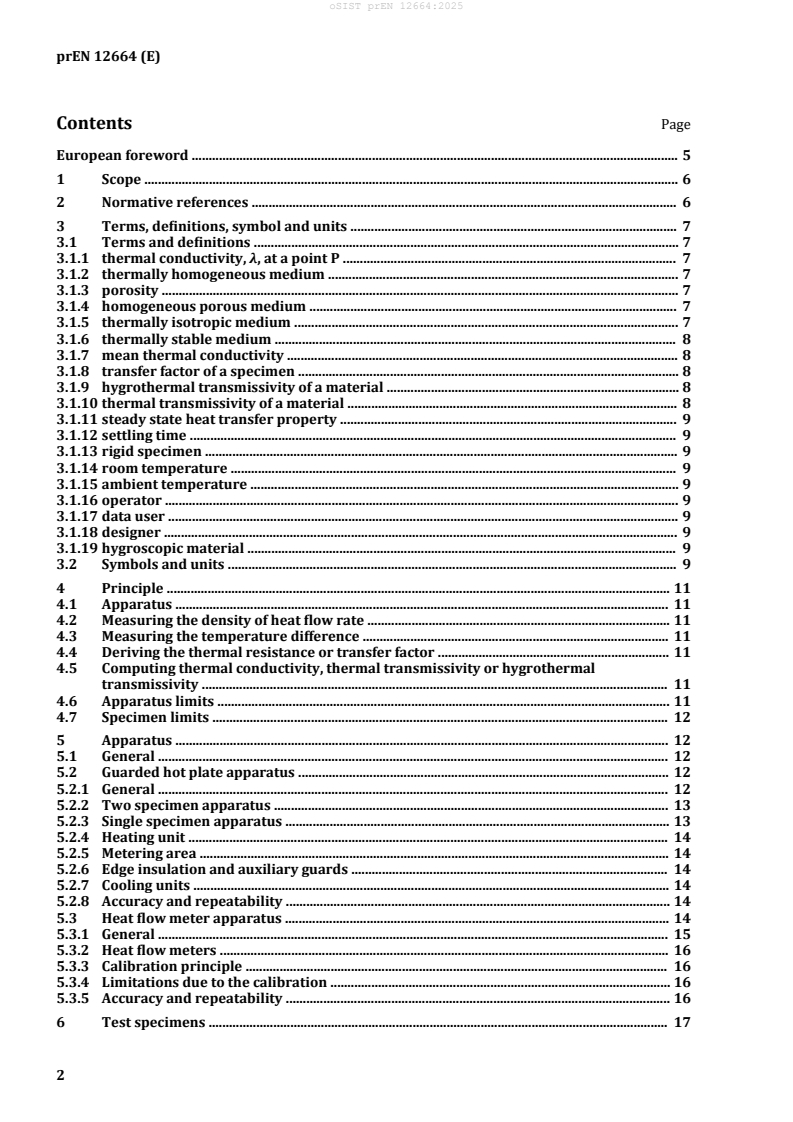
Contents Page
European foreword . 5
1 Scope . 6
2 Normative references . 6
3 Terms, definitions, symbol and units . 7
3.1 Terms and definitions . 7
3.1.1 thermal conductivity, λ, at a point P . 7
3.1.2 thermally homogeneous medium . 7
3.1.3 porosity . 7
3.1.4 homogeneous porous medium . 7
3.1.5 thermally isotropic medium . 7
3.1.6 thermally stable medium . 8
3.1.7 mean thermal conductivity . 8
3.1.8 transfer factor of a specimen . 8
3.1.9 hygrothermal transmissivity of a material . 8
3.1.10 thermal transmissivity of a material . 8
3.1.11 steady state heat transfer property . 9
3.1.12 settling time . 9
3.1.13 rigid specimen . 9
3.1.14 room temperature . 9
3.1.15 ambient temperature . 9
3.1.16 operator . 9
3.1.17 data user . 9
3.1.18 designer . 9
3.1.19 hygroscopic material . 9
3.2 Symbols and units . 9
4 Principle . 11
4.1 Apparatus . 11
4.2 Measuring the density of heat flow rate . 11
4.3 Measuring the temperature difference . 11
4.4 Deriving the thermal resistance or transfer factor . 11
4.5 Computing thermal conductivity, thermal transmissivity or hygrothermal
transmissivity . 11
4.6 Apparatus limits . 11
4.7 Specimen limits . 12
5 Apparatus . 12
5.1 General . 12
5.2 Guarded hot plate apparatus . 12
5.2.1 General . 12
5.2.2 Two specimen apparatus . 13
5.2.3 Single specimen apparatus . 13
5.2.4 Heating unit . 14
5.2.5 Metering area . 14
5.2.6 Edge insulation and auxiliary guards . 14
5.2.7 Cooling units . 14
5.2.8 Accuracy and repeatability . 14
5.3 Heat flow meter apparatus . 14
5.3.1 General . 15
5.3.2 Heat flow meters . 16
5.3.3 Calibration principle . 16
5.3.4 Limitations due to the calibration . 16
5.3.5 Accuracy and repeatability . 16
6 Test specimens . 17
prEN 12664 (E)
6.1 General . 17
6.2 Selection and size . 17
6.3 Specimen preparation and instrumentation . 17
6.3.1 Conformity with product standards . 17
6.3.2 All specimens except loose-fills . 17
6.3.3 Loose-fill materials . 20
7 Testing procedure . 20
7.1 General . 20
7.2 Conditioning . 20
7.2.1 General . 20
7.2.2 Conditioning for measurements on dry materials . 20
7.2.3 Conditioning for measurements on moist materials . 21
7.3 Measurements . 29
7.3.1 Mass . 29
7.3.2 Thickness and density . 29
7.3.3 Temperature difference selection . 29
7.3.4 Ambient conditions . 30
7.3.5 Heat flow rate measurements . 30
7.3.6 Cold surface control (for two-specimen guarded hot plate apparatus) . 30
7.3.7 Temperature difference detection . 30
7.3.8 Settling time and measurement interval . 30
7.3.9 Final mass and thickness measurements . 31
8 Calculations . 31
8.1 Density and mass changes . 31
8.1.1 Densities . 31
8.1.2 Mass changes . 31
8.2 Heat transfer properties . 32
8.2.1 General . 32
8.2.2 Guarded hot plate apparatus measurements . 32
8.2.3 Heat flow meter apparatus measurements . 32
9 Test report . 33
Annex A (normative) Limitations to the implementation of the measurement principle
and on measurable properties . 36
A.1 Considerations on heat transfer and measured properties . 36
A.2 Limitations due to the implementation of the principle . 37
A.2.1 General . 37
A.2.2 Specimen homogeneity . 37
A.2.3 Maximum specimen thickness . 37
A.2.4 Minimum specimen thickness . 39
A.2.5 Maximum limits for the thermal resistance . 40
A.2.6 Flatness and contact resistances . 40
A.2.7 Parallelism . 43
A.2.8 Limits to temperature difference . 43
A.2.9 Maximum operating temperature . 43
A.2.10 Warping . 44
A.2.11 Settling time and measurement interval . 44
A.3 Limitations on measurable heat transfer properties . 45
A.3.1 General . 45
A.3.2 Thermal resistance, thermal conductance or transfer factor . 45
A.3.3 Mean thermal conductivity, thermal transmissivity or hygrothermal
transmissivity of a specimen . 45
A.3.4 Thermal conductivity, thermal transmissivity or hygrothermal transmissivity of
a material . 45
A.4 Preliminary decisions . 46
prEN 12664 (E)
Annex B (normative) Limits for equipment performance and test conditions - Guarded hot
plate . 48
B.1 General . 48
B.2 Accuracy and repeatability, stability, uniformity . 48
B.3 Suggested apparatus sizes . 49
B.4 Equipment design requirements . 49
B.5 Acceptable specimen characteristics . 51
B.6 Acceptable testing conditions . 52
Annex C (normative) Limits for equipment performance and test conditions - Heat flow
meter . 55
C.1 General . 55
C.2 Accuracy and repeatability, stability, uniformity . 55
C.3 Equipment design requirements . 56
C.4 Acceptable specimen characteristics . 58
C.5 Acceptable testing conditions . 59
Annex D (informative) Equipment design . 61
D.1 General . 61
D.2 Guarded hot plate apparatus . 61
Annex E (informative) Procedures related to measurements at moisture equilibrium . 70
E.1 General . 70
E.2 Calculation of λ* at moisture equilibrium . 73
E.3 Theoretical estimation of the moisture distribution . 73
E.4 Determination of the moisture distribution by parallel tests with the same material
and the same boundary conditions . 74
Annex F (informative) Conditioning to a specified moisture content in a specified
atmosphere . 76
F.1 Introductory considerations . 76
F.2 Definitions . 76
F.2.1 atmosphere 23/xx: . 76
F.2.2 hygroscopic range . 76
F.3 Principles of conditioning . 76
Annex G (informative) Estimation of effects of condensation . 78
Annex H (informative) Theoretical background . 79
H.1 Introduction . 79
H.2 Description of heat and mass transfers . 79
H.2.1 Qualitative description of mass transfer phenomena in a simple case . 79
H.2.2 Vapour mass transfer . 80
H.2.3 Qualitative description of mass transfer phenomena in a simple case . 81
H.2.4 Total mass transfer . 81
H.2.5 Heat transfer equations . 81
Bibliography . 82
prEN 12664 (E)
European foreword
This document (prEN 12664:2025) has been prepared by Technical Committee CEN/TC 89
"Thermal performance of buildings and building components", the secretariat of which is held by
SIS.
This document is currently submitted to the CEN Enquiry.
This document will supersede EN 12664:2001
In comparison with the previous edition, the following technical modifications have been made:
— revision of all document to be compliant with CEN rules;
— revision Scope;
— revision of Clause 3;
— revision of Clause 7.2.3 with reference to CEN/TR 14613:2003[1] clauses and ISO 10051:1996[2];
— revision of Annex A;
— revision of Annex E;
— new Annex H Theoretical background.
prEN 12664 (E)
1 Scope
This document spécifiés principles and testing procedures for determining, by means of the guarded
hot plate or heat flow meter methods, the thermal resistance of test specimens either in the dry state
or conditioned to equilibrium with moist air, having a thermal resistance of not less than 0,1 m ·K/W
and a (hygro)thermal transmissivity or thermal conductivity up to 2,0 W/(m·K).
NOTE The lower limit for measurable thermal resistance is due to the effect of contact thermal resistances,
which require special testing techniques described in this document. Although this document can be used for
testing dry specimens of high and medium thermal resistance, i.e. on products having a thermal resistance, that
is, on products with a thermal resistance of at least 0.5 m².K/W, the simpler procedures of EN 12667[3] are
available for such specimen.
This document does not cover methods to assess the hygrothermal transmissivity of materials in the
over-hygroscopic range (i.e. when free liquid water occurs in the material in general above 95% of
moisture).
It applies in principle to any mean test temperature, but the equipment design in Annex D is essentially
intended to operate between a minimum cooling unit temperature of -100 °C and maximum heating
unit temperature of +100 °C.
This document does not supply general guidance and background information (e.g. the heat transfer
property to be reported, product-dependent specimen preparations, suggested materials for vapour-
tight envelopes when testing moist specimens, procedures requiring multiple measurements, such as
those to assess the effect of specimen non-homogeneities, those to test specimens whose thickness
exceeds the apparatus capabilities, and those to assess the relevance of the thickness effect).
2 Normative references
The following documents are referred to in the text in such a way that some or all of their content
constitutes requirements of this document. For dated references, only the edition cited applies. For
undated references, the latest edition of the referenced document (including any amendments) applies.
ISO 8301:1991, Thermal insulation — Determination of steady-state thermal resistance and related
properties — Heat flow meter apparatus
ISO 8302:1991, Thermal insulation — Determination of steady-state thermal resistance and related
properties — Guarded hot plate apparatus
EN 1946-2:1999, Thermal performance of building products and components - Specific criteria for the
assessment of laboratories measuring heat transfer properties - Part 2: Measurements by guarded hot
plate method
EN 1946-2, Thermal performance of building products and components - Specific criteria for the
assessment of laboratories measuring heat transfer properties - Part 2: Measurements by guarded hot
plate method
EN 1946-3, Thermal performance of building products and components - Specific criteria for the
assessment of laboratories measuring heat transfer properties - Part 3: Measurements by heat flow meter
method
EN ISO 7345:2018, Thermal performance of buildings and building components - Physical quantities and
definitions (ISO 7345:2018)
EN ISO 9288:2022, Thermal insulation - Heat transfer by radiation - Vocabulary (ISO 9288:2022)
EN ISO 9346:2007, Hygrothermal performance of buildings and building materials - Physical quantities
for mass transfer - Vocabulary (ISO 9346:2007)
prEN 12664 (E)
EN 12667:2001, Thermal performance of building materials and products - Determination of thermal
resistance by means of guarded hot plate and heat flow meter methods - Products of high and medium
thermal resistance
3 Terms, definitions, symbol and units
3.1 Terms and definitions
For the purposes of this document, the terms and définitions given in EN ISO 7345:2018,
EN ISO 9288:2022, EN ISO 9346:2007 and the following apply.
ISO and IEC maintain terminology databases for use in standardization at the following addresses:
— ISO Online browsing platform: available at http://www.iso.org/obp
— IEC Electropedia: available at http://www.electropedia.org/
3.1.1 thermal conductivity, λ, at a point P
quantity définéd in each point P of a purely conducting medium by the following relation between the
vectors q and grad(T):
q = - λ grad(T)
NOTE In the most general case the thermal conductivity is a nine element tensor and not a constant.
3.1.2 thermally homogeneous medium
medium in which the thermal conductivity is not a function of the position within the medium but may
be a function of the direction, time and temperature
3.1.3 porosity
ξ: total volume of the voids within a porous medium divided by the total volume of the medium.
NOTE 1 A porous medium is one which is heterogeneous due to the presence of e.g. fibrés, cell walls, grains.
NOTE 2 The local porosity, ξ at the point P is the porosity within a specimen when the volume of an elementary
P
part of the specimen is small with respect of the specimen, but large enough to evaluate a meaningful average.
3.1.4 homogeneous porous medium
medium in which the local porosity is independent of the point where the value is computed [EN ISO
9251:1995[4]]
NOTE Most medium and low thermal resistance specimens are homogeneous porous, i.e. not homogeneous
(see the définition of porosity) and hence not thermally homogeneous.
3.1.5 thermally isotropic medium
medium in which the thermal conductivity is not a function of the direction but may be a function of the
position within the medium, of time and temperature
NOTE The thermal conductivity of an isotropic medium is définéd through a single value in each point, instead
of a matrix of values.
prEN 12664 (E)
3.1.6 thermally stable medium
medium in which the thermal conductivity is not a function of time, but may be a function of the co-
ordinates, of temperature and, when applicable, of direction.
3.1.7 mean thermal conductivity
property définéd in steady state conditions in a body that has the form of a slab bounded
by two parallel, flat isothermal faces and by adiabatic edges perpendicular to the faces, that is made of
a material thermally homogeneous, isotropic (or anisotropic with a symmetry axis perpendicular to the
faces), stable only within the precision of a measurement and the time required to execute it, and with
the thermal conductivity constant or a linear function of temperature
3.1.8 transfer factor of a specimen
factor définéd by
q d
d
T = = (1)
∆T R
NOTE This définition is applicable to any steady state test with a guarded hot plate or heat flow meter apparatus,
including e.g. measurements on specimens including air layers, where conduction, convection, radiation and
moisture migration take place together. It depends on experimental conditions, e.g. temperature difference, liquid
and vapour flow, moisture distribution within the specimen, apparatus emissivity and specimen thickness, and
in these conditions characterizes a specimen in relation to moisture migration and/or the combined conduction,
convection and radiation heat transfer. It is often referred to elsewhere as measured, equivalent, apparent or
effective thermal conductivity of a specimen.
3.1.9 hygrothermal transmissivity of a material
λ*: transmissivity of a material définéd by the ratio of the density of heat flow rate and temperature
gradient, as the thermal conductivity
NOTE 1 It applies to moist materials during steady state conditions when moisture distribution within the
material is in equilibrium and there is no moisture movement within the material (with the possible exception of
moisture circulation locally or within a pore). When these conditions apply, it is also:
q d
d
λ* = = (2)
∆T R
NOTE 2 Hygrothermal transmissivity is an intrinsic material property depending upon moisture content and
temperature but not on testing conditions. It can be seen as the transfer factor when appropriate testing conditions
apply. It is often referred to elsewhere as the "thermal conductivity of a moist material". It may be used in one-
dimensional steady state calculations only.
3.1.10 thermal transmissivity of a material
transmissivity of a material définéd by
∆ d
λ =
(3)
t
∆T
when Δd/ΔR is independent of the thickness d
NOTE The thermal transmissivity is independent of experimental conditions and characterizes an insulating
material in relation with combined conduction and radiation heat transfer. The thermal transmissivity can be seen
as the limit reached by the transfer factor in thick layers where combined conduction and radiation heat transfer
takes place. It is often referred to elsewhere as equivalent, apparent or effective thermal conductivity of a material.
prEN 12664 (E)
3.1.11 steady state heat transfer property
Generic term to identify one of the following properties: thermal resistance, transfer factor, thermal
conductivity, thermal resistivity, thermal transmissivity, hygrothermal transmissivity, thermal
conductance, mean thermal conductivity
3.1.12 settling time
time needed for a measurement to reach steady state conditions within 1 %
3.1.13 rigid specimen
specimen of a material too hard and unyielding to be appreciably altered in shape by the pressure of
the heating and cooling unit, so as to achieve uniform thermal contact over the entire heating and cooling
unit surfaces facing the specimen
3.1.14 room temperature
mean test temperature of a measurement such that a person in a room would regard it comfortable if
it were the temperature of that room
3.1.15 ambient temperature
temperature in the vicinity of the edge of the specimen or in the vicinity of the whole apparatus
NOTE This temperature is the temperature within the cabinet where the apparatus is enclosed or that of the
laboratory for non-enclosed apparatus.
3.1.16 operator
person responsible for carrying out the test and for the presentation through a report of the
measured results
3.1.17 data user
person involved in the application and interpretation of measured results to judge material or system
performance
3.1.18 designer
person who develops the constructional details of an apparatus in order to meet prédéfinéd
performance limits for the apparatus in assigned testing conditions and who idéntifiés the test
procedures to verify the predicted apparatus accuracy
3.1.19 hygroscopic material
material which adsorbs, and retain moisture from the environment
NOTE In this standard, the hygroscopic material is a material whose mass increases between the dry (dried at
50°C 70°C or 110°C) and the wet state (conditioning at 23 °C 50 %RH) and whose thermal conductivity changes
with moisture.
3.2 Symbols and units
Table 1 summaries the symbols and units referred to within this document
prEN 12664 (E)
Table 1
Symbol Quantity Unit
A metering area measured on a selected isothermal surface
m
A area of the defect
m
d
A area of the metering section
m
m
D moisture diffusivity
m /s
w
E temperature difference error in non-plane specimens -
Fo Fourier's number -
R thermal resistance
m ·K/W
T transfer factor W/(m·K)
T temperature of the warm surface of the specimen K
T temperature of the cold surface of the specimen K
T mean test temperature (usually (T1 + T2)/2) K
m
V volume
m
Z moisture resistance s/m
v
a moisture factor
W·m /(kg·K)
c spécific heat capacity J/(kg·K)
d thickness; average thickness of a specimen m
e edge temperature ratio -
eh heat flow meter output voltage mV
er percent error due to phase changes -
p
er percent error due to non-uniform moisture distribution -
d
f calibration factor of the heat flow meter
W/(mV·m )
f multiplying factor for measured thermal resistance -
r
g density of moisture flow rate
kg/(m ·s)
he latent enthalpy of evaporation per mass J/kg
m mass (of the specimen) kg
q density of heat flow rate
W/m
p deviation of the specimen surface from a true plane mm
r thermal resistivity K·m/W
t time s
v humidity by volume
kg/m
v humidity by volume at saturation
kg/m
sat
w moisture content mass by volume
kg/m
w mean moisture content mass by volume
kg/m
m
ΔR increments of thermal resistance
m ·K/W
ΔT temperature difference (usually T1 - T2) K
Δd increments of thickness m
Δm relative mass change -
Δt time interval s
Δw change in moisture content (mass by volume)
kg/m
Φ heat flow rate W
2 2
γ conditioning time factor
s/m (or h/cm )
δ moisture permeability with regard to humidity by volume
m /s
v
prEN 12664 (E)
Symbol Quantity Unit
λ thermal conductivity W/(m·K)
λ thermal transmissivity W/(m·K)
t
λ* hygrothermal transmissivity W/(m·K)
λ thermal conductivity of dry material W/(m·K)
ξ moisture differential capacity, dw/dz
kg/m
d
ξ porosity -
ξ local porosity -
P
ρ density
kg/m
ϕ relative humidity -
NOTE The meaning of some additional subscripts is spécifiéd in the text.
4 Principle
4.1 Apparatus
Both the guarded hot plate apparatus and the heat flow meter apparatus are intended to establish within
homogeneous specimens with flat parallel faces, in the form of slabs, a unidirectional constant and
uniform density of heat flow rate. The part of the apparatus where this takes place with acceptable
accuracy is around its centre; the apparatus is therefore divided in a central metering section in which
measurements are taken, and a surrounding guard section.
4.2 Measuring the density of heat flow rate
With the establishment of steady state in the metering section, the density of heat flow rate, q, is
determined from measurement of the heat flow rate, Φ, and the metering area, A, that the heat flow rate
crosses.
4.3 Measuring the temperature difference
The temperature difference across the specimens, ΔT, is measured by temperature sensors fixéd at the
surfaces of the apparatus in contact with the specimen and/or those of the specimens themselves, where
appropriate.
4.4 Deriving the thermal resistance or transfer factor
The thermal resistance, R, is calculated from a knowledge of q, A and ΔT if the appropriate conditions
given in A.2.2 A.3.3 are realized. From the additional knowledge of the thickness, d, of the specimen, the
transfer factor, , is computed.
T
4.5 Computing thermal conductivity, thermal transmissivity or hygrothermal
transmissivity
The mean thermal conductivity, λ, thermal transmissivity λt, or hygrothermal transmissivity λ*, of the
specimen may also be computed if the appropriate conditions to identify them and those given in A.4.3
are realised.
4.6 Apparatus limits
The application of the method is limited by the capability of the apparatus to maintain a unidirectional,
constant and uniform density of heat flow rate in the specimen, coupled with the apparatus limits ability
prEN 12664 (E)
to measure power, temperature and dimensions to the limit of accuracy required. The apparatus shall
follow the information spécifiéd in Annex A .
4.7 Specimen limits
The application of the method is also limited by the shape of the specimen(s) and the degree to which
they are identical in thickness and uniformity of structure (in the case of two specimen apparatus) and
whether their surfaces are flat or parallel. The specimen shall respect the information spécifiéd in Annex
A .
5 Apparatus
5.1 General
A guarded hot plate apparatus or a heat flow meter apparatus used for measurements according to this
document shall comply with the limits on equipment performance and test conditions given in Annex
B or Annex C of this document and shall conform with the requirements concerning the assessment of
equipment accuracy given in EN 1946-2 or EN 1946-3. The equipment design, error analysis and
performance check shall be according to section 2 of ISO 8302:1991 or ISO 8301:1991 respectively.
Annex D gives designs of guarded hot plate apparatus which conform with these requirements. A heat
flow meter apparatus shall follow Annex D of EN 12667:2001. If the equipment used is designed in
accordance with one of these, an error analysis should not be carried out, even though in all cases a
performance check according to EN 1946-2 or EN 1946-3 shall be undertaken for the initial assessment
of the equipment.
Apparatus width or diameter shall be compatible with aggregate or pore size, in accordance with A.2.2.1.
NOTE The overall apparatus width, or diameter, referred to in Clause B.3 is 0,3 m or 0,5 m.
Unlike the Heat flow meter method, the guarded hot plate apparatus is an absolute apparatus, it shall
not be calibrated. A check with only a single reference sample is not a sufficiént evidence. Temperature
sensors and ancillary instrumentation directly affecting accuracy of results shall be subjected to periodic
calibration with traceability to national measurement standards.
Its results shall never be corrected using the results of measurements on reference materials. The
equipment design and all the associated instrumentation shall be checked until the cause of
disagreement has been idéntifiéd and réctifiéd. It is recommended that a vérification with one or more
reference materials be performed after the initial performance check required by 2.4 of ISO
8302:1991[6] and at regular intervals e.g. once a year.
Comparative test methods (e.g. the heat flow meter method) require a calibration of the heat flow rate
transducer, in addition to the calibrations applicable to absolute test methods.
The ancillary equipment requiring periodic calibration checks include: digital voltmeters, power
supplies, voltage and current transducers, standard resistances, thickness transducers, etc.
Equipment maintenance actions and the results of calibrations shall be annotated in the calibration and
maintenance filés.
5.2 Guarded hot plate apparatus
5.2.1 General
In a guarded hot pla
...