

SIST EN 60546-1:2010
(Main)Controllers with analogue signals for use in industrial-process control systems - Part 1: Methods of evaluating the performance (IEC 60546-1:2010)
General Information
- Abstract
IEC 60546-1:2010 is intended to specify uniform methods of test for evaluating the performance of industrial-process PID controllers with analogue input and output signals. The test conditions specified in this standard, for example the range of ambient temperatures, power supply, etc., are used when no other values are agreed upon by the manufacturer and the user. This third edition cancels and replaces the second edition, published in 1987 and constitutes a minor technical revision made to bring terms, measurement units and references up to date.
- Status
- Published
- Publication Date
- 03-Nov-2010
- Technical Committee
- MOV - Measuring equipment for electromagnetic quantities
- Current Stage
- 6060 - National Implementation/Publication (Adopted Project)
- Start Date
- 13-Oct-2010
- Due Date
- 18-Dec-2010
- Completion Date
- 04-Nov-2010

Overview
EN 60546-1:2010 (identical to IEC 60546-1:2010) defines uniform methods for evaluating the performance of controllers with analogue signals, specifically industrial-process PID controllers with analogue input and output signals. This third edition updates terminology, measurement units and references and provides standardized test conditions (ambient environment, power supply, load impedance, etc.) to be used when manufacturer and user have not agreed otherwise.
Key topics
- Scope and test philosophy
- Methods for open-loop and closed-loop testing of analogue PID controllers.
- Procedures to stabilise controller outputs and reproducible measurement practice.
- Controller functional tests
- Measurement of offset, verification of setpoint scales and dial graduation.
- Characterisation of proportional, integral and derivative actions (P, I, D), dead band and response recordings.
- Influence-quantity tests
- Environmental conditions (ambient temperature, humidity) and mechanical stresses (vibration, shock).
- Power supply variations and electromagnetic compatibility (EMC): common-mode and series-mode interference, radio and magnetic field susceptibility, electrostatic discharge.
- Performance metrics
- Output characteristics, power consumption (electric controllers) or air flow/consumption (pneumatic controllers).
- Frequency response measurements and analysis for dynamic behaviour.
- Documentation and reporting
- Test report content, technical examination and a summary of tests for product evaluation and acceptance.
Applications and who uses it
EN 60546-1:2010 is practical for:
- Controller manufacturers - product design validation, type and production testing, and specification of dial/scale accuracy.
- Test laboratories and QA teams - performing standardized performance and EMC tests and producing comparable test reports.
- System integrators and end-users (plant engineers, procurement) - acceptance testing of analogue PID controllers and verifying controller behaviour under specified environmental and supply conditions.
- Regulatory and certification bodies - reference for conformity assessment where analogue controller performance needs standardised measurement.
Typical applications include valve/flow/regulatory loop controllers, HVAC process controllers, and other industrial automation devices using analogue signals.
Related standards
EN 60546-1 references and aligns with several IEC standards used for test methods and EMC/environmental criteria, including:
- IEC 60068 series (environmental testing: vibration, damp heat, shock)
- IEC 61000-4-x series (EMC immunity: ESD, radiated RF)
- IEC 61298 parts 1, 3 and 4 (general evaluation methods and report content)
- IEC 61010-1 (safety for measurement and control equipment)
EN 60546-1:2010 is essential when you need standardized, reproducible methods to evaluate analogue PID controller performance and to ensure interoperable and dependable industrial-process control.
Relations
- Effective Date
- 01-Nov-2010
- Effective Date
- 03-Feb-2026
- Effective Date
- 03-Feb-2026
- Effective Date
- 03-Feb-2026
- Effective Date
- 03-Feb-2026
- Refers
SIST EN 60068-2-6:2008 - Environmental testing - Part 2-6: Tests - Test Fc: Vibration (sinusoidal) - Effective Date
- 03-Feb-2026
- Effective Date
- 03-Feb-2026
- Effective Date
- 03-Feb-2026
- Effective Date
- 03-Feb-2026
- Effective Date
- 03-Feb-2026
- Effective Date
- 03-Feb-2026
- Effective Date
- 08-Oct-2013
Get Certified
Connect with accredited certification bodies for this standard

DVS-ZERT GmbH
German welding certification society.
CARES (UK Certification Authority for Reinforcing Steels)
UK certification for reinforcing steels and construction.
EWF/IIW (European/International Welding Federation)
International welding personnel certification.
Sponsored listings
Frequently Asked Questions
SIST EN 60546-1:2010 is a standard published by the Slovenian Institute for Standardization (SIST). Its full title is "Controllers with analogue signals for use in industrial-process control systems - Part 1: Methods of evaluating the performance (IEC 60546-1:2010)". This standard covers: IEC 60546-1:2010 is intended to specify uniform methods of test for evaluating the performance of industrial-process PID controllers with analogue input and output signals. The test conditions specified in this standard, for example the range of ambient temperatures, power supply, etc., are used when no other values are agreed upon by the manufacturer and the user. This third edition cancels and replaces the second edition, published in 1987 and constitutes a minor technical revision made to bring terms, measurement units and references up to date.
IEC 60546-1:2010 is intended to specify uniform methods of test for evaluating the performance of industrial-process PID controllers with analogue input and output signals. The test conditions specified in this standard, for example the range of ambient temperatures, power supply, etc., are used when no other values are agreed upon by the manufacturer and the user. This third edition cancels and replaces the second edition, published in 1987 and constitutes a minor technical revision made to bring terms, measurement units and references up to date.
SIST EN 60546-1:2010 is classified under the following ICS (International Classification for Standards) categories: 25.040.40 - Industrial process measurement and control. The ICS classification helps identify the subject area and facilitates finding related standards.
SIST EN 60546-1:2010 has the following relationships with other standards: It is inter standard links to SIST EN 60546-1:1998, SIST EN 60068-2-31:2008, SIST EN 61000-4-2:2009, SIST EN 61298-1:2009, SIST EN 61298-3:2009, SIST EN 60068-2-6:2008, SIST EN 61000-4-3:2006, SIST EN 60068-2-30:2006, SIST EN 61298-4:2009, SIST EN 61010-1:2010, SIST EN 60546-2:2010, SIST EN 60546-1:1998. Understanding these relationships helps ensure you are using the most current and applicable version of the standard.
SIST EN 60546-1:2010 is available in PDF format for immediate download after purchase. The document can be added to your cart and obtained through the secure checkout process. Digital delivery ensures instant access to the complete standard document.
Standards Content (Sample)
2003-01.Slovenski inštitut za standardizacijo. Razmnoževanje celote ali delov tega standarda ni dovoljeno.Krmilniki z analognimi signali za uporabo pri nadzoru industrijskih procesov - 1. del: Postopki za ocenjevanje lastnosti (IEC 60546-1:2010)Regler mit analogen Signalen für die Anwendung in Systemen der industriellen Prozesstechnik - Teil 1: Methoden zur Beurteilung des Betriebsverhaltens (IEC 60546-1:2010)Régulateurs à signaux analogiques utilisés pour les systèmes de conduite des processus industriels - Partie 1: Méthodes d’évaluation des performances (CEI 60546-1:2010)Controllers with analogue signals for use in industrial-process control systems - Part 1: Methods of evaluating the performance (IEC 60546-1:2010)25.040.40Merjenje in krmiljenje industrijskih postopkovIndustrial process measurement and controlICS:Ta slovenski standard je istoveten z:EN 60546-1:2010SIST EN 60546-1:2010en01-december-2010SIST EN 60546-1:2010SLOVENSKI
STANDARDSIST EN 60546-1:19981DGRPHãþD
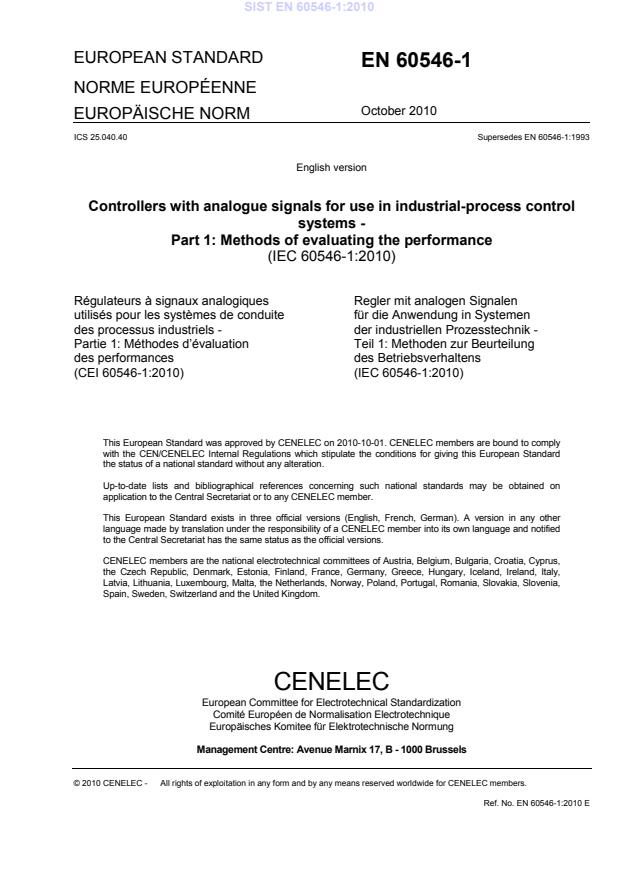
EUROPEAN STANDARD EN 60546-1 NORME EUROPÉENNE
EUROPÄISCHE NORM October 2010
CENELEC European Committee for Electrotechnical Standardization Comité Européen de Normalisation Electrotechnique Europäisches Komitee für Elektrotechnische Normung
Management Centre: Avenue Marnix 17, B - 1000 Brussels
© 2010 CENELEC -
All rights of exploitation in any form and by any means reserved worldwide for CENELEC members.
Ref. No. EN 60546-1:2010 E
ICS 25.040.40 Supersedes EN 60546-1:1993
English version
Controllers with analogue signals for use in industrial-process control systems -
Part 1: Methods of evaluating the performance (IEC 60546-1:2010)
Régulateurs à signaux analogiques utilisés pour les systèmes de conduite
des processus industriels -
Partie 1: Méthodes d’évaluation
des performances (CEI 60546-1:2010)
Regler mit analogen Signalen
für die Anwendung in Systemen
der industriellen Prozesstechnik -
Teil 1: Methoden zur Beurteilung
des Betriebsverhaltens (IEC 60546-1:2010)
This European Standard was approved by CENELEC on 2010-10-01. CENELEC members are bound to comply with the CEN/CENELEC Internal Regulations which stipulate the conditions for giving this European Standard the status of a national standard without any alteration.
Up-to-date lists and bibliographical references concerning such national standards may be obtained on application to the Central Secretariat or to any CENELEC member.
This European Standard exists in three official versions (English, French, German). A version in any other language made by translation under the responsibility of a CENELEC member into its own language and notified to the Central Secretariat has the same status as the official versions.
CENELEC members are the national electrotechnical committees of Austria, Belgium, Bulgaria, Croatia, Cyprus, the Czech Republic, Denmark, Estonia, Finland, France, Germany, Greece, Hungary, Iceland, Ireland, Italy, Latvia, Lithuania, Luxembourg, Malta, the Netherlands, Norway, Poland, Portugal, Romania, Slovakia, Slovenia, Spain, Sweden, Switzerland and the United Kingdom.
at national level by publication of an identical
national standard or by endorsement
(dop)
2011-07-01 – latest date by which the national standards conflicting
with the EN have to be withdrawn
(dow)
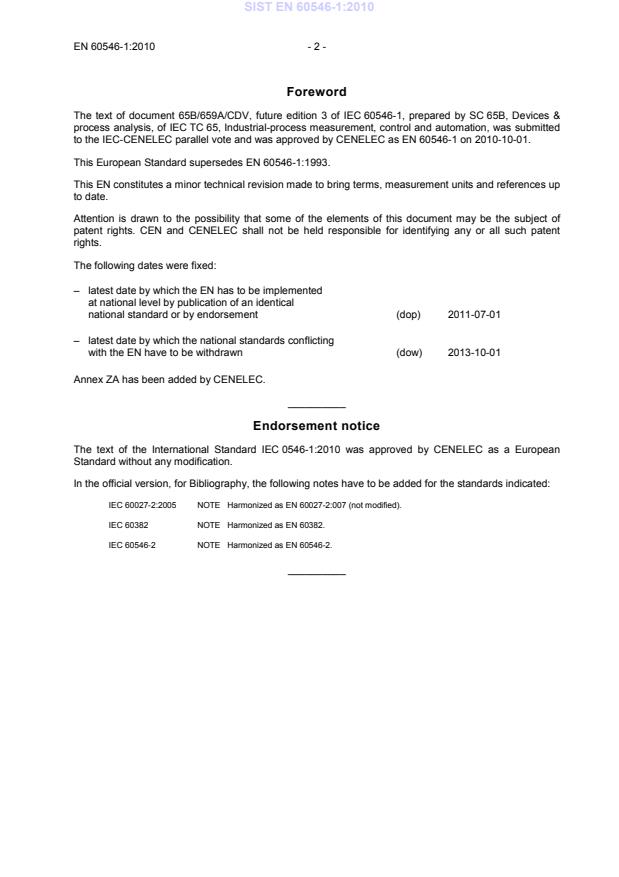
2013-10-01 Annex ZA has been added by CENELEC. __________ Endorsement notice The text of the International Standard IEC 0546-1:2010 was approved by CENELEC as a European Standard without any modification. In the official version, for Bibliography, the following notes have to be added for the standards indicated: IEC 60027-2:2005 NOTE
Harmonized as EN 60027-2:007 (not modified). IEC 60382 NOTE
Harmonized as EN 60382. IEC 60546-2 NOTE
Harmonized as EN 60546-2. __________ SIST EN 60546-1:2010
- 3 - EN 60546-1:2010 Annex ZA
(normative)
Normative references to international publications with their corresponding European publications
The following referenced documents are indispensable for the application of this document. For dated references, only the edition cited applies. For undated references, the latest edition of the referenced document (including any amendments) applies.
NOTE
When an international publication has been modified by common modifications, indicated by (mod), the relevant EN/HD applies.
Publication Year Title EN/HD Year
IEC 60068-2-6 - Environmental testing -
Part 2-6: Tests - Test Fc: Vibration (sinusoidal)
EN 60068-2-6 -
IEC 60068-2-30 - Environmental testing -
Part 2-30: Tests - Test Db: Damp heat, cyclic (12 h + 12 h cycle) EN 60068-2-30 -
IEC 60068-2-31 - Environmental testing -
Part 2-31: Tests - Test Ec: Rough handling shocks, primarily for equipment-type specimens EN 60068-2-31 -
IEC 61000-4-2 - Electromagnetic compatibility (EMC) -
Part 4-2: Testing and measurement techniques - Electrostatic discharge immunity test EN 61000-4-2 -
IEC 61000-4-3 - Electromagnetic compatibility (EMC) -
Part 4-3: Testing and measurement techniques - Radiated, radio-frequency, electromagnetic field immunity test EN 61000-4-3 -
IEC 61010-1 - Safety requirements for electrical equipment for measurement, control and laboratory use - Part 1: General requirements EN 61010-1 -
IEC 61298-1 - Process measurement and control devices - General methods and procedures for evaluating performance -
Part 1: General considerations EN 61298-1 -
IEC 61298-3 - Process measurement and control devices - General methods and procedures for evaluating performance -
Part 3: Tests for the effects of influence quantitites EN 61298-3 -
IEC 61298-4 - Process measurement and control devices - General methods and procedures for evaluating performance -
Part 4: Evaluation report content EN 61298-4 -
IEC 60546-1Edition 3.0 2010-08INTERNATIONAL STANDARD NORME INTERNATIONALEControllers with analogue signals for use in industrial-process control systems Part 1: Methods of evaluating the performance
Régulateurs à signaux analogiques utilisés pour les systèmes de conduite des processus industriels –
Partie 1: Méthodes d’évaluation des performances
INTERNATIONAL ELECTROTECHNICAL COMMISSION COMMISSION ELECTROTECHNIQUE INTERNATIONALE WICS 25.040.40 PRICE CODECODE PRIXISBN 978-2-88912-139-7
– 2 – 60546-1 © IEC:2010 CONTENTS FOREWORD.5 INTRODUCTION.7 1 Scope.8 2 Normative references.8 3 Terms and definitions.9 4 Basic relationships.10 4.1 Input/output relations of idealized controllers.10 4.2 Limitations.12 4.3 Dial graduation of controllers.12 5 General test conditions.13 5.1 Environmental conditions.13 5.1.1 Recommended range of ambient conditions for test measurements.13 5.1.2 Standard reference atmosphere.13 5.1.3 Standard atmosphere for referee measurements.13 5.2 Supply conditions.14 5.2.1 Reference values.14 5.2.2 Tolerances.14 5.3 Load impedance.14 5.4 Other test conditions.14 5.5 Stabilizing the controller output.15 6 Offset.16 6.1 Test set-up.16 6.2 Initial conditions.16 6.3 Test procedure.16 6.3.1 Offset at different values of Xp.16 6.3.2 Effect of changes of reset and rate time.17 7 Dial markings and scale values.17 7.1 Verification of set point scales.17 7.2 Proportional action.17 7.2.1 Initial conditions.17 7.2.2 Test procedure.17 7.2.3 Dead band.18 7.3 Integral action.19 7.3.1 Initial conditions.19 7.3.2 Test procedure.19 7.4 Derivative action.21 7.4.1 Initial conditions.21 7.4.2 Test procedure.21 8 Effect of influence quantities.22 8.1 General.22 8.2 Initial conditions.22 8.3 Climatic influences.23 8.3.1 Ambient temperature (as per IEC 61298-3).23 8.3.2 Humidity (electric controllers only) (as per IEC 61298-3).23 8.4 Mechanical influences.23 8.4.1 Mounting position.23 SIST EN 60546-1:2010
60546-1 © IEC:2010 – 3 – 8.4.2 Shock.23 8.4.3 Mechanical vibration.24 8.5 Power supply influences.25 8.5.1 Power supply variations.25 8.6 Electrical interferences.26 8.6.1 Common mode interference (see Figure 7).26 8.6.2 Series mode interference.27 8.6.3 Earthing.28 8.6.4 Radio interference.28 8.6.5 Magnetic field interference.28 8.6.6 Electrostatic discharge.29 8.7 Output load (electric controllers only).29 8.8 Accelerated operational life test.29 8.8.1 Initial conditions.29 8.8.2 Test procedure.30 9 Output characteristics and power consumption.30 9.1 Consumed and delivered energy.30 9.1.1 General.30 9.1.2 Initial conditions.30 9.1.3 Air flow delivered or exhausted (pneumatic controllers).30 9.1.4 Steady-state air consumption (pneumatic controllers).31 9.1.5 Power consumption (electric controllers).31 9.2 "Automatic"/"Manual" transfer.31 9.3 Ripple content of electrical output.31 10 Frequency response.31 10.1 Application of frequency response tests.31 10.2 Test procedure.32 10.3 Analysis of test results.32 11 Miscellaneous tests.32 11.1 Voltage test (see also IEC 61010-1).32 11.2 Insulation resistance (see also IEC 61010-1).33 11.3 Input over-range.33 12 Documentary information.33 13 Technical examination.34 14 Test report.34 15 Summary of tests.34 Bibliography.38
Figure 1 – Basic signals to/from an idealized controller.10 Figure 2a – Arrangement for open loop or closed loop tests.15 Figure 2b – Arrangement for measuring air flow.16 Figure 3 – Characteristics of a controller with proportional action only.19 Figure 4 – Recorded characteristics of proportional action.20 Figure 5 – Recorded characteristics of integral action.21 Figure 6 – Recorded characteristics of derivative action.22 Figure 7 – Arrangement for common mode interference test (a.c. generator).27 Figure 8a – Arrangement for series mode interference test (voltage input).28 SIST EN 60546-1:2010
– 4 – 60546-1 © IEC:2010 Figure 8b – Arrangement for series mode interference test (current input).29 Figure 9 – Flow characteristic of a pneumatic controller.31 Figure 10 – Frequency response test results.37
Table 1 – Operating conditions for mechanical vibration tests.24 Table 2 – Conditions for frequency response tests.32 Table 3 – Voltage test values.33
60546-1 © IEC:2010 – 5 – INTERNATIONAL ELECTROTECHNICAL COMMISSION ____________
CONTROLLERS WITH ANALOGUE SIGNALS FOR USE IN
INDUSTRIAL-PROCESS CONTROL SYSTEMS –
Part 1: Methods of evaluating the performance
FOREWORD 1) The International Electrotechnical Commission (IEC) is a worldwide organization for standardization comprising all national electrotechnical committees (IEC National Committees). The object of IEC is to promote international co-operation on all questions concerning standardization in the electrical and electronic fields. To this end and in addition to other activities, IEC publishes International Standards, Technical Specifications, Technical Reports, Publicly Available Specifications (PAS) and Guides (hereafter referred to as “IEC Publication(s)”). Their preparation is entrusted to technical committees; any IEC National Committee interested in the subject dealt with may participate in this preparatory work. International, governmental and non-governmental organizations liaising with the IEC also participate in this preparation. IEC collaborates closely with the International Organization for Standardization (ISO) in accordance with conditions determined by agreement between the two organizations. 2) The formal decisions or agreements of IEC on technical matters express, as nearly as possible, an international consensus of opinion on the relevant subjects since each technical committee has representation from all interested IEC National Committees.
3) IEC Publications have the form of recommendations for international use and are accepted by IEC National Committees in that sense. While all reasonable efforts are made to ensure that the technical content of IEC Publications is accurate, IEC cannot be held responsible for the way in which they are used or for any misinterpretation by any end user. 4) In order to promote international uniformity, IEC National Committees undertake to apply IEC Publications transparently to the maximum extent possible in their national and regional publications. Any divergence between any IEC Publication and the corresponding national or regional publication shall be clearly indicated in the latter. 5) IEC itself does not provide any attestation of conformity. Independent certification bodies provide conformity assessment services and, in some areas, access to IEC marks of conformity. IEC is not responsible for any services carried out by independent certification bodies. 6) All users should ensure that they have the latest edition of this publication. 7) No liability shall attach to IEC or its directors, employees, servants or agents including individual experts and members of its technical committees and IEC National Committees for any personal injury, property damage or other damage of any nature whatsoever, whether direct or indirect, or for costs (including legal fees) and expenses arising out of the publication, use of, or reliance upon, this IEC Publication or any other IEC Publications.
8) Attention is drawn to the Normative references cited in this publication. Use of the referenced publications is indispensable for the correct application of this publication. 9) Attention is drawn to the possibility that some of the elements of this IEC Publication may be the subject of patent rights. IEC shall not be held responsible for identifying any or all such patent rights. International Standard IEC 60546-1 has been prepared by subcommittee 65B: Devices and process analysis, of IEC technical committee 65: Industrial-process measurement, control and automation. This third edition cancels and replaces the second edition, published in 1987. This third edition constitutes a minor technical revision made to bring terms, measurement units and references up to date.
The text of this standard is based on the following documents: CDV Report on voting 65B/659A/CDV 65B/717A/RVC
Full information on the voting for the approval of this standard can be found in the report on voting indicated in the above table. SIST EN 60546-1:2010
– 6 – 60546-1 © IEC:2010 This publication has been drafted in accordance with the ISO/IEC Directives, Part 2. A list of all parts of the IEC 60546 series, under the general title: Controllers with analogue signals for use in industrial-process control systems, can be found on the IEC website. The committee has decided that the contents of this publication will remain unchanged until the stability date indicated on the IEC web site under "http://webstore.iec.ch" in the data related to the specific publication. At this date, the publication will be
• reconfirmed, • withdrawn, • replaced by a revised edition, or • amended.
60546-1 © IEC:2010 – 7 – INTRODUCTION The methods of evaluation given in this International Standard are intended for use by manufacturers to determine the performance of their products and by users, or independent testing establishments, to verify manufacturers’ performance specifications. Part 2 of IEC 60546 describes a limited series of tests which may be used as acceptance tests. The tests specified in this standard are not necessarily sufficient for instruments specifically designed for unusually arduous duties. Conversely, a restricted series of tests may be suitable for instruments designed to perform within a limited range of conditions. It will be appreciated that the closest liaison should be maintained between an evaluating body and the manufacturer. Note is taken of the manufacturer’s specifications for the instrument when the test program is being decided, and the manufacturer should be invited to comment on both the test program and the results. His comments on the results should be included in any report produced by the testing organization. SIST EN 60546-1:2010
– 8 – 60546-1 © IEC:2010 CONTROLLERS WITH ANALOGUE SIGNALS FOR USE IN
INDUSTRIAL-PROCESS CONTROL SYSTEMS –
Part 1: Methods of evaluating the performance
1 Scope This International Standard applies to proportional-integral-derivative (PID) pneumatic and electric industrial-process controllers using analogue continuous input and output signals which are in accordance with current international standards. It should be noted that while the tests specified herein cover controllers having such signals, they can be applied in principle to controllers having different but continuous signals. It should be also noted that this standard has been written for pneumatic and electric industrial-process controllers with only analogue components and is not necessarily to be used for controllers with microprocessors. This standard is intended to specify uniform methods of test for evaluating the performance of industrial-process PID controllers with analogue input and output signals1).
The test conditions specified in this standard, for example the range of ambient temperatures, power supply, etc., are used when no other values are agreed upon by the manufacturer and the user. When a full evaluation in accordance with this standard is not required, those tests which are required shall be performed and the results reported in accordance with those parts of the standard which are relevant. The testing program should be subject to an agreement between manufacturer and user, depending on the nature and the extent of the equipment under consideration. 2 Normative references The following referenced documents are indispensable for the application of this document. For dated references, only the edition cited applies. For undated references, the latest edition of the referenced document (including any amendments) applies. IEC 60068-2-6, Environmental testing – Part 2-6: Tests – Test Fc: Vibration (sinusoidal) IEC 60068-2-30, Environmental testing – Part 2-30: Tests – Test Db: Damp heat, cyclic (12 h + 12 h cycle IEC 60068-2-31, Environmental testing – Part 2-31: Tests – Test Ec: Rough handling shocks, primarily for equipment-type specimens IEC 61000-4-2, Electromagnetic compatibility (EMC) – Part 4-2: Testing and measurement techniques – Electrostatic discharge immunity test IEC 61000-4-3, Electromagnetic compatibility (EMC) – Part 4-3: Testing and measurement techniques – Radiated, radio-frequency, electromagnetic field immunity test ————————— 1)
See IEC 60381 and IEC 60382. SIST EN 60546-1:2010
60546-1 © IEC:2010 – 9 – IEC 61010-1, Safety requirements for electrical equipment for measurement, control, and laboratory use – Part 1: General requirements IEC 61298-1, Process measurement and control devices – General methods and procedures for evaluating performance – Part 1: General considerations IEC 61298-3, Process measurement and control devices – General methods and procedures for evaluating performance – Part 3: Tests for the effects of influence quantities IEC 61298-4, Process measurement and control devices – General methods and procedures for evaluating performance – Part 4: Evaluation report content 3 Terms and definitions For the purposes of this document, the following terms and definitions apply. 3.1
proportional band proportional band Xp of a linear controller, expressed in per cent, given by the expression:
pp100KX= (1) 3.2
direct acting controller output, which increases with an increase in the measured value
3.3
reverse acting controller output, which decreases with an increase in the measured value
3.4
offset steady-state deviation between measured value and set point
3.5
controller, proportional
P controller which produces proportional control action only 3.6
controller, proportional plus derivative (rate)
PD controller which produces proportional plus derivative control action 3.7
controller, proportional plus integral (reset)
PI controller which produces proportional plus integral control action 3.8
controller PID controller with compound action which produces proportional, plus integral, plus derivative actions SIST EN 60546-1:2010
– 10 – 60546-1 © IEC:2010 3.9
dead band finite range of values within which variation of the input variable does not produce any measurable change in the output variable 3.10
average upscale error arithmetic mean of the errors at each point of measurement for the upscale readings of each measurement cycle 3.11
average downscale error arithmetic mean of the errors at each point of measurement for the downscale readings of each measurement cycle 3.12
average error arithmetic mean of all upscale and downscale errors at each point of measurement 3.13
hysteresis difference between the average upscale error and the average downscale error at each point of measurement 4 Basic relationships 4.1 Input/output relations of idealized controllers In its simplest form, the relationship may be given by an equation generally presented in one of the following forms:
Controller wx –wy xPID IEC
1620/10
Figure 1 – Basic signals to/from an idealized controller SIST EN 60546-1:2010
60546-1 © IEC:2010 – 11 –
()()()∫−+−+−=−ttwxKtwxKwxKyy0DIp0ddd (2)
()()()⎥⎥⎦⎤⎢⎢⎣⎡−+−+−=−∫ttwxTtwxTwxKyy0DIp0ddd1 (3) or in the frequency domain:
()DIpjj11jTTKFωωω+⎥⎦⎤⎢⎣⎡+= (4) These equations are valid for controllers with no interaction between factors Kp, K1 and KD. The equation for idealized controllers with interaction taken into account may be written as:
()()()⎥⎥⎦⎤⎢⎢⎣⎡−′+−′+−′=−∫ttAwxTtwxTAwxAKyy0DIp0ddd1 (5) In this equation, A is the interaction factor that depends on the structure of the controller. It can often be written as:
ID1TTA′′+=
(6a);
AKKpp=′
(6b)
ATT1I1+=′
(6c);
DDTAT=′
(6d) where t
is the time;
y
is the output signal (correcting variable);
y0
is the output signal at time t = 0 (controller output balance); x
is the measured value (controlled variable); w
is the set point value (reference input variable); Kp
is the proportional action factor (proportional action coefficient (see Note 1); K1
is the integral action factor (integral action coefficient (see Note 1); KD
is the derivative action factor (derivative action coefficient (see Note 1); TI
is the reset time; TD
is the rate time;
x and w, and consequently also y can be functions of time t, and: e
is the error or controller off-set, i.e.: x – w; ω is the angular velocity. NOTE 1 For the definition of this term, see IEC 60050-351. NOTE 2 This standard is limited to P, PI, PD or PID controllers. NOTE 3 The factors Kp, K1 and KD may have the sign “plus” or “minus”; it is usual to associate “direct action” with the positive sign and “reverse action” with the negative sign. NOTE 4 Symbols with prime (K′p, T′I T′D) represent nominal values, in contrast to effective values. NOTE 5 Integral-action time constant and derivative-action time constant refer only to pure integral or derivative-action controllers (IEC 60050-351)). SIST EN 60546-1:2010
– 12 – 60546-1 © IEC:2010 There are controllers with still other structures, for example where the differentiation is applied only to the measured value x, not to (x – w). Equation (5) therefore becomes:
()()()⎥⎥⎦⎤⎢⎢⎣⎡′+−′+−′=−∫xtATtwxTAwxAKyyt0DIp0ddd1 (7) 4.2 Limitations The equations describing the performance of an actual controller are usually different from equations (2) to (7) because they include time constants and limitations. Two commonly encountered deviations from the idealized controller equations can be expressed as follows: a) Maximum integral gain VI Because of the finite integral gain of actual controllers, the integral part of equations (2) and (3) is an approximation of the actual response only for sufficiently high frequencies. For low frequencies, a controller may have an integral action [integral term of equation (4)] expressed in the frequency domain as follows:
()1Ipj1jVTVKFIωω+= (8) b) Maximum derivative gain VD Because of the limited derivative gain of actual controllers, the derivative terms of equations (2) and (3) are an approximation of the actual response only for sufficiently low frequencies. In the most simple case, there may be additional time constant and proportional terms. The derivative term of equation (4) may then be expressed, in the frequency domain, as follows: Derivative action and time constant
()TTKFωωωj1jjDp+= (9) or
proportional action, derivative action and time constant
()TTKFωωωj1j1jDp++= (10) where T
is the time constant of a first order time delay. The ratio TTD may be constant for all adjustable values of TD (depending upon the design of the controller). The ratio TTD is then called maximum derivative gain or VD. 4.3 Dial graduation of controllers The action factors and action times as used in the equations shown above give an idealized description of the performance of a controller. Their values may differ from the values which are the graduations marked on the dials of the controller. The relationship between the dial graduations and the effective values, i.e. the “interaction formula”, shall be provided by the SIST EN 60546-1:2010
60546-1 © IEC:2010 – 13 – manufacturer. The relationship may be expressed in algebraic form or by graphs, tables, diagrams, etc. 5 General test conditions 5.1 Environmental conditions As per IEC 61298-1: 5.1.1 Recommended range of ambient conditions for test measurements Temperature range
15 °C to 35 °C Relative humidity
45 % to 75 % Atmospheric pressure
86 kPa to 106 kPa Electromagnetic field
value to be stated, if relevant The maximum rate of ambient temperature change permissible during any test shall be 1 °C in
10 min. These conditions may be equivalent to normal operating conditions. 5.1.2 Standard reference atmosphere Temperature
20 °C Relative humidity
65 % Atmospheric pressure
101,3 kPa This standard reference atmosphere is the atmosphere to which values measured under any other atmospheric conditions are corrected by calculation. It is recognized, however, that in many cases a correction factor for humidity is not possible. In such cases, the standard reference atmosphere takes account of temperature and pressure only. This atmosphere is equivalent to the normal reference operating conditions usually identified by the manufacturer. 5.1.3 Standard atmosphere for referee measurements When correction factors to adjust atmospheric-condition-sensitive parameters to their standard reference atmosphere value are unknown, and measurements under the recommended range of ambient atmospheric conditions are unsatisfactory, repeated measurements under closely controlled atmospheric conditions may be conducted. For the purpose of this standard, the following atmospheric conditions are given for referee measurements.
Nominal value
Tolerance Temperature
20 °C
±2 °C Relative humidity
65 %
±5 % Atmospheric pressure
86 kPa to 106 kPa – For tropical, sub-tropical or other special requirements, alternate referee atmospheres may be used. SIST EN 60546-1:2010
– 14 – 60546-1 © IEC:2010 5.2 Supply conditions 5.2.1 Reference values The values shall be specified by the manufacturer or agreed upon between user and manufacturer. 5.2.2 Tolerances As per IEC 61298-1: 1) Electrical supply – rated voltage
±1 % – rated frequency
±1 % – harmonic distortion (a.c. supply)
less than 5 % – ripple content (d.c. supply)
less than 0,1 % 2) Pneumatic supply –
rated pressure
±1 % – supply air temperature
ambient temperature ± 2 °C –
supply air humidity
dew point at least 10 °C below controller temperature – oil and dust content • oil less than 1 × 10⁻⁶
by weight • dust absence of particles greater than 3 μm diameter 5.3 Load impedance As per IEC 61298-1: The value given by the manufacturer shall be used as the reference value. For electric controllers, if the manufacturer gives more than one value, the load impedance shall be taken as equal to: – the minimum value specified by the manufacturer for controllers with direct voltage output signal; – the maximum permissible value for controllers with direct current output signal. Unless otherwise stated by the manufacturer, for pneumatic controllers, an 8 m length of 4 mm internal diameter rigid pipe followed by 20 cm3 capacity shall be used for load impedance. NOTE This arrangement is specified for steady-state tests on pneumatic controllers. For dynamic tests, a 100 cm3 capacity may be used in place of the 20 cm3. 5.4 Other test conditions Other conditions to consider when performing general tests are as follows: –
on the input signals: spurious induced voltages or pressure fluctuations which may affect the measurement shall not be present; – controller position during operation: normal mounting position specified by the manufacturer. Throughout each test, however, the mounting position of the controller should not change by more than ±3° about any axis; – external mechanical constraints: they shall be negligible. SIST EN 60546-1:2010
60546-1 © IEC:2010 – 15 – The limit of error of the measuring systems used for the tests shall be stated in the test report and should be smaller than or equal to one-fourth of the stated limit of error of the instrument tested. 5.5 Stabilizing the controller output For the purpose of the following tests, the controller may be stabilized in the following manner (see Figure 2a2)).
a) Set the controller in a closed loop configuration by putting the switch in position B. Set the controller for reverse action, or the differential amplifier to a gain of –1. b)
Set the proportional band to 100 % if possible and unless specified otherwise. c) Set the derivative action for minimum effect (minimum rate time or off). d) Set the integral action for maximum effect (minimum reset time).
e) Set the set point to 50 %. f) If necessary, adjust the bias of generator No. 3 in order to obtain the desired output.
Set point generator No. 1 Measured value generator No. 2 Bias
generator No. 3 Offset measurement Controller under test Measured value/output recorder Set point
Measured value Output
Load
Damping Switch A B ± 1A = open loop B = closed loop IEC
1621/10 Generator No. 1
Generator for set point input
For controller with external set point Generator No. 2
DC for steady state input
Step for integral action test
Ramp for derivative action test Generator No. 3
Sine wave for frequency response test and accelerated life test
DC for fixed bias levels 2a) Arrangement for open loop or closed loop tests ————————— 2) Damping is sometimes necessary for stabilization. SIST EN 60546-1:2010
– 16 – 60546-1 © IEC:2010
Measured value/ output recorder FlowmeterThrottle valve Throttle valve FlowmeterAir supply Atmosphere w x Circuit as in Figure 2a Controller under test Damping IEC
1918/102b) Arrangement for measuring air flow Figure 2 – Test arrangements 6 Offset 6.1 Test set-up The offset test only applies to controllers with integral action. The circuit arrangement shown in Figure 2a or an equivalent arrangement shall be used. The set point and the measured value shall be connected to the input of a differential measuring device. The selector switch shall be set in position B, thus obtaining a stable “closed loop” condition. Changing the bias of generator No. 3 allows the controller output y to be varied over the full span for any value of the controller set point value and measured value. 6.2 Initial conditions Initial conditions shall be as specified in Clause 5.
6.3 Test procedure 6.3.1 Offset at different values of Xp The offset will change for different values of proportional bands. The test procedures to determine the offsets are as follows: –
If the controller being tested has scale markings not directly in terms of proportional band, or reset and rate times, the relationship of such markings to the parameters used in this standard needs to be established. The method specified in this clause shall be used with the instrument set to the scale markings which correspond to the values specified. – With the controller stabilized in accordance with 5.5, adjust the bias of generator No. 3 until the output is 50 %. After allowing sufficient time for the controller output to stabilize, measure the offset. – The measurement shall be repeated with the proportional band adjusted to the minimum value and then to the maximum value (or to the nearest scale markings). SIST EN 60546-1:2010
60546-1 © IEC:2010 – 17 – – Set the proportional band to 100 %. Repeat measurements as described above for all nine combinations of the three values of the set point: 10 %, 50 % and 90 % of span and the three values of output: 10 %, 50 % and 90 % of span. –
Switch the controller to direct action. At the same time adjust the gain of the differential amplifier to –1. Measure offset with Xp = 100 %, set point = 50 % and output = 50 %. – Further measurements may be made with other values of the proportional band or of the set point at special points, in order to interpolate between some preceding readings where there are significant variations in the offset. – Offset shall be reported expressed in per cent of span of measured value. 6.3.2 Effect of changes of reset and rate time
Adjust set point to 50 %, output to 50 % and proportional band Xp to 100 %. With the reset time set to its minimum value, change the rate time from its minimum value to an intermediate value and then to the maximum value (for example 6 s, 12 s and 120 s). With the rate time set to its minimum value, change the reset time from its minimum value to an intermediate value and then to the maximum value (for example 6 s, 12 s and 120 s). The offset shall be measured for each condition. 7 Dial markings and scale values 7.1 Verification of set point scales The majority of controllers with internal set point sources have accessible terminals where the effective set point signal can be measured. When this is so, the following test shall be carried out. The set point indicator shall be set in turn to the 0 %, 20 %, 40 %, 50 %, 60 %, 80 % and 100 % markings of its scale, and the corresponding values of the generated set point signal shall be measured. The procedure shall then be repeated for settings in descending order, i.e. 100 %, 80 %, etc., down to 0 %. The above procedure shall be repeated at least three times. Determine the difference between the indicator reading and the generated value at each setting. Express the difference in per cent of the set point span. Report the following: a) average upscale error;
b) average downscale;
c) average error;
d) hysteresis.
7.2 Proportional action The circuit arrangement shown in Figure 2a, or an equivalent arrangement should be used. 7.2.1 Initial conditions The reference conditions are as specified in Clause 5. 7.2.2 Test procedure The test procedure is as follows: SIST EN 60546-1:2010
– 18 – 60546-1 © IEC:2010 –
Adjust the set point to 50 %. Set the proportional band at 100 % (or the nearest scale marking).
– Stabilize the output at 50 %. – Adjust integral action to minimum effect (maximum reset time or off). – Adjust derivative action to minimum effect (minimum rate time or off). – Open the loop connection (switch in position A), and set controller action to direct action mode. – Vary the measured value signal over the range necessary to change the output from minimum to maximum and note the corresponding measured value and output signals.
Measurements shall start with a measured value signal of 50 % and subsequent signals of 30 %, 70 %, 10 %, 90 %, 0 %, 100 % in that order.
– This procedure shall be carried out without interruption and as rapidly as possible to minimize the effects of residual integral action.
– These measurements shall be repeated with the proportional band set at the two extreme scale markings. For measurements at proportional band settings smaller than 100 %, measured value signals shall be used such that the corresponding output signals are 50 %, 30 %, 70 %, 10 %, 90 %, 0 % and 100 %. – Measurement shall be repeated at 100 % proportional band setting, but with controller set to reverse action.
– A graph of the output signal plotted against the measured value signal (as percentages) shall be plotted as in Figure 3. The average proportional action factor (Kp) shall be determined for each proportional band setting from the slope of the best fitting straight line (see Figure 3). The proportional band (Xp) shall be determined from the points of intersection of the characteristics, as plotted in
Figure 3, with the 0 % and 100 % measured value and output lines, as appropria
...