


SIST EN ISO 19085-15:2022
(Main)Woodworking machines - Safety - Part 15: Presses (ISO 19085-15:2021)
Woodworking machines - Safety - Part 15: Presses (ISO 19085-15:2021)
This document gives the safety requirements and measures for stationary manually loaded and unloaded:
— cold presses;
— hot presses;
— bending presses;
— edge/face gluing presses;
— membrane presses;
— embossing presses;
where the pressing force is applied by hydraulic actuators pushing two flat or shaped surfaces against each other, hereinafter referred to as "machines".
It deals with all significant hazards, hazardous situations and events as listed in Clause 4 relevant to machines, when operated, adjusted and maintained as intended and under the conditions foreseen by the manufacturer including reasonably foreseeable misuse. Also, transport, assembly, dismantling, disabling and scrapping phases are taken into account.
NOTE For relevant but not significant hazards, e.g. sharp edges of the machine frame, see ISO 12100:2010.
It is also applicable to machines fitted with one or more of the following devices/additional working units, whose hazards have been dealt with:
a) device for hot gluing;
b) device for high-frequency gluing;
c) device for high-frequency shaping;
d) automatic work-piece loading and unloading system;
e) intermediate additional platens;
f) work-piece extractor;
g) work-piece clamping pressure beam;
h) split moveable platens.
The machines are designed to process work-pieces consisting of:
1) solid wood;
2) materials with similar characteristics to wood (see ISO 19085‑1:2017, 3.2);
3) honeycomb board.
This document does not deal with any hazards related to:
— specific devices that differ from the list above;
— hot fluid heating systems internal to the machine other than electrical;
— any hot fluid heating systems external to the machine;
— operation of taking intermediate platens out and in again;
— the combination of a single machine being used with any other machine (as part of a line).
It is not applicable to:
— frame presses;
— membrane presses where the pressing force is applied by vacuum only;
— presses for producing chipboard, fibreboard, OSB;
— machines intended for use in potentially explosive atmosphere;
— machines manufactured before the date of its publication as an international standard.
Holzbearbeitungsmaschinen - Sicherheit - Teil 15: Pressen (ISO 19085-15:2021)
Dieses Dokument stellt Sicherheitsanforderungen und Maßnahmen zur Verfügung für stationäre
— Kaltpressen;
— Heißpressen;
— Biegepressen;
— Kanten-/Flächenverleimpressen;
— Membranpressen;
— Prägepressen;
mit Handbeschickung und Handentnahme, bei denen die Presskraft durch hydraulische Antriebe aufgebracht wird, die zwei ebene oder geformte Flächen gegeneinander drücken, nachfolgend als „Maschinen“ bezeichnet.
Es behandelt alle im Abschnitt 4 aufgeführten signifikanten Gefährdungen, Gefährdungssituationen und Gefährdungsereignisse, die auf die Maschinen zutreffen, wenn sie bestimmungsgemäß und entsprechend den vom Hersteller vorhergesehenen Bedingungen verwendet, eingestellt und gewartet werden, einschließlich der vernünftigerweise vorhersehbaren Fehlanwendung. Ferner werden die Phasen Transport, Montage, Demontage, Rückbau und Verschrottung berücksichtigt.
ANMERKUNG Hinsichtlich zutreffender aber nicht signifikanter Gefährdungen, z. B. scharfe Kanten des Maschinengestells, siehe ISO 12100:2010.
Es gilt auch für Maschinen, die mit einer oder mehreren der folgenden Einrichtungen/zusätzlichen Arbeitsaggregate ausgerüstet sind, deren Gefährdungen behandelt wurden:
a) Einrichtung zum Heißverleimen;
b) Einrichtung zum Hochfrequenzverleimen;
c) Einrichtung zum Hochfrequenzformen;
d) automatisches Be- und Entladesystem für Werkstücke;
e) zusätzliche Zwischenplatten;
f) Werkstück-Auszieher;
g) Werkstück-Spanndruckbalken;
h) geteilte bewegliche Platten.
Die Maschinen sind gestaltet für die Bearbeitung von Werkstücken aus:
1) Massivholz;
2) Werkstoffen mit ähnlichen Eigenschaften wie Holz (siehe ISO 19085-1:2017, 3.2);
3) Wabenplatten.
Dieses Dokument behandelt keine Gefährdungen im Zusammenhang mit:
— spezifischen Einrichtungen, die von der obigen Liste abweichen;
— Heizsystemen für heiße Flüssigkeiten innerhalb der Maschine, die nicht elektrisch betrieben werden;
— Heizsystemen für heiße Flüssigkeiten außerhalb der Maschine;
— dem Vorgang der Entnahme und des Wiedereinsetzens von Zwischenplatten;
— der Kombination einer einzelnen Maschine, die mit einer beliebigen anderen Maschine (als Teil einer Linie) verwendet wird.
Es gilt nicht für:
— Rahmenpressen;
— Membranpressen, bei denen die Presskraft nur durch Vakuum aufgebracht wird;
— Pressen zur Herstellung von Spanplatten, Faserplatten, OSB;
— Maschinen, die zur bestimmungsgemäßen Verwendung in potentiell explosiven Atmosphären vorgesehen sind;
— Maschinen, die vor dem Datum seiner Veröffentlichung als Internationale Norm hergestellt wurden.
Machines pour le travail du bois - Sécurité - Partie 15: Presses (ISO 19085-15:2021)
Le présent document donne les exigences et mesures de sécurité pour les machines fixes, à chargement et déchargement manuels:
— presses à froid;
— presses à chaud;
— presses à cintrer;
— presses de collage sur chant/face;
— presses à membrane;
— presses à estamper;
dans lesquelles la force de pressage est appliquée par des actionneurs hydrauliques poussant deux surfaces planes ou façonnées l’une contre l’autre, ci-après désignées «machines».
Il traite de tous les phénomènes dangereux, situations et événements dangereux significatifs, tels qu'énumérés à l'Article 4, applicables aux machines lorsqu'elles sont utilisées, réglées et entretenues comme prévu et dans les conditions prévues par le fabricant, incluant une mauvaise utilisation raisonnablement prévisible. Les phases de transport, d'assemblage, de démontage, de mise hors service et de mise au rebut sont également prises en compte.
NOTE Pour les phénomènes dangereux pertinents mais non significatifs, par exemple, les arêtes vives du bâti de la machine, voir l'ISO 12100:2010.
Il est également applicable aux machines équipées d'un ou plusieurs des dispositifs/unités de travail supplémentaires suivants, dont les phénomènes dangereux ont été traités:
a) dispositif de collage à chaud;
b) dispositif de collage à haute fréquence;
c) dispositif de façonnage à haute fréquence;
d) système de chargement et déchargement automatiques de la pièce;
e) plateaux intermédiaires supplémentaires;
f) extracteur de pièce;
g) poutre de pressage pour le bridage de la pièce;
h) plateaux mobiles séparés.
Les machines sont conçues pour usiner des pièces constituées de:
1) bois massif;
2) matériau présentant des caractéristiques similaires à celles du bois (voir l'ISO 19085-1:2017, 3.2);
3) plaque alvéolaire.
Le présent document ne traite pas des phénomènes dangereux relatifs à:
— des dispositifs spécifiques qui diffèrent de la liste ci-dessus;
— des systèmes de chauffage par fluide chaud internes à la machine, autres qu’électriques;
— tous les systèmes de chauffage par fluide chaud externe à la machine;
— l’opération d’extraction et de réinsertion des plateaux intermédiaires;
— la combinaison d’une machine simple utilisée avec toute autre machine (comme une partie d’une ligne).
Il ne s’applique pas aux:
— presses à cadre;
— presses à membrane dans lesquelles la force de pressage est appliquée uniquement par dépression;
— presses pour la production de panneaux de particules, de panneaux de fibres, d’OSB;
— machines prévues pour une utilisation en atmosphère explosible;
— machines fabriquées avant la date de sa publication comme Norme internationale.
Lesnoobdelovalni stroji - Varnost - 15. del: Stiskalnice (ISO 19085-15:2021)
Ta del standarda ISO 19085 podaja varnostne zahteve in ukrepe za naslednje stacionarne stroje z ročnim nalaganjem in razlaganjem:
– stiskalnice za hladno stiskanje;
– stiskalnice za vroče stiskanje;
– stiskalnice za upogibanje;
– stiskalnice za lepljenje robov/stranic;
– membranske stiskalnice;
– stiskalnice za vtiskovanje,
pri katerih silo stiskanja ustvarijo hidravlična sprožila, ki potiskajo dve ravni ali oblikovani ploskvi drugo proti drugi (v nadaljnjem besedilu »stroji«).
Obravnava vse večje nevarnosti, nevarne situacije in dogodke iz točke 4 v zvezi s stroji, kadar se ti uporabljajo, prilagajajo in vzdržujejo v skladu s svojim namenom ter pod pogoji, ki jih je predvidel proizvajalec, vključno z razumno predvideno nepravilno uporabo. Upoštevane so tudi faze transporta, sestavljanja, razstavljanja in razrezovanja stroja.
OPOMBA: Za pomembne (ne pa tudi večje) nevarnosti, npr. ostre robove okvirja stroja, glej standard ISO 12100:2010.
Standard se uporablja tudi za stroje, ki so opremljeni z eno ali več naslednjimi napravami/dodatnimi delovnimi enotami, katerih nevarnosti so bile obravnavane:
– naprava za vroče lepljenje;
– naprava za visokofrekvenčno lepljenje;
– naprava za visokofrekvenčno oblikovanje;
– sistem za samodejno nalaganje in razlaganje obdelovancev;
– vmesni dodatni stiskalni valji;
– izmetalo za obdelovance;
– tlačni nosilec za vpenjanje obdelovancev;
– deljeni premični stiskalni valji.
Stroji so zasnovani za obdelavo obdelovancev iz:
– masivnega lesa;
– materialov, ki imajo podobne lastnosti kot les (glej standard ISO 19085-1:2017, točka 3.2);
– satovja.
Ta del standarda ISO 19085 ne obravnava nevarnosti v zvezi z naslednjim:
– posebne naprave, ki se razlikujejo od zgoraj navedenih;
– sistemi za ogrevanje s toplo vodo, ki so del stroja, razen električnih sistemov;
– kateri koli sistemi za ogrevanje s toplo vodo, ki niso del stroja;
– odstranitev vmesnih stiskalnih valjev iz stroja in njihova vnovična namestitev;
– kombinacija posameznih strojev in drugih strojev (kot del proizvodne linije).
Standard se ne uporablja za:
– okvirne stiskalnice;
– membranske stiskalnice, pri katerih je sila stiskanja ustvarjena zgolj z vakuumom;
– stiskalnice za izdelavo ivernih plošč, vlaknenih plošč, plošč z usmerjenim iverjem (OSB);
– stroje, namenjene za uporabo v potencialno eksplozivnem okolju;
– stroje, ki so bili izdelani, preden je bil objavljen kot mednarodni standard.
General Information
- Status
- Withdrawn
- Publication Date
- 27-Dec-2021
- Withdrawal Date
- 04-Feb-2026
- Technical Committee
- VSN - Safety of machinery
- Current Stage
- 9900 - Withdrawal (Adopted Project)
- Start Date
- 04-Feb-2026
- Due Date
- 27-Feb-2026
- Completion Date
- 05-Feb-2026
Relations
- Effective Date
- 28-Jan-2026
- Effective Date
- 28-Jan-2026
- Effective Date
- 28-Jan-2026
- Effective Date
- 28-Jan-2026
- Effective Date
- 28-Jan-2026
- Effective Date
- 28-Jan-2026
- Revises
SIST EN ISO 19085-15:2026 - Woodworking machines - Safety - Part 15: Presses (ISO 19085 -15:2025) - Effective Date
- 18-Jan-2023



Get Certified
Connect with accredited certification bodies for this standard

National Aerospace and Defense Contractors Accreditation Program (NADCAP)
Global cooperative program for special process quality in aerospace.

NSF International
Global independent organization facilitating standards development and certification.
CARES (UK Certification Authority for Reinforcing Steels)
UK certification for reinforcing steels and construction.
Sponsored listings
Frequently Asked Questions
SIST EN ISO 19085-15:2022 is a standard published by the Slovenian Institute for Standardization (SIST). Its full title is "Woodworking machines - Safety - Part 15: Presses (ISO 19085-15:2021)". This standard covers: This document gives the safety requirements and measures for stationary manually loaded and unloaded: — cold presses; — hot presses; — bending presses; — edge/face gluing presses; — membrane presses; — embossing presses; where the pressing force is applied by hydraulic actuators pushing two flat or shaped surfaces against each other, hereinafter referred to as "machines". It deals with all significant hazards, hazardous situations and events as listed in Clause 4 relevant to machines, when operated, adjusted and maintained as intended and under the conditions foreseen by the manufacturer including reasonably foreseeable misuse. Also, transport, assembly, dismantling, disabling and scrapping phases are taken into account. NOTE For relevant but not significant hazards, e.g. sharp edges of the machine frame, see ISO 12100:2010. It is also applicable to machines fitted with one or more of the following devices/additional working units, whose hazards have been dealt with: a) device for hot gluing; b) device for high-frequency gluing; c) device for high-frequency shaping; d) automatic work-piece loading and unloading system; e) intermediate additional platens; f) work-piece extractor; g) work-piece clamping pressure beam; h) split moveable platens. The machines are designed to process work-pieces consisting of: 1) solid wood; 2) materials with similar characteristics to wood (see ISO 19085‑1:2017, 3.2); 3) honeycomb board. This document does not deal with any hazards related to: — specific devices that differ from the list above; — hot fluid heating systems internal to the machine other than electrical; — any hot fluid heating systems external to the machine; — operation of taking intermediate platens out and in again; — the combination of a single machine being used with any other machine (as part of a line). It is not applicable to: — frame presses; — membrane presses where the pressing force is applied by vacuum only; — presses for producing chipboard, fibreboard, OSB; — machines intended for use in potentially explosive atmosphere; — machines manufactured before the date of its publication as an international standard.
This document gives the safety requirements and measures for stationary manually loaded and unloaded: — cold presses; — hot presses; — bending presses; — edge/face gluing presses; — membrane presses; — embossing presses; where the pressing force is applied by hydraulic actuators pushing two flat or shaped surfaces against each other, hereinafter referred to as "machines". It deals with all significant hazards, hazardous situations and events as listed in Clause 4 relevant to machines, when operated, adjusted and maintained as intended and under the conditions foreseen by the manufacturer including reasonably foreseeable misuse. Also, transport, assembly, dismantling, disabling and scrapping phases are taken into account. NOTE For relevant but not significant hazards, e.g. sharp edges of the machine frame, see ISO 12100:2010. It is also applicable to machines fitted with one or more of the following devices/additional working units, whose hazards have been dealt with: a) device for hot gluing; b) device for high-frequency gluing; c) device for high-frequency shaping; d) automatic work-piece loading and unloading system; e) intermediate additional platens; f) work-piece extractor; g) work-piece clamping pressure beam; h) split moveable platens. The machines are designed to process work-pieces consisting of: 1) solid wood; 2) materials with similar characteristics to wood (see ISO 19085‑1:2017, 3.2); 3) honeycomb board. This document does not deal with any hazards related to: — specific devices that differ from the list above; — hot fluid heating systems internal to the machine other than electrical; — any hot fluid heating systems external to the machine; — operation of taking intermediate platens out and in again; — the combination of a single machine being used with any other machine (as part of a line). It is not applicable to: — frame presses; — membrane presses where the pressing force is applied by vacuum only; — presses for producing chipboard, fibreboard, OSB; — machines intended for use in potentially explosive atmosphere; — machines manufactured before the date of its publication as an international standard.
SIST EN ISO 19085-15:2022 is classified under the following ICS (International Classification for Standards) categories: 13.110 - Safety of machinery; 25.120.10 - Forging equipment. Presses. Shears; 79.120.10 - Woodworking machines. The ICS classification helps identify the subject area and facilitates finding related standards.
SIST EN ISO 19085-15:2022 has the following relationships with other standards: It is inter standard links to SIST ENV 10247:2000, oSIST prEN 15072:2020, SIST EN ISO 21613:2018, SIST EN 13003-3:2000, SIST EN 12697-14:2002/AC:2002, SIST EN 12198-1:2001+A1:2008, SIST EN ISO 19085-15:2026. Understanding these relationships helps ensure you are using the most current and applicable version of the standard.
SIST EN ISO 19085-15:2022 is associated with the following European legislation: EU Directives/Regulations: 2006/42/EC; Standardization Mandates: M/396. When a standard is cited in the Official Journal of the European Union, products manufactured in conformity with it benefit from a presumption of conformity with the essential requirements of the corresponding EU directive or regulation.
SIST EN ISO 19085-15:2022 is available in PDF format for immediate download after purchase. The document can be added to your cart and obtained through the secure checkout process. Digital delivery ensures instant access to the complete standard document.
Standards Content (Sample)
SLOVENSKI STANDARD
01-februar-2022
Lesnoobdelovalni stroji - Varnost - 15. del: Stiskalnice (ISO 19085-15:2021)
Woodworking machines - Safety - Part 15: Presses (ISO 19085-15:2021)
Holzbearbeitungsmaschinen - Sicherheit - Teil 15: Pressen (ISO 19085-15:2021)
Machines pour le travail du bois - Sécurité - Partie 15: Presses (ISO 19085-15:2021)
Ta slovenski standard je istoveten z: EN ISO 19085-15:2021
ICS:
13.110 Varnost strojev Safety of machinery
25.120.10 Kovaški stroji. Stiskalnice. Forging equipment. Presses.
Škarje Shears
79.120.10 Lesnoobdelovalni stroji Woodworking machines
2003-01.Slovenski inštitut za standardizacijo. Razmnoževanje celote ali delov tega standarda ni dovoljeno.
EN ISO 19085-15
EUROPEAN STANDARD
NORME EUROPÉENNE
November 2021
EUROPÄISCHE NORM
ICS 13.110; 79.120.10; C
English Version
Woodworking machines - Safety - Part 15: Presses (ISO
19085-15:2021)
Machines à bois - Sécurité - Partie 15: Presses (ISO Holzbearbeitungsmaschinen - Sicherheit - Teil 15:
19085-15:2021) Pressen (ISO 19085-15:2021)
This European Standard was approved by CEN on 4 September 2021.
CEN members are bound to comply with the CEN/CENELEC Internal Regulations which stipulate the conditions for giving this
European Standard the status of a national standard without any alteration. Up-to-date lists and bibliographical references
concerning such national standards may be obtained on application to the CEN-CENELEC Management Centre or to any CEN
member.
This European Standard exists in three official versions (English, French, German). A version in any other language made by
translation under the responsibility of a CEN member into its own language and notified to the CEN-CENELEC Management
Centre has the same status as the official versions.
CEN members are the national standards bodies of Austria, Belgium, Bulgaria, Croatia, Cyprus, Czech Republic, Denmark, Estonia,
Finland, France, Germany, Greece, Hungary, Iceland, Ireland, Italy, Latvia, Lithuania, Luxembourg, Malta, Netherlands, Norway,
Poland, Portugal, Republic of North Macedonia, Romania, Serbia, Slovakia, Slovenia, Spain, Sweden, Switzerland, Turkey and
United Kingdom.
EUROPEAN COMMITTEE FOR STANDARDIZATION
COMITÉ EUROPÉEN DE NORMALISATION
EUROPÄISCHES KOMITEE FÜR NORMUNG
CEN-CENELEC Management Centre: Rue de la Science 23, B-1040 Brussels
© 2021 CEN All rights of exploitation in any form and by any means reserved Ref. No. EN ISO 19085-15:2021 E
worldwide for CEN national Members.
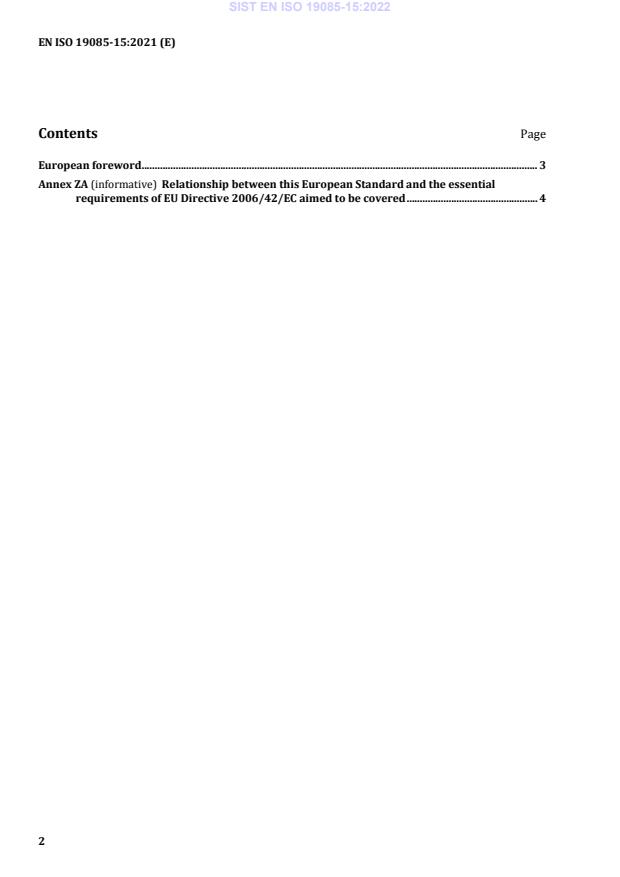
Contents Page
European foreword . 3
Annex ZA (informative) Relationship between this European Standard and the essential
requirements of EU Directive 2006/42/EC aimed to be covered . 4
European foreword
This document (EN ISO 19085-15:2021) has been prepared by Technical Committee ISO/TC 39
"Machine tools" in collaboration with Technical Committee CEN/TC 142 “Woodworking machines -
Safety” the secretariat of which is held by UNI.
This European Standard shall be given the status of a national standard, either by publication of an
identical text or by endorsement, at the latest by May 2022, and conflicting national standards shall be
withdrawn at the latest by May 2022.
Attention is drawn to the possibility that some of the elements of this document may be the subject of
patent rights. CEN shall not be held responsible for identifying any or all such patent rights.
This document has been prepared under a Standardization Request given to CEN by the European
Commission and the European Free Trade Association, and supports essential requirements of EU
Directive(s) / Regulation(s).
For the relationship with EU Directive(s) / Regulation(s), see informative Annex ZA, which is an integral
part of this document.
Any feedback and questions on this document should be directed to the users’ national standards
body/national committee. A complete listing of these bodies can be found on the CEN website.
According to the CEN-CENELEC Internal Regulations, the national standards organizations of the
following countries are bound to implement this European Standard: Austria, Belgium, Bulgaria,
Croatia, Cyprus, Czech Republic, Denmark, Estonia, Finland, France, Germany, Greece, Hungary, Iceland,
Ireland, Italy, Latvia, Lithuania, Luxembourg, Malta, Netherlands, Norway, Poland, Portugal, Republic of
North Macedonia, Romania, Serbia, Slovakia, Slovenia, Spain, Sweden, Switzerland, Turkey and the
United Kingdom.
Endorsement notice
The text of ISO 19085-15:2021 has been approved by CEN as EN ISO 19085-15:2021 without any
modification.
Annex ZA
(informative)
Relationship between this European Standard and the essential
requirements of EU Directive 2006/42/EC aimed to be covered
This European Standard has been prepared under a Commission’s standardization request "M/396
Mandate to CEN and CENELEC for standardisation in the field of machinery” to provide one voluntary
means of conforming to essential requirements of Directive 2006/42/EC of the European Parliament
and of the Council of 17 May 2006 on machinery, and amending Directive 95/16/EC (recast).
Once this standard is cited in the Official Journal of the European Union under that Directive,
compliance with the normative clauses of this standard given in Table ZA.1 confers, within the limits of
the scope of this standard, a presumption of conformity with the corresponding essential requirements
of that Directive, and associated EFTA regulations.
Table ZA.1 — Correspondence between this European Standard and Directive 2006/42/EC
The relevant Essential Requirements (ERs) of Clause(s)/sub-clause(s) Remarks/Notes
Directive 2006/42/EC of this EN
1.1.2 Principles of safety integration
a) fitted for its function Clauses 5, 6, 7, 8
c) intended use and reasonably foreseeable misuse Clauses 5, 6, 7, 8
d) constraints in use 7.5, 8.3
e) equipment 6.1, 8.3
1.1.4 Lighting 7.6, 8.3
1.1.5 Design of machinery to facilitate its handling 7.5
1.1.6 Ergonomics 7.5
1.2.1 Safety and reliability of control systems 5.1, 7.7, 7.8
1.2.2 Control devices 5.2, 5.3, 5.4
1.2.3 Starting 5.3
1.2.4.1 Normal stop 5.4.2
1.2.4.3 Emergency stop 5.4.4
1.2.6 Failure of the power supply 5.8, 7.7, 7.8
1.3.1 Risk of loss of stability 6.1, 8.3
1.3.2 Risk of break-up during operation 7.8, 8.3
1.3.3 Risks due to falling or ejected objects 6.5, 8.3
1.3.7 Risks related to moving parts 6.5, 6.6, 6.7, 8.3
1.3.8.1 Moving transmission parts 6.6.1, 6.6.3, 6.6.4, 6.7
1.3.8.2 Moving parts involved in the process 6.6.1
1.3.9 Risk of uncontrolled movements 6.1.1
1.4.1 General requirements 6.5.1 6.5.2, 7.4.1
1.4.2.1 Fixed guards 6.5.1
1.4.2.2 Interlocking movable guards 6.5.2
1.4.3 Special requirements for protective devices 6.5.3, 6.5.4, 6.5.5, 6.5.6
1.5.1 Electricity supply 7.4, 7.13
1.5.2 Static electricity 7.4.1
1.5.3 Energy supply other than electricity 7.7, 7.8
1.5.5 Extreme temperatures 7.15
1.5.6 Fire 7.1
1.5.8 Noise 7.2, Annex E
1.5.11 External radiation 7.9
1.6.1 Machinery maintenance 7.14, 8.3
1.6.2 Access to operating position and servicing 6.5, 6.6, 7.14, 8.3
points
1.6.3 Isolation of energy sources 7.13, 8.3
1.6.4 Operator intervention 7.14, 8.3
1.6.5 Cleaning of internal parts 7.14, 8.3
1.7.1 Information and warnings on the machinery 8.1, 8.2
1.7.2 Warning devices 8.1
1.7.3 Marking of machinery 8.2
1.7.4 Instructions
1.7.4.1 General principles for the drafting of 8.3
instructions
1.7.4.2 Contents of the instructions 8.3, Annex E
1.7.4.3 Sales literature Annex E, E.8.1
2.3 Machinery for working wood and analogous
materials
a) guiding 6.10
WARNING 1 — Presumption of conformity stays valid only as long as a reference to this European
Standard is maintained in the list published in the Official Journal of the European Union. Users of this
standard should consult frequently the latest list published in the Official Journal of the European
Union.
WARNING 2 — Other Union legislation may be applicable to the product(s) falling within the scope of
this standard.
INTERNATIONAL ISO
STANDARD 19085-15
First edition
2021-10
Woodworking machines — Safety —
Part 15:
Presses
Machines à bois — Sécurité —
Partie 15: Presses
Reference number
ISO 19085-15:2021(E)
ISO 19085-15:2021(E)
© ISO 2021
All rights reserved. Unless otherwise specified, or required in the context of its implementation, no part of this publication may
be reproduced or utilized otherwise in any form or by any means, electronic or mechanical, including photocopying, or posting on
the internet or an intranet, without prior written permission. Permission can be requested from either ISO at the address below
or ISO’s member body in the country of the requester.
ISO copyright office
CP 401 • Ch. de Blandonnet 8
CH-1214 Vernier, Geneva
Phone: +41 22 749 01 11
Email: copyright@iso.org
Website: www.iso.org
Published in Switzerland
ii
ISO 19085-15:2021(E)
Contents Page
Foreword .v
Introduction . vi
1 Scope . 1
2 Normative references . 2
3 Terms and definitions . 3
4 List of significant hazards .12
5 Safety requirements and measures for controls .14
5.1 Safety and reliability of control systems. 14
5.2 Control devices . 14
5.3 Start . 15
5.4 Safe stops . 15
5.4.1 General .15
5.4.2 Normal stop .15
5.4.3 Operational stop . 16
5.4.4 Emergency stop . 16
5.5 Braking function of tool spindles . 16
5.6 Mode selection . 16
5.7 Spindle speed changing . 16
5.7.1 Spindle speed changing by changing belts on the pulleys . 16
5.7.2 Spindle speed changing by incremental speed change motor . 16
5.7.3 Infinitely variable speed by frequency inverter . 16
5.8 Failure of any power supply . 16
5.9 Manual reset control . 17
5.10 Enabling control . 17
5.11 Machine moving parts speed monitoring. 17
5.12 Time delay. 17
6 Safety requirements and measures for protection against mechanical hazards .17
6.1 Stability . 17
6.1.1 General . 17
6.1.2 Displaceable machines . 18
6.2 Risk of break-up during operation . 18
6.3 Tool holder and tool design . 18
6.3.1 General . 18
6.3.2 Spindle locking . 18
6.3.3 Circular saw blade fixing devices . 18
6.3.4 Flange dimensions for circular saw blades . 19
6.4 Braking . 19
6.4.1 Braking of tool spindles . 19
6.4.2 Maximum run-down time . 19
6.4.3 Brake release . 19
6.5 Safeguards . 19
6.5.1 Fixed guards . 19
6.5.2 Interlocking moveable guards . 19
6.5.3 Hold-to-run control . 19
6.5.4 Two hand control . 19
6.5.5 Electro-sensitive protective equipment (ESPE) . 19
6.5.6 Pressure sensitive protective equipment (PSPE) . 19
6.6 Prevention of access to moving parts . 20
6.6.1 General .20
6.6.2 Guarding of tools .20
6.6.3 Guarding of drives . 20
6.6.4 Guarding of shearing and/or crushing zones . 20
iii
ISO 19085-15:2021(E)
6.7 Impact hazard . 24
6.8 Clamping devices . 24
6.9 Measures against ejection . 25
6.9.1 General . 25
6.9.2 Guards materials and characteristics . 25
6.10 Work-piece support and guides .25
7 Safety requirements and measures for protection against other hazards .26
7.1 Fire . 26
7.2 Noise . 26
7.2.1 Noise reduction at the design stage . 26
7.2.2 Noise emission measurement and declaration . 27
7.3 Emission of chips and dust . 27
7.4 Electricity . 28
7.4.1 General .28
7.4.2 Displaceable machines .29
7.5 Ergonomics and handling .29
7.6 Lighting .29
7.7 Pneumatics . 29
7.8 Hydraulics .29
7.9 Electromagnetic compatibility.29
7.10 Laser .29
7.11 Static electricity. 29
7.12 Errors of fitting . 29
7.13 Isolation . 29
7.14 Maintenance . 30
7.15 Extreme temperatures .30
8 Information for use .30
8.1 Warning devices .30
8.2 Marking . 30
8.2.1 General .30
8.2.2 Additional markings . 30
8.3 Instruction handbook.30
8.3.1 General .30
8.3.2 Additional information . 31
Annex A (informative) Performance level required .32
Annex B (normative) Tests for braking function .33
Annex C (normative) Stability test for displaceable machines .34
Annex D (normative) Impact test for guards .35
Annex E (normative) Noise test code .36
Bibliography .42
iv
ISO 19085-15:2021(E)
Foreword
ISO (the International Organization for Standardization) is a worldwide federation of national standards
bodies (ISO member bodies). The work of preparing International Standards is normally carried out
through ISO technical committees. Each member body interested in a subject for which a technical
committee has been established has the right to be represented on that committee. International
organizations, governmental and non-governmental, in liaison with ISO, also take part in the work.
ISO collaborates closely with the International Electrotechnical Commission (IEC) on all matters of
electrotechnical standardization.
The procedures used to develop this document and those intended for its further maintenance are
described in the ISO/IEC Directives, Part 1. In particular, the different approval criteria needed for the
different types of ISO documents should be noted. This document was drafted in accordance with the
editorial rules of the ISO/IEC Directives, Part 2 (see www.iso.org/directives).
Attention is drawn to the possibility that some of the elements of this document may be the subject of
patent rights. ISO shall not be held responsible for identifying any or all such patent rights. Details of
any patent rights identified during the development of the document will be in the Introduction and/or
on the ISO list of patent declarations received (see www.iso.org/patents).
Any trade name used in this document is information given for the convenience of users and does not
constitute an endorsement.
For an explanation of the voluntary nature of standards, the meaning of ISO specific terms and
expressions related to conformity assessment, as well as information about ISO's adherence to
the World Trade Organization (WTO) principles in the Technical Barriers to Trade (TBT) see
www.iso.org/iso/foreword.html.
This document was prepared by Technical Committee ISO/TC 39, Machine tools, Subcommittee SC 4,
Woodworking machines, in collaboration with the European Committee for Standardization (CEN)
Technical Committee CEN/TC 142, Woodworking machines - Safety, in accordance with the Agreement
on technical cooperation between ISO and CEN (Vienna Agreement).
Any feedback or questions on this document should be directed to the user’s national standards body. A
complete listing of these bodies can be found at www.iso.org/members.html.
1)
This document is intended to be used in conjunction with ISO 19085-1:2017 , which gives requirements
common to the different machine types.
A list of all parts in the ISO 19085 series can be found on the ISO website.
1) This document refers to ISO 19085-1:2017 because it experienced delays in preparation. A new edition of this
document is under preparation, which refers to ISO 19085-1:2021.
v
ISO 19085-15:2021(E)
Introduction
The ISO 19085 series of International Standards provides technical safety requirements for the
design and construction of woodworking machinery. It concerns designers, manufacturers, suppliers
and importers of the machines specified in the Scope. It also includes a list of informative items to be
provided the user by the manufacturer.
This document is a type-C standard as stated in ISO 12100.
This document is of relevance, in particular, for the following stakeholder groups representing the
market players with regard to machinery safety:
— machine manufacturers (small, medium and large enterprises);
— health and safety bodies (regulators, accident prevention organisations, market surveillance etc.)
Others can be affected by the level of machinery safety achieved with the means of the document by the
above-mentioned stakeholder groups:
— machine users/employers (small, medium and large enterprises);
— machine users/employees (e.g. trade unions, organizations for people with special needs);
— service providers, e. g. for maintenance (small, medium and large enterprises);
— consumers (in case of machinery intended for use by consumers).
The above-mentioned stakeholder groups have been given the possibility to participate at the drafting
process of this document.
The machinery concerned and the extent to which hazards, hazardous situations or hazardous events
are covered are indicated in the Scope of this document.
When requirements of this type-C standard are different from those which are stated in type-A or
type-B standards, the requirements of this type-C standard take precedence over the requirements of
the other standards for machines that have been designed and built according to the requirements of
this type-C standard.
The full set of requirements for a particular type of woodworking machine are those given in the part
of ISO 19085 applicable to that type, together with the relevant requirements from ISO 19085-1:2017, to
the extent specified in the Scope of the applicable part of ISO 19085.
As far as possible, in parts of ISO 19085 other than ISO 19085-1:2017, safety requirements are referenced
to the relevant sections of ISO 19085-1:2017, to avoid repetition and reduce their length. The other parts
contain replacements and additions to the common requirements given in ISO 19085-1:2017.
Thus, Clauses 5, 6, 7 and 8 with their subclauses and the annexes of this document can either
— confirm as a whole,
— confirm with additions,
— exclude in total, or
— replace with specific text
the corresponding subclauses or annexes of ISO 19085-1:2017.
This interrelation is indicated in the first paragraph of each subclause or annex right after the title by
one of the following possible statements:
— “ISO 19085-1:2017, [subclause/Annex], applies”;
vi
ISO 19085-15:2021(E)
— “ISO 19085-1:2017, [subclause/Annex], applies with the following additions.” or “ISO 19085-
1:2017, [subclause/Annex], applies with the following additions, subdivided into further specific
subclauses.”;
— “ISO 19085-1:2017, [subclause/Annex], does not apply.”;
— “ISO 19085-1:2017, [subclause/Annex], is replaced by the following text.” or “ISO 19085-1:2017,
[subclause/Annex], is replaced by the following text, subdivided into further specific subclauses.”.
Specific subclauses and annexes in this document without correspondent in ISO 19085-1:2017 are
indicated by the introductory sentence: “Subclause/Annex specific to this document.”.
Clauses 1, 2 and 4 replace the corresponding clauses of ISO 19085-1:2017, with no need for indication
since they are specific to each part of the series.
This document refers to ISO 19085-1:2017 because it experienced delays in preparation. A new edition
of this document is under preparation, which refers to ISO 19085-1:2021.
vii
INTERNATIONAL STANDARD ISO 19085-15:2021(E)
Woodworking machines — Safety —
Part 15:
Presses
1 Scope
This document gives the safety requirements and measures for stationary manually loaded and
unloaded:
— cold presses;
— hot presses;
— bending presses;
— edge/face gluing presses;
— membrane presses;
— embossing presses;
where the pressing force is applied by hydraulic actuators pushing two flat or shaped surfaces against
each other, hereinafter referred to as "machines".
It deals with all significant hazards, hazardous situations and events as listed in Clause 4 relevant to
machines, when operated, adjusted and maintained as intended and under the conditions foreseen by
the manufacturer including reasonably foreseeable misuse. Also, transport, assembly, dismantling,
disabling and scrapping phases are taken into account.
NOTE For relevant but not significant hazards, e.g. sharp edges of the machine frame, see ISO 12100:2010.
It is also applicable to machines fitted with one or more of the following devices/additional working
units, whose hazards have been dealt with:
a) device for hot gluing;
b) device for high-frequency gluing;
c) device for high-frequency shaping;
d) automatic work-piece loading and unloading system;
e) intermediate additional platens;
f) work-piece extractor;
g) work-piece clamping pressure beam;
h) split moveable platens.
The machines are designed to process work-pieces consisting of:
1) solid wood;
2) materials with similar characteristics to wood (see ISO 19085-1:2017, 3.2);
3) honeycomb board.
ISO 19085-15:2021(E)
This document does not deal with any hazards related to:
— specific devices that differ from the list above;
— hot fluid heating systems internal to the machine other than electrical;
— any hot fluid heating systems external to the machine;
— operation of taking intermediate platens out and in again;
— the combination of a single machine being used with any other machine (as part of a line).
It is not applicable to:
— frame presses;
— membrane presses where the pressing force is applied by vacuum only;
— presses for producing chipboard, fibreboard, OSB;
— machines intended for use in potentially explosive atmosphere;
— machines manufactured before the date of its publication as an international standard.
2 Normative references
The following documents are referred to in the text in such a way that some or all of their content
constitutes requirements of this document. For dated references, only the edition cited applies. For
undated references, the latest edition of the referenced document (including any amendments) applies.
ISO 3744:2010, Acoustics — Determination of sound power levels and sound energy levels of noise sources
using sound pressure — Engineering methods for an essentially free field over a reflecting plane
ISO 11201:2010, Acoustics — Noise emitted by machinery and equipment — Determination of emission
sound pressure levels at a work station and at other specified positions in an essentially free field over a
reflecting plane with negligible environmental corrections
ISO 11202:2010, Acoustics — Noise emitted by machinery and equipment — Determination of emission
sound pressure levels at a work station and at other specified positions applying approximate environmental
corrections
ISO 11204:2010, Acoustics — Noise emitted by machinery and equipment — Determination of emission
sound pressure levels at a work station and at other specified positions applying accurate environmental
corrections
ISO 12100:2010, Safety of machinery — General principles for design — Risk assessment and risk reduction
ISO 13849-1:2015, Safety of machinery — Safety-related parts of control systems — Part 1: General
principles for design
ISO 19085-1:2017, Woodworking machines — Safety — Part 1: Common requirements
ISO/TR 11688-1:1995, Acoustics — Recommended practice for the design of low-noise machinery and
equipment — Part 1: Planning
IEC 60204-1:2016, Safety of machinery — Electrical equipment of machines — Part 1: General requirements
IEC 61310-1:2007, Safety of machinery — Indication, marking and actuation — Part 1: Requirements for
visual, acoustic and tactile signals
IEC 61800-5-2:2016, Adjustable speed electrical power drive systems — Part 5-2: Safety requirements —
Functional
ISO 19085-15:2021(E)
ISO 7010:2019, Graphical symbols — Safety colours and safety signs — Registered safety signs
EN 12198-1:2000+A1: 2008, Safety of machinery — Assessment and reduction of risks arising from
radiation emitted by machinery — Part 1: General principles
3 Terms and definitions
For the purposes of this document, the terms and definitions given in ISO 12100:2010, ISO 13849-
1:2015, ISO 19085-1:2017, and the following apply.
ISO and IEC maintain terminological databases for use in standardization at the following addresses:
— ISO Online browsing platform: available at https:// www .iso .org/ obp
— IEC Electropedia: available at https:// www .electropedia .org/
3.1
cold press
machine used to laminate and/or join together flat panels, in which the pressing force is applied by
hydraulic actuators pushing two cold flat platens against each other
Note 1 to entry: The moveable platen can be the top or the bottom one or both. Examples of different machine
designs are illustrated in Figures 1 and 2 (safeguarding devices are not fully illustrated).
Note 2 to entry: The following devices can be provided:
— automatic panel loading and unloading;
— split moveable platens (see Figure 14).
3.2
hot press
machine used to laminate and/or join together flat panels, in which the pressing force is applied by
hydraulic actuators pushing two hot flat platens against each other
Note 1 to entry: The moveable platen can be the top or the bottom one or both. Examples of different machine
designs are illustrated in Figures 1 and 2 (safeguarding devices are not fully illustrated).
Note 2 to entry: The following devices can be provided:
— automatic panel loading and unloading;
— intermediate additional platens (see Figure 3).
Note 3 to entry: Platens heating systems can be by electrical resistance or hot fluid (e.g. diathermic oil, water).
Fluid heating system can be internal to the machine or external.
3.3
bending press
machine with manual loading and/or unloading used to assembly and/or shape flat panels, in which the
pressing force is applied by hydraulic actuators pushing two shaped surfaces against each other, and
hot gluing process is by hot dies or high-frequency system
Note 1 to entry: An example of a bending press is illustrated in Figure 4 (safeguarding devices are not fully
illustrated).
ISO 19085-15:2021(E)
Figure 1 — Example of cold or hot press with bottom actuators
Figure 2 — Example of cold or hot press with top actuators
ISO 19085-15:2021(E)
Figure 3 — Example of hot press with intermediate platens
Figure 4 — Example of a bending press with top actuators
3.4
edge/face gluing press
machine used to join together solid wood bars, in which the pressing force is applied by hydraulic
actuators vertically pushing two flat platens against each other, and horizontally pushing elements
against each other, and hot gluing process is by hot platens or high-frequency system
Note 1 to entry: The following devices can be provided:
ISO 19085-15:2021(E)
— work-pieces extractor;
— automatic panel loading and unloading system;
— work-piece clamping pressure beam (3.15).
Note 2 to entry: An example of edge/face gluing press is illustrated in Figure 5 (safeguarding devices are not fully
illustrated).
Figure 5 — Example of edge/face gluing press
3.5
membrane press
machine used to laminate or veneer flat or shaped work-pieces, in which the pressing force is applied
through a membrane pushed onto the work-piece by compressed air from above and by vacuum from
below, hermetically enclosed by two shells, of which the upper one is heated, pushed against each other
by hydraulic actuators
Note 1 to entry: Automatic panel loading and unloading devices can be provided.
Note 2 to entry: Upper shell heating systems can be by electrical resistance or hot fluid (e.g. diathermic oil,
water). Fluid heating system can be internal to the machine or external.
Note 3 to entry: An example of membrane press is illustrated in Figure 6 (safeguarding devices are not fully
illustrated).
ISO 19085-15:2021(E)
Figure 6 — Example of membrane press
3.6
embossing press
machine used to emboss work-pieces by a special mould/die fixed to the upper plate, in which the
pressing force is applied by hydraulic actuators pushing two hot flat platens against each other
Note 1 to entry: The moveable platen can be the top or the bottom one or both. Examples of different machine
designs are illustrated in Figures 1 and 2 (safeguarding devices are not fully illustrated).
Note 2 to entry: Automatic panel loading and unloading devices can be provided.
Note 3 to entry: Platens heating systems can be by electrical resistance or hot fluid (e.g. diathermic oil, water).
Fluid heating system can be internal to the machine or external.
3.7
daylight
compartment between two consecutive pressing platens
3.8
automatic work-piece loading/unloading system
system for automatic feed of work-pieces into/out of the machine, whereby the work-piece is manually
loaded/unloaded into/out of it
Note 1 to entry: Six usual types of automatic work-piece loa
...
Questions, Comments and Discussion
Ask us and Technical Secretary will try to provide an answer. You can facilitate discussion about the standard in here.
Loading comments...