

SIST EN 18000-2:2026
(Main)Animal health diagnostic analyses - Control of in-vitro diagnostic reagents - Part 2: Reagents for immunological techniques
General Information
- Abstract
This document specifies the control and approval of in vitro diagnostic reagents used in animal health for immunological analyses with a qualitative expression of test results.
This document is applicable to diagnostic reagents, as a priority for infectious (bacterial, viral, fungal or parasitic) or prion diseases and associated animal species for which harmonization of practices in this area is needed, i.e. those for which the national, regional or international regulatory framework provides for the control of trade in animals and/or animal products and/or the definition of a health status (absence of infection) of areas, establishments or individuals. While all reagents designated by the competent authorities fall under the scope of this document, the authorities or any other animal health stakeholder can choose to derogate in specific and exceptional situations such as emerging, exotic or rare diseases.
This document is not applicable to all existing diagnostic reagents, in particular those for which certain parameters described in this document cannot be validly evaluated in accordance with international requirements, due, e.g. to the absence of a specific reference method and/or accessible and duly validated reference materials (RMs).
This document does not cover the step in which the user verifies a reagent (analysis method adoption).
- Status
- Published
- Public Enquiry End Date
- 12-Dec-2023
- Publication Date
- 04-Feb-2026
- Technical Committee
- VAZ - Healthcare
- Current Stage
- 6060 - National Implementation/Publication (Adopted Project)
- Start Date
- 23-Jan-2026
- Due Date
- 30-Mar-2026
- Completion Date
- 05-Feb-2026

Overview
SIST EN 18000-2:2026 is a European standard that defines requirements for the control and approval of in vitro diagnostic reagents used in animal health, specifically those intended for immunological techniques with qualitatively expressed test results. Developed by the Slovenski inštitut za standardizacijo (SIST) and aligned with European Committee for Standardization (CEN) guidelines, this standard is essential for ensuring the quality and consistency of reagents used to diagnose infectious (bacterial, viral, fungal, parasitic, or prion) diseases in animals. The harmonization provided by SIST EN 18000-2:2026 supports regulatory frameworks governing the trade of animals and animal products and the establishment of animal health status.
Key Topics
- Scope of Application: Focuses on reagents used for qualitative immunological analyses, such as ELISA, AGID, and IFA, prioritizing infectious and prion diseases relevant to national, regional, or international regulation. The standard applies to reagents designated by competent authorities, with defined exceptions for reagents that cannot be properly evaluated or special cases like emerging diseases.
- Conformity Control: Outlines comprehensive procedures for the initial characterization and conformity assessment of reagents, including sensitivity, specificity, repeatability, and stability.
- Batch-to-Batch Control: Addresses ongoing quality assurance for new production batches and the monitoring of reagent stability throughout shelf life.
- Reference Materials (RMs): Details requirements for positive and negative reference materials used during validation and control, as well as protocols for their preparation and quality.
- Responsibilities: Differentiates the obligations of applicants (manufacturers or distributors) and control organizations (COs) in the dossier preparation, testing, and review processes.
- Transparency and Confidentiality: Promotes transparent communication of control protocols and requirements, while safeguarding confidential information and managing conflicts of interest.
Applications
- Animal Disease Control Programs: SIST EN 18000-2:2026 is indispensable for laboratories and authorities involved in official disease surveillance and eradication campaigns. It ensures that diagnostic reagents for diseases affecting livestock, pets, or wildlife are reliable and harmonized across different jurisdictions.
- Diagnostic Reagent Manufacturers: Companies developing or marketing immunological diagnostic kits must comply with these requirements for initial approval and ongoing batch verification, supporting product quality and regulatory acceptance.
- Regulatory Compliance: The standard facilitates adherence to European and international veterinary legislation regarding animal trade, movement, and certification of disease-free status.
- Accredited Testing Laboratories: Laboratories conducting animal diagnostic assays according to official or industry standards use this document to meet accreditation and performance criteria, ensuring consistent and reproducible test results.
Related Standards
- SIST EN 18000-1:2025 – Defines the application file and dossier requirements for initial and batch-to-batch control of in vitro diagnostic reagents in animal health.
- EN ISO/IEC 17025 – General competence of testing and calibration laboratories, essential for subcontracted laboratories carrying out reagent controls.
- WOAH (OIE) Manuals of Diagnostic Tests and Vaccines: Provide reference procedures and materials relevant for some assays covered by SIST EN 18000-2:2026.
- ISO Guide 30, ISO 33401, ISO 23640, ISO 5725 Series: Offer guidance on reference materials, stability studies, and method performance parameters.
By adopting SIST EN 18000-2:2026, stakeholders in the veterinary diagnostics sector can ensure improved product control, regulatory compliance, and mutual recognition of test results, bolstering animal health management and disease control efforts worldwide. For professionals seeking robust, harmonized standards in veterinary immunological diagnostics, this document is a key resource.
Relations
- Effective Date
- 28-Jan-2026
Get Certified
Connect with accredited certification bodies for this standard

BSI Group
BSI (British Standards Institution) is the business standards company that helps organizations make excellence a habit.

TÜV Rheinland
TÜV Rheinland is a leading international provider of technical services.

TÜV SÜD
TÜV SÜD is a trusted partner of choice for safety, security and sustainability solutions.
Sponsored listings
Frequently Asked Questions
SIST EN 18000-2:2026 is a standard published by the Slovenian Institute for Standardization (SIST). Its full title is "Animal health diagnostic analyses - Control of in-vitro diagnostic reagents - Part 2: Reagents for immunological techniques". This standard covers: This document specifies the control and approval of in vitro diagnostic reagents used in animal health for immunological analyses with a qualitative expression of test results. This document is applicable to diagnostic reagents, as a priority for infectious (bacterial, viral, fungal or parasitic) or prion diseases and associated animal species for which harmonization of practices in this area is needed, i.e. those for which the national, regional or international regulatory framework provides for the control of trade in animals and/or animal products and/or the definition of a health status (absence of infection) of areas, establishments or individuals. While all reagents designated by the competent authorities fall under the scope of this document, the authorities or any other animal health stakeholder can choose to derogate in specific and exceptional situations such as emerging, exotic or rare diseases. This document is not applicable to all existing diagnostic reagents, in particular those for which certain parameters described in this document cannot be validly evaluated in accordance with international requirements, due, e.g. to the absence of a specific reference method and/or accessible and duly validated reference materials (RMs). This document does not cover the step in which the user verifies a reagent (analysis method adoption).
This document specifies the control and approval of in vitro diagnostic reagents used in animal health for immunological analyses with a qualitative expression of test results. This document is applicable to diagnostic reagents, as a priority for infectious (bacterial, viral, fungal or parasitic) or prion diseases and associated animal species for which harmonization of practices in this area is needed, i.e. those for which the national, regional or international regulatory framework provides for the control of trade in animals and/or animal products and/or the definition of a health status (absence of infection) of areas, establishments or individuals. While all reagents designated by the competent authorities fall under the scope of this document, the authorities or any other animal health stakeholder can choose to derogate in specific and exceptional situations such as emerging, exotic or rare diseases. This document is not applicable to all existing diagnostic reagents, in particular those for which certain parameters described in this document cannot be validly evaluated in accordance with international requirements, due, e.g. to the absence of a specific reference method and/or accessible and duly validated reference materials (RMs). This document does not cover the step in which the user verifies a reagent (analysis method adoption).
SIST EN 18000-2:2026 is classified under the following ICS (International Classification for Standards) categories: 11.100.10 - In vitro diagnostic test systems; 11.220 - Veterinary medicine. The ICS classification helps identify the subject area and facilitates finding related standards.
SIST EN 18000-2:2026 has the following relationships with other standards: It is inter standard links to SIST EN 18000-1:2026. Understanding these relationships helps ensure you are using the most current and applicable version of the standard.
SIST EN 18000-2:2026 is available in PDF format for immediate download after purchase. The document can be added to your cart and obtained through the secure checkout process. Digital delivery ensures instant access to the complete standard document.
Standards Content (Sample)
SLOVENSKI STANDARD
01-marec-2026
Diagnostične analize zdravja živali - Nadzor diagnostičnih reagentov in vitro - 2.
del: Reagenti za imunološke tehnike
Animal health diagnostic analyses - Control of in-vitro diagnostic reagents - Part 2:
Reagents for immunological techniques
Tiergesundheitsdiagnostische Analysen - Kontrolle von in-vitro-diagnostischen
Reagenzien - Teil 2: Reagenzien für immunologische Verfahren
Analyses de diagnostic en santé animale - Contrôle des réactifs de diagnostic in vitro -
Partie 2 : Réactifs pour les techniques immunologiques
Ta slovenski standard je istoveten z: EN 18000-2:2026
ICS:
11.100.10 Diagnostični preskusni In vitro diagnostic test
sistemi in vitro systems
11.220 Veterinarstvo Veterinary medicine
2003-01.Slovenski inštitut za standardizacijo. Razmnoževanje celote ali delov tega standarda ni dovoljeno.
EN 18000-2
EUROPEAN STANDARD
NORME EUROPÉENNE
January 2026
EUROPÄISCHE NORM
ICS 11.220
English Version
Animal health diagnostic analyses - Control of in vitro
diagnostic reagents - Part 2: Reagents for immunological
techniques
Analyses de diagnostic en santé animale - Contrôle des Tiergesundheitsdiagnostische Analysen - Kontrolle von
réactifs de diagnostic in vitro - Partie 2 : Réactifs pour in-vitro-diagnostischen Reagenzien - Teil 2:
les techniques immunologiques Reagenzien für immunologische Verfahren
This European Standard was approved by CEN on 4 August 2025.
CEN members are bound to comply with the CEN/CENELEC Internal Regulations which stipulate the conditions for giving this
European Standard the status of a national standard without any alteration. Up-to-date lists and bibliographical references
concerning such national standards may be obtained on application to the CEN-CENELEC Management Centre or to any CEN
member.
This European Standard exists in three official versions (English, French, German). A version in any other language made by
translation under the responsibility of a CEN member into its own language and notified to the CEN-CENELEC Management
Centre has the same status as the official versions.
CEN members are the national standards bodies of Austria, Belgium, Bulgaria, Croatia, Cyprus, Czech Republic, Denmark, Estonia,
Finland, France, Germany, Greece, Hungary, Iceland, Ireland, Italy, Latvia, Lithuania, Luxembourg, Malta, Netherlands, Norway,
Poland, Portugal, Republic of North Macedonia, Romania, Serbia, Slovakia, Slovenia, Spain, Sweden, Switzerland, Türkiye and
United Kingdom.
EUROPEAN COMMITTEE FOR STANDARDIZATION
COMITÉ EUROPÉEN DE NORMALISATION
EUROPÄISCHES KOMITEE FÜR NORMUNG
CEN-CENELEC Management Centre: Rue de la Science 23, B-1040 Brussels
© 2026 CEN All rights of exploitation in any form and by any means reserved Ref. No. EN 18000-2:2026 E
worldwide for CEN national Members.
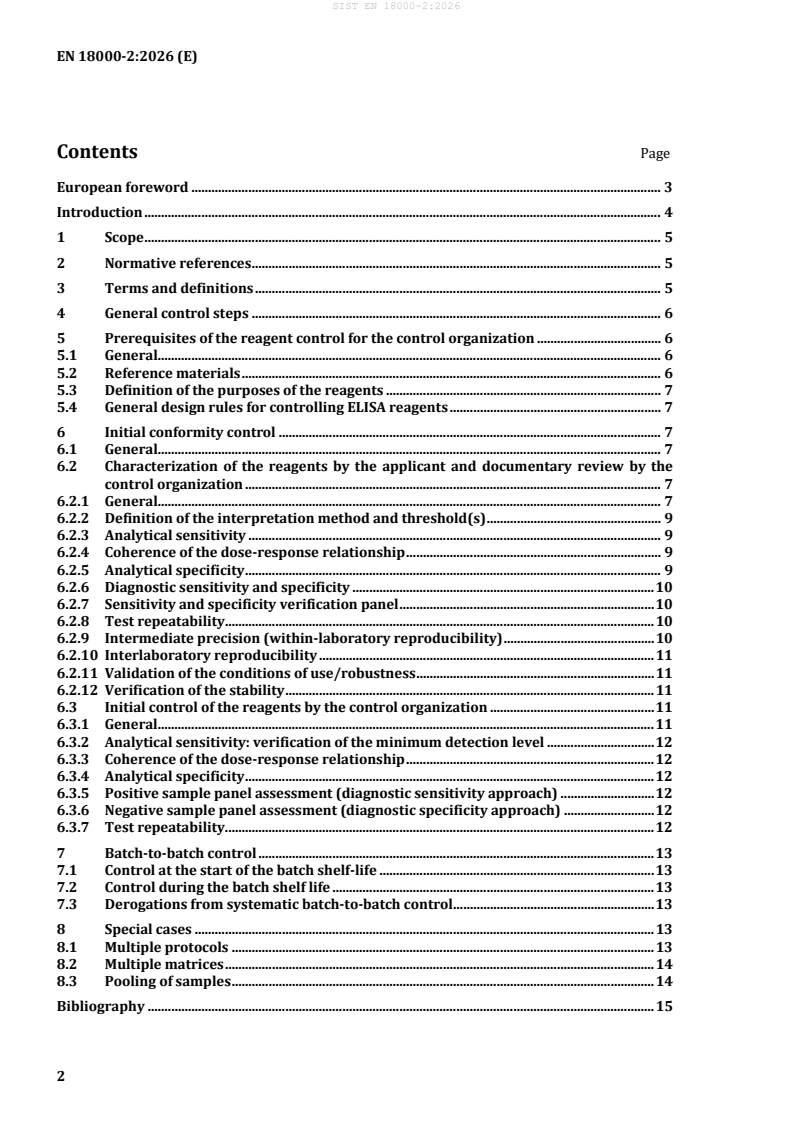
Contents Page
European foreword . 3
Introduction . 4
1 Scope . 5
2 Normative references . 5
3 Terms and definitions . 5
4 General control steps . 6
5 Prerequisites of the reagent control for the control organization . 6
5.1 General. 6
5.2 Reference materials . 6
5.3 Definition of the purposes of the reagents . 7
5.4 General design rules for controlling ELISA reagents . 7
6 Initial conformity control . 7
6.1 General. 7
6.2 Characterization of the reagents by the applicant and documentary review by the
control organization . 7
6.2.1 General. 7
6.2.2 Definition of the interpretation method and threshold(s) . 9
6.2.3 Analytical sensitivity . 9
6.2.4 Coherence of the dose-response relationship . 9
6.2.5 Analytical specificity . 9
6.2.6 Diagnostic sensitivity and specificity . 10
6.2.7 Sensitivity and specificity verification panel . 10
6.2.8 Test repeatability . 10
6.2.9 Intermediate precision (within-laboratory reproducibility) . 10
6.2.10 Interlaboratory reproducibility . 11
6.2.11 Validation of the conditions of use/robustness . 11
6.2.12 Verification of the stability . 11
6.3 Initial control of the reagents by the control organization . 11
6.3.1 General. 11
6.3.2 Analytical sensitivity: verification of the minimum detection level . 12
6.3.3 Coherence of the dose-response relationship . 12
6.3.4 Analytical specificity . 12
6.3.5 Positive sample panel assessment (diagnostic sensitivity approach) . 12
6.3.6 Negative sample panel assessment (diagnostic specificity approach) . 12
6.3.7 Test repeatability . 12
7 Batch-to-batch control . 13
7.1 Control at the start of the batch shelf-life . 13
7.2 Control during the batch shelf life . 13
7.3 Derogations from systematic batch-to-batch control . 13
8 Special cases . 13
8.1 Multiple protocols . 13
8.2 Multiple matrices . 14
8.3 Pooling of samples . 14
Bibliography . 15
European foreword
This document (EN 18000-2:2026) has been prepared by Technical Committee CEN/TC 469 “Animal
health diagnostic analyses”, the secretariat of which is held by AFNOR.
This European Standard shall be given the status of a national standard, either by publication of an
identical text or by endorsement, at the latest by July 2026, and conflicting national standards shall be
withdrawn at the latest by July 2026.
Attention is drawn to the possibility that some of the elements of this document may be the subject of
patent rights. CEN shall not be held responsible for identifying any or all such patent rights.
Any feedback and questions on this document should be directed to the users’ national standards body.
A complete listing of these bodies can be found on the CEN website.
According to the CEN-CENELEC Internal Regulations, the national standards organisations of the
following countries are bound to implement this European Standard: Austria, Belgium, Bulgaria, Croatia,
Cyprus, Czech Republic, Denmark, Estonia, Finland, France, Germany, Greece, Hungary, Iceland, Ireland,
Italy, Latvia, Lithuania, Luxembourg, Malta, Netherlands, Norway, Poland, Portugal, Republic of North
Macedonia, Romania, Serbia, Slovakia, Slovenia, Spain, Sweden, Switzerland, Türkiye and the United
Kingdom.
Introduction
The purpose of the EN 18000 series is to facilitate the mutual recognition of the work of the animal health
in vitro diagnostic reagent control organizations at the European level (or even more widely) and thus to
eventually allow the use of strategic reagents controlled by a single control organization (CO) for a given
disease.
The EN 18000 series establishes the requirements for the control of in vitro diagnostic reagents in animal
health. This series is divided into three parts.
Part 1 concerns terms and definitions and the submission of a reagent dossier to a CO for control and
approval.
Part 2 concerns the specific aspects of the control by such organization of an immunological diagnostic
reagent. It describes the control of in vitro reagents for immunological analyses with a qualitative
expression of test results used in animal health. It involves CO and applicants (including their
subcontractors, when relevant).
Part 3 concerns the specific aspects of the control by such organizations of a polymerase-chain reaction
diagnostic reagent for the detection or quantification of pathogen-specific nucleic acids.
Like any standard, this document is intended to be voluntary and, if its use is prescribed by a competent
authority or any other animal health stakeholder, it will be up to them to determine for which diseases
and to which extent this document will be applied by the control bodies they have designated for this
purpose.
The terms defined in Clause 3 and the terms of EN 18000-1 are written in italics throughout the EN 18000
series.
1 Scope
This document specifies the control and approval of in vitro diagnostic reagents used in animal health for
immunological analyses with a qualitative expression of test results.
This document is applicable to diagnostic reagents, as a priority for infectious (bacterial, viral, fungal or
parasitic) or prion diseases and associated animal species for which harmonization of practices in this
area is needed, i.e. those for which the national, regional or international regulatory framework provides
for the control of trade in animals and/or animal products and/or the definition of a health status
(absence of infection) of areas, establishments or individuals. While all reagents designated by the
competent authorities fall under the scope of this document, the authorities or any other animal health
stakeholder can choose to derogate in specific and exceptional situations such as emerging, exotic or rare
diseases.
This document is not applicable to all existing diagnostic reagents, in particular those for which certain
parameters described in this document cannot be validly evaluated in accordance with international
requirements, due, e.g. to the absence of a specific reference method and/or accessible and duly validated
reference materials (RMs).
This document does not cover the step in which the user verifies a reagent (analysis method adoption).
2 Normative references
The following documents are referred to in the text in such a way that some or all of their content
constitutes requirements of this document. For dated references, only the edition cited applies. For
undated references, the latest edition of the referenced document (including any amendments) applies.
EN 18000-1:2025, Animal health diagnostic analyses — Control of in vitro diagnostic reagents —
Part 1: Application file for the initial and the batch-to-batch control
3 Terms and definitions
For the purposes of this document, the terms and definitions given in EN 18000-1 and the following apply.
ISO and IEC maintain terminology databases for use in standardization at the following addresses:
— ISO Online browsing platform: available at https://www.iso.org/obp/
— IEC Electropedia: available at https://www.electropedia.org/
3.1
immunological analysis with a qualitative expression of test results
qualitative result
analysis involving an antigen-antibody reaction or, more broadly, a ligand-protein reaction, the result of
which is expressed in qualitative terms (positive, negative, inconclusive)
Note 1 to entry: This qualitative result can be the result of the interpretation of numerical data.
EXAMPLES Enzyme Linked Immuno-Sorbent Assay (ELISA), Agar Gel Immunodiffusion (AGID),
Immunofluorescence Assay (IFA).
3.2
reaction support
material (device, object, medium) in or on which the reaction is carried out
EXAMPLES Plate for a rapid agglutination, gel for an agar-based immunodiffusion, microplate for an ELISA, tube
for a tube agglutination.
4 General control steps
The reagents are controlled in accordance with this document when so required. Depending on the
context (e.g. regulation, disease control programme) of the implementation of analyses with such
reagents, the control can include an initial conformity control and several batch-to-batch controls.
Certain steps of the reagent control can be subcontracted by the CO, provided that it ensures that the
subcontractors possess the necessary skills (e.g. accreditation in accordance with EN ISO/IEC 17025) and
are independent. This accreditation shall include the same technique and disease as those covered by the
reagent control.
Commitment of impartiality and confidentiality shall be guaranteed by written disclosure of potential
conflicts of interest in accordance with EN 18000-1:2025, Annex C.
Subcontracted laboratories shall follow and work in accordance with the protocols approved by the CO.
The list of subcontracted laboratories shall be public.
This document describes the requirements for each of the steps of the control, without defining the
criteria of conformity, which shall be specified beforehand by the CO according to the state of art (e.g.
existing disease test-specific standards, consensus conference recommendations, scientific literature). If
necessary, or based on a particular risk or epidemiological context, additional control tests can be
performed that are not described in this document.
5 Prerequisites of the reagent control for the control organization
5.1 General
The prerequisites of the control of reagents include:
— the availability of RMs;
— the definition of the minimum performance requirements of the reagents (e.g. regulations, standards,
guidelines);
— additional useful information (e.g. templates) provided by the CO, when relevant to harmonize as far
as possible the implementation of control between the CO and the applicant.
5.2 Reference materials
The CO shall possess characterized positive RMs and negative RMs. The RMs can exist in the form of
different matrices in different levels of concentration.
The CO shall provide the applicant with RMs, so that the applicant can prepare its internal RMs in order
to conduct the control described in this document (refer to ISO Guide 30; ISO 33403). With these RMs, it
shall provide the characteristics listed in EN 18000-1:2025, Annex A. For certified RMs, the
characteristics appearing on the certificate to be provided are listed in ISO 33401.
The RMs can also be prepared and/or supplied by third parties, provided that they meet the criteria
defined by the CO and have been approved by the latter.
Certain RMs are defined by regulations or standards (e.g. WOAH Manuals of Diagnostic Tests and
Vaccines, Reference Laboratories guidelines).
For certain matrices (e.g. wet blots), the RMs shall be produced under conditions as close to reality as
possible. If possible, the CO shall provide the user and the applicant with the production protocol.
The CO is not required to provide the field samples or the samples produced by experimental infection
that are necessary for the assessment of the diagnostic sensitivity and diagnostic specificity. However, the
CO shall recommend the method(s) and/or procedure(s) used for sample characterization.
5.3 Definition of the purposes of the reagents
The CO shall specify in writing the purposes of the reagents for the applicant (regulatory and/or
particular requirements, such as the determination of a minimum detection level, the modalities of use of
the reagents, the animal species and matrices concerned, etc.). It shall inform the applicant of the details
of its control protocol (initial conformity control and batch-to-batch control). All above-mentioned
purposes, requirements and the protocols for the reagent control shall also be made public.
5.4 General design rules for controlling ELISA reagents
In particular, for ELISAs, the CO shall propose a plate layout to follow, designed in such a way that it allows
the detection of any edge-, column- or line-effect for all the different samples included in the plate,
including control samples. The cost implications of this design for the CO (workload and control costs)
and/or the applicant (reagent amount) shall also be taken into account.
In order to verify the eventuality of edge-effects and the homogeneity of the plates,
— all samples shall be placed at least in duplicate and in different positions on the plate;
— the positive and negative control samples of the reagent shall be tested at least twice and in different
positions;
— the reagent diluent shall also be tested to ensure that it does not cause any interference or non-
specificity in the test results.
In the case the kit instructions for use (IFU) does not mention the acceptable variation within OD controls
(duplicates, triplicates, or more):
— interpreting the test results for indirect ELISA: the mean OD obtained for the positive control samples
shall be taken into account, provided that all their individual values are within the acceptable range,
according to the intraplate repeatability coefficient of variation (CV) established at the initial
conformity control;
— interpreting the test results for competitive ELISA: the mean OD obtained for the negative control
samples shall be taken into account, provided that all their individual values are within the acceptable
range, according to the intraplate repeatability CV established at the initial conformity control.
6 Initial conformity control
6.1 General
This clause and Clause 7 describe the respective responsibilities of the applicant (6.2 and Clause 7) and
the CO (6.2 documentary review by the CO, 6.3 and Clause 7) with regard to the initial conformity control
and the batch-to-batch control. The following Table 1 summarizes these obligations.
6.2 Characterization of the reagents by the applicant and documentary review by the
control organization
6.2.1 General
After developing a reagent, the applicant shall proceed with the characterization of its performances for
a specified protocol, based on one or more production batches.
The applicant shall send a file to the CO. This file contains an administrative part, describing the
manufacturer, the applicant and
...