

SIST EN 18000-1:2026
(Main)Animal health diagnostic analyses - Control of in vitro diagnostic reagents - Part 1: Application file for the initial and the batch-to-batch control
General Information
- Abstract
This document specifies terms and definitions applicable to the EN 18000 series and requirements concerning information to be provided by applicants submitting animal health in vitro diagnostic reagents to control.
This document is applicable to diagnostic reagents, as a priority for infectious (bacterial, viral, fungal or parasitic) or prion diseases and associated animal species for which harmonization of practices in this area is necessary, i.e. those for which the national, regional or international regulatory framework provides for the control of trade in animals and/or animal products and/or the definition of a health status (absence of infection) of areas, establishments or individuals. While all reagents designated by the competent authorities fall under the scope of this document, the authorities or any other animal health stakeholder can choose to derogate in specific and exceptional situations such as emerging, exotic or rare diseases.
This document is not applicable to all existing diagnostic reagents, in particular those for which certain parameters described in this document cannot be validly evaluated in accordance with international requirements due, e.g. to the absence of a specific reference method and/or accessible and duly validated reference materials (RMs).
This document does not cover the step in which the user verifies a reagent (analysis method adoption).
- Status
- Published
- Public Enquiry End Date
- 12-Dec-2023
- Publication Date
- 04-Feb-2026
- Technical Committee
- VAZ - Healthcare
- Current Stage
- 6060 - National Implementation/Publication (Adopted Project)
- Start Date
- 23-Jan-2026
- Due Date
- 30-Mar-2026
- Completion Date
- 05-Feb-2026

Overview
SIST EN 18000-1:2026, titled Animal health diagnostic analyses - Control of in vitro diagnostic reagents - Part 1: Application file for the initial and the batch-to-batch control, establishes standardized requirements for the submission and control of animal health in vitro diagnostic (IVD) reagents. Developed by the Slovenski inštitut za standardizacijo (SIST) as part of the EN 18000 series and aligned with European regulatory frameworks, this standard ensures harmonization of practices for monitoring animal diseases across national, regional, and international contexts.
The document provides essential guidance on the information manufacturers and applicants must include when submitting diagnostic reagents, particularly those intended for detecting infectious diseases (bacterial, viral, fungal, parasitic, or prion-related) in animal populations. It is especially relevant where animal trade regulations or health status definitions depend on reliable disease diagnostics.
Key Topics
1. Standardized Terms and Definitions
- Provides a harmonized vocabulary for animal health diagnostics, facilitating clear communication among laboratories, regulatory authorities, and stakeholders.
- Definitions derived from respected references, including WOAH, ISO, and EU legislation.
2. Application File Requirements
- Specifies administrative and technical content to be provided by applicants, covering:
- Applicant and manufacturer identification.
- Product type, trade name, test methods, and unique identification numbers.
- Batch details, including size, location, and control records.
- Description of reagent components and intended diagnostic applications.
- Draft labels and Instructions for Use (IFU) in the required languages.
3. Initial and Batch-to-Batch Control
- Outlines procedures for the initial conformity assessment and ongoing batch controls to ensure reagent consistency and reliability.
- Highlights documentation and laboratory testing requirements for validation and verification purposes.
4. Limitations and Scope
- The scope covers reagents designated by competent authorities, primarily for regulated animal diseases affecting trade or health status.
- Excludes reagents where valid international evaluation is not possible (due to lack of reference methods or materials).
- Does not cover the laboratory’s analysis method adoption or user verification steps.
Applications
Practical applications for SIST EN 18000-1:2026 include:
- Regulatory Compliance: Supports manufacturers and suppliers in preparing compliant documentation for approval and market entry within the EU and internationally.
- Quality Assurance: Encourages systematic batch controls, improving product reliability and diagnostic accuracy in animal health laboratories.
- Trade and Health Status: Facilitates trustworthy animal health diagnostics crucial for cross-border animal movement and disease management, supporting controls on trade in animals and animal products.
- Stakeholder Confidence: Provides competent authorities, reference laboratories, and control organizations with a robust framework to assess the suitability and consistency of IVD reagents.
- Harmonization: Contributes to the mutual recognition of reagent assessment across countries, reducing redundancy and fostering efficient disease management strategies.
Related Standards
- EN 18000-2: Focuses on control processes for immunological diagnostic reagents in animal health.
- EN 18000-3: Addresses requirements specific to polymerase chain reaction (PCR) diagnostic reagents.
- ISO 18113-1: Relates to the labeling and information requirements for in vitro diagnostic medical devices.
- ISO/IEC 17025: Covers general requirements for the competence of testing and calibration laboratories.
- WOAH Manuals and Guidelines: Provide foundational definitions and frameworks referenced by this standard.
Keywords: animal health diagnostic reagents, in vitro diagnostics, batch-to-batch control, conformity assessment, regulatory compliance, infectious diseases, veterinary diagnostics, standardization in animal health, reagent application file, quality assurance in veterinary medicine.
Relations
- Effective Date
- 28-Jan-2026
Get Certified
Connect with accredited certification bodies for this standard

BSI Group
BSI (British Standards Institution) is the business standards company that helps organizations make excellence a habit.

TÜV Rheinland
TÜV Rheinland is a leading international provider of technical services.

TÜV SÜD
TÜV SÜD is a trusted partner of choice for safety, security and sustainability solutions.
Sponsored listings
Frequently Asked Questions
SIST EN 18000-1:2026 is a standard published by the Slovenian Institute for Standardization (SIST). Its full title is "Animal health diagnostic analyses - Control of in vitro diagnostic reagents - Part 1: Application file for the initial and the batch-to-batch control". This standard covers: This document specifies terms and definitions applicable to the EN 18000 series and requirements concerning information to be provided by applicants submitting animal health in vitro diagnostic reagents to control. This document is applicable to diagnostic reagents, as a priority for infectious (bacterial, viral, fungal or parasitic) or prion diseases and associated animal species for which harmonization of practices in this area is necessary, i.e. those for which the national, regional or international regulatory framework provides for the control of trade in animals and/or animal products and/or the definition of a health status (absence of infection) of areas, establishments or individuals. While all reagents designated by the competent authorities fall under the scope of this document, the authorities or any other animal health stakeholder can choose to derogate in specific and exceptional situations such as emerging, exotic or rare diseases. This document is not applicable to all existing diagnostic reagents, in particular those for which certain parameters described in this document cannot be validly evaluated in accordance with international requirements due, e.g. to the absence of a specific reference method and/or accessible and duly validated reference materials (RMs). This document does not cover the step in which the user verifies a reagent (analysis method adoption).
This document specifies terms and definitions applicable to the EN 18000 series and requirements concerning information to be provided by applicants submitting animal health in vitro diagnostic reagents to control. This document is applicable to diagnostic reagents, as a priority for infectious (bacterial, viral, fungal or parasitic) or prion diseases and associated animal species for which harmonization of practices in this area is necessary, i.e. those for which the national, regional or international regulatory framework provides for the control of trade in animals and/or animal products and/or the definition of a health status (absence of infection) of areas, establishments or individuals. While all reagents designated by the competent authorities fall under the scope of this document, the authorities or any other animal health stakeholder can choose to derogate in specific and exceptional situations such as emerging, exotic or rare diseases. This document is not applicable to all existing diagnostic reagents, in particular those for which certain parameters described in this document cannot be validly evaluated in accordance with international requirements due, e.g. to the absence of a specific reference method and/or accessible and duly validated reference materials (RMs). This document does not cover the step in which the user verifies a reagent (analysis method adoption).
SIST EN 18000-1:2026 is classified under the following ICS (International Classification for Standards) categories: 11.100.10 - In vitro diagnostic test systems; 11.220 - Veterinary medicine. The ICS classification helps identify the subject area and facilitates finding related standards.
SIST EN 18000-1:2026 has the following relationships with other standards: It is inter standard links to SIST EN 18000-2:2026. Understanding these relationships helps ensure you are using the most current and applicable version of the standard.
SIST EN 18000-1:2026 is available in PDF format for immediate download after purchase. The document can be added to your cart and obtained through the secure checkout process. Digital delivery ensures instant access to the complete standard document.
Standards Content (Sample)
SLOVENSKI STANDARD
01-marec-2026
Diagnostične analize zdravja živali - Nadzor diagnostičnih reagentov in vitro - 1.
del: Vloga za začetno kontrolo in kontrolo od serije do serije
Animal health diagnostic analyses - Control of in vitro diagnostic reagents - Part 1:
Application file for the initial and the batch-to-batch control
Tiergesundheitsdiagnostische Analysen - Kontrolle von in-vitro-diagnostischen
Reagenzien - Teil 1: Antragsunterlagen für die Erstkontrolle und die Kontrolle von
Charge zu Charge
Analyses de diagnostic en santé animale - Contrôle des réactifs de diagnostic in vitro -
Partie 1 : Dossier de présentation pour le contrôle initial et le contrôle lot à lot
Ta slovenski standard je istoveten z: EN 18000-1:2026
ICS:
11.100.10 Diagnostični preskusni In vitro diagnostic test
sistemi in vitro systems
11.220 Veterinarstvo Veterinary medicine
2003-01.Slovenski inštitut za standardizacijo. Razmnoževanje celote ali delov tega standarda ni dovoljeno.
EN 18000-1
EUROPEAN STANDARD
NORME EUROPÉENNE
January 2026
EUROPÄISCHE NORM
ICS 11.220
English Version
Animal health diagnostic analyses - Control of in vitro
diagnostic reagents - Part 1: Application file for the initial
and the batch-to-batch control
Analyses de diagnostic en santé animale - Contrôle des Tiergesundheitsdiagnostische Analysen - Kontrolle von
réactifs de diagnostic in vitro - Partie 1 : Dossier de in-vitro-diagnostischen Reagenzien - Teil 1:
présentation pour le contrôle initial et le contrôle lot à Antragsunterlagen für die Zulassungs- und die
lot Chargenprüfung
This European Standard was approved by CEN on 4 August 2025.
CEN members are bound to comply with the CEN/CENELEC Internal Regulations which stipulate the conditions for giving this
European Standard the status of a national standard without any alteration. Up-to-date lists and bibliographical references
concerning such national standards may be obtained on application to the CEN-CENELEC Management Centre or to any CEN
member.
This European Standard exists in three official versions (English, French, German). A version in any other language made by
translation under the responsibility of a CEN member into its own language and notified to the CEN-CENELEC Management
Centre has the same status as the official versions.
CEN members are the national standards bodies of Austria, Belgium, Bulgaria, Croatia, Cyprus, Czech Republic, Denmark, Estonia,
Finland, France, Germany, Greece, Hungary, Iceland, Ireland, Italy, Latvia, Lithuania, Luxembourg, Malta, Netherlands, Norway,
Poland, Portugal, Republic of North Macedonia, Romania, Serbia, Slovakia, Slovenia, Spain, Sweden, Switzerland, Türkiye and
United Kingdom.
EUROPEAN COMMITTEE FOR STANDARDIZATION
COMITÉ EUROPÉEN DE NORMALISATION
EUROPÄISCHES KOMITEE FÜR NORMUNG
CEN-CENELEC Management Centre: Rue de la Science 23, B-1040 Brussels
© 2026 CEN All rights of exploitation in any form and by any means reserved Ref. No. EN 18000-1:2026 E
worldwide for CEN national Members.
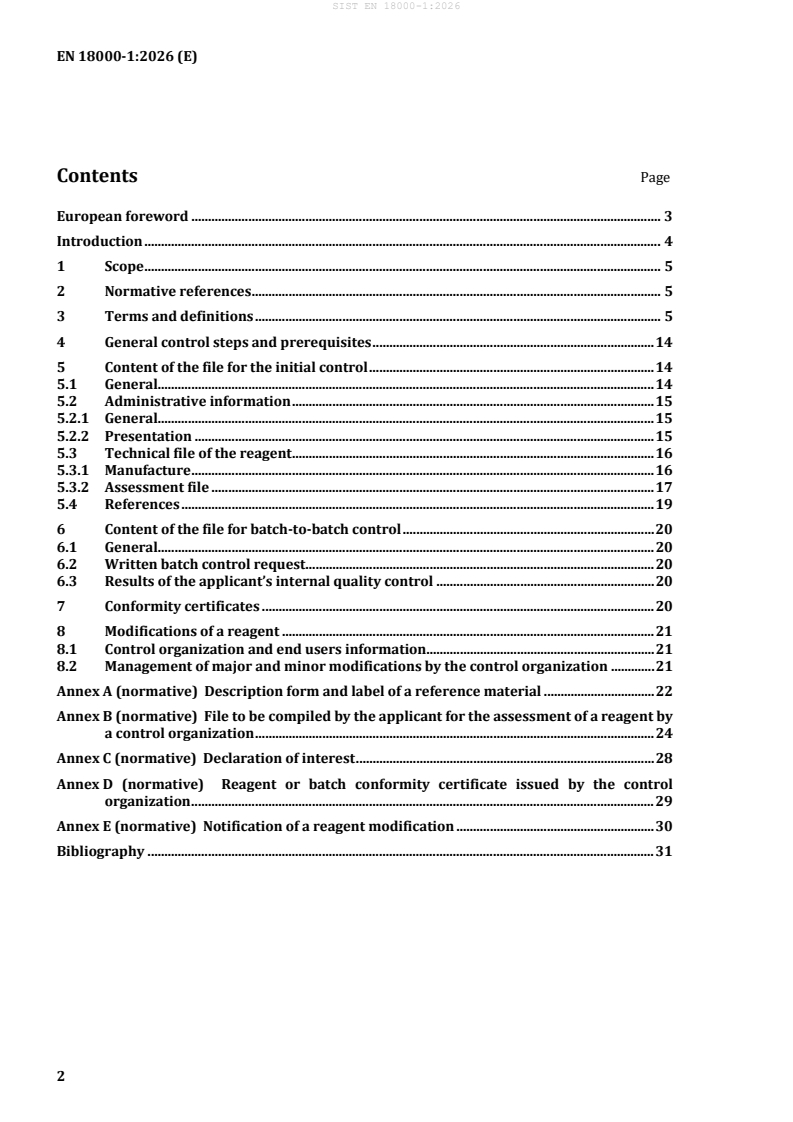
Contents Page
European foreword . 3
Introduction . 4
1 Scope . 5
2 Normative references . 5
3 Terms and definitions . 5
4 General control steps and prerequisites . 14
5 Content of the file for the initial control . 14
5.1 General. 14
5.2 Administrative information . 15
5.2.1 General. 15
5.2.2 Presentation . 15
5.3 Technical file of the reagent . 16
5.3.1 Manufacture . 16
5.3.2 Assessment file . 17
5.4 References . 19
6 Content of the file for batch-to-batch control . 20
6.1 General. 20
6.2 Written batch control request. 20
6.3 Results of the applicant’s internal quality control . 20
7 Conformity certificates . 20
8 Modifications of a reagent . 21
8.1 Control organization and end users information. 21
8.2 Management of major and minor modifications by the control organization . 21
Annex A (normative) Description form and label of a reference material . 22
Annex B (normative) File to be compiled by the applicant for the assessment of a reagent by
a control organization . 24
Annex C (normative) Declaration of interest . 28
Annex D (normative) Reagent or batch conformity certificate issued by the control
organization . 29
Annex E (normative) Notification of a reagent modification . 30
Bibliography . 31
European foreword
This document (EN 18000-1:2026) has been prepared by Technical Committee CEN/TC 469 “Animal
health diagnostic analyses”, the secretariat of which is held by AFNOR.
This European Standard shall be given the status of a national standard, either by publication of an
identical text or by endorsement, at the latest by July 2026, and conflicting national standards shall be
withdrawn at the latest by July 2026.
Attention is drawn to the possibility that some of the elements of this document may be the subject of
patent rights. CEN shall not be held responsible for identifying any or all such patent rights.
Any feedback and questions on this document should be directed to the users’ national standards body.
A complete listing of these bodies can be found on the CEN website.
According to the CEN-CENELEC Internal Regulations, the national standards organisations of the
following countries are bound to implement this European Standard: Austria, Belgium, Bulgaria, Croatia,
Cyprus, Czech Republic, Denmark, Estonia, Finland, France, Germany, Greece, Hungary, Iceland, Ireland,
Italy, Latvia, Lithuania, Luxembourg, Malta, Netherlands, Norway, Poland, Portugal, Republic of North
Macedonia, Romania, Serbia, Slovakia, Slovenia, Spain, Sweden, Switzerland, Türkiye and the United
Kingdom.
Introduction
The purpose of the EN 18000 series is to facilitate the mutual recognition of the work of the animal health
in vitro diagnostic reagent control organizations at the European level (or even more widely) and thus to
eventually allow the use of strategic reagents controlled by a single control organization for a given
disease.
The EN 18000 series establishes requirements for the control of in vitro diagnostic reagents in animal
health. This series is divided into three parts.
Part 1 concerns terms and definitions and the submission of a reagent dossier to a control organization
for control and approval. Its purpose is to provide the applicant submitting an animal disease in vitro
diagnostic reagent to control with the general input for the preparation of the control application file. It
describes the optimal administrative and technical information regarding the applicant and the reagent
required for the application file for initial control and for a batch-to-batch control, respectively. It
specifies, in particular, the validation parameters of the test method using the reagent (objectives,
methodology, criteria and results) according to international standards.
Parts 2 and 3 concern the specific aspects of the control by such organization of an immunological
diagnostic reagent and of a polymerase-chain reaction (PCR) diagnostic reagent, respectively.
Like any standard, this document is intended to be voluntary and, if its use is prescribed by a competent
authority or any other animal health stakeholder, it will be up to them to determine for which diseases
and to which extent this document will be applied by the control bodies they have designated for this
purpose.
Many of the definitions in Clause 3 are derived from definitions presently or previously given in chapters
or in the “Glossary terms” of the WOAH (World Organisation for Animal Health) Manual. These WOAH
documents are revised on a regular basis. However, given the impossibility of tracing successive versions
of WOAH documents and thus guaranteeing access to archived versions, the WOAH source has not been
cited in the definitions used. These definitions are applicable in this document and have been agreed by
all stakeholders.
The terms defined in Clause 3 are written in italics throughout the EN 18000 series.
1 Scope
This document specifies terms and definitions applicable to the EN 18000 series and requirements
concerning information to be provided by applicants submitting animal health in vitro diagnostic
reagents to control.
This document is applicable to diagnostic reagents, as a priority for infectious (bacterial, viral, fungal or
parasitic) or prion diseases and associated animal species for which harmonization of practices in this
area is necessary, i.e. those for which the national, regional or international regulatory framework
provides for the control of trade in animals and/or animal products and/or the definition of a health
status (absence of infection) of areas, establishments or individuals. While all reagents designated by the
competent authorities fall under the scope of this document, the authorities or any other animal health
stakeholder can choose to derogate in specific and exceptional situations such as emerging, exotic or rare
diseases.
This document is not applicable to all existing diagnostic reagents, in particular those for which certain
parameters described in this document cannot be validly evaluated in accordance with international
requirements due, e.g. to the absence of a specific reference method and/or accessible and duly validated
reference materials (RMs).
This document does not cover the step in which the user verifies a reagent (analysis method adoption).
2 Normative references
There are no normative references in this document.
3 Terms and definitions
For the purposes of this document, the following terms and definitions apply.
ISO and IEC maintain terminology databases for use in standardization at the following addresses:
— ISO Online browsing platform: available at https://www.iso.org/obp/
— IEC Electropedia: available at https://www.electropedia.org/
3.1
analysis method adoption
verification by a laboratory that it can properly perform a test method before introducing it by ensuring
that it can achieve the required performance, e.g., in comparison with a second test method
Note 1 to entry: This concept is called “in-house validation” by WOAH.
3.2
analyte
substance to be detected or determined target of the test method
Note 1 to entry: In this document, the term analyte can refer to a single analyte or to a given population of analytes
(antibodies, antigens, nucleic acids, live or inactivated organisms, etc.).
3.3
analytical sensitivity
measured through the limit of detection (LOD), i.e. the estimated amount of
analyte in a specified matrix that would produce a positive test result at least a specified percent of the
time
3.4
analytical sensitivity
measured through the limit of detection (LOD), based on the smallest detectable
amount of analyte that can be measured with a defined certainty (i.e. a signal significantly above a matrix
background without the analyte)
3.5
analytical specificity
degree to which the assay distinguishes the target analyte from non-target analytes, including sample
matrix components
Note 1 to entry: The higher the analytical specificity, the lower the level of false positive reactions.
Note 2 to entry: Analytical specificity combines exclusivity, inclusivity and selectivity.
3.6
applicant
individual or legal entity that submits the dossier of a reagent for initial control or who submits a batch
of reagent for batch-to-batch control
3.7
assay validation
confirmation, through the provision of objective evidence, that the requirements for a specific intended
use or application have been fulfilled
Note 1 to entry: In this document, for the applicant, this consists of providing assessment results that demonstrate
that the test method using the reagent submitted to control is validated according to existing standards, i.e. general
ones (test validation according to WOAH) and disease-specific ones (according to the state of art, e.g. disease-
specific standards, scientific literature).
Note 2 to entry: The control organization does not strictly speaking validate the reagent itself, but verifies through
the documentation provided and by the implementation of a limited number of appropriate tests, that the elements
of the application file and the submitted batch comply with the requirements.
3.8
batch
production batch
defined amount of material, either starting material, intermediate or finished product which is uniform
in its properties and has been produced in one process or series of processes
Note 1 to entry: FDA (FDA’s Code of Federal Regulations 21 CFR 210.3) definition considers “A certain amount of a
material that is intended to have a uniform character and quality within defined limits and is manufactured
according to a single production order during the same manufacturing cycle”. Therefore, to avoid any ambiguity,
according to FDA definition, one process or series of processes should be understood as a single production order
during the same manufacturing cycle.
Note 2 to entry: The circumstances under which the conditions are assumed to be uniform cannot be defined in
general terms; for example, a change of the material or the tool used, or an interruption of the manufacturing
process can produce different conditions.
[SOURCE: EN 13975:2003, 3.3, modified — addition of production batch as a synonym, deletion of lot as
a synonym and addition of 2 notes to entry]
3.9
batch conformity certificate
document issued by the control organization guaranteeing that a specific reagent batch meets the
previously defined requirements, when used according to one or more specified technical protocols
3.10
batch number
A unique number assigned to a specific batch and each of its components
Note 1 to entry: The reagent batch number is inseparable from the version number of the instructions for use, except
otherwise clearly specified on the reagent final package.
3.11
batch-to-batch control
when necessary, applies to a single reagent associated with a defined technical protocol and a single
production batch and consists of a control at the start of the batch shelf life by the applicant and the control
organization, prior to distribution to the user, and a control in the course of batch shelf life, where
appropriate, by the control organization
3.12
certified reference material
reference material accompanied by a certificate, of which one or more values of the specified properties
are certified by a procedure that establishes the accurate production of the unit for which the values of
the property are given and for which each certified value is associated with an uncertainty at a specified
level of confidence
3.13
characterization
determination of the characteristics of a reagent, when used according to one or more
specified technical protocols
EXAMPLE Analytical specificity, analytical sensitivity (limit of detection), precision.
3.14
coefficient of variation
CV
relative standard deviation
RSD
statistical measure that reports the relative dispersion of a set of data, calculated by the ratio of the
standard deviation of numerical data to their mean, obtained under repeatability or reproducibility
conditions
3.15
component
part of a finished, packaged and labelled diagnostic reagent
EXAMPLE Raw material, substance, piece, part, software, firmware or labelling or assembly.
Note 1 to entry: Typical immunological diagnostic kit components include antibody solutions, antigen preparation
(solutions, coated plates), buffer solutions, calibrators, and/or control samples
[SOURCE: ISO 18113-1: 2022, 3.1.14, modified — “IVD medical device (3.1.33)” has been replaced by
“diagnostic reagent”, and Note 1 to entry has been modified — “Typical kit (3.1.38)” has been replaced by
“Typical immunological diagnostic kit”]
3.16
control
measurement, examination, testing or gauging of one or more characteristics of a product or service and
comparing them with specific requirements in order to verify their conformity
Note 1 to entry: The term “control” is also commonly used to refer to a control sample as defined below. In this
document, to avoid confusion, when the term “control” is used, only the definition above applies.
3.17
control organization
CO
entity of a recognized scientific and diagnostic expertise for a specified animal disease and for its analysis
methodology, and designated as such by the competent authority
Note 1 to entry: This expertise includes the capability for the characterization and/or the assignment of values to
reference materials.
3.18
control sample
substance, material or article intended by its manufacturer to be used to verify the performance
properties of a diagnostic reagent
EXAMPLES Positive control samples, negative control samples.
3.19
diagnostic kit
kit
set of components that are packaged together and intended to be used to perform one or more specific in
vitro diagnostic examinations
3.20
diagnostic sensitivity
proportion of reference animals known to be infected and producing a positive test result upon analysis
Note 1 to entry: The infected reference animals that produce a negative test result are considered to be “false
negative reactions”.
3.21
diagnostic specificity
proportion of reference animals known to be uninfected and producing a negative test result upon analysis
Note 1 to entry: The uninfected reference animals that produce a positive test result are considered to be “false
positive reactions”.
3.22
dose-response relationship
correlation between successive dilutions of an analyte and the corresponding values obtained using a
specified reagent and a technical protocol within the range of concentrations where a relationship (in
general linear) exists
3.23
exclusivity
capacity of a test to detect an analyte that is unique to a targeted organism, while excluding those of all
other known organisms that are prone to cross-reactions
3.24
false negative reaction
negative reactivity in an assay of a test sample obtained from an animal infected with the organism in
question
Note 1 to entry: It can be due to lack of analytical sensitivity, restricted analytical specificity or analyte absence or
degradation.
Note 2 to entry: It decreases diagnostic sensitivity.
3.25
false positive reaction
positive reactivity in an assay that is not attributable to exposure to or infection with the organism in
question
Note 1 to entry: It can be due to immunological (or genic) cross-reactivity, cross-contamination of the test sample
or non-specific reactions.
Note 2 to entry: It decreases diagnostic specificity.
3.26
inclusivity
capacity of a test to detect an analyte related to several strains or subtypes of the same species, several
species of the same type or a group of closely related organisms
3.27
initial conformity control
initial control
control which applies to a reagent associated with a defined technical protocol and includes the
characterization and validation of the reagent by the applicant and the assessment of the application
dossier and the initial control of the reagent by the control organization, prior to distribution to the user
3.28
instructions for use
IFU
information provided by the manufacturer or supplier to inform the user of the intended purpose of a
product, about its correct use, as well as on any precautions to be taken
[SOURCE: Regulation (EU) 2017/745 of the European Parliament and of the Council of 5 April 2017 on
medical devices, amending Directive 2001/83/EC, (EC) No 178/2002 and Regulation (EC) No 1223/2009
and repealing Council Directives 90/385/EEC and 93/42/EEC (Text with EEA relevance)]
3.29
interlaboratory reproducibility
ability of a test method to provide consistent test results, as determined by estimates of precision, when
applied to aliquots of the same sample tested by the same test method in different laboratories
3.30
intermediate precision
within-laboratory reproducibility
agreement between the results of repeated analyses of a sample, between one series of analyses and
another, using an identical technical protocol, with the same batch of reagent, in a given laboratory on
different days or times of the day with, wherever possible, different operators and different equipment
3.31
internal reference material
reference material whose reference value is attributed by the user, in comparison with the certified values
or with the consensus values of the reference materials or by adding a known quantity of the analyte to
the matrix that is free of that analyte
Note 1 to entry: This concept is called “working standard reagent” by WOAH.
Note 2 to entry: A working (internal) reference material is included in routine diagnostic tests as a control sample
and/or for standardization of test results.
3.32
linearity
capability, within a certain range, to produce test results proportional to the quantity of analyte to be
assayed in the sample
3.33
manufacturer
company that produces the finished reagent
Note 1 to entry: This term refers to a single manufacturer, or to a group of manufacturers.
3.34
matrix
different biological materials of varying nature, chemical composition and physical state that are used as
samples subjected to analysis that can have different chemical compositions and physical states
EXAMPLES Whole-blood, blood serum, blood plasma, meat juice, milk, skimmed milk, blotting paper, pool of
blood sera, tank milk, ear biopsy, biological tissues.
3.35
minimum detection level
MDL
specified level of dilution of a reference material containing the analyte, which, for a given reagent, will
produce a positive response with a specified technical protocol, and which is defined by the regulations,
standards or, otherwise, by the control organization
3.36
precision
closeness of agreement between independent test results obtained under stipulated conditions
Note 1 to entry: Precision depends only on the distribution of random errors and does not relate to the true value
or the specified value.
Note 2 to entry: The measure of precision is usually expressed in terms of imprecision and computed as a standard
deviation of the test results. Less precision is reflected by a larger standard deviation.
3.37
reagent
diagnostic reagent
product or set of products intended for an analysis according to one or several defined technical
protocols, used exclusively in vitro for screening or diagnostic purposes
Note 1 to entry: When the reagent is made up of a set of components, it can be called a (diagnostic) kit.
Note 2 to entry: Products and materials for general laboratory use shall not be considered as reagents.
Note 3 to entry: This concept is called “IVD medical device” in ISO 18113-1.
3.38
reagent conformity certificate
document issued by the control organization guaranteeing that a reagent meets the previously defined
requirements, when used according to one or more specified technical protocols
3.39
reference animal population
reference animals
animal population selected for estimating diagnostic sensitivity and diagnostic specificity of an assay
Note 1 to entry: Selection of reference animals requires that important variables in the target population are
represented in animals chosen for being infected or exposed to the target agent, or that have never been infected or
exposed. The variables to be noted include but are not limited to species, age, sex, breed, stage of infection,
vaccination history, and relevant herd disease history.
3.40
reference laboratory
national (NRL) or international laboratory of recognized scientific and diagnostic expertise for a
particular animal disease or testing methodology, and designated as such by the competent authority
Note 1 to entry: This includes capability for the characterization and the assignment of values to reference material
and samples.
3.41
reference material
RM
material sufficiently homogeneous and stable with respect to one or more specified properties, which has
been established to be fit for its intended use in a measurement process
Note 1 to entry: The term reference material corresponds to the term “Reference Measurement standard” defined
by WOAH as a “measurement standard designated for the calibration of other measurement standards for quantities
of a given kind in a given organization or at a given location”. In this document, the term “standard” is used
exclusively to refer to a standard (national, European or international) (See standard definition).
Note 2 to entry: An international reference material is a reference material by which all other reagents and assays
are calibrated and prepared and distributed by an international reference laboratory. This concept is called
“international standard reagent” by WOAH.
Note 3 to entry: A national reference material is calibrated by comparison with international reference reagents
and prepared and distributed by a national reference laboratory. This concept is called “national standard reagent”
by WOAH.
[SOURCE: ISO/Guide 30:2015, modified — Notes 1, 2 and 3 to entry have been deleted and replaced]
3.42
reference method
internationally recognized and widely accepted test method
[SOURCE: ISO 16140-1:2016, 2.59, modified — “test” was added before “method”, Note 1 to entry was
deleted]
3.43
repeatability
precision under repeatability conditions
Note 1 to entry: Repeatability can be expressed quantitatively in terms of the dispersion characteristics of the
results.
[SOURCE: ISO 3534-2:2006, 3.3.5]
3.44
repeatability conditions
observation conditions where independent test results are obtained with the same test method on
identical test items in the same test facility by the same operator using the same equipment within short
intervals of time
Note 1 to entry: In this document “within short intervals of time” means “in the same series of tests”.
[SOURCE: ISO 3534-2:2006, 3.3.6, modified — “test” was added before “method”, “or measurement” was
deleted before “items”, “the same test or measuring facility” has been replaced by “the same test facility”,
Note 1 to entry deleted.]
3.45
reproducibility
precision under reproducibility conditions
Note 1 to entry: Reproducibility can be expressed quantitatively in terms of dispersion characteristics of the results.
Note 2 to entry: Results are usually understood to be corrected results.
[SOURCE: ISO 3534-2:2006, 3.3.10]
3.46
reproducibility conditions
observation conditions where independent test results are obtained with the same test method on
identical test items in different test facilities with different operators using different equipment
[SOURCE: ISO 3534-2:2006, 3.3.11, modified — “test” was added before “method”, “/measurement” was
deleted before “results” and “items”, “test or measurement facilities” has been replaced by “test facilities”]
3.47
robustness
validation of the conditions of use
agreement between repeated analyses of the same samples, with the same reagent, in the same laboratory
under the extreme conditions of use specified by the technical protocol
Note 1 to entry: Interlaboratory reproducibility is an additional means of assessing robustness.
3.48
sample
material that is derived from a specimen and used for testing purposes
3.49
selectivity
extent to which the test method can accurately quantify the targeted analyte in the presence of e.g., 1)
interferents such as matrix components (e.g., inhibitors of enzymes in the reaction mix), 2) degradants
(e.g., toxic factors), 3) nonspecific binding of reactants to a solid phase (e.g., conjugate of an ELISA
adsorbed to a well of microtitre plate)
Note 1 to entry: Such interferents can cause falsely reduced or elevated responses in the assay that negatively affect
its analytical specificity or analytical sensitivity.
3.50
sensitivity of the measurement
measure of the change in a quantitative test result that occurs when the quantity of analyte being
measured changes by a given amount
3.51
specimen
biological or laboratory specimen
animal tissue, fluid or other body, feed or environmental material used for animal health diagnostic
analysis
Note 1 to entry: If the specimen concerned in animal health is, or can be used in another field of application, e.g. in
food and feed safety or environmental health, the competent authorities or other stakeholders shall decide on the
field of application in such a way as to avoid any (normative) conflict. This excludes feed, environmental samples
and primary production samples analysed for possible microbiological contamination of the food chain.
3.52
standard
document, established by consensus and approved by a recognized body, that provides, for common and
repeated use, rules, guidelines or characteristics for activities or their results, aimed at the achievement
of the optimum degree of order in a given context
Note 1 to entry: Standards should be based on the consolidated results of science, technology and experience, and
aimed at the promotion of optimum community benefits.
[SOURCE: EN 45020:2006, 3.2]
3.53
supplier
company or person who aims at marketing the reagent submitted to control
Note 1 to entry: This can be the manufacturer or another entity, e.g. distributor, reseller.
3.54
test method
analysis method
assay method
specified technical procedure for detection of an analyte
3.55
test result
outcome of an analysis procedure or method
3.56
test result interpretation
interpretation of the test result as positive, negative or other, if applicable, after modification of the raw
data by a specific calculation method
Note 1 to entry: “other” relates to a result which cannot be interpreted as positive or negative (e.g., according to
the test, anticomplementary, unreadable, contamination, inconclusive, intermediate).
3.57
test series validation
validation of a series of tests by verification of criteria predefined by the test method, usually expected
results for the control samples
3.58
threshold
cut-off
value of the measurement of a test method, above or under which the test result is
considered either positive, or negative (or inconclusive where relevant)
3.59
user
analysis laboratory that uses the reagent for screening or diagnostic purposes
3.60
verification
provision of objective evidence that a given item fulfils specified requirements
[SOURCE: ISO/IEC 17025:2017, 3.8 modified — Examples and notes to entry deleted]
4 General control steps and prerequisites
This document specifies the reagent evaluation elements to be carried out either by the applicant or by
independent third-party laboratories as well as the intervention of the control organization (CO) in terms
of documentary verification or laboratory control implementation.
For the CO, the initial control of the reagent consists of checking in the laboratory that a limited number
of parameters are in conformity with the information produced in the application file.
For the CO, the batch-to-batch control consists of checking in the laboratory that each batch produced
does not differ from the initial batch and is therefore in conformity with the initial application file.
In both cases, the parameters checked in the laboratory are limited in number and chosen in such a way
as to ensure the reliability of the check at an acceptable workload and cost for both the applicant and the
CO.
The reference materials (RMs) used and the procedure followed by the CO to check those parameters, on
which its decision is based, are available to the applicant, if necessary in limited quantities, so that it can
carry out its own controls. With these RMs, the CO shall provide at least the information listed in Annex A.
For certified RMs, the characteristics appearing on the certificate to be provided are listed in ISO 33401.
In all cases, the CO provides the applicant with the information necessary to carry out the required tests
without undue difficulty. In particular, if it is significantly difficult to obtain these field samples (disease
eradicated or eliminated from the region where the manufacturer or applicant is based, fragile samples
that cannot be stored, etc.), the CO indicates to the applicant the unavoidable and acceptable amendments
and simplifications to be made to the methodology proposed in this document.
5 Content of the file for the initial control
5.1 General
The applicant shall compile at least the expected content of the file for the initial control of a reagent by a
CO as described hereafter and summarized in Annex B. This information relating to the supply of the
application file for control of a reagent by the applicant shall be provided in English and, where relevant,
in other required languages. This prescription does not take into account any language requirements for
placing the reagent on a specific market.
5.2 Administrative information
5.2.1 General
a) The name and address of the applicant;
b) The name and address of the manufacturer; accreditation or ISO certification of the manufacturer
and/or applicant, if relevant;
c) If the applicant is not the manufacturer, documentation or certifications proving that it is authorized
by it to request the authorization;
d) The name and address of the person responsible for the reagent;
e) Reagent type (e.g. ELISA, AGID, CFT, IFA, PCR, etc.) ;
f) The trade name, short name, test method, designation of the reagent and its identification number;
g) Manufacturing and internal batch control location(s);
h) Packaging location(s);
i) the batch size and batch number of the batch submitted for control.
5.2.2 Presentation
a) Description of the reagent, and, if relevant, of the respective components by type and quantity, and of
the context of diagnostic use;
b) Scope of the reagent including field of applications, targeted animal species, type of samples (matrix,
individual or pooled specimens), limits of use (vaccinated animals for example);
c) Composition of the reagent and/or each component and safety data sheet;
d) Storage conditions and temperature and shelf life including guarantee of stability;
e) Inner and outer draft labels (of the reagent or the kit and its components), on which a designation
shall appear stating that it is for in vitro use. For component labels, an identification system code (e.g.
barcode, letter or number referring to outer label and/or IFU) is acceptable;
f) Draft IFU. An electronic version (e.g. accessible through a provided barcode) is acceptable. Such
instructions shall contain at least the following information:
— trade name and designation, short name and manufacturer/supplier product number, if relevant;
— intended use and type of useable samples;
— general information (purpose of application);
ELISA: Enzyme-Linked Immunosorbent Assay, AGID: Agar Gel Immunodiffusion, CFT: Complement Fixation Test,
IFA: Immunofluorescence Assay, PCR: Polymerase Chain Reaction.
— descriptions, principles and contents;
— maximum number of reactions possible under the conditions of use specified in the IFU;
— precautions and warnings (to ensure a safe and appropriate handling of components);
— special storage conditions or treatment of the samples, if relevant;
— any known interferences (for example hemolyzed samples);
— list of any necessary equipment or accessories not included with the reagent;
— instructions including the preparation of samples and reagents, instruction for each step of the
procedure, the reading method, the precise rules applying to assay validation (test series
validation criteria) and expression of test results;
— conditions and duration of storage of components, before/after opening and, where relevant,
after their reconstitution;
— the methods of disposing of the components;
— the version reference and the date of the last modification, if relevant;
— marketing authorization number, if relevant.
5.3 Technical file of the reagent
5.3.1 Manufacture
5.3.1.1 Description of the biological and chemical ingredients
Description of the final product and components shall make the distinction between the chemical and
biological ingredients. Probes produced by cloning are considered as biologicals while synthetic
oligonucleotides or peptides are considered as chemicals.
Any component with a safety issue or result impact shall be described in order to assess the risk:
— enzymatic substrates, dyes (if they can incur a chemical risk);
— oligonucleotides, peptides;
— preservatives and other chemicals;
— antigens produced from viruses, microorganisms or cells/list and denomination of the strains;
— antibodies/list and origin of the antibodies/sera/monoclonal antibodies;
— proteins produced by recombination/list of the proteins;
— nucleic acid probes and plasmids/list of the nucleic acid probes and plasmids;
— other biological or chemical ingredients.
This description can be made in general terms in order to guarantee the degree of confidentiality that the
applicant deems necessary.
A material safety data sheet can be included as an alternative to individual raw material listing.
5.3.1.2 Manufacturing process
The steps that are critical to manufacturing or imposed by another European or international standard
shall be presented as a diagram with comments. When the reagent can incur a biological risk to the user
or the environment, the conditions of inactivation of the pathogenic agent and the methods of checking
this inactivation shall be described.
5.3.1.3 Primary packaging
The type of package, material used, the closing mechanisms and the minimum volume per packaging unit
shall be specified.
5.3.1.4 Identification
The process used to identify the batch of the reagent or of each component of the kit (batch of components)
shall be described. For kits, the final reagent is defined by a unique batch number for each combination of
batches of components.
For kits made up of several components (biological and chemical), the applicant shall indicate:
— the biological reagents that cannot be dissociated from the batch submitted for control (e.g. plates +
control samples + conjugate);
— the chemical reagents that can be replaced by reagents from another batch with an identical chemical
composition (e.g. washing or stop solution or substrate). The interchangeability assessment of the
batches of chemical reagents is presented in the assessment file.
5.3.2 Assessment file
5.3.2.1 General
The initial assessment is performed on a specified number of reagent batches. The corresponding batch
sizes shall be specified. The batch(es) subject to control shall be manufactured and packaged under the
final marketing conditions.
When the applicant proposes several technical protocols in a specification, the following parameters shall
be validated for each one.
When the applicant submits for control a kit comprising, on the one hand, indissociable biological
components, and, on the other, interchangeable chemical components, they shall provide the quality
control data guaranteeing that the test results (analytical sensitivity, specificity, etc.) meet acceptability
criteria, irrespective of the batch number of the chemical reagent used (minimum of 3 batches). For
example, for the same batch of plates + control samples + conjugate, three batches of different substrates
with an identical chemical composition are tested. The applicant proceeds in this way for each
interchangeable component.
RMs and field samples used shall be described in detail for each parameter assessed. Where appropriate
(in particular for diagnostic sensitivity and diagnostic specificity), correlation with reference metho
...