

oSIST prEN 18265:2026
(Main)Agricultural machinery - Flax harvesting and conditioning machinery - Safety requirements
General Information
- Abstract
This document specifies the safety requirements and associated means of verification for the design and
construction of the following mounted, trailed and self-propelled machines for harvesting and conditioning flax:
— single or double flaxpuller, forming 1 or 2 windrows,
— single or double turning machine, for 1 or 2 windrows,
— single or double deseeder , harvesting 1 or 2 windrows,
— combined flaxpuller-deseeder machines,
— flax windrow lifters,
— "Flax-specific" round balers, i.e. those designed and built to collect and prepare the flax windrow for
scutching. They include: trailed, in-line or remote and self-propelled round balers with:
— 1 windrow and 1 binding cell, or
— 2 windrows and 1 or 2 binding cells.
This document does not deal with agricultural pick-up balers designed and equipped to harvest forage or
straw (covered in EN ISO 4254-11).
This document, applied in conjunction with EN ISO 4254-1:2015, deals with all the significant hazards
(as listed in Table D.1), hazardous situations and events relevant to self-propelled machines for harvesting and conditioning flax, when they are used as intended and under the conditions foreseen by the manufacturer (see Annex D).
NOTE For traffic on public roads, national highway codes apply (e.g. braking, driving, lighting, coupling) as long as harmonised requirements are not available.
In addition, it specifies the type of information that the manufacturer shall give on safe use practices.
This document does not apply to machinery for harvesting and conditioning flax manufactured before the date of publication.
- Status
- Not Published
- Public Enquiry End Date
- 24-Jun-2026
- Technical Committee
- IMKG - Machinery for agriculture and forestry
- Current Stage
- 4020 - Public enquire (PE) (Adopted Project)
- Start Date
- 09-Apr-2026
- Due Date
- 27-Aug-2026
- Completion Date
- 27-May-2026

Overview
oSIST prEN 18265:2026 sets forth essential safety requirements for agricultural machinery used in the harvesting and conditioning of flax. Published by CEN, this European standard is applicable to mounted, trailed, and self-propelled flax machines, including flax pullers, turners, deseeder machines, windrow lifters, and flax-specific round balers. The document focuses on risks posed to operators and others during use, aiming to minimize hazards by specifying how these machines should be designed and constructed, as well as outlining the information manufacturers must provide for safe working practices. oSIST prEN 18265:2026 works in conjunction with EN ISO 4254-1 for general agricultural machinery safety.
Key Topics
- Scope of Machinery:
- Single or double flax pullers (forming one or two windrows)
- Flax turning machines and deseeder machines for one or two windrows
- Combined flax puller-deseeder machines
- Flax windrow lifters
- Flax-specific round balers (including trailed, in-line, remote, and self-propelled)
- Exclusions:
- Stationary or autonomous mobile flax machinery
- General pick-up balers for forage or straw (see EN ISO 4254-11)
- Hazard Prevention:
- Identification and mitigation of mechanical, operational, and environmental hazards
- Protection against moving parts, roll-over risks, noise, vibrations, and fire hazards
- Special safety requirements for operator stations, including cabins, access, and controls
- Guidelines for safe handling of fuel, hot surfaces, and visibility (lighting and field of vision)
- Operator Safety:
- Requirements for stability during operation and storage
- Provisions for safe servicing and maintenance, including centralized or accessible greasing points
- Information the manufacturer must supply: operator manuals, marking, and warning signals
Applications
This standard is highly relevant for:
- Agricultural machinery manufacturers: Ensuring new flax harvesting and conditioning equipment complies with European safety legislation, addressing all significant hazards during intended use.
- Safety auditors and regulators: Benchmarking compliance of flax harvesting machinery against harmonized European safety requirements.
- Farm operators and contractors: Selecting and operating compliant machinery to minimize occupational risks and improve workplace safety during flax harvesting.
- Maintenance professionals: Following specified maintenance procedures and safety precautions as outlined by the machinery manufacturer.
- Design engineers and product developers: Integrating safety principles into the development cycle for new machines, ensuring protection against mechanical, electrical, and operational hazards.
The standard is not applicable to machines built before its publication date, nor does it cover road traffic requirements, which are the subject of national highway codes.
Related Standards
- EN ISO 4254-1:2015: General safety for agricultural machinery
- EN 15695-1, EN 15695-2: Operator protection against hazardous substances
- EN 15811: Fixed and interlocked guards for moving transmission parts
- EN 17344: Braking requirements for self-propelled agricultural and forestry vehicles
- EN ISO 4254-11: Safety of pick-up balers (excludes flax-specific balers)
- EN ISO 12100:2010: General machinery safety and risk reduction
- EN ISO 16231-1, EN ISO 16231-2: Stability assessment for agricultural machinery
These related documents provide foundational requirements and testing procedures that support the implementation of oSIST prEN 18265:2026 in practice. Ensuring machinery is compliant with these harmonized safety standards will help manufacturers, operators, and maintenance providers foster a safer agricultural working environment while enhancing operational efficiency in the flax supply chain.
Keywords: oSIST prEN 18265:2026, flax harvesting machinery, agricultural machinery safety, CEN standard, flax puller, round baler, risk reduction, operator safety, machine design, European standards.
Get Certified
Connect with accredited certification bodies for this standard

Control Union Certifications
Global certification for agriculture and sustainability.

ECOCERT
Organic and sustainability certification.

FSC International
Forest Stewardship Council certification.
Sponsored listings
Frequently Asked Questions
oSIST prEN 18265:2026 is a draft published by the Slovenian Institute for Standardization (SIST). Its full title is "Agricultural machinery - Flax harvesting and conditioning machinery - Safety requirements". This standard covers: This document specifies the safety requirements and associated means of verification for the design and construction of the following mounted, trailed and self-propelled machines for harvesting and conditioning flax: — single or double flaxpuller, forming 1 or 2 windrows, — single or double turning machine, for 1 or 2 windrows, — single or double deseeder , harvesting 1 or 2 windrows, — combined flaxpuller-deseeder machines, — flax windrow lifters, — "Flax-specific" round balers, i.e. those designed and built to collect and prepare the flax windrow for scutching. They include: trailed, in-line or remote and self-propelled round balers with: — 1 windrow and 1 binding cell, or — 2 windrows and 1 or 2 binding cells. This document does not deal with agricultural pick-up balers designed and equipped to harvest forage or straw (covered in EN ISO 4254-11). This document, applied in conjunction with EN ISO 4254-1:2015, deals with all the significant hazards (as listed in Table D.1), hazardous situations and events relevant to self-propelled machines for harvesting and conditioning flax, when they are used as intended and under the conditions foreseen by the manufacturer (see Annex D). NOTE For traffic on public roads, national highway codes apply (e.g. braking, driving, lighting, coupling) as long as harmonised requirements are not available. In addition, it specifies the type of information that the manufacturer shall give on safe use practices. This document does not apply to machinery for harvesting and conditioning flax manufactured before the date of publication.
This document specifies the safety requirements and associated means of verification for the design and construction of the following mounted, trailed and self-propelled machines for harvesting and conditioning flax: — single or double flaxpuller, forming 1 or 2 windrows, — single or double turning machine, for 1 or 2 windrows, — single or double deseeder , harvesting 1 or 2 windrows, — combined flaxpuller-deseeder machines, — flax windrow lifters, — "Flax-specific" round balers, i.e. those designed and built to collect and prepare the flax windrow for scutching. They include: trailed, in-line or remote and self-propelled round balers with: — 1 windrow and 1 binding cell, or — 2 windrows and 1 or 2 binding cells. This document does not deal with agricultural pick-up balers designed and equipped to harvest forage or straw (covered in EN ISO 4254-11). This document, applied in conjunction with EN ISO 4254-1:2015, deals with all the significant hazards (as listed in Table D.1), hazardous situations and events relevant to self-propelled machines for harvesting and conditioning flax, when they are used as intended and under the conditions foreseen by the manufacturer (see Annex D). NOTE For traffic on public roads, national highway codes apply (e.g. braking, driving, lighting, coupling) as long as harmonised requirements are not available. In addition, it specifies the type of information that the manufacturer shall give on safe use practices. This document does not apply to machinery for harvesting and conditioning flax manufactured before the date of publication.
oSIST prEN 18265:2026 is classified under the following ICS (International Classification for Standards) categories: 65.060.50 - Harvesting equipment. The ICS classification helps identify the subject area and facilitates finding related standards.
oSIST prEN 18265:2026 is associated with the following European legislation: EU Directives/Regulations: 2006/42/EC, 2023/1230, 2023/1230, 2023/1230; Standardization Mandates: M/605. When a standard is cited in the Official Journal of the European Union, products manufactured in conformity with it benefit from a presumption of conformity with the essential requirements of the corresponding EU directive or regulation.
oSIST prEN 18265:2026 is available in PDF format for immediate download after purchase. The document can be added to your cart and obtained through the secure checkout process. Digital delivery ensures instant access to the complete standard document.
Standards Content (Sample)
SLOVENSKI STANDARD
01-junij-2026
Kmetijski stroji - Stroji za žetev in obdelavo lanu - Varnostne zahteve
Agricultural machinery - Flax harvesting and conditioning machinery - Safety
requirements
Landmaschinen - Flachsentnahme- und Verpackungsmaschinen -
Sicherheitsanforderungen
Matériel agricole - Machines pour la récolte et le conditionnement du lin - Prescriptions
de sécurité
Ta slovenski standard je istoveten z: prEN 18265
ICS:
65.060.50 Oprema za spravilo pridelkov Harvesting equipment
2003-01.Slovenski inštitut za standardizacijo. Razmnoževanje celote ali delov tega standarda ni dovoljeno.
DRAFT
EUROPEAN STANDARD
NORME EUROPÉENNE
EUROPÄISCHE NORM
April 2026
ICS 65.060.50
English Version
Agricultural machinery - Flax harvesting and conditioning
machinery - Safety requirements
Matériel agricole - Machines pour la récolte et le Landmaschinen - Flachsentnahme- und
conditionnement du lin - Prescriptions de sécurité Verpackungsmaschinen - Sicherheitsanforderungen
This draft European Standard is submitted to CEN members for enquiry. It has been drawn up by the Technical Committee
CEN/TC 144.
If this draft becomes a European Standard, CEN members are bound to comply with the CEN/CENELEC Internal Regulations
which stipulate the conditions for giving this European Standard the status of a national standard without any alteration.
This draft European Standard was established by CEN in three official versions (English, French, German). A version in any other
language made by translation under the responsibility of a CEN member into its own language and notified to the CEN-CENELEC
Management Centre has the same status as the official versions.
CEN members are the national standards bodies of Austria, Belgium, Bulgaria, Croatia, Cyprus, Czech Republic, Denmark, Estonia,
Finland, France, Germany, Greece, Hungary, Iceland, Ireland, Italy, Latvia, Lithuania, Luxembourg, Malta, Netherlands, Norway,
Poland, Portugal, Republic of North Macedonia, Romania, Serbia, Slovakia, Slovenia, Spain, Sweden, Switzerland, Türkiye and
United Kingdom.
Recipients of this draft are invited to submit, with their comments, notification of any relevant patent rights of which they are
aware and to provide supporting documentation.
Warning : This document is not a European Standard. It is distributed for review and comments. It is subject to change without
notice and shall not be referred to as a European Standard.
EUROPEAN COMMITTEE FOR STANDARDIZATION
COMITÉ EUROPÉEN DE NORMALISATION
EUROPÄISCHES KOMITEE FÜR NORMUNG
CEN-CENELEC Management Centre: Rue de la Science 23, B-1040 Brussels
© 2026 CEN All rights of exploitation in any form and by any means reserved Ref. No. prEN 18265:2026 E
worldwide for CEN national Members.
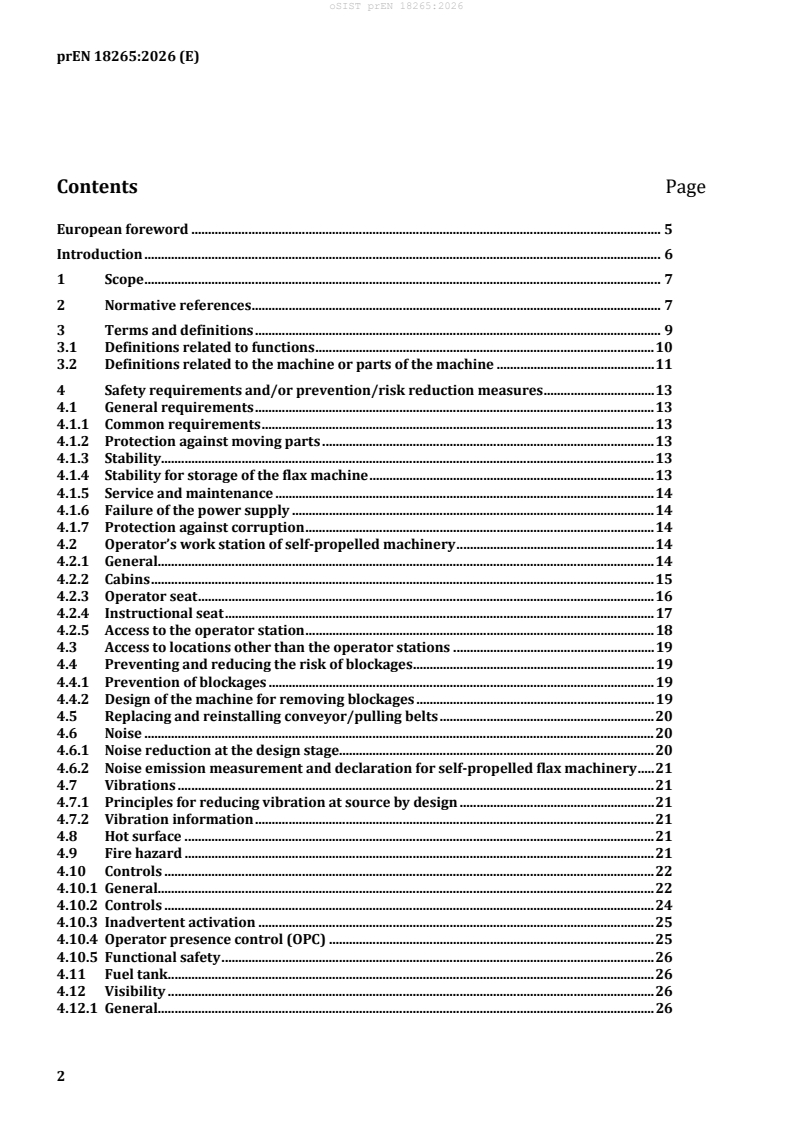
Contents Page
European foreword . 5
Introduction . 6
1 Scope . 7
2 Normative references . 7
3 Terms and definitions . 9
3.1 Definitions related to functions . 10
3.2 Definitions related to the machine or parts of the machine . 11
4 Safety requirements and/or prevention/risk reduction measures . 13
4.1 General requirements . 13
4.1.1 Common requirements . 13
4.1.2 Protection against moving parts . 13
4.1.3 Stability . 13
4.1.4 Stability for storage of the flax machine . 13
4.1.5 Service and maintenance . 14
4.1.6 Failure of the power supply . 14
4.1.7 Protection against corruption . 14
4.2 Operator’s work station of self-propelled machinery . 14
4.2.1 General. 14
4.2.2 Cabins . 15
4.2.3 Operator seat . 16
4.2.4 Instructional seat . 17
4.2.5 Access to the operator station . 18
4.3 Access to locations other than the operator stations . 19
4.4 Preventing and reducing the risk of blockages . 19
4.4.1 Prevention of blockages . 19
4.4.2 Design of the machine for removing blockages . 19
4.5 Replacing and reinstalling conveyor/pulling belts . 20
4.6 Noise . 20
4.6.1 Noise reduction at the design stage. 20
4.6.2 Noise emission measurement and declaration for self-propelled flax machinery . 21
4.7 Vibrations . 21
4.7.1 Principles for reducing vibration at source by design . 21
4.7.2 Vibration information . 21
4.8 Hot surface . 21
4.9 Fire hazard . 21
4.10 Controls . 22
4.10.1 General. 22
4.10.2 Controls . 24
4.10.3 Inadvertent activation . 25
4.10.4 Operator presence control (OPC) . 25
4.10.5 Functional safety . 26
4.11 Fuel tank . 26
4.12 Visibility . 26
4.12.1 General. 26
4.12.2 Lighting . 27
4.12.3 Visibility for self-propelled machinery . 27
4.12.4 Visibility for trailed machinery . 27
4.13 Cab windows . 27
4.14 Braking system for flax machinery designed for off-road application only . 28
4.14.1 Self-propelled machinery . 28
4.14.2 Trailed machines . 28
4.15 Recovery, towing for recovery, stowage, lifting and transport . 28
4.16 Specific requirements for harvesters (pullers) . 28
4.16.1 Guiding by self-guiding system . 28
4.16.2 Specific requirements regarding prevention and removal of blockages . 28
4.17 Specific requirements for deseeders . 29
4.17.1 Grain tank and seed handling systems . 29
4.17.2 Discharge auger . 31
4.17.3 Access to moving parts . 31
4.17.4 Identification of blockages . 31
4.17.5 Cleaning the machine . 31
4.17.6 Clean grain and returns handling systems . 32
4.18 Specific requirements for round balers . 32
4.18.1 General . 32
4.18.2 Access . 32
4.18.3 Tying operation for self-propelled machines . 32
4.18.4 Bale chamber ejection door . 32
4.18.5 Offset machinery . 33
5 Verification of the safety requirements and/or protective/risk reduction measures
................................................................................................................................................................... 33
6 Information for use . 38
6.1 General . 38
6.2 Operator’s manual . 38
6.2.1 General . 38
6.2.2 General for all machines . 38
6.2.3 Self-propelled machines . 40
6.2.4 trailed or mounted machines . 41
6.2.5 Prevention of blockages . 41
6.2.6 Removal of blockages . 41
6.2.7 Removal of belts of the pulling device . 41
6.2.8 Supplementary instructions regarding CCTV system. 42
6.3 Marking . 42
6.4 Warning signals and devices . 42
6.4.1 Warning signals . 42
6.4.2 Safety signs . 43
Annex A (informative) Flax harvesting machines — Illustrations of examples . 44
A.1 General . 44
A.2 Flax pullers. 44
A.3 Flax turning machines . 45
A.4 Flax swath lifters . 48
A.5 deseeders . 48
A.5.1 General . 48
A.5.2 Flax puller and deseeder combination . 48
A.5.3 Turning machine and deseeder combination . 49
A.6 Flax balers . 51
Annex B (informative) List of significant hazards . 54
Annex C (normative) Verification of the visibility for self-propelled machines . 65
C.1 Terms and definitions . 65
C.2 Eye position . 65
C.3 Field of vision to the front . 65
C.4 Lateral field of vision . 65
C.5 Lateral field of vision to the rear . 65
C.6 Field of vision to the rear . 66
Annex D (normative) Verification of the visibility for trailed machines — Field of vision to
the rear . 68
Annex E (informative) Prevention of hazards related to blockages and removal of blockages
on flax machinery . 69
E.1 General. 69
E.2 Prevention of the occurrence of blockages hazards . 69
E.2.1 Design rules and mechanical solutions . 69
E.2.2 Detection of blockages . 69
E.2.3 Instructions for use . 70
E.3 Prevention of hazards when blockages occur . 70
E.3.1 Design rules . 70
E.3.2 Instructions for use . 71
Annex F (normative) Noise measurement . 72
F.1 General. 72
F.2 Machine configuration and operating conditions . 72
F.3 Cabins and auxiliaries . 73
Annex G (informative) Examples of vibration sources and reduction solutions . 74
Annex ZA (informative) Relationship between this European Standard and the essential
requirements of Regulation (EU) 2023/1230 aimed to be covered . 75
Bibliography . 79
European foreword
This document (prEN 18265:2026) has been prepared by Technical Committee CEN/TC 144 “Tractors
and machinery for agriculture and forestry”, the secretariat of which is held by AFNOR.
This document is currently submitted to the CEN enquiry.
This document has been prepared under a standardization request addressed to CEN by the European
Commission. The Standing Committee of the EFTA States subsequently approves these requests for its
Member States.
For the relationship with EU Legislation, see informative Annex ZA, which is an integral part of this
document.
Introduction
This document is a type-C standard as stated in EN ISO 12100:2010.
This document is of relevance, in particular, for the following stakeholder groups representing the market
players with regard to machinery safety:
— machine manufacturers (small, medium and large enterprises);
— health and safety bodies (regulators, accident prevention organizations, market surveillance etc.).
Others can be affected by the level of machinery safety achieved with the means of the document by the
above-mentioned stakeholder groups:
— machine users/employers (small, medium and large enterprises);
— machine users/employees (e.g. trade unions, organizations for people with special needs);
— service providers, e.g. for maintenance (small, medium and large enterprises);
— consumers (in case of machinery intended for use by consumers).
The above-mentioned stakeholder groups have been given the possibility to participate in the drafting
process of this document.
The machinery concerned and the extent to which hazards, hazardous situations or hazardous events are
covered are indicated in the Scope of this document. These hazards are specific to mounted, trailed and
self-propelled machines for harvesting and conditioning flax.
When requirements of this type-C standard are different from those which are stated in type-A or type-B
standards, the requirements of this type-C standard take precedence over the requirements of the other
standards for machines that have been designed and built according to the requirements of this type-C
standard.
1 Scope
This document specifies the safety requirements and associated means of verification for the design and
construction of mounted, trailed and self-propelled machines for harvesting and conditioning flax.
Examples of machinery and their components are given in Annex A.
This document is not applicable to:
— stationary flax machinery.
— autonomous mobile flax machinery.
NOTE 1 ‘Autonomous mobile machinery’ means mobile machinery which has an autonomous mode, in which all
the essential safety functions of the mobile machinery are ensured in its travel and working operations area without
permanent interaction of an operator.
This document, applied in conjunction with EN ISO 4254-1:2015 deals with all the significant hazards (as
listed in Table B.1), hazardous situations and events relevant to machines for harvesting and conditioning
flax, when they are used by one person as intended and under the conditions foreseen by the
manufacturer (see Annex B), except:
— machinery with intended fully or partially self-evolving behaviour or logic.
NOTE 2 Specific requirements related to road traffic regulations (e.g. steering, braking, lighting, coupling) are
not taken into account in this document.
In addition, it specifies the type of information on safe working practices including information about
residual risks to be provided by the manufacturer.
For machinery mounted on or trailed by a tractor, this document does not address the requirements
related to noise measurement nor declaration.
This document does not apply to machinery for harvesting and conditioning flax manufactured before
the date of publication.
2 Normative references
The following documents are referred to in the text in such a way that some or all of their content
constitutes requirements of this document. For dated references, only the edition cited applies. For
undated references, the latest edition of the referenced document (including any amendments) applies.
EN 15695-1:2017, Agricultural tractors and self-propelled sprayers — Protection of the operator (driver)
against hazardous substances — Part 1: Cab classification, requirements and test procedures
EN 15695-2:2017, Agricultural tractors and self-propelled sprayers — Protection of the operator (driver)
against hazardous substances — Part 2: Filters, requirements and test procedures
EN 15811:2014, Agricultural machinery - Fixed guards and interlocked guards with guards locking for
moving transmission parts (ISO/TS 28923:2012 modified)
EN 17344:2020, Agricultural machinery — Self-propelled agricultural and forestry vehicles —
Requirements for braking
EN ISO 4254-1:2015, Agricultural machinery — Safety — Part 1: General requirements
(ISO 4254-1:2013)
EN ISO 4254-11:2010, Agricultural machinery — Safety — Part 11: Pick-up balers (ISO 4254 11:2010)
EN ISO 12100:2010, Safety of machinery — General principles for design — Risk assessment and risk
reduction
EN ISO 13851:2019, Safety of machinery — Two-hand control devices — Principles for design and selection
(ISO 13851:2019)
EN ISO 13855:2024, Safety of machinery — Positioning of safeguards with respect to the approach speeds
of parts of the human body (ISO 13855:2024)
EN ISO 14119:2025, Safety of machinery — Interlocking devices associated with guards — Principles for
design and selection (ISO 14119:2024)
EN ISO 25119-1:2023, Tractors and machinery for agriculture and forestry — Safety-related parts of
control systems Part 1: General principles for design and development (ISO 25119-1:2018)
EN ISO 25119-2:2023, Tractors and machinery for agriculture and forestry — Safety-related parts of
control systems Part 2: Concept phase(ISO 25119-2:2019)
EN ISO 25119-3:2023, Tractors and machinery for agriculture and forestry — Safety-related parts of
control systems Part 3: Series development, hardware and software (ISO 25119-3:2018)
EN ISO 25119-4:2023, Tractors and machinery for agriculture and forestry — Safety-related parts of
control systems — Part 4: Production, operation, modification and supporting processes
(ISO 25119-4:2018)
EN ISO 5353:1998, Earth-moving machinery, and tractors and machinery for agriculture and forestry —
Seat index point (ISO 5353:1995)
EN ISO 16231-1:2013, Self-propelled agricultural machinery — Assessment of stability — Part 1:
Principles (ISO 16231-1:2013)
EN ISO 16231-2:2015, Self-propelled agricultural machinery — Assessment of stability — Part 2:
determination of static stability and test procedures (ISO 16231-2:2015)
Agricultural machinery, tractors, and earth-moving machinery — Cybersecurity
EN ISO 24882:-,
Engineering
ISO 3767-1:2016, Tractors, machinery for agriculture and forestry, powered lawn and garden
equipment — Symbols for operator controls and other displays. Part 1: common symbols
As impacted by EN ISO 4254-1:2015/A1:2021.
As impacted by EN ISO 4254-11:2010/A1:2020.
Under revision at ENQ stage.
As impacted by EN ISO 25119-1:2023/A1:2023.
As impacted by EN ISO 25119-3:2023/A1:2023.
As impacted by EN ISO 25119-4:2023/A1:2023.
Under preparation (DIS awaited)
As impacted by ISO 3767-1:2016/A1:2020.
ISO 3767-2:2016, Tractors, machinery for agriculture and forestry, powered lawn and garden
equipment — Symbols for operator controls and other displays — Part 2: Symbols for agricultural tractors
and machinery
ISO 3776-1:2006, Tractors and machinery for agriculture — Seat belts — Part 1: anchorages location
requirements
ISO 3776-2:2013, Tractors and machinery for agriculture — Seat belts — Part 2: anchorage strength
requirements
ISO 3776-3:2009, Tractors and machinery for agriculture — Seat belts — Part 3: requirements for
assemblies
ISO 5007:2003, Agricultural wheeled tractors — Operator’s seat — Laboratory measurement of
transmitted vibration
ISO 5721-1:2013, Agricultural tractors — Requirements, test procedures and acceptance criteria for the
operator’s field of vision — Part 1: Field of vision to the front
ISO 5700:2025, Tractors for agriculture and forestry — Roll-over protective structures — Static test
method and acceptance conditions
ISO 10968:2020, Earth-moving machinery - Operator’s controls
ISO 9533:2010, Earth-moving machinery — Machine-mounted audible travel alarms and forward horns —
Test methods and performance criteria
ISO 10975:2023, Tractors and machinery for agriculture — Auto-guidance systems for operator-controlled
tractors and self-propelled machines — Safety requirements
ISO 11684:2023, Tractors, machinery for agriculture and forestry, powered lawn and garden equipment —
Safety labels — General principles
ISO 15817:2012, Earth-moving machinery — Safety requirements for remote operator control systems
3 Terms and definitions
For the purposes of this document, the terms and definitions given in EN ISO 12100:2010,
EN ISO 4254-1:2015 and EN 17344:2020 and the following apply.
ISO and IEC maintain terminology databases for use in standardization at the following addresses:
— ISO Online browsing platform: available at https://www.iso.org/obp/
— IEC Electropedia: available at https://www.electropedia.org/
NOTE Explanation of the functions and illustrations of mounted, trailed and self-propelled machines for
harvesting and conditioning flax are given in Annex A.
As impacted by ISO 3767-2:2016/A1:2020.
3.1 Definitions related to functions
3.1.1
pull out
operation which consists of breaking the link between the flax stalk and part of its root system
Note 1 to entry: : Pull out is carried out by pinching then pulling, partially uprooting the flax.
3.1.2
tedding
natural drying operation leading to the separation of the leaves/vegetation and the stems
3.1.3
field retting
action of soil micro-organisms to obtain a degradation of the cements which bind the flax fibres under
natural conditions of temperature and humidity
Note 1 to entry: The retting process is crucial as it determines the quality of the fibre and the proper separation of
the fibres during subsequent operations in the plant (e.g. scutching).
3.1.4
ecapsulation
operation to separate the capsules from the stems and the seeds from the capsules
3.1.5
turn over
operation which consists in taking a flax swath (3.1.4) from the ground, turning it over and then placing
it back on the ground while keeping the alignment of the stems and the straightness of the linen flax swath
3.1.6
lifting
operation which consists in lifting the flax swath (3.1.4) from the ground, without turning it over, in order
to:
— separate the flax swath from the ground and from the regrowth of the plants holding it; and/or
— stimulate drying of the linen flax swath
Note 1 to entry: This operation makes it possible to limit the dust in the flax swath by avoiding excessive scratching
of the ground during winding (3.1.7).
3.1.7
winding
wrapping
operation that consists of picking up the flax swath (3.1.4) from the ground by densifying it, then rolling
it up by placing two strings in the middle of the windrow and, when the diameter is reached, finishing the
constitution of the flax bale (3.1.5) by moving the strings towards the ends on its periphery, with a view
to maintaining a cylindrical shape for transport, handling and storage, as illustrated in Figure 1
a) Bale of harvested flax b) Schematic representation of a bale
Figure 1 — Winding
3.1.8
tying
action of holding the flax bale (3.1.5) by means of a tie (e.g. string, net or other) distributed around the
flax bale
3.2 Definitions related to the machine or parts of the machine
3.2.1
flax puller
self-propelled machine for of breaking the link between the mature flax stem and part of its root system,
forming a flax swath and depositing it on the ground
3.2.2
flax turning machine
trailed or self-propelled machine for pick-up the flax swath laid on the ground and to invert the side
exposed to the sun and the one in contact with the ground
3.2.3
flax deseeder
trailed or self propelled machine for pick-up the flax swath laid on the ground, to separate the capsule
from the stem and to deposite the flax swath again on the ground
3.2.4
deseeder combination combinations
3.2.4.1
flax puller and deseeder combination
self-propelled machine which combines the functionality of a flax puller (3.2.1) and a deseeder
3.2.4.2
turning machine and deseeder combination
self-propelled machine which combines the functionality of a flax turning machine (3.2.2) and a deseeder
3.2.5
flax swath lifter
mounted implement for lift up the flax swath laid on the ground and detaches the flax stem from the
ground
3.2.6
flax baler
trailed or self-propelled machine for pick-up the flax swath laid on the ground, compresses them to form
a compact cylindrical or rectangular bale and bound it by twine, net or other means of tying
3.2.7
round baler
trailed (in-line or remote) or self-propelled machine which collects the flax mats from the ground, winds
them up and compresses them to form a compact cylindrical flax bale (3.1.5) bound by twine, net or other
means of tying
3.2.8
bale chamber
part of the round baler (3.2.7) in which the flax swath (3.1.4) is wound and compressed to form a
cylindrical flax bale, which is then tied and deposited on the ground when the door is opened
3.2.9
bale ejection door
part of the bale chamber (3.2.8) that pivots and opens to release and allow the ejection of the cylindrical
flax bale (3.1.5)
Note 1 to entry: The bale chamber door provides access to the moving parts for maintenance.
3.2.10
flax pick-up
device to lift up the flax swath laid on the ground and move it to the successive elements
3.2.11
lifter
equipment, coupled to the agricultural tractor, consisting of one or more rollers fitted with curved teeth,
which, by moving forward on the flax swath (3.1.4), lifts it and detaches it from the ground
3.2.12
pulling element
header located in front of the flax puller to grip the rooted flax plant, pull it out and move it to the
successive elements
3.2.13
spreading table
spreader element
device located at the rear of the machine, consisting of spiked belts whose functions are to transport and
deposit the flax swath (3.1.4) on the ground
Note 1 to entry: This device is present on all machines except on round balers.
3.2.14
base crusher
pair of rollers of a harvester located downstream of the harvester element which crushes the flax
stalks (3.1.1) of the flax stalk in order to promote its field retting (3.2.3)
3.2.15
base aligner
device located at the rear of the machine in the lay-down section which reduces the offset of the
flax stalks (3.1.1) next to each other in a straight line
4 Safety requirements and/or prevention/risk reduction measures
4.1 General requirements
4.1.1 Common requirements
Machinery shall comply with the safety requirements and/or prevention/risk reduction measures of
Clause 4. In addition, the machine shall be designed according to the principles of EN ISO 12100:2010 for
relevant, but not significant hazards, which are not dealt with by this document.
Unless otherwise specified in this document, flax machines shall comply with the safety requirements
and/or prevention/risk reduction measures of EN ISO 4254-1:2015.
4.1.2 Protection against moving parts
In addition to EN ISO 4254-1:2015, 4.1.2, 4.2, 4.10 and 6.4, the following apply:
Transmission of motion parts (e.g. sprockets, chains, rollers, belts, etc.) shall be protected against
inadvertent contact in accordance with the provisions for moving transmission parts in EN 15811:2014.
4.1.3 Stability
In addition to EN ISO 4254-1:2015, 6.2, the following applies.
To assess the risks related to roll-over, EN ISO 16231-1:2013 and EN ISO 16231-2:2015 shall apply. The
calculation for the RSSA shall be done as specified in Table 1:
Table 1 — MOS, SF, and RSSA for self-propelled flax machines
Lateral roll/tip-over Front/rear tip-over
Machine type
MOS SF RSSA MOS SF RSSA
(%) (%) (%) (%)
Flax harvester 15 1,5 22,5 25 1,5 37,5
Flax baler
Turner
Deseeder 12 1,5 18 18 1,5 27
When a ROPS is required for a self-propelled flax machine, it shall comply with ISO 5700:2025.
NOTE OECD code IV or VIII [VA1] brings similar requirement for tractors.
4.1.4 Stability for storage of the flax machine
When removed and parked on firm ground, the harvesting machine shall be stable in accordance with an
inclination up to 8,5° in any direction.
4.1.5 Service and maintenance
4.1.5.1 Where possible, greasing points shall be centralized. The operator’s manual shall specify
those parts which need to be greased or lubricated. If parts need to be greased or lubricated while in
motion, the greasing/lubrication points shall be located outside of the hazard zone.
4.1.5.2 If greasing points are centralized, these greasing points shall be reachable from the ground
or a platform.
4.1.5.3 Specific instructions about greasing and lubrication shall be provided in the operator’s
manual (see 6.2.1).
4.1.6 Failure of the power supply
In addition to EN ISO 4254-1:2015, 4.6 and 4.20 amended by EN ISO 4254-1:2015/A1:2021, an
interruption of the power supply and a re-establishment after an interruption shall not lead to a
hazardous situation in particular:
— it shall only be possible to restart the machine;
— the machinery shall not be prevented from stopping if the stop command has been given;
— no part of the machine or a tool shall fall or be ejected;
— stopping, automatic or manual, of moving parts shall be unimpeded;
— guards and other protective devices shall remain effective.
A power failure or a hydraulic or pneumatic pressure drop shall not cause any hazardous movements or
actions. Such failures shall not stop the emergency stop systems from functioning.
For the powered assisted steering system, in case of failure of the power supply, it shall be possible to
steer the machine the time to bring it to a stop either by a manual steering provided that the required
manual force conforms to ISO 10968:2020, or a back-up power supply shall be provided.
NOTE For public road circulation, national or European traffic road regulation requirements satisfy the
requirement regarding powered assisted steering system.
4.1.7 Protection against corruption
For protection against corruption, EN ISO 24882:- shall be met.
NOTE Alternatively, prEN 50742, Safety of machinery - Protection against corruption which is under
preparation, provides requirements and recommendations for protection against accidental and intentional
damage to machinery.
4.2 Operator’s work station of self-propelled machinery
4.2.1 General
To protect the operator against noise, dust and adverse weather conditions, self-propelled machinery
shall be equipped with a cabin fitted with a filtration system of category 3 according to EN 15695-1:2017.
To avoid unauthorized activation of the engine starting, EN ISO 4254-1:2015, 5.1.8.1 shall be met.
Under preparation (DIS awaited)
The windshield shall be designed to resist the projection of objects such as stones carried by the
harvesting elements and deflectors can be provided to reduce impact on the windshield.
NOTE Windshields where there is a risk of breakage by objects or projectiles which have performance
characteristics in accordance with UN ECE R43 [7] Annex 4 as amended by Annex 9 or an arrangement giving
equivalent protection are deemed to meet this requirement.
4.2.2 Cabins
4.2.2.1 General
The cabin shall meet the following requirements.
4.2.2.2 Doors and door openings
4.2.2.2.1 The door opening shall conform to Figure 3, provided that the angles between the lower
horizontal limitation (dimension ≥ 300 mm) and the lateral vertical limitations shall not be smaller than
90°. The dimension shown in Figure 3 shall be the aperture measured with the door open. It shall be
possible for the door to remain in the open position (gas struts, effect of gravity or by mechanical means,
etc.).
4.2.2.2.2 Opening and closing the door shall be possible from the ground/platform or while keeping
three-point contact with the boarding means.
Dimensions in millimetres
Figure 2 — Main dimensions of door opening
4.2.2.3 Interior dimensions
The interior dimensions shall be as shown in Figure 3. The dimensions specified apply when the seat is
at the SIP position, as determined in EN ISO 5353:1998.
Dimensions in millimetres
Key
1 SIP
Figure 3 — Interior dimensions
4.2.2.4 Emergency exit
For emergency exit(s), the provisions of EN ISO 4254-1:2015, 5.1.5 apply.
4.2.3 Operator seat
In addition to EN ISO 4254-1:2015, 5.1.2, a restraint system, e.g. seat belt complying with
ISO 3776-1:2006, ISO 3776-2:2013 and ISO 3776-3:2009, shall be provided to keep the operator in the
seat.
Alternatively, a 3-point restraint system is permitted.
NOTE UN ECE R16 [7] gives requirements on 3-point restraint systems.
When SOA according to EN ISO 16231-2 is between MOS and RSSA, a visual and audible signal shall be
provided at the driving position alerting the driver when the driver is in the driving position and not
using the restraint system in travelling mode.
When the SOA according to EN ISO 16231-2 is lower than MOS, the machine movement controlled from
the seated position shall be allowed only when the restraint system is locked or in the working position.
In the case of an instructional seat, see 4.2.4.
4.2.4 Instructional seat
Where cab space permits, a second seat may be installed for an instructor for occasional use.
The instructional seat, if provided, shall meet the following requirements.
a) The instructional seat shall be located as shown in Figure 4. The instructional seat shall be placed
such that the trainer or trainee seated in it creates minimal potential impact on operation and
visibility under the usage conditions specified by the manufacturer in the operator's manual,
consistent with machine function and other design considerations;
b) The instructional seat shall have the minimum dimen
...