

oSIST prEN 18307-1:2026
(Main)Adhesives for load-bearing timber structures made of hardwoods - Classification and performance requirements - Part 1: Adhesives for the bonding of selected hardwood species (group A), with no specific high shear strength classification
General Information
- Abstract
This document establishes a classification for phenolic and aminoplastic polycondensation adhesives classified according to EN 301, one component polyurethane adhesives classified according to EN 15425 and emulsion polymer isocyanate adhesives classified according to EN 16254, according to their suitability for use for load-bearing timber structures made of selected hardwood species (group A) in defined climatic exposure conditions; it specifies performance requirements for such adhesives for the factory manufacture or factory-like manufacturing conditions of load-bearing timber structures made of selected hardwood species only, with no specific high shear strength classification.
NOTE An adhesive with high shear strength classification is needed when the declared characteristic shear strength of the glued laminated product is above 3,5 N/mm2, which is the declared characteristic shear strength of glulam made of softwoods according to EN 14080:2013 Table 4. See prEN 18307-3 requirements in this case.
It also classifies aminoplastic adhesive systems being used with a range of hardener dosage, and one component polyurethane adhesive product lines where all the products within the line have the same chemical composition except for a different amount of catalyst.
This document only specifies the performance of an adhesive for use in an environment corresponding to the defined conditions.
The performance requirements of this document are applicable to the adhesive only, not to the manufacturing timber products. This document does not cover the performance of adhesives for on-site gluing (except for factory-like conditions) nor the production of wood-based panels, except solid wood panels, or modified and stabilized wood with considerably reduced swelling and shrinkage properties, e.g. such as acetylated wood, heat treated wood and polymer impregnated wood. It also does not cover preservative treated wood.
This document is primarily intended for use by adhesive manufacturers and for use in timber products made of selected hardwood species bonded with adhesives, to assess or control the quality of adhesives. The requirements apply to the type testing of the adhesives. Production control activities are outside the scope of this document.
Adhesives meeting the requirements of this document are adequate for use in a load-bearing timber products made of selected hardwood species, provided that the bonding process has been carried out according to an appropriate product standard.
Selected hardwood species covered by this document are listed in FprCEN/TS XXX , group A. FprCEN/TS XXX also specifies nominal physical properties of the mentioned species that are used for testing according to this document.
- Status
- Not Published
- Public Enquiry End Date
- 19-Apr-2026
- Technical Committee
- IPMA - Polimer materials and products
- Current Stage
- 4020 - Public enquire (PE) (Adopted Project)
- Start Date
- 20-Feb-2026
- Due Date
- 10-Jul-2026
- Completion Date
- 20-Apr-2026

Overview
oSIST prEN 18307-1:2026 is a draft European Standard developed by CEN (European Committee for Standardization). It focuses on the classification and performance requirements of adhesives used for load-bearing timber structures made from selected hardwood species (group A), without a specific high shear strength classification. The document covers various types of adhesives, including phenolic and aminoplastic polycondensation adhesives (as per EN 301), one component polyurethane adhesives (as per EN 15425), and emulsion polymer isocyanate adhesives (as per EN 16254). This standard is particularly relevant for adhesive manufacturers and professionals involved in the production and assessment of factory-manufactured hardwood timber structures.
Key Topics
Adhesive Types:
- Phenolic and aminoplastic adhesives
- One component polyurethane (PUR) adhesives
- Emulsion polymer isocyanate (EPI) adhesives
Hardwood Species: Focuses on "group A" selected hardwoods, listed and characterized in FprCEN/TS XXX.
Application Areas:
- General purpose, finger jointing, gap filling, special purpose, and small dimension adhesives
- Both face lamination and finger jointing applications
Classification & Performance:
- Adhesives are classified according to their suitability for particular climatic exposure conditions (service class 1, 2, or 3)
- Requirements for Type I adhesives as per standards for softwoods, extended and tested for selected hardwoods
- No specific high shear strength classification-intended for products where shear strength does not exceed specified limits
Testing Protocols:
- Delamination resistance tests as per EN 302-2 and application-specific standards
- Additional testing for adhesives used with primers and various application methods
Product Labelling: Adhesives must be properly labelled with essential product and batch identification, as well as applicable hardwood species.
Applications
oSIST prEN 18307-1:2026 is primarily intended for use in the following areas:
- Adhesive Manufacture & Quality Control: Provides a standardized framework for adhesive producers to assess and declare the suitability and performance of their products for load-bearing hardwood timber structures.
- Structural Timber Engineering: Essential for engineers, architects, and manufacturers involved in designing and producing glued hardwood timber elements used in construction.
- Factory Manufacturing: Applies to adhesives used under controlled factory or factory-like environments, ensuring reliable performance in conditions similar to those found during industrial production of timber structures.
- Product Standardization: Supports compliance with broader product standards, such as Eurocode 5 (EN 1995-1-1) for timber structure design.
The standard does not cover on-site gluing outside of factory conditions, wood-based panels (other than solid wood panels), modified or stabilized wood with reduced swelling/shrinkage, or preservative-treated wood.
Related Standards
Understanding and implementation of oSIST prEN 18307-1:2026 should consider its relationship with the following standards:
- EN 301: Phenolic and aminoplastic adhesives for load-bearing timber structures
- EN 15425: One component polyurethane adhesives for load-bearing timber structures
- EN 16254: Emulsion polymer isocyanate adhesives for load-bearing timber
- EN 302 Series: Test methods for adhesives, including tensile shear strength and resistance to delamination
- EN 923: General terms and definitions for adhesives
- EN 13556: Nomenclature of timbers used in Europe
- prEN 1995-1-1 (Eurocode 5): Rules for the design of timber structures
- FprCEN/TS XXX: Technical specification listing group A hardwood species and their properties (under preparation)
Practical Value
The adoption of oSIST prEN 18307-1:2026 helps ensure:
- Consistent adhesive performance and reliability for structural applications with selected hardwoods
- Enhanced safety and durability of engineered timber products
- Harmonization of adhesive classifications and testing methods across Europe
- Transparent quality benchmarks for manufacturers seeking market access or certification
For adhesive manufacturers and the timber construction industry, compliance with this standard is crucial for delivering trusted, high-performance load-bearing timber structures made of hardwood.
Relations
- Effective Date
- 28-Jan-2026
Get Certified
Connect with accredited certification bodies for this standard

DIN CERTCO
DIN Group product certification.
DIBt (Deutsches Institut für Bautechnik)
German Institute for Building Technology.

Aboma Certification B.V.
Specialized in construction, metal, and transport sectors.
Sponsored listings
Frequently Asked Questions
oSIST prEN 18307-1:2026 is a draft published by the Slovenian Institute for Standardization (SIST). Its full title is "Adhesives for load-bearing timber structures made of hardwoods - Classification and performance requirements - Part 1: Adhesives for the bonding of selected hardwood species (group A), with no specific high shear strength classification". This standard covers: This document establishes a classification for phenolic and aminoplastic polycondensation adhesives classified according to EN 301, one component polyurethane adhesives classified according to EN 15425 and emulsion polymer isocyanate adhesives classified according to EN 16254, according to their suitability for use for load-bearing timber structures made of selected hardwood species (group A) in defined climatic exposure conditions; it specifies performance requirements for such adhesives for the factory manufacture or factory-like manufacturing conditions of load-bearing timber structures made of selected hardwood species only, with no specific high shear strength classification. NOTE An adhesive with high shear strength classification is needed when the declared characteristic shear strength of the glued laminated product is above 3,5 N/mm2, which is the declared characteristic shear strength of glulam made of softwoods according to EN 14080:2013 Table 4. See prEN 18307-3 requirements in this case. It also classifies aminoplastic adhesive systems being used with a range of hardener dosage, and one component polyurethane adhesive product lines where all the products within the line have the same chemical composition except for a different amount of catalyst. This document only specifies the performance of an adhesive for use in an environment corresponding to the defined conditions. The performance requirements of this document are applicable to the adhesive only, not to the manufacturing timber products. This document does not cover the performance of adhesives for on-site gluing (except for factory-like conditions) nor the production of wood-based panels, except solid wood panels, or modified and stabilized wood with considerably reduced swelling and shrinkage properties, e.g. such as acetylated wood, heat treated wood and polymer impregnated wood. It also does not cover preservative treated wood. This document is primarily intended for use by adhesive manufacturers and for use in timber products made of selected hardwood species bonded with adhesives, to assess or control the quality of adhesives. The requirements apply to the type testing of the adhesives. Production control activities are outside the scope of this document. Adhesives meeting the requirements of this document are adequate for use in a load-bearing timber products made of selected hardwood species, provided that the bonding process has been carried out according to an appropriate product standard. Selected hardwood species covered by this document are listed in FprCEN/TS XXX , group A. FprCEN/TS XXX also specifies nominal physical properties of the mentioned species that are used for testing according to this document.
This document establishes a classification for phenolic and aminoplastic polycondensation adhesives classified according to EN 301, one component polyurethane adhesives classified according to EN 15425 and emulsion polymer isocyanate adhesives classified according to EN 16254, according to their suitability for use for load-bearing timber structures made of selected hardwood species (group A) in defined climatic exposure conditions; it specifies performance requirements for such adhesives for the factory manufacture or factory-like manufacturing conditions of load-bearing timber structures made of selected hardwood species only, with no specific high shear strength classification. NOTE An adhesive with high shear strength classification is needed when the declared characteristic shear strength of the glued laminated product is above 3,5 N/mm2, which is the declared characteristic shear strength of glulam made of softwoods according to EN 14080:2013 Table 4. See prEN 18307-3 requirements in this case. It also classifies aminoplastic adhesive systems being used with a range of hardener dosage, and one component polyurethane adhesive product lines where all the products within the line have the same chemical composition except for a different amount of catalyst. This document only specifies the performance of an adhesive for use in an environment corresponding to the defined conditions. The performance requirements of this document are applicable to the adhesive only, not to the manufacturing timber products. This document does not cover the performance of adhesives for on-site gluing (except for factory-like conditions) nor the production of wood-based panels, except solid wood panels, or modified and stabilized wood with considerably reduced swelling and shrinkage properties, e.g. such as acetylated wood, heat treated wood and polymer impregnated wood. It also does not cover preservative treated wood. This document is primarily intended for use by adhesive manufacturers and for use in timber products made of selected hardwood species bonded with adhesives, to assess or control the quality of adhesives. The requirements apply to the type testing of the adhesives. Production control activities are outside the scope of this document. Adhesives meeting the requirements of this document are adequate for use in a load-bearing timber products made of selected hardwood species, provided that the bonding process has been carried out according to an appropriate product standard. Selected hardwood species covered by this document are listed in FprCEN/TS XXX , group A. FprCEN/TS XXX also specifies nominal physical properties of the mentioned species that are used for testing according to this document.
oSIST prEN 18307-1:2026 is classified under the following ICS (International Classification for Standards) categories: 79.060.99 - Other wood-based panels; 83.180 - Adhesives; 91.080.20 - Timber structures. The ICS classification helps identify the subject area and facilitates finding related standards.
oSIST prEN 18307-1:2026 has the following relationships with other standards: It is inter standard links to SIST EN ISO 21388-2:2024. Understanding these relationships helps ensure you are using the most current and applicable version of the standard.
oSIST prEN 18307-1:2026 is available in PDF format for immediate download after purchase. The document can be added to your cart and obtained through the secure checkout process. Digital delivery ensures instant access to the complete standard document.
Standards Content (Sample)
SLOVENSKI STANDARD
01-april-2026
Lepila za nosilne lesene konstrukcije iz trdega lesa - Razvrstitev in zahteve za
lastnosti - 1. del: Lepila za lepljenje izbranih vrst trdega lesa (skupina A), brez
posebne klasifikacije visoke strižne trdnosti
Adhesives for load-bearing timber structures made of hardwoods - Classification and
performance requirements - Part 1: Adhesives for the bonding of selected hardwood
species (group A), with no specific high shear strength classification
Klebstoffe für tragende Holzbauteile aus Laubholz - Klassifizierung und
Leistungsanforderungen - Teil 1: Klebstoffe für bestimmte Laubholzarten (Gruppe A)
ohne besondere hohe Scherfestigkeitsklassifizierung
Adhésifs pour structures portantes en bois feuillus - Classification et exigences de
performance - Partie 1 : Adhésifs destinés au collage d’essences de bois feuillus
sélectionnées (groupe A), sans classification spécifique pour la résistance au
cisaillement élevée
Ta slovenski standard je istoveten z: prEN 18307-1
ICS:
83.180 Lepila Adhesives
91.080.20 Lesene konstrukcije Timber structures
2003-01.Slovenski inštitut za standardizacijo. Razmnoževanje celote ali delov tega standarda ni dovoljeno.
DRAFT
EUROPEAN STANDARD
NORME EUROPÉENNE
EUROPÄISCHE NORM
February 2026
ICS
English Version
Adhesives for load-bearing timber structures made of
hardwoods - Classification and performance requirements
- Part 1: Adhesives for the bonding of selected hardwood
species (group A), with no specific high shear strength
classification
Adhésifs pour structures portantes en bois feuillus - Klebstoffe für tragende Holzbauteile aus Laubholz -
Classification et exigences de performances - Partie 1: Klassifizierung und Leistungsanforderungen - Teil 1:
Adhésifs destinés au collage de structures portantes en Klebstoffe für bestimmte Laubholzarten (Gruppe A)
bois feuillus sélectionnés (groupe A), sans ohne besondere hohe Scherfestigkeitsklassifizierung
classification spécifique pour la résistance au
cisaillement élevée
This draft European Standard is submitted to CEN members for enquiry. It has been drawn up by the Technical Committee
CEN/TC 193.
If this draft becomes a European Standard, CEN members are bound to comply with the CEN/CENELEC Internal Regulations
which stipulate the conditions for giving this European Standard the status of a national standard without any alteration.
This draft European Standard was established by CEN in three official versions (English, French, German). A version in any other
language made by translation under the responsibility of a CEN member into its own language and notified to the CEN-CENELEC
Management Centre has the same status as the official versions.
CEN members are the national standards bodies of Austria, Belgium, Bulgaria, Croatia, Cyprus, Czech Republic, Denmark, Estonia,
Finland, France, Germany, Greece, Hungary, Iceland, Ireland, Italy, Latvia, Lithuania, Luxembourg, Malta, Netherlands, Norway,
Poland, Portugal, Republic of North Macedonia, Romania, Serbia, Slovakia, Slovenia, Spain, Sweden, Switzerland, Türkiye and
United Kingdom.
Recipients of this draft are invited to submit, with their comments, notification of any relevant patent rights of which they are
aware and to provide supporting documentation.
Warning : This document is not a European Standard. It is distributed for review and comments. It is subject to change without
notice and shall not be referred to as a European Standard.
EUROPEAN COMMITTEE FOR STANDARDIZATION
COMITÉ EUROPÉEN DE NORMALISATION
EUROPÄISCHES KOMITEE FÜR NORMUNG
CEN-CENELEC Management Centre: Rue de la Science 23, B-1040 Brussels
© 2026 CEN All rights of exploitation in any form and by any means reserved Ref. No. prEN 18307-1:2026 E
worldwide for CEN national Members.
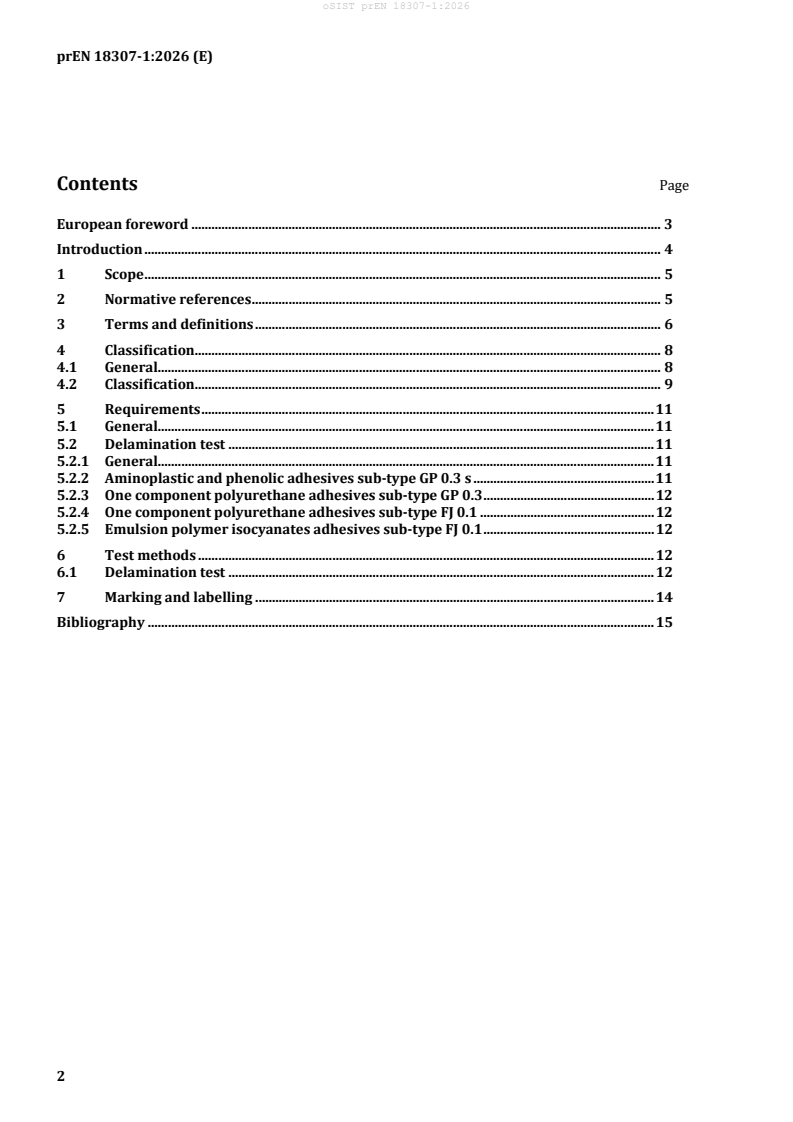
Contents Page
European foreword . 3
Introduction . 4
1 Scope . 5
2 Normative references . 5
3 Terms and definitions . 6
4 Classification. 8
4.1 General. 8
4.2 Classification. 9
5 Requirements . 11
5.1 General. 11
5.2 Delamination test . 11
5.2.1 General. 11
5.2.2 Aminoplastic and phenolic adhesives sub-type GP 0.3 s . 11
5.2.3 One component polyurethane adhesives sub-type GP 0.3 . 12
5.2.4 One component polyurethane adhesives sub-type FJ 0.1 . 12
5.2.5 Emulsion polymer isocyanates adhesives sub-type FJ 0.1 . 12
6 Test methods . 12
6.1 Delamination test . 12
7 Marking and labelling . 14
Bibliography . 15
European foreword
This document (prEN 18307-1:2026) has been prepared by Technical Committee CEN/TC 193
“Adhesives”, the secretariat of which is held by UNE.
This document is currently submitted to the CEN Enquiry.
Introduction
This document is one of a series of standards dealing with adhesives for use with timber structures and
is published in support of product standards for load-bearing timber structures in connection with
EN 1995-1-1 Eurocode 5: Design of timber structures - Part 1-1: General – Common rules and rules for
buildings.
The series consists of:
• three standards for classification and performance requirements for adhesives for load-bearing
timber structures (EN 301 for phenolic and aminoplastic adhesives, EN 15425 for one component
polyurethane adhesives and EN 16254 for emulsion polymer isocyanate adhesives),
• one standard for classification and performance requirements for adhesives for load-bearing
hardwood timber structures (prEN 18307-1), made of selected hardwood species (group A), with no
specific high shear strength classification,
• one standard for the definition of groups of selected hardwood species (A and B) and sampling
specifications for testing according to FprCEN/TS XXX ,
• seven test methods (EN 302-1, EN 302-2, EN 302-3, EN 302-4, EN 302-8 and EN 15416-1,
EN 15416-3) used to assess the performance of adhesives after specified heat and humidity
treatments, and
• five test methods (EN 302-5, EN 302-6, EN 302-7 and EN 15416-4, EN 15416-5) to characterize the
working properties of the adhesive.
NOTE prEN 18307-1 is part of a sub-series of three standards for classification and performance requirements
for adhesives for load-bearing hardwood timber structures; prEN 18307-2 and prEN 18307-3 are not published
yet:
Part 1: Adhesives for the bonding of selected hardwood species (group A), with no specific high shear strength
classification.
[Part 2: Adhesives for the bonding of selected hardwood species (group B), with no specific high shear strength
classification].
[Part 3: Adhesives for the bonding of selected hardwood species (group A and B), with specific high shear strength
classification].
SAFETY STATEMENT
Persons using this document should be familiar with the normal laboratory practice, if applicable. This
document cannot address all of the safety problems, if any, associated with its use. It is the responsibility
of the user to establish appropriate safety and health practices and to ensure compliance with any
regulatory conditions.
ENVIRONMENTAL STATEMENT
It is understood that some of the material permitted in this document may have a negative environmental
impact. As technological advantages lead to acceptable alternatives for these materials, they will be
eliminated from this document to the greatest extent possible.
At the end of the test, the user of the document should take care to carry out an appropriate disposal of
the wastes.
Under preparation. Stage at the time of publication: WI 00193396.
NOTE Local regulations can apply.
1 Scope
This document establishes a classification for phenolic and aminoplastic polycondensation adhesives
classified according to EN 301, one component polyurethane adhesives classified according to EN 15425
and emulsion polymer isocyanate adhesives classified according to EN 16254, according to their
suitability for use for load-bearing timber structures made of selected hardwood species (group A) in
defined climatic exposure conditions; it specifies performance requirements for such adhesives for the
factory manufacture or factory-like manufacturing conditions of load-bearing timber structures made of
selected hardwood species only, with no specific high shear strength classification.
NOTE An adhesive with high shear strength classification is needed when the declared characteristic shear
strength of the glued laminated product is above 3,5 N/mm , which is the declared characteristic shear strength of
glulam made of softwoods according to EN 14080:2013 Table 4. See prEN 18307-3 requirements in this case.
It also classifies aminoplastic adhesive systems being used with a range of hardener dosage, and one
component polyurethane adhesive product lines where all the products within the line have the same
chemical composition except for a different amount of catalyst.
This document only specifies the performance of an adhesive for use in an environment corresponding
to the defined conditions.
The performance requirements of this document are applicable to the adhesive only, not to the
manufacturing timber products. This document does not cover the performance of adhesives for on-site
gluing (except for factory-like conditions) nor the production of wood-based panels, except solid wood
panels, or modified and stabilized wood with considerably reduced swelling and shrinkage properties,
e.g. such as acetylated wood, heat treated wood and polymer impregnated wood. It also does not cover
preservative treated wood.
This document is primarily intended for use by adhesive manufacturers and for use in timber products
made of selected hardwood species bonded with adhesives, to assess or control the quality of adhesives.
The requirements apply to the type testing of the adhesives. Production control activities are outside the
scope of this document.
Adhesives meeting the requirements of this document are adequate for use in a load-bearing timber
products made of selected hardwood species, provided that the bonding process has been carried out
according to an appropriate product standard.
Selected hardwood species covered by this document are listed in FprCEN/TS XXX , group A.
FprCEN/TS XXX also specifies nominal physical properties of the mentioned species that are used for
testing according to this document.
2 Normative references
The following documents are referred to in the text in such a way that some or all of their content
constitutes requirements of this document. For dated references, only the edition cited applies. For
undated references, the latest edition of the referenced document (including any amendments) applies.
EN 301, Adhesives, phenolic and aminoplastic, for load-bearing timber structures - Classification and
performance requirements
Under preparation. Stage at the time of publication: WI 00193396.
Under preparation. Stage at the time of publication: WI 00193396.
EN 302-1, Adhesives for load-bearing timber structures - Test methods - Part 1: Determination of
longitudinal tensile shear strength
EN 302-2, Adhesives for load-bearing timber structures - Test methods - Part 2: Determination of resistance
to delamination
EN 923, Adhesives - Terms and definitions
EN 13556, Round and sawn timber - Nomenclature of timbers used in Europe
EN 15425, Adhesives - One component polyurethane (PUR) for load-bearing timber structures -
Classification and performance requirements
EN 16254, Adhesives - Emulsion polymer isocyanate (EPI) for load-bearing timber structures - Classification
and performance requirements
3 Terms and definitions
For the purposes of this document, the terms and definitions given in EN 923 and the following apply.
ISO and IEC maintain terminology databases for use in standardization at the following addresses:
— ISO Online browsing platform: available at https://www.iso.org/obp/
— IEC Electropedia: available at https://www.electropedia.org/
3.1
aminoplastic resin
thermosetting synthetic resin derived from a condensation reaction of the –NH groups or –NH2 groups
of amines or amides with aldehydes
3.2
phenolic resin
thermosetting synthetic resin derived from a condensation reaction of a phenol with an aldehyde
3.3
polycondensation adhesive
adhesive mixture made from a resin formed by a polymerisation reaction involving the elimination of
water, usually with a hardener
Note 1 to entry: Such adhesives usually also contain extenders and/or fillers.
3.4
one component polyurethane (PUR) adhesive
isocyanate containing urethane polymers, which are cross-linked by reaction with water
3.5
emulsion polymer isocyanate (EPI) adhesive
water based emulsion polymer or a mixture of water based emulsion polymers cross-linked with an
isocyanate as hardener
3.6
service class 1
climatic conditions characterised by a relative humidity of surrounding air of 65% (upper limit) and 50%
(yearly average) at a temperature of 20°C
[SOURCE: prEN 1995-1-1:2024/10 Table 4.2]
Note 1 to entry: In service class 1, which comprises typical indoor conditions, the average moisture content in most
softwoods will not exceed 12 %.
3.7
service class 2
climatic conditions characterised by a relative humidity of surrounding air of 85% (maximum) and 75%
(yearly average) at a temperature of 20°C
[SOURCE: prEN 1995-1-1:2024/10 Table 4.2]
Note 1 to entry: In service class 2, to which most covered exterior conditions belong, the average moisture content
in most softwoods will not exceed 20 %.
3.8
service class 3
climatic conditions characterized by a relative humidity of surrounding air of 95% (maximum) and 85%
(yearly average) at a temperature of 20°C
[SOURCE: prEN 1995-1-1:2024/10 Table 4.2]
Note 1 to entry: Exterior conditions typically belong to service class 3.
3.9
glue line
adhesive layer between the wood members
3.10
thick glue line
glue line of nominal thickness in the range of 0,3 mm to 2,0 mm at the time of bonding
Note 1 to entry: Thick glue lines are achieved by using spacers, grooves or similar devices when two plain members
are glued together.
3.11
close contact glue line
glue line of thickness maximum 0,1 mm
Note 1 to entry: Close contact glue line is achieved by pressing together two plane wood members with a clamping
pressure of (0,8 ± 0,1) N/mm2 without additional grooves, spacers or similar devices.
3.12
adhesive product line
series of products, all with the same chemical composition except for a different amount of catalyst
Note 1 to entry: Only for this reason the products have different reactivity.
3.13
primer treatment
application of a coating (primer) substance to both adherend surfaces, prior to the application of an
...