

SIST EN 16887:2017
(Main)Leather - Environmental footprint - Product Category Rules (PCR) - Carbon footprints
General Information
- Abstract
This European Standard provides a system for calculation of the carbon footprint of leather as defined in EN 15987 and sold in the semi-processed state or ready to be shipped for use in consumer articles manufacturing processes.
- Status
- Published
- Public Enquiry End Date
- 29-Sep-2015
- Publication Date
- 19-Apr-2017
- Technical Committee
- IUSN - Leather
- Current Stage
- 6060 - National Implementation/Publication (Adopted Project)
- Start Date
- 13-Apr-2017
- Due Date
- 18-Jun-2017
- Completion Date
- 20-Apr-2017

Overview
EN 16887:2017 - produced by CEN - defines Product Category Rules (PCR) for calculating the carbon footprint of leather. It provides a standardized system to quantify greenhouse gas emissions for leather (as defined in EN 15987) sold in semi‑processed form or ready to be shipped for manufacture into consumer articles. The standard supports transparent, comparable Product Carbon Footprint (PCF) studies and aligns with Type III environmental declaration principles.
Key topics and requirements
- Scope and product definition: Applies to all kinds of leather from animals bred primarily for other purposes (e.g., meat, milk). Covers semi‑processed and finished leather used in manufacturing.
- Functional unit and bill of materials: Requires clear specification of the functional unit and detailed reporting of material inputs and quantities.
- System boundaries: Specifies upstream, core (product system) and downstream processes to be included - including split leather processes and transportation requirements.
- Data quality and data types: Distinguishes site‑specific data, primary data and secondary data; sets expectations for measurement and data source transparency.
- Allocation rules: Defines how to allocate emissions between products, co‑products and by‑products (including waste and recovery scenarios).
- Modules and time/geography: Details core, upstream and downstream modules with geographic and temporal boundaries and interfaces to other life cycle inventories.
- Reporting and declaration: Specifies information to include in a leather PCF (company identification, site(s), process phases, optional environmental management info).
- Annexes: Includes guidance on chemicals, CPC codes and waste/by‑product treatment formulas relevant to leather life cycles.
Practical applications
- Create standardized, comparable Product Carbon Footprints (PCF) for leather used in footwear, garments, upholstery and accessories.
- Support LCA practitioners and sustainability teams in producing credible environmental declarations and meeting procurement or regulatory requirements.
- Enable tanneries and leather manufacturers to benchmark process emissions, prioritize emission‑reduction actions and document improvements for customers and labels.
- Inform brand sustainability reporting, eco‑design, supplier assessments and communications consistent with EN ISO 14025 and CEN ISO/TS 14067.
Who should use it
- Tanneries and leather processors
- Product sustainability managers and LCA consultants
- Environmental compliance and procurement teams
- Brands and manufacturers specifying leather inputs
- Third‑party verifiers and ecolabel bodies
Related standards
- EN 15987 (leather terminology and definitions)
- CEN ISO/TS 14067 (carbon footprint of products)
- EN ISO 14025 / EN ISO 14021 (environmental declarations and claims)
EN 16887:2017 helps ensure leather carbon footprint calculations are robust, comparable and suitable for transparent environmental communication across the supply chain.
Relations
- Effective Date
- 15-Jul-2026
- Effective Date
- 28-Jan-2026
- Effective Date
- 28-Jan-2026
- Effective Date
- 28-Jan-2026
- Effective Date
- 28-Jan-2026
- Effective Date
- 28-Jan-2026
Get Certified
Connect with accredited certification bodies for this standard

BSI Group
BSI (British Standards Institution) is the business standards company that helps organizations make excellence a habit.

Bureau Veritas
Bureau Veritas is a world leader in laboratory testing, inspection and certification services.

DNV
DNV is an independent assurance and risk management provider.
Sponsored listings
Frequently Asked Questions
SIST EN 16887:2017 is a standard published by the Slovenian Institute for Standardization (SIST). Its full title is "Leather - Environmental footprint - Product Category Rules (PCR) - Carbon footprints". This standard covers: This European Standard provides a system for calculation of the carbon footprint of leather as defined in EN 15987 and sold in the semi-processed state or ready to be shipped for use in consumer articles manufacturing processes.
This European Standard provides a system for calculation of the carbon footprint of leather as defined in EN 15987 and sold in the semi-processed state or ready to be shipped for use in consumer articles manufacturing processes.
SIST EN 16887:2017 is classified under the following ICS (International Classification for Standards) categories: 13.020.60 - Product life-cycles; 59.140.30 - Leather and furs. The ICS classification helps identify the subject area and facilitates finding related standards.
SIST EN 16887:2017 has the following relationships with other standards: It is inter standard links to SIST EN ISO 14025:2026, SIST EN ISO 14025:2010, SIST EN ISO 14067:2019, SIST EN ISO 2589:2016, SIST EN ISO 14021:2016, SIST EN 15987:2015. Understanding these relationships helps ensure you are using the most current and applicable version of the standard.
SIST EN 16887:2017 is available in PDF format for immediate download after purchase. The document can be added to your cart and obtained through the secure checkout process. Digital delivery ensures instant access to the complete standard document.
Standards Content (Sample)
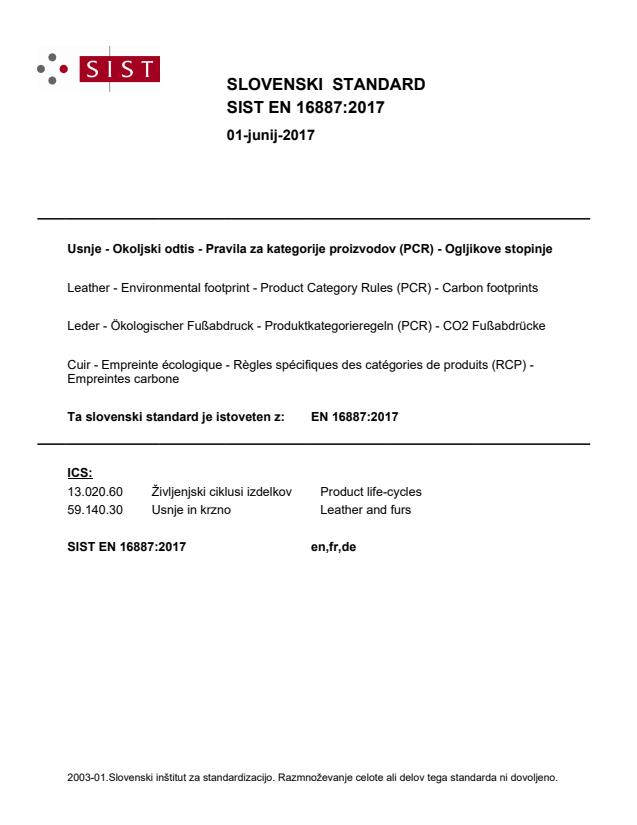
2003-01.Slovenski inštitut za standardizacijo. Razmnoževanje celote ali delov tega standarda ni dovoljeno.Usnje - Okoljski odtis - Pravila za kategorije proizvodov (PCR) - Ogljikove stopinjeLeder - Ökologischer Fußabdruck - Produktkategorieregeln (PCR) - CO2 FußabdrückeCuir - Empreinte écologique - Règles spécifiques des catégories de produits (RCP) - Empreintes carboneLeather - Environmental footprint - Product Category Rules (PCR) - Carbon footprints59.140.30Usnje in krznoLeather and furs13.020.60Življenjski ciklusi izdelkovProduct life-cyclesICS:Ta slovenski standard je istoveten z:EN 16887:2017SIST EN 16887:2017en,fr,de01-junij-2017SIST EN 16887:2017SLOVENSKI
STANDARD
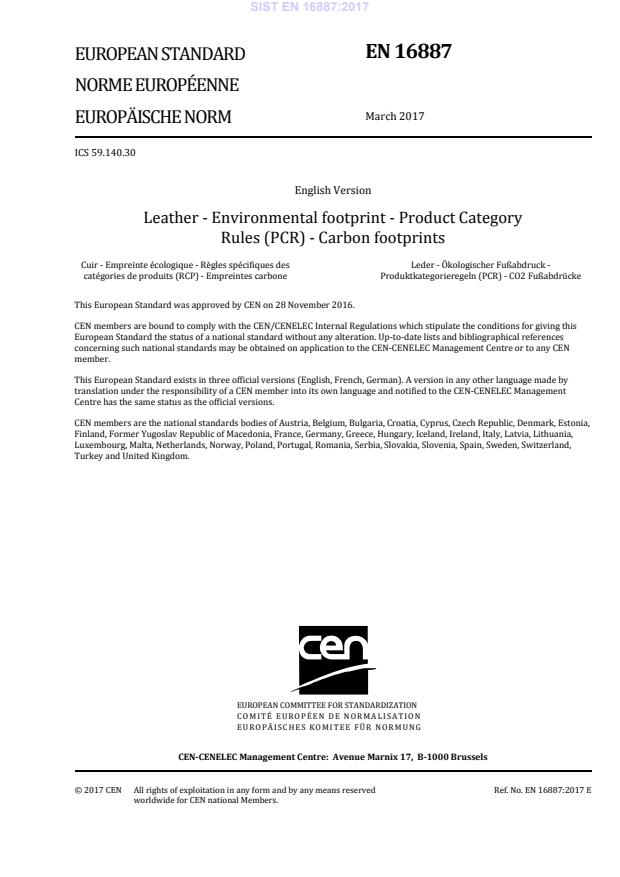
EUROPEAN STANDARD NORME EUROPÉENNE EUROPÄISCHE NORM
EN 16887
March
t r s y ICS
w {ä s v rä u r English Version
Leather æ Environmental footprint æ Product Category Cuir æ Empreinte écologique æ Règles spécifiques des
Leder æ Ökologischer Fußabdruck æ This European Standard was approved by CEN on
t z November
t r s xä
egulations which stipulate the conditions for giving this European Standard the status of a national standard without any alterationä Upætoædate lists and bibliographical references concerning such national standards may be obtained on application to the CENæCENELEC Management Centre or to any CEN memberä
translation under the responsibility of a CEN member into its own language and notified to the CENæCENELEC Management Centre has the same status as the official versionsä
CEN members are the national standards bodies of Austriaá Belgiumá Bulgariaá Croatiaá Cyprusá Czech Republicá Denmarká Estoniaá Finlandá Former Yugoslav Republic of Macedoniaá Franceá Germanyá Greeceá Hungaryá Icelandá Irelandá Italyá Latviaá Lithuaniaá Luxembourgá Maltaá Netherlandsá Norwayá Polandá Portugalá Romaniaá Serbiaá Slovakiaá Sloveniaá Spainá Swedená Switzerlandá Turkey and United Kingdomä
EUROPEAN COMMITTEE FOR STANDARDIZATION COMITÉ EUROPÉEN DE NORMALISATION EUROPÄISCHES KOMITEE FÜR NORMUNG
CEN-CENELEC Management Centre:
Avenue Marnix 17,
B-1000 Brussels
t r s y CEN All rights of exploitation in any form and by any means reserved worldwide for CEN national Membersä Refä Noä EN
s x z z yã t r s y ESIST EN 16887:2017
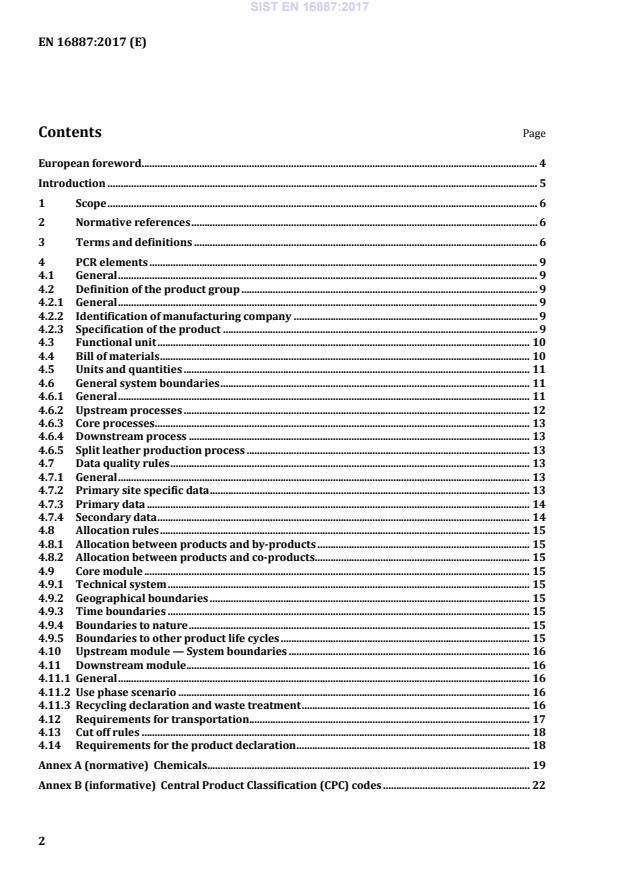
Chemicals . 19 Annex B (informative)
Central Product Classification (CPC) codes . 22 SIST EN 16887:2017
Resource use and emissions profile formula - Waste and by-product treatment - Allocation rules . 23 C.1 Material recovery . 23 C.2 Thermal utilization . 24 C.3 Disposal . 24 Bibliography . 25
environmental footprint studies of these products of a same category 3.8 semi-processed leather intermediates of leather production, like wet blue, wet-white, crust, pickled pelt, etc 3.9 upstream process process occurring along the supply chain of purchased goods/services prior to entering the core process 3.10 product system (core process) collection of unit processes with elementary and product flows, performing one or more defined functions, and which models the life cycle of a product [SOURCE: EN ISO 14040:2006, 3.28] 3.11 downstream process process occurring along a product supply chain after entering the core process SIST EN 16887:2017
...