


oSIST prEN IEC 61298-3:2024
(Main)Process measurement and control devices - General methods and procedures for evaluating performance - Part 3: Tests for the effects of influence quantities
Process measurement and control devices - General methods and procedures for evaluating performance - Part 3: Tests for the effects of influence quantities
Prozessmess-, -steuer- und -regelgeräte - Allgemeine Methoden und Verfahren für die Bewertung des Betriebsverhaltens - Teil 3: Prüfungen der Auswirkungen von Einflussgrößen
Dispositifs de mesure et de commande de processus - Méthodes et procédures générales d'évaluation des performances - Partie 3: Essais pour la détermination des effets des grandeurs d'influence
Naprave za merjenje in nadzor procesa - Splošne metode in postopki za ocenjevanje lastnosti - 3. del: Preskusi na učinke vplivnih veličin
General Information
- Status
- Not Published
- Public Enquiry End Date
- 24-Nov-2024
- Technical Committee
- MOV - Measuring equipment for electromagnetic quantities
- Current Stage
- 4020 - Public enquire (PE) (Adopted Project)
- Start Date
- 10-Sep-2024
- Due Date
- 28-Jan-2025
- Completion Date
- 04-Dec-2024
Relations
- Effective Date
- 26-Sep-2023
Overview
The oSIST prEN IEC 61298-3:2024 standard, published by the International Electrotechnical Commission (IEC) through its committee CLC, provides general methods and procedures for evaluating the performance of process measurement and control devices. It specifically addresses the tests for the effects of influence quantities on these devices. This document is part three of the IEC 61298 series and serves as a reference for assessing how environmental and operational factors impact the functionality and reliability of industrial process instrumentation, excluding Process Measurement Transmitters (PMTs) covered by IEC 62828.
The standard establishes a comprehensive framework for performing functional and performance tests related to external influences such as temperature, humidity, vibration, power supply variations, electromagnetic interference, and other environmental conditions. Its application supports manufacturers, testing laboratories, and end-users to ensure devices meet rigorous quality and reliability criteria for use in industrial process control systems.
Key Topics
Scope and General Considerations
Defines the applicability of tests across various analogue and digital process control devices, with a focus on transfer functions between input and output variables.Environmental Influence Tests
- Ambient Temperature and Humidity: Measurement of device stability and accuracy under fluctuating temperature and moisture conditions.
- Vibration and Shock: Procedures to evaluate device resilience under mechanical stress, including resonance search and endurance conditioning tests.
- Mounting Position Effects: Assessment of performance variability depending on device installation orientation.
Electrical and Electromagnetic Tests
- Power Supply Variations: Testing device performance with different voltage, frequency fluctuations, supply depressions, interruptions, and transients.
- Electromagnetic Compatibility (EMC): Immunity to electromagnetic fields, electrostatic discharge, conducted radio frequency, and harmonic distortions.
- Superimposed Voltages and Magnetic Fields: Effects of external electrical disturbances relevant to process environments.
Process Media and Operational Influences
- Process Fluid Temperature and Flow: Evaluating device response to changes in temperature and movement of process media.
- Atmospheric and Static Line Pressure Effects.
- Purge Gas Flow Impact: For devices exposed to clean or protective gases.
Mechanical and Long-term Reliability Tests
- Shock, Drop, and Topple Tests.
- Accelerated Life and Long-term Drift Testing: Optional procedures to predict device degradation over time under operational stresses.
Applications
This standard is critical for industries relying on precise and reliable process measurement and control instrumentation, such as:
- Chemical and Petrochemical Plants: To ensure devices withstand harsh chemical environments and mechanical shocks.
- Oil & Gas Industry: For robustness against vibration, pressure fluctuations, and electromagnetic interference common in field installations.
- Manufacturing and Automation: To guarantee consistent performance despite electrical supply variations or factory floor conditions.
- Water and Wastewater Treatment: Where environmental humidity and pressure changes can affect sensor outputs.
- Power Generation: To validate control devices’ immunity to electromagnetic disturbances and transient power conditions.
The oSIST prEN IEC 61298-3:2024 helps manufacturers design and qualify their instruments for global market acceptance and regulatory compliance. Testing aligned with these methods ensures operational integrity, safety, and maintenance cost reduction in critical industrial process control systems.
Related Standards
- IEC 61298-1: General methods and procedures for evaluating performance of process measurement and control devices.
- IEC 61298-2: Specific performance criteria for various types of devices within the series.
- IEC 62828: Standards governing Process Measurement Transmitters (PMT), which are excluded from this part.
- IEC 60654-2: Defines power supply classes and commutation-interruption characteristics referenced for power supply tests.
- IEC 61326-1: Provides the EMC testing and measurement requirements applicable to electrical equipment including process control devices.
By using oSIST prEN IEC 61298-3:2024 alongside these related IEC standards, stakeholders can develop a comprehensive and harmonized testing regime that addresses all critical aspects of process instrumentation performance and durability under real-world operating conditions.

Frequently Asked Questions
oSIST prEN IEC 61298-3:2024 is a draft published by the Slovenian Institute for Standardization (SIST). Its full title is "Process measurement and control devices - General methods and procedures for evaluating performance - Part 3: Tests for the effects of influence quantities". This standard covers: Process measurement and control devices - General methods and procedures for evaluating performance - Part 3: Tests for the effects of influence quantities
Process measurement and control devices - General methods and procedures for evaluating performance - Part 3: Tests for the effects of influence quantities
oSIST prEN IEC 61298-3:2024 is classified under the following ICS (International Classification for Standards) categories: 25.040.40 - Industrial process measurement and control. The ICS classification helps identify the subject area and facilitates finding related standards.
oSIST prEN IEC 61298-3:2024 has the following relationships with other standards: It is inter standard links to SIST EN 61298-3:2009. Understanding these relationships helps ensure you are using the most current and applicable version of the standard.
oSIST prEN IEC 61298-3:2024 is available in PDF format for immediate download after purchase. The document can be added to your cart and obtained through the secure checkout process. Digital delivery ensures instant access to the complete standard document.
Standards Content (Sample)
SLOVENSKI STANDARD
01-november-2024
Naprave za merjenje in nadzor procesa - Splošne metode in postopki za
ocenjevanje lastnosti - 3. del: Preskus na učinke vplivnih veličin
Process measurement and control devices - General methods and procedures for
evaluating performance - Part 3: Tests for the effects of influence quantities
Prozessmess-, -steuer- und -regelgeräte - Allgemeine Methoden und Verfahren für die
Bewertung des Betriebsverhaltens - Teil 3: Prüfungen der Auswirkungen von
Einflussgrößen
Dispositifs de mesure et de commande de processus - Méthodes et procédures
générales d'évaluation des performances - Partie 3: Essais pour la détermination des
effets des grandeurs d'influence
Ta slovenski standard je istoveten z: prEN IEC 61298-3:2024
ICS:
25.040.40 Merjenje in krmiljenje Industrial process
industrijskih postopkov measurement and control
2003-01.Slovenski inštitut za standardizacijo. Razmnoževanje celote ali delov tega standarda ni dovoljeno.
65B/1271/CDV
COMMITTEE DRAFT FOR VOTE (CDV)
PROJECT NUMBER:
IEC 61298-3 ED3
DATE OF CIRCULATION: CLOSING DATE FOR VOTING:
2024-09-06 2024-11-29
SUPERSEDES DOCUMENTS:
65B/1247/CD, 65B/1260/CC
IEC SC 65B : MEASUREMENT AND CONTROL DEVICES
SECRETARIAT: SECRETARY:
United States of America Mr Wallie Zoller
OF INTEREST TO THE FOLLOWING COMMITTEES: HORIZONTAL FUNCTION(S):
ASPECTS CONCERNED:
SUBMITTED FOR CENELEC PARALLEL VOTING NOT SUBMITTED FOR CENELEC PARALLEL VOTING
Attention IEC-CENELEC parallel voting
The attention of IEC National Committees, members of
CENELEC, is drawn to the fact that this Committee Draft
for Vote (CDV) is submitted for parallel voting.
The CENELEC members are invited to vote through the
CENELEC online voting system.
This document is still under study and subject to change. It should not be used for reference purposes.
Recipients of this document are invited to submit, with their comments, notification of any relevant patent rights of
which they are aware and to provide supporting documentation.
Recipients of this document are invited to submit, with their comments, notification of any relevant “In Some
Countries” clauses to be included should this proposal proceed. Recipients are reminded that the CDV stage is the
final stage for submitting ISC clauses. (SEE AC/22/2007 OR NEW GUIDANCE DOC).
TITLE:
Process measurement and control devices - General methods and procedures for evaluating
performance - Part 3: Tests for the effects of influence quantities
PROPOSED STABILITY DATE: 2028
NOTE FROM TC/SC OFFICERS:
download this electronic file, to make a copy and to print out the content for the sole purpose of preparing National
Committee positions. You may not copy or "mirror" the file or printed version of the document, or any part of it, for
any other purpose without permission in writing from IEC.
IEC CDV 61298-3 ED3 © IEC 2024 -2- 65B/1271/CDV
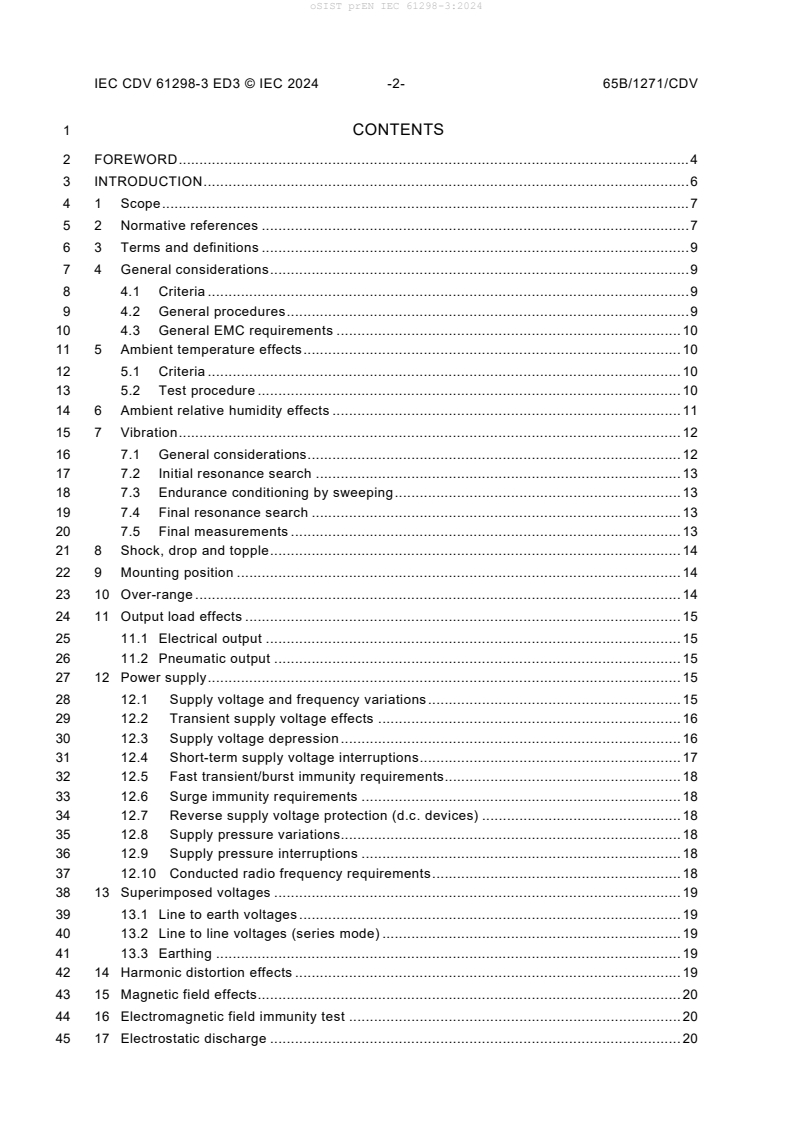
1 CONTENTS
2 FOREWORD . 4
3 INTRODUCTION . 6
4 1 Scope . 7
5 2 Normative references . 7
6 3 Terms and definitions . 9
7 4 General considerations . 9
8 4.1 Criteria . 9
9 4.2 General procedures . 9
10 4.3 General EMC requirements . 10
11 5 Ambient temperature effects . 10
12 5.1 Criteria . 10
13 5.2 Test procedure . 10
14 6 Ambient relative humidity effects . 11
15 7 Vibration . 12
16 7.1 General considerations . 12
17 7.2 Initial resonance search . 13
18 7.3 Endurance conditioning by sweeping . 13
19 7.4 Final resonance search . 13
20 7.5 Final measurements . 13
21 8 Shock, drop and topple . 14
22 9 Mounting position . 14
23 10 Over-range . 14
24 11 Output load effects . 15
25 11.1 Electrical output . 15
26 11.2 Pneumatic output . 15
27 12 Power supply . 15
28 12.1 Supply voltage and frequency variations . 15
29 12.2 Transient supply voltage effects . 16
30 12.3 Supply voltage depression . 16
31 12.4 Short-term supply voltage interruptions . 17
32 12.5 Fast transient/burst immunity requirements. 18
33 12.6 Surge immunity requirements . 18
34 12.7 Reverse supply voltage protection (d.c. devices) . 18
35 12.8 Supply pressure variations. 18
36 12.9 Supply pressure interruptions . 18
37 12.10 Conducted radio frequency requirements . 18
38 13 Superimposed voltages . 19
39 13.1 Line to earth voltages . 19
40 13.2 Line to line voltages (series mode) . 19
41 13.3 Earthing . 19
42 14 Harmonic distortion effects . 19
43 15 Magnetic field effects. 20
44 16 Electromagnetic field immunity test . 20
45 17 Electrostatic discharge . 20
IEC CDV 61298-3 ED3 © IEC 2024 -3- 65B/1271/CDV
46 18 Effect of open-circuited and short-circuited input . 20
47 19 Effect of open-circuited and short-circuited output . 21
48 20 Effects of process medium conditions . 21
49 20.1 Temperature of process fluid . 21
50 20.2 Flow of process fluid through the device . 21
51 Static line pressure effect . 21
20.3
52 21 Atmospheric pressure effects . 22
53 22 Flow of purge gas through the device . 22
54 23 Accelerated operational life test. 23
55 24 Operational long-term drift test (optional) . 23
56 Bibliography . 25
58 Figure 1 – Arrangement for supply voltage depression or interruption tests . 17
59 Figure 2 – Arrangement for harmonic distortion effects test . 20
60 Figure 4 – Test set-up of the effects of static pressure . 22
61 Figure 5 – Time schedule of input changes and changes of ambient temperature . 23
63 Table 1 – Ambient temperature test ranges . 10
64 Table 2 – Vibration test levels . 12
65 Table 3 – Power supply classes (IEC 60654-2) . 16
66 Table 4 – Power supply commutations-interruptions (IEC 60654-2) . 17
67 Table 7 – Conducted RF characteristics (IEC 61326-1) . 18
IEC CDV 61298-3 ED3 © IEC 2024 -4- 65B/1271/CDV
71 INTERNATIONAL ELECTROTECHNICAL COMMISSION
72 –––––––––––
74 PROCESS MEASUREMENT AND CONTROL DEVICES –
75 GENERAL METHODS AND PROCEDURES
76 FOR EVALUATING PERFORMANCE –
78 Part 3: Tests for the effects of influence quantities
81 FOREWORD
82 1) The International Electrotechnical Commission (IEC) is a worldwide organization for standardization comprising
83 all national electrotechnical committees (IEC National Committees). The object of IEC is to promote
84 international co-operation on all questions concerning standardization in the electrical and electronic fields. To
85 this end and in addition to other activities, IEC publishes International Standards, Technical Specifications,
86 Technical Reports, Publicly Available Specifications (PAS) and Guides (hereafter referred to as “IEC
87 Publication(s)”). Their preparation is entrusted to technical committees; any IEC National Committee interested
88 in the subject dealt with may participate in this preparatory work. International, governmental and non-
89 governmental organizations liaising with the IEC also participate in this preparation. IEC collaborates closely
90 with the International Organization for Standardization (ISO) in accordance with conditions determined by
91 agreement between the two organizations.
92 2) The formal decisions or agreements of IEC on technical matters express, as nearly as possible, an international
93 consensus of opinion on the relevant subjects since each technical committee has representation from all
94 interested IEC National Committees.
95 3) IEC Publications have the form of recommendations for international use and are accepted by IEC National
96 Committees in that sense. While all reasonable efforts are made to ensure that the technical content of IEC
97 Publications is accurate, IEC cannot be held responsible for the way in which they are used or for any
98 misinterpretation by any end user.
99 4) In order to promote international uniformity, IEC National Committees undertake to apply IEC Publications
100 transparently to the maximum extent possible in their national and regional publications. Any divergence
101 between any IEC Publication and the corresponding national or regional publication shall be clearly indicated in
102 the latter.
103 5) IEC provides no marking procedure to indicate its approval and cannot be rendered responsible for any
104 equipment declared to be in conformity with an IEC Publication.
105 6) All users should ensure that they have the latest edition of this publication.
106 7) No liability shall attach to IEC or its directors, employees, servants or agents including individual experts and
107 members of its technical committees and IEC National Committees for any personal injury, property damage or
108 other damage of any nature whatsoever, whether direct or indirect, or for costs (including legal fees) and
109 expenses arising out of the publication, use of, or reliance upon, this IEC Publication or any other IEC
110 Publications.
111 8) Attention is drawn to the Normative references cited in this publication. Use of the referenced publications is
112 indispensable for the correct application of this publication.
113 9) Attention is drawn to the possibility that some of the elements of this IEC Publication may be the subject of
114 patent rights. IEC shall not be held responsible for identifying any or all such patent rights.
115 International Standard IEC 61298-3 has been prepared by sub-committee 65B: Devices and
116 process analysis, of IEC technical committee 65: Industrial-process measurement, control and
117 automation.
118 This second edition cancels and replaces the first edition published in 1998. This second
119 edition constitutes a technical revision.
120 This edition is a general revision with respect to the previous edition and does not include any
121 significant changes (see Introduction).
IEC CDV 61298-3 ED3 © IEC 2024 -5- 65B/1271/CDV
123 The text of this standard is based on the following documents:
FDIS Report on voting
65B/687/FDIS 65B/695/RVD
125 Full information on the voting for the approval of this standard can be found in the report on
126 voting indicated in the above table.
127 This publication has been drafted in accordance with the ISO/IEC Directives, Part 2.
128 A list of all parts of the IEC 61298 series, under the general title Process measurement and
129 control devices – General methods and procedures for evaluating performance, can be found
130 on the IEC website.
131 The committee has decided that the contents of this publication will remain unchanged until
132 the maintenance result date indicated on the IEC web site under "http://webstore.iec.ch" in
133 the data related to the specific publication. At this date, the publication will be
134 • reconfirmed,
135 • withdrawn,
136 • replaced by a revised edition, or
137 • amended.
IEC CDV 61298-3 ED3 © IEC 2024 -6- 65B/1271/CDV
140 INTRODUCTION
141 This standard is not intended as a substitute for existing standards, but is rather intended as a
142 reference document for any future standard developed within the IEC, or other standards
143 organizations, concerning the evaluation of process instrumentation, except the Process
144 Measurement Transmitters (PMT) which are standardized by IEC series 62828. .
145 This common standardized basis should be utilized for the preparation of future relevant
146 standards, as follows:
147 – any test method or procedure, already treated in this standard, should be specified and
148 described in the new standard by referring to the corresponding clause of this standard.
149 Consequently new editions of this standard are revised without any change in numbering
150 and scope of each clause;
151 – any particular method or procedure, not covered by this standard, should be developed
152 and specified in the new standard in accordance with the criteria, as far as they are
153 applicable, stated in this standard;
154 – any conceptual or significant deviation from the content of this standard should be clearly
155 identified and justified if introduced in a new standard.
IEC CDV 61298-3 ED3 © IEC 2024 -7- 65B/1271/CDV
157 PROCESS MEASUREMENT AND CONTROL DEVICES –
158 GENERAL METHODS AND PROCEDURES
159 FOR EVALUATING PERFORMANCE –
161 Part 3: Tests for the effects of influence quantities
165 1 Scope
166 This part of IEC 61298 specifies general methods and procedures for conducting tests and
167 reporting on the functional and performance characteristics of process instrumentation except
168 Process Measurement Transmitters (PMT) which are standardized by IEC series 62828. The
169 tests are applicable to any such devices characterized by their own specific input and output
170 variables, and by the specific relationship (transfer function) between the inputs and outputs,
171 and include analogue and digital devices. For devices that require special tests, this standard
172 should be used, together with any product-specific standard specifying special tests.
173 This standard covers tests for the effects of influence quantities.
174 2 Normative references
175 The following referenced documents are indispensable for the application of this document.
176 For dated references, only the edition cited applies. For undated references, the latest edition
177 of the referenced document (including any amendments) applies.
178 IEC 60050-300, International Electrotechnical Vocabulary (IEV) – Electrical and electronic
179 measurements and measuring instruments (composed of Part 311, 312, 313 and 314)
180 IEC 60050-351, International Electrotechnical Vocabulary (IEV) – Part 351 : Control
181 technology
182 IEC 61298-1, Process measurement and control devices – General methods and procedures
183 for evaluating performance – Part 1: General considerations
184 IEC 61298-2, Process measurement and control devices – General methods and procedures
185 for evaluating performance – Part 2: Tests under reference conditions
186 IEC 61298-4, Process measurement and control devices – General methods and procedures
187 for evaluating performance – Part 4: Evaluation report content
188 IEC 60068-2-1, Environmental testing – Part 2-1: Tests – Test A: Cold
189 IEC 60068-2-2, Environmental testing – Part 2-2: Tests – Test B: Dry heat
190 IEC 60068-2-6, Environmental testing – Part 2-6: Tests – Test Fc: Vibration (sinusoidal)
191 IEC 60068-2-30, Environmental testing – Part 2-30: Tests – Test Db: Damp heat, cyclic (12 +
192 12 h cycle)
193 IEC 60068-2-31, Environmental testing – Part 2-31: Tests – Test Ec: Drop and topple,
194 primarily for equipment-type specimens
IEC CDV 61298-3 ED3 © IEC 2024 -8- 65B/1271/CDV
196 IEC 60654-1, Operating conditions for industrial-process measurement and control equipment
197 – Part 1: Climatic conditions
198 IEC 60654-2, Operating conditions for industrial-process measurement and control equipment
199 – Part 2: Power
200 IEC 60654-3, Operating conditions for industrial-process measurement and control equipment
201 – Part 3: Mechanical influences
202 IEC 60654-4, Operating conditions for industrial-process measurement and control equipment
203 -. Part 4: Corrosive and erosive influences
204 IEC 61010-1, Safety requirements for electrical equipment for measurement, control, and
205 laboratory use - Part 1: General requirement
206 IEC 61326-1, Electrical equipment for measurement, control and laboratory use – EMC
207 Requirements – Part 1: General requirements
208 IEC 61000-4-2, Electromagnetic compatibility (EMC) – Part 4-2: Testing and measurement
209 techniques – Electrostatic discharge immunity test. Basic EMC publication
210 IEC 61000-4-3, Electromagnetic compatibility (EMC) – Part 4-3: Testing and measurement
211 techniques – Radiated, radio-frequency, electromagnetic field immunity test. Basic EMC
212 publication
213 IEC 61000-4-4, Electromagnetic compatibility (EMC) – Part 4-4: Testing and measurement
214 techniques – Electrical fast transient/burst immunity test. Basic EMC publication
215 IEC 61000-4-5, Electromagnetic compatibility (EMC) – Part 4-5: Testing and measurement
216 techniques – Surge immunity test. Basic EMC publication
217 IEC 61000-4-6, Electromagnetic compatibility (EMC) – Part 4-6: Testing and measurement
218 techniques – Immunity to conducted disturbances, induced by radio-frequency fields
219 IEC 61000-4-8, Electromagnetic compatibility (EMC) – Part 4-8: Testing and measurement
220 techniques – Power frequency magnetic field immunity test. Basic EMC publication
221 IEC 61000-4-11, Electromagnetic compatibility (EMC) – Part 4-11: Testing and measurement
222 techniques – Voltage dips, short interruptions and voltage variations immunity tests . Basic
223 EMC publication
224 IEC 61508 (part1/7), Functional safety of electrical/electronic/programmable electronic safety-
225 related systems
226 IEC 61511(part 1/3), Functional safety - Safety instrumented systems for the process industry
227 sector
228 IEC 62061, Safety of machinery - Functional safety of safety-related electrical, electronic and
229 programmable electronic control systems
230 IEC 62262, Degrees of protection provided by enclosures for electrical equipment against
231 external mechanical impacts (IK code)
IEC CDV 61298-3 ED3 © IEC 2024 -9- 65B/1271/CDV
232 3 Terms and definitions
233 For the purpose of this document, the following relevant terms and definitions, some of them
234 based main on IEC 60050(300) or IEC 60050(351), apply.
235 3.1
236 influence quantity
237 test parameter chosen to represent a condition representing one aspect of the environment
238 under which a device may operate
239 4 General considerations
240 4.1 Criteria
241 Unless otherwise stated, any effects of the tests described in this standard shall be assessed
242 by determining the change in the functional and performance characteristics due to the single
243 influence quantity applied. A test is only to be performed if it is applicable to the Device Under
244 Test (DUT). If the specification of the DUT states limits for the influence considered, these
245 limits shall be noted and respected.
246 NOTE It is recommended to perform each influence test described in this standard, except if the DUT operates
247 under an environment that excludes the influence considered.
248 Rates of change of influence quantities shall be sufficiently slow to ensure that no overshoot
249 of the influence quantities occurs at any point in the DUT. Sufficient time shall be allowed for
250 stabilization at each value or state of the influence quantity before taking readings. It may be
251 useful to check, by means of specific measurements of the effects, whether the influence
252 quantities cause variations in the characteristics of the DUT other than those addressed in
253 this part of the standard.
254 In the case of discontinuous-output devices such as alarms, the tests shall be conducted to
255 establish the effects of the specified influence.
256 Only that influence quantity for which a specific test is being conducted shall be applied
257 during a specified test. All other influences shall be maintained at the reference operating
258 conditions.
259 However, consideration should be given to any combination of two or more influence
260 quantities which may aggravate the operating conditions (e.g. for an electrical device,
261 temperature and supply voltage).
262 The limit values of influence quantities specified in this standard should be used if no other
263 limit values are specified by the manufacturer or by the user. Testing at these values shall be
264 agreed by the parties and the results of tests shall be added to the report.
265 4.2 General procedures
266 The procedures used for the determination of the effects of influence quantities depend on the
267 kind of test, on the type of device and on its most significant characteristics (e.g. zero, span,
268 etc.).
269 The procedures should be established in accordance with the criteria given in 5.1 and 5.2 of
270 IEC 61298-1 in order to avoid tests which are too severe.
271 To satisfy these criteria, the DUT should be tested by assessing the effects of all the
272 quantities which might influence the performance of the DUT; this general statement is strictly
273 valid for performance evaluation and for type tests.
IEC CDV 61298-3 ED3 © IEC 2024 -10- 65B/1271/CDV
274 For routine and sampling tests, only the influence quantity which is considered to have the
275 most effect or is agreed between the parties should be applied. Wherever possible, all the
276 tests shall be carried out by measurement of the change of the output of the DUT.
277 The deviations caused by the effect of the specific influence quantity should be expressed
278 generally as a percentage of the output span. On certain devices, it may be more convenient
279 to express it in terms of the input span (see 4.1.6 of IEC 61298-2). It is important that the
280 input should be set so that the output is not limited; so in all tests, inputs corresponding to, for
281 example, 5 % and 95 % may be used instead of 0 % and 100 %. For the same reason, tests
282 that can produce large deviations on output (for example, supply voltage interruptions,
283 electrical fast transients, and so on) may be executed at input levels held at a value which
284 produces 50 % output signal.
285 In the case of discontinuous output devices such as alarms, the tests shall be conducted in
286 the same way to establish the conditions at which the performance is affected, with the
287 alarm/switching level set to 10 % above or below the nominal output.
288 4.3 General EMC requirements
289 For what concerns this subclause make reference to IEC 61326 and IEC 61000 series
291 5 Ambient temperature effects
292 5.1 Criteria
293 Sufficient time shall be allowed at each test temperature to permit thermal stabilization of the
294 DUT before test measurements are taken (as specified in IEC 60068-2-1 and 60068-2-2).
295 The stabilization period is a function of the DUT mass and of energy dissipation. It is normally
296 checked by recording the output signal of the DUT. It may be as long as 3 h.
297 Whatever the temperature cycle prescribed, during the temperature cycles, it is important to
298 carry out the measurements at the same temperatures during repeat cycles so as to permit
299 comparison.
300 Pneumatic devices shall have sufficient air supply tubing inside the test chamber to ensure
301 that the supply and input air are at the same temperature as the DUT.
302 5.2 Test procedure
303 The effects of ambient temperature shall be measured in the temperature range specified by
304 the technical documentation or, if no value is specified, between the limits shown in Table 1
305 (according to the standard range specified in IEC 60654-1).
306 The test limits for ambient temperature should be appropriate to the temperatures at the
307 intended operational location of the DUT.
308 The test shall be carried out by conducting the same performance test at each selected test
309 ambient temperature, beginning at the reference temperature (+20 °C).
310 Table 1 – Ambient temperature test ranges
Temperature Temperature Typical service
class (IEC 60654-1) application
°C
IEC CDV 61298-3 ED3 © IEC 2024 -11- 65B/1271/CDV
min. max.
+5 +40 B2 Heated or/and cooled enclosed
locations
–25 +55 C2 Sheltered locations
–33 +40 D1 Outdoor locations
–40 +85 DX Special outdoor locations
NOTE For others temperature classes, see IEC 60654-1.
311 The test ambient temperatures should be chosen generally at 20 °C intervals, up to the
312 specified limit temperatures for the DUT.
313 For example, for the temperature class C2, the test temperature cycle should be +20 °C
314 (reference), +40 °C, +55 °C, +20 °C, 0 °C, -25 °C, +20 °C.
315 If agreed by all parties in the test programme, a test at only four temperatures, 20 °C
316 (reference), maximum, minimum, and 20 °C, may be sufficient.
317 The tolerance for each test temperature should be ±2 °C and the rate of change of ambient
318 temperature should be less than 1 °C per minute. No adjustments to the DUT shall be made
319 during the test cycle.
320 A second or third temperature cycle, without any adjustment of the DUT, may be specified in
321 the test program. At each test temperature, data shall be recorded for increasing and
322 decreasing values of output at each 25 % of span.
323 The output changes at each test value shall be calculated from the average of the upscale
324 and downscale readings and reported in percent of ideal output span. Any significant changes
325 in hysteresis, linearity or repeatability shall also be calculated and reported. See IEC 61298-4.
326 Any effects on a digital display indicator shall al
...
Questions, Comments and Discussion
Ask us and Technical Secretary will try to provide an answer. You can facilitate discussion about the standard in here.
Loading comments...