

SIST EN 1090-3:2019
(Main)Execution of steel structures and aluminium structures - Part 3: Technical requirements for aluminium structures
General Information
- Abstract
This document specifies requirements for the execution of aluminium structural components and structures made from:
a) rolled sheet, strip and plate;
b) extrusions;
c) cold drawn rod, bar and tube;
d) forgings;
e) castings.
NOTE 1 The execution of structural components is referred to as manufacturing, in accordance with EN 1090-1.
This document specifies requirements independent of the type and shape of the aluminium structure, and this document is applicable to structures under predominantly static loads as well as structures subject to fatigue. It specifies requirements related to the execution classes that are linked with consequence classes.
NOTE 2 Consequence classes are defined in EN 1990.
NOTE 3 Recommendations for selection of execution class in relation to consequence class are given in EN 1999-1-1.
This document covers components made of constituent products with thickness not less than 0,6 mm for welded components not less than 1,5 mm.
For components made from cold formed profiled sheeting that are within the scope of EN 1090-5, the requirements of EN 1090-5 take precedence over corresponding requirements in this document.
This document applies to structures designed according to the relevant parts of EN 1999. If this document is used for structures designed according to other design rules or used for other alloys and tempers not covered by EN 1999, a judgement of the reliability elements in these design rules is intended to be made.
This document specifies requirements for surface preparation prior to application of a protective treatment, and gives guidelines for application for such treatment in an informative annex.
This document gives options for specifying requirements to match project specific requirements.
This document is also applicable to temporary aluminium structures.
- Status
- Published
- Public Enquiry End Date
- 24-Apr-2017
- Publication Date
- 10-Jun-2019
- Technical Committee
- KON - Structures
- Current Stage
- 6060 - National Implementation/Publication (Adopted Project)
- Start Date
- 09-May-2019
- Due Date
- 14-Jul-2019
- Completion Date
- 11-Jun-2019



Overview - SIST EN 1090-3:2019 (Execution of aluminium structures)
SIST EN 1090-3:2019 specifies the technical requirements for execution of aluminium structural components and complete aluminium structures. It applies to structures and components manufactured from rolled sheet, strip and plate; extrusions; cold drawn rod, bar and tube; forgings; and castings. The standard covers both predominantly static and fatigue-loaded structures, including temporary aluminium structures. Thickness limits in the scope: constituent products from 0.6 mm and welded components not less than 1.5 mm.
This part of EN 1090 is focused on execution (manufacturing, preparation, assembly, erection, surface treatment) and is intended to be used with structure design rules given in EN 1999 (Eurocode 9). It also links execution classes to consequence classes (EN 1990) and provides options to match project-specific requirements.
Key technical topics and requirements
- Execution specification and documentation: required execution classes, tolerance types, quality documentation, and execution documentation (including quality plans and welding plans).
- Constituent products and traceability: identification, inspection documents, parent material requirements, welding consumables, mechanical fasteners and adhesives.
- Preparation: handling, storage, cutting, forming, drilling/holing, full-contact bearing surfaces, heat treatment and straightening.
- Welding: welding plans, specified processes (including friction stir welding), qualification of welding procedures and personnel, preheat/interpass, acceptance criteria and post-weld heat treatment.
- Mechanical fastening & adhesive bonding: bolting assemblies (preloaded and non-preloaded), rivets, screws, fit-up, slip-resistant joint preparation and tightening requirements.
- Erection: site conditions, erection method statements, supports, alignment and grouting, site surveys and protection/cleaning after erection.
- Surface treatment: surface preparation for protective finishes and guidance for application (informative annex).
- Testing, inspection and acceptance: acceptance criteria for welds and assemblies, marking and traceability throughout manufacturing and erection.
Practical applications - who uses this standard
- Aluminium fabricators and manufacturers seeking compliant production and CE marking support.
- Structural engineers and designers using EN 1999 who need execution guidance tied to design consequence classes.
- Contractors and erectors responsible for site erection, alignment and protection of aluminium structures.
- Quality managers and inspectors performing welding qualification, material traceability and acceptance testing.
- Specifiers and clients defining project-specific execution classes, tolerances and surface treatment requirements.
Related standards
- EN 1999 (Eurocode 9) - design of aluminium structures
- EN 1990 - basis of structural design (consequence classes)
- EN 1090-1 - execution requirements and CE marking for steel and aluminium structures
- EN 1090-5 - cold-formed profiled sheeting (takes precedence where applicable)
Keywords: SIST EN 1090-3:2019, aluminium structures, execution of aluminium structures, welding, mechanical fastening, surface treatment, execution classes, EN 1999.
Relations
- Effective Date
- 08-Jun-2022
- Effective Date
- 25-Mar-2026
- Effective Date
- 18-Mar-2026
- Effective Date
- 09-Feb-2026
- Effective Date
- 28-Jan-2026
- Effective Date
- 28-Jan-2026
- Effective Date
- 28-Jan-2026
- Refers
SIST EN ISO 7090:2002 - Plain washers, chamfered - Normal series - Product grade A (ISO 7090:2000) - Effective Date
- 28-Jan-2026
- Effective Date
- 28-Jan-2026
- Effective Date
- 28-Jan-2026
- Effective Date
- 28-Jan-2026
- Effective Date
- 28-Jan-2026
- Refers
SIST EN 1301-3:2008 - Aluminium and aluminium alloys - Drawn wire - Part 3: Tolerances on dimensions - Effective Date
- 28-Jan-2026
- Effective Date
- 28-Jan-2026
- Effective Date
- 28-Jan-2026
Get Certified
Connect with accredited certification bodies for this standard

DIBt (Deutsches Institut für Bautechnik)
German Institute for Building Technology.
DIN CERTCO
DIN Group product certification.

Aboma Certification B.V.
Specialized in construction, metal, and transport sectors.
Sponsored listings
Frequently Asked Questions
SIST EN 1090-3:2019 is a standard published by the Slovenian Institute for Standardization (SIST). Its full title is "Execution of steel structures and aluminium structures - Part 3: Technical requirements for aluminium structures". This standard covers: This document specifies requirements for the execution of aluminium structural components and structures made from: a) rolled sheet, strip and plate; b) extrusions; c) cold drawn rod, bar and tube; d) forgings; e) castings. NOTE 1 The execution of structural components is referred to as manufacturing, in accordance with EN 1090-1. This document specifies requirements independent of the type and shape of the aluminium structure, and this document is applicable to structures under predominantly static loads as well as structures subject to fatigue. It specifies requirements related to the execution classes that are linked with consequence classes. NOTE 2 Consequence classes are defined in EN 1990. NOTE 3 Recommendations for selection of execution class in relation to consequence class are given in EN 1999-1-1. This document covers components made of constituent products with thickness not less than 0,6 mm for welded components not less than 1,5 mm. For components made from cold formed profiled sheeting that are within the scope of EN 1090-5, the requirements of EN 1090-5 take precedence over corresponding requirements in this document. This document applies to structures designed according to the relevant parts of EN 1999. If this document is used for structures designed according to other design rules or used for other alloys and tempers not covered by EN 1999, a judgement of the reliability elements in these design rules is intended to be made. This document specifies requirements for surface preparation prior to application of a protective treatment, and gives guidelines for application for such treatment in an informative annex. This document gives options for specifying requirements to match project specific requirements. This document is also applicable to temporary aluminium structures.
This document specifies requirements for the execution of aluminium structural components and structures made from: a) rolled sheet, strip and plate; b) extrusions; c) cold drawn rod, bar and tube; d) forgings; e) castings. NOTE 1 The execution of structural components is referred to as manufacturing, in accordance with EN 1090-1. This document specifies requirements independent of the type and shape of the aluminium structure, and this document is applicable to structures under predominantly static loads as well as structures subject to fatigue. It specifies requirements related to the execution classes that are linked with consequence classes. NOTE 2 Consequence classes are defined in EN 1990. NOTE 3 Recommendations for selection of execution class in relation to consequence class are given in EN 1999-1-1. This document covers components made of constituent products with thickness not less than 0,6 mm for welded components not less than 1,5 mm. For components made from cold formed profiled sheeting that are within the scope of EN 1090-5, the requirements of EN 1090-5 take precedence over corresponding requirements in this document. This document applies to structures designed according to the relevant parts of EN 1999. If this document is used for structures designed according to other design rules or used for other alloys and tempers not covered by EN 1999, a judgement of the reliability elements in these design rules is intended to be made. This document specifies requirements for surface preparation prior to application of a protective treatment, and gives guidelines for application for such treatment in an informative annex. This document gives options for specifying requirements to match project specific requirements. This document is also applicable to temporary aluminium structures.
SIST EN 1090-3:2019 is classified under the following ICS (International Classification for Standards) categories: 91.080.10 - Metal structures; 91.080.17 - Aluminium structures. The ICS classification helps identify the subject area and facilitates finding related standards.
SIST EN 1090-3:2019 has the following relationships with other standards: It is inter standard links to SIST EN 1090-3:2008, SIST EN 573-3:2026, SIST EN ISO 10642:2026, SIST ISO 10509:2015, SIST EN 1301-1:2008, SIST EN 14399-2:2015, SIST EN 1011-1:2009, SIST EN ISO 7090:2002, SIST EN 754-1:2016, SIST EN ISO 7094:2002, kSIST FprEN 1999-1-2:2022, SIST EN 485-4:1998, SIST EN 1301-3:2008, SIST EN 1337-8:2008, SIST EN ISO 15614-2:2025. Understanding these relationships helps ensure you are using the most current and applicable version of the standard.
SIST EN 1090-3:2019 is associated with the following European legislation: EU Directives/Regulations: 305/2011; Standardization Mandates: M/120. When a standard is cited in the Official Journal of the European Union, products manufactured in conformity with it benefit from a presumption of conformity with the essential requirements of the corresponding EU directive or regulation.
SIST EN 1090-3:2019 is available in PDF format for immediate download after purchase. The document can be added to your cart and obtained through the secure checkout process. Digital delivery ensures instant access to the complete standard document.
Standards Content (Sample)
SLOVENSKI STANDARD
01-julij-2019
Izvedba jeklenih in aluminijastih konstrukcij - 3. del: Tehnične zahteve za
aluminijaste konstrukcije
Execution of steel structures and aluminium structures - Part 3: Technical requirements
for aluminium structures
Ausführung von Stahltragwerken und Aluminiumtragwerken - Teil 3: Technische Regeln
für die Ausführung von Aluminiumtragwerken
Exécution des structures en acier et des structures en aluminium - Partie 3: Exigences
techniques pour l'exécution des structures en aluminium
Ta slovenski standard je istoveten z: EN 1090-3:2019
ICS:
91.080.10 Kovinske konstrukcije Metal structures
91.080.17 Aluminijaste konstrukcije Aluminium structures
2003-01.Slovenski inštitut za standardizacijo. Razmnoževanje celote ali delov tega standarda ni dovoljeno.
EN 1090-3
EUROPEAN STANDARD
NORME EUROPÉENNE
April 2019
EUROPÄISCHE NORM
ICS 91.080.17 Supersedes EN 1090-3:2008
English Version
Execution of steel structures and aluminium structures -
Part 3: Technical requirements for aluminium structures
Exécution des structures en acier et des structures en Ausführung von Stahltragwerken und
aluminium - Partie 3: Exigences techniques pour Aluminiumtragwerken - Teil 3: Technische
l'exécution des structures en aluminium Anforderungen an Aluminiumtragwerke
This European Standard was approved by CEN on 6 January 2019.
CEN members are bound to comply with the CEN/CENELEC Internal Regulations which stipulate the conditions for giving this
European Standard the status of a national standard without any alteration. Up-to-date lists and bibliographical references
concerning such national standards may be obtained on application to the CEN-CENELEC Management Centre or to any CEN
member.
This European Standard exists in three official versions (English, French, German). A version in any other language made by
translation under the responsibility of a CEN member into its own language and notified to the CEN-CENELEC Management
Centre has the same status as the official versions.
CEN members are the national standards bodies of Austria, Belgium, Bulgaria, Croatia, Cyprus, Czech Republic, Denmark, Estonia,
Finland, Former Yugoslav Republic of Macedonia, France, Germany, Greece, Hungary, Iceland, Ireland, Italy, Latvia, Lithuania,
Luxembourg, Malta, Netherlands, Norway, Poland, Portugal, Romania, Serbia, Slovakia, Slovenia, Spain, Sweden, Switzerland,
Turkey and United Kingdom.
EUROPEAN COMMITTEE FOR STANDARDIZATION
COMITÉ EUROPÉEN DE NORMALISATION
EUROPÄISCHES KOMITEE FÜR NORMUNG
CEN-CENELEC Management Centre: Rue de la Science 23, B-1040 Brussels
© 2019 CEN All rights of exploitation in any form and by any means reserved Ref. No. EN 1090-3:2019 E
worldwide for CEN national Members.
Contents Page
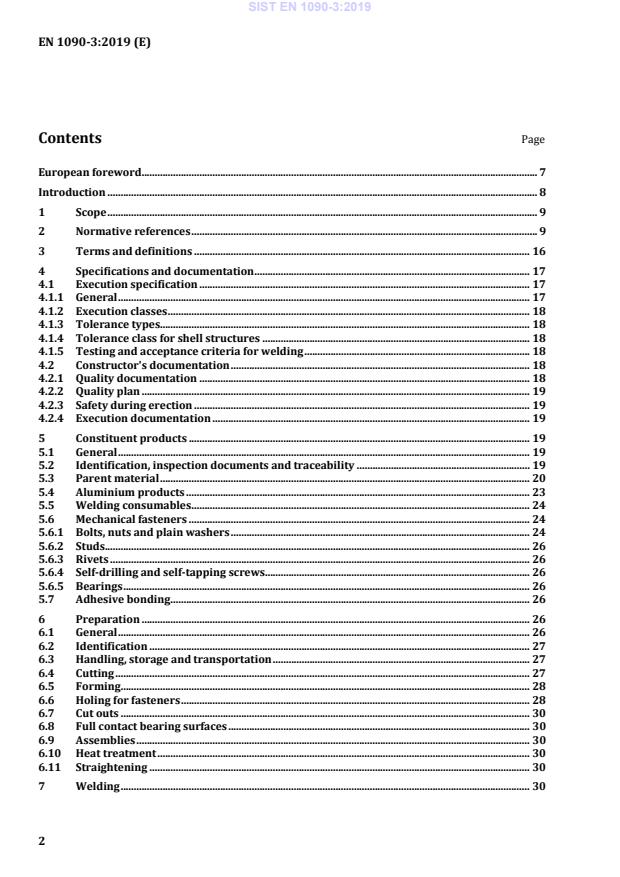
European foreword . 7
Introduction . 8
1 Scope . 9
2 Normative references . 9
3 Terms and definitions . 16
4 Specifications and documentation . 17
4.1 Execution specification . 17
4.1.1 General . 17
4.1.2 Execution classes . 18
4.1.3 Tolerance types. 18
4.1.4 Tolerance class for shell structures . 18
4.1.5 Testing and acceptance criteria for welding . 18
4.2 Constructor's documentation . 18
4.2.1 Quality documentation . 18
4.2.2 Quality plan . 19
4.2.3 Safety during erection . 19
4.2.4 Execution documentation . 19
5 Constituent products . 19
5.1 General . 19
5.2 Identification, inspection documents and traceability . 19
5.3 Parent material . 20
5.4 Aluminium products . 23
5.5 Welding consumables . 24
5.6 Mechanical fasteners . 24
5.6.1 Bolts, nuts and plain washers . 24
5.6.2 Studs . 26
5.6.3 Rivets . 26
5.6.4 Self-drilling and self-tapping screws . 26
5.6.5 Bearings . 26
5.7 Adhesive bonding . 26
6 Preparation . 26
6.1 General . 26
6.2 Identification . 27
6.3 Handling, storage and transportation . 27
6.4 Cutting . 27
6.5 Forming . 28
6.6 Holing for fasteners . 28
6.7 Cut outs . 30
6.8 Full contact bearing surfaces . 30
6.9 Assemblies . 30
6.10 Heat treatment . 30
6.11 Straightening . 30
7 Welding . 30
7.1 General . 30
7.2 Welding plan. 31
7.2.1 Requirement for a welding plan . 31
7.2.2 Content of a welding plan . 31
7.3 Welding process . 31
7.4 Qualification of welding procedures and welding personnel. 32
7.4.1 Qualification of welding procedures . 32
7.4.2 Validity of the welding procedure qualification . 33
7.4.3 Qualification of welders and welding operators . 33
7.4.4 Welding coordination personnel . 34
7.5 Preparation and execution of welding . 34
7.5.1 General . 34
7.5.2 Joint preparation . 35
7.5.3 Weather protection . 35
7.5.4 Assembly for welding . 35
7.5.5 Temporary attachments . 35
7.5.6 Tack welds . 35
7.5.7 Preheating and interpass temperature . 36
7.5.8 Butt welds . 36
7.5.9 Slot and plug welds . 36
7.5.10 Fillet welds . 36
7.5.11 Single sided welds . 36
7.5.12 Friction stir welding . 37
7.5.13 Other welds . 37
7.6 Acceptance criteria . 37
7.7 Post-weld heat treatment . 37
8 Mechanical fastening and adhesive bonding . 38
8.1 Joint assembly for mechanical fastening . 38
8.1.1 Preparation of contact surfaces . 38
8.1.2 Fit-up . 38
8.1.3 Preparations of contact surfaces in slip-resistant connections . 39
8.2 Bolting assemblies . 39
8.2.1 General . 39
8.2.2 Bolts . 39
8.2.3 Fitted bolts . 39
8.2.4 Countersunk bolt . 40
8.2.5 Nuts . 40
8.2.6 Washers . 40
8.3 Tightening of bolting assemblies . 41
8.3.1 Non-preloaded bolting assemblies . 41
8.3.2 Preloaded bolting assemblies . 41
8.4 Riveting . 42
8.4.1 General . 42
8.4.2 Installation of rivets . 43
8.5 Adhesive bonded connections . 43
9 Erection . 43
9.1 General . 43
9.2 Site conditions . 43
9.3 Erection method statement . 43
9.4 Supports . 43
9.5 Execution on site . 44
9.5.1 Site survey . 44
9.5.2 Marking . 44
9.5.3 Handling and storage at site . 44
9.5.4 Erection methods . 44
9.5.5 Alignment and grouting . 44
9.6 Protection of surfaces, cleaning after erection. 45
10 Surface treatment . 45
10.1 General . 45
10.2 Protection of the structure and components . 45
10.3 Protection of contact surfaces and fasteners . 45
10.3.1 General . 45
10.3.2 Contact surfaces aluminium-to-aluminium and aluminium-to-plastics . 45
10.3.3 Contact surfaces of aluminium and steel or wood . 46
10.3.4 Contact surfaces of aluminium and concrete, brickwork and plaster, etc. . 46
10.3.5 Fasteners . 46
10.3.6 Bonded joints . 46
10.4 Fire protection . 46
11 Geometrical tolerances . 47
11.1 Types of tolerances . 47
11.2 Essential tolerances . 47
11.2.1 General . 47
11.2.2 Manufacturing tolerances . 47
11.2.3 Erection tolerances . 48
11.3 Functional tolerances . 49
11.3.1 General . 49
11.3.2 Manufacturing tolerances . 49
12 Inspection, testing and corrections . 50
12.1 General . 50
12.2 Constituent products and components . 50
12.2.1 Constituent products . 50
12.2.2 Components . 50
12.3 Preparation . 51
12.3.1 Forming . 51
12.3.2 Geometrical dimensions of components . 51
12.4 Welding . 51
12.4.1 Inspection stages . 51
12.4.2 Methods of inspection and personnel qualification . 51
12.4.3 Extent of inspection . 53
12.4.4 Acceptance criteria for welds . 55
12.4.5 Acceptance criteria for ultrasonic testing . 57
12.4.6 Repair welds . 58
12.4.7 Inspection of temporary attachment locations after removal. 58
12.5 Mechanical fasteners . 58
12.5.1 Inspection of connections with non-preloaded bolting assemblies . 58
12.5.2 Inspection of connections with preloaded bolting assemblies . 59
12.5.3 Inspection of riveted connections . 59
12.6 Adhesive bonding . 59
12.7 Inspection of the erected structure geometry . 59
12.8 Nonconforming products . 59
12.8.1 Nonconforming constituent products. 59
12.8.2 Nonconforming components and structures . 60
Annex A (normative) Required additional information, options to be specified and
requirements for execution classes . 61
A.1 List of required information . 61
A.2 List of options to be specified . 62
A.3 Requirements related to execution classes . 63
Annex B (informative) Checklist for the content of a quality plan. 66
B.1 Introduction. 66
B.2 Content . 66
Annex C (normative) Cruciform weld test . 68
C.1 Introduction. 68
C.2 Test piece . 68
C.3 Examination and testing . 70
Annex D (normative) Procedure for determination of slip factor . 72
D.1 The purpose of testing . 72
D.2 Significant variables . 72
D.3 Test specimens . 72
D.4 Slip test procedure and evaluation of results . 74
D.5 Extended creep test procedure and evaluation . 74
D.6 Test results . 75
Annex E (informative) Surface treatment . 77
E.1 Anodic oxidation . 77
E.2 Coatings . 77
E.3 Passivation . 79
Annex F (normative) Geometrical tolerances – Essential tolerances . 80
F.1 Manufacturing tolerances. 80
F.2 Erection tolerances . 88
Annex G (normative) Geometrical tolerances - Functional tolerances . 92
G.1 General . 92
G.2 Manufacturing tolerances. 92
G.3 Erection tolerances . 98
G.4 Bridges . 100
Annex H (normative) Geometrical tolerances – Shell structures . 102
H.1 General . 102
H.2 Out-of-roundness tolerances . 102
H.3 Non-intended eccentricity due to execution . 103
H.4 Dent tolerances . 104
H.5 Interface flatness tolerances . 106
Annex I (informative) Designation of requirements to welds on drawings . 107
I.1 General . 107
I.2 Global specification . 107
I.3 Specific designations for welds, part of welds, details . 108
Annex J (informative) Recommendations for description of site conditions and erection in
the execution specification . 109
J.1 Site conditions . 109
J.2 Erection method statement . 109
Annex K (informative) Guide for preparation of the execution specification for quality
requirements of welds . 112
K.1 General . 112
K.2 Utilization grades and utilization ranges . 113
K.3 Extent of additional NDT . 113
K.4 Extent of destructive testing for friction stir welds . 114
K.5 Acceptance criteria for welds . 114
Annex L (informative) Guide for specification of quality requirements for components and
structures in service category SC2 . 116
Annex M (informative) Chart for development and use of a welding procedure specification
(WPS) . 121
Annex N (informative) Weld studs connected by arc stud welding with tip ignition . 122
N.1 Introduction . 122
N.2 Area of application. 122
N.3 Construction . 122
N.4 Design . 123
N.5 Qualification of the welding procedure . 124
Bibliography . 126
European foreword
This document (EN 1090-3:2019) has been prepared by Technical Committee CEN/TC 135 “Execution
of steel structures and aluminium structures”, the secretariat of which is held by SN.
This European Standard shall be given the status of a national standard, either by publication of an
identical text or by endorsement, at the latest by October 2019, and conflicting national standards shall
be withdrawn at the latest by October 2019.
Attention is drawn to the possibility that some of the elements of this document may be the subject of
patent rights. CEN shall not be held responsible for identifying any or all such patent rights.
This document supersedes EN 1090-3:2008.
The main changes with respect to the previous edition are contained in the following clauses: Clause 1,
Clause 2, Clause 3, 4.1.1, 4.1.2, Table 1, Table 5, 5.6.2, 6.1, 7.3, 7.4.1, 7.4.3, 7.4.4, 7.5.1, 7.5.9, 7.5.10,
7.5.11, 7.5.12, 7.5.13, 7.6, 8.3.1, 11.2.3.1, 12.4.2.1, 12.4.2.2, 12.4.3.2, 12.4.4.3, 12.4.5 and 12.7. Annex E
has been deleted and the annexes correspondingly renumbered. The main changes in the annexes are
contained in the following sub-clauses: E.2.2, Table F.3, I.1, Table I.1, Table I.2, Table K.1, Table K.2 and
K.4. Annex N is a new annex. The Bibliography has been revised. In addition to the major changes in the
clauses listed above, some editorial changes have been made.
This document is part of the EN 1090 series, which comprises the following parts:
— EN 1090-1, Execution of steel structures and aluminium structures - Part 1: Requirements for
conformity assessment of structural components
— EN 1090-2, Execution of steel structures and aluminium structures - Part 2: Technical requirements
for steel structures
— EN 1090-3, Execution of steel structures and aluminium structures - Part 3: Technical requirements
for aluminium structures
— EN 1090-4, Execution of steel structures and aluminium structures - Part 4: Technical requirements
for cold-formed structural steel elements and cold-formed structures for roof, ceiling, floor and wall
applications
— EN 1090-5, Execution of steel structures and aluminium structures - Part 5: Technical requirements
for cold-formed structural aluminium elements and cold-formed structures for roof, ceiling, floor and
wall applications
According to the CEN-CENELEC Internal Regulations, the national standards organisations of the
following countries are bound to implement this European Standard: Austria, Belgium, Bulgaria,
Croatia, Cyprus, Czech Republic, Denmark, Estonia, Finland, Former Yugoslav Republic of Macedonia,
France, Germany, Greece, Hungary, Iceland, Ireland, Italy, Latvia, Lithuania, Luxembourg, Malta,
Netherlands, Norway, Poland, Portugal, Romania, Serbia, Slovakia, Slovenia, Spain, Sweden, Switzerland,
Turkey and the United Kingdom.
Introduction
This European Standard specifies requirements for the execution of aluminium structures, in order to
ensure adequate levels of mechanical resistance and stability, serviceability and durability.
This document specifies requirements for the execution of aluminium structures, in particular those
that are designed according to EN 1999-1-1, EN 1999-1-2, EN 1999-1-3, EN 1999-1-4 and EN 1999-1-5.
This document presupposes that the work is carried out with the necessary skill and adequate
equipment and resources to perform the work in accordance with the execution specification and the
requirements of this document.
1 Scope
This document specifies requirements for the execution of aluminium structural components and
structures made from:
a) rolled sheet, strip and plate;
b) extrusions;
c) cold drawn rod, bar and tube;
d) forgings;
e) castings.
NOTE 1 The execution of structural components is referred to as manufacturing, in accordance with
EN 1090-1.
This document specifies requirements independent of the type and shape of the aluminium structure,
and this document is applicable to structures under predominantly static loads as well as structures
subject to fatigue. It specifies requirements related to the execution classes that are linked with
consequence classes.
NOTE 2 Consequence classes are defined in EN 1990.
NOTE 3 Recommendations for selection of execution class in relation to consequence class are given in
EN 1999-1-1.
This document covers components made of constituent products with thickness not less than 0,6 mm
for welded components not less than 1,5 mm.
For components made from cold formed profiled sheeting that are within the scope of EN 1090-5, the
requirements of EN 1090-5 take precedence over corresponding requirements in this document.
This document applies to structures designed according to the relevant parts of EN 1999. If this
document is used for structures designed according to other design rules or used for other alloys and
tempers not covered by EN 1999, a judgement of the reliability elements in these design rules is
intended to be made.
This document specifies requirements for surface preparation prior to application of a protective
treatment, and gives guidelines for application for such treatment in an informative annex.
This document gives options for specifying requirements to match project specific requirements.
This document is also applicable to temporary aluminium structures.
2 Normative references
The following documents are referred to in the text in such a way that some or all of their content
constitutes requirements of this document. For dated references, only the edition cited applies. For
undated references, the latest edition of the referenced document (including any amendments) applies.
EN 485-1, Aluminium and aluminium alloys - Sheet, strip and plate - Part 1: Technical conditions for
inspection and delivery
EN 485-3, Aluminium and aluminium alloys - Sheet, strip and plate - Part 3: Tolerances on dimensions and
form for hot-rolled products
EN 485-4, Aluminium and aluminium alloys - Sheet, strip and plate - Part 4: Tolerances on shape and
dimensions for cold-rolled products
EN 515, Aluminium and aluminium alloys - Wrought products - Temper designations
EN 573-1, Aluminium and aluminium alloys - Chemical composition and form of wrought products - Part
1: Numerical designation system
EN 573-2, Aluminium and aluminium alloys - Chemical composition and form of wrought products - Part
2: Chemical symbol based designation system
EN 573-3, Aluminium and aluminium alloys - Chemical composition and form of wrought products - Part
3: Chemical composition and form of products
EN 586-1, Aluminium and aluminium alloys - Forgings - Part 1: Technical conditions for inspection and
delivery
EN 586-3, Aluminium and aluminium alloys - Forgings - Part 3: Tolerances on dimensions and form
EN 754-1, Aluminium and aluminium alloys - Cold drawn rod/bar and tube - Part 1: Technical conditions
for inspection and delivery
EN 754-3, Aluminium and aluminium alloys - Cold drawn rod/bar and tube - Part 3: Round bars,
tolerances on dimensions and form
EN 754-4, Aluminium and aluminium alloys - Cold drawn rod/bar and tube - Part 4: Square bars,
tolerances on dimensions and form
EN 754-5, Aluminium and aluminium alloys - Cold drawn rod/bar and tube - Part 5: Rectangular bars,
tolerances on dimensions and form
EN 754-6, Aluminium and aluminium alloys - Cold drawn rod/bar and tube - Part 6: Hexagonal bars,
tolerances on dimensions and form
EN 754-7, Aluminium and aluminium alloys - Cold drawn rod/bar and tube - Part 7: Seamless tubes,
tolerances on dimensions and form
EN 754-8, Aluminium and aluminium alloys - Cold drawn rod/bar and tube - Part 8: Porthole tubes,
tolerances on dimensions and form
EN 755-1, Aluminium and aluminium alloys - Extruded rod/bar, tube and profiles - Part 1: Technical
conditions for inspection and delivery
EN 755-3, Aluminium and aluminium alloys - Extruded rod/bar, tube and profiles - Part 3: Round bars,
tolerances on dimensions and form
EN 755-4, Aluminium and aluminium alloys - Extruded rod/bar, tube and profiles - Part 4: Square bars,
tolerances on dimensions and form
EN 755-5, Aluminium and aluminium alloys - Extruded rod/bar, tube and profiles - Part 5: Rectangular
bars, tolerances on dimensions and form
EN 755-6, Aluminium and aluminium alloys - Extruded rod/bar, tube and profiles - Part 6: Hexagonal
bars, tolerances on dimensions and form
...