

SIST-TS ISO/TS 55010:2024
(Main)Asset management - Guidance on the alignment of financial and non-financial functions in asset management
General Information
- Abstract
This document gives guidance on the alignment between financial and non-financial asset management functions, to improve internal controls as part of an organization’s management system.
This document is applicable to all types of assets and by all types and sizes of organizations.
- Status
- Published
- Public Enquiry End Date
- 21-Apr-2024
- Publication Date
- 11-Aug-2024
- Technical Committee
- VZD - Maintenance
- Current Stage
- 6060 - National Implementation/Publication (Adopted Project)
- Start Date
- 21-Jun-2024
- Due Date
- 26-Aug-2024
- Completion Date
- 12-Aug-2024
Buy Documents



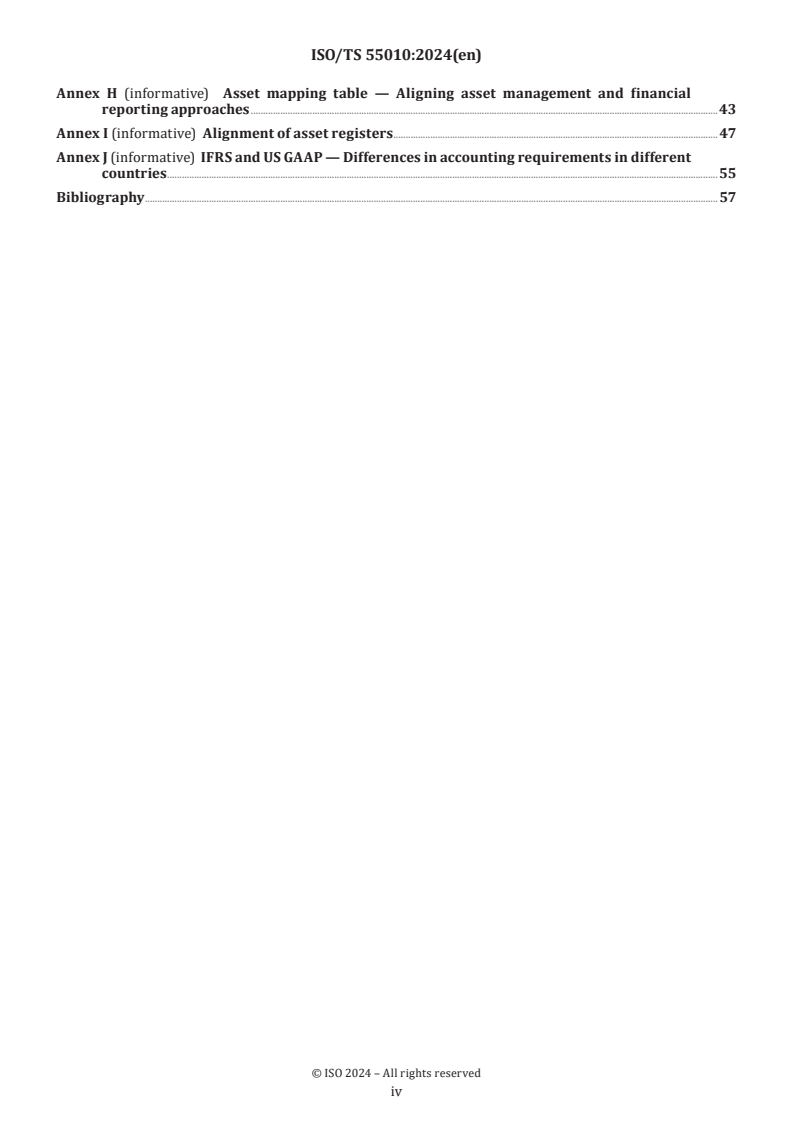
ISO/TS 55010:2024 - Asset management — Guidance on the alignment of financial and non-financial functions in asset management Released:7/8/2024
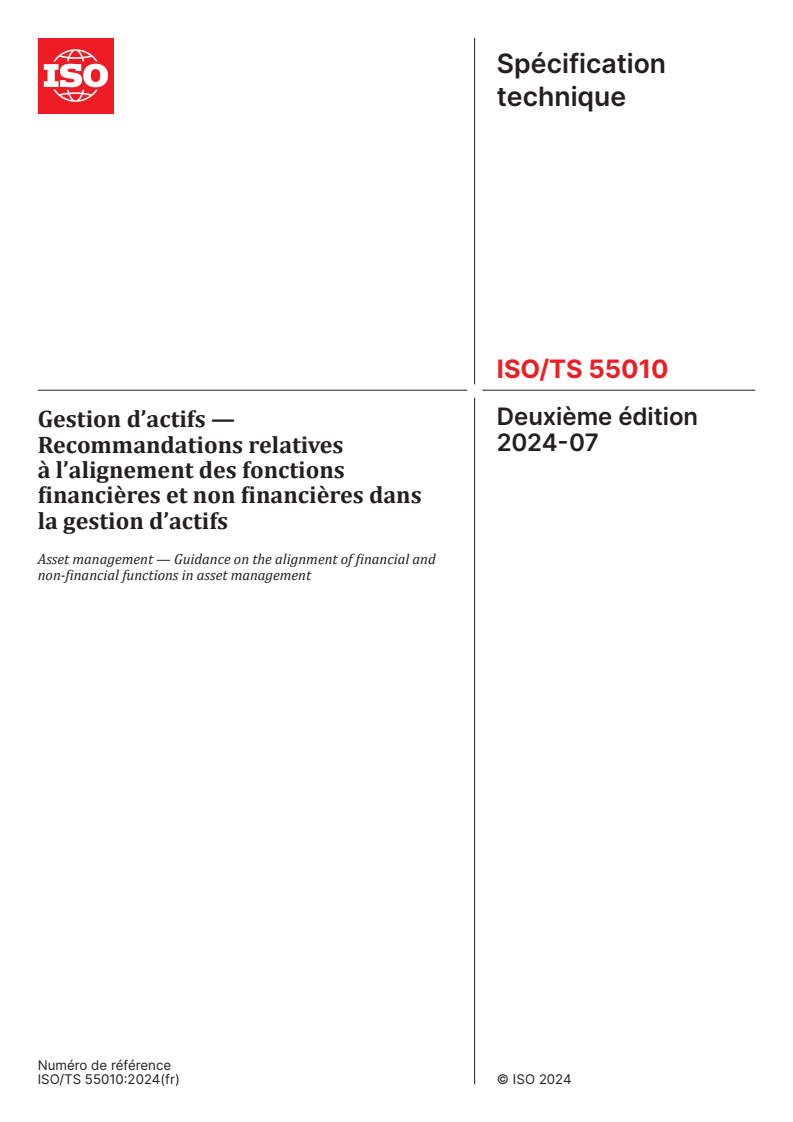

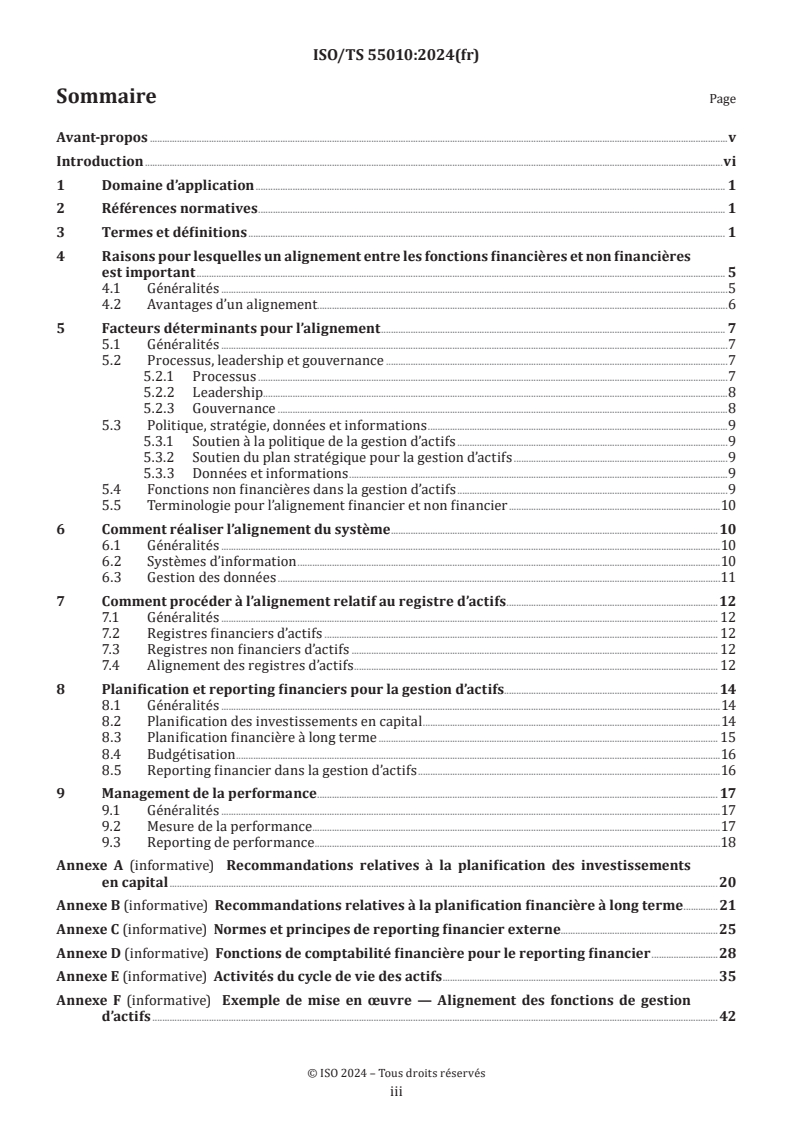
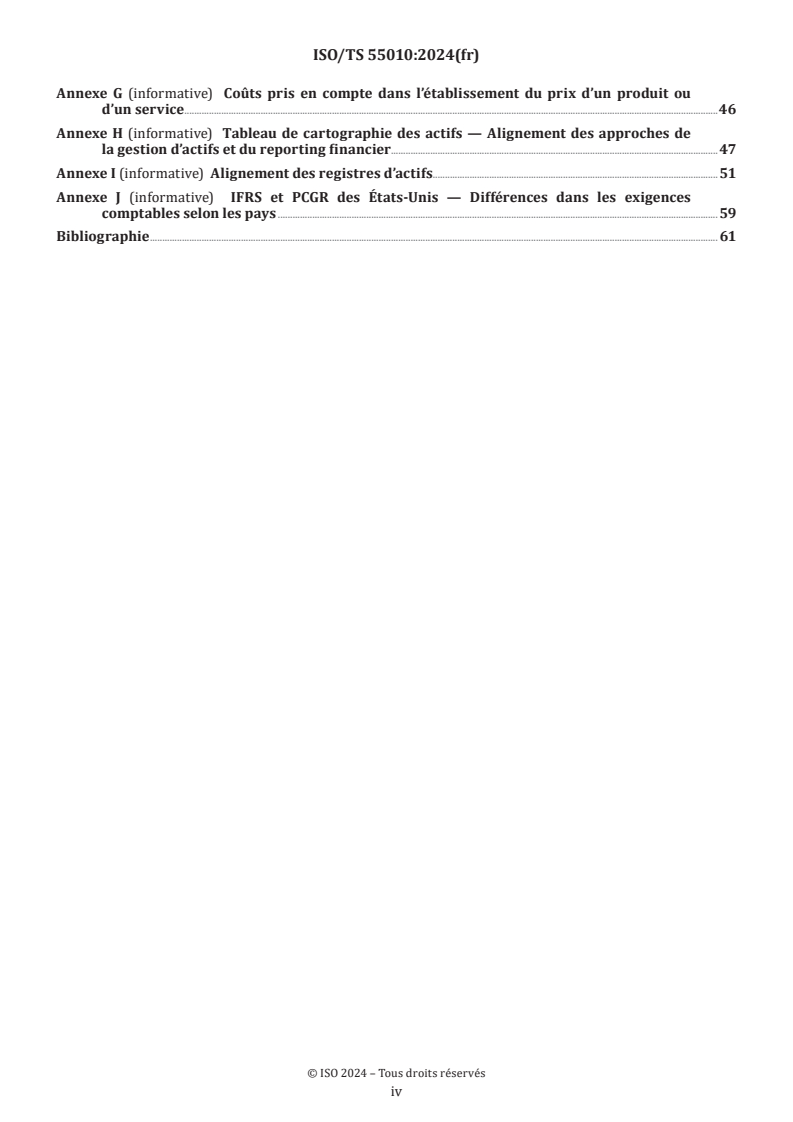
ISO/TS 55010:2024 - Gestion d’actifs — Recommandations relatives a l’alignement des fonctions financieres et non financieres dans la gestion d’actifs Released:7/8/2024
Overview
ISO/TS 55010:2024 - Asset management: Guidance on the alignment of financial and non‑financial functions in asset management - is a technical specification from ISO that provides practical guidance to improve collaboration between financial and operational (non‑financial) asset management functions. Applicable to all types of assets and all sizes and types of organizations, the document explains why alignment matters, describes enablers (processes, leadership, governance, data and information), and shows how to align systems, asset registers, financial planning and performance management. This guidance supports implementation of an ISO 55001 asset management system without adding new requirements.
Key topics and recommended practices
- Benefits of alignment: Improves decision‑making, internal controls, value realization and cross‑functional communication.
- Enablers for alignment: Processes, leadership, governance, strategy, policy, and shared terminology to break down organizational silos.
- Data and information: Guidance on data management, common asset identifiers and information systems that support consistent financial/non‑financial views.
- Asset register alignment: Principles for aligning financial asset registers (accounting/valuation) and non‑financial registers (technical, operational) to reduce inconsistencies.
- Financial planning & reporting: Practical guidance on capital investment planning, long‑term financial planning, budgeting and financial reporting in the context of asset management.
- Performance management: Measurement and reporting approaches that integrate financial and non‑financial metrics to support asset‑based decision making.
- Informative annexes: Annexes cover capital and long‑term planning, external reporting standards (IFRS/US GAAP), accounting functions, asset life‑cycle activities, implementation examples, asset mapping tables and register alignment.
Applications - practical value
- Aligns accounting, budgeting and managerial costing with operational asset activities to support better investment and lifecycle decisions.
- Helps organizations create consistent asset definitions and common data models so finance, maintenance, operations and risk teams use the same asset information.
- Improves internal controls and auditability by reconciling technical asset records with financial records.
- Supports pricing, cost allocation, capital program planning and long‑term sustainability of asset portfolios.
Who should use this standard
- Executive leadership, asset managers and finance managers seeking to improve governance and value realization.
- Multidisciplinary teams (operations, engineering, maintenance, finance, risk) involved in asset lifecycle planning and reporting.
- Auditors and internal control teams assessing alignment between technical asset management and financial reporting.
Related standards
- ISO 55001 / ISO 55000 (Asset management system requirements and overview) - ISO/TS 55010:2024 provides alignment guidance consistent with ISO 55001 but does not introduce new requirements.
- External financial reporting frameworks referenced in the annexes: IFRS and US GAAP.
Relations
- Effective Date
- 01-Sep-2024
Buy Documents
ISO/TS 55010:2024 - Asset management — Guidance on the alignment of financial and non-financial functions in asset management Released:7/8/2024
ISO/TS 55010:2024 - Gestion d’actifs — Recommandations relatives a l’alignement des fonctions financieres et non financieres dans la gestion d’actifs Released:7/8/2024
Get Certified
Connect with accredited certification bodies for this standard

BSI Group
BSI (British Standards Institution) is the business standards company that helps organizations make excellence a habit.

Bureau Veritas
Bureau Veritas is a world leader in laboratory testing, inspection and certification services.

DNV
DNV is an independent assurance and risk management provider.
Sponsored listings
Frequently Asked Questions
SIST-TS ISO/TS 55010:2024 is a technical specification published by the Slovenian Institute for Standardization (SIST). Its full title is "Asset management - Guidance on the alignment of financial and non-financial functions in asset management". This standard covers: This document gives guidance on the alignment between financial and non-financial asset management functions, to improve internal controls as part of an organization’s management system. This document is applicable to all types of assets and by all types and sizes of organizations.
This document gives guidance on the alignment between financial and non-financial asset management functions, to improve internal controls as part of an organization’s management system. This document is applicable to all types of assets and by all types and sizes of organizations.
SIST-TS ISO/TS 55010:2024 is classified under the following ICS (International Classification for Standards) categories: 03.100.01 - Company organization and management in general; 03.100.10 - Purchasing. Procurement. Logistics. The ICS classification helps identify the subject area and facilitates finding related standards.
SIST-TS ISO/TS 55010:2024 has the following relationships with other standards: It is inter standard links to SIST-TS ISO/TS 55010:2020. Understanding these relationships helps ensure you are using the most current and applicable version of the standard.
SIST-TS ISO/TS 55010:2024 is available in PDF format for immediate download after purchase. The document can be added to your cart and obtained through the secure checkout process. Digital delivery ensures instant access to the complete standard document.
Standards Content (Sample)
SLOVENSKI STANDARD
01-september-2024
Nadomešča:
SIST-TS ISO/TS 55010:2020
Obvladovanje premoženja - Napotki za usklajevanje finančnih in nefinančnih
funkcij pri obvladovanju premoženja
Asset management — Guidance on the alignment of financial and non-financial functions
in asset management
Gestion d'actifs — Orientation sur l'alignement des fonctions financières et non
financières dans la gestion d'actifs
Ta slovenski standard je istoveten z: ISO/TS 55010:2024
ICS:
03.100.10 Nabava. Dobava. Logistika Purchasing. Procurement.
Logistics
2003-01.Slovenski inštitut za standardizacijo. Razmnoževanje celote ali delov tega standarda ni dovoljeno.
Technical
Specification
ISO/TS 55010
Second edition
Asset management — Guidance
2024-07
on the alignment of financial and
non-financial functions in asset
management
Gestion d’actifs — Recommandations relatives à l’alignement des
fonctions financières et non financières dans la gestion d’actifs
Reference number
© ISO 2024
All rights reserved. Unless otherwise specified, or required in the context of its implementation, no part of this publication may
be reproduced or utilized otherwise in any form or by any means, electronic or mechanical, including photocopying, or posting on
the internet or an intranet, without prior written permission. Permission can be requested from either ISO at the address below
or ISO’s member body in the country of the requester.
ISO copyright office
CP 401 • Ch. de Blandonnet 8
CH-1214 Vernier, Geneva
Phone: +41 22 749 01 11
Email: copyright@iso.org
Website: www.iso.org
Published in Switzerland
ii
Contents Page
Foreword .v
Introduction .vi
1 Scope . 1
2 Normative references . 1
3 Terms and definitions . 1
4 Why alignment between financial and non-financial functions is important . 4
4.1 General .4
4.2 Benefits of alignment .6
5 Enablers for alignment . 7
5.1 General .7
5.2 Processes, leadership and governance .7
5.2.1 Processes .7
5.2.2 Leadership.7
5.2.3 Governance .8
5.3 Policy, strategy, data and information .8
5.3.1 Asset management policy support .8
5.3.2 Strategic asset management plan support .8
5.3.3 Data and information .8
5.4 Non-financial functions in asset management .9
5.5 Terminology for financial and non-financial alignment .9
6 How to achieve system alignment . 9
6.1 General .9
6.2 Information systems .10
6.3 Data management .10
7 How to achieve asset-register-related alignment .11
7.1 General .11
7.2 Financial asset registers .11
7.3 Non-financial asset registers .11
7.4 Asset register alignment. 12
8 Financial planning and reporting for asset management .12
8.1 General . 12
8.2 Capital investment planning . 13
8.3 Long-term financial planning.14
8.4 Budgeting .14
8.5 Financial reporting in asset management . 15
9 Performance management . 16
9.1 General .16
9.2 Performance measurement .16
9.3 Performance reporting .17
Annex A (informative) Guidance on capital investment planning .18
Annex B (informative) Guidance on long-term financial planning . 19
Annex C (informative) External financial reporting standards and principles .23
Annex D (informative) Financial accounting functions for financial reporting .26
Annex E (informative) Asset life cycle activities .32
Annex F (informative) Implementation example — Aligning asset management functions .38
Annex G (informative) Cost input to pricing for product or service .42
iii
Annex H (informative) Asset mapping table — Aligning asset management and financial
reporting approaches .43
Annex I (informative) Alignment of asset registers . 47
Annex J (informative) IFRS and US GAAP — Differences in accounting requirements in different
countries .55
Bibliography .57
iv
Foreword
ISO (the International Organization for Standardization) is a worldwide federation of national standards
bodies (ISO member bodies). The work of preparing International Standards is normally carried out through
ISO technical committees. Each member body interested in a subject for which a technical committee
has been established has the right to be represented on that committee. International organizations,
governmental and non-governmental, in liaison with ISO, also take part in the work. ISO collaborates closely
with the International Electrotechnical Commission (IEC) on all matters of electrotechnical standardization.
The procedures used to develop this document and those intended for its further maintenance are described
in the ISO/IEC Directives, Part 1. In particular, the different approval criteria needed for the different types
of ISO document should be noted. This document was drafted in accordance with the editorial rules of the
ISO/IEC Directives, Part 2 (see www.iso.org/directives).
ISO draws attention to the possibility that the implementation of this document may involve the use of (a)
patent(s). ISO takes no position concerning the evidence, validity or applicability of any claimed patent
rights in respect thereof. As of the date of publication of this document, ISO had not received notice of (a)
patent(s) which may be required to implement this document. However, implementers are cautioned that
this may not represent the latest information, which may be obtained from the patent database available at
www.iso.org/patents. ISO shall not be held responsible for identifying any or all such patent rights.
Any trade name used in this document is information given for the convenience of users and does not
constitute an endorsement.
For an explanation of the voluntary nature of standards, the meaning of ISO specific terms and expressions
related to conformity assessment, as well as information about ISO’s adherence to the World Trade
Organization (WTO) principles in the Technical Barriers to Trade (TBT), see www.iso.org/iso/foreword.html.
This document was prepared by Technical Committee ISO/TC 251, Asset management.
This second edition cancels and replaces the first edition (ISO/TS 55010:2019), which has been technically
revised.
The main changes are as follows:
— the text has been updated to be aligned with ISO 55001:2024;
— the retitling and revision of Annex E;
— the addition of new Annexes H, I and J.
Any feedback or questions on this document should be directed to the user’s national standards body. A
complete listing of these bodies can be found at www.iso.org/members.html.
v
Introduction
The ISO 55000, ISO 55001 and ISO 55002 asset management standards raise awareness of the importance
of improving alignment between an organization’s financial and non-financial functions, and this document
provides guidance on how to achieve this. Alignment of these functions enabling the realization of value
derived from the implementation of asset management is detailed in ISO 55000, ISO 55001 and ISO 55002,
particularly ISO 55002:2018, Annex F.
The guidance in this document is consistent with the requirements of ISO 55001 for an asset management
system but does not add new requirements to ISO 55001 or provide interpretations of the requirements of
ISO 55001.
For an example of an organization aligning its asset management functions, see Annex F.
As used in this document, financial functions refer to processes and activities such as managerial costing
and accounting, budgeting, financing and valuation related to the assets. Non-financial functions are the
complementary processes and activities, for providing a product or service from the assets.
The asset management function may include both financial and non-financial functions.
The definition of “asset” in ISO 55000 is broader than that of the United States (US) Generally Accepted
Accounting Principles (GAAP) or the International Financial Reporting Standards (IFRS). The term “asset”
as primarily used in this document is defined in ISO 55000. See Annex H.
In many organizations, the financial and non-financial functions of asset management are inadequately
aligned. Often the financial accounting functions are predominantly focused on retrospective reporting
of accounting/regulatory financial activities. However, there is a growing awareness in organizations of
the need to focus on providing a managerial costing approach to support decision-making for the future.
At the same time, the non-financial functions are recognizing the need to improve their understanding of
the financial implications of their activities. These are examples of moves towards better alignment of the
financial and non-financial functions with the aim of better decision-making and value realization.
Lack of alignment between financial and non-financial functions can be attributed to silos in an organization,
including reporting structures, functional/operational business processes and related technical data.
Reference [23] advises that “… silos [department/functional specialization] are necessary to allow for the
required level of specialization, but if these silos [department/functional specialization] do not communicate,
inefficiencies and errors in asset management result” and that “when asset management implementation
fails, it is often because asset management staff and senior management are not in alignment”.
Alignment should prudently work both “vertically” and “horizontally”. Vertical alignment “top-down
and bottom-up information flow” means that financial and non-financial asset-related directives by
top management are informed by accurate upward information flows, effectively implemented within
the appropriate levels of the organization. Horizontal alignment means that financial and non-financial
information that flows between departments (conducting functions such as operations, engineering, plant
maintenance, financial accounting, financial management and risk management) uses the same terminology
and refers to the assets identified in the same way. See the asset mapping table in Annex H.
The aim of this document is to encourage organizations to support alignment between these asset
management functions and to provide guidance on how such alignment can be achieved. It also promotes
the benefits that can be achieved for an organization and its stakeholders by having alignment of these
asset management functions better understood, implemented and improved. This enables an organization’s
functional areas to share information and collaborate to achieve the organization’s objectives.
This document can assist users in applying the concepts of ISO 55000 and fulfilling the requirements of
ISO 55001. It provides additional advice and guidance over and above the explanations outlined in ISO 55002
on the benefits to be realized for an organization through alignment.
vi
It is intended for use by personnel, at all levels in an organization, who are involved in asset management,
including:
— top management and decision-makers, to derive the benefits that are achievable by better alignment
between financial and non-financial functions;
— those in asset-related multidisciplinary functions who provide information to support decision- making
or rely on the outcomes of those decisions;
— a wide range of personnel, including those who have responsibility for the technical planning, design,
construction, operation, maintenance and performance of the assets, and those with financial
responsibilities such as accounting, financial planning, budgeting and financial reporting.
Knowledge and understanding of terminology and common language used by financial and non-financial
functions can facilitate discussion, communication and exchange of information between these functions.
Clauses 4 to 9 and the related annexes provide a range of information on financial and non-financial
functions in asset management, including information on asset management accounting principles.
vii
Technical Specification ISO/TS 55010:2024(en)
Asset management — Guidance on the alignment of financial
and non-financial functions in asset management
1 Scope
This document gives guidance on the alignment between financial and non-financial asset management
functions, to improve internal controls as part of an organization’s management system.
This document is applicable to all types of assets and by all types and sizes of organizations.
2 Normative references
The following documents are referred to in the text in such a way that some or all of their content constitutes
requirements of this document. For dated references, only the edition cited applies. For undated references,
the latest edition of the referenced document (including any amendments) applies.
ISO 55000, Asset management — Overview, principles and vocabulary
3 Terms and definitions
For the purposes of this document, the terms and definitions given in ISO 55000 and the following apply.
ISO and IEC maintain terminology databases for use in standardization at the following addresses:
— ISO Online browsing platform: available at https:// www .iso .org/ obp
— IEC Electropedia: available at https:// www .electropedia .org/
3.1
financial accounting
process of recording, summarizing and reporting the transactions resulting from an organization’s
operations over a period of time
Note 1 to entry: These transactions are summarized in the preparation of financial statements (including the balance
sheet, income statement and cash-flow statement) that communicate the organization’s operating performance over a
specified period.
3.2
management accounting
accounting to assist management in the formulation and implementation of an organization’s strategy
Note 1 to entry: Management accounting usually requires partnering across different functions (3.20) in an
organization for management decision-making, devising planning and performance management systems, and
providing expertise in financial reporting and control.
3.3
managerial costing
costing used internally by an organization to ensure that information for decisions reflects the characteristics
of the organization’s resources and operations
Note 1 to entry: For further information on managerial costing, see Reference [15].
3.4
financial function
work, or portions of work, that pertain to financial management
EXAMPLE Financial reporting, budgeting, financing, valuation (3.12), financial planning and analysis,
management accounting (3.2), tax accounting.
Note 1 to entry: In organizations, there is sometimes no separation between financial and non-financial functions (3.5);
some functions can be blended. Those distinctions should be addressed in internal strategic asset management plans
or policy.
3.5
non-financial function
work, or portions of work, that combine with an organization’s financial functions (3.4) in delivering its
services or products
Note 1 to entry: Asset planning, acquisition, marketing, operations, maintenance.
3.6
internal control
process used by an organization’s managers to help it achieve its objectives
Note 1 to entry: Internal controls help an organization to run its operations efficiently and effectively while
safeguarding assets, report reliable financial and non-financial information about its operations, and comply with
applicable laws, regulations and standards.
Note 2 to entry: Internal controls apply to all activities, irrespective of whether they are financial or non-financial.
Note 3 to entry: In order to achieve a high level of assurance of the organization’s internal controls, segregation of
duties is required (e.g. avoiding having the same individual responsible for decision-making as well as asset custody
and record keeping; having procedures to prevent and identify waste, fraud abuse and mismanagement, including due
diligence omissions, procrastination, dereliction of duty and toleration of incompetence).
Note 4 to entry: Internal controls support sound decision-making, considering risks to the achievement of objectives
and reducing them to acceptable levels through cost-effective controls.
Note 5 to entry: This definition of internal control is derived from Reference [11], which also provides further useful
information on this topic.
3.7
asset register
record of asset data considered worthy of separate identification and accountability
Note 1 to entry: Financial or accounting asset registers are databases or systems used to describe and manage the
organization’s financial accounts and management accounting (3.2).
Note 2 to entry: Non-financial asset registers (technical or operational) are databases or computerized systems in
which relevant technical or operational data and information of an asset are kept.
3.8
capital expenditure
CapEx
expenditure on acquisitions of, or improvements to, assets
Note 1 to entry: Based upon accounting standards and organizational policy, CapEx usually relates to relatively large
(material) expenditure, which has benefits that are expected to last for more than 12 months.
3.9
operational expenditure
OpEx
recurrent or specific non-capital expenditures required to provide a service or product
3.10
total expenditure
TotEx
sum of capital expenditure (3.8) and operational expenditure (3.9) over a period of time
3.11
alignment
deliberate arrangement, relationship and mutual understanding of common concerns within a particular
activity or among activities
3.12
valuation
process of determining the current value of an asset
Note 1 to entry: Valuation methods are numerous. Values are expressed in monetary terms.
Note 2 to entry: Valuations may be made to a single asset, a group of assets or an entire enterprise.
3.13
book value
monetary expression at which an asset or group of assets are carried on a balance sheet
Note 1 to entry: Book value is also known as “carrying amount” or “carrying value”.
3.14
residual value
estimated financial amount that an organization would expect to obtain from disposal of an asset, after
deducting the estimated costs of disposal, if the asset were already of the age and in the condition expected
at the end of its useful life (3.15)
3.15
useful life
period over which an asset or class of assets are expected to be available for use by an organization
Note 1 to entry: Useful life is determined by factors such as the economic, technological, physical and functional
performance of the assets or asset system, which demands an understanding between financial functions (3.4) and
non-financial functions (3.5) depending on the context (e.g. market, cost recovery, maintenance planning, long-term
planning).
Note 2 to entry: The applicable period is dependent on the nature of the asset or asset system and can be elapsed time,
operating hours, number of cycles, number of units of production, etc.
3.16
depreciation
systematic allocation of the depreciable amount of an asset over its useful life (3.15)
Note 1 to entry: While “depreciation” can be used for both tangible and intangible assets, “amortization” is normally
used for intangible assets only.
3.17
fair value
price that would be received to sell an asset, or paid to transfer a liability (3.18), in an orderly transaction
between market participants at the measurement date
3.18
liability
present obligation of the organization arising from past events, the settlement of which is expected to result
in an outflow of resources from the organization
3.19
six capitals
classification of the different kinds of value in an organization that can be transformed in its operations,
namely financial, manufactured, intellectual, human, social and relationship, and natural
Note 1 to entry: Within the framework of integrated reporting, an organization is encouraged to provide a fuller
picture of how it creates value through a combination of related quantitative and qualitative information.
3.20
function
purpose of each area or division of an organization that performs a specific activity, provides specialized
information or implements procedures
3.21
domain
broad area of management responsibility in an organization
EXAMPLE Assets, human resources, customers, procurement, regulators.
Note 1 to entry: A domain can include one or more functions (3.20).
3.22
life cycle cost
LCC
total cost incurred during the life cycle
Note 1 to entry: See also life cycle costing (3.25).
[SOURCE: IEC 60050-192:2015, 192-01-10]
3.23
compliance
mandatory requirement, performance or design, imposed upon by or agreed with an external organization
Note 1 to entry: Compliance is a required action, behaviour or condition.
Note 2 to entry: A compliance requirement is enforceable. Failure to achieve compliance can result in penalties and
require correction, compensation or restitution.
Note 3 to entry: The term “conformance” is often erroneously used as a synonym for the term “compliance”.
EXAMPLE Organizations must comply with financial reporting requirements but should conform to the non-
financial reporting plan.
3.24
best value
expected outcome of an acquisition that, in the organization’s estimation, provides the greatest overall
benefit in response to a requirement
3.25
life cycle costing
process of economic analysis to assess the cost of an item over its life cycle or a portion thereof
[SOURCE: IEC 60050-192:2015, 192-01-11]
4 Why alignment between financial and non-financial functions is important
4.1 General
Alignment between financial and non-financial functions is important in the implementation of a successful
asset management system. Lack of organizational alignment can be due to barriers within the organization
(e.g. language/terminology differences, information/data standard quality differences, poor coordination
between the organization’s financial and non-financial functions in asset management). Top management
often struggles with many asset management related questions due to a lack of alignment. Some examples of
questions include the following:
— How can top management be sure that they get the best value for their stakeholders from the assets?
— How do the assets contribute to the delivery of the organization’s objectives? Which assets are critical for it?
— What are the risks and opportunities to the organization’s objectives arising from its assets?
— What level of investment should be made in the assets over both the short and longer term (TotEx) to
deliver the organization’s objectives and how does top management prioritize this investment?
— What is the cost of delivering products or services to meet customer satisfaction and how can the
organization use this as an input for pricing or service delivery?
— How does top management determine the cost impacts of changes in the six capitals, and the resilience
of the organizational assets to these changes?
— How can top management know the life cycle cost (LCC) of assets?
— Is top management making decisions that provide short-term cost savings but, due to lack of adequate
asset management involvement, lead to higher long-term costs?
— How can top management get the necessary funding commitment to ensure the long-term financial
sustainability of assets and continue meeting the objectives of the organization?
— How can the organization obtain enough information on the asset base for integrated reporting purposes,
enable correct and timely decisions, and understand the nature and use of seemingly conflicting
information from different sources?
— Are the stakeholders confident about the asset verification/valuation/existence/necessity/
impairment tests?
— Does the organization have the financial information to make evidence-based asset management
decisions?
— What assets are not delivering the value expected and what assets are costing more than anticipated?
— What liabilities, and hence cost, are the assets exposing the organization to?
— Do the organization’s financial statements really reflect the state of the asset portfolio including
leased assets?
— For the outsourced services, how are the associated costs tracked and managed through an appropriate
internal control?
— How can top management obtain/maintain competitive advantage through the use of assets?
As illustrated in the above questions, all parts of the organization should work together, to share and utilize
information, to provide the transparency, insight and necessary answers, and to support asset management
reporting and decision-making. This document provides a general solution to these questions in the form
of better alignment of functions across the organization, enabling the realization of the benefits detailed in
4.2. It does not seek to explicitly answer these questions individually but instead guides users to adopt the
concepts contained within this document to find their own answers to these and other pertinent questions.
Asset management deals with the challenge of maximizing value derived from the assets. A significant
explanation of the value proposition can be found in ISO 55002:2018, Annex A.
The concept of value in asset management is broader than the more constrained specific definition of value
in accounting terms, where the various accounting standards deal with value as part of the valuation of
assets process. The value in asset management can be expressed in both monetary and non-monetary terms
and an aligned understanding of financial and non-financial value is needed to determine decision-making
criteria.
Financial planning, decision-making and reporting are crucial to asset management and, conversely,
asset management has major impacts on financial aspects. Accordingly, close coordination of financial
and accounting functions with the non-financial asset management functions is essential to meeting
organizational objectives.
4.2 Benefits of alignment
Alignment and coordination between financial and non-financial functions related to assets and asset
management can lead to resolution of many of the issues listed in 4.1, as follows:
a) Improved expression of asset criticality and risk in financial terms, which helps to implement more
robust risk controls.
b) Integrated and efficient asset investment planning and prioritization for short- and longer-term
timescales.
c) Improved understanding of longer-term funding needs relating to assets that supports informed
decision-making for financing and budgeting, leading to long-term predictable and sustainable funding
mechanisms.
d) Improved options analysis and decision-making on investment projects based on more complete
information from both financial and non-financial functions.
e) Improved decision-making and communication on pricing for the organization’s products and services
based on sound practices such as managerial costing, and a better understanding of value to customers
and stakeholders.
f) More accurate, complete, transparent, and timely registration and reporting of all changes to asset
management information affecting the financial functions, including functions of accounting and
finance, auditing, regulating, tax and insurance. This includes for accounting purposes when a self-
constructed asset is determined to be substantially complete and ready for use, at which time the cost of
the capital project is taken from a construction in the progress account and capitalized for depreciation
or amortization purposes.
g) Improved methodology and procedures to enable financial and non-financial staff to efficiently share
knowledge and information whereby both financial and non-financial staff use commonly agreed
terminology, which can lead to collective understanding.
h) Maintained or improved competitive advantage.
i) Improved internal controls as part of the wider management system of the organization.
j) More efficient measurement of operational performance and the organization’s overall performance.
k) More efficient procedures for capital and operational budgeting processes.
l) Better alignment of long-term financial planning and asset life cycle planning.
m) Collaboration across departments to optimize resources and reduce duplication.
n) Improved depreciation methodology.
o) Improved teamwork, collaboration, clarity, transparency, and availability of information and up- skilling
for financial and non-financial staff.
p) Better understanding of what services can be provided, based on available funding, enabling meaningful
trade-off analyses when reviewing service and funding gaps.
q) More reliable knowledge of cost inputs for pricing, considering all LCCs originating from financial and
non-financial functions (see Annex G).
Improved alignment between financial and non-financial functions helps to improve the quality of
information used to support an organization’s decision-making and value maximization. Such improved
alignment also encourages both financial and non-financial practitioners to speak the same language.
5 Enablers for alignment
5.1 General
Business processes, leadership and governance are key enablers for the alignment of financial and non-
financial asset management activities. Data, information, knowledge, capabilities and other elements
required to support alignment among different levels of the organization are addressed.
5.2 Processes, leadership and governance
5.2.1 Processes
Defined processes can be significant enablers for the alignment of financial and non-financial asset
management functions. Processes should be properly supported by documented information and
opportunities identified to link tasks across different levels, functions and processes. For example, the
process used by an asset manager to bring a new asset online (non-financial) should contain a task to capture
total installed cost and send/link this to the accounting function where it can be used as the cost basis of the
asset (financial). This example of a co-developed process enables timely and accurate data and information
for asset cost, installation date and expected useful life to be captured in both the financial and non-financial
asset registers. The processes developed within an organization should use common terminology across the
financial and non-financial functions and focus on the end-to-end need rather than being governed solely by
function.
5.2.2 Leadership
To achieve alignment between the financial and non-financial asset management functions within the
organization, top management should demonstrate leadership and commitment by:
a) promoting and encouraging collaboration and clarity, transparency and availability of information for
financial and non-financial staff;
b) ensuring alignment between the objectives of the various financial and non-financial functions in
conformity with the defined overall organizational objectives;
c) ensuring training for appropriate people (from top management to frontline operations) involved at
intersecting processes, between financial and non-financial asset management disciplines, to promote
communication and common understanding of the terminology being applied;
d) ensuring the availability of adequate resources capable of promoting and implementing cross-functional
collaborative teams with a focus on continual improvement;
e) ensuring both financial and non-financial functions have adequate awareness and influence in decision-
making processes;
f) ensuring consistency of the various policies in their intent, language and communication; ensuring
implementation and maintenance of inter-departmental shared granularity to identify how an asset is
recorded;
g) ensuring alignment in risk management of the various financial and non-financial functions in
conformity with the overall risk management framework.
5.2.3 Governance
Governance should provide a framework to align financial and non-financial asset management functions.
This is demonstrated by a governance process and policies designed to establish alignment relationships
between stakeholders that can address any conflicting interests regarding how assets are managed.
Figure 1 suggests key elements of a framework that can be adopted to achieve alignment.
Figure 1 — Key elements of a framework to achieve alignment
The governance framework should address the alignment of financial and non-financial functions in relation
to risk management (particularly financial risk) within the context of the common overall risk management
framework. ISO 55002:2018, Annex E, provides further detail on risk management. Another useful reference
[11]
on risk management is the COSO framework .
5.3 Policy, strategy, data and information
5.3.1 Asset management policy support
Top management, through the asset management policy, should acknowledge and endorse the role of
alignment between the financial and non-financial functions. Top management should provide commitment
to the provision of the information, knowledge and capabilities required to achieve, maintain and continually
improve alignment. Such information should be available for use within the organization’s non-financial
decision-making functions, e.g. replacement, renewal, maintenance, training, inspection. This ensures that
decisions are informed and balance the financial needs as well as the organization’s wider performance
requirements.
5.3.2 Strategic asset management plan support
Department/division managers, through the strategic asset management plan (SAMP), should specifically
address the high-level requirements to capture, store and share the information, knowledge and capabilities
required to support alignment between financial and non-financial asset management activities.
ISO 55002:2018, Annex C, provides significant guidance on the format and content of a SAMP.
5.3.3 Data and information
Accurate, reliable, and current data and the resulting information are key elements of asset management.
When data are processed, interpreted, organized, structured or presented to make them meaningful
or useful, they are called “information”. Data and information management is of utmost importance to
facilitate and ensure the collection, currency, accuracy, availability, integrity and completeness of data and
information. Data management should cover data generated within the organization as well as data coming
from outsourced or contracted functions.
Data and information should be useful and worthwhile to collect, record, report and analyse. Expected
benefits should justify the expected cost. As Reference [13] states: “If financial [and non-financial]
information is to be useful, it must be relevant and faithfully represent what it purports to represent. The
usefulness of financial information is enhanced if it is comparable, verifiable, timely, and understandable.”
After determining its reporting, planning and an
...
Technical
Specification
ISO/TS 55010
Second edition
Asset management — Guidance
2024-07
on the alignment of financial and
non-financial functions in asset
management
Gestion d’actifs — Recommandations relatives à l’alignement des
fonctions financières et non financières dans la gestion d’actifs
Reference number
© ISO 2024
All rights reserved. Unless otherwise specified, or required in the context of its implementation, no part of this publication may
be reproduced or utilized otherwise in any form or by any means, electronic or mechanical, including photocopying, or posting on
the internet or an intranet, without prior written permission. Permission can be requested from either ISO at the address below
or ISO’s member body in the country of the requester.
ISO copyright office
CP 401 • Ch. de Blandonnet 8
CH-1214 Vernier, Geneva
Phone: +41 22 749 01 11
Email: copyright@iso.org
Website: www.iso.org
Published in Switzerland
ii
Contents Page
Foreword .v
Introduction .vi
1 Scope . 1
2 Normative references . 1
3 Terms and definitions . 1
4 Why alignment between financial and non-financial functions is important . 4
4.1 General .4
4.2 Benefits of alignment .6
5 Enablers for alignment . 7
5.1 General .7
5.2 Processes, leadership and governance .7
5.2.1 Processes .7
5.2.2 Leadership.7
5.2.3 Governance .8
5.3 Policy, strategy, data and information .8
5.3.1 Asset management policy support .8
5.3.2 Strategic asset management plan support .8
5.3.3 Data and information .8
5.4 Non-financial functions in asset management .9
5.5 Terminology for financial and non-financial alignment .9
6 How to achieve system alignment . 9
6.1 General .9
6.2 Information systems .10
6.3 Data management .10
7 How to achieve asset-register-related alignment .11
7.1 General .11
7.2 Financial asset registers .11
7.3 Non-financial asset registers .11
7.4 Asset register alignment. 12
8 Financial planning and reporting for asset management .12
8.1 General . 12
8.2 Capital investment planning . 13
8.3 Long-term financial planning.14
8.4 Budgeting .14
8.5 Financial reporting in asset management . 15
9 Performance management . 16
9.1 General .16
9.2 Performance measurement .16
9.3 Performance reporting .17
Annex A (informative) Guidance on capital investment planning .18
Annex B (informative) Guidance on long-term financial planning . 19
Annex C (informative) External financial reporting standards and principles .23
Annex D (informative) Financial accounting functions for financial reporting .26
Annex E (informative) Asset life cycle activities .32
Annex F (informative) Implementation example — Aligning asset management functions .38
Annex G (informative) Cost input to pricing for product or service .42
iii
Annex H (informative) Asset mapping table — Aligning asset management and financial
reporting approaches .43
Annex I (informative) Alignment of asset registers . 47
Annex J (informative) IFRS and US GAAP — Differences in accounting requirements in different
countries .55
Bibliography .57
iv
Foreword
ISO (the International Organization for Standardization) is a worldwide federation of national standards
bodies (ISO member bodies). The work of preparing International Standards is normally carried out through
ISO technical committees. Each member body interested in a subject for which a technical committee
has been established has the right to be represented on that committee. International organizations,
governmental and non-governmental, in liaison with ISO, also take part in the work. ISO collaborates closely
with the International Electrotechnical Commission (IEC) on all matters of electrotechnical standardization.
The procedures used to develop this document and those intended for its further maintenance are described
in the ISO/IEC Directives, Part 1. In particular, the different approval criteria needed for the different types
of ISO document should be noted. This document was drafted in accordance with the editorial rules of the
ISO/IEC Directives, Part 2 (see www.iso.org/directives).
ISO draws attention to the possibility that the implementation of this document may involve the use of (a)
patent(s). ISO takes no position concerning the evidence, validity or applicability of any claimed patent
rights in respect thereof. As of the date of publication of this document, ISO had not received notice of (a)
patent(s) which may be required to implement this document. However, implementers are cautioned that
this may not represent the latest information, which may be obtained from the patent database available at
www.iso.org/patents. ISO shall not be held responsible for identifying any or all such patent rights.
Any trade name used in this document is information given for the convenience of users and does not
constitute an endorsement.
For an explanation of the voluntary nature of standards, the meaning of ISO specific terms and expressions
related to conformity assessment, as well as information about ISO’s adherence to the World Trade
Organization (WTO) principles in the Technical Barriers to Trade (TBT), see www.iso.org/iso/foreword.html.
This document was prepared by Technical Committee ISO/TC 251, Asset management.
This second edition cancels and replaces the first edition (ISO/TS 55010:2019), which has been technically
revised.
The main changes are as follows:
— the text has been updated to be aligned with ISO 55001:2024;
— the retitling and revision of Annex E;
— the addition of new Annexes H, I and J.
Any feedback or questions on this document should be directed to the user’s national standards body. A
complete listing of these bodies can be found at www.iso.org/members.html.
v
Introduction
The ISO 55000, ISO 55001 and ISO 55002 asset management standards raise awareness of the importance
of improving alignment between an organization’s financial and non-financial functions, and this document
provides guidance on how to achieve this. Alignment of these functions enabling the realization of value
derived from the implementation of asset management is detailed in ISO 55000, ISO 55001 and ISO 55002,
particularly ISO 55002:2018, Annex F.
The guidance in this document is consistent with the requirements of ISO 55001 for an asset management
system but does not add new requirements to ISO 55001 or provide interpretations of the requirements of
ISO 55001.
For an example of an organization aligning its asset management functions, see Annex F.
As used in this document, financial functions refer to processes and activities such as managerial costing
and accounting, budgeting, financing and valuation related to the assets. Non-financial functions are the
complementary processes and activities, for providing a product or service from the assets.
The asset management function may include both financial and non-financial functions.
The definition of “asset” in ISO 55000 is broader than that of the United States (US) Generally Accepted
Accounting Principles (GAAP) or the International Financial Reporting Standards (IFRS). The term “asset”
as primarily used in this document is defined in ISO 55000. See Annex H.
In many organizations, the financial and non-financial functions of asset management are inadequately
aligned. Often the financial accounting functions are predominantly focused on retrospective reporting
of accounting/regulatory financial activities. However, there is a growing awareness in organizations of
the need to focus on providing a managerial costing approach to support decision-making for the future.
At the same time, the non-financial functions are recognizing the need to improve their understanding of
the financial implications of their activities. These are examples of moves towards better alignment of the
financial and non-financial functions with the aim of better decision-making and value realization.
Lack of alignment between financial and non-financial functions can be attributed to silos in an organization,
including reporting structures, functional/operational business processes and related technical data.
Reference [23] advises that “… silos [department/functional specialization] are necessary to allow for the
required level of specialization, but if these silos [department/functional specialization] do not communicate,
inefficiencies and errors in asset management result” and that “when asset management implementation
fails, it is often because asset management staff and senior management are not in alignment”.
Alignment should prudently work both “vertically” and “horizontally”. Vertical alignment “top-down
and bottom-up information flow” means that financial and non-financial asset-related directives by
top management are informed by accurate upward information flows, effectively implemented within
the appropriate levels of the organization. Horizontal alignment means that financial and non-financial
information that flows between departments (conducting functions such as operations, engineering, plant
maintenance, financial accounting, financial management and risk management) uses the same terminology
and refers to the assets identified in the same way. See the asset mapping table in Annex H.
The aim of this document is to encourage organizations to support alignment between these asset
management functions and to provide guidance on how such alignment can be achieved. It also promotes
the benefits that can be achieved for an organization and its stakeholders by having alignment of these
asset management functions better understood, implemented and improved. This enables an organization’s
functional areas to share information and collaborate to achieve the organization’s objectives.
This document can assist users in applying the concepts of ISO 55000 and fulfilling the requirements of
ISO 55001. It provides additional advice and guidance over and above the explanations outlined in ISO 55002
on the benefits to be realized for an organization through alignment.
vi
It is intended for use by personnel, at all levels in an organization, who are involved in asset management,
including:
— top management and decision-makers, to derive the benefits that are achievable by better alignment
between financial and non-financial functions;
— those in asset-related multidisciplinary functions who provide information to support decision- making
or rely on the outcomes of those decisions;
— a wide range of personnel, including those who have responsibility for the technical planning, design,
construction, operation, maintenance and performance of the assets, and those with financial
responsibilities such as accounting, financial planning, budgeting and financial reporting.
Knowledge and understanding of terminology and common language used by financial and non-financial
functions can facilitate discussion, communication and exchange of information between these functions.
Clauses 4 to 9 and the related annexes provide a range of information on financial and non-financial
functions in asset management, including information on asset management accounting principles.
vii
Technical Specification ISO/TS 55010:2024(en)
Asset management — Guidance on the alignment of financial
and non-financial functions in asset management
1 Scope
This document gives guidance on the alignment between financial and non-financial asset management
functions, to improve internal controls as part of an organization’s management system.
This document is applicable to all types of assets and by all types and sizes of organizations.
2 Normative references
The following documents are referred to in the text in such a way that some or all of their content constitutes
requirements of this document. For dated references, only the edition cited applies. For undated references,
the latest edition of the referenced document (including any amendments) applies.
ISO 55000, Asset management — Overview, principles and vocabulary
3 Terms and definitions
For the purposes of this document, the terms and definitions given in ISO 55000 and the following apply.
ISO and IEC maintain terminology databases for use in standardization at the following addresses:
— ISO Online browsing platform: available at https:// www .iso .org/ obp
— IEC Electropedia: available at https:// www .electropedia .org/
3.1
financial accounting
process of recording, summarizing and reporting the transactions resulting from an organization’s
operations over a period of time
Note 1 to entry: These transactions are summarized in the preparation of financial statements (including the balance
sheet, income statement and cash-flow statement) that communicate the organization’s operating performance over a
specified period.
3.2
management accounting
accounting to assist management in the formulation and implementation of an organization’s strategy
Note 1 to entry: Management accounting usually requires partnering across different functions (3.20) in an
organization for management decision-making, devising planning and performance management systems, and
providing expertise in financial reporting and control.
3.3
managerial costing
costing used internally by an organization to ensure that information for decisions reflects the characteristics
of the organization’s resources and operations
Note 1 to entry: For further information on managerial costing, see Reference [15].
3.4
financial function
work, or portions of work, that pertain to financial management
EXAMPLE Financial reporting, budgeting, financing, valuation (3.12), financial planning and analysis,
management accounting (3.2), tax accounting.
Note 1 to entry: In organizations, there is sometimes no separation between financial and non-financial functions (3.5);
some functions can be blended. Those distinctions should be addressed in internal strategic asset management plans
or policy.
3.5
non-financial function
work, or portions of work, that combine with an organization’s financial functions (3.4) in delivering its
services or products
Note 1 to entry: Asset planning, acquisition, marketing, operations, maintenance.
3.6
internal control
process used by an organization’s managers to help it achieve its objectives
Note 1 to entry: Internal controls help an organization to run its operations efficiently and effectively while
safeguarding assets, report reliable financial and non-financial information about its operations, and comply with
applicable laws, regulations and standards.
Note 2 to entry: Internal controls apply to all activities, irrespective of whether they are financial or non-financial.
Note 3 to entry: In order to achieve a high level of assurance of the organization’s internal controls, segregation of
duties is required (e.g. avoiding having the same individual responsible for decision-making as well as asset custody
and record keeping; having procedures to prevent and identify waste, fraud abuse and mismanagement, including due
diligence omissions, procrastination, dereliction of duty and toleration of incompetence).
Note 4 to entry: Internal controls support sound decision-making, considering risks to the achievement of objectives
and reducing them to acceptable levels through cost-effective controls.
Note 5 to entry: This definition of internal control is derived from Reference [11], which also provides further useful
information on this topic.
3.7
asset register
record of asset data considered worthy of separate identification and accountability
Note 1 to entry: Financial or accounting asset registers are databases or systems used to describe and manage the
organization’s financial accounts and management accounting (3.2).
Note 2 to entry: Non-financial asset registers (technical or operational) are databases or computerized systems in
which relevant technical or operational data and information of an asset are kept.
3.8
capital expenditure
CapEx
expenditure on acquisitions of, or improvements to, assets
Note 1 to entry: Based upon accounting standards and organizational policy, CapEx usually relates to relatively large
(material) expenditure, which has benefits that are expected to last for more than 12 months.
3.9
operational expenditure
OpEx
recurrent or specific non-capital expenditures required to provide a service or product
3.10
total expenditure
TotEx
sum of capital expenditure (3.8) and operational expenditure (3.9) over a period of time
3.11
alignment
deliberate arrangement, relationship and mutual understanding of common concerns within a particular
activity or among activities
3.12
valuation
process of determining the current value of an asset
Note 1 to entry: Valuation methods are numerous. Values are expressed in monetary terms.
Note 2 to entry: Valuations may be made to a single asset, a group of assets or an entire enterprise.
3.13
book value
monetary expression at which an asset or group of assets are carried on a balance sheet
Note 1 to entry: Book value is also known as “carrying amount” or “carrying value”.
3.14
residual value
estimated financial amount that an organization would expect to obtain from disposal of an asset, after
deducting the estimated costs of disposal, if the asset were already of the age and in the condition expected
at the end of its useful life (3.15)
3.15
useful life
period over which an asset or class of assets are expected to be available for use by an organization
Note 1 to entry: Useful life is determined by factors such as the economic, technological, physical and functional
performance of the assets or asset system, which demands an understanding between financial functions (3.4) and
non-financial functions (3.5) depending on the context (e.g. market, cost recovery, maintenance planning, long-term
planning).
Note 2 to entry: The applicable period is dependent on the nature of the asset or asset system and can be elapsed time,
operating hours, number of cycles, number of units of production, etc.
3.16
depreciation
systematic allocation of the depreciable amount of an asset over its useful life (3.15)
Note 1 to entry: While “depreciation” can be used for both tangible and intangible assets, “amortization” is normally
used for intangible assets only.
3.17
fair value
price that would be received to sell an asset, or paid to transfer a liability (3.18), in an orderly transaction
between market participants at the measurement date
3.18
liability
present obligation of the organization arising from past events, the settlement of which is expected to result
in an outflow of resources from the organization
3.19
six capitals
classification of the different kinds of value in an organization that can be transformed in its operations,
namely financial, manufactured, intellectual, human, social and relationship, and natural
Note 1 to entry: Within the framework of integrated reporting, an organization is encouraged to provide a fuller
picture of how it creates value through a combination of related quantitative and qualitative information.
3.20
function
purpose of each area or division of an organization that performs a specific activity, provides specialized
information or implements procedures
3.21
domain
broad area of management responsibility in an organization
EXAMPLE Assets, human resources, customers, procurement, regulators.
Note 1 to entry: A domain can include one or more functions (3.20).
3.22
life cycle cost
LCC
total cost incurred during the life cycle
Note 1 to entry: See also life cycle costing (3.25).
[SOURCE: IEC 60050-192:2015, 192-01-10]
3.23
compliance
mandatory requirement, performance or design, imposed upon by or agreed with an external organization
Note 1 to entry: Compliance is a required action, behaviour or condition.
Note 2 to entry: A compliance requirement is enforceable. Failure to achieve compliance can result in penalties and
require correction, compensation or restitution.
Note 3 to entry: The term “conformance” is often erroneously used as a synonym for the term “compliance”.
EXAMPLE Organizations must comply with financial reporting requirements but should conform to the non-
financial reporting plan.
3.24
best value
expected outcome of an acquisition that, in the organization’s estimation, provides the greatest overall
benefit in response to a requirement
3.25
life cycle costing
process of economic analysis to assess the cost of an item over its life cycle or a portion thereof
[SOURCE: IEC 60050-192:2015, 192-01-11]
4 Why alignment between financial and non-financial functions is important
4.1 General
Alignment between financial and non-financial functions is important in the implementation of a successful
asset management system. Lack of organizational alignment can be due to barriers within the organization
(e.g. language/terminology differences, information/data standard quality differences, poor coordination
between the organization’s financial and non-financial functions in asset management). Top management
often struggles with many asset management related questions due to a lack of alignment. Some examples of
questions include the following:
— How can top management be sure that they get the best value for their stakeholders from the assets?
— How do the assets contribute to the delivery of the organization’s objectives? Which assets are critical for it?
— What are the risks and opportunities to the organization’s objectives arising from its assets?
— What level of investment should be made in the assets over both the short and longer term (TotEx) to
deliver the organization’s objectives and how does top management prioritize this investment?
— What is the cost of delivering products or services to meet customer satisfaction and how can the
organization use this as an input for pricing or service delivery?
— How does top management determine the cost impacts of changes in the six capitals, and the resilience
of the organizational assets to these changes?
— How can top management know the life cycle cost (LCC) of assets?
— Is top management making decisions that provide short-term cost savings but, due to lack of adequate
asset management involvement, lead to higher long-term costs?
— How can top management get the necessary funding commitment to ensure the long-term financial
sustainability of assets and continue meeting the objectives of the organization?
— How can the organization obtain enough information on the asset base for integrated reporting purposes,
enable correct and timely decisions, and understand the nature and use of seemingly conflicting
information from different sources?
— Are the stakeholders confident about the asset verification/valuation/existence/necessity/
impairment tests?
— Does the organization have the financial information to make evidence-based asset management
decisions?
— What assets are not delivering the value expected and what assets are costing more than anticipated?
— What liabilities, and hence cost, are the assets exposing the organization to?
— Do the organization’s financial statements really reflect the state of the asset portfolio including
leased assets?
— For the outsourced services, how are the associated costs tracked and managed through an appropriate
internal control?
— How can top management obtain/maintain competitive advantage through the use of assets?
As illustrated in the above questions, all parts of the organization should work together, to share and utilize
information, to provide the transparency, insight and necessary answers, and to support asset management
reporting and decision-making. This document provides a general solution to these questions in the form
of better alignment of functions across the organization, enabling the realization of the benefits detailed in
4.2. It does not seek to explicitly answer these questions individually but instead guides users to adopt the
concepts contained within this document to find their own answers to these and other pertinent questions.
Asset management deals with the challenge of maximizing value derived from the assets. A significant
explanation of the value proposition can be found in ISO 55002:2018, Annex A.
The concept of value in asset management is broader than the more constrained specific definition of value
in accounting terms, where the various accounting standards deal with value as part of the valuation of
assets process. The value in asset management can be expressed in both monetary and non-monetary terms
and an aligned understanding of financial and non-financial value is needed to determine decision-making
criteria.
Financial planning, decision-making and reporting are crucial to asset management and, conversely,
asset management has major impacts on financial aspects. Accordingly, close coordination of financial
and accounting functions with the non-financial asset management functions is essential to meeting
organizational objectives.
4.2 Benefits of alignment
Alignment and coordination between financial and non-financial functions related to assets and asset
management can lead to resolution of many of the issues listed in 4.1, as follows:
a) Improved expression of asset criticality and risk in financial terms, which helps to implement more
robust risk controls.
b) Integrated and efficient asset investment planning and prioritization for short- and longer-term
timescales.
c) Improved understanding of longer-term funding needs relating to assets that supports informed
decision-making for financing and budgeting, leading to long-term predictable and sustainable funding
mechanisms.
d) Improved options analysis and decision-making on investment projects based on more complete
information from both financial and non-financial functions.
e) Improved decision-making and communication on pricing for the organization’s products and services
based on sound practices such as managerial costing, and a better understanding of value to customers
and stakeholders.
f) More accurate, complete, transparent, and timely registration and reporting of all changes to asset
management information affecting the financial functions, including functions of accounting and
finance, auditing, regulating, tax and insurance. This includes for accounting purposes when a self-
constructed asset is determined to be substantially complete and ready for use, at which time the cost of
the capital project is taken from a construction in the progress account and capitalized for depreciation
or amortization purposes.
g) Improved methodology and procedures to enable financial and non-financial staff to efficiently share
knowledge and information whereby both financial and non-financial staff use commonly agreed
terminology, which can lead to collective understanding.
h) Maintained or improved competitive advantage.
i) Improved internal controls as part of the wider management system of the organization.
j) More efficient measurement of operational performance and the organization’s overall performance.
k) More efficient procedures for capital and operational budgeting processes.
l) Better alignment of long-term financial planning and asset life cycle planning.
m) Collaboration across departments to optimize resources and reduce duplication.
n) Improved depreciation methodology.
o) Improved teamwork, collaboration, clarity, transparency, and availability of information and up- skilling
for financial and non-financial staff.
p) Better understanding of what services can be provided, based on available funding, enabling meaningful
trade-off analyses when reviewing service and funding gaps.
q) More reliable knowledge of cost inputs for pricing, considering all LCCs originating from financial and
non-financial functions (see Annex G).
Improved alignment between financial and non-financial functions helps to improve the quality of
information used to support an organization’s decision-making and value maximization. Such improved
alignment also encourages both financial and non-financial practitioners to speak the same language.
5 Enablers for alignment
5.1 General
Business processes, leadership and governance are key enablers for the alignment of financial and non-
financial asset management activities. Data, information, knowledge, capabilities and other elements
required to support alignment among different levels of the organization are addressed.
5.2 Processes, leadership and governance
5.2.1 Processes
Defined processes can be significant enablers for the alignment of financial and non-financial asset
management functions. Processes should be properly supported by documented information and
opportunities identified to link tasks across different levels, functions and processes. For example, the
process used by an asset manager to bring a new asset online (non-financial) should contain a task to capture
total installed cost and send/link this to the accounting function where it can be used as the cost basis of the
asset (financial). This example of a co-developed process enables timely and accurate data and information
for asset cost, installation date and expected useful life to be captured in both the financial and non-financial
asset registers. The processes developed within an organization should use common terminology across the
financial and non-financial functions and focus on the end-to-end need rather than being governed solely by
function.
5.2.2 Leadership
To achieve alignment between the financial and non-financial asset management functions within the
organization, top management should demonstrate leadership and commitment by:
a) promoting and encouraging collaboration and clarity, transparency and availability of information for
financial and non-financial staff;
b) ensuring alignment between the objectives of the various financial and non-financial functions in
conformity with the defined overall organizational objectives;
c) ensuring training for appropriate people (from top management to frontline operations) involved at
intersecting processes, between financial and non-financial asset management disciplines, to promote
communication and common understanding of the terminology being applied;
d) ensuring the availability of adequate resources capable of promoting and implementing cross-functional
collaborative teams with a focus on continual improvement;
e) ensuring both financial and non-financial functions have adequate awareness and influence in decision-
making processes;
f) ensuring consistency of the various policies in their intent, language and communication; ensuring
implementation and maintenance of inter-departmental shared granularity to identify how an asset is
recorded;
g) ensuring alignment in risk management of the various financial and non-financial functions in
conformity with the overall risk management framework.
5.2.3 Governance
Governance should provide a framework to align financial and non-financial asset management functions.
This is demonstrated by a governance process and policies designed to establish alignment relationships
between stakeholders that can address any conflicting interests regarding how assets are managed.
Figure 1 suggests key elements of a framework that can be adopted to achieve alignment.
Figure 1 — Key elements of a framework to achieve alignment
The governance framework should address the alignment of financial and non-financial functions in relation
to risk management (particularly financial risk) within the context of the common overall risk management
framework. ISO 55002:2018, Annex E, provides further detail on risk management. Another useful reference
[11]
on risk management is the COSO framework .
5.3 Policy, strategy, data and information
5.3.1 Asset management policy support
Top management, through the asset management policy, should acknowledge and endorse the role of
alignment between the financial and non-financial functions. Top management should provide commitment
to the provision of the information, knowledge and capabilities required to achieve, maintain and continually
improve alignment. Such information should be available for use within the organization’s non-financial
decision-making functions, e.g. replacement, renewal, maintenance, training, inspection. This ensures that
decisions are informed and balance the financial needs as well as the organization’s wider performance
requirements.
5.3.2 Strategic asset management plan support
Department/division managers, through the strategic asset management plan (SAMP), should specifically
address the high-level requirements to capture, store and share the information, knowledge and capabilities
required to support alignment between financial and non-financial asset management activities.
ISO 55002:2018, Annex C, provides significant guidance on the format and content of a SAMP.
5.3.3 Data and information
Accurate, reliable, and current data and the resulting information are key elements of asset management.
When data are processed, interpreted, organized, structured or presented to make them meaningful
or useful, they are called “information”. Data and information management is of utmost importance to
facilitate and ensure the collection, currency, accuracy, availability, integrity and completeness of data and
information. Data management should cover data generated within the organization as well as data coming
from outsourced or contracted functions.
Data and information should be useful and worthwhile to collect, record, report and analyse. Expected
benefits should justify the expected cost. As Reference [13] states: “If financial [and non-financial]
information is to be useful, it must be relevant and faithfully represent what it purports to represent. The
usefulness of financial information is enhanced if it is comparable, verifiable, timely, and understandable.”
After determining its reporting, planning and analysis requirements, an organization should determine
the data needed to facilitate the reporting and planning functions and the best source of such data. Both
financial and non-financial areas are likely sources of the required data. Emerging and evolving business
and technology innovations for data and information will continue to provide emerging means to support
alignment.
The organization should ensure that both financial and non-financial functional areas strive to collaborate
on data collection and management, and also should ensure data access for the right users.
5.4 Non-financial functions in asset management
There are a range of non-financial functions involved across the whole life cycle of assets, from creation
through to disposal, that have financial implications. For example, the operational phase of the asset life
cycle represents a significant proportion of LCC, particularly for long-life infrastructure assets. The financial
and non-financial functional areas should collaborate to find ways to perform the necessary operational and
maintenance activities at an optimized cost and acceptable risk. It is important that staff with knowledge of
these activities are involved at the decision-making stage of acquiring the assets, so that accurate life cycle
costing can be assessed and considered.
Financial and non-fi
...
Spécification
technique
ISO/TS 55010
Deuxième édition
Gestion d’actifs —
2024-07
Recommandations relatives
à l’alignement des fonctions
financières et non financières dans
la gestion d’actifs
Asset management — Guidance on the alignment of financial and
non-financial functions in asset management
Numéro de référence
DOCUMENT PROTÉGÉ PAR COPYRIGHT
© ISO 2024
Tous droits réservés. Sauf prescription différente ou nécessité dans le contexte de sa mise en œuvre, aucune partie de cette
publication ne peut être reproduite ni utilisée sous quelque forme que ce soit et par aucun procédé, électronique ou mécanique,
y compris la photocopie, ou la diffusion sur l’internet ou sur un intranet, sans autorisation écrite préalable. Une autorisation peut
être demandée à l’ISO à l’adresse ci-après ou au comité membre de l’ISO dans le pays du demandeur.
ISO copyright office
Case postale 401 • Ch. de Blandonnet 8
CH-1214 Vernier, Genève
Tél.: +41 22 749 01 11
E-mail: copyright@iso.org
Web: www.iso.org
Publié en Suisse
ii
Sommaire Page
Avant-propos .v
Introduction .vi
1 Domaine d’application . 1
2 Références normatives . 1
3 Termes et définitions . 1
4 Raisons pour lesquelles un alignement entre les fonctions financières et non financières
est important . 5
4.1 Généralités .5
4.2 Avantages d’un alignement.6
5 Facteurs déterminants pour l’alignement . 7
5.1 Généralités .7
5.2 Processus, leadership et gouvernance .7
5.2.1 Processus .7
5.2.2 Leadership.8
5.2.3 Gouvernance .8
5.3 Politique, stratégie, données et informations .9
5.3.1 Soutien à la politique de la gestion d’actifs .9
5.3.2 Soutien du plan stratégique pour la gestion d’actifs .9
5.3.3 Données et informations .9
5.4 Fonctions non financières dans la gestion d’actifs .9
5.5 Terminologie pour l’alignement financier et non financier .10
6 Comment réaliser l’alignement du système . 10
6.1 Généralités .10
6.2 Systèmes d’information .10
6.3 Gestion des données .11
7 Comment procéder à l’alignement relatif au registre d’actifs .12
7.1 Généralités . 12
7.2 Registres financiers d’actifs . 12
7.3 Registres non financiers d’actifs . 12
7.4 Alignement des registres d’actifs . 12
8 Planification et reporting financiers pour la gestion d’actifs. 14
8.1 Généralités .14
8.2 Planification des investissements en capital .14
8.3 Planification financière à long terme . 15
8.4 Budgétisation .16
8.5 Reporting financier dans la gestion d’actifs .16
9 Management de la performance . 17
9.1 Généralités .17
9.2 Mesure de la performance.17
9.3 Reporting de performance .18
Annexe A (informative) Recommandations relatives à la planification des investissements
en capital .20
Annexe B (informative) Recommandations relatives à la planification financière à long terme .21
Annexe C (informative) Normes et principes de reporting financier externe.25
Annexe D (informative) Fonctions de comptabilité financière pour le reporting financier .28
Annexe E (informative) Activités du cycle de vie des actifs .35
Annexe F (informative) Exemple de mise en œuvre — Alignement des fonctions de gestion
d’actifs .42
iii
Annexe G (informative) Coûts pris en compte dans l’établissement du prix d’un produit ou
d’un service . .46
Annexe H (informative) Tableau de cartographie des actifs — Alignement des approches de
la gestion d’actifs et du reporting financier. 47
Annexe I (informative) Alignement des registres d’actifs .51
Annexe J (informative) IFRS et PCGR des États-Unis — Différences dans les exigences
comptables selon les pays .59
Bibliographie . 61
iv
Avant-propos
L’ISO (Organisation internationale de normalisation) est une fédération mondiale d’organismes nationaux
de normalisation (comités membres de l’ISO). L’élaboration des Normes internationales est en général
confiée aux comités techniques de l’ISO. Chaque comité membre intéressé par une étude a le droit de faire
partie du comité technique créé à cet effet. Les organisations internationales, gouvernementales et non
gouvernementales, en liaison avec l’ISO participent également aux travaux. L’ISO collabore étroitement avec
la Commission électrotechnique internationale (IEC) en ce qui concerne la normalisation électrotechnique.
Les procédures utilisées pour élaborer le présent document et celles destinées à sa mise à jour sont
décrites dans les Directives ISO/IEC, Partie 1. Il convient, en particulier, de prendre note des différents
critères d’approbation requis pour les différents types de documents ISO. Le présent document a
été rédigé conformément aux règles de rédaction données dans les Directives ISO/IEC, Partie 2 (voir
www.iso.org/directives).
L’ISO attire l’attention sur le fait que la mise en application du présent document peut entraîner l’utilisation
d’un ou de plusieurs brevets. L’ISO ne prend pas position quant à la preuve, à la validité et à l’applicabilité de
tout droit de brevet revendiqué à cet égard. À la date de publication du présent document, l’ISO n’avait pas
reçu notification qu’un ou plusieurs brevets pouvaient être nécessaires à sa mise en application. Toutefois,
il y a lieu d’avertir les responsables de la mise en application du présent document que des informations
plus récentes sont susceptibles de figurer dans la base de données de brevets, disponible à l’adresse
www.iso.org/brevets. L’ISO ne saurait être tenue pour responsable de ne pas avoir identifié tout ou partie de
tels droits de propriété.
Les appellations commerciales éventuellement mentionnées dans le présent document sont données pour
information, par souci de commodité, à l’intention des utilisateurs et ne sauraient constituer un engagement.
Pour une explication de la nature volontaire des normes, la signification des termes et expressions
spécifiques de l’ISO liés à l’évaluation de la conformité, ou pour toute information au sujet de l’adhésion de
l’ISO aux principes de l’Organisation mondiale du commerce (OMC) concernant les obstacles techniques au
commerce (OTC), voir www.iso.org/avant-propos.
Le présent document a été élaboré par le comité technique ISO/TC 251, Gestion d’actifs.
Cette deuxième édition annule et remplace la première édition (ISO/TS 55010:2019), qui a fait l’objet d’une
révision technique.
Les principales modifications sont les suivantes:
— mise à jour du texte pour être aligné sur l’ISO 55001:2024;
— modification du titre et révision de l’Annexe E;
— ajout des nouvelles Annexes H, I et J.
Il convient que l’utilisateur adresse tout retour d’information ou toute question concernant le présent
document à l’organisme national de normalisation de son pays. Une liste exhaustive desdits organismes se
trouve à l’adresse www.iso.org/fr/members.html.
v
Introduction
Les normes de gestion d’actifs ISO 55000, ISO 55001 et ISO 55002 font prendre conscience de l’importance
d’améliorer l’alignement entre les fonctions financières et non financières d’un organisme, et le présent
document fournit des recommandations sur la manière d’y parvenir. L’alignement de ces fonctions, qui vise
à permettre la réalisation de valeur découlant de la mise en œuvre de la gestion d’actifs, est détaillé dans
l’ISO 55000, l’ISO 55001, l’ISO 55002 et, plus particulièrement, dans l’Annexe F de l’ISO 55002:2018.
Les recommandations du présent document sont cohérentes avec les exigences de l’ISO 55001 relatives à
un système de gestion d’actifs, mais n’ajoutent pas de nouvelles exigences par rapport à l’ISO 55001 et ne
fournissent pas d’interprétation des exigences de l’ISO 55001.
Pour un exemple d’organisme alignant ses fonctions de gestion d’actifs, voir l’Annexe F.
Au sens où elles sont utilisées dans le présent document, les fonctions financières font référence aux
processus et activités tels que l’évaluation des coûts de gestion et la comptabilité, la budgétisation,
le financement et la valorisation concernant les actifs. Les fonctions non financières sont les processus et
activités complémentaires pour fournir un produit ou service à partir des actifs.
La fonction de gestion d’actifs peut inclure à la fois les fonctions financière et non financière.
La définition du terme «actif» dans l’ISO 55000 a un sens plus large que celle des Principes comptables
généralement reconnus (PCGR) des États-Unis ou des Normes internationales de reporting financier (IFRS).
Le terme «actif», tel qu’il est principalement utilisé dans le présent document, est défini dans l’ISO 55000.
Voir l’Annexe H.
Dans de nombreux organismes, les fonctions financières et non financières de la gestion d’actifs sont alignées
de manière inadéquate. Souvent, les fonctions de comptabilité financière sont principalement axées sur le
reporting rétrospectif des activités comptables/financières réglementaires. Toutefois, les organismes sont
de plus en plus conscients de la nécessité de se concentrer sur la définition d’une approche d’évaluation des
coûts de gestion afin d’appuyer la prise de décisions pour l’avenir. Dans le même temps, les fonctions non
financières reconnaissent la nécessité d’améliorer leur compréhension des implications financières de leurs
activités. Il s’agit là d’exemples de mesures vers un meilleur alignement des fonctions financières et non
financières dans le but d’améliorer la prise de décisions et la réalisation de valeur.
Le manque d’alignement entre les fonctions financières et non financières peut être attribué aux
cloisonnements au sein d’un organisme, y compris les structures de reporting, les processus fonctionnels/
opérationnels de l’entreprise et les données techniques connexes. La Référence [23] précise que «[…]
le cloisonnement (spécialisation des services/fonctions) est nécessaire pour permettre le niveau de
spécialisation requis, mais si ce cloisonnement (spécialisation des services/fonctions) est associé à une
absence de communication, il en résulte une inefficacité et des erreurs dans la gestion d’actifs» et que
«lorsque la mise en œuvre de la gestion d’actifs échoue, c’est souvent en raison de l’absence d’alignement
entre le personnel de la gestion d’actifs et la direction».
Il convient que l’alignement fonctionne judicieusement à la fois «verticalement» et «horizontalement».
L’alignement vertical «flux d’information ascendant et descendant» signifie que les directives relatives aux
actifs financiers et non financiers de la direction sont fondées sur des flux d’information ascendants exacts,
mis en œuvre efficacement aux niveaux appropriés de l’organisme. L’alignement horizontal signifie que les
informations financières et non financières qui circulent entre les services (pour exécuter des fonctions telles
que l’exploitation, l’ingénierie, la maintenance de l’usine, la comptabilité financière, la gestion financière et
le management des risques) utilisent la même terminologie et se rapportent aux actifs identifiés de la même
manière. Voir le tableau de cartographie des actifs dans l’Annexe H.
Le présent document a pour objectif d’encourager les organismes à soutenir l’alignement entre ces fonctions
de la gestion d’actifs et de fournir des recommandations sur la manière d’y parvenir. Il présente également
les avantages qu’un organisme et ses parties prenantes peuvent retirer d’une meilleure compréhension,
d’une meilleure mise en œuvre et d’une amélioration de l’alignement de ces fonctions de la gestion d’actifs.
Cela permet aux domaines fonctionnels d’un organisme de partager des informations et de collaborer dans
le but d’atteindre les objectifs de l’organisme.
vi
Le présent document peut aider les utilisateurs à appliquer les concepts de l’ISO 55000 et à satisfaire aux
exigences de l’ISO 55001. Il fournit des conseils et des recommandations complémentaires allant au-delà des
explications fournies dans l’ISO 55002 sur les avantages qu’un organisme peut tirer de l’alignement.
Il est destiné à être utilisé par le personnel impliqué dans la gestion d’actifs, à tous les niveaux au sein d’un
organisme, y compris:
— la direction et les décideurs, pour tirer les avantages pouvant être obtenus par un meilleur alignement
entre les fonctions financières et non financières;
— les personnes assurant des fonctions pluridisciplinaires liées aux actifs qui fournissent des informations
à l’appui de la prise de décisions ou qui s’appuient sur les résultats de ces décisions;
— de nombreux membres du personnel, y compris ceux qui sont responsables de la planification technique,
de la conception, de la construction, de l’exploitation, de la maintenance et de la performance des actifs
et ceux qui ont des responsabilités financières telles que la comptabilité, la planification financière, la
budgétisation et le reporting financier.
La connaissance et la compréhension de la terminologie et du langage commun utilisés par les fonctions
financières et non financières peuvent faciliter la discussion, la communication et l’échange d’informations
entre ces fonctions. Les Articles 4 à 9 et les annexes correspondantes fournissent un éventail d’informations
sur les fonctions financières et non financières dans la gestion d’actifs, y compris des informations sur les
principes comptables de la gestion d’actifs.
vii
Spécification technique ISO/TS 55010:2024(fr)
Gestion d’actifs — Recommandations relatives à l’alignement
des fonctions financières et non financières dans la gestion
d’actifs
1 Domaine d’application
Le présent document fournit des recommandations relatives à l’alignement entre les fonctions financières
et non financières de la gestion d’actifs afin d’améliorer les contrôles internes dans le cadre du système de
management d’un organisme.
Le présent document est applicable à tous les types d’actifs ainsi que par tous les types et toutes les tailles
d’organismes.
2 Références normatives
Les documents suivants sont cités dans le texte de sorte qu’ils constituent, pour tout ou partie de leur
contenu, des exigences du présent document. Pour les références datées, seule l’édition citée s’applique. Pour
les références non datées, la dernière édition du document de référence s’applique (y compris les éventuels
amendements).
ISO 55000, Gestion d’actifs — Aperçu général, principes et terminologie
3 Termes et définitions
Pour les besoins du présent document, les termes et les définitions de l’ISO 55000 ainsi que les suivants
s’appliquent.
L’ISO et l’IEC tiennent à jour des bases de données terminologiques destinées à être utilisées en normalisation,
consultables aux adresses suivantes:
— ISO Online browsing platform: disponible à l’adresse https:// www .iso .org/ obp
— IEC Electropedia: disponible à l’adresse https:// www .electropedia .org/
3.1
comptabilité financière
processus d’enregistrement, de synthèse et de reporting des transactions résultant des activités d’un
organisme sur une période donnée
Note 1 à l'article: Ces transactions sont résumées lors de la préparation des états financiers (incluant le bilan, le compte
de résultat et l’état des flux de trésorerie) qui communiquent la performance opérationnelle de l’organisme sur une
période spécifiée.
3.2
comptabilité de gestion
comptabilité visant à assister la direction dans l’élaboration et la mise en œuvre de la stratégie d’un
organisme
Note 1 à l'article: La comptabilité de gestion exige généralement des partenariats entre les différentes fonctions
(3.20) au sein d’un organisme pour la prise de décisions de gestion, la conception de systèmes de planification et de
management de la performance, et la fourniture d’une expertise en reporting et contrôle financiers.
3.3
évaluation des coûts de gestion
évaluation des coûts utilisée en interne par un organisme pour s’assurer que les informations servant à la
prise de décision reflètent les caractéristiques des ressources et des activités de l’organisme
Note 1 à l'article: Pour de plus amples informations sur l’évaluation des coûts de gestion, voir la Référence [15].
3.4
fonction financière
travail, ou parties d’un travail, se rapportant à la gestion financière
EXEMPLE Reporting financier, budgétisation, financement, valorisation (3.12), planification et analyse
financières, comptabilité de gestion (3.2), comptabilité fiscale.
Note 1 à l'article: Dans certains organismes, il n’y a parfois pas de séparation entre les fonctions financières et les
fonctions non financières (3.5); certaines fonctions peuvent être confondues. Il convient que ces distinctions soient
prises en compte dans les plans ou politiques stratégiques internes de gestion d’actifs.
3.5
fonction non financière
travail, ou parties d’un travail, qui sont associés aux fonctions financières (3.4) d’un organisme dans le cadre
de la prestation de services ou de la fourniture de produits
Note 1 à l'article: Planification, acquisition, commercialisation, exploitation et maintenance des actifs.
3.6
contrôle interne
processus utilisé par les dirigeants d’un organisme pour l’aider à atteindre ses objectifs
Note 1 à l'article: Les contrôles internes aident un organisme à mener à bien ses activités de façon efficiente et efficace
tout en protégeant ses actifs, à communiquer des informations financières et non financières fiables sur ses activités
et à se conformer aux lois, réglementations et normes applicables.
Note 2 à l'article: Les contrôles internes s’appliquent à toutes les activités, qu’elles soient financières ou non financières.
Note 3 à l'article: Afin d’atteindre un niveau d’assurance élevé des contrôles internes de l’organisme, il est nécessaire
de séparer les tâches (par exemple, éviter que la même personne soit responsable de la prise de décision, de la garde
des actifs et de la tenue des registres; mettre en place des procédures pour prévenir et identifier les gaspillages,
les fraudes, les abus et les erreurs de gestion, y compris les manquements à l’obligation de diligence raisonnable, la
procrastination, le manquement aux devoirs et la tolérance à l’égard de l’incompétence).
Note 4 à l'article: Les contrôles internes appuient la prise de décisions judicieuses, en prenant en considération les
risques liés à la réalisation des objectifs et en les réduisant à des niveaux acceptables grâce à des moyens de maîtrise
rentables.
Note 5 à l'article: Cette définition du contrôle interne est tirée de la Référence [11], qui fournit également d’autres
informations utiles en la matière.
3.7
registre d’actifs
enregistrement des données relatives aux actifs et considérées comme requérant une identification et une
comptabilité séparées
Note 1 à l'article: Les registres financiers, ou registres comptables d’actifs, sont des bases de données ou des systèmes
utilisés pour décrire et gérer les comptes financiers et la comptabilité de gestion de l’organisme (3.2).
Note 2 à l'article: Les registres non financiers (techniques ou opérationnels) d’actifs sont des bases de données ou
des systèmes informatisés dans lesquels sont conservées les données et informations techniques ou opérationnelles
pertinentes concernant un actif.
3.8
dépenses en capital
CapEx
dépenses liées à l’acquisition ou à l’amélioration des actifs
Note 1 à l'article: Selon les normes comptables et la politique de l’organisme, les CapEx se rapportent généralement à
des dépenses (matérielles) relativement importantes, dont les avantages sont censés durer plus de 12 mois.
3.9
dépenses de fonctionnement
OpEx
dépenses autres qu’en capital, récurrentes ou spécifiques, requises pour fournir un service ou un produit
3.10
dépenses totales
TotEx
somme des dépenses en capital (3.8) et des dépenses de fonctionnement (3.9) sur une période
3.11
alignement
accord délibéré, relation et compréhension mutuelle des préoccupations communes dans le cadre d’une
activité particulière ou entre des activités
3.12
valorisation
processus de détermination de la valeur actuelle d’un actif
Note 1 à l'article: Il existe de nombreuses méthodes de valorisation. Les valeurs sont exprimées en termes monétaires.
Note 2 à l'article: Les valorisations peuvent porter sur un seul actif, un groupe d’actifs ou l’ensemble d’une entreprise.
3.13
valeur comptable
expression monétaire à laquelle un actif ou un groupe d’actifs est porté au bilan
Note 1 à l'article: La valeur comptable est également appelée «valeur au livre» ou «valeur au bilan».
3.14
valeur résiduelle
montant financier qu’un organisme estime pouvoir obtenir de la cession d’un actif, après déduction des coûts
estimatifs de cession, si l’actif est déjà âgé et dans l’état prévu à la fin de sa durée de vie utile (3.15)
3.15
durée de vie utile
période pendant laquelle un organisme s’attend à pouvoir disposer d’un actif ou d’une classe d’actifs
Note 1 à l'article: La durée de vie utile est déterminée par des facteurs tels que la performance économique,
technologique, physique et fonctionnelle des actifs ou du système d’actifs, ce qui exige une compréhension entre les
fonctions financières (3.4) et les fonctions non financières (3.5) selon le contexte (par exemple marché, recouvrement
des coûts, planification de la maintenance, planification à long terme).
Note 2 à l'article: La période applicable dépend de la nature de l’actif ou du système d’actifs et peut être le temps
écoulé, les heures de fonctionnement, le nombre de cycles, le nombre d’unités de production, etc.
3.16
dépréciation
affectation systématique du montant amortissable d’un actif sur sa durée de vie utile (3.15)
Note 1 à l'article: Alors que la «dépréciation» peut être utilisée aussi bien pour des actifs tangibles qu’intangibles,
«l’amortissement» n’est normalement utilisé que pour des actifs intangibles.
3.17
juste valeur
prix qui serait reçu pour la vente d’un actif, ou payé pour le transfert d’un passif (3.18), dans une transaction
ordonnée entre des acteurs du marché à la date d’évaluation
3.18
passif
obligation actuelle de l’organisme résultant d’événements passés et dont l’extinction devrait se traduire pour
l’organisme par une sortie de ressources
3.19
modèle des six capitaux
classification des différents types de valeurs d’un organisme qui peuvent être transformées dans le cadre de
ses activités, à savoir les capitaux financiers, manufacturiers, intellectuels, humains, sociaux et sociétaux, et
environnementaux
Note 1 à l'article: Dans le cadre du reporting intégré, un organisme est encouragé à fournir un aperçu plus exhaustif de
la manière dont il crée de la valeur au moyen d’une combinaison d’informations quantitatives et qualitatives connexes.
3.20
fonction
objectif de chaque secteur ou département d’un organisme qui exerce une activité spécifique, fournit des
informations spécialisées ou met en œuvre des procédures
3.21
domaine
vaste champ de responsabilités en matière de gestion au sein d’un organisme
EXEMPLE Actifs, ressources humaines, clients, achats, gestion de la réglementation.
Note 1 à l'article: Un domaine peut inclure une ou plusieurs fonctions (3.20).
3.22
coût du cycle de vie
CCV
coût cumulé d’une entité tout au long de son cycle de vie
Note 1 à l'article: Voir aussi évaluation du coût du cycle de vie (3.25).
[SOURCE: IEC 60050-192:2015, 192-01-10]
3.23
(mise en) conformité
exigence, performance ou conception obligatoire, imposée par un organisme externe ou convenue avec lui
Note 1 à l'article: La conformité est une action, un comportement ou une condition requise.
Note 2 à l'article: Une exigence de conformité est exécutoire. Le non-respect de cette exigence peut entraîner des
sanctions et nécessiter une rectification, une compensation ou une restitution.
Note 3 à l'article: En anglais, le terme «conformance» est souvent utilisé, à tort, en synonyme de «compliance».
EXEMPLE Non applicable en français.
3.24
meilleure valeur
résultat attendu d’une acquisition qui, selon l’estimation de l’organisme, apporte le plus grand bénéfice
global en réponse à une exigence
3.25
évaluation du coût du cycle de vie
évaluation du coût global
processus d’analyse économique consistant à évaluer le coût d’une entité sur l’ensemble ou une partie de son
cycle de vie
[SOURCE: IEC 60050-192:2015, 192-01-11]
4 Raisons pour lesquelles un alignement entre les fonctions financières et
non financières est important
4.1 Généralités
L’alignement entre les fonctions financières et non financières est important pour la mise en œuvre d’un
système de gestion d’actifs efficace. Le manque d’alignement au sein d’un organisme peut être dû à des
obstacles internes (par exemple, des différences de langage/terminologie, des différences de qualité entre
les normes d’information/de données ou une mauvaise coordination entre les fonctions financières et non
financières de l’organisme en matière de gestion d’actifs). La direction se heurte souvent à des difficultés
pour résoudre de nombreuses questions liées à la gestion d’actifs en raison d’un manque d’alignement. Voici
quelques exemples de questions:
— Comment la direction peut-elle s’assurer qu’elle tire la meilleure valeur des actifs pour ses parties
prenantes?
— Comment les actifs contribuent-ils à la réalisation des objectifs de l’organisme? Quels sont les actifs
critiques en ce domaine?
— Quels sont les risques et les opportunités pour les objectifs de l’organisme découlant de ses actifs?
— Quel niveau d’investissement dans les actifs convient-il de prévoir à court et à long terme (TotEx)
pour réaliser les objectifs de l’organisme et comment la direction définit-elle ses priorités pour ces
investissements?
— Quel est le coût de la fourniture de produits ou de services pour assurer la satisfaction des clients et
comment l’organisme peut-il l’exploiter pour établir ses prix ou fournir des services?
— Comment la direction détermine-t-elle l’impact des évolutions des six capitaux sur les coûts et la résilience
des actifs de l’organisme à ces changements?
— Comment la direction peut-elle connaître le coût du cycle de vie (CCV) des actifs?
— La direction prend-elle des décisions qui permettent de réaliser des économies à court terme, mais qui,
faute d’implication adéquate dans la gestion d’actifs, entraînent des coûts plus élevés à long terme?
— Comment la direction peut-elle obtenir l’engagement du financement nécessaire pour assurer la viabilité
financière à long terme des actifs et continuer à réaliser les objectifs de l’organisme?
— Comment l’organisme peut-il obtenir suffisamment d’informations sur les actifs à des fins de reporting,
prendre des décisions correctes et opportunes et comprendre la nature et l’utilisation d’informations
apparemment contradictoires provenant de différentes sources?
— Les parties prenantes ont-elles confiance dans les tests de vérification/valorisation/existence/ nécessité/
perte de valeur des actifs?
— L’organisme dispose-t-il des informations financières nécessaires pour prendre des décisions de gestion
d’actifs fondées sur des preuves?
— Quels actifs ne fournissent pas la valeur attendue et quels actifs coûtent plus cher que prévu?
— À quel passif, et donc à quel coût, les actifs exposent-ils l’organisme?
— Les états financiers de l’organisme reflètent-ils réellement l’état du portefeuille d’actifs, y compris les
actifs loués?
— Pour les services externalisés, comment les coûts associés sont-ils suivis et gérés par le biais d’un contrôle
interne approprié?
— Comment la direction peut-elle obtenir/maintenir un avantage concurrentiel en utilisant les actifs?
Comme l’illustrent les questions ci-dessus, il convient que toutes les parties de l’organisme travaillent
ensemble pour partager et utiliser les informations, fournir la transparence, les connaissances et les
réponses nécessaires, et étayer le reporting et la prise de décisions sur la gestion d’actifs. Le présent
document fournit une solution générale à ces questions sous la forme d’un meilleur alignement des fonctions
au sein de l’organisme, permettant la réalisation des avantages détaillés en 4.2. Il ne cherche pas à répondre
explicitement à ces questions individuellement, mais incite plutôt les utilisateurs à adopter les concepts
contenus dans le présent document pour trouver leurs propres réponses à ces questions et à d’autres
questions pertinentes.
La gestion d’actifs traite de la problématique de maximisation de la valeur obtenue à partir des actifs. Une
explication importante de la proposition de valeur est donnée dans l’Annexe A de l’ISO 55002:2018.
Le concept de valeur dans la gestion d’actifs est plus large que la définition spécifique plus restrictive de
la valeur en termes comptables, où les diverses normes comptables traitent de la valeur dans le cadre du
processus de valorisation des actifs. La valeur dans la gestion d’actifs peut être exprimée à la fois en termes
monétaires et non monétaires et une compréhension commune de la valeur financière et non financière est
nécessaire pour déterminer les critères décisionnels.
La planification, la prise de décision et le reporting financiers sont essentiels pour la gestion d’actifs
et, inversement, la gestion d’actifs a des impacts majeurs sur les aspects financiers. Par conséquent,
une coordination étroite des fonctions financières et comptables avec les fonctions non financières de
gestion d’actifs est essentielle pour atteindre les objectifs de l’organisme.
4.2 Avantages d’un alignement
L’alignement et la coordination entre les fonctions financières et non financières liées aux actifs et à la gestion
d’actifs peuvent mener à la résolution d’un grand nombre des questions énumérées en 4.1, comme suit:
a) meilleure expression de la criticité des actifs et du risque en termes financiers, qui contribue à la mise
en œuvre de moyens plus robustes de maîtrise du risque;
b) planification et hiérarchisation intégrées et efficaces des investissements en actifs à court et à long terme;
c) meilleure compréhension des besoins de financement à long terme liés aux actifs, qui appuie la prise
de décisions éclairées en matière de financement et de budgétisation et mène à des mécanismes de
financement prévisibles et durables à long terme;
d) amélioration de l’analyse des options et de la prise de décisions sur les projets d’investissement, fondée
sur des informations plus complètes provenant des fonctions financières et non financières;
e) amélioration de la prise de décisions et de la communication sur l’établissement des prix des produits
et services de l’organisme, fondée sur des pratiques saines telles que l’évaluation des coûts de gestion et
une meilleure compréhension de la valeur pour les clients et les parties prenantes;
f) enregistrement et reporting plus exacts, complets, transparents et opportuns de tous les changements
apportés aux informations sur la gestion d’actifs affectant les fonctions financières, y compris les
fonctions de comptabilité et de finances, d’audit, de réglementation, de fiscalité et d’assurance. Cela inclut,
à des fins comptables, lorsqu’un actif auto-construit est déterminé comme étant pratiquement achevé et
prêt à être utilisé, à quel moment le coût du projet d’investissement est retiré d’une construction dans le
compte d’avancement et capitalisé à des fins de dépréciation et d’amortissement;
g) amélioration de la méthodologie et des procédures pour permettre au personnel financier et non
financier de partager efficacement les connaissances et les informations grâce à l’utilisation d’une
terminologie commune convenue par le personnel financier et non financier, ce qui peut conduire à une
compréhension collective;
h) maintien ou amélioration de l’avantage concurrentiel;
i) amélioration des contrôles internes dans le cadre plus étendu du système de management de l’organisme;
j) mesure plus efficiente de la performance opérationnelle et de la performance globale de l’organisme;
k) procédures plus efficaces pour les processus de budgétisation des investissements et des opérations;
l) meilleur alignement de la planification financière à long terme et de la planification du cycle de vie des actifs;
m) collaboration entre les services afin d’optimiser les ressources et de réduire les doubles emplois;
n) amélioration de la méthode de dépréciation;
o) amélioration du travail en équipe, de la collaboration, de la clarté, de la transparence et de la disponibilité
des informations, et perfectionnement des compétences du personnel financier et non financier;
p) meilleure compréhension des services qui peuvent être fournis, sur la base du financement disponible,
ce qui permet des analyses de compromis utiles lors de l’examen des lacunes en matière de services et
de financement;
q) connaissance plus fiable des éléments de coût pour l’établissement des prix, en tenant compte de tous les
coûts du cycle de vie provenant des fonctions financières et non financières (voir l’Annexe G).
Un meilleur alignement entre les fonctions financières et non financières permet d’améliorer la qualité des
informations utilisées pour appuyer la prise de décisions d’un organisme et la maximisation de la valeur.
Une telle amélioration de l’alignement encourage également les spécialistes financiers et non financiers à
parler le même langage.
5 Facteurs déterminants pour l’alignement
5.1 Généralités
Les processus métiers, le leadership et la gouvernance sont des facteurs clés pour l’alignement des activités
financières et non financières de la gestion d’actifs. Les données, informations, connaissances, capacités et
autres éléments nécessaires pour soutenir l’alignement entre les différents niveaux de l’organisme sont pris
en considération.
5.2 Processus, leadership et gouvernance
5.2.1 Processus
Les processus définis peuvent être des catalyseurs importants pour l’alignement des fonctions financières
et non financières de la gestion d’actifs. Il convient que les processus soient convenablement étayés par des
informations documentées et que les opportunités de relier les tâches entre différents niveaux, fonctions
et processus soient identifiées. Par exemple, il convient que le processus utilisé par un gestionnaire d’actifs
pour mettre un nouvel actif en ligne (non financier) comprenne une tâche de saisie du coût total installé
et d’envoi/lien avec la fonction comptable où il peut être utilisé comme base de coût de l’actif (financier).
Cet exemple de processus élaboré conjointement permet de saisir en temps opportun des données et des
informations exactes sur le coût des actifs, la date d’installation et la durée de vie utile prévue dans les
registres financiers et non financiers d’actifs. Il convient que les processus élaborés au sein d’un organisme
utilisent une terminologie commune aux fonctions financières et non financières et se concentrent sur les
besoins de bout en bout plutôt que d’être régis uniquement par la fonction.
5.2.2 Leadership
Pour parvenir à un alignement entre les fonctions financières et non financières de la gestion d’actifs au sein
de l’organisme, il convient que la direction fasse preuve de leadership et d’engagement en:
a) promouvant et encourageant la collaboration et la clarté, la transparence et la disponibilité des
informations pour le personnel financier et non financier;
b) assurant l’alignement entre les objectifs des différentes fonctions financières et non financières
conformément aux objectifs globaux définis de l’organisme;
c) assurant la formation des personnes concernées (de la direction aux opérations de première ligne)
impliquées dans les processus intersectoriels, entre les disciplines financières et non financières de la
gestion d’actifs, afin de promouvoir la communication et la compréhension commune de la terminologie
appliquée;
d) assurant la disponibilité
...