

SIST ISO 55013:2024
(Main)Asset management - Guidance on the management of data assets
General Information
- Abstract
This document gives guidance on managing data to support an organization in meeting its asset management objectives and by extension its organizational objectives.
This document is applicable to any organization, regardless of its type or size.
This document does not provide methodologies to derive or appraise value for data assets.
This document does not provide methodologies to derive financial values for data assets.
This document does not provide direction to organizations on the need (or not) for calculating financial values for asset data.
- Status
- Published
- Public Enquiry End Date
- 23-Oct-2023
- Publication Date
- 11-Aug-2024
- Technical Committee
- VZD - Maintenance
- Current Stage
- 6060 - National Implementation/Publication (Adopted Project)
- Start Date
- 21-Jun-2024
- Due Date
- 26-Aug-2024
- Completion Date
- 12-Aug-2024
Buy Documents


ISO 55013:2024 - Asset management — Guidance on the management of data assets Released:3. 07. 2024
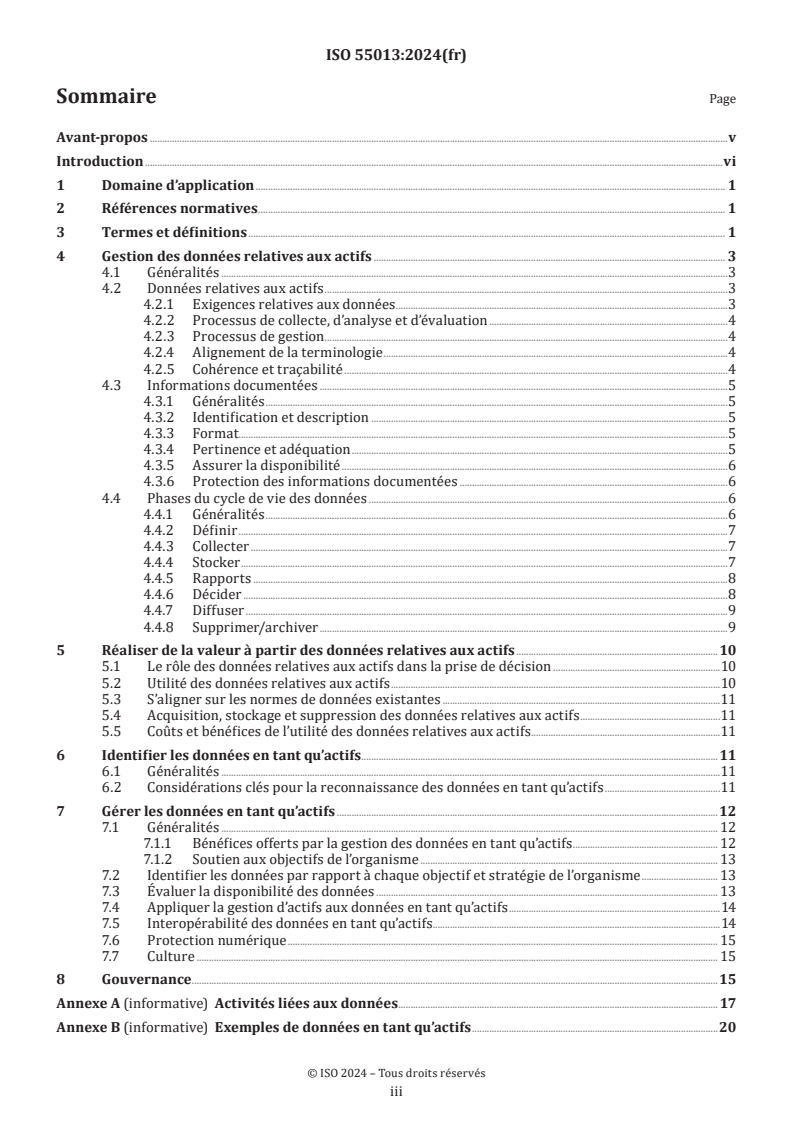

ISO 55013:2024 - Gestion d’actifs — Document d’orientation sur la gestion de données en tant qu’actifs Released:3. 07. 2024

ISO 55013:2024 - Asset management — Guidance on the management of data assets Released:16. 05. 2025
Overview
SIST ISO 55013:2024 - Asset management - Guidance on the management of data assets - provides practical guidance for managing data as an asset and for using data to support asset management decision‑making. Applicable to any organization regardless of type or size, the standard explains how to treat “asset data” (data that lists/describes assets) and “data assets” (collections of asset data with asset-like properties). SIST ISO 55013:2024 supports implementation of asset management principles described in ISO 55000 and the requirements of ISO 55001, while explicitly not prescribing methods to appraise or assign financial value to data assets.
Key Topics and Technical Focus
- Managing asset data and documented information
Guidance on identification, description, format, adequacy, availability and protection of asset data and related documented information. - Data requirements and processes
Defining data needs; processes for collection, analysis, evaluation, management, distribution and reporting. - Data lifecycle stages
Coverage of lifecycle stages such as Define → Collect → Store → Report → Decide → Distribute → Dispose/Archive, with attention to traceability and consistency. - Data quality, usefulness and decision support
Ensuring data fitness for purpose, usefulness in organizational decision‑making, and alignment to business objectives. - Interoperability and digital preservation
Ensuring data can be used across systems and preserved for future use. - Governance, roles and culture
Guidance on governance structures, stewardship responsibilities, data security and organizational culture for effective data asset management. - Practical annexes
Informative annexes include data activities and examples to help translate guidance into practice.
Practical Applications and Who Uses It
SIST ISO 55013:2024 is intended for professionals involved in asset and information management, including:
- Asset owners and asset managers
- Information managers, data stewards and IT teams
- Service providers, contractors and maintainers
- Auditors, regulators and investors
- Cross‑functional stakeholders responsible for operational, tactical and strategic decisions
Typical uses:
- Designing or improving data governance and stewardship programs
- Defining asset data requirements to support ISO 55001 asset management systems
- Establishing processes for data collection, protection, interoperability and lifecycle management
- Strengthening decision‑making by improving data quality, traceability and availability
Related Standards
- ISO 55000 (Asset management - Overview, principles)
- ISO 55001 (Asset management - Management system requirements)
Keywords: SIST ISO 55013:2024, asset management, data assets, asset data, data lifecycle, data governance, data stewardship, ISO 55000, ISO 55001.
Buy Documents
ISO 55013:2024 - Asset management — Guidance on the management of data assets Released:3. 07. 2024
ISO 55013:2024 - Gestion d’actifs — Document d’orientation sur la gestion de données en tant qu’actifs Released:3. 07. 2024
ISO 55013:2024 - Asset management — Guidance on the management of data assets Released:16. 05. 2025
Get Certified
Connect with accredited certification bodies for this standard

BSI Group
BSI (British Standards Institution) is the business standards company that helps organizations make excellence a habit.

Bureau Veritas
Bureau Veritas is a world leader in laboratory testing, inspection and certification services.

DNV
DNV is an independent assurance and risk management provider.
Sponsored listings
Frequently Asked Questions
SIST ISO 55013:2024 is a standard published by the Slovenian Institute for Standardization (SIST). Its full title is "Asset management - Guidance on the management of data assets". This standard covers: This document gives guidance on managing data to support an organization in meeting its asset management objectives and by extension its organizational objectives. This document is applicable to any organization, regardless of its type or size. This document does not provide methodologies to derive or appraise value for data assets. This document does not provide methodologies to derive financial values for data assets. This document does not provide direction to organizations on the need (or not) for calculating financial values for asset data.
This document gives guidance on managing data to support an organization in meeting its asset management objectives and by extension its organizational objectives. This document is applicable to any organization, regardless of its type or size. This document does not provide methodologies to derive or appraise value for data assets. This document does not provide methodologies to derive financial values for data assets. This document does not provide direction to organizations on the need (or not) for calculating financial values for asset data.
SIST ISO 55013:2024 is classified under the following ICS (International Classification for Standards) categories: 03.100.01 - Company organization and management in general; 03.100.10 - Purchasing. Procurement. Logistics. The ICS classification helps identify the subject area and facilitates finding related standards.
SIST ISO 55013:2024 is available in PDF format for immediate download after purchase. The document can be added to your cart and obtained through the secure checkout process. Digital delivery ensures instant access to the complete standard document.
Standards Content (Sample)
SLOVENSKI STANDARD
01-september-2024
Obvladovanje premoženja - Napotki za upravljanje podatkovnih sredstev
Asset management - Guidance on the management of data assets
Gestion d’actifs — Orientation sur la gestion d’actifs de données
Ta slovenski standard je istoveten z: ISO 55013:2024
ICS:
03.100.10 Nabava. Dobava. Logistika Purchasing. Procurement.
Logistics
2003-01.Slovenski inštitut za standardizacijo. Razmnoževanje celote ali delov tega standarda ni dovoljeno.
International
Standard
ISO 55013
First edition
Asset management — Guidance on
2024-07
the management of data assets
Gestion d’actifs — Document d’orientation sur la gestion de
données en tant qu’actifs
Reference number
© ISO 2024
All rights reserved. Unless otherwise specified, or required in the context of its implementation, no part of this publication may
be reproduced or utilized otherwise in any form or by any means, electronic or mechanical, including photocopying, or posting on
the internet or an intranet, without prior written permission. Permission can be requested from either ISO at the address below
or ISO’s member body in the country of the requester.
ISO copyright office
CP 401 • Ch. de Blandonnet 8
CH-1214 Vernier, Geneva
Phone: +41 22 749 01 11
Email: copyright@iso.org
Website: www.iso.org
Published in Switzerland
ii
Contents Page
Foreword .v
Introduction .vi
1 Scope . 1
2 Normative references . 1
3 Terms and definitions . 1
4 Managing asset data . 2
4.1 General .2
4.2 Asset data .3
4.2.1 Data requirements .3
4.2.2 Processes for collection, analysis and evaluation .4
4.2.3 Processes for management .4
4.2.4 Alignment of terminology .4
4.2.5 Consistency and traceability .4
4.3 Documented information .4
4.3.1 General .4
4.3.2 Identification and description .4
4.3.3 Format.5
4.3.4 Suitability and adequacy .5
4.3.5 Ensuring availability.5
4.3.6 Protection of documented information .5
4.4 Data life cycle stages .6
4.4.1 General .6
4.4.2 Define .6
4.4.3 Collect .6
4.4.4 Store .6
4.4.5 Reporting .7
4.4.6 Decide .7
4.4.7 Distribute .8
4.4.8 Dispose/archiving .8
5 Delivering value from asset data . 8
5.1 Asset data’s role in decision-making .8
5.2 Usefulness of asset data .9
5.3 Align with prevailing data standards .9
5.4 Acquisition, storage and disposal of asset data .9
5.5 Costs and benefits of the usefulness of asset data .10
6 Identifying data assets .10
6.1 General .10
6.2 Key considerations for recognizing data assets .10
7 Managing data assets .11
7.1 General .11
7.1.1 Benefits provided by management of data assets .11
7.1.2 Support for organizational objectives .11
7.2 Identify data related to each organizational objective and strategy .11
7.3 Assess data availability. 12
7.4 Applying asset management to data assets . 12
7.5 Interoperability of the data asset . 13
7.6 Digital preservation . 13
7.7 Culture . 13
8 Governance . 14
Annex A (informative) Data activities .15
Annex B (informative) Data asset examples .18
iii
Bibliography .20
iv
Foreword
ISO (the International Organization for Standardization) is a worldwide federation of national standards
bodies (ISO member bodies). The work of preparing International Standards is normally carried out through
ISO technical committees. Each member body interested in a subject for which a technical committee
has been established has the right to be represented on that committee. International organizations,
governmental and non-governmental, in liaison with ISO, also take part in the work. ISO collaborates closely
with the International Electrotechnical Commission (IEC) on all matters of electrotechnical standardization.
The procedures used to develop this document and those intended for its further maintenance are described
in the ISO/IEC Directives, Part 1. In particular, the different approval criteria needed for the different types
of ISO document should be noted. This document was drafted in accordance with the editorial rules of the
ISO/IEC Directives, Part 2 (see www.iso.org/directives).
ISO draws attention to the possibility that the implementation of this document may involve the use of (a)
patent(s). ISO takes no position concerning the evidence, validity or applicability of any claimed patent
rights in respect thereof. As of the date of publication of this document, ISO had not received notice of (a)
patent(s) which may be required to implement this document. However, implementers are cautioned that
this may not represent the latest information, which may be obtained from the patent database available at
www.iso.org/patents. ISO shall not be held responsible for identifying any or all such patent rights.
Any trade name used in this document is information given for the convenience of users and does not
constitute an endorsement.
For an explanation of the voluntary nature of standards, the meaning of ISO specific terms and expressions
related to conformity assessment, as well as information about ISO’s adherence to the World Trade
Organization (WTO) principles in the Technical Barriers to Trade (TBT), see www.iso.org/iso/foreword.html.
This document was prepared by Technical Committee ISO/TC 251, Asset management.
Any feedback or questions on this document should be directed to the user’s national standards body. A
complete listing of these bodies can be found at www.iso.org/members.html.
v
Introduction
0.1 General
This document gives guidance on the management of data when applying asset management principles
or requirements for an asset management system. These principles and requirements are described in
ISO 55000 and ISO 55001, respectively. Much of asset management involves decision-making with decisions
being reliant on data, particularly for larger and more complex contexts.
This document is intended to facilitate organizations in their management of data in the context of asset
management. Effective asset management typically relies on the proper management of data that is pertinent
to the assets. Organizations can manage the data as an asset to support their organizational management.
This document covers management of data both for supporting the practice of asset management and for
handling the data as an asset.
NOTE For the purposes of this document, the term “asset data” is used to refer to data that lists and describes an
asset and the term “data asset” is used to refer to collections of asset data that has the properties of an asset.
This document gives guidance for those who:
a) are identifying the usefulness or fitness for purpose of data for achieving the asset management
objectives of the organization, including fulfilling its accountability;
b) are involved in the establishment, implementation, maintenance, stewardship and improvement of data
in the context of asset management;
c) are involved in the planning, designing, implementation and reviewing of data-based asset management
activities along with service providers;
d) are asset owners, asset managers, information managers, service providers, maintainers, partners,
auditors, regulators and investors;
e) are the internal and external stakeholders, including internal and external personnel, that affect, or are
affected (positively or negatively) by, the management of data in the context of asset management.
Management of data can play a critical role in other management systems as well as in an asset management
system. Meanwhile, there can be many benefits for organizations to integrate and implement multiple
management systems. The achievement of mutual alignments to other management systems requires an
approach based on an appropriate cross-functional data exchange and analysis within the organization.
0.2 Context of this document
Against a background of advances in information technology (IT) and diversifying stakeholder demands,
how data should be managed in the context of asset management is now seen as a pressing issue for many
organizations. As organizations get larger and tend to become more complex, the need for reliable data to
support sound decision-making becomes increasingly important. Data acquisition and maintenance is a cost
to an organization, while data’s potential value is realized when it is used or can be used in the future. The
value of data is diminished if it is unreliable, out of date and/or applied incorrectly.
Accordingly, the role of data is changing from being a resource that supports management activities to a
non-physical asset from which value is generated by being managed in a coordinated way, just like any other
tangible or intangible asset.
Data in the context of asset management has its own characteristics as follows:
a) like physical assets, asset data follows a sequence of life cycle stages; it can be used many times although
the usefulness of data can change as they move along their life cycle;
b) data can be stolen if not protected appropriately; such data theft does not bring data loss and can
therefore not be immediately evident to an organization yet create sustained negative impacts;
vi
c) data are easy to copy, transport and even corrupt, but they can be difficult or impossible to reproduce if
they are lost, destroyed or corrupted;
d) data can be used for multiple purposes: the same data can even be used by multiple people at the same
time; similarly, many people and processes can be adding or updating data simultaneously;
e) data can generate new value when combined with other assets;
f) many uses of data often lead to more data to handle as a result; most organizations manage increasing
volumes of data and the relationships between data sets;
g) data and information are essential in conducting business within an organization and/or between two
functions or divisions; most business decisions from the strategic to the operational level generally
involve the sharing of data.
While some of these characteristics are similar to other assets, as a whole, they differ in nature from those
of other asset types. This requires different approaches to ensure that the management of data supports its
objectives in the context of asset management.
Different data sets may be treated as assets which can be critical to the success of the organization. In
such situations, organizations may treat such collections of data as data assets. The principles of asset
management described in ISO 55000 should be applied to the management of data assets.
0.3 Relationship to ISO 55000 and ISO 55001
ISO 55000 is the foundation for implementing asset management, and therefore the prerequisite to
understand this document.
ISO 55001 can be applied by organizations to establish and implement an asset management system. This
also applies to an asset management system for data assets. On the other hand, since an organization’s
asset management system is supported by decision-making based on information or data and its
analysis, the process of determining decision-making criteria in an asset management system that meets
the requirements of ISO 55001 generally includes the process of managing data. As such, this document
facilitates organizations to include data assets within their asset management system.
vii
International Standard ISO 55013:2024(en)
Asset management — Guidance on the management of
data assets
1 Scope
This document gives guidance on managing data to support an organization in meeting its asset management
objectives and by extension its organizational objectives.
This document is applicable to any organization, regardless of its type or size.
This document does not provide methodologies to derive or appraise value for data assets.
This document does not provide methodologies to derive financial values for data assets.
This document does not provide direction to organizations on the need (or not) for calculating financial
values for asset data.
2 Normative references
The following documents are referred to in the text in such a way that some or all of their content constitutes
requirements of this document. For dated references, only the edition cited applies. For undated references,
the latest edition of the referenced document (including any amendments) applies.
ISO 55000, Asset management — Vocabulary, overview and principles
3 Terms and definitions
For the purposes of this document, the terms and definitions given in ISO 55000 and the following apply.
ISO and IEC maintain terminology databases for use in standardization at the following addresses:
— ISO Online browsing platform: available at https:// www .iso .org/ obp
— IEC Electropedia: available at https:// www .electropedia .org/
3.1
asset data
data that lists and describes an asset
Note 1 to entry: Asset data can exist in a number of formats such as structured data, documented information, sensor
data, etc. requiring different approaches to their management.
Note 2 to entry: Data supporting asset management decision-making can be considered as asset data.
3.2
data asset
data that has the properties of an asset
Note 1 to entry: Data assets can be managed as an asset in accordance with ISO 55001.
Note 2 to entry: Asset data (3.1) can be part of more than one data asset. Data assets can have relationships between
each other.
3.3
type
data type
named category of data characterized by a set of values, a syntax for denoting these values, and a set of
operations that interpret, manipulate or store the values
[SOURCE: ISO/IEC 1539-1:2023, 3.144, modified — “or store” added.]
3.4
metadata
data that defines and describes other data
[SOURCE: ISO 24531:2013, 4.32]
3.5
data quality
degree to which a set of inherent characteristics of data fulfils requirements
[SOURCE: ISO 8000-2:2022, 3.8.1, modified — Note to entry deleted.]
3.6
interoperability
capability of two or more entities to exchange items in accordance with a set of rules and mechanisms
implemented by an interface in each entity, in order to perform their specified tasks
Note 1 to entry: Examples of entities include devices, equipment, machines, people, processes, applications, computer
firmware and application software units, data exchange systems and enterprises.
Note 2 to entry: Examples of items include services, information, material in standards, design documents and
drawings, improvement projects, energy reduction programs, control activities, asset description and ideas.
Note 3 to entry: In this context, entities provide items to, and accept items from, other entities, and they use the items
exchanged in this way to enable them to operate effectively together.
[SOURCE: ISO 18435-1:2009, 3.12, modified — “specified” replaced “respective” in the definition. Notes 1
and 2 to entry expanded. Note 3 to entry added.]
3.7
governing function
function responsible for the strategic guidance of the data governance programme
Note 1 to entry: The governing function is responsible for the prioritization of data governance projects and initiatives,
and the approval of organization-wide data policies and standards, as well as enabling ongoing support, understanding
and awareness of the data governance programme.
Note 2 to entry: Depending on the culture of the organization, a governing body can be known by other names such
as the data governance committee, data governance steering council/committee/group, data governance advisory
council/committee/group, data stewardship council/committee, data owners’ council/committee.
4 Managing asset data
4.1 General
Asset management enables an organization to realize value from its assets in the achievement of its asset
management objectives and by extension its organizational objectives. What constitutes value depends
on these objectives, the nature and purpose of the organization, and the needs and expectations of its
stakeholders (see ISO 55000).
Many asset management activities rely on effective decision-making which in turn relies on data and
documented information. The asset data used by an organization to inform decision-making in turn requires
effective management to ensure usefulness to the organization within the required timescales. Suitable
accountability and management of these asset data is required to ensure and maintain usefulness.
Asset data can be created, acquired or generated at all stages of the asset life cycle. Asset data supporting
asset management activities is generally required for at least as long as the asset itself exists. Asset data
that conformed with the requirements of the organization at the time it was acquired does not necessarily
conform to current organizational requirements.
The configuration or nature of the asset can constrain or prevent data acquisition activities and also make it
difficult to check or improve incorrect or missing asset data. Asset interventions occur at a discrete period;
therefore, subsequent checking or improvement of asset data arising from these interventions requires
additional data sources.
4.2 Asset data
4.2.1 Data requirements
The organization should determine its data requirements and manage its data across its life cycle to
support the scope of its asset management system to achieve both its asset management and organizational
objectives (see ISO 55001:2024, 7.6, which also deals with requirements related both to the data themselves
and to their alignment across the organization’s functions).
In addition, the organization should determine the following:
a) Legal requirements: The legal requirements of holding, managing and transferring asset data.
b) Data dictionaries: Data specifications and requirements by the organization’s management system to
enable consistent definition of attributes, units of measurement, criticality, quality and source for the
different types of asset data.
c) Data frequency: The frequency for updating data. While some asset data can remain static across all life
cycle stages, others can be updated in pre-defined intervals of time.
d) Data volume: The volume of data can determine which tools and storage environments are most
appropriate to be used.
e) Data security: Ensuring that data are protected from inappropriate access (e.g. from loss of
confidentiality, improper use or improper modification including improper additions, alterations and
deletions).
f) Data availability: Ensuring the availability of data at critical times is defined and it is accessible by the
asset management team when required.
g) Data responsibility: Determining roles and responsibilities related to the management of asset data.
Where it is not possible for the organization to achieve these data requirements, it is important for the
organization to provide direction as appropriate.
Before data can be published or used to make asset management decisions, its quality should be understood.
Making decision-makers aware of what data are available and how their quality enables informed decision-
making, mitigates risks related to confidence in the accuracy and effectiveness of the decisions being made.
By deriving meaning from data and by managing data to ensure that they are of sufficient quality to meet
asset management objectives, they increase in usefulness to the organization.
Quality requirements for asset data closely relate to asset data requirements. Quality requirements are
determined and managed alongside the data requirements to ensure an adequate balance of cost, risk and
performance. Data quality can be assessed using a confidence scale similar to that of the condition scale of
the underlying asset.
NOTE The ISO 8000 series provides guidance on assessing and managing data quality.
The identification of data requirements and associated quality requirements ensures that data are fit for
purpose and provides support to decision-making processes as expected.
4.2.2 Processes for collection, analysis and evaluation
Changes to assets and the acquisition or disposal of assets generates asset data requiring collection and
storage for future use and decision-making. Defined processes covering such situations supports the
consistent collection and analysis of asset data.
4.2.3 Processes for management
Changes to assets, software technologies, processes and organizational configurations will generally lead
to related changes to asset data. Defining and running processes for all aspects of the asset data life cycle
ensure that asset data continues to support asset management decision-making.
The processes for the management of asset data should include a consideration of ongoing maintenance from
the decision to collect data. Without processes for maintaining data quality, the results of the initial data
collection exercise can quickly lose value. As soon as data are collected, data quality management should
become part of the normal business processes.
NOTE ISO 8000-61 describes a process reference model for data quality management.
4.2.4 Alignment of terminology
Different organizational contexts, technical disciplines, software technologies and territories can lead to
differences in the terminology relating to assets. Data dictionaries can be useful to explain synonyms and
different terminology and to clearly identify preferred terms.
4.2.5 Consistency and traceability
Asset data supporting the asset management objectives of an organization can arise from many sources
and processes, potentially leading to inconsistent approaches to collection and storage. Asset data can be
transferred between data stores, potentially multiple times, with each transfer activity potentially being a
source of inconsistency or quality issues.
Management processes to monitor the consistency of asset data helps identify activities leading to
inconsistent data. Asset-owning organizations typically have data about assets stored in more than one data
store. Where this is the case, one data store should be identified as the master data source that is updated
first and is referred to by other data stores. Understanding how data are transferred into, across and out
of an organization ensures that master data sources are understood and that changes to master data are
correctly applied across the organization.
4.3 Documented information
4.3.1 General
Documented information can fulfil many purposes within an organization, including recording and
explaining the asset management system, providing narrative descriptions of how to maintain an asset and
providing test certificates. Like asset data, documented information can experience many similar problems
and requires active management.
4.3.2 Identification and description
Organizations typically acquire and store large quantities of documented information. Documented
information can support ongoing processes and decision-making or can require safe storage for future
usage, for example, during asset disposal.
Defined and relevant approaches to the identification and description of documented information ensure
that people can find the correct documented information without undue effort.
4.3.3 Format
Documented information may have many different arrangements and formats of the content within them
and may be stored using different file formats. Organizations that specify allowable content and file formats
help ensure that users of the documented information can effectively do so for as long as the information is
needed to support asset management decision-making.
4.3.4 Suitability and adequacy
Documented information may be created in many different written styles, use varied content structures
and can have very different quantities of text, to meet the needs of different use(s) and users. Assessing
the suitability of documented information against these use(s) and users helps ensure that asset decision-
making is effectively supported and ensures documented information meets organizational requirements.
Assessments of the adequacy of documented information against the use(s) and users identifies where
revisions and changes to the documented information are required.
NOTE Where organizations operate in multiple countries or use different languages, the language used can be an
additional factor relating to suitability.
4.3.5 Ensuring availability
Many factors can restrict the availability and suitability of documented information, including:
a) changes to technology platforms increasing or decreasing the availability of documented information
(e.g. changes in the capability and effectiveness of search functionality);
b) changes to software licensing, which can restrict user access to required documented information;
c) changes to the user base within the organization, such as when expanding into new territories, which
can necessitate the translation of documented information into different languages;
d) changes to the competence of users within the organization (e.g. which can necessitate the redrafting of
documented information into simpler formats for users with lower competency levels).
4.3.6 Protection of documented information
Documented information can be required over the whole life of the assets that they represent. Factors that
inform the level of protection required include the following:
a) Protection from deletion: Application of user-level permissions to restrict who may delete documented
information. The deletion may also include logical deletion prior to ultimate physical deletion.
b) Protection from alteration: Application of user-level permissions to restrict who may edit and alter
documented information. The retention of superseded versions of documented information allows
organizations to view and restore previous versions of the documented information.
c) Protection of unauthorized access: Application of security permissions to restrict access to documented
information to approved users within the organization accessing, sharing or printing restricted
information. Security permissions and restrictions on document sharing can protect documented
information from unauthorized users outside the organization.
d) Protection from technology failure: Application of data backup processes to maintain off-line and off-site
copies of documented information that may be used to restore documented information in situations of
catastrophic hardware and/or software failure. Testing of backup restoration processes ensures that
backups are being correctly taken and that there are the skills and tools to restore this documented
information.
4.4 Data life cycle stages
4.4.1 General
The accountability for data and its use ultimately rests with the governance function of the organization,
and is usually delegated to those responsible for the operation of the asset management system. These life
cycle stages may be applied in a different order, and depending on the organizational context, can have
different relationships to each other.
NOTE Annex A provides supplementary information/explanation on data life cycles.
4.4.2 Define
The define activity includes provision of explicit guidance of the form, structure and meaning of asset data
required by the organization. The combined set of data definitions for an organization may be described as a
“data dictionary”, “organizational information requirements” (OIR) or “asset information requirements” (AIR).
The overall collection of data definitions for an organization changes over time. The organization’s change
management processes should ensure that changes are agreed before implementation.
4.4.3 Collect
The collect activity includes the data acquisition, gathering and creation process, learning from previous
decisions made, and additional context extracted from other data sets (internal or external).
Data exists in many forms and can be created and collected for managing by individuals in the organization
in a number of different ways, including the following.
a) Data entry: Data entry is achieved using applications either within the organization (e.g. in an enterprise
resource planning, enterprise resource planning (ERP), system or email application) or externally via a
website, mobile application or similar application.
b) Transactions from other systems: Data entry or updating done on other systems can flow through to the
organization’s system through electronic data interchange (EDI), or other interfacing processes.
c) Sensors: An increasing amount of data are ingested into the organization through machine systems
such as sensors. Sensors cover a wide range of data acquisition devices including website logs, social
media sources and so-called “internet of things” devices which include everyday devices from simple
temperature sensors to TVs, cars, traffic lights and buildings. Data from sensors can also include
potentially urgent signals such as alerts and alarms.
d) New context: Data from reports can be combined with other data sources, such as from supplementary
models, to provide additional information, which is itself fed back into the data of the organization. In
many cases, this additional data gives new context to the original data and should be treated differently
from the original data. New contextual data may come from decisions which can give relevance or value
to existing data.
e) Subscription: Data may be made available to the organization through a subscription to a data feed or
virtual data store.
f) Time sensitivity: Live data can encounter an expiry date, or data collected at any given time can be
required and useful only at certain times. Therefore, the time frame of the data collection and the
relevance of the data for that moment in time should be considered during this life cycle stage.
4.4.4 Store
The store activity includes locating the data where it can be retrieved. This includes data stored on devices
owned and operated by the organization, devices external to the organization and also virtual stores, such
as data feeds where the data are only collated when needed. In each case, the stored data may be retained
for reporting purposes pending a decision to dispose.
As data are collected through the above actions, it is ingested into a data store where it should be secured,
managed and possibly archived. The amount of data that organizations control is increasing rapidly due to
new technologies. Many of these new technologies run in public cloud computing environments where the
economies of scale enable large storage and processing capabilities at much lower cost.
In some cases, the organization may use a data store that is outside its location. Traditionally, this has been
through offsite hosting operations where the storage is outsourced. Cloud computing takes this to the next
stage where the operation of the store is not visible to the client organization. Furthermore, the organization
may use a virtual store, where data are provided only as a data feed which can flow directly into reports or
analysis.
Even though the organization controls the data in its store, it does not necessarily own that data because
of intellectual property rights (such as copyright) or other legal issues (including personal or health
information handling laws). Special care may also be necessary where the storage and use of data cross
jurisdictional boundaries. In any case, the stewardship of the data remains with the governance function.
NOTE ISO/IEC 27040 provides guidance on data storage security.
4.4.5 Reporting
The reporting activity includes the manual or automated extraction and analysis of data to support decision-
making, distribution or disposal. It is important to note that the reporting and deciding activities can be
interchangeable in their order, as they have a bidirectional relationship.
An important capability of an information system is to extract data from the data store in the form of a
data feed. The data feed, a structured system to provide updated data regularly, should have associated
properties such as quality and currency of the data so that the organization can determine its usefulness to
the reports they produce from that data.
During the extraction and reporting process, many data feeds may be used and these can come from a data
store within the organization or may come from a virtual data store outside the organization. The combination
of these data feeds can give a new context to the data. This new context is in itself new data and this should be
fed back into the data creation and collection process, where the normal collection process occurs.
Applications can also produce reports as well as update the existing data and again, this new data follows
the creation process.
Reports may also be used to filter data to increase its usefulness, or to enable distribution and disposal.
For example, data from sensors can be aggregated to extract trends, removing personally identifiable
information may be achieved through techniques such as anonymization and pseudonymization. The
original data can then be similarly extracted and disposed of.
4.4.6 Decide
The decide activity occurs when a decision is made based on the report evaluation. The decisions may be
made by people within the organization or by automated means. Suitable agreement is required before
automated decision-making takes place; it is important that the decisions and outcomes are monitored.
The main reason for asset data is to support decisions, and the value of data is how they improve the
decisions that are made. Reports (including on screen reporting) are examined to provide information upon
which decisions are made.
Through a process of delegation, the governing function can ensure that the decisions made are appropriate
for the level of responsibility of those decisions. This is of particular importance when decisions are
made automatically through simple or complex data flow processes. In any case, the governing function
remains accountable for all decisions and should ensure that they have the appropriate controls and, where
necessary, apply human intervention to deal with any biases, discrimination or profiling in the decisi
...
International
Standard
ISO 55013
First edition
Asset management — Guidance on
2024-07
the management of data assets
Gestion d’actifs — Document d’orientation sur la gestion de
données en tant qu’actifs
Reference number
© ISO 2024
All rights reserved. Unless otherwise specified, or required in the context of its implementation, no part of this publication may
be reproduced or utilized otherwise in any form or by any means, electronic or mechanical, including photocopying, or posting on
the internet or an intranet, without prior written permission. Permission can be requested from either ISO at the address below
or ISO’s member body in the country of the requester.
ISO copyright office
CP 401 • Ch. de Blandonnet 8
CH-1214 Vernier, Geneva
Phone: +41 22 749 01 11
Email: copyright@iso.org
Website: www.iso.org
Published in Switzerland
ii
Contents Page
Foreword .v
Introduction .vi
1 Scope . 1
2 Normative references . 1
3 Terms and definitions . 1
4 Managing asset data . 2
4.1 General .2
4.2 Asset data .3
4.2.1 Data requirements .3
4.2.2 Processes for collection, analysis and evaluation .4
4.2.3 Processes for management .4
4.2.4 Alignment of terminology .4
4.2.5 Consistency and traceability .4
4.3 Documented information .4
4.3.1 General .4
4.3.2 Identification and description .4
4.3.3 Format.5
4.3.4 Suitability and adequacy .5
4.3.5 Ensuring availability.5
4.3.6 Protection of documented information .5
4.4 Data life cycle stages .6
4.4.1 General .6
4.4.2 Define .6
4.4.3 Collect .6
4.4.4 Store .6
4.4.5 Reporting .7
4.4.6 Decide .7
4.4.7 Distribute .8
4.4.8 Dispose/archiving .8
5 Delivering value from asset data . 8
5.1 Asset data’s role in decision-making .8
5.2 Usefulness of asset data .9
5.3 Align with prevailing data standards .9
5.4 Acquisition, storage and disposal of asset data .9
5.5 Costs and benefits of the usefulness of asset data .10
6 Identifying data assets .10
6.1 General .10
6.2 Key considerations for recognizing data assets .10
7 Managing data assets .11
7.1 General .11
7.1.1 Benefits provided by management of data assets .11
7.1.2 Support for organizational objectives .11
7.2 Identify data related to each organizational objective and strategy .11
7.3 Assess data availability. 12
7.4 Applying asset management to data assets . 12
7.5 Interoperability of the data asset . 13
7.6 Digital preservation . 13
7.7 Culture . 13
8 Governance . 14
Annex A (informative) Data activities .15
Annex B (informative) Data asset examples .18
iii
Bibliography .20
iv
Foreword
ISO (the International Organization for Standardization) is a worldwide federation of national standards
bodies (ISO member bodies). The work of preparing International Standards is normally carried out through
ISO technical committees. Each member body interested in a subject for which a technical committee
has been established has the right to be represented on that committee. International organizations,
governmental and non-governmental, in liaison with ISO, also take part in the work. ISO collaborates closely
with the International Electrotechnical Commission (IEC) on all matters of electrotechnical standardization.
The procedures used to develop this document and those intended for its further maintenance are described
in the ISO/IEC Directives, Part 1. In particular, the different approval criteria needed for the different types
of ISO document should be noted. This document was drafted in accordance with the editorial rules of the
ISO/IEC Directives, Part 2 (see www.iso.org/directives).
ISO draws attention to the possibility that the implementation of this document may involve the use of (a)
patent(s). ISO takes no position concerning the evidence, validity or applicability of any claimed patent
rights in respect thereof. As of the date of publication of this document, ISO had not received notice of (a)
patent(s) which may be required to implement this document. However, implementers are cautioned that
this may not represent the latest information, which may be obtained from the patent database available at
www.iso.org/patents. ISO shall not be held responsible for identifying any or all such patent rights.
Any trade name used in this document is information given for the convenience of users and does not
constitute an endorsement.
For an explanation of the voluntary nature of standards, the meaning of ISO specific terms and expressions
related to conformity assessment, as well as information about ISO’s adherence to the World Trade
Organization (WTO) principles in the Technical Barriers to Trade (TBT), see www.iso.org/iso/foreword.html.
This document was prepared by Technical Committee ISO/TC 251, Asset management.
Any feedback or questions on this document should be directed to the user’s national standards body. A
complete listing of these bodies can be found at www.iso.org/members.html.
v
Introduction
0.1 General
This document gives guidance on the management of data when applying asset management principles
or requirements for an asset management system. These principles and requirements are described in
ISO 55000 and ISO 55001, respectively. Much of asset management involves decision-making with decisions
being reliant on data, particularly for larger and more complex contexts.
This document is intended to facilitate organizations in their management of data in the context of asset
management. Effective asset management typically relies on the proper management of data that is pertinent
to the assets. Organizations can manage the data as an asset to support their organizational management.
This document covers management of data both for supporting the practice of asset management and for
handling the data as an asset.
NOTE For the purposes of this document, the term “asset data” is used to refer to data that lists and describes an
asset and the term “data asset” is used to refer to collections of asset data that has the properties of an asset.
This document gives guidance for those who:
a) are identifying the usefulness or fitness for purpose of data for achieving the asset management
objectives of the organization, including fulfilling its accountability;
b) are involved in the establishment, implementation, maintenance, stewardship and improvement of data
in the context of asset management;
c) are involved in the planning, designing, implementation and reviewing of data-based asset management
activities along with service providers;
d) are asset owners, asset managers, information managers, service providers, maintainers, partners,
auditors, regulators and investors;
e) are the internal and external stakeholders, including internal and external personnel, that affect, or are
affected (positively or negatively) by, the management of data in the context of asset management.
Management of data can play a critical role in other management systems as well as in an asset management
system. Meanwhile, there can be many benefits for organizations to integrate and implement multiple
management systems. The achievement of mutual alignments to other management systems requires an
approach based on an appropriate cross-functional data exchange and analysis within the organization.
0.2 Context of this document
Against a background of advances in information technology (IT) and diversifying stakeholder demands,
how data should be managed in the context of asset management is now seen as a pressing issue for many
organizations. As organizations get larger and tend to become more complex, the need for reliable data to
support sound decision-making becomes increasingly important. Data acquisition and maintenance is a cost
to an organization, while data’s potential value is realized when it is used or can be used in the future. The
value of data is diminished if it is unreliable, out of date and/or applied incorrectly.
Accordingly, the role of data is changing from being a resource that supports management activities to a
non-physical asset from which value is generated by being managed in a coordinated way, just like any other
tangible or intangible asset.
Data in the context of asset management has its own characteristics as follows:
a) like physical assets, asset data follows a sequence of life cycle stages; it can be used many times although
the usefulness of data can change as they move along their life cycle;
b) data can be stolen if not protected appropriately; such data theft does not bring data loss and can
therefore not be immediately evident to an organization yet create sustained negative impacts;
vi
c) data are easy to copy, transport and even corrupt, but they can be difficult or impossible to reproduce if
they are lost, destroyed or corrupted;
d) data can be used for multiple purposes: the same data can even be used by multiple people at the same
time; similarly, many people and processes can be adding or updating data simultaneously;
e) data can generate new value when combined with other assets;
f) many uses of data often lead to more data to handle as a result; most organizations manage increasing
volumes of data and the relationships between data sets;
g) data and information are essential in conducting business within an organization and/or between two
functions or divisions; most business decisions from the strategic to the operational level generally
involve the sharing of data.
While some of these characteristics are similar to other assets, as a whole, they differ in nature from those
of other asset types. This requires different approaches to ensure that the management of data supports its
objectives in the context of asset management.
Different data sets may be treated as assets which can be critical to the success of the organization. In
such situations, organizations may treat such collections of data as data assets. The principles of asset
management described in ISO 55000 should be applied to the management of data assets.
0.3 Relationship to ISO 55000 and ISO 55001
ISO 55000 is the foundation for implementing asset management, and therefore the prerequisite to
understand this document.
ISO 55001 can be applied by organizations to establish and implement an asset management system. This
also applies to an asset management system for data assets. On the other hand, since an organization’s
asset management system is supported by decision-making based on information or data and its
analysis, the process of determining decision-making criteria in an asset management system that meets
the requirements of ISO 55001 generally includes the process of managing data. As such, this document
facilitates organizations to include data assets within their asset management system.
vii
International Standard ISO 55013:2024(en)
Asset management — Guidance on the management of
data assets
1 Scope
This document gives guidance on managing data to support an organization in meeting its asset management
objectives and by extension its organizational objectives.
This document is applicable to any organization, regardless of its type or size.
This document does not provide methodologies to derive or appraise value for data assets.
This document does not provide methodologies to derive financial values for data assets.
This document does not provide direction to organizations on the need (or not) for calculating financial
values for asset data.
2 Normative references
The following documents are referred to in the text in such a way that some or all of their content constitutes
requirements of this document. For dated references, only the edition cited applies. For undated references,
the latest edition of the referenced document (including any amendments) applies.
ISO 55000, Asset management — Vocabulary, overview and principles
3 Terms and definitions
For the purposes of this document, the terms and definitions given in ISO 55000 and the following apply.
ISO and IEC maintain terminology databases for use in standardization at the following addresses:
— ISO Online browsing platform: available at https:// www .iso .org/ obp
— IEC Electropedia: available at https:// www .electropedia .org/
3.1
asset data
data that lists and describes an asset
Note 1 to entry: Asset data can exist in a number of formats such as structured data, documented information, sensor
data, etc. requiring different approaches to their management.
Note 2 to entry: Data supporting asset management decision-making can be considered as asset data.
3.2
data asset
data that has the properties of an asset
Note 1 to entry: Data assets can be managed as an asset in accordance with ISO 55001.
Note 2 to entry: Asset data (3.1) can be part of more than one data asset. Data assets can have relationships between
each other.
3.3
type
data type
named category of data characterized by a set of values, a syntax for denoting these values, and a set of
operations that interpret, manipulate or store the values
[SOURCE: ISO/IEC 1539-1:2023, 3.144, modified — “or store” added.]
3.4
metadata
data that defines and describes other data
[SOURCE: ISO 24531:2013, 4.32]
3.5
data quality
degree to which a set of inherent characteristics of data fulfils requirements
[SOURCE: ISO 8000-2:2022, 3.8.1, modified — Note to entry deleted.]
3.6
interoperability
capability of two or more entities to exchange items in accordance with a set of rules and mechanisms
implemented by an interface in each entity, in order to perform their specified tasks
Note 1 to entry: Examples of entities include devices, equipment, machines, people, processes, applications, computer
firmware and application software units, data exchange systems and enterprises.
Note 2 to entry: Examples of items include services, information, material in standards, design documents and
drawings, improvement projects, energy reduction programs, control activities, asset description and ideas.
Note 3 to entry: In this context, entities provide items to, and accept items from, other entities, and they use the items
exchanged in this way to enable them to operate effectively together.
[SOURCE: ISO 18435-1:2009, 3.12, modified — “specified” replaced “respective” in the definition. Notes 1
and 2 to entry expanded. Note 3 to entry added.]
3.7
governing function
function responsible for the strategic guidance of the data governance programme
Note 1 to entry: The governing function is responsible for the prioritization of data governance projects and initiatives,
and the approval of organization-wide data policies and standards, as well as enabling ongoing support, understanding
and awareness of the data governance programme.
Note 2 to entry: Depending on the culture of the organization, a governing body can be known by other names such
as the data governance committee, data governance steering council/committee/group, data governance advisory
council/committee/group, data stewardship council/committee, data owners’ council/committee.
4 Managing asset data
4.1 General
Asset management enables an organization to realize value from its assets in the achievement of its asset
management objectives and by extension its organizational objectives. What constitutes value depends
on these objectives, the nature and purpose of the organization, and the needs and expectations of its
stakeholders (see ISO 55000).
Many asset management activities rely on effective decision-making which in turn relies on data and
documented information. The asset data used by an organization to inform decision-making in turn requires
effective management to ensure usefulness to the organization within the required timescales. Suitable
accountability and management of these asset data is required to ensure and maintain usefulness.
Asset data can be created, acquired or generated at all stages of the asset life cycle. Asset data supporting
asset management activities is generally required for at least as long as the asset itself exists. Asset data
that conformed with the requirements of the organization at the time it was acquired does not necessarily
conform to current organizational requirements.
The configuration or nature of the asset can constrain or prevent data acquisition activities and also make it
difficult to check or improve incorrect or missing asset data. Asset interventions occur at a discrete period;
therefore, subsequent checking or improvement of asset data arising from these interventions requires
additional data sources.
4.2 Asset data
4.2.1 Data requirements
The organization should determine its data requirements and manage its data across its life cycle to
support the scope of its asset management system to achieve both its asset management and organizational
objectives (see ISO 55001:2024, 7.6, which also deals with requirements related both to the data themselves
and to their alignment across the organization’s functions).
In addition, the organization should determine the following:
a) Legal requirements: The legal requirements of holding, managing and transferring asset data.
b) Data dictionaries: Data specifications and requirements by the organization’s management system to
enable consistent definition of attributes, units of measurement, criticality, quality and source for the
different types of asset data.
c) Data frequency: The frequency for updating data. While some asset data can remain static across all life
cycle stages, others can be updated in pre-defined intervals of time.
d) Data volume: The volume of data can determine which tools and storage environments are most
appropriate to be used.
e) Data security: Ensuring that data are protected from inappropriate access (e.g. from loss of
confidentiality, improper use or improper modification including improper additions, alterations and
deletions).
f) Data availability: Ensuring the availability of data at critical times is defined and it is accessible by the
asset management team when required.
g) Data responsibility: Determining roles and responsibilities related to the management of asset data.
Where it is not possible for the organization to achieve these data requirements, it is important for the
organization to provide direction as appropriate.
Before data can be published or used to make asset management decisions, its quality should be understood.
Making decision-makers aware of what data are available and how their quality enables informed decision-
making, mitigates risks related to confidence in the accuracy and effectiveness of the decisions being made.
By deriving meaning from data and by managing data to ensure that they are of sufficient quality to meet
asset management objectives, they increase in usefulness to the organization.
Quality requirements for asset data closely relate to asset data requirements. Quality requirements are
determined and managed alongside the data requirements to ensure an adequate balance of cost, risk and
performance. Data quality can be assessed using a confidence scale similar to that of the condition scale of
the underlying asset.
NOTE The ISO 8000 series provides guidance on assessing and managing data quality.
The identification of data requirements and associated quality requirements ensures that data are fit for
purpose and provides support to decision-making processes as expected.
4.2.2 Processes for collection, analysis and evaluation
Changes to assets and the acquisition or disposal of assets generates asset data requiring collection and
storage for future use and decision-making. Defined processes covering such situations supports the
consistent collection and analysis of asset data.
4.2.3 Processes for management
Changes to assets, software technologies, processes and organizational configurations will generally lead
to related changes to asset data. Defining and running processes for all aspects of the asset data life cycle
ensure that asset data continues to support asset management decision-making.
The processes for the management of asset data should include a consideration of ongoing maintenance from
the decision to collect data. Without processes for maintaining data quality, the results of the initial data
collection exercise can quickly lose value. As soon as data are collected, data quality management should
become part of the normal business processes.
NOTE ISO 8000-61 describes a process reference model for data quality management.
4.2.4 Alignment of terminology
Different organizational contexts, technical disciplines, software technologies and territories can lead to
differences in the terminology relating to assets. Data dictionaries can be useful to explain synonyms and
different terminology and to clearly identify preferred terms.
4.2.5 Consistency and traceability
Asset data supporting the asset management objectives of an organization can arise from many sources
and processes, potentially leading to inconsistent approaches to collection and storage. Asset data can be
transferred between data stores, potentially multiple times, with each transfer activity potentially being a
source of inconsistency or quality issues.
Management processes to monitor the consistency of asset data helps identify activities leading to
inconsistent data. Asset-owning organizations typically have data about assets stored in more than one data
store. Where this is the case, one data store should be identified as the master data source that is updated
first and is referred to by other data stores. Understanding how data are transferred into, across and out
of an organization ensures that master data sources are understood and that changes to master data are
correctly applied across the organization.
4.3 Documented information
4.3.1 General
Documented information can fulfil many purposes within an organization, including recording and
explaining the asset management system, providing narrative descriptions of how to maintain an asset and
providing test certificates. Like asset data, documented information can experience many similar problems
and requires active management.
4.3.2 Identification and description
Organizations typically acquire and store large quantities of documented information. Documented
information can support ongoing processes and decision-making or can require safe storage for future
usage, for example, during asset disposal.
Defined and relevant approaches to the identification and description of documented information ensure
that people can find the correct documented information without undue effort.
4.3.3 Format
Documented information may have many different arrangements and formats of the content within them
and may be stored using different file formats. Organizations that specify allowable content and file formats
help ensure that users of the documented information can effectively do so for as long as the information is
needed to support asset management decision-making.
4.3.4 Suitability and adequacy
Documented information may be created in many different written styles, use varied content structures
and can have very different quantities of text, to meet the needs of different use(s) and users. Assessing
the suitability of documented information against these use(s) and users helps ensure that asset decision-
making is effectively supported and ensures documented information meets organizational requirements.
Assessments of the adequacy of documented information against the use(s) and users identifies where
revisions and changes to the documented information are required.
NOTE Where organizations operate in multiple countries or use different languages, the language used can be an
additional factor relating to suitability.
4.3.5 Ensuring availability
Many factors can restrict the availability and suitability of documented information, including:
a) changes to technology platforms increasing or decreasing the availability of documented information
(e.g. changes in the capability and effectiveness of search functionality);
b) changes to software licensing, which can restrict user access to required documented information;
c) changes to the user base within the organization, such as when expanding into new territories, which
can necessitate the translation of documented information into different languages;
d) changes to the competence of users within the organization (e.g. which can necessitate the redrafting of
documented information into simpler formats for users with lower competency levels).
4.3.6 Protection of documented information
Documented information can be required over the whole life of the assets that they represent. Factors that
inform the level of protection required include the following:
a) Protection from deletion: Application of user-level permissions to restrict who may delete documented
information. The deletion may also include logical deletion prior to ultimate physical deletion.
b) Protection from alteration: Application of user-level permissions to restrict who may edit and alter
documented information. The retention of superseded versions of documented information allows
organizations to view and restore previous versions of the documented information.
c) Protection of unauthorized access: Application of security permissions to restrict access to documented
information to approved users within the organization accessing, sharing or printing restricted
information. Security permissions and restrictions on document sharing can protect documented
information from unauthorized users outside the organization.
d) Protection from technology failure: Application of data backup processes to maintain off-line and off-site
copies of documented information that may be used to restore documented information in situations of
catastrophic hardware and/or software failure. Testing of backup restoration processes ensures that
backups are being correctly taken and that there are the skills and tools to restore this documented
information.
4.4 Data life cycle stages
4.4.1 General
The accountability for data and its use ultimately rests with the governance function of the organization,
and is usually delegated to those responsible for the operation of the asset management system. These life
cycle stages may be applied in a different order, and depending on the organizational context, can have
different relationships to each other.
NOTE Annex A provides supplementary information/explanation on data life cycles.
4.4.2 Define
The define activity includes provision of explicit guidance of the form, structure and meaning of asset data
required by the organization. The combined set of data definitions for an organization may be described as a
“data dictionary”, “organizational information requirements” (OIR) or “asset information requirements” (AIR).
The overall collection of data definitions for an organization changes over time. The organization’s change
management processes should ensure that changes are agreed before implementation.
4.4.3 Collect
The collect activity includes the data acquisition, gathering and creation process, learning from previous
decisions made, and additional context extracted from other data sets (internal or external).
Data exists in many forms and can be created and collected for managing by individuals in the organization
in a number of different ways, including the following.
a) Data entry: Data entry is achieved using applications either within the organization (e.g. in an enterprise
resource planning, enterprise resource planning (ERP), system or email application) or externally via a
website, mobile application or similar application.
b) Transactions from other systems: Data entry or updating done on other systems can flow through to the
organization’s system through electronic data interchange (EDI), or other interfacing processes.
c) Sensors: An increasing amount of data are ingested into the organization through machine systems
such as sensors. Sensors cover a wide range of data acquisition devices including website logs, social
media sources and so-called “internet of things” devices which include everyday devices from simple
temperature sensors to TVs, cars, traffic lights and buildings. Data from sensors can also include
potentially urgent signals such as alerts and alarms.
d) New context: Data from reports can be combined with other data sources, such as from supplementary
models, to provide additional information, which is itself fed back into the data of the organization. In
many cases, this additional data gives new context to the original data and should be treated differently
from the original data. New contextual data may come from decisions which can give relevance or value
to existing data.
e) Subscription: Data may be made available to the organization through a subscription to a data feed or
virtual data store.
f) Time sensitivity: Live data can encounter an expiry date, or data collected at any given time can be
required and useful only at certain times. Therefore, the time frame of the data collection and the
relevance of the data for that moment in time should be considered during this life cycle stage.
4.4.4 Store
The store activity includes locating the data where it can be retrieved. This includes data stored on devices
owned and operated by the organization, devices external to the organization and also virtual stores, such
as data feeds where the data are only collated when needed. In each case, the stored data may be retained
for reporting purposes pending a decision to dispose.
As data are collected through the above actions, it is ingested into a data store where it should be secured,
managed and possibly archived. The amount of data that organizations control is increasing rapidly due to
new technologies. Many of these new technologies run in public cloud computing environments where the
economies of scale enable large storage and processing capabilities at much lower cost.
In some cases, the organization may use a data store that is outside its location. Traditionally, this has been
through offsite hosting operations where the storage is outsourced. Cloud computing takes this to the next
stage where the operation of the store is not visible to the client organization. Furthermore, the organization
may use a virtual store, where data are provided only as a data feed which can flow directly into reports or
analysis.
Even though the organization controls the data in its store, it does not necessarily own that data because
of intellectual property rights (such as copyright) or other legal issues (including personal or health
information handling laws). Special care may also be necessary where the storage and use of data cross
jurisdictional boundaries. In any case, the stewardship of the data remains with the governance function.
NOTE ISO/IEC 27040 provides guidance on data storage security.
4.4.5 Reporting
The reporting activity includes the manual or automated extraction and analysis of data to support decision-
making, distribution or disposal. It is important to note that the reporting and deciding activities can be
interchangeable in their order, as they have a bidirectional relationship.
An important capability of an information system is to extract data from the data store in the form of a
data feed. The data feed, a structured system to provide updated data regularly, should have associated
properties such as quality and currency of the data so that the organization can determine its usefulness to
the reports they produce from that data.
During the extraction and reporting process, many data feeds may be used and these can come from a data
store within the organization or may come from a virtual data store outside the organization. The combination
of these data feeds can give a new context to the data. This new context is in itself new data and this should be
fed back into the data creation and collection process, where the normal collection process occurs.
Applications can also produce reports as well as update the existing data and again, this new data follows
the creation process.
Reports may also be used to filter data to increase its usefulness, or to enable distribution and disposal.
For example, data from sensors can be aggregated to extract trends, removing personally identifiable
information may be achieved through techniques such as anonymization and pseudonymization. The
original data can then be similarly extracted and disposed of.
4.4.6 Decide
The decide activity occurs when a decision is made based on the report evaluation. The decisions may be
made by people within the organization or by automated means. Suitable agreement is required before
automated decision-making takes place; it is important that the decisions and outcomes are monitored.
The main reason for asset data is to support decisions, and the value of data is how they improve the
decisions that are made. Reports (including on screen reporting) are examined to provide information upon
which decisions are made.
Through a process of delegation, the governing function can ensure that the decisions made are appropriate
for the level of responsibility of those decisions. This is of particular importance when decisions are
made automatically through simple or complex data flow processes. In any case, the governing function
remains accountable for all decisions and should ensure that they have the appropriate controls and, where
necessary, apply human intervention to deal with any biases, discrimination or profiling in the decision-
making process.
Because the asset management decision-making process values the data, that information may be fed back
into the data collection and creation process. By creating this data maintenance and feedback loop, it is
possible to fine tune the reports that are created, the data feeds that are used and ultimately, the data that
is fed into the system. Together, this loop increases the value of the decisions made and that in turn can
improve the organization’s performance.
4.4.7 Distribute
The distribute activity involves extraction or copying of data via the reporting activity for circulation to
external parties.
Data may be extracted from the store and distributed outside the organization. This can occur for several
reasons, such as:
a) external reporting is required (e.g. to a government authority);
b) it is part of a business-to-business (B2B) data exchange, customer us
...
Norme
internationale
ISO 55013
Première édition
Gestion d’actifs — Document
2024-07
d’orientation sur la gestion de
données en tant qu’actifs
Asset management — Guidance on the management of data assets
Numéro de référence
DOCUMENT PROTÉGÉ PAR COPYRIGHT
© ISO 2024
Tous droits réservés. Sauf prescription différente ou nécessité dans le contexte de sa mise en œuvre, aucune partie de cette
publication ne peut être reproduite ni utilisée sous quelque forme que ce soit et par aucun procédé, électronique ou mécanique,
y compris la photocopie, ou la diffusion sur l’internet ou sur un intranet, sans autorisation écrite préalable. Une autorisation peut
être demandée à l’ISO à l’adresse ci-après ou au comité membre de l’ISO dans le pays du demandeur.
ISO copyright office
Case postale 401 • Ch. de Blandonnet 8
CH-1214 Vernier, Genève
Tél.: +41 22 749 01 11
E-mail: copyright@iso.org
Web: www.iso.org
Publié en Suisse
ii
Sommaire Page
Avant-propos .v
Introduction .vi
1 Domaine d’application . 1
2 Références normatives . 1
3 Termes et définitions . 1
4 Gestion des données relatives aux actifs . 3
4.1 Généralités .3
4.2 Données relatives aux actifs .3
4.2.1 Exigences relatives aux données .3
4.2.2 Processus de collecte, d’analyse et d’évaluation .4
4.2.3 Processus de gestion . .4
4.2.4 Alignement de la terminologie .4
4.2.5 Cohérence et traçabilité .4
4.3 Informations documentées .5
4.3.1 Généralités .5
4.3.2 Identification et description .5
4.3.3 Format.5
4.3.4 Pertinence et adéquation .5
4.3.5 Assurer la disponibilité .6
4.3.6 Protection des informations documentées .6
4.4 Phases du cycle de vie des données .6
4.4.1 Généralités .6
4.4.2 Définir .7
4.4.3 Collecter .7
4.4.4 Stocker .7
4.4.5 Rapports .8
4.4.6 Décider .8
4.4.7 Diffuser .9
4.4.8 Supprimer/archiver .9
5 Réaliser de la valeur à partir des données relatives aux actifs .10
5.1 Le rôle des données relatives aux actifs dans la prise de décision .10
5.2 Utilité des données relatives aux actifs .10
5.3 S’aligner sur les normes de données existantes .11
5.4 Acquisition, stockage et suppression des données relatives aux actifs .11
5.5 Coûts et bénéfices de l’utilité des données relatives aux actifs .11
6 Identifier les données en tant qu’actifs . .11
6.1 Généralités .11
6.2 Considérations clés pour la reconnaissance des données en tant qu’actifs .11
7 Gérer les données en tant qu’actifs .12
7.1 Généralités . 12
7.1.1 Bénéfices offerts par la gestion des données en tant qu’actifs . 12
7.1.2 Soutien aux objectifs de l’organisme . 13
7.2 Identifier les données par rapport à chaque objectif et stratégie de l’organisme . 13
7.3 Évaluer la disponibilité des données . 13
7.4 Appliquer la gestion d’actifs aux données en tant qu’actifs .14
7.5 Interopérabilité des données en tant qu’actifs .14
7.6 Protection numérique . 15
7.7 Culture . 15
8 Gouvernance . .15
Annexe A (informative) Activités liées aux données . 17
Annexe B (informative) Exemples de données en tant qu’actifs .20
iii
Bibliographie .23
iv
Avant-propos
L’ISO (Organisation internationale de normalisation) est une fédération mondiale d’organismes nationaux
de normalisation (comités membres de l’ISO). L’élaboration des Normes internationales est en général
confiée aux comités techniques de l’ISO. Chaque comité membre intéressé par une étude a le droit de faire
partie du comité technique créé à cet effet. Les organisations internationales, gouvernementales et non
gouvernementales, en liaison avec l’ISO participent également aux travaux. L’ISO collabore étroitement avec
la Commission électrotechnique internationale (IEC) en ce qui concerne la normalisation électrotechnique.
Les procédures utilisées pour élaborer le présent document et celles destinées à sa mise à jour sont
décrites dans les Directives ISO/IEC, Partie 1. Il convient, en particulier, de prendre note des différents
critères d’approbation requis pour les différents types de documents ISO. Le présent document a
été rédigé conformément aux règles de rédaction données dans les Directives ISO/IEC, Partie 2 (voir
www.iso.org/directives).
L’ISO attire l’attention sur le fait que la mise en application du présent document peut entraîner l’utilisation
d’un ou de plusieurs brevets. L’ISO ne prend pas position quant à la preuve, à la validité et à l’applicabilité de
tout droit de brevet revendiqué à cet égard. À la date de publication du présent document, l’ISO n’avait pas
reçu notification qu’un ou plusieurs brevets pouvaient être nécessaires à sa mise en application. Toutefois,
il y a lieu d’avertir les responsables de la mise en application du présent document que des informations
plus récentes sont susceptibles de figurer dans la base de données de brevets, disponible à l’adresse
www.iso.org/brevets. L’ISO ne saurait être tenue pour responsable de ne pas avoir identifié tout ou partie de
tels droits de propriété.
Les appellations commerciales éventuellement mentionnées dans le présent document sont données pour
information, par souci de commodité, à l’intention des utilisateurs et ne sauraient constituer un engagement.
Pour une explication de la nature volontaire des normes, la signification des termes et expressions
spécifiques de l’ISO liés à l’évaluation de la conformité, ou pour toute information au sujet de l’adhésion de
l’ISO aux principes de l’Organisation mondiale du commerce (OMC) concernant les obstacles techniques au
commerce (OTC), voir www.iso.org/avant-propos.
Le présent document a été élaboré par le comité technique ISO/TC 251, Gestion d’actifs.
Il convient que l’utilisateur adresse tout retour d’information ou toute question concernant le présent
document à l’organisme national de normalisation de son pays. Une liste exhaustive desdits organismes se
trouve à l’adresse www.iso.org/fr/members.html.
v
Introduction
0.1 Généralités
Le présent document donne des recommandations relatives à la gestion des données lors de l’application
des principes ou des exigences de la gestion d’actifs pour un système de gestion d’actifs. Les principes et
les exigences sont respectivement décrits dans l’ISO 55000 et ISO 55001. Une grande partie de la gestion
d’actifs consiste à prendre des décisions en se fiant à des données, en particulier dans les contextes vastes et
complexes.
Le présent document est destiné à faciliter la gestion des données pour les organismes, dans le contexte de
la gestion d’actifs. Une gestion d’actifs efficace repose généralement sur une gestion appropriée des données
pertinentes pour les actifs. Les organismes peuvent gérer les données en tant qu’actifs afin de soutenir le
management organisationnel. Le présent document couvre la gestion des données utilisée à la fois pour
soutenir la pratique de la gestion d’actifs et pour traiter les données en tant qu’actifs.
NOTE Pour les besoins du présent document, le terme «données relatives aux actifs» renvoie aux données qui
énumèrent et décrivent un actif et le terme «données en tant qu’actifs» renvoie aux collections de données qui ont les
propriétés d’un actif.
Le présent document donne des recommandations aux personnes qui:
a) identifient l’utilité ou l’adéquation des données pour la réalisation des objectifs de gestion d’actifs de
l’organisme, y compris l’acquittement de ses responsabilités;
b) sont impliquées dans l’établissement, la mise en œuvre, la maintenance, la gestion responsable et
l’amélioration des données dans le contexte de la gestion d’actifs;
c) sont impliquées dans la planification, la conception, la mise en œuvre et l’examen des données fondées
sur les activités de gestion d’actifs ainsi que les prestataires de services;
d) sont propriétaires d’actifs, gestionnaires d’actifs, gestionnaires d’informations, prestataires de services,
techniciens, partenaires, auditeurs, régulateurs et investisseurs;
e) sont des parties intéressées internes et externes, y compris le personnel interne et externe, qui ont
une incidence sur ou sont affectées (positivement ou négativement) par la gestion des données dans le
contexte de la gestion d’actifs.
La gestion des données peut jouer un rôle critique dans d’autres systèmes de management ainsi que dans le
système de gestion d’actifs. L’intégration et la mise en œuvre de multiples systèmes de management peuvent
présenter de nombreux bénéfices pour les organismes. La réalisation d’alignements mutuels par rapport à
d’autres systèmes de management nécessite une approche fondée sur un échange et une analyse appropriée
de données transversales dans l’organisme.
0.2 Contenu du présent document
Avec en toile de fond des avancées dans le domaine des technologies de l’information et la diversification
des exigences des parties intéressées, le choix de la gestion des données qu’il convient d’adopter dans le
contexte de la gestion d’actifs devient de plus en plus pressant au sein de nombreux organismes. En raison de
l’augmentation de la taille et de la complexité des organismes, le recours à des données fiables pour soutenir
une prise de décision éclairée devient de plus en plus important. L’acquisition et la maintenance des données
constituent un coût pour un organisme, tandis que la valeur potentielle des données est créée lorsqu’elles
sont utilisées ou qu’elles peuvent être utilisées dans le futur. La valeur des données est moindre si elles ne
sont pas fiables, si elles ne sont pas à jour et/ou si elles sont utilisées de manière incorrecte.
Par conséquent, les données n’ont plus seulement le rôle de ressources utiles aux activités de management,
mais elles deviennent des actifs non physiques qui génèrent de la valeur grâce à une gestion coordonnée,
exactement comme pour tout autre actif matériel ou immatériel.
vi
Dans le contexte de la gestion d’actifs, les données ont leurs propres caractéristiques, à savoir:
a) comme les actifs physiques, les données relatives aux actifs suivent les séquences de phases de cycle de
vie. Elles peuvent être utilisées à de nombreuses reprises, même si l’utilité des données peut changer au
cours du cycle de vie des actifs;
b) les données peuvent être volées si elles ne sont pas protégées de manière appropriée; un tel vol de
données n’entraîne pas de perte de données, de sorte qu’un organisme peut ne pas le remarquer
immédiatement, créant potentiellement des effets négatifs durables;
c) les données sont faciles à copier, à déplacer et même à corrompre, mais elles peuvent être difficiles, voire
impossibles à reproduire si elles sont perdues, détruites ou corrompues;
d) les données peuvent être utilisées pour de multiples usages; les mêmes données peuvent être utilisées
par plusieurs personnes en même temps; de la même manière, de nombreuses personnes et de nombreux
processus peuvent ajouter ou télécharger des données de façon simultanée;
e) les données peuvent générer une nouvelle valeur lorsqu’elles sont combinées à d’autres actifs;
f) les nombreuses utilisations des données entraînent souvent une augmentation du volume de données
à gérer; la plupart des organismes gèrent des volumes croissants de données et les relations entre les
ensembles de données;
g) les données et les informations sont essentielles pour la conduite des affaires au sein d’un organisme
et/ou entre les fonctions ou les services; en règle générale, la plupart des décisions métiers, du niveau
stratégique jusqu’au niveau opérationnel, nécessitent un partage de données.
Si certaines d’entre elles sont semblables à celles d’autres actifs, ces caractéristiques, dans leur ensemble,
diffèrent des caractéristiques des autres types d’actifs de par leur nature. Cela nécessite des approches
différentes pour garantir que la gestion des données soutient les objectifs fixés dans le contexte de la gestion
d’actifs.
Différents ensembles de données peuvent être traités comme des actifs susceptibles d’être essentiels
pour le succès de l’organisme. Dans de telles situations, les organismes peuvent traiter ces collections de
données comme des données en tant qu’actifs. Il convient que les principes de la gestion d’actifs décrits dans
l’ISO 55000 s’appliquent à la gestion des données en tant qu’actifs.
0.3 Relation avec l’ISO 55000 et l’ISO 55001
L’ISO 55000 fournit les fondements pour la mise en œuvre de la gestion d’actifs, et constitue donc un
prérequis pour comprendre le présent document.
L’ISO 55001 peut être appliquée pour établir et mettre en œuvre un système de gestion d’actifs au sein des
organismes. Cela s’applique également à un système de gestion d’actifs pour les données en tant qu’actifs.
Par ailleurs, puisqu’un système de gestion d’actifs d’un organisme est soutenu par la prise de décisions à
partir d’informations, de données et de leur analyse, le processus de détermination des critères de prise
de décision au sein d’un système de gestion d’actifs conforme aux exigences de l’ISO 55001 inclut en règle
générale le processus de gestion des données. Ainsi, le présent document simplifie pour les organismes
l’inclusion de données en tant qu’actifs à leurs systèmes de gestion d’actifs.
vii
Norme internationale ISO 55013:2024(fr)
Gestion d’actifs — Document d’orientation sur la gestion de
données en tant qu’actifs
1 Domaine d’application
Le présent document donne des recommandations relatives à la gestion des données visant à soutenir
un organisme dans la réalisation de ses objectifs de gestion d’actifs, et par extension, de ses objectifs
organisationnels.
Le présent document est applicable à tout organisme, quels que soient son type ou sa taille.
Le présent document ne fournit pas de méthodes pour déduire ou estimer la valeur des données en tant
qu’actifs.
Le présent document ne fournit pas de méthodes pour déduire les valeurs financières des données en tant
qu’actifs.
Le présent document ne donne pas d’orientations aux organismes sur la nécessité (ou l’absence de nécessité)
de calculer les valeurs financières des données relatives aux actifs.
2 Références normatives
Les documents suivants sont cités dans le texte de sorte qu’ils constituent, pour tout ou partie de leur
contenu, des exigences du présent document. Pour les références datées, seule l’édition citée s’applique. Pour
les références non datées, la dernière édition du document de référence s’applique (y compris les éventuels
amendements).
ISO 55000, Gestion d’actifs — Vocabulaire, aperçu général et principes
3 Termes et définitions
Pour les besoins du présent document, les termes et les définitions de l’ISO 55000 ainsi que les suivants
s’appliquent.
L’ISO et l’IEC tiennent à jour des bases de données terminologiques destinées à être utilisées en normalisation,
consultables aux adresses suivantes:
— ISO Online browsing platform: disponible à l’adresse https:// www .iso .org/ obp
— IEC Electropedia: disponible à l’adresse https:// www .electropedia .org/
3.1
données relatives aux actifs
données qui énumèrent et décrivent un actif
Note 1 à l'article: Les données relatives aux actifs peuvent exister dans de nombreux formats, notamment des données
structurées, des informations documentées, des données issues de capteurs, etc., chaque format nécessitant une
approche de gestion différente.
Note 2 à l'article: Les données soutenant la prise de décision en matière de gestion d’actifs peuvent être considérées
comme des données relatives aux actifs.
3.2
données en tant qu’actifs
données qui ont les propriétés d’un actif
Note 1 à l'article: Les données en tant qu’actifs peuvent être gérées comme des actifs conformément à l’ISO 55001.
Note 2 à l'article: Les données relatives aux actifs (3.1) peuvent faire partie d’une ou de plusieurs données en tant
qu’actifs. Il peut exister des relations entre les données en tant qu’actifs.
3.3
type
type de donnée
catégorie identifiée de données caractérisées par un ensemble de valeurs, une syntaxe pour indiquer leurs
valeurs et un ensemble d’opérations qui interprètent, manipulent ou stockent ces valeurs
[SOURCE: ISO/IEC 1539‑1:2023, 3.144, modifié — «ou stockent» a été ajouté.]
3.4
métadonnées
données qui définissent et décrivent d’autres données
[SOURCE: ISO 24531:2013, 4.32]
3.5
qualité des données
degré selon lequel un ensemble de caractéristiques intrinsèques à des données satisfait à des exigences
[SOURCE: ISO 8000‑2:2022, 3.8.1, modifié — La Note à l’article a été supprimée.]
3.6
interopérabilité
capabilité de deux entités ou plus à échanger des items conformément à un ensemble de règles et de
mécanismes mis en œuvre par une interface dans chaque entité, dans le but d’accomplir des tâches
spécifiques
Note 1 à l'article: Parmi les entités, on peut citer à titre d’exemple les dispositifs, les équipements, les machines, les
personnes, les processus, les applications, les micrologiciels d’ordinateur, les unités logicielles d’applications, les
systèmes d’échange de données et les entreprises.
Note 2 à l'article: Les items incluent par exemple les services, les informations, les supports dans les normes, les
documents et dessins de conception, les projets d’amélioration, les programmes de réduction d’énergie, les activités de
contrôle, la description des actifs et les idées.
Note 3 à l'article: Dans ce contexte, les entités fournissent des items et reçoivent des items d’autres entités, et utilisent
les items ainsi échangés pour fonctionner plus efficacement ensemble.
[SOURCE: ISO 18435‑1:2009, 3.12, modifié — «respectives» a été remplacé par «spécifiques» dans la
définition. Les Notes 1 et 2 à l’article ont été étendues. La Note 3 à l’article ajoutée.]
3.7
fonction de gouvernance
fonction responsable de l’orientation stratégique du programme de gouvernance des données
Note 1 à l'article: La fonction de gouvernance est responsable de la hiérarchisation des projets et des initiatives de
gouvernance des données, et de l’approbation des politiques et normes sur les données à l’échelle de l’organisme, et doit
s’assurer du soutien, de la compréhension et de la sensibilisation en continu s’agissant du programme de gouvernance
des données.
Note 2 à l'article: En fonction de la culture de l’organisme, l’organe de gouvernance peut être connu sous un autre nom,
notamment comité de gouvernance des données, conseil/comité/groupe de pilotage de la gouvernance des données,
conseil/comité/groupe consultatif de gouvernance des données, conseil/comité d’intendance des données, conseil/
comité des propriétaires de données.
4 Gestion des données relatives aux actifs
4.1 Généralités
La gestion d’actifs permet à un organisme de créer de la valeur à partir d’actifs en atteignant ses objectifs de
gestion d’actifs et, par extension, ses objectifs organisationnels. Ce dont la valeur est constituée dépend de
ces objectifs ainsi que de la nature, de l’intention de l’organisme, des besoins et des attentes de ses parties
intéressées (voir l’ISO 55000).
De nombreuses activités de gestion d’actifs reposent sur une prise de décision efficace, qui elle‑même
repose sur des données et des informations documentées. Les données relatives aux actifs utilisées par un
organisme pour éclairer sa prise de décision nécessitent quant à elles une gestion efficace pour garantir leur
utilité pour l’organisme dans les délais nécessaires. La responsabilité et la gestion pertinentes en lien avec
ces données relatives aux actifs sont nécessaires pour garantir et préserver leur utilité.
Les données relatives aux actifs peuvent être créées, acquises ou générées à toutes les phases du cycle de
vie des actifs. Les données relatives aux actifs soutenant les activités de gestion d’actifs sont généralement
nécessaires pendant une durée au moins égale à la durée d’existence des actifs eux-mêmes. Les données
relatives aux actifs conformes aux exigences de l’organisme au moment de leur acquisition ne sont pas
nécessairement conformes aux exigences actuelles de l’organisme.
La configuration ou la nature de l’actif peut restreindre ou empêcher la réalisation d’activités d’acquisition
de données et également rendre difficile la vérification ou l’amélioration des données relatives aux actifs
erronées ou manquantes. Les interventions sur les actifs interviennent au cours d’une période donnée; par
conséquent, la vérification ou l’amélioration ultérieure des données relatives aux actifs émergeant de ces
interventions nécessite des sources de données supplémentaires.
4.2 Données relatives aux actifs
4.2.1 Exigences relatives aux données
Il convient que l’organisme détermine ses besoins en matière de données et gère ces données tout au long
de leur cycle de vie afin de soutenir le champ d’application de son système de gestion d’actifs pour atteindre
ses objectifs de gestion d’actifs et organisationnels (voir l’ISO 55001:2024, 7.6, qui traite également des
exigences liées à la fois aux données elles-mêmes et à leur alignement sur les fonctions de l’organisme).
En outre, il convient que l’organisme définisse les éléments suivants:
a) exigences légales: Les exigences légales applicables à la propriété, à la gestion et au transfert de données
relatives aux actifs;
b) dictionnaire de données: Des spécifications et des critères relatifs aux données appliqués par le système
de management de l’organisme afin de garantir la définition cohérente des attributs, des unités de mesure,
de la criticité, de la qualité et de la source pour les différents types de données relatives aux actifs;
c) fréquence des données: La fréquence de mise à jour des données. Si certaines données relatives aux
actifs peuvent ne pas évoluer pendant toutes les phases du cycle de vie, d’autres peuvent être mises à
jour à des intervalles prédéfinis;
d) volume de données: Le volume de données peut déterminer les outils et les environnements de stockage
les plus appropriés;
e) sécurité des données: S’assurer que les données sont protégées contre tout accès inapproprié (par
exemple contre la perte de confidentialité, l’utilisation inappropriée ou la modification inappropriée,
notamment les ajouts, altérations et suppressions inappropriés);
f) disponibilité des données: Veiller à définir les critères de disponibilité des données en période critique
et que les données soient accessibles pour l’équipe de gestion d’actifs si nécessaire;
g) responsabilité des données: Déterminer les rôles et les responsabilités en lien avec la gestion des
données relatives aux actifs.
Lorsque l’organisme n’a pas la possibilité de satisfaire à ces exigences relatives aux données, il est important
que l’organisme donne des orientations appropriées.
Avant que les données puissent être publiées ou utilisées pour prendre des décisions en matière de
gestion d’actifs, il convient que leur qualité soit comprise. En informant les décideurs au sujet des données
disponibles et de la manière dont leur qualité leur permet de prendre des décisions éclairées, cela atténue
les risques liés à la confiance dans la précision et l’efficacité des décisions prises.
En donnant un sens aux données et en les gérant de manière à ce qu’elles soient d’une qualité suffisante pour
atteindre les objectifs de gestion d’actifs permettent aux données de gagner en utilité pour l’organisme.
Les exigences en matière de qualité des données relatives aux actifs sont étroitement liées aux exigences en
matière de données relatives aux actifs. Les exigences en matière de qualité sont déterminées et gérées en
parallèle aux exigences en matière de données pour garantir l’équilibre adéquat entre le coût, le risque et la
performance. La qualité des données peut être évaluée à l’aide d’une échelle de confiance similaire à celle
utilisée pour les actifs sous-jacents.
NOTE La série ISO 8000 fournit des recommandations relatives à l’évaluation et la gestion de la qualité des
données.
L’identification des exigences relatives aux données et des exigences en matière de qualité associées garantit
que les données sont adéquates et qu’elles soutiennent les processus de prise de décision comme attendu.
4.2.2 Processus de collecte, d’analyse et d’évaluation
Les modifications apportées aux actifs, l’acquisition ainsi que la suppression d’actifs génèrent des données
relatives aux actifs nécessitant d’être collectées et stockées pour une utilisation et une prise de décision
ultérieures. La définition de processus couvrant de telles situations vient en appui d’une collecte et d’une
analyse cohérentes des données relatives aux actifs.
4.2.3 Processus de gestion
Les modifications apportées aux actifs, aux technologies logicielles, aux processus et aux configurations
organisationnelles entraîneront, en général, des modifications correspondantes aux données relatives aux
actifs. La définition et la mise en œuvre de processus pour tous les aspects du cycle de vie des données
relatives aux actifs garantissent que ces données continuent à soutenir la prise de décision en matière de
gestion d’actifs.
Il convient que les processus de gestion des données relatives aux actifs tiennent compte de la maintenance
courante, de la décision à la collecte de données. En l’absence de processus visant à préserver la qualité des
données, les résultats de l’effort initial de collecte des données peuvent vite perdre de la valeur. Il convient
que la gestion de la qualité des données intègre les processus métiers normaux dès que les données sont
collectées.
NOTE L’ISO 8000-61 décrit un modèle de référence pour le processus de gestion de la qualité des données.
4.2.4 Alignement de la terminologie
La variété de contextes organisationnels, de disciplines techniques, de technologies logicielles et de
territoires peut engendrer des différences de terminologie s’agissant des actifs. Les dictionnaires de données
peuvent être utiles pour expliquer les synonymes et les terminologies différentes ainsi que pour identifier
clairement les termes privilégiés.
4.2.5 Cohérence et traçabilité
Les données relatives aux actifs qui soutiennent les objectifs de gestion d’actifs d’un organisme peuvent
provenir de nombreuses sources et processus, ce qui peut conduire à des approches incohérentes en matière
de collecte et de stockage. Les données relatives aux actifs peuvent être transférées, potentiellement,
plusieurs fois, entre différents centres de stockage de données, en sachant que chaque activité de transfert
est potentiellement une source d’incohérence ou de problèmes de qualité.
Les processus de gestion visant à surveiller la cohérence des données relatives aux actifs contribuent à
identifier les activités générant des données incohérentes. Les organismes propriétaires d’actifs disposent
généralement de données sur les actifs stockées dans plus d’un centre de stockage de données. Dans une
telle situation, il convient d’identifier l’un des centres de données comme la source de données de référence,
c’est-à-dire celle actualisée en premier et sur laquelle s’appuient les autres centres de stockage de données.
Comprendre comment les données sont transférées à l’intérieur, à l’extérieur et à l’intérieur d’un organisme
permet de s’assurer que les sources de données de référence sont comprises et que les changements apportés
aux données de référence sont correctement appliqués dans l’ensemble de l’organisme.
4.3 Informations documentées
4.3.1 Généralités
Les informations documentées peuvent remplir de nombreuses fonctions au sein d’un organisme;
notamment enregistrer et expliquer le système de gestion d’actifs, fournir des descriptions narratives sur la
manière de gérer un actif et fournir de certificats de test. Les informations documentées peuvent rencontrer
de nombreux problèmes similaires à ceux rencontrés par les données relatives aux actifs et nécessitent aussi
une gestion active.
4.3.2 Identification et description
En général, les organismes acquièrent et conservent de grandes quantités d’informations documentées.
Les informations documentées peuvent soutenir les processus en cours et la prise de décision ou peuvent
nécessiter d’être stockées de manière sûre pour une utilisation ultérieure, par exemple lors de la suppression
des actifs.
La définition d’approches pertinentes pour l’identification et la description des informations documentées
permet aux personnes de trouver l’information documentée requise sans effort déraisonnable.
4.3.3 Format
Les informations documentées peuvent avoir une présentation et un format de contenu très différents et
peuvent être stockées selon différents formats de fichier. Les organismes qui spécifient le contenu et les
formats de fichiers autorisés contribuent à garantir que les utilisateurs des informations documentées
puissent soutenir efficacement la prise de décision en matière de gestion d’actifs, aussi longtemps que
l’information documentée est requise.
4.3.4 Pertinence et adéquation
Il est permis de créer des informations documentées dans de nombreux styles de rédaction, de les présenter
selon des structures de contenu variées et il est possible qu’elles contiennent une quantité différente
de texte, afin de satisfaire à différentes utilisations et aux besoins de différents utilisateurs. L’évaluation
de la pertinence des informations documentées vis-à-vis d’une ou plusieurs de ces utilisations, et de ces
utilisateurs, contribue à s’assurer que la prise de décision en matière d’actifs est efficacement soutenue et
garantit que les informations documentées satisfont aux exigences organisationnelles. Les évaluations de
l’adéquation des informations documentées à une ou plusieurs utilisations, et aux utilisateurs, identifient les
révisions et modifications nécessaires concernant les informations documentées.
NOTE Lorsque les organismes agissent dans plusieurs pays ou utilisent différentes langues, la langue utilisée
peut être un facteur supplémentaire pour la pertinence.
4.3.5 Assurer la disponibilité
De nombreux facteurs peuvent limiter la disponibilité et la pertinence des informations documentées,
y compris:
a) les modifications apportées aux plateformes technologiques augmentant ou réduisant la disponibilité
des informations documentées (par exemple les modifications de la capabilité ou de l’efficacité de la
fonctionnalité de recherche);
b) les modifications en matière de licence logicielle pouvant limiter l’accès des utilisateurs aux informations
documentées requises;
c) les modifications apportées à la base d’utilisateurs au sein de l’organisme, comme lors de l’élargissement
à de nouveaux territoires, pouvant nécessiter la traduction d’informations documentées dans différentes
langues;
d) les modifications apportées aux compétences des utilisateurs au sein de l’organisme (par exemple, cela
peut nécessiter une nouvelle rédaction de l’information documentée dans des formats plus simples pour
les utilisateurs ayant des niveaux de compétences moins élevés).
4.3.6 Protection des informations documentées
Les informations documentées peuvent être requises tout au long de la vie des actifs qu’elles représentent.
Les facteurs qui influent sur le niveau de protection requis incluent notamment les éléments suivants:
a) protection contre la suppression: Application d’autorisations de niveau utilisateur pour restreindre le
nombre d’utilisateurs pouvant supprimer des informations documentées. La suppression pouvant aussi
inclure la suppression logique préalable à la suppression physique ultime;
b) protection contre la modification: Application d’autorisations de niveau utilisateur pour restreindre le
nombre d’utilisateurs pouvant éditer et modifier les informations documentées. La conservation des
versions des informations documentées qui ont été remplacées permettant aux organismes de consulter
et de restaurer des versions précédentes des informations documentées;
c) protection contre l’accès non autorisé: Application d’autorisations de sécurité pour restreindre l’accès
aux informations documentées des utilisateurs approuvés de l’organisme qui accèdent, partagent ou
impriment des informations soumises à une restriction. Les autorisations et les restrictions de sécurité
applicables au partage de documents étant en mesure de protéger les informations documentées contre
les utilisateurs non autorisés en dehors de l’organisme;
d) protection contre les défaillances technologiques: Application de processus de sauvegarde de données
pour conserver des copies hors ligne et hors site des informations documentées qui peuvent être
utilisées pour récupérer les informations documentées en cas de défaillance matérielle et/ou logicielle
très grave. Le fait de tester les processus de récupération à partir de sauvegardes permettant de
s’assurer de la bonne réalisation des sauvegardes et de l’existence des compétences et outils nécessaires
pour récupérer les informations documentées.
4.4 Phases du cycle de vie des données
4.4.1 Généralités
La responsabilité des données et de leur utilisation incombe en dernier ressort à la fonction de gouvernance
de l’organisme et elle est généralement déléguée aux responsables de l’exploitation du système de gestion
d’actifs. Il est permis que ces phases du cycle de vie soient appliquées dans un ordre différent, et selon le
contexte de l’organisme, elles peuvent avoir des relations différentes les unes par rapport aux autres.
NOTE L’Annexe B fournit des informations/explications supplémentaires sur les cycles de vie de données.
4.4.2 Définir
L’activité «Définir» comprend la fourniture de recommandations explicites sur la forme, la structure et la
signification des données relatives aux actifs requises par l’organisme. L’ensemble formé par combinaison
de définitions de données au sein d’un organisme peut être décrit par les termes «dictionnaire de données»,
«exigences d’information organisationnelles» (OIR) ou «exigences d’informations en lien avec les actifs» (AIR).
Le dictionnaire complet de définitions de données d’un organisme évolue au fil du temps. Il convient que les
processus de gestion du changement appliqués par l’organisme s’assurent de la validation des changements
avant leur mise en œuvre.
4.4.3 Collecter
L’activité «Collecter» inclut les processus d’acquisition, de regroupement et de création de données, les
enseignements des décisions antérieures et le contexte supplémentaire tiré des autres ensembles de données
(internes ou externes).
Les données existent sous de nombreuses formes et peuvent être créées et collectées à des fins de gestion de
différentes manières par des personnes dans un organisme, notamment les suivantes:
a) saisie de données: La saisie de données intervient à l’aide d’applications soit au sein de l’organisme (par
exemple un progiciel de gestion intégré, un système ERP ou une application e-mail), soit en externe par
l’intermédiaire d’un site internet, d’une application mobile ou d’une application similaire;
b) transactions à partir d’autres systèmes La saisie ou la mise à jour de données effectuée sur d’autres
systèmes peut être intégrée au système de l’organisme au moyen de processus d’échange de données
informatisé (EDI) ou d’autres processus d’interface;
c) capteurs Une quantité croissante de données est recueillie par les organismes grâce à des systèmes
automatisés tels que des capteurs. Les capteurs englobent un large éventail de dispositifs d’acquisition
de données, notamment les fichiers journaux de site web, les sources de médias sociaux et les dispositifs
de l’«internet Of Things» incluant des appareils du quotidien, de simples capteurs de température aux
téléviseurs, voitures, feux de signalisation et bâtiments. Les données issues des capteurs peuvent aussi
inclure les signaux potentiellement urgents tels que les alertes et les alarmes
...
Международный
стандарт
ISO 55013
Первое издание
Управление активами —
2024-07
Руководство по вовлеченности и
компетенции персонала
Asset management — Guidance on the management of data assets
Ссылочный номер
ДОКУМЕНТ ЗАЩИЩЕН АВТОРСКИМ ПРАВОМ
© ISO 2024
Все права сохраняются. Если не указано иное и не требуется в контексте внедрения, никакую часть настоящей
публикации нельзя копировать или использовать в какой-либо форме или каким-либо электронным или механическим
способом, включая фотокопирование, или размещение в сети интернет или интранет, без предварительного
письменного согласия ISO. Запрос о разрешении может быть направлен по адресу, приведенному ниже, или в комитет –
член ISO в стране запрашивающей стороны.
ISO copyright office
CP 401 • Ch. de Blandonnet 8
CH-1214 Vernier, Geneva
Телефон: +41 22 749 01 11
Email: copyright@iso.org
Веб-сайт: www.iso.org
Опубликовано в Швейцарии
ii
Содержание Стр.
Предисловие .v
Введение .vi
1 Область применения . 1
2 Нормативные ссылки . 1
3 Термины и определения . 1
4 Управление данными об активах . 3
4.1 Общие положения .3
4.2 Данные об активах .3
4.2.1 Требования к данным .3
4.2.2 Процессы сбора, анализа и оценки .4
4.2.3 Процессы управления .4
4.2.4 Согласование терминологии.5
4.2.5 Согласованность и прослеживаемость .5
4.3 Документированная информация .5
4.3.1 Общие положения .5
4.3.2 Идентификация и описание .5
4.3.3 Формат .5
4.3.4 Пригодность и адекватность .6
4.3.5 Обеспечение доступности .6
4.3.6 Защита документированной информации .6
4.4 Этапы жизненного цикла данных .7
4.4.1 Общие положения .7
4.4.2 Определение .7
4.4.3 Сбор .7
4.4.4 Хранение .8
4.4.5 Получение отчетов .8
4.4.6 Использование для принятия решений .9
4.4.7 Распространение .9
4.4.8 Управление/архивирование .9
5 Получение ценности от данных об активах . 10
5.1 Роль данных об активах в принятии решений .10
5.2 Полезность данных об активах .10
5.3 Согласованность с существующими стандартами данных .11
5.4 Получение, хранение и удаление данных об активах .11
5.5 Затраты и выгоды, связанные с полезностью данных об активах .11
6 Определение активов данных .12
6.1 Общие положения . 12
6.2 Основные факторы для идентификации данных как активов . 12
7 Управление активами данных.13
7.1 Общие положения . 13
7.1.1 Выгоды, обеспечиваемые управлением активами данных . 13
7.1.2 Поддержка целей организации . 13
7.2 Идентификация данных, относящихся к каждой цели и стратегии организации .14
7.3 Оценка доступности данных .14
7.4 Применение управления активами к активам данных .14
7.5 Интероперабельность активов данных . 15
7.6 Сохранение цифровых данных . 15
7.7 Культура .16
8 Руководство.16
Приложение А (информационное) Действия с данными . 17
Приложение B (информационное) Примеры активов данных .20
iii
Библиография .22
iv
Предисловие
Международная организация по стандартизации (ISO) является всемирной федерацией
национальных организаций по стандартизации (комитетов-членов ISO). Разработка
международных стандартов обычно осуществляется техническими комитетами ISO. Каждый
комитет-член, заинтересованный в деятельности, для которой был создан технический комитет,
имеет право быть представленным в этом комитете. Международные правительственные и
неправительственные организации, имеющие связи с ISO, также принимают участие в работах.
Что касается стандартизации в области электротехники, ISO работает в тесном сотрудничестве с
Международной электротехнической комиссией (IEC).
Процедуры, используемые для разработки данного документа, и процедуры, предусмотренные
для его дальнейшего ведения, описаны в Директивах ISO/IEC Directives, Part 1. В частности, следует
отметить различные критерии утверждения, требуемые для различных типов документов ISO.
Проект данного документа был разработан в соответствии с редакционными правилами Директив
ISO/IEC Directives, Part 2 (см. www.iso.org/directives).
Необходимо обратить внимание на возможность того, что ряд элементов данного документа могут
быть предметом патентных прав. ISO не занимает никакой позиции относительно доказательств,
действительности или применимости любых заявленных патентных прав в отношении них. На
дату публикации этого документа ИСО не получила уведомление о патенте(ах), который может
потребоваться для внедрения этого документа. Однако разработчики предупреждаются, что это
может не отражать последнюю информацию, которая может быть получена из патентной базы
данных, доступной по адресу. см. www.iso.org/patents. Международная организация ISO не должна
нести ответственность за идентификацию таких прав, частично или полностью.
Любое торговое наименование, использованное в данном документе, является информацией,
предоставляемой для удобства пользователей, а не свидетельством в пользу того или иного товара
или той или иной компании.
Для пояснения добровольного характера стандартов, значения конкретных терминов и
выражений ISO, относящихся к оценке соответствия, а также информацию о соблюдении
Международной организацией ISO принципов ВТО по техническим барьерам в торговле (TБT), см.
www.iso.org/iso/foreword.html.
Данный документ был подготовлен Техническим комитетом ISO/TC 251, Управление активами.
Все замечания, вопросы и запросы по данному документу следует направлять в свой
национальный орган по стандартизации. Полный перечень этих органов можно найти на сайте
www.iso.org/members.html.
v
Введение
0.1 Общие сведения
Настоящий документ содержит руководство по управлению данными при применении принципов
управления активами или требований к системе управления активами. Эти принципы и требования
описаны в ISO 55000 и ISO 55001, соответственно. Большая часть управления активами включает в
себя принятие решений, основанных на данных, особенно в больших и сложных контекстах.
Настоящий документ призван помочь организациям в управлении данными в контексте управления
активами. Эффективное управление активами обычно опирается на надлежащее управление
данными, относящимися к активам. Организации могут управлять данными как активом для
поддержки своего организационного управления. В настоящем документе рассматривается
управление данными как для поддержки практики управления активами, так и для обращения с
данными как с активом.
ПРИМЕЧАНИЕ Для целей настоящего документа термин "данные об активах" используется для обозначения
данных, в которых перечислены и описаны активы, а термин "активы данных" используется для обозначения
массивов данных об активах, обладающих свойствами активов.
Настоящий документ содержит рекомендации для тех, кто:
a) определяют полезность или пригодность данных для достижения целей управления активами
организации, включая обеспечение ее подотчетности;
b) участвуют в создании, внедрении, обслуживании, контроле и улучшении данных в контексте
управления активами;
c) участвуют в планировании, разработке, внедрении и анализе деятельности по управлению
активами на основе данных вместе с поставщиками услуг;
d) являются владельцами активов, управляющими активами, управляющими информацией,
поставщиками услуг, обслуживающими организациями, партнерами, аудиторами,
регулирующими органами и инвесторами;
e) являются внутренними и внешними заинтересованными сторонами, включая внутренний
и внешний персонал, которые влияют или подвергаются влиянию (положительно или
отрицательно) управления данными в контексте управления активами.
Управление данными может играть важную роль в других системах управления, а также в системе
управления активами. Между тем, интеграция и внедрение нескольких систем управления может
принести организациям множество преимуществ. Достижение взаимной согласованности с другими
системами управления требует подхода, основанного на соответствующем межфункциональном
обмене данными и их анализе внутри организации.
0.2 Контекст данного документа
На фоне развития информационных технологий (ИТ) и диверсификации требований
заинтересованных сторон вопрос о том, как управлять данными в контексте управления активами,
становится актуальным для многих организаций. По мере того, как организации становятся все
крупнее и сложнее, потребность в надежных данных для поддержки принятия обоснованных
решений становится все более важной. Сбор и обслуживание данных сопряжены с большими
расходами организации, в то время как потенциальная ценность данных реализуется, когда они
используются или могут быть использованы в будущем. Ценность данных снижается, если они
ненадежны, устарели и/или применяются неправильно.
Соответственно, роль данных меняется: они превращаются из ресурса, поддерживающего
управленческую деятельность, в нефизический актив, ценность из которого извлекается благодаря
скоординированному управлению, как и любым другим материальным или нематериальным
активом.
vi
Данные в контексте управления активами имеют следующие особенности:
a) как и физические активы, данные об активах проходят последовательность этапов жизненного
цикла; они могут использоваться многократно, хотя полезность данных может меняться по
мере прохождения ими своего жизненного цикла;
b) данные могут быть украдены, если их не защитить должным образом; такая кража не приводит
к потере данных и поэтому может не сразу стать очевидной для организации, но может привести
к устойчивым негативным последствиям;
c) данные легко копировать, перемещать и даже повреждать, но их может быть трудно или
невозможно воспроизвести, если они утеряны, уничтожены или повреждены;
d) данные могут использоваться для разных целей: одни и те же данные могут использоваться
несколькими людьми одновременно; точно так же многие люди и процессы могут добавлять
или обновлять данные одновременно;
e) данные могут генерировать новую ценность в сочетании с другими активами;
f) многие способы использования данных часто приводят к увеличению объема обрабатываемых
данных; большинство организаций управляют растущими объемами данных и взаимосвязями
между наборами данных;
g) данные и информация необходимы для ведения бизнеса внутри организации и/или между
двумя функциями или подразделениями; большинство бизнес-решений, от стратегических до
оперативных, обычно предполагают обмен данными.
Хотя некоторые из этих характеристик схожи с другими активами, в целом они отличаются по своей
природе от характеристик других типов активов. Это требует различных подходов для обеспечения
того, чтобы управление данными способствовало достижению целей в контексте управления
активами.
Различные массивы данных могут рассматриваться как активы, которые могут быть критически
важны для успеха организации. В таких ситуациях организации могут рассматривать такие
массивы данных как активы данных. Принципы управления активами, описанные в ISO 55000,
должны применяться к управлению активами данных.
0.3 Взаимосвязь ISO 55000 и ISO 55001
Стандарт ISO 55000 является основой для внедрения управления активами и, следовательно,
необходимым условием для понимания данного документа.
Стандарт ISO 55001 может применяться организациями для создания и внедрения системы
управления активами. Это также относится к системе управления активами для активов данных. С
другой стороны, поскольку система управления активами организации поддерживается принятием
решений на основе информации или данных и их анализа, процесс определения критериев принятия
решений в системе управления активами, соответствующих требованиям ISO 55001, обычно
включает процесс управления данными. Таким образом, данный документ помогает организациям
включить активы данных в свою систему управления активами.
vii
Международный стандарт ISO 55013:2024(ru)
Управление активами — Руководство по вовлеченности и
компетенции персонала
1 Область применения
В настоящем документе содержится руководство по управлению данными для поддержки
организации в достижении целей управления активами и, соответственно, целей организации.
Настоящий документ применим к любой организации, независимо от ее типа или размера.
Настоящий документ не содержит методик определения или оценки ценности активов данных.
Настоящий документ не содержит методик определения финансовой стоимости активов данных.
Настоящий документ не содержит указаний для организаций относительно необходимости (или её
отсутствия) расчета финансовой стоимости для данных об активах.
2 Нормативные ссылки
Следующие документы упоминаются в тексте таким образом, что часть или все их содержание
представляет собой требования данного документа. Для датированных ссылок применяется только
указанное издание. Для недатированных ссылок применяется последнее издание документа, на
который дана ссылка (включая любые изменения).
ISO 55000, Управление активами. Терминология, общее представление и принципы
3 Термины и определения
Для целей настоящего документа применяются термины и определения, приведенные в стандарте
ISO 55000, а также следующие.
ISO и IEC ведут терминологические базы данных для применения в стандартизации по следующим
адресам:
— онлайн-платформа ISO: доступна по адресу https:// www .iso .org/ obp
— Электропедия IEC: доступна по адресу https:// www .electropedia .org/
3.1
данные об активе
asset data
данные, содержащие состав и описание актива
Примечание 1 к статье: Данные об активах могут существовать в различных форматах, таких как
структурированные данные, документированная информация, данные датчиков и т. д., что требует
различных подходов к управлению ими.
Примечание 2 к статье: Данные, поддерживающие принятие решений по управлению активами, могут
рассматриваться как данные об активах.
3.2
Актив данных
data asset
данные, обладающие свойствами актива
Примечание 1 к статье: Активы данных могут управляться как активы в соответствии с ISO 55001.
Примечание 2 к статье: Данные об активе (3.1) могут быть частью более чем одного актива данных. Активы
данных могут иметь взаимосвязи между собой.
3.3
Тип
Тип данных
type
data type
именованная категория данных, характеризующаяся набором величин, синтаксисом для
обозначения этих величин и набором операций, которые интерпретируют, обрабатывают или
хранят эти величины
[ИСТОЧНИК: ISO/IEC 1539-1:2023, 3.144, изменено - добавлено «или хранить».]
3.4
метаданные
metadata
данные, определяющие и описывающие другие данные
[ИСТОЧНИК: ISO 24531:2013, 4.32]
3.5
качество данных
data quality
степень, в которой набор присущих данным характеристик соответствует требованиям
[ИСТОЧНИК: ISO 8000-2:2022, 3.8.1, изменено - Примечание к записи удалено.]
3.6
интероперабельность
interoperability
способность двух или более сущностей обмениваться объектами в соответствии с набором
правил и механизмов, реализуемых интерфейсом в каждой сущности, для выполнения своих
определенных задач
Примечание 1 к статье: Примерами сущностей являются устройства, оборудование, машины, люди, процессы,
приложения, встроенное и прикладное программное обеспечение, системы обмена данными и предприятия.
Примечание 2 к статье: Примерами объектов являются услуги, информация, материалы в стандартах,
проектная документация и чертежи, проекты по улучшению, программы по снижению энергопотребления,
контрольные мероприятия, описание активов и идеи.
Примечание 3 к статье: В данном контексте организации предоставляют объекты другим организациям
и принимают объекты от них, и они используют объекты, которыми обмениваются таким образом, чтобы
обеспечить эффективную совместную деятельность.
[ИСТОЧНИК: ISO 18435-1:2009, 3.12 изменено - в определении слово «соответствующих» заменено
словом «определенных». Расширены примечания 1 и 2 к позиции. Добавлено примечание 3 к
позиции.]
3.7
руководящий орган
governing function
орган, отвечающий за стратегическое руководство программой управления данными
Примечание 1 к статье: Руководящий орган отвечает за определение приоритетности проектов и инициатив
в области управления данными, утверждение общеорганизационных политик и стандартов в области
данных, а также за обеспечение постоянной поддержки, понимания и осведомленности о программе
управления данными.
Примечание 2 к статье: В зависимости от культуры организации руководящий орган может иметь другие
названия, такие как комитет по управлению данными, руководящий совет/комитет/группа по управлению
данными, консультативный совет/комитет/группа по управлению данными, совет/комитет по управлению
данными, совет/комитет владельцев данных.
4 Управление данными об активах
4.1 Общие положения
Управление активами позволяет организации получать ценность от своих активов для достижения
целей управления активами и, как следствие, целей организации. Что представляет собой ценность,
зависит от этих целей, характера и назначения организации, а также потребностей и ожиданий ее
заинтересованных сторон (см. ISO 55000).
Многие виды деятельности по управлению активами основаны на эффективном принятии
решений, которые, в свою очередь, опираются на данные и документированную информацию.
Данные об активах, используемые организацией для принятия решений, в свою очередь, требуют
эффективного управления, обеспечивающего их полезность для организации в требуемые
сроки. Для обеспечения и поддержания полезности данных об активах требуется надлежащие
подотчетность и управление ими.
Данные об активах могут создаваться, накапливаться или генерироваться на всех этапах
жизненного цикла актива. Данные об активах, поддерживающие деятельность по управлению
активами, обычно требуются как минимум до тех пор, пока существует сам актив. Данные
об активах, которые соответствовали требованиям организации на момент их получения, не
обязательно соответствуют текущим организационным требованиям.
Конфигурация или характер актива могут ограничивать деятельность по получению данных
или препятствовать ей, а также затруднять проверку или исправление неверных данных или
приобретение отсутствующих данных об активе. Воздействия на активы происходят в дискретные
периоды времени; поэтому последующая проверка данных или исправление данных об активах,
полученных в результате этих воздействий, требует дополнительных источников данных.
4.2 Данные об активах
4.2.1 Требования к данным
Организации следует определить свои требования к данным и управлять своими данными на
протяжении всего жизненного цикла, чтобы поддержать область применения своей системы
управления активами для достижения как целей управления активами, так и целей организации
(см. ISO 55001:2024, 7.6, где также рассматриваются требования, относящиеся как к самим данным,
так и к их межфункциональному согласованию в организации).
Кроме того, организации следует определить следующее:
a) Юридические требования: Юридические требования к хранению, управлению и передаче
данных об активах.
b) Словари данных: Спецификации данных и требования системы управления организации к
данным, позволяющие согласованно определять атрибуты, единицы измерения, критичность,
качество и источник для различных типов данных об активах.
c) Частота обновления данных: Частота обновления данных. Хотя некоторые данные об активах
могут оставаться статичными на всех этапах жизненного цикла, другие могут обновляться
через заранее определенные промежутки времени.
d) Объем данных: Объем данных может определять, какие инструменты и среды хранения
целесообразно использовать.
e) Безопасность данных: Обеспечение защиты данных от ненадлежащего доступа (например, от
потери конфиденциальности, ненадлежащего использования или ненадлежащей модификации,
включая ненадлежащие добавления, изменения и удаления).
f) Доступность данных: Обеспечение доступности данных в критические моменты времени и их
доступности для команды управления активами в случае необходимости.
g) Ответственность за данные: Определение ролей и обязанностей, связанных с управлением
данными об активах.
Если организация не в состоянии выполнить эти требования к данным, важно, чтобы она дала
соответствующие указания.
Прежде чем публиковать данные или использовать их для принятия решений по управлению
активами, необходимо понять их качество. Информирование лиц, принимающих решения, о том,
какие данные доступны и насколько их качество позволяет принимать обоснованные решения,
снижает риски, связанные с уверенностью в точности и эффективности принимаемых решений.
Извлечение смысла из данных и управление данными для обеспечения их качества, достаточного
для достижения целей управления активами, повышает их полезность для организации.
Требования к качеству данных об активах тесно связаны с требованиями к данным об активах.
Требования к качеству определяются и управляются вместе с требованиями к данным, чтобы
обеспечить адекватный баланс затрат, риска и производительности. Качество данных может быть
оценено с помощью шкалы доверия, аналогичной шкале состояния исходного актива.
ПРИМЕЧАНИЕ Серия ISO 8000 содержит руководство по оценке и управлению качеством данных.
Определение требований к данным и связанных с ними требований к качеству гарантирует
соответствие данных намеченным целям и обеспечивает поддержку процессов принятия решений
в соответствии с ожиданиями.
4.2.2 Процессы сбора, анализа и оценки
Изменения в активах, приобретение или выбытие активов порождают данные об активах,
требующие сбора и хранения для дальнейшего использования, и принятия решений. Наличие
разработанных процессов, описывающих вышеуказанные этапы жизненного цикла актива,
обеспечивают целостный подход к сбору и анализу данных об активах.
4.2.3 Процессы управления
Изменения в активах, технологиях программного обеспечения, процессах и организационных
структурах, как правило, приводят к соответствующим изменениям в данных об активах.
Определение и использование процессов для всех аспектов жизненного цикла данных об активах
обеспечивает, что данные об активах будут продолжать поддерживать принятие решений по
управлению активами.
В процессы управления данными об активах необходимо включать рассмотрение вопроса о
постоянном поддержании этих процессов в рабочем состоянии с момента принятия решения о сборе
данных. Без процессов поддержки качества данных результаты первоначального сбора данных
могут быстро потерять ценность. Как только данные будут собраны, управление качеством данных
должно стать неотъемлемой частью существующих бизнес-процессов.
ПРИМЕЧАНИЕ ISO 8000-61 описывает эталонную модель процесса для управления качеством данных.
4.2.4 Согласование терминологии
Различные контексты организаций, технические дисциплины, программные технологии и
территориальные особенности могут привести к различиям в терминологии, относящейся к
активам. Словари, описывающие терминологию в области управления данными, могут быть
полезны для определения терминов, указания их синонимов и для четкого определения
предпочтительных терминов.
4.2.5 Согласованность и прослеживаемость
Данные об активах, поддерживающие цели управления активами организации, могут
поступать из многих источников и процессов, что может привести к несогласованным подходам
к сбору и хранению. Данные об активах могут передаваться между хранилищами данных,
причем потенциально многократно, и каждая операция передачи может стать источником
несогласованности или проблем с качеством.
Процессы управления, позволяющие отслеживать согласованность данных об активах, помогают
выявить действия, приводящие к несогласованности данных. Организации, владеющие активами,
обычно хранят данные об активах более чем в одном хранилище данных. В этом случае одно
хранилище данных должно быть определено как источник мастер-данных, который обновляется
первым и на который ссылаются другие хранилища данных. Понимание того, как данные поступают
в организацию, циркулируют внутри организации и передаются за ее пределы, обеспечивает
понимание источников мастер-данных и то, что изменения в мастер-данных правильно
применяются в организации.
4.3 Документированная информация
4.3.1 Общие положения
Документированная информация может выполнять множество задач в организации, включая
регистрацию и описание системы управления активами, предоставление подробных описаний
того, как обслуживать активы, и предоставление сертификатов испытаний. Как и данные об
активах, документированная информация может столкнуться с множеством аналогичных проблем
и требует активного управления.
4.3.2 Идентификация и описание
Организации обычно получают и хранят большие объемы документированной информации.
Документированная информация может поддерживать текущие процессы и принятие решений
или может требовать безопасного хранения для использования в будущем, например, при выбитии
активов.
Определенные и релевантные подходы к идентификации и описанию документированной
информации гарантируют, что люди смогут найти нужную документированную информацию без
излишних усилий.
4.3.3 Формат
Документированная информация может иметь множество различных форм и форматов
содержимого, а также храниться с использованием различных форматов файлов. Организации,
определяющие допустимое содержание и форматы файлов, помогают гарантировать, что
пользователи документированной информации смогут эффективно работать с ней до тех пор, пока
эта информация будет необходима для поддержки принятия решений по управлению активами.
4.3.4 Пригодность и адекватность
Документированная информация может быть создана в различных письменных стилях,
использовать различные структуры содержания и иметь очень разные объемы текста, чтобы
удовлетворить потребности различных видов использования и пользователей. Оценка
пригодности документированной информации для этих целей и пользователей помогает
обеспечить эффективную поддержку принятия решений по активам и гарантировать
соответствие документированной информации требованиям организации. Оценка адекватности
документированной информации по отношению к использованию(ям) и пользователям определяет,
где требуются пересмотры и изменения в документированной информации.
ПРИМЕЧАНИЕ Если организации работают в нескольких странах или используют разные языки,
используемый язык может быть дополнительным фактором, влияющим на пригодность.
4.3.5 Обеспечение доступности
Многие факторы могут ограничивать доступность и пригодность документированной информации,
в том числе:
a) изменения технологических платформ, повышающие или уменьшающие доступность
документированной информации (например, изменения в возможностях и эффективности
поисковых функций);
b) изменения в лицензировании программного обеспечения, которые могут ограничить доступ
пользователей к необходимой документированной информации;
c) изменение состава пользователей в организации, например, при расширении на новые
территории, что может потребовать перевода документированной информации на разные языки;
d) изменения в компетенции пользователей в организации (например, что может потребовать
адаптировать документированную информацию в более простые форматы для пользователей
с более низким уровнем компетенции).
4.3.6 Защита документированной информации
Документированная информация может требоваться в течение всего срока службы активов,
которые она представляет. Факторы, определяющие необходимый уровень защиты, включают
следующие:
a) Защита от удаления: Применение разрешений на уровне пользователя для ограничения прав
на удаление документированной информации. Удаление может также включать логическое
удаление перед окончательным физическим удалением.
b) Защита от изменений: Применение разрешений на уровне пользователя для ограничения прав
на редактирование и изменение документированной информации. Сохранение замененных
версий документированной информации позволяет организациям просматривать и
восстанавливать предыдущие версии документированной информации.
c) Защита от несанкционированного доступа: Применение разрешений безопасности для
ограничения доступа к документированной информации одобренным пользователям в
организации, которые получают доступ к информации ограниченного доступа, обмениваются ею
или распечатывают ее. Разрешения безопасности и ограничения на совместное использование
документов могут защитить документированную информацию от неавторизованных
пользователей за пределами организации.
d) Защита от технологических сбоев: Применение процессов резервного копирования данных
для поддержания автономных и удалённых копий документированной информации, которые
могут быть использованы для восстановления документированной информации в ситуациях
катастрофического отказа оборудования и/или программного обеспечения. Тестирование
процессов восстановления резервных копий гарантирует, что резервные копии создаются
правильно и что имеются навыки и инструменты для восстановления этой документированной
информации.
4.4 Этапы жизненного цикла данных
4.4.1 Общие положения
Ответственность за данные и их использование в конечном итоге возлагается на руководство
организации и обычно делегируется тем, кто отвечает за функционирование системы управления
активами. Этапы жизненного цикла данных могут следовать в разном порядке и, в зависимости от
организационного контекста, могут по-разному соотноситься друг с другом.
ПРИМЕЧАНИЕ В Приложении A содержится дополнительная информация/описание жизненных циклов данных.
4.4.2 Определение
Деятельность по определению включает в себя предоставление явных указаний в отношении
формы, структуры и смыслового значения данных об активах, требуемых организацией. Сводный
набор определений данных для организации может быть описан как «словарь данных», «требования
организации к информации» (organizational information requirements - OIR) или «требования к
информации об активах» (asset information requirements - AIR).
Этот сборник определений данных в организации меняется с течением времени. Процессы
управления изменениями в организации должны обеспечивать согласование изменений до их
внедрения.
4.4.3 Сбор
Деятельность по сбору данных включает в себя процесс получения, накопления и создания данных,
основанный на извлечении уроков из ранее принятых решений, а также на дополнительных
сведениях, полученных из процессов сбора других массивов данных (внутренних или внешних).
Данные существуют в различных формах и могут создаваться и собираться различными способами
отдельными лицами в организации для управления ими, включая следующие способы.
a) Ввод данных: Ввод данных осуществляется с помощью приложений либо внутри организации
(например, в системе планирования ресурсов предприятия (ERP) или в приложении
электронной почты), либо извне - через веб-сайт, мобильное приложение или аналогичное
приложение.
b) Транзакции из других систем: Ввод или обновление данных, выполняемые в других системах,
могут передаваться в систему организации посредством электронного обмена данными
(electronic data interchange - EDI) или других процессов взаимодействия.
c) Датчики: Все больше данных поступает в организации через машинные системы, такие как
датчики. Датчики охватывают широкий спектр устройств сбора данных, включая журналы
вебсайтов, источники в социальных сетях и устройства так называемого «Интернета вещей»,
которые включают в себя повседневные устройства, от простых датчиков температуры до
телевизоров, автомобилей, светофоров и зданий. Данные от датчиков могут также включать
потенциально экстренные сигналы, такие как предупреждения и тревоги.
d) Новый контекст: Данные из отчетов можно комбинировать с другими источниками данных,
например, с дополнительными моделями, для получения дополнительной информации,
которая сама по себе является обратной связью в данные организации. Во многих случаях
эти дополнительные данные придают новый контекст исходным данным и должны
рассматриваться иначе, чем исходные данные. Новые контекстуальные данные могут быть
получены в результате принятия решений, которые могут придать актуальность или ценность
существующим данным.
e) Подписка: Данные могут быть доступны организации через подписку на канал данных или
виртуальное хранилище данных.
f) Чувствительность к времени: У существующих данных может истечь срок годности, или
данные, собранные в любой момент времени, могут быть востребованы и полезны только в
определенное время. Поэтому на этом этапе жизненного цикла следует учитывать временные
рамки сбора данных и их актуальность в данный момент времени.
4.4.4 Хранение
Деятельность по хранению включает в себя определение местоположения данных, откуда их
можно извлечь. Сюда входят данные, хранящиеся на устройствах, принадлежащих организации и
эксплуатируемых ею, устройствах, внешних по отношению к организации, а также виртуальные
хранилища, такие как потоки данных, где данные накапливаются только по мере необходимости.
В каждом случае хранящиеся данные могут быть сохранены для целей отчетности до принятия
решения об удалении.
После того как данные собраны с помощью вышеперечисленных действий, они попадают в
хранилище данных, где должны быть защищены, управляемы и, возможно, архивированы. Объем
данных, которые контролируют организации, быстро растет благодаря новым технологиям.
Многие из этих новых технологий работают в публичных облачных вычислительных средах, где
экономия от масштаба позволяет использовать большие возможности хранения и обработки
данных по гораздо более низкой цене.
В некоторых случаях организация может использовать хранилище данных, находящееся за
пределами ее местонахождения. Традиционно для этого используется удаленный хостинг, когда
хранилище передается на аутсорсинг. Облачные вычисления выводят это на следующий этап, когда
работа хранилища не видна организации-клиенту. Кроме того, организация может использовать
виртуальное хранилище, где данные предоставляются только в виде потока, который может
напрямую поступать в отчеты или аналитические материалы.
Несмотря на то, что организация контролирует данные в своем хранилище, она не обязательно
является их владельцем из-за прав интеллектуальной собственности (например, авторских прав)
или других юридических вопросов (включая законы о работе с персональными или медицинскими
данными). Особая осторожность может потребоваться и в тех случаях, когда хранение и
использование данных вытекает за рамки юрисдикции. В любом случае ответственность за данные
остается за органом управления.
ПРИМЕЧАНИЕ ISO/IEC 27040 содержит руководство по обеспечению безопасности хранения данных.
4.4.5 Получение отчетов
Деятельность по подготовке отчетности включает в себя ручное или автоматизированное
извлечение и анализ данных для поддержки принятия решений, а также для распространения или
удаления данных. Важно отметить, что подготовка отчетности и принятие решений могут быть
взаимозаменяемыми по порядку следования, поскольку они имеют двунаправленную взаимосвязь.
Важной возможностью информационной системы является извлечение данных из хранилища
данных в виде потока данных. Поток данных, представляющий собой структурированную систему
для регулярного предоставления обновленных данных, должен обладать сопутствующими
свойствами, такими как качество и актуальность данных, чтобы организация могла определить их
полезность для отчетов, которые она составляет на основе этих данных.
В процессе извлечения и создания отчетов может использоваться множество потоков данных,
которые могут поступать из хранилища данных внутри организации или из виртуального
хранилища данных за ее пределами. Сочетание этих потоков данных может придать данным новый
контекст. Этот новый контекст сам по себе является новыми данными, которые должны быть
возвращены в процесс создания и сбора данных, где происходит обычный процесс сбора.
Приложения также могут создавать отчеты, а также обновлять существующие данные, и опять же
эти новые данные проходят процесс создания.
Отчеты также могут использоваться для фильтрации данных, чтобы повысить их полезность или
обеспечить их распространение и удаление. Например, данные с датчиков могут быть агрегированы
для извлечения тенденций, а удаление персональных данных
...