

SIST EN 14656:2007+A1:2010
(Main)Safety of machinery - Safety requirements for extrusion presses for steel and non-ferrous metals
General Information
- Abstract
This European Standard applies to:
- extrusion presses from the exit side of the heater through associated handling, cooling and quenching equipment including, e.g. the puller, the hot saw, the run-out table, the stretcher, the cold saw, cold saw table and/or coiler when incorporated into the equipment, to a point where the extruded product is passed to associated finishing equipment.
It specifies the health and safety requirements at all stages in the life of the equipment, its design, ordering, construction, use and disposal.
This European Standard specifies requirements to be met by the manufacturer to ensure the health and safety of persons during construction, transport, commissioning, operation, maintenance and de-commissioning, as well as in the event of foreseeable faults as malfunctions which may occur in the equipment.
This European Standard deals with all significant hazards, hazardous situations and events relevant to extrusion presses when they are used as intended and under conditions which are reasonably foreseeable by the manufacturer (see Clause 4).
This European Standard is not applicable to extrusion presses which are manufactured before the date of its publication as EN.
- Status
- Published
- Publication Date
- 03-May-2010
- Technical Committee
- I13 - Imaginarni 13
- Current Stage
- 6060 - National Implementation/Publication (Adopted Project)
- Start Date
- 13-Apr-2010
- Due Date
- 18-Jun-2010
- Completion Date
- 04-May-2010
- Directive
- 2006/42/EC - Directive 2006/42/EC of the European Parliament and of the Council of 17 May 2006 on machinery, and amending Directive 95/16/EC (recast)OJ Ref: C 284, TIP C,7.9.2026 UMIK 20.1.2027 OJ Date: 20-Oct-2010 Conflicting Date: 20-Jan-2027

Overview
EN 14656:2006+A1:2010 is the CEN European standard that specifies safety requirements for extrusion presses for steel and non‑ferrous metals. It covers extrusion presses from the exit side of the heater through associated handling, cooling and quenching equipment (for example pullers, hot and cold saws, run‑out tables, stretchers and coilers) up to the point where the extruded product is handed over to finishing equipment. The standard sets health and safety requirements throughout the equipment lifecycle - design, ordering, construction, transport, commissioning, operation, maintenance, de‑commissioning and disposal - and addresses foreseeable faults and malfunctions.
Key topics and technical requirements
- Scope and applicability: Applies to extrusion presses manufactured after publication; it is a type C standard under EN ISO 12100 and takes precedence where it differs from type A/B standards.
- Manufacturer responsibilities: Requirements to ensure the safety of persons during construction, installation, commissioning and all stages of use; includes documentation and conformity obligations.
- Risk assessment and hazards: Identification and treatment of significant hazards, hazardous situations and events relevant to extrusion press operation under reasonably foreseeable conditions.
- Safety systems and controls: Requirements for electrical and control equipment (see normative Annex B), emergency functions and interlocks, prevention of unexpected start‑up and ergonomic design of control actuators and displays.
- Hydraulics, fluids and piping: Normative requirements for hydraulic, pressure‑water and lubrication systems (Annex A) and relevant piping standards.
- Noise and vibration: Noise test code and noise‑reduction requirements (Annex C); guidance for declaration and verification of noise emissions.
- Verification and information for use: Procedures for verifying safety measures, plus required marking, warning signs, instruction handbook and maintenance manual.
- Special topics: Integral lighting, guarding, access, de‑commissioning guidance (Annex D) and relationship to EU Machinery Directive (Annex ZA).
Practical applications and users
Who uses EN 14656:
- Manufacturers and machine builders designing and delivering extrusion presses and integrated extrusion lines.
- Safety and compliance engineers assessing conformity with European safety requirements.
- Plant managers and maintenance teams implementing safe operation, servicing procedures and maintenance manuals.
- Purchasers and specifiers who need to include health and safety requirements in procurement.
- Notified bodies and inspectors verifying conformity with the EU Machinery Directive (2006/42/EC).
Related standards
EN 14656 references many normative standards for machine safety, ergonomics, electrical equipment and acoustics (examples include EN ISO 12100, EN ISO 13849‑1, EN 60204‑1, EN ISO 11202 and EN ISO 3744). Annex ZA maps the standard to the Essential Requirements of Directive 2006/42/EC.
Keywords: EN 14656:2006+A1:2010, extrusion presses, safety of machinery, CEN standard, health and safety requirements, risk assessment, hydraulic systems, electrical controls, noise reduction, manufacturer responsibilities.
Relations
- Effective Date
- 25-Aug-2026
- Effective Date
- 18-Mar-2026
- Effective Date
- 09-Feb-2026
- Effective Date
- 09-Feb-2026
- Refers
SIST EN 60825-1:2014 - Safety of laser products - Part 1: Equipment classification and requirements - Effective Date
- 09-Feb-2026
- Effective Date
- 09-Feb-2026
- Effective Date
- 09-Feb-2026
- Effective Date
- 09-Feb-2026
- Effective Date
- 09-Feb-2026
- Effective Date
- 09-Feb-2026
- Effective Date
- 09-Feb-2026
- Effective Date
- 28-Jan-2026
- Effective Date
- 28-Jan-2026
- Effective Date
- 28-Jan-2026
- Effective Date
- 28-Jan-2026
Get Certified
Connect with accredited certification bodies for this standard

DVS-ZERT GmbH
German welding certification society.
CARES (UK Certification Authority for Reinforcing Steels)
UK certification for reinforcing steels and construction.
CIS Institut d.o.o.
Personal Protective Equipment (PPE) certification body. Notified Body NB-2890 for EU Regulation 2016/425 PPE.
Sponsored listings
Frequently Asked Questions
SIST EN 14656:2007+A1:2010 is a standard published by the Slovenian Institute for Standardization (SIST). Its full title is "Safety of machinery - Safety requirements for extrusion presses for steel and non-ferrous metals". This standard covers: This European Standard applies to: - extrusion presses from the exit side of the heater through associated handling, cooling and quenching equipment including, e.g. the puller, the hot saw, the run-out table, the stretcher, the cold saw, cold saw table and/or coiler when incorporated into the equipment, to a point where the extruded product is passed to associated finishing equipment. It specifies the health and safety requirements at all stages in the life of the equipment, its design, ordering, construction, use and disposal. This European Standard specifies requirements to be met by the manufacturer to ensure the health and safety of persons during construction, transport, commissioning, operation, maintenance and de-commissioning, as well as in the event of foreseeable faults as malfunctions which may occur in the equipment. This European Standard deals with all significant hazards, hazardous situations and events relevant to extrusion presses when they are used as intended and under conditions which are reasonably foreseeable by the manufacturer (see Clause 4). This European Standard is not applicable to extrusion presses which are manufactured before the date of its publication as EN.
This European Standard applies to: - extrusion presses from the exit side of the heater through associated handling, cooling and quenching equipment including, e.g. the puller, the hot saw, the run-out table, the stretcher, the cold saw, cold saw table and/or coiler when incorporated into the equipment, to a point where the extruded product is passed to associated finishing equipment. It specifies the health and safety requirements at all stages in the life of the equipment, its design, ordering, construction, use and disposal. This European Standard specifies requirements to be met by the manufacturer to ensure the health and safety of persons during construction, transport, commissioning, operation, maintenance and de-commissioning, as well as in the event of foreseeable faults as malfunctions which may occur in the equipment. This European Standard deals with all significant hazards, hazardous situations and events relevant to extrusion presses when they are used as intended and under conditions which are reasonably foreseeable by the manufacturer (see Clause 4). This European Standard is not applicable to extrusion presses which are manufactured before the date of its publication as EN.
SIST EN 14656:2007+A1:2010 is classified under the following ICS (International Classification for Standards) categories: 13.110 - Safety of machinery; 25.120.10 - Forging equipment. Presses. Shears. The ICS classification helps identify the subject area and facilitates finding related standards.
SIST EN 14656:2007+A1:2010 has the following relationships with other standards: It is inter standard links to SIST ISO 7000:2004, SIST EN ISO 3744:2026, SIST EN 61310-1:2008, SIST EN IEC 61496-1:2020, SIST EN 60825-1:2014, SIST EN 50171:2022, SIST EN 60073:2003, SIST EN 60825-1:1999, SIST EN 61310-2:2008, SIST EN 60447:2004, SIST ISO 3864-1:2003, SIST EN ISO 3744:2010, SIST EN 953:2000, SIST EN 13861:2011, SIST EN ISO 13732-1:2008. Understanding these relationships helps ensure you are using the most current and applicable version of the standard.
SIST EN 14656:2007+A1:2010 is associated with the following European legislation: EU Directives/Regulations: 2006/42/EC, 98/37/EC; Standardization Mandates: M/396. When a standard is cited in the Official Journal of the European Union, products manufactured in conformity with it benefit from a presumption of conformity with the essential requirements of the corresponding EU directive or regulation.
SIST EN 14656:2007+A1:2010 is available in PDF format for immediate download after purchase. The document can be added to your cart and obtained through the secure checkout process. Digital delivery ensures instant access to the complete standard document.
Standards Content (Sample)
2003-01.Slovenski inštitut za standardizacijo. Razmnoževanje celote ali delov tega standarda ni dovoljeno.Varnost strojev - Varnostne zahteve za stiskalnice za iztiskanje jekla in nekovinskih materialovSicherheit von Maschinen - Sicherheitsanforderungen an Strangpressen für Stahl und NE-MetalleSécurité des machines - Exigences de sécurité pour presses à filer l'acier et les métaux non ferreuxSafety of machinery - Safety requirements for extrusion presses for steel and non-ferrous metals25.120.10Kovaški stroji. Stiskalnice. ŠkarjeForging equipment. Presses. Shears13.110Varnost strojevSafety of machineryICS:Ta slovenski standard je istoveten z:EN 14656:2006+A1:2010SIST EN 14656:2007+A1:2010en,fr01-junij-2010SIST EN 14656:2007+A1:2010SLOVENSKI
STANDARD
EUROPEAN STANDARD NORME EUROPÉENNE EUROPÄISCHE NORM
EN 14656:2006+A1
April 2010 ICS 25.120.10 Supersedes EN 14656:2006English Version
Safety of machinery - Safety requirements for extrusion presses for steel and non-ferrous metals
Sécurité des machines - Exigences de sécurité pour presses à filer l'acier et les métaux non ferreux
Sicherheit von Maschinen - Sicherheitsanforderungen an Strangpressen für Stahl und NE-Metalle This European Standard was approved by CEN on 4 September 2006 and includes Amendment 1 approved by CEN on 28 February 2010. CEN members are bound to comply with the CEN/CENELEC Internal Regulations which stipulate the conditions for giving this European Standard the status of a national standard without any alteration. Up-to-date lists and bibliographical references concerning such national standards may be obtained on application to the CEN Management Centre or to any CEN member.
This European Standard exists in three official versions (English, French, German). A version in any other language made by translation under the responsibility of a CEN member into its own language and notified to the CEN Management Centre has the same status as the official versions.
CEN members are the national standards bodies of Austria, Belgium, Bulgaria, Croatia, Cyprus, Czech Republic, Denmark, Estonia, Finland, France, Germany, Greece, Hungary, Iceland, Ireland, Italy, Latvia, Lithuania, Luxembourg, Malta, Netherlands, Norway, Poland, Portugal, Romania, Slovakia, Slovenia, Spain, Sweden, Switzerland and United Kingdom.
EUROPEAN COMMITTEE FOR STANDARDIZATION
COMITÉ EUROPÉEN DE NORMALISATION EUROPÄISCHES KOMITEE FÜR NORMUNG
Management Centre:
Avenue Marnix 17,
B-1000 Brussels © 2010 CEN All rights of exploitation in any form and by any means reserved worldwide for CEN national Members. Ref. No. EN 14656:2006+A1:2010: ESIST EN 14656:2007+A1:2010
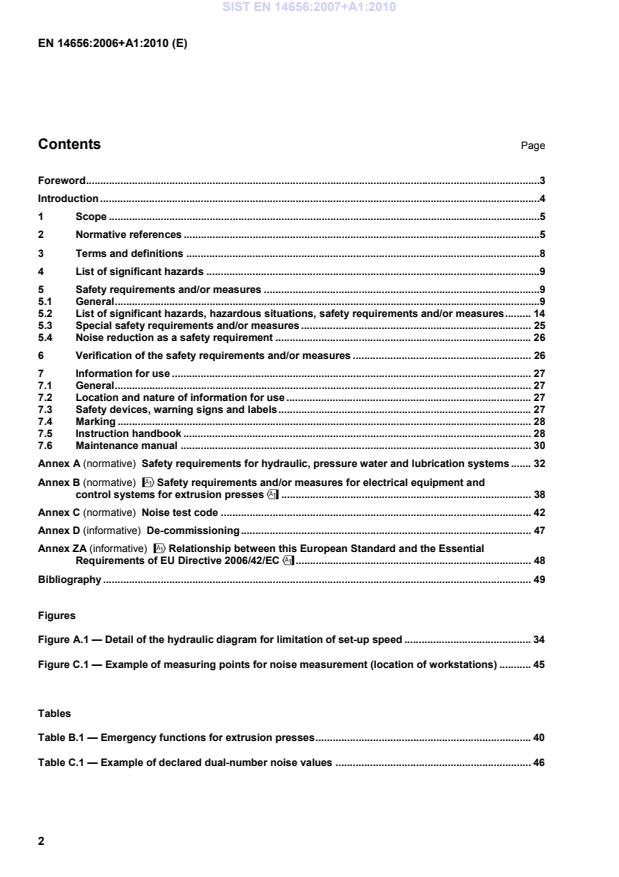
Safety requirements for hydraulic, pressure water and lubrication systems . 32Annex B (normative)
!Safety requirements and/or measures for electrical equipment and control systems for extrusion presses" . 38Annex C (normative)
Noise test code . 42Annex D (informative)
De-commissioning . 47Annex ZA (informative)
!Relationship between this European Standard and the Essential Requirements of EU Directive 2006/42/EC" . 48Bibliography . 49 Figures Figure A.1 — Detail of the hydraulic diagram for limitation of set-up speed . 34 Figure C.1 — Example of measuring points for noise measurement (location of workstations) . 45
Tables Table B.1 — Emergency functions for extrusion presses . 40 Table C.1 — Example of declared dual-number noise values . 46 SIST EN 14656:2007+A1:2010
1 Scope This European Standard applies to: extrusion presses from the exit side of the heater through associated handling, cooling and quenching equipment including, e.g. the puller, the hot saw, the run-out table, the stretcher, the cold saw, cold saw table and/or coiler when incorporated into the equipment, to a point where the extruded product is passed to associated finishing equipment. It specifies the health and safety requirements at all stages in the life of the equipment, its design, ordering, construction, use and disposal. This European Standard specifies requirements to be met by the manufacturer to ensure the health and safety of persons during construction, transport, commissioning, operation, maintenance and de-commissioning, as well as in the event of foreseeable faults as malfunctions which may occur in the equipment. This European Standard deals with all significant hazards, hazardous situations and events relevant to extrusion presses when they are used as intended and under conditions which are reasonably foreseeable by the manufacturer (see Clause 4). This European Standard is not applicable to extrusion presses which are manufactured before the date of its publication as EN. 2 Normative references The following referenced documents are indispensable for the application of this document. For dated references, only the edition cited applies. For undated references, the latest edition of the referenced document (including any amendments) applies. !EN 349, Safety of machinery — Minimum gaps to avoid crushing of parts of the human body EN 614-1, Safety of machinery — Ergonomic design principles — Part 1: Terminology and general principles EN 614-2, Safety of machinery — Ergonomic design principles — Part 2: Interactions between the design of machinery and work tasks EN 626-1, Safety of machinery — Reduction of risks to health from hazardous substances emitted by machinery — Part 1: Principles and specifications for machinery manufacturers EN 842, Safety of machinery — Visual danger signals — General requirements, design and testing EN 894-1, Safety of machinery — Ergonomics requirements for the design of displays and control actuators — Part 1: General principles for human interactions with displays and control actuators EN 894-2, Safety of machinery — Ergonomics requirements for the design of displays and control actuators — Part 2: Displays EN 894-3, Safety of machinery — Ergonomics requirements for the design of displays and control actuators — Part 3: Control actuators EN 953:1997, Safety of machinery — Guards — General requirements for the design and construction of fixed and movable guards EN 981:1996, Safety of machinery — System of auditory and visual danger and information signals SIST EN 14656:2007+A1:2010
(IEC 60528-1:2007) SIST EN 14656:2007+A1:2010
EN ISO 14121-1:2007. However, guard-rails, are not to be considered as sufficient measures of safeguarding to address hazardous situations included in Table 1, where only significant hazards are dealt with. In addition, the manufacturer shall give information in the instructions for use (see Clause 7) about the foreseen restrictions for access to the areas surrounded by the guard-rails and about the nature of the existing residual risks." 5.1.7 Discharge of fluids The manufacturer shall give instructions for discharge of fluids in case of maintenance of the fluid systems or due to a leakage. These instructions shall include information for sealed surfaces (e.g. foundation), drains and the fluid that will be discharged. 5.1.8 Personal protective equipment (PPE) The manufacturer shall give information in the instruction handbook (see 7.5) on the required type of personal protective equipment needed to safeguard personnel from any risks remaining after applying the safety measures. 5.1.9 Warning devices and safety signs Warning devices and safety signs are additions to the design requirements to reduce hazards. Warning devices and safety signs according to EN 61310-1 and EN 61310-2 shall be used. !Graphical symbols shall be in accordance with ISO 3864-1 and/or ISO 7000." Danger signals shall be in accordance with EN ISO 7731 and/or EN 842 and/or EN 981. Warning signs shall be affixed so that they are visible from outside the danger zone. The manufacturer shall not rely upon warning devices and safety signs alone to reduce hazards in case of significant risks. !Warning signs about non-ionising radiation for persons with implanted medical devices shall be fixed where applicable. If an audible warning device is required (e.g. horn), the A-weighted sound pressure level measured according to EN ISO 7731 shall be 10 dB higher than the environmental noise of the operating extrusion presses, measured at 7 m distance from the audible warning device. NOTE The manufacturer should not rely upon warning signs alone to reduce hazards in the case of significant risks being present." 5.1.10 Access The manufacturer shall take account of the following: a) access to the plant shall be controlled in such a way that unintentional entry into any danger zone shall not be possible, considering EN ISO 12100-2 and EN 953; b) access to control desks, pulpits, underground areas, inspection and service floors shall be protected against heat radiation, jets of high pressure fluids and designed to withstand moving materials and tools (if any), according !EN ISO 13857", EN ISO 14122-1, EN ISO 14122-2, EN ISO 14122-3 and
EN ISO 14122-4; c) surfaces for walking or standing shall be so designed, that risks of slipping caused by scale, oil and/or lubricant are minimised; SIST EN 14656:2007+A1:2010
!EN ISO 13849-1". The function of each safety control shall be considered in combination with other elements of the safety control system and shall be selected so as it does not reduce the safety level of any other component of the control system. For the hazards listed in Table 1 where an electrical control system is involved a risk assessment shall be carried out according to !EN ISO 13849-1". 5.1.13 Guards Guards shall be provided to prevent access to a danger zone. They shall be selected as appropriate for the degree and frequency of access to be permitted, e.g. an enclosing guard or distance guard, fixed or movable with interlock. This selection shall be made according to EN 953. Interlock systems shall meet the requirements of EN 1088. !The requirements for guards shall conform to Clause 5 of EN 953:1997, EN ISO 13857 and EN 349. At zones, where risks due to potentially danger movements of equipment exist, operation of manual modes shall be made by means of hold-to-run devices from control stands with full overview of the driving elements." 5.1.14 !Surface temperatures and heat radiation" !Surfaces which are accessible and could be touched shall have temperatures not exceeding the burn threshold for contact time and material specified in EN ISO 13732-1. Where these limits can not be kept, additional technical measures shall be applied, e.g. isolation, distance guard. These measures shall be supplemented by warning instructions and wearing of PPE, if necessary. Where the risk of heat radiation at permanent workplaces is given, protection walls/shields with isolating material shall be provided. EN 12198-3 shall be considered." 5.1.15 Operators' visibility A good operators' visibility to the operating process shall be provided. Where it is not possible to prevent access to hazardous areas which are not naturally visible from the operator’s position, e.g. the die during break-through of the profile, devices shall be provided to prevent the operation of the equipment while a person is present in the area and/or to give the operator a clear view of the hazardous area, e.g. suitably placed mirrors or closed circuit televison (CCTV). SIST EN 14656:2007+A1:2010
V: Visual inspection verifies the required features of the components. D: Drawings and/or calculations verify that the design characteristics of the components provided meet the requirements of the relevant standards. M: Measurement or mode test verifies that requirements are met, within the tolerances permitted by the relevant standards. For further information on verification see Clause 6. SIST EN 14656:2007+A1:2010
1 800 mm high which enclose the danger zone. See 5.1.13 D, V
1.2 Fixed distance guards may include interlocked movable guards which, when opened, stop the movement of components before access is possible. The interlocked movable guards shall also stop the movement of components in other sections of the machine, e.g. those in the press and die handling areas, if access is possible to them from the billet handling area. See 5.1.13 EN 1088
See 5.1.12 D, V, M
1.3 Where ducts through guards are necessary they shall be so designed that any possible access shall be prevented. See 5.1.13 V
2 Unexpected move-ment or start-up of components during non-production cycles, e.g. during maintenance, inspection, repair and setting. 2.1 Provide means to stop supply of energy and where appropriate release of unnecessary residual energy to the components, e.g. by hydraulic dump valves, pneumatic exhaust valves and electrical isolators. See 5.1.16 EN 982 EN 983 EN 60204-1 V, M 2.2 Where interlocked movable guards are provided, the valves and isolators shall be activated by the guard interlocking devices. Valves and isolators shall remain de-activated even when guards are closed, and shall only be re-activated from safe positions outside the protected hazardous area with a clear adequate view of the danger zone. See 5.1.12 See 5.1.13 D, V, M Impact 1 Struck by falling materials or tools falling from overhead. 1.1 Provide toeboards at open edges of permanent working platforms and walkways. See 5.1.10 EN ISO 14122-2 D, V
2 Ejected parts of equipment. 2.1 Select components to withstand design forces. See 5.1.13 EN 1088 D
3 Falling machine components during their removal or replacement. 3.1 Mechanical protection against unexpected movement of component(s) during removal or replacement, e.g. temporary securing bolts, latches, supports. See 5.3.4 V, D
3.2 Operating/maintenance instruction: include advice on means to support components. See 7.6 V
4 Trapping between stationary and rolling billets on transfer ramp between furnace and billet transfer arms, and on billet reject conveyor. 4.1 Fixed distance guards at least
1 800 mm high which enclose the danger zone. See 5.1.13 D, V 4.2 Fixed distance guards may include interlocked movable guards which, when opened, stop the movement of components before access is possible. The interlocked movable guards shall also stop the movement of dangerous components in other sections of the equipment, e.g. those in the press and die handling area, if access to them is possible from the billet handling area. See 5.1.12 See 5.1.13 EN 999 EN 1088 EN 60204-1 D, V, M 5.2.1.2 Thermal hazards for all metals Burns 1 Contact with hot surfaces, e.g. billet and billet transfer devices. 1.1 The guards provided to prevent impact injuries shall be designed to prevent accidental contact with hot billets and billet transfer devices during production cycles. See 5.1.13 D, V
1.2 Appropriate signs giving warning of hot surfaces affixed to the guards. See 5.1.9 EN 61310-1 D, V SIST EN 14656:2007+A1:2010
1.3 Operating/maintenance instruction: include advice on appropriate personal protective equipment, e.g. fire resistant gloves and overalls for maintenance and similar activities. See 5.1.8 See 7.6 V
2 Contact with billets on transfer ramp between heater and billet transfer arms, on the billet reject conveyor and on the hot billet storage rack. 2.1 The guards provided to prevent impact injuries shall be designed to prevent contact with hot billets. See 5.1.13 D, V Fire 1 Bursting of, or leaks from hydraulic hoses, pipes and fittings 1.1 Protect hoses, pipes and fittings with metal shields or covers. See Annex A V
2 Ignition of oil on billet transfer conveyor or ramp. 2.1 Operating/maintenance instruction: include advice on regular cleaning. See 7.5.5 V 5.2.1.3 Additional requirements for aluminium presses Scalds 1 Contact with hot billet quenching water. 1.1 Provide local shielding to contain spraying hot water. See 5.1.13 D, V 5.2.2 Press, die and disc handling equipment 5.2.2.1 Mechanical hazards for all metals Crushing, shearing, severing, entangle-ment 1 Access into danger zone when internal components are in motion, e.g. press ram, movable crosshead, container holder, side rams, transmission machinery, die carrier, butt shear or saw or other cutting devices, butt-end discard pusher and discard conveyer. 1.1 Fixed guards at all possible access points to prevent access to the dangerous moving components by any part of a person’s body. See 5.1.10 See 5.1.13 D, V 1.2 If the above is not possible, provide fixed distance guards at least 1 800 mm high which enclose the danger zone. See 5.1.13 D, V 1.3 Fixed distance guards may include interlocked movable guards which, when opened, stop the movement of components before access is possible. The interlocked movable guards shall also stop the movement of dangerous components in other sections of the equipment, e.g. those in the billet handling and transfer area, if access is possible to them from the press and die handling area. See 5.1.12 See 5.1.13 EN 1088 D, V, M 1.4 Where ducts through guards are necessary they shall
...