

oSIST prEN IEC 62745:2026
(Main)Safety of machinery - Requirements for cableless control systems of machinery
General Information
- Abstract
- Status
- Not Published
- Public Enquiry End Date
- 15-Feb-2026
- Technical Committee
- MOV - Measuring equipment for electromagnetic quantities
- Current Stage
- 4020 - Public enquire (PE) (Adopted Project)
- Start Date
- 02-Dec-2025
- Due Date
- 21-Apr-2026
- Completion Date
- 24-Feb-2026

Overview
oSIST prEN IEC 62745:2026 specifies essential requirements for the safe use of cableless control systems (CCS) on machinery. Developed by the International Electrotechnical Commission (IEC) and adopted by CLC, this standard ensures that wireless and cableless operator interfaces on machinery meet stringent functional and safety criteria. The document covers systems using technologies such as radio and infra-red for operator control, and includes requirements for both general and safety-related (SR-CCS) functions. With the increasing adoption of wireless operator interfaces in industrial automation, this standard plays a pivotal role in supporting machinery safety while enabling operational flexibility.
Key Topics
- Scope: Applies to cableless control systems that act as operator interface stations transferring commands, data, and signals between machinery and its operator. The standard focuses on those systems that include safety-related functions.
- Definitions: Key terminology such as safety-related cableless control system (SR-CCS), remote station, base station, active and passive stop, valid signals, and cybersecurity are clearly defined.
- Functional requirements: Sets out measures to minimize inadvertent actuation, prevent unauthorized usage, ensure reliable signal transmission, and provide critical stop functions.
- Prevention of unintended or hazardous commands
- Encode physical and electronic protections against accidental actuation or misuse
- Verification that commands only impact the intended device
- Safety integrity: Specifies safety levels, stop function categories (manual, automatic, emergency), and system response to faults or communication loss.
- Cybersecurity: Recognizes modern cyber threats by requiring cybersecurity provisions to protect SR-CCS integrity, confidentiality, and availability.
- Testing and verification: Details verification processes, labelling, environmental testing, and documentation requirements.
Applications
oSIST prEN IEC 62745:2026 is applicable to a wide array of industrial environments where cableless control of machinery is used, including:
- Factory automation and robotics: Enables safe use of wireless operator panels or remote controls for conveyors, robotic arms, and assembly machines.
- Material handling systems: Supports safety for wireless controls on cranes, hoists, and mobile equipment in warehouses or ports.
- Construction and mining equipment: Facilitates the integration of safe, cableless remote control for heavy vehicles and site machinery.
- Automated guided vehicles (AGVs): Governs wireless operator control stations that interact with AGVs and driverless transport vehicles.
- Process industry machinery: Used for non-stationary operator interface points in chemical, pharmaceutical, or food processing plants.
Adopting this standard helps machinery designers, manufacturers, integrators, and operators achieve compliance with European and international machinery safety regulations while embracing the flexibility of wireless controls.
Related Standards
Several standards are referenced within oSIST prEN IEC 62745:2026, creating a comprehensive framework for machine safety and functional reliability:
- IEC 60204-1: Safety of machinery – Electrical equipment of machines
- IEC 61508: Functional safety of electrical/electronic/programmable electronic safety-related systems
- IEC 62061: Safety of machinery – Functional safety of electrical, electronic and programmable electronic control systems
- ISO 13849-1/-2: Safety-related parts of control systems, general design and validation
- IEC 60529: Degrees of protection provided by enclosures (IP Code)
- IEC 61140: Protection against electric shock – Common aspects for installation and equipment
By integrating oSIST prEN IEC 62745:2026 into machinery design, organizations bolster their safety management systems, improve operator protection, and future-proof their equipment for advanced cableless and wireless control system technologies. This standard is crucial for industries focusing on industrial safety, digitalization of manufacturing, and safe introduction of automation and remote machine control solutions.
Relations
- Effective Date
- 03-May-2022
- Effective Date
- 03-May-2022
Get Certified
Connect with accredited certification bodies for this standard

BSI Group
BSI (British Standards Institution) is the business standards company that helps organizations make excellence a habit.

IMQ S.p.A. (Certification)
Italian electrical product certification.

SLG Prüf- und Zertifizierungs GmbH
German testing and certification body.
Sponsored listings
Frequently Asked Questions
oSIST prEN IEC 62745:2026 is a draft published by the Slovenian Institute for Standardization (SIST). Its full title is "Safety of machinery - Requirements for cableless control systems of machinery". This standard covers: Safety of machinery - Requirements for cableless control systems of machinery
Safety of machinery - Requirements for cableless control systems of machinery
oSIST prEN IEC 62745:2026 is classified under the following ICS (International Classification for Standards) categories: 13.110 - Safety of machinery; 29.020 - Electrical engineering in general; 35.100.01 - Open systems interconnection in general. The ICS classification helps identify the subject area and facilitates finding related standards.
oSIST prEN IEC 62745:2026 has the following relationships with other standards: It is inter standard links to SIST EN 62745:2017/A11:2020, SIST EN 62745:2017. Understanding these relationships helps ensure you are using the most current and applicable version of the standard.
oSIST prEN IEC 62745:2026 is associated with the following European legislation: EU Directives/Regulations: 2006/42/EC, 2014/35/EU, 2023/1230; Standardization Mandates: M/396, M/511, M/605. When a standard is cited in the Official Journal of the European Union, products manufactured in conformity with it benefit from a presumption of conformity with the essential requirements of the corresponding EU directive or regulation.
oSIST prEN IEC 62745:2026 is available in PDF format for immediate download after purchase. The document can be added to your cart and obtained through the secure checkout process. Digital delivery ensures instant access to the complete standard document.
Standards Content (Sample)
SLOVENSKI STANDARD
01-februar-2026
Varnost strojev - Zahteve za brezžično povezavo upravljalnikov nadzornih
sistemov strojev
Safety of machinery - Requirements for cableless control systems of machinery
Sicherheit von Maschinen - Anforderungen für kabellose Steuerungen an Maschinen
Sécurité des machines - Exigences pour les systèmes de commande sans fil des
machines
Ta slovenski standard je istoveten z: prEN IEC 62745:2025
ICS:
13.110 Varnost strojev Safety of machinery
35.100.01 Medsebojno povezovanje Open systems
odprtih sistemov na splošno interconnection in general
2003-01.Slovenski inštitut za standardizacijo. Razmnoževanje celote ali delov tega standarda ni dovoljeno.
44/1071/CDV
COMMITTEE DRAFT FOR VOTE (CDV)
PROJECT NUMBER:
IEC 62745 ED2
DATE OF CIRCULATION: CLOSING DATE FOR VOTING:
2025-11-28 2026-02-20
SUPERSEDES DOCUMENTS:
44/1054/CD, 44/1059A/CC
IEC TC 44 : SAFETY OF MACHINERY - ELECTROTECHNICAL ASPECTS
SECRETARIAT: SECRETARY:
United Kingdom Mrs Nyomee Hla-Shwe Tun
OF INTEREST TO THE FOLLOWING COMMITTEES: HORIZONTAL FUNCTION(S):
TC 65
ASPECTS CONCERNED:
Electromagnetic Compatibility,Safety
SUBMITTED FOR CENELEC PARALLEL VOTING NOT SUBMITTED FOR CENELEC PARALLEL VOTING
Attention IEC-CENELEC parallel voting
The attention of IEC National Committees, members of
CENELEC, is drawn to the fact that this Committee Draft for
Vote (CDV) is submitted for parallel voting.
The CENELEC members are invited to vote through the
CENELEC online voting system.
This document is still under study and subject to change. It should not be used for reference purposes.
Recipients of this document are invited to submit, with their comments, notification of any relevant patent rights of which
they are aware and to provide supporting documentation.
Recipients of this document are invited to submit, with their comments, notification of any relevant “In Some Countries”
clauses to be included should this proposal proceed. Recipients are reminded that the CDV stage is the final stage for
submitting ISC clauses. (SEE AC/22/2007 OR NEW GUIDANCE DOC).
TITLE:
Safety of machinery - Requirements for cableless control systems of machinery
PROPOSED STABILITY DATE: 2027
NOTE FROM TC/SC OFFICERS:
electronic file, to make a copy and to print out the content for the sole purpose of preparing National Committee positions.
You may not copy or "mirror" the file or printed version of the document, or any part of it, for any other purpose without
permission in writing from IEC.
IEC CDV 62745 © IEC 2025
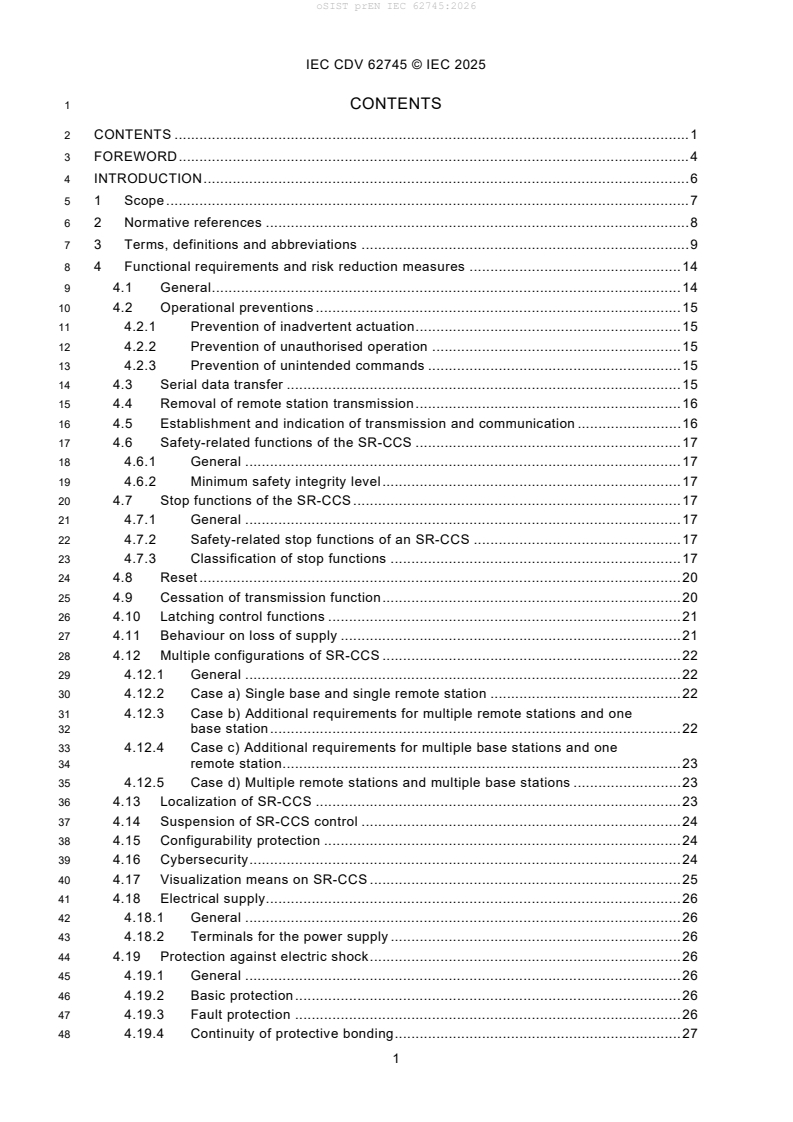
1 CONTENTS
2 CONTENTS . 1
3 FOREWORD . 4
4 INTRODUCTION . 6
5 1 Scope . 7
6 2 Normative references . 8
7 3 Terms, definitions and abbreviations . 9
8 4 Functional requirements and risk reduction measures . 14
9 4.1 General . 14
10 4.2 Operational preventions . 15
11 4.2.1 Prevention of inadvertent actuation . 15
12 4.2.2 Prevention of unauthorised operation . 15
13 4.2.3 Prevention of unintended commands . 15
14 4.3 Serial data transfer . 15
15 4.4 Removal of remote station transmission . 16
16 4.5 Establishment and indication of transmission and communication . 16
17 4.6 Safety-related functions of the SR-CCS . 17
18 4.6.1 General . 17
19 4.6.2 Minimum safety integrity level . 17
20 4.7 Stop functions of the SR-CCS . 17
21 4.7.1 General . 17
22 4.7.2 Safety-related stop functions of an SR-CCS . 17
23 4.7.3 Classification of stop functions . 17
24 4.8 Reset . 20
25 4.9 Cessation of transmission function . 20
26 4.10 Latching control functions . 21
27 4.11 Behaviour on loss of supply . 21
28 4.12 Multiple configurations of SR-CCS . 22
29 4.12.1 General . 22
30 4.12.2 Case a) Single base and single remote station . 22
31 4.12.3 Case b) Additional requirements for multiple remote stations and one
32 base station . 22
33 4.12.4 Case c) Additional requirements for multiple base stations and one
34 remote station. 23
35 4.12.5 Case d) Multiple remote stations and multiple base stations . 23
36 4.13 Localization of SR-CCS . 23
37 4.14 Suspension of SR-CCS control . 24
38 4.15 Configurability protection . 24
39 4.16 Cybersecurity . 24
40 4.17 Visualization means on SR-CCS . 25
41 4.18 Electrical supply . 26
42 4.18.1 General . 26
43 4.18.2 Terminals for the power supply . 26
44 4.19 Protection against electric shock . 26
45 4.19.1 General . 26
46 4.19.2 Basic protection . 26
47 4.19.3 Fault protection . 26
48 4.19.4 Continuity of protective bonding . 27
IEC CDV 62745 © IEC 2025
49 4.20 Colour of actuators . 27
50 4.21 Indicator lights and displays . 27
51 4.22 Protection against abnormal temperatures . 27
52 4.23 Degree of protection . 27
53 4.24 Environmental operating conditions . 27
54 5 Verification . 28
55 5.1 General . 28
56 5.2 Labelling and markings . 28
57 5.3 Documentation . 28
58 5.4 Acceptance criteria . 28
59 5.5 Operating parameters for tests . 28
60 5.6 Selection of test samples . 28
61 5.7 Functional verifications . 29
62 5.8 Environmental testing . 34
63 6 Information for use . 35
64 6.1 General . 35
65 6.2 Information to be provided . 35
66 6.3 List of verifications on a CCS to be required to the system integrator . 37
67 7 Labelling and markings . 39
68 Annex A (informative) Logic of stop functions . 40
69 Annex B (informative) Relationship between requirements of GSS and EMS . 42
70 C.1 Levels of SR-CCS cybersecurity behaviour . 44
71 C.2 Difficulty level in CCS signal identification and tracking. 44
72 C.3 Level of protection against attack vectors . 44
73 D.1 Environmental operating conditions . 46
74 E.1 Circular economy . 48
75 Bibliography . 49
77 Figure A.1 – Logic for stop functions . 43
79 For the purposes of this document, the following terms, definitions and abbreviations
80 apply. 13
81 ISO and IEC maintain terminology databases for use in standardization at the following
82 addresses: . 13
83 • ISO Online browsing platform: available at https://www.iso.org/obp . 13
84 Table 1 – Alphabetical list of definitions . 13
85 Table 2 – Abbreviations . 14
86 Table 3 – Overview of stop functions of the SR-CCS . 22
87 Table 4 – Possible configurations of SR-CCS . 26
88 Table 5 – Possible situation with multiple base station . 27
89 Table 6 – SR-CCS related particular attack vectors . 28
90 Table 7 – Environmental conditions for tests . 32
91 Table 8 – Verification of functional requirements . 34
92 Table 9 – Reference for environmental testing . 39
93 Table 10 – List of required verifications to the system integrator . 42
94 Table B.1 – Relationship between requirements of GSS and EMS . 46
IEC CDV 62745 © IEC 2025
95 Table 11 – Cableless signal identification and tracking level . 48
96 Table 12 – Level of protection against jamming (JA) . 49
97 Table 13 – Level of protection against Record and Replay (RR) . 49
IEC CDV 62745 © IEC 2025
100 INTERNATIONAL ELECTROTECHNICAL COMMISSION
101 ____________
103 SAFETY OF MACHINERY –
104 CABLELESS CONTROL SYSTEMS OF MACHINERY: GENERAL
105 REQUIREMENTS
107 FOREWORD
108 1) The International Electrotechnical Commission (IEC) is a worldwide organization for standardization comprising
109 all national electrotechnical committees (IEC National Committees). The object of IEC is to promote international
110 co-operation on all questions concerning standardization in the electrical and electronic fields. To this end and
111 in addition to other activities, IEC publishes International Standards, Technical Specifications, Technical Reports,
112 Publicly Available Specifications (PAS) and Guides (hereafter referred to as “IEC Publication(s)”). Their
113 preparation is entrusted to technical committees; any IEC National Committee interested in the subject dealt with
114 may participate in this preparatory work. International, governmental and non-governmental organizations liaising
115 with the IEC also participate in this preparation. IEC collaborates closely with the International Organization for
116 Standardization (ISO) in accordance with conditions determined by agreement between the two organizations.
117 2) The formal decisions or agreements of IEC on technical matters express, as nearly as possible, an international
118 consensus of opinion on the relevant subjects since each technical committee has representation from all
119 interested IEC National Committees.
120 3) IEC Publications have the form of recommendations for international use and are accepted by IEC National
121 Committees in that sense. While all reasonable efforts are made to ensure that the technical content of IEC
122 Publications is accurate, IEC cannot be held responsible for the way in which they are used or for any
123 misinterpretation by any end user.
124 4) In order to promote international uniformity, IEC National Committees undertake to apply IEC Publications
125 transparently to the maximum extent possible in their national and regional publications. Any divergence between
126 any IEC Publication and the corresponding national or regional publication shall be clearly indicated in the latter.
127 5) IEC itself does not provide any attestation of conformity. Independent certification bodies provide conformity
128 assessment services and, in some areas, access to IEC marks of conformity. IEC is not responsible for any
129 services carried out by independent certification bodies.
130 6) All users should ensure that they have the latest edition of this publication.
131 7) No liability shall attach to IEC or its directors, employees, servants or agents including individual experts and
132 members of its technical committees and IEC National Committees for any personal injury, property damage or
133 other damage of any nature whatsoever, whether direct or indirect, or for costs (including legal fees) and
134 expenses arising out of the publication, use of, or reliance upon, this IEC Publication or any other IEC
135 Publications.
136 8) Attention is drawn to the Normative references cited in this publication. Use of the referenced publications is
137 indispensable for the correct application of this publication.
138 9) Attention is drawn to the possibility that some of the elements of this IEC Publication may be the subject of patent
139 rights. IEC shall not be held responsible for identifying any or all such patent rights.
140 International Standard IEC 62745 has been prepared by IEC technical committee 44: Safety of
141 machinery – Electrotechnical aspects.
142 This bilingual version (2018-01) corresponds to the monolingual English version, published in
143 2017-03.
144 The text of this standard is based on the following documents:
FDIS Report on voting
44/783/FDIS 44/785/RVD
146 Full information on the voting for the approval of this International Standard can be found in the
147 report on voting indicated in the above table.
148 The French version of this standard has not been voted upon.
149 This document has been drafted in accordance with the ISO/IEC Directives, Part 2.
IEC CDV 62745 © IEC 2025
150 The committee has decided that the contents of this document will remain unchanged until the
151 stability date indicated on the IEC website under "http://webstore.iec.ch" in the data related to
152 the specific document. At this date, the document will be:
153 • reconfirmed,
154 • withdrawn,
155 • replaced by a revised edition, or
156 • amended.
IMPORTANT – The 'colour inside' logo on the cover page of this publication indicates
that it contains colours which are considered to be useful for the correct understanding
of its contents. Users should therefore print this document using a colour printer.
IEC CDV 62745 © IEC 2025
160 INTRODUCTION
161 Cableless control systems (CCS) are increasingly being used to provide an operator interface
162 on a wide range of machinery. The functions of a CCS and the way in which they interface with
163 the overall machine control system can therefore affect the safety of the machinery. The risk
164 assessment can require the CCS to incorporate safety-related functions; in this case the CCS
165 becomes a safety-related cableless control system (SR-CCS).
166 IEC 62745 specifies requirements for the functions of a CCS incorporating safety-related
167 functions that is interfaced with or is part of a machine control system for use as an operator
168 control station on a machine. Additional requirements can be necessary for particular
169 applications.
170 The extent to which the safety-related functions of a CCS are relied upon to reduce risk on a
171 machine is a key selection criterion. It is therefore important to select a CCS that provides
172 suitable control functions with an appropriate safety integrity in accordance with the risk
173 assessment at the machine.
IEC CDV 62745 © IEC 2025
180 SAFETY OF MACHINERY –
181 CABLELESS CONTROL SYSTEMS OF MACHINERY: GENERAL
182 REQUIREMENTS
185 1 Scope
186 This standard specifies requirements for the functionality and interfacing of cableless control
187 systems, including safety-related functions, that provide cableless communication (for example
188 radio, infra-red) between operator control station(s) and the control system of a machine.
189 Specific requirements are included for operator control stations that are movable or portable by
190 the operator.This document does not deal with cableless communication between parts of a
191 machine(s) that are not operator control stations.
192 This document is not intended to specify all the necessary requirements for the design and
193 construction of a cableless control system. For example, it does not specify communication
194 protocols, frequency or bandwidth aspects, nor the full range of constructional requirements
195 such as electromagnetic compatibility, etc.
196 The provisions of this document are intended to be applied in addition to the requirements for
197 electrical equipment in relevant parts of IEC 60204 series.
198 This document is a type-B2 standard as stated in ISO 12100.
IEC CDV 62745 © IEC 2025
201 2 Normative references
202 The following documents are referred to in the text in such a way that some or all of their content
203 constitutes requirements of this document. For dated references, only the edition cited applies.
204 For undated references, the latest edition of the referenced document (including any
205 amendments) applies.
206 IEC 60068-2-27:2008, Environmental testing – Part 2-27: Tests - Test Ea and guidance: Shock
207 IEC 60068-2-31:2008, Environmental testing – Part 2-31: Tests – Test Ec – Rough handling
208 shocks, primarily for equipment-type specimens
209 IEC 60204-1:2016+AMD1:2021, Safety of machinery – Electrical equipment of machines – Part
210 1: General requirements
211 IEC 60364-4-41:2005+AMD1:2017 Low voltage electrical installations - Part 4-41: Protection
212 for safety - Protection against electric shock
213 IEC 60529:1989+AMD1:1999+AMD2:2013 Degrees of protection provided by enclosures (IP
214 Code)
215 IEC 60664-1:2020+AMD1:2025 Insulation coordination for equipment within low-voltage supply
216 systems - Part 1: Principles, requirements and tests
217 IEC 60947-5-1:2024, Low-voltage switchgear and controlgear – Part 5-1: Control circuit devices
218 and switching elements – Electromechanical control circuit devices
219 IEC 60947-5-5:1997+AMD1:2005+AMD2:2016, Low-voltage switchgear and controlgear – Part
220 5-5: Control circuit devices and switching elements – Electrical emergency stop device with
221 mechanical latching function
222 IEC 61140:2016, Protection against electric shock - Common aspects for installation and
223 equipment
224 IEC 61508 (all parts), Functional safety of electrical/electronic/programmable electronic safety-
225 related systems
226 IEC 62061:2021+AMD1:2024, Safety of machinery – Functional safety of safety-related
227 electrical, electronic and programmable electronic control systems
228 ISO 13849-1:2023, Safety of machinery – Safety-related parts of control systems – Part 1:
229 General principles for design
230 ISO 13849-2:2012, Safety of machinery – Safety-related parts of control systems – Part 2:
231 Validation
232 ISO 13850:2015, Safety of machinery – Emergency stop function– Principles for design
233 ISO 20607:2019, Safety of machinery — Instruction handbook — General drafting principles
IEC CDV 62745 © IEC 2025
236 3 Terms, definitions and abbreviations
237 For the purposes of this document, the following terms, definitions and abbreviations apply.
238 ISO and IEC maintain terminology databases for use in standardization at the following
239 addresses:
240 • ISO Online browsing platform: available at https://www.iso.org/obp
241 IEC Electropedia: available at https://www.electropedia.org
242 Table 1 – Alphabetical list of definitions
Term Definition number
active stop 3.18
address code 3.8
automatic stop 3.20
base station 3.14
cableless control 3.1
cableless control system 3.2
safety-related cableless control system 3.3
error detection code 3.10
frame 3.7
Hamming distance 3.12
manual stop 3.21
neutral frame 3.11
OFF-state 3.16
operating command signal 3.9
operator control station 3.6
passive stop 3.19
receiver 3.4
remote station 3.13
safety-related stop function 3.17
stop output 3.15
transmitter 3.5
valid signal 3.22
cybersecurity 3.23
IEC CDV 62745 © IEC 2025
244 Table 2 – Abbreviations
Term Abbreviation
automatic stop (4.7.3.5) ATS
cableless control system (3.2) CCS
safety-related cableless control system (3.3) SR-CCS
emergency stop (4.7.3.4) EMS
general safe stop (4.7.3.3) GSS
remote station (3.13) RST
base station (3.14) BST
246 3.1
247 cableless control
248 transmission of the machine operator's commands without a wired connection
249 3.2 cableless control system
250 CCS
251 system that consisting of at least one remote station and one base station, which uses cableless
252 control to transmit commands, controls signals and data between them
253 3.3
254 safety-related cableless control system
255 SR-CCS
256 cableless control system that includes safety-related functions
257 Note 1 to entry: In the Ed. 1 of this document safety-related cableless control system was
258 named only CCS.
259 3.4
260 receiver
261 part of a cableless control system which receives frames from a transmitter
262 3.5
263 transmitter
264 part of a cableless control system which sends frames to a receiver
265 3.6
266 operator control station
267 assembly of one or more control actuators (part of a device to which an external manual action
268 is to be applied by an operator) fixed on the same panel or located in the same enclosure
269 Note 1 to entry: An operator control station can also contain related equipment, for example, potentiometers, signal
270 lamps, instruments, display devices, etc.
271 3.7
272 frame
273 "packet" of information exchanged between a remote station and a base station
274 Note 1 to entry: Frame can consist of, for example address code, operating command signals, error detection code,
275 signals or information.
276 Note 2 to entry: Sometimes “frame” is also called “telegram” or “message”.
277 3.8
278 address code
279 part of a frame that identifies the intended receiver of the frame
IEC CDV 62745 © IEC 2025
280 Note 1 to entry: The base station or remote station respond to commands that have the relevant address code.
281 3.9
282 operating command signal
283 control signal that is intended to initiate, set or maintain a machine operation
284 3.10
285 error detection code
286 information included in each frame to enable the detection of transmission errors
287 3.11
288 neutral frame
289 frame in which all operating command signals are in a state such that when it is received at the
290 base station it does not activate any outputs intended for control of hazardous operations of the
291 machine
292 Note 1 to entry: Neutral frames can be used to maintain communication (i.e. a valid signal) between a transmitter
293 and receiver, for example to preclude automatic initiation of the stop function at a machine.
294 Note 2 to entry: Neutral frame transmission is intended to prevent unexpected or unintended behaviour of the SR-
295 CCS resulting from establishment or re-establishment of communication.
296 Note 3 to entry: Neutral frames can contain data, for example parameterisation data, and commands that are not
297 intended to cause hazardous operations of the machine.
298 3.12
299 Hamming distance
300 number of bit positions in which any two frames of the same length differ from each other
301 3.13
302 remote station
303 part of a safety-related cableless control system which is not physically connected to the
304 machine control system intended to control the operations of the machine
305 Note 1 to entry: The remote station of a cableless control system is sometimes referred to as a “transmitter”, but a
306 remote station that is part of a bi-directional cableless control system will incorporate both a transmitter and a
307 receiver.
308 Note 2 to entry: The remote station forms the operator control station of a cableless control system.
309 Note 3 to entry: The remote station can be portable or non-portable
310 3.14
311 base station
312 part of the safety-related cableless control system physically connected to the machine control
313 system
314 Note 1 to entry: The base station of a cableless control system is sometimes referred to as a “receiver”, but a base
315 station that is part of a bi-directional cableless control system will incorporate both a receiver and a transmitter.
316 Note 2 to entry: The base station can be installed on stationary or mobile machines.
317 Note 3 to entry: The base station is not necessarily a discrete physical entity, but it includes all of the components
318 that fulfill the requirements specified in this standard for the base station.
319 3.15
320 stop output
321 output circuit of the base station that interfaces with the control system of the machine to initiate
322 a stop function
323 Note 1 to entry: Stop outputs can be safety-related or non-safety-related. See also Table 3.
324 Note 2 to entry: Interfaces to field bus part of an SR-CCS base station can also be considered as a stop output
325 circuit.
IEC CDV 62745 © IEC 2025
326 3.16
327 OFF-state
328 state of safety-related stop output(s) of the base station used to initiate one or more stop
329 functions of a machine
330 3.17
331 safety-related stop function
332 stop function provided by the SR-CCS that results in an OFF-state and whose failure can result
333 in an immediate increase of the risk(s)
334 3.18
335 active stop
336 stop resulting from transmission of a stop signal from the remote station to the base station
337 3.19
338 passive stop
339 safety-related stop resulting from absence of a valid signal at the base station
340 Note 1 to entry: A passive stop can be initiated by, for example, an out of range condition, battery failure,
341 electromagnetic interference.
342 3.20
343 automatic stop
344 safety-related stop initiated without manual actuation of a device by an operator
345 3.21
346 manual stop
347 stop initiated by actuation of a device by an operator
348 3.22
349 valid signal
350 any received frame, including a neutral frame, that is accepted by the error checking routines
351 of the receiver and contains the relevant address code for the receiver
352 3.23
353 cybersecurity
354 set of activities necessary to protect SR-CCS and information systems of the SR-CCS, the users
355 of such systems, and other persons from cyber threats, typically regarding the aspects of
356 confidentiality, integrity and availability
357 [SOURCE: IEC TS 63074:2023, 3.1.6, modified removing and
358 “network” and “machine control system”.]
360 3.24
361 portable remote station
362 remote station intended to be carried by a person during its operation
363 Note 1 to entry: Portable remote station is sometimes referred to as hand-held remote station.
364 Note 2 to entry: Non-portable remote station can be fixed installed (e.g. installed on or near to the machine) or
365 movable.
366 [SOURCE: IEV 426-01-11, modified changing with ]
368 3.25
369 movable remote station
370 remote station intended to be installed on mobile means (e.g. vehicle-mounted or installed on
371 a trolley)
IEC CDV 62745 © IEC 2025
372 3.26
373 safe state
374 condition which continues to preserve safety
375 [SOURCE: IEV 821-12-49]
377 3.27
378 system integrator
379 person(s) or entity responsible for integration of components, devices, equipment and
380 subsystems into a whole over system (or machine), ensuring that such parts are assembled,
381 interconnected, interfaced and work together as intended.
382 Note 1 to entry: This stakeholder is typically present on projects that deal with multiple providers.
383 Note 2 to entry: The integrator can be a manufacturer, an engineering company or the user of the product.
IEC CDV 62745 © IEC 2025
386 4 Functional requirements and risk reduction measures
387 4.1 General
388 A safety-related cableless control system shall comply with all applicable requirements of this
389 document and have at least, one safety-related function.
390 NOTE A CCS presenting one or more safety-related functions that does not comply with the following requirements
391 can not be considered as SR-CCS.
392 Figure 1 illustrates an example of the main elements of an SR-CCS and its interaction with the
393 machine control system.
396 Figure 1 – Block diagram example of an SR-CCS
397 and its interaction as part of the machine control system
399 NOTE The references to IEC 60204-1:2016 in this standard can have corresponding
400 requirements in other relevant parts of IEC 60204 series (e.g. IEC 60204-32).
IEC CDV 62745 © IEC 2025
401 4.2 Operational preventions
402 4.2.1 Prevention of inadvertent actuation
403 The remote station and its control actuators shall be designed and arranged so as to minimise
404 the possibility of inadvertent actuation (for example, caused by dropping to the floor or striking
405 an obstruction) generating an unintended hazardous command.
406 Measure to reduce inadvertent actuation include, for example: collars, enabling devices, hold-
407 to-run control (e.g., dead-man switches).
409 Depending on the specific application or design, where collars are used to protect operating
410 devices, they shall surround totally or partially such devices (e.g. push-button); surrounding
411 protective collars shall not be lower than the protected devices. For EMS see 4.7.3.4.
413 Note: sometimes collars can be higher than the profile (height of the device).
415 4.2.2 Prevention of unauthorised operation
416 Means to prevent unauthorised use (for example, key-operated switch, access code) shall be
417 provided.
418 4.2.3 Prevention of unintended commands
419 Measures shall be taken to ensure that operating command signals:
420 • affect only the intended base station or remote station (for example, using unique address
421 code);
422 • initiate only the intended functions in that base station or remote station.
423 Upon detection of malfunction or faults in these measures, an automatic stop function ATS shall
424 initiate. Where hardware switches (for example, DIP) are used for device addressing, additional
425 measures (for example, parity checking) shall be required to fulfil the requirements.
426 NOTE Typical methods include factory-set coding, which are more robust than user-configurable methods because
427 they cannot be defeated (either intentionally or inadvertently) by the user.
428 4.3 Serial data transfer
429 The serial data transfer shall satisfy one of the following requirements:
430 • means shall be provided that ensure the probability of an erroneous frame being received
-8 -3
431 undetected, R(P ), is less than 1 × 10 , given an input bit error probability of P = 10 , if
e e
432 no better input bit error probability can be proven, or
433 • the minimum Hamming distance shall be either 4 or the total number of bits in a frame
434 divided by 20, whichever is greater.
-3
435 NOTE 1 An input bit error probability of P = 10 can be assumed as typical estimate for a wireless channel
e
436 disturbed by Additive White Gaussian Noise (AWGN) and electromagnetic interference (EMI).
437 NOTE 2 IEC 60870-5-1:1990 defines a set of possible transmission frame formats.
438 NOTE 3 Increasing the reliability of serial data transmission only reduces the possibility of errors that can be
439 occurring in the transmission media.
440 In addition, for safety-related functions of an SR-CCS the residual error probability Λ of
441 undetected error per hour shall be less than 1 % of the specified PFH value for the respective
442 function of the SR-CCS. Residual probability of undetected error per hour Λ shall be calculated
443 by:
444 Λ(P ) = R(P ) × ν × b [1/h]
e e
IEC CDV 62745 © IEC 2025
445 where:
446 Λ(P ): residual probability of undetected error per hour in relation to the input bit error
e
447 probability
448 R(P ): residual probability of undetected error per frame in relation to the input bit error
e
449 probability
-
450 P : input error probability: if no better input bit error probability can be proven, P = 1 × 10
e e
451 applies
452 ν: maximum number of safety-related messages per hour
453 b: maximum number of listening base stations
454 NOTE 4 For a definition of PFH (average frequency of a dangerous failure per hour) see IEC 62061:2021 or
455 ISO 13849-1:2023.
456 NOTE 5 Λ(P ) calculation is based on IEC 61784-3:2021+AMD1:2024; this approach is valid for cyclic transmission
e
457 of safety-related messages.
458 NOTE 6 Equation (B.3) or (B.4) from IEC 61784-3:2021+AMD1:2024can be applied in order to determine R(P )
e
-3
459 with an input bit error probability of P = 1 × 10 , when using CRC as hash-function: for more details see IEC 61784-
e
460 3:2021+AMD1:2024.
461 NOTE 7: The SR-CCS can be equipped with indicator of transmission reliability. See 6.2.
462 NOTE 8 It is not necessary to provide a separate warning indicator for each condition that can affect transmission
463 reliability.
464 Use of industrial wireless fieldbus technologies in accordance with the IEC 61784 series can
465 satisfy the requirements of this clause.
466 4.4 Removal of remote station transmission
467 Means shall be provided to readily cease transmission from the remote station. This shall be
468 achieved by one or more of the following:
469 a) a device that interrupts the power supply of transmission for the remote station, where such
470 a device shall have direct opening action in accordance with IEC 60947-5-1:2024, Annex K,
471 or
472 b) removal of the battery without the use of a tool, or
473 c) a dedicated transmission removal function in accordance with with 4.6.2.
474 A passive stop shall result from the ceasing of transmission.
475 4.5 Establishment and indication of transmission and communication
476 Power up of the remote station or re-establishment of communication (for example, after power
477 supply interruption, remote station battery replacement, lost signal condition) shall not activate
478 any output that is intended for control of hazardous operations of the machine. Initiation or re-
479 initiation of such operations shall require a deliberate action (for example, releasing a control
480 actuator from its energised position and then pressing it again).
481 The base station shall not respond to operating command signals that can activate outputs
482 intended for control of hazardous operations of the machine until a neutral frame has been
483 received (i.e. following re-establishment of communication).
484 When transmission from a remote station is taking place, this shall be indicated on the remote
485 station (for example, by an indicating light, a visual display indication, etc.); the indication shall
486 remain until the transmission ends.
487 NOTE It can also be useful to provide a means of indicating when a base station is receiving transmissions from an
488 associated remote station. For example, an output(s) on the base station can be designated for this purpose, and/or
IEC CDV 62745 © IEC 2025
489 a confirmation signal can be transmitted to the remote station if bi-directional communication is available. Where the
490 base station does not provide a designated means of indication, see 6.2.
491 4.6 Safety-related functions of the SR-CCS
492 4.6.1 General
493 Functions of the SR-CCS that are intended for safety-related applications, other than those
494 specified in 4.7.2, shall have an appropriate safety integrity. The requirements of
495 IEC 62061:2021, IEC 61508 series or ISO 13849-1:2023, ISO 13849-2:2012 shall apply.
496 Upon detection of faults, all safety-related stop outputs shall result in OFF-state. The detection
497 of a fault in the remote station that can lead to the loss of a safety-related function, shall cease
498 the transmission in accordance with 4.4.
499 NOTE Further information on the design of safety-related aspects of control functions is given in ISO 12100:2010
500 and IEC 61508 series.
501 4.6.2 Minimum safety integrity level
502 According to IEC 62061:2021, IEC 61508 series or ISO 13849-1:2023 each safety-related
503 function of an SR-CCS shall have a safety integrity of:
504 • SIL1, HFT = 1 or
505 • PL c Category 3.
506 4.7 Stop functions of the SR-CCS
507 4.7.1 General
508 The SR-CCS shall provide an automatic stop function (ATS).
509 At least one safety-related stop function shall be provided that is initiated by a deliberate human
510 action on a control device provided specifically for that purpose; portable and movable remote
511 station shall be provided with GSS or EMS, according to 4.7.3. Information about logic of all
512 stop functions is given in Annex A.
513 NOTE 1 In most applications this manually-initiated stop function is either a GSS or EMS (see 4.7.3).
514 NOTE 2 In most SR-CCS ATS and the additional safety-related manually-initiated stop function is combined in the
515 same stop output circuit.
516 NOTE 3 Emergency stop devices on SR-CCS is not be the sole means of initiating the emergency stop function of a
517 machine according to IEC 60204-1:2016.
518 4.7.2 Safety-related stop functions of an SR-CCS
519 Each safety-related stop function of an SR-CCS shall initiate an OFF-state of the stop output(s)
520 at the base station.
521 The safety-related stop function of an SR-CCS shall have at least a safety integrity according
522 to 4.6.2.
523 4.7.3 Classification of stop functions
524 4.7.3.1 General
525 Stop functions of an SR-CCS are classified as:
526 • control stop;
IEC CDV 62745 © IEC 2025
527 • general safe stop (GSS);
528 • emergency stop (EMS);
529 • automatic stop (ATS).
530 Table 3 describes the characteristics of the different stop functions.
531 Table 3 – Overview of stop functions of the SR-CCS
Type of stop Control actuator
Safety- Availability
Effect on
Function Clause related &
(see Fig.
SR-CCS
Type Colour
function operability
A1)
Defined state
of (a) stop
output(s), or
of another
output
Active
associated
No
with release
Operational See
Black
of a hold-to-
when the IEC 60204-1:2
run
...