

SIST EN IEC 62321-12:2025
(Main)Determination of certain substances in electrotechnical products - Part 12: Simultaneous determination - Polybrominated biphenyls, polybrominated diphenyl ethers and phthalates in polymers by gas chromatography-mass spectrometry
General Information
- Abstract
IEC 62321-12:2023 specifies a reference test method for the simultaneous determination of polybrominated biphenyls, polybrominated diphenyl ethers, and four phthalates: di-isobutyl phthalate (DIBP), di-n-butyl phthalate (DBP), benzylbutyl phthalate (BBP), di-(2-ethylhexyl) phthalate (DEHP) in polymers of electrotechnical products.
The extraction technique described in this document is the ultrasonic-assisted extraction used for simultaneous extraction for sample preparation.
Gas chromatography-mass spectrometry (GC-MS) is considered as the reference technique for the measurement of the simultaneous determination of analytes in the range of 25 mg/kg to 2 000 mg/kg.
The test method using ultrasonic-assisted extraction followed by GC-MS detection has been evaluated by the tests of polypropylene (PP), polyvinylchloride (PVC), acrylonitrile butadiene styrene (ABS), acrylate rubber (ACM), polystyrene (PS), polyurethane (PU) and polyethylene (PE) materials.
This document has the status of a horizontal publication in accordance with IEC Guide 108.
- Status
- Published
- Public Enquiry End Date
- 30-Mar-2022
- Publication Date
- 03-Apr-2025
- Technical Committee
- ITIV - Electronics assembly technology and Environmental standardization
- Current Stage
- 6060 - National Implementation/Publication (Adopted Project)
- Start Date
- 21-Mar-2025
- Due Date
- 26-May-2025
- Completion Date
- 04-Apr-2025
Buy Documents

Overview
EN IEC 62321-12:2023 defines a laboratory reference method for the simultaneous determination of polybrominated biphenyls (PBBs), polybrominated diphenyl ethers (PBDEs) and four phthalates (DIBP, DBP, BBP, DEHP) in polymer parts of electrotechnical products. The standard specifies ultrasonic‑assisted extraction for sample preparation and gas chromatography–mass spectrometry (GC‑MS) as the reference measurement technique for analyte concentrations in the range 25 mg/kg to 2 000 mg/kg. It is published as a horizontal IEC/CENELEC standard (IEC Guide 108) and has been evaluated on common polymers including PP, PVC, ABS, ACM, PS, PU and PE.
Key topics and technical requirements
- Target analytes: Polybrominated biphenyls (PBBs), polybrominated diphenyl ethers (PBDEs) and phthalates - di‑isobutyl phthalate (DIBP), di‑n‑butyl phthalate (DBP), benzylbutyl phthalate (BBP), di‑(2‑ethylhexyl) phthalate (DEHP).
- Sample preparation: Ultrasonic‑assisted extraction is specified for simultaneous extraction of flame retardants and phthalates from polymer matrices.
- Analytical technique: GC‑MS is designated as the reference technique; method details include stock solutions, internal standards, calibration and instrumental parameters.
- Quantification range: Validated for 25–2 000 mg/kg (reporting and calibration guidance included).
- Validation and performance: Method performance evaluated across multiple polymer matrices; annexes provide extraction efficiency data, example chromatograms and mass spectra, and interlaboratory study statistics.
- Quality control: Provisions for calibration, limits of detection/quantification (LOD/LOQ), precision (repeatability/reproducibility), matrix spiking and performance checks are included.
- Documentation: Requirements for test reporting and traceability of standards and reference materials.
Applications and users
- Testing laboratories performing chemical analysis of electronic and electrical product components.
- Product compliance teams and environmental engineers who need reliable test data to demonstrate restriction-of-substance limits for polymers.
- Manufacturers and material suppliers validating raw polymer grades or finished parts for restricted flame retardants and plasticizers.
- Regulatory bodies and conformity assessment bodies evaluating laboratory methods and interlaboratory comparability.
Practical benefits include a harmonized, validated procedure for simultaneous measurement of both brominated flame retardants and common phthalates in plastic components, reducing analysis time and improving comparability of results between labs.
Related standards
- This part is one of the IEC 62321 series; normative cross‑references include IEC 62321‑1 (Introduction and overview) and relevant parts for sampling and other analytic methods.
Relations
- Effective Date
- 03-Feb-2026
- Effective Date
- 03-Feb-2026
Buy Documents
Get Certified
Connect with accredited certification bodies for this standard

BSI Group
BSI (British Standards Institution) is the business standards company that helps organizations make excellence a habit.

Bureau Veritas
Bureau Veritas is a world leader in laboratory testing, inspection and certification services.

DNV
DNV is an independent assurance and risk management provider.
Sponsored listings
Frequently Asked Questions
SIST EN IEC 62321-12:2025 is a standard published by the Slovenian Institute for Standardization (SIST). Its full title is "Determination of certain substances in electrotechnical products - Part 12: Simultaneous determination - Polybrominated biphenyls, polybrominated diphenyl ethers and phthalates in polymers by gas chromatography-mass spectrometry". This standard covers: IEC 62321-12:2023 specifies a reference test method for the simultaneous determination of polybrominated biphenyls, polybrominated diphenyl ethers, and four phthalates: di-isobutyl phthalate (DIBP), di-n-butyl phthalate (DBP), benzylbutyl phthalate (BBP), di-(2-ethylhexyl) phthalate (DEHP) in polymers of electrotechnical products. The extraction technique described in this document is the ultrasonic-assisted extraction used for simultaneous extraction for sample preparation. Gas chromatography-mass spectrometry (GC-MS) is considered as the reference technique for the measurement of the simultaneous determination of analytes in the range of 25 mg/kg to 2 000 mg/kg. The test method using ultrasonic-assisted extraction followed by GC-MS detection has been evaluated by the tests of polypropylene (PP), polyvinylchloride (PVC), acrylonitrile butadiene styrene (ABS), acrylate rubber (ACM), polystyrene (PS), polyurethane (PU) and polyethylene (PE) materials. This document has the status of a horizontal publication in accordance with IEC Guide 108.
IEC 62321-12:2023 specifies a reference test method for the simultaneous determination of polybrominated biphenyls, polybrominated diphenyl ethers, and four phthalates: di-isobutyl phthalate (DIBP), di-n-butyl phthalate (DBP), benzylbutyl phthalate (BBP), di-(2-ethylhexyl) phthalate (DEHP) in polymers of electrotechnical products. The extraction technique described in this document is the ultrasonic-assisted extraction used for simultaneous extraction for sample preparation. Gas chromatography-mass spectrometry (GC-MS) is considered as the reference technique for the measurement of the simultaneous determination of analytes in the range of 25 mg/kg to 2 000 mg/kg. The test method using ultrasonic-assisted extraction followed by GC-MS detection has been evaluated by the tests of polypropylene (PP), polyvinylchloride (PVC), acrylonitrile butadiene styrene (ABS), acrylate rubber (ACM), polystyrene (PS), polyurethane (PU) and polyethylene (PE) materials. This document has the status of a horizontal publication in accordance with IEC Guide 108.
SIST EN IEC 62321-12:2025 is classified under the following ICS (International Classification for Standards) categories: 01.110 - Technical product documentation; 13.020.01 - Environment and environmental protection in general; 29.020 - Electrical engineering in general; 29.100.01 - Components for electrical equipment in general; 31.020 - Electronic components in general; 71.040.50 - Physicochemical methods of analysis. The ICS classification helps identify the subject area and facilitates finding related standards.
SIST EN IEC 62321-12:2025 has the following relationships with other standards: It is inter standard links to SIST EN IEC 62321-2:2022, SIST EN 62321-1:2014. Understanding these relationships helps ensure you are using the most current and applicable version of the standard.
SIST EN IEC 62321-12:2025 is available in PDF format for immediate download after purchase. The document can be added to your cart and obtained through the secure checkout process. Digital delivery ensures instant access to the complete standard document.
Standards Content (Sample)
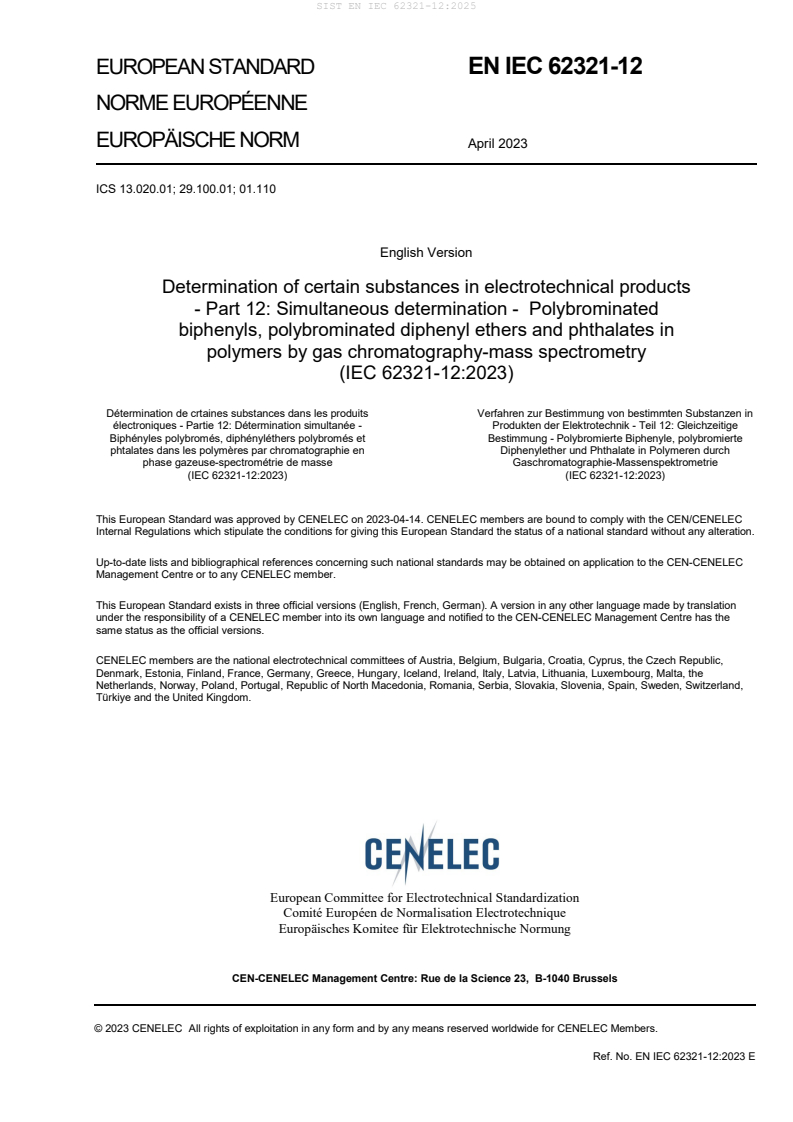
SLOVENSKI STANDARD
01-maj-2025
Določevanje posameznih snovi v elektrotehničnih izdelkih - 12. del: Sočasno
določevanje polibromiranih bifenilov, polibromiranih difenil etrov in ftalatov v
polimerih s plinsko kromatografijo-masno spektrometrijo
Determination of certain substances in electrotechnical products - Part 12: Simultaneous
determination - Polybrominated biphenyls, polybrominated diphenyl ethers and
phthalates in polymers by gas chromatography-mass spectrometry
Verfahren zur Bestimmung von bestimmten Substanzen in Produkten der Elektrotechnik
- Teil 12: Gleichzeitige Bestimmung - Polybromierte Biphenyle, polybromierte
Diphenylether und Phthalate in Polymeren durch Gaschromatographie-
Massenspektrometrie
Détermination de crtaines substances dans les produits électroniques - Partie 12:
Détermination simultanmée - Biphéyles polybromés, diphényléthers polybromés et
phtalates dans les polymères par chromatographie en phase gazeuse-spectronmétrie de
masse
Ta slovenski standard je istoveten z: EN IEC 62321-12:2023
ICS:
29.020 Elektrotehnika na splošno Electrical engineering in
general
31.020 Elektronske komponente na Electronic components in
splošno general
71.040.50 Fizikalnokemijske analitske Physicochemical methods of
metode analysis
2003-01.Slovenski inštitut za standardizacijo. Razmnoževanje celote ali delov tega standarda ni dovoljeno.
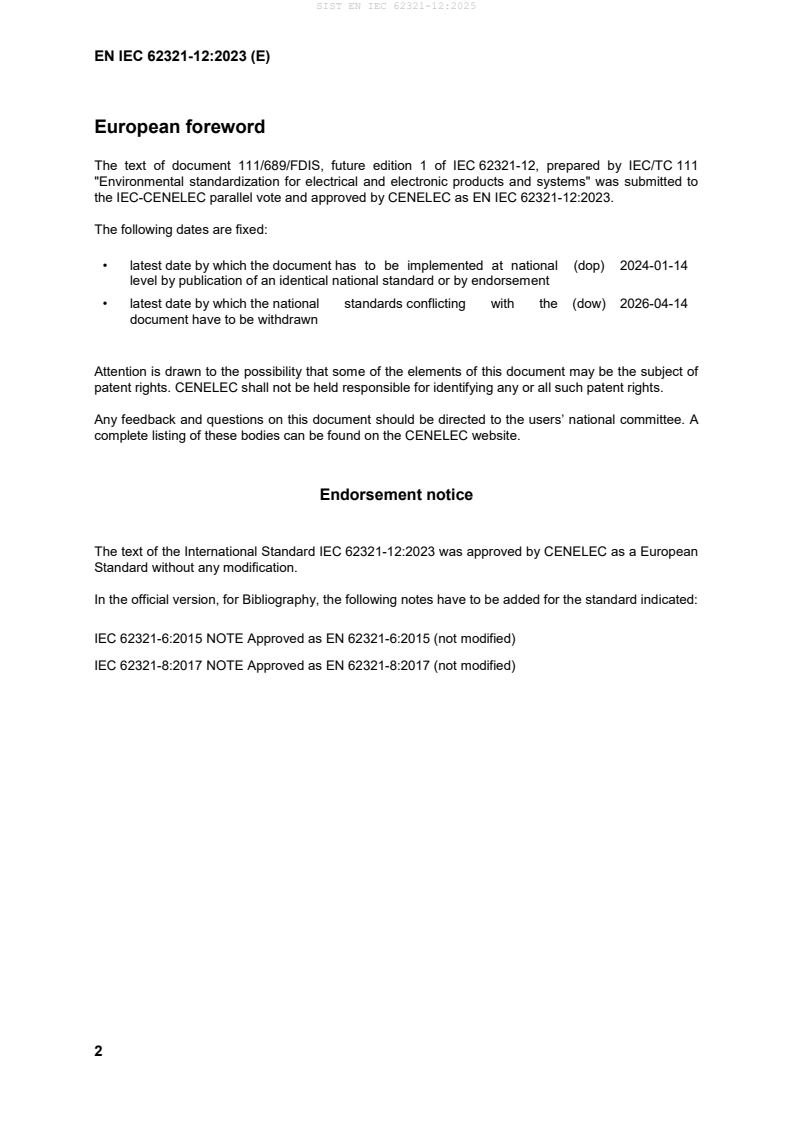
EUROPEAN STANDARD EN IEC 62321-12
NORME EUROPÉENNE
EUROPÄISCHE NORM April 2023
ICS 13.020.01; 29.100.01; 01.110
English Version
Determination of certain substances in electrotechnical products
- Part 12: Simultaneous determination - Polybrominated
biphenyls, polybrominated diphenyl ethers and phthalates in
polymers by gas chromatography-mass spectrometry
(IEC 62321-12:2023)
Détermination de crtaines substances dans les produits Verfahren zur Bestimmung von bestimmten Substanzen in
électroniques - Partie 12: Détermination simultanée - Produkten der Elektrotechnik - Teil 12: Gleichzeitige
Biphényles polybromés, diphényléthers polybromés et Bestimmung - Polybromierte Biphenyle, polybromierte
phtalates dans les polymères par chromatographie en Diphenylether und Phthalate in Polymeren durch
phase gazeuse-spectrométrie de masse Gaschromatographie-Massenspektrometrie
(IEC 62321-12:2023) (IEC 62321-12:2023)
This European Standard was approved by CENELEC on 2023-04-14. CENELEC members are bound to comply with the CEN/CENELEC
Internal Regulations which stipulate the conditions for giving this European Standard the status of a national standard without any alteration.
Up-to-date lists and bibliographical references concerning such national standards may be obtained on application to the CEN-CENELEC
Management Centre or to any CENELEC member.
This European Standard exists in three official versions (English, French, German). A version in any other language made by translation
under the responsibility of a CENELEC member into its own language and notified to the CEN-CENELEC Management Centre has the
same status as the official versions.
CENELEC members are the national electrotechnical committees of Austria, Belgium, Bulgaria, Croatia, Cyprus, the Czech Republic,
Denmark, Estonia, Finland, France, Germany, Greece, Hungary, Iceland, Ireland, Italy, Latvia, Lithuania, Luxembourg, Malta, the
Netherlands, Norway, Poland, Portugal, Republic of North Macedonia, Romania, Serbia, Slovakia, Slovenia, Spain, Sweden, Switzerland,
Türkiye and the United Kingdom.
European Committee for Electrotechnical Standardization
Comité Européen de Normalisation Electrotechnique
Europäisches Komitee für Elektrotechnische Normung
CEN-CENELEC Management Centre: Rue de la Science 23, B-1040 Brussels
© 2023 CENELEC All rights of exploitation in any form and by any means reserved worldwide for CENELEC Members.
Ref. No. EN IEC 62321-12:2023 E
European foreword
The text of document 111/689/FDIS, future edition 1 of IEC 62321-12, prepared by IEC/TC 111
"Environmental standardization for electrical and electronic products and systems" was submitted to
the IEC-CENELEC parallel vote and approved by CENELEC as EN IEC 62321-12:2023.
The following dates are fixed:
• latest date by which the document has to be implemented at national (dop) 2024-01-14
level by publication of an identical national standard or by endorsement
• latest date by which the national standards conflicting with the (dow) 2026-04-14
document have to be withdrawn
Attention is drawn to the possibility that some of the elements of this document may be the subject of
patent rights. CENELEC shall not be held responsible for identifying any or all such patent rights.
Any feedback and questions on this document should be directed to the users’ national committee. A
complete listing of these bodies can be found on the CENELEC website.
Endorsement notice
The text of the International Standard IEC 62321-12:2023 was approved by CENELEC as a European
Standard without any modification.
In the official version, for Bibliography, the following notes have to be added for the standard indicated:
IEC 62321-6:2015 NOTE Approved as EN 62321-6:2015 (not modified)
IEC 62321-8:2017 NOTE Approved as EN 62321-8:2017 (not modified)
Annex ZA
(normative)
Normative references to international publications
with their corresponding European publications
The following documents are referred to in the text in such a way that some or all of their content
constitutes requirements of this document. For dated references, only the edition cited applies. For
undated references, the latest edition of the referenced document (including any amendments)
applies.
NOTE 1 Where an International Publication has been modified by common modifications, indicated by (mod), the
relevant EN/HD applies.
NOTE 2 Up-to-date information on the latest versions of the European Standards listed in this annex is available
here: www.cencenelec.eu.
Publication Year Title EN/HD Year
IEC 62321-1 2013 Determination of certain substances in EN 62321-1 2013
electrotechnical products - Part 1:
Introduction and overview
IEC 62321-2 - Determination of certain substances in EN IEC 62321-2 -
electrotechnical products - Part 2:
Disassembly, disjointment and mechanical
sample preparation
IEC 62321-12 ®
Edition 1.0 2023-03
INTERNATIONAL
STANDARD
NORME
INTERNATIONALE
HORIZONTAL PUBLICATION
PUBLICATION HORIZONTALE
Determination of certain substances in electrotechnical products –
Part 12: Simultaneous determination – Polybrominated biphenyls,
polybrominated diphenyl ethers and phthalates in polymers by gas
chromatography-mass spectrometry
Détermination de certaines substances dans les produits électrotechniques –
Partie 12: Détermination simultanée – Biphényles polybromés, diphényléthers
polybromés et phtalates dans les polymères par chromatographie en phase
gazeuse-spectrométrie de masse
INTERNATIONAL
ELECTROTECHNICAL
COMMISSION
COMMISSION
ELECTROTECHNIQUE
INTERNATIONALE
ICS 01.110; 13.020.01; 29.100.01 ISBN 978-2-8322-6539-0
– 2 – IEC 62321-12:2023 © IEC 2023
CONTENTS
FOREWORD . 4
INTRODUCTION . 6
1 Scope . 7
2 Normative references . 7
3 Terms, definitions and abbreviated terms . 7
3.1 Terms and definitions . 7
3.2 Abbreviated terms . 8
4 Principle . 9
5 Reagents and materials . 9
6 Equipment, apparatus and tools . 10
7 Sampling . 10
8 Procedure . 10
8.1 General instructions for the analysis . 10
8.2 Sample preparation . 11
8.2.1 Stock solution . 11
8.2.2 Extraction . 11
8.2.3 Addition of the internal standard (IS) . 12
8.3 Instrumental parameters . 12
8.4 Calibrants . 14
8.5 Calibration . 14
8.5.1 General . 14
8.5.2 Mixing stock solutions for PBB (10 μg/ml for each congener), PBDE (10
μg/ml for each congener), phthalate (10 μg/ml for each analyte) and
surrogate standard (10 μg/ml) . 15
8.5.3 Internal standard solution (100 μg/ml of CB209, anthracene-d ) . 15
8.5.4 Standard solutions . 15
9 Calculation of analyte concentration . 16
9.1 General . 16
9.2 Calculation . 16
10 Precision . 19
11 Quality assurance and control . 20
11.1 Resolution . 20
11.2 Performance . 20
11.3 Limit of detection (LOD) or method detection limit (MDL) and limit of
quantification (LOQ) . 22
12 Test report . 23
Annex A (informative) Example of extraction efficiency in different extractants . 24
Annex B (informative) Example of extraction efficiency in different cycles . 25
Annex C (informative) Examples of chromatograms . 26
Annex D (informative) Examples of mass spectrograms . 27
Annex E (informative) Statistics results of the international interlaboratory
study 12 (IIS12) . 36
Bibliography . 37
IEC 62321-12:2023 © IEC 2023 – 3 –
Figure A.1 – Extraction efficiency using detection response of the analytes in different
extractants . 24
Figure C.1 – Total ion current chromatogram of each analyte (1,5 µg/ml, 1 µl,
splitless) . 26
Figure C.2 – SIM ion chromatogram of PBBs, PBDEs and phthalate (1,5 µg/ml, 1 µl,
splitless) . 26
Figure D.1 – 2-Bromobiphenyl (Mono-BB) . 27
Figure D.2 – 4-Bromodiphenyl ether (Mono-BDE) . 27
Figure D.3 – 2,5-Dibromobiphenyl (Di-BB) . 28
Figure D.4 – Di-isobutyl phthalate (DIBP). 28
Figure D.5 – Di-n-butyl phthalate (DBP) . 28
Figure D.6 – 4,4’-Dibromobiphenyl ether (Di-BDE) . 29
Figure D.7 – 2,4,6-Tribromobiphenyl (Tri-BB) . 29
Figure D.8 – 3,3’,4-Tribromobiphenyl ether (Tri-BDE) . 29
Figure D.9 – 2,2’,5,5’-Tetrabromobiphenyl (Tetra-BB) . 30
Figure D.10 – Butyl benzyl phthalate (BBP) . 30
Figure D.11 – 2,2’,4,5’,6-Pentabromobiphenyl (Penta-BB) . 30
Figure D.12 – Di-(2-ethylhexyl) phthalate (DEHP) . 31
Figure D.13 – 3,3’,4,4’-Tetrabromobiphenyl ether (Tetra-BDE) . 31
Figure D.14 – 2,2’,4,4’,6,6’-Hexabromobiphenyl (Hexa-BB) . 31
Figure D.15 – 2,2’,4,4’,6-Pentabromobiphenyl ether (Penta-BDE) . 32
Figure D.16 – 2,2’,4,4’,5,6’-Hexabromodiphenyl ether (Hexa-BDE) . 32
Figure D.17 – 2,2’,3,4,4’,5,5’-Heptabromobiphenyl (Hepta-BB) . 32
Figure D.18 – 2,2’,3,4,4’,5,6-Heptabromodiphenyl ether (Hepta-BDE) . 33
Figure D.19 – 2,2’,3,4,4’,5,5’,6’-Octabromodiphenyl ether (Octa-BDE) . 33
Figure D.20 – Octabromobiphenyl, technology (hepta + octa + nona) (Octa-BB) . 33
Figure D.21 – 2,2’,3,3’,4,4’,5,5’,6-Nonabromobiphenyl (Nona-BB) . 34
Figure D.22 – 2,2’,3,3’,4,4’,5,5’,6-Nonabromodiphenyl ether (Nona-BDE) . 34
Figure D.23 – Decabromobiphenyl (Deca-BB) . 34
Figure D.24 – Decabromodiphenyl ether (Deca-BDE) . 35
Table 1 – Matrix spiking solution . 11
Table 2 – Reference for the quantification of PBBs . 13
Table 3 –Reference for the quantification of PBDEs . 13
Table 4 – Reference for the quantification of each phthalate . 13
Table 5 – Example of commercially available reference solutions . 14
Table 6 – Examples of calibration ranges of PBBs, PBDEs and phthalates . 15
Table 7 – IIS12 repeatability and reproducibility . 19
Table 8 – Example calculation . 20
Table 9 – IIS12 mean, recovery and relative standard deviation . 21
Table B.1 – Extraction efficiency of the analytes in different cycles . 25
– 4 – IEC 62321-12:2023 © IEC 2023
INTERNATIONAL ELECTROTECHNICAL COMMISSION
____________
DETERMINATION OF CERTAIN SUBSTANCES
IN ELECTROTECHNICAL PRODUCTS –
Part 12: Simultaneous determination – Polybrominated biphenyls,
polybrominated diphenyl ethers and phthalates in polymers by
gas chromatography-mass spectrometry
FOREWORD
1) The International Electrotechnical Commission (IEC) is a worldwide organization for standardization comprising
all national electrotechnical committees (IEC National Committees). The object of IEC is to promote international
co-operation on all questions concerning standardization in the electrical and electronic fields. To this end and
in addition to other activities, IEC publishes International Standards, Technical Specifications, Technical Reports,
Publicly Available Specifications (PAS) and Guides (hereafter referred to as "IEC Publication(s)"). Their
preparation is entrusted to technical committees; any IEC National Committee interested in the subject dealt with
may participate in this preparatory work. International, governmental and non-governmental organizations liaising
with the IEC also participate in this preparation. IEC collaborates closely with the International Organization for
Standardization (ISO) in accordance with conditions determined by agreement between the two organizations.
2) The formal decisions or agreements of IEC on technical matters express, as nearly as possible, an international
consensus of opinion on the relevant subjects since each technical committee has representation from all
interested IEC National Committees.
3) IEC Publications have the form of recommendations for international use and are accepted by IEC National
Committees in that sense. While all reasonable efforts are made to ensure that the technical content of IEC
Publications is accurate, IEC cannot be held responsible for the way in which they are used or for any
misinterpretation by any end user.
4) In order to promote international uniformity, IEC National Committees undertake to apply IEC Publications
transparently to the maximum extent possible in their national and regional publications. Any divergence between
any IEC Publication and the corresponding national or regional publication shall be clearly indicated in the latter.
5) IEC itself does not provide any attestation of conformity. Independent certification bodies provide conformity
assessment services and, in some areas, access to IEC marks of conformity. IEC is not responsible for any
services carried out by independent certification bodies.
6) All users should ensure that they have the latest edition of this publication.
7) No liability shall attach to IEC or its directors, employees, servants or agents including individual experts and
members of its technical committees and IEC National Committees for any personal injury, property damage or
other damage of any nature whatsoever, whether direct or indirect, or for costs (including legal fees) and
expenses arising out of the publication, use of, or reliance upon, this IEC Publication or any other IEC
Publications.
8) Attention is drawn to the Normative references cited in this publication. Use of the referenced publications is
indispensable for the correct application of this publication.
9) Attention is drawn to the possibility that some of the elements of this IEC Publication may be the subject of patent
rights. IEC shall not be held responsible for identifying any or all such patent rights.
IEC 62321-12 has been prepared by IEC technical committee 111: Environmental
standardization for electrical and electronic products and systems. It is an International
Standard.
The text of this International Standard is based on the following documents:
Draft Report on voting
111/689/FDIS 111/696/RVD
Full information on the voting for its approval can be found in the report on voting indicated in
the above table.
The language used for the development of this International Standard is English.
IEC 62321-12:2023 © IEC 2023 – 5 –
This document was drafted in accordance with ISO/IEC Directives, Part 2, and developed in
accordance with ISO/IEC Directives, Part 1 and ISO/IEC Directives, IEC Supplement, available
at www.iec.ch/members_experts/refdocs. The main document types developed by IEC are
described in greater detail at www.iec.ch/standardsdev/publications.
A list of all parts in the IEC 62321 series, published under the general title Determination of
certain substances in electrotechnical products, can be found on the IEC website.
The committee has decided that the contents of this document will remain unchanged until the
stability date indicated on the IEC website under webstore.iec.ch in the data related to the
specific document. At this date, the document will be
• reconfirmed,
• withdrawn,
• replaced by a revised edition, or
• amended.
– 6 – IEC 62321-12:2023 © IEC 2023
INTRODUCTION
The widespread use of electrotechnical products has drawn increased attention to their impact
on the environment. In many countries around the world it has been a contributing factor in
adapting regulations that affect wastes, substances and energy use of electrotechnical products.
The use of certain substances (e.g. lead (Pb), cadmium (Cd), polybrominated diphenyl ethers
(PBDEs) and specific phthalates) in electrotechnical products is a source of concern in current
and proposed regional legislation.
The purpose of the IEC 62321 series is therefore to provide test methods that will allow the
electrotechnical industry to determine the levels of certain substances of concern in
electrotechnical products on a consistent global basis.
This first edition of IEC 62321-12 introduces a new part in the IEC 62321 series.
WARNING – Persons using this document should be familiar with normal laboratory practices.
This document does not purport to address all of the safety problems, if any, associated with
its use. It is the responsibility of the user to establish appropriate safety and health practices
and to ensure compliance with any national regulatory conditions.
IEC 62321-12:2023 © IEC 2023 – 7 –
DETERMINATION OF CERTAIN SUBSTANCES
IN ELECTROTECHNICAL PRODUCTS –
Part 12: Simultaneous determination – Polybrominated biphenyls,
polybrominated diphenyl ethers and phthalates in polymers by
gas chromatography-mass spectrometry
1 Scope
This part of IEC 62321 specifies a reference test method for the simultaneous determination of
polybrominated biphenyls, polybrominated diphenyl ethers, and four phthalates: di-isobutyl
phthalate (DIBP), di-n-butyl phthalate (DBP), benzylbutyl phthalate (BBP), di-(2-ethylhexyl)
phthalate (DEHP) in polymers of electrotechnical products.
The extraction technique described in this document is the ultrasonic-assisted extraction used
for simultaneous extraction for sample preparation.
Gas chromatography-mass spectrometry (GC-MS) is considered as the reference technique for
the measurement of the simultaneous determination of analytes in the range of 25 mg/kg to
2 000 mg/kg.
The test method using ultrasonic-assisted extraction followed by GC-MS detection has been
evaluated by the tests of polypropylene (PP), polyvinylchloride (PVC), acrylonitrile butadiene
styrene (ABS), acrylate rubber (ACM), polystyrene (PS), polyurethane (PU) and polyethylene
(PE) materials.
This document has the status of a horizontal standard in accordance with IEC Guide 108.
2 Normative references
The following documents are referred to in the text in such a way that some or all of their content
constitutes requirements of this document. For dated references, only the edition cited applies.
For undated references, the latest edition of the referenced document (including any
amendments) applies.
IEC 62321-1:2013, Determination of certain substances in electrotechnical products – Part 1:
Introduction and overview
IEC 62321-2, Determination of certain substances in electrotechnical products – Part 2:
Disassembly, disjointment and mechanical sample preparation
3 Terms, definitions and abbreviated terms
3.1 Terms and definitions
For the purposes of this document, the following terms and definitions apply.
ISO and IEC maintain terminology databases for use in standardization at the following
addresses:
• IEC Electropedia: available at http://www.electropedia.org/
• ISO Online browsing platform: available at http://www.iso.org/obp
– 8 – IEC 62321-12:2023 © IEC 2023
3.1.1
simultaneous determination
same analysis and detection procedure to determine different classes of analytes that includes
(but is not limited to): pretreatment, extraction, cleaning-up and detection
3.1.2
ultrasonic-assisted extraction
extraction technique using ultrasonic waves, which makes it possible to accelerate the speed
of extraction of substances in the sample matrix (the extractant does not dissolve the sample
matrix), in order to improve the extraction efficiency, for example in an ultrasonic bath
3.1.3
calibrant
calibration standard
substance in solid or liquid form with known and stable concentration(s) of the analyte(s) of
interest used to establish instrument response (calibration curve) with respect to analyte(s)
concentration(s)
[SOURCE: IEC 62321-8:2017, 3.1.3]
3.1.4
technical mixture
commercial product manufactured for industrial use whose purity is not as clearly defined as an
individual high purity calibration standard
[SOURCE: IEC 62321-6:2015, 3.1.2, modified – "(e.g. flame retardants)" has been deleted.]
3.2 Abbreviated terms
ABS acrylonitrile butadiene styrene
ACM acrylate rubber
BBP benzyl butyl phthalate
BDE brominated diphenyl ether
BSA bis(trimethylsilyl)acetamide
BSTFA N,O-bis(trimethylsilyl)trifluoroacetamide
CCC continuing calibration check standard
DBOFB (4, 4’-dibromooctafluorobiphenyl) (n)
DBP di-n-butyl phthalate
deca-BB decabromobiphenyl
deca-BDE decabromodiphenyl ether
DEHP di-(2-ethylhexyl) phthalate
DIBP di-isobutyl phthalate
DMDCS dimethyldichlorosilane
EI electron ionization
EPA U.S. Environmental Protection Agency
GC-MS gas chromatography-mass spectrometry
IS internal standard
IUPAC International Union of Pure and Applied Chemistry
LOD limit of detection
LOQ limit of quantification
MDL method detection limit
IEC 62321-12:2023 © IEC 2023 – 9 –
PBB polybrominated biphenyl
PBDE polybrominated diphenyl ether
PE polyethylene
PP polypropylene
PS polystyrene
PTFE polytetrafluoroethylene
PTV programmed temperature vaporizing
PU polyurethane
PVC polyvinylchloride
QC quality control
RSD relative standard deviation
SIM selected ion monitoring
TICS tentatively identified compounds
4 Principle
Different classes of analytes, i.e. PBBs, PBDEs, BBP, DBP, DEHP, and DIBP, in polymers, are
simultaneously extracted by ultrasonic-assisted extraction and determined qualitatively and
quantitatively by gas chromatography-mass spectrometry (GC-MS) using full scan mode and
(or) single (or "selected") ion monitoring (SIM) mode.
5 Reagents and materials
All reagents chemicals shall be tested for contamination and blank values prior to application
as follows:
a) n-hexane (GC grade or higher);
b) acetone (GC grade or higher);
c) acetone/n-hexane (1:1, v/v);
d) toluene (GC grade or higher);
e) helium (purity greater than a volume fraction of 99,999 %);
f) technical BDE-209 with BDE-209 ~ 96,9 % and BDE-206 ~ 1,5 % solution;
g) calibrants: refer to 8.4;
h) surrogate and internal standards:
– surrogate standard used to monitor analyte recovery according to 8.2.1 a), 8.5.2 and
8.5.3, e.g. DBOFB (4, 4’-dibromooctafluorobiphenyl) (n), dibutyl phthalate-3,4,5,6-d or
di-(2-ethylhexyl) phthalate-3,4,5,6-d ;
– internal standard used to correct for injection errors, according to 8.2.1 b), 8.2.3 and
8.5.4, e.g. anthracene-d or CB209 (2,2’,3,3’,4,4’,5,5’,6,6’-decachlorobiphenyl).
Deuterium substituted target analytes are recommended as surrogate and internal standards.
C-labelled nonaBDE and C-labelled decaBDE are recommended for the high-mass PBDEs.
13 13
Other standards can be used as surrogate and internal standard, if they have been validated to
give acceptable blank, recoveries and precision of analysis.
– 10 – IEC 62321-12:2023 © IEC 2023
6 Equipment, apparatus and tools
The following items shall be used for the analysis:
a) analytical balance capable of measuring accurately to 0,000 1 g;
b) 1 ml, 5 ml, 10 ml, 25 ml, 100 ml volumetric flasks;
c) ultrasonic bath (450 W, 40 kHz, volume ~10 l, or equivalent);
NOTE 1 Much lower ultrasonic power and frequency, and a much larger bath volume can influence the extraction
efficiency. Validation of extraction efficiency can be referred to in Annex B.
d) glass centrifuge tube with a screw cap with polytetrafluoroethylene gasket (for extraction,
~10 ml);
e) centrifuge (capacity not less than 5 000 r/min);
f) deactivated injector liner (for GC-MS);
g) aluminium foil;
NOTE 2 Brown or amber vessels as indicated in the text of the procedure can also be used.
h) microlitre syringe or automatic pipettes;
i) Pasteur pipette;
j) 1,5 ml sample vials with 100 μl glass insert and a screw cap with polytetrafluoroethylene
(PTFE) gasket or, depending on the analytical system, a comparable sample receptacle.
Brown or amber vessels shall be used as indicated in the text of the procedure;
k) mini-shaker (also known as vortexer or vortex mixer);
l) a gas chromatograph with a capillary column coupled to a mass spectrometric detector
(electron ionization, EI). The mass spectrometric detector shall be able to perform selective
ion monitoring and have an upper mass range of at least 1 000 m/z. The high-range mass
is required to unambiguously identify deca-BDE and nona-BDE. The use of an autosampler
is strongly recommended to ensure repeatability;
m) a column length of approximately 15 m that has sufficient separation efficiency for PBB,
PBDE and phthalate compounds (see 8.3 a)) for example of suitable column);
n) 0,45 μm PTFE filter membrane;
o) pre-cleaned filter paper, pre extracted using acetone/n-hexane (see Clause 5 c)) as
extractant according to 8.2.2 d) for three cycles and dried in the air with a temperature below
45 °C.
7 Sampling
Sampling shall be as described in IEC 62321-2, unless indicated otherwise (e.g. "… using a
nipper."). Cryogenic grinding with liquid nitrogen cooling is recommended and the samples shall
be ground to pass through a 500 μm sieve before extraction. Otherwise, the sample shall be
cut in pieces < 1 × 1 mm.
8 Procedure
8.1 General instructions for the analysis
The following general instructions shall be followed:
In order to reduce blank values, ensure the cleanliness of all glass equipment (excluding
volumetric flasks) and deactivate glass wool by subjecting it to 450 °C for at least 30 min.
___________
Jingu (China), Bandelin (Germany), SONOSWISS (Switzerland), Branson (USA), Shumei (China), SHARP
(Japan) are examples of suitable ultrasonic bath or equipment available commercially. This information is given
for the convenience of users of this document and does not constitute an endorsement by IEC of these products.
IEC 62321-12:2023 © IEC 2023 – 11 –
To avoid decomposition or debromination, or both, of PBDEs by UV light during extraction
and analysis, glass equipment made from brown or amber glass shall be used after
extraction for storage of the extract.
NOTE If no brown or amber glass is available, aluminium foil can be used for protection from light.
8.2 Sample preparation
8.2.1 Stock solution
The following stock solutions shall be prepared:
a) surrogate standard (to monitor analyte recovery): 1 000 μg/ml in an organic solvent (e.g.
DBOFB, dibutyl phthalate-3,4,5,6-d or di-(2-ethylhexyl)phthalate-3,4,5,6-d in n-hexane);
4 4
b) internal standard (to correct for injection error): 1 000 μg/ml in an organic solvent (e.g.
decachlorobiphenyl, anthracene-d in n-hexane);
c) polybrominated biphenyl (PBB) solution: 100 μg/ml in an organic solvent (e.g. toluene);
d) polybrominated diphenyl ether (PBDE) solution: 100 μg/ml in an organic solvent (e.g.
toluene);
e) phthalate (DIBP, DBP, BBP and DEHP) solution: 1 000 μg/ml in an organic solvent (e.g. n-
hexane).
f) matrix spiking solution for PBBs, PBDEs and phthalate; containing a total of five calibration
congener standards in an organic solvent (e.g. n-hexane) as indicated in Table 1. The
addition of 1 ml of a matrix spiking solution containing each of the five analytes in a
concentration of 10 μg/ml is suitable for delivery of the required 10 μg (see 11.2 b)) in the
matrix spike sample.
Table 1 – Matrix spiking solution
Number of PBDEs Number of PBBs Number of phthalate
congeners congeners congeners
Mono to penta 1 Mono to penta 1
Hexa to deca 1 Hexa to deca 1
All brominated species from mono- to deca-brominated biphenyl (PBB) and mono- to deca-
brominated diphenyl ether (PBDE) shall be included in the PBB and PBDE stock solutions (see
8.4). Other stock solution concentrations can be utilized providing the standard solution
concentrations given in 8.5.2 can be achieved. All the standard solutions should be stored at a
temperature lower than −10 °C before use.
8.2.2 Extraction
The following steps shall be followed for sample extraction:
a) Transfer 100 mg ± 10 mg of the sample into the centrifuge tube (see Clause 6 d)). Record
the sample mass to the nearest 0,1 mg. The sample is allowed to be wrapped up by a pre-
cleaned filter paper (see Clause 6 o)) to help in isolating the supernatant, so as to avoid
centrifugation (see e) below) after extraction. In this way, the centrifuge tube can be
replaced with other glass containers in which the sample can be soaked (see 8.2.2 b)).
b) Add 4 ml acetone/n-hexane (see Clause 5 c)) into the tube and shake for a moment so that
the sample is soaked.
NOTE 1 Different extractants can give different extraction efficiencies (see Annex A).
c) Add 25 μl of the surrogate standard (1 000 μg/ml) (see 8.2.1 a)).
d) Extract for 15 min in an ultrasonic bath (see Clause 6 c). The temperature of the ultrasonic
bath should not be higher than 40 °C. The temperature of the bath can usually be kept below
40 °C during extraction. The temperature control can be taken by adding an ice-pack or by
– 12 – IEC 62321-12:2023 © IEC 2023
changing the water in the bath. The water level in the ultrasonic bath should be higher than
the extractant level in the tube during extraction.
WARNING – A temperature of the bath that is too high can be dangerous due to the volatilization
of the organic solvent in the sealed tube.
e) Centrifuge the tube at 5 000 r/min for 5 min. Transfer the supernatant into a 25 ml volumetric
flask.
f) Repeat b), d) and e) twice. All the supernatants are collected into the same 25 ml volumetric
flask.
NOTE 2 An insufficient number of extraction cycles will give lower recoveries of the analytes. See Annex B for
details.
g) The volumetric flask is filled with extraction solvent to the mark.
8.2.3 Addition of the internal standard (IS)
Prepare a 1 ml aliquot of each sample extract to be analysed and place it in an appropriate
sample vial. Add 20 μl of internal standard solution (see 8.5.3) to the vial and cap the vial.
Shake the vial by hand to mix thoroughly.
Inject 1 μl of the sample solution into the GC-MS and analyse it according to the parameters
described in 8.3.
8.3 Instrumental parameters
Different conditions can be necessary to optimize a specific GC-MS system to achieve effective
separation of all calibration congeners and meet the quality control (QC) and limits of detection
(LOD) requirements. The following parameters have been found suitable and are provided as
an example (see the chromatograms and mass spectrograms in Annex C and Annex D,
respectively):
a) GC column: non-polar (phenyl-arylene-polymer equivalent to 5 % phenyl-
methylpolysiloxane); length 15 m; internal diameter 0,25 mm; film thickness 0,1 μm. A high
temperature column (maximum = 400 °C) shall be used for the stated GC conditions in the
method.
b) PTV (programmed temperature vaporizing), cool on-column, split/splitless injector or
comparable injection systems can be used.
The use of an on-column injector can also be suggested as another way of introducing the
sample. This is particularly beneficial for the sensitivity of heavier congeners like octa-BDE
and nona-BDE. Be aware of sensitivity to matrix effects.
c) Injector liner: 4 mm single bottom taper glass liner with glass wool at bottom (deactivated).
NOTE 1 Additional deactivation of a purchased deactivated injector liner can be performed. This is especially useful
if the "PR-206" quality control requirements in 11.3 cannot be achieved. An example of a chemical deactivation
procedure is as follows: a commercially available, factory-deactivated liner (split/splitless single-taper with glass
wool at the bottom) is taken and immersed in 5 % dimethyldichlorosilane (DMDCS) in dichloromethane or toluene for
15 min. It is picked up with forceps and drained and immersed three times in the DMDCS to make sure the glass
wool has been thoroughly covered and flushed. It is drained once more and the residue solution is blotted onto a
clean wiper. The liner is immersed in methanol for 10 min to 15 min, and again drained and immersed three times. It
is rinsed inside and out with methanol from a squeeze bottle, followed by dichloromethane from a squeeze bottle.
The liner is transferred to a vacuum oven purged with nitrogen and dried at 110 °C for at least 15 min. Once dry it is
ready for use.
d) Carrier: helium (see Clause 5 e)), 1,0 ml/min, constant flow.
e) Oven: 100 °C for 2 min, 20 °C/min ramp to 320 °C for 3 min.
f) Transfer line: 300 °C, direct.
g) Ion source temperature: 230 °C.
h) Ionization method: electron ionization (EI), 70 eV.
i) Dwell time: 50 ms in SIM mode.
IEC 62321-12:2023 © IEC 2023 – 13 –
NOTE 2 To achieve the required data quality for a PBB, PBDE or phthalate GC peak, three to four scans of the
quantification ions selected can be acquired per second. This will give the appropriate dwell time for each ion (m/z)
to be monitored. The scan rate will result in a dwell time in the range of 50 ms per ion. It is noted that by default
some software sets the dwell time as a function of the scan rate. The analysis of PBBs and PBDEs is carried out in
selected ion monitoring (SIM) mode with the mass traces given in Table 2 to Table 4. These have been found suitable
and are provided as examples.
Table 2 – Reference for the quantification of PBBs
Type of PBBs Identification ions Quantification ions
Mono 152 232 233 232
Di 152 310 312 312
Tri 390 230 149 390
Tetra 470 310 308 310
Penta 548 227 388 388
Hexa 628 468 308 468
Hepta 705 546 544 705
Octa 785 546 707 785
Nona 864 786 705 705
Deca 943 783 781 783
Table 3 –Reference for the quantification of PBDEs
Type of PBDEs Identification ions Quantification ions
Mono 250 248 141 248
Di 328 221 168 328
Tri 406 248 139 406
Tetra 488 486 326 486
Penta 564 406 404 564
Hexa 644 484 242 644
Hepta 722 562 455 562
Octa 799 642 564 642
Nona 880 721 719 721
Deca 959 799 797 799
Table 4 – Reference for the quantification of each phthalate
Type of phthalate Identification ions Quantification ions
DIBP 149 57 104 149
DBP 149 223 205 149
BBP 149 91 296 149
DEHP 149 167 57 149
A full scan run using a total ion current ("full scan") MS method for each sample is also
recommended for checking for the existence of target compounds not present in the calibration
(tentatively identified compounds or "TICS") or not seen in the SIM window. If present, identify
the peak and determine the class of compound (e.g. octabromobiphenyl, pentabromodiphenyl
ether) by evaluation of the total ion spectra.
– 14 – IEC 62321-12:2023 © IEC 2023
8.4 Calibrants
Reference solutions are used as calibrants. All brominated species from mono-BB to deca-BB,
mono-BDE to deca-BDE and phthalates shall be included in the calibration. The following
Table 5 is an example list of commercially available reference solutions that have been found
suitable for this analysis.
Table 5 – Example of commercially available reference solutions
Group Compound CAS No.
2-Bromobiphenyl 2052-07-5
2,5-Dibromobiphenyl 57422-77-2
2,4,6-Tribromobiphenyl 59080-33-0
2,2’,5,5’-Tetrabromobiphenyl 59080-37-4
2,2’,4,5’,6-Pentabromobiphenyl 59080-39-6
PBBs
2,2’,4,4’,6,6’-Hexabromobiphenyl 59261-08-4
2,2’,3,4,4’,5,5’-Heptabromobiphenyl 67733-52-2
Octabromobiphenyl, technology (hepta + octa + nona) 27858-07-7
2,2’,3,3’,4,4’,5,5’,6-Nonabromobiphenyl 69278-62-2
Decabromobiphenyl 13654-09-6
4-Bromodiphenyl ether 101-55-3
4,4’-Dibromobiphenyl ether 2050-47-7
3,3’,4-Tribromobiphenyl ether 147217-80-9
3,3’,4,4’-Tetrabromobiphenyl ether 93703-48-1
2,2’,4,4’,6-Pentabromobiphenyl ether 189084-64-8
PBDEs
2,2’,4,4’,5,6’-Hexabromodiphenyl ether 207122-15-4
2,2’,3,4,4’,5,6-Heptabromodiphenyl ether 189084-67-1
2,2’,3,4,4’,5,5’,6’-Octabromodiphenyl ether 337513-72-1
2,2’,3,3’,4,4’,5,5’,6-Nonabromodiphenyl ether 63387-28-0
Decabromodiphenyl ether 1163-19-5
Butyl benzyl phthalate 85-68-7
Di-n-butyl phthalate 84-74-2
Phthalates
Di-(2-ethylhexyl) phthalate 117-81-7
Di-isobutyl phthalate 84-69-5
8.5 Calibration
8.5.1 General
Wherever possible, the solvent used for the sample and standard solutions shall be the same
to avoid any potential solvent effects.
A calibration curve shall be
...