

SIST EN 542:2003
(Main)Adhesives - Determination of density
General Information
- Abstract
This European Standard defines two methods for the determination of density which are applicable to all adhesives.
One procedure is used for adhesives in liquid form and the other one for solid, very viscous or pasty adhesives.
- Status
- Published
- Publication Date
- 30-Jun-2003
- Technical Committee
- IPMA - Polimer materials and products
- Current Stage
- 6060 - National Implementation/Publication (Adopted Project)
- Start Date
- 01-Jul-2003
- Due Date
- 01-Jul-2003
- Completion Date
- 01-Jul-2003

Overview
SIST EN 542:2003 is a European standard developed by CEN for the determination of adhesive density. It specifies two precise methods applicable to all types of adhesives-one method for adhesives in liquid form and another for solid, very viscous, or pasty adhesives. This standard ensures consistent and reliable measurement of density, which is a critical parameter affecting adhesive performance and quality control in industrial and manufacturing processes.
This standard was approved in February 2003, superseding EN 542:1994, and is mandatory for adoption by CEN member countries. It provides a comprehensive, standardized approach to density testing to support harmonized quality assessment and regulatory compliance within the adhesives sector.
Key Topics
Scope
Defines methods applicable for liquid and solid/pasty adhesives to measure density accurately at 23°C.Testing Procedures
- Liquid Adhesives: Utilizes a glass or metal pyknometer to determine density by comparing adhesive mass to a reference volume of water at controlled temperature.
- Solid or Viscous Adhesives: Involves filling the pyknometer with a reference liquid that does not react with the adhesive, enabling the volume displacement method for density calculation.
Apparatus Requirements
Included are laboratory essentials such as a pyknometer (20-100 ml), a precise thermometer (accuracy ±0.2°C), a constant-temperature water bath (±0.5°C control), and an analytical balance accurate to 0.1 mg.Safety Considerations
Users must follow standard laboratory safety protocols and regulatory frameworks to ensure safe testing environments.Precision and Accuracy
- Repeatability between measurements by the same operator should not exceed a variance of 0.001 g/cm³.
- Reproducibility between different operators and laboratories also stays within 0.001 g/cm³, highlighting the method's robustness.
Test Reporting
Reports must document test conditions, adhesive type, test temperature, results, and any deviations from the standard procedure for traceability and quality assurance.
Applications
The SIST EN 542:2003 density determination standard is essential for adhesive manufacturers, quality control laboratories, and research institutions. Practical applications include:
Quality Control in Production
Ensures consistency in adhesive density which correlates with formulation, performance, and shelf life of adhesives.Regulatory Compliance
Meets European harmonized standards required for product certification, export, and conformity assessments.Material Development & Testing
Assists in characterizing new adhesive formulations by providing reliable density data critical for process tuning and end-use performance evaluation.Industrial Use
Applicable across industries where adhesives are employed-from automotive and aerospace to packaging and construction.
Related Standards
EN 923:1998 – Adhesives-Terms and definitions
Provides essential terminology to ensure consistency in adhesive testing.EN 1066 – Adhesives-Sampling
Details proper sampling techniques essential for representative adhesive testing.EN 1067 – Adhesives-Examination and preparation of samples for testing
Specifies preparation steps to ensure accurate and reproducible test results.
By adhering to SIST EN 542:2003 alongside these supporting standards, organizations can maintain cohesive testing protocols that bolster adhesive quality and performance assessment across the European market.
Keywords: SIST EN 542:2003, adhesive density determination, CEN standard, liquid adhesive testing, solid adhesive density, pyknometer method, adhesive quality control, European adhesive standards, viscosity measurement, laboratory adhesive testing
Relations
- Effective Date
- 01-Jul-2003
- Effective Date
- 28-Jan-2026
- Effective Date
- 28-Jan-2026
- Effective Date
- 28-Jan-2026
- Effective Date
- 28-Jan-2026
Get Certified
Connect with accredited certification bodies for this standard

DIN CERTCO
DIN Group product certification.

Smithers Quality Assessments
US management systems and product certification.
Sponsored listings
Frequently Asked Questions
SIST EN 542:2003 is a standard published by the Slovenian Institute for Standardization (SIST). Its full title is "Adhesives - Determination of density". This standard covers: This European Standard defines two methods for the determination of density which are applicable to all adhesives. One procedure is used for adhesives in liquid form and the other one for solid, very viscous or pasty adhesives.
This European Standard defines two methods for the determination of density which are applicable to all adhesives. One procedure is used for adhesives in liquid form and the other one for solid, very viscous or pasty adhesives.
SIST EN 542:2003 is classified under the following ICS (International Classification for Standards) categories: 83.180 - Adhesives. The ICS classification helps identify the subject area and facilitates finding related standards.
SIST EN 542:2003 has the following relationships with other standards: It is inter standard links to SIST EN 542:1998, SIST EN 923:1999, SIST EN ISO 15605:2004, SIST EN 1067:2006, SIST EN 4106:2014. Understanding these relationships helps ensure you are using the most current and applicable version of the standard.
SIST EN 542:2003 is available in PDF format for immediate download after purchase. The document can be added to your cart and obtained through the secure checkout process. Digital delivery ensures instant access to the complete standard document.
Standards Content (Sample)
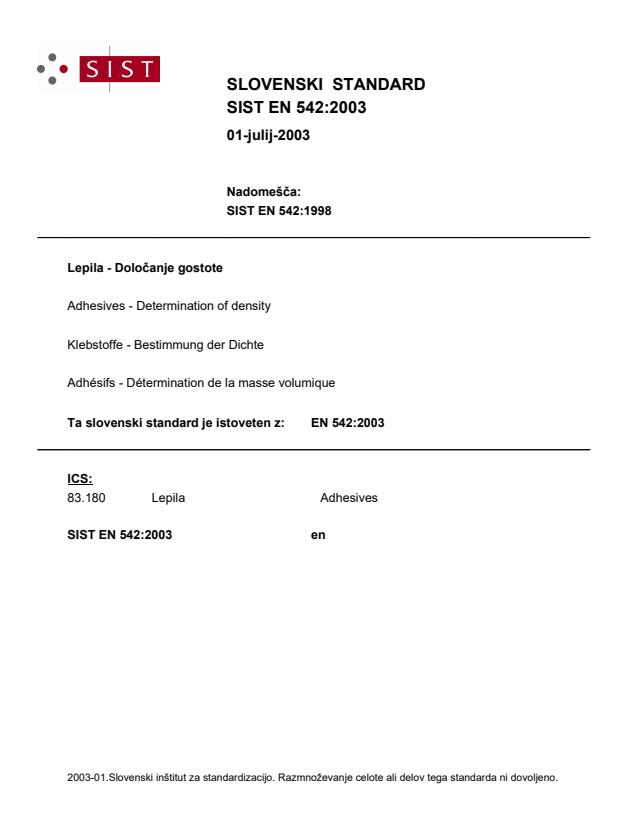
2003-01.Slovenski inštitut za standardizacijo. Razmnoževanje celote ali delov tega standarda ni dovoljeno.Klebstoffe - Bestimmung der DichteAdhésifs - Détermination de la masse volumiqueAdhesives - Determination of density83.180LepilaAdhesivesICS:Ta slovenski standard je istoveten z:EN 542:2003SIST EN 542:2003en01-julij-2003SIST EN 542:2003SLOVENSKI
STANDARDSIST EN 542:19981DGRPHãþD
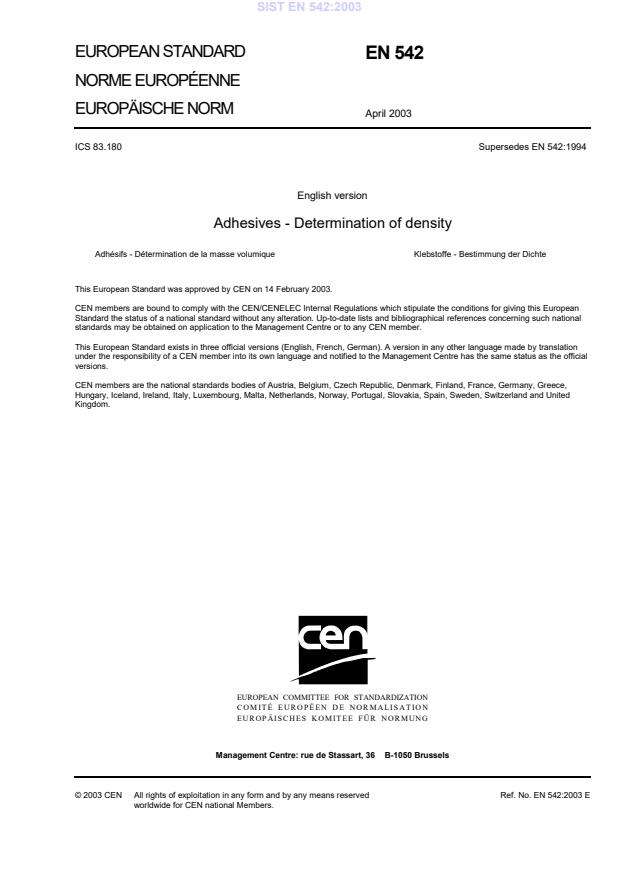
EUROPEAN STANDARDNORME EUROPÉENNEEUROPÄISCHE NORMEN 542April 2003ICS 83.180Supersedes EN 542:1994English versionAdhesives - Determination of densityAdhésifs - Détermination de la masse volumiqueKlebstoffe - Bestimmung der DichteThis European Standard was approved by CEN on 14 February 2003.CEN members are bound to comply with the CEN/CENELEC Internal Regulations which stipulate the conditions for giving this EuropeanStandard the status of a national standard without any alteration. Up-to-date lists and bibliographical references concerning such nationalstandards may be obtained on application to the Management Centre or to any CEN member.This European Standard exists in three official versions (English, French, German). A version in any other language made by translationunder the responsibility of a CEN member into its own language and notified to the Management Centre has the same status as the officialversions.CEN members are the national standards bodies of Austria, Belgium, Czech Republic, Denmark, Finland, France, Germany, Greece,Hungary, Iceland, Ireland, Italy, Luxembourg, Malta, Netherlands, Norway, Portugal, Slovakia, Spain, Sweden, Switzerland and UnitedKingdom.EUROPEAN COMMITTEE FOR STANDARDIZATIONCOMITÉ EUROPÉEN DE NORMALISATIONEUROPÄISCHES KOMITEE FÜR NORMUNGManagement Centre: rue de Stassart, 36
B-1050 Brussels© 2003 CENAll rights of exploitation in any form and by any means reservedworldwide for CEN national Members.Ref. No. EN 542:2003 ESIST EN 542:2003
...