

SIST EN 13121-2:2004
(Main)GRP tanks and vessels for use above ground - Part 2: Composite materials - Chemical resistance
General Information
- Abstract
This European Standard gives requirements for chemical resistance of composite materials used for GRP tanks and vessels for storage or processing of fluids, for use above ground. The tanks or vessels may be factory made or site built, with or without lining.
- Status
- Published
- Publication Date
- 31-May-2004
- Technical Committee
- TLP - Pressure vessels
- Current Stage
- 6060 - National Implementation/Publication (Adopted Project)
- Start Date
- 01-Jun-2004
- Due Date
- 01-Jun-2004
- Completion Date
- 01-Jun-2004
2014/68/EU - Directive 2014/68/EU of the European Parliament and of the Council of 15 May 2014 on the harmonisation of the laws of the Member States relating to the making available on the market of pressure equipmentOJ Ref: C 293/01 OJ Date: 12-Aug-2016
97/23/EC - Pressure equipmentOJ Ref: C 118 OJ Date: 15-Apr-2011


Overview
EN 13121-2:2003 is the CEN European Standard that specifies requirements for the chemical resistance of composite materials used in above-ground GRP tanks and vessels (glass‑fibre reinforced polyester) for storage or processing of fluids. It applies to factory-made or site-built tanks, with or without thermoplastic linings, and forms Part 2 of the EN 13121 series that covers materials, design, manufacture and maintenance of GRP tanks.
Key search terms: EN 13121-2:2003, GRP tanks, composite materials, chemical resistance, above-ground storage tanks, CEN standard.
Key topics and technical requirements
- Protective layers: The standard defines required protective systems on the inner laminate:
- Single Protective Layer (SPL) - veil or resin layer.
- Chemical Resistant Layer (CRL) - one or two veil layers plus chopped‑strand/sprayed fibres (min. 900 g/m² total).
- Thermoplastic Lining (TPL) - PVC-U, PP, PVDF, E‑CTFE, FEP, PFA etc., with bonding and backing requirements.
- Minimum thicknesses (specified in the standard):
- SPL: 0.4–0.6 mm
- CRL: 2.5–4.0 mm
- PVC‑U: 3.0–4.5 mm
- PP variants: 3.0–6.0 mm
- PVDF: 2.4–4.0 mm
- E‑CTFE/FEP/PFA: 1.7–4.0 mm
- Environmental stress cracking: Protective layers and thermoplastic linings must resist ESC; TPLs may require stress relief and specific initial bonding procedures.
- Partial design factor (A2): Methods to determine A2 (used to derive design factors in prEN 13121-3) include:
- Using Annex A media lists
- Resin manufacturer data
- Thermoplastic manufacturer data
- Documented service experience (Annex B)
- Laboratory or in-situ testing (Annex C) Each method has defined maximum design temperatures and applicability rules.
Applications and practical value
- Use for specification, design verification and procurement of GRP tanks and vessels handling corrosive fluids above ground.
- Helps manufacturers, materials suppliers, design engineers and plant operators:
- select appropriate protective layers or linings,
- verify chemical resistance for service conditions (temperature, concentration, phases),
- determine design parameters (A2) required by the design standard (prEN 13121-3).
- Important for industries storing/processing acids, alkalis, solvents and industrial process streams where corrosion resistance and safety are essential.
Who should use this standard
- GRP tank and vessel manufacturers
- Material and resin suppliers
- Design and structural engineers
- Inspection and compliance personnel
- Asset owners/operators specifying corrosion‑resistant storage/processing equipment
Related standards
- EN 13121-1 (Raw materials - specification and acceptance)
- prEN 13121-3 (Design and workmanship)
- EN 13121-4 (Delivery, installation and maintenance)
- Relevant ISO/EN test standards cited in EN 13121-2 for ESC, flexural testing and thermoplastic chemical classification (e.g., ISO 4599, ISO 6252, ISO 14125, ISO 4433 series).
This standard supports compliance with EU Directive 97/23/EC (PED) and is intended to be used in combination with the other EN 13121 parts for complete GRP tank lifecycle requirements.
Relations
- Refers
SIST EN 59:2016 - Glass reinforced plastics - Measurement of hardness by means of a Barcol impressor - Effective Date
- 28-Jan-2026
- Effective Date
- 28-Jan-2026
- Effective Date
- 28-Jan-2026
- Effective Date
- 28-Jan-2026
- Effective Date
- 28-Jan-2026
- Effective Date
- 28-Jan-2026
- Effective Date
- 28-Jan-2026
- Effective Date
- 28-Jan-2026
- Effective Date
- 28-Jan-2026
- Effective Date
- 28-Jan-2026
- Effective Date
- 28-Jan-2026
- Effective Date
- 09-Feb-2026
- Effective Date
- 28-Jan-2026
- Effective Date
- 28-Jan-2026
- Effective Date
- 28-Jan-2026
Get Certified
Connect with accredited certification bodies for this standard

Institut za varilstvo d.o.o. (Welding Institute)
Slovenia's leading welding institute since 1952. ISO 3834, EN 1090, pressure equipment certification, NDT personnel, welder qualification. Only IIW Au
Sponsored listings
Frequently Asked Questions
SIST EN 13121-2:2004 is a standard published by the Slovenian Institute for Standardization (SIST). Its full title is "GRP tanks and vessels for use above ground - Part 2: Composite materials - Chemical resistance". This standard covers: This European Standard gives requirements for chemical resistance of composite materials used for GRP tanks and vessels for storage or processing of fluids, for use above ground. The tanks or vessels may be factory made or site built, with or without lining.
This European Standard gives requirements for chemical resistance of composite materials used for GRP tanks and vessels for storage or processing of fluids, for use above ground. The tanks or vessels may be factory made or site built, with or without lining.
SIST EN 13121-2:2004 is classified under the following ICS (International Classification for Standards) categories: 23.020.10 - Stationary containers and tanks. The ICS classification helps identify the subject area and facilitates finding related standards.
SIST EN 13121-2:2004 has the following relationships with other standards: It is inter standard links to SIST EN 59:2016, SIST EN 590:2025, SIST EN ISO 15181-1:2004, SIST EN ISO 22088-2:2006, SIST EN 13121-1:2003, SIST EN 15309:2007, SIST EN ISO 13803:2004, SIST EN ISO 22088-3:2006, SIST EN ISO 14125:1999, SIST EN 3858:2004, SIST EN 13121-4:2005, SIST EN 50018:1995, SIST EN 13121-1:2021, SIST EN 13160-7:2016+A1:2025, SIST EN 13121-3:2008+A1:2010. Understanding these relationships helps ensure you are using the most current and applicable version of the standard.
SIST EN 13121-2:2004 is associated with the following European legislation: EU Directives/Regulations: 2009-01-4568, 2014/68/EU, 97/23/EC, EUR-PUB, TRRTP261; Standardization Mandates: M/071. When a standard is cited in the Official Journal of the European Union, products manufactured in conformity with it benefit from a presumption of conformity with the essential requirements of the corresponding EU directive or regulation.
SIST EN 13121-2:2004 is available in PDF format for immediate download after purchase. The document can be added to your cart and obtained through the secure checkout process. Digital delivery ensures instant access to the complete standard document.
Standards Content (Sample)
2003-01.Slovenski inštitut za standardizacijo. Razmnoževanje celote ali delov tega standarda ni dovoljeno.GRP tanks and vessels for use above ground - Part 2: Composite materials - Chemical resistanceNadzemni rezervoarji iz armiranega poliestra – 2. del: Kompozitni materiali – Kemijska obstojnostRéservoirs et récipients en PRV pour utilisation hors sol - Partie 2: Matériaux composites - Résistance chimiqueOberirdische GFK-Tanks und -Behälter - Teil 2: Verbundwerkstoffe - Chemische WiderstandsfähigkeitTa slovenski standard je istoveten z:EN 13121-2:2003SIST EN 13121-2:2004en23.020.10ICS:SLOVENSKI
STANDARDSIST EN 13121-2:200401-junij-2004
EUROPEAN STANDARDNORME EUROPÉENNEEUROPÄISCHE NORMEN 13121-2October 2003ICS 23.020.10English versionGRP tanks and vessels for use above ground - Part 2:Composite materials - Chemical resistanceRéservoirs et récipients en PRV pour utilisation hors sol -Partie 2: Matériaux composites - Résistance chimiqueOberirdische GFK-Tanks und -Behälter - Teil 2:Verbundwerkstoffe - Chemische WiderstandsfähigkeitThis European Standard was approved by CEN on 26 June 2003.CEN members are bound to comply with the CEN/CENELEC Internal Regulations which stipulate the conditions for giving this EuropeanStandard the status of a national standard without any alteration. Up-to-date lists and bibliographical references concerning such nationalstandards may be obtained on application to the Management Centre or to any CEN member.This European Standard exists in three official versions (English, French, German). A version in any other language made by translationunder the responsibility of a CEN member into its own language and notified to the Management Centre has the same status as the officialversions.CEN members are the national standards bodies of Austria, Belgium, Czech Republic, Denmark, Finland, France, Germany, Greece,Hungary, Iceland, Ireland, Italy, Luxembourg, Malta, Netherlands, Norway, Portugal, Slovakia, Spain, Sweden, Switzerland and UnitedKingdom.EUROPEAN COMMITTEE FOR STANDARDIZATIONCOMITÉ EUROPÉEN DE NORMALISATIONEUROPÄISCHES KOMITEE FÜR NORMUNGManagement Centre: rue de Stassart, 36
B-1050 Brussels© 2003 CENAll rights of exploitation in any form and by any means reservedworldwide for CEN national Members.Ref. No. EN 13121-2:2003 E
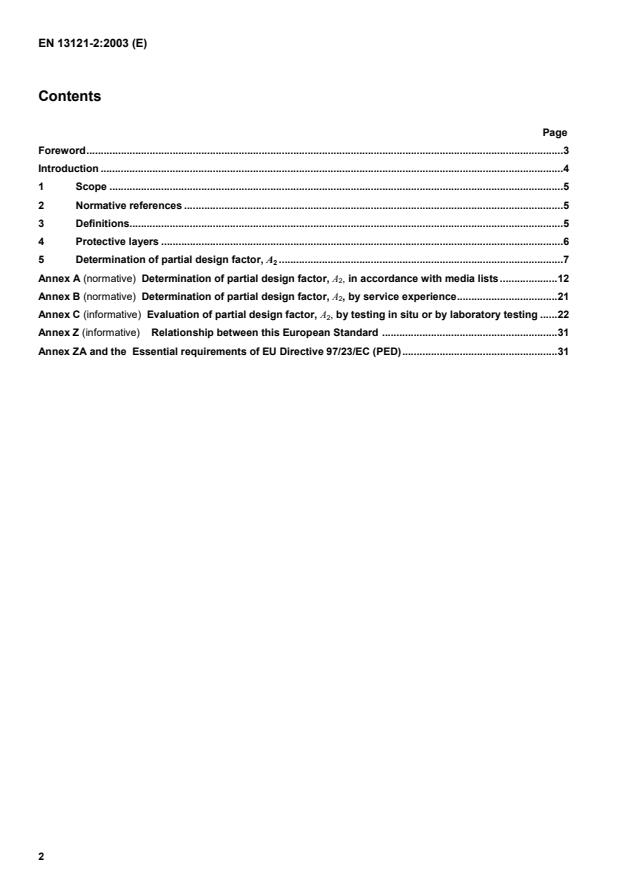
Determination of partial design factor, A2, in accordance with media lists.12Annex B (normative)
Determination of partial design factor, A2, by service experience.21Annex C (informative)
Evaluation of partial design factor, A2, by testing in situ or by laboratory testing.22Annex Z (informative)
Relationship between this European Standard .31Annex ZA and the
Essential requirements of EU Directive 97/23/EC (PED).31
EN 13121-1 specifies the requirementsfor the specification conditions and acceptance conditions for GRP and thermoplastic materials, which are necessaryin order to establish the chemical resistance properties of these materials in accordance with this Part of the standard.EN 13121-2 gives the requirements necessary to establish that the GRP material and any thermoplastic lining willlhave sufficient chemical and thermal resistance to service conditions. Part 2 defines the requirements for theprotective layer and the structural laminate as well as defining methods for proof of suitability to meet thechemical/thermal effects caused by the fluids and of determination of the partial design factor, A2, as required fordesign in accordance with prEN 13121-3. Five methods are described — use of Media Lists, use of resinmanufacturers data, use of thermoplastics manufacturers data, service experience and sample testing. Themanufacturer of the tank or vessel may choose any one of these methods subject to here being sufficient dataavailable in that method for the particular application.Together with the requirements and acceptance conditions for the raw materials determined in EN 13121-1, thedesign and workmanship requirements as determined in prEN 13121-3 and the delivery, handling, installation andmaintenance recommendations given in EN 13121-4, EN 13121-2 completes the total standard's requirements.
80 °C60 °C
80 °C
80 °C— of category 3 (see Tables A.5 and A.8)n. a.
60 °C60 °C
60 °C
60 °Cresin manufacturer's data 40 °C120 °Cn. a.n. a.n. a.thermoplastics manufacturer's datan. a.n. a.60 °C100 °C120 °Cservice experience40 °C120 °C80 °C100 °C120 °Ctesting in laboratory/in-situ40 °C120 °C80 °C100 °C120 °C
n. a. = not applicable5.2 Determination of partial design factor, A2 by using media listsThe media lists when used with protective layers in accordance with clause 4, at different temperatures andconcentrations, are given in annex A.Use of media lists is only applicable when considering use of a resin described in the resin groups in accordance withEN 13121-1. For other polyester, vinyl ester, furance and phenolic resins which are not in a resin group in accordancewith EN 13121-1, then methods 5.3, 5.5 or 5.6 shall be used.The list of media given in Annex A is not a comprehensive list of all media for which this Standard may be used.Additional data may be found using methods 5.3, 5.4 or 5.5
recommendedconditions of cure and post cure will be followed during manufacture.5.3.3 Partial design factor A2The partial design factor, A2, using SPL or CRL, shall be determined in relation to the resin manufacturer'smaximum temperature, Tm, for the service conditions and the maximum design temperature, Td.The interpretation of resin manufacturer's maximum temperature, Tm, data in terms of A2, is given in Table 3.Table 3 — Partial design factor, A2, relating to the maximum designtemperature, Td, and the maximum temperature, TmMaximum design temperature, Td°CA2post curedaTd = Tm1,4Td = Tm – 101,4Td = Tm – 201,3Td = Tm – 301,3Td = Tm – 401,2Td = Tm – 501,2Td = Tm – 601,1Td = Tm – 701,1aConditions as given in 5.2 or subject to agreement with the resin manufacturer.
Palmitic acid Stearic acid Potassium Bromate, aq Sodium Sulfite, aq Ammonium Phosphate, aq Potassium Bromide, aq Sodium Thiosulphate, aq Ammonium Sulphate, aq Potassium Chlorate, aq Starch, aq (5pH8) Barium Chloride, aq Potassium Chloride, aq Barium Nitrate, aq Fruit syrups (3pH8), e.g. Beet syrup Raspberry syrup Starch syrup Potassium Chromate, aq Brine, aq, sat Magnesium Chloride, aq Potassium Ferric Cyanide, aq Calcium Chloride, aq Magnesium Nitrate, aq Potassium Ferrous Cyanide, aq Calcium Nitrate, aq Magnesium Sulphate, aq Potassium Iodide, aq Sugar, e.g. GalactoseGlucose, SorbitolFructoseMannose, Mannitol Calcium Sulphate, aq Manganese-II-Chloride, aq Potassium Nitrate, aq Cobalt Chloride, aq Manganese-II-Nitrate, aq Potassium Nitrite, aq Cobalt Nitrate, aq Manganese-II-Sulphate, aq Potassium Phosphate, aq Copper-I-Chloride, aq Mercury Potassium Sulphate, aq Copper-II-Chloride, aq Mercuric-I-Chloride Seawater (3pH8) Vegetable Oil, e.g. castor oilcotton seed oilsoya oilwheat germ oil Copper-II-Nitrate, aq Mercuric-II-Chloride Silicon Oil/Grease Copper-I-Sulphate, aq Mercuric-II-Nitrate Sodium Bromate, aq Copper-II-Sulphate, aq Molasses (3pH8) Sodium Bromide, aq Diesel Oil, fuel oil (EN 590) Nickel Chloride, aq Sodium Chlorate, aq (no aromatics, no methanol) Nickel Nitrate, aq Sodium Chloride, aqNOTEFor higher temperatures other methods may be used; see 5.5 and 5.6.
30 °C1A-81A-81A-81,130 °C < Td
40 °C1B-81B-81A-81,240 °C < Td
60 °C use other
methods3-83-81,360 °C < Td
80 °C use other
methods4-84-81,480 °C < Td 100 °C use other
methods6-86-81,4NOTE 1Resin groups 1A-8 see Table 2 of EN 13121-1:2003.NOTE 2For higher temperatures other methods may be used; see 5.5 and 5.6.aConditions as given in 5.2 or subject to agreement with the resin manufacturer.A.2 Category 2 mediaCategory 2 media are listed in Table A.3.For maximum design temperatures, Td, 40 °C, the protective layer shall be a SPL or a CRL or a TPL. Formaximum design temperatures Td, > 40 °C but80 °C, the protective layer shall be a CRL or a TPL. The value ofthe partial design factor, A2, for SPL and CRL shall be in accordance with Table A.4. The value of the partial designfactor, A2, for TPL protective layer shall be in accordance with 5.4, Table 4 taking into account the maximum designtemperature, Td, for each lining material given in Table A.3.
...