

SIST EN 590:2025
(Main)Automotive fuels - Diesel - Requirements and test methods
General Information
- Abstract
This document specifies requirements and test methods for marketed and delivered automotive diesel fuel. It is applicable to automotive diesel fuel for use in diesel engine vehicles designed to run on automotive diesel fuel containing up to 7,0 %(V/V) fatty acid methyl ester (FAME).
NOTE For the purposes of this document, the terms “% (m/m)” and “% (V/V)” are used to represent respectively the mass fraction and the volume fraction.
- Status
- Published
- Public Enquiry End Date
- 30-Jun-2024
- Publication Date
- 31-Aug-2025
- Technical Committee
- NAD - Petroleum products, lubricants and related products
- Current Stage
- 6060 - National Implementation/Publication (Adopted Project)
- Start Date
- 16-Jul-2025
- Due Date
- 20-Sep-2025
- Completion Date
- 01-Sep-2025

Overview
EN 590:2025 - "Automotive fuels - Diesel - Requirements and test methods" is the updated CEN standard that sets mandatory requirements and test methods for marketed and delivered automotive diesel fuel in CEN member countries. It applies to diesel fuels formulated for vehicles designed to run on diesel containing up to 7.0 % (V/V) fatty acid methyl ester (FAME). The 2025 edition supersedes EN 590:2022 and incorporates new definitions, particle-count controls, updated test methods and pump marking requirements in line with EU fuel legislation.
Key topics and technical requirements
- Scope and FAME limit: Diesel may contain up to 7.0 % (V/V) FAME complying with FprEN 14214:2024. Climate-dependent requirements for such blends are referenced.
- Particle count requirement: New particle-count limit of 10 000 counts/ml for particles ≥ 4 µm at the point of particle certification (point of production or import). Procedures for particle measurement include IP 630 (Automatic Particle Counter - light obscuration), with Procedures A and B introduced.
- Sampling and certification points: Sampling is to follow EN ISO 3170 / EN ISO 3171; the standard defines point of production, point of particle certification and particle recertification within the supply chain.
- Additives and markers: Use of dyes and additives is allowed; MMT (manganese-containing additive) is permitted but requires specific pump labelling and limits for manganese content.
- Pump marking and consumer information: Dispensing pumps/nozzles must be labelled per EN 16942, including visible labelling when metallic additives are present.
- Test methods updates:
- IP 630 for particle counting.
- EN ISO 18335 added as an alternative constant-pressure viscometer method for viscosity determination (in addition to EN ISO 3104).
- Other referenced methods cover cetane number, oxidation stability, sulfur, density, cloud point, cold filter plugging point, lubricity, etc.
- Climate-dependent grades and density: Minimum density for summer grades has been reduced (from 820.0 kg/m³ to 815.0 kg/m³) and relocated to Table 1.
Applications and who should use it
EN 590:2025 is essential for:
- Refineries and blending hubs - to certify production and ensure compliance at the point of production.
- Fuel distributors and terminals - for particle recertification and quality control during storage and transport.
- Independent testing laboratories - to perform mandated test methods (IP 630, EN ISO methods).
- Fuel retailers and forecourt operators - for correct pump marking and handling of labelled fuels.
- Automotive manufacturers, fleet operators and regulators - to verify fuel compatibility and emissions/durability impacts.
Practical benefits include improved fuel cleanliness control, harmonised test procedures across Europe, and clearer consumer information at the pump.
Related standards
Relevant referenced documents include:
- FprEN 14214:2024 (FAME specification)
- IP 630 (particle counting)
- EN ISO 3170 / EN ISO 3171 (sampling)
- EN 16942 (pump marking)
- EN ISO 18335 / EN ISO 3104 (viscosity)
- EN ISO 12156-1 (lubricity)
Keywords: EN 590:2025, diesel fuel standard, automotive diesel requirements, FAME limit, particle count in diesel, diesel fuel test methods, CEN standard.
Relations
- Effective Date
- 01-Oct-2025
- Effective Date
- 24-Jun-2026
- Effective Date
- 28-Jan-2026
- Effective Date
- 28-Jan-2026
- Effective Date
- 28-Jan-2026
- Effective Date
- 28-Jan-2026
- Effective Date
- 28-Jan-2026
- Effective Date
- 28-Jan-2026
- Effective Date
- 28-Jan-2026
- Effective Date
- 28-Jan-2026
- Effective Date
- 28-Jan-2026
- Effective Date
- 28-Jan-2026
- Effective Date
- 28-Jan-2026
- Effective Date
- 28-Jan-2026
- Effective Date
- 28-Jan-2026
Get Certified
Connect with accredited certification bodies for this standard

Element Materials Technology
Materials testing and product certification.

ABS Group Brazil
ABS Group certification services in Brazil.

ABS Quality Evaluations Inc.
American Bureau of Shipping quality certification.
Sponsored listings
Frequently Asked Questions
SIST EN 590:2025 is a standard published by the Slovenian Institute for Standardization (SIST). Its full title is "Automotive fuels - Diesel - Requirements and test methods". This standard covers: This document specifies requirements and test methods for marketed and delivered automotive diesel fuel. It is applicable to automotive diesel fuel for use in diesel engine vehicles designed to run on automotive diesel fuel containing up to 7,0 %(V/V) fatty acid methyl ester (FAME). NOTE For the purposes of this document, the terms “% (m/m)” and “% (V/V)” are used to represent respectively the mass fraction and the volume fraction.
This document specifies requirements and test methods for marketed and delivered automotive diesel fuel. It is applicable to automotive diesel fuel for use in diesel engine vehicles designed to run on automotive diesel fuel containing up to 7,0 %(V/V) fatty acid methyl ester (FAME). NOTE For the purposes of this document, the terms “% (m/m)” and “% (V/V)” are used to represent respectively the mass fraction and the volume fraction.
SIST EN 590:2025 is classified under the following ICS (International Classification for Standards) categories: 75.160.20 - Liquid fuels. The ICS classification helps identify the subject area and facilitates finding related standards.
SIST EN 590:2025 has the following relationships with other standards: It is inter standard links to SIST EN 590:2022, SIST EN ISO 4259-2:2026, SIST EN ISO 20884:2019/A1:2021, SIST EN 15751:2025, SIST EN ISO 12205:1998, SIST EN 16576:2015, SIST EN ISO 2160:1999, SIST EN 15195:2023, SIST EN ISO 6245:2003, SIST EN 12662-1:2024, SIST EN 116:2015, SIST EN 16715:2015, SIST EN ISO 12937:2001, SIST EN 17155:2018, SIST EN ISO 2719:2026. Understanding these relationships helps ensure you are using the most current and applicable version of the standard.
SIST EN 590:2025 is associated with the following European legislation: EU Directives/Regulations: 2008/68/EC, 2011-01-3198, 2011-01-3239, 98/70/EC. When a standard is cited in the Official Journal of the European Union, products manufactured in conformity with it benefit from a presumption of conformity with the essential requirements of the corresponding EU directive or regulation.
SIST EN 590:2025 is available in PDF format for immediate download after purchase. The document can be added to your cart and obtained through the secure checkout process. Digital delivery ensures instant access to the complete standard document.
Standards Content (Sample)
SLOVENSKI STANDARD
01-oktober-2025
Nadomešča:
SIST EN 590:2022
Goriva za motorna vozila - Dizelsko gorivo - Zahteve in preskusne metode
Automotive fuels - Diesel - Requirements and test methods
Kraftstoffe - Dieselkraftstoff - Anforderungen und Prüfverfahren
Carburants pour automobiles - Carburants pour moteur diesel (gazole) - Exigences et
méthodes d'essai
Ta slovenski standard je istoveten z: EN 590:2025
ICS:
75.160.20 Tekoča goriva Liquid fuels
2003-01.Slovenski inštitut za standardizacijo. Razmnoževanje celote ali delov tega standarda ni dovoljeno.
EN 590
EUROPEAN STANDARD
NORME EUROPÉENNE
July 2025
EUROPÄISCHE NORM
ICS 75.160.20 Supersedes EN 590:2022
English Version
Automotive fuels - Diesel - Requirements and test methods
Carburants pour automobiles - Carburants pour Kraftstoffe - Dieselkraftstoff - Anforderungen und
moteur diesel (gazole) - Exigences et méthodes d'essai Prüfverfahren
This European Standard was approved by CEN on 6 July 2025.
CEN members are bound to comply with the CEN/CENELEC Internal Regulations which stipulate the conditions for giving this
European Standard the status of a national standard without any alteration. Up-to-date lists and bibliographical references
concerning such national standards may be obtained on application to the CEN-CENELEC Management Centre or to any CEN
member.
This European Standard exists in three official versions (English, French, German). A version in any other language made by
translation under the responsibility of a CEN member into its own language and notified to the CEN-CENELEC Management
Centre has the same status as the official versions.
CEN members are the national standards bodies of Austria, Belgium, Bulgaria, Croatia, Cyprus, Czech Republic, Denmark, Estonia,
Finland, France, Germany, Greece, Hungary, Iceland, Ireland, Italy, Latvia, Lithuania, Luxembourg, Malta, Netherlands, Norway,
Poland, Portugal, Republic of North Macedonia, Romania, Serbia, Slovakia, Slovenia, Spain, Sweden, Switzerland, Türkiye and
United Kingdom.
EUROPEAN COMMITTEE FOR STANDARDIZATION
COMITÉ EUROPÉEN DE NORMALISATION
EUROPÄISCHES KOMITEE FÜR NORMUNG
CEN-CENELEC Management Centre: Rue de la Science 23, B-1040 Brussels
© 2025 CEN All rights of exploitation in any form and by any means reserved Ref. No. EN 590:2025 E
worldwide for CEN national Members.
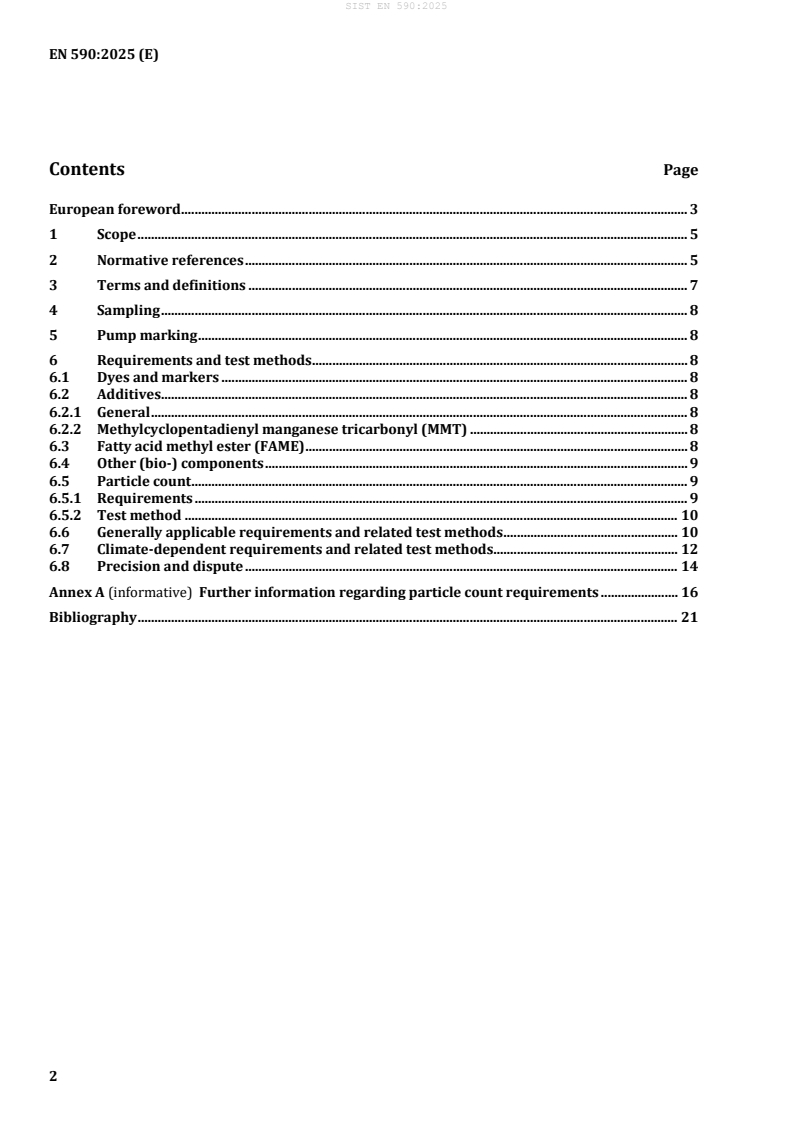
Contents Page
European foreword . 3
1 Scope . 5
2 Normative references . 5
3 Terms and definitions . 7
4 Sampling . 8
5 Pump marking . 8
6 Requirements and test methods . 8
6.1 Dyes and markers . 8
6.2 Additives . 8
6.2.1 General . 8
6.2.2 Methylcyclopentadienyl manganese tricarbonyl (MMT) . 8
6.3 Fatty acid methyl ester (FAME) . 8
6.4 Other (bio-) components . 9
6.5 Particle count . 9
6.5.1 Requirements . 9
6.5.2 Test method . 10
6.6 Generally applicable requirements and related test methods . 10
6.7 Climate-dependent requirements and related test methods . 12
6.8 Precision and dispute . 14
Annex A (informative) Further information regarding particle count requirements . 16
Bibliography . 21
European foreword
This document (EN 590:2025) has been prepared by Technical Committee CEN/TC 19 “Gaseous and
liquid fuels, lubricants and related products of petroleum, synthetic and biological origin”, the secretariat
of which is held by NEN.
This European Standard shall be given the status of a national standard, either by publication of an
identical text or by endorsement, at the latest by January 2026, and conflicting national standards shall
be withdrawn at the latest by January 2026.
Attention is drawn to the possibility that some of the elements of this document may be the subject of
patent rights. CEN shall not be held responsible for identifying any or all such patent rights.
This document supersedes EN 590:2022.
This document has originally been prepared under a mandate given to CEN by the European Commission
and the European Free Trade Association [9].
Requirements following amendments 2003/17/EC [2], 2009/30/EC [3], 2011/63/EU [4], 2014/77/EU
[5], 2015/1513/EC [6], 2018/1999/EU [7] and 2023/2413/EU [8] to the European Fuels Quality
Directive 98/70/EC [1], are taken into account. Dates are included with all normative test method
references for properties required by Annex II of the Fuels Quality Directive in order to comply with the
requirements of the European Commission; with the accompanying assurance by CEN/TC 19 that any
referenced updated versions will always give similar accuracy and the same or better precision (see [4]).
The marking at the pump of this product is in line with the requirements of the Fuels Quality Directive
and the Alternative Fuels Infrastructure Regulation [10].
Further significant technical changes between this document and the previous edition EN 590:2022 are:
— introduction of new definitions in Clause 3 “Terms and definitions”;
— inclusion of a particle count limit of 10 000 counts/ml for particles ≥ 4 μm at “the point of particle
certification” in a new Table 2 and 6.5;
— introduction of test method IP 630 procedures A and B to measure the number of particles ≥ 4 μm in
diesel fuel;
— addition of the constant pressure viscometer method (EN ISO 18335) as an alternative test method
to EN ISO 3104 for the determination of viscosity;
3 3
— reduction of the minimum density for summer grades (A, B, C) from 820,0 kg/m to 815,0 kg/m
and displacement of the parameter to Table 1;
— addition of Annex A “Further information regarding particle count requirements”.
Any feedback and questions on this document should be directed to the users’ national standards body.
A complete listing of these bodies can be found on the CEN website.
According to the CEN-CENELEC Internal Regulations, the national standards organisations of the
following countries are bound to implement this European Standard: Austria, Belgium, Bulgaria, Croatia,
Cyprus, Czech Republic, Denmark, Estonia, Finland, France, Germany, Greece, Hungary, Iceland, Ireland,
Italy, Latvia, Lithuania, Luxembourg, Malta, Netherlands, Norway, Poland, Portugal, Republic of North
Macedonia, Romania, Serbia, Slovakia, Slovenia, Spain, Sweden, Switzerland, Türkiye and the United
Kingdom.
1 Scope
This document specifies requirements and test methods for marketed and delivered automotive diesel
fuel. It is applicable to automotive diesel fuel for use in diesel engine vehicles designed to run on
automotive diesel fuel containing up to 7,0 %(V/V) fatty acid methyl ester (FAME).
NOTE For the purposes of this document, the terms “% (m/m)” and “% (V/V)” are used to represent
respectively the mass fraction and the volume fraction.
2 Normative references
The following documents are referred to in the text in such a way that some or all of their content
constitutes requirements of this document. For dated references, only the edition cited applies. For
undated references, the latest edition of the referenced document (including any amendments) applies.
EN 116, Diesel and domestic heating fuels — Determination of cold filter plugging point — Stepwise cooling
bath method
EN 12662-1, Liquid petroleum products — Determination of total contamination — Part 1: Middle
distillates and diesel fuels
EN 12916:2024, Petroleum products — Determination of aromatic hydrocarbon types in middle distillates
— High performance liquid chromatography method with refractive index detection
EN 14078:2014, Liquid petroleum products — Determination of fatty acid methyl ester (FAME) content in
middle distillates — Infrared spectrometry method
FprEN 14214:2024, Liquid petroleum products — Fatty acid methyl esters (FAME) for use in diesel engines
and heating applications — Requirements and test methods
EN 15195:2023, Liquid petroleum products — Determination of ignition delay and derived cetane number
(DCN) of middle distillate fuels by combustion in a constant volume chamber
EN 15751, Automotive fuels — Fatty acid methyl ester (FAME) fuel and blends with diesel fuel —
Determination of oxidation stability by accelerated oxidation method
EN 16091, Liquid petroleum products — Middle distillates and fatty acid methyl ester (FAME) fuels and
blends — Determination of oxidation stability by rapid small scale oxidation test (RSSOT)
EN 16329, Diesel and domestic heating fuels — Determination of cold filter plugging point — Linear cooling
bath method
EN 16576:2014, Automotive fuels — Determination of manganese and iron content in diesel — Inductively
coupled plasma optical emission spectrometry (ICP OES) method
EN 16715:2015, Liquid petroleum products — Determination of ignition delay and derived cetane number
(DCN) of middle distillate fuels — Ignition delay and combustion delay determination using a constant
volume combustion chamber with direct fuel injection
EN 16906:2023, Liquid petroleum products — Determination of the ignition quality of diesel fuels — Fixed
compression ratio engine method
EN 16942, Fuels — Identification of vehicle compatibility — Graphical expression for consumer information
EN 17155:2018, Liquid petroleum products — Determination of indicated cetane number (ICN) of middle
distillate fuels — Primary reference fuels calibration method using a constant volume combustion chamber
EN 17306:2023, Liquid petroleum products — Determination of distillation characteristics at atmospheric
pressure — Micro-distillation
EN ISO 2160, Petroleum products — Corrosiveness to copper — Copper strip test (ISO 2160)
EN ISO 2719, Determination of flash point — Pensky-Martens closed cup method (ISO 2719)
EN ISO 3015, Petroleum and related products from natural or synthetic sources — Determination of cloud
point (ISO 3015)
EN ISO 3104, Petroleum products — Transparent and opaque liquids — Determination of kinematic
viscosity and calculation of dynamic viscosity (ISO 3104)
EN ISO 3170, Petroleum liquids — Manual sampling (ISO 3170)
EN ISO 3171, Petroleum liquids — Automatic pipeline sampling (ISO 3171)
EN ISO 3405:2019, Petroleum and related products from natural or synthetic sources — Determination of
distillation characteristics at atmospheric pressure (ISO 3405:2019)
EN ISO 3675:1998, Crude petroleum and liquid petroleum products — Laboratory determination of density
— Hydrometer method (ISO 3675:1998)
EN ISO 3924:2019, Petroleum products — Determination of boiling range distribution — Gas
chromatography method (ISO 3924:2019)
EN ISO 4259-2, Petroleum and related products — Precision of measurement methods and results — Part
2: Interpretation and application of precision data in relation to methods of test (ISO 4259-2)
EN ISO 4264, Petroleum products — Calculation of cetane index of middle-distillate fuels by the four
variable equation (ISO 4264)
EN ISO 5165:2020, Petroleum products — Determination of the ignition quality of diesel fuels — Cetane
engine method (ISO 5165:2020)
EN ISO 6245, Petroleum products — Determination of ash (ISO 6245)
EN ISO 10370, Petroleum products — Determination of carbon residue — Micro method (ISO 10370)
EN ISO 12156-1, Diesel fuel — Assessment of lubricity using the high-frequency reciprocating rig (HFRR) —
Part 1: Test method (ISO 12156-1)
EN ISO 12185:2024, Crude petroleum, petroleum products and related products — Determination of
density — Laboratory density meter with an oscillating U-tube sensor (ISO 12185:2024)
EN ISO 12205, Petroleum products — Determination of the oxidation stability of middle-distillate fuels
(ISO 12205)
EN ISO 12937, Petroleum products — Determination of water — Coulometric Karl Fischer titration method
(ISO 12937)
EN ISO 13032:2024, Petroleum products —Determination of low concentration of sulfur in automotive
fuels — Energy-dispersive X-ray fluorescence spectrometric method (ISO 13032:2024)
EN ISO 13759, Petroleum products — Determination of alkyl nitrate in diesel fuels — Spectrometric method
(ISO 13759)
EN ISO 18335, Petroleum products and related products — Determination of kinematic viscosity by
calculation from the measured dynamic viscosity and density — Method by constant pressure viscometer
(ISO 18335)
EN ISO 20846:2019, Petroleum products — Determination of sulfur content of automotive fuels —
Ultraviolet fluorescence method (ISO 20846:2019)
, Petroleum products — Determination of sulfur content of automotive fuels —
EN ISO 20884:2019
Wavelength-dispersive X-ray fluorescence spectrometry (ISO 20884:2019)
EN ISO 22995, Petroleum products — Determination of cloud point — Automated step-wise cooling method
(ISO 22995)
EN ISO 23581, Petroleum products and related products — Determination of kinematic viscosity — Method
by Stabinger type viscometer (ISO 23581)
IP 630, Determination of the concentration of dispersed particles in diesel fuel — Automatic Particle Counter
(APC) Light Obscuration Method
3 Terms and definitions
For the purposes of this document, the following terms and definitions apply.
ISO and IEC maintain terminology databases for use in standardization at the following addresses:
— ISO Online browsing platform: available at https://www.iso.org/obp/ui
— IEC Electropedia: available at https://www.electropedia.org/
3.1
point of particle certification
point of import of EN 590 automotive diesel fuel into a CEN member country from a non-CEN member
country, or, point of production (3.2) of EN 590 automotive diesel fuel inside a CEN member country
Note 1 to entry: Figure A.1 provides diagrammatic examples of points of particle certification.
3.2
point of production
point where fuel and/or blend components, when blended together, are certified to conform to EN 590
automotive diesel fuel inside a CEN member country
Note 1 to entry: The point of production can be, but is not limited to, a refinery or blending hub.
Note 2 to entry: A diesel fuel not fully conforming to EN 590 is considered a blend component.
As impacted by EN ISO 20884:2019/A1:2021.
3.3
particle certification
confirmation that the fuel meets the particle count requirement as per Table 2
3.4
particle recertification
confirmation, in the supply chain after the point of particle certification (3.1), that the automotive diesel
fuel still meets the particle count requirement as per Table 2
4 Sampling
Samples shall be taken as described in EN ISO 3170 or EN ISO 3171 and/or in accordance with the
requirements of national standards or regulations for the sampling of automotive diesel fuel. The national
requirements shall be set out in detail or shall be referred to by reference in a National Annex to this
document.
In view of the sensitivity of some of the test methods referred to in this document, particular attention
shall be paid to compliance with any guidance on sampling containers which is included in the test
method standard.
5 Pump marking
Information to be marked on dispensing pumps and nozzles used for delivering automotive diesel fuel,
and the dimensions of the mark shall be in accordance with EN 16942.
Labelling shall be clearly visible, easily legible and displayed at any point where diesel fuel with metallic
additives is made available to consumers. The label shall contain: “Contains metallic additives” in the
national language(s) and shall be laid down in the National Annex to this document.
6 Requirements and test methods
6.1 Dyes and markers
The use of dyes or markers is allowed.
6.2 Additives
6.2.1 General
In order to improve the performance quality, the use of additives is allowed. Suitable fuel additives
without known harmful side-effects are recommended in the appropriate amount, to help to avoid
deterioration of driveability and emissions control durability. Other technical means with equivalent
effect may also be used.
NOTE At the time of publication of this document, deposit forming tendency test methods suitable for routine
control purposes have not yet been identified and developed.
6.2.2 Methylcyclopentadienyl manganese tricarbonyl (MMT)
When methylcyclopentadienyl manganese tricarbonyl (MMT) is used, a specific labelling is required (see
also Clause 5). The presence of MMT is limited via a manganese content limit as in Table 1.
6.3 Fatty acid methyl ester (FAME)
Diesel fuel may contain up to 7,0 % (V/V) of FAME complying with FprEN 14214:2024, in which case the
climate dependent requirements set out in 6.4.2 of FprEN 14214:2024 do not apply.
NOTE 1 A suitable method for the separation and identification of FAME is given in EN 14331 [11].
Climate dependent requirements for FAME as a blending component for use in diesel fuel according to
this document are set out in 6.4.3 of FprEN 14214:2024. The specific grades shall be specified on a
national basis according to local climatic conditions and the FAME volume in the diesel fuel.
The finished blend of diesel fuel shall also comply with the climate dependent requirements set out in 6.7
of this document.
Cold flow additives, when used in FAME, should be specifically matched to the base diesel fuel and FAME
quality to ensure correct performance consistent with the requirements set out in this document. The
choice could result in incompatibility between the cold flow additives used in the FAME and the diesel
fuel. The choice of cold flow additive technology should be a contractual matter between the fuel blender
and the FAME supplier taking into account the climatic-dependent requirements of the finished diesel
fuel.
NOTE 2 Cold flow requirements for FAME as a blend component in diesel fuel are set out in Tables 3 and 4 and
the National Annex of FprEN 14214:2024, in order to control maximum content of saturated monoglycerides in the
final EN 590 blend to ensure trouble-free operation. Work is on-going to identify a suitable performance test to
control this aspect of low temperature performance.
In order to improve the oxidation stability of FAME, it is strongly recommended to add oxidation stability
enhancing additives to FAME at the production stage and before storage.
NOTE 3 The use of 1 000 mg/kg of 2,6-di-tert-butyl-4-hydroxytoluene (BHT) has proven to be effective, although
the resulting oxidation stability varies depending on the FAME feedstocks.
CAUTION — There is a potential risk of precipitate formation with oxidation stability enhancing
additives at low temperatures in low aromatic arctic fuel. Caution should therefore be taken in the choice
of oxidation stability enhancing additives to arctic grade FAME.
6.4 Other (bio-) components
Limits for FAME do not apply to other (non-petroleum derived) hydrocarbons, such as Hydrotreated
Vegetable Oil (HVO), Gas To Liquid (GTL) or Biomass To Liquid (BTL) derived hydrocarbons, since these
paraffinic diesel components are allowed in any proportions provided that the final blend complies with
the requirements of this document. The co-processing of renewable feedstock at refineries is also
allowed provided that the final fuel meets the requirements of this document.
6.5 Particle count
6.5.1 Requirements
At the point of particle certification, EN 590 automotive diesel fuel before or after the addition of FAME
and/or paraffinic diesel, shall meet the requirements of Table 2.
Particle recertification is not required if movement occurs inside or between CEN member countries.
Subsequent blending with diesel fuel complying with EN 590 and/or FAME and/or paraffinic diesel in a
CEN member country after the point of particle certification does not require particle recertification.
Annex A provides further information and illustration regarding particle count requirements.
For clarification of the term “renewable” see Directive (EU) 2018/2001 [18].
NOTE 1 Attention is drawn to CEN/TR 15367-1 [12] and to CEN/TR 17548 [19] in relation to the issue of
abrasive wear of fuel injection equipment by hard particles in diesel fuel.
NOTE 2 Attention is drawn to Clause 4 regarding sampling. In view of the various opportunities to contaminate
samples which can affect the particle count result, it is important that the required sampling standards are followed
carefully.
6.5.2 Test method
The limiting value for the particle count given in Table 2 applies to hard particles. In the context of this
document and in the test method IP 630, hard particles are defined as particles that are not dissolved by
specified co-solvents. Hard particles, that can be abrasive, typically contain iron and/or silicon. IP 630
procedure A measures total particles and IP 630 procedure B measures undissolved hard particles.
Therefore, on a given sample, the result obtained using procedure B is normally expected to be equal to
or less than the result obtained using procedure A, that is the simpler and faster test. Getting a particle
count result below the maximum limit specified in Table 2 with procedure A provides confidence that the
particle count limit would also be met with procedure B.
6.6 Generally applicable requirements and related test methods
6.6.1 When tested by the methods indicated in Table 1, automotive diesel fuel shall be in accordance
with the limits specified in Table 1. The t
...