

SIST-TP CEN/TR 16389:2025
(Main)Automotive fuels - Paraffinic diesel fuel and blends with FAME - Background to the parameters required and their respective limits and determination
General Information
- Abstract
This document explains the requirements and test methods for paraffinic diesel fuel from synthesis or hydrotreatment. Synthesis refers to XTL processes where X refers to various feedstocks for example Gas (G), Biomass (B) or Coal (C) and TL stands for To-Liquid. Hydrotreatment of vegetable oils and animal fats yield Hydrotreated Vegetable Oil (HVO). Paraffinic diesel fuel can be blended with up to 7,0 % (V/V) fatty acid methyl ester (FAME). This document provides background information to the final text of EN 15940 [1] and gives guidance and explanations to the producers, blenders, marketers and users of paraffinic automotive diesel fuel.
Paraffinic diesel fuel is a high quality, clean burning fuel with virtually no sulfur and aromatics. Paraffinic diesel fuel can be used in diesel engines, also to reduce regulated emissions. In order to have the greatest possible emissions reduction, a specific calibration is needed. Some types of paraffinic diesel fuel, at present notably HVO, can also offer a meaningful contribution to the target of increased non-crude derived and/or renewable content in the transportation fuel pool.
For general diesel engine operation, durability and warranty, paraffinic automotive diesel fuel needs a validation step to confirm the compatibility of the fuel with the vehicle, which for some existing engines still needs to be done. The vehicle manufacturer needs to be consulted before use.
NOTE 1 This document is directly related to EN 15940 and will be updated once further publications take place.
NOTE 2 Paraffinic diesel fuel is also used as a blending component in automotive diesel fuel. In that case, composition and properties of the final blends are defined by relevant fuel specification standards.
NOTE 3 For the purposes of this document, the terms "% (m/m)" and "% (V/V)" are used to represent respectively the mass fraction and the volume fraction.
- Status
- Published
- Public Enquiry End Date
- 29-May-2025
- Publication Date
- 18-Aug-2025
- Technical Committee
- NAD - Petroleum products, lubricants and related products
- Current Stage
- 6060 - National Implementation/Publication (Adopted Project)
- Start Date
- 04-Aug-2025
- Due Date
- 09-Oct-2025
- Completion Date
- 19-Aug-2025

Overview
CEN/TR 16389:2025 provides background, rationale and test-method guidance for paraffinic diesel fuel produced by synthesis (XTL - e.g., GTL, BTL, CTL) or by hydrotreatment of fats and oils (HVO/HEFA). It explains the parameters and measurement methods that underpin EN 15940 (paraffinic diesel requirements) and covers blends containing up to 7.0 % (V/V) FAME. The Technical Report is intended as practical guidance for producers, blenders, laboratories, fuel marketers and end‑users, and summarises test precision, parameter considerations and compatibility issues.
Key topics and requirements
- Scope and fuel types: XTL (To‑Liquid from gas, biomass or coal) and hydrotreatment products such as HVO/HEFA.
- Blending rule: Paraffinic diesel may be blended with up to 7.0 % (V/V) FAME (EN 14214).
- Fuel quality attributes explained with rationale and test methods, including:
- Cetane number (ignition quality and emissions/cold start effects)
- Density and viscosity (fuel handling, injection and metering)
- Flash point and distillation characteristics (safety and volatility)
- Lubricity and wear (HFRR test family)
- Total aromatics and sulfur content (emissions and regulatory compliance)
- Residues, ash, water and contamination limits and determination
- Copper strip corrosion, oxidation stability, biodegradability
- Cold‑flow properties (cloud point, CFPP) and climate dependence
- Additives, sampling, pump marking and housekeeping guidance
- Special topics: methylcyclopentadienyl manganese tricarbonyl (MMT) and heating applications
- Test methods and precision: TR summarises the relevant EN/ISO test standards (e.g., EN ISO 5165 for cetane, EN ISO 12185 for density, EN ISO 3104 for viscosity, EN 14078 for FAME) and provides precision data and inter‑laboratory study results.
Applications - who uses this standard
- Fuel producers and refiners (XTL/HVO manufacturers) - to ensure product compliance with EN 15940 and to document test methods and limits.
- Blenders and distributors - to manage FAME blending limits and final blend compliance.
- Vehicle and engine manufacturers - to evaluate fuel compatibility, durability and calibration needs; consultation with OEMs is advised before use.
- Test laboratories and QA teams - for standardised methods and precision expectations.
- Regulators and policymakers - to assess non‑crude/renewable fuel contributions and emissions impacts.
Related standards
- EN 15940 - paraffinic diesel fuel: requirements and test methods (primary specification).
- EN 14214 - FAME (biodiesel) specification referenced for blending.
- Other referenced EN/ISO test methods (cetane, viscosity, density, HFRR, distillation, oxidation, CFPP) are detailed within the TR.
For implementation, consult EN 15940 for formal limits and contact your national standards body or vehicle manufacturer for compatibility and the latest updates.
Relations
- Effective Date
- 01-Sep-2025
Get Certified
Connect with accredited certification bodies for this standard

Element Materials Technology
Materials testing and product certification.

ABS Group Brazil
ABS Group certification services in Brazil.

ABS Quality Evaluations Inc.
American Bureau of Shipping quality certification.
Sponsored listings
Frequently Asked Questions
SIST-TP CEN/TR 16389:2025 is a technical report published by the Slovenian Institute for Standardization (SIST). Its full title is "Automotive fuels - Paraffinic diesel fuel and blends with FAME - Background to the parameters required and their respective limits and determination". This standard covers: This document explains the requirements and test methods for paraffinic diesel fuel from synthesis or hydrotreatment. Synthesis refers to XTL processes where X refers to various feedstocks for example Gas (G), Biomass (B) or Coal (C) and TL stands for To-Liquid. Hydrotreatment of vegetable oils and animal fats yield Hydrotreated Vegetable Oil (HVO). Paraffinic diesel fuel can be blended with up to 7,0 % (V/V) fatty acid methyl ester (FAME). This document provides background information to the final text of EN 15940 [1] and gives guidance and explanations to the producers, blenders, marketers and users of paraffinic automotive diesel fuel. Paraffinic diesel fuel is a high quality, clean burning fuel with virtually no sulfur and aromatics. Paraffinic diesel fuel can be used in diesel engines, also to reduce regulated emissions. In order to have the greatest possible emissions reduction, a specific calibration is needed. Some types of paraffinic diesel fuel, at present notably HVO, can also offer a meaningful contribution to the target of increased non-crude derived and/or renewable content in the transportation fuel pool. For general diesel engine operation, durability and warranty, paraffinic automotive diesel fuel needs a validation step to confirm the compatibility of the fuel with the vehicle, which for some existing engines still needs to be done. The vehicle manufacturer needs to be consulted before use. NOTE 1 This document is directly related to EN 15940 and will be updated once further publications take place. NOTE 2 Paraffinic diesel fuel is also used as a blending component in automotive diesel fuel. In that case, composition and properties of the final blends are defined by relevant fuel specification standards. NOTE 3 For the purposes of this document, the terms "% (m/m)" and "% (V/V)" are used to represent respectively the mass fraction and the volume fraction.
This document explains the requirements and test methods for paraffinic diesel fuel from synthesis or hydrotreatment. Synthesis refers to XTL processes where X refers to various feedstocks for example Gas (G), Biomass (B) or Coal (C) and TL stands for To-Liquid. Hydrotreatment of vegetable oils and animal fats yield Hydrotreated Vegetable Oil (HVO). Paraffinic diesel fuel can be blended with up to 7,0 % (V/V) fatty acid methyl ester (FAME). This document provides background information to the final text of EN 15940 [1] and gives guidance and explanations to the producers, blenders, marketers and users of paraffinic automotive diesel fuel. Paraffinic diesel fuel is a high quality, clean burning fuel with virtually no sulfur and aromatics. Paraffinic diesel fuel can be used in diesel engines, also to reduce regulated emissions. In order to have the greatest possible emissions reduction, a specific calibration is needed. Some types of paraffinic diesel fuel, at present notably HVO, can also offer a meaningful contribution to the target of increased non-crude derived and/or renewable content in the transportation fuel pool. For general diesel engine operation, durability and warranty, paraffinic automotive diesel fuel needs a validation step to confirm the compatibility of the fuel with the vehicle, which for some existing engines still needs to be done. The vehicle manufacturer needs to be consulted before use. NOTE 1 This document is directly related to EN 15940 and will be updated once further publications take place. NOTE 2 Paraffinic diesel fuel is also used as a blending component in automotive diesel fuel. In that case, composition and properties of the final blends are defined by relevant fuel specification standards. NOTE 3 For the purposes of this document, the terms "% (m/m)" and "% (V/V)" are used to represent respectively the mass fraction and the volume fraction.
SIST-TP CEN/TR 16389:2025 is classified under the following ICS (International Classification for Standards) categories: 75.160.20 - Liquid fuels; 75.160.40 - Biofuels. The ICS classification helps identify the subject area and facilitates finding related standards.
SIST-TP CEN/TR 16389:2025 has the following relationships with other standards: It is inter standard links to SIST-TP CEN/TR 16389:2024. Understanding these relationships helps ensure you are using the most current and applicable version of the standard.
SIST-TP CEN/TR 16389:2025 is available in PDF format for immediate download after purchase. The document can be added to your cart and obtained through the secure checkout process. Digital delivery ensures instant access to the complete standard document.
Standards Content (Sample)
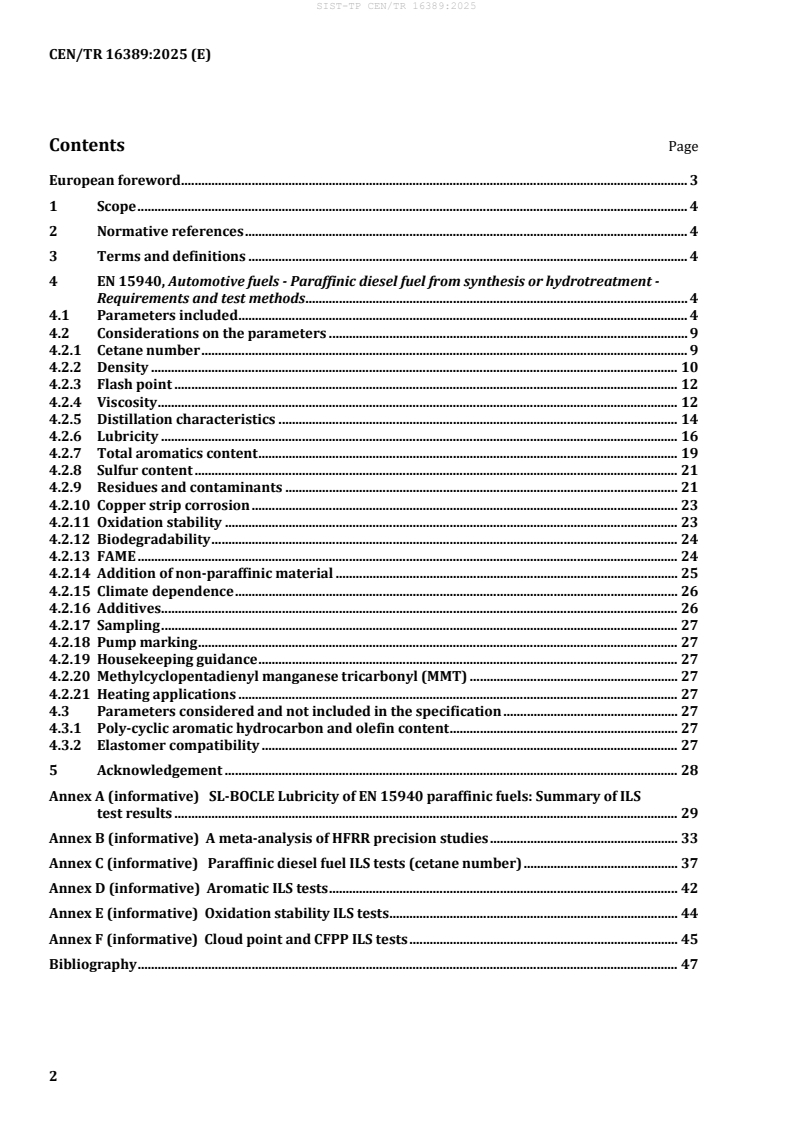
SLOVENSKI STANDARD
01-september-2025
Nadomešča:
SIST-TP CEN/TR 16389:2024
Goriva za motorna vozila - Parafinsko dizelsko gorivo in mešanice s FAME -
Ozadje zahtevanih parametrov, njihove omejitve ter določanje
Automotive fuels - Paraffinic diesel fuel and blends with FAME - Background to the
parameters required and their respective limits and determination
Kraftstoff für Kraftfahrzeuge - Paraffinischer Dieselkraftstoff und Kraftstoff-Mischungen -
Hintergrund zu den erforderlichen Parametern, den entsprechenden Grenzwerten und
deren Bestimmung
Carburants pour automobiles - Gazole paraffinique et mélanges d'EMAG - Historique sur
la définition des paramètres requis, de leurs limites et de leurs déterminations
respectives
Ta slovenski standard je istoveten z: CEN/TR 16389:2025
ICS:
75.160.20 Tekoča goriva Liquid fuels
2003-01.Slovenski inštitut za standardizacijo. Razmnoževanje celote ali delov tega standarda ni dovoljeno.
CEN/TR 16389
TECHNICAL REPORT
RAPPORT TECHNIQUE
July 2025
TECHNISCHER REPORT
ICS Supersedes CEN/TR 16389:2023
English Version
Automotive fuels - Paraffinic diesel fuel and blends with
FAME - Background to the parameters required and their
respective limits and determination
Carburants pour automobiles - Gazole paraffinique et Kraftstoff für Kraftfahrzeuge - Paraffinischer
mélanges d'EMAG - Historique sur la définition des Dieselkraftstoff und Kraftstoff-Mischungen -
paramètres requis, de leurs limites et de leurs Hintergrund zu den erforderlichen Parametern, den
déterminations respectives entsprechenden Grenzwerten und deren Bestimmung
This Technical Report was approved by CEN on 30 June 2025. It has been drawn up by the Technical Committee CEN/TC 19.
CEN members are the national standards bodies of Austria, Belgium, Bulgaria, Croatia, Cyprus, Czech Republic, Denmark, Estonia,
Finland, France, Germany, Greece, Hungary, Iceland, Ireland, Italy, Latvia, Lithuania, Luxembourg, Malta, Netherlands, Norway,
Poland, Portugal, Republic of North Macedonia, Romania, Serbia, Slovakia, Slovenia, Spain, Sweden, Switzerland, Türkiye and
United Kingdom.
EUROPEAN COMMITTEE FOR STANDARDIZATION
COMITÉ EUROPÉEN DE NORMALISATION
EUROPÄISCHES KOMITEE FÜR NORMUNG
CEN-CENELEC Management Centre: Rue de la Science 23, B-1040 Brussels
© 2025 CEN All rights of exploitation in any form and by any means reserved Ref. No. CEN/TR 16389:2025 E
worldwide for CEN national Members.
Contents Page
European foreword . 3
1 Scope . 4
2 Normative references . 4
3 Terms and definitions . 4
4 EN 15940, Automotive fuels - Paraffinic diesel fuel from synthesis or hydrotreatment -
Requirements and test methods . 4
4.1 Parameters included . 4
4.2 Considerations on the parameters . 9
4.2.1 Cetane number . 9
4.2.2 Density . 10
4.2.3 Flash point . 12
4.2.4 Viscosity . 12
4.2.5 Distillation characteristics . 14
4.2.6 Lubricity . 16
4.2.7 Total aromatics content . 19
4.2.8 Sulfur content . 21
4.2.9 Residues and contaminants . 21
4.2.10 Copper strip corrosion . 23
4.2.11 Oxidation stability . 23
4.2.12 Biodegradability . 24
4.2.13 FAME . 24
4.2.14 Addition of non-paraffinic material . 25
4.2.15 Climate dependence . 26
4.2.16 Additives . 26
4.2.17 Sampling . 27
4.2.18 Pump marking . 27
4.2.19 Housekeeping guidance . 27
4.2.20 Methylcyclopentadienyl manganese tricarbonyl (MMT) . 27
4.2.21 Heating applications . 27
4.3 Parameters considered and not included in the specification . 27
4.3.1 Poly-cyclic aromatic hydrocarbon and olefin content . 27
4.3.2 Elastomer compatibility . 27
5 Acknowledgement . 28
Annex A (informative) SL-BOCLE Lubricity of EN 15940 paraffinic fuels: Summary of ILS
test results . 29
Annex B (informative) A meta-analysis of HFRR precision studies . 33
Annex C (informative) Paraffinic diesel fuel ILS tests (cetane number) . 37
Annex D (informative) Aromatic ILS tests . 42
Annex E (informative) Oxidation stability ILS tests . 44
Annex F (informative) Cloud point and CFPP ILS tests . 45
Bibliography . 47
European foreword
This document (CEN/TR 16389:2025) has been prepared by Technical Committee CEN/TC 19 “Gaseous
and liquid fuels, lubricants and related products of petroleum, synthetic and biological origin”, the
secretariat of which is held by NEN.
Attention is drawn to the possibility that some of the elements of this document may be the subject of
patent rights. CEN shall not be held responsible for identifying any or all such patent rights.
This document supersedes CEN/TR 16389:2023.
The fourth version of this document has been updated after the revision of EN 15940:2023. In this update,
several editorial and technical improvements have been made.
Any feedback and questions on this document should be directed to the users’ national standards body.
A complete listing of these bodies can be found on the CEN website.
1 Scope
This document explains the requirements and test methods for paraffinic diesel fuel from synthesis or
hydrotreatment containing up to 7,0 % (V/V) Fatty Acid Methyl Ester (FAME). Synthesis refers to XTL
processes where X refers to various feedstocks for example Gas (G), Biomass (B) or Coal (C) and TL stands
for To-Liquid. In this document the term hydrotreatment includes all catalytic processes where hydrogen
is used. Hydrotreatment of oils and fats from plant, animal or any other biological origin yield paraffinic
diesel fuel for example Hydrotreated Vegetable Oil (HVO) or Hydroprocessed Esters and Fatty Acids
(HEFA). Paraffinic diesel fuel can be blended with up to 7,0 % (V/V) fatty acid methyl ester (FAME). This
document provides background information to the final text of EN 15940:2023 [1] and gives guidance
and explanations to the producers, blenders, marketers and users of paraffinic automotive diesel fuel.
Paraffinic diesel fuel is a high quality, clean burning fuel with virtually no sulfur and aromatics. Paraffinic
diesel fuel can be used in diesel engines, also to reduce regulated emissions. In order to have the greatest
possible emissions reduction, a specific calibration is needed. Some types of paraffinic diesel fuel, at
present notably HVO, can also offer a meaningful contribution to the target of increased non-crude
derived and/or renewable content in the transportation fuel pool.
For general diesel engine operation, durability and warranty, paraffinic automotive diesel fuel needs a
validation step to confirm the compatibility of the fuel with the vehicle, which for some existing engines
still needs to be done. The vehicle manufacturer needs to be consulted before use.
NOTE 1 This document is directly related to EN 15940 and will be updated once further publications take place.
NOTE 2 Paraffinic diesel fuel is also used as a blending component in automotive diesel fuel. In that case,
composition and properties of the final blends are defined by relevant fuel specification standards.
NOTE 3 For the purposes of this document, the terms “% (m/m)” and “% (V/V)” are used to represent
respectively the mass fraction and the volume fraction.
2 Normative references
There are no normative references in this document.
3 Terms and definitions
No terms and definitions are listed in this document.
ISO and IEC maintain terminology databases for use in standardization at the following addresses:
— IEC Electropedia: available at https://www.electropedia.org/
— ISO Online browsing platform: available at https://www.iso.org/obp/
4 EN 15940, Automotive fuels - Paraffinic diesel fuel from synthesis or
hydrotreatment - Requirements and test methods
4.1 Parameters included
This document gives further detailed information about requirements and parameters as defined in
EN 15940:2023 [1].
All parameters discussed in this document are based on the paraffinic nature of XTL and HVO and the use
of FAME complying with EN 14214:2019 [2] as a blending component. The test methods precisions are
presented in Table 1.
Table 1 — Precision of the methods to paraffinic diesel fuel and conventional diesel fuel
Property Unit Test method EN 15940 [1] and EN 590 [3] Precision
Methods whose precision statement includes paraffinic diesel fuel and conventional diesel fuel
Cetane number EN ISO 5165:1998 [4] Average cetane number Repeatability Reproducibility
a
level
(R = 0,125× CN - 2,2)
40 0,8 2,8
44 0,9 3,3
48 0,9 3,8
52 0,9 4,3
56 1,0 4,8
EN 15195:2023 [5] r = 0,013 80 × X
R = 0,046 82 × X
EN 16906:2017 [6] r = 1,474 2 + 0,004 3 × X
R = −1,054 2+ 0,069 2 × X
1,47
EN 17155:2018 [7] r = 0,002 931 × (X)
1,47
R = 0,006 407 × (X)
3 3
Density at 15 °C EN ISO 3675:1998 [8]
kg/m r = 0,5 kg/m
R =1,2 kg/m
EN ISO 12185:1996 [9]
r =0,2 kg/m
R =0,5 kg/m
Flash point °C EN ISO 2719:2016 [10] r =0,029 × X
R =0,071 × X
Viscosity at EN ISO 3104:2020 [11] r =0,004 3 × (X + 1)
mm /s
40 °C
R =0,008 2 × (X + 1)
ISO 23581:2020 [12] r = 0,010 5 – 0,000 3 × X
R = 0,034 6 + 0,005 × X
Property Unit Test method EN 15940 [1] and EN 590 [3] Precision
Distillation °C or EN ISO 3405:2019 [13] % recovered Repeatability °C Reproducibility °C
% recovered
IBP 3,3 5,6
5 r1+0,66 R1+1,11
10 r1 R1
20 r1 R1
30 to 70 r1 R1
80 r1 R1
90 r1 R1-1,22
95 r1 R1-0,94
FBP 3,9 7,2
Each of the variables r1 and
R1 is a constant function of
the slope, ΔC/ΔV, at each
distillation point in question,
with values calculated from:
r1 = 0,864 (ΔC/ΔV) + 1,214;
R1 = 1,736 (ΔC/ΔV) + 1,994.
EN ISO 3924:2019 [14] % recovered Repeatability °C Reproducibility °C
b b
IBP
0,011 × X 0,066 × X
5 %
0,0032×(X+100) 0,015 × (X+100)
10 % to 40 %
0,8 0,013 ×(X+100)
50 % to 90 %
1,0 4,3
95%
1,2 5,0
FBP
3,2 11,8
Repeatability Reproducibility Valid range
EN 17306:2023 [15]
IBP r = 3,9 R = 6,0 145 °C – 195 °C
T5 r = T × 0,011 94 R= T × 0,017 2 175 °C – 250 °C
T10 r = T × 0,009 54 R = T × 0,017 7 160 °C – 265 °C
T20 r = T × 0,009 32 R = T × 0,011 7 180 °C – 275 °C
T30 r = T × 0,007 82 R = T × 0,012 2 190 °C – 285 °C
T40 r = T × 0,008 22 R = T × 0,012 2 200 °C – 290 °C
T50 r = T × 0,006 14 R = T × 0,010 3 170 °C – 295 °C
T60 r = T × 0,005 34 R = T × 0,009 2 220 °C – 305 °C
T70 r = T × 0,004 05 R = T × 0,008 4 230 °C – 315 °C
T80 r = T × 0,004 41 R = T × 0,008 4 240 °C – 325 °C
T90 r = T × 0,004 1 R = T × 0,008 1 180 °C – 340 °C
T95 r = 2,03 R = 3,23 260 °C – 360 °C
FBP r = 3,93 R = 7,7 195 °C – 365 °C
Property Unit Test method EN 15940 [1] and EN 590 [3] Precision
Lubricity, µm EN ISO 12156-1:2023[16] r = 0,085 × (1 138 –X)
corrected wear
R = 0,119 × (1 138 – X)
scar diameter
(WSD ) at 60 °C
FAME content % (V/V) EN 14078:2014 [17] Overall r is between 0,1 % to 0,5 %
Overall R is between 0,5 % to 1,5 %
Sulfur content mg/kg EN ISO 20846:2019 [18] range 3 to 60 mg/kg
r = 0,055 3 × X + 0,55
R = 0,112 0 × X + 1,12
EN ISO 20884:2019 [19] range 5 to 60 mg/kg
r =1,7 + 0,024 8 × X
R = 1,9 + 0,120 1 × X
2/3
Carbon residue % (m/m) EN ISO 10370:2014 [20]
r = 0,077 × X
(on 10 %
2/3
R = 0,245 1 × X
distillation
residue)
Ash content % (m/m) EN ISO 6245:2002 [21] Ash content r R
0,001-0,079 0,003 0,005
0,08-0,180 0,007 0,024
Water content mg/kg EN ISO 12937:2000 [22] range 0,003 % (m/m) to 0,100 %
0,5
r = 0,018 74 × X
0,5
R = 0,068 77 × X
Total mg/kg EN 12662:2014 [23] r = 0,064 4 × X +1,609 9
contamination
R = 0,164 4 × X + 4,111 0
Copper strip rating EN ISO 2160:1998 [24] no generally acceptable method for determining precision
corrosion
(3 h at 50 °C)
Property Unit Test method EN 15940 [1] and EN 590 [3] Precision
0,25
Oxidation g/m EN ISO 12205;1996 [25]
r = 5,4 × (X/10)
stability
0,25
R = 10,6 ×(X/10)
where C is total insoluble matter:
Repeatability (r) Reproducibility
Insoluble matter (C),
(R)
g/m
3,0 6,0
4,5 8,9
5,4 10,6
6,0 11,7
6,4 12,6
6,8 13,3
7,1 14,0
h EN 15751:2014 [26] r = 0,220 27 + 0,043 44 × X
R = 0,372 69 + 0,190 38 × X
where X represents the average of the two results in hours
min EN 16091;2022 [27] r = 0,028 8 × X + 0,496 5
R = 0,086 3 × X + 1,377 2
where X represents the average of the two results in minutes
Cloud point °C EN ISO 3015:2019 [28] r = 1,433 9 - 0,007 1 × X
R = 3,958 5 + 0,066 1 × X
where X is the mean of two results being compared
Manual method: r and R reported for distilled oils:
r = 2
R = 4
EN ISO 22995:2019 [29] r = 1,1 °C
R = 2,5 °C
Manganese mg/l EN 16576:2014 [30] r = 0,035 2 × X + 0,029 0
content
R = 0,114 7 × X + 0,094 4
where X represents the mean of the two results expressed in mg/l
c
CFPP °C EN 116 :2015 [31] r = 1,2 – 0,027 × X
R = 3,0 – 0,060 × X
EN 16329:2022 [32] r = 1,1 – 0,033 × X
R = 1,7 – 0,052 × X
Property Unit Test method EN 15940 [1] and EN 590 [3] Precision
Methods that have a different precision for paraffinic diesel fuel and conventional diesel fuel
EN 15940 Precision EN 590 precision
Total aromatics EN 12916:2019+A1:2022
% (m/m) range 0,8 to 1,8 % range 7 to 42 % (m/m)
content [33] (m/m)
r=0,040 × X -0,070
total aromatic r=0,039 1 × X + 0,077 2
R=0,172 × X – 1,094
R=0,171 3 × X +
0,346 9
a
Values for CNs intermediate to those listed above can be obtained by linear interpolation.
b
Where X is the average of the two results in degrees Celsius.
c
CFPP precisions have been improved and will be corrected in next revision of the EN 15940.
4.2 Considerations on the parameters
4.2.1 Cetane number
The cetane number is a measure of the compression ignition behaviour of a fuel, which influences cold
startability, exhaust emissions and combustion noise. The cetane number is measured on a test engine or
a Derived Cetane Number (DCN) is determined from a correlation with ignition delay as measured in a
constant volume combustion chamber. The cetane number reflects the combination of the natural self-
ignition properties and the effects of cetane improver additives.
The choice of two different classes originates from the differences between the processes which results
in different chemical composition. The processes are the low-temperature and high-temperature Fischer-
Tropsch (LTFT and HTFT) and Hydrogenated Vegetable Oils (HVO). Because a higher cetane number is
an advantage for some applications, the specific distinction between automotive diesel complying with
EN 590:2022 [ class (minimum cetane of 51) and a high-cetane fuel (minimum 70) has been incorporated
in EN 15940:2023 [1].
GTL and HVO are highly paraffinic. LTFT GTL and HVO consist of linear and branched paraffins and have
very high cetane numbers in excess of 70. Generally, a high cetane number leads to a reduction in white
smoke, noise, engine misfire, emissions and improved cold starting in some engines, especially in engines
without pilot injection. HTFT GTL will in general be produced with a cetane between 52 and 65, as this
paraffinic fuel also contains significant quantities of cyclo-paraffins. In earlier discussions, a maximum
cetane number would be desirable by the OEMs, but it was not introduced in the standard. It is difficult
to adjust the production process to limit high cetane number in paraffinic fuels.
The OEMs wished to have a certain band in order to tune the engine where possible. The original band
was 55 to 70. Because 55 was really borderline for the HTFT producers, the minimum was lowered to 51
and the maximum to 66 in order to preserve the band width. With this decision it left a four-point gap
(66 to 70), so it was decided to delete the maximum on class B. There are two classes: Class A with
minimum cetane number 70 and Class B with minimum cetane number 51. Either of the classes do not
have a maximum limit for cetane number.
For a European Standard, all referenced test methods need to be applicable to paraffinic fuels and have
valid precision statements.
EN 15940:2023 [1] referenced four different test methods for cetane number test methods; EN ISO
5165:1998 (CRF engine) [4], EN 15195:2023 (IQT) [5], EN 16906:2017 (BASF engine) [6] and EN
17155:2018 (ICN) [7].
EN ISO 5165 is the method using the CFR cetane engine and EN 16906 is the method using the BASF
engine. EN 15195 is derived cetane by combustion in a constant volume chamber and, specifically using
the Ignition Quality Tester or IQT apparatus, EN 15195 directly measures the ignition delay under
prescribed conditions from which a derived cetane number (DCN) is calculated via a correlation to cetane
number. EN 17155 is a test method for the quantitative determination of the indicated cetane number
(ICN).
All four cetane number methods cover conventional and paraffinic diesel fuels.
CEN/TC 19 decided that EN 15195 is the method to be used in cases of dispute due to the significantly
better precision of EN 15195 over the other methods at the higher cetane numbers. This was agreed to
even though this is a derived test method and not a direct measurement in an engine.
During the update process of EN 15940 in 2022 it was agreed to remove subclause 5.6.3 and Annex A
(precision statement), because EN 15195:2014 was also under an update process and it was agreed that
an optional equation in the annex was removed in 2023 [5].
Cetane index is a calculated value that approximates the ‘natural’ cetane of a fuel. Cetane index is linked
to arctic climate requirements of automotive diesel fuel. However, the cetane index as it stands now,
cannot be applied to paraffinic diesel fuels since XTL and HVO fuels were not part of the database
underpinning the empirical correlation. Cetane index has not been incorporated in EN 15940.
4.2.2 Density
Generally, paraffins have a lower density than aromatic hydrocarbons and consequently, the density of
3 3
highly paraffinic XTL/HVO diesel is lower than that of conventional diesel fuel (765 kg/m to 810 kg/m
3 3
compared to 815kg/m to 845 kg/m for temperate grades of conventional diesel fuels). The presence of
aromatics in conventional diesel fuel results in a higher density fuel.
The diesel fuel injection is controlled volumetrically or by timing of the solenoid valve. Variations in fuel
density (and viscosity) result in variations in engine power and, consequently, in engine emissions and
fuel consumption. Therefore, in order to optimize engine performance and tailpipe emissions, OEMs
prefer both minimum and maximum density limits to be defined in a fairly narrow range. Moreover, the
(volumetric) injection quantity is a control parameter for other emission control systems like the exhaust
gas recirculation (EGR). Variations in fuel density therefore result in non-optimal EGR-rates for a given
load and speed point in the engine map and, as a consequence, influence the exhaust emission
characteristics.
Engine and vehicle manufacturers prefer a narrow range of density for good driveability not exceeding
40 kg/m . For durability, a minimum density limit, and for optimized exhaust emission characteristics, a
maximum density limit, is important. Diesel fuel categories 3, 4 and 5 of the WWFC 2019 which are
defined for markets with more stringent emission requirements restrict the density range from
3 3 3
to 840 kg/m , with the option to relax the lower density limit to 800 kg/m for fuel used under
815 kg/m
low temperature conditions (cloud point below -10 °C).
The impact of the lower density of paraffinic fuels on the gravimetric injection amount depends on the
injection principle. For passenger cars, many injectors are designed according to the servo principle with
a full ballistic behaviour. In such applications, the gravimetric injection amount is only marginally
reduced despite density of paraffinic fuels is 6 % to 7 % lower. For energising times up to 1 000 µs
(microsecond), i.e. before the lift stop of the nozzle needle is reached, lower density affects fuel flow
through the injector orifices and results in a faster and slightly stronger lift of the nozzle needle (Bernoulli
equation). Consequently, the distance that the needle needs to travel for closing is increased. For a given
injection timing, changed needle opening and closing behaviour allows a slightly higher volume of fuel to
be injected. Under ballistic operating conditions, the increased volumetric injection amount is inversely
proportional to fuel density. For paraffinic fuels, the volume injected is approximately increased by 6 %
to 7 %, fairly compensating for the lower density and thus corresponding to a gravimetric injection
amount of ±1 % compared to standard diesel fuel. Considering the higher inferior heating value of
paraffinic fuels (around 44,1 MJ/kg compared to 42,9 MJ/kg for standard diesel) the same gravimetric
injection amount results in an approx. 2,8 % higher engine power for paraffinic fuels under part load
conditions (see Figure 1).
In the non-ballistic operating area of diesel injectors, typically above injection timings of 1 000 µs, the
increase of the volumetric injection amount is smaller and does usually not exceed 3 %, thus not fully
compensating for the lower density of paraffinic fuels. Such conditions are more typical of full power
operation, as might be found on heavy duty vehicle applications. The higher injected volume compensates
for approximately half of the density related loss in fuel energy only. Considering again the higher inferior
heating value of paraffinic fuels, the injected energy is only slightly reduced and engine performance
remains largely unchanged. Older mechanical fuel injection system designs are frequently volume (piston
stroke) metered, so will lose gravimetric injection quantity in proportion to density.
a) b)
c) d)
Key
solid line conventional diesel fuel EN 590
dotted line paraffinic diesel fuel EN 15940
X-axis (1a) energising time [µs]
Y-axis (1a) volumetric injection quantity [mm³/stroke]
X-axis (1b) energising time [µs]
Y-axis (1b) gravimetric injection quantity [mg/stoke]
X-axis (1c) energising time [ms]
Y-axis (1c) volumetric flow rate [cm /s]
X-axis (1d) energising time [ms]
Y-axis (1d) mass flow rate [g/s]
Figure 1 — Volumetric (1a) and gravimetric (1b) injection map at different pressure levels (p1
to p3), volumetric (1c) and gravimetric injection rate (1d) at maximum pressure (p3),
presented by the example of the Bosch passenger car injector CRI2.25
The Task Force investigated the effect of temperature on density, based on work done by the PTB
(Physical Technical Institute) Braunschweig, Germany. The work is summarized in Annex B of
EN 15940:2023.
4.2.3 Flash point
Flash point of a diesel fuel is defined as the lowest temperature at which fuel vapours above the liquid
will ignite upon exposure to an ignition source. It is used to classify fuels for transport and storage
according to hazard level; minimum flash point temperatures are (legally) required for proper safety and
handling of the fuel. Flash point varies inversely with the fuel’s volatility.
Flashpoint is a legal requirement for diesel grade fuels. As the flash point of a diesel fuel is associated with
the light (lower boiling) material, a diesel fuel with too much light material (shorter carbon chain length
molecules) will have a low flash point and it will be hazardous to handle.
Generally, the flash point of neat FAME (soy, rapeseed and palm) fuels is higher than that of paraffinic
diesel and conventional crude-derived diesel fuels.
The flash point in EN 15940 has been defined as “Above 55 °C” as in EN 590. Most of the paraffinic diesel
fuels have a flashpoint above 60 °C and as such are not required to be labelled as flammable . The higher
flashpoint allows for the use of such fuels in marine applications. More data is given in the chapter on IBP
and cavitation.
4.2.4 Viscosity
Viscosity is a measure of a fuel’s resistance to flow and affects the performance of diesel fuel pumps and
injection systems. Low viscosity also has an influence on sliding by changing hydrodynamic contacts, e.g.,
bearings of camshafts, rollers, etc. Also, mixed contacts, e.g., piston in cylinder, can be adversely affected.
Moreover, increased leaking in pressure sealing contacts such as between plunger and guide results in
additional heat generation and in reduced injected fuel quantities. Higher temperature associated with
low viscosity increases the risk of cavitation and deposit formation. High viscosities on the other hand
can reduce fuel flow rates, especially at low ambient temperatures, resulting in insufficient fuel flow and
affecting cold start. The pressure build-up in non pressure-controlled systems like unit injectors is also
increased imposing additional stress on system components.
Viscosity is related to fuel spray atomisation and it is thus required that a fuel has a certain viscosity range
to avoid incomplete combustion which could be associated with poor atomisation of the fuel. If the
viscosity is too low, the injection spray is too soft and will not penetrate far enough into the cylinder and
loss of power will occur.
The effects of temperature on kinematic viscosity are plotted in Figure 2 for a range of diesel fuels as well
as rapeseed methyl ester (RME) based FAME. The graph has nonlinear axes following the practice of
ASTM D341 [35]. This approach permits the kinematic viscosity of petroleum fluids to be plotted as a
straight line, the slope of which indicates variation with temperature. The results indicate that the relative
effect of temperature on kinematic viscosity is similar for each of the petroleum fuels, i.e., the dependency
of viscosity on temperature of HVO are virtually identical to summer and winter conventional diesel fuel,
as well as Swedish class 1 diesel fuel with and without 5 % (V/V) FAME.
The kinematic viscosity of pure RME based FAME is appreciably higher than any of the petroleum-based
fuels. In addition, the slope of the line for pure FAME is slightly lower, i.e., it is slightly less sensitive to
the effects of increasing temperature than conventional diesel fuel. FAME fuel blends generally have
improved lubricity; however, their higher viscosity levels tend to form larger droplets on injection which
can cause poor combustion and increased exhaust smoke under certain operating conditions. At FAME
blending levels up to 7 % by volume, the suggested limits provide an acceptable level of fuel system
performance for the finished fuel blends and allow blending without changing the viscosity of the base
paraffinic diesel fuel.
EU Classification, Labelling and Packaging of Substances and Mixtures Regulation (no 1272/2008) classifies
substances and mixtures as flammable where they have a flashpoint of up to 60 °C.
Key
X-axis temperature, °C
Y-axis
kinematic viscosity, mm /s (cSt)
Figure 2 — Kinematic viscosities of different fuels as a function of temperature
During the latest update process, besides EN ISO 3104, a new method ISO 23581 was added as an optional
method for measuring viscosity.
4.2.5 Distillation characteristics
4.2.5.1 Distillation curve
The distillation curve indicates the amount of fuel that will boil off at a given temperature. The curve can
be divided into three parts:
— the light end, which affects cavitation and lubrication;
— the region between the light and heavy end, which is linked to other fuel parameters such as viscosity
and density; and
— the heavy end, characterized by the T90, T95 and final boiling points, which affects injector tip and
engine valve cleanliness, emissions and engine oil dilution.
Blending FAME to the paraffinic fuels increases the heavy end part (see Figure 3).
Key
X-axis volume recovered ,% (V/V)
Y-axis temperature, °C
Figure 3 — Distillation curves of different diesel fuels (B0, Swedish diesel, COD, GtL and HVO),
diesel/FAME blends (B5 and B30) and pure rapeseed based FAME (B100)
4.2.5.2 IBP and cavitation
The impact of the Initial Boiling Point (IBP) on the risk of cavitation erosion within the high-pressure fuel
injection equipment (FIE) was extensively discussed. A low IBP can indicate an increased propensity for
cavitation, leading to a possibility for damage close to areas of pressure release in fuel injection
equipment, e.g., at diffuser and throttle as applied in injectors and pumps. Cavitation is the process of
vapour bubble formation and vapour condensation within a fluid. Depending on the type and quantity of
volatile components, intensity and location of cavitation can be altered. If cavitation is higher or shifted
closer to inner wall surfaces, damage by cavitation erosion is increased.
When standardization of EN 15940 started, the concern was raised that the IBP of paraffinic fuels might
be more often < 160 °C, and that a flashpoint limit of above 55 °C does not always prevent paraffinic fuels
falling below an IBP of 160 °C. An assessment of EN 590 market fuels data has revealed that ~7 % of the
fuels have an IBP below 160 °C although they met the requirements for Flash Point (> 55 °C). However,
some fuel producers felt there was no difference in the behaviour of paraffinic and EN 590 fuels with
respect to their ability to meet an IBP above 160 °C.
As IBP data of paraffinic fuels were not available on a statistical basis, the decision was made in 2018 to
collect more data by placing an IBP reporting requirement into EN 15940:2018. It was felt that the
reporting requirement would provide real market data.
Following the 2018 revision of EN 15940, large comprehensive datasets were collected on IBP and
flashpoints from paraffinic fuels producers with both GTL and HVO data.
With the latest revision of EN 15940:2023 [1], it was decided to evaluate all IBP data collected. Based on
this evaluation, the group agreed that it would be a good idea to review additional data from 2018 to
2021 to complement the IBP/flashpoint dataset.
The collection of all survey data, see Figure 4, show that the majority of paraffinic fuels have an
IBP ≥ 160 °C and only a few fuels display an IBP as low as 145 °C. There is a clear tendency that HVO have
a higher IBP and higher flashpoint than GTL fuels. The data sets confirm the similar behaviour to EN 590
fuels and it was decided to remove the reporting requirement from Table 1 in EN 15940:2023 [1].
Cavitation risk increases with decreasing IBP. The lower the IBP in the range of 160 °C to 145 °C, the
higher is the risk of cavitation damage. It is recognized that end-of-life fuel injection equipment has not
been available for a final assessment and the FIE manufacturers were concerned for frequent use of
paraffinic fuels in home-based tank installations of customer and city fleets because the variety of IBP
values could be less. In such cases, delivery of fuels lower in IBP might happen more often. So far,
cavitation damage by use of paraffinic fuels complying with EN 15940 have not come to the attention of
FIE manufacturers.
A more extensive paragraph on cavitation prevention was replaced by a cautionary statement under
section ‘Generally applicable requirements and related test methods’, stating that the ‘majority of the
paraffinic fuels have an IBP above 160 °C as determined by EN ISO 3405’, added with the note ‘continuous
usage of low IBP fuels in fleets creates a risk of cavitation damage.’
Key
X-axis flash point, °C
Y-axis IBP, °C
Figure 4 — Correlation of IBP to Flash Point for paraffinic fuels
4.2.6 Lubricity
The lubricating components of the diesel fuel are believed to be the heavier hydrocarbons, aromatic
compounds, certain acids and polar fuel molecules. Diesel injection systems without an external
lubrication system rely on the lubricating properties of diesel fuel to ensure proper operation and lifetime
durability. Refining processes to remove sulfur tend to reduce diesel fuel components that provide
natural lubricity. In order to eliminate the risk of increased wear, lubricity of fuels low in sulfur content
need to be carefully controlled and suitably adjusted with e.g., additives or FAME.
Years of field experience with conventional crude oil-based diesel fuels confirms that adequate protection
from both mild wear and seizure related failure mechanisms is given if the Wear Scar Diameter (WSD) of
the ball does not exceed 460 µm in the High Frequency Reciprocating Rig (HFRR) test (EN ISO 12156-
1:2023) [16]. The vehicle fleet in Europe, which contains an unusually high proportion of diesel passenger
cars, is generally validated for fuels with a HFRR wear scar diameter of maximum 460 µm.
Most paraffinic fuels, however, intrinsically have poor lubricating properties. If no lubricity adjustment
is provided, WSD results in the HFRR test can easily exceed 600 µm or even 700 µm. Use of an effective
lubricity additive is essential. Due to the almost complete absence of aromatic compounds and other polar
substances, the solvency characteristic of paraffinic diesel fuel can be lower than that of conventional
diesel fuel [36, 37]. Therefore, the type and dosage rate of lubricity additives for paraffinic fuels is
frequently different from those for conventional diesel fuel. FAME blending can be an alternative to use
of lubricity additives. Detailed information about the risks of precipitation when using FAME as a
blending component is given in 4.2.13.
Two criteria regarding fuel lubricity are relevant for fuel injection equipment:
1) Mild wear, which results in a continuous (and mostly easily detectable) change in geometric
dimensions of sliding parts and for which the test method and limit are HFRR (EN ISO 12156-1:2023)
[16] and a wear scar diameter (WSD) at 60 °C of less than 460 μm respectively, and
2) Seizure load, which results in a sudden and unpredictable failure caused by severe adhesive scuffing
and for which the test method and limit are: SL-BOCLE (ASTM D6078:2004) [38] and an applied load
exceeding 3 500 grams.
In conventional crude oil-based diesel fuels, a 460 μm HFRR result has been demonstrated to protect
against both mild wear and seizure. The response of pure paraffinic diesel fuel to lubricity additives is
known to be different to that of conventional diesel fuel, however. As a result, in non or low aromatic
fuels this correlation is less reliable because the chemistry and concentration of additive is affected by
fuel composition. Depending on additive chemistry, tests have shown that only the risk of wear but not
necessarily that of seizure will be reduced. For some ester-based lubricity additives, the treat rate does
not seem to have any correlation to SL-BOCLE test result, even if the repeatability of 900 g for SL-BOCLE
is taken into consideration. The responsiveness of ester-based additives can even be reversed compared
to the lubricity performance demonstrated in the HFRR test. In general, the SL-BOCLE response with acid
lubricity additive is better than with ester lubricity additive. See Figure 5 [39].
Key
left Y-axis lubricity, HFRR (µm)
right Y-axis lubricity, SL-BOCLE (g)
Figure 5 — Response of the ester-based lubricity additive on lubricity of conventional diesel and
HVO
In particular at low dose rates, some additives do not provide adequate seizure protection if used in fuels
of paraffinic nature. Furthermore, FIE bench and engine test results indicate slightly higher wear when
fuels having the same HFRR but lower SL-BOCLE lubricity are tested under the same conditions. The
effect is small but can affect injector lifetime.
The lubricating characteristics of paraffinic fuels have not been extensively studied. In addition,
verification of the precision of the HFRR test methodology with paraffinic fuels is completely missing.
The scope of EN ISO 12156-1:2018 [40] contains a note stating that “It is not known if this test method
will predict the performance of all additive/fuel combinations, including paraffinic fuels for which no
additional correlation testing has been performed. Nevertheless, no data has been presented to suggest
that such fuels are not within scope.”
Regarding the precision data of the SL-BOCLE test, information relating to the composition of the fuels
used in the ILS (Inter Laboratory Study) test more than two decades ago remained insufficient, while fuel
quality and additive technology could have changed since then. It was the general perception that the SL-
BOCLE test is imprecise, however, it is well established in the FIE industry to additionally characterise
lubricity of test fuels.
As a consequence, an extensive new ILS for the SL-BOCLE test was started, complemented by HFRR
measurements. Significant effort was spent to investigate whether the SL-BOCLE test with an appropriate
limit would be a suitable parameter for the table of requirements in EN 15940. The ILS with seven
participating laboratories comprised four GTL fuels and three HVO fuels as well as one high lubricity
diesel used as a reference for the HFRR. The results indicated that the precision of the SL-BOCLE could
not be improved relative to the 1995 ILS. The repeatability stayed the same at 900 g, and reproducibility
remained at 1 500 g [CEN/TC 19/WG 24 N 586, see Annex A]. In consequence, the SL-BOCLE test was
considered not to be qualified for introduction into EN 15940. Independently, the SL-BOCLE method
(ASTM D6078) has been withdrawn in 2021.
The additional HFRR test results confirmed a direct relationship between SL-BOCLE and HFRR lubricity
for six of the eight fuels. Two fuels displayed a diverging behaviour with good SL-BOCLE but poor HFRR
performance.
The new data on HFRR lubricity of paraffinic fuels were compared to results compiled from data of
previous ILS tests. In this meta study the following conclusions were drawn [CEN/TC 19/WG 24 N 585,
see Annex B]:
— Re
...