

SIST EN 61511-2:2017
(Main)Functional safety - Safety instrumented systems for the process industry sector - Part 2: Guidelines for the application of IEC 61511-1 (IEC 61511-2:2016)
General Information
- Status
- Published
- Publication Date
- 07-Aug-2017
- Technical Committee
- MOV - Measuring equipment for electromagnetic quantities
- Current Stage
- 6060 - National Implementation/Publication (Adopted Project)
- Start Date
- 08-May-2017
- Due Date
- 13-Jul-2017
- Completion Date
- 08-Aug-2017



Overview
EN 61511-2:2017 (adoption of IEC 61511-2:2016 RLV) is a guidance standard for functional safety in the process industry. It provides practical, application‑focused guidance to implement the requirements of IEC 61511-1, addressing the specification, design, installation, operation and maintenance of safety instrumented functions (SIFs) and safety instrumented systems (SIS). This edition supersedes the 2003/2004 guidance, constitutes a technical revision, and includes expanded examples and annexes to support modern application programming and lifecycle execution.
Key Topics
EN 61511-2:2017 covers guidance across the safety lifecycle and related processes, including:
- Management of functional safety – organizational roles, responsibilities and processes for SIS projects
- Safety lifecycle requirements – phased guidance for planning, design, verification and validation
- Verification & validation – review, testing and evidence collection across lifecycle stages
- Hazard & risk assessment (H&RA) – inputs for defining SIFs and required risk reduction
- Allocation of safety functions – how to assign functions to protection layers and avoid common‑cause or dependent failures
- SIS Safety Requirements Specification (SRS) – content and structure for SRS documents
- SIS design and engineering – hardware fault tolerance, device selection, interfaces and maintenance design
- Application program development – design, implementation, verification and tools/methods for logic solvers
- Factory acceptance testing (FAT), commissioning & validation – practical test objectives and execution
- Operation, maintenance & proof testing – procedures, intervals and documentation needs
- Modification & decommissioning – controlled change and retirement processes
- Informative annexes with practical examples: function block and relay ladder programming examples, P&ID-to-program conversion, toolsets and guidance for migrating technologies.
Applications
This standard is intended for use in process sectors where automated safety systems protect people, assets and the environment, including chemical, petrochemical, oil & gas, pharmaceuticals, power generation and other continuous or batch process industries. It helps organizations translate IEC 61511-1 requirements into implementable project activities, test plans and operational practices.
Who uses this standard
- Functional safety engineers and SIS designers
- Process engineers and safety managers
- Control system integrators and automation vendors
- Plant operators, maintenance teams and asset owners
- Regulatory/compliance auditors and certification bodies
Related standards
- IEC 61511-1 (Framework, definitions, hardware/software requirements) - normative reference for EN 61511-2:2017
- IEC 61508 and other industry standards referenced in the annexes
EN 61511-2:2017 is an essential guidance document for practitioners implementing safety instrumented systems and seeking to apply IEC 61511-1 consistently and effectively across the safety lifecycle.
Relations
- Effective Date
- 22-Apr-2014
- Effective Date
- 03-Feb-2026
- Effective Date
- 01-Sep-2026
- Effective Date
- 09-Feb-2026
- Effective Date
- 09-Feb-2026
- Effective Date
- 09-Feb-2026
- Effective Date
- 09-Feb-2026
- Effective Date
- 09-Feb-2026
- Referred By
SIST EN 12583:2022+A1:2025 - Gas Infrastructure - Compressor stations - Functional requirements - Effective Date
- 09-Feb-2026
- Effective Date
- 09-Feb-2026
- Referred By
SIST EN 17928-1:2025 - Gas infrastructure - Injection stations - Part 1: General requirements - Effective Date
- 09-Feb-2026
- Effective Date
- 09-Feb-2026
- Effective Date
- 03-Feb-2026
- Effective Date
- 03-Feb-2026
- Effective Date
- 03-Feb-2026
Get Certified
Connect with accredited certification bodies for this standard

DVS-ZERT GmbH
German welding certification society.
CARES (UK Certification Authority for Reinforcing Steels)
UK certification for reinforcing steels and construction.
EWF/IIW (European/International Welding Federation)
International welding personnel certification.
Sponsored listings
Frequently Asked Questions
SIST EN 61511-2:2017 is a standard published by the Slovenian Institute for Standardization (SIST). Its full title is "Functional safety - Safety instrumented systems for the process industry sector - Part 2: Guidelines for the application of IEC 61511-1 (IEC 61511-2:2016)". This standard covers: IEC 61511-2:2016 is available as <a href="https://webstore.iec.ch/publication/25521">IEC 61511-2:2016 RLV which contains the International Standard and its Redline version, showing all changes of the technical content compared to the previous edition. IEC 61511-2:2016 provides guidance on the specification, design, installation, operation and maintenance of SIFs and related SIS as defined in IEC 61511-1:2016. This second edition cancels and replaces the first edition published in 2003. This edition constitutes a technical revision. This edition includes the following significant technical changes with respect to the previous edition: guidance examples based on all phases of the safety life cycle provided based on usage experience with IEC61511 1st edition; annexes replaced to address transition from software to application programming.
IEC 61511-2:2016 is available as <a href="https://webstore.iec.ch/publication/25521">IEC 61511-2:2016 RLV which contains the International Standard and its Redline version, showing all changes of the technical content compared to the previous edition. IEC 61511-2:2016 provides guidance on the specification, design, installation, operation and maintenance of SIFs and related SIS as defined in IEC 61511-1:2016. This second edition cancels and replaces the first edition published in 2003. This edition constitutes a technical revision. This edition includes the following significant technical changes with respect to the previous edition: guidance examples based on all phases of the safety life cycle provided based on usage experience with IEC61511 1st edition; annexes replaced to address transition from software to application programming.
SIST EN 61511-2:2017 is classified under the following ICS (International Classification for Standards) categories: 25.040.40 - Industrial process measurement and control. The ICS classification helps identify the subject area and facilitates finding related standards.
SIST EN 61511-2:2017 has the following relationships with other standards: It is inter standard links to SIST EN 61511-2:2007, SIST EN 61511-1:2017, kSIST FprEN IEC 61514-2:2026, SIST EN 12583:2022, SIST EN 1474-1:2009, SIST EN 746-3:2022, SIST EN 12583:2014, SIST EN 1474-3:2009, SIST EN 12583:2022+A1:2025, SIST EN 1012-3:2014, SIST EN 17928-1:2025, SIST EN 17942:2024, SIST EN 61784-3-3:2018, SIST EN 62657-1:2018, SIST EN 61784-3-8:2018. Understanding these relationships helps ensure you are using the most current and applicable version of the standard.
SIST EN 61511-2:2017 is available in PDF format for immediate download after purchase. The document can be added to your cart and obtained through the secure checkout process. Digital delivery ensures instant access to the complete standard document.
Standards Content (Sample)
2003-01.Slovenski inštitut za standardizacijo. Razmnoževanje celote ali delov tega standarda ni dovoljeno.Funkcijska varnost - Sistemi z varnostnimi instrumenti za sektor procesne industrije - 2. del: Smernice za uporabo IEC 61511-1 (IEC 61511-2:2016)Funktionale Sicherheit - PLT-Sicherheitseinrichtungen für die Prozessindustrie - Teil 2: Anleitungen zur Anwendung des Teils 1 (IEC 61511-2:2016)Sécurité fonctionnelle - Systèmes instrumentés de sécurité pour le secteur des industries de transformation - Partie 2: Directives pour l’application de l’IEC 61511-1 (IEC 61511-2:2016)Functional safety - Safety instrumented systems for the process industry sector - Part 2: Guidelines for the application of IEC 61511-1 (IEC 61511-2:2016)25.040.40Merjenje in krmiljenje industrijskih postopkovIndustrial process measurement and controlICS:Ta slovenski standard je istoveten z:EN 61511-2:2017SIST EN 61511-2:2017en,fr,de01-september-2017SIST EN 61511-2:2017SLOVENSKI
STANDARDSIST EN 61511-2:20071DGRPHãþD
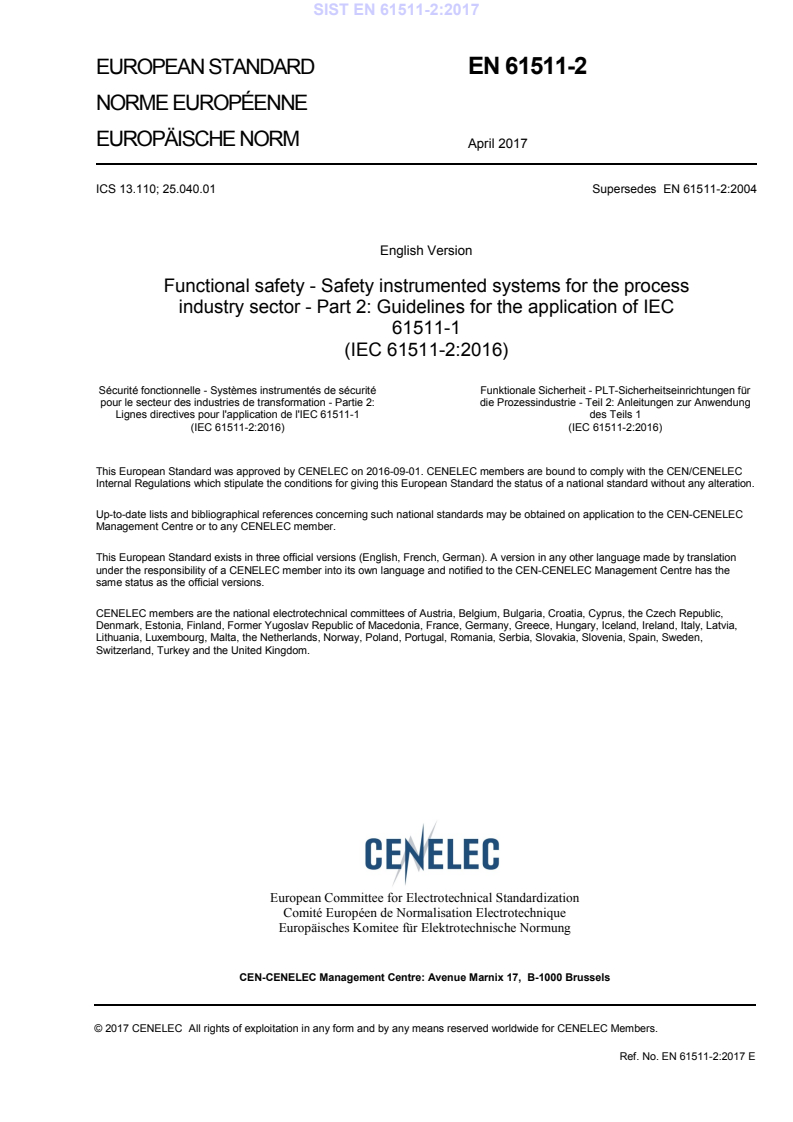
EUROPEAN STANDARD NORME EUROPÉENNE EUROPÄISCHE NORM
EN 61511-2
April 2017 ICS 13.110; 25.040.01
Supersedes
EN 61511-2:2004
English Version
Functional safety - Safety instrumented systems for the process industry sector - Part 2: Guidelines for the application of IEC 61511-1 (IEC 61511-2:2016)
Sécurité fonctionnelle - Systèmes instrumentés de sécurité pour le secteur des industries de transformation - Partie 2: Lignes directives pour l'application de l'IEC 61511-1 (IEC 61511-2:2016)
Funktionale Sicherheit - PLT-Sicherheitseinrichtungen für die Prozessindustrie - Teil 2: Anleitungen zur Anwendung des Teils 1 (IEC 61511-2:2016) This European Standard was approved by CENELEC on 2016-09-01. CENELEC members are bound to comply with the CEN/CENELEC Internal Regulations which stipulate the conditions for giving this European Standard the status of a national standard without any alteration. Up-to-date lists and bibliographical references concerning such national standards may be obtained on application to the CEN-CENELEC Management Centre or to any CENELEC member.
This European Standard exists in three official versions (English, French, German). A version in any other language made by translation under the responsibility of a CENELEC member into its own language and notified to the CEN-CENELEC Management Centre has the same status as the official versions. CENELEC members are the national electrotechnical committees of Austria, Belgium, Bulgaria, Croatia, Cyprus, the Czech Republic, Denmark, Estonia, Finland, Former Yugoslav Republic of Macedonia, France, Germany, Greece, Hungary, Iceland, Ireland, Italy, Latvia, Lithuania, Luxembourg, Malta, the Netherlands, Norway, Poland, Portugal, Romania, Serbia, Slovakia, Slovenia, Spain, Sweden, Switzerland, Turkey and the United Kingdom. European Committee for Electrotechnical Standardization
Comité Européen de Normalisation Electrotechnique Europäisches Komitee für Elektrotechnische Normung CEN-CENELEC Management Centre: Avenue Marnix 17,
B-1000 Brussels © 2017 CENELEC All rights of exploitation in any form and by any means reserved worldwide for CENELEC Members.
Ref. No. EN 61511-2:2017 E SIST EN 61511-2:2017
The following dates are fixed: • latest date by which the document has to be implemented at national level by publication of an identical national standard or by endorsement (dop) 2017-10-21 • latest date by which the national standards conflicting with the document have to be withdrawn (dow) 2020-04-21
This document supersedes EN 61511-2:2004.
Attention is drawn to the possibility that some of the elements of this document may be the subject of patent rights. CENELEC [and/or CEN] shall not be held responsible for identifying any or all such patent rights.
Endorsement notice The text of the International Standard IEC 61511-2:2016 was approved by CENELEC as a European Standard without any modification. In the official version, for Bibliography, the following notes have to be added for the standards indicated: IEC 60880:2006 NOTE Harmonized as EN 60880:2009. IEC 61025:2006 NOTE Harmonized as EN 61025:2007. IEC 61078:2006 NOTE Harmonized as EN 61078:2006. IEC 61131-3:2013 NOTE Harmonized as EN 61131-3:2013. IEC 61165:2006 NOTE Harmonized as EN 61165:2006. IEC 61508-1:2010 NOTE Harmonized as EN 61508-1:2010. IEC 61508-2:2010 NOTE Harmonized as EN 61508-2:2010. IEC 61508-3:2010 NOTE Harmonized as EN 61508-3:2010. IEC 61508-6:2010 NOTE Harmonized as EN 61508-6:2010. IEC 61508-6:2010 NOTE Harmonized as EN 61508-6:2010. IEC 62061:2005 NOTE Harmonized as EN 62061:2005. IEC 62502:2010 NOTE Harmonized as EN 62502:2010. IEC 62551:2012 NOTE Harmonized as EN 62551:2012. ISO 9000:2015 NOTE Harmonized as EN ISO 9000:2015. SIST EN 61511-2:2017
Annex ZA (normative)
Normative references to international publications with their corresponding European publications
The following documents, in whole or in part, are normatively referenced in this document and are indispensable for its application. For dated references, only the edition cited applies. For undated references, the latest edition of the referenced document (including any amendments) applies.
NOTE 1 When an International Publication has been modified by common modifications, indicated by (mod), the relevant EN/HD applies.
NOTE 2 Up-to-date information on the latest versions of the European Standards listed in this annex is available here: www.cenelec.eu.
Publication Year Title EN/HD Year IEC 61511-1 2016
Functional safety - Safety instrumented systems for the process industry sector - Normative (uon) -- Part 1: Framework, definitions, system, hardware and software requirements EN 61511-1 2016
IEC 61511-2 Edition 2.0 2016-07 INTERNATIONAL STANDARD NORME INTERNATIONALE Functional safety – Safety instrumented systems for the process industry
sector –
Part 2: Guidelines for the application of IEC 61511-1: 2016
Sécurité fonctionnelle – Systèmes instrumentés de sécurité pour le secteur
des industries de transformation –
Partie 2: Lignes directrices pour l'application de l'IEC 61511-1:2016
INTERNATIONAL ELECTROTECHNICAL COMMISSION COMMISSION ELECTROTECHNIQUE INTERNATIONALE
ICS 13.110; 25.040.01
ISBN 978-2-8322-3227-9
– 2 – IEC 61511-2:2016 © IEC 2016 CONTENTS FOREWORD. 9 INTRODUCTION . 11 1 Scope . 13 2 Normative references . 13 3 Terms, definitions, and abbreviations . 13 Annex A (informative)
Guidance for IEC 61511-1 . 14 A.1 Scope . 14 A.2 Normative references . 14 A.3 Terms, definitions and abbreviations . 14 A.4 Conformance to the IEC 61511-1:– . 14 A.5 Management of functional safety . 14 A.5.1 Objective . 14 A.5.2 Guidance to "Requirements" . 14 A.6 Safety life-cycle requirements . 23 A.6.1 Objectives . 23 A.6.2 Guidance to "Requirements" . 23 A.6.3 Guidance to "Application program SIS safety life-cycle requirements" . 24 A.7 Verification . 25 A.7.1 Objective . 25 A.7.2 Guidance to "Requirements" . 25 A.8 Process hazard and risk assessment (H&RA) . 27 A.8.1 Objectives . 27 A.8.2 Guidance to “Requirements" . 27 A.9 Allocation of safety functions to protection layers . 30 A.9.1 Objective . 30 A.9.2 Guidance to "Requirements of the allocation process". 30 A.9.3 Guidance to "Requirements on the basic process control system as a protection layer" . 32 A.9.4 Guidance to "Requirements for preventing common cause, common mode and dependent failures" . 35 A.10 SIS safety requirements specification . 36 A.10.1 Objective . 36 A.10.2 Guidance to "General requirements" . 36 A.10.3 Guidance to "SIS safety requirements" . 36 A.11 SIS design and engineering . 40 A.11.1 Objective . 40 A.11.2 Guidance to "General requirements" . 40 A.11.3 Guidance to "Requirements for system behaviour on detection of a fault" . 47 A.11.4 Guidance to “Hardware fault tolerance" . 47 A.11.5 Guidance to "Requirements for selection of devices" . 50 A.11.6 Field devices . 53 A.11.7 Interfaces . 53 A.11.8 Guidance to "Maintenance or testing design requirements" . 55 A.11.9 Guidance to "Quantification of random failure" . 56 A.12 SIS application program development . 62 SIST EN 61511-2:2017
IEC 61511-2:2016 © IEC 2016 – 3 – A.12.1 Objective . 62 A.12.2 Guidance to "General requirements" . 62 A.12.3 Guidance to "Application program design" . 64 A.12.4 Guidance to "Application program implementation" . 66 A.12.5 Guidance to "Requirements for application program verification (review and testing)" . 67 A.12.6 Guidance to "Requirements for application program methodology and tools" . 70 A.13 Factory acceptance testing (FAT) . 73 A.13.1 Objectives . 73 A.13.2 Guidance to "Recommendations" . 73 A.14 SIS installation and commissioning . 73 A.14.1 Objectives . 73 A.14.2 Guidance to "Requirements" . 73 A.15 SIS safety validation . 74 A.15.1 Objective . 74 A.15.2 Guidance to "Requirements" . 74 A.16 SIS operation and maintenance . 74 A.16.1 Objectives . 74 A.16.2 Guidance to "Requirements" . 75 A.16.3 Proof testing and inspection . 76 A.17 SIS modification . 78 A.17.1 Objective . 78 A.17.2 Guidance to "Requirements" . 79 A.18 SIS decommissioning . 79 A.18.1 Objectives . 79 A.18.2 Guidance to "Requirements" . 79 A.19 Information and documentation requirements . 80 A.19.1 Objectives . 80 A.19.2 Guidance to "Requirements" . 80 Annex B (informative)
Example of SIS logic solver application program development using function block diagram . 81 B.1 General . 81 B.2 Application program development and validation philosophy . 81 B.3 Application description . 82 B.3.1 General . 82 B.3.2 Process description . 82 B.3.3 Safety instrumented functions . 83 B.3.4 Risk reduction and domino effects . 84 B.4 Application program safety life-cycle execution . 84 B.4.1 General . 84 B.4.2 Inputs to application program SRS development . 84 B.4.3 Application program design and development . 87 B.4.4 Application program production . 101 B.4.5 Application program verification and testing . 101 B.4.6 Validation . 101 Annex C (informative)
Considerations when converting from NP technologies to PE technologies . 102 SIST EN 61511-2:2017
– 4 – IEC 61511-2:2016 © IEC 2016 Annex D (informative)
Example of how to get from a piping
and instrumentation diagram (P&ID) to application program . 104 Annex E (informative)
Methods and tools for application programming . 107 E.1 Typical toolset for application programming . 107 E.2 Rules and constraints for application program design . 108 E.3 Rules and constraints for application programming . 108 Annex F (informative)
Example SIS project illustrating each phase of the safety life cycle with application program development using relay ladder language . 110 F.1 Overview . 110 F.2 Project definition . 110 F.2.1 General . 110 F.2.2 Conceptual planning . 111 F.2.3 Process hazards analysis . 111 F.3 Simplified process description . 111 F.4 Preliminary design . 113 F.5 IEC 61511 application . 113 F.5.1 General . 113 F.5.2 Step F.1: Hazard & risk assessment . 117 F.5.3 Hazard identification . 117 F.5.4 Preliminary hazard evaluation . 117 F.5.5 Accident history . 117 F.6 Preliminary process design safety considerations . 120 F.7 Recognized process hazards . 120 F.8 Process design definitions strategy . 121 F.9 Preliminary hazard assessment . 124 F.9.1 General . 124 F.9.2 Step F.2: Allocation of safety functions . 128 F.10 SIF safety integrity level determination . 129 F.11 Layer of protection analysis (LOPA) applied to example . 129 F.12 Tolerable risk criteria . 130 F.13 Step F.3: SIS safety requirements specifications . 133 F.13.1 Overview . 133 F.13.2 Input requirements . 133 F.13.3 Safety functional requirements . 134 F.13.4 Safety integrity requirements . 135 F.14 Functional description and conceptual design . 136 F.14.1 Narrative for example reactor system logic . 136 F.15 SIL verification calculations . 137 F.16 Application program requirements . 144 F.17 Step F.4:
SIS safety life-cycle . 151 F.18 Technology and device selection . 151 F.18.1 General . 151 F.18.2 Logic solver . 151 F.18.3 Sensors . 152 F.18.4 Final elements . 152 F.18.5 Solenoid valves . 152 F.18.6 Emergency vent valves . 153 F.18.7 Modulating valves . 153 F.18.8 Bypass valves . 153 SIST EN 61511-2:2017
IEC 61511-2:2016 © IEC 2016 – 5 – F.18.9 Human-machine interfaces (HMIs) . 153 F.18.10 Separation . 154 F.19 Common cause and systematic failures . 155 F.19.1 General . 155 F.19.2 Diversity . 155 F.19.3 Specification errors . 155 F.19.4 Hardware design errors . 155 F.19.5 Software design errors . 156 F.19.6 Environmental overstress . 156 F.19.7 Temperature . 156 F.19.8 Humidity . 156 F.19.9 Contaminants . 157 F.19.10 Vibration . 157 F.19.11 Grounding . 157 F.19.12 Power line conditioning . 157 F.19.13 Electro-magnetic compatibility (EMC) . 157 F.19.14 Utility sources . 158 F.19.15 Sensors . 159 F.19.16 Process corrosion or fouling . 159 F.19.17 Maintenance . 159 F.19.18 Susceptibility to mis-operation . 159 F.19.19 SIS architecture . 159 F.20 SIS application program design features . 160 F.21 Wiring practices . 161 F.22 Security . 161 F.23 Step F.5: SIS installation, commissioning, validation . 162 F.24 Installation . 162 F.25 Commissioning . 163 F.26 Documentation . 164 F.27 Validation . 164 F.28 Testing . 165 F.29 Step F.6:
SIS operation and maintenance . 178 F.30 Step F.7:
SIS Modification . 181 F.31 Step F.8: SIS decommissioning . 181 F.32 Step F.9: SIS verification . 181 F.33 Step F.10: Management of functional safety and SIS FSA . 182 F.34 Management of functional safety . 183 F.34.1 General . 183 F.34.2 Competence of personnel . 183 F.35 Functional safety assessment . 183 Annex G (informative)
Guidance on developing application programming practices . 184 G.1 Purpose of this guidance . 184 G.2 Generic safe application programming attributes . 184 G.3 Reliability . 184 G.3.1 General . 184 G.3.2 Predictability of memory utilisation . 185 G.3.3 Predictability of control flow . 186 G.3.4 Accounting for precision and accuracy . 188 G.3.5 Predictability of timing . 190 SIST EN 61511-2:2017
– 6 – IEC 61511-2:2016 © IEC 2016 G.4 Predictability of mathematical or logical result . 190 G.5 Robustness . 191 G.5.1 General . 191 G.5.2 Controlling use of diversity . 191 G.5.3 Controlling use of exception handling . 192 G.5.4 Checking input and output . 193 G.6 Traceability . 194 G.6.1 General . 194 G.6.2 Controlling use of built-in functions . 194 G.6.3 Controlling use of compiled libraries . 194 G.7 Maintainability . 194 G.7.1 General . 194 G.7.2 Readability . 195 G.7.3 Data abstraction . 198 G.7.4 Functional cohesiveness . 199 G.7.5 Malleability . 199 G.7.6 Portability . 199 Bibliography . 201
Figure 1 – Overall framework of IEC 61511 series . 12 Figure A.1 – Application program V-Model . 25 Figure A.2 – Independence of a BPCS
protection layer and an initiating source in the BPCS . 34 Figure A.3 – Independence of two protection layers allocated to the BPCS . 35 Figure A.4 – Relationship of system, SIS hardware, and SIS application program . 39 Figure A.5 – Illustration of uncertainties on a reliability parameter . 60 Figure A.6 – Illustration of the 70 % confidence upper bound . 61 Figure A.7 – Typical probabilistic distribution
of target results from Monte Carlo simulation . 62 Figure B.1 – Process flow diagram for SIF 02.01 . 83 Figure B.2 – Process flow diagram for SIF 06.02 . 84 Figure B.3 – Functional specification of SIF02.01 and SIF 06.02 . 85 Figure B.4 – SIF 02.01 hardware functional architecture . 85 Figure B.5 – SIF 06.02 hardware functional architecture . 86 Figure B.6 – Hardware specification for SOV extracted
from piping and instrumentation diagram . 86 Figure B.7 – SIF 02.01 hardware physical architecture . 87 Figure B.8 – SIF 06.02 hardware physical architecture . 87 Figure B.9 – Hierarchical structure of model integration . 91 Figure B.10 – Hierarchical structure of model integration
including models of safety properties and of BPCS logic . 93 Figure B.11 – State transition diagram . 94 Figure B.12 – SOV typical block diagram . 95 Figure B.13 – SOV typical model block diagram . 96 Figure B.14 – Typical model block diagram implementation – BPCS part . 98 Figure B.15 – SOV application program typical
model implementation – SIS part . 99 SIST EN 61511-2:2017
IEC 61511-2:2016 © IEC 2016 – 7 – Figure B.16 – Complete model for final implementation model checking . 101 Figure D.1 – Example of P&ID for an oil and gas separator . 104 Figure D.2 – Example of (part of) an ESD cause & effect diagram (C&E) . 105 Figure D.3 – Example of (part of) an application
program in a safety PLC function block programming . 106 Figure F.1 – Simplified flow diagram: the PVC process . 112 Figure F.2 – SIS safety life-cycle phases and FSA stages . 114 Figure F.3 – Example of the preliminary P&ID for PVC reactor unit . 123 Figure F.4 – SIF S-1 Bubble diagram showing the PFDavg of each SIS device . 139 Figure F.5 – S-1 Fault tree . 140 Figure F.6 – SIF S-2 Bubble diagram showing the PFDavg of each SIS device . 141 Figure F.7 – SIF S-2 fault tree . 142 Figure F.8 – SIF S-3 Bubble diagram showing the PFDavg of each SIS device . 143 Figure F.9 – SIF S-3 fault tree . 144 Figure F.10 – P&ID for PVC reactor unit SIF . 145 Figure F.11 – Legend (1 of 5) . 146 Figure F.12 – SIS for the VCM reactor . 160
Table B.1 – Modes of operation specification . 88 Table B.2 – State transition table . 93 Table F.1 – SIS safety life-cycle overview . 115 Table F.2 – SIS safety life-cycle – Box 1 . 117 Table F.3 – Some physical properties of vinyl chloride . 119 Table F.4 – What-If/Checklist . 125 Table F.5 – HAZOP . 126 Table F.6 – Partial summary of hazard assessment for SIF strategy development . 127 Table F.7 – SIS safety life-cycle – Box 2 . 129 Table F.8 – Tolerable risk ranking . 131 Table F.9 – VCM reactor example: LOPA based integrity level . 132 Table F.10 – SIS safety life-cycle – Box 3 . 133 Table F.11 – Safety instrumented functions and SILs . 133 Table F.12 – Functional relationship of I/O for the SIF(s) . 134 Table F.13 – SIS sensors, normal operating range & trip points . 134 Table F.14 – Cause and effect diagram . 137 Table F.15 – MTTFd figures of SIS F.1 devices . 138 Table F.16 – SIS safety life-cycle – Box 4 . 151 Table F.17 – SIS safety life-cycle – Box 5 . 162 Table F.18 – List of instrument types and testing procedures used . 166 Table F.19 – Interlock check procedure bypass/simulation check sheet . 178 Table F.20 – SIS safety life-cycle – Box 6 . 178 Table F.21 – SIS trip log . 179 Table F.22 – SIS device failure log . 179 Table F.23 – SIS safety life-cycle – Box 7 . 181 SIST EN 61511-2:2017
– 8 – IEC 61511-2:2016 © IEC 2016 Table F.24 – SIS safety life-cycle – Box 8 . 181 Table F.25 – SIS safety life-cycle – Box 9 . 182 Table F.26 – SIS safety life-cycle – Box 10 . 182 SIST EN 61511-2:2017
IEC 61511-2:2016 © IEC 2016 – 9 – INTERNATIONAL ELECTROTECHNICAL COMMISSION
____________
FUNCTIONAL SAFETY –
SAFETY INSTRUMENTED SYSTEMS
FOR THE PROCESS INDUSTRY SECTOR –
Part 2: Guidelines for the application of IEC 61511-1:2016
FOREWORD 1) The International Electrotechnical Commission (IEC) is a worldwide organization for standardization comprising all national electrotechnical committees (IEC National Committees). The object of IEC is to promote international co-operation on all questions concerning standardization in the electrical and electronic fields. To this end and in addition to other activities, IEC publishes International Standards, Technical Specifications, Technical Reports, Publicly Available Specifications (PAS) and Guides (hereafter referred to as “IEC Publication(s)”). Their preparation is entrusted to technical committees; any IEC National Committee interested in the subject dealt with may participate in this preparatory work. International, governmental and non-governmental organizations liaising with the IEC also participate in this preparation. IEC collaborates closely with the International Organization for Standardization (ISO) in accordance with conditions determined by agreement between the two organizations. 2) The formal decisions or agreements of IEC on technical matters express, as nearly as possible, an international consensus of opinion on the relevant subjects since each technical committee has representation from all interested IEC National Committees.
3) IEC Publications have the form of recommendations for international use and are accepted by IEC National Committees in that sense. While all reasonable efforts are made to ensure that the technical content of IEC Publications is accurate, IEC cannot be held responsible for the way in which they are used or for any misinterpretation by any end user. 4) In order to promote international uniformity, IEC National Committees undertake to apply IEC Publications transparently to the maximum extent possible in their national and regional publications. Any divergence between any IEC Publication and the corresponding national or regional publication shall be clearly indicated in the latter. 5) IEC itself does not provide any attestation of conformity. Independent certification bodies provide conformity assessment services and, in some areas, access to IEC marks of conformity. IEC is not responsible for any services carried out by independent certification bodies. 6) All users should ensure that they have the latest edition of this publication. 7) No liability shall attach to IEC or its directors, employees, servants or agents including individual experts and members of its technical committees and IEC National Committees for any personal injury, property damage or other damage of any nature whatsoever, whether direct or indirect, or for costs (including legal fees) and expenses arising out of the publication, use of, or reliance upon, this IEC Publication or any other IEC Publications.
8) Attention is drawn to the Normative references cited in this publication. Use of the referenced publications is indispensable for the correct application of this publication. 9) Attention is drawn to the possibility that some of the elements of this IEC Publication may be the subject of patent rights. IEC shall not be held responsible for identifying any or all such patent rights. International Standard IEC 61511-2 has been prepared by subcommittee 65A: System aspects, of IEC technical committee 65: Industrial-process measurement, control and automation.
This second edition cancels and replaces the first edition published in 2003. This edition constitutes a technical revision. This edition includes the following significant technical changes with respect to the previous edition: • guidance examples based on all phases of the safety life cycle provided based on usage experience with IEC61511 1st edition;
• annexes replaced to address transition from software to application programming. SIST EN 61511-2:2017
– 10 – IEC 61511-2:2016 © IEC 2016 The text of this standard is based on the following documents: FDIS Report on voting 65A/783/FDIS 65A/787/RVD
Full information on the voting for the approval of this standard can be found in the report on voting indicated in the above table. This publication has been drafted in accordance with the ISO/IEC Directives, Part 2. This International Standard is to be read in conjunction with IEC 61511-1. It is based on the second edition of that standard. A list of all parts in the IEC 61511 series, published under the general title Functional safety – Safety instrumented systems for the process industry sector, can be found on the IEC website. The committee has decided that the contents of this publication will remain unchanged until the stability date indicated on the IEC website under "http://webstore.iec.ch" in the data related to the specific publication. At this date, the publication will be • reconfirmed, • withdrawn, • replaced by a revised edition, or • amended.
IMPORTANT – The 'colour inside' logo on the cover page of this publication indicates that it contains colours which are considered to be useful for the correct understanding of its contents. Users should therefore print this document using a colour printer.
IEC 61511-2:2016 © IEC 2016 – 11 – INTRODUCTION Safety instrumented systems (SISs) have been used for many yea
...