

SIST EN ISO 15614-1:2017/kFprA2:2020
(Amendment)Specification and qualification of welding procedures for metallic materials - Welding procedure test - Part 1: Arc and gas welding of steels and arc welding of nickel and nickel alloys - Amendment 2 (ISO 15614-1:2017/FDAM 2:2020)
General Information
- Abstract
2020-12-01 (data): WI abandoned to follow cancellation of WI at ISO
- Status
- Not Published
- Public Enquiry End Date
- 31-Oct-2019
- Technical Committee
- VAR - Welding
- Current Stage
- 98 - Abandoned project (Adopted Project)
- Start Date
- 09-Mar-2021
- Due Date
- 14-Mar-2021
- Completion Date
- 09-Mar-2021

Overview
SIST EN ISO 15614-1:2017/kFprA2:2020 is a crucial international standard from CEN, focusing on the specification and qualification of welding procedures for metallic materials. Specifically, it addresses the welding procedure test - Part 1: Arc and gas welding of steels and arc welding of nickel and nickel alloys. This Amendment 2 (ISO 15614-1:2017/FDAM 2:2020) introduces important updates to welding procedure qualifications for manufacturers and organizations involved in welding steels and nickel alloys under industrial and quality management systems.
EN ISO 15614-1 is part of a wider series within the field of welding processes (ICS 25.160.10), steel materials (ICS 77.080.20), and nickel and their alloys (ICS 77.120.40). It defines the main testing framework and qualification requirements to ensure welding procedures deliver consistent, reliable, and mechanical property-compliant results.
Key Topics
- Amendment 2 Updates:
- Changes in the handling of mechanization levels for welding processes.
- Revised requirements for measurement and acceptance ranges of heat input (arc energy) in procedure qualifications.
- Scope of Application:
- Arc welding and gas welding for steels.
- Arc welding for nickel and nickel alloys.
- Qualification Testing:
- Establishes comprehensive criteria for testing and qualifying welding procedures for metallic materials.
- Addresses impact and hardness requirements critical for ensuring welded joint reliability.
- Documentation and Recordkeeping:
- Emphasizes proper documentation of welding procedures, test results, and qualification records as per quality standards.
Applications
SIST EN ISO 15614-1:2017/kFprA2:2020 has practical value for a broad range of industries that require precise and safe welding of metallic materials, especially in sectors where quality, repeatability, and compliance are critical. Key application areas include:
- Manufacturing and Fabrication:
- Ensures qualified welding procedures for pressure vessels, pipes, structural steelwork, and frameworks.
- Automotive and Transport:
- Used in developing qualified joining processes for bodywork and critical assemblies.
- Aerospace and Defense:
- Provides robust qualification criteria for high-performance welded components.
- Oil, Gas, and Energy Sectors:
- Essential for pipelines, process equipment, and installations requiring reliable welds under dynamic service conditions.
- Construction:
- Supports compliance in building steel frameworks and related assemblies.
- Maintenance and Repairs:
- Applicable wherever repair welding integrity must meet defined mechanical and metallurgical criteria.
By adhering to EN ISO 15614-1, organizations can demonstrate compliance with international best practices, reduce risks of failure due to inadequate welds, and streamline certification for end products across global markets.
Related Standards
EN ISO 15614-1 forms part of a comprehensive framework for welding procedure qualification. Relevant related standards include:
- ISO 15614 Series: Covers various materials and welding processes for comprehensive qualification guidance.
- EN ISO 9606 Series: Defines qualification of welders for metallic materials.
- ISO 3834 Series: Outlines quality requirements for fusion welding of metallic materials.
- ISO 14731: Specifies tasks and responsibilities of welding coordination personnel.
- ISO 15609: Relates to drafting welding procedure specifications (WPS).
Summary
SIST EN ISO 15614-1:2017/kFprA2:2020 sets detailed requirements for the qualification of welding procedures used with steels, nickel, and nickel alloys via arc and gas welding. Recent amendments further clarify essential qualification variables and acceptance criteria, directly supporting industries that depend on the integrity and performance of welded metallic structures. Adopting this standard helps organizations achieve high standards of weld quality, compliance, and international market access.
Relations
- Effective Date
- 28-Jan-2026
- Effective Date
- 01-Oct-2019
Get Certified
Connect with accredited certification bodies for this standard

DVS-ZERT GmbH
German welding certification society.

Element Materials Technology
Materials testing and product certification.
Inštitut za kovinske materiale in tehnologije
Institute of Metals and Technology. Materials testing, metallurgical analysis, NDT.
Sponsored listings
Frequently Asked Questions
SIST EN ISO 15614-1:2017/kFprA2:2020 is a draft published by the Slovenian Institute for Standardization (SIST). Its full title is "Specification and qualification of welding procedures for metallic materials - Welding procedure test - Part 1: Arc and gas welding of steels and arc welding of nickel and nickel alloys - Amendment 2 (ISO 15614-1:2017/FDAM 2:2020)". This standard covers: 2020-12-01 (data): WI abandoned to follow cancellation of WI at ISO
2020-12-01 (data): WI abandoned to follow cancellation of WI at ISO
SIST EN ISO 15614-1:2017/kFprA2:2020 is classified under the following ICS (International Classification for Standards) categories: 25.160.10 - Welding processes; 77.080.20 - Steels; 77.120.40 - Nickel, chromium and their alloys. The ICS classification helps identify the subject area and facilitates finding related standards.
SIST EN ISO 15614-1:2017/kFprA2:2020 has the following relationships with other standards: It is inter standard links to SIST EN ISO 12417-1:2024, SIST EN ISO 15614-1:2017. Understanding these relationships helps ensure you are using the most current and applicable version of the standard.
SIST EN ISO 15614-1:2017/kFprA2:2020 is associated with the following European legislation: EU Directives/Regulations: 2014/68/EU; Standardization Mandates: M/071. When a standard is cited in the Official Journal of the European Union, products manufactured in conformity with it benefit from a presumption of conformity with the essential requirements of the corresponding EU directive or regulation.
SIST EN ISO 15614-1:2017/kFprA2:2020 is available in PDF format for immediate download after purchase. The document can be added to your cart and obtained through the secure checkout process. Digital delivery ensures instant access to the complete standard document.
Standards Content (Sample)
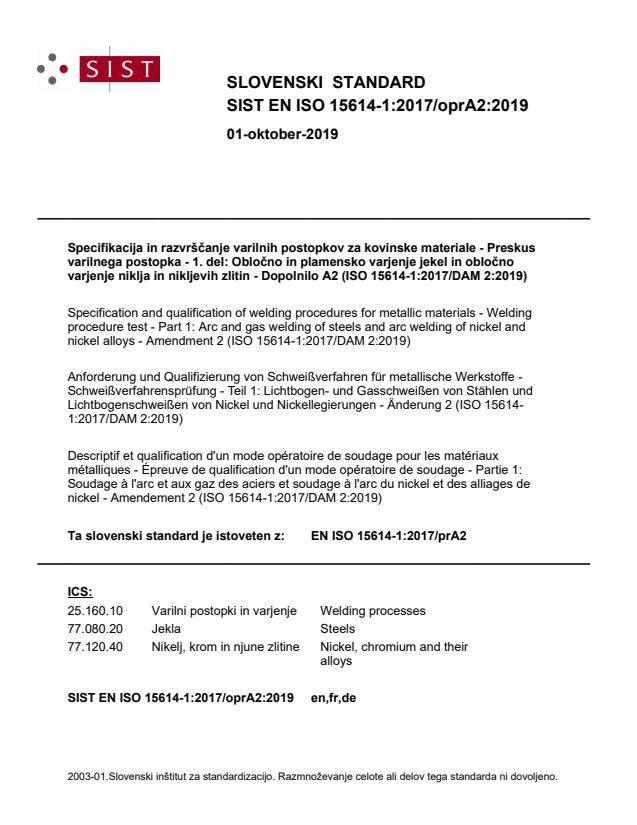
SLOVENSKI STANDARD
SIST EN ISO 15614-1:2017/oprA2:2019
01-oktober-2019
Specifikacija in razvrščanje varilnih postopkov za kovinske materiale - Preskus
varilnega postopka - 1. del: Obločno in plamensko varjenje jekel in obločno
varjenje niklja in nikljevih zlitin - Dopolnilo A2 (ISO 15614-1:2017/DAM 2:2019)
Specification and qualification of welding procedures for metallic materials - Welding
procedure test - Part 1: Arc and gas welding of steels and arc welding of nickel and
nickel alloys - Amendment 2 (ISO 15614-1:2017/DAM 2:2019)
Anforderung und Qualifizierung von Schweißverfahren für metallische Werkstoffe -
Schweißverfahrensprüfung - Teil 1: Lichtbogen- und Gasschweißen von Stählen und
Lichtbogenschweißen von Nickel und Nickellegierungen - Änderung 2 (ISO 15614-
1:2017/DAM 2:2019)
Descriptif et qualification d'un mode opératoire de soudage pour les matériaux
métalliques - Épreuve de qualification d'un mode opératoire de soudage - Partie 1:
Soudage à l'arc et aux gaz des aciers et soudage à l'arc du nickel et des alliages de
nickel - Amendement 2 (ISO 15614-1:2017/DAM 2:2019)
Ta slovenski standard je istoveten z: EN ISO 15614-1:2017/prA2
ICS:
25.160.10 Varilni postopki in varjenje Welding processes
77.080.20 Jekla Steels
77.120.40 Nikelj, krom in njune zlitine Nickel, chromium and their
alloys
SIST EN ISO 15614-1:2017/oprA2:2019 en,fr,de
2003-01.Slovenski inštitut za standardizacijo. Razmnoževanje celote ali delov tega standarda ni dovoljeno.
SIST EN ISO 15614-1:2017/oprA2:2019
SIST EN ISO 15614-1:2017/oprA2:2019
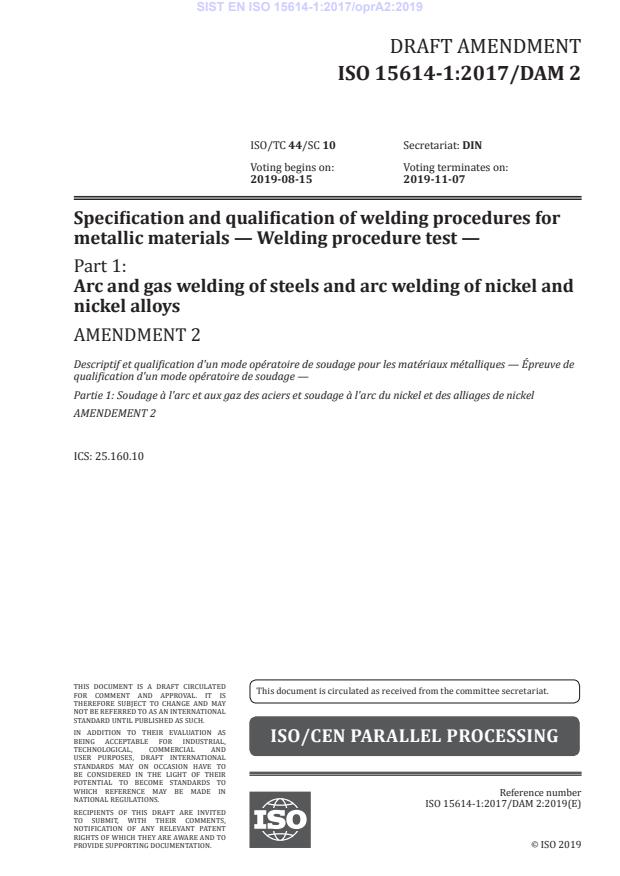
DRAFT AMENDMENT
ISO 15614-1:2017/DAM 2
ISO/TC 44/SC 10 Secretariat: DIN
Voting begins on: Voting terminates on:
2019-08-15 2019-11-07
Specification and qualification of welding procedures for
metallic materials — Welding procedure test —
Part 1:
Arc and gas welding of steels and arc welding of nickel and
nickel alloys
AMENDMENT 2
Descriptif et qualification d'un mode opératoire de soudage pour les matériaux métalliques — Épreuve de
qualification d'un mode opératoire de soudage —
Partie 1: Soudage à l'arc et aux gaz des aciers et soudage à l'arc du nickel et des alliages de nickel
AMENDEMENT 2
ICS: 25.160.10
THIS DOCUMENT IS A DRAFT CIRCULATED
This document is circulated as received from the committee secretariat.
FOR COMMENT AND APPROVAL. IT IS
THEREFORE SUBJECT TO CHANGE AND MAY
NOT BE REFERRED TO AS AN INTERNATIONAL
STANDARD UNTIL PUBLISHED AS SUCH.
IN ADDITION TO THEIR EVALUATION AS
ISO/CEN PARALLEL PROCESSING
BEING ACCEPTABLE FOR INDUSTRIAL,
TECHNOLOGICAL, COMMERCIAL AND
USER PURPOSES, DRAFT INTERNATIONAL
STANDARDS MAY ON OCCASION HAVE TO
BE CONSIDERED IN THE LIGHT OF THEIR
POTENTIAL TO BECOME STANDARDS TO
WHICH REFERENCE MAY BE MADE IN
Reference number
NATIONAL REGULATIONS.
ISO 15614-1:2017/DAM 2:2019(E)
RECIPIENTS OF THIS DRAFT ARE INVITED
TO SUBMIT, WITH THEIR COMMENTS,
NOTIFICATION OF ANY RELEVANT PATENT
RIGHTS OF WHICH THEY ARE AWARE AND TO
©
PROVIDE SUPPORTING DOCUMENTATION. ISO 2019
SIST EN ISO 15614-1:2017/oprA2:2019
ISO 15614-1:2017/DAM 2:2019(E)
© ISO 2019
All rights reserved. Unless otherwise specified, or required in the context of its implementation, no part of this publication may
be reproduced or utilized otherwise in any form or by any means, electronic or mechanical, including photocopying, or posting
on the internet or an intranet, without prior written permission. Permission can be requested from either ISO at the address
below or ISO’s member body in the country of the requester.
ISO copyright office
CP 401 • Ch. de Blandonnet 8
CH-1214 Vernier, Geneva
Phone: +41 22 749 01 11
Fax: +41 22 749 09 47
Email: copyright@iso.org
Website: www.iso.org
Published in Switzerland
ii © ISO 2019 – All rights reserved
SIST EN ISO 15614-1:2017/oprA2:2019
ISO 15614-1:2017/DAM 2:2019(E)
Foreword
ISO (the International Organization for Standardization) is a worldwide federation of national standards
bodies (ISO member bodies). The work of preparing International Standards is normally carried out
through ISO technical committees. Each member body interested in a subject for which a technical
committee has been established has the right to be represented on that committee. International
organizations, governmental and non-governmental, in liaison with ISO, also take part in the work.
ISO collaborates closely with the International Electrotechnical Commission (IEC) on all matters of
electrotechnical standardization.
The procedures used to develop this document and those intended for its further maintenance are
described in the ISO/IEC Directives, Part 1. In particular, the different approval criteria needed for the
different types of ISO documents should be noted. This document was drafted in accordance with
...