

SIST EN 12953-1:2026
(Main)Shell boilers - Part 1: General
General Information
- Abstract
This document applies to shell boilers with volumes in excess of 2 l for the generation of steam and/or hot water at a maximum allowable pressure greater than 0,5 bar and with a temperature in excess of 110 °C.
For the purpose of this document the following pressurized parts are included:
— the shell boiler as one entity of pressure equipment including all the pressure parts from the feedwater/hot water inlet (including the inlet valve) up to and including the steam/hot water outlet (including the outlet valve or, if there is no valve, the first circumferential weld or flange downstream of the shell boiler or if applicable the outlet header);
— all superheaters, economizers and interconnecting piping;
— additionally, the piping that is connected to the boiler involved in services such as draining, venting, desuperheating, etc., up to the first isolating valve or, if there is no valve, the first circumferential weld or flange downstream of the shell boiler or if applicable the outlet header/piping.
This document does not apply to the following types of boilers and equipments:
a) water-tube boilers;
b) non stationary boilers, e.g. locomotive boilers;
c) thermal oil boilers;
d) boilers where the main pressure housing is made of cast material;
e) pumps, gaskets, etc;
f) brickwork setting and insulation, etc.
NOTE 1 Further information on shell boilers is given in Annex A.
NOTE 2 Stainless steel boilers are covered by EN 14222:2021.
- Status
- Published
- Public Enquiry End Date
- 02-May-2024
- Publication Date
- 08-Dec-2025
- Technical Committee
- TLP - Pressure vessels
- Current Stage
- 6060 - National Implementation/Publication (Adopted Project)
- Start Date
- 09-Dec-2025
- Due Date
- 13-Feb-2026
- Completion Date
- 09-Dec-2025

Overview
EN 12953-1:2025 - Shell boilers, Part 1: General is the CEN European standard that sets the general framework for shell boilers used to generate steam and/or hot water. It applies to shell boilers with volumes greater than 2 L, a maximum allowable pressure > 0.5 bar, and temperatures > 110 °C. The standard treats the shell boiler as a single pressure equipment entity, including feedwater/hot water inlets and outlets (and their valves), superheaters, economizers, interconnecting piping and associated service piping up to the first isolating valve or first circumferential weld/flange.
This Part 1 document provides the scope, terms and definitions, symbols, general requirements and informative annexes (vocabulary, additional information, market recommendations and changes from the previous edition). It is part of the EN 12953 series that together covers design, materials, construction, inspection, testing and operation of shell boilers.
Key Topics and Requirements
- Scope and applicability: Defines which shell boilers are covered and explicit exclusions (e.g., water‑tube boilers, non‑stationary boilers such as locomotives, thermal oil boilers, boilers with cast main pressure housings).
- Pressurized parts included: Clarifies included components - shell, valves, superheaters, economizers, interconnecting piping and service piping up to the first isolating valve/weld/flange.
- Terminology and symbols: Harmonized terms and definitions referenced to EN 764‑1 to ensure consistent language across pressure equipment standards.
- General requirements: High‑level obligations for manufacturers, purchasers and installers regarding design intent, marking, documentation and conformity with the relevant parts of the EN 12953 series.
- Informative annexes: Practical guidance (Annex A–E) including component vocabulary, pre‑market recommendations and a summary of significant technical changes from the 2012 edition.
- Regulatory linkage: Relationship to EU Pressure Equipment Directive (2014/68/EU) is addressed (Annex ZA), helping align standard compliance with legal requirements.
Applications and Who Uses It
- Manufacturers and designers - use Part 1 as the baseline for applying subsequent parts (materials, design, construction, testing).
- Installers and contractors - to identify included pressurized parts and installation responsibilities.
- Notified bodies, inspectors and testing agencies - for conformity assessment and acceptance testing coordination with other EN 12953 parts.
- Plant engineers, purchasers and asset owners - to specify requirements and verify compliance for boilers used in industrial steam or hot water systems.
- Regulators and standards committees - for harmonization and legal conformity in European markets.
Related Standards
- EN 12953 series (Parts 2–13) - materials, design, construction, inspection, equipment, firing systems, safeguards, water quality, tests and operating instructions.
- EN 764‑1 (vocabulary for pressure equipment)
- EN 14222:2021 (stainless steel boilers)
- EU Directive 2014/68/EU (Pressure Equipment Directive)
Keywords: EN 12953-1:2025, shell boilers, steam boilers, hot-water boilers, pressure equipment, CEN, boiler design, boiler standards, boiler inspection, boiler safety.
Relations
- Effective Date
- 01-Jan-2026
- Effective Date
- 28-Jan-2026
- Effective Date
- 28-Jan-2026
- Effective Date
- 28-Jan-2026
- Effective Date
- 28-Jan-2026
- Effective Date
- 28-Jan-2026
- Effective Date
- 28-Jan-2026
- Effective Date
- 28-Jan-2026
- Effective Date
- 28-Jan-2026
- Effective Date
- 28-Jan-2026
- Effective Date
- 28-Jan-2026
- Effective Date
- 28-Jan-2026
- Effective Date
- 28-Jan-2026
- Effective Date
- 28-Jan-2026
- Effective Date
- 28-Jan-2026
Get Certified
Connect with accredited certification bodies for this standard

DNV
DNV is an independent assurance and risk management provider.

Lloyd's Register
Lloyd's Register is a global professional services organisation specialising in engineering and technology.
DNV Energy Systems
Energy and renewable energy certification.
Sponsored listings
Frequently Asked Questions
SIST EN 12953-1:2026 is a standard published by the Slovenian Institute for Standardization (SIST). Its full title is "Shell boilers - Part 1: General". This standard covers: This document applies to shell boilers with volumes in excess of 2 l for the generation of steam and/or hot water at a maximum allowable pressure greater than 0,5 bar and with a temperature in excess of 110 °C. For the purpose of this document the following pressurized parts are included: — the shell boiler as one entity of pressure equipment including all the pressure parts from the feedwater/hot water inlet (including the inlet valve) up to and including the steam/hot water outlet (including the outlet valve or, if there is no valve, the first circumferential weld or flange downstream of the shell boiler or if applicable the outlet header); — all superheaters, economizers and interconnecting piping; — additionally, the piping that is connected to the boiler involved in services such as draining, venting, desuperheating, etc., up to the first isolating valve or, if there is no valve, the first circumferential weld or flange downstream of the shell boiler or if applicable the outlet header/piping. This document does not apply to the following types of boilers and equipments: a) water-tube boilers; b) non stationary boilers, e.g. locomotive boilers; c) thermal oil boilers; d) boilers where the main pressure housing is made of cast material; e) pumps, gaskets, etc; f) brickwork setting and insulation, etc. NOTE 1 Further information on shell boilers is given in Annex A. NOTE 2 Stainless steel boilers are covered by EN 14222:2021.
This document applies to shell boilers with volumes in excess of 2 l for the generation of steam and/or hot water at a maximum allowable pressure greater than 0,5 bar and with a temperature in excess of 110 °C. For the purpose of this document the following pressurized parts are included: — the shell boiler as one entity of pressure equipment including all the pressure parts from the feedwater/hot water inlet (including the inlet valve) up to and including the steam/hot water outlet (including the outlet valve or, if there is no valve, the first circumferential weld or flange downstream of the shell boiler or if applicable the outlet header); — all superheaters, economizers and interconnecting piping; — additionally, the piping that is connected to the boiler involved in services such as draining, venting, desuperheating, etc., up to the first isolating valve or, if there is no valve, the first circumferential weld or flange downstream of the shell boiler or if applicable the outlet header/piping. This document does not apply to the following types of boilers and equipments: a) water-tube boilers; b) non stationary boilers, e.g. locomotive boilers; c) thermal oil boilers; d) boilers where the main pressure housing is made of cast material; e) pumps, gaskets, etc; f) brickwork setting and insulation, etc. NOTE 1 Further information on shell boilers is given in Annex A. NOTE 2 Stainless steel boilers are covered by EN 14222:2021.
SIST EN 12953-1:2026 is classified under the following ICS (International Classification for Standards) categories: 27.060.30 - Boilers and heat exchangers. The ICS classification helps identify the subject area and facilitates finding related standards.
SIST EN 12953-1:2026 has the following relationships with other standards: It is inter standard links to SIST EN 12953-1:2012, SIST EN 12953-4:2018, SIST EN 12953-3:2016, SIST EN 12953-7:2002, SIST EN 12953-10:2004, SIST EN 12953-5:2020, SIST EN 12953-13:2012, SIST EN 12953-8:2002, SIST EN 12953-9:2025, SIST EN 764-1:2015+A1:2016, SIST EN 12953-12:2004, SIST EN 12953-11:2004, SIST EN 12953-6:2025, SIST CR 12953-14:2002, SIST EN 14222:2003. Understanding these relationships helps ensure you are using the most current and applicable version of the standard.
SIST EN 12953-1:2026 is associated with the following European legislation: EU Directives/Regulations: 2014/68/EU; Standardization Mandates: M/071, M/601. When a standard is cited in the Official Journal of the European Union, products manufactured in conformity with it benefit from a presumption of conformity with the essential requirements of the corresponding EU directive or regulation.
SIST EN 12953-1:2026 is available in PDF format for immediate download after purchase. The document can be added to your cart and obtained through the secure checkout process. Digital delivery ensures instant access to the complete standard document.
Standards Content (Sample)
SLOVENSKI STANDARD
01-januar-2026
Nadomešča:
SIST EN 12953-1:2012
Mnogovodni kotli - 1. del: Splošno
Shell boilers - Part 1: General
Großwasserraumkessel - Teil 1: Allgemeines
Chaudières à tubes de fumée - Partie 1: Généralités
Ta slovenski standard je istoveten z: EN 12953-1:2025
ICS:
27.060.30 Grelniki vode in prenosniki Boilers and heat exchangers
toplote
2003-01.Slovenski inštitut za standardizacijo. Razmnoževanje celote ali delov tega standarda ni dovoljeno.
EN 12953-1
EUROPEAN STANDARD
NORME EUROPÉENNE
November 2025
EUROPÄISCHE NORM
ICS 27.060.30 Supersedes EN 12953-1:2012
English Version
Shell boilers - Part 1: General
Chaudières à tubes de fumée - Partie 1: Généralités Großwasserraumkessel - Teil 1: Allgemeines
This European Standard was approved by CEN on 15 September 2025.
CEN members are bound to comply with the CEN/CENELEC Internal Regulations which stipulate the conditions for giving this
European Standard the status of a national standard without any alteration. Up-to-date lists and bibliographical references
concerning such national standards may be obtained on application to the CEN-CENELEC Management Centre or to any CEN
member.
This European Standard exists in three official versions (English, French, German). A version in any other language made by
translation under the responsibility of a CEN member into its own language and notified to the CEN-CENELEC Management
Centre has the same status as the official versions.
CEN members are the national standards bodies of Austria, Belgium, Bulgaria, Croatia, Cyprus, Czech Republic, Denmark, Estonia,
Finland, France, Germany, Greece, Hungary, Iceland, Ireland, Italy, Latvia, Lithuania, Luxembourg, Malta, Netherlands, Norway,
Poland, Portugal, Republic of North Macedonia, Romania, Serbia, Slovakia, Slovenia, Spain, Sweden, Switzerland, Türkiye and
United Kingdom.
EUROPEAN COMMITTEE FOR STANDARDIZATION
COMITÉ EUROPÉEN DE NORMALISATION
EUROPÄISCHES KOMITEE FÜR NORMUNG
CEN-CENELEC Management Centre: Rue de la Science 23, B-1040 Brussels
© 2025 CEN All rights of exploitation in any form and by any means reserved Ref. No. EN 12953-1:2025 E
worldwide for CEN national Members.
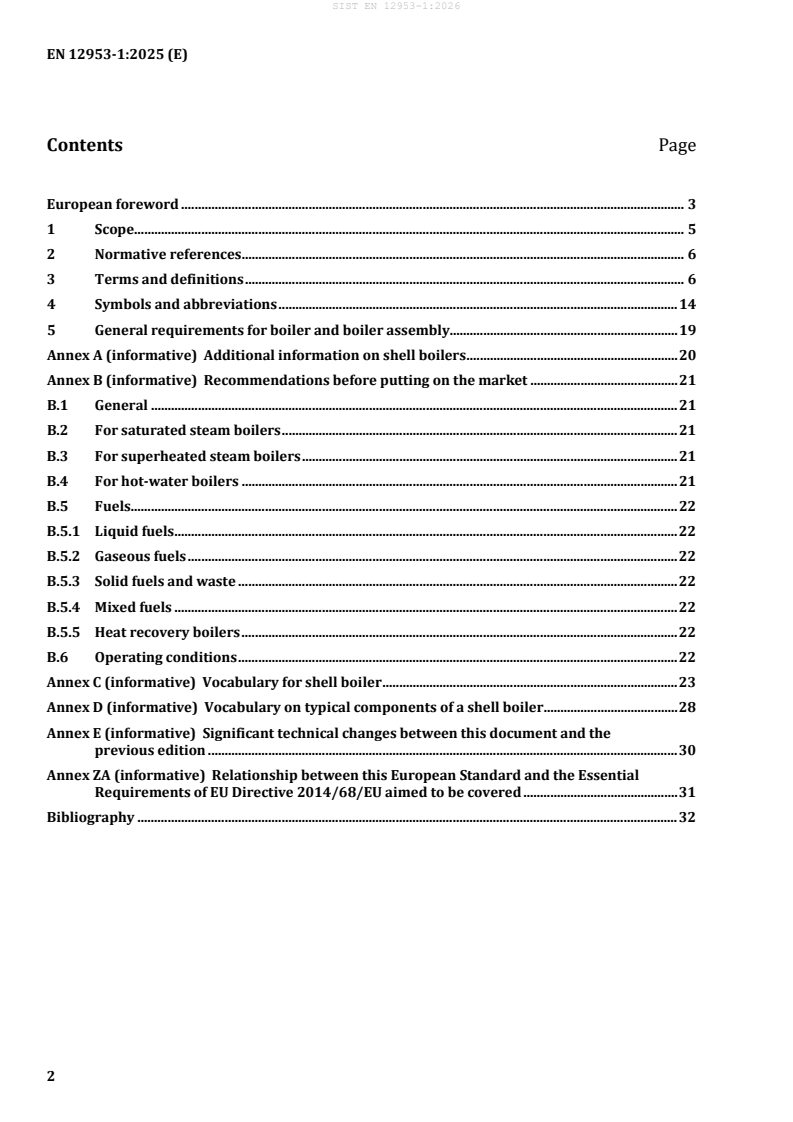
Contents Page
European foreword . 3
1 Scope. 5
2 Normative references . 6
3 Terms and definitions . 6
4 Symbols and abbreviations . 14
5 General requirements for boiler and boiler assembly. 19
Annex A (informative) Additional information on shell boilers . 20
Annex B (informative) Recommendations before putting on the market . 21
B.1 General . 21
B.2 For saturated steam boilers . 21
B.3 For superheated steam boilers . 21
B.4 For hot-water boilers . 21
B.5 Fuels . 22
B.5.1 Liquid fuels . 22
B.5.2 Gaseous fuels . 22
B.5.3 Solid fuels and waste . 22
B.5.4 Mixed fuels . 22
B.5.5 Heat recovery boilers . 22
B.6 Operating conditions . 22
Annex C (informative) Vocabulary for shell boiler . 23
Annex D (informative) Vocabulary on typical components of a shell boiler . 28
Annex E (informative) Significant technical changes between this document and the
previous edition . 30
Annex ZA (informative) Relationship between this European Standard and the Essential
Requirements of EU Directive 2014/68/EU aimed to be covered . 31
Bibliography . 32
European foreword
This document (EN 12953-1:2025) has been prepared by Technical Committee CEN/TC 269 “Shell and
water-tube boilers”, the secretariat of which is held by DIN.
This European Standard shall be given the status of a national standard, either by publication of an
identical text or by endorsement, at the latest by May 2026, and conflicting national standards shall be
withdrawn at the latest by May 2026.
Attention is drawn to the possibility that some of the elements of this document may be the subject of
patent rights. CEN shall not be held responsible for identifying any or all such patent rights.
This document supersedes EN 12953-1:2012.
Annex E provides details of the significant technical changes between this document and
EN 12953-1:2012.
This document has been prepared under a standardization request addressed to CEN by the European
Commission. The Standing Committee of the EFTA States subsequently approves these requests for its
Member States.
For the relationship with EU Legislation, see informative Annex ZA, which is an integral part of this
document.
The series concerning shell boilers consists of the following parts:
— Part 1: General
— Part 2: Materials for pressure parts of boilers and accessories
— Part 3: Design and calculation for pressure parts
— Part 4: Workmanship and construction of pressure parts of the boiler
— Part 5: Inspection during construction, documentation and marking of pressure parts of the boiler
— Part 6: Requirements for equipment for the boiler
— Part 7: Requirements for firing systems for liquid and gaseous fuels for the boiler
— Part 8: Requirements for safeguards against excessive pressure
— Part 9: Requirements for limiting devices of the boiler and accessories
— Part 10: Requirements for boiler feed water and boiler water quality
— Part 11: Acceptance tests
— Part 12: Requirements for firing systems for solid fuels for the boiler
— Part 13: Operating instructions
Although these parts can be obtained separately, it is recognized that the parts are inter-dependent. As
such, the design and manufacture of shell boilers requires the application of more than one part in order
for the requirements of the standard to be satisfactorily fulfilled.
Any feedback and questions on this document should be directed to the users’ national standards body.
A complete listing of these bodies can be found on the CEN website.
According to the CEN-CENELEC Internal Regulations, the national standards organisations of the
following countries are bound to implement this European Standard: Austria, Belgium, Bulgaria, Croatia,
Cyprus, Czech Republic, Denmark, Estonia, Finland, France, Germany, Greece, Hungary, Iceland, Ireland,
Italy, Latvia, Lithuania, Luxembourg, Malta, Netherlands, Norway, Poland, Portugal, Republic of North
Macedonia, Romania, Serbia, Slovakia, Slovenia, Spain, Sweden, Switzerland, Türkiye and the United
Kingdom.
1 Scope
This document is applicable to shell boilers with volumes in excess of 2 l for the generation of steam
and/or hot water at a maximum allowable pressure greater than 0,5 bar and with a temperature in excess
of 110 °C.
For the purpose of this document the following pressurized parts are included:
— the shell boiler as one entity of pressure equipment including all the pressure parts from the
feedwater/hot water inlet (including the inlet valve) up to and including the steam/hot water outlet
(including the outlet valve or, if there is no valve, the first circumferential weld or flange downstream
of the shell boiler or if applicable the outlet header);
— all superheaters, economizers and interconnecting piping;
— additionally, the piping that is connected to the boiler involved in services such as draining, venting,
desuperheating, etc., up to the first isolating valve or, if there is no valve, the first circumferential weld
or flange downstream of the shell boiler or if applicable the outlet header/piping.
This document does not apply to the following types of boilers and equipments:
a) water-tube boilers;
b) non-stationary boilers, e.g. locomotive boilers;
c) thermal oil boilers;
d) boilers where the main pressure housing is made of cast material;
e) pumps, gaskets, etc;
f) brickwork setting and insulation, etc.
NOTE 1 Further information on shell boilers is given in Annex A.
NOTE 2 Stainless steel boilers are covered by EN 14222:2021.
2 Normative references
The following documents are referred to in the text in such a way that some or all of their content
constitutes requirements of this document. For dated references, only the edition cited applies. For
undated references, the latest edition of the referenced document (including any amendments) applies.
EN 764-1:2015+A1:2016, Pressure equipment — Part 1: Vocabulary
EN 12953-2:2025, Shell boilers — Part 2: Materials for pressure parts of boilers and accessories
EN 12953-3:2016, Shell boilers — Part 3: Design and calculation for pressure parts
EN 12953-4:2018, Shell boilers — Part 4: Workmanship and construction of pressure parts of the boiler
EN 12953-5:2020, Shell boilers — Part 5: Inspection during construction, documentation and marking of
pressure parts of the boiler
EN 12953-6:2024, Shell Boilers — Part 6: Requirements for equipment for the boiler
EN 12953-7:2002, Shell boilers — Part 7: Requirements for firing systems for liquid and gaseous fuels for
the boilers
EN 12953-8:2001, Shell boilers — Part 8: Requirements for safeguards against excessive pressure
EN 12953-9:2024, Shell boilers — Part 9: Requirements for limiting devices of the boiler and accessories
EN 12953-10:2003, Shell boilers — Part 10 : Requirements for feedwater and boiler water quality
EN 12953-11:2003, Shell boilers — Part 11: Acceptance tests
EN 12953-12:2003, Shell boilers — Part 12: Requirements for grate firing systems for solid fuels for the
boiler
EN 12953-13:2012, Shell boilers — Part 13: Operating instructions
3 Terms and definitions
For the purposes of this document, the terms and definitions given in EN 764-1:2015+A1:2016 and the
following apply.
ISO and IEC maintain terminology databases for use in standardization at the following addresses:
— ISO Online browsing platform: available at https://www.iso.org/obp
— IEC Electropedia: available at https://www.electropedia.org/
3.1
purchaser
individual or organization that buys the boiler or part thereof from the manufacturer
Document impacted by EN 12953-3:2016/AC:2024.
3.2
manufacturer
individual or organization responsible for the design, fabrication, testing, installation where relevant, and
compliance with the requirements of the relevant product standard, whether executed by him or a
subcontractor
Note 1 to entry: The manufacturer can subcontract one or more of the above mentioned tasks under their
responsibility.
Note 2 to entry: In EU member states the manufacturer is responsible for compliance with the Pressure
Equipment Directive 2014/68/EU. For those manufacturers outside of the EU, their authorized representative
inside the EU assumes this responsibility.
Note 3 to entry: The installer (for example reseller, end user, installation contractor, etc.) can be considered as a
manufacturer, when he decided to place on the market an assembly.
[SOURCE: EN 764-1:2015+A1:2016, 3.5.5, with the addition of Note 3 to entry]
3.3
material supplier
individual or organization, not being a material manufacturer, that supplies material or prefabricated
parts to be used in the construction of pressure components
Note 1 to entry: A material supplier can be a stockist.
[SOURCE: EN 764-1:2015+A1:2016, 3.5.7, with the addition of Note 1 to entry]
3.4
material manufacturer
individual or organization that produces material in the basic product form used in the manufacture of
pressure components
[SOURCE: EN 764-1:2015+A1:2016, 3.5.6]
3.5
installer
individual or organisation that carries out the installation of the pressure equipment at the location where
it is to be put into service
Note 1 to entry: Depending on the contractual circumstances, the installer can be considered as the manufacturer
of the assembly.
3.6
low pressure boiler
LPB
steam boiler with a maximum saturation temperature of 120 °C (this corresponds to a pressure of 1 bar
gauge) or hot water boiler with a maximum outlet temperature of 120 °C and a maximum allowable
pressure of 10 bar gauge
Note 1 to entry: The manufacturer can have the option of using this document or alternatively
EN 14394:2005+A1:2008 for low pressure boilers which are to be used as hot water heating boilers.
3.7
shell boiler
closed vessel containing water in which flames and/or hot gases pass through the inside of tubes located
within the shell
Note 1 to entry: This is opposed to water-tube boiler where the water is inside the tubes and flue gas is outside
the tubes.
Note 2 to entry: Figures 1 to 6 are typical configurations and examples of shell boilers. Other configurations are
also permissible (e.g. vertical shell).
Note 3 to entry: Informative Annexes C and D give translations of some typical components of a shell boiler.
Key
1 cylindrical shell
2 furnace tube (1st pass): for example plain or corrugated or with bowling hoops
3 front tube plate (or front plate depending on the configuration)
4 rear plate (or rear tube plate depending on the configuration)
5 smoke tube(s) (2nd pass/3rd pass) (can be with stay tubes or bar stays)
6 wrapper plate (shell of reversal chamber)
7 reversal chamber tube plate
8 wet back rear plate
12 lifting lugs
13 gusset stays
14 branches
15 supports
16 inspection opening
NOTE The main pressure-bearing parts are the parts which constitute the envelope under pressure and the
parts which are essential for the integrity of the boiler.
Figure 1 — Typical components of a shell boiler
a) two pass boiler
b) three pass boiler
Key
1 cylindrical shell
2 furnace tube (1st pass): for example plain or corrugated or with bowling hoops
3 front tube plate (or front plate depending on the configuration)
4 rear plate (or rear tube plate depending on the configuration)
5 smoke tubes (2nd pass/3rd pass) (can be with stay tubes or bar stays)
6 wrapper plate (shell of reversal chamber)
7 reversal chamber tube plate
8 wet back rear plate
NOTE The effective radiant heating surface comprises the furnace tube and the surface of the reversal chamber,
where applicable.
Figure 2 — Wet back boiler with internal reversal chamber
a) two pass boiler
b) three pass boiler
Key
1 cylindrical shell
2 furnace tube (1st pass): for example plain or corrugated or with bowling hoops
3 front tube plate (or front plate depending on the configuration)
4 rear plate (or rear tube plate depending on the configuration)
5 smoke tubes (2nd pass/3rd pass) (can be with stay tubes or bar stays)
9 header
10 membrane wall
NOTE The effective radiant heating surface comprises the furnace tube and complete surface of the reversal
chamber.
Figure 3 — Wet back boiler with external reversal chamber
a) two pass boiler
b) three pass boiler
Key
1 cylindrical shell
2 furnace tube (1st pass): for example plain or corrugated or with bowling hoops
3 front tube plate (or front plate depending on the configuration)
4 rear plate (or rear tube plate depending on the configuration)
5 smoke tubes (2nd pass/3rd pass) (can be with stay tubes or bar stays)
6 wrapper plate (shell of reversal chamber)
7 reversal chamber tube plate
11 insulation: for example refractory
NOTE The effective radiant heating surface comprises the furnace tube wrapper plate and reversal chamber
tube plate.
Figure 4 — Semi-wet back boiler
a) two pass boiler
b) three pass boiler
Key
1 cylindrical shell
2 furnace tube (1st pass): for example plain or corrugated or with bowling hoops
3 front tube plate (or front plate depending on the configuration)
4 rear plate (or rear tube plate depending on the configuration)
5 smoke tubes (2nd pass/3rd pass) (can be with stay tubes or bars)
11 insulation: for example refractory
NOTE The effective radiant heating surface comprises the furnace tube and rear tube plate.
Figure 5 — Dry back boiler
Key
1 cylindrical shell
2 furnace tube (1st pass): for example plain or corrugated or with bowling hoops
3 front tube plate (or front plate depending on the configuration)
4 rear plate (or rear tube plate depending on the configuration)
5 smoke tubes (2nd pass/3rd pass) (can be with stay tubes or bars)
NOTE The effective radiant heating surface consists of the furnace only.
Figure 6 — Reverse flame boiler
3.8
assembly
consists, as a minimum a boiler and where applicable including an economiser and/or a superheater, that
are not capable of isolation from the main system by interposing shut-off valves, associated safety
accessories and interconnecting piping, and if relevant, protective devices and instrumentation (control
and indicating devices), assembled by one manufacturer to constitute an integrated and functional whole
Note 1 to entry: The following equipment and components can be integrated in the assembly at the discretion of
the manufacturer:
— isolatable superheaters, economizers and related interconnecting piping;
— the energy supply and/or firing system;
— the means of preparing and feeding the fuel to the boiler including the control systems;
— the means of providing the boiler with feedwater including the control system;
— the pressure expansion vessels and tanks of hot water generating plant.
3.9
generator
assembly with boiler, energy supply and/or firing system, valves and, if applicable, other protective
devices
3.10
operating instructions
written procedure provided by the manufacturer which include all information regarding installation,
operation and maintenance of the equipment within the manufacturer's scope of supply including:
— erection including assembling of different pieces of pressure equipment;
— first startup procedures and measures;
— normal operation procedures and surveillance;
— maintenance including scheduled checks by the user;
— residual hazards.
Note 1 to entry: See also EN 12953-13:2012 and CEN/TR 764-6:2012.
4 Symbols and abbreviations
For the purposes of this document, the symbols and abbreviations indicated in Table 1 apply to all parts
under the EN 12953 series. However, specific symbols and abbreviations can be used for specific
requirements in other parts of the standard.
Table 1 — Symbols and abbreviations
Symbol Description Unit
A Surface of furnace (see EN 12953-3:2016, Annex B) or tube plate mm
element (see EN 12953-3:2016, Annex C)
A Cross-sectional area effective as compensation without mm
f
consideration of allowances
A Cross-sectional area of branch effective as compensation mm
fb
A Cross-sectional area of reinforcing pad effective as compensation mm
fp
A Cross-sectional area of main body effective as compensation mm
fs
A Pressure-loaded area without consideration of allowances mm
p
A Pressure-loaded area relative to branch mm
pb
A Pressure-loaded area relative to main body mm
ps
a Dimensions indicated in EN 12953-3:2016, Figures 18, 20 to 22 mm
b Dimensions indicated as examples in EN 12953-3:2016, Figures 18, mm
19 to 22, and in EN 12953-3:2016, Annex B
C Shape factor for unstayed dished heads without openings indicated —
in EN 12953-3:2016, Figure 16
C Shape factor for unstayed walls, ends or plates as given in —
EN 12953-3:2016, 9.2
c Minus tolerance on the ordered nominal wall thickness mm
c Allowance for metal wastage mm
C Constant determined from EN 12953-3:2016, Table 4 —
Symbol Description Unit
D Gasket mean diameter mm
b
dL or Bolt circle diameter mm
D
L
d Diameter of tube hole mm
d Depth of welded-on girder stay mm
g
d Inside diameter mm
i
d Inside diameter of branch without allowances (defined by d = d - mm
ib ib ob
2 * (e - c - c ))
b 1 2
d Diameter of inner periphery of circular pad or compensating plate mm
ip
d Inside diameter of main body (cylindrical shell, spherical shell or mm
is
dished end) without allowances (defined as an example by d = d -
is os
2 * (e - c - c ))
s 1 2
d Mean diameter mm
m
d Nominal outside diameter mm
o
d Nominal outside diameter of branch mm
ob
d Diameter of outer periphery of circular pad of compensating plate mm
op
d Nominal outside diameter of main body mm
os
d Diameter of stay mm
s
E Modulus of elasticity at design temperature MPa
e Wall thickness mm
e Ordered wall thickness of nozzle mm
b
e Calculated wall thickness of branch or nozzle without allowances mm
cb
e Calculated wal
...