

SIST ISO 25551:2022
(Main)Ageing societies - General requirements and guidelines for carer-inclusive organizations
General Information
- Abstract
This document specifies requirements and provides guidelines for an organizational program for working carers providing care to:
— adult care recipients (e.g. adults with cognitive, sensory, physical, and invisible disabilities, adults with chronic or episodic conditions and older dependents);
— long-term childcare recipients (e.g. due to chronic illness or permanent cognitive, sensory or physical disability or injury).
This document is applicable to any organization, regardless of size, sector or community setting (i.e. urban, rural or remote).
This document can be used in conjunction with an organization’s management systems, human resource programs, and/or equity, diversity and inclusion programs, or on its own in the absence of a formal workplace program to support working carers.
- Status
- Published
- Publication Date
- 18-Jan-2022
- Current Stage
- 6100 - Translation of adopted SIST standards (Adopted Project)
- Start Date
- 26-Sep-2023
- Due Date
- 24-Sep-2024
- Completion Date
- 06-Feb-2024
Buy Documents





ISO 25551:2021 - Ageing societies -- General requirements and guidelines for carer-inclusive organizations

ISO 25551:2021 - Ageing societies — General requirements and guidelines for carer-inclusive organizations/17/2021
Overview
ISO 25551:2021 - Ageing societies: General requirements and guidelines for carer‑inclusive organizations provides requirements and practical guidance for establishing organizational programs that support working carers. The standard addresses carers of adults with cognitive, sensory, physical or invisible disabilities, chronic or episodic conditions, older dependents, and long‑term childcare recipients. It is applicable to any organization - regardless of size, sector or location - and can be used alone or integrated with existing management systems, human resources (HR) programs, or equity, diversity and inclusion (EDI) initiatives.
Key context:
- Recognizes unpaid and paid caregiving as a growing social and economic issue in ageing societies (introductory data highlights global care dependence).
- Emphasizes a sex/gender lens to address disproportionate caregiving burdens on women and to promote equality.
Key topics and requirements
ISO 25551 outlines a structured, flexible framework for a carer‑inclusive program, including:
- Leadership and commitment: top management support, accountability and integration with organizational strategy.
- Worker consultation and participation: engaging employees and carers in program design and review.
- Policy development: establishing a clear carer‑inclusive organization policy.
- Regulatory and social responsibility alignment: consider statutory entitlements, public supports and community resources.
- Internal review and gap analysis: assess existing supports, identify barriers and set objectives and targets.
- Confidential disclosure: mechanisms for confidentially identifying and supporting working carers.
- Awareness, competence and training: training for managers and staff to recognize and support carers.
- Communication: make available services, entitlements and supports visible and accessible.
- Practical supports and actions: suggested workplace actions (e.g., flexible working, targeted benefits, referral to services).
- Response planning: arrangements for unplanned or emergency caregiving situations.
- Monitoring, measurement and documentation: track outcomes, monitor performance and report.
- Management review and continual improvement: periodic review inputs/outputs and continual improvement processes.
The standard also includes informative annexes (e.g., sex/gender lens and a sample internal review checklist).
Applications
ISO 25551 is designed to help organizations:
- Develop or improve workplace caregiver policies and benefits.
- Integrate carer supports into HR, EDI and health & safety systems.
- Reduce staff turnover, absenteeism and presenteeism while improving morale and productivity.
- Comply with or complement statutory carer leave and social supports.
Practical uses include creating flexible work arrangements, confidential disclosure pathways, targeted training for managers, and measurable objectives for carer support programs.
Who should use it
- Employers, HR leaders and senior management
- Occupational health and safety teams
- EDI and people‑strategy professionals
- Public sector agencies, NGOs and service providers
- Consultants designing workplace wellbeing and caregiver support programs
Related standards
Use in conjunction with ISO 30415 (Diversity & inclusion), ISO TR 30406 (HR guidance), ISO 45001 / ISO 45003 (occupational health and safety and psychosocial risk). Keywords: ISO 25551:2021, carer‑inclusive organizations, working carers, caregiver support, workplace policy, ageing societies, flexible working, employee wellbeing.
Buy Documents
ISO 25551:2021 - Ageing societies -- General requirements and guidelines for carer-inclusive organizations
ISO 25551:2021 - Ageing societies — General requirements and guidelines for carer-inclusive organizations/17/2021
Get Certified
Connect with accredited certification bodies for this standard

BSI Group
BSI (British Standards Institution) is the business standards company that helps organizations make excellence a habit.

TÜV SÜD
TÜV SÜD is a trusted partner of choice for safety, security and sustainability solutions.

Bureau Veritas
Bureau Veritas is a world leader in laboratory testing, inspection and certification services.
Sponsored listings
Frequently Asked Questions
SIST ISO 25551:2022 is a standard published by the Slovenian Institute for Standardization (SIST). Its full title is "Ageing societies - General requirements and guidelines for carer-inclusive organizations". This standard covers: This document specifies requirements and provides guidelines for an organizational program for working carers providing care to: — adult care recipients (e.g. adults with cognitive, sensory, physical, and invisible disabilities, adults with chronic or episodic conditions and older dependents); — long-term childcare recipients (e.g. due to chronic illness or permanent cognitive, sensory or physical disability or injury). This document is applicable to any organization, regardless of size, sector or community setting (i.e. urban, rural or remote). This document can be used in conjunction with an organization’s management systems, human resource programs, and/or equity, diversity and inclusion programs, or on its own in the absence of a formal workplace program to support working carers.
This document specifies requirements and provides guidelines for an organizational program for working carers providing care to: — adult care recipients (e.g. adults with cognitive, sensory, physical, and invisible disabilities, adults with chronic or episodic conditions and older dependents); — long-term childcare recipients (e.g. due to chronic illness or permanent cognitive, sensory or physical disability or injury). This document is applicable to any organization, regardless of size, sector or community setting (i.e. urban, rural or remote). This document can be used in conjunction with an organization’s management systems, human resource programs, and/or equity, diversity and inclusion programs, or on its own in the absence of a formal workplace program to support working carers.
SIST ISO 25551:2022 is classified under the following ICS (International Classification for Standards) categories: 03.080.30 - Services for consumers; 03.100.30 - Management of human resources; 11.020.10 - Health care services in general. The ICS classification helps identify the subject area and facilitates finding related standards.
SIST ISO 25551:2022 is available in PDF format for immediate download after purchase. The document can be added to your cart and obtained through the secure checkout process. Digital delivery ensures instant access to the complete standard document.
Standards Content (Sample)
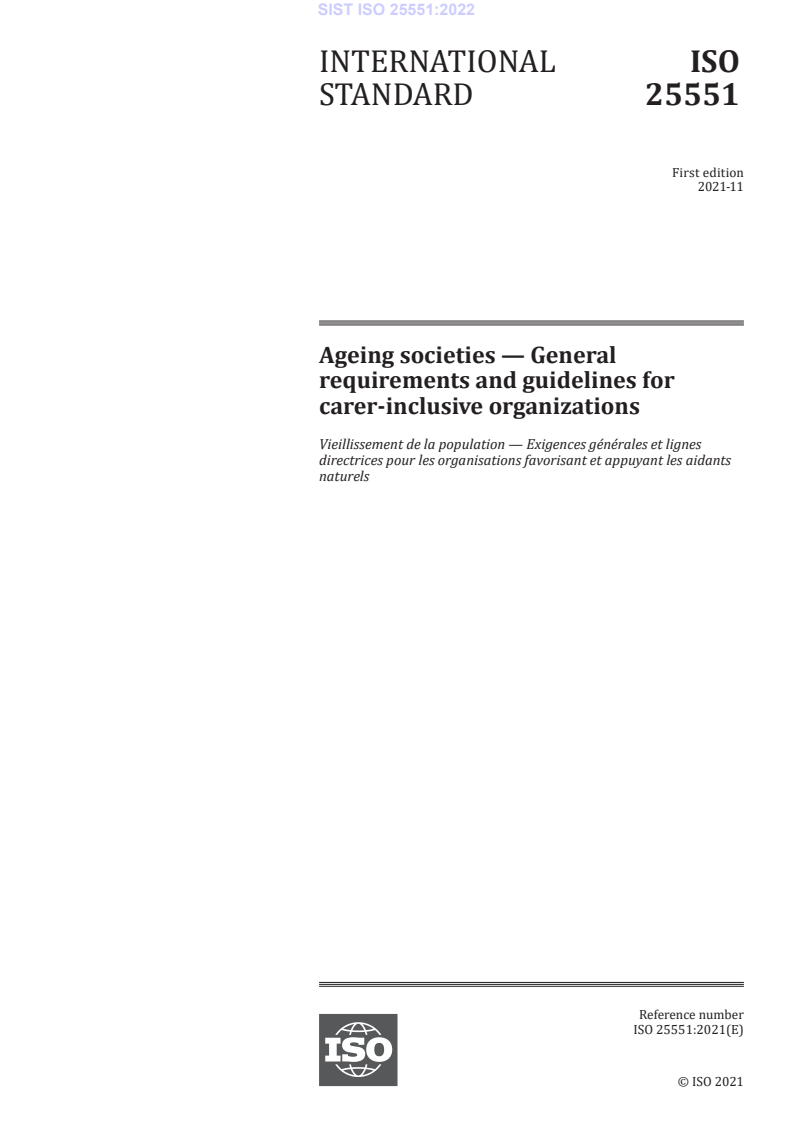
SLOVENSKI STANDARD
01-marec-2022
Starajoča se družba - Splošne zahteve in smernice za oskrbovalcem prijazne
organizacije
Ageing societies - General requirements and guidelines for carer-inclusive organizations
Vieillissement de la population -- Exigences générales et lignes directrices pour les
organisations favorisant et appuyant les aidants naturels
Ta slovenski standard je istoveten z: ISO 25551:2021
ICS:
03.080.30 Storitve za potrošnike Services for consumers
03.100.30 Vodenje ljudi Management of human
resources
11.020.10 Zdravstvene storitve na Health care services in
splošno general
2003-01.Slovenski inštitut za standardizacijo. Razmnoževanje celote ali delov tega standarda ni dovoljeno.
INTERNATIONAL ISO
STANDARD 25551
First edition
2021-11
Ageing societies — General
requirements and guidelines for
carer-inclusive organizations
Vieillissement de la population — Exigences générales et lignes
directrices pour les organisations favorisant et appuyant les aidants
naturels
Reference number
© ISO 2021
All rights reserved. Unless otherwise specified, or required in the context of its implementation, no part of this publication may
be reproduced or utilized otherwise in any form or by any means, electronic or mechanical, including photocopying, or posting on
the internet or an intranet, without prior written permission. Permission can be requested from either ISO at the address below
or ISO’s member body in the country of the requester.
ISO copyright office
CP 401 • Ch. de Blandonnet 8
CH-1214 Vernier, Geneva
Phone: +41 22 749 01 11
Email: copyright@iso.org
Website: www.iso.org
Published in Switzerland
ii
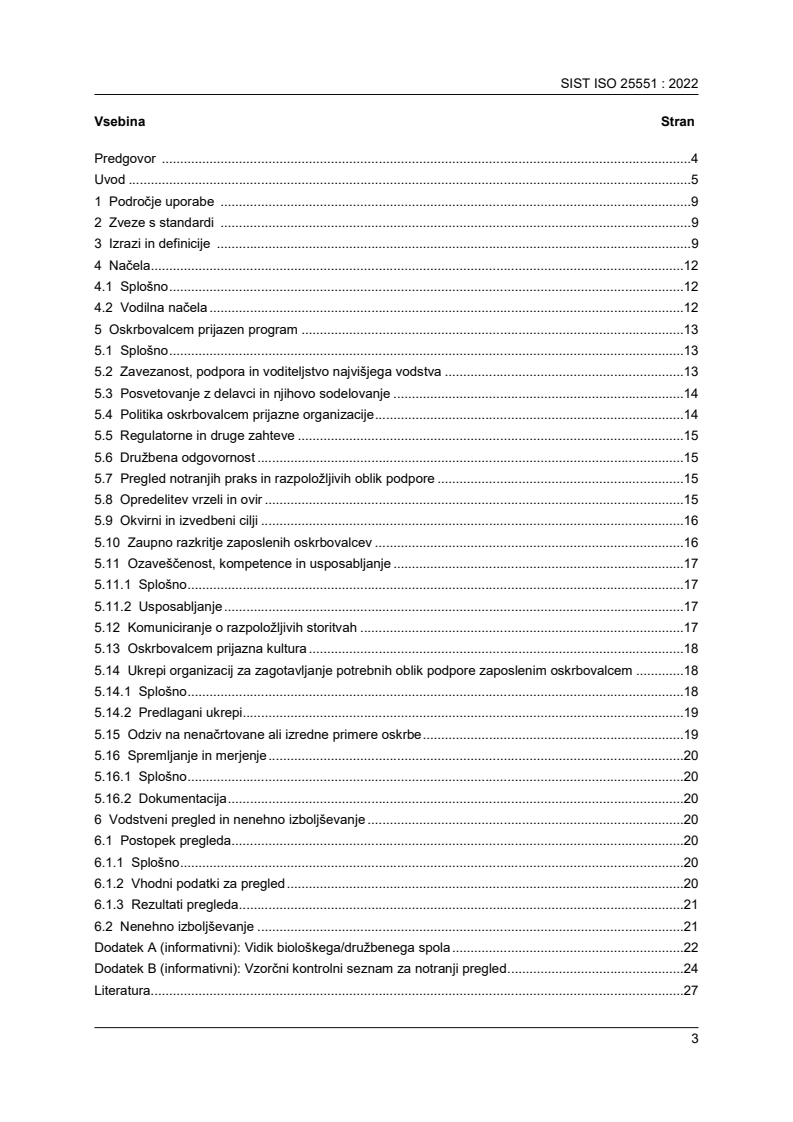
Contents Page
Foreword .iv
Introduction .v
1 Scope . 1
2 Normative references . 1
3 Terms and definitions . 1
4 Principles . 4
4.1 General . 4
4.2 Guiding principles . 4
5 Carer-inclusive program . 5
5.1 General . 5
5.2 Top management commitment, support, and leadership . 5
5.3 Worker consultation and participation . 6
5.4 Carer-inclusive organization policy . 6
5.5 Regulatory and other requirements . 7
5.6 Social responsibility . 7
5.7 Review of internal practices and available supports . 7
5.8 Identify gaps and barriers . 8
5.9 Objectives and targets . 8
5.10 Confidential disclosure of working carers . 9
5.11 Awareness, competence, and training . 9
5.11.1 General . 9
5.11.2 Training . 9
5.12 Communication of available services . 9
5.13 Carer culture . 10
5.14 Actions by organizations to provide necessary supports for working carers . 10
5.14.1 General . 10
5.14.2 Suggested actions . 11
5.15 Response to unplanned or emergency caregiving situations . 11
5.16 Monitoring and measurement . 12
5.16.1 General .12
5.16.2 Documentation.12
6 Management review and continual improvement .12
6.1 Review process . .12
6.1.1 General .12
6.1.2 Review input . 13
6.1.3 Review output . 13
6.2 Continual improvement . 13
Annex A (informative) Sex-/gender-based lens .15
Annex B (informative) Sample internal review checklist .17
Bibliography .20
iii
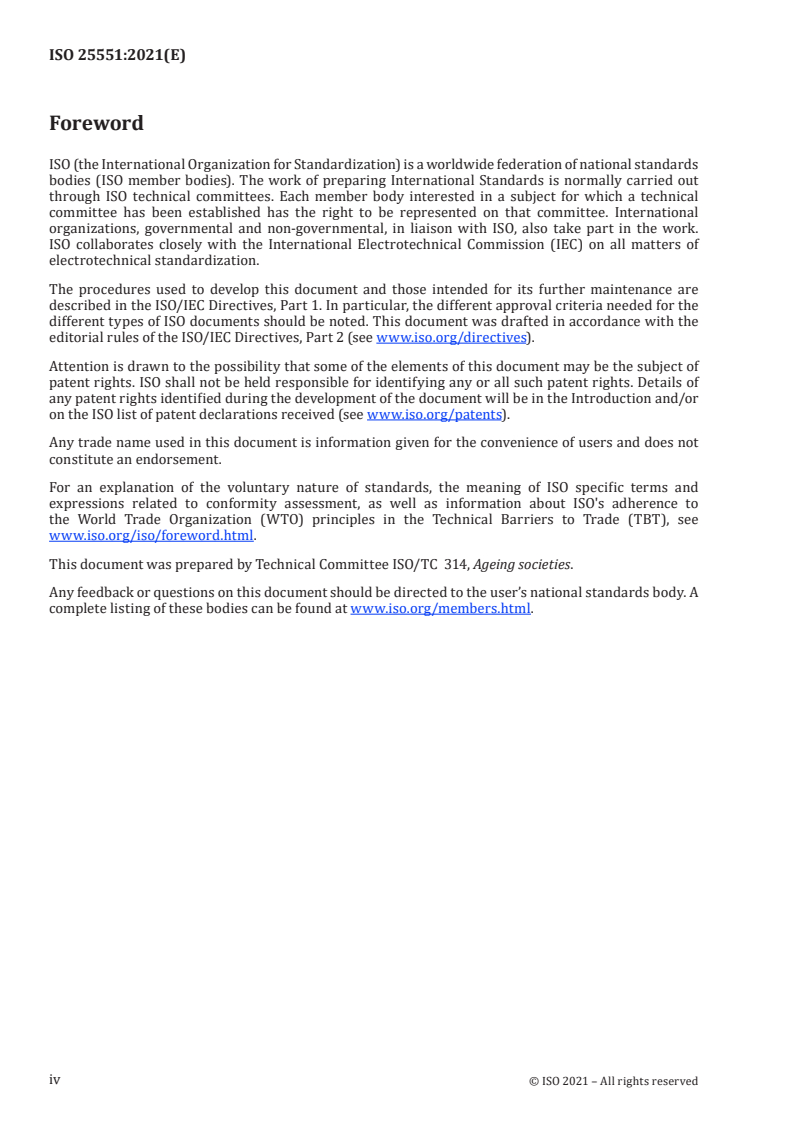
Foreword
ISO (the International Organization for Standardization) is a worldwide federation of national standards
bodies (ISO member bodies). The work of preparing International Standards is normally carried out
through ISO technical committees. Each member body interested in a subject for which a technical
committee has been established has the right to be represented on that committee. International
organizations, governmental and non-governmental, in liaison with ISO, also take part in the work.
ISO collaborates closely with the International Electrotechnical Commission (IEC) on all matters of
electrotechnical standardization.
The procedures used to develop this document and those intended for its further maintenance are
described in the ISO/IEC Directives, Part 1. In particular, the different approval criteria needed for the
different types of ISO documents should be noted. This document was drafted in accordance with the
editorial rules of the ISO/IEC Directives, Part 2 (see www.iso.org/directives).
Attention is drawn to the possibility that some of the elements of this document may be the subject of
patent rights. ISO shall not be held responsible for identifying any or all such patent rights. Details of
any patent rights identified during the development of the document will be in the Introduction and/or
on the ISO list of patent declarations received (see www.iso.org/patents).
Any trade name used in this document is information given for the convenience of users and does not
constitute an endorsement.
For an explanation of the voluntary nature of standards, the meaning of ISO specific terms and
expressions related to conformity assessment, as well as information about ISO's adherence to
the World Trade Organization (WTO) principles in the Technical Barriers to Trade (TBT), see
www.iso.org/iso/foreword.html.
This document was prepared by Technical Committee ISO/TC 314, Ageing societies.
Any feedback or questions on this document should be directed to the user’s national standards body. A
complete listing of these bodies can be found at www.iso.org/members.html.
iv
Introduction
0.1 General
Worldwide, 349 million people are estimated to be care-dependent and of these, 101 million people
[1]
are over the age of 60 years . The form that long-term care takes varies significantly among and
within countries, from home care services to institutional hospital-based care. In most countries,
individuals assume caregiving responsibilities for a spouse, family member, or friend who needs care
because of limitations in their physical, mental or cognitive functioning and the majority of these carers
are women. Although caregiving is a valued societal resource and often viewed positively by carers
themselves, family/friend carers are largely a hidden and unacknowledged workforce.
Caregiving has become one of the most important social and economic issues worldwide and as
population ages, carers will play an increasing critical role in every society, providing substantial
economic value globally. For example, a study in Finland showed that the availability of unpaid care
[2]
considerably reduces public care expenditure (estimated cost savings of 338 million euros) . As
unpaid care reduces costs of health system expenditure, it needs to be recognized that both unpaid
and paid care is more often done by women. This can result in women leaving paid work to meet the
demands of their unpaid care work and/or experiencing workplace inequalities. Caregiving is impacting
workforces, health care systems, families and societies in general.
One of the greatest challenges for working carers is trying to balance employment with caregiving
responsibilities. For example, labour force participation (the percentage of working age people in
an economy who are either employed or unemployed but actively looking for work) is significantly
affected by the family care needs of the growing ageing population. At the same time, family sizes are
decreasing, more women are employed in the labour force, mobility is increasing, life expectancy is
increasing, and the number of older adults in need of care is projected to continue to grow. These trends
[3][4][5][6]
are impacting the growing number of working carers. Studies show that their paid work is
negatively impacted by becoming a carer and in most situations, employers do not have policies or
[7]
programs in place to support these working carers .
0.2 Supports for working carers
Employers can play a key role in supporting their employees who are also carers. Organizations can
opt to sponsor benefits to working carers, such as education, skills training or supportive services, or
to implement carer-supportive personnel policies and programs. These policies and programs help
working carers to manage their paid work alongside their caring role, providing equal opportunities for
them to remain in/or return to work, and help to reduce work-family conflict and/or support work-life
balance. However, there is a lack of clear guidance for employers on how to support working carers.
The workplace is but one arena where working carers can be supported. Although the majority of
waking hours are often spent at work, making it a key environment for carer supports, there are other
arenas where carer supports are available. These include those available through the government or
state, via the provision of public health care services and supports, such as family leaves. There are also
a range of non-governmental, charitable and/or disease-specific organizations (i.e. cancer, dementia)
that also provide supports, whether transportation services or personal care, for example. Finally, each
working carer also has their own informal support system made up of extended family, friends and/or
neighbours.
In some jurisdictions, working carers can be entitled to statutory care leaves, income support or credits,
insurance schemes, financial support for care expenses, etc. For example, in June 2019, the European
Union updated its Work-Life Balance Directive to introduce carer leaves and extended the right to
[8]
request flexible working arrangements to working carers (previously available to working parents) .
The intent of this document is to complement relevant existing programs and supports, whether state
provided or otherwise.
v
0.3 Benefits of implementing a carer-inclusive program
Studies have shown that carer-inclusive policies and programs can help to:
— retain skilled staff;
— improve worker morale and productivity;
— reduce absenteeism and presenteeism;
— avoid the number of staff coming to work sick;
— reduce disability costs and mental health claims;
— give organizations a competitive advantage;
— build a more engaged workforce;
— support the organization’s efforts for a more inclusive workforce;
— demonstrate the organization’s investment in society through their support of working carers.
0.4 Application of document and relevant publications
This document can be selectively applied by organizations, recognizing that resources and supports
available will differ from organization to organization depending on the size and sector of the
organization and the jurisdiction. The development of a carer-inclusive program is seen as a process
that requires flexibility in terms of implementation.
A carer-inclusive program can be as basic as recognizing working carers as recipients that would
benefit from existing supports. For example, many organizations have existing employee support
programs which can be used to support working carers. A carer-inclusive program can build on these
existing supports or be a stand-alone program, if these are not available. Strategies need to include
raising awareness of these supports and targeting them appropriately.
Achieving a carer-inclusive workplace requires a holistic approach and depends on the engagement of
many stakeholders and integration of systems. For example, programs to address equity, diversity and
inclusion, human resources management and health and safety management would be relevant to the
application of this document. As such, there are related documents that can be used in conjunction with
this document, e.g. ISO 30415, ISO TR 30406, ISO 45001 and ISO 45003.
0.5 Caregiving and sex/gender issues
A sex/gender lens is important to consider in developing carer-inclusive policies and practices. For
example, estimates from across different countries indicate that 57 % to 81 % of all carers of older
[9]
adults and others requiring long term care are females, and are likely to work outside the home .
For female carers the impact that caregiving can have on employment can be considerable given that
they provide significantly more caregiving hours than males. Recent European research shows that
only 50 % of female working carers can work full-time and specifies that caregiving impacts their
[10][11]
financial circumstances . In addition, when compared to males, female working carers are more
[11]
likely to make job adjustments (change or leave jobs) as a result of their ongoing caregiving demands .
In addition, female carers provide more emotional support to care recipients, which can have a greater
impact on a carer’s mental health and contribute to carer distress.
A sex/gender lens is key to establishing carer-inclusive policies and programs to help eliminate bias
and to promote sex and gender equality. This will help to ensure that the needs of all are given equal
consideration in organizational decisions and activities.
This document provides guidance to organizations on how to apply a sex/gender lens to the
development of carer-inclusive programs. It supports the aims of United Nations Declaration on Gender
vi
[12]
Responsive Standards and Standards Development to make standards more gender responsive .
It also contributes to the achievement of the United Nations Sustainable Development Goal (SDG) 5:
Achieve gender equality and empower all women and girls and specifically SDG Target 5.4: Recognize
and value unpaid care and domestic work through the provision of public services, infrastructure
and social protection policies and the promotion of shared responsibility within the household and
the family as nationally appropriate. Further this document contributes to SDG 8: Promote sustained,
inclusive and sustainable economic growth, full and productive employment and decent work for all,
and specifically Target 8: To achieve full and productive employment and decent work for all women
and men, including for young people and persons with disabilities, and for equal pay for work of equal
[13][14]
value . Additional guidance on sex, gender and caregiving is provided in Annex A.
0.6 Emerging and evolving issues for working carers
The COVID-19 pandemic has highlighted and increased risks for many working carers. Although
providing certain advantages for working carers, such as working from home, COVID-19 has shown
more clearly the gaps in supports for working carers in both social and health care systems. A UK survey
showed that 70 % of family carers are providing more care due to the pandemic and many working
[15]
carers have seen a dramatic reduction in their income due to lockdown policies .
While not a new situation, one group particularly at risk are the “double duty” carers. Many of the
frontline health care workers providing care to older adults are also providing unpaid care to their own
older family members, friends or neighbours. These workers are at increased risk of contracting the
virus, making it is difficult for them to carry out their family caring role.
Another critical group of working carers are the “sandwich carers”. These are people trying to look
after frail and disabled elderly relatives, often their parents, or other older family or friends at the same
time as looking after dependent children. During the pandemic, these working carers are often working
from home, doing home schooling, parenting, and caring for their older relatives, friends or neighbours.
While this document focuses on working adults, there is increasing concern about the issues facing
young carers who can also be students and workers. Some academic organizations and employers are
beginning to address this issue, but at present, there is little guidance in this area.
Phrases and words related to caregiving have developed differently in individual languages and
language communities, depending on the professional, social, economic, political, cultural, and
linguistic factors. In addition, these words and phrases have evolved over recent decades with changes
in health care systems and public views about the role of caregiving in an ageing society. Some phrases
[16]
traditionally used in this field can now be viewed as misleading or inappropriate . In the development
of this document, feedback from experts showed great variation in the use of these phrases in different
countries and contexts.
The Technical Committee has developed an informative guide on terminology related to caregiving
to show how these words and phrases are used across regions and disciplines and how they are
evolving over time. See: Terminology Related to Caregiving, available on the TC 314 website at:
[17]
https://committee.iso.org/sites/tc314/home/projects/published/resources.html .
This document can assist organizations in identifying and responding to these issues for working
carers.
In this document, the following verbal forms are used:
— “shall” indicates a requirement;
— “should” indicates a recommendation;
— “can” indicates a possibility or a capability;
— “may” indicates a permission.
vii
Information marked as “NOTE” is intended to assist the understanding or use of the document. “Notes
to entry” used in Clause 3 provide additional information that supplements the terminological data and
can contain requirements relating to the use of a term.
viii
INTERNATIONAL STANDARD ISO 25551:2021(E)
Ageing societies — General requirements and guidelines
for carer-inclusive organizations
1 Scope
This document specifies requirements and provides guidelines for an organizational program for
working carers providing care to:
— adult care recipients (e.g. adults with cognitive, sensory, physical, and invisible disabilities, adults
with chronic or episodic conditions and older dependents);
— long-term childcare recipients (e.g. due to chronic illness or permanent cognitive, sensory or
physical disability or injury).
This document is applicable to any organization, regardless of size, sector or community setting (i.e.
urban, rural or remote).
This document can be used in conjunction with an organization’s management systems, human
resource programs, and/or equity, diversity and inclusion programs, or on its own in the absence of a
formal workplace program to support working carers.
2 Normative references
There are no normative references in this document.
3 Terms and definitions
For the purposes of this document, the following terms and definitions apply.
ISO and IEC maintain terminology databases for use in standardization at the following addresses:
— ISO Online browsing platform: available at https:// www .iso .org/ obp
— IEC Electropedia: available at https:// www .electropedia .org/
3.1
care
activities/actions (social, physical, emotional, spiritual, mental) that take place across a variety of
settings: in the home, community, institution and all care settings
Note 1 to entry: Applies to both paid and unpaid care.
3.2
care recipient
person who is receiving care from the working carer
3.3
care worker
care provider
person who is paid to support someone who is ill, struggling or disabled and who could not manage
without this help
Note 1 to entry: In some countries and regions, similar phrases include: home care provider, home health care
professional, personal support worker, personal care assistant, certified caregiver, trained carer, care specialist,
and health care professional.
3.4
carer
caregiver
family caregiver
person who cares, unpaid, for a family member, friend or significant person who, due to a lifelong
condition, illness, disability, serious injury, a mental health condition or an addiction, cannot cope
without their support
Note 1 to entry: This term includes carers who are generally unpaid but can receive some financial support for
care they provide from time to time. It does not include trained care providers affiliated with home care agencies.
Note 2 to entry: Carers can provide emotional or financial support, as well as hands-on help with different tasks.
Caregiving can also be done from long distance.
Note 3 to entry: The terms “carer”, “family caregiver” and “caregiver” are often used interchangeably. “Carer”
is more commonly used in Europe, UK, New Zealand, and Australia. In North America, “caregiver” or “family
caregiver” is more commonly used. In Asia “carer” more commonly refers to a paid care provider.
3.5
family
combination of two or more persons who are bound together over time by ties of mutual consent, birth
and/or adoption or placement and who, together, assume responsibilities for various roles and functions
Note 1 to entry: The term “family” can include “chosen families,” such as strong friendships and communities
where unrelated persons provide care normally provided by nuclear family members.
3.6
unpaid care
care provided without a monetary reward by carers
Note 1 to entry: “informal care” is often used to describe unpaid care but is becoming less acceptable as it does
not reflect the complexity and essential nature of care that is provided. Unpaid care is labour and provides
significant value to families, health care systems and the economy.
3.7
working carer
individual in full or part-time work who also provides care to a family member, friend or significant
person and where the care responsibilities have a substantial impact on their working life
Note 1 to entry: Persons with disabilities can be working carers as well as care recipients.
Note 2 to entry: Commonly used term in UK, Nordic countries and Europe. In Canada, "carer-worker" or "employee
carer" are also used.
3.8
young carer
children and young people who provide regular and prolonged care for ill or disabled family members,
including those with addictions and mental health issues
Note 1 to entry: The upper age limit for young carers can vary from 18 to 25 years. Some countries are using the
term young adult carers to distinguish between the age categories of young carers.
3.9
absenteeism
time taken off work, including periods of paid or unpaid leave, to attend to non-work-related
responsibilities such as self-care or caregiving-related matters
Note 1 to entry: Absenteeism includes any kind or amount of time off work, such as sick or vacation days, leaving
work early, or coming into work late.
3.10
accommodation
intentional organizational actions, whether in policies, programs, or the organizational culture, which
relieves work-family conflict
Note 1 to entry: Accommodation can include flexible work arrangements, such as working from home, flexible
working hours, job sharing or giving workers more autonomy over their work schedules.
3.11
consultation
process of seeking views before making a decision
Note 1 to entry: Consultation includes engaging health and safety committees and workers’ representatives,
where they exist.
[SOURCE: ISO 45001:2018, 3.5]
3.12
organizational culture
values, beliefs and practices that influence the conduct, behaviour and knowledge of people and
organizations
[SOURCE: ISO 30400:2016, 3.2, modified — "and knowledge" has been added.]
3.13
participation
involvement in decision-making
Note 1 to entry: Participation includes engaging health and safety committees and workers’ representatives,
where they exist.
[SOURCE: ISO 45001:2018, 3.4]
3.14
presenteeism
lost productivity that occurs when employees are not fully functioning in the workplace because of an
illness, injury, or other condition
Note 1 to entry: Even though an employee can be physically at work, they might not be able to fully perform their
duties, and this leads to loss of productivity due to preoccupation with carer-related burdens.
3.15
top management
person or group of people who directs and controls an organization at the highest level
[SOURCE: ISO 45001:2018, 3.12]
3.16
worker
person performing work or work-related activities that are under the control of the organization
Note 1 to entry: Persons perform work or work-related activities under various arrangements, paid or unpaid,
such as regularly or temporarily, intermittently or seasonally, casually or on a part-time basis.
Note 2 to entry: Workers include top management, managerial, and non-managerial persons.
Note 3 to entry: The work or work-related activities performed under the control of the organization can be
performed by workers employed by the organization, workers of external providers, contractors, individuals,
agency workers, and by other persons to the extent the organization shares control over their work or work-
related activities, according to the context of the organization.
Note 4 to entry: Workers can include students and volunteers.
[SOURCE: ISO 45001:2018, 3.3, modified — Notes 1 to 3 to entry have been modified, Note 4 to entry
has been added.]
3.17
gender equality
sexual equality and equitable treatment for all genders, according to their respective needs
Note 1 to entry: This term includes equal treatment or, in some instances, treatment that is different but
considered equivalent in terms of rights, benefits, obligations and opportunities.
3.18
marginalized group
group of people within a given culture, context and history at risk of being subjected to multiple
discrimination due to the interplay of different personal characteristics or grounds, such as sex, gender,
age, ethnicity, religion or belief, health status, disability, sexual orientation, gender identity, education
or income, or living in various geographic localities
[SOURCE: European Institute for Gender Equality, Glossary and Thesaurus]
4 Principles
4.1 General
The organization should have the leadership and guiding principles to support and implement a carer-
inclusive program that develops an organizational culture to support the program. While each program
to support working carers will be unique, based on specific needs and resources of the organization,
common principles should guide the development and implementation of the program.
4.2 Guiding principles
a) Leadership commitment and integrity: The organization’s top management and leadership
demonstrates commitment and integrity by ensuring that it supports, accommodates, and endorses
a carer-inclusive workplace and takes overall responsibility for this program.
b) Fairness and inclusiveness: The organization includes all persons regardless of age, gender,
ethnicity, ability, or disability and ensures that workplace policies reflect that inclusiveness. This
principle includes being a non-discriminatory organization that recognizes, respects, trusts and
appreciates workers with caring responsibilities and treats them fairly.
c) Awareness and communication: The organization promotes awareness of ‘caring’ and ‘carers’ in
the workplace and there is a clear understanding of what is meant by these terms. Support available
for working carers is communicated to all workers throughout the organization.
d) Worker consultation and participation: The organization has an open and inclusive culture that
encourages and facilitates workers to self-identify as working carers, combine work and caring
responsibilities, and participate in developing and accessing relevant workplace support.
e) Confidentiality, privacy and security: The organization respects the privacy of all workers,
including working carers. This principle includes treating personal information and data in a
confidential manner, time limited, ensuring that it is stored securely, and only disclosing such
information with the individual’s consent.
f) Flexibility and openness: The organization recognizes family (and other wider social)
responsibilities outside of work important to the working carer and provides flexible working
arrangements and adjustments that are receptive to and accommodating to working carers’
particular situations and needs.
g) Responsiveness: The organization initiates and responds to communications to and from staff,
consumers, suppliers and other interested parties concerning its carer-inclusive workplace
guidelines and takes appropriate action in a timely way.
h) Gender equality: The organization promotes gender equality in the workplace by recognizing the
gendered aspects of caregiving and using a gender/sex lens in the development of relevant policies
and programs, while recognizing the diversity of carers and creating a culture where carers feel
comfortable utilizing programs and benefits regardless of age, gender or organizational role.
i) Compassionate workplace: The organization supports a working system or culture that
emphasizes showing empathy and compassion when dealing with all workers.
5 Carer-inclusive program
5.1 General
The organization shall establish, implement, and maintain a documented policy and supporting
program in accordance with this document.
This policy and program should be integrated with other applicable management systems, human
resource programs and/or diversity or inclusion programs or used on its own, if no program for
supporting working carers exists.
The development of an organizational carer-inclusive program can require a systematic and phased
process to properly conceive, plan, implement, assess, and improve the program. The requirements and
complexities of organizations and workers vary considerably, and implementation of this document
should be seen as a process that requires flexibility in terms of implementation and continual
improvement. Organizations might not be able to implement this document in its entirety but can use
the guidelines to help make the workplace more carer-inclusive.
Organizations should determine what existing employee assistance programs and supports exist, at
an organizational level, through external third-party providers (e.g. employee benefit or assistance
programs), non-profit organizations or at a community or state level. A carer-inclusive program can
build on these existing supports or be a stand-alone program, if these are not available.
The organization should determine the organizational unit that will be responsible for the program.
For example, this unit can be human resources, occupational health and safety, wellness, people and
culture, etc.
5.2 Top management commitment, support, and leadership
Top management shall commit to the principles of an organizational program that supports,
accommodates, and includes working carers while providing the required leadership to implement this
program.
Top management should:
— assume overall responsibility for the program;
— oversee the program implementation;
— provide human and financial resources required to implement and maintain the program;
— define and communicate the roles and responsibilities of internal stakeholders;
— develop and implement appropriate carer-inclusive organizational policies and practices;
— develop and implement measurable objectives and targets related to the program;
— provide the necessary resources and opportunities for worker consultation and participation in all
aspects of the program;
— disseminate and promote the program to all workers;
— encourage all workers to promote the program;
— monitor the execution and ongoing sustainability of the program;
— review the progress and performance of the program with respect to carer’s outcomes (e.g. health,
quality of life, work satisfaction), and work culture outcomes;
— regularly review the organization’s progress and performance in implementing the program;
— oversee the continuous improvement of the organization’s adoption of the program;
— assign responsibility for any or all the above to an appointed champion or designee, such as a human
resource director, committee, or separate team established to be accountable for the program;
— regularly inquire about the sex/gender factors, using the checklist in A.2;
— provide opportunities for all workers to provide feedback on their experiences, suggestions on
improvements and ideas for enhancements.
5.3 Worker consultation and participation
To maximize the impacts of adopting the requirements and guidelines in this document, it is important
that workers are engaged in all elements of the program’s implementation and maintenance.
The organization should:
— create an organizational culture that recognizes, respects, trusts, honours, and appreciates workers
with care responsibilities and that encourages and facilitates them to self-identify as working
carers;
— provide opportunities for gender-balanced representation in the design and development of the
program;
— ensure that program information is created in easy-to-read language, in accessible formats and
provided through communication platforms accessible to all workers;
— provide time, resources, and opportunities for all workers to participate in the program, including
but not limited to:
— paid time during work hours for worker consultation and participation related to the program;
— providing visible leadership, finding a senior leader champion, assuming or assigning
accountability, monitoring key metrics, and measuring progress, then publicly sharing results
of the assessments;
— orienting all executive and organizational leaders, offering awareness training for all managers
and team leaders, providing professional development opportunities for all workers, making
resource materials available for everyone, and engaging related vendors (e.g. worker and family
assistance providers, insurance carriers).
5.4 Carer-inclusive organization policy
Top management shall establish and maintain the organization’s carer-inclusive organization policy.
The policy should include commitment to:
— follow the guiding principles outlined in 4.2;
— provide accommodations for working carers;
— review and adjust the policy to address global shocks such as pandemics, etc.;
— monitor the organization’s performance and continual improvement of the carer-inclusive
organization program.
5.5 Regulatory and other requirements
Regulatory requirements for organizations to provide support for working carers and laws for sex and
gender discrimination differ from jurisdiction to jurisdiction. It is the responsibility of the user of this
document to determine how applicable regulatory and other requirements relate to the application of
this document.
5.6 Social responsibility
The organization should:
— recognize caregiving demands outside of work to understand how to best respond and provide
organizational support;
— establish a procedure to define and communicate the organization’s social/ethical responsibility
to better support workers with caring responsibilities, irrespective of when these responsibilities
occur;
— recognize that there are sex, gender and age-related differences with respect to roles taken outside
of work, as they relate to caregiving.
5.7 Review of internal practices and available supports
The organization shall establish, implement, and maintain a procedure to review current policies,
practices, and programs with the consultation and participation of workers at all levels to support
working carer-inclusion.
This review should include:
— benefit programs such as employee assistance plans and extended health coverage;
— flexible hours, special leaves and work from home polices;
— return to work programs;
— family-friendly organization programs;
— union/professional association benefit policies and programs;
— human resources policies and programs;
— consideration of sex/gender lens as outlined in Annex A;
— other related programs.
The organization should conduct an assessment and analysis of the use of the available resources and
supports (as listed in this subclause).
NOTE This assessment will help the organization to better understand usability of resources and supports
while identifying gaps and areas for improvement.
5.8 Identify gaps and barriers
The organization shall establish, implement, and maintain a procedure to identify gaps and barriers to
providing reasonable support and accommodation for working carers within an organization.
The organization should:
— identify supports and accommodations that are being used and how they can be extended and
tailored, being sensitive to the sex/gender and age-related norms, both within (i.e., male-dominated
workplaces) and outside of the workplace (i.e. societal expectations for women to provide care);
— evaluate how supports and accommodations can be made more available to its working carers;
— obtain workers’ feedback about current practices;
— establish, implement, and maintain a procedure to obtain workers’ feedback on future improvement
plans and programs using the results to set objectives and targets to develop appropriate actions;
— identify barriers such as inflexible workplace culture, to support working carers, while initiating
supports such as lunchtime carer support groups,
...
INTERNATIONAL ISO
STANDARD 25551
First edition
2021-11
Ageing societies — General
requirements and guidelines for
carer-inclusive organizations
Vieillissement de la population — Exigences générales et lignes
directrices pour les organisations favorisant et appuyant les aidants
naturels
Reference number
© ISO 2021
All rights reserved. Unless otherwise specified, or required in the context of its implementation, no part of this publication may
be reproduced or utilized otherwise in any form or by any means, electronic or mechanical, including photocopying, or posting on
the internet or an intranet, without prior written permission. Permission can be requested from either ISO at the address below
or ISO’s member body in the country of the requester.
ISO copyright office
CP 401 • Ch. de Blandonnet 8
CH-1214 Vernier, Geneva
Phone: +41 22 749 01 11
Email: copyright@iso.org
Website: www.iso.org
Published in Switzerland
ii
Contents Page
Foreword .iv
Introduction .v
1 Scope . 1
2 Normative references . 1
3 Terms and definitions . 1
4 Principles . 4
4.1 General . 4
4.2 Guiding principles . 4
5 Carer-inclusive program . 5
5.1 General . 5
5.2 Top management commitment, support, and leadership . 5
5.3 Worker consultation and participation . 6
5.4 Carer-inclusive organization policy . 6
5.5 Regulatory and other requirements . 7
5.6 Social responsibility . 7
5.7 Review of internal practices and available supports . 7
5.8 Identify gaps and barriers . 8
5.9 Objectives and targets . 8
5.10 Confidential disclosure of working carers . 9
5.11 Awareness, competence, and training . 9
5.11.1 General . 9
5.11.2 Training . 9
5.12 Communication of available services . 9
5.13 Carer culture . 10
5.14 Actions by organizations to provide necessary supports for working carers . 10
5.14.1 General . 10
5.14.2 Suggested actions . 11
5.15 Response to unplanned or emergency caregiving situations . 11
5.16 Monitoring and measurement . 12
5.16.1 General .12
5.16.2 Documentation.12
6 Management review and continual improvement .12
6.1 Review process . .12
6.1.1 General .12
6.1.2 Review input . 13
6.1.3 Review output . 13
6.2 Continual improvement . 13
Annex A (informative) Sex-/gender-based lens .15
Annex B (informative) Sample internal review checklist .17
Bibliography .20
iii
Foreword
ISO (the International Organization for Standardization) is a worldwide federation of national standards
bodies (ISO member bodies). The work of preparing International Standards is normally carried out
through ISO technical committees. Each member body interested in a subject for which a technical
committee has been established has the right to be represented on that committee. International
organizations, governmental and non-governmental, in liaison with ISO, also take part in the work.
ISO collaborates closely with the International Electrotechnical Commission (IEC) on all matters of
electrotechnical standardization.
The procedures used to develop this document and those intended for its further maintenance are
described in the ISO/IEC Directives, Part 1. In particular, the different approval criteria needed for the
different types of ISO documents should be noted. This document was drafted in accordance with the
editorial rules of the ISO/IEC Directives, Part 2 (see www.iso.org/directives).
Attention is drawn to the possibility that some of the elements of this document may be the subject of
patent rights. ISO shall not be held responsible for identifying any or all such patent rights. Details of
any patent rights identified during the development of the document will be in the Introduction and/or
on the ISO list of patent declarations received (see www.iso.org/patents).
Any trade name used in this document is information given for the convenience of users and does not
constitute an endorsement.
For an explanation of the voluntary nature of standards, the meaning of ISO specific terms and
expressions related to conformity assessment, as well as information about ISO's adherence to
the World Trade Organization (WTO) principles in the Technical Barriers to Trade (TBT), see
www.iso.org/iso/foreword.html.
This document was prepared by Technical Committee ISO/TC 314, Ageing societies.
Any feedback or questions on this document should be directed to the user’s national standards body. A
complete listing of these bodies can be found at www.iso.org/members.html.
iv
Introduction
0.1 General
Worldwide, 349 million people are estimated to be care-dependent and of these, 101 million people
[1]
are over the age of 60 years . The form that long-term care takes varies significantly among and
within countries, from home care services to institutional hospital-based care. In most countries,
individuals assume caregiving responsibilities for a spouse, family member, or friend who needs care
because of limitations in their physical, mental or cognitive functioning and the majority of these carers
are women. Although caregiving is a valued societal resource and often viewed positively by carers
themselves, family/friend carers are largely a hidden and unacknowledged workforce.
Caregiving has become one of the most important social and economic issues worldwide and as
population ages, carers will play an increasing critical role in every society, providing substantial
economic value globally. For example, a study in Finland showed that the availability of unpaid care
[2]
considerably reduces public care expenditure (estimated cost savings of 338 million euros) . As
unpaid care reduces costs of health system expenditure, it needs to be recognized that both unpaid
and paid care is more often done by women. This can result in women leaving paid work to meet the
demands of their unpaid care work and/or experiencing workplace inequalities. Caregiving is impacting
workforces, health care systems, families and societies in general.
One of the greatest challenges for working carers is trying to balance employment with caregiving
responsibilities. For example, labour force participation (the percentage of working age people in
an economy who are either employed or unemployed but actively looking for work) is significantly
affected by the family care needs of the growing ageing population. At the same time, family sizes are
decreasing, more women are employed in the labour force, mobility is increasing, life expectancy is
increasing, and the number of older adults in need of care is projected to continue to grow. These trends
[3][4][5][6]
are impacting the growing number of working carers. Studies show that their paid work is
negatively impacted by becoming a carer and in most situations, employers do not have policies or
[7]
programs in place to support these working carers .
0.2 Supports for working carers
Employers can play a key role in supporting their employees who are also carers. Organizations can
opt to sponsor benefits to working carers, such as education, skills training or supportive services, or
to implement carer-supportive personnel policies and programs. These policies and programs help
working carers to manage their paid work alongside their caring role, providing equal opportunities for
them to remain in/or return to work, and help to reduce work-family conflict and/or support work-life
balance. However, there is a lack of clear guidance for employers on how to support working carers.
The workplace is but one arena where working carers can be supported. Although the majority of
waking hours are often spent at work, making it a key environment for carer supports, there are other
arenas where carer supports are available. These include those available through the government or
state, via the provision of public health care services and supports, such as family leaves. There are also
a range of non-governmental, charitable and/or disease-specific organizations (i.e. cancer, dementia)
that also provide supports, whether transportation services or personal care, for example. Finally, each
working carer also has their own informal support system made up of extended family, friends and/or
neighbours.
In some jurisdictions, working carers can be entitled to statutory care leaves, income support or credits,
insurance schemes, financial support for care expenses, etc. For example, in June 2019, the European
Union updated its Work-Life Balance Directive to introduce carer leaves and extended the right to
[8]
request flexible working arrangements to working carers (previously available to working parents) .
The intent of this document is to complement relevant existing programs and supports, whether state
provided or otherwise.
v
0.3 Benefits of implementing a carer-inclusive program
Studies have shown that carer-inclusive policies and programs can help to:
— retain skilled staff;
— improve worker morale and productivity;
— reduce absenteeism and presenteeism;
— avoid the number of staff coming to work sick;
— reduce disability costs and mental health claims;
— give organizations a competitive advantage;
— build a more engaged workforce;
— support the organization’s efforts for a more inclusive workforce;
— demonstrate the organization’s investment in society through their support of working carers.
0.4 Application of document and relevant publications
This document can be selectively applied by organizations, recognizing that resources and supports
available will differ from organization to organization depending on the size and sector of the
organization and the jurisdiction. The development of a carer-inclusive program is seen as a process
that requires flexibility in terms of implementation.
A carer-inclusive program can be as basic as recognizing working carers as recipients that would
benefit from existing supports. For example, many organizations have existing employee support
programs which can be used to support working carers. A carer-inclusive program can build on these
existing supports or be a stand-alone program, if these are not available. Strategies need to include
raising awareness of these supports and targeting them appropriately.
Achieving a carer-inclusive workplace requires a holistic approach and depends on the engagement of
many stakeholders and integration of systems. For example, programs to address equity, diversity and
inclusion, human resources management and health and safety management would be relevant to the
application of this document. As such, there are related documents that can be used in conjunction with
this document, e.g. ISO 30415, ISO TR 30406, ISO 45001 and ISO 45003.
0.5 Caregiving and sex/gender issues
A sex/gender lens is important to consider in developing carer-inclusive policies and practices. For
example, estimates from across different countries indicate that 57 % to 81 % of all carers of older
[9]
adults and others requiring long term care are females, and are likely to work outside the home .
For female carers the impact that caregiving can have on employment can be considerable given that
they provide significantly more caregiving hours than males. Recent European research shows that
only 50 % of female working carers can work full-time and specifies that caregiving impacts their
[10][11]
financial circumstances . In addition, when compared to males, female working carers are more
[11]
likely to make job adjustments (change or leave jobs) as a result of their ongoing caregiving demands .
In addition, female carers provide more emotional support to care recipients, which can have a greater
impact on a carer’s mental health and contribute to carer distress.
A sex/gender lens is key to establishing carer-inclusive policies and programs to help eliminate bias
and to promote sex and gender equality. This will help to ensure that the needs of all are given equal
consideration in organizational decisions and activities.
This document provides guidance to organizations on how to apply a sex/gender lens to the
development of carer-inclusive programs. It supports the aims of United Nations Declaration on Gender
vi
[12]
Responsive Standards and Standards Development to make standards more gender responsive .
It also contributes to the achievement of the United Nations Sustainable Development Goal (SDG) 5:
Achieve gender equality and empower all women and girls and specifically SDG Target 5.4: Recognize
and value unpaid care and domestic work through the provision of public services, infrastructure
and social protection policies and the promotion of shared responsibility within the household and
the family as nationally appropriate. Further this document contributes to SDG 8: Promote sustained,
inclusive and sustainable economic growth, full and productive employment and decent work for all,
and specifically Target 8: To achieve full and productive employment and decent work for all women
and men, including for young people and persons with disabilities, and for equal pay for work of equal
[13][14]
value . Additional guidance on sex, gender and caregiving is provided in Annex A.
0.6 Emerging and evolving issues for working carers
The COVID-19 pandemic has highlighted and increased risks for many working carers. Although
providing certain advantages for working carers, such as working from home, COVID-19 has shown
more clearly the gaps in supports for working carers in both social and health care systems. A UK survey
showed that 70 % of family carers are providing more care due to the pandemic and many working
[15]
carers have seen a dramatic reduction in their income due to lockdown policies .
While not a new situation, one group particularly at risk are the “double duty” carers. Many of the
frontline health care workers providing care to older adults are also providing unpaid care to their own
older family members, friends or neighbours. These workers are at increased risk of contracting the
virus, making it is difficult for them to carry out their family caring role.
Another critical group of working carers are the “sandwich carers”. These are people trying to look
after frail and disabled elderly relatives, often their parents, or other older family or friends at the same
time as looking after dependent children. During the pandemic, these working carers are often working
from home, doing home schooling, parenting, and caring for their older relatives, friends or neighbours.
While this document focuses on working adults, there is increasing concern about the issues facing
young carers who can also be students and workers. Some academic organizations and employers are
beginning to address this issue, but at present, there is little guidance in this area.
Phrases and words related to caregiving have developed differently in individual languages and
language communities, depending on the professional, social, economic, political, cultural, and
linguistic factors. In addition, these words and phrases have evolved over recent decades with changes
in health care systems and public views about the role of caregiving in an ageing society. Some phrases
[16]
traditionally used in this field can now be viewed as misleading or inappropriate . In the development
of this document, feedback from experts showed great variation in the use of these phrases in different
countries and contexts.
The Technical Committee has developed an informative guide on terminology related to caregiving
to show how these words and phrases are used across regions and disciplines and how they are
evolving over time. See: Terminology Related to Caregiving, available on the TC 314 website at:
[17]
https://committee.iso.org/sites/tc314/home/projects/published/resources.html .
This document can assist organizations in identifying and responding to these issues for working
carers.
In this document, the following verbal forms are used:
— “shall” indicates a requirement;
— “should” indicates a recommendation;
— “can” indicates a possibility or a capability;
— “may” indicates a permission.
vii
Information marked as “NOTE” is intended to assist the understanding or use of the document. “Notes
to entry” used in Clause 3 provide additional information that supplements the terminological data and
can contain requirements relating to the use of a term.
viii
INTERNATIONAL STANDARD ISO 25551:2021(E)
Ageing societies — General requirements and guidelines
for carer-inclusive organizations
1 Scope
This document specifies requirements and provides guidelines for an organizational program for
working carers providing care to:
— adult care recipients (e.g. adults with cognitive, sensory, physical, and invisible disabilities, adults
with chronic or episodic conditions and older dependents);
— long-term childcare recipients (e.g. due to chronic illness or permanent cognitive, sensory or
physical disability or injury).
This document is applicable to any organization, regardless of size, sector or community setting (i.e.
urban, rural or remote).
This document can be used in conjunction with an organization’s management systems, human
resource programs, and/or equity, diversity and inclusion programs, or on its own in the absence of a
formal workplace program to support working carers.
2 Normative references
There are no normative references in this document.
3 Terms and definitions
For the purposes of this document, the following terms and definitions apply.
ISO and IEC maintain terminology databases for use in standardization at the following addresses:
— ISO Online browsing platform: available at https:// www .iso .org/ obp
— IEC Electropedia: available at https:// www .electropedia .org/
3.1
care
activities/actions (social, physical, emotional, spiritual, mental) that take place across a variety of
settings: in the home, community, institution and all care settings
Note 1 to entry: Applies to both paid and unpaid care.
3.2
care recipient
person who is receiving care from the working carer
3.3
care worker
care provider
person who is paid to support someone who is ill, struggling or disabled and who could not manage
without this help
Note 1 to entry: In some countries and regions, similar phrases include: home care provider, home health care
professional, personal support worker, personal care assistant, certified caregiver, trained carer, care specialist,
and health care professional.
3.4
carer
caregiver
family caregiver
person who cares, unpaid, for a family member, friend or significant person who, due to a lifelong
condition, illness, disability, serious injury, a mental health condition or an addiction, cannot cope
without their support
Note 1 to entry: This term includes carers who are generally unpaid but can receive some financial support for
care they provide from time to time. It does not include trained care providers affiliated with home care agencies.
Note 2 to entry: Carers can provide emotional or financial support, as well as hands-on help with different tasks.
Caregiving can also be done from long distance.
Note 3 to entry: The terms “carer”, “family caregiver” and “caregiver” are often used interchangeably. “Carer”
is more commonly used in Europe, UK, New Zealand, and Australia. In North America, “caregiver” or “family
caregiver” is more commonly used. In Asia “carer” more commonly refers to a paid care provider.
3.5
family
combination of two or more persons who are bound together over time by ties of mutual consent, birth
and/or adoption or placement and who, together, assume responsibilities for various roles and functions
Note 1 to entry: The term “family” can include “chosen families,” such as strong friendships and communities
where unrelated persons provide care normally provided by nuclear family members.
3.6
unpaid care
care provided without a monetary reward by carers
Note 1 to entry: “informal care” is often used to describe unpaid care but is becoming less acceptable as it does
not reflect the complexity and essential nature of care that is provided. Unpaid care is labour and provides
significant value to families, health care systems and the economy.
3.7
working carer
individual in full or part-time work who also provides care to a family member, friend or significant
person and where the care responsibilities have a substantial impact on their working life
Note 1 to entry: Persons with disabilities can be working carers as well as care recipients.
Note 2 to entry: Commonly used term in UK, Nordic countries and Europe. In Canada, "carer-worker" or "employee
carer" are also used.
3.8
young carer
children and young people who provide regular and prolonged care for ill or disabled family members,
including those with addictions and mental health issues
Note 1 to entry: The upper age limit for young carers can vary from 18 to 25 years. Some countries are using the
term young adult carers to distinguish between the age categories of young carers.
3.9
absenteeism
time taken off work, including periods of paid or unpaid leave, to attend to non-work-related
responsibilities such as self-care or caregiving-related matters
Note 1 to entry: Absenteeism includes any kind or amount of time off work, such as sick or vacation days, leaving
work early, or coming into work late.
3.10
accommodation
intentional organizational actions, whether in policies, programs, or the organizational culture, which
relieves work-family conflict
Note 1 to entry: Accommodation can include flexible work arrangements, such as working from home, flexible
working hours, job sharing or giving workers more autonomy over their work schedules.
3.11
consultation
process of seeking views before making a decision
Note 1 to entry: Consultation includes engaging health and safety committees and workers’ representatives,
where they exist.
[SOURCE: ISO 45001:2018, 3.5]
3.12
organizational culture
values, beliefs and practices that influence the conduct, behaviour and knowledge of people and
organizations
[SOURCE: ISO 30400:2016, 3.2, modified — "and knowledge" has been added.]
3.13
participation
involvement in decision-making
Note 1 to entry: Participation includes engaging health and safety committees and workers’ representatives,
where they exist.
[SOURCE: ISO 45001:2018, 3.4]
3.14
presenteeism
lost productivity that occurs when employees are not fully functioning in the workplace because of an
illness, injury, or other condition
Note 1 to entry: Even though an employee can be physically at work, they might not be able to fully perform their
duties, and this leads to loss of productivity due to preoccupation with carer-related burdens.
3.15
top management
person or group of people who directs and controls an organization at the highest level
[SOURCE: ISO 45001:2018, 3.12]
3.16
worker
person performing work or work-related activities that are under the control of the organization
Note 1 to entry: Persons perform work or work-related activities under various arrangements, paid or unpaid,
such as regularly or temporarily, intermittently or seasonally, casually or on a part-time basis.
Note 2 to entry: Workers include top management, managerial, and non-managerial persons.
Note 3 to entry: The work or work-related activities performed under the control of the organization can be
performed by workers employed by the organization, workers of external providers, contractors, individuals,
agency workers, and by other persons to the extent the organization shares control over their work or work-
related activities, according to the context of the organization.
Note 4 to entry: Workers can include students and volunteers.
[SOURCE: ISO 45001:2018, 3.3, modified — Notes 1 to 3 to entry have been modified, Note 4 to entry
has been added.]
3.17
gender equality
sexual equality and equitable treatment for all genders, according to their respective needs
Note 1 to entry: This term includes equal treatment or, in some instances, treatment that is different but
considered equivalent in terms of rights, benefits, obligations and opportunities.
3.18
marginalized group
group of people within a given culture, context and history at risk of being subjected to multiple
discrimination due to the interplay of different personal characteristics or grounds, such as sex, gender,
age, ethnicity, religion or belief, health status, disability, sexual orientation, gender identity, education
or income, or living in various geographic localities
[SOURCE: European Institute for Gender Equality, Glossary and Thesaurus]
4 Principles
4.1 General
The organization should have the leadership and guiding principles to support and implement a carer-
inclusive program that develops an organizational culture to support the program. While each program
to support working carers will be unique, based on specific needs and resources of the organization,
common principles should guide the development and implementation of the program.
4.2 Guiding principles
a) Leadership commitment and integrity: The organization’s top management and leadership
demonstrates commitment and integrity by ensuring that it supports, accommodates, and endorses
a carer-inclusive workplace and takes overall responsibility for this program.
b) Fairness and inclusiveness: The organization includes all persons regardless of age, gender,
ethnicity, ability, or disability and ensures that workplace policies reflect that inclusiveness. This
principle includes being a non-discriminatory organization that recognizes, respects, trusts and
appreciates workers with caring responsibilities and treats them fairly.
c) Awareness and communication: The organization promotes awareness of ‘caring’ and ‘carers’ in
the workplace and there is a clear understanding of what is meant by these terms. Support available
for working carers is communicated to all workers throughout the organization.
d) Worker consultation and participation: The organization has an open and inclusive culture that
encourages and facilitates workers to self-identify as working carers, combine work and caring
responsibilities, and participate in developing and accessing relevant workplace support.
e) Confidentiality, privacy and security: The organization respects the privacy of all workers,
including working carers. This principle includes treating personal information and data in a
confidential manner, time limited, ensuring that it is stored securely, and only disclosing such
information with the individual’s consent.
f) Flexibility and openness: The organization recognizes family (and other wider social)
responsibilities outside of work important to the working carer and provides flexible working
arrangements and adjustments that are receptive to and accommodating to working carers’
particular situations and needs.
g) Responsiveness: The organization initiates and responds to communications to and from staff,
consumers, suppliers and other interested parties concerning its carer-inclusive workplace
guidelines and takes appropriate action in a timely way.
h) Gender equality: The organization promotes gender equality in the workplace by recognizing the
gendered aspects of caregiving and using a gender/sex lens in the development of relevant policies
and programs, while recognizing the diversity of carers and creating a culture where carers feel
comfortable utilizing programs and benefits regardless of age, gender or organizational role.
i) Compassionate workplace: The organization supports a working system or culture that
emphasizes showing empathy and compassion when dealing with all workers.
5 Carer-inclusive program
5.1 General
The organization shall establish, implement, and maintain a documented policy and supporting
program in accordance with this document.
This policy and program should be integrated with other applicable management systems, human
resource programs and/or diversity or inclusion programs or used on its own, if no program for
supporting working carers exists.
The development of an organizational carer-inclusive program can require a systematic and phased
process to properly conceive, plan, implement, assess, and improve the program. The requirements and
complexities of organizations and workers vary considerably, and implementation of this document
should be seen as a process that requires flexibility in terms of implementation and continual
improvement. Organizations might not be able to implement this document in its entirety but can use
the guidelines to help make the workplace more carer-inclusive.
Organizations should determine what existing employee assistance programs and supports exist, at
an organizational level, through external third-party providers (e.g. employee benefit or assistance
programs), non-profit organizations or at a community or state level. A carer-inclusive program can
build on these existing supports or be a stand-alone program, if these are not available.
The organization should determine the organizational unit that will be responsible for the program.
For example, this unit can be human resources, occupational health and safety, wellness, people and
culture, etc.
5.2 Top management commitment, support, and leadership
Top management shall commit to the principles of an organizational program that supports,
accommodates, and includes working carers while providing the required leadership to implement this
program.
Top management should:
— assume overall responsibility for the program;
— oversee the program implementation;
— provide human and financial resources required to implement and maintain the program;
— define and communicate the roles and responsibilities of internal stakeholders;
— develop and implement appropriate carer-inclusive organizational policies and practices;
— develop and implement measurable objectives and targets related to the program;
— provide the necessary resources and opportunities for worker consultation and participation in all
aspects of the program;
— disseminate and promote the program to all workers;
— encourage all workers to promote the program;
— monitor the execution and ongoing sustainability of the program;
— review the progress and performance of the program with respect to carer’s outcomes (e.g. health,
quality of life, work satisfaction), and work culture outcomes;
— regularly review the organization’s progress and performance in implementing the program;
— oversee the continuous improvement of the organization’s adoption of the program;
— assign responsibility for any or all the above to an appointed champion or designee, such as a human
resource director, committee, or separate team established to be accountable for the program;
— regularly inquire about the sex/gender factors, using the checklist in A.2;
— provide opportunities for all workers to provide feedback on their experiences, suggestions on
improvements and ideas for enhancements.
5.3 Worker consultation and participation
To maximize the impacts of adopting the requirements and guidelines in this document, it is important
that workers are engaged in all elements of the program’s implementation and maintenance.
The organization should:
— create an organizational culture that recognizes, respects, trusts, honours, and appreciates workers
with care responsibilities and that encourages and facilitates them to self-identify as working
carers;
— provide opportunities for gender-balanced representation in the design and development of the
program;
— ensure that program information is created in easy-to-read language, in accessible formats and
provided through communication platforms accessible to all workers;
— provide time, resources, and opportunities for all workers to participate in the program, including
but not limited to:
— paid time during work hours for worker consultation and participation related to the program;
— providing visible leadership, finding a senior leader champion, assuming or assigning
accountability, monitoring key metrics, and measuring progress, then publicly sharing results
of the assessments;
— orienting all executive and organizational leaders, offering awareness training for all managers
and team leaders, providing professional development opportunities for all workers, making
resource materials available for everyone, and engaging related vendors (e.g. worker and family
assistance providers, insurance carriers).
5.4 Carer-inclusive organization policy
Top management shall establish and maintain the organization’s carer-inclusive organization policy.
The policy should include commitment to:
— follow the guiding principles outlined in 4.2;
— provide accommodations for working carers;
— review and adjust the policy to address global shocks such as pandemics, etc.;
— monitor the organization’s performance and continual improvement of the carer-inclusive
organization program.
5.5 Regulatory and other requirements
Regulatory requirements for organizations to provide support for working carers and laws for sex and
gender discrimination differ from jurisdiction to jurisdiction. It is the responsibility of the user of this
document to determine how applicable regulatory and other requirements relate to the application of
this document.
5.6 Social responsibility
The organization should:
— recognize caregiving demands outside of work to understand how to best respond and provide
organizational support;
— establish a procedure to define and communicate the organization’s social/ethical responsibility
to better support workers with caring responsibilities, irrespective of when these responsibilities
occur;
— recognize that there are sex, gender and age-related differences with respect to roles taken outside
of work, as they relate to caregiving.
5.7 Review of internal practices and available supports
The organization shall establish, implement, and maintain a procedure to review current policies,
practices, and programs with the consultation and participation of workers at all levels to support
working carer-inclusion.
This review should include:
— benefit programs such as employee assistance plans and extended health coverage;
— flexible hours, special leaves and work from home polices;
— return to work programs;
— family-friendly organization programs;
— union/professional association benefit policies and programs;
— human resources policies and programs;
— consideration of sex/gender lens as outlined in Annex A;
— other related programs.
The organization should conduct an assessment and analysis of the use of the available resources and
supports (as listed in this subclause).
NOTE This assessment will help the organization to better understand usability of resources and supports
while identifying gaps and areas for improvement.
5.8 Identify gaps and barriers
The organization shall establish, implement, and maintain a procedure to identify gaps and barriers to
providing reasonable support and accommodation for working carers within an organization.
The organization should:
— identify supports and accommodations that are being used and how they can be extended and
tailored, being sensitive to the sex/gender and age-related norms, both within (i.e., male-dominated
workplaces) and outside of the workplace (i.e. societal expectations for women to provide care);
— evaluate how supports and accommodations can be made more available to its working carers;
— obtain workers’ feedback about current practices;
— establish, implement, and maintain a procedure to obtain workers’ feedback on future improvement
plans and programs using the results to set objectives and targets to develop appropriate actions;
— identify barriers such as inflexible workplace culture, to support working carers, while initiating
supports such as lunchtime carer support groups, self-care and information sharing sessions;
— develop action plans to overcome identified challenges and barriers.
5.9 Objectives and targets
The organization shall document and communicate the program’s objectives and targets for all relevant
functions and levels within the organization.
The objectives and targets should be:
— specific, measurable, achievable, realistic and timely (SMART);
— consistent with the organization’s policy;
— informed by external issues, such as applicable requirements;
— based on identified gaps and barriers;
— reviewed and modified in planned intervals and according to evolving information and conditions;
— impactful to:
— decrease working carer burdens and work stressors;
— improve mental and physical health;
— improve work-life balance;
— improve health-related quality of life;
— improve work satisfaction and employee morale;
— decrease sex and gender inequality;
— improve retention of working carers;
— increase performance;
— decrease absenteeism and presenteeism.
NOTE Functions and levels refer to different levels of employment and organizational functions such as
production, quality, services, and human resources.
The organization should allocate necessar
...
INTERNATIONAL ISO
STANDARD 25551
First edition
2021-11
Ageing societies — General
requirements and guidelines for
carer-inclusive organizations
Vieillissement de la population — Exigences générales et lignes
directrices pour les organisations favorisant et appuyant les aidants
naturels
Reference number
© ISO 2021
All rights reserved. Unless otherwise specified, or required in the context of its implementation, no part of this publication may
be reproduced or utilized otherwise in any form or by any means, electronic or mechanical, including photocopying, or posting on
the internet or an intranet, without prior written permission. Permission can be requested from either ISO at the address below
or ISO’s member body in the country of the requester.
ISO copyright office
CP 401 • Ch. de Blandonnet 8
CH-1214 Vernier, Geneva
Phone: +41 22 749 01 11
Email: copyright@iso.org
Website: www.iso.org
Published in Switzerland
ii
Contents Page
Foreword .iv
Introduction .v
1 Scope . 1
2 Normative references . 1
3 Terms and definitions . 1
4 Principles . 4
4.1 General . 4
4.2 Guiding principles . 4
5 Carer-inclusive program . 5
5.1 General . 5
5.2 Top management commitment, support, and leadership . 5
5.3 Worker consultation and participation . 6
5.4 Carer-inclusive organization policy . 6
5.5 Regulatory and other requirements . 7
5.6 Social responsibility . 7
5.7 Review of internal practices and available supports . 7
5.8 Identify gaps and barriers . 8
5.9 Objectives and targets . 8
5.10 Confidential disclosure of working carers . 9
5.11 Awareness, competence, and training . 9
5.11.1 General . 9
5.11.2 Training . 9
5.12 Communication of available services . 9
5.13 Carer culture . 10
5.14 Actions by organizations to provide necessary supports for working carers . 10
5.14.1 General . 10
5.14.2 Suggested actions . 11
5.15 Response to unplanned or emergency caregiving situations . 11
5.16 Monitoring and measurement . 12
5.16.1 General .12
5.16.2 Documentation.12
6 Management review and continual improvement .12
6.1 Review process . .12
6.1.1 General .12
6.1.2 Review input . 13
6.1.3 Review output . 13
6.2 Continual improvement . 13
Annex A (informative) Sex-/gender-based lens .15
Annex B (informative) Sample internal review checklist .17
Bibliography .20
iii
Foreword
ISO (the International Organization for Standardization) is a worldwide federation of national standards
bodies (ISO member bodies). The work of preparing International Standards is normally carried out
through ISO technical committees. Each member body interested in a subject for which a technical
committee has been established has the right to be represented on that committee. International
organizations, governmental and non-governmental, in liaison with ISO, also take part in the work.
ISO collaborates closely with the International Electrotechnical Commission (IEC) on all matters of
electrotechnical standardization.
The procedures used to develop this document and those intended for its further maintenance are
described in the ISO/IEC Directives, Part 1. In particular, the different approval criteria needed for the
different types of ISO documents should be noted. This document was drafted in accordance with the
editorial rules of the ISO/IEC Directives, Part 2 (see www.iso.org/directives).
Attention is drawn to the possibility that some of the elements of this document may be the subject of
patent rights. ISO shall not be held responsible for identifying any or all such patent rights. Details of
any patent rights identified during the development of the document will be in the Introduction and/or
on the ISO list of patent declarations received (see www.iso.org/patents).
Any trade name used in this document is information given for the convenience of users and does not
constitute an endorsement.
For an explanation of the voluntary nature of standards, the meaning of ISO specific terms and
expressions related to conformity assessment, as well as information about ISO's adherence to
the World Trade Organization (WTO) principles in the Technical Barriers to Trade (TBT), see
www.iso.org/iso/foreword.html.
This document was prepared by Technical Committee ISO/TC 314, Ageing societies.
Any feedback or questions on this document should be directed to the user’s national standards body. A
complete listing of these bodies can be found at www.iso.org/members.html.
iv
Introduction
0.1 General
Worldwide, 349 million people are estimated to be care-dependent and of these, 101 million people
[1]
are over the age of 60 years . The form that long-term care takes varies significantly among and
within countries, from home care services to institutional hospital-based care. In most countries,
individuals assume caregiving responsibilities for a spouse, family member, or friend who needs care
because of limitations in their physical, mental or cognitive functioning and the majority of these carers
are women. Although caregiving is a valued societal resource and often viewed positively by carers
themselves, family/friend carers are largely a hidden and unacknowledged workforce.
Caregiving has become one of the most important social and economic issues worldwide and as
population ages, carers will play an increasing critical role in every society, providing substantial
economic value globally. For example, a study in Finland showed that the availability of unpaid care
[2]
considerably reduces public care expenditure (estimated cost savings of 338 million euros) . As
unpaid care reduces costs of health system expenditure, it needs to be recognized that both unpaid
and paid care is more often done by women. This can result in women leaving paid work to meet the
demands of their unpaid care work and/or experiencing workplace inequalities. Caregiving is impacting
workforces, health care systems, families and societies in general.
One of the greatest challenges for working carers is trying to balance employment with caregiving
responsibilities. For example, labour force participation (the percentage of working age people in
an economy who are either employed or unemployed but actively looking for work) is significantly
affected by the family care needs of the growing ageing population. At the same time, family sizes are
decreasing, more women are employed in the labour force, mobility is increasing, life expectancy is
increasing, and the number of older adults in need of care is projected to continue to grow. These trends
[3][4][5][6]
are impacting the growing number of working carers. Studies show that their paid work is
negatively impacted by becoming a carer and in most situations, employers do not have policies or
[7]
programs in place to support these working carers .
0.2 Supports for working carers
Employers can play a key role in supporting their employees who are also carers. Organizations can
opt to sponsor benefits to working carers, such as education, skills training or supportive services, or
to implement carer-supportive personnel policies and programs. These policies and programs help
working carers to manage their paid work alongside their caring role, providing equal opportunities for
them to remain in/or return to work, and help to reduce work-family conflict and/or support work-life
balance. However, there is a lack of clear guidance for employers on how to support working carers.
The workplace is but one arena where working carers can be supported. Although the majority of
waking hours are often spent at work, making it a key environment for carer supports, there are other
arenas where carer supports are available. These include those available through the government or
state, via the provision of public health care services and supports, such as family leaves. There are also
a range of non-governmental, charitable and/or disease-specific organizations (i.e. cancer, dementia)
that also provide supports, whether transportation services or personal care, for example. Finally, each
working carer also has their own informal support system made up of extended family, friends and/or
neighbours.
In some jurisdictions, working carers can be entitled to statutory care leaves, income support or credits,
insurance schemes, financial support for care expenses, etc. For example, in June 2019, the European
Union updated its Work-Life Balance Directive to introduce carer leaves and extended the right to
[8]
request flexible working arrangements to working carers (previously available to working parents) .
The intent of this document is to complement relevant existing programs and supports, whether state
provided or otherwise.
v
0.3 Benefits of implementing a carer-inclusive program
Studies have shown that carer-inclusive policies and programs can help to:
— retain skilled staff;
— improve worker morale and productivity;
— reduce absenteeism and presenteeism;
— avoid the number of staff coming to work sick;
— reduce disability costs and mental health claims;
— give organizations a competitive advantage;
— build a more engaged workforce;
— support the organization’s efforts for a more inclusive workforce;
— demonstrate the organization’s investment in society through their support of working carers.
0.4 Application of document and relevant publications
This document can be selectively applied by organizations, recognizing that resources and supports
available will differ from organization to organization depending on the size and sector of the
organization and the jurisdiction. The development of a carer-inclusive program is seen as a process
that requires flexibility in terms of implementation.
A carer-inclusive program can be as basic as recognizing working carers as recipients that would
benefit from existing supports. For example, many organizations have existing employee support
programs which can be used to support working carers. A carer-inclusive program can build on these
existing supports or be a stand-alone program, if these are not available. Strategies need to include
raising awareness of these supports and targeting them appropriately.
Achieving a carer-inclusive workplace requires a holistic approach and depends on the engagement of
many stakeholders and integration of systems. For example, programs to address equity, diversity and
inclusion, human resources management and health and safety management would be relevant to the
application of this document. As such, there are related documents that can be used in conjunction with
this document, e.g. ISO 30415, ISO TR 30406, ISO 45001 and ISO 45003.
0.5 Caregiving and sex/gender issues
A sex/gender lens is important to consider in developing carer-inclusive policies and practices. For
example, estimates from across different countries indicate that 57 % to 81 % of all carers of older
[9]
adults and others requiring long term care are females, and are likely to work outside the home .
For female carers the impact that caregiving can have on employment can be considerable given that
they provide significantly more caregiving hours than males. Recent European research shows that
only 50 % of female working carers can work full-time and specifies that caregiving impacts their
[10][11]
financial circumstances . In addition, when compared to males, female working carers are more
[11]
likely to make job adjustments (change or leave jobs) as a result of their ongoing caregiving demands .
In addition, female carers provide more emotional support to care recipients, which can have a greater
impact on a carer’s mental health and contribute to carer distress.
A sex/gender lens is key to establishing carer-inclusive policies and programs to help eliminate bias
and to promote sex and gender equality. This will help to ensure that the needs of all are given equal
consideration in organizational decisions and activities.
This document provides guidance to organizations on how to apply a sex/gender lens to the
development of carer-inclusive programs. It supports the aims of United Nations Declaration on Gender
vi
[12]
Responsive Standards and Standards Development to make standards more gender responsive .
It also contributes to the achievement of the United Nations Sustainable Development Goal (SDG) 5:
Achieve gender equality and empower all women and girls and specifically SDG Target 5.4: Recognize
and value unpaid care and domestic work through the provision of public services, infrastructure
and social protection policies and the promotion of shared responsibility within the household and
the family as nationally appropriate. Further this document contributes to SDG 8: Promote sustained,
inclusive and sustainable economic growth, full and productive employment and decent work for all,
and specifically Target 8: To achieve full and productive employment and decent work for all women
and men, including for young people and persons with disabilities, and for equal pay for work of equal
[13][14]
value . Additional guidance on sex, gender and caregiving is provided in Annex A.
0.6 Emerging and evolving issues for working carers
The COVID-19 pandemic has highlighted and increased risks for many working carers. Although
providing certain advantages for working carers, such as working from home, COVID-19 has shown
more clearly the gaps in supports for working carers in both social and health care systems. A UK survey
showed that 70 % of family carers are providing more care due to the pandemic and many working
[15]
carers have seen a dramatic reduction in their income due to lockdown policies .
While not a new situation, one group particularly at risk are the “double duty” carers. Many of the
frontline health care workers providing care to older adults are also providing unpaid care to their own
older family members, friends or neighbours. These workers are at increased risk of contracting the
virus, making it is difficult for them to carry out their family caring role.
Another critical group of working carers are the “sandwich carers”. These are people trying to look
after frail and disabled elderly relatives, often their parents, or other older family or friends at the same
time as looking after dependent children. During the pandemic, these working carers are often working
from home, doing home schooling, parenting, and caring for their older relatives, friends or neighbours.
While this document focuses on working adults, there is increasing concern about the issues facing
young carers who can also be students and workers. Some academic organizations and employers are
beginning to address this issue, but at present, there is little guidance in this area.
Phrases and words related to caregiving have developed differently in individual languages and
language communities, depending on the professional, social, economic, political, cultural, and
linguistic factors. In addition, these words and phrases have evolved over recent decades with changes
in health care systems and public views about the role of caregiving in an ageing society. Some phrases
[16]
traditionally used in this field can now be viewed as misleading or inappropriate . In the development
of this document, feedback from experts showed great variation in the use of these phrases in different
countries and contexts.
The Technical Committee has developed an informative guide on terminology related to caregiving
to show how these words and phrases are used across regions and disciplines and how they are
evolving over time. See: Terminology Related to Caregiving, available on the TC 314 website at:
[17]
https://committee.iso.org/sites/tc314/home/projects/published/resources.html .
This document can assist organizations in identifying and responding to these issues for working
carers.
In this document, the following verbal forms are used:
— “shall” indicates a requirement;
— “should” indicates a recommendation;
— “can” indicates a possibility or a capability;
— “may” indicates a permission.
vii
Information marked as “NOTE” is intended to assist the understanding or use of the document. “Notes
to entry” used in Clause 3 provide additional information that supplements the terminological data and
can contain requirements relating to the use of a term.
viii
INTERNATIONAL STANDARD ISO 25551:2021(E)
Ageing societies — General requirements and guidelines
for carer-inclusive organizations
1 Scope
This document specifies requirements and provides guidelines for an organizational program for
working carers providing care to:
— adult care recipients (e.g. adults with cognitive, sensory, physical, and invisible disabilities, adults
with chronic or episodic conditions and older dependents);
— long-term childcare recipients (e.g. due to chronic illness or permanent cognitive, sensory or
physical disability or injury).
This document is applicable to any organization, regardless of size, sector or community setting (i.e.
urban, rural or remote).
This document can be used in conjunction with an organization’s management systems, human
resource programs, and/or equity, diversity and inclusion programs, or on its own in the absence of a
formal workplace program to support working carers.
2 Normative references
There are no normative references in this document.
3 Terms and definitions
For the purposes of this document, the following terms and definitions apply.
ISO and IEC maintain terminology databases for use in standardization at the following addresses:
— ISO Online browsing platform: available at https:// www .iso .org/ obp
— IEC Electropedia: available at https:// www .electropedia .org/
3.1
care
activities/actions (social, physical, emotional, spiritual, mental) that take place across a variety of
settings: in the home, community, institution and all care settings
Note 1 to entry: Applies to both paid and unpaid care.
3.2
care recipient
person who is receiving care from the working carer
3.3
care worker
care provider
person who is paid to support someone who is ill, struggling or disabled and who could not manage
without this help
Note 1 to entry: In some countries and regions, similar phrases include: home care provider, home health care
professional, personal support worker, personal care assistant, certified caregiver, trained carer, care specialist,
and health care professional.
3.4
carer
caregiver
family caregiver
person who cares, unpaid, for a family member, friend or significant person who, due to a lifelong
condition, illness, disability, serious injury, a mental health condition or an addiction, cannot cope
without their support
Note 1 to entry: This term includes carers who are generally unpaid but can receive some financial support for
care they provide from time to time. It does not include trained care providers affiliated with home care agencies.
Note 2 to entry: Carers can provide emotional or financial support, as well as hands-on help with different tasks.
Caregiving can also be done from long distance.
Note 3 to entry: The terms “carer”, “family caregiver” and “caregiver” are often used interchangeably. “Carer”
is more commonly used in Europe, UK, New Zealand, and Australia. In North America, “caregiver” or “family
caregiver” is more commonly used. In Asia “carer” more commonly refers to a paid care provider.
3.5
family
combination of two or more persons who are bound together over time by ties of mutual consent, birth
and/or adoption or placement and who, together, assume responsibilities for various roles and functions
Note 1 to entry: The term “family” can include “chosen families,” such as strong friendships and communities
where unrelated persons provide care normally provided by nuclear family members.
3.6
unpaid care
care provided without a monetary reward by carers
Note 1 to entry: “informal care” is often used to describe unpaid care but is becoming less acceptable as it does
not reflect the complexity and essential nature of care that is provided. Unpaid care is labour and provides
significant value to families, health care systems and the economy.
3.7
working carer
individual in full or part-time work who also provides care to a family member, friend or significant
person and where the care responsibilities have a substantial impact on their working life
Note 1 to entry: Persons with disabilities can be working carers as well as care recipients.
Note 2 to entry: Commonly used term in UK, Nordic countries and Europe. In Canada, "carer-worker" or "employee
carer" are also used.
3.8
young carer
children and young people who provide regular and prolonged care for ill or disabled family members,
including those with addictions and mental health issues
Note 1 to entry: The upper age limit for young carers can vary from 18 to 25 years. Some countries are using the
term young adult carers to distinguish between the age categories of young carers.
3.9
absenteeism
time taken off work, including periods of paid or unpaid leave, to attend to non-work-related
responsibilities such as self-care or caregiving-related matters
Note 1 to entry: Absenteeism includes any kind or amount of time off work, such as sick or vacation days, leaving
work early, or coming into work late.
3.10
accommodation
intentional organizational actions, whether in policies, programs, or the organizational culture, which
relieves work-family conflict
Note 1 to entry: Accommodation can include flexible work arrangements, such as working from home, flexible
working hours, job sharing or giving workers more autonomy over their work schedules.
3.11
consultation
process of seeking views before making a decision
Note 1 to entry: Consultation includes engaging health and safety committees and workers’ representatives,
where they exist.
[SOURCE: ISO 45001:2018, 3.5]
3.12
organizational culture
values, beliefs and practices that influence the conduct, behaviour and knowledge of people and
organizations
[SOURCE: ISO 30400:2016, 3.2, modified — "and knowledge" has been added.]
3.13
participation
involvement in decision-making
Note 1 to entry: Participation includes engaging health and safety committees and workers’ representatives,
where they exist.
[SOURCE: ISO 45001:2018, 3.4]
3.14
presenteeism
lost productivity that occurs when employees are not fully functioning in the workplace because of an
illness, injury, or other condition
Note 1 to entry: Even though an employee can be physically at work, they might not be able to fully perform their
duties, and this leads to loss of productivity due to preoccupation with carer-related burdens.
3.15
top management
person or group of people who directs and controls an organization at the highest level
[SOURCE: ISO 45001:2018, 3.12]
3.16
worker
person performing work or work-related activities that are under the control of the organization
Note 1 to entry: Persons perform work or work-related activities under various arrangements, paid or unpaid,
such as regularly or temporarily, intermittently or seasonally, casually or on a part-time basis.
Note 2 to entry: Workers include top management, managerial, and non-managerial persons.
Note 3 to entry: The work or work-related activities performed under the control of the organization can be
performed by workers employed by the organization, workers of external providers, contractors, individuals,
agency workers, and by other persons to the extent the organization shares control over their work or work-
related activities, according to the context of the organization.
Note 4 to entry: Workers can include students and volunteers.
[SOURCE: ISO 45001:2018, 3.3, modified — Notes 1 to 3 to entry have been modified, Note 4 to entry
has been added.]
3.17
gender equality
sexual equality and equitable treatment for all genders, according to their respective needs
Note 1 to entry: This term includes equal treatment or, in some instances, treatment that is different but
considered equivalent in terms of rights, benefits, obligations and opportunities.
3.18
marginalized group
group of people within a given culture, context and history at risk of being subjected to multiple
discrimination due to the interplay of different personal characteristics or grounds, such as sex, gender,
age, ethnicity, religion or belief, health status, disability, sexual orientation, gender identity, education
or income, or living in various geographic localities
[SOURCE: European Institute for Gender Equality, Glossary and Thesaurus]
4 Principles
4.1 General
The organization should have the leadership and guiding principles to support and implement a carer-
inclusive program that develops an organizational culture to support the program. While each program
to support working carers will be unique, based on specific needs and resources of the organization,
common principles should guide the development and implementation of the program.
4.2 Guiding principles
a) Leadership commitment and integrity: The organization’s top management and leadership
demonstrates commitment and integrity by ensuring that it supports, accommodates, and endorses
a carer-inclusive workplace and takes overall responsibility for this program.
b) Fairness and inclusiveness: The organization includes all persons regardless of age, gender,
ethnicity, ability, or disability and ensures that workplace policies reflect that inclusiveness. This
principle includes being a non-discriminatory organization that recognizes, respects, trusts and
appreciates workers with caring responsibilities and treats them fairly.
c) Awareness and communication: The organization promotes awareness of ‘caring’ and ‘carers’ in
the workplace and there is a clear understanding of what is meant by these terms. Support available
for working carers is communicated to all workers throughout the organization.
d) Worker consultation and participation: The organization has an open and inclusive culture that
encourages and facilitates workers to self-identify as working carers, combine work and caring
responsibilities, and participate in developing and accessing relevant workplace support.
e) Confidentiality, privacy and security: The organization respects the privacy of all workers,
including working carers. This principle includes treating personal information and data in a
confidential manner, time limited, ensuring that it is stored securely, and only disclosing such
information with the individual’s consent.
f) Flexibility and openness: The organization recognizes family (and other wider social)
responsibilities outside of work important to the working carer and provides flexible working
arrangements and adjustments that are receptive to and accommodating to working carers’
particular situations and needs.
g) Responsiveness: The organization initiates and responds to communications to and from staff,
consumers, suppliers and other interested parties concerning its carer-inclusive workplace
guidelines and takes appropriate action in a timely way.
h) Gender equality: The organization promotes gender equality in the workplace by recognizing the
gendered aspects of caregiving and using a gender/sex lens in the development of relevant policies
and programs, while recognizing the diversity of carers and creating a culture where carers feel
comfortable utilizing programs and benefits regardless of age, gender or organizational role.
i) Compassionate workplace: The organization supports a working system or culture that
emphasizes showing empathy and compassion when dealing with all workers.
5 Carer-inclusive program
5.1 General
The organization shall establish, implement, and maintain a documented policy and supporting
program in accordance with this document.
This policy and program should be integrated with other applicable management systems, human
resource programs and/or diversity or inclusion programs or used on its own, if no program for
supporting working carers exists.
The development of an organizational carer-inclusive program can require a systematic and phased
process to properly conceive, plan, implement, assess, and improve the program. The requirements and
complexities of organizations and workers vary considerably, and implementation of this document
should be seen as a process that requires flexibility in terms of implementation and continual
improvement. Organizations might not be able to implement this document in its entirety but can use
the guidelines to help make the workplace more carer-inclusive.
Organizations should determine what existing employee assistance programs and supports exist, at
an organizational level, through external third-party providers (e.g. employee benefit or assistance
programs), non-profit organizations or at a community or state level. A carer-inclusive program can
build on these existing supports or be a stand-alone program, if these are not available.
The organization should determine the organizational unit that will be responsible for the program.
For example, this unit can be human resources, occupational health and safety, wellness, people and
culture, etc.
5.2 Top management commitment, support, and leadership
Top management shall commit to the principles of an organizational program that supports,
accommodates, and includes working carers while providing the required leadership to implement this
program.
Top management should:
— assume overall responsibility for the program;
— oversee the program implementation;
— provide human and financial resources required to implement and maintain the program;
— define and communicate the roles and responsibilities of internal stakeholders;
— develop and implement appropriate carer-inclusive organizational policies and practices;
— develop and implement measurable objectives and targets related to the program;
— provide the necessary resources and opportunities for worker consultation and participation in all
aspects of the program;
— disseminate and promote the program to all workers;
— encourage all workers to promote the program;
— monitor the execution and ongoing sustainability of the program;
— review the progress and performance of the program with respect to carer’s outcomes (e.g. health,
quality of life, work satisfaction), and work culture outcomes;
— regularly review the organization’s progress and performance in implementing the program;
— oversee the continuous improvement of the organization’s adoption of the program;
— assign responsibility for any or all the above to an appointed champion or designee, such as a human
resource director, committee, or separate team established to be accountable for the program;
— regularly inquire about the sex/gender factors, using the checklist in A.2;
— provide opportunities for all workers to provide feedback on their experiences, suggestions on
improvements and ideas for enhancements.
5.3 Worker consultation and participation
To maximize the impacts of adopting the requirements and guidelines in this document, it is important
that workers are engaged in all elements of the program’s implementation and maintenance.
The organization should:
— create an organizational culture that recognizes, respects, trusts, honours, and appreciates workers
with care responsibilities and that encourages and facilitates them to self-identify as working
carers;
— provide opportunities for gender-balanced representation in the design and development of the
program;
— ensure that program information is created in easy-to-read language, in accessible formats and
provided through communication platforms accessible to all workers;
— provide time, resources, and opportunities for all workers to participate in the program, including
but not limited to:
— paid time during work hours for worker consultation and participation related to the program;
— providing visible leadership, finding a senior leader champion, assuming or assigning
accountability, monitoring key metrics, and measuring progress, then publicly sharing results
of the assessments;
— orienting all executive and organizational leaders, offering awareness training for all managers
and team leaders, providing professional development opportunities for all workers, making
resource materials available for everyone, and engaging related vendors (e.g. worker and family
assistance providers, insurance carriers).
5.4 Carer-inclusive organization policy
Top management shall establish and maintain the organization’s carer-inclusive organization policy.
The policy should include commitment to:
— follow the guiding principles outlined in 4.2;
— provide accommodations for working carers;
— review and adjust the policy to address global shocks such as pandemics, etc.;
— monitor the organization’s performance and continual improvement of the carer-inclusive
organization program.
5.5 Regulatory and other requirements
Regulatory requirements for organizations to provide support for working carers and laws for sex and
gender discrimination differ from jurisdiction to jurisdiction. It is the responsibility of the user of this
document to determine how applicable regulatory and other requirements relate to the application of
this document.
5.6 Social responsibility
The organization should:
— recognize caregiving demands outside of work to understand how to best respond and provide
organizational support;
— establish a procedure to define and communicate the organization’s social/ethical responsibility
to better support workers with caring responsibilities, irrespective of when these responsibilities
occur;
— recognize that there are sex, gender and age-related differences with respect to roles taken outside
of work, as they relate to caregiving.
5.7 Review of internal practices and available supports
The organization shall establish, implement, and maintain a procedure to review current policies,
practices, and programs with the consultation and participation of workers at all levels to support
working carer-inclusion.
This review should include:
— benefit programs such as employee assistance plans and extended health coverage;
— flexible hours, special leaves and work from home polices;
— return to work programs;
— family-friendly organization programs;
— union/professional association benefit policies and programs;
— human resources policies and programs;
— consideration of sex/gender lens as outlined in Annex A;
— other related programs.
The organization should conduct an assessment and analysis of the use of the available resources and
supports (as listed in this subclause).
NOTE This assessment will help the organization to better understand usability of resources and supports
while identifying gaps and areas for improvement.
5.8 Identify gaps and barriers
The organization shall establish, implement, and maintain a procedure to identify gaps and barriers to
providing reasonable support and accommodation for working carers within an organization.
The organization should:
— identify supports and accommodations that are being used and how they can be extended and
tailored, being sensitive to the sex/gender and age-related norms, both within (i.e., male-dominated
workplaces) and outside of the workplace (i.e. societal expectations for women to provide care);
— evaluate how supports and accommodations can be made more available to its working carers;
— obtain workers’ feedback about current practices;
— establish, implement, and maintain a procedure to obtain workers’ feedback on future improvement
plans and programs using the results to set objectives and targets to develop appropriate actions;
— identify barriers such as inflexible workplace culture, to support working carers, while initiating
supports such as lunchtime carer support groups, self-care and information sharing sessions;
— develop action plans to overcome identified challenges and barriers.
5.9 Objectives and targets
The organization shall document and communicate the program’s objectives and targets for all relevant
functions and levels within the organization.
The objectives and targets should be:
— specific, measurable, achievable, realistic and timely (SMART);
— consistent with the organization’s policy;
— informed by external issues, such as applicable requirements;
— based on identified gaps and barriers;
— reviewed and modified in planned intervals and according to evolving information and conditions;
— impactful to:
— decrease working carer burdens and work stressors;
— improve mental and physical health;
— improve work-life balance;
— improve health-related quality of life;
— improve work satisfaction and employee morale;
— decrease sex and gender inequality;
— improve retention of working carers;
— increase performance;
— decrease absenteeism and presenteeism.
NOTE Functions and levels refer to different levels of employment and organizational functions such as
production, quality, services, and human resources.
The organization should allocate necessar
...
S L O V E N S K I SIST ISO 25551
S T A N D A R D marec 2022
Starajoča se družba – Splošne zahteve in smernice za
oskrbovalcem prijazne organizacije
Ageing societies – General requirements and guidelines for carer-inclusive
organizations
Vieillissement de la population – Exigences générales et lignes directrices pour
les organisations favorisant et appuyant les aidants naturels
Referenčna oznaka
ICS 03.080.30; 03.100.30: 11.020.10 SIST ISO 25551:2022 (sl)
Nadaljevanje na straneh 2 do 28
© 2024-03. Slovenski inštitut za standardizacijo. Razmnoževanje ali kopiranje celote ali delov tega standarda ni dovoljeno.
SIST ISO 25551 : 2022
NACIONALNI UVOD
Standard SIST ISO 25551 (sl), Starajoča se družba – Splošne zahteve in smernice za oskrbovalcem
prijazne organizacije, 2022, ima status slovenskega standarda in je istoveten mednarodnemu standardu
ISO 25551 (en), Ageing societies – General requirements and guidelines for carer-inclusive
organizations, 2021.
NACIONALNI PREDGOVOR
Mednarodni standard ISO 25551:2021 je pripravil tehnični odbor ISO/TC 314 Starajoča se družba.
Slovenski standard SIST ISO 25551:2022 je prevod mednarodnega standarda ISO 25551:2021. V
primeru spora glede besedila slovenskega prevoda v tem standardu je odločilen izvirni mednarodni
standard v angleškem jeziku.
Odločitev za izdajo tega standarda je 14. januarja 2022 sprejel Strokovni svet SIST za splošno področje.
OSNOVA ZA IZDAJO STANDARDA
– privzem standarda ISO 25551:2021
OPOMBI:
– Povsod, kjer se v besedilu standarda uporablja izraz "mednarodni standard", v SIST ISO 25551:2022
to pomeni "slovenski standard".
– Nacionalni uvod in nacionalni predgovor nista sestavni del standarda.
SIST ISO 25551 : 2022
Vsebina Stran
Predgovor . 4
Uvod . 5
1 Področje uporabe . 9
2 Zveze s standardi . 9
3 Izrazi in definicije . 9
4 Načela.12
4.1 Splošno .12
4.2 Vodilna načela .12
5 Oskrbovalcem prijazen program .13
5.1 Splošno .13
5.2 Zavezanost, podpora in voditeljstvo najvišjega vodstva .13
5.3 Posvetovanje z delavci in njihovo sodelovanje .14
5.4 Politika oskrbovalcem prijazne organizacije .14
5.5 Regulatorne in druge zahteve .15
5.6 Družbena odgovornost .15
5.7 Pregled notranjih praks in razpoložljivih oblik podpore .15
5.8 Opredelitev vrzeli in ovir .15
5.9 Okvirni in izvedbeni cilji .16
5.10 Zaupno razkritje zaposlenih oskrbovalcev .16
5.11 Ozaveščenost, kompetence in usposabljanje .17
5.11.1 Splošno .17
5.11.2 Usposabljanje .17
5.12 Komuniciranje o razpoložljivih storitvah .17
5.13 Oskrbovalcem prijazna kultura .18
5.14 Ukrepi organizacij za zagotavljanje potrebnih oblik podpore zaposlenim oskrbovalcem .18
5.14.1 Splošno .18
5.14.2 Predlagani ukrepi.19
5.15 Odziv na nenačrtovane ali izredne primere oskrbe .19
5.16 Spremljanje in merjenje .20
5.16.1 Splošno .20
5.16.2 Dokumentacija .20
6 Vodstveni pregled in nenehno izboljševanje .20
6.1 Postopek pregleda .20
6.1.1 Splošno .20
6.1.2 Vhodni podatki za pregled .20
6.1.3 Rezultati pregleda .21
6.2 Nenehno izboljševanje .21
Dodatek A (informativni): Vidik biološkega/družbenega spola .22
Dodatek B (informativni): Vzorčni kontrolni seznam za notranji pregled .24
Literatura.27
SIST ISO 25551 : 2022
Predgovor
ISO (Mednarodna organizacija za standardizacijo) je svetovna zveza nacionalnih organov za standarde
(članov ISO). Mednarodne standarde po navadi pripravljajo tehnični odbori ISO. Vsak član, ki želi
delovati na določenem področju, za katero je bil ustanovljen tehnični odbor, ima pravico biti zastopan v
tem odboru. Pri delu sodelujejo tudi mednarodne vladne in nevladne organizacije, povezane z ISO. V
vseh zadevah, ki so povezane s standardizacijo na področju elektrotehnike, ISO tesno sodeluje z
Mednarodno elektrotehniško komisijo (IEC).
Postopki, uporabljeni pri pripravi tega dokumenta, in predvideni postopki za njegovo vzdrževanje so
opisani v 1. delu Direktiv ISO/IEC. Posebna pozornost naj se nameni različnim kriterijem odobritve,
potrebnim za različne vrste dokumentov ISO. Ta dokument je bil zasnovan v skladu z uredniškimi pravili
Direktiv ISO/IEC, 2. del (glej www.iso.org/directives).
Opozoriti je treba na možnost, da so nekateri elementi tega dokumenta lahko predmet patentnih pravic.
ISO ne prevzema odgovornosti za identifikacijo nekaterih ali vseh takih patentnih pravic. Podrobnosti o
morebitnih patentnih pravicah, identificiranih med pripravo tega dokumenta, bodo navedene v uvodu
in/ali na seznamu patentnih izjav, ki jih je prejela organizacija ISO (glej www.iso.org/patents).
Vsakršna trgovska imena, uporabljena v tem dokumentu, so informacije za uporabnike in ne pomenijo
podpore blagovni znamki.
Za razlago prostovoljne narave standardov, pomena specifičnih pojmov in izrazov ISO, povezanih z
ugotavljanjem skladnosti, ter informacije o tem, kako ISO upošteva načela Svetovne trgovinske
organizacije (WTO) v Tehničnih ovirah pri trgovanju (TBT), glej spletno mesto
www.iso.org/iso/foreword.html.
Ta dokument je pripravil tehnični odbor ISO/TC 314 “Starajoča se družba”.
Uporabnik naj vse povratne informacije ali vprašanja o tem dokumentu posreduje nacionalnemu organu
za standarde v svoji državi. Celoten seznam teh organov je na voljo na spletnem mestu
www.iso.org/members.html.
SIST ISO 25551 : 2022
Uvod
0.1 Splošno
Po ocenah je na svetu 349 milijonov ljudi odvisnih od oskrbe, od tega je 101 milijon ljudi starejših od
[1]
60 let. Oblike dolgotrajne oskrbe se med državami in znotraj njih močno razlikujejo ter zajemajo od
storitev oskrbe na domu do institucionalne bolnišnične oskrbe. V večini držav posamezniki, med katerimi
so večinoma ženske, prevzamejo obveznosti oskrbe zakonca, družinskega člana ali prijatelja, ki
potrebuje oskrbo zaradi omejitev v fizičnem, duševnem ali kognitivnem delovanju. Čeprav je oskrba
cenjen družbeni vir in jo oskrbovalci sami pogosto dojemajo pozitivno, so oskrbovalci, ki so družinski
člani/prijatelji, večinoma skrita in nepriznana delovna sila.
Oskrba je postala eno od najpomembnejših socialnih in ekonomskih vprašanj po vsem svetu, pri čemer
bodo s staranjem prebivalstva oskrbovalci pridobivali vse pomembnejšo vlogo v vsaki družbi in bodo
zagotavljali znatno ekonomsko vrednost po vsem svetu. Študija na Finskem je na primer pokazala, da
se z razpoložljivostjo neplačane oskrbe znatno zmanjšajo javnofinančni odhodki za oskrbo (prihranki po
[2]
ocenah znašajo 338 milijonov evrov). Z neplačano oskrbo se zmanjšujejo izdatki za zdravstvene
sisteme, pri tem pa se je treba zavedati, da tako neplačano kot plačano oskrbo pogosteje zagotavljajo
ženske. Ženske zato včasih opustijo plačano delo, da lahko izpolnjujejo obveznosti neplačane oskrbe,
in/ali se soočajo z neenakostmi na delovnem mestu. Oskrba vpliva na delovno silo, zdravstvene
sisteme, družine in družbo na splošno.
Eden od največjih izzivov za zaposlene oskrbovalce je usklajevanje zaposlitve z obveznostmi oskrbe.
Potrebe po družinski oskrbi vse številčnejšega starajočega se prebivalstva na primer znatno vplivajo na
stopnjo aktivnosti (odstotek delovno sposobnih ljudi v gospodarstvu, ki so zaposleni ali brezposelni,
vendar aktivno iščejo zaposlitev). Po drugi strani se velikost družine zmanjšuje, več žensk je zaposlenih,
povečuje se mobilnost, podaljšuje se pričakovana življenjska doba, še naprej pa naj bi se povečevalo
tudi število starejših odraslih, ki potrebujejo oskrbo. Zaradi teh trendov se število zaposlenih
[3][4][5][6]
oskrbovalcev povečuje. Glede na študije posameznikom to, da postanejo oskrbovalci, negativno
vpliva na njihovo plačano delo, delodajalci pa v večini primerov nimajo politik ali programov, ki bi te
[7]
zaposlene oskrbovalce podpirali.
0.2 Podpore za zaposlene oskrbovalce
Delodajalci imajo lahko ključno vlogo pri zagotavljanju podpore svojim zaposlenim, ki so tudi oskrbovalci.
Organizacije se lahko odločijo za sponzoriranje ugodnosti za zaposlene oskrbovalce, kot so
izobraževanje, praktično usposabljanje ali podporne storitve, ali za izvajanje kadrovskih politik in
programov v podporo oskrbovalcem. Te politike in programi pomagajo zaposlenim oskrbovalcem, da
opravljajo svoje plačano delo poleg svoje vloge oskrbovalca, jim zagotavljajo enake možnosti, da
ostanejo v delovnem razmerju/ali se vrnejo vanj, ter pomagajo zmanjšati konflikt med delom in družino
in/ali podpirajo usklajevanje med poklicnim in zasebnim življenjem. Kljub temu ni jasnih smernic za
delodajalce o tem, kako podpirati zaposlene oskrbovalce.
Delovno mesto je le eno od okolij, kjer lahko zaposleni oskrbovalci pridobijo podporo. Čeprav se večina
časa pogosto preživi na delovnem mestu, zaradi česar je to okolje ključno za podporo oskrbovalcem,
obstajajo tudi drugi okviri za podporo oskrbovalcem. To vključuje podporo prek vlade ali države, v obliki
javnih storitev zdravstvenega varstva in podpore, kot je družinski dopust. Poleg tega obstaja vrsta
nevladnih, dobrodelnih organizacij in/ali organizacij za posamezne bolezni (npr. rak, demenca), ki prav
tako zagotavljajo podporo, kot so prevozne storitve ali osebna oskrba. Prav tako ima vsak zaposleni
oskrbovalec tudi svoj neformalni sistem podpore, ki ga sestavljajo širša družina, prijatelji in/ali sosedje.
V nekaterih jurisdikcijah so zaposleni oskrbovalci lahko upravičeni do zakonsko predpisanih odsotnosti
z dela za nego/oskrbo, prejemajo dohodkovne podpore ali kredit, so vključeni v zavarovalne sheme,
prejemajo finančno podporo za stroške oskrbe itd. Evropska unija je na primer junija 2019 posodobila
svojo direktivo o usklajevanju poklicnega in zasebnega življenja tako, da je vključila odsotnost z dela
zaradi oskrbe in razširila pravico do prožne ureditve dela na zaposlene oskrbovalce (prej na voljo
[8]
zaposlenim staršem).
SIST ISO 25551 : 2022
Namen tega dokumenta je dopolniti ustrezne obstoječe programe in oblike podpore, ki jih zagotavlja
država ali se zagotavljajo kako drugače.
0.3 Prednosti izvajanja oskrbovalcem prijaznega programa
Študije kažejo, da oskrbovalcem prijazne politike in programi prispevajo k:
‒ zadržanju usposobljenega osebja,
‒ povečanju zavzetosti in produktivnosti pri delavcih,
‒ zmanjšanju absentizma in prezentizma,
‒ preprečevanju prihoda bolnih zaposlenih na delo,
‒ zmanjšanju stroškov invalidnosti in zahtevkov iz naslova duševnega zdravja,
‒ konkurenčni prednosti organizacij,
‒ zavzetejši delovni sili,
‒ podpori prizadevanjem organizacije za bolj vključujočo delovno silo,
‒ dokazovanju vlaganja organizacije v družbo prek podpore zaposlenim oskrbovalcem.
0.4 Uporaba dokumenta in ustreznih publikacij
Ta dokument lahko organizacije uporabljajo selektivno, pri čemer se je treba zavedati, da se bodo
razpoložljivi viri in oblike podpore razlikovali od organizacije do organizacije, odvisno od njihove velikosti
in sektorja ter jurisdikcije. Oblikovanje oskrbovalcem prijaznega programa je proces, katerega izvajanje
zahteva prožnost.
Oskrbovalcem prijazen program je lahko povsem osnoven, kot je priznavanje zaposlenih oskrbovalcev
kot upravičenih do obstoječih oblik podpore. Številne organizacije imajo na primer že programe podpore
za zaposlene, ki se lahko uporabljajo za podporo zaposlenih oskrbovalcev. Oskrbovalcem prijazen
program lahko temelji na teh obstoječih oblikah podpore ali pa je samostojen program, kadar te niso na
voljo. Strategije morajo vključevati ozaveščanje o teh oblikah podpore in ustrezno usmerjanje vanje.
Za doseganje oskrbovalcem prijaznih delovnih mest so potrebni celosten pristop, vključenost številnih
deležnikov in povezovanje sistemov. Programi za obravnavo enakosti, raznolikosti in vključenosti,
vodenje ljudi ter upravljanje zdravja in varnosti bi bili na primer relevantni za uporabo tega dokumenta.
V povezavi s tem dokumentom je mogoče uporabljati povezane dokumente, kot so ISO 30415, ISO TR
30406, ISO 45001 in ISO 45003.
0.5 Oskrba in vprašanja biološkega/družbenega spola
Pri oblikovanju oskrbovalcem prijaznih politik in praks je pomembno upoštevati vidik
biološkega/družbenega spola. Ocene iz različnih držav na primer kažejo, da je od vseh oskrbovalcev
starejših odraslih in oseb, ki potrebujejo dolgotrajno oskrbo, med 57 % in 81 % žensk in da oskrbovalci
[9]
pogosto delajo na drugi lokaciji kot doma.
Zagotavljanje oskrbe lahko pri oskrbovalkah zelo vpliva na njihovo zaposlitev, saj oskrbi namenjajo
bistveno več ur kot moški. Nedavna evropska raziskava kaže, da le 50 % zaposlenih oskrbovalk lahko
[10][11]
opravlja delo za polni delovni čas in da oskrba vpliva na njihove finančne okoliščine. Poleg tega
zaposlene oskrbovalke v primerjavi z moškimi zaradi stalne potrebe po oskrbi večkrat zamenjajo službo
[11]
ali podajo odpoved. Poleg tega oskrbovalke nudijo oskrbovancem več čustvene podpore, kar lahko
dodatno vpliva na duševno zdravje oskrbovalk in prispeva k njihovi izčrpanosti.
Vidik biološkega/družbenega spola je ključen pri vzpostavljanju oskrbovalcem prijaznih politik in
programov, saj prispeva k preprečevanju pristranskosti ter spodbuja enakost bioloških in družbenih
spolov. To bo pomagalo zagotoviti, da bodo pri organizacijskih odločitvah in aktivnostih enako
upoštevane potrebe vseh.
SIST ISO 25551 : 2022
Ta dokument vsebuje smernice o tem, kako naj organizacije upoštevajo vidik biološkega/družbenega
spola pri oblikovanju oskrbovalcem prijaznih programov. Podpira cilje Deklaracije Združenih narodov o
standardih, ki upoštevajo vidik spola, in njihovi pripravi, da bi standardi v večji meri upoštevali vidik
[12]
spola.
Prispeva tudi k doseganju cilja trajnostnega razvoja Združenih narodov št. 5 (SDG): Doseči enakost
spolov ter krepiti vlogo vseh žensk in deklic, zlasti podcilja 5.4: Priznati in ovrednotiti neplačano oskrbo
in gospodinjsko delo z zagotavljanjem javnih storitev, infrastrukture in politik socialne zaščite ter
spodbujanjem skupne odgovornosti v gospodinjstvu in družini, prilagojeno glede na državo. Dokument
prispeva tudi k cilju trajnostnega razvoja št. 8: Spodbujati vzdržno, vključujočo in trajnostno gospodarsko
rast, polno in produktivno zaposlenost ter dostojno delo za vse, zlasti k podcilju 8.5: Doseči polno in
produktivno zaposlenost ter vsem ženskam in moškim, tudi mladim in invalidom, zagotoviti dostojno
[13][14]
delo in enako plačilo za enakovredno delo. Dodatne smernice o biološkem in družbenem spolu ter
oskrbi so navedene v dodatku A.
0.6 Nove in razvijajoče se težave zaposlenih oskrbovalcev
Pandemija koronavirusne bolezni (COVID-19) je izpostavila in povečala tveganja za številne zaposlene
oskrbovalce. Čeprav je zaposlenim oskrbovalcem zagotovila nekatere prednosti, kot je delo od doma,
je jasno pokazala vrzeli v podpori za zaposlene oskrbovalce v socialnih in zdravstvenih sistemih.
Raziskava v Združenem kraljestvu je pokazala, da 70 % družinskih oskrbovalcev zaradi pandemije
zagotavlja več oskrbe in da so se prihodki mnogih zaposlenih oskrbovalcev zaradi omejitev drastično
[15]
zmanjšali.
Čeprav ne gre za nekaj novega, je skupina oskrbovalcev, ki opravljajo dvojno vlogo, še posebej
ogrožena. Številni zdravstveni delavci v prvih vrstah, ki zagotavljajo oskrbo starejših odraslih, nudijo tudi
neplačano oskrbo svojim starejšim družinskim članom, prijateljem ali sosedom. Pri teh delavcih je
tveganje okužbe večje, kar jim otežuje skrb za družino.
Druga kritična skupina zaposlenih oskrbovalcev so pripadniki t. i. ''sendvič'' ali "vmesne" generacije, to
so oskrbovalci, ki skrbijo za slabotne in invalidne starejše sorodnike, pogosto starše ali druge starejše
družinske člane ali prijatelje, hkrati pa še za svoje vzdrževane otroke. Med pandemijo so ti zaposleni
oskrbovalci pogosto delali od doma, skrbeli za šolanje otrok od doma, opravljali svoje starševske naloge
in skrbeli za starejše sorodnike, prijatelje ali sosede.
Čeprav se ta dokument osredotoča na zaposlene odrasle, je zaskrbljenost zaradi težav, s katerimi se
srečujejo mladi oskrbovalci, ki so lahko tudi študenti in zaposleni, vse večja. Nekatere akademske
organizacije in delodajalci začenjajo obravnavati to vprašanje, vendar je trenutno na tem področju le
malo smernic.
Besedne zveze in besede, povezane z oskrbo, so se v različnih jezikih in jezikovnih skupnostih različno
oblikovale, odvisno od strokovnih, socialnih, ekonomskih, političnih, kulturnih in jezikovnih dejavnikov.
Poleg tega so se s spremembami sistemov zdravstvenega varstva in javnih mnenj o vlogi oskrbe v
starajoči se družbi te besede oziroma besedne zveze v zadnjih desetletjih spremenile. Nekatere
besedne zveze, ki se na tem področju tradicionalno uporabljajo, so lahko zdaj zavajajoče ali
[16]
neustrezne. Pri povratnih informacijah, ki so jih v okviru priprave tega dokumenta predložili
strokovnjaki, so se pokazale velike razlike pri uporabi teh besednih zvez med državami in konteksti.
Tehnični odbor je oblikoval informativni priročnik o terminologiji, povezani z oskrbo, za prikaz, kako se
te besede in besedne zveze uporabljajo v različnih območjih oziroma disciplinah ter kako se skozi čas
spreminjajo. Glej: Terminology Related to Caregiving, na voljo na spletnem mestu odbora TC 314: https:
[17]
/committee.iso.org/sites/tc314/home/projects/published/resources.html.
Ta dokument je lahko v pomoč organizacijam pri opredelitvi teh vprašanj za zaposlene oskrbovalce in
pri odzivanju nanje.
SIST ISO 25551 : 2022
V tem dokumentu so uporabljene naslednje glagolske oblike:
‒ "je treba" ali "mora" označuje zahtevo;
‒ "naj" označuje priporočilo;
‒ "lahko" označuje možnost ali sposobnost;
‒ "sme" označuje dovoljenje.
Informacije, označene kot "OPOMBA", so namenjene pomoči pri razumevanju ali uporabi tega
dokumenta. "Opombe" v točki 3 podajajo dodatne informacije, ki dopolnjujejo terminološke podatke in
lahko vsebujejo zahteve v zvezi z uporabo izraza.
SIST ISO 55002 : 2019
Starajoča se družba – Splošne zahteve in smernice za oskrbovalcem prijazne
organizacije
1 Področje uporabe
Ta dokument določa zahteve in podaja smernice za organizacijski program za oskrbovalce, ki skrbijo
za:
‒ odrasle oskrbovance (npr. odrasle s kognitivnimi, senzoričnimi, telesnimi in nevidnimi oviranostmi,
odrasle s kroničnimi ali epizodnimi boleznimi ter starejše odvisne osebe),
‒ dolgotrajne otroške oskrbovance (npr. zaradi kronične bolezni ali trajne kognitivne, senzorične ali
fizične prizadetosti ali poškodbe).
Ta dokument se uporablja za vse organizacije ne glede na njihovo velikost, sektor ali okolje (tj. mestno,
podeželsko ali odročno).
Ta dokument je mogoče uporabljati v povezavi s sistemi vodenja organizacije, programi človeških virov
in/ali programi pravičnosti, raznolikosti in vključevanja oziroma samostojno, če ni uradnega programa
za delovno mesto oskrbovalca.
2 Zveze s standardi
Ta dokument ne vsebuje zvez s standardi.
3 Izrazi in definicije
V tem dokumentu se uporabljajo naslednji izrazi in definicije.
ISO in IEC hranita terminološke zbirke podatkov za uporabo pri standardizaciji na naslednjih naslovih:
‒ platforma za brskanje po spletu ISO: na voljo na spletnem mestu https://www.iso.org/obp
‒ IEC Electropedia: na voljo na spletnem mestu https://www.electropedia.org/
3.1
oskrba
aktivnosti/ukrepi (socialni, fizični, čustveni, duhovni, mentalni), ki potekajo v različnih okoljih: doma, v
skupnosti, instituciji in vseh okoljih oskrbe
Opomba 1: Velja za plačano in neplačano oskrbo.
3.2
oskrbovanec
oseba, ki ji oskrbovalec nudi oskrbo
3.3
delavec v oskrbi
izvajalec oskrbe
oseba, plačana za oskrbo bolne, slabotne ali invalidne osebe, ki brez te pomoči ne bi zmogla
Opomba 1: V nekaterih državah in območjih se uporabljajo podobne besedne zveze, med drugim ponudnik oskrbe na domu,
zdravstveni delavec na domu, osebni pomočnik, pomočnik za osebno nego, certificirani oskrbovalec, usposobljeni
oskrbovalec, specialist za nego in zdravstveni delavec.
SIST ISO 25551 : 2022
3.4
družinski oskrbovalec
oskrbovalec
oseba, ki brez plačila oskrbuje družinskega člana, prijatelja ali pomembno osebo v njenem življenju, ki
zaradi doživljenjskega stanja, bolezni, invalidnosti, resne poškodbe, duševne bolezni ali odvisnosti ne
zmore brez njene podpore
Opomba 1: Ta izraz vključuje oskrbovalce, ki na splošno niso plačani, vendar lahko za oskrbo, ki jo nudijo, občasno prejmejo
nekaj finančne podpore. Ne zajema usposobljenih izvajalcev oskrbe, ki delujejo v okviru agencij.
Opomba 2: Oskrbovalci lahko zagotavljajo čustveno ali finančno podporo ter tudi praktično pomoč pri različnih opravilih.
Oskrba se lahko izvaja tudi na dolge razdalje.
Opomba 3: Izrazi "oskrbovalec", "družinski oskrbovalec", "negovalec" se pogosto uporabljajo kot sopomenke. "Oskrbovalec"
se pogosteje uporablja v Evropi, Združenem kraljestvu, Novi Zelandiji in Avstraliji. V Severni Ameriki se pogosteje
uporabljata izraza "negovalec" ali "družinski negovalec". V Aziji se izraz "oskrbovalec" pogosto uporablja za
plačanega izvajalca oskrbe.
3.5
družina
skupnost dveh ali več oseb, ki so se sčasoma povezale na podlagi medsebojnega soglasja, rojstva in/ali
posvojitve ali namestitve ter ki skupaj prevzemajo odgovornosti za različne vloge in funkcije
Opomba 1: Izraz "družina" lahko vključuje "izbrane družine", kot so tesna prijateljstva in skupnosti, v katerih osebe, med
katerimi ni sorodstvenih vezi, zagotavljajo oskrbo, ki jo navadno sicer zagotavljajo člani jedrne družine.
3.6
neplačana oskrba
oskrba, za katero oskrbovalci ne prejmejo denarnega plačila
Opomba 1: Izraz "neformalna oskrba" se pogosto uporablja za opis neplačane oskrbe, vendar postaja vse manj sprejemljiv,
saj ne odraža kompleksnosti in bistvenih značilnosti oskrbe, ki se zagotavlja. Neplačana oskrba je delo ter je za
družine, sisteme zdravstvenega varstva in gospodarstvo zelo pomembna.
3.7
zaposleni oskrbovalec
posameznik, ki je zaposlen za polni ali krajši delovni čas in ki hkrati nudi oskrbo družinskemu članu,
prijatelju ali pomembni osebi, pri čemer odgovornosti oskrbe znatno vplivajo na njegovo delovno
življenje
Opomba 1: Osebe z oviranostmi so lahko zaposleni oskrbovalci in tudi oskrbovanci.
Opomba 2: Pogosto uporabljen izraz v Združenem kraljestvu, severnih državah in Evropi. V Kanadi se uporablja tudi izraz
"oskrbovalec-delavec".
3.8
mladi oskrbovalec
otroci in mladi, ki nudijo redno in dolgotrajno oskrbo bolnim ali invalidnim družinskim članom, vključno z
odvisniki in osebami z duševnimi težavami
Opomba 1: Zgornja starostna meja za mlade oskrbovalce se giblje med 18. in 25. letom. Nekatere države uporabljajo izraz
mladi odrasli oskrbovalci, da razlikujejo med starostnimi kategorijami mladih oskrbovalcev.
3.9
absentizem
čas odsotnosti z dela, vključno z obdobji plačane ali neplačane odsotnosti, za opravljanje obveznosti, ki
niso povezane z delom, kot so samooskrba ali zadeve, povezane z oskrbo
Opomba 1: Absentizem vključuje vse vrste in trajanja odsotnosti z dela, kot so bolniška odsotnost ali dopust, predčasen odhod
z dela ali nepravočasen prihod na delo.
SIST ISO 25551 : 2022
3.10
prilagoditve
načrtni organizacijski ukrepi v okviru politik, programov ali organizacijske kulture za lažje usklajevanje
delovnih in družinskih obveznosti
Opomba 1: Prilagoditve lahko vključujejo prožne ureditve dela, kot so delo od doma, prilagodljiv delovni čas, delitev delovnega
mesta ali večja avtonomija delavcev pri njihovem delovnem urniku.
3.11
posvetovanje
postopek pridobivanja mnenj pred sprejetjem odločitve
Opomba 1: Posvetovanje pomeni pridobivanje mnenj odborov za varnost in zdravje pri delu ter predstavnikov delavcev, če
obstajajo.
[VIR: ISO 45001:2018, 3.5]
3.12
organizacijska kultura
vrednote, prepričanja in prakse, ki vplivajo na ravnanje, vedenje ter znanje ljudi in organizacij
[VIR: ISO 30400:2016, 3.2, s spremembami – dodano "ter znanje"]
3.13
sodelovanje
vključenost v sprejemanje odločitev
Opomba 1: Sodelovanje vključuje delovanje odborov za zdravje in varnost pri delu ter predstavnikov delavcev, če obstajajo.
[VIR: ISO 45001:2018, 3.4]
3.14
prezentizem
izgubljena produktivnost, ki je posledica tega, da zaposleni zaradi bolezni, poškodbe ali drugega stanja
niso v celoti učinkoviti na delovnem mestu
Opomba 1: Čeprav je zaposleni fizično prisoten na delovnem mestu, zaradi preobremenjenosti z obveznostmi oskrbovalca
morda ne bo mogel v celoti opravljati svojih dolžnosti, kar vodi do izgube produktivnosti.
3.15
najvišje vodstvo
oseba ali skupina ljudi, ki na najvišji ravni usmerja in obvladuje organizacijo
[VIR: ISO 45001:2018, 3.12]
3.16
delavec
oseba, ki izvaja delo ali z delom povezane aktivnosti, ki jih nadzoruje organizacija
Opomba 1: Osebe izvajajo delo ali z delom povezane aktivnosti v skladu z različnimi dogovori, za plačilo ali ne, npr. redno ali
začasno, občasno ali sezonsko, priložnostno ali s krajšim delovnim časom.
Opomba 2: Delavci so tudi najvišje vodstvo, osebe na vodstvenih in drugih položajih.
Opomba 3: Delo ali z delom povezane aktivnosti, ki jih nadzoruje organizacija, lahko izvajajo delavci, zaposleni pri
organizaciji, delavci zunanjih ponudnikov, pogodbeniki, posamezniki, delavci, zaposleni prek agencije in druge
osebe v obsegu, v katerem si organizacija deli nadzor nad njihovim delom ali z delom povezanimi aktivnostmi v
skladu s kontekstom organizacije.
Opomba 4: Delavci so lahko tudi študenti in prostovoljci.
SIST ISO 25551 : 2022
[VIR: ISO 45001:2018, 3.3, s spremembami – opombe od 1 do 3 so bile spremenjene, dodana je bila
opomba 4]
3.17
enakost spolov
enakost spolov in pravična obravnava vseh spolov glede na njihove potrebe
Opomba 1: Ta izraz vključuje enako obravnavo ali v nekaterih primerih obravnavo, ki je različna, vendar se šteje za
enakovredno v smislu pravic, ugodnosti, obveznosti in priložnosti.
3.18
marginalizirana skupina
skupina ljudi v posamezni kulturi, kontekstu in obdobju, ki ji grozi večkratna diskriminacija zaradi
prepletanja različnih osebnih značilnosti ali razlogov, kot so biološki spol, družbeni spol, starost, etnično
poreklo, vera ali prepričanje, zdravstveno stanje, invalidnost, spolna usmerjenost, spolna identiteta,
izobrazba, dohodek ali prebivanje na različnih geografskih lokacijah
[VIR: Evropski inštitut za enakost spolov, glosar in tezaver]
4 Načela
4.1 Splošno
Organizacija naj ima vodstvo in vodilna načela za podporo oziroma izvajanje oskrbovalcem prijaznega
programa, s katerim se oblikuje organizacijska kultura v podporo programu. Čeprav bo vsak program
za podporo zaposlenih oskrbovalcev edinstven ter bo temeljil na posebnih potrebah in virih organizacije,
pa naj njegovo oblikovanje in izvajanje usmerjajo splošna načela.
4.2 Vodilna načela
a) Zavezanost vodstva in integriteta: Najvišje vodstvo in voditeljstvo organizacije dokazujeta
zavezanost oziroma integriteto z zagotavljanjem, da se podpirajo, omogočajo in sprejemajo
oskrbovalcem prijazna delovna mesta ter se prevzema splošna odgovornost za ta program.
b) Poštenost in vključevanje: Organizacija vključuje vse osebe ne glede na njihovo starost, spol,
etnično poreklo, sposobnost ali invalidnost ter zagotavlja, da politike delovnih mest odražajo to
vključevanje. To načelo zajema nediskriminatornost organizacije, ki priznava, spoštuje in ceni
delavce z obveznostmi oskrbe, jim zaupa in jih obravnava pošteno.
c) Ozaveščenost in komuniciranje: Organizacija spodbuja ozaveščenost o "oskrbi" in
"oskrbovalcih" na delovnem mestu, pri čemer se jasno razume, kaj ta izraza pomenita. O podpori,
ki je na voljo zaposlenim oskrbovalcem, so obveščeni vsi delavci v organizaciji.
d) Posvetovanje z delavci in njihovo sodelovanje: Organizacija ima odprto in vključujočo kulturo,
ki delavce spodbuja in podpira, da se samoopredelijo kot zaposleni oskrbovalci, združujejo delo in
obveznosti oskrbe ter sodelujejo pri oblikovanju ustrezne podpore na delovnem mestu in dostopajo
do nje.
e) Zaupnost, zasebnost in varnost: Organizacija spoštuje zasebnost vseh delavcev, tudi zaposlenih
oskrbovalcev. To načelo vključuje zaupno in časovno omejeno obdelavo osebnih informacij in
podatkov ter njihovo varno shranjevanje, pri čemer se take informacije razkrijejo le s soglasjem
posameznika.
f) Prožnost in odprtost: Organizacija priznava družinske (in druge širše družbene) odgovornosti
zunaj dela, ki so za zaposlenega oskrbovalca pomembne, ter zagotavlja prožne delovne ureditve
in prilagoditve, ki so ustrezne in primerne za posamezne okoliščine ter potrebe zaposlenih
oskrbovalcev.
g) Odzivnost: Organizacija vodi komunikacijo z osebjem, potrošniki, dobavitelji in drugimi
zainteresiranimi stranmi v zvezi s svojimi smernicami o oskrbovalcem prijaznih delovnih mestih,
odgovarja nanjo in pravočasno sprejema ustrezne ukrepe.
SIST ISO 25551 : 2022
h) Enakost spolov: Organizacija spodbuja enakost spolov na delovnem mestu s priznavanjem s
spolom povezanih elementov oskrbe in upoštevanjem vidika družbenega/biološkega spola pri
oblikovanju ustreznih politik in programov, priznavanjem raznolikosti oskrbovalcev ter ustvarjanjem
kulture, v kateri bodo oskrbovalci z zadovoljstvom izvajali programe in izkoriščali ugodnosti ne
glede na starost, spol ali vlogo v organizaciji.
i) Sočutno delovno mesto: Organizacija podpira sistem ali kulturo dela, ki poudarja izkazovanje
empatije in sočutja pri obravnavi vseh delavcev.
5 Oskrbovalcem prijazen program
5.1 Splošno
Organizacija mora vzpostaviti, izvajati ter vzdrževati dokumentirano politiko in program podpore v skladu
s tem dokumentom.
Ta politika in program naj se povežeta z drugimi veljavnimi sistemi vodenja, programi človeških virov
in/ali programi raznolikosti ali vključevanja oziroma se izvajata samostojno, če ni na voljo noben program
za podporo zaposlenih oskrbovalcev.
Razvoj oskrbovalcem prijaznega programa organizacije lahko potrebuje sistematičen in postopen
proces za ustrezno zasnovo, načrtovanje, izvajanje, oceno in izboljševanje programa. Zahteve oziroma
posebnosti organizacij in delavcev se znatno razlikujejo, izvajanje tega dokumenta pa naj se razume
kot proces, ki zahteva prožnost v smislu izvajanja in nenehnega izboljševanja. Organizacije morda ne
bodo mogle v celoti izvajati tega dokumenta, lahko pa ga uporabljajo kot smernice za zagotavljanje
oskrbovalcem prijaznejših delovnih mest.
Organizacije naj določijo, kateri programi in oblike podpore za pomoč zaposlenim obstajajo na ravni
organizacije, prek zunanjih tretjih ponudnikov (npr. programi ugodnosti ali pomoči za zaposlene),
nepridobitnih organizacij ali na ravni skupnosti ali države. Oskrbovalcem prijazen program lahko temelji
na teh obstoječih oblikah podpore ali pa je samostojen program, kadar le-te niso na voljo.
Organizacija naj določi organizacijsko enoto, ki bo odgovorna za program. Ta enota je lahko na primer
oddelek za človeške vire, zdravje in varnost pri delu, dobro počutje, ljudi in kulturo itd.
5.2 Zavezanost, podpora in voditeljstvo najvišjega vodstva
Najvišje vodstvo se mora zavezati načelom organizacijskega programa, ki podpira zaposlene
oskrbovalce, se jim prilaga in jih vključuje, hkrati pa zagotavlja potrebno voditeljstvo za izvajanje tega
programa.
Najvišje vodstvo naj:
‒ prevzame splošno odgovornost za program,
‒ nadzira izvajanje programa,
‒ zagotavlja človeške in finančne vire, potrebne za izvajanje in vzdrževanje programa,
‒ opredeli vloge in odgovornosti notranjih deležnikov ter o njih komunicira,
‒ razvija in izvaja ustrezne oskrbovalcem prijazne politike in prakse organizacije,
‒ razvija in izvaja merljive okvirne in izvedbene cilje, povezane s programom,
‒ zagotavlja potrebne vire oziroma priložnosti za posvetovanje z delavci in njihovo sodelovanje pri
vseh vidikih programa,
‒ razširja program med vsemi delavci in o njem komunicira,
‒ spodbuja vse delavce k zavzemanju za izvajanje programa,
SIST ISO 25551 : 2022
‒ spremlja izvajanje in trajno obstojnost programa,
‒ pregleduje potek in uspešnost programa glede na izide za oskrbovalce (npr. zdravje, kakovost
življenja, zadovoljstvo z delom) ter izide na področju delovne kulture,
‒ redno pregleduje napredek in uspešnost organizacije pri izvajanju programa,
‒ nadzira nenehno izboljševanje pri uresničevanju programskih zavez v organizaciji,
‒ dodeli odgovornost za izbrane ali vse zgoraj naštete obveznosti imenovanemu zagovorniku ali
osebi, kot je kadrovski direktor, odbor ali ločena ekipa, vzpostavljena za program,
‒ redno poizveduje o dejavnikih biološkega/družbenega spola z uporabo kontrolnega seznama v
točki A.2,
‒ zagotavlja priložnosti vsem delavcem, da podajo povratne informacije o svojih izkušnjah ter
predloge in ideje za izboljšave.
5.3 Posvetovanje z delavci in njihovo sodelovanje
Da bi bili učinki sprejetja zahtev in smernic v tem dokumentu čim večji, je pomembno, da delavci
sodelujejo pri vseh elementih izvajanja in vzdrževanja programa.
Organizacija naj:
‒ ustvarja organizacijsko kulturo, ki priznava, spoštuje in ceni delavce z obveznostmi oskrbe, jim
zaupa, jih spodbuja ter jim omogoča, da se samoopredelijo kot zaposleni oskrbovalci,
‒ zagotavlja priložnosti za spolno uravnoteženo zastopanost pri zasnovi in oblikovanju programa,
‒ zagotavlja, da so informacije o programu zapisane v lahko berljivem jeziku ter so na voljo v
dostopnih oblikah in prek komunikacijskih platform, ki so dostopne vsem delavcem,
‒ zagotavlja čas, vire in priložnosti za vse delavce, da lahko sodelujejo v programu, kar med drugim
vključuje:
‒ plačani čas med delovnim časom za posvetovanje z delavci v zvezi s programom in njihovo
sodelovanje,
‒ zagotavljanje vidnega voditeljstva, iskanje zagovornika med višjimi vodji, prevzemanje ali
dodelitev odgovornosti, spremljanje ključnih metrik in merjenje napredka ter javno objavo
rezultatov ocenjevanja,
‒ usmerjanje vseh izvršnih in organizacijskih vodij, zagotavljanje usposabljanja na področju
ozaveščanja za vse direktorje in vodje ekip, zagotavljanje priložnosti za poklicni razvoj za vse
delavce, omogočanje razpoložljivosti virov za vse in vključevanje povezanih ponudnikov (npr.
ponudnikov pomoči delavcem in družinam, ponudnikov zavarovanj).
5.4 Politika oskrbovalcem prijazne organizacije
Najvišje vodstvo mora vzpostaviti in vzdrževati politiko oskrbovalcem prijazne organizacije.
Politika naj vključuje zavezo k:
‒ upoštevanju vodilnih načel iz točke 4.2,
‒ zagotavljanju prilagoditev za zaposlene oskrbovalce,
‒ pregledu in prilagoditvi politike za obravnavanje svetovnih pretresov, kot so pandemije itd.,
‒ spremljanju uspešnosti organizacije in nenehnemu izboljševanju oskrbovalcem prijaznega
programa organizacije.
SIST ISO 25551 : 2022
5.5 Regulatorne in druge zahteve
Regulatorne zahteve, v skladu s katerimi organizacije zagotavljajo podporo zaposlenim oskrbovalcem,
ter zakonodaja o diskriminaciji na podlagi biološkega in družbenega spola se razlikujejo med
posameznimi jurisdikcijami. Uporabnik tega dokumenta je odgovoren, da določi, kako veljavne
regulatorne in druge zahteve vplivajo na uporabo dokumenta.
5.6 Družbena odgovornost
Organizacija naj:
‒ prepozna zahteve oskrbe zunaj dela, da bi razumela, kako se najbolje odzivati in zagotavljati
organizacijsko podporo,
‒ vzpostavi postopek za opredelitev svoje družbene/etične odgovornosti in obveščanje o njej za
boljšo podporo delavcev z obveznostmi oskrbe ne glede na to, kdaj te obveznosti nastopijo,
‒ prepozna razlike v vlogah na področju oskrbe zunaj dela, povezane z biološkim in družbenim
spolom ter starostjo.
5.7 Pregled notranjih praks in razpoložljivih oblik podpore
Organizacija mora vzpostaviti, izvajati in vzdrževati postopek za pregled trenutnih politik, praks in
programov ob posvetovanju z delavci in njihovem sodelovanju na vseh ravneh, da podpre vključevanje
zaposlenih oskrbovalcev.
Ta pregled naj vključuje:
‒ programe ugodnosti, kot so načrti za pomoč zaposlenim in razširjeno zdravstveno kritje,
‒ politike prilagodljivega delovnega časa, izredne odsotnosti z dela in dela od doma,
‒ programe vrnitve na delo,
‒ programe družinam prijazne organizacije,
‒ politike in programe sindikalnih/strokovnih združenj,
‒ politike in programe na področju človeških virov,
‒ upoštevanje vidika biološkega/družbenega spola, kot je določeno v dodatku A,
‒ druge povezane programe.
Organizacija naj oceni in analizira uporabo razpoložljivih virov in oblik podpore (kot je navedeno v tej
podtočki).
OPOMBA: Na podlagi te ocene bo organizacija lahko bolje razumela uporabnost virov in oblik podpore ter hkrati opredelila
vrzeli in področja za izboljšave.
5.8 Opredelitev vrzeli in ovir
Organizacija mora vzpostaviti, izvajati in vzdrževati postopek za opredelitev vrzeli oziroma ovir za
zagotavljanje razumne podpore in prilagoditev za zaposlene oskrbovalce v organizaciji.
Organizacija naj:
‒ prepozna oblike podpore in prilagoditve, ki se uporabljajo, ter možnosti za njihovo razširitev in
prirejanje, pri čemer upošteva norme, povezane z biološkim/družbenim spolom in starostjo, tako
na delovnem mestu (npr. delovna mesta, kjer prevladujejo moški) kot zunaj njega (npr. družbena
pričakovanja, da oskrbo zagotavljajo ženske),
SIST ISO 25551 : 2022
‒ ovrednoti, kako omogočiti večjo razpoložljivost oblik podpore in prilagoditev za zaposlene
oskrbovalce,
‒ pridobi povratne informacije delavcev o sedanjih praksah,
‒ vzpostavi, izvaja in vzdržuje postopek za pridobitev povratnih informacij delavcev o prihodnjih
planih oziroma programih izboljšav, na podlagi rezultatov pa določi okvirne in izvedbene cilje za
oblikovanje ustreznih ukrepov,
‒ prepozna ovire, kot je neprožnost delovnega mesta, pri podpori zaposlenih oskrbovalcev in začne
zagotavljati oblike podpore, kot so podporne skupine oskrbovalcev ob kosilu, samopomoč in
izmenjava informacij,
‒ razvije akcijske plane za premagovanje prepoznanih izzivov in ovir.
5.9 Okvirni in izvedbeni cilji
Organizacija mora dokumentirati okvirne in izvedbene cilje programa za ustrezne funkcije in ravni znotraj
organizacije ter o njih komunicirati.
Okvirni in izvedbeni cilji naj:
‒ bodo specifični, merljivi, dosegljivi, uresničljivi in časovno določeni (SMART),
‒ bodo skladni s politiko organizacije,
‒ temeljijo na zunanjih vprašanjih, kot so veljavne zahteve,
‒ bodo oblikovani na podlagi prepoznanih vrzeli in ovir,
‒ se pregledujejo in spreminjajo v planiranih intervalih ter v skladu z razvijajočimi se informacijami in
pogoji,
‒ vodijo v:
‒ zmanjšanje obremenjenosti in omejitev dejavnikov stresa na delu za zaposlene oskrbovalce,
‒ izboljšanje duševnega in fizičnega zdravja,
‒ izboljšanje usklajevanja poklicnega in zasebnega življenja,
‒ izboljšanje z zdravjem povezane kakovosti življenja,
‒ povečanje zadovoljstva in zavzetosti zaposlenih pri delu,
‒ zmanjšanje neenakosti zaradi biološkega in družbenega spola,
‒ izboljšanje zadržanja zaposlenih oskrbovalcev,
‒ povečanje uspešnosti,
‒ zmanjšanje absentizma in prezentizma.
OPOMBA: Funkcije in ravni se navezujejo na različne ravni zaposlenosti in organizacijske funkcije, kot so proizvodnja,
kakovost, podpora in človeški viri.
Organizacija n
...