

SIST EN 62506:2014
(Main)Methods for product accelerated testing
General Information
- Abstract
IEC 62506:2013 provides guidance on the application of various accelerated test techniques for measurement or improvement of product reliability. Identification of potential failure modes that could be experienced in the use of a product/item and their mitigation is instrumental to ensure dependability of an item. The object of the methods is to either identify potential design weakness or provide information on item dependability, or to achieve necessary reliability/availability improvement, all within a compressed or accelerated period of time. This standard addresses accelerated testing of non-repairable and repairable systems. It can be used for probability ratio sequential tests, fixed duration tests and reliability improvement/growth tests, where the measure of reliability may differ from the standard probability of failure occurrence. This standard also extends to present accelerated testing or production screening methods that would identify weakness introduced into the product by manufacturing error, which could compromise product dependability. Keywords: test techniques for measurement or improvement of product reliability
- Status
- Published
- Publication Date
- 09-Apr-2014
- Technical Committee
- I11 - Imaginarni 11
- Current Stage
- 6060 - National Implementation/Publication (Adopted Project)
- Start Date
- 25-Mar-2014
- Due Date
- 30-May-2014
- Completion Date
- 10-Apr-2014


Overview
SIST EN 62506:2014 (Methods for product accelerated testing) is a European Standard developed by CLC, harmonized with IEC 62506:2013. This standard provides essential guidance on the application of accelerated test techniques in order to measure and improve product reliability. Accelerated testing enables manufacturers and engineers to identify potential failure modes in products early in the development cycle, supporting dependability objectives through timely failure mitigation and design improvement.
The document covers accelerated testing strategies for both non-repairable and repairable systems. By compressing the test duration through increased stress levels or frequency, accelerated test methods can reveal weaknesses that may otherwise emerge only after lengthy field use. This ultimately contributes to higher product reliability and shorter time to market, benefiting industries where quality and dependability are mission-critical.
Keywords: accelerated testing, product reliability, dependability, failure mode identification, stress testing, reliability improvement
Key Topics
Accelerated Test Methods: SIST EN 62506:2014 details multiple test types, such as probability ratio sequential tests, fixed duration tests, and reliability growth tests, broadening the choice of approaches for different applications.
Failure Mode Identification: The standard emphasizes the importance of identifying potential failure modes and mechanisms that may arise during typical product use or through manufacturing errors.
Types of Accelerated Testing:
- Qualitative Testing (e.g., Highly Accelerated Limit Tests - HALT): Focuses on revealing latent weaknesses and design margins.
- Quantitative Testing: Provides measurable data on reliability and the probability of failure under increased stress.
- Time and Event Compression: Achieves rapid test cycles by increasing the frequency or severity of applied stresses.
Testing for Manufacturing Quality: Accelerated testing and production screening help detect weaknesses introduced during manufacturing that could impact overall product dependability.
Application Guidance: The standard assists in selecting appropriate test methods, considering product life cycle, required reliability goals, and the specific context of use.
Applications
SIST EN 62506:2014 is widely applicable across consumer electronics, automotive, aerospace, industrial equipment, and other sectors where high product reliability is essential. Its practical value lies in:
- Design Validation: Verifying that products can withstand intended use environments through accelerated simulation of real-life stresses.
- Reliability Demonstration: Providing data to support reliability claims and certification requirements.
- Development Optimization: Accelerated tests shorten design cycles and reduce time to market by rapidly uncovering risks and informing corrective actions.
- Quality Assurance: Screening production lots to prevent latent defects from reaching customers, thus reducing warranty costs and enhancing brand reputation.
- Statistical Confidence: Supporting statistical test planning by referencing related standards for sample sizing, test duration, and reliability estimation methods.
Related Standards
SIST EN 62506:2014 works in conjunction with several other international standards that provide additional methodologies and best practices for reliability and test management, including:
- IEC 60068: Environmental testing
- IEC 60300-3-1: Dependability management – Analysis techniques for dependability
- IEC 61124: Reliability testing – Compliance tests for constant failure rates
- IEC 61649: Weibull analysis for life data analysis
- IEC 61164: Reliability growth – Statistical estimation methods
- IEC 61709: Failure rate reference conditions and stress models
Adopting SIST EN 62506:2014 in concert with these standards ensures a comprehensive and robust approach to accelerated testing and product reliability assurance.
Implementing SIST EN 62506:2014 provides organizations with structured methods to improve product reliability, reduce costs associated with in-field failures, and reinforce customer confidence through scientifically validated accelerated test regimes.
Relations
- Effective Date
- 01-Feb-2024
- Effective Date
- 09-Feb-2026
- Effective Date
- 09-Feb-2026
- Effective Date
- 09-Feb-2026
- Effective Date
- 09-Feb-2026
- Effective Date
- 03-Feb-2026
- Effective Date
- 03-Feb-2026
- Effective Date
- 03-Feb-2026
- Effective Date
- 03-Feb-2026
- Effective Date
- 03-Feb-2026
- Effective Date
- 03-Feb-2026
- Effective Date
- 03-Feb-2026
- Effective Date
- 03-Feb-2026
- Referred By
SIST EN 45552:2020 - General method for the assessment of the durability of energy-related products - Effective Date
- 09-Feb-2026
Get Certified
Connect with accredited certification bodies for this standard

BSI Group
BSI (British Standards Institution) is the business standards company that helps organizations make excellence a habit.

Bureau Veritas
Bureau Veritas is a world leader in laboratory testing, inspection and certification services.

DNV
DNV is an independent assurance and risk management provider.
Sponsored listings
Frequently Asked Questions
SIST EN 62506:2014 is a standard published by the Slovenian Institute for Standardization (SIST). Its full title is "Methods for product accelerated testing". This standard covers: IEC 62506:2013 provides guidance on the application of various accelerated test techniques for measurement or improvement of product reliability. Identification of potential failure modes that could be experienced in the use of a product/item and their mitigation is instrumental to ensure dependability of an item. The object of the methods is to either identify potential design weakness or provide information on item dependability, or to achieve necessary reliability/availability improvement, all within a compressed or accelerated period of time. This standard addresses accelerated testing of non-repairable and repairable systems. It can be used for probability ratio sequential tests, fixed duration tests and reliability improvement/growth tests, where the measure of reliability may differ from the standard probability of failure occurrence. This standard also extends to present accelerated testing or production screening methods that would identify weakness introduced into the product by manufacturing error, which could compromise product dependability. Keywords: test techniques for measurement or improvement of product reliability
IEC 62506:2013 provides guidance on the application of various accelerated test techniques for measurement or improvement of product reliability. Identification of potential failure modes that could be experienced in the use of a product/item and their mitigation is instrumental to ensure dependability of an item. The object of the methods is to either identify potential design weakness or provide information on item dependability, or to achieve necessary reliability/availability improvement, all within a compressed or accelerated period of time. This standard addresses accelerated testing of non-repairable and repairable systems. It can be used for probability ratio sequential tests, fixed duration tests and reliability improvement/growth tests, where the measure of reliability may differ from the standard probability of failure occurrence. This standard also extends to present accelerated testing or production screening methods that would identify weakness introduced into the product by manufacturing error, which could compromise product dependability. Keywords: test techniques for measurement or improvement of product reliability
SIST EN 62506:2014 is classified under the following ICS (International Classification for Standards) categories: 03.120.01 - Quality in general; 19.020 - Test conditions and procedures in general; 21.020 - Characteristics and design of machines, apparatus, equipment. The ICS classification helps identify the subject area and facilitates finding related standards.
SIST EN 62506:2014 has the following relationships with other standards: It is inter standard links to SIST EN IEC 62506:2024, SIST EN ISO 105-X06:1999, SIST EN ISO 15119:2005, SIST EN 1254-4:2000/AC:2002, SIST EN ISO 13792:2005, SIST EN 60300-3-1:2007, SIST EN 61709:2011, SIST EN 61649:2009, SIST EN 62429:2008, SIST EN 61124:2012, SIST EN 61710:2014, SIST EN 61014:2004, SIST EN 61164:2004, SIST EN 45552:2020. Understanding these relationships helps ensure you are using the most current and applicable version of the standard.
SIST EN 62506:2014 is available in PDF format for immediate download after purchase. The document can be added to your cart and obtained through the secure checkout process. Digital delivery ensures instant access to the complete standard document.
Standards Content (Sample)
2003-01.Slovenski inštitut za standardizacijo. Razmnoževanje celote ali delov tega standarda ni dovoljeno.Metode za pospešeno preskušanje proizvodov (IEC 62506:2013)Méthodes d'essais accélérés de produitsMethods for product accelerated testing21.020Characteristics and design of machines, apparatus, equipment19.020Preskuševalni pogoji in postopki na splošnoTest conditions and procedures in general03.120.01Kakovost na splošnoQuality in generalICS:Ta slovenski standard je istoveten z:EN 62506:2013SIST EN 62506:2014en01-maj-2014SIST EN 62506:2014SLOVENSKI
STANDARD
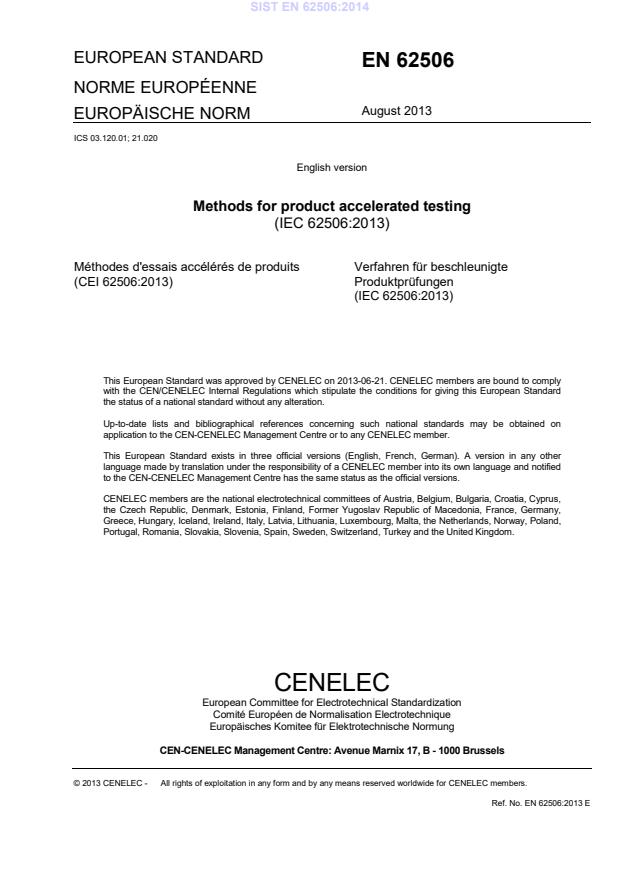
EUROPEAN STANDARD EN 62506 NORME EUROPÉENNE
EUROPÄISCHE NORM August 2013
CENELEC European Committee for Electrotechnical Standardization Comité Européen de Normalisation Electrotechnique Europäisches Komitee für Elektrotechnische Normung
CEN-CENELEC Management Centre: Avenue Marnix 17, B - 1000 Brussels
© 2013 CENELEC -
All rights of exploitation in any form and by any means reserved worldwide for CENELEC members.
Ref. No. EN 62506:2013 E
ICS 03.120.01; 21.020
English version
Methods for product accelerated testing (IEC 62506:2013)
Méthodes d'essais accélérés de produits (CEI 62506:2013)
Verfahren für beschleunigte Produktprüfungen (IEC 62506:2013)
This European Standard was approved by CENELEC on 2013-06-21. CENELEC members are bound to comply with the CEN/CENELEC Internal Regulations which stipulate the conditions for giving this European Standard the status of a national standard without any alteration.
Up-to-date lists and bibliographical references concerning such national standards may be obtained on application to the CEN-CENELEC Management Centre or to any CENELEC member.
This European Standard exists in three official versions (English, French, German). A version in any other language made by translation under the responsibility of a CENELEC member into its own language and notified to the CEN-CENELEC Management Centre has the same status as the official versions.
CENELEC members are the national electrotechnical committees of Austria, Belgium, Bulgaria, Croatia, Cyprus, the Czech Republic, Denmark, Estonia, Finland, Former Yugoslav Republic of Macedonia, France, Germany, Greece, Hungary, Iceland, Ireland, Italy, Latvia, Lithuania, Luxembourg, Malta, the Netherlands, Norway, Poland, Portugal, Romania, Slovakia, Slovenia, Spain, Sweden, Switzerland, Turkey and the United Kingdom.
Foreword The text of document 56/1503/FDIS, future edition 1 of IEC 62506, prepared by IEC/TC 56 "Dependability" was submitted to the IEC-CENELEC parallel vote and approved by CENELEC as EN 62506:2013.
The following dates are fixed: • latest date by which the document has to be implemented at national level by publication of an identical national standard or by endorsement (dop) 2014-03-21 • latest date by which the national standards conflicting with the document have to be withdrawn (dow) 2016-06-21
Attention is drawn to the possibility that some of the elements of this document may be the subject of patent rights. CENELEC [and/or CEN] shall not be held responsible for identifying any or all such patent rights. Endorsement notice The text of the International Standard IEC 62506:2013 was approved by CENELEC as a European Standard without any modification. In the official version, for Bibliography, the following notes have to be added for the standards indicated: IEC 60812 NOTE
Harmonized as EN 60812:2006 IEC 61125:1992 NOTE
Harmonized as EN 61125:1993 (not modified).
- 3 - EN 62506:2013
Annex ZA
(normative)
Normative references to international publications with their corresponding European publications
The following documents, in whole or in part, are normatively referenced in this document and are indispensable for its application. For dated references, only the edition cited applies. For undated references, the latest edition of the referenced document (including any amendments) applies.
NOTE
When an international publication has been modified by common modifications, indicated by (mod), the relevant EN/HD applies.
Publication Year Title EN/HD Year IEC 60068
Series Environmental testing - -
IEC 60300-3-1 2003 Dependability management - Part 3-1: Application guide - Analysis techniques for dependability - Guide on methodology EN 60300-3-1 2004
IEC 60300-3-5
Dependability management - Part 3-5: Application guide - Reliability test conditions and statistical test principles - -
IEC 60605-2
Equipment reliability testing -
Part 2: Design of test cycles - -
IEC 60721
Series Classification of environmental testing - -
IEC 61014 2003 Programmes for reliability growth EN 61014 2003
IEC 61124 + corr. January
2012 2013 Reliability testing - Compliance tests for constant failure rate and constant failure intensity EN 61124 2012
IEC 61163-2
Reliability stress screening -
Part 2: Electronic components - -
IEC 61164 2004 Reliability growth - Statistical test and estimation methods EN 61164 2004
IEC 61649 2008 Weibull analysis EN 61649 2008
IEC 61709 2011 Electric components - Reliability - Reference conditions for failure rates and stress models for conversion EN 61709 2011
IEC 61710
Power law model - Goodness-of-fit tests and estimation methods EN 61710
IEC 62303
Radiation protection instrumentation - Equipment for monitoring airborne tritium - -
IEC/TR 62380
Reliability data handbook - Universal model for reliability prediction of electronics components, PCBs and equipment - -
IEC 62429
Reliability growth - Stress testing for early failures in unique complex systems EN 62429
IEC 62506 Edition 1.0 2013-06 INTERNATIONAL STANDARD NORME INTERNATIONALE Methods for product accelerated testing
Méthodes d'essais accélérés de produits
INTERNATIONAL ELECTROTECHNICAL COMMISSION COMMISSION ELECTROTECHNIQUE INTERNATIONALE XD ICS 03.120.01; 21.020 PRICE CODE CODE PRIX ISBN 978-2-83220-861-8
– 2 – 62506 © IEC:2013 CONTENTS FOREWORD . 5 INTRODUCTION . 7 1 Scope . 8 2 Normative references . 8 3 Terms, definitions, symbols and abbreviations . 9 3.1 Terms and definitions . 9 3.2 Symbols and abbreviated terms . 11 4 General description of the accelerated test methods. 12 4.1 Cumulative damage model . 12 4.2 Classification, methods and types of test acceleration . 14 4.2.1 General . 14 4.2.2 Type A: qualitative accelerated tests . 15 4.2.3 Type B: quantitative accelerated tests . 15 4.2.4 Type C: quantitative time and event compressed tests . 16 5 Accelerated test models . 17 5.1 Type A, qualitative accelerated tests . 17 5.1.1 Highly accelerated limit tests (HALT) . 17 5.1.2 Highly accelerated stress test (HAST) . 21 5.1.3 Highly accelerated stress screening/audit (HASS/HASA) . 21 5.1.4 Engineering aspects of HALT and HASS . 22 5.2 Type B and C – Quantitative accelerated test methods . 23 5.2.1 Purpose of quantitative accelerated testing . 23 5.2.2 Physical basis for the quantitative accelerated Type B test methods . 23 5.2.3 Type C tests, time (C1) and event (C2) compression . 24 5.3 Failure mechanisms and test design . 26 5.4 Determination of stress levels, profiles and combinations in use and test – stress modelling . 27 5.4.1 General . 27 5.4.2 Step-by-step procedure . 27 5.5 Multiple stress acceleration methodology – Type B tests . 27 5.6 Single and multiple stress acceleration for Type B tests . 30 5.6.1 Single stress acceleration methodology . 30 5.6.2 Stress models with stress varying as a function of time – Type B tests . 37 5.6.3 Stress models that depend on repetition of stress applications – Fatigue models . 38 5.6.4 Other acceleration models – Time and event compression. 40 5.7 Acceleration of quantitative reliability tests . 40 5.7.1 Reliability requirements, goals, and use profile . 40 5.7.2 Reliability demonstration or life tests . 42 5.7.3 Testing of components for a reliability measure . 47 5.7.4 Reliability measures for components and systems/items . 48 5.8 Accelerated reliability compliance or evaluation tests . 48 5.9 Accelerated reliability growth testing . 50 5.10 Guidelines for accelerated testing . 50 5.10.1 Accelerated testing for multiple stresses and the known use profile . 50 5.10.2 Level of accelerated stresses . 51 SIST EN 62506:2014
62506 © IEC:2013 – 3 – 5.10.3 Accelerated reliability and verification tests . 51 6 Accelerated testing strategy in product development . 51 6.1 Accelerated testing sampling plan . 51 6.2 General discussion about test stresses and durations . 52 6.3 Testing components for multiple stresses . 53 6.4 Accelerated testing of assemblies . 53 6.5 Accelerated testing of systems . 53 6.6 Analysis of test results . 53 7 Limitations of accelerated testing methodology . 53 Annex A (informative)
Highly accelerated limit test (HALT) . 55 Annex B (informative)
Accelerated reliability compliance and growth test design . 59 Annex C (informative)
Comparison between HALT and conventional accelerated testing . 74 Annex D (informative)
Estimating the activation energy, Ea. 75 Annex E (informative)
Calibrated accelerated life testing (CALT) . 77 Annex F (informative)
Example on how to estimate empirical factors . 79 Annex G (informative)
Determination of acceleration factors by testing to failure . 84 Bibliography . 87
Figure 1 – Probability density functions (PDF) for cumulative damage, degradation, and test types . 13 Figure 2 – Relationship of PDFs of the product strength vs. load in use . 18 Figure 3 – How uncertainty of load and strength affects the test policy . 19 Figure 4 – PDFs of operating and destruct limits as a function of applied stress . 20 Figure 5 – Line plot for Arrhenius reaction model . 34 Figure 6 – Plot for determination of the activation energy . 35 Figure 7 – Multiplier of the test stress duration for demonstration of required reliability for compliance or reliability growth testing . 45 Figure 8 – Multiplier of the duration of the load application
for the desired reliability . 46 Figure B.1 – Reliability as a function of multiplier k and for combinations of parameters a and b . 61 Figure B.2 – Determination of the multiplier k . 64 Figure B.3 – Determination of the growth rate . 73 Figure D.1 – Plotting failures to estimate the activation energy Ea . 76 Figure F.1 – Weibull graphical data analysis . 81 Figure F.2 – Scale parameter as a function of the temperature range . 82 Figure F.3 – Probability of failure as a function of number of cycles ∆T = 50 °C . 83 Figure G.1 – Weibull plot of the three data sets . 85 Figure G.2 – Scale parameters’ values fitted with a power line . 86
Table 1 – Test types mapped to the product development cycle . 14 Table A.1 – Summary of HALT test results for a DC/DC converter . 56 Table A.2 – Summary of HALT results from a medical system . 57 Table A.3 – Summary of HALT results for a Hi-Fi equipment . 58 Table B.1 – Environmental stress conditions of an automotive electronic device . 63 SIST EN 62506:2014
– 4 – 62506 © IEC:2013 Table B.2 – Product use parameters . 67 Table B.3 – Assumed product use profile . 71 Table B.4 – Worksheet for determination of use times to failures . 72 Table B.5 – Data for reliability growth plotting . 73 Table C.1 – Comparison between HALT and conventional accelerated testing . 74 Table F.1 − Probability of failure of test samples A and B . 80 Table F.2 – Data transformation for Weibull plotting . 80 Table G.1 – Voltage test failure data for Weibull distribution . 84
62506 © IEC:2013 – 5 – INTERNATIONAL ELECTROTECHNICAL COMMISSION ____________
METHODS FOR PRODUCT ACCELERATED TESTING
FOREWORD 1) The International Electrotechnical Commission (IEC) is a worldwide organization for standardization comprising all national electrotechnical committees (IEC National Committees). The object of IEC is to promote international co-operation on all questions concerning standardization in the electrical and electronic fields. To this end and in addition to other activities, IEC publishes International Standards, Technical Specifications, Technical Reports, Publicly Available Specifications (PAS) and Guides (hereafter referred to as “IEC Publication(s)”). Their preparation is entrusted to technical committees; any IEC National Committee interested in the subject dealt with may participate in this preparatory work. International, governmental and non-governmental organizations liaising with the IEC also participate in this preparation. IEC collaborates closely with the International Organization for Standardization (ISO) in accordance with conditions determined by agreement between the two organizations. 2) The formal decisions or agreements of IEC on technical matters express, as nearly as possible, an international consensus of opinion on the relevant subjects since each technical committee has representation from all interested IEC National Committees.
3) IEC Publications have the form of recommendations for international use and are accepted by IEC National Committees in that sense. While all reasonable efforts are made to ensure that the technical content of IEC Publications is accurate, IEC cannot be held responsible for the way in which they are used or for any misinterpretation by any end user. 4) In order to promote international uniformity, IEC National Committees undertake to apply IEC Publications transparently to the maximum extent possible in their national and regional publications. Any divergence between any IEC Publication and the corresponding national or regional publication shall be clearly indicated in the latter. 5) IEC itself does not provide any attestation of conformity. Independent certification bodies provide conformity assessment services and, in some areas, access to IEC marks of conformity. IEC is not responsible for any services carried out by independent certification bodies. 6) All users should ensure that they have the latest edition of this publication. 7) No liability shall attach to IEC or its directors, employees, servants or agents including individual experts and members of its technical committees and IEC National Committees for any personal injury, property damage or other damage of any nature whatsoever, whether direct or indirect, or for costs (including legal fees) and expenses arising out of the publication, use of, or reliance upon, this IEC Publication or any other IEC Publications.
8) Attention is drawn to the Normative references cited in this publication. Use of the referenced publications is indispensable for the correct application of this publication. 9) Attention is drawn to the possibility that some of the elements of this IEC Publication may be the subject of patent rights. IEC shall not be held responsible for identifying any or all such patent rights. International Standard IEC 62506 has been prepared by IEC technical committee 56: Dependability. The text of this standard is based on the following documents: FDIS Report on voting 56/1503/FDIS 56/1513/RVD
Full information on the voting for the approval of this standard can be found in the report on voting indicated in the above table. This publication has been drafted in accordance with the ISO/IEC Directives, Part 2. SIST EN 62506:2014
– 6 – 62506 © IEC:2013 The committee has decided that the contents of this publication will remain unchanged until the stability date indicated on the IEC web site under "http://webstore.iec.ch" in the data related to the specific publication. At this date, the publication will be • reconfirmed, • withdrawn, • replaced by a revised edition, or • amended.
IMPORTANT – The 'colour inside' logo on the cover page of this publication indicates that it contains colours which are considered to be useful for the correct understanding of its contents. Users should therefore print this document using a colour printer.
62506 © IEC:2013 – 7 – INTRODUCTION Many reliability or failure investigation test methods have been developed and most of them are currently in use. These methods are used to either determine product reliability or to identify potential product failure modes, and have been considered effective as demonstrations of reliability: – fixed duration,
– sequential probability ratio,
– reliability growth tests,
– tests to failure, etc.
Such tests, although very useful, are usually lengthy, especially when the product reliability that has to be demonstrated was high. The reduction in time-to-market periods as well as competitive product cost, increase the need for efficient and effective accelerated testing. Here, the tests are shortened through the application of increased stress levels or by increasing the speed of application of repetitive stresses, thus facilitating a quicker assessment and growth of product reliability through failure mode discovery and mitigation. There are two distinctly different approaches to reliability activities: – the first approach verifies, through analysis and testing, that there are no potential failure modes in the product that are likely to be activated during the expected life time of the product under the expected operating conditions;
– the second approach estimates how many failures can be expected after a given time under the expected operating conditions.
Accelerated testing is a method appropriate for both cases, but used quite differently. The first approach is associated with qualitative accelerated testing, where the goal is identification of potential faults that eventually might result in product field failures. The second approach is associated with quantitative accelerated testing where the product reliability may be estimated based on the results of accelerated simulation testing that can be related back to the use of the environment and usage profile. Accelerated testing can be applied to multiple levels of items containing hardware or software. Different types of reliability testing, such as fixed duration, sequential test-to-failure, success test, reliability demonstration, or reliability growth/improvement tests can be candidates for accelerated methods. This standard provides guidance on selected, commonly used accelerated test types. This standard should be used in conjunction with statistical test plan standards such as IEC 61123, IEC 61124, IEC 61649 and IEC 61710. The relative merits of various methods and their individual or combined applicability in evaluating a given system or item, should be reviewed by the product design team (including dependability engineering) prior to selection of a specific test method or a combination of methods. For each method, consideration should also be given to the test time, results produced, credibility of the results, data required to perform meaningful analysis, life cycle cost impact, complexity of analysis and other identified factors.
– 8 – 62506 © IEC:2013 METHODS FOR PRODUCT ACCELERATED TESTING
1 Scope This International Standard provides guidance on the application of various accelerated test techniques for measurement or improvement of product reliability. Identification of potential failure modes that could be experienced in the use of a product/item and their mitigation is instrumental to ensure dependability of an item.
The object of the methods is to either identify potential design weakness or provide information on item dependability, or to achieve necessary reliability/availability improvement, all within a compressed or accelerated period of time. This standard addresses accelerated testing of non-repairable and repairable systems. It can be used for probability ratio sequential tests, fixed duration tests and reliability improvement/growth tests, where the measure of reliability may differ from the standard probability of failure occurrence.
This standard also extends to present accelerated testing or production screening methods that would identify weakness introduced into the product by manufacturing error, which could compromise product dependability. 2 Normative references The following documents, in whole or in part, are normatively referenced in this document and are indispensable for its application. For dated references, only the edition cited applies. For undated references, the latest edition of the referenced document (including any amendments) applies. IEC 60068 (all parts), Environmental testing IEC 60300-3-1:2003, Dependability management – Part 3-1: Application guide – Analysis techniques for dependability – Guide on methodology IEC 60300-3-5, Dependability management – Part 3-5: Application guide – Reliability test conditions and statistical test principles IEC 60605-2, Equipment reliability testing – Part 2: Design of test cycles IEC 60721 (all parts), Classification of environmental conditions IEC 61014:2003, Programmes for reliability growth IEC 61164:2004, Reliability growth – Statistical test and estimation methods IEC 61124:2012, Reliability testing – Compliance tests for constant failure rate and constant failure intensity
IEC 61163-2, Reliability stress screening – Part 2: Electronic components IEC 61649:2008, Weibull analysis
IEC 61709, Electronic components – Reliability – Reference conditions for failure rates and stress models for conversion SIST EN 62506:2014
62506 © IEC:2013 – 9 – IEC 61710, Power law model – Goodness-of-fit tests and estimation methods IEC 62303, Radiation protection instrumentation – Equipment for monitoring airborne tritium
IEC/TR 62380, Reliability data handbook – Universal model for reliability prediction of electronics components, PCBs and equipment IEC 62429, Reliability growth – Stress testing for early failures in unique complex systems
3 Terms, definitions, symbols and abbreviations For the purposes of this document, the term and definitions given in IEC 60050-191:____, as well as the following, apply. NOTE Symbols for reliability, availability, maintainability and safety measures follow those of
IEC 50060-191:1990, where available.
3.1 Terms and definitions 3.1.1
item subject being considered Note 1 to entry: The item may be an individual part, component, device, functional unit, equipment, subsystem, or system.
Note 2 to entry: The item may consist of hardware, software, people or any combination thereof.
Note 3 to entry: The item is often comprised of elements that may each be individually considered. See "sub-item", definition 191-41-02 and "indenture level", definition 191-41-05.
Note 4 to entry: IEC 60050-191:1990, first edition, identified the term “entity” as a synonym, which is not true for all applications.
Note 5 to entry: The definition for item given in the first edition
is a description rather than a definition. This new definition provides meaningful substitution throughout this standard. The words of the former definition form the new note 1. [SOURCE: IEC 60050-191:—, definition 191-41-01] [1]1 3.1.2
step stress step stress test
test in which the applied stress is increased, after each specified interval, until failure occurs or a predetermined stress level is reached
Note 1 to entry: The ‘intervals’ could be specified in terms of number of stress applications, durations, or test sequences.
Note 2 to entry: The test should not alter the basic failure modes, failure mechanisms, or their relative prevalence. [SOURCE: IEC 60050-191:—, definition 191-49-10] 3.1.3
acceleration factor ratio between the item failure distribution characteristics or reliability measures (e.g. failure intensities) of an item when it is subject to stresses in expected use and those the item acquires when the higher level stresses are applied for achieving a shorter test duration ————————— 1
Figures in square brackets refer to the Bibliography. SIST EN 62506:2014
– 10 – 62506 © IEC:2013 Note 1 to entry: For a test to be effectively accelerated, the acceleration factor is ξ1. Note 2 to entry: When the failure distribution Poisson is assumed with constant failure rate, then the acceleration factor corresponds to the ratio of time under stress in use vs. time under increased stress in test. 3.1.4
highly accelerated limit test HALT test or sequence of tests intended to identify the most likely failure modes of the product in a defined stress environment
Note 1 to entry: HALT is sometimes spelled out as the highly accelerated life test (as it was originally named in error). However, as a non-measurable accelerated test, it does not provide information on life duration, but on the magnitude of stress which represents the limit of the design. 3.1.5
highly accelerated stress test HAST test where applied stresses are considerably increased in order to reduce duration of their application 3.1.6
highly accelerated stress screening HASS screening intended to identify latent defects in a product caused by manufacturing process or control errors 3.1.7
highly accelerated stress audit HASA process monitoring tool where a sample from a production lot is tested to detect potential weaknesses in a product caused by manufacturing 3.1.8
activation energy Ea empirical factor for estimating the acceleration caused by a change in absolute temperature Note 1 to entry: Activation energy is usually measured in electron volts per degree Kelvin. 3.1.9
event compression increasing stress repetition frequency to be considerably higher than it is in the field 3.1.10
time compression removal of exposure time at low or deemed non damaging stress levels from a test for purpose of acceleration 3.1.11
precipitation screen screening profile to precipitate, through failure, conversion of latent into permanent faults 3.1.12
detection screen low stress level exposure to detect intermittent faults SIST EN 62506:2014
62506 © IEC:2013 – 11 – 3.2 Symbols and abbreviated terms Symbol/ Abbreviation Description (ΦtR reliability as a function of time; probability of survival past the time t NOTE 1 IEC 60050-191:1990, definition 191-12-01 uses the general symbol (Φ21,ttR. Time may be substituted by cycles, measure of distance, etc. (Φtλ failure rate as a function of time NOTE 2 In reliability growth testing, the same symbol normally used for the instantaneous failure rate can be used for variable failure intensity. HALT highly accelerated limit test HASS highly accelerated stress screening test HAST highly accelerated stress test HASA highly accelerated stress audit λ(S) failure rate as a function of a stress UUT unit under test A acceleration, acceleration factor Atest overall acceleration in a test ADT accelerated degradation testing DSL design specification limit RTL reliability test level SL specification limit DL destruct limit LDL lower destruct limit UDL upper destruct limit OL operating limit UOL upper operating limit LOL lower operating limit SPRT sequential probability ratio test RG reliability growth URTL upper reliability test limit LRTL lower reliability test limit
THB temperature humidity bias test TTF time to failure MTBF mean operating time between failures MTTF mean time to failure AF acceleration factor FIT failure to time CALT calibrated accelerated life testing ADT accelerated degradation test t0 start of a period of in determination of product destruct life rest tL duration of a predetermined time, e. g. life SPRT sequential probability ratio tests SIST EN 62506:2014
– 12 – 62506 © IEC:2013 4 General description of the accelerated test methods 4.1 Cumulative damage model
Accelerated testing of any type is based on the cumulative damage principle. The stresses of the product in its life cause progressive damage that accumulates throughout the product life. This damage may or may not result in a product’s failure in the field.
The strategy of any type of accelerated testing is to produce, by increasing stress levels during testing, cumulative damage equivalent to that expected in the product’s life for the type of expected stress. Determination of product destruct limits, without reliability estimation, provides information on whether there exists a sufficient margin between those destruct limits and product specification limits, thus providing assurance that the product will survive its predetermined life period without failure related to that specific stress type. This technique may or may not necessarily quantify a probability of product survival for its life, just assurance that the necessary adjustments in product strength would help eliminate such failure in product use. Where sufficient margins are determined unrelated to the probability of survival, the type of test is qualitative. In tests where this probability of survival is determined, the magnitude of the stress is correlated to the probability that the product would survive that stress type beyond the predetermined life, and this test type is quantitative.
Figure 1 depicts the principle of cumulative damage in both qualitative and quantitative accelerated tests. In Figure 1, for simplicity, all stresses, operating limits, destruct limits, etc. are shown as absolute values. The specification values for an item are usually given in both extremes, upper and lower, thus the upper and lower (or low) specification limit, USL and LSL with the corresponding design limits (DSL), UDL and LDL, the upper and lower operating limits, UOL and LOL, and also the reliability test limits, URTL and LRTL. The rationale is that the opposite (negative stresses, may also cause cumulative damage probably with a differently failure mechanism, thus the relationship between the expected and specified limits can be illustrated in the same manner as for the high or positive stress. As an example, cold temperature extremes might produce the same or different failure modes in a product. To avoid clutter, the positive and the negative thermal or any other stresses are not separately shown in Figure 1, thus the magnitudes of stresses are either positive or negative, and thus represented as absolute values only as upper or lower limits. SIST EN 62506:2014
62506 © IEC:2013 – 13 –
0,00 0,10 0,20 0,30 0,40 0,50 0,60 0,70 0,80 0,90 1,00 0,0 2,5 5,0 7,5 10,0 12,5 15,0 17,5 20,0 22,5 25,0 27,5 30,0 32,5 35,0 37,5 40,0 42,5 45,0 Stress
PDF Requirement level Reliability test level Design specification level Operating level/HALT Destruct level ReqL RTL (tL) DSL OL DL Cumulative
damage Stress level IEC
1378/13
Figure 1 – Probability density functions (PDF) for cumulative damage, degradation, and test types The graph in Figure 1 shows the required strength of a product regarding a stress for the duration of its lifetime, from beginning of life (e.g. time when the product is made), t0 through the end of life, tL. The strength and stresses in tests are also assumed to have a Gaussian distribution.
The different types of accelerated tests can now be illustrated using Figure 1 as a conceptual model. Functional testing is carried out within the range of the requirement specification and at the level of the specification. In this area no failures should occur during the test; design is validated to allow operation within the upper and lower specification limits. Accelerated testing of Type B and C (4.2.3 and 4.2.4), i.e. accelerated degradation testing (ADT) or cumulative damage testing can be illustrated as the distance between the design specification level (DSL) and the level where the reliability demonstration test should be performed (RTL). When the degradation reduces the performance below the requirement specifications the product can be declared as failed, if this behaviour is defined as a failure. When testing the product at time t0 no failures should be expected for stress levels up to and including the design specification level (DSL). The product design specification should take into consideration certain degradation during the product’s life which is resultant from the cumulative damage of the stresses expected in life, thus its limit is the design specification limit (DSL) which is higher than the requirement limit (RL) in order to provide the necessary margin. After product degradation resultant from the cumulative damage caused by expected stresses, the reliability test provides information on the existing margin between the test level (the remaining strength) and the requirement. This margin is a measure of reliability at the end of required period, tL. The ultimate strength of the design is considerably higher than the design specifications and this is the level determined in the qualitative accelerated test where the goal is to identify SIST EN 62506:2014
– 14 – 62506 © IEC:2013 design weaknesses which could compromise product reliability, i.e. the weaknesses that could occur in the product’s life span, as the product degrades. Thus, the strength in the qualitative test is demonstrated at operating limit (OL). The destruct limit is above (beyond) the operating limit, and is denoted as DL. This is where a permanent failure is observed. If OL or DL are close to the DSL or standard deviation of the OL or DL distributions are high, then the test will indicate a potential weakness in the design as indicated in Figure 1. Product reliability is a function of time, usually predetermined life time, tL. The cumulative normal distribution of the margin (difference of stress means divided by their common standard deviation) between the specified strength (use conditions) which is represented by the requirement and the reliability test level (RTL) determines product reliability. The test level and its duration are chosen so as to cause cumulative damage during testing corresponding to the degradation due to cumulative damage in the product’s life span. The calculated value, produces product required reliability, which is then a quantitative measure.
A summary of listed tests and the mapping of their applications to the product life cycle is presented in Table 1. Table 1 – Test types mapped to the product development cycle
Table 1 provides the users of this standard a synthesis in order to get a better understanding of the different methods as and when required during the whole life cycle product.
4.2 Classification, methods and types of test acceleration 4.2.1 General Based on the cumulative damage model, the information expected from the test and the product use assumptions, the accelerated test methods may be divided into three groups:
• Type A: qualitative accelerated tests: for detection of failure mode and/or phenomenon;
• Type B quantitative accelerated tests: for prediction of failure distribution in normal use; • Type C: quantitative time and event compression tests: for prediction of failure distribution in normal use. NOTE Both B and C types of test may lead to test time reduction. Type B test should be performed based on particular failure mechanism, and generally it may be applied to lifetime acceleration. Type C test requires
Reliability Production Acceptance TestReliability Qualification TestReliability Growth TestB & CQuantativeType B/C : ComponentType A: ComponentFMECADesignHASS/HASAHALTAQualitativeType B/C : SystemType A : Assembly an/or SubsystemType B/C : AssemblyProduct Breakdown structure OpportunityServicesManufacturingAcceptanceValidationIntegrationTypeReliability Production Acceptance TestReliability Qualification TestReliability Growth TestB & CQuantativeType B/C : ComponentType A: ComponentFMECADesignHASS/HASAHALTAQualitativeType B/C : SystemType A : Assembly an/or SubsystemType B/C : AssemblyProduct Breakdown structure OpportunityServicesManufacturingAcceptanceValidationIntegrationTypeMaturity BuildingMaturity ConfirmationMaturity AssessmentIEC
1379/13 SIST EN 62506:2014
62506 © IEC:2013 – 15 – research of usage or specific conditions’ assumption before test . Type C test may be applied to failure rate acceleration. 4.2.2 Type A: qualitative accelerated tests Type A, accelerated tests, are designed to identify potential design weaknesses and also weaknesses caused by the manufacturing process. They can therefore be induced at levels considerably higher, than OL, as shown in Figure 1, i.e. The goal of this type of test is not to quantify product reliability, but to induce or precipitate, during the test, the product’s overall performance issues which are likely to take place in the field some time during the product’s useful life and result in a product failure. Improvement of the product design or manufacturing processes is executed to preclude those failures, producing a stronger or more robust product, expected to be more reliable in the field even under extreme or repetitive stresses as outlined in the design specifications.
Product development processes using this type of test increase product reliability through the mitigation of failure modes and by increasing product robustness without demonstrating a reliability target or measuring reliability improvement. These tests are often made with such high stress levels that, ideally, failures should be observed (DL in Figure 1) well beyond design specification limits. The purpose is to identify the failure modes, the weak links in the design and the margin between the functional limits, operating limit (OL) and the destruct limit (DL) in Figure 1. The margin between the specification limit and the operating limit ensures that the weaknesses are identified in HALT and are not expected to occur as failures during the expected product life, tL. 4.2.3 Type B: quantitative accelerated tests
Type B tests use cumulative damage methods to determine product reliability projected to the end of the expected product life. The necessary margin between the expected cumulative damage and the requirement produces a reliability measure. These tests are then accelerated to achieve the required cumulative damage in considerably shorter time than the product’s expected life. Type B accelerated tests use quantifiable acceleration factors which are based on the physics of specific failures (or failure modes) and provide a relationship between the exposure time to the specific stresses during testing and in use environment. The failure, or failure mode distribution, is determined from information gathered through separate accelerated tests. Such test information provides the basis for a functional life model and can be used to quantify test acceleration for various reliability calculations, as necessary and/or applicable. In this way, product reliability can be estimated through estimation of the reliability or probability of occurrence of individual failure modes for any level of expected stresses. If needed for data analysis using other test types (e.g. reliability growth or reliability demonstration tests), the determined test acceleration factor can be used to recalculate times to failure data from accelerated tests so as to represent times to failure occurrences in the use environment, and use the results for reliability calculations. In Figure 1, these tests are shown as reliability test levels (RTL). Another way of getting information from this type of test is to test to failure samples of items for the specific failure modes and the specific environments. This permits determination of applicable failure distributions and appropriate acceleration factors which can then be used for calculation of the pro
...