

SIST EN ISO 10993-1:2026
(Main)Biological evaluation of medical devices - Part 1: Requirements and general principles for the evaluation of biological safety within a risk management process (ISO 10993-1:2025)
General Information
- Abstract
This document specifies the requirements and general principles governing the biological evaluation of medical devices within a risk management process according to ISO 14971.
This document applies to the biological evaluation of medical devices that have direct contact or indirect contact with either:
— a patient's body during intended use or reasonably foreseeable misuse; or
— the body of other users who are not patients, if the medical device is intended for personal protection (e.g. medical gloves, surgical masks).
Biological evaluation assesses the biological safety of the medical device by considering the biological risks associated with:
— constituents of a medical device; and
— tissue-device interactions (including physical effects).
The biological evaluation specified in this document can address the biological safety of the medical device, considering the life cycle from design and development through initial use of the finished medical device to final decommissioning or withdrawal from use. The biological evaluation considers both the biological safety of the finished device in first use, and the significance of any changes to the medical device which can occur throughout the life cycle. However, the evaluation of risks related to environmental impacts of decommissioning of medical devices are not within the scope of this document. This document does not mandate re-testing of medical devices that are already on the market and have established and acceptable safety profiles (see 6.6.2).
This document can be useful to support clinical or usability evaluations of medical devices. For example, a biological evaluation is a pre-requisite for conducting a clinical trial. This means that principles outlined in this document can be applied to the evaluation of prototype or development stage devices, as well as to finished medical devices.
Other parts of the ISO 10993 series cover specific aspects of biological evaluation, such as chemical characterization, biological testing, sample preparation, animal welfare and toxicological risk assessment.
For some types of medical devices, specific requirements from other standards (outside the ISO 10993 series) can be considered with a justification for the approach taken if there are differences between the requirements of the ISO 10993 series and those provided in other standards. For example, the ISO 18562 series provides specific requirements for biological evaluation of breathing gas pathway medical devices and ISO 7405 provides specific requirements for biological evaluation of dental devices.
The evaluation of risks related to infectious agents [e.g. bacteria, moulds, yeasts, viruses, transmissible spongiform encephalopathy (TSE) agents] is not within the scope of this document.
NOTE 1 The evaluation of bacterial endotoxins is addressed by ISO 11737-3.
NOTE 2 The evaluation of risks related to viruses, TSE agents and other pathogens originating from materials of animal origin is addressed by the ISO 22442 series.
- Status
- Published
- Public Enquiry End Date
- 15-Sep-2024
- Publication Date
- 18-Jan-2026
- Technical Committee
- VAZ - Healthcare
- Current Stage
- 6060 - National Implementation/Publication (Adopted Project)
- Start Date
- 08-Jan-2026
- Due Date
- 15-Mar-2026
- Completion Date
- 19-Jan-2026
- Directive
- 2017/745 - Regulation (EU) 2017/745 of the European Parliament and of the Council of 5 April 2017 on medical devices, amending Directive 2001/83/EC, Regulation (EC) No 178/2002 and Regulation (EC) No 1223/2009 and repealing Council Directives 90/385/EEC and 93/42/EECOJ Ref: L, 17.6.2026 OJ Date: 17-Jun-2026

Overview
SIST EN ISO 10993-1:2026 provides essential requirements and general principles for the biological evaluation of medical devices in the context of a risk management process. Developed by SIST and harmonized across the European Union, this international standard is aligned with the ISO 14971 risk management framework. It applies to all medical devices-whether intended for direct or indirect contact with a patient’s body during intended use (or foreseeable misuse), or for use by individuals other than patients, such as personal protection products like medical gloves and surgical masks.
This standard guides manufacturers and stakeholders in planning, conducting, and documenting biological evaluations to ensure the biological safety of medical devices throughout their entire life cycle-from material selection and device development to post-market phases and decommissioning. SIST EN ISO 10993-1:2026 is integral for compliance with regulatory requirements and for supporting clinical and usability evaluations.
Keywords: biological evaluation, medical devices, risk management, biocompatibility, ISO 10993-1, biological safety, regulatory compliance, medical device testing
Key Topics
- Integration with Risk Management: Biological evaluation must be conducted within the structured risk management process defined by ISO 14971, ensuring the identification, analysis, and control of biological risks.
- Scope of Biological Risk: The evaluation considers the impact of device constituents, device-tissue interactions (physical effects), and changes throughout the device’s life cycle.
- Contact Assessment: Applies to devices with both direct and indirect body contact, including products for personal protection.
- Evaluation Plan: Manufacturers must establish and follow a detailed biological evaluation plan, incorporating device categorization, hazard identification, and justification for biological testing or equivalence.
- Biological Testing: The standard outlines when and how to carry out biological, chemical, and physical testing. It emphasizes a science-based, risk-informed approach rather than prescriptive testing.
- Clinical and Usability Support: A proper biological evaluation is a prerequisite for clinical trials and can support broader clinical and usability assessments during product development.
Applications
- Medical Device Manufacturers: Ensures the selection and validation of materials and device designs that prioritize patient and user biological safety, both for established products and innovative technologies.
- Regulatory Compliance: Demonstrates conformity with the General Safety and Performance Requirements of Regulation (EU) 2017/745, supporting regulatory submissions in Europe and internationally.
- Clinical Investigations: Supplies required evidence of biological safety before clinical trials or usability studies, impacting device development timelines and market access.
- Lifecycle Management: Supports ongoing risk assessment throughout the product’s lifecycle, including after-market changes, device modifications, and decommissioning phases.
Related Standards
The ISO 10993 series offers comprehensive guidance for biological evaluation of medical devices, with specialized documents covering topics such as:
- Chemical Characterization: ISO 10993-18
- Biological Testing Methods: ISO 10993-5 (in vitro cytotoxicity), ISO 10993-10 (skin sensitization), ISO 10993-23 (irritation), among others
- Toxicological Risk Assessment: ISO 10993-17
- Sample Preparation and Material Characterization: ISO 10993-12, ISO/TS 10993-19
- Sterilization Residuals: ISO 10993-7
- Animal Welfare in Testing: ISO 10993-2
Other device-specific standards may apply, such as ISO 18562 for gas pathway devices and ISO 7405 for dental devices. Risk assessments related to infectious agents and some biological contaminations are addressed in standards outside the ISO 10993 series, including ISO 11737-3 and ISO 22442.
In summary, SIST EN ISO 10993-1:2026 is a cornerstone standard for biological risk management in medical devices, facilitating compliance, patient safety, and market acceptance through robust biological evaluation practices.
Relations
- Effective Date
- 01-Feb-2026
- Effective Date
- 28-Jan-2026
- Effective Date
- 28-Jan-2026
- Effective Date
- 28-Jan-2026
- Effective Date
- 28-Jan-2026
- Refers
SIST EN 15624:2021/kFprA1:2024 - Railway applications - Braking - Empty-loaded changeover devices - Effective Date
- 28-Jan-2026
- Effective Date
- 28-Jan-2026
- Refers
SIST EN ISO 19353:2019 - Safety of machinery - Fire prevention and fire protection (ISO 19353:2098) - Effective Date
- 28-Jan-2026
- Effective Date
- 28-Jan-2026
- Effective Date
- 28-Jan-2026
- Effective Date
- 28-Jan-2026
- Effective Date
- 28-Jan-2026
- Effective Date
- 28-Jan-2026
- Effective Date
- 28-Jan-2026
- Effective Date
- 09-Feb-2026
Get Certified
Connect with accredited certification bodies for this standard

BSI Group
BSI (British Standards Institution) is the business standards company that helps organizations make excellence a habit.

TÜV Rheinland
TÜV Rheinland is a leading international provider of technical services.

TÜV SÜD
TÜV SÜD is a trusted partner of choice for safety, security and sustainability solutions.
Sponsored listings
Frequently Asked Questions
SIST EN ISO 10993-1:2026 is a standard published by the Slovenian Institute for Standardization (SIST). Its full title is "Biological evaluation of medical devices - Part 1: Requirements and general principles for the evaluation of biological safety within a risk management process (ISO 10993-1:2025)". This standard covers: This document specifies the requirements and general principles governing the biological evaluation of medical devices within a risk management process according to ISO 14971. This document applies to the biological evaluation of medical devices that have direct contact or indirect contact with either: — a patient's body during intended use or reasonably foreseeable misuse; or — the body of other users who are not patients, if the medical device is intended for personal protection (e.g. medical gloves, surgical masks). Biological evaluation assesses the biological safety of the medical device by considering the biological risks associated with: — constituents of a medical device; and — tissue-device interactions (including physical effects). The biological evaluation specified in this document can address the biological safety of the medical device, considering the life cycle from design and development through initial use of the finished medical device to final decommissioning or withdrawal from use. The biological evaluation considers both the biological safety of the finished device in first use, and the significance of any changes to the medical device which can occur throughout the life cycle. However, the evaluation of risks related to environmental impacts of decommissioning of medical devices are not within the scope of this document. This document does not mandate re-testing of medical devices that are already on the market and have established and acceptable safety profiles (see 6.6.2). This document can be useful to support clinical or usability evaluations of medical devices. For example, a biological evaluation is a pre-requisite for conducting a clinical trial. This means that principles outlined in this document can be applied to the evaluation of prototype or development stage devices, as well as to finished medical devices. Other parts of the ISO 10993 series cover specific aspects of biological evaluation, such as chemical characterization, biological testing, sample preparation, animal welfare and toxicological risk assessment. For some types of medical devices, specific requirements from other standards (outside the ISO 10993 series) can be considered with a justification for the approach taken if there are differences between the requirements of the ISO 10993 series and those provided in other standards. For example, the ISO 18562 series provides specific requirements for biological evaluation of breathing gas pathway medical devices and ISO 7405 provides specific requirements for biological evaluation of dental devices. The evaluation of risks related to infectious agents [e.g. bacteria, moulds, yeasts, viruses, transmissible spongiform encephalopathy (TSE) agents] is not within the scope of this document. NOTE 1 The evaluation of bacterial endotoxins is addressed by ISO 11737-3. NOTE 2 The evaluation of risks related to viruses, TSE agents and other pathogens originating from materials of animal origin is addressed by the ISO 22442 series.
This document specifies the requirements and general principles governing the biological evaluation of medical devices within a risk management process according to ISO 14971. This document applies to the biological evaluation of medical devices that have direct contact or indirect contact with either: — a patient's body during intended use or reasonably foreseeable misuse; or — the body of other users who are not patients, if the medical device is intended for personal protection (e.g. medical gloves, surgical masks). Biological evaluation assesses the biological safety of the medical device by considering the biological risks associated with: — constituents of a medical device; and — tissue-device interactions (including physical effects). The biological evaluation specified in this document can address the biological safety of the medical device, considering the life cycle from design and development through initial use of the finished medical device to final decommissioning or withdrawal from use. The biological evaluation considers both the biological safety of the finished device in first use, and the significance of any changes to the medical device which can occur throughout the life cycle. However, the evaluation of risks related to environmental impacts of decommissioning of medical devices are not within the scope of this document. This document does not mandate re-testing of medical devices that are already on the market and have established and acceptable safety profiles (see 6.6.2). This document can be useful to support clinical or usability evaluations of medical devices. For example, a biological evaluation is a pre-requisite for conducting a clinical trial. This means that principles outlined in this document can be applied to the evaluation of prototype or development stage devices, as well as to finished medical devices. Other parts of the ISO 10993 series cover specific aspects of biological evaluation, such as chemical characterization, biological testing, sample preparation, animal welfare and toxicological risk assessment. For some types of medical devices, specific requirements from other standards (outside the ISO 10993 series) can be considered with a justification for the approach taken if there are differences between the requirements of the ISO 10993 series and those provided in other standards. For example, the ISO 18562 series provides specific requirements for biological evaluation of breathing gas pathway medical devices and ISO 7405 provides specific requirements for biological evaluation of dental devices. The evaluation of risks related to infectious agents [e.g. bacteria, moulds, yeasts, viruses, transmissible spongiform encephalopathy (TSE) agents] is not within the scope of this document. NOTE 1 The evaluation of bacterial endotoxins is addressed by ISO 11737-3. NOTE 2 The evaluation of risks related to viruses, TSE agents and other pathogens originating from materials of animal origin is addressed by the ISO 22442 series.
SIST EN ISO 10993-1:2026 is classified under the following ICS (International Classification for Standards) categories: 11.100 - Laboratory medicine; 11.100.20 - Biological evaluation of medical devices. The ICS classification helps identify the subject area and facilitates finding related standards.
SIST EN ISO 10993-1:2026 has the following relationships with other standards: It is inter standard links to SIST EN ISO 10993-1:2021, SIST EN 12905:2013, SIST EN 10217-2:2003/A1:2005, oSIST prEN ISO 16383-2:2026, kSIST FprEN 13121-3:2026, SIST EN 15624:2021/kFprA1:2024, SIST EN 16068:2012, SIST EN ISO 19353:2019, SIST EN 4652-220:2017, SIST EN 1793-2:2018, SIST EN 13381-1:2020, SIST EN 17703:2025, SIST EN 12301:2020/AC:2021, SIST EN ISO 3826-1:2019/A1:2023, SIST EN 60601-1:2007/A2:2021. Understanding these relationships helps ensure you are using the most current and applicable version of the standard.
SIST EN ISO 10993-1:2026 is associated with the following European legislation: EU Directives/Regulations: 2017/745; Standardization Mandates: M/575, M/575 Amd 2. When a standard is cited in the Official Journal of the European Union, products manufactured in conformity with it benefit from a presumption of conformity with the essential requirements of the corresponding EU directive or regulation.
SIST EN ISO 10993-1:2026 is available in PDF format for immediate download after purchase. The document can be added to your cart and obtained through the secure checkout process. Digital delivery ensures instant access to the complete standard document.
Standards Content (Sample)
SLOVENSKI STANDARD
01-februar-2026
Nadomešča:
SIST EN ISO 10993-1:2021
Biološko ovrednotenje medicinskih pripomočkov - 1. del: Zahteve in splošna
načela za oceno biološke varnosti znotraj procesa obvladovanja tveganja (ISO
10993-1:2025)
Biological evaluation of medical devices - Part 1: Requirements and general principles
for the evaluation of biological safety within a risk management process (ISO 10993-
1:2025)
Biologische Beurteilung von Medizinprodukten - Teil 1: Anforderungen und allgemeine
Grundsätze für die Beurteilung der biologischen Sicherheit im Rahmen eines
Risikomanagementsystems (ISO 10993-1:2025)
Évaluation biologique des dispositifs médicaux - Partie 1: Exigences et principes
généraux pour l’évaluation de la sécurité biologique au sein d’un processus de gestion
des risques (ISO 10993-1:2025)
Ta slovenski standard je istoveten z: EN ISO 10993-1:2025
ICS:
11.100.20 Biološko ovrednotenje Biological evaluation of
medicinskih pripomočkov medical devices
2003-01.Slovenski inštitut za standardizacijo. Razmnoževanje celote ali delov tega standarda ni dovoljeno.
EN ISO 10993-1
EUROPEAN STANDARD
NORME EUROPÉENNE
December 2025
EUROPÄISCHE NORM
ICS 11.100; 11.100.20 Supersedes EN ISO 10993-1:2020
English Version
Biological evaluation of medical devices - Part 1:
Requirements and general principles for the evaluation of
biological safety within a risk management process (ISO
10993-1:2025)
Évaluation biologique des dispositifs médicaux - Partie Biologische Beurteilung von Medizinprodukten - Teil 1:
1: Exigences et principes généraux pour l'évaluation de Anforderungen und allgemeine Grundsätze für die
la sécurité biologique au sein d'un processus de gestion Beurteilung der biologischen Sicherheit im Rahmen
des risques (ISO 10993-1:2025) eines Risikomanagementsystems (ISO 10993-1:2025)
This European Standard was approved by CEN on 18 August 2025.
CEN members are bound to comply with the CEN/CENELEC Internal Regulations which stipulate the conditions for giving this
European Standard the status of a national standard without any alteration. Up-to-date lists and bibliographical references
concerning such national standards may be obtained on application to the CEN-CENELEC Management Centre or to any CEN
member.
This European Standard exists in three official versions (English, French, German). A version in any other language made by
translation under the responsibility of a CEN member into its own language and notified to the CEN-CENELEC Management
Centre has the same status as the official versions.
CEN members are the national standards bodies of Austria, Belgium, Bulgaria, Croatia, Cyprus, Czech Republic, Denmark, Estonia,
Finland, France, Germany, Greece, Hungary, Iceland, Ireland, Italy, Latvia, Lithuania, Luxembourg, Malta, Netherlands, Norway,
Poland, Portugal, Republic of North Macedonia, Romania, Serbia, Slovakia, Slovenia, Spain, Sweden, Switzerland, Türkiye and
United Kingdom.
EUROPEAN COMMITTEE FOR STANDARDIZATION
COMITÉ EUROPÉEN DE NORMALISATION
EUROPÄISCHES KOMITEE FÜR NORMUNG
CEN-CENELEC Management Centre: Rue de la Science 23, B-1040 Brussels
© 2025 CEN All rights of exploitation in any form and by any means reserved Ref. No. EN ISO 10993-1:2025 E
worldwide for CEN national Members.
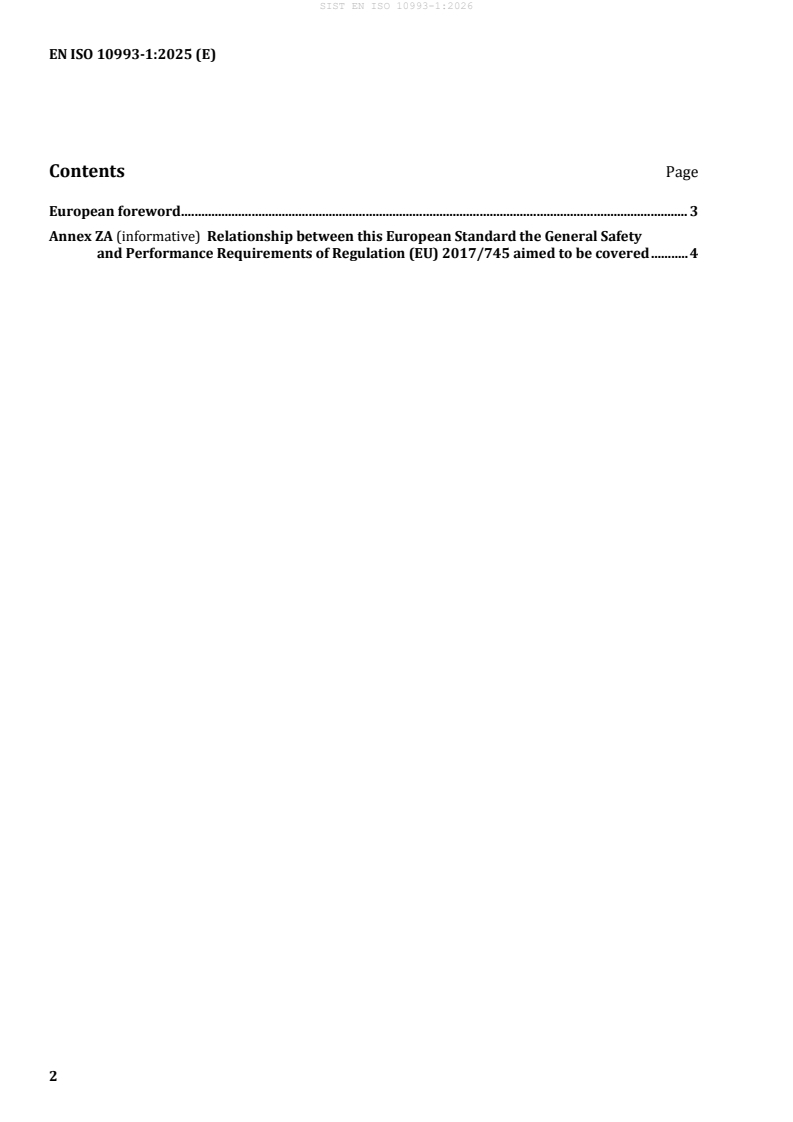
Contents Page
European foreword . 3
Annex ZA (informative) Relationship between this European Standard the General Safety
and Performance Requirements of Regulation (EU) 2017/745 aimed to be covered . 4
European foreword
This document (EN ISO 10993-1:2025) has been prepared by Technical Committee ISO/TC 194
"Biological and clinical evaluation of medical devices" in collaboration with Technical Committee
CEN/TC 206 “Biological and clinical evaluation of medical devices” the secretariat of which is held by
DIN.
This European Standard shall be given the status of a national standard, either by publication of an
identical text or by endorsement, at the latest by June 2026, and conflicting national standards shall be
withdrawn at the latest by June 2026.
Attention is drawn to the possibility that some of the elements of this document may be the subject of
patent rights. CEN shall not be held responsible for identifying any or all such patent rights.
This document supersedes EN ISO 10993-1:2020.
This document has been prepared under a standardization request addressed to CEN by the European
Commission. The Standing Committee of the EFTA States subsequently approves these requests for its
Member States.
For the relationship with EU Legislation, see informative Annex ZA, which is an integral part of this
document.
Any feedback and questions on this document should be directed to the users’ national standards
body/national committee. A complete listing of these bodies can be found on the CEN website.
According to the CEN-CENELEC Internal Regulations, the national standards organizations of the
following countries are bound to implement this European Standard: Austria, Belgium, Bulgaria,
Croatia, Cyprus, Czech Republic, Denmark, Estonia, Finland, France, Germany, Greece, Hungary, Iceland,
Ireland, Italy, Latvia, Lithuania, Luxembourg, Malta, Netherlands, Norway, Poland, Portugal, Republic of
North Macedonia, Romania, Serbia, Slovakia, Slovenia, Spain, Sweden, Switzerland, Türkiye and the
United Kingdom.
Endorsement notice
The text of ISO 10993-1:2025 has been approved by CEN as EN ISO 10993-1:2025 without any
modification.
Annex ZA
(informative)
Relationship between this European Standard the General Safety and
Performance Requirements of Regulation (EU) 2017/745 aimed to be
covered
This European standard has been prepared under M/575 to provide one voluntary means of
conforming to the General Safety and Performance Requirements of Regulation (EU) 2017/745 of 5
April 2017 concerning medical devices [OJ L 117] and to system or process requirements including
those relating to quality management systems, risk management, post-market surveillance systems,
clinical investigations, clinical evaluation or post-market clinical follow-up.
Once this standard is cited in the Official Journal of the European Union under that Regulation,
compliance with the normative clauses of this standard given in Table ZA.1 and application of the
edition of the normatively referenced standards as given in Table ZA.2 confers, within the limits of the
scope of this standard, a presumption of conformity with the corresponding General Safety and
Performance Requirements of that Regulation, and associated EFTA Regulations.
Where a definition in this harmonised standard differs from a definition of the same term set out in
Regulation (EU) 2017/745, the differences shall be indicated in the Annex Z. For the purpose of using
this standard in support of the requirements set out in Regulation (EU) 2017/745, the definitions set
out in this Regulation prevail.
Where the European standard is an adoption of an International Standard, the scope of this document
can differ from the scope of the European Regulation that it supports. As the scope of the applicable
regulatory requirements differ from nation to nation and region to region the standard can only
support European regulatory requirements to the extent of the scope of the European Regulation for
medical devices ((EU) 2017/745).
NOTE 1 Where a reference from a clause of this standard to the risk management process is made, the risk
management process needs to be in compliance with Regulation (EU) 2017/745. This means that risks have to be
‘reduced as far as possible’, ‘reduced to the lowest possible level’, ‘reduced as far as possible and appropriate’,
‘removed or reduced as far as possible’, ‘eliminated or reduced as far as possible’, ’removed or minimized as far as
possible’, or ‘minimized’, according to the wording of the corresponding General Safety and Performance
Requirement.
NOTE 2 The manufacturer’s policy for determining acceptable risk must be in compliance with General Safety
and Performance Requirements 1, 2, 3, 4, 5, 8, 9, 10, 11, 14, 16, 17, 18, 19, 20, 21 and 22 of the Regulation.
NOTE 3 When a General Safety and Performance Requirement does not appear in Table ZA.1, it means that it is
not addressed by this European Standard.
NOTE 4 General Safety and Performance Requirements listed in Table ZA.1 are specific to biological safety for
patients only, unless the medical device is used for personal protection of the user
Table ZA.1 — Correspondence between this European Standard and Annex I
of Regulation (EU) 2017/745 [OJ L 117] and to system or process requirements including those
relating to quality management systems, risk management, post-market surveillance systems, clinical
investigations, clinical evaluation or post-market clinical follow-up
General Safety and Performance
Clause(s)/subclause(s) of
Requirements of Regulation Remarks/Notes
this EN
(EU) 2017/745
This is partly covered by this
document since the standard does
not provide requirements for
10.1. a) 4.1, 4.3, 6.2, 6.3, 6.5, 7, 8, 10
performance.
Flammability is not covered.
These are partly covered by this
4.1, 4.3, 5, 6.1, 6.2, 6.3, 6.4, 6.5, 7, document since the standard does
10.1. b), d) and g)
10 not provide requirements for
performance.
Persons involved in the transport,
storage and use of medical devices
4.1, 4.3, 5, 6.1, 6.2, 6.3, 6.4, 6.5, 7,
10.2 are not covered unless the user is
8, 10
the patient, or the medical device
is used for personal protection.
4.1, 4.3, 5, 6.1, 6.2, 6.3, 6.4, 6.5, 7,
10.4.1 (first paragraph)
8, 10
10.6 4.1, 4.3, 6.2, 6.3, 6.5, 7, 8, 10
Table ZA.2 — Normative references from clause 2 of this document and their corresponding
European publications
Column 1 Column 2 Column 3 Column 4
Reference in International
Title Corresponding
Clause 2 Standard Edition
European Standard
Edition
ISO 10993-2 ISO 10993-2:2022 Biological evaluation of medical EN ISO 10993-2:2022
devices — Part 2: Animal welfare
requirements
ISO 10993-3 ISO 10993-3:2014 Biological evaluation of medical EN ISO 10993-3:2014
devices — Part 3: Tests for
ISO EN ISO 10993-
genotoxicity, carcinogenicity and
10993-3:2014/AMD 4:2017/A1:2025
reproductive toxicity
1:2025
ISO 10993-4 ISO 10993-4:2017 Biological evaluation of medical EN ISO 10993-4:2017
devices — Part 4: Selection of tests
for interactions with blood
ISO 10993-5 ISO 10993-5:2009 Biological evaluation of medical EN ISO 10993-5:2009
devices — Part 5: Tests for in vitro
EN ISO 10993-
cytotoxicity
5:2009/A11:2025
ISO 10993-6 ISO 10993-6:2016 Biological evaluation of medical EN ISO 10993-6:2016
devices — Part 6: Tests for local
effects after implantation
ISO 10993-7 ISO 10993-7: 2008 Biological evaluation of medical EN ISO 10993-7: 2008
devices – Part 7: Ethylene oxide
ISO 10993-7: EN ISO 10993-7:
sterilization residuals
2008/AMD 1: 2019 2008/A1 2022
ISO 10993-9 ISO 10993-9:2019 Biological evaluation of medical EN ISO 10993-9:2021
devices — Part 9: Framework for
identification and quantification of
potential degradation products
ISO 10993-10 ISO 10993-10:2021 Biological evaluation of medical EN ISO 10993-10:2023
devices — Part 10: Tests for skin
sensitization
ISO 10993-11 ISO 10993-11:2017 Biological evaluation of medical EN ISO 10993-11:2018
devices — Part 11: Tests for systemic
toxicity
ISO 10993-12 ISO 10993-12:2021 Biological evaluation of medical EN ISO 10993-12:2021
devices — Part 12: Sample
preparation and reference materials
ISO 10993-13 ISO 10993-13:2010 Biological evaluation of medical EN ISO 10993-13:2010
devices — Part 13: Identification and
quantification of degradation
products from polymeric medical
devices
ISO 10993-14 ISO 10993-14:2001 Biological evaluation of medical EN ISO 10993-14:2009
devices — Part 14: Identification and
quantification of degradation
products from ceramics
ISO 10993-15 ISO 10993-15:2019 Biological evaluation of medical EN ISO 10993-15:2023
devices — Part 15: Identification and
quantification of degradation
products from metals and alloys
ISO 10993-16 ISO 10993-16:2017 Biological evaluation of medical EN ISO 10993-16:2017
devices — Part 16: Toxicokinetic
study design for degradation
products and leachables
ISO 10993-17 ISO 10993-17:2023 Biological evaluation of medical EN ISO 10993-17:2023
devices — Part 17: Toxicological risk
assessment of medical device
constituents
ISO 10993-18 ISO 10993-18:2020 Biological evaluation of medical EN ISO 10993-18:2020
devices — Part 18: Chemical
ISO 10993- EN ISO 10993-
characterization of medical device
18:2020/AMD 18/A1:2023
materials within a risk management
1:2022
process
ISO/TS 10993-19 ISO/TS 10993- Biological evaluation of medical For applicable
19:2020 devices — Part 19: Physico-chemical, standard edition see
morphological and topographical Column 2
characterization of materials
ISO/TS 10993-20 ISO/TS 10993- Biological evaluation of medical For applicable
20:2006 devices — Part 20: Principles and standard edition see
methods for immunotoxicology Column 2
testing of medical devices
ISO 10993-23 ISO 10993-23:2021 Biological evaluation of medical EN ISO 10993-23:2021
devices — Part 23: Tests for
ISO 10993- EN ISO
irritation
23:2021/AMD 10993-23:2021/A1:20
1:2025 25
ISO 14971:2019 ISO 14971:2019 Medical devices — Application of risk EN ISO 14971:2019
management to medical devices
EN ISO
14971:2019/A11:2021
The documents listed in the Column 1 of Table ZA.2, in whole or in part, are normatively referenced in
this document, i.e. are indispensable for its application. The achievement of the presumption of
conformity is subject to the application of the edition of Standards as listed in Column 4 or, if no
European Standard Edition exists, the International Standard Edition given in Column 2 of Table ZA.2.
Table ZA.3 — Prevailing terms of Regulation (EU) 2017/754 for the use of this European
standard under that Regulation
Article in
(EU)
Clause(s)/sub
Differences/
Term used in 2017/745
-Clause(s)
this EN that defines
Consequences
of this EN
or uses this
term
Intended use 3.23 Article 2 (12) The definition is substantially equivalent. The
definition in this document specifies that the
specifications, instructions, and information provided
by the manufacturer, are all elements of the intended
use.
This text aligns with the definition in the Regulation
as detailed in the brackets below: The Regulation
refers to data supplied by the manufacturer on the
label (information), in the instructions for use
(instructions) or in promotional or sales materials
(information) or statements and as specified by the
manufacturer in the clinical evaluation
(specifications).
The definition in the Regulation does not require
additional information beyond what is considered in
the definition in this standard.
Medical device 3.28 Article 2 (1) Both definitions are substantially equivalent. In the
Regulation, the definition also specifies:
• Under medical purposes, the Regulation adds
in the first bullet point prediction and
prognosis,
• The third bullet point adds pathological
process or state,
• The fourth bullet has additional specification
including organ, blood and tissue donations
• A medical device can be a product used for
cleaning and sterilisation of a medical device
In this standard, the definition and Note 1 also
specifies:
• In the initial paragraph, the standard adds
implement, machine,
• In the initial paragraph, the standard
specifies ‘reagent’ for invitro use,
• The third bullet point adds ‘support’ of
anatomy
• A new bullet point added; supporting or
sustaining life,
• A bullet point added to note, devices (3.28)
incorporating animal or human tissues (3.40);
The review of the differences between the Regulation
and standard as detailed above concluded that the
concept of each of the differences were already
addressed by text in the other definition. Therefore,
all terms within the definition in the Regulation are
covered.
Nanomaterial 3.30 Article 2 (18) ISO 10993-1 definition only describes materials with
nanoscale dimensions or structures without
considering their regulatory implications. The
nanoscale definition is the same as detailed in the
Regulation i.e. 1-100nm.
The Regulation further qualifies nanomaterials as a
material which contains 50% or more particles with
external dimensions within the nanoscale, while the
definition in this standard focuses on the attributes of
nanoparticles within a material. For the purpose of
biological evaluation, the presence and safety of
nanoparticles needs to be assessed, irrespective of
the material falling within the nanomaterial
definition in the Regulation or not.
User 3.43 Article 2 (37) Both definitions are substantially equivalent.
WARNING 1 — Presumption of conformity stays valid only as long as a reference to this European
standard is maintained in the list published in the Official Journal of the European Union. Users of this
standard should consult frequently the latest list published in the Official Journal of the European
Union.
WARNING 2 — Other Union legislation may be applicable to the product(s) falling within the scope of
this standard.
International
Standard
ISO 10993-1
Sixth edition
Biological evaluation of medical
2025-11
devices —
Part 1:
Requirements and general
principles for the evaluation of
biological safety within a risk
management process
Évaluation biologique des dispositifs médicaux —
Partie 1: Exigences et principes généraux pour l’évaluation de la
sécurité biologique au sein d’un processus de gestion des risques
Reference number
ISO 10993-1:2025(en) © ISO 2025
ISO 10993-1:2025(en)
© ISO 2025
All rights reserved. Unless otherwise specified, or required in the context of its implementation, no part of this publication may
be reproduced or utilized otherwise in any form or by any means, electronic or mechanical, including photocopying, or posting on
the internet or an intranet, without prior written permission. Permission can be requested from either ISO at the address below
or ISO’s member body in the country of the requester.
ISO copyright office
CP 401 • Ch. de Blandonnet 8
CH-1214 Vernier, Geneva
Phone: +41 22 749 01 11
Email: copyright@iso.org
Website: www.iso.org
Published in Switzerland
ii
ISO 10993-1:2025(en)
Contents Page
Foreword .v
Introduction .vii
1 Scope . 1
2 Normative references . 2
3 Terms and definitions . 2
4 General principles . 8
4.1 Biological evaluation within the ISO 14971 risk management framework .8
4.2 Biological evaluation process .10
4.3 Medical device life cycle .11
4.4 Animal welfare . 12
5 Biological evaluation plan .12
6 Biological risk analysis .13
6.1 General approach . 13
6.2 Identification of characteristics related to biological safety .14
6.3 Identification of biological hazards, biologically hazardous situations and potential
biological harms .14
6.4 Categorization of medical device and determination of scope of evaluation .16
6.4.1 General .16
6.4.2 Exposure duration categories .16
6.4.3 Calculation of exposure duration for categorization of medical devices .17
6.4.4 Body contact and biological effects for consideration .18
6.5 Biological effects for evaluation .21
6.5.1 Overall approach .21
6.5.2 Cytotoxicity .21
6.5.3 Sensitization . 22
6.5.4 Irritation . 22
6.5.5 Systemic toxicity . 22
6.5.6 Local effects after tissue contact . 23
6.5.7 Genotoxicity . 23
6.5.8 Carcinogenicity . 23
6.5.9 Haemocompatibility .24
6.5.10 Other biological effects .24
6.5.11 Other factors to be considered . 25
6.6 Gap analysis . 28
6.6.1 General . 28
6.6.2 Medical devices evaluated using previous versions of this document . 28
6.7 Biological equivalence . 28
6.8 Testing . 30
6.8.1 General principles . 30
6.8.2 Biological, physical and chemical testing .31
6.8.3 Degradation testing .32
6.8.4 Toxicokinetic studies .32
6.9 Biological risk estimation . 33
7 Biological risk evaluation.33
8 Biological risk control .34
9 Biological evaluation report . .34
10 Production and post-production activities .34
Annex A (informative) Material selection and characterization to support the biological
evaluation of a medical device .36
Annex B (informative) Rationale for key changes in the biological effects listed in Tables 1 to 4 .39
iii
ISO 10993-1:2025(en)
Bibliography . 41
iv
ISO 10993-1:2025(en)
Foreword
ISO (the International Organization for Standardization) is a worldwide federation of national standards
bodies (ISO member bodies). The work of preparing International Standards is normally carried out through
ISO technical committees. Each member body interested in a subject for which a technical committee
has been established has the right to be represented on that committee. International organizations,
governmental and non-governmental, in liaison with ISO, also take part in the work. ISO collaborates closely
with the International Electrotechnical Commission (IEC) on all matters of electrotechnical standardization.
The procedures used to develop this document and those intended for its further maintenance are described
in the ISO/IEC Directives, Part 1. In particular, the different approval criteria needed for the different types
of ISO document should be noted. This document was drafted in accordance with the editorial rules of the
ISO/IEC Directives, Part 2 (see www.iso.org/directives).
ISO draws attention to the possibility that the implementation of this document may involve the use of (a)
patent(s). ISO takes no position concerning the evidence, validity or applicability of any claimed patent
rights in respect thereof. As of the date of publication of this document, ISO had not received notice of (a)
patent(s) which may be required to implement this document. However, implementers are cautioned that
this may not represent the latest information, which may be obtained from the patent database available at
www.iso.org/patents. ISO shall not be held responsible for identifying any or all such patent rights.
Any trade name used in this document is information given for the convenience of users and does not
constitute an endorsement.
For an explanation of the voluntary nature of standards, the meaning of ISO specific terms and expressions
related to conformity assessment, as well as information about ISO's adherence to the World Trade
Organization (WTO) principles in the Technical Barriers to Trade (TBT), see www.iso.org/iso/foreword.html.
This document was prepared by Technical Committee ISO/TC 194, Biological and clinical evaluation of medical
devices, in collaboration with the European Committee for Standardization (CEN) Technical Committee CEN/
TC 206, Biological and clinical evaluation of medical devices, in accordance with the Agreement on technical
cooperation between ISO and CEN (Vienna Agreement).
This sixth edition cancels and replaces the fifth edition (ISO 10993-1:2018), which has been technically
revised.
The main changes are as follows:
— this document has been completely reorganised and the title has been aligned with the risk management
framework described in ISO 14971;
— content has been added to provide guidance and clarification of calculation of exposure duration;
— content has been added to provide guidance on characterization of the device and identification of
biological hazards;
— the identification of biological effects (previously referred to as biological end points) has been modified;
— the term “externally communicating” has been replaced by language which reflects the specific tissue
contact of device components;
— the term “effects after implantation” has been changed to “local effects after tissue contact” as some non-
implanted devices also will need this type of assessment;
— Annex A has been revised to move most of the content to the main text and the remaining text in Annex A
is now confined to the provision of guidance on materials characterization;
— Annex B has been added to explain the rationale for the changes to biological effects listed in Table 1 to
Table 4.
A list of all parts in the ISO 10993 series can be found on the ISO website.
v
ISO 10993-1:2025(en)
Any feedback or questions on this document should be directed to the user’s national standards body. A
complete listing of these bodies can be found at www.iso.org/members.html.
vi
ISO 10993-1:2025(en)
Introduction
The aim of this document is to provide guidance and requirements for the biological evaluation of a medical
device within a risk management process to protect humans from biological risks arising from the use
of medical devices and the materials from which they are made. Biological risk evaluation compares the
estimated biological risk against given risk criteria to determine the acceptability of the biological risk as
part of the overall risk management.
Biological evaluation is primarily concerned with medical device biological safety, through consideration
of risks associated with biological hazards. Nonetheless, some activities undertaken in the course of
biological evaluation in addition to assessments of long-term safety can also generate information on device
performance. For example, functional implant models can be used to assess long-term responses such as
tissue ingrowth. Biological evaluation, as described in this document, is synonymous with biocompatibility
evaluation.
Biological evaluation is conducted on the finished medical device. The principles and methods described
can also be useful in the evaluation of candidate materials or prototype devices during a medical device
development process, and data obtained from such evaluations can be of value in the assessment of the
finished medical device.
Medical device design is wide-ranging, and, at one extreme, a medical device consists only of a single
material, which can exist in more than one physical form, while at the other extreme, is a complex article
consisting of numerous components made from multiple materials. Biological safety cannot be considered in
isolation from the overall medical device design and can require the balancing of conflicting requirements.
For example, the choice of the best material with respect to its biological safety can result in a less functional
medical device.
The evaluation of biological safety is conducted in the context of the intended use of a particular medical
device. Materials can be safe in one medical device and not in another. It is impossible to make generalized
conclusions about the safety of a particular material for all medical applications. Biological responses that
are regarded as adverse, caused by a material in one application, are not necessarily regarded as adverse in
a different situation.
Physical and chemical information supports the overall biological evaluation and can be used to inform
testing needs, if any. When biological testing is required, such testing is based upon in vitro, ex vivo or in vivo
models. The interpretation of the results of biological tests requires caution because the inherent variability
in biological responses between species and individuals means that the biological response observed in
animal or cell culture models can differ from those observed in clinical use. Differences in response to the
same material among individuals means that some individuals can have adverse reactions, even to well-
established materials. Thus, biological evaluation is an exercise in risk management. When applied to the
evaluation of candidate materials or prototype devices during a medical device development process,
biological evaluation allows the informed and timely consideration of risk control measures such as use of
alternative materials, manufacturing processes or designs.
The biological evaluation process described in this document draw on all available sources of information
relevant to biological safety of the medical device, including post-market information. This approach allows
a comprehensive review of the medical device, the identification of biological hazards and the biological
harms which can arise and estimation of the associated risks. This comprehensive approach allows for the
identification of any gaps in the existing data set and the consequent need for supplementary assessments
(e.g. chemical analysis and hazard identification, biological testing to refine a biological risk estimate) to be
conducted.
This document is supported by a wide range of test methods and guidance published in other documents
in the ISO 10993 series, as well as other standards. Those who use this document can also consider more
specific guidance contained in device-specific standards, where available. For some complex or novel
materials or technologies, it can be difficult to use the established methods described in the ISO 10993
series. This document allows for the use of alternative procedures where scientifically justified.
vii
ISO 10993-1:2025(en)
The welfare of animals is very important and the selection of test methods and evolution of testing within
the ISO 10993 framework is directed to continue to reduce, refine and, where possible, replace the use of
animals for biological testing.
viii
International Standard ISO 10993-1:2025(en)
Biological evaluation of medical devices —
Part 1:
Requirements and general principles for the evaluation of
biological safety within a risk management process
1 Scope
This document specifies the requirements and general principles governing the biological evaluation of
medical devices within a risk management process according to ISO 14971.
This document applies to the biological evaluation of medical devices that have direct contact or indirect
contact with either:
— a patient's body during intended use or reasonably foreseeable misuse; or
— the body of other users who are not patients, if the medical device is intended for personal protection
(e.g. medical gloves, surgical masks).
Biological evaluation assesses the biological safety of the medical device by considering the biological risks
associated with:
— constituents of a medical device; and
— tissue-device interactions (including physical effects).
The biological evaluation specified in this document can address the biological safety of the medical device,
considering the life cycle from design and development through initial use of the finished medical device
to final decommissioning or withdrawal from use. The biological evaluation considers both the biological
safety of the finished device in first use, and the significance of any changes to the medical device which
can occur throughout the life cycle. However, the evaluation of risks related to environmental impacts of
decommissioning of medical devices are not within the scope of this document. This document does not
mandate re-testing of medical devices that are already on the market and have established and acceptable
safety profiles (see 6.6.2).
This document can be useful to support clinical or usability evaluations of medical devices. For example, a
biological evaluation is a pre-requisite for conducting a clinical trial. This means that principles outlined
in this document can be applied to the evaluation of prototype or development stage devices, as well as to
finished medical devices.
Other parts of the ISO 10993 series cover specific aspects of biological evaluation, such as chemical
characterization, biological testing, sample preparation, animal welfare and toxicological risk assessment.
For some types of medical devices, specific requirements from other standards (outside the ISO 10993
series) can be considered with a justification for the approach taken if there are differences between the
requirements of the ISO 10993 series and those provided in other standards. For example, the ISO 18562
series provides specific requirements for biological evaluation of breathing gas pathway medical devices
and ISO 7405 provides specific requirements for biological evaluation of dental devices.
The evaluation of risks related to infectious agents [e.g. bacteria, moulds, yeasts, viruses, transmissible
spongiform encephalopathy (TSE) agents] is not within the scope of this document.
NOTE 1 The evaluation of bacterial endotoxins is addressed by ISO 11737-3.
ISO 10993-1:2025(en)
NOTE 2 The evaluation of risks related to viruses, TSE agents and other pathogens originating from materials of
animal origin is addressed by the ISO 22442 series.
2 Normative references
The following documents are referred to in the text in such a way that some or all of their content constitutes
requirements of this document. For dated references, only the edition cited applies. For undated references,
the latest edition of the referenced document (including any amendments) applies.
ISO 10993-2, Biological evaluation of medical devices — Part 2: Animal welfare requirements
ISO 10993-3, Biological evaluation of medical devices — Part 3: Tests for genotoxicity, carcinogenicity and
reproductive toxicity
ISO 10993-4, Biological evaluation of medical devices — Part 4: Selection of tests for interactions with blood
ISO 10993-5, Biological evaluation of medical devices — Part 5: Tests for in vitro cytotoxicity
ISO 10993-6, Biological evaluation of medical devices — Part 6: Tests for local effects after implantation
ISO 10993-7, Biological evaluation of medical devices — Part 7: Ethylene oxide sterilization residuals
ISO 10993-9:2019, Biological evaluation of medical devices — Part 9: Framework for identification and
quantification of potential degradation products
ISO 10993-10, Biological evaluation of medical devices — Part 10: Tests for skin sensitization
ISO 10993-11, Biological evaluation of medical devices — Part 11: Tests for systemic toxicity
ISO 10993-12, Biological evaluation of medical devices — Part 12: Sample preparation and reference materials
ISO 10993-13, Biological evaluation of medical devices — Part 13: Identification and quantification of
degradation products from polymeric medical devices
ISO 10993-14, Biological evaluation of medical devices — Part 14: Identification and quantification of
degradation products from ceramics
ISO 10993-15, Biological evaluation of medical devices — Part 15: Identification and quantification of
degradation products from metals and alloys
ISO 10993-16, Biological evaluation of medical devices — Part 16: Toxicokinetic study design for degradation
products and leachables
ISO 10993-17:2023,
...