

SIST EN 1175:2026
(Main)Safety of industrial trucks - Electrical/electronic requirements
General Information
- Abstract
This document specifies the electrical requirements for the design and construction of the electrical installation in self-propelled industrial trucks that are within the scope of ISO 5053-1:2020, except rough-terrain variable-reach trucks as defined in ISO 5053-1:2020, 3.21 and 3.22, straddle carriers as defined in ISO 5053-1:2020, 3.18 and 3.19, and all those functions utilized for the automatic operation of driverless industrial trucks as defined in ISO 5053-1:2020, 3.32. It provides the electrical/electronic and safety-related parts of control system requirements for those self-propelled industrial trucks identified above.
NOTE 1 For detailed information about the electrical/electronic requirements for driverless trucks see EN ISO 3691-4:2023, 4.1.3.
NOTE 2 Reference is made to this document in other standards which cover the non-electrical requirements of the various industrial truck types.
This document deals with safety requirements for all electrical and electronic components of industrial trucks, including electrically actuated hydraulic/pneumatic valves. It specifies minimum performance levels required for safety functions realized by safety related parts of control systems. It is intended to be used to avoid or minimize hazards or hazardous situations listed in Annex I. These situations can arise during the operation in the area of use for which it is designed and during maintenance of trucks in accordance with the specifications and instruction given by the manufacturer.
This document does not deal with hazards which could occur:
- during construction;
- when operating in potentially explosive atmospheres;
- because of malfunction of non-electric safety-related parts of control systems, e.g. hydraulic and pneumatic elements like pistons, non-electric valves, pumps, etc.;
- when operating outside the range of 30 % to 95 % (not condensing) of relative humidity.
NOTE 3 The level of the defined required performance for electrical safety related control systems can be used as a guideline to determine the performance of non-electric systems.
NOTE 4 Hazards due to penetration of water and dust are covered by the definition of PLr of safety functions, according to EN ISO 13849-1:2023.
NOTE 5 Safety measures outside the scope of the electrical/electronic system are covered by other safety standards e.g. EN ISO 3691 series and EN 16307 series.
- Status
- Published
- Public Enquiry End Date
- 29-Apr-2023
- Publication Date
- 19-Jan-2026
- Technical Committee
- DTN - Lift and transport appliances
- Current Stage
- 6060 - National Implementation/Publication (Adopted Project)
- Start Date
- 26-Nov-2025
- Due Date
- 31-Jan-2026
- Completion Date
- 20-Jan-2026
- Directive
- 2006/42/EC - Directive 2006/42/EC of the European Parliament and of the Council of 17 May 2006 on machinery, and amending Directive 95/16/EC (recast)OJ Ref: L 7.9.2026 OJ Date: 07-Sep-2026

Overview
SIST EN 1175:2026 – Safety of Industrial Trucks – Electrical/Electronic Requirements is a European standard that specifies the electrical and electronic safety requirements for the design and construction of self-propelled industrial trucks as defined in ISO 5053-1:2020. This standard, developed by the Slovenian Institute for Standardization (SIST), addresses key aspects of electrical installation, control systems, and safety functions to ensure safe operation and maintenance of industrial trucks. It excludes rough-terrain variable-reach trucks, straddle carriers, and driverless trucks' automatic functions, with references to relevant standards for these exceptions.
SIST EN 1175:2026 is essential for manufacturers, operators, health and safety bodies, and service providers concerned with the safe use of electrically powered industrial trucks in a wide range of industries.
Key Topics
Scope and Applicability
Covers requirements for self-propelled industrial trucks except certain types (e.g. rough-terrain, straddle carriers, driverless trucks automatic functions).Electrical/Electronic Safety Requirements
Specifies requirements for all electrical and electronic components, including:- Control circuit design and protection
- Electrical load handling systems
- Safety devices and emergency stop mechanisms
- Protection against electric shock
Performance Levels for Safety Functions
Outlines minimum performance criteria for safety functions associated with control systems, ensuring risk reduction in hazardous situations.Protection Measures
Addresses:- Ingress protection from water and dust
- Overcurrent and residual voltage protection
- Fire and heat hazards due to arcing, sparking, or overheating components
Testing and Validation
Details type and routine test procedures for electrical systems, including dielectric and insulation tests.Energy Sources
Requirements for batteries (lead-acid, lithium-ion, etc.) and related connectors, as well as hybrid systems and interoperability of energy sources.Software and User Interfaces
Guidelines for the design, language, and symbols for software and control panels associated with truck operation.
Applications
SIST EN 1175:2026 is widely applicable to industrial trucks including forklifts, pallet trucks, tow tractors, and similar vehicles used in logistics, warehousing, manufacturing, and distribution. Key applications include:
Industrial Truck Manufacturing
- Ensures that new electrical/electronic systems meet stringent safety requirements.
- Provides a robust framework for integrating safety into design processes.
Operation and Maintenance
- Guides operators in the safe use of industrial trucks via clear marking, manuals, and diagnostics.
- Facilitates regular safety checks and maintenance protocols.
Risk Assessment and Compliance
- Supports compliance with EU Machinery Directive 2006/42/EC.
- Assists in the identification and mitigation of safety hazards during both operation and maintenance.
Product Certification and Market Access
- Helps manufacturers achieve CE marking and acceptance in European and global markets.
- Referenced in related standards for overarching safety verification.
Related Standards
To ensure comprehensive safety coverage, SIST EN 1175:2026 should be used alongside related standards, including:
- ISO 5053-1:2020 – Vocabulary and classification of industrial trucks
- EN ISO 3691 Series – Safety requirements for various types of industrial trucks, including variable-reach, elevating operator position, and personnel carriers
- EN 16307 Series – Supplementary safety requirements and verification procedures
- EN ISO 13849-1:2023 – General safety requirements for machine control systems
- EN 60204-1:2018 – Electrical equipment safety for machinery
- EN 12895:2015+A1:2019 – Electromagnetic compatibility for industrial trucks
Additional references include standards for batteries (EN 62485-3, EN 62620, EN IEC 62619), low-voltage installations, fire safety, and graphic symbols for operator controls.
By adhering to the electrical/electronic requirements outlined in SIST EN 1175:2026, organizations can enhance the safety, reliability, and regulatory compliance of their self-propelled industrial trucks, supporting safer workplaces and efficient logistics operations.
Relations
- Effective Date
- 13-Apr-2022
- Effective Date
- 20-May-2026
- Effective Date
- 09-Feb-2026
- Effective Date
- 09-Feb-2026
- Effective Date
- 09-Feb-2026
- Effective Date
- 09-Feb-2026
- Refers
SIST EN 60068-2-6:2008 - Environmental testing - Part 2-6: Tests - Test Fc: Vibration (sinusoidal) - Effective Date
- 09-Feb-2026
- Effective Date
- 09-Feb-2026
- Effective Date
- 09-Feb-2026
- Effective Date
- 09-Feb-2026
- Effective Date
- 09-Feb-2026
- Effective Date
- 09-Feb-2026
- Effective Date
- 09-Feb-2026
- Effective Date
- 09-Feb-2026
- Effective Date
- 09-Feb-2026
Frequently Asked Questions
SIST EN 1175:2026 is a standard published by the Slovenian Institute for Standardization (SIST). Its full title is "Safety of industrial trucks - Electrical/electronic requirements". This standard covers: This document specifies the electrical requirements for the design and construction of the electrical installation in self-propelled industrial trucks that are within the scope of ISO 5053-1:2020, except rough-terrain variable-reach trucks as defined in ISO 5053-1:2020, 3.21 and 3.22, straddle carriers as defined in ISO 5053-1:2020, 3.18 and 3.19, and all those functions utilized for the automatic operation of driverless industrial trucks as defined in ISO 5053-1:2020, 3.32. It provides the electrical/electronic and safety-related parts of control system requirements for those self-propelled industrial trucks identified above. NOTE 1 For detailed information about the electrical/electronic requirements for driverless trucks see EN ISO 3691-4:2023, 4.1.3. NOTE 2 Reference is made to this document in other standards which cover the non-electrical requirements of the various industrial truck types. This document deals with safety requirements for all electrical and electronic components of industrial trucks, including electrically actuated hydraulic/pneumatic valves. It specifies minimum performance levels required for safety functions realized by safety related parts of control systems. It is intended to be used to avoid or minimize hazards or hazardous situations listed in Annex I. These situations can arise during the operation in the area of use for which it is designed and during maintenance of trucks in accordance with the specifications and instruction given by the manufacturer. This document does not deal with hazards which could occur: - during construction; - when operating in potentially explosive atmospheres; - because of malfunction of non-electric safety-related parts of control systems, e.g. hydraulic and pneumatic elements like pistons, non-electric valves, pumps, etc.; - when operating outside the range of 30 % to 95 % (not condensing) of relative humidity. NOTE 3 The level of the defined required performance for electrical safety related control systems can be used as a guideline to determine the performance of non-electric systems. NOTE 4 Hazards due to penetration of water and dust are covered by the definition of PLr of safety functions, according to EN ISO 13849-1:2023. NOTE 5 Safety measures outside the scope of the electrical/electronic system are covered by other safety standards e.g. EN ISO 3691 series and EN 16307 series.
This document specifies the electrical requirements for the design and construction of the electrical installation in self-propelled industrial trucks that are within the scope of ISO 5053-1:2020, except rough-terrain variable-reach trucks as defined in ISO 5053-1:2020, 3.21 and 3.22, straddle carriers as defined in ISO 5053-1:2020, 3.18 and 3.19, and all those functions utilized for the automatic operation of driverless industrial trucks as defined in ISO 5053-1:2020, 3.32. It provides the electrical/electronic and safety-related parts of control system requirements for those self-propelled industrial trucks identified above. NOTE 1 For detailed information about the electrical/electronic requirements for driverless trucks see EN ISO 3691-4:2023, 4.1.3. NOTE 2 Reference is made to this document in other standards which cover the non-electrical requirements of the various industrial truck types. This document deals with safety requirements for all electrical and electronic components of industrial trucks, including electrically actuated hydraulic/pneumatic valves. It specifies minimum performance levels required for safety functions realized by safety related parts of control systems. It is intended to be used to avoid or minimize hazards or hazardous situations listed in Annex I. These situations can arise during the operation in the area of use for which it is designed and during maintenance of trucks in accordance with the specifications and instruction given by the manufacturer. This document does not deal with hazards which could occur: - during construction; - when operating in potentially explosive atmospheres; - because of malfunction of non-electric safety-related parts of control systems, e.g. hydraulic and pneumatic elements like pistons, non-electric valves, pumps, etc.; - when operating outside the range of 30 % to 95 % (not condensing) of relative humidity. NOTE 3 The level of the defined required performance for electrical safety related control systems can be used as a guideline to determine the performance of non-electric systems. NOTE 4 Hazards due to penetration of water and dust are covered by the definition of PLr of safety functions, according to EN ISO 13849-1:2023. NOTE 5 Safety measures outside the scope of the electrical/electronic system are covered by other safety standards e.g. EN ISO 3691 series and EN 16307 series.
SIST EN 1175:2026 is classified under the following ICS (International Classification for Standards) categories: 53.060 - Industrial trucks. The ICS classification helps identify the subject area and facilitates finding related standards.
SIST EN 1175:2026 has the following relationships with other standards: It is inter standard links to SIST EN 1175:2020, SIST ISO 7000:2020, SIST EN 60034-8:2007/A1:2014, SIST EN IEC 62281:2019, SIST EN 60529:1997/A1:2000, SIST EN 60332-1-2:2005/A1:2015, SIST EN 60068-2-6:2008, SIST EN 60332-1-2:2005/A12:2021, SIST EN IEC 62619:2022, SIST EN 60947-5-5:1999/A2:2017, SIST EN 60947-5-5:1999/A1:2005, SIST EN 62620:2015/A1:2024, SIST EN 60529:1997/A2:2014, SIST EN 61643-11:2012/A11:2018, SIST EN 60034-8:2007. Understanding these relationships helps ensure you are using the most current and applicable version of the standard.
SIST EN 1175:2026 is associated with the following European legislation: EU Directives/Regulations: 2006/42/EC; Standardization Mandates: M/396. When a standard is cited in the Official Journal of the European Union, products manufactured in conformity with it benefit from a presumption of conformity with the essential requirements of the corresponding EU directive or regulation.
SIST EN 1175:2026 is available in PDF format for immediate download after purchase. The document can be added to your cart and obtained through the secure checkout process. Digital delivery ensures instant access to the complete standard document.
Standards Content (Sample)
SLOVENSKI STANDARD
01-marec-2026
Nadomešča:
SIST EN 1175:2020
Varnost vozil za talni transport - Električne/elektronske zahteve
Safety of industrial trucks - Electrical/electronic requirements
Sicherheit von Flurförderzeugen - Elektrische/elektronische Anforderungen
Sécurité des chariots de manutention - Prescriptions électriques/électroniques
Ta slovenski standard je istoveten z: EN 1175:2025
ICS:
53.060 Industrijski tovornjaki Industrial trucks
2003-01.Slovenski inštitut za standardizacijo. Razmnoževanje celote ali delov tega standarda ni dovoljeno.
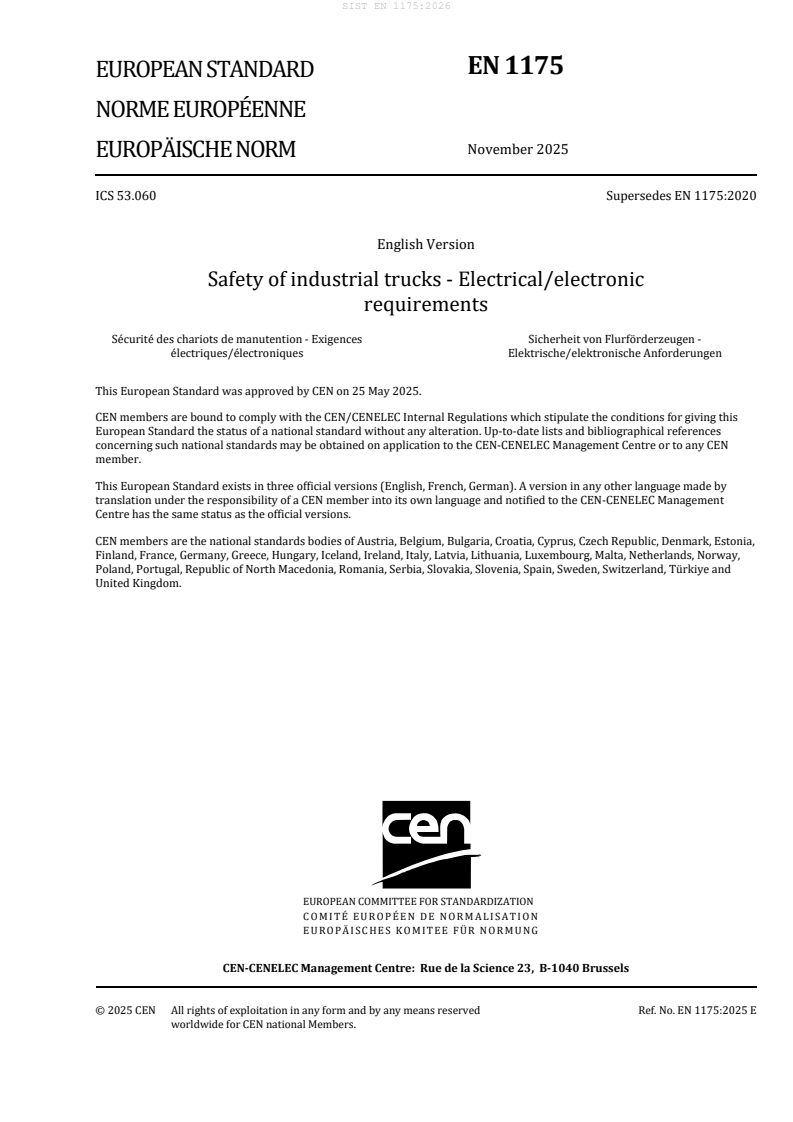
EN 1175
EUROPEAN STANDARD
NORME EUROPÉENNE
November 2025
EUROPÄISCHE NORM
ICS 53.060 Supersedes EN 1175:2020
English Version
Safety of industrial trucks - Electrical/electronic
requirements
Sécurité des chariots de manutention - Exigences Sicherheit von Flurförderzeugen -
électriques/électroniques Elektrische/elektronische Anforderungen
This European Standard was approved by CEN on 25 May 2025.
CEN members are bound to comply with the CEN/CENELEC Internal Regulations which stipulate the conditions for giving this
European Standard the status of a national standard without any alteration. Up-to-date lists and bibliographical references
concerning such national standards may be obtained on application to the CEN-CENELEC Management Centre or to any CEN
member.
This European Standard exists in three official versions (English, French, German). A version in any other language made by
translation under the responsibility of a CEN member into its own language and notified to the CEN-CENELEC Management
Centre has the same status as the official versions.
CEN members are the national standards bodies of Austria, Belgium, Bulgaria, Croatia, Cyprus, Czech Republic, Denmark, Estonia,
Finland, France, Germany, Greece, Hungary, Iceland, Ireland, Italy, Latvia, Lithuania, Luxembourg, Malta, Netherlands, Norway,
Poland, Portugal, Republic of North Macedonia, Romania, Serbia, Slovakia, Slovenia, Spain, Sweden, Switzerland, Türkiye and
United Kingdom.
EUROPEAN COMMITTEE FOR STANDARDIZATION
COMITÉ EUROPÉEN DE NORMALISATION
EUROPÄISCHES KOMITEE FÜR NORMUNG
CEN-CENELEC Management Centre: Rue de la Science 23, B-1040 Brussels
© 2025 CEN All rights of exploitation in any form and by any means reserved Ref. No. EN 1175:2025 E
worldwide for CEN national Members.
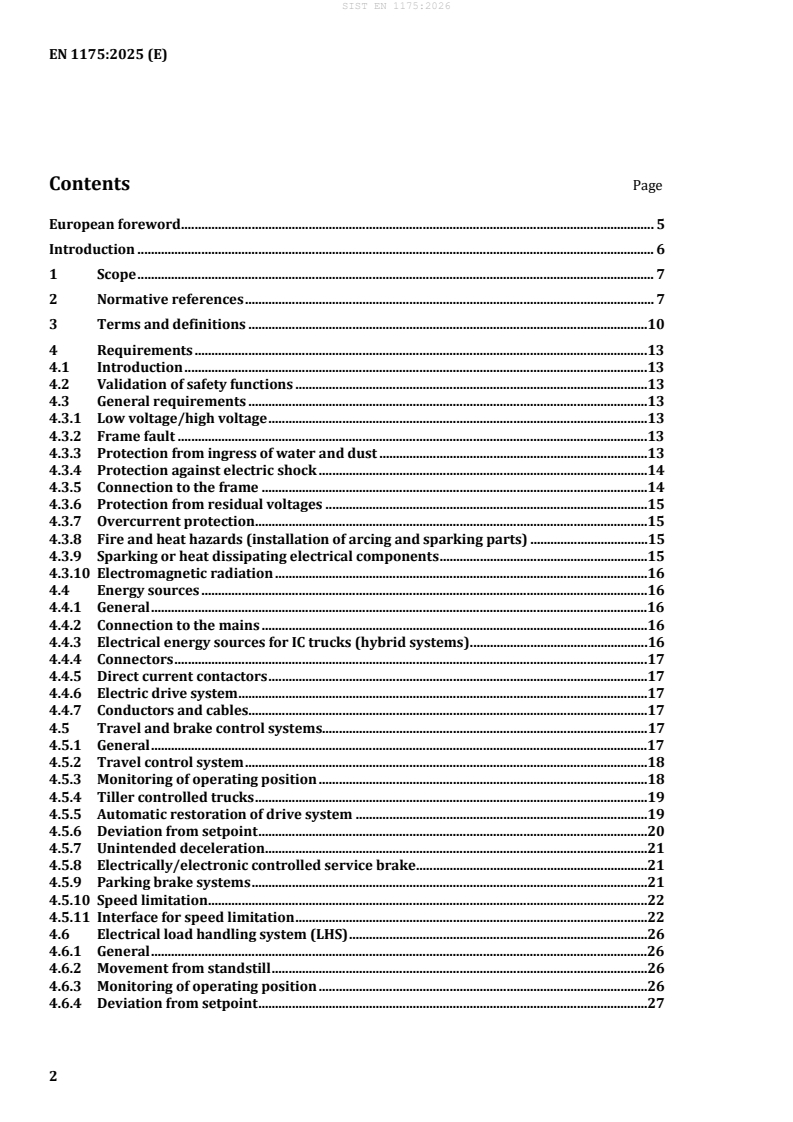
Contents Page
European foreword . 5
Introduction . 6
1 Scope . 7
2 Normative references . 7
3 Terms and definitions .10
4 Requirements .13
4.1 Introduction .13
4.2 Validation of safety functions .13
4.3 General requirements .13
4.3.1 Low voltage/high voltage .13
4.3.2 Frame fault .13
4.3.3 Protection from ingress of water and dust .13
4.3.4 Protection against electric shock .14
4.3.5 Connection to the frame .14
4.3.6 Protection from residual voltages .15
4.3.7 Overcurrent protection .15
4.3.8 Fire and heat hazards (installation of arcing and sparking parts) .15
4.3.9 Sparking or heat dissipating electrical components .15
4.3.10 Electromagnetic radiation .16
4.4 Energy sources .16
4.4.1 General .16
4.4.2 Connection to the mains .16
4.4.3 Electrical energy sources for IC trucks (hybrid systems) .16
4.4.4 Connectors .17
4.4.5 Direct current contactors .17
4.4.6 Electric drive system .17
4.4.7 Conductors and cables.17
4.5 Travel and brake control systems.17
4.5.1 General .17
4.5.2 Travel control system .18
4.5.3 Monitoring of operating position .18
4.5.4 Tiller controlled trucks .19
4.5.5 Automatic restoration of drive system .19
4.5.6 Deviation from setpoint .20
4.5.7 Unintended deceleration .21
4.5.8 Electrically/electronic controlled service brake .21
4.5.9 Parking brake systems .21
4.5.10 Speed limitation .22
4.5.11 Interface for speed limitation .22
4.6 Electrical load handling system (LHS) .26
4.6.1 General .26
4.6.2 Movement from standstill .26
4.6.3 Monitoring of operating position .26
4.6.4 Deviation from setpoint .27
4.6.5 Load clamp devices . 27
4.6.6 Limitation of load movement functions . 27
4.7 Steering . 29
4.7.1 General . 29
4.7.2 Electrical/electronic steering . 29
4.7.3 Electrically powered assisted steering systems . 30
4.8 Software design . 32
4.8.1 General . 32
4.8.2 Symbols and languages for user interfaces, service interfaces and keypads . 32
4.8.3 Parameters . 32
4.9 Other protective measures . 32
4.9.1 Switching off . 32
4.9.2 General purpose devices . 33
4.9.3 Other safety functions . 34
4.9.4 Dielectric test (type test) . 34
4.9.5 Insulation test (routine test) . 35
4.9.6 Insulation test (routine test) for high voltage trucks . 36
4.9.7 Frame fault test . 36
5 Additional requirements for high voltage trucks . 36
5.1 General . 36
5.2 Battery . 36
5.2.1 General . 36
5.2.2 Charger switching . 36
5.2.3 Requirements . 37
5.2.4 Emergency disconnection . 37
5.3 Protection against electric shock . 37
5.3.1 Electrical enclosures . 37
5.3.2 Circuits . 37
5.3.3 Bonding . 37
5.3.4 Detection of frame fault . 37
6 Information for use . 39
6.1 General . 39
6.2 Electrical diagram . 39
6.3 Electrical interface for external systems . 39
6.4 Safety checks . 39
6.5 Capacitors . 39
6.6 Marking . 39
6.6.1 General . 39
6.6.2 Electronic controller . 39
6.7 Non-ionising radiation . 39
6.8 Interoperability of energy sources. 40
Annex A (normative) Connectors for energy sources . 41
A.1 General . 41
A.2 Terms and definitions . 41
A.3 Requirements . 41
A.4 Type-test methods . 43
A.5 Quality assurance . 46
A.6 Information for use . 46
Annex B (normative) Electromagnetic contactors .47
B.1 General .47
B.2 Terms and definitions .47
B.3 Types of contactors.48
B.4 Product information .49
B.5 Normal service, mounting and transport conditions .50
B.6 Constructional and performance requirements .50
B.7 Tests .52
B.8 General test conditions .60
Annex C (normative) Energy sources .61
C.1 Lead-acid batteries .61
C.2 Lithium-ion batteries .62
Annex D (normative) Electric drive system (motors, converters, generators, energy sources)
....................................................................................................................................................................68
D.1 General .68
D.2 Special requirements .68
D.3 Testing .69
Annex E (normative) Assistance systems .70
E.1 General .70
E.2 Requirements .70
E.3 Information for use .71
Annex F (informative) Steering systems .72
F.1 General .72
F.2 Electric steering without backup .72
F.3 Electric steering with backup .73
F.4 Assisted steering systems .75
Annex G (normative) Conductors and cables .76
G.1 General .76
G.2 Protection .76
G.3 Cross-sectional area .76
G.4 Wiring practices .77
Annex H (informative) Cross reference with industrial truck types of ISO 5053-1:2020 .78
Annex I (informative) List of significant hazards .81
Annex J (informative) Explanations of safety functions .92
Annex ZA (informative) Relationship between this European Standard and the essential
requirements of Directive 2006/42/EC aimed to be covered .97
Bibliography . 100
European foreword
This document (EN 1175:2025) has been prepared by Technical Committee CEN/TC 150 “Industrial
trucks - Safety”, the secretariat of which is held by BSI.
This European Standard shall be given the status of a national standard, either by publication of an
identical text or by endorsement, at the latest by May 2026, and conflicting national standards shall be
withdrawn at the latest by May 2026.
Attention is drawn to the possibility that some of the elements of this document may be the subject of
patent rights. CEN shall not be held responsible for identifying any or all such patent rights.
This document supersedes EN 1175:2020.
This document specifies up-to-date requirements for electric/electronic installations of industrial trucks.
Requirements are mainly based on safety functions and not only on safety related parts and take into
account exclusively electric/electronic elements.
The main changes compared to EN 1175:2020 are:
— updating of normative and informative references;
— added references to EN ISO 3691-2:2023, to EN ISO 3691-3:2016, to EN ISO 3691-6:2021.
— correction of the specification in transport test for contactors in Annex B;
— updating of Table 5.
This document is intended to be used in conjunction with EN ISO 3691 series and EN 16307 series.
This document has been prepared under a standardization request addressed to CEN by the European
Commission. The Standing Committee of the EFTA States subsequently approves these requests for its
Member States.
For the relationship with EU Legislation, see informative Annex ZA, which is an integral part of this
document.
Any feedback and questions on this document should be directed to the users’ national standards body.
A complete listing of these bodies can be found on the CEN website.
According to the CEN-CENELEC Internal Regulations, the national standards organisations of the
following countries are bound to implement this European Standard: Austria, Belgium, Bulgaria, Croatia,
Cyprus, Czech Republic, Denmark, Estonia, Finland, France, Germany, Greece, Hungary, Iceland, Ireland,
Italy, Latvia, Lithuania, Luxembourg, Malta, Netherlands, Norway, Poland, Portugal, Republic of North
Macedonia, Romania, Serbia, Slovakia, Slovenia, Spain, Sweden, Switzerland, Türkiye and the United
Kingdom.
Introduction
This document is a type-C standard as stated in EN ISO 12100:2010.
This document is of relevance for the following stakeholder groups representing the market players with
regard to machinery safety:
— machine manufacturers (small, medium and large enterprises);
— health and safety bodies (regulators, accident prevention organizations, market surveillance, etc.).
Others can be affected by the level of machinery safety achieved with the means of the document by the
above-mentioned stakeholder groups:
— machine users/employers (small, medium and large enterprises);
— machine users/employees (e.g. trade unions, organizations for people with special needs);
— service providers, e.g. for maintenance (small, medium and large enterprises).
The above-mentioned stakeholder groups have been given the possibility to participate at the drafting
process of this document.
The machinery concerned and the extent to which hazards, hazardous situations or hazardous events are
covered are indicated in the Scope of this document.
When requirements of this type-C standard are different from those which are stated in type-A or type-B
standards, the requirements of this type-C standard take precedence over the requirements of the other
standards for machines that have been designed and built according to the requirements of this type-C
standard.
1 Scope
This document specifies the electrical requirements for the design and construction of the electrical
installation in self-propelled industrial trucks that are within the scope of ISO 5053-1:2020, except rough-
terrain variable-reach trucks as defined in ISO 5053-1:2020, 3.21 and 3.22, straddle carriers as defined
in ISO 5053-1:2020, 3.18 and 3.19, and all those functions utilized for the automatic operation of
driverless industrial trucks as defined in ISO 5053-1:2020, 3.32. It provides the electrical/electronic and
safety-related parts of control system requirements for those self-propelled industrial trucks identified
above.
NOTE 1 For detailed information about the electrical/electronic requirements for driverless trucks see EN ISO
3691-4:2023, 4.1.3.
NOTE 2 Reference is made to this document in other standards which cover the non-electrical requirements of
the various industrial truck types.
This document deals with safety requirements for all electrical and electronic components of industrial
trucks, including electrically actuated hydraulic/pneumatic valves. It specifies minimum performance
levels required for safety functions realized by safety related parts of control systems. It is intended to be
used to avoid or minimize hazards or hazardous situations listed in Annex I. These situations can arise
during the operation in the area of use for which it is designed and during maintenance of trucks in
accordance with the specifications and instruction given by the manufacturer.
This document does not deal with hazards which could occur:
— during construction;
— when operating in potentially explosive atmospheres;
— because of malfunction of non-electric safety-related parts of control systems, e.g. hydraulic and
pneumatic elements like pistons, non-electric valves, pumps, etc.;
— when operating outside the range of 30 % to 95 % (not condensing) of relative humidity.
NOTE 3 The level of the defined required performance for electrical safety related control systems can be used
as a guideline to determine the performance of non-electric systems.
NOTE 4 Hazards due to penetration of water and dust are covered by the definition of PL of safety functions,
r
according to EN ISO 13849-1:2023.
NOTE 5 Safety measures outside the scope of the electrical/electronic system are covered by other safety
standards e.g. EN ISO 3691 series and EN 16307 series.
2 Normative references
The following documents are referred to in the text in such a way that some or all of their content
constitutes requirements of this document. For dated references, only the edition cited applies. For
undated references, the latest edition of the referenced document (including any amendments) applies.
EN 12895:2015+A1:2019, Industrial trucks — Electromagnetic compatibility
EN 16307-1:2020, Industrial trucks — Safety requirements and verification — Part 1: Supplementary
requirements for self-propelled industrial trucks, other than driverless trucks, variable-reach trucks and
burden-carrier trucks
EN 50565-1:2014, Electric cables — Guide to use for cables with a rated voltage not exceeding 450/750 V
(U0/U) — Part 1: General guidance
EN 60034-8:2007, Rotating electrical machines — Part 8: Terminal markings and direction of rotation
(IEC 60034-8:2007)
EN 60068-2-27:2009, Environmental testing — Part 2-27: Tests — Test Ea and guidance: Shock
(IEC 60068-2-27:2008)
EN 60068-2-6:2008, Environmental testing — Part 2-6: Tests — Test Fc: Vibration (sinusoidal)
(IEC 60068-2-6:2007)
EN 60204-1:2018, Safety of machinery — Electrical equipment of machines — Part 1: General
requirements
EN 60332-1-2:2004, Tests on electric and optical fibre cables under fire conditions — Part 1-2: Test for
vertical flame propagation for a single insulated wire or cable — Procedure for 1 kW pre-mixed flame
(IEC 60332-1-2:2004)
EN 60529:1991, Degrees of protection provided by enclosures (IP Code) (IEC 60529:1989)
EN 60695-11-10:2013, Fire hazard testing — Part 11-10: Test flames — 50 W horizontal and vertical
flame test methods (IEC 60695-11-10:2013)
EN 60947-5-5:1997, Low-voltage switchgear and controlgear — Part 5-5: Control circuit devices and
switching elements — Electrical emergency stop device with mechanical latching function
(IEC 60947-5-5:1997)
EN 61643-11:2012, Low-voltage surge protective devices — Part 11: Surge protective devices connected
to low-voltage power systems — Requirements and test methods (IEC 61643-11:2011)
EN 62485-3:2014, Safety requirements for secondary batteries and battery installations — Part 3: Traction
batteries (IEC 62485-3:2014)
EN 62620:2015, Secondary cells and batteries containing alkaline or other non-acid electrolytes —
Secondary lithium cells and batteries for use in industrial applications (IEC 62620:2014)
EN IEC 60384-14:2023, Fixed capacitors for use in electronic equipment — Part 14: Sectional specification
— Fixed capacitors for electromagnetic interference suppression and connection to the supply mains
(IEC 60384-14:2023)
Insulation coordination for equipment within low-voltage systems — Part 1:
EN IEC 60664-1:2020,
Principles, requirements and tests (IEC 60664-1:2020)
As impacted by EN 60034-8:2007/A1:2014.
As impacted by EN 60332-1-2:2004/A1:2015, EN 60332-1-2:2004/A11:2016 and EN 60332-1-
2:2004/A12:2020.
As impacted by EN 60529:1991/A1:2000, EN 60529:1991/A2:2013, EN 60529:1991/AC:2019-02,
EN 60529:1991/AC:2016-12 and EN 60529:1991/A2:2013/AC:2019-02.
As impacted by EN 60695-11-10:2013/AC:2014.
As impacted by EN 60947-5-5:1997/A1:2005, EN 60947-5-5:1997/A11:2013 and EN 60947-5-
5:1997/A2:2017.
As impacted by EN 61643-11:2012/A11:2018.
As impacted by EN 62620:2015/A1:2023.
As impacted by EN IEC 60664-1:2020/AC:2020-12.
EN IEC 62281:2019, Safety of primary and secondary lithium cells and batteries during transport (IEC
62281:2019)
EN IEC 62619:2022, Secondary cells and batteries containing alkaline or other non-acid electrolytes —
Safety requirements for secondary lithium cells and batteries, for use in industrial applications (IEC
62619:2022)
EN IEC 62902:2019, Secondary batteries — Marking symbols for identification of their chemistry (IEC
62902:2019)
EN ISO 12100:2010, Safety of machinery — General principles for design — Risk assessment and risk
reduction (ISO 12100:2010)
EN ISO 13849-1:2023, Safety of machinery — Safety-related parts of control systems — Part 1: General
principles for design (ISO 13849-1:2023)
EN ISO 3691-1:2015, Industrial trucks — Safety requirements and verification — Part 1: Self-propelled
industrial trucks, other than driverless trucks, variable-reach trucks and burden-carrier trucks (ISO
3691-1:2011, including Cor 1:2013)
EN ISO 3691-2:2023, Industrial trucks — Safety requirements and verification — Part 2: Self-propelled
variable-reach trucks (ISO 3691-2:2023)
Industrial trucks — Safety requirements and verification — Part 3: Additional
EN ISO 3691-3:2016,
requirements for trucks with elevating operator position and trucks specifically designed to travel with
elevated loads (ISO 3691-3:2016)
EN ISO 3691-6:2021, Industrial trucks — Safety requirements and verification — Part 6: Burden and
personnel carriers (ISO 3691-6:2021)
EN ISO 6743-4:2015, Lubricants, industrial oils and related products (class L) — Classification — Part 4:
Family H (Hydraulic systems) (ISO 6743 4:2015)
IEC 60417:2024, DB, Graphical symbols for use on equipment
IEC 60947-4-1:2023, Low-voltage switchgear and controlgear — Part 4-1: Contactors and motor-starters
— Electromechanical contactors and motor-starters
ISO 3287:1999, Powered industrial trucks — Symbols for operator controls and other displays
ISO 5053-1:2020, Industrial trucks — Vocabulary — Part 1: Types of industrial trucks
ISO 7000:2019, Graphical symbols for use on equipment — Registered symbols
As impacted by EN IEC 62281:2019/A1:2021 and EN IEC 62281:2019/A2:2023.
As impacted by EN ISO 3691-1:2015/A1:2020.
As impacted by EN ISO 3691-3:2016/A1:2023.
3 Terms and definitions
For the purposes of this document, the terms and definitions given in ISO 5053-1:2020 and the following
apply.
ISO and IEC maintain terminology databases for use in standardization at the following addresses:
— ISO Online browsing platform: available at https://www.iso.org/obp
— IEC Electropedia: available at https://www.electropedia.org/
3.1
U
n
nominal voltage of the truck system
designated value of the voltage of the electrical system and to which its characteristics are referred
3.2
nominal battery voltage
number of battery cells connected in series multiplied by the nominal cell voltage, relative to the chemical
technology of the cell
Note 1 to entry: If the battery consists of cells connected in series and in parallel, the nominal voltage is defined
by the number of cells, which are arranged in one line of cells connected in series.
3.3
drive system
electrically controlled system moving truck on ground, generating torque with effect on one or more
drive wheels
3.4
low speed
travel speed below 0,4 m/s for pedestrian trucks and below 0,7 m/s for all other types of trucks
3.5
LHS
electrical load handling system
system for electrical or electronically controlled load handling
3.6
electrical steering
electrical or electronic system controlling the angular position of the wheel(s) of the truck with respect
to its vertical longitudinal centre plane
Note 1 to entry: See Annex F for examples.
3.7
assistance system
system intended to improve the operational performance, the ergonomics of industrial trucks, or to warn
the operator about hazards due to improper use in the specific operation related to the work environment
and application
Note 1 to entry: Assistance systems are not necessary for the safe operation of industrial trucks and cannot be
used as safety functions (3.13).
3.8
PL
r
required performance level
performance level (PL) applied to achieve the required risk reduction for each safety function
[SOURCE: EN ISO 13849-1:2023, 3.1.6, note 1 to entry deleted]
3.9
setpoint
operator's physical actions on the intended control device
Note 1 to entry: For travelling, the actuation of the accelerator control.
3.10
actpoint
actual physical value of the system output
Note 1 to entry: Examples of actpoint are: truck speed, position of truck steered wheel(s), energised solenoid and
the combination of voltage, current and frequency applied to a drive motor.
3.11
service brake
braking system allowing the operator to control, directly or indirectly, the speed of the truck or to bring
the truck to a halt
[SOURCE: ISO 6292:2020, 3.9, modified by substituting “braking system” with “brake” in the term]
Note 1 to entry: The service brake can also be activated by the electronic control system of the truck.
Note 2 to entry: The service brake can also serve as a parking brake.
3.12
parking brake
braking system allowing a vehicle to be held stationary mechanically, even on an inclined surface,
particularly in the absence of the operator
[SOURCE: ISO 6292:2020, 3.8, modified by substituting “braking system” with “brake” in the term]
3.13
safety function
function of the machine whose failure can result in an immediate increase of the risk(s)
[SOURCE: EN ISO 12100:2010, 3.30]
3.14
risk
combination of the probability of occurrence of harm and the severity of that harm
[SOURCE: EN ISO 12100:2010, 3.12]
3.15
type test
test to the requirements of this document of an example of devices, systems or complete trucks
representative of the production, including the relevant range of options provided by the manufacturer
of the truck, as part of the verification of compliance with this document
3.16
routine test
tests carried out during series production necessary to maintain compliance with this document
3.17
control circuit
electrical circuit used for the control, including monitoring, of the truck and its electrical equipment
3.18
auxiliary circuit
electrical circuit that controls lights, fans and other accessories
3.19
power circuit
circuit that supplies power from the energy source to units of equipment used for truck operation
3.20
energy source
unit for energizing equipment of the truck used for productive operation
Note 1 to entry: Energy sources for trucks can be:
— batteries based on different technologies;
— liquid or gaseous fuel combined with internal combustion engine or fuel cell;
— AC power sources.
3.21
frame fault
accidental connection of a live part to the truck frame or exposed conductive parts
3.22
IC truck
truck equipped with an internal combustion engine of which the power is transferred to a mechanical,
hydraulic or electrical system
3.23
normal operating position
position in which the operator is able to control all functions for driving and load handling as defined by
the manufacturer
Note 1 to entry: Additional positions are permitted to be defined by the manufacturer if it is not possible to
control all the functions of the truck from a single position. A rotating seat or stand-up end-control truck with more
than one operating direction is considered as being or having a single operating position.
[SOURCE: EN ISO 3691-1:2015, 3.8]
3.24
high voltage truck
truck whose U is greater than 120 V DC or 50 V AC and less than or equal to 1 500 V DC or 1 000 V AC
n
under idle or fully charged condition
3.25
OPC
operator-presence control
device that detects the presence of the operator in the normal operating position
3.26
electric powered assisted steering system
mechanical and/or hydraulic steering system powered by an electrical system
4 Requirements
4.1 Introduction
Trucks shall comply with the safety requirements and/or protective measures of this clause. In addition,
the truck shall be designed according to the principles of EN ISO 12100:2010 for relevant but not
significant hazards which are not dealt with by this document.
4.2 Validation of safety functions
The design of safety functions shall be validated in accordance with EN ISO 13849-1:2023, Clause 10.
4.3 General requirements
4.3.1 Low voltage/high voltage
Nominal voltage of the truck system shall not exceed 1 500 V DC or 1 000 V AC.
Safety shall not be compromised at any voltage level that can occur.
Electrical systems of trucks powered by lead-acid batteries shall be designed so that all functions operate
in the voltage range from 70 % up to 120 % of the nominal battery voltage. These limits shall be adapted
to other energy sources technologies.
NOTE Limits set by the manufacturer for other energy sources are outside the scope of this document.
4.3.2 Frame fault
The electric circuits shall be so designed or protected, that frame faults shall not cause hazardous
inadvertent movements that cannot be corrected or compensated by the operator. Compliance shall be
verified by means of the type test of 4.9.7.
4.3.3 Protection from ingress of water and dust
The electrical installation of the trucks in operating condition shall be designed and constructed such that
the protection from harmful ingress of water and dust is in accordance with the environmental conditions
in which the truck is designed to operate, including reasonably foreseeable misuses, as defined in the
instruction handbook (for example, EN ISO 3691-1:2015, 6.2.2).
NOTE Standardized degrees of protection provided by the enclosure of the electrical equipment are given in
EN 60529:1991.
4.3.4 Protection against electric shock
Non-insulated live parts of trucks in the operating condition shall be protected to a degree of IPXXB
preventing direct contact. For top surfaces, the minimum degree shall be IPXXD in accordance with
EN 60529:1991.
Access to an electrical enclosure containing uninsulated live parts in excess of nominal voltage 60 V DC
or 25 V AC shall be possible only using a tool.
Indirect contact with live parts shall be avoided by electric separation of the protection devices in
accordance with EN 60204-1:2018, 6.3.2.3.
It shall be possible to electrically disconnect the energy sources for maintenance and replacement
operations. An easily accessible switch, connector or disconnectable battery terminals meets the intent
of this requirement.
For energy sources with nominal voltage greater than 60 V DC or 25 V AC live parts shall be protected
against direct contact.
4.3.5 Connection to the frame
4.3.5.1 Battery powered trucks
There shall be no electrical connection to the truck frame, except for:
a) frame fault detection system;
b) electric/electronic circuits with a nominal voltage not greater than 60 V DC which are galvanically
separated from the energy source;
c) connection to the earthing terminal of on-board chargers;
d) suppression capacitors. Where the nominal battery voltage exceeds 60 V DC, minimum requirement
for the capacitor shall be Class Y in accordance with EN IEC 60384-14:2023;
e) the screen of shielded cables and components. This condition shall meet the requirements of the
insulation resistance testing in 4.9.5;
f) suppression resistor for electrostatic discharge reduction, the system shall meet the requirements of
4.9.5.
4.3.5.2 IC trucks
a) Electrical system with nominal voltage not greater than 48 V (starter battery):
— all conductors of the electrical system not connected to the truck frame shall be effectively
insulated. They shall be protected against thermal and mechanical damage where such damage
is expected;
— there shall be means to disconnect both poles of the starter battery from the truck for service
purposes.
NOTE A connection of the electrical system to the truck frame is not excluded.
b) Electrical system with nominal voltage greater than 48 V (hybrid drive system):
— electrical systems with nominal voltage greater than 48 V shall be electrically insulated and
galvanically separated from frame, with the exceptions listed in 4.3.5.1 a), b), d), e) and f);
...