

oSIST prEN IEC 62364:2026
(Main)Hydraulic machines - Guidelines for dealing with hydro-abrasive erosion in Kaplan, Francis and Pelton turbines
General Information
- Abstract
- Status
- Not Published
- Public Enquiry End Date
- 31-Mar-2026
- Technical Committee
- IEHT - Electrotechnics - Hydraulic turbins
- Current Stage
- 4020 - Public enquire (PE) (Adopted Project)
- Start Date
- 04-Feb-2026
- Due Date
- 24-Jun-2026
- Completion Date
- 26-Mar-2026

Overview
oSIST prEN IEC 62364:2026 is an international standard developed by CLC and IEC, providing comprehensive guidelines for addressing hydro-abrasive erosion in Kaplan, Francis, and Pelton turbines. Hydro-abrasive erosion, caused by the action of suspended abrasive particles in water, can significantly impact the efficiency and longevity of hydraulic turbines used in hydropower generation. This standard serves as a critical resource for hydroelectric power plant operators, designers, engineers, and equipment suppliers seeking to minimize erosion, optimize maintenance, and achieve reliable, long-term turbine performance.
Key Topics
- Hydro-abrasive Erosion Mechanisms: Explanation of how suspended particles like silt and sand lead to material loss in turbine components.
- Data Presentation: Guidelines for collecting and reporting erosion rates, covering various combinations of water quality, operating conditions, and material properties.
- Design Considerations: Recommendations for modifying hydraulic and mechanical designs to reduce erosion risks without sacrificing efficiency.
- Material Selection: Guidance on choosing materials and coatings with high resistance to hydro-abrasive wear, considering long-term maintainability.
- Operation and Maintenance: Strategies for turbine operation modes in particle-laden water to extend service intervals and reduce wear, as well as advice on regular inspection and repair.
- Monitoring and Sampling: Procedures for measuring particle concentrations, size distribution, and properties in water, with recommended sampling intervals and evaluation methods.
- Specification Development: Support for owners in drafting technical specifications that effectively communicate concerns about erosion and operational expectations to equipment suppliers.
Applications
This standard is highly relevant for:
- Hydroelectric Power Plants: Ensuring reliable operation of Kaplan, Francis, and Pelton turbines in rivers or reservoirs containing sediment or abrasive particles.
- Turbine Design and Manufacturing: Assisting engineers and manufacturers in developing turbine components and systems optimally resistant to abrasive wear.
- Plant Operation and Maintenance: Enabling owners to adopt best practices for monitoring, maintaining, and overhauling turbines, thereby reducing unscheduled downtime and optimizing performance.
- Specification and Procurement: Assisting project planners in drafting clear, achievable technical requirements for new installations or refurbishments.
- Research and Performance Evaluation: Supporting ongoing research into erosion mechanisms and the development of improved materials and coatings.
Key practical benefits include:
- Extended Turbine Life: Through reduction of material wear and improved maintenance guidelines.
- Lower Operating Costs: By minimizing downtime and optimizing overhaul intervals.
- Enhanced Efficiency: Keeping turbine surfaces smooth and design shapes intact for peak hydraulic performance.
- Improved Safety and Reliability: Reducing risk of sudden failures due to undetected or unchecked erosion.
Related Standards
For holistic implementation and enhanced compatibility, consider these related international standards:
- IEC 60193 – Hydraulic turbines, storage pumps, and pump-turbines – Model acceptance tests
- IEC 60609-2 – Hydraulic turbines, storage pumps, and pump-turbines – Cavitation pitting evaluation guide
- IEC TR 61364 – Terminology related to hydraulic turbines and their associated equipment
These standards complement prEN IEC 62364 by providing further detail on measurement methods, acceptance criteria, and terminology.
Keywords: hydraulic turbines, hydro-abrasive erosion, Kaplan turbines, Francis turbines, Pelton turbines, erosion-resistant materials, turbine maintenance, particle monitoring, hydropower standards, IEC 62364, turbine design, hydropower plant operation.
Relations
- Effective Date
- 14-Jan-2025
Get Certified
Connect with accredited certification bodies for this standard

DNV
DNV is an independent assurance and risk management provider.

Lloyd's Register
Lloyd's Register is a global professional services organisation specialising in engineering and technology.
DNV Energy Systems
Energy and renewable energy certification.
Sponsored listings
Frequently Asked Questions
oSIST prEN IEC 62364:2026 is a draft published by the Slovenian Institute for Standardization (SIST). Its full title is "Hydraulic machines - Guidelines for dealing with hydro-abrasive erosion in Kaplan, Francis and Pelton turbines". This standard covers: Hydraulic machines - Guidelines for dealing with hydro-abrasive erosion in Kaplan, Francis and Pelton turbines
Hydraulic machines - Guidelines for dealing with hydro-abrasive erosion in Kaplan, Francis and Pelton turbines
oSIST prEN IEC 62364:2026 is classified under the following ICS (International Classification for Standards) categories: 23.100.10 - Pumps and motors; 27.140 - Hydraulic energy engineering. The ICS classification helps identify the subject area and facilitates finding related standards.
oSIST prEN IEC 62364:2026 has the following relationships with other standards: It is inter standard links to SIST EN IEC 62364:2019. Understanding these relationships helps ensure you are using the most current and applicable version of the standard.
oSIST prEN IEC 62364:2026 is available in PDF format for immediate download after purchase. The document can be added to your cart and obtained through the secure checkout process. Digital delivery ensures instant access to the complete standard document.
Standards Content (Sample)
SLOVENSKI STANDARD
01-marec-2026
Hidravlični stroji - Smernice za obravnavanje hidroabrazivne erozije pri
Kaplanovih, Francisovih in Peltonovih turbinah
Hydraulic machines - Guidelines for dealing with hydro-abrasive erosion in Kaplan,
Francis and Pelton turbines
Wasserturbinen - Leitfaden für den Umgang mit hydroabrasiver Erosion in Kaplan-,
Francis und Pelton-Turbinen
Machines hydrauliques - Lignes directrices relatives au traitement de l'érosion
hydroabrasive des turbines Kaplan, Francis et Pelton
Ta slovenski standard je istoveten z: prEN IEC 62364:2026
ICS:
23.100.10 Hidravlične črpalke in motorji Pumps and motors
27.140 Vodna energija Hydraulic energy engineering
2003-01.Slovenski inštitut za standardizacijo. Razmnoževanje celote ali delov tega standarda ni dovoljeno.
4/538/CDV
COMMITTEE DRAFT FOR VOTE (CDV)
PROJECT NUMBER:
IEC 62364 ED3
DATE OF CIRCULATION: CLOSING DATE FOR VOTING:
2026-01-30 2026-04-24
SUPERSEDES DOCUMENTS:
4/515/RR
IEC TC 4 : HYDRAULIC TURBINES
SECRETARIAT: SECRETARY:
Canada Mrs Christine Geraghty
OF INTEREST TO THE FOLLOWING COMMITTEES: HORIZONTAL FUNCTION(S):
TC 114
ASPECTS CONCERNED:
Safety
SUBMITTED FOR CENELEC PARALLEL VOTING NOT SUBMITTED FOR CENELEC PARALLEL VOTING
Attention IEC-CENELEC parallel voting
The attention of IEC National Committees, members of
CENELEC, is drawn to the fact that this Committee Draft
for Vote (CDV) is submitted for parallel voting.
The CENELEC members are invited to vote through the
CENELEC online voting system.
This document is still under study and subject to change. It should not be used for reference purposes.
Recipients of this document are invited to submit, with their comments, notification of any relevant patent rights of
which they are aware and to provide supporting documentation.
Recipients of this document are invited to submit, with their comments, notification of any relevant “In Some
Countries” clauses to be included should this proposal proceed. Recipients are reminded that the CDV stage is the
final stage for submitting ISC clauses. (SEE AC/22/2007 OR NEW GUIDANCE DOC).
TITLE:
Hydraulic machines - Guidelines for dealing with hydro-abrasive erosion in Kaplan, Francis and
Pelton turbines
PROPOSED STABILITY DATE: 2028
NOTE FROM TC/SC OFFICERS:
download this electronic file, to make a copy and to print out the content for the sole purpose of preparing
National Committee positions. You may not copy or "mirror" the file or printed version of the document, or any part
of it, for any other purpose without permission in writing from IEC.
IEC CDV 62364 © IEC 2026
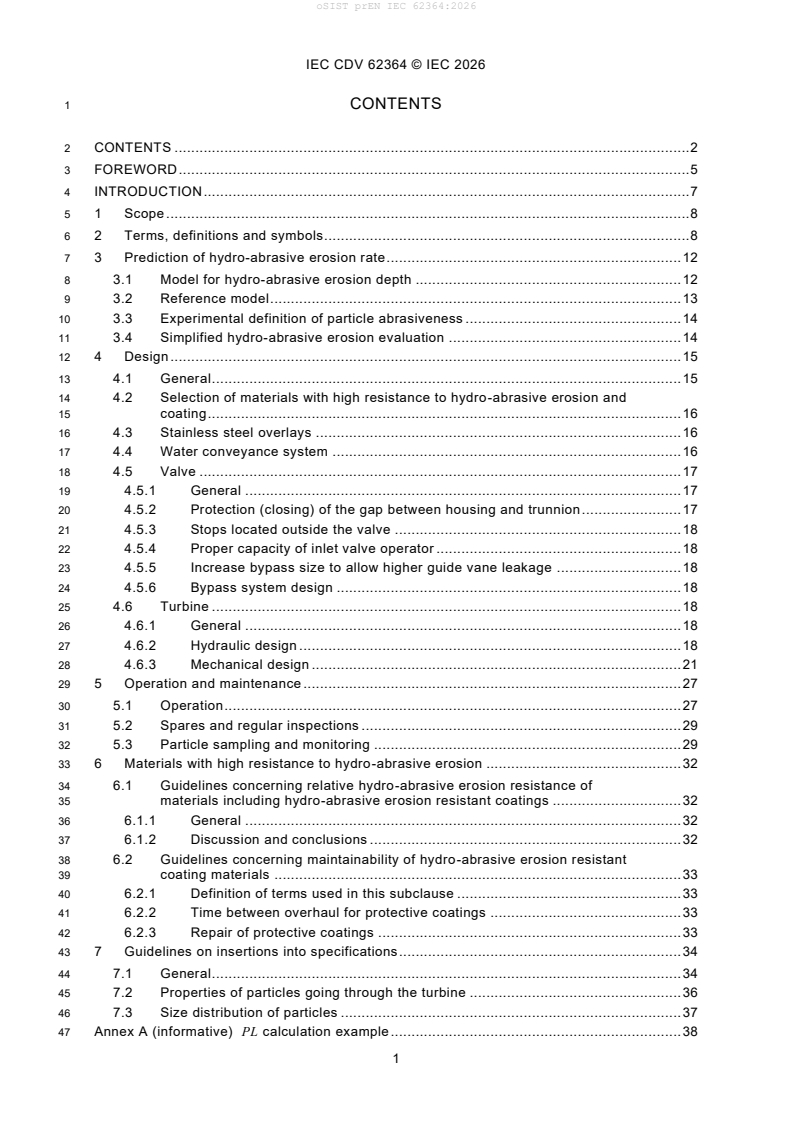
1 CONTENTS
2 CONTENTS . 2
3 FOREWORD . 5
4 INTRODUCTION . 7
5 1 Scope . 8
6 2 Terms, definitions and symbols. 8
7 3 Prediction of hydro-abrasive erosion rate . 12
8 3.1 Model for hydro-abrasive erosion depth . 12
9 3.2 Reference model . 13
10 3.3 Experimental definition of particle abrasiveness . 14
11 3.4 Simplified hydro-abrasive erosion evaluation . 14
12 4 Design . 15
13 4.1 General . 15
14 4.2 Selection of materials with high resistance to hydro-abrasive erosion and
15 coating . 16
16 4.3 Stainless steel overlays . 16
17 4.4 Water conveyance system . 16
18 4.5 Valve . 17
19 4.5.1 General . 17
20 4.5.2 Protection (closing) of the gap between housing and trunnion. 17
21 4.5.3 Stops located outside the valve . 18
22 4.5.4 Proper capacity of inlet valve operator . 18
23 4.5.5 Increase bypass size to allow higher guide vane leakage . 18
24 4.5.6 Bypass system design . 18
25 4.6 Turbine . 18
26 4.6.1 General . 18
27 4.6.2 Hydraulic design . 18
28 4.6.3 Mechanical design . 21
29 5 Operation and maintenance . 27
30 5.1 Operation . 27
31 5.2 Spares and regular inspections . 29
32 5.3 Particle sampling and monitoring . 29
33 6 Materials with high resistance to hydro-abrasive erosion . 32
34 6.1 Guidelines concerning relative hydro-abrasive erosion resistance of
35 materials including hydro-abrasive erosion resistant coatings . 32
36 6.1.1 General . 32
37 6.1.2 Discussion and conclusions . 32
38 6.2 Guidelines concerning maintainability of hydro-abrasive erosion resistant
39 coating materials . 33
40 6.2.1 Definition of terms used in this subclause . 33
41 6.2.2 Time between overhaul for protective coatings . 33
42 6.2.3 Repair of protective coatings . 33
43 7 Guidelines on insertions into specifications. 34
44 7.1 General . 34
45 7.2 Properties of particles going through the turbine . 36
46 7.3 Size distribution of particles . 37
47 Annex A (informative) PL calculation example . 38
IEC CDV 62364 © IEC 2026
48 Annex B (informative) Measuring and recording hydro-abrasive erosion damages . 40
49 B.1 Recording hydro-abrasive erosion damage . 40
50 B.2 Pelton runner without coating . 40
51 B.3 Needle tip and mouth piece without coating . 41
52 B.4 Pelton runner with hardcoating . 41
53 B.5 Needle tip, seat ring and nozzle housing with coating . 41
54 B.6 Francis runner and stationary labyrinth without coating . 42
55 B.7 Francis runner with coating and stationary labyrinth . 42
56 B.8 Guide vanes and facing plates without coating . 42
57 B.9 Guide vanes and facing plates with coating . 43
58 B.10 Stay vanes . 43
59 B.11 Francis labyrinth seals uncoated . 43
60 B.12 Kaplan uncoated . 43
61 B.13 Kaplan coated . 44
62 B.14 Sample data sheets . 44
63 B.15 Inspection record, runner blade inlet . 45
64 B.16 Inspection record, runner blade outlet . 46
65 B.17 Inspection record, runner band . 47
66 B.18 Inspection record, guide vanes . 48
67 B.19 Inspection record, facing plates and covers . 49
68 B.20 Inspection record, upper stationary seal . 50
69 B.21 Inspection record, upper rotating seal . 51
70 B.22 Inspection record, lower stationary seal . 52
71 B.23 Inspection record, lower rotating seal . 53
72 B.24 Inspection record, runner bucket . 54
73 B.25 Inspection record, Pelton runner splitter . 55
74 Annex C (informative) Monitoring of particle concentration and properties and water
75 sampling procedure . 56
76 C.1 General . 56
77 C.2 Sampling before building a power station . 56
78 C.3 Sampling in existing power stations . 57
79 C.4 Logging of samples . 57
80 Annex D (informative) Procedures for analysis of particle concentration, size,
81 hardness and shape . 58
82 D.1 General . 58
83 D.2 Particle concentration . 58
84 D.3 Particle size distribution . 58
85 D.4 Mineralogical composition . 58
86 D.5 Particle geometry . 58
87 Annex E (informative) Frequency of sediment sampling . 61
88 Annex F (informative) Typical criteria to determine overhaul time due to hydro-
89 abrasive erosion . 62
90 F.1 General . 62
91 F.2 Parameters which are observable while the unit is in operation . 62
92 F.3 Criteria that require internal inspection of the unit . 63
93 Annex G (informative) Example to calculate the hydro-abrasive erosion depth . 64
94 Annex H (informative) Examples to calculate the TBO in the reference model . 66
95 Annex I (informative) Background for hydro-abrasive erosion depth model . 69
IEC CDV 62364 © IEC 2026
96 I.1 Model background and derivation. 69
97 I.2 Introduction to the PL variable. 70
98 I.3 Calibration of the formula . 72
99 Annex J (informative) Quality control of thermal sprayed WC-CoCr . 74
100 J.1 Specification . 74
101 J.2 Quality control . 74
102 Bibliography . 75
104 Figure 1 – Estimation of the characteristic velocities in guide vanes, W , and runner,
gv
105 W , as a function of turbine specific speed . 14
run
106 Figure 2 – Simplified evaluation of risk of hydro-abrasive erosion for first assessment . 16
107 Figure 3 – Example of protection of transition area . 19
108 Figure 4 – Runner blade overhang in refurbishment project . 21
109 Figure 5 – Example of cavitation on runner band due to thicker blades . 22
110 Figure 6 – Example of design of guide vane trunnion seals . 23
111 Figure 7 – Example of fixing of facing plates from the dry side (bolt to the left) . 25
112 Figure 8 – Head cover balancing pipes with bends . 26
113 Figure 9 – Step labyrinth with optimized shape for hardcoating . 28
114 Figure 10 – Typical measurement ranges for continuous monitoring of suspended
115 particles . 31
116 Figure 11 – Sample plot of particle concentration versus time . 32
117 Figure D.1 – Typical examples of particle geometry . 61
118 Figure I.1 – Example of flow pattern in a Pelton injector at different load . 72
120 Table 1 – Values of K and p for various components . 14
f
121 Table 2 – relevant properties of suspended particles for hydroabrasive erosion . 30
122 Table 3 – comparison of measurement technologies for continuous monitoring of
123 suspended particles . 31
124 Table 4 – Overview over the feasibility for repair C on site . 35
125 Table 5 – Form for properties of particles going through the turbine . 37
126 Table 6 – Form for size distribution of particles . 38
127 Table A.1 – Example of documenting sample tests . 39
128 Table A.2 – Example of documenting sample results . 40
129 Table B.1 – Inspection record, runner blade inlet form . 46
130 Table B.2 – Inspection record, runner blade outlet form . 47
131 Table B.3 – Inspection record, runner band form . 48
132 Table B.4 – Inspection record, guide vanes form . 49
133 Table B.5 – Inspection record, facing plates and covers form . 50
134 Table B.6 – Inspection record, upper stationary seal form . 51
135 Table B.7 – Inspection record, upper rotating seal form . 52
136 Table B.8 – Inspection record, lower stationary seal form . 53
137 Table B.9 – Inspection record, lower rotating seal form . 54
138 Table B.10 – Inspection record, runner bucket . 55
139 Table B.11 – Inspection record, Pelton runner splitter . 56
140 Table G.1 – Calculations . 66
IEC CDV 62364 © IEC 2026
141 Table H.1 – Pelton turbine calculation example . 67
142 Table H.2 – Francis turbine calculation example . 68
143 Table I.1 – Analysis of the calibration constant K and p . 74
f
144 Table J.1 – Recommended items to include in HVOF inspection . 75
IEC CDV 62364 © IEC 2026
147 INTERNATIONAL ELECTROTECHNICAL COMMISSION
148 ____________
150 HYDRAULIC MACHINES –
151 GUIDELINES FOR DEALING WITH HYDRO-ABRASIVE
152 EROSION IN KAPLAN, FRANCIS, AND PELTON TURBINES
154 FOREWORD
155 1) The International Electrotechnical Commission (IEC) is a worldwide organization for standardization comprising
156 all national electrotechnical committees (IEC National Committees). The object of IEC is to promote
157 international co-operation on all questions concerning standardization in the electrical and electronic fields. To
158 this end and in addition to other activities, IEC publishes International Standards, Technical Specifications,
159 Technical Reports, Publicly Available Specifications (PAS) and Guides (hereafter referred to as “IEC
160 Publication(s)”). Their preparation is entrusted to technical committees; any IEC National Committee interested
161 in the subject dealt with may participate in this preparatory work. International, governmental and non -
162 governmental organizations liaising with the IEC also participate in this preparation. IEC collaborates closely
163 with the International Organization for Standardization (ISO) in accordance with conditions determined by
164 agreement between the two organizations.
165 2) The formal decisions or agreements of IEC on technical matters express, as nearly as possible, an international
166 consensus of opinion on the relevant subjects since each technical committee has representation from all
167 interested IEC National Committees.
168 3) IEC Publications have the form of recommendations for international use and are accepted by IEC National
169 Committees in that sense. While all reasonable efforts are made to ensure that the technical content of IEC
170 Publications is accurate, IEC cannot be held responsible for the way in which they are used or for any
171 misinterpretation by any end user.
172 4) In order to promote international uniformity, IEC National Committees undertake to apply IEC Publications
173 transparently to the maximum extent possible in their national and regional publications. Any divergence
174 between any IEC Publication and the corresponding national or regional publication shall be clearly indicated in
175 the latter.
176 5) IEC itself does not provide any attestation of conformity. Independent certification bodies provide conformity
177 assessment services and, in some areas, access to IEC marks of conformity. IEC is not responsible for any
178 services carried out by independent certification bodies.
179 6) All users should ensure that they have the latest edition of this publication.
180 7) No liability shall attach to IEC or its directors, employees, servants or agents including individual experts and
181 members of its technical committees and IEC National Committees for any personal injury, property damage or
182 other damage of any nature whatsoever, whether direct or indirect, or for costs (including legal fees) and
183 expenses arising out of the publication, use of, or reliance upon, this IEC Publication or any other IEC
184 Publications.
185 8) Attention is drawn to the Normative references cited in this publication. Use of the referenced publications is
186 indispensable for the correct application of this publication.
187 9) Attention is drawn to the possibility that some of the elements of this IEC Publication may be the subject of
188 patent rights. IEC shall not be held responsible for identifying any or all such patent rights.
189 International Standard IEC 62364 has been prepared by IEC technical committee 4: Hydraulic
190 turbines.
191 This second edition cancels and replaces the first edition published in 2013. This edition
192 constitutes a technical revision.
193 This edition includes the following significant technical changes with respect to the previous
194 edition:
195 a) the formula for TBO in Pelton reference model has been modified;
196 b) the formula for calculating sampling interval has been modified;
197 c) the chapter in hydro-abrasive erosion resistant coatings has been substantially modified;
198 d) the annex with test data for hydro-abrasive erosion resistant materials has been removed;
199 e) a simplified hydro-abrasive erosion evaluation has been added.
IEC CDV 62364 © IEC 2026
200 The text of this International Standard is based on the following documents:
FDIS Report on voting
4/351/FDIS 4/366/RVD
202 Full information on the voting for the approval of this International Standard can be found in
203 the report on voting indicated in the above table.
204 This document has been drafted in accordance with the ISO/IEC Directives, Part 2.
205 The committee has decided that the contents of this document will remain unchanged until the
206 stability date indicated on the IEC website under "http://webstore.iec.ch" in the data related to
207 the specific document. At this date, the document will be
208 • reconfirmed,
209 • withdrawn,
210 • replaced by a revised edition, or
211 • amended.
IMPORTANT – The 'colour inside' logo on the cover page of this publication indicates
that it contains colours which are considered to be useful for the correct
understanding of its contents. Users should therefore print this document using a
colour printer.
IEC CDV 62364 © IEC 2026
215 INTRODUCTION
216 The number of hydro power plants with hydro-abrasive erosion is increasing worldwide.
217 An overall approach is needed to minimize the impact of this phenomenon. Already at the
218 start of the planning phase an evaluation should be done to quantify the hydro-abrasive
219 erosion and the impact on the operation. For this, the influencing parameters and their impact
220 on the hydro-abrasive erosion have to be known. The necessary information for the evaluation
221 comprises among others the future design, the particle parameters of the water, which will
222 pass the turbine, the reservoir sedimentation and the power plant owner’s framework for the
223 future operation like availability or maximum allowable efficiency loss, before an overhaul
224 needs to be done.
225 Based on this evaluation of the hydro-abrasive erosion, an optimised solution can then be
226 found, by analysing all measures in relation to investments, energy production and
227 maintenance costs as decision parameters. Often a more hydro-abrasive erosion-resistant
228 design, instead of choosing the turbine design with the highest efficiency, will lead to higher
229 revenue. This analysis is best performed by the overall plant designer.
230 With regards to the machines, owners should find the means to communicate to potential
231 suppliers for their sites, their desire to have the particular attention of the designers at the
232 turbine design phase, directed to the minimization of the severity and effects of hydro-
233 abrasive erosion.
234 Limited consensus and very little quantitative data exists on the steps which the designer
235 could and should take to extend the useful life before major overhaul of the turbine
236 components when they are operated under severe hydro-abrasive erosion service. This has
237 led some owners to write into their specifications, conditions which cannot be met with known
238 methods and materials.
IEC CDV 62364 © IEC 2026
241 HYDRAULIC MACHINES –
242 GUIDELINES FOR DEALING WITH HYDRO-ABRASIVE
243 EROSION IN KAPLAN, FRANCIS, AND PELTON TURBINES
247 1 Scope
248 This document gives guidelines for:
249 a) presenting data on hydro-abrasive erosion rates on several combinations of water quality,
250 operating conditions, component materials, and component properties collected from a
251 variety of hydro sites;
252 b) developing guidelines for the methods of minimizing hydro-abrasive erosion by
253 modifications to hydraulic design for clean water. These guidelines do not include details
254 such as hydraulic profile shapes which are determined by the hydraulic design experts for
255 a given site;
256 c) developing guidelines based on “experience data” concerning the relative resistance of
257 materials faced with hydro-abrasive erosion problems;
258 d) developing guidelines concerning the maintainability of materials with high resistance to
259 hydro-abrasive erosion and hardcoatings;
260 e) developing guidelines on a recommended approach, which owners could and should take
261 to ensure that specifications communicate the need for particular attention to this aspect
262 of hydraulic design at their sites without establishing criteria which cannot be satisfied
263 because the means are beyond the control of the manufacturers;
264 f) developing guidelines concerning operation mode of the hydro turbines in water with
265 particle materials to increase the operation life.
266 It is assumed in this document that the water is not chemically aggressive. Since chemical
267 aggressiveness is dependent upon so many possible chemical compositions, and the
268 materials of the machine, it is beyond the scope of this document to address these issues.
269 It is assumed in this document that cavitation is not present in the turbine. Cavitation and
270 hydro-abrasive erosion can reinforce each other so that the resulting erosion is larger than
271 the sum of cavitation erosion plus hydro-abrasive erosion. The quantitative relationship of the
272 resulting hydro-abrasive erosion is not known and it is beyond the scope of this document to
273 assess it, except to suggest that special efforts be made in the turbine design phase to
274 minimize cavitation.
275 Large solids (e.g. stones, wood, ice, metal objects, etc.) traveling with the water can impact
276 turbine components and produce damage. This damage can in turn increase the flow
277 turbulence thereby accelerating wear by both cavitation and hydro-abrasive erosion. Hydro-
278 abrasive erosion resistant coatings can also be damaged locally by impact of large solids. It is
279 beyond the scope of this document to address these issues.
280 This document focuses mainly on hydroelectric powerplant equipment. Certain portions can
281 also be applicable to other hydraulic machines.
282 2 Terms, definitions and symbols
283 For the purposes of this document, the following terms and definitions apply.
284 ISO and IEC maintain terminological databases for use in standardization at the following
285 addresses:
IEC CDV 62364 © IEC 2026
286 • IEC Electropedia: available at http://www.electropedia.org/
287 • ISO Online browsing platform: available at http://www.iso.org/obp
288 NOTE 1 Terms and definitions are also based, where relevant, on IEC TR 61364.
289 NOTE 2 The International System of Units (S.I.) is adopted throughout this document but other systems are
290 allowed.
Sub- Term Definition Symbol Unit
clause
specific specific energy of water available between the high and
2.2.1 E J/kg
hydraulic low pressure reference sections 1 and 2 of the machine
energy of a
machine
Note 1 to entry: For full information, see IEC 60193.
acceleration local value of gravitational acceleration at the place of 2
2.2.2 g m/s
due to gravity testing
Note 1 to entry: For full information, see IEC 60193.
turbine head available head at hydraulic machine terminal
2.2.3 H m
pump head
H = E/g
reference reference diameter of the hydraulic machine
2.2.4 D m
diameter
Note 1 to entry: For Pelton turbines this is the pitch
diameter, for Kaplan turbines this is the runner chamber
diameter and for Francis and Francis type pump
turbines this is the blade low pressure section diameter
at the band
Note 2 to entry: See IEC 60193 for further information.
hub diameter the diameter of runner hub for Kaplan turbines
2.2.5 D mm
h
hydro-abrasive depth of material removed (measured perpendicular to
2.2.6 S mm
erosion depth the original surface) from a component due to hydro-
abrasive erosion
characteristic characteristic velocity defined for each machine
2.2.7 W m/s
velocity component and used to quantify hydro-abrasive erosion
damage
Note 1 to entry: See also 2.2.20 to 2.2.24.
particle mass concentration of particles, i.e. the mass of solid 3
2.2.8 C kg/m
concentration particles per volume of water-particle mixture
Note 1 to entry: In case the particle concentration is
expressed in parts per million (ppm) it is recommended
to use the mass of particles per volume of water, so that
1 000 ppm approximately corresponds to 1 kg/m .
particle load the integral of the modified particle concentration over
2.2.9 PL
kg h/m
time:
𝑇
𝑃𝐿 = ∫ 𝐶(𝑡) × 𝐴 (𝑡)𝑑𝑡
s
𝑁
(≈ ∑ 𝐶 × 𝐴 × 𝑇 )
𝑛 s,𝑛 𝑠,𝑛
𝑛=1
C(t) = 0 if no water is flowing through the turbine.
Note 1 to entry: For Francis turbines C(t) = 0 when
calculating PL for runner and labyrinth seals, if the unit
is at standstill with pressurized spiral case, but C(t) ≠ 0
when calculating PL for guide vanes and facing plates.
IEC CDV 62364 © IEC 2026
Sub- Term Definition Symbol Unit
clause
Abrasiveness
2.2.10 𝐴 = 𝐾 × 𝐾 × 𝐾 A
s
𝑠 size shape hardness
factor
size factor factor that characterizes how the hydro-abrasive erosion
2.2.11 K
size
relates to the size of the abrasive particles = median
particle size dP in mm
shape factor factor that characterizes how the hydro-abrasive erosion
2.2.12 K
shape
relates to the shape of the abrasive particles
Note 1 to entry: See Annex D.
hardness factor that characterizes how the hydro-abrasive erosion
2.2.13 K
hardness
factor relates to the hardness of the abrasive particles
for 13Cr4Ni stainless steel: K = fraction of
hardness
particles harder than Mohs 4,5.
for hard coated surfaces: K = fraction of particles
hardness
harder than Mohs 7,0.
material factor factor that characterizes how the hydro-abrasive erosion
2.2.14 K
m
relates to the material properties of the base material
flow coefficient coefficient that characterizes how the hydro-abrasive 3,4
2.2.15 K mm × s
f
erosion relates to the water flow around each
𝛼
kg × h × m
component
sampling time interval between two water samples taken to
2.2.16 T h
s
interval determine the concentration of abrasive particles in the
water
maximum maximum value of Cthe integrand in the PL integral 3
2.2.17 C Kg/m
max
concentration during a specified time interval, i.e. the maximum value
of the following expression
𝑇
Accumulated
2.2.18 S Kg
A
sediment
𝑆 = ∫ 𝐶(𝑡) × 𝑄(𝑡)𝑑𝑡
A
amount 0
particle median diameter of abrasive particles in a sample, i.e.
2.2.19 dP mm
median such diameter that the particles with size smaller than
diameter the value under consideration represent 50 % of the
total mass of particles in the sample
o
impingement angle between the particle trajectory and the surface of
2.2.20
angle the substrate
characteristic flow through unit divided by the minimum flow area at
2.2.21 W m/s
gv
velocity in the guide vane apparatus at best efficiency point
Francis guide
vanes
Q
characteristic
W =
gv
velocity in
a Z B
0 0
Kaplan guide
vanes
characteristic speed of the water flow at injector location
2.2.22 W m/s
inj
velocity in
Pelton injector
W = 2 E
inj
IEC CDV 62364 © IEC 2026
Sub- Term Definition Symbol Unit
clause
characteristic relative velocity between the water and the runner blade
2.2.23 W m/s
run
velocity in estimated with below formulas at best efficiency point
turbine runner
2 2
W = u + c
run 2 2
u = n D
Q 4
c = (Francis)
D
Q 4
c = (Kaplan)
(D − D )
h
characteristic relative velocity between the water and the runner
2.2.24 W m/s
run
velocity in bucket
Pelton runner
W = 0,5 2 E
run
discharge volume of water per unit time passing through any 3
2.2.25 Q m /s
section in the system
guide vane average shortest distance between adjacent guide
2.2.26 a m
opening vanes (at a specified section if necessary)
Note 1 to entry: For further information, see
IEC 60193.
number of total number of guide vanes in a turbine
2.2.27 z
guide vanes
distributor height of the distributor in a turbine
2.2.28 B m
height
rotational number of revolutions per unit time
2.2.29 n 1/s
speed
specific speed commonly used specific speed of a hydraulic machine
2.2.30 n rpm
s
60 n P
n =
s
5 / 4
H
P and H are taken in the rated operating point and given
in kW and m respectively
output output of the turbine in the rated operating point
2.2.31 P kW
hydro-abrasive estimated actual depth of metal that will be removed S
2.2.32 target mm
erosion depth from a component of the target turbine due to particle
of target unit
hydro-abrasive erosion
Note 1 to entry: For use with the reference model.
hydro-abrasive hydro-abrasive erosion depth of metal that has been S
2.2.33 ref mm
erosion depth removed from a component of the reference turbine due
of reference to hydro-abrasive erosion
unit
Note 1 to entry: For use with the reference model.
number of number of nozzles in a Pelton turbine z
2.2.34 jet
nozzles
bucket width bucket width in a Pelton runner B
2.2.35 2 mm
number of number of buckets in a Pelton runner z
2.2.36 2
buckets
time between time between overhaul for target unit TBO
2.2.37 target h
overhaul for
target unit
Note 1 to entry: For use with the reference model.
IEC CDV 62364 © IEC 2026
Sub- Term Definition Symbol Unit
clause
time between time between overhaul for reference unit TBO
2.2.38 ref h
overhaul for
reference unit
Note 1 to entry: For use with the reference model.
turbine reference size for calculation curvature dependent RS
2.2.39 m
reference size effects of hydro-abrasive erosion
Note 1 to entry: For Francis turbines, it is the
reference diameter, D (see 2.2.4).
Note 2 to entry: For Pelton turbines it is the inner
bucket width, B .
Note 3 to entry: For further information in the inner
bucket width, B , see IEC 60609-2.
size exponent exponent that describes the size dependant effects of p
2.2.40
hydro-abrasive erosion in evaluating RS
exponent numerical value of 0,4-p that balances units for K α
2.2.41 f
293 3 Prediction of hydro-abrasive erosion rate
294 3.1 Model for hydro-abrasive erosion depth
295 The following formula can be used to estimate the hydro-abrasive erosion depth in a Francis
296 turbine:
3,4 p
297 S = W PL K K / RS
m f
298 • The characteristic velocity, W, is defined in 2.2.20 to 2.2.23. If detailed data to calculate W
299 is not available it can be estimated based on Figure 1,
300 • PL, K and RS are defined in 2.2.9, 2.2.13 and 2.2.38 respectively,
m
301 • For uncoated components of Francis turbines K and p are taken from Table 1 below.
f
302 For additional information of the background for this formula please refer to Annex I. A sample
303 calculation is found in Annex G.
IEC CDV 62364 © IEC 2026
2,5
0,5
W = (0,25 + 0,003 n ) (2 g H)
run s
1,5
0,5
W = 0,55 (2 g H)
gv
0,5
0 100 200 300 400 500 600 700 800
Turbine specific speed, n (using m, kW)
s
304 IEC
305 NOTE Values of n and H in this figure refer to the rated operating point while the characteristic velocities are
s
306 given for the points noted in Clause 2.
307 Figure 1 – Estimation of the characteristic velocities in guide vanes, W ,
gv
308 and runner, W , as a function of turbine specific speed
run
309 Table 1 – Values of K and p for various components
f
Component K Exponent p
f
(for RS)
-6
Francis guide vanes 0,25
1,06 10
-6
Francis facing plates 0,86 10 0,25
-6
Francis labyrinth seals 0,38 10 0,75
-6
Francis runner inlet 0,25
0,90 10
-6
Francis runner outlet 0,75
0,54 10
311 3.2 Reference model
312 In the reference model presented in this document the TBO of two turbines are compared to
313 each other. To do this the TBO of one turbine (here called reference turbine) and the
314 differences in the influencing parameters to another turbine (here called target turbine) have
315 to be known to calculate the TBO of the target turbine. Note that the same overhaul criteria
316 have to be applied for both the target and reference turbines.
317 The aim of the reference model is not to calculate the hydro-abrasive erosion depth (S).
318 Therefore a calibrated model for the depth is not necessary. The criteria for the TBO can be
319 the relative amount of damage, the efficiency loss or some other criteria but has to be the
320 same for both turbines.
Characteristic velocity coefficient W , W
gv run
IEC CDV 62364 © IEC 2026
321 There are a few differences in the way the formula is built up between the reference model
322 and the absolute model as follows:
323 • since the reference model does not calculate the hydro-abrasive erosion depth of
324 individual components, constants valid for the whole turbine are used instead of different
325 constants for different components;
326 • a larger turbine can normally withstand more hydro-abrasive erosion depth than a small
327 turbine before it needs overhaul. For this reason the exponent for turbine reference size,
328 p, is chosen as 1 in the reference model;
329 • for Pelton turbines, it is assumed that the critical component for overhaul is the runner. In
330 addition to the factors described above, the K for Pelton runners is assumed to be
f
331 proportional to the number of nozzles and the speed and inversely proportional to the
332 number of buckets;
333 The TBO for the target turbine can be calculated as follows:
3,4 3,4
334 TBO / TBO = W / W PL / Pl K / K K / K
target ref ref target ref target m,ref m,target f,ref f,target
p p
335 RS / RS
target ref
336 In this equation, we use the following values for the relationships:
337 Pelton turbines: K / K = z z / (z z )
f, ref f, target jet,ref 2,target jet,target 2,ref
338 Francis and Kaplan turbines: K / K = 1
f,ref f,target
339 Size exponent: p = 1
340 The accuracy of the reference model might decrease when the differences between the
341 reference and target turbines become large.
342 The sensitivity of the calculated TBO value to variances in the input variables can also be
343 studied with the same formula. A sample calculation is found in Annex H.
344 3.3 Experimental definition of particle abrasiveness
345 The particle abrasiveness is calculated from three K-factors that can each be determined
346 inbdividually in the laboratory. This determination involves uncertainties for each of the
347 individual K-factors.In contrast, the overall influence of the factors can be determined using a
348 laboratory test stand. This method has the advantage that the abrasiveness, A , of the actual
s
349 sediment can be measured directly and under various influencing factors.
350 Depending on the geometry to be assessed, different test stands can be used to determine A
s
351 such as flow test stand or free jet test stands, etc.
352 Note that this method requires the calibration of the laboratory test stands and test
353 methodology against particles with known particle abrasiveness.
354 3.4 Simplified hydro-abrasive erosion evaluation
355 In addition to the formulas in 3.1 and 3.2 other methods to estimate hydro-abrasive erosion
356 have been proposed, such as in [15] and [22] . Each method may have its advantages and
357 disadvantages.
358 As a quick and easy rule of thumb to make a first assessment of the severity at a particular
359 site it is recommended to evaluate the following expression, which is shown graphically in
360 Figure 2.
______________
Numbers in square brackets refer to the Bibliography.
IEC CDV 62364 © IEC 2026
1,5
361 If C H ≤ 150 then the hydro-ab
...