

SIST EN 60436:2020
(Main)Electric dishwashers for household use - Methods for measuring the performance
General Information
- Abstract
IEC 60436:2015 applies to electric dishwashers for household and similar use that are supplied with hot and/or cold water. The object is to state and define the principal performance characteristics of electric dishwashers for household and similar use and to describe the standard methods of measuring these characteristics. This standard is concerned neither with safety nor with minimum performance requirements. This edition constitutes a technical revision and includes the following significant technical changes with respect to the previous edition:
a) Addition of a specification of the reference dishwasher G1222, addition of the microwave oven 752C, inclusion of standby/low power modes and updated cutlery and tableware items.
b) Combined cleaning and drying: combining the cleaning and drying performance evaluations into one test, along with the energy and water consumption evaluation, prevents an opportunity for circumvention if tests were performed separately. A dishwasher can detect whether soil is present (cleaning evaluation) or not (drying evaluation) and adjust the cycle to favour performance; combining the tests addresses this.
c) New dish load items: new dish load items were incorporated which reflect consumer use. New items are: stainless pots, coffee mugs, melamine plastic items, and glass bowl. The new load items provide different shapes which challenge a dishwasher water spray patterns and provide additional surfaces for soil removal assessment.
d) Detergent: a new detergent "D" is specified which mirrors current tablet formulations available on the market. Detergent type D is phosphate free, with percarbonate instead of perborate bleach and more active enzymes.
e) Repeatability and reproducibility improvements.
f) Addition of annexes for the evaluation of soil sensing programmes, rinsing performance, dishwasher filtration and of an annex on the inlet water temperature influence on energy consumption.
- Status
- Published
- Publication Date
- 07-Apr-2020
- Technical Committee
- FGA - Consumer information related to household electrical appliances
- Current Stage
- 6060 - National Implementation/Publication (Adopted Project)
- Start Date
- 01-Apr-2020
- Due Date
- 06-Jun-2020
- Completion Date
- 08-Apr-2020
2019/2017 - COMMISSION DELEGATED REGULATION (EU) 2019/2017 of 11 March 2019 supplementing Regulation (EU) 2017/1369 of the European Parliament and of the Council with regard to energy labelling of household dishwashers and repealing Commission Delegated Regulation (EU) No 1059/2010OJ Ref: GLEJ PRILOGO 1, L, L 199, L 224 (12.9.2023) OJ Date: 07-Jun-2021
2019/2022 - COMMISSION REGULATION (EU) 2019/2022 of 1 October 2019 laying down ecodesign requirements for household dishwashers pursuant to Directive 2009/125/EC of the European Parliament and of the Council amending Commission Regulation (EC) No 1275/2008 and repealing Commission Regulation (EU) No 1016/2010OJ Ref: GLEJ PRILOGO 2, L, L 199, L 224 (12.9.2023) OJ Date: 07-Jun-2021



Overview
SIST EN 60436:2020 - Electric dishwashers for household use - Methods for measuring the performance - is the adopted Slovene version of EN 60436:2020 (based on IEC 60436:2015, modified). The standard defines the principal performance characteristics of electric household dishwashers supplied with hot and/or cold water and specifies standardised test methods to measure them. It is focused on performance measurement (cleaning, drying, energy and water consumption, acoustics and low‑power modes) and does not set safety requirements or minimum performance thresholds.
Key topics and technical requirements
- Combined cleaning and drying test: Cleaning and drying performance (plus energy and water consumption) are evaluated in a single combined procedure to avoid manipulation of cycle selection.
- Updated test loads and soiling: New dish load items reflecting consumer use (stainless pots, coffee mugs, melamine items, glass bowls) and refined soiling procedures for realistic challenge of spray patterns and soil removal.
- Reference materials and equipment: Specification of a reference dishwasher (G1222) and a defined microwave oven (752C) for test preparation and drying procedures.
- Detergent specification: Introduction of Detergent D, a market‑relevant, phosphate‑free tablet formulation (percarbonate bleach, more active enzymes) to reflect contemporary detergent chemistry.
- Low power and standby modes: New definitions and measurement procedures (Annex ZA) for off, standby, networked standby and delay‑start power modes.
- Energy, water and time measurements: Standardised methods to record cycle energy consumption, water use and programme times, including provisions to account for inlet water temperature influence (Annex U).
- Repeatability and reproducibility: Improvements and additional annexes (soil sensing programs, rinsing performance, filtration) enhance test reliability and comparability between labs.
- Normative annexes: Detailed load plans, test soils, appliances, and alternative test methods are provided in annexes to ensure consistency.
Practical applications - who uses this standard
- Manufacturers and product designers: To validate dishwasher performance, optimise cycles for real‑world cleaning/drying, and prepare data for energy labelling and ecodesign compliance.
- Test laboratories & certification bodies: For harmonised test procedures ensuring repeatable, reproducible results across facilities and jurisdictions.
- Regulators and policy makers: To reference in energy labelling and ecodesign frameworks (see related Annexes ZZA/ZZB).
- Retailers and product comparators: To interpret declared performance data and make consistent product comparisons.
- R&D teams: To evaluate the effects of detergent formulations, spray systems, filtration and soil‑sensing algorithms on measured performance.
Related standards and references
- IEC 60436:2015 (source international standard)
- Supersedes EN 50242:2016
- Annexes ZZA / ZZB reference applicable EU energy‑labelling and ecodesign regulations
SIST EN 60436:2020 provides harmonised, market‑relevant test methods that improve comparability and integrity of dishwasher performance data - essential for manufacturers, test labs and regulators working on energy, water and functionality claims.
Relations
- Effective Date
- 01-May-2020
- Effective Date
- 01-Nov-2025
- Effective Date
- 05-May-2026
- Effective Date
- 03-Feb-2026
- Effective Date
- 03-Feb-2026
- Effective Date
- 01-Jan-2023
- Effective Date
- 01-Jan-2021
- Corrected By
SIST EN 60436:2020/AC:2020 - Electric dishwashers for household use - Methods for measuring the performance - Effective Date
- 01-Sep-2020
Frequently Asked Questions
SIST EN 60436:2020 is a standard published by the Slovenian Institute for Standardization (SIST). Its full title is "Electric dishwashers for household use - Methods for measuring the performance". This standard covers: IEC 60436:2015 applies to electric dishwashers for household and similar use that are supplied with hot and/or cold water. The object is to state and define the principal performance characteristics of electric dishwashers for household and similar use and to describe the standard methods of measuring these characteristics. This standard is concerned neither with safety nor with minimum performance requirements. This edition constitutes a technical revision and includes the following significant technical changes with respect to the previous edition: a) Addition of a specification of the reference dishwasher G1222, addition of the microwave oven 752C, inclusion of standby/low power modes and updated cutlery and tableware items. b) Combined cleaning and drying: combining the cleaning and drying performance evaluations into one test, along with the energy and water consumption evaluation, prevents an opportunity for circumvention if tests were performed separately. A dishwasher can detect whether soil is present (cleaning evaluation) or not (drying evaluation) and adjust the cycle to favour performance; combining the tests addresses this. c) New dish load items: new dish load items were incorporated which reflect consumer use. New items are: stainless pots, coffee mugs, melamine plastic items, and glass bowl. The new load items provide different shapes which challenge a dishwasher water spray patterns and provide additional surfaces for soil removal assessment. d) Detergent: a new detergent "D" is specified which mirrors current tablet formulations available on the market. Detergent type D is phosphate free, with percarbonate instead of perborate bleach and more active enzymes. e) Repeatability and reproducibility improvements. f) Addition of annexes for the evaluation of soil sensing programmes, rinsing performance, dishwasher filtration and of an annex on the inlet water temperature influence on energy consumption.
IEC 60436:2015 applies to electric dishwashers for household and similar use that are supplied with hot and/or cold water. The object is to state and define the principal performance characteristics of electric dishwashers for household and similar use and to describe the standard methods of measuring these characteristics. This standard is concerned neither with safety nor with minimum performance requirements. This edition constitutes a technical revision and includes the following significant technical changes with respect to the previous edition: a) Addition of a specification of the reference dishwasher G1222, addition of the microwave oven 752C, inclusion of standby/low power modes and updated cutlery and tableware items. b) Combined cleaning and drying: combining the cleaning and drying performance evaluations into one test, along with the energy and water consumption evaluation, prevents an opportunity for circumvention if tests were performed separately. A dishwasher can detect whether soil is present (cleaning evaluation) or not (drying evaluation) and adjust the cycle to favour performance; combining the tests addresses this. c) New dish load items: new dish load items were incorporated which reflect consumer use. New items are: stainless pots, coffee mugs, melamine plastic items, and glass bowl. The new load items provide different shapes which challenge a dishwasher water spray patterns and provide additional surfaces for soil removal assessment. d) Detergent: a new detergent "D" is specified which mirrors current tablet formulations available on the market. Detergent type D is phosphate free, with percarbonate instead of perborate bleach and more active enzymes. e) Repeatability and reproducibility improvements. f) Addition of annexes for the evaluation of soil sensing programmes, rinsing performance, dishwasher filtration and of an annex on the inlet water temperature influence on energy consumption.
SIST EN 60436:2020 is classified under the following ICS (International Classification for Standards) categories: 97.040.40 - Dishwashers. The ICS classification helps identify the subject area and facilitates finding related standards.
SIST EN 60436:2020 has the following relationships with other standards: It is inter standard links to SIST EN 50242:2016, SIST EN IEC 60436:2025, oSIST prEN IEC 60335-2-90:2026, SIST EN 60704-2-3:2019, SIST EN 60335-2-58:2025, SIST EN 60436:2020/A12:2023, SIST EN 60436:2020/A11:2021, SIST EN 60436:2020/AC:2020. Understanding these relationships helps ensure you are using the most current and applicable version of the standard.
SIST EN 60436:2020 is associated with the following European legislation: EU Directives/Regulations: 1016/2010, 1059/2010, 1275/2008, 2019/2017, 2019/2022; Standardization Mandates: M/481, M/566. When a standard is cited in the Official Journal of the European Union, products manufactured in conformity with it benefit from a presumption of conformity with the essential requirements of the corresponding EU directive or regulation.
SIST EN 60436:2020 is available in PDF format for immediate download after purchase. The document can be added to your cart and obtained through the secure checkout process. Digital delivery ensures instant access to the complete standard document.
Standards Content (Sample)
SLOVENSKI STANDARD
01-maj-2020
Nadomešča:
SIST EN 50242:2016
Električni pomivalni stroji za gospodinjstva - Preskusne metode za merjenje
lastnosti
Electric dishwashers for household use - Methods for measuring the performance
Lave-vaisselle électriques à usage domestique - Méthodes de mesure de l’aptitude à la
fonction
Ta slovenski standard je istoveten z: EN 60436:2020
ICS:
97.040.40 Pomivalni stroji Dishwashers
2003-01.Slovenski inštitut za standardizacijo. Razmnoževanje celote ali delov tega standarda ni dovoljeno.
EUROPEAN STANDARD EN 60436
NORME EUROPÉENNE
EUROPÄISCHE NORM
March 2020
ICS Supersedes EN 50242:2016 and all of its amendments
and corrigenda (if any)
English Version
Electric dishwashers for household use - Methods for measuring
the performance
(IEC 60436:2015 , modified)
Lave-vaisselle électriques à usage domestique - Méthodes Elektrische Geschirrspüler für den Hausgebrauch -
de mesure de l'aptitude à la fonction Messverfahren für Gebrauchseigenschaften
(IEC 60436:2015 , modifiée) (IEC 60436:2015 , modifiziert)
This European Standard was approved by CENELEC on 2019-09-30. CENELEC members are bound to comply with the CEN/CENELEC
Internal Regulations which stipulate the conditions for giving this European Standard the status of a national standard without any alteration.
Up-to-date lists and bibliographical references concerning such national standards may be obtained on application to the CEN-CENELEC
Management Centre or to any CENELEC member.
This European Standard exists in three official versions (English, French, German). A version in any other language made by translation
under the responsibility of a CENELEC member into its own language and notified to the CEN-CENELEC Management Centre has the
same status as the official versions.
CENELEC members are the national electrotechnical committees of Austria, Belgium, Bulgaria, Croatia, Cyprus, the Czech Republic,
Denmark, Estonia, Finland, France, Germany, Greece, Hungary, Iceland, Ireland, Italy, Latvia, Lithuania, Luxembourg, Malta, the
Netherlands, Norway, Poland, Portugal, Republic of North Macedonia, Romania, Serbia, Slovakia, Slovenia, Spain, Sweden, Switzerland,
Turkey and the United Kingdom.
European Committee for Electrotechnical Standardization
Comité Européen de Normalisation Electrotechnique
Europäisches Komitee für Elektrotechnische Normung
CEN-CENELEC Management Centre: Rue de la Science 23, B-1040 Brussels
© 2020 CENELEC All rights of exploitation in any form and by any means reserved worldwide for CENELEC Members.
Ref. No. EN 60436:2020 E
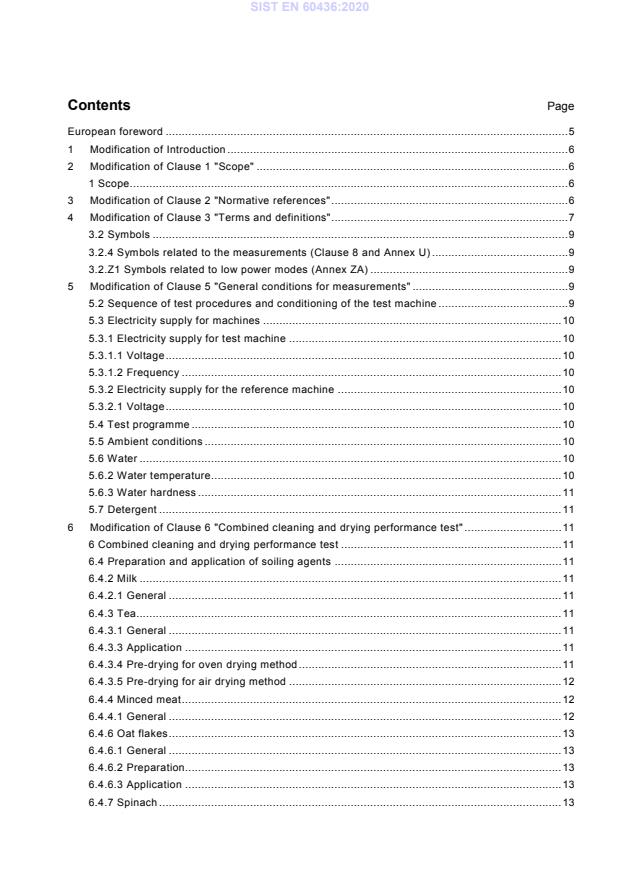
Contents Page
European foreword . 5
1 Modification of Introduction . 6
2 Modification of Clause 1 "Scope" . 6
1 Scope . 6
3 Modification of Clause 2 "Normative references" . 6
4 Modification of Clause 3 "Terms and definitions" . 7
3.2 Symbols . 9
3.2.4 Symbols related to the measurements (Clause 8 and Annex U) . 9
3.2.Z1 Symbols related to low power modes (Annex ZA) . 9
5 Modification of Clause 5 "General conditions for measurements" . 9
5.2 Sequence of test procedures and conditioning of the test machine . 9
5.3 Electricity supply for machines . 10
5.3.1 Electricity supply for test machine . 10
5.3.1.1 Voltage . 10
5.3.1.2 Frequency . 10
5.3.2 Electricity supply for the reference machine . 10
5.3.2.1 Voltage . 10
5.4 Test programme . 10
5.5 Ambient conditions . 10
5.6 Water . 10
5.6.2 Water temperature. 10
5.6.3 Water hardness . 11
5.7 Detergent . 11
6 Modification of Clause 6 "Combined cleaning and drying performance test" . 11
6 Combined cleaning and drying performance test . 11
6.4 Preparation and application of soiling agents . 11
6.4.2 Milk . 11
6.4.2.1 General . 11
6.4.3 Tea. 11
6.4.3.1 General . 11
6.4.3.3 Application . 11
6.4.3.4 Pre-drying for oven drying method . 11
6.4.3.5 Pre-drying for air drying method . 12
6.4.4 Minced meat . 12
6.4.4.1 General . 12
6.4.6 Oat flakes . 13
6.4.6.1 General . 13
6.4.6.2 Preparation. 13
6.4.6.3 Application . 13
6.4.7 Spinach . 13
6.4.7.1 General . 13
6.5 Drying of the soiled tableware items . 14
6.5.2 Oven drying method . 14
6.5.3 Air drying method . 14
6.6 Loading and operating . 14
6.6.2 Operating . 14
7 Modification of Clause 7 "Combined cleaning and drying performance assessment" . 15
7 Combined cleaning and drying performance assessment . 15
7.2 Determination of the drying performance . 15
7.2.1 General requirements to enable subsequent cleaning assessment . 15
7.2.2 Drying assessment procedure . 15
7.2.3 Calculation of the drying index . 16
7.3 Determination of the cleaning performance. 16
7.3.1 General . 16
7.3.4 Assessing ln WC . 16
8 Modification of clause 8, "Energy consumption, water consumption, cycle time and programme
time" . 17
8.1 General and purpose . 17
8.2 Method of measurement . 17
8.2.1 General . 17
8.2.2 Energy consumption . 18
8.2.4 Water consumption . 18
8.2.5 Time . 18
9 Modification of clause 9 "Airborne acoustical noise" . 19
10 Modification of Annex A . 19
Annex A (normative) Place settings and serving pieces . 19
A.2 Test load specification . 19
11 Modification of Annex B . 22
12 Modification of Annex D . 30
13 Modification of Annex E . 30
E.1 General . 30
14 Modification of Annex F . 30
F.1 Specification of the microwave oven . 30
F.2 Calibration of the microwave oven . 30
15 Modification of Annex G . 31
G.1 Specification of the thermal cabinet . 31
16 Modification of Annex I . 31
I.4 Reference machine loading plan . 32
17 Modification of Annex J . 34
18 Modification of Annex K . 34
K.3 Determination of left on mode duration . 37
K.4 Determination of end of programme mode power . 37
K.5 Determination of end of programme mode duration . 37
K.6 Determination of off mode power. 38
K.7 Determination of delay start mode power . 38
19 Modification of Annex L. 39
L.2 Alternative suppliers . 42
L.2.1 General . 42
L.2.2 Alternative food soils . 42
20 Modification of Annex N . 43
21 Modification of Annex P . 43
22 Modification of Annex Q . 43
23 Modification of Annex R . 43
24 Modification of Annex S . 43
25 Modification of Annex T . 43
26 Modification of Annex U . 44
U.3 Correlating energy consumption tests with different cold water inlet temperatures . 44
U.3.2 Estimating regional energy consumption from standard cold water temperature . 44
U.3.3 Estimating standard energy consumption from regional cold water temperature . 44
27 Addition of Annexes . 45
Annex ZA (normative) Measurement procedure for low power modes . 45
ZA.1 General . 45
ZA.2 Determination of off mode . 48
ZA.3 Determination of standby mode . 48
ZA.4 Determination of standby mode in condition of networked standby . 48
ZA.5 Determination of delay start mode power . 48
Annex ZB (normative) Normative references to international publications with their corresponding
European publications . 49
Annex ZZA (EU regulation on energy labelling) . 50
Annex ZZB (EU regulation on ecodesign) . 50
European foreword
This document (EN 60436:2020) consists of the text of IEC 60436:2015 prepared by IEC/TC 59, "Electric
dishwashers", together with the common modifications prepared by CLC/TC 59X "Performance of household
and similar electrical appliances".
The following dates are fixed:
• latest date by which this document has to be (dop) 2020-09-27
implemented at national level by publication of an
identical national standard or by endorsement
• latest date by which the national standards conflicting (dow) 2023-03-27
with this document have to be withdrawn
This document supersedes EN 50242:2016 and all of its amendments and corrigenda (if any).
Attention is drawn to the possibility that some of the elements of this document may be the subject of patent
rights. CENELEC shall not be held responsible for identifying any or all such patent rights.
EN 60436:2019 includes the following significant technical changes with respect to EN 50242:2016/EN
60436:2016:
— new test load with a bigger variety of materials and shapes, including pots, mugs, plastic items and
more bowls;
— new phosphate-free reference detergent reflecting more market relevant composition of ingredients;
— more precise soiling procedure;
— new reference materials;
— new definitions and measurement procedures for low power modes.
Clauses, subclauses, notes, tables, figures and annexes which are additional to those in IEC 60436:2015 are
prefixed “Z”.
In this document, the common modifications to the International Standards are indicated in red.
Endorsement notice
The text of the International Standard IEC 60436:2015 was approved by CENELEC as a European Standard
with agreed common modifications.
1 Modification of Introduction
Replace by:
“This edition of the standard EN 60436 Electric dishwashers for household use - Methods for measuring
the performance was developed for the future EU energy labelling and ecodesign scheme and
therefore based on the principle described in the mandate M/481 to CEN, CENELEC and ETSI for
standardisation in the field of household dishwashers relating to REGULATION (EU) 2017/1369 OF
THE EUROPEAN PARLIAMENT AND OF THE COUNCIL of 4 July 2017 setting a framework for energy
labelling and repealing Directive 2010/30/EU.
Mandate M/481, issued by the European Commission, includes the standardisation task to develop
measures in testing household dishwashers, which ensure that the prospective harmonized standard
takes into account improved test conditions and test materials to better reflect the user behaviour and
the state of the art at European and international level. Test conditions described in IEC 60436:2015
indeed represent today’s usage behaviours of European households in a better manner.
Common modifications were developed to further improve the standard for its application concerning
EU energy labelling and ecodesign purposes, specifically in regard to the measurement procedure for
low power modes, uncertainty of measurements, and test burden.”
2 Modification of Clause 1 "Scope"
1 Scope
Modify first sentence of first paragraph:
“This European Standard applies to electric dishwashers for household and similar use that are supplied with
hot and/or cold water.”
3 Modification of Clause 2 "Normative references"
Delete IEC 62301.
Add as follows:
“
EN 50564, Electrical and electronic household and office equipment – Measurement of low power
consumption
EN 50643, Electrical and electronic household and office equipment – Measurement of networked
standby power consumption of edge equipment
”
4 Modification of Clause 3 "Terms and definitions"
Modify 3.1.14 as follows:
“programme
series of operations which are pre-defined within the dishwasher and which are declared as suitable
for specified levels of soil and/or type of load and together form a complete cycle
Note1 to entry: Usually an end of programme indicator signals the end of the programme and the user has access
to the load.”
In 3.1.15, Add a note:
“Note Z1 to entry: The cycle can be equal or last longer than the programme.”
Modify 3.1.16 as follows:
“cycle time
length of time beginning with the initiation of the cycle (of the selected programme), excluding any user
programmed delay, until all activity ceases (i.e. the end of the cycle)”
Modify 3.1.17 as follows:
“programme time
length of time beginning with the initiation of the cycle (of the selected programme) programme, excluding
any user programmed delay, until an end of programme indicator is activated and the user has access to the
load
Note 1 to entry: If there is no end of programme indicator, the programme time is equal to the cycle time.”
Add note to entry to 3.1.21:
“Note Z1 to entry: This may include several separate steps during the programme(s).”
Modify 3.1.25 as follows:
end of cycle programme mode
“
mode that begins immediately after the completion of the programme, and continues without any further
intervention of the user
Note Z1 to entry: This mode can persist indefinitely or may be of limited duration if the dishwasher is equipped with a
power management system.”
Modify 3.1.26 as follows:
“left on mode
mode that begins as soon as the dishwasher door has been opened and / or unlatched by the user after the
completion of the programme, and continues without any further intervention of the user
Note Z1 to entry: In some products this mode can be equivalent to off mode.
Note Z2 to entry: This mode can persist indefinitely or can be of limited duration if the dishwasher is equipped with a power
management system. ”
Replace 3.1.27 as follows:
“off mode
condition in which the household dishwasher is connected to the mains and is not providing any function; the
following shall also be considered as off mode:
(a) conditions providing only an indication of off mode;
(b) conditions providing only functionalities intended to ensure electromagnetic compatibility”
Replace 3.1.28 as follows:
“delay start mode
condition where the user has selected a specified delay to the beginning of the selected programme.
Note Z1 to entry: This mode is only applicable to dishwashers that provide a delay start function for the user.”"
Modify 3.1.29 as follows:
“end of cycle programme mode duration
time for the dishwasher to revert automatically to off mode after the end of the cycle programme without
any further intervention of the operator”
Delete Note 1 to entry in 3.1.29 and renumber the following note.
Modify 3.1.30 as follows:
“left on mode duration
time from the start of left on mode until the dishwasher reverts automatically to off mode
Note Z1 to entry: This time span is only applicable to dishwashers equipped with power management systems.”
Delete Note 1, 2 and 3 to entry:
Add the following new entries:
“3.1.Z1
all activity ceases
power consumption decreases to a low steady state fluctuating by no more than 10% or 0,1W,
whichever is the greater, over a period of at least 60 min.
Note Z1 to entry: The current waveform shall be sampled at a frequency of 1000 Hz and averaged over the duration of
60 seconds.
3.1.Z2
standby mode
condition where the household dishwasher is connected to the mains and provides only the following
functions, which may persist for an indefinite time:
(a) reactivation function, or reactivation function and a mere indication of enabled reactivation function;
and/or
(b) information or status display; and/or
(c) detection function for emergency measures.
3.1.Z3
network
communication infrastructure with a topology of links, an architecture, including the physical
components, organizational principles, communication procedures and formats (protocols).
3.1.Z4
standby mode in condition of networked standby
condition of networked standby means a condition where the household dishwasher is connected to
the mains and provides only the reactivation function through a connection to a network, which may
persist for an indefinite time.
Note Z1 to entry: This mode is only applicable to dishwashers that provide a connection function to a network.”
3.2 Symbols
3.2.4 Symbols related to the measurements (Clause 8 and Annex U)
Modify the symbol “E ” by:
IEC15 °C-m
“E “
EN 15 °C-m
Modify the symbol “E ” by:
IEC15 °C- e
“E “
EN 15 °C- e
Add following subclause:
“
3.2.Z1 Symbols related to low power modes (Annex ZA)
P the measured power consumption in W in standby mode
sm
P the measured power consumption in W in off mode
o
P the measured power consumption in W in standby mode in condition of networked standby
ns
P the measured power consumption in W in delay start mode”
ds
5 Modification of Clause 5 "General conditions for measurements"
In clause 5.1.1, modify the second paragraph as follows:
“Manufacturers should provide sufficient information on relevant test conditions for the test machine,
including installation instructions, detergent amounts, rinse aid settings, water softener settings and
any other information relevant to identifying regeneration operations (if applicable), filter type, and
loading schemes.”
5.2 Sequence of test procedures and conditioning of the test machine
In clause 5.2, modify the last sentence of the third paragraph as follows:
“The determination of energy consumption, water consumption, cycle time and programme time (Clause 8)
shall be done concurrently with the combined cleaning and drying performance test (Clause 6 and 7).”
5.3 Electricity supply for machines
5.3.1 Electricity supply for test machine
5.3.1.1 Voltage
Modify as follows:
“The supply voltage of the test machine shall be maintained at 230 V ± 1 %. The supply voltage measured
during the tests shall be recorded.”
5.3.1.2 Frequency
Modify as follows:
“The supply frequency shall be set at 50 Hz and maintained within ±1 % throughout the test. The
measured frequency shall be reported.”
5.3.2 Electricity supply for the reference machine
5.3.2.1 Voltage
Modify as follows:
“The supply voltage shall be set at 230 V a.c. and maintained within ±1 % throughout the test. The
measured voltage shall be reported.”
5.4 Test programme
Replace the first paragraph as follows:
“For energy labelling and ecodesign purposes, the programme to be tested for performance
measurements shall be the “ECO” programme which is intended to clean normally soiled tableware
(standard cleaning and drying cycle).
NOTE Z1 For noise testing see Clause 9. ”
5.5 Ambient conditions
Modify as follows:
“The following ambient conditions shall be maintained throughout the soiling, drying and measurement process.
The conditions shall be reported.
– Ambient temperature of the room: (23 ± 2) °C
– Relative humidity: (55 ± 5) % ”
5.6 Water
5.6.2 Water temperature
Add the following paragraph after the note:
“For energy labelling and ecodesign purposes, the use of hot water is not permitted.”
5.6.3 Water hardness
Replace in the 2nd sentence of the first paragraph ‘IEC 60734’ by ‘EN 60734’
Add the following paragraph after the first paragraph:
“For energy labelling and ecodesign purposes, if the appliance is not equipped with a water softener,
the hardest water which is permitted by the manufacturer's instructions shall be used, otherwise only
water of (2,5 ± 0,5) mmol/l shall be used.”
5.7 Detergent
Modify the first sentence of the first paragraph as follows:
“The reference detergent D, as described in Annex E, shall be used in the reference and test machines.”
6 Modification of Clause 6 "Combined cleaning and drying performance test"
6 Combined cleaning and drying performance test
6.4 Preparation and application of soiling agents
6.4.2 Milk
6.4.2.1 General
Add the following paragraph after the last paragraph:
“For energy labelling and ecodesign purposes, UHT milk shall be used.”
6.4.3 Tea
6.4.3.1 General
Add the following paragraph after the last paragraph:
“For energy labelling and ecodesign purposes, tea as described in Annex L shall be used.”
6.4.3.3 Application
Delete Note 1.
Modify numbering of ‘Note 2’ to ‘Note 1’.
6.4.3.4 Pre-drying for oven drying method
Replace Figure 2 by following:
6.4.3.5 Pre-drying for air drying method
Add the following paragraph after the last paragraph:
“For energy labelling and ecodesign purposes, this subclause is not applicable.”
6.4.4 Minced meat
6.4.4.1 General
Add the following sentence after the third sentence of second paragraph:
“One pass through the grinder is specified.”
6.4.4.2 Preparation and storage
Modify as follows:
“Mix 50 g of whisked whole egg (see 6.4.5) to every 150 g minced meat (see 6.4.4). Mix well and divide
into 20 g or multiple of 20 g portions. Store the portions in watertight containers and freeze. Before
use, allow to defrost to ambient temperature and mix with water (see 5.6 for specification) at a ratio of
20 g to 6 g of water, until the minced meat mixture is homogeneous.”
6.4.4.3 Application
Modify the text of 6.4.4.3 as follows:
Items to be soiled:
Soil the oval platter, the glass bowl and the oven pot with minced meat mixture.
Quantity of soil:
8 g of minced meat mixture for the oval platter, 8 g for the glass bowl and 6 g for the oven pot.
Method of soiling:
Refer to 6.4.1 and use a plastic fork as an application tool.
- Oval platter:
Apply the minced meat mixture evenly to the upper surface of the platter and ensure that a space
of 20 mm around the edge is left clean.
- Glass bowl:
Apply the minced meat mixture to the bottom and inner sides and ensure that a space of 40 mm
around the edge is left clean.
- Oven pot:
Apply the minced meat mixture on the bottom and the inner sides of the oven pot and ensure
that a space of 10 mm around the edge is left clean.
6.4.6 Oat flakes
6.4.6.1 General
Add the following paragraph after the last paragraph:
“For energy labelling and ecodesign purposes, oat flakes as described in Annex L shall be used.”
6.4.6.2 Preparation
Modify the second sentence as follows:
“Prepare porridge by bringing the mixture to the boiling point and allow to simmer for 10 min, stirring
continuously from the very beginning of heating, using for example a wooden spoon.”
6.4.6.3 Application
Add the following paragraph after the last paragraph:
“For energy labelling and ecodesign purposes, the use of alternate load items is not permitted.”
6.4.7 Spinach
6.4.7.1 General
Add the following paragraph after the note:
“For energy labelling and ecodesign purposes, spinach as described in Annex L shall be used.”
6.4.7.2 Preparation and storage
Add the following paragraphs before the last paragraph and before Note 2 of this subclause:
“After mincing, the spinach may be freeze-dried using lyophilisation and stored until use. By using
lyophilisation the water content of the spinach is extracted and only 6 to 8 % of the original weight will
remain as dry matter spinach. This dry matter spinach may be stored for up to 12 months provided it
is air-tight and kept in the dark. Once the container has been opened, the remaining dry matter spinach
may be used for four weeks provided it is stored in a re-sealed container in the dark.
For reconstitution of the quantities of minced spinach needed, an appropriate amount of this dry matter
spinach is taken and distilled water is added. Follow the supplier’s (e.g. Annex L.1.11) instruction when
reconstituting the spinach for a test. After reconstituting the spinach shall be handled and stored like
the de-frosted and ground spinach.
Freeze dried spinach from listed suppliers (refer to Annex L) has been proven to result in equivalent
test results compared to using frozen spinach. Alternative sources shall prove equivalency through
testing. Refer to L.2 for guidance on equivalency.”
6.5 Drying of the soiled tableware items
6.5.2 Oven drying method
Add the following sentence at the end of the last paragraph:
“Following subclause 5.1.1 this requires soils prepared at the same time from the same batch for
reference and test machine.”
Add the following notes after the last paragraph:
“NOTE Z1 The opaque plastic cover is used to limit air circulation and avoid dust particles falling on the stored
tableware items.
NOTE Z2 If tableware items are stored in the baskets of a dishwasher, these baskets should remain outside the
opened dishwasher.”
6.5.3 Air drying method
Add the following paragraph after the last paragraph:
“For energy labelling and ecodesign purposes, this subclause is not applicable.”
6.6 Loading and operating
6.6.2 Operating
Modify the first paragraph as follows:
“During the performance tests the starting of the machines may have to be staggered to ensure there is enough
time for a single assessor to assess the performance of each machine at the prescribed time after its cycle
programme finishes. However, test machines shall run at the same time as part of the reference machine
cycle programme.”
Replace the second sentence of the fifth paragraph by the following:
“The index for cleaning is calculated at the number of test runs in the test series in which the value of
ln W C is satisfied. The index for drying is calculated at the number of test runs in the test series in
which the value of ln W is satisfied. These respective numbers of test runs in the test series may be
D
different.”
Modify the eighth paragraph as follows:
“At the completion of the test cycle programme, the door shall be left undisturbed until commencing the
evaluation procedure according to 7.2.2.”
7 Modification of Clause 7 "Combined cleaning and drying performance
assessment"
7 Combined cleaning and drying performance assessment
7.2 Determination of the drying performance
7.2.1 General requirements to enable subsequent cleaning assessment
Modify the fourth paragraph as follows:
“A partial or complete wet rim (not a drop or streak) around soil residue adhered to the surface of the
tableware shall not be taken into account for the drying assessment.”
Modify the last sentence of the fifth paragraph as follows:
“The water and soil in the cavities shall not be emptied out into the machine (to avoid carry over to the next
cycle run).”
Add the following paragraph before the last paragraph in the subclause 7.2.1:
“Check all surfaces during the drying evaluation. Do not take into consideration water found on
unglazed edges of porcelain, pot handles or caught between handle and pot body.”
7.2.2 Drying assessment procedure
Replace the first paragraph by the following:
“After completing each test programme the reference machine and test machine shall be
disconnected from the electricity supply; the door or cover is left undisturbed for 30 min. At the end of
this period, open the door of the machine completely and start the assessment of drying performance
immediately.
When a manufacturer provides information (together with the information asked for under 5.1.1) that
at end of programme all activity ceases, the test machine can remain connected to the supply. It shall
be noted in the test report whether the test machine was disconnected or remained connected to the
main supply.”
Replace the Table 1 by the following:
Score Amount of water residue
2 The item is completely free from water residue.
The item has up to two drops of water, or one wet streak (run), or a total wet area of up to 50
mm .
The item has more than two drops of water, or one drop and one streak, or two streaks, or a
total wet area of more than 50 mm .
Replace the text of the last paragraph by the following:
“Record four scores for each pot excluding pot handles:
- inner bottom;
- inner wall;
- outer surfaces;
- all pot surfaces.
Water found on the pot rim top side is scored on the inner wall. Water found on the pot rim bottom side is
scored on the outer surface. Do not include the pot handles in the evaluation and do not include any area of
water which bridges both a pot handle and the pot.”
7.2.3 Calculation of the drying index
Replace the equation (5) as follows:
“
D
T, i
ln P = ln
(5)
D, i
D
R,t
where:
D is (0,82) the target drying score of the reference machine”
R,t
Modify the sentence after the sixth (6) equation as follows:
“where n is the number of combined cleaning and drying test runs.”
Add new paragraph after equation (7):
“For the calculation of the confidence interval for the drying index, repeat calculating the drying index
as described above with D instead of D in equation (5).”
R,i R,t
7.3 Determination of the cleaning performance
7.3.1 General
Add the following paragraph after the third paragraph:
“It is not permitted to use any additives enhancing the visibility of soil during the cleaning assessment.”
Replace the text of the last paragraph by the following:
“Record four scores for each pot:
- inner bottom;
- inner wall;
- outer surfaces;
- all pot surfaces.
Soil found on the pot rim top side is scored on the inner wall. Soil found on the pot rim bottom side is
scored on the outer surface.”
7.3.4 Assessing ln W
C
Add the following paragraph after the Note:
“For energy labelling and ecodesign purposes, only the cleaning index without filter cleaning shall be
used.”
8 Modification of clause 8, "Energy consumption, water consumption, cycle
time and programme time"
8.1 General and purpose
Modify the first paragraph as follows:
“Clause 8 defines how to measure the electrical energy consumption, the calculated energy contained in the
hot water if an external source of hot water is used, the quantity of water consumed by the dishwasher and the
time it takes to complete a particular cycle programme used for measuring the cleaning and drying
performance.”
8.2 Method of measurement
8.2.1 General
Modify the first paragraph as follows:
“Energy consumption, water consumption, cycle time and programme time measurements shall be
measured in conjunction with combined cleaning and drying performance tests specified in Clause 6
and 7.”
Modify the second paragraph as follows:
“The energy consumption, the water consumption the cycle time and the programme time are
measured for each cycle test run and the arithmetical mean of the values measured is calculated and
reported for each test series when the requirement for both ln W C and ln WD are satisfied.”
Modify the first sentence in the third paragraph as follows:
“There may be significant variations in the water consumption, energy consumption, cycle time or
programme time measured for some of the test runs in a test series.”
Delete the last sentence of the third paragraph.
Add the following text after the third paragraph:
“When calculating the arithmetical mean value of the energy, water consumption and programme time
for dishwashers, where the regeneration of the water softener depends on demand and water
hardness, and does not take place on every cycle, test runs where regeneration took place within
the test series shall be disregarded when increased water, energy consumption and programme time
are in line with manufacturer’s instructions to the consumer in regard to the following points:
- The total impact on the quantity of water, and electrical energy and the period of time
associated with one complete regeneration;
- the frequency with which the softener is regenerated;
- the moment(s) in time during the programme that the regeneration takes place.
The regeneration process may consist of several stages. It may start during one test run and finish
during the following test run. For this purpose, when the regeneration event is in line with
manufacturer’s instructions to the consumer, test runs during which a regeneration operation took
place within the test series shall be disregarded for the purposes of calculating the mean
consumption values. However, no more than two test runs in a test series of five runs, and no more
than three test runs in a test series of six to eight runs shall be disregarded.
NOTE Z1 The information expected to be provided would include regeneration information regarding the water
used for testing according to this standard.
NOTE Z2 The measured energy, water, and time of regeneration operations may vary. If these values differ by
more than 10% from the consumption values provided by the manufacturer, then the laboratory should seek
further guidance from the manufacturer.
If the information provided by the manufacturer is not in line with the measurement or in the absence
of consumer information regarding the impact of regeneration operations on water, energy, and time,
data from all test runs shall be used for the calculation of the mean value for the test series.
In the test report, the test runs in which regeneration of the water softener occurred shall be identified.”
8.2.2 Energy consumption
Modify as follows:
“The energy consumption for the whole test run is calculated from the measured electrical energy
consumption E and the energy of the supplied hot water E (if any), and stated for each test run in
e h
the test report.
The mean energy consumption shall be calculated from the energy consumption for every whole test
run except those test runs where a regeneration event has been identified in accordance with the
manufacturer’s instructions to the consumer as described in 8.2.1.
NOTE Annex U provides an informative method to correct energy consu
...