

SIST EN 17267:2019
(Main)Energy measurement and monitoring plan - Design and implementation - Principles for energy data collection
General Information
- Abstract
This document specifies the requirements and principles for the design and implementation of an energy measurement and monitoring plan for an organization in order to improve its energy performance. The measurement and monitoring plan defines a measurement system for monitoring and analysing the energy performance of an organization, taking into account its influencing factors.
This document applies to all forms of energy, to all energy uses and to all types of organizations. It does not apply to domestic dwellings.
- Status
- Published
- Public Enquiry End Date
- 31-Aug-2018
- Publication Date
- 12-Sep-2019
- Technical Committee
- I11 - Imaginarni 11
- Current Stage
- 6060 - National Implementation/Publication (Adopted Project)
- Start Date
- 06-Sep-2019
- Due Date
- 11-Nov-2019
- Completion Date
- 13-Sep-2019



Overview
EN 17267:2019 - "Energy measurement and monitoring plan - Design and implementation - Principles for energy data collection" (CEN) specifies requirements and principles for designing and implementing an energy measurement and monitoring plan. The standard defines how to set up a measurement system to monitor and analyse an organisation’s energy performance, taking into account influencing factors (relevant variables and static factors). It applies to all forms of energy and energy uses across all types of organisations (except domestic dwellings).
Key Topics
- Purpose and scope of a measurement and monitoring plan within an Energy Management System (EnMS).
- Definitions and terminology: measurement system, measurement point, metering, monitoring, EnPI (energy performance indicator), EnB (energy baseline), influencing factors.
- Measurement system components: measuring devices, time-stamped recording, data utilisation and information architecture (see annexes).
- Design and lifecycle stages: the standard structures the plan into stages (define context/objectives, assess existing situation, prioritise improvements, implement, use data, maintain the system).
- Data quality and metrology: concepts of measurement accuracy, repeatability, precision and metrological maintenance (informative annexes).
- Topological and functional considerations: zoning, levels of measurement, examples for sectors, and recommended information flows.
- Integration with energy performance management: how measurement supports EnPIs, EnBs and decision-making for energy performance improvement.
Applications
EN 17267:2019 is practical guidance for organisations seeking reliable energy data to:
- Establish or improve an energy measurement and monitoring plan.
- Support ISO 50001 EnMS requirements for data collection, EnPIs and EnBs.
- Ensure data quality for energy audits, measurement & verification (M&V) and energy efficiency services.
Who uses it:
- Energy managers and EnMS teams
- Facility and operations managers
- Energy consultants, auditors and auditors conducting EN 16247 energy audits
- ESCOs and energy services providers
- Instrumentation and building automation integrators
Related Standards
- ISO 50001:2018 (Energy management systems) - referenced for EnMS context.
- ISO 50006:2014 (EnPI/EnB guidance) - related guidance on baselines and indicators.
- ISO 50015:2014 (Measurement & verification) - M&V processes that rely on measurement plans.
- EN 16247-1 and EN 15900 - energy audits and energy efficiency services where measurement plans support data needs.
EN 17267:2019 is a practical, CEN-approved resource for organisations and professionals implementing robust energy data collection and measurement systems to drive validated energy performance improvements.
Relations
- Effective Date
- 28-Jan-2026
Get Certified
Connect with accredited certification bodies for this standard

DNV
DNV is an independent assurance and risk management provider.

BSI Group
BSI (British Standards Institution) is the business standards company that helps organizations make excellence a habit.

Bureau Veritas
Bureau Veritas is a world leader in laboratory testing, inspection and certification services.
Sponsored listings
Frequently Asked Questions
SIST EN 17267:2019 is a standard published by the Slovenian Institute for Standardization (SIST). Its full title is "Energy measurement and monitoring plan - Design and implementation - Principles for energy data collection". This standard covers: This document specifies the requirements and principles for the design and implementation of an energy measurement and monitoring plan for an organization in order to improve its energy performance. The measurement and monitoring plan defines a measurement system for monitoring and analysing the energy performance of an organization, taking into account its influencing factors. This document applies to all forms of energy, to all energy uses and to all types of organizations. It does not apply to domestic dwellings.
This document specifies the requirements and principles for the design and implementation of an energy measurement and monitoring plan for an organization in order to improve its energy performance. The measurement and monitoring plan defines a measurement system for monitoring and analysing the energy performance of an organization, taking into account its influencing factors. This document applies to all forms of energy, to all energy uses and to all types of organizations. It does not apply to domestic dwellings.
SIST EN 17267:2019 is classified under the following ICS (International Classification for Standards) categories: 03.100.01 - Company organization and management in general; 27.010 - Energy and heat transfer engineering in general. The ICS classification helps identify the subject area and facilitates finding related standards.
SIST EN 17267:2019 has the following relationships with other standards: It is inter standard links to SIST EN ISO 14922:2021. Understanding these relationships helps ensure you are using the most current and applicable version of the standard.
SIST EN 17267:2019 is available in PDF format for immediate download after purchase. The document can be added to your cart and obtained through the secure checkout process. Digital delivery ensures instant access to the complete standard document.
Standards Content (Sample)
SLOVENSKI STANDARD
01-november-2019
Načrt za merjenje in nadzorovanje energije - Načrtovanje in izvajanje - Načela za
zbiranje podatkov o energiji
Energy measurement and monitoring plan - Design and implementation - Principles for
energy data collection
Plan für die Energiemessung und -überwachung für Organisationen - Gestaltung und
Umsetzung
Plan de mesure et de surveillance de l'énergie - Conception et mise en oeuvre -
Principes pour la collecte des données énergétiques
Ta slovenski standard je istoveten z: EN 17267:2019
ICS:
03.100.01 Organizacija in vodenje Company organization and
podjetja na splošno management in general
27.010 Prenos energije in toplote na Energy and heat transfer
splošno engineering in general
2003-01.Slovenski inštitut za standardizacijo. Razmnoževanje celote ali delov tega standarda ni dovoljeno.
EUROPEAN STANDARD
EN 17267
NORME EUROPÉENNE
EUROPÄISCHE NORM
August 2019
ICS 27.010
English version
Energy measurement and monitoring plan - Design and
implementation - Principles for energy data collection
Plan de mesure et de surveillance de l'énergie - Plan für die Energiemessung und -überwachung für
Conception et mise en oeuvre - Principes pour la Organisationen - Gestaltung und Umsetzung
collecte des données énergétiques
This European Standard was approved by CEN on 12 May 2019.
CEN and CENELEC members are bound to comply with the CEN/CENELEC Internal Regulations which stipulate the conditions for
giving this European Standard the status of a national standard without any alteration. Up-to-date lists and bibliographical
references concerning such national standards may be obtained on application to the CEN-CENELEC Management Centre or to
any CEN and CENELEC member.
This European Standard exists in three official versions (English, French, German). A version in any other language made by
translation under the responsibility of a CEN and CENELEC member into its own language and notified to the CEN-CENELEC
Management Centre has the same status as the official versions.
CEN and CENELEC members are the national standards bodies and national electrotechnical committees of Austria, Belgium,
Bulgaria, Croatia, Cyprus, Czech Republic, Denmark, Estonia, Finland, France, Germany, Greece, Hungary, Iceland, Ireland, Italy,
Latvia, Lithuania, Luxembourg, Malta, Netherlands, Norway, Poland, Portugal, Republic of North Macedonia, Romania, Serbia,
Slovakia, Slovenia, Spain, Sweden, Switzerland, Turkey and United Kingdom.
CEN-CENELEC Management Centre:
Rue de la Science 23, B-1040 Brussels
© 2019 CEN/CENELEC All rights of exploitation in any form and by any means Ref. No. EN 17267:2019 E
reserved worldwide for CEN national Members and for
CENELEC Members.
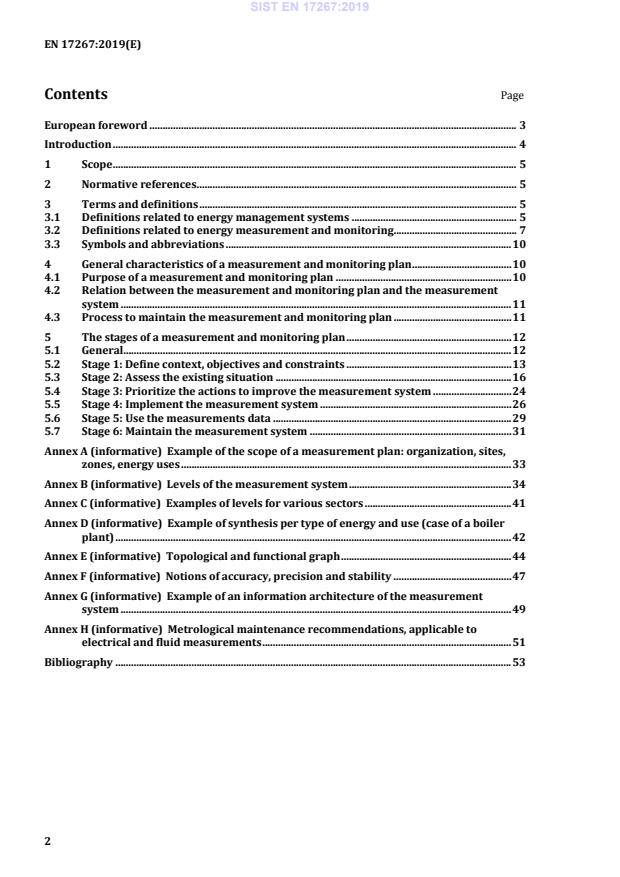
Contents Page
European foreword . 3
Introduction . 4
1 Scope . 5
2 Normative references . 5
3 Terms and definitions . 5
3.1 Definitions related to energy management systems . 5
3.2 Definitions related to energy measurement and monitoring . 7
3.3 Symbols and abbreviations . 10
4 General characteristics of a measurement and monitoring plan . 10
4.1 Purpose of a measurement and monitoring plan . 10
4.2 Relation between the measurement and monitoring plan and the measurement
system . 11
4.3 Process to maintain the measurement and monitoring plan . 11
5 The stages of a measurement and monitoring plan . 12
5.1 General. 12
5.2 Stage 1: Define context, objectives and constraints . 13
5.3 Stage 2: Assess the existing situation . 16
5.4 Stage 3: Prioritize the actions to improve the measurement system . 24
5.5 Stage 4: Implement the measurement system . 26
5.6 Stage 5: Use the measurements data . 29
5.7 Stage 6: Maintain the measurement system . 31
Annex A (informative) Example of the scope of a measurement plan: organization, sites,
zones, energy uses . 33
Annex B (informative) Levels of the measurement system . 34
Annex C (informative) Examples of levels for various sectors . 41
Annex D (informative) Example of synthesis per type of energy and use (case of a boiler
plant) . 42
Annex E (informative) Topological and functional graph . 44
Annex F (informative) Notions of accuracy, precision and stability . 47
Annex G (informative) Example of an information architecture of the measurement
system . 49
Annex H (informative) Metrological maintenance recommendations, applicable to
electrical and fluid measurements . 51
Bibliography . 53
European foreword
This document (EN 17267:2019) has been prepared by CEN/CLC/JTC 15 “Energy measurement plan for
organizations”, the secretariat of which is held by AFNOR.
This European Standard shall be given the status of a national standard, either by publication of an
identical text or by endorsement, at the latest by January 2020, and conflicting national standards shall
be withdrawn at the latest by January 2020.
Attention is drawn to the possibility that some of the elements of this document may be the subject of
patent rights. CEN shall not be held responsible for identifying any or all such patent rights.
According to the CEN-CENELEC Internal Regulations, the national standards organisations of the
following countries are bound to implement this European Standard: Austria, Belgium, Bulgaria, Croatia,
Cyprus, Czech Republic, Denmark, Estonia, Finland, Former Yugoslav Republic of Macedonia, France,
Germany, Greece, Hungary, Iceland, Ireland, Italy, Latvia, Lithuania, Luxembourg, Malta, Netherlands,
Norway, Poland, Portugal, Romania, Serbia, Slovakia, Slovenia, Spain, Sweden, Switzerland, Turkey and
the United Kingdom.
Introduction
Existing energy management standards often refer to the measurement of energy as an important
improvement of energy performance, but do not detail how a measurement and monitoring plan should
be designed and implemented:
— EN 16247-1:2012, Energy audits: in specific cases an energy audit requires to get specific data
measurement (§ 5-2 b) 5-3, 5-5). An energy measurement plan has to be set up in order to collect
this data. But there are no guidelines given on how to design or implement an energy measurement
plan: The future standard will help to fulfil this step;
— EN 15900:2010, Energy Efficiency Services: the energy efficiency service has to be based on collected
data (4-1 b). If there is not available or reliable data an energy measurement plan is needed;
— ISO EN 50001:2018 states in 6-6: "The organization shall define and implement an energy data
collection plan appropriate to its size, its complexity, its resources and its measurement and
monitoring equipment. The plan shall specify the data necessary to monitor the key characteristics
and state how and at what frequency the data shall be collected and retained." EN 17267 provides
principles for the design and implementation of an energy data collection plan;
— ISO 50006:2014, "Energy management systems — Measuring energy performance using energy
baselines (EnB) and energy performance indicators (EnPI) — General principles and guidance",
provides some recommendation related to measurement (§ 4.2.6.2);
— ISO EN 50015:2014, describes the process of "Measurement and verification" (M & V) to help
organizations determine and validate in a systematic way the improvement of its energy
performance, within specified boundaries. As can be seen in Clause 5.2 [h) k) l) m)], the M&V process
relies upon a number of measurements, without giving the methodology on how to organize the
measurement. To ensure the quality of these measurements (reliability, accuracy as well as
appropriateness) a "measurement plan" is needed.
The measurement and monitoring plan should be considered as a tool to facilitate the operational
implementation of those cited standards.
1 Scope
This document specifies the requirements and principles for the design and implementation of an energy
measurement and monitoring plan for an organization in order to improve its energy performance. The
measurement and monitoring plan defines a measurement system for monitoring and analysing the
energy performance of an organization, taking into account its influencing factors.
This document applies to all forms of energy, to all energy uses and to all types of organizations. It does
not apply to domestic dwellings.
2 Normative references
The following documents are referred to in the text in such a way that some or all of their content
constitutes requirements of this document. For dated references, only the edition cited applies. For
undated references, the latest edition of the referenced document (including any amendments) applies.
ISO 50001:2018, Energy management systems — Requirements with guidance for use
ISO 50006:2014, Energy management systems — Measuring energy performance using energy baselines
(EnB) and energy performance indicators (EnPI) — General principles and guidance
3 Terms and definitions
For the purposes of this document, the following terms and definitions apply.
3.1 Definitions related to energy management systems
3.1.1
energy management system
EnMS
set of interrelated or interacting elements of an organization to establish an energy policy, objectives,
energy targets, action plans, and process(es) to achieve the objectives and energy targets
[SOURCE: ISO 50001:2018]
3.1.2
energy performance indicator
EnPI
measure or unit of energy performance, as defined by the organization
Note 1 to entry: EnPI(s) can be expressed by using a simple metric, ratio, or a model.
Note 2 to entry: See ISO 50006 for additional guidance.
[SOURCE: ISO 50001:2018]
3.1.3
energy performance improvement
improvement in measurable results of energy efficiency, or energy consumption related to energy use,
compared to the energy baseline
[SOURCE: ISO 50001:2018]
3.1.4
energy baseline
EnB
quantitative reference(s) providing a basis for comparison of energy performance
Note 1 to entry: An energy baseline is based on data from a specified period of time and/or conditions, as defined
by the organization.
Note 2 to entry: One or more energy baselines are used for determination of energy performance improvement, as
a reference before and after, or with and without implementation of energy performance improvement actions.
Note 3 to entry: See ISO 50015 for additional information on measurement and verification of energy performance.
Note 4 to entry: See ISO 50006 for additional information on EnPIs and EnBs.
3.1.5
energy management team
person(s) with responsibility and authority for effective implementation of an energy management
system and for delivering energy performance improvement
[SOURCE: ISO 50001:2018 modified:note 1 was deleted]
3.1.6
relevant variable
quantifiable factor that impacts energy performance and routinely changes
EXAMPLE Weather condition, operating condition (indoor temperature, light level), working hours,
production throughput.
[SOURCE ISO 50001:2018]
3.1.7
static factor
identified factor that impacts energy performance and doesn’t routinely change
EXAMPLE 1 Examples of static factors can include facility size, design of installed equipment. To be completed.
EXAMPLE 2 A example of a change in static factor could be a change in a manufacturing process raw material
from aluminium to plastic and may lead to a non-routine adjustment.
[SOURCE ISO 50001:2018]
3.1.8
influencing factor
factor that has an influence on energy performance, either a relevant variable or a static factor
3.1.9
boundary
physical or site limits and/or organizational limits as defined by the organization
[SOURCE: ISO 50001:2018]
3.1.10
significant energy use
energy use accounting for substantial energy consumption and/or offering considerable potential for
energy performance improvement
[SOURCE ISO 50001:2018]
3.2 Definitions related to energy measurement and monitoring
3.2.1
measurement
process that consists in physically obtaining one or more values which can be reasonably assigned to a
quantity
Note 1 to entry: Measurements do not apply to qualitative properties.
Note 2 to entry: A measurement implies the comparison of quantities, including the counting of entities.
[SOURCE: ISO/IEC GUIDE 99:2007, modified. Deletion of the NOTE 3]
3.2.2
device
material element or assembly of such elements intended to perform a required function
Note 1 to entry: to entry: A device may form part of a larger device.
[SOURCE: ISO/IEC GUIDE 99:2007]
3.2.3
measuring device
device intended to be used for taking measurements, alone or combined with one or more auxiliary
devices
[SOURCE: ISO/IEC GUIDE 99:2007]
3.2.4
measurement point
location of the sensing function(s) of a measuring device
3.2.5
measurement system
set of measuring devices, means of reading and recording time-stamped values resulting from the
measurement, and the means of utilizing these values
[SOURCE: ISO/IEC GUIDE 99:2011, modified. Deletion of the qualifier “complete”. Replacement of
“measuring instruments” by “measuring devices”. Replacement of “other equipment” by “means of
time-stamped reading and recording and means of utilizing these values”]
3.2.6
measurement and monitoring plan
all tasks organized in time including the design, setting up, utilization, maintenance and improvement of
a measurement system and its monitoring functions
3.2.7
metering
continuous integration of quantities measured as a function of time
Note 1 to entry: The integration can be carried out on a measurement of active or reactive electrical power, flow of
fluid, number of parts, etc.
3.2.8
monitoring
determining the status of a system, a process or an activity
Note 1 to entry: To determine the status, there can be a need to check, supervise or critically observe.
Note 2 to entry: In an energy management system monitoring can be a review of energy data.
[SOURCE: ISO 50001:2018]
3.2.9
installation monitoring
continuous assessment of the installation in order to ensure availability and reliability of energy flows as
well as the performance and the durability of the installation
Note 1 to entry: Installation monitoring can reveal malfunctions that affect energy performance. To facilitate
monitoring, thresholds and alarms can be put in place on the parameters to be monitored.
EXAMPLES In the case of steam production: outgoing pressure, quality of the make-up water, etc. or to monitor
an electrical installation: power factor, voltage, and harmonics, etc.
Note 2 to entry: This technical concept is complementary to the concept of monitoring as defined in ISO 50001 (see
3.2.8)
3.2.10
parameter to monitor
parameter that is not directly related to energy but which can influence the energy distribution and
energy performance in an installation
EXAMPLE Level of harmonics or power factor in an electrical installation, outgoing pressure and dryness
fraction for a steam production plant, etc.
3.2.11
zone
geographical or functional space defining a part of the organization
Note 1 to entry: Examples: a zone can be a kitchen (function), or a storage area of 5 000 m (surface area) or a
building of 10 000 m (volume space).
3.2.12
measurement accuracy
closeness of agreement between a measured quantity value and a true quantity value of a measurand
Note 1 to entry: The concept "measurement accuracy" is not a quantity and is not given a numerical quantity value.
A measurement is said to be more accurate when it offers a smaller measurement error.
Note 2 to entry: The term “measurement accuracy” should not be used for measurement trueness and the term
measurement precision should not be used for ‘measurement accuracy’, which, however, is related to both these
concepts.
Note 3 to entry: "Measurement accuracy" is sometimes understood as closeness of agreement between measured
quantity values that are being attributed to the measurand.
[SOURCE: ISO/IEC GUIDE 99:2011]
3.2.13
repeatability (of results of measurements)
closeness of agreement between the results of successive measurements of the same measurand, carried
out under the same conditions of measurement, i.e.:
— by the same measurement procedure;
— by the same observer;
— with the same measuring instruments, used under the same conditions;
— in the same laboratory;
— at relatively short intervals of time
Note 1 to entry: The concept of "measurement procedure" is defined in VIM 2.5.
[SOURCE IEV 311-06-06]
3.2.14
stability
ability of a measuring instrument to keep its performance characteristics unchanged during a specified
time interval, all other conditions being the same
[SOURCE IEV 311-06-12]
3.2.15
durability,
ability to perform as required, under given conditions of use and maintenance, until the end of useful life
[SOURCE IEV 192-01-21]
3.2.16
uncertainty
non-negative parameter characterizing the dispersion of the quantity values being attributed to a
measurand, based on the information used
[SOURCE: ISO/IEC GUIDE 99:2007]
3.2.17
sensitivity
quotient of the change in an indication of a measuring system and the corresponding change in a value of
a quantity being measured
Note 1 to entry: Sensitivity of a measuring system can depend on the value of the quantity being measured.
Note 2 to entry: The change considered in a value of a quantity being measured shall be large compared with the
resolution.
[SOURCE: ISO/IEC GUIDE 99:2007]
3.3 Symbols and abbreviations
COP Coefficient of Performance
EnMs Energy management system
EnPI Energy Performance Indicator
M&V Measurement and verification
EnB Energy baseline
PF Power Factor
THD Total harmonic distortion
U voltage
U voltage unbalance
nb
Toe ton of oil equivalent
f frequency
4 General characteristics of a measurement and monitoring plan
4.1 Purpose of a measurement and monitoring plan
The purpose of the measurement and monitoring plan is to design, apply, use and maintain the
measurement system which enables the organization to:
— measure the energy performance to ascertain that it complies with the targets;
— analyse the causes of potential drifts in energy consumption;
— monitor the relevant parameters of the installation;
— sustain the energy performance gains made over time;
— identify potential improvements.
The measurement and monitoring plan may be used on its own. It also provides practical principles and
guidance on how to collect data for ISO 50001, in line with the requirements stated in its 6-6 section (“The
organization shall define and implement an energy data collection plan appropriate to its size, its
complexity, its resources and its measurement and monitoring equipment. The plan shall specify the data
necessary to monitor the key characteristics and state how and at what frequency the data shall be
collected and retained.").
4.2 Relation between the measurement and monitoring plan and the measurement
system
Figure 1 brings together the elements of a measurement system, to be adapted according to the needs of
the organisation:
Figure 1 — Description of a measurement system
4.3 Process to maintain the measurement and monitoring plan
The implementation of the measurement and monitoring plan is an iterative process.
The organization shall put in place a periodic review of its plan in order to reach its objectives.
5 The stages of a measurement and monitoring plan
5.1 General
The organization shall carry out the stages 1 to 6 defined in 5.2 to 5.7 when putting in place a
measurement and monitoring plan, as described in the following figure:
Figure 2 — The stages of a measurement and monitoring plan
The figure doesn’t imply a linear approach and users of the standard may loop back to a stage in an
iterative process.
5.2 Stage 1: Define context, objectives and constraints
5.2.1 Objectives
— Ensure that the motivations, implications and objectives of organization are clearly defined;
— ensure that the key characteristics of operations that determine energy performance are measured,
analysed and monitored at planned intervals;
— ensure that the organizational, technical and financial contexts will allow the creation and
maintenance of a measurement and monitoring plan.
5.2.2 Context of the measurement and monitoring plan
The measurement and monitoring plan is meant as a tool to help organizations to improve and monitor
their energy performance and support the verification of the savings.
The measurement and monitoring plan should be used for the implementation of an ISO 50001 energy
management system:
— an energy management system in ISO 50001 requires that the key characteristics of energy
performance are measured, monitored and analysed at regular intervals, as part of an energy data
collection plan;
— “measurement and verification” (M&V) methods, as defined in ISO 50015, help the organization
determine and validate in a systematic way the improvement of its energy performance, within
specified boundaries. The M&V process relies upon a number of measurements. To ensure the quality
of these measurements (reliability, accuracy as well as appropriateness) a “measurement and
monitoring plan” is therefore needed.
The measurement and monitoring plan may support the use of other standards relative to energy
management, such as:
— energy audits (as described in EN 16247): an energy audit requires to get specific data measurement;
— energy efficiency services (as described in EN 15900): an energy efficiency service has to be based
on collected data.
However, an organization wishing to deploy a measurement and monitoring plan faces a number of
obstacles, including:
— the design of the plan, defining its content according to the needs and objectives;
— the evaluation of the cost/benefits of implementing the plan, acting as a decision-aid;
— the technical difficulties associated with the implementation of the plan.
5.2.3 Motivations of the organization
The organization shall design its measurement and monitoring plan such that it contributes to the
improvement of its energy performance.
By putting in place a plan, the organization obtains benefits such as:
— improve the monitoring of energy consumption;
— detect anomalies or drifts;
— facilitate operation and maintenance;
— implement a proactive approach to improving energy performance;
— meet the legal requirements and other requirements relative to energy;
— implement the recommendations of the energy audits.
5.2.4 Boundaries of the measurement and monitoring plan
The organization shall define the boundaries of the measurement and monitoring plan, and more
specifically the sites and the zones.
NOTE 1 See Annex A for an explanation on the notion of zones.
NOTE 2 For electrical applications, another way to define boundaries is using the notion of mesh
(see IEC 60364-8-1)
5.2.5 End purpose of measurements
The organization shall define the end-purpose of each measurement within the measurement and
monitoring plan, such as:
— calculate an Energy Performance Indicator (EnPI) (as specified in ISO 50006) and follow its
development over time;
— establish an energy baseline (as specified in ISO 50006);
— verify the savings;
— monitor the energy performance of an equipment, a process or an installation.
Additional measurements of influencing factors are in the scope of the standard, to complete the
information provided by energy meters. Yet it shall be verified that all the measuring points included in
the measurement and monitoring plan are intended to improve the energy performance of the
organization. Parameter measurements that have no direct or indirect influence on energy consumption
are not included in the boundaries of the energy measurement and monitoring plan.
5.2.6 Users of the plan
The organization shall identify the specific needs of each type of user of a measurement and monitoring
plan, including but not limited to:
— top management: defines the organization objectives relative to energy management in general and
energy measurement and monitoring in particular including the budget and priorities;
— energy management team: provides expertise related to energy management, at site or
organizational level. The measurement and monitoring plan is one of the tools he uses to implement
an efficient energy management system. The energy management team is responsible for making
sure the scope of measured data are consistent with energy management objectives;
— operating and maintenance staff: tasked with using the measurement system to check and ensure
efficient operation by taking corrective measures in the event of deviations in energy performance,
by eliminating energy losses and performing corrective and preventive maintenance to reduce
deterioration in energy performance. The operating and maintenance personnel can use the
measurement and monitoring plan for the equipment, process or installation under their
responsibility;
— end-users: these users can include other corporate departments, business experts, contract
managers, EnMS auditors, customers, suppliers, regulating organizations, architects, facility
managers or any other user interested into the energy related data;
— installers and system integrators: are responsible for the design and setup of the measurement
system. They shall make sure the measurement system is working as expected by the plan. They may
be internal or external.
5.2.7 Budget
The organization shall define the budget allocated to the measurement and monitoring plan according to
its objectives and the energy issues at stake. The plan shall be validated by the financial sponsors in the
organization, to whom energy management team shall report on the progress of its practical
implementation.
5.2.8 Planning
The energy performance measurement plan may be implemented in steps according to priorities in order
to meet the organization's budgetary constraints and mitigate the project risks.
The organization shall put in place a schedule for the implementation of the measurement plan, including
the most important milestones of the project.
5.2.9 Resources
The organization shall identify the human and material resources necessary for the implementation of
the measurement plan, related to:
— design;
— installation;
— metrology;
— acquisition system or resources necessary for manual reading if necessary;
— storage and use of data;
— maintenance.
The organization shall clearly identify a responsible team for the measurement and monitoring plan and
ensure that it is competent and available.
The organization shall identify and verify the skills necessary for the application of the measurement and
monitoring plan by its personnel or its service providers.
5.2.10 Criteria to asset the levels of the measurement system
The organization shall assess the appropriateness of its measurement system with respect to its needs
and in order to identify its potential improvements. An example of a qualitative assessment of a
measurement system is defined in Annex B, where three levels (base, medium, high) are suggested. The
levels shall be assessed in accordance with the following six criteria:
— criterion 1: the ability to quantify the energy consumption by zone and by energy use;
NOTE 1 The majority of the sites have consumption measurements at the points of delivery. These
measurements are used essentially for billing. Having sub-measurement by zone or by energy use allows finer
analysis and monitoring of energy consumption and performance.
— criterion 2: the ability to acquire measuring points and relevant variables at a regular frequency;
NOTE 2 To analyse the trend of energy consumption, the measuring point readings can be taken regularly. The
measuring points can be read manually by operators or automatically by remote reading. Remote reading generally
allows a larger number of measuring points to be read at a higher frequency while controlling costs.
NOTE 3 The identification and quantification of the influencing factors improves and refines the analysis of
variations in energy consumption and therefore in energy performance.
— criterion 3: the ability to transfer the measurement and relevant variables data;
NOTE 4 The time-stamped recording of the readings taken at regular intervals from the different measuring
points allows the detection of variations in energy consumption over time.
— criterion 4: the ability to store measurement and influencing factors data;
— criterion 5: the ability to analyse the collected data;
NOTE 5 Installation monitoring can reveal malfunctions that affect energy performance. To facilitate installation
monitoring, thresholds and alarms can be put in place on the parameters to be monitored. The levels of the
measurement system on a zone, on an energy use or even a measuring point can differ according to the energy
issues at stake, the technical and economic constraints and its energy performance objectives.
— criterion 6: the ability to visualize data and the results from the analysis.
Annex C provides examples of assessment according to the six above-mentioned criteria.
5.2.11 Deliverables
The organization shall provide a note summarizing its objectives and constraints, the organizational
structure adopted and the implementation schedule and budgets allocated to the measurement and
monitoring plan.
5.3 Stage 2: Assess the existing situation
5.3.1 Objectives
— Draw up the functional inventory (the needs, the data that shall be collected and why);
— draw up the technical inventory (the available data, tools, measurement devices and equipment).
5.3.2 Preliminary analysis
The organization shall conduct a preliminary analysis of the existing information available in order to
define the energy issues at stake. The organization may carry this study via the collect and analysis of:
— energy bills;
— energy audits;
— buildings or plant design documentation (e.g. energy rating of the building);
— simulations (e.g. thermal simulation for a new building);
— existing measurement system documentation;
— or any other document that it may see fit for that purpose.
5.3.3 Zones
The organization shall determine the useful zones depending on its activity, such as:
— workshops (e.g. in the industry);
— rooms (e.g. in a hotel);
— floor (e.g. in a building).
5.3.4 List of energy consumption
The organization shall carry out a list of energy consumption by the installations in each zone, in
accordance with Table 1.
Table 1— Example of list of energy consumption
Type of energy Type of Unit of Conversion Energy Measurement
used within zone 1 measurement measure factor measurement frequency
unit
Electricity Active, reactive kWh, - kWh, kvarh e.g 15 min
energy kvarh
Natural gas Flow rate Nm /h, GCV kWh, MJ, toe e.g 1 h
Sm /h
Fuel oil Flow rate kWh, MJ, toe
LPG Flow rate kWh, MJ, toe
Coal Weight kWh, MJ, toe
Wood Weight kWh, MJ, toe
Biomass Weight kWh, MJ, toe
Compressed air Flow rate, kWh, MJ, toe
Pressure
Steam Flow rate, kWh, MJ, toe
Temperature
Secondary coolant Flow rate kWh, MJ, toe
fluids
Other energy kWh, MJ, toe
carriers
TOTAL
NOTE 1 Toe means ton of oil equivalent.
NOTE 2 GCV means gross calorific value and can be either a direct measurement from a chromatograph or a
static factor.
NOTE 3 For organizations which are producing their own energy a similar table with local produced energy or
exported energy may be set up.
NOTE 4 To fill out the table, the organization may use the results of energy audits or energy review
(see Annex D, Figure D.1).
NOTE 5 Energy carrier can be water, fluid, etc.
5.3.5 Energy uses
The organization shall determine its energy uses, for example:
— HVAC (heating, ventilation and air-conditioning);
— lighting;
— connectors for electrical devices (computers, printers, etc.);
— manufacturing, process (motors, machines, etc.);
— transportation;
— processes and production lines.
The organization shall list its energy uses in each zone and characterize them by a measured or estimated
energy consumption in accordance with Table 2.
Table 2 — Example of inventory of the energy uses
Energy use in zone 1 Unit of Value Significant Evaluation method (unknown /
measure Energy Use? estimated / measured)
Lighting kWh Yes Measured
HVAC kWh Yes Measured
Other uses kWh No Estimated
TOTAL
NOTE 1 To fill out Table 2, the organization may use the results of energy audits or energy review
(see Annex D, Figure D.2).
NOTE 2 The organization focuses in priority on its significant energy uses.
NOTE 3 In case the evaluation method is estimated, the organization also provides an explanation on the
methodology used.
5.3.6 Relevant variables
The organization shall identify the relevant variables influencing the energy consumption of each chosen
use, such as:
— production activity, for instance:
— a number, a volume or a weight of parts produced or equivalent (turnover, etc.) in the industry;
— a number of persons present per time period (occupancy rate, etc.) for buildings;
— factors on local production of energy if relevant;
— climatic conditions, such as:
— outside air temperature;
— outside relative humidity;
— degree days;
NOTE 1 Degree Day is a derived parameter designed to quantify the demand of energy needed to
heat (HDD) or to cool (CDD) a building. Degree Days are defined relative to an indoor base temperature
adequate for human comfort and type of building – home, businesses, hospital, etc. HDDs depend on outside
air temperature and are calculated by algorithms computing only the positive differences between the
reference indoor temperatures and the actual outdoor temperature on daily or hourly/semi-hourly basis. CDDs
are related to outside air temperature too, but in continental and Mediterranean areas they strongly depend
on relative humidity and solar radiation and other weather parameters. CDDs are calculated subtracting the
reference temperature from apparent temperature (combined effect of air temperature and relative humidity
and other weather parameters).
— solar radiation;
— atmospheric pressure;
— natural light;
— hygrometry;
— wind speed and direction:
— comfort of the occupant (indoor temperature, relative humidity, radiant heat, light, etc.);
— other processes, such as air quality (particle matters, etc.).
The organization shall produce a synthesis of relevant variables in each zone and for each energy use and
the impact of each variable on achieving the objectives, in accordance with Table 3.
Table 3 — Example of inventory of the relevant variables
Energy use: air conditioning in zone 1
Relevant factor Measurement method Storage Impact with respect to objectives
frequency
outside daily aligning energy consumption with
the closest weather
real needs
station
air temperature
outside relative humidity sensor daily real time monitoring of anomalies
with solar shield on site and drifts of thermal plants
relative humidity
indoor air temperature sensor hourly optimize energy consumption while
inside the office taking comfort of users into account
air temperature
NOTE 2 In a measurement chain aimed at evaluating derived energy parameter (e.g EnPI, baselines, etc.) the
quality of the final result is dependent on the least accurate measurement.
The organization shall identify which relevant variables are already being measured. The organization
may include external data sources whenever it is relevant, such as the closest weather station in Table 3.
5.3.7 Static factors
The organization shall define the static factors for each zone and for each energy use, such as:
— building occupancy rate;
— facility size (surface or volume);
— building envelope characteristics;
— opening times;
— level of services provided by the energy use;
— temperature setting;
— context of operations (processing sequence, product quality, legal or other requirements, etc.);
— operating conditions (manual or automatic modes, etc.);
— availability of the equipment (in operation or not).
Depending on the situation, some of the listed static factors may be considered as relevant variables. For
instance the operating conditions may change regularly within industrial plants, opening times can
change between summer and winter, etc.
5.3.8 Installation parameters to monitor
5.3.8.1 General
The organization shall list the quantities that are or should be used to characterize the performance of
the installation.
5.3.8.2 Monitoring the electrical installation
Table 4 below describes the influence of certain electrical energy-related parameters on the energy
performance of the installation, as described more thoroughly in IEC 60364-8-1.
Table 4 — Example of electrical parameters to monitor
Electrical Impact on the energy Impact on the performance
parameter Abbreviation performance of the of the installation
installation
Power factor PF Energy losses are generated in The cables need to be
(cos phi) the cables. The supplier bills oversized
penalties
Total THD , U The negative sequence Premature failure of certain
u h
harmonic harmonics (u2) slow down devices, particularly motors
THD , I
i h
distortion, the motors, the zero sequence
Harmonic, harmonics (u0) cause energy
voltage and losses
current
Constant or U The electrical devices work Premature failure of certain
frequent outside their specifications devices, particularly motors
voltage and will overconsume,
deviations particularly motors
Voltage U Energy losses are generated in Premature failure of certain
nb
unbalance motors devices, particularly motors
Voltage dips, U –- Process stoppages with
dip
voltage financial impact
U
int
interruptions
Frequency F –- Change in speed of rotating
machines
NOTE The organisation should check the relevancy of the given parameters in terms of economic
effort and monitorability.
5.3.8.3 Monitoring the fluids installation
For fluids installations (boiler room, compressed air plant, refrigerating plant, water treatment
plant, etc.), some other parameters may be important and subject to installation monitoring.
For example:
— steam production plant: the outgoing pressure from the plant, the quality of the make-up water and
the condensate returns (conductivity, pH, etc.), the condensates return rate, the dryness fraction;
— compressed air plant: the pressure, hygrometry, the head losses of the filtration system, the
compressor suction temperature;
— refrigerating plant: the high pressure, low pressure, the temperature difference between the
outgoing and return line of the refrigerant system, monitoring of heat exchanger fouling, the oil
temperature of lubricated machines;
— water, waste water and sludge treatment plant: the inlet and outlet quality of the fluid.
Some of these parameters should be monitored as part of corrective and preventive maintenance to
ensure the reliability, durability and optimum performance of the equipment.
5.3.8.4 Existing measuring devices
The organization shall draw up an inventory of the existing measuring devices for each installation:
— electrical energy meters;
— power meters (for monitoring the electrical installation);
— gas meters;
— fluid meters;
— measuring devices related to the relevant variables.
The organization shall explain their current use and make a synthesis of the existing measurements per
zone or per use.
The organization shall characterize the measuring devices (brand, reference) and their location. The
organization shall verify that the reading frequency of each measuring device is appropriate for the
quantity measured and its variability.
5.3.8.5 Mapping of energy flows
The organization shall identify the energy distribution or generation networks within th
...